
Last Updated May 21, 2026
Research methods in developmental psychology are not neutral technical choices made after the real thinking is done. They shape what kinds of development can be seen, what kinds of change can be inferred, and what kinds of claims can be made about age, time, experience, context, and the life course. Developmental psychology studies growth and change, which means its methods must confront temporality directly. A study that compares 6-year-olds and 16-year-olds at one moment answers a different question from a study that follows the same children for ten years, and both differ from a cohort design that compares people born into different historical worlds.
Longitudinal, cross-sectional, cohort, and cohort-sequential designs are therefore not interchangeable. Each design opens some developmental questions while constraining others. Cross-sectional research can efficiently describe age-group differences. Longitudinal research can estimate within-person change and developmental sequence. Cohort designs can reveal how historical location shapes development. Cohort-sequential and accelerated longitudinal designs can combine age coverage with repeated measurement. A serious developmental psychology depends not only on theory and statistical skill, but on careful design matched to the developmental question being asked.
Main Library
Publications
Article Map
Developmental Psychology
Related Topic
Cognitive Psychology
Related Topic
Social Psychology
Related Topic
Data Systems & Analytics
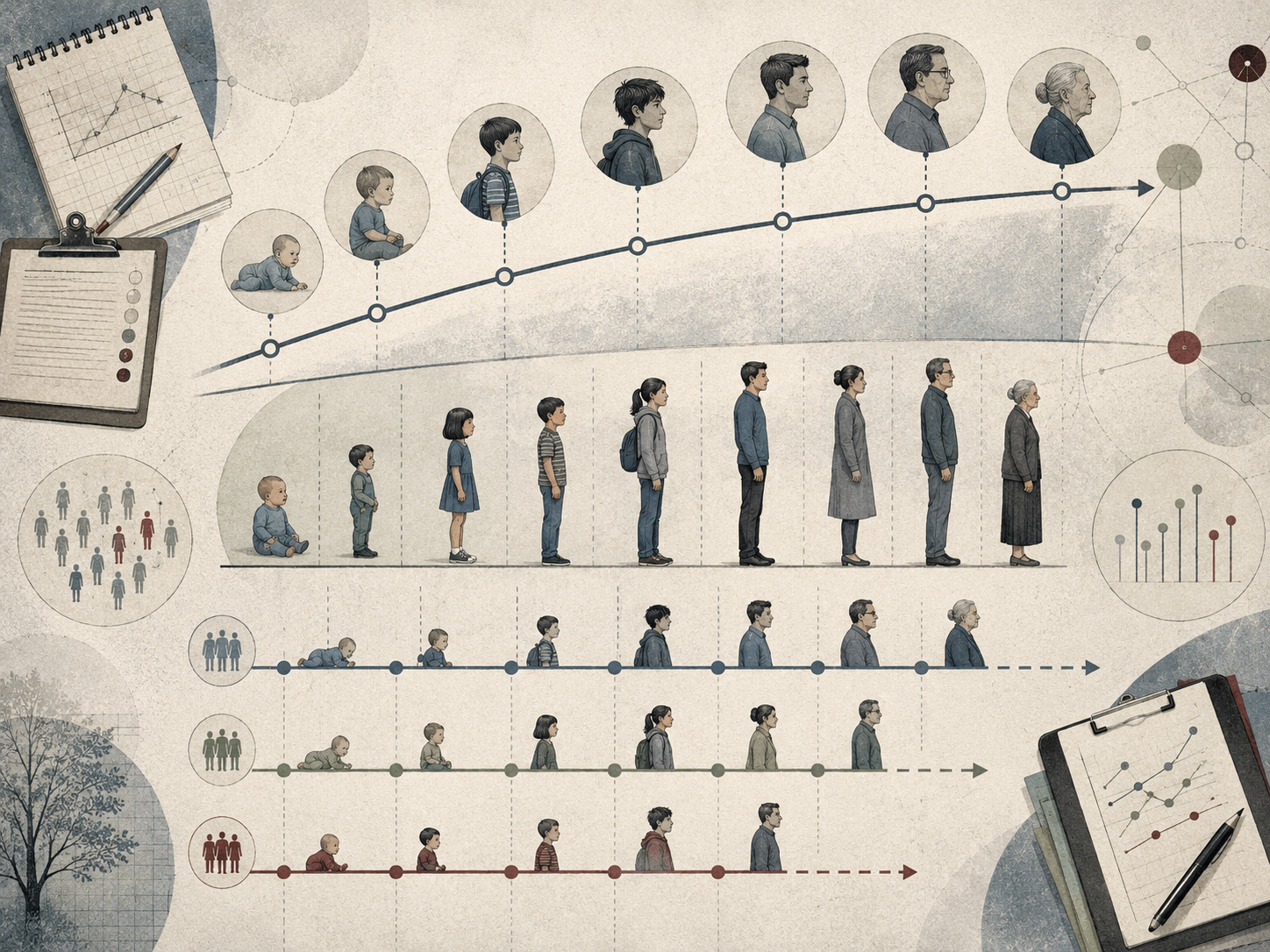
Developmental research methods matter because the field studies processes that unfold across age, context, and historical time. A method that looks once at different age groups can describe differences across ages, but it cannot directly observe how the same individuals changed. A method that follows the same individuals across time can reveal trajectories, but it may face attrition, repeated-testing effects, changing instruments, historical disruption, and long time horizons. A cohort design can show generational patterning, but it must be interpreted with care because cohorts differ not only in age but in historical conditions.
Why Methods Matter in Developmental Psychology
Methods matter in developmental psychology because development is about change, and change can be badly misunderstood when time is handled carelessly. A study can show that 5-year-olds differ from 15-year-olds, but that does not automatically show how any particular 5-year-old becomes a 15-year-old. A study can show that adolescents today differ from adolescents twenty years ago, but that does not automatically show a universal developmental shift. A study can show that older adults differ from young adults, but that difference may reflect age, cohort, health selection, education, technology, historical period, or survival effects.
This is why developmental methods are not merely technical procedures. They are part of the conceptual architecture of the field. A design determines whether researchers can observe age differences, within-person change, cohort effects, developmental timing, continuity, instability, transition, prediction, or historical variation. When the design is weak or mismatched to the question, sophisticated statistics cannot fully repair the problem. A poorly chosen design can make developmental claims appear stronger than the evidence allows.
Developmental psychology also faces the problem that the people being studied are changing while the world around them is changing. Children grow into adolescents; schools change; families move; technologies spread; policies shift; pandemics, recessions, wars, and cultural changes affect entire cohorts. The developmental researcher is therefore studying change within change. That is why methods must account for multiple time scales at once: biological age, developmental stage, study wave, historical period, cohort membership, and individual life history.
Strong developmental research begins with design discipline. It asks what kind of change is being studied, what comparison is being made, how time is represented, what alternative explanations must be ruled out, and what claims the design can honestly support. The method is not separate from the developmental theory. It is the structure through which the theory becomes observable.
What Developmental Research Designs Do
Research designs in developmental psychology organize age, time, comparison, measurement, and inference. They decide who is observed, when they are observed, how often they are observed, which age groups are compared, which cohorts are included, and how historical conditions enter the analysis. These choices determine what the study can reveal.
Cross-sectional designs compare different individuals of different ages at one point in time. Longitudinal designs measure the same individuals repeatedly. Cohort designs focus on people who share a common temporal starting point, such as birth year, school-entry year, or exposure to a historical event. Cohort-sequential and accelerated longitudinal designs combine multiple cohorts and repeated observations to estimate developmental trajectories more efficiently than a single-cohort longitudinal study.
Each design therefore answers a different developmental question. Cross-sectional research is strongest for describing age-related differences efficiently. Longitudinal work is strongest for estimating within-person change and developmental pathways. Cohort-based work is strongest when generational or historical context matters. Cohort-sequential designs are especially useful when researchers need to estimate broad developmental trajectories without waiting decades for one cohort to age through the entire span.
A developmental methods framework should therefore avoid ranking designs in a simplistic hierarchy. Longitudinal designs are often powerful, but they are not automatically superior for every question. Cross-sectional designs can be valuable for descriptive mapping, screening, feasibility work, and hypothesis generation. Cohort designs are indispensable when historical conditions matter. Accelerated longitudinal designs can be highly efficient, but they require careful assumptions about cohort comparability and overlapping age spans. The best design is the one whose structure matches the question and whose limits are clearly acknowledged.
Cross-Sectional Designs
Cross-sectional designs examine different age groups at the same point in time. In developmental psychology, this may mean comparing preschool children, school-age children, adolescents, adults, and older adults in a single wave of data collection. The major strength of cross-sectional research is efficiency. It is usually faster, less expensive, and less logistically demanding than following the same people across many years. It can quickly reveal age-related patterns and provide a broad developmental snapshot.
This makes cross-sectional designs useful for many purposes. They can identify age-group differences in language, memory, moral reasoning, emotion regulation, peer behavior, school belonging, identity, well-being, risk exposure, or health. They can help researchers decide whether a phenomenon is worth studying longitudinally. They can provide descriptive evidence when rapid information is needed. They can also be useful when longitudinal follow-up is impractical, unethical, too expensive, or too slow for the question at hand.
But cross-sectional designs have a central limitation: they do not directly measure within-person development. A difference between 7-year-olds and 15-year-olds may reflect age-related change, but it may also reflect differences in school systems, family environments, technology exposure, curriculum, health conditions, socioeconomic context, or cohort membership. Cross-sectional designs show that groups differ; they do not by themselves prove how individuals change.
The limitation is especially serious when age and cohort are tightly linked. In a single-year cross-sectional study, younger and older participants necessarily come from different birth years. If 10-year-olds score differently from 16-year-olds, that difference could reflect developmental age, but it could also reflect historical differences in educational policy, digital media exposure, social norms, or pandemic-related disruption. Cross-sectional inference therefore requires caution when moving from age difference to developmental process.
Cross-sectional research is strongest when its claims are framed precisely: “these age groups differ at this point in time,” not “this is how individuals develop.” It becomes more powerful when combined with strong sampling, careful measurement, cohort awareness, and follow-up studies that test whether observed differences actually reflect within-person change.
Longitudinal Designs
Longitudinal designs follow the same individuals over time. Participants are measured repeatedly across months, years, or decades. This gives longitudinal research a special place in developmental psychology because development itself is temporal. When the research question concerns within-person change, developmental sequence, stability, transition, timing, prediction, or trajectory, longitudinal designs are often essential.
Longitudinal research can ask questions that cross-sectional research cannot answer directly. Does early language exposure predict later literacy? Does adolescent school belonging predict adult well-being? Does early adversity forecast later mental-health risk? Do children who begin with high self-regulation maintain that advantage? Do depressive symptoms rise, fall, or stabilize across adolescence? Do individual differences widen or narrow across schooling? These are pathway questions, and pathway questions require repeated observation.
Longitudinal designs can also distinguish continuity from change. A trait may be stable in rank order while still changing in average level. For example, children may generally improve in executive function with age, while those who started higher remain higher relative to peers. Longitudinal data can model both average growth and individual variation around that growth. This is essential for understanding developmental trajectories rather than only group averages.
But longitudinal designs bring serious challenges. They are expensive, slow, and logistically demanding. Participants may move, withdraw, become unreachable, die, or lose interest. Attrition can bias results if those who remain differ systematically from those who leave. Repeated testing can change performance through practice effects. Measures can become outdated. Historical events can affect all participants during the study. Researchers may face the problem that the original theory, instruments, or social context has changed by the time the study concludes.
Longitudinal evidence is therefore powerful but not effortless. Its strength lies in observing change directly. Its weakness lies in the difficulty of sustaining valid measurement, representative samples, and clean interpretation across time. A strong longitudinal study plans for attrition, measurement consistency, historical change, ethical obligations, and analytic transparency from the beginning.
Cohort Designs
Cohort designs focus on groups that share a common temporal starting point. A birth cohort includes people born during the same period. A school cohort may include children entering kindergarten in the same year. A policy cohort may include families exposed to a program or reform at the same historical moment. Cohort thinking is crucial in developmental psychology because people develop not only through age but through history.
A 15-year-old in 1995 and a 15-year-old in 2025 are the same age, but they are not located in the same developmental world. They may differ in technology exposure, schooling, family norms, economic conditions, mental-health discourse, social media, public health, climate anxiety, labor-market expectations, and political context. If researchers ignore cohort, they may confuse historical difference with developmental age.
Cohort designs help identify generational patterning. They can ask whether children born in different periods show different school readiness, whether adolescent mental health differs across generations, whether older adults who experienced different educational systems age differently, or whether policy reforms affect developmental trajectories for cohorts exposed at different points. These questions cannot be answered well by age alone.
But cohort designs also carry limits. A cohort effect is not always easy to interpret. Members of a cohort share historical timing, but they may not share the same exposures equally. Within-cohort differences by class, race, gender, geography, disability, family structure, school quality, migration, and health can be substantial. Cohort designs should therefore avoid treating generations as homogeneous. They are tools for locating development historically, not for flattening people into simple generational categories.
Cohort thinking strengthens developmental psychology because it reminds the field that development is never purely biological age. It is always age within history. A child develops in a time, a place, a policy environment, a technology ecology, a family system, and a cultural world. Cohort designs make that historical embeddedness visible.
Cohort-Sequential and Accelerated Longitudinal Designs
Cohort-sequential and accelerated longitudinal designs combine multiple age cohorts with repeated measurement. Instead of following one cohort from age 5 to age 25, researchers might follow several cohorts that begin at ages 5, 8, 11, and 14, then observe each cohort for several years. Their overlapping age ranges can be used to estimate a broader developmental trajectory in less calendar time.
The advantage is efficiency. A single-cohort longitudinal study covering twenty years may require twenty years of data collection. An accelerated design can estimate much of the same age span more quickly by stitching together overlapping cohort trajectories. This can be especially useful in developmental psychology, where researchers often need to study processes that unfold across long periods but cannot wait decades for initial answers.
These designs also help address cohort effects when structured carefully. If multiple cohorts overlap at the same ages, researchers can compare whether age-related patterns look similar across cohorts. If 10-year-olds from one cohort resemble 10-year-olds from another cohort measured at a different period, confidence in age-related inference may increase. If they differ, the design can reveal cohort or period effects that a simpler design might miss.
But accelerated designs require careful assumptions. The overlapping segments must be comparable enough to combine. Measures must function similarly across ages and cohorts. Attrition must be addressed. Cohort differences must be modeled rather than ignored. Period effects may still complicate interpretation. An accelerated design is powerful because it handles time more flexibly, but it is not a shortcut around conceptual discipline.
When used well, cohort-sequential designs offer one of the strongest practical compromises in developmental research. They preserve repeated measurement, expand age coverage, reduce calendar time, and improve leverage on age and cohort. They are especially useful when the developmental question concerns a broad age span and when the researcher can justify the comparability of overlapping cohorts.
Age, Period, and Cohort Problems
One of the central methodological problems in developmental research is the relation among age, period, and cohort. Age refers to time since birth or developmental stage. Period refers to historical time: the year, policy environment, technology ecology, economic condition, pandemic era, or cultural moment in which measurement occurs. Cohort refers to a group born or entering observation at a similar historical point.
These three dimensions are deeply entangled. In its simplest form, cohort can be understood as period minus age. A person’s age at a given historical moment necessarily implies a birth cohort. This creates the classic age-period-cohort problem: it is difficult to identify age effects, period effects, and cohort effects independently because they are mathematically and historically linked.
\text{Cohort} = \text{Period} – \text{Age}
\]
Interpretation: Age, period, and cohort are structurally related. This makes it difficult to interpret developmental differences without careful design and cautious modeling.
This problem matters because developmental conclusions can become misleading when age is treated as if it were the only time axis. Suppose older adults score lower than younger adults on a cognitive task. That difference may reflect aging, but it may also reflect differences in education, nutrition, health care, occupational exposure, testing familiarity, or technology experience across cohorts. Suppose adolescents report more anxiety today than adolescents did twenty years ago. That difference may reflect cohort or period conditions rather than a universal change in adolescence itself.
Developmental psychology therefore needs designs that make age, period, and cohort visible. Cross-sectional designs are vulnerable because age and cohort are often confounded at one moment. Longitudinal designs are stronger for within-person change but can still be affected by historical period. Cohort-sequential designs improve leverage by observing multiple cohorts across overlapping ages and periods, but even they require careful modeling and interpretation.
The age-period-cohort problem does not make developmental research impossible. It makes methodological humility necessary. Strong developmental claims should specify whether they are claims about aging, historical period, cohort membership, or some combination of all three.
Attrition, Measurement, and the Problem of Time
Longitudinal research gains power by following people over time, but that same time creates methodological risk. Attrition occurs when participants drop out, move away, become unreachable, decline further participation, die, or are otherwise lost to follow-up. If attrition is random, it reduces sample size and statistical power. If attrition is systematic, it can bias the study.
Systematic attrition is common enough to require serious attention. Families facing instability may be harder to follow. Participants with higher stress, lower income, poorer health, less trust in institutions, or more demanding work and caregiving responsibilities may be more likely to leave a study. If the remaining sample becomes more advantaged, healthier, more compliant, or more stable over time, the study may underestimate developmental risk or overestimate positive outcomes.
Developmental researchers therefore need attrition plans. They should track who leaves, compare retained and lost participants, report retention rates, use appropriate missing-data methods, and avoid treating the final sample as if it were identical to the original sample. Longitudinal studies should also invest in participant relationships, ethical follow-up, accessible communication, and respectful compensation to reduce avoidable attrition.
Measurement changes are another problem of time. A measure appropriate for a 5-year-old may not be appropriate for a 15-year-old. A questionnaire item may mean one thing in childhood and another in adolescence. A cognitive task may show age differences because of developmental change, but also because younger children understand instructions differently. A depression scale may not function identically across ages, cultures, or language groups.
Time also affects the instrument itself. Measures can become outdated. Technology-mediated assessments may change. Diagnostic categories may shift. Educational standards may change. Repeated testing can produce practice effects. Participants may become more familiar with the study and alter their responses. A longitudinal design therefore requires not only repeated measurement but careful thinking about whether repeated measures remain comparable over time.
Measurement Invariance and Developmental Meaning
Measurement invariance is one of the most important methodological concerns in developmental psychology. A measure is useful for developmental comparison only if it measures the same construct in a sufficiently comparable way across ages, cohorts, groups, or time points. Without that comparability, observed differences may reflect changes in measurement meaning rather than developmental change.
For example, “independence” may mean something different at age 4, age 14, age 24, and age 84. “Peer acceptance” may operate differently in preschool, middle school, high school, and adulthood. “Memory performance” may depend on task familiarity, schooling, sensory ability, motivation, and health. “Depressive symptoms” may be expressed differently across childhood, adolescence, adulthood, and later life. A developmental researcher cannot assume that the same label always means the same construct.
This problem does not mean developmental comparison is impossible. It means researchers must justify comparability. They may need age-appropriate instruments, linking measures, item-response models, measurement-invariance tests, qualitative validation, multi-informant data, or domain-specific interpretation. In some studies, the goal may not be to use exactly the same measure across time, but to use developmentally appropriate measures that can be linked conceptually and statistically.
Measurement invariance is especially important when comparing groups. If a measure functions differently by language, culture, disability status, socioeconomic background, or age, apparent developmental differences may partly reflect measurement bias. Strong developmental methods therefore treat measurement as a substantive issue, not merely a technical step. The construct must remain meaningful as the person changes.
Sampling, Representation, and Context
Developmental psychology depends on samples, and samples shape what the field can claim. A study of children from one region, class background, school system, language group, or cultural context cannot automatically represent all children. A study of college students cannot stand for adulthood. A study of healthy older adults who remain available for research cannot fully represent aging. Sampling is therefore not just a recruitment issue; it is part of developmental theory.
Representation matters because development is contextual. Families, schools, neighborhoods, cultures, economies, health systems, disability supports, migration histories, and policy environments all shape developmental pathways. A sample that excludes unstable housing, rural communities, non-dominant languages, disabled participants, low-income families, or institutionalized populations may miss precisely the conditions most important for understanding development under real-world constraints.
Context also matters analytically. Participants are often nested within classrooms, schools, neighborhoods, clinics, families, or service systems. These contexts may shape outcomes independently of individual characteristics. A child’s development is not only an individual process; it is organized through shared environments. Multilevel designs and models can help represent this structure by distinguishing individual variation from context-level variation.
Strong developmental research therefore asks who is included, who is missing, and what contexts are represented. It also asks whether findings are being generalized beyond the sample’s defensible scope. A study can be valuable without being universal. The methodological problem arises when a narrow sample is treated as if it were a general account of human development.
Strengths and Limits of Each Design
Cross-sectional designs are efficient, practical, and useful for mapping age-related differences. They can cover wide age ranges quickly and provide valuable descriptive evidence. Their main limitation is that they do not directly observe within-person change. They are vulnerable to cohort confounding and should be interpreted as age-group comparisons rather than direct developmental trajectories.
Longitudinal designs are strongest for studying trajectories, pathways, stability, change, and prediction. They can show how earlier conditions relate to later outcomes and how individuals change over time. Their main limitations are cost, duration, attrition, repeated-testing effects, period effects, and the difficulty of maintaining comparable measurement across developmental stages.
Cohort designs bring historical sensitivity. They help researchers understand how development differs across generational or historical contexts. Their main limitation is that cohort differences can be difficult to interpret. Cohorts are internally diverse, and cohort membership can be confounded with age, period, policy, technology, and social change.
Cohort-sequential and accelerated longitudinal designs offer a strong compromise. They can estimate wider developmental trajectories in less time by combining multiple cohorts with repeated measurement. They can improve leverage on age and cohort effects. Their main limitations are design complexity, modeling demands, missing data, and assumptions about the comparability of overlapping age ranges across cohorts.
No design eliminates uncertainty. Good developmental methods make uncertainty explicit. They state what the design can show, what it cannot show, and what alternative explanations remain plausible. A strong design does not promise perfect inference. It creates the most honest structure for answering the question at hand.
Choosing the Right Design for the Question
The right design depends on the question. If the question is descriptive — “How do age groups differ at this moment?” — a cross-sectional design may be appropriate. If the question is developmental — “How do individuals change over time?” — longitudinal data are usually needed. If the question is historical — “How do people born in different periods differ?” — cohort designs become important. If the question requires both broad age coverage and repeated measurement, cohort-sequential designs may be the strongest option.
Design choice should therefore be question-driven rather than prestige-driven. Longitudinal research is often highly valued, and for many developmental questions rightly so. But a poorly executed longitudinal study with severe attrition, weak measurement, or inadequate follow-up may be less useful than a carefully designed cross-sectional study whose claims are modest and precise. Similarly, a cohort-sequential design can be powerful, but only if the overlapping cohorts are measured well and modeled carefully.
A useful design-selection framework begins with five questions. First, is the goal to describe age differences or observe within-person change? Second, is historical context likely to matter? Third, how long is the developmental process under study? Fourth, can the construct be measured comparably across ages? Fifth, what forms of missingness, attrition, or sampling bias are likely?
These questions help prevent overclaiming. A cross-sectional study should not be used to make strong claims about within-person change unless supported by other evidence. A longitudinal study should not ignore cohort and period effects. A cohort study should not treat generations as homogeneous. A cohort-sequential study should not stitch together age ranges without testing whether overlap is defensible. Matching design to question is one of the core responsibilities of developmental science.
Ethics and Developmental Methods
Developmental methods are ethically significant because they often involve children, adolescents, families, disabled people, older adults, trauma survivors, schools, clinics, and communities. The way researchers design studies affects not only the quality of evidence but also the dignity, privacy, and representation of participants.
Longitudinal research creates special obligations because it may involve long-term relationships with participants. Researchers must protect confidentiality over time, manage changing consent and assent needs, handle sensitive information responsibly, and avoid treating participants as data sources alone. Children may become adolescents during a study; adolescents may become legal adults; families may change; risks may emerge. Ethical procedures must evolve with the participants.
Developmental research also carries interpretive ethical risks. A study can unintentionally stigmatize a group if it frames developmental differences as deficits without attending to context. A cohort comparison can encourage stereotypes about generations. A longitudinal risk model can be misread as destiny. A study of adversity can overemphasize harm while underemphasizing resilience, support, and structural conditions. A study of disability can pathologize variation if it ignores accommodation and environment.
Responsible developmental methods therefore require more than technical validity. They require careful framing, transparent limitations, privacy protection, participant respect, contextual interpretation, and avoidance of deterministic language. The goal is not only to measure development accurately, but to represent developing persons ethically.
An Analytical Framework for Developmental Research Designs
A general developmental outcome \(Y_{it}\) for individual \(i\) at time \(t\) can be written as a function of age, cohort, period, individual differences, context, support, risk, and error. A stylized model is:
Y_{it} = \alpha_i + \beta A_{it} + \gamma C_i + \delta P_t + \theta X_{it} + \varepsilon_{it}
\]
Interpretation: Developmental outcomes may vary with age \(A_{it}\), cohort membership \(C_i\), historical period \(P_t\), time-varying conditions \(X_{it}\), individual differences \(\alpha_i\), and residual variation \(\varepsilon_{it}\).
In a cross-sectional design observed at one time point, period is effectively fixed by design. The model becomes:
Y_i = \alpha + \beta A_i + \gamma C_i + \theta X_i + \varepsilon_i
\]
Interpretation: A cross-sectional model can estimate age-group differences, but age and cohort are often linked at a single observation point. Apparent age differences may partly reflect cohort differences.
In a longitudinal design, the same individuals are observed repeatedly. This allows the model to distinguish between-person differences from within-person change:
Y_{it} = \alpha_i + \beta t + \theta X_{it} + \varepsilon_{it}
\]
Interpretation: The person-specific term \(\alpha_i\) captures stable individual differences, while \(t\) and \(X_{it}\) represent change across repeated observations.
A growth-curve model can allow people to differ not only in baseline level but also in rate of change:
Y_{it} = (\alpha + u_i) + (\beta + b_i)t + \theta X_{it} + \varepsilon_{it}
\]
Interpretation: Individuals may begin at different levels \(u_i\) and change at different rates \(b_i\). This is central for modeling developmental heterogeneity.
A cohort-sequential design includes overlapping cohorts and age ranges:
Y_{it} = \alpha_i + \beta A_{it} + \gamma C_i + \delta P_t + \theta X_{it} + \varepsilon_{it}
\]
Interpretation: Cohort-sequential designs use overlapping observations to estimate age-related change while retaining sensitivity to cohort and period effects.
Finally, a multilevel developmental model recognizes that people are nested within contexts such as schools, neighborhoods, clinics, families, or care systems:
Y_{ijt} = \alpha + u_i + v_j + \beta A_{ijt} + \gamma C_i + \delta P_t + \theta X_{ijt} + \varepsilon_{ijt}
\]
Interpretation: The term \(u_i\) captures individual-level variation, while \(v_j\) captures shared context-level variation. Development is modeled as both individual and contextual.
These equations are simplified, but they clarify the methodological problem. Developmental psychology is not only about measuring age. It is about designing studies that can separate age, cohort, historical period, individual difference, context, and change well enough to support honest inference.
R: Simulating Cross-Sectional, Longitudinal, and Cohort Data
The following R example simulates developmental data across cross-sectional, longitudinal, and cohort-sequential designs. It includes age, cohort, support, risk, context quality, and missingness to show why design affects interpretation.
# Simulating developmental research designs
# -----------------------------------------
# This example creates synthetic data for cross-sectional,
# longitudinal, and cohort-sequential developmental research.
# The data are synthetic and should not be interpreted as findings.

suppressPackageStartupMessages({
  library(dplyr)
  library(ggplot2)
  library(lme4)
})

set.seed(2026)

# -----------------------------
# Synthetic cohort-sequential panel
# -----------------------------
n_people <- 1200
n_waves <- 6
n_contexts <- 30

cohort_groups <- c(2006, 2009, 2012, 2015)
cohort_start_age <- c(
  "2006" = 14,
  "2009" = 11,
  "2012" = 8,
  "2015" = 5
)

people <- data.frame(
  person_id = 1:n_people,
  context_id = sample(1:n_contexts, n_people, replace = TRUE),
  birth_cohort = sample(cohort_groups, n_people, replace = TRUE),
  baseline_trait = rnorm(n_people, 0, 1),
  baseline_support = rnorm(n_people, 0, 1),
  baseline_risk = rnorm(n_people, 0, 1)
)

contexts <- data.frame(
  context_id = 1:n_contexts,
  context_quality = rnorm(n_contexts, 0, 0.65)
)

people <- people |>
  mutate(start_age = cohort_start_age[as.character(birth_cohort)])

panel <- people |>
  slice(rep(1:n(), each = n_waves)) |>
  group_by(person_id) |>
  mutate(
    study_wave = 0:(n_waves - 1),
    period = 2026 + study_wave,
    age = start_age + study_wave
  ) |>
  ungroup() |>
  left_join(contexts, by = "context_id")

panel <- panel |>
  mutate(
    cohort_effect = case_when(
      birth_cohort == 2006 ~ 0.40,
      birth_cohort == 2009 ~ 0.10,
      birth_cohort == 2012 ~ -0.10,
      birth_cohort == 2015 ~ -0.30,
      TRUE ~ 0
    ),
    period_effect = 0.08 * (period - min(period)),
    support = rnorm(n(), baseline_support + 0.25 * context_quality, 0.65),
    risk = rnorm(n(), baseline_risk, 0.70),
    centered_age = age - mean(age),
    developmental_curve = 0.95 * centered_age - 0.035 * centered_age^2,
    development_score =
      50 +
      developmental_curve +
      1.15 * support -
      1.20 * risk +
      1.00 * baseline_trait +
      0.90 * context_quality +
      1.25 * cohort_effect +
      0.75 * period_effect +
      rnorm(n(), 0, 2.2)
  )

# Attrition mechanism: higher risk and later waves reduce observation probability.
panel <- panel |>
  mutate(
    attrition_logit = -2.0 + 0.22 * study_wave + 0.25 * risk - 0.20 * support,
    attrition_probability = 1 / (1 + exp(-attrition_logit)),
    observed = rbinom(n(), size = 1, prob = 1 - attrition_probability)
  )

observed_panel <- panel |>
  filter(observed == 1)

# -----------------------------
# Cross-sectional design
# -----------------------------
cross_section <- observed_panel |>
  filter(period == min(period))

cross_sectional_model <- lm(
  development_score ~ age + I(age^2) + support + risk + context_quality,
  data = cross_section
)

# -----------------------------
# Longitudinal design
# -----------------------------
longitudinal_model <- lm(
  development_score ~ age + I(age^2) + support + risk +
    baseline_trait + context_quality,
  data = observed_panel
)

# -----------------------------
# Cohort-aware model
# -----------------------------
cohort_aware_model <- lm(
  development_score ~ age + I(age^2) + factor(birth_cohort) +
    factor(period) + support + risk + baseline_trait + context_quality,
  data = observed_panel
)

# -----------------------------
# Multilevel growth model
# -----------------------------
mixed_growth_model <- lmer(
  development_score ~ age + I(age^2) + factor(birth_cohort) +
    support + risk + baseline_trait + context_quality +
    (1 + age | person_id) + (1 | context_id),
  data = observed_panel
)

summary(cross_sectional_model)
summary(longitudinal_model)
summary(cohort_aware_model)
summary(mixed_growth_model)

# -----------------------------
# Design comparison outputs
# -----------------------------
trajectory <- observed_panel |>
  group_by(birth_cohort, age) |>
  summarize(
    mean_development_score = mean(development_score),
    people = n_distinct(person_id),
    .groups = "drop"
  )

missingness <- panel |>
  group_by(study_wave) |>
  summarize(
    observation_rate = mean(observed),
    observations = sum(observed),
    possible_observations = n(),
    .groups = "drop"
  )

ggplot(
  trajectory,
  aes(x = age, y = mean_development_score, linetype = factor(birth_cohort))
) +
  geom_line(linewidth = 1) +
  geom_point() +
  labs(
    title = "Synthetic Cohort-Sequential Developmental Trajectories",
    x = "Age",
    y = "Average development score",
    linetype = "Birth cohort"
  ) +
  theme_minimal()

ggplot(missingness, aes(x = study_wave, y = observation_rate)) +
  geom_line(linewidth = 1) +
  geom_point() +
  labs(
    title = "Synthetic Observation Rate by Study Wave",
    x = "Study wave",
    y = "Observation rate"
  ) +
  theme_minimal()

# Analysts can extend this workflow by:
# 1. testing alternative attrition mechanisms;
# 2. adding measurement invariance checks;
# 3. comparing cross-sectional and longitudinal age coefficients;
# 4. modeling period shocks such as a pandemic or policy change;
# 5. adding classroom, school, neighborhood, or clinic clustering.
This R workflow demonstrates why design changes interpretation. The cross-sectional model estimates age differences at one period. The longitudinal model uses repeated observations. The cohort-aware model adjusts for birth cohort and period. The multilevel model recognizes that repeated observations are nested within people and people are nested within contexts.
Python: Modeling Developmental Change Across Designs
The following Python example builds a synthetic cohort-sequential panel and compares cross-sectional, longitudinal, and cohort-aware models. It also produces trajectory and missingness outputs.
# Modeling developmental research designs in Python
# -------------------------------------------------
# This example creates synthetic data for cross-sectional,
# longitudinal, and cohort-sequential developmental research.
# The data are synthetic and should not be interpreted as findings.

from __future__ import annotations

import numpy as np
import pandas as pd
import matplotlib.pyplot as plt
import statsmodels.formula.api as smf

np.random.seed(2026)

n_people = 1200
n_waves = 6
n_contexts = 30

cohort_groups = np.array([2006, 2009, 2012, 2015])
cohort_start_age = {
    2006: 14,
    2009: 11,
    2012: 8,
    2015: 5,
}

people = pd.DataFrame({
    "person_id": np.arange(1, n_people + 1),
    "context_id": np.random.choice(np.arange(1, n_contexts + 1), n_people),
    "birth_cohort": np.random.choice(cohort_groups, n_people),
    "baseline_trait": np.random.normal(0, 1, n_people),
    "baseline_support": np.random.normal(0, 1, n_people),
    "baseline_risk": np.random.normal(0, 1, n_people),
})

contexts = pd.DataFrame({
    "context_id": np.arange(1, n_contexts + 1),
    "context_quality": np.random.normal(0, 0.65, n_contexts),
})

people["start_age"] = people["birth_cohort"].map(cohort_start_age)

panel = people.loc[people.index.repeat(n_waves)].copy()
panel["study_wave"] = np.tile(np.arange(n_waves), n_people)
panel["period"] = 2026 + panel["study_wave"]
panel["age"] = panel["start_age"] + panel["study_wave"]

panel = panel.merge(contexts, on="context_id", how="left")

cohort_effect_map = {
    2006: 0.40,
    2009: 0.10,
    2012: -0.10,
    2015: -0.30,
}

panel["cohort_effect"] = panel["birth_cohort"].map(cohort_effect_map)
panel["period_effect"] = 0.08 * (panel["period"] - panel["period"].min())

panel["support"] = np.random.normal(
    panel["baseline_support"] + 0.25 * panel["context_quality"],
    0.65,
)

panel["risk"] = np.random.normal(panel["baseline_risk"], 0.70)

centered_age = panel["age"] - panel["age"].mean()
developmental_curve = 0.95 * centered_age - 0.035 * centered_age ** 2

panel["development_score"] = (
    50
    + developmental_curve
    + 1.15 * panel["support"]
    - 1.20 * panel["risk"]
    + 1.00 * panel["baseline_trait"]
    + 0.90 * panel["context_quality"]
    + 1.25 * panel["cohort_effect"]
    + 0.75 * panel["period_effect"]
    + np.random.normal(0, 2.2, len(panel))
)

# Attrition mechanism: higher risk and later waves reduce observation probability.
attrition_logit = (
    -2.0
    + 0.22 * panel["study_wave"]
    + 0.25 * panel["risk"]
    - 0.20 * panel["support"]
)

attrition_probability = 1 / (1 + np.exp(-attrition_logit))
panel["observed"] = (
    np.random.random(len(panel)) > attrition_probability
).astype(int)

observed_panel = panel.loc[panel["observed"] == 1].copy()

# -----------------------------
# Cross-sectional design
# -----------------------------
cross_section = observed_panel.loc[
    observed_panel["period"] == observed_panel["period"].min()
].copy()

cross_sectional_model = smf.ols(
    """
    development_score ~ age + I(age ** 2) + support + risk + context_quality
    """,
    data=cross_section,
).fit(cov_type="HC3")

# -----------------------------
# Longitudinal design
# -----------------------------
longitudinal_model = smf.ols(
    """
    development_score ~ age + I(age ** 2) + support + risk +
    baseline_trait + context_quality
    """,
    data=observed_panel,
).fit(cov_type="HC3")

# -----------------------------
# Cohort-aware design
# -----------------------------
cohort_aware_model = smf.ols(
    """
    development_score ~ age + I(age ** 2) + C(birth_cohort) +
    C(period) + support + risk + baseline_trait + context_quality
    """,
    data=observed_panel,
).fit(cov_type="HC3")

print("\nCROSS-SECTIONAL MODEL")
print(cross_sectional_model.summary())

print("\nLONGITUDINAL MODEL")
print(longitudinal_model.summary())

print("\nCOHORT-AWARE MODEL")
print(cohort_aware_model.summary())

# -----------------------------
# Trajectory and missingness outputs
# -----------------------------
trajectory = observed_panel.groupby(
    ["birth_cohort", "age"],
    as_index=False
).agg(
    mean_development_score=("development_score", "mean"),
    people=("person_id", "nunique"),
)

missingness = panel.groupby("study_wave", as_index=False).agg(
    observation_rate=("observed", "mean"),
    observations=("observed", "sum"),
    possible_observations=("observed", "count"),
)

plt.figure(figsize=(9, 5.5))
for cohort, group in trajectory.groupby("birth_cohort"):
    plt.plot(
        group["age"],
        group["mean_development_score"],
        marker="o",
        label=f"Cohort {cohort}",
    )

plt.xlabel("Age")
plt.ylabel("Average development score")
plt.title("Synthetic Cohort-Sequential Developmental Trajectories")
plt.legend()
plt.tight_layout()
plt.show()

plt.figure(figsize=(8, 5))
plt.plot(missingness["study_wave"], missingness["observation_rate"], marker="o")
plt.xlabel("Study wave")
plt.ylabel("Observation rate")
plt.title("Synthetic Attrition / Observation Rate by Wave")
plt.tight_layout()
plt.show()

# Analysts can extend this workflow by:
# 1. testing age-period-cohort sensitivity;
# 2. adding multilevel models for classrooms or clinics;
# 3. simulating practice effects from repeated testing;
# 4. adding measurement non-invariance across ages;
# 5. comparing complete-case and missing-data approaches.
The Python workflow shows the practical differences between design strategies. The cross-sectional model estimates age differences at a single period. The longitudinal model uses repeated observations. The cohort-aware model includes birth cohort and period indicators. The trajectory plot shows how cohort-sequential data can cover a wider developmental age span by combining overlapping cohorts.
GitHub Repository
Complete Code Repository
Access the full companion repository for this article, including reproducible analysis materials and multi-language code workflows for cross-sectional, longitudinal, cohort, cohort-sequential, age-period-cohort, attrition, missingness, and developmental trajectory modeling.
Conclusion
Research methods in developmental psychology matter because the field studies change, and change can be misunderstood when time is poorly represented. Cross-sectional, longitudinal, cohort, and cohort-sequential designs each reveal different aspects of development. Each also carries different vulnerabilities. The strongest developmental science matches design to question and remains honest about what the available evidence can and cannot show.
Cross-sectional designs are efficient for age-group comparisons but weak for direct inference about within-person change. Longitudinal designs are powerful for trajectories but vulnerable to attrition, repeated measurement, and period effects. Cohort designs reveal historical patterning but require caution against generational overstatement. Cohort-sequential designs can estimate broader developmental trajectories more efficiently, but only when overlap, measurement, and cohort comparability are handled carefully.
In that sense, methods are not merely procedural. They are part of how developmental psychology thinks. To study growth across the lifespan is also to study how age, cohort, context, and historical time can be observed without being confused for one another. A serious developmental methods framework does not promise perfect certainty. It builds disciplined, transparent, ethically responsible ways to see human change more clearly.
Related Articles
- What Is Developmental Psychology?
- Why Developmental Psychology Matters Today
- Lifespan Developmental Psychology and the Baltes Tradition
- Developmental Systems Theory and the Ecology of Human Growth
- Genes, Environment, and Developmental Plasticity
- Development, Inequality, and the Life Course
- Culture and Development Across Societies
- Developmental Psychology knowledge series
Further Reading
- Baltes, P.B., Reese, H.W. and Nesselroade, J.R. (1977) Life-Span Developmental Psychology: Introduction to Research Methods. Monterey, CA: Brooks/Cole.
- Bell, A. and Jones, K. (2015) ‘Age, period and cohort processes in longitudinal and life course analysis’, in Burton-Jeangros, C. et al. (eds.) A Life Course Perspective on Health Trajectories and Transitions. Cham: Springer. Available at: https://www.ncbi.nlm.nih.gov/books/NBK385364/.
- Caruana, E.J. et al. (2015) ‘Longitudinal studies’, Journal of Thoracic Disease, 7(11), pp. E537–E540. Available at: https://pmc.ncbi.nlm.nih.gov/articles/PMC4669300/.
- Galbraith, S. et al. (2017) ‘Accelerated longitudinal designs: An overview of modelling, power, costs and handling missing data’, Statistical Methods in Medical Research, 26(1), pp. 374–398. Available at: https://pmc.ncbi.nlm.nih.gov/articles/PMC5302089/.
- Lerner, R.M. (2009) ‘Problematics of time and timing in the longitudinal study of human development’, Human Development, 52(3), pp. 178–184. Available at: https://pmc.ncbi.nlm.nih.gov/articles/PMC2701292/.
- Little, T.D. (2013) Longitudinal Structural Equation Modeling. New York: Guilford Press.
- McArdle, J.J. and Nesselroade, J.R. (2014) Longitudinal Data Analysis Using Structural Equation Models. Washington, DC: American Psychological Association.
- Singer, J.D. and Willett, J.B. (2003) Applied Longitudinal Data Analysis: Modeling Change and Event Occurrence. Oxford: Oxford University Press.
References
- American Psychological Association (n.d.) Developmental Psychology. Available at: https://www.apa.org/education-career/guide/subfields/developmental.
- American Psychological Association (n.d.) Life Span Development. Available at: https://www.apa.org/ed/precollege/topss/lessons/life-development.pdf.
- Andrade, C. (2022) ‘Research design: Cohort studies’, Indian Journal of Psychological Medicine, 44(2), pp. 189–191. Available at: https://pmc.ncbi.nlm.nih.gov/articles/PMC9120971/.
- Baltes, P.B., Reese, H.W. and Nesselroade, J.R. (1977) Life-Span Developmental Psychology: Introduction to Research Methods. Monterey, CA: Brooks/Cole.
- Bell, A. and Jones, K. (2015) ‘Age, period and cohort processes in longitudinal and life course analysis’, in Burton-Jeangros, C. et al. (eds.) A Life Course Perspective on Health Trajectories and Transitions. Cham: Springer. Available at: https://www.ncbi.nlm.nih.gov/books/NBK385364/.
- Capili, B. (2021) ‘Overview: Cross-sectional studies’, American Journal of Nursing, 121(10), pp. 59–62. Available at: https://pmc.ncbi.nlm.nih.gov/articles/PMC9536510/.
- Caruana, E.J. et al. (2015) ‘Longitudinal studies’, Journal of Thoracic Disease, 7(11), pp. E537–E540. Available at: https://pmc.ncbi.nlm.nih.gov/articles/PMC4669300/.
- Galbraith, S. et al. (2017) ‘Accelerated longitudinal designs: An overview of modelling, power, costs and handling missing data’, Statistical Methods in Medical Research, 26(1), pp. 374–398. Available at: https://pmc.ncbi.nlm.nih.gov/articles/PMC5302089/.
- Hirota, T. et al. (2022) ‘Editorial: Longitudinal data analysis in child and adolescent mental health research’, Frontiers in Psychiatry, 13. Available at: https://pmc.ncbi.nlm.nih.gov/articles/PMC9574384/.
- Keresztes, A. et al. (2022) ‘Longitudinal developmental trajectories do not follow cross-sectional age associations in hippocampal subfield and memory development’, Developmental Cognitive Neuroscience, 54. Available at: https://pmc.ncbi.nlm.nih.gov/articles/PMC8917271/.
- Lerner, R.M. (2009) ‘Problematics of time and timing in the longitudinal study of human development’, Human Development, 52(3), pp. 178–184. Available at: https://pmc.ncbi.nlm.nih.gov/articles/PMC2701292/.
- Little, T.D. (2013) Longitudinal Structural Equation Modeling. New York: Guilford Press.
- McArdle, J.J. and Nesselroade, J.R. (2014) Longitudinal Data Analysis Using Structural Equation Models. Washington, DC: American Psychological Association.
- Salthouse, T.A. (2014) ‘Why are there different age relations in cross-sectional and longitudinal comparisons of cognitive functioning?’, Current Directions in Psychological Science, 23(4), pp. 252–256. Available at: https://pmc.ncbi.nlm.nih.gov/articles/PMC4219741/.
- Singer, J.D. and Willett, J.B. (2003) Applied Longitudinal Data Analysis: Modeling Change and Event Occurrence. Oxford: Oxford University Press.