
Last Updated May 4, 2026
Liberation, anti-colonial, and decolonial thought form one of the central constellations of political philosophy, organized around the historical experiences of conquest, occupation, enslavement, empire, settler colonialism, racial domination, extractive rule, epistemic violence, and the long struggle to reclaim land, dignity, self-determination, and historical agency. This field is not a single doctrine but a broad and internally diverse body of reflection asking how freedom, sovereignty, justice, and political community should be rethought in a world shaped by colonial domination and by the unfinished aftermath of empire.
Anti-colonial and decolonial thought emerged not from abstract speculation alone but from concrete struggles against foreign rule, racial hierarchy, land theft, forced labor, cultural erasure, and the political degradation of colonized peoples. Across Africa, Asia, the Caribbean, Latin America, the Middle East, and Indigenous worlds, thinkers, organizers, revolutionaries, poets, educators, and movements developed frameworks for liberation that challenged both the material structures of empire and the conceptual orders through which domination justified itself.
These traditions include anti-colonial nationalism, liberation philosophy, Pan-African and Black internationalism, decolonial critique, Indigenous resurgence, anti-imperial socialism, feminist decolonial thought, and struggles over language, culture, memory, land, sovereignty, ecology, and epistemic justice. They also include contemporary struggles over borders, detention, surveillance, counterinsurgency, pipelines, extractive infrastructure, carceral power, and the criminalization of Indigenous, anti-colonial, and decolonial resistance.
At its core lies a defining political question: how should freedom be understood after conquest? Liberation thought asks whether admission into institutions built through dispossession can ever be enough, or whether freedom requires deeper transformations in land relations, political sovereignty, legal memory, economic power, cultural authority, and the structure of knowledge itself.
Current Space
Political Philosophy & Justice
Related Topic
Pan-African & Black Political Thought
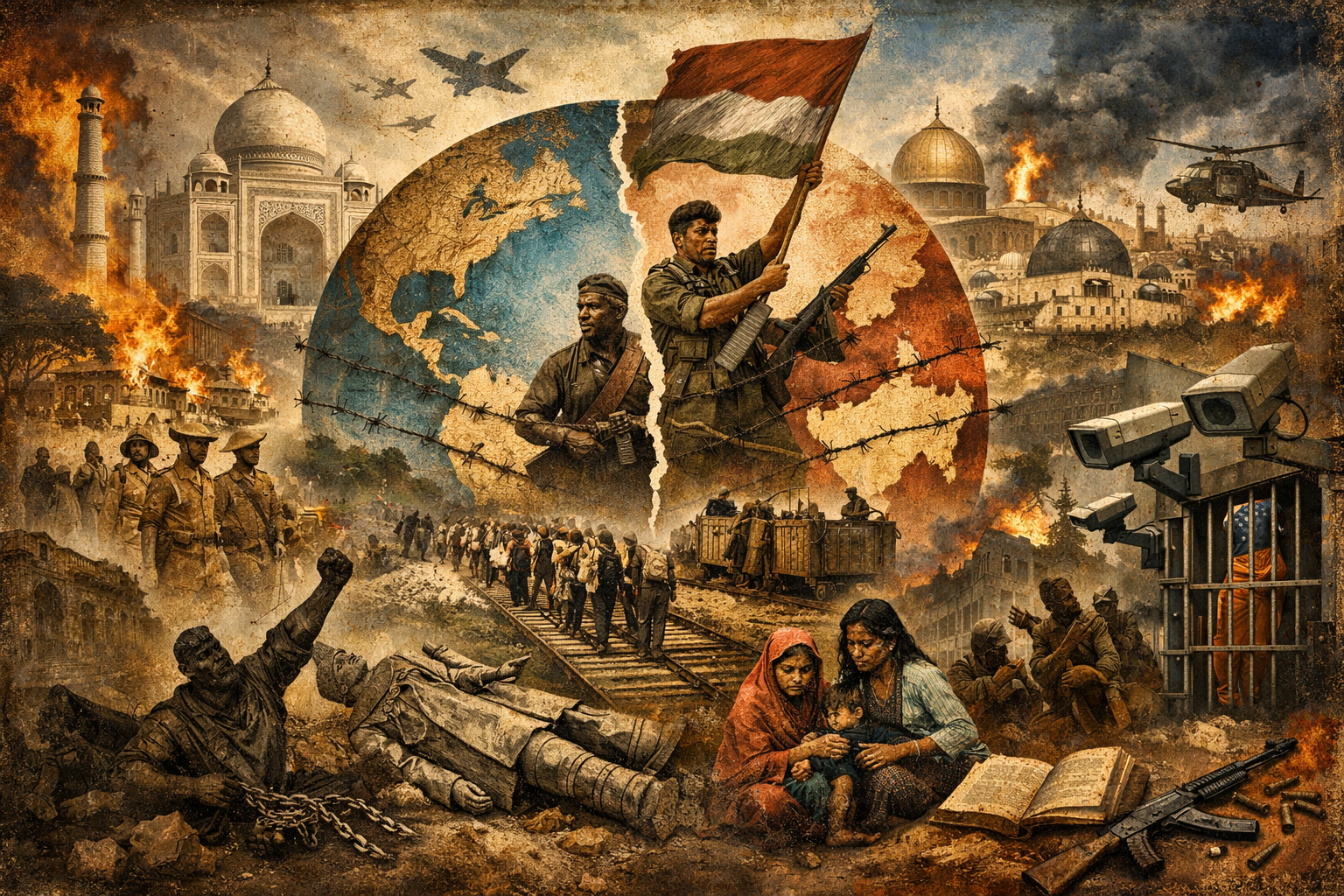
The significance of the subject extends far beyond the history of political ideas. Liberation, anti-colonial, and decolonial thought have shaped debates about sovereignty, citizenship, violence, law, development, race, capitalism, reparations, education, land, borders, religion, culture, ecology, surveillance, Indigenous sovereignty, and the legitimacy of the state itself. They also challenge the assumptions of canonical political theory by asking whether concepts such as liberty, equality, law, rights, reason, civilization, sovereignty, and development can be understood apart from the histories of conquest, slavery, racialization, partition, settler colonialism, and imperial hierarchy through which modernity was built.
A couple of paragraphs into the inquiry, the field’s deeper conceptual challenge becomes clear. The nation-state is not an ancient or universal political form that existed everywhere since time immemorial. It is a relatively recent political arrangement tied to modern sovereignty, nationalism, imperial restructuring, and the reorganization of territory under colonial and postcolonial rule. In Asia, Africa, the Americas, and the Middle East, colonial power often did not merely conquer existing societies; it actively remade political space, imposed borders, partitioned peoples, reorganized territory, and redefined the terms through which political community came to be imagined.
Anti-colonial and decolonial thought therefore ask not only how empire ruled, but how the political world itself was remade through empire’s categories. Some traditions emphasize national liberation, independence, and the recovery of sovereign statehood. Others argue that formal decolonization is insufficient where colonial power persists through economic dependency, racial stratification, military domination, epistemic hierarchy, securitization, proxy rule, settler jurisdiction, extractive infrastructure, or cultural subordination.
Some focus on class and imperialism; others emphasize race, gender, language, ecology, religion, Indigenous sovereignty, land defense, or the politics of memory. Some defend revolutionary struggle; others emphasize reconstruction, pedagogy, care, refusal, ceremony, treaty rights, cultural survival, community autonomy, or alternative forms of belonging beyond the state as inherited from empire. What unites the field is not one program but a shared confrontation with the fact that empire has shaped the modern world at every level, and that freedom requires more than admission into institutions built on dispossession.
This pillar is part of the broader Political Philosophy and Justice category and is designed as a long-horizon knowledge series. It moves from empire, colonialism, and early anti-colonial resistance through national liberation, Fanon, Cabral, Nkrumah, philosophy of liberation, decolonial critique, Indigenous resurgence, feminist anti-colonial thought, regional studies of Africa, South Asia, Indochina, Indonesia, Palestine, West Asia, Native American resistance, Standing Rock, Wounded Knee, Leonard Peltier, and contemporary struggles over land, water, memory, reparations, migration, surveillance, border militarization, digital control, and the unfinished structures of colonial rule.
Why Liberation, Anti-Colonial, and Decolonial Thought Matter
Liberation, anti-colonial, and decolonial thought matter because they force political philosophy to confront the constitutive role of empire in the making of the modern world. Colonial rule was not a peripheral distortion of otherwise universal political ideals. It was a central mechanism through which land was seized, labor was disciplined, peoples were categorized, political hierarchy was globalized, and whole societies were reorganized through foreign power. These traditions therefore do not merely add neglected cases to established theory. They transform the questions political theory must ask.
They matter because they redefine freedom. Under colonial conditions, freedom cannot be reduced to legal status or individual noninterference. Colonized peoples may be governed through military occupation, economic dependency, racial classification, epistemic marginalization, settler expansion, extractive development, border violence, cultural destruction, and the destruction of language, ceremony, memory, and land-based life. Anti-colonial and decolonial thought therefore often treat freedom as collective, historical, territorial, ecological, and material.
The question is not only whether domination ends formally, but whether peoples regain the power to determine their political futures, reconstruct social worlds, recover historical agency, defend land and water, and repair historical dispossession. Formal independence may leave intact debt dependency, military hierarchy, resource extraction, racialized borders, corporate control, settler jurisdiction, and security systems that continue colonial power under new names.
These traditions also matter because they remain contemporary. The end of formal empire did not end coloniality, neocolonial dependency, racial capitalism, military intervention, regime change, occupation, permanent war, digital surveillance, predictive policing, border detention, pipeline policing, or algorithmic administration. Political struggles over Palestine, Indigenous land defense, Native sovereignty, migration, debt, reparations, cultural restitution, AI governance, policing, and the securitized state all show that colonial structures remain active. A serious study of liberation and decolonization therefore belongs not only to historical inquiry but to present debates over justice, sovereignty, and world order.
What This Pillar Covers
This pillar is designed as a comprehensive foundation for the study of liberation, anti-colonial, and decolonial thought within political philosophy and justice. It combines historical depth, conceptual analysis, and contemporary debate while connecting political theory to empire, race, land, sovereignty, labor, culture, gender, ecology, technology, surveillance, epistemic struggle, and Indigenous resurgence.
Colonialism, Empire, and Domination
At the foundation of the field lies the analysis of colonialism itself: conquest, occupation, settlement, extraction, racial hierarchy, and the subjugation of one people by another. Anti-colonial and decolonial thought ask not only how colonial domination functions materially, but how it reorganizes law, culture, political subjectivity, knowledge, territory, and historical possibility.
Liberation and National Self-Determination
Many anti-colonial traditions treated national liberation as a necessary political response to empire. Self-determination, political independence, sovereignty, and the right to collective existence were central demands in struggles across Africa, Asia, the Caribbean, and the Middle East. Yet liberation thought also asks what happens after independence: whether formal sovereignty can survive neocolonial dependency, whether national unity can coexist with plurality, and whether postcolonial states can avoid reproducing domination internally.
Race, Coloniality, and the Making of Modernity
Another major concern is the relationship between race and empire. Colonialism was not merely territorial domination but also a project of classification and hierarchy that reshaped who counted as human, civilized, rational, or fit for self-rule. Decolonial and anti-colonial traditions therefore often argue that modernity itself was constituted through colonial violence, racialization, and global asymmetry rather than developing independently of them.
Violence, Resistance, and Revolutionary Struggle
Many liberation traditions wrestle directly with the problem of violence. Can colonial violence be overturned through institutional reform, or does liberation require revolutionary rupture? Is anti-colonial violence a tragic necessity, a morally transformative force, a strategic error, or something contingent on context? These questions are central to figures such as Fanon and to wider debates over armed struggle, insurgency, organization, and political reconstruction.
Culture, Language, and Epistemic Liberation
Decolonization is not only political and economic. It also concerns language, education, memory, history, aesthetics, and the structure of knowledge itself. Colonial rule often imposed alien categories of reason, civilization, and legitimacy while degrading Indigenous and colonized ways of knowing. Decolonial thought therefore emphasizes epistemic liberation, cultural recovery, and the reconstruction of intellectual life beyond colonial hierarchies.
Labor, Capital, and Neocolonial Dependency
Anti-colonial and liberation traditions often connect empire to capitalism, extraction, labor discipline, unequal exchange, and developmental dependency. Formal independence may leave intact global structures of debt, trade asymmetry, resource capture, military dependency, and financial power. This has made anti-imperial socialism, dependency theory, and critiques of neocolonialism central parts of the field.
Gender, Body, and Decolonial Feminist Thought
No adequate account of decolonization can treat gender as secondary. Colonial rule reorganized family structures, labor, education, authority, and the regulation of bodies. Feminist anti-colonial and decolonial thought have shown how empire and patriarchy are entangled, and how liberation must include struggles over care, embodiment, reproduction, and the political standing of women and gendered subjects.
Land, Ecology, and Indigenous Resurgence
For many Indigenous and anti-colonial traditions, land is not simply property but a relation of life, memory, obligation, sovereignty, law, and responsibility. Settler colonialism, extraction, enclosure, pipelines, mining, water contamination, and development projects therefore become central targets of critique. Decolonial thought increasingly connects liberation to ecological struggle, territorial defense, treaty rights, land back, and alternative conceptions of belonging beyond extractive statecraft.
Security, Surveillance, and the Imperial Present
Contemporary decolonial thought must also confront the imperial afterlife of emergency law, counterterrorism, border militarization, detention, predictive policing, AI-enabled governance, proxy war, pipeline policing, and surveillance. The language of security often serves as a modern vehicle for older structures of domination, transforming colonial techniques of rule into permanent instruments of global policing, algorithmic administration, and domestic civil-liberties restriction.
Historical Formation: Empire, Colonialism, Resistance, and Decolonization
A serious account of liberation and anti-colonial thought begins with the expansion of empire and the political structures it imposed. European conquest, settler expansion, racial slavery, missionary projects, extractive rule, and imperial administration transformed social worlds across continents. Yet empire also generated resistance in many forms: revolts, maroon communities, anti-colonial intellectual networks, peasant uprisings, labor struggles, cultural renaissances, Indigenous confederacies, treaty struggles, and movements for national liberation. Anti-colonial political thought emerged from these struggles as much as from formal philosophy.
The nineteenth and twentieth centuries transformed resistance into a more systematic field of reflection. Anti-colonial thinkers linked sovereignty to dignity, land, language, labor, culture, and international struggle. National liberation movements demanded formal independence, but many also aimed at deeper social transformation through socialism, Pan-Africanism, agrarian reform, educational reconstruction, Indigenous resurgence, and anti-imperial solidarity. Fanon, Cabral, Nkrumah, Césaire, and many others gave these struggles conceptual form by analyzing colonial violence, cultural domination, class formation, and the unfinished tasks of liberation.
In settler colonial contexts, the problem is different but related. The colonizing power does not simply extract wealth and leave. It seeks to possess land, eliminate or absorb Indigenous political orders, rewrite jurisdiction, and make settlement appear permanent and legitimate. In this context, decolonization cannot be reduced to postcolonial state independence. It must address land, treaty rights, sovereignty, jurisdiction, cultural survival, ecological protection, and the ongoing political existence of Indigenous nations.
In the later twentieth century and into the present, decolonial thought expanded the critique by arguing that coloniality survives beyond the end of formal empire. Political independence did not abolish epistemic hierarchy, racial capitalism, military dependency, border violence, carceral expansion, digital surveillance, or the unequal global organization of knowledge and power. Decolonial approaches therefore ask not only how colonies became states, but how worlds might be rebuilt after empire in ways that do not reproduce colonial forms under new names.
Regional Architectures of Empire and Decolonization
A comprehensive pillar on liberation and decolonization must be regionally concrete. Empire did not unfold everywhere in the same way, and anti-colonial thought cannot be fully understood through a generic template alone. Africa, South Asia, Indochina, Indonesia, Palestine, West Asia, the Americas, and Indigenous nations each reveal different combinations of conquest, extraction, partition, settler rule, proxy governance, counterinsurgency, cultural erasure, and postcolonial dependency.
In South Asia, the problem is not only colonial domination but the imperial remaking of political space. Precolonial polities in the region were not modern nation-states in the European sense, yet British rule did not simply govern an already unified nation-state called India. It reorganized territory, imposed a new imperial order, and later exited through Partition, producing one of the most consequential episodes of mass displacement and sectarian violence in modern history. Any serious anti-colonial treatment of South Asia must therefore move beyond Gandhi alone to include revolutionary politics, Partition, Kashmir, and the colonial production of territorial and communal categories.
In Southeast Asia and Indochina, anti-colonial thought is inseparable from French and Dutch empire, armed struggle, Cold War intervention, and the fragmentation of liberation movements under global power blocs. Indochina, Vietnam, Cambodia, Laos, and Indonesia all reveal how formal decolonization could be redirected into proxy war, counterrevolution, mass violence, and authoritarian state formation. These histories belong at the center of anti-colonial political thought because they show how decolonization was often constrained, partitioned, or militarized by the wider imperial order.
Africa reveals another architecture of empire: conquest, arbitrary partition, extraction, labor coercion, and the tension between territorial sovereignty and postcolonial dependency. The anti-colonial thought of Nkrumah, Cabral, Nyerere, Lumumba, Fanon, and many others cannot be understood apart from the scramble for Africa, settler colonialism in places such as Algeria and Kenya, and the persistence of external economic and military control after flag independence. In Africa, liberation thought repeatedly asks whether sovereignty without economic transformation is enough, and whether postcolonial states can overcome imperial borders without reproducing colonial forms internally.
West Asia and the modern Middle East reveal yet another structure: the collapse of empire followed by imperial redesign through mandates, partition plans, strategic borders, oil politics, coups, client regimes, occupations, and endless war. The carving up of the region after Ottoman collapse, the Palestinian catastrophe, the politics of mandate rule, and the later regimes of intervention, proxy power, counterterrorism, and occupation all belong within anti-colonial analysis. Iraq, Afghanistan, and the War on Terror are not external to the history of empire. They are among its most visible contemporary forms.
In the Americas, settler colonialism created a political order structured by Indigenous dispossession, treaty violation, forced removal, allotment, boarding schools, reservation systems, extractive infrastructure, and the denial or limitation of Indigenous jurisdiction. Native American struggle therefore belongs at the center of this pillar. Wounded Knee, the American Indian Movement, Leonard Peltier, Standing Rock, water protectors, and the politics of land back reveal that decolonization is not only a matter of distant empire but also of ongoing settler state power within the United States.
Indigenous Sovereignty, Native American Resistance, and Settler Colonialism
Indigenous sovereignty and Native American resistance occupy a central place in liberation, anti-colonial, and decolonial thought because settler colonialism is not merely an event in the past. It is an ongoing structure involving land, jurisdiction, resource extraction, policing, treaty violation, cultural destruction, and the repeated criminalization of Indigenous political resistance. A decolonial account of political philosophy must therefore treat Indigenous struggle not as a regional sidebar, but as one of the clearest challenges to modern theories of property, sovereignty, law, citizenship, and state legitimacy.
The Native American struggle reveals how colonial power works through legal continuity as much as through open conquest. Treaties may be signed and then violated. Land may be recognized as sacred and then opened to extraction. Indigenous nations may be described as sovereign while their jurisdiction is restricted by federal authority, state power, corporate infrastructure, or emergency policing. In this context, sovereignty is not a ceremonial phrase. It is a live political demand tied to land, water, burial grounds, language, ceremony, ecological responsibility, and the right to govern according to Indigenous law and memory.
Wounded Knee is especially important because it condenses multiple historical layers. The 1890 massacre of Lakota people at Wounded Knee belongs to the history of U.S. military violence, the suppression of Indigenous spiritual life, and the attempted closure of armed Native resistance. The 1973 occupation of Wounded Knee by members of the American Indian Movement and Oglala Lakota supporters belongs to a later history of treaty struggle, tribal governance conflict, federal confrontation, and the Red Power movement. Together, these histories show how memory, sovereignty, land, and state violence remain connected across generations.
Leonard Peltier’s case belongs within this same architecture of Indigenous resistance and the carceral state. Whatever one’s position on the legal details of the case, his imprisonment became a major international symbol in debates over the American Indian Movement, Pine Ridge, federal prosecution, political imprisonment, and the criminalization of Indigenous resistance. His 2025 commutation and transition to home confinement reopened public attention to the relationship between Native activism, federal power, prosecutorial controversy, and long-running clemency campaigns.
Standing Rock similarly shows that Indigenous resistance remains contemporary. The struggle against the Dakota Access Pipeline centered treaty rights, water protection, environmental justice, pipeline risk, militarized policing, and Indigenous sovereignty. Water protectors reframed environmental defense not as a narrow regulatory dispute but as a question of life, land, memory, and treaty obligations. Standing Rock also revealed how infrastructure projects can become colonial flashpoints when extractive development overrides Indigenous consent, sacred geography, and ecological responsibility.
The broader Native American struggle therefore belongs in the center of this pillar. It includes land back, treaty rights, boarding school memory, tribal sovereignty, sacred sites, jurisdiction, language survival, environmental justice, Missing and Murdered Indigenous Peoples advocacy, resistance to extractive infrastructure, and the defense of water, land, and future generations. It also forces political philosophy to ask whether a settler state can be decolonized without confronting the land relations that make it possible.
Security, Surveillance, and the Imperial Present
The imperial present is often organized through the language of security. Counterterrorism, border enforcement, predictive policing, drone warfare, immigration detention, emergency powers, data infrastructure, corporate surveillance, and algorithmic governance all claim to protect public order. Yet liberation and decolonial thought ask whether these systems reproduce older colonial techniques of classification, containment, targeting, and control.
Colonial rule often depended on surveillance, mapping, identification, pass systems, informants, census categories, military policing, and administrative files. Contemporary security systems often inherit these logics in digital form. Predictive policing, watchlists, biometric databases, border analytics, drone targeting, and counterinsurgency training can transform colonial governance into automated or bureaucratized public administration.
This matters because the language of security can make domination appear technical, neutral, or inevitable. The problem is not only that states monitor, detain, deport, and police. It is that those practices often fall disproportionately on colonized, racialized, Indigenous, migrant, and politically dissident communities. Decolonial thought therefore treats surveillance and security not only as civil-liberties issues but as questions of empire, race, territory, and political control.
The same logic applies domestically. Urban militarization, forest defense repression, police exchange programs, border detention, family separation, and the criminalization of protest all show how imperial techniques move across borders and return home. A serious decolonial pillar must therefore connect foreign war, domestic policing, corporate data systems, extractive infrastructure, and administrative violence within one architecture of control.
Liberation, Anti-Colonial, and Decolonial Thought Within Political Philosophy and Justice
Within political philosophy, liberation, anti-colonial, and decolonial thought occupy a foundational but historically marginalized position. They are foundational because they address sovereignty, freedom, violence, law, personhood, labor, development, legitimacy, surveillance, detention, land, ecology, treaty rights, and memory at the deepest level. They were marginalized because canonical political philosophy often treated colonialism as an external episode rather than as one of the core structures through which the modern political world was formed. Anti-colonial and decolonial thought correct that distortion by showing that empire is central, not incidental, to political modernity.
This field also serves as a site where multiple traditions meet and collide. National liberation, socialism, Pan-Africanism, Indigenous resurgence, liberation philosophy, decolonial critique, anti-imperial feminism, postcolonial theory, abolitionist politics, border critique, ecological justice, and technological critique all share overlapping concerns while diverging sharply on strategy, sovereignty, violence, class, gender, culture, and the role of the state. Some seek a transformed state. Others seek plural sovereignties, confederal forms, communal reconstruction, treaty enforcement, abolition of carceral institutions, or worlds beyond the state as inherited from empire.
For that reason, this pillar treats liberation, anti-colonial, and decolonial thought not as a supplement to European political theory but as a field of political argument in its own right about empire, sovereignty, race, land, labor, culture, security, technology, ecology, and the terms of freedom after domination. To study this field seriously is to study one of the most powerful traditions of modern political critique and one of the clearest challenges to any philosophy that imagines justice without decolonization or freedom without historical repair.
Core Themes in Liberation, Anti-Colonial, and Decolonial Thought
One major theme is sovereignty after empire. The field asks whether political independence, treaty recognition, statehood, or national self-determination is enough when colonial power persists through economics, security, knowledge, land, and infrastructure.
A second theme is land. Anti-colonial and Indigenous traditions insist that land is not merely property, but a relation of memory, life, law, belonging, and responsibility.
A third theme is race and coloniality. These traditions examine how empire created racial hierarchies that shaped who counted as human, civilized, rational, governable, or disposable.
A fourth theme is violence and resistance. Liberation thought asks whether colonial violence can be overcome through reform, refusal, civil resistance, armed struggle, international law, pedagogy, or alternative institution-building.
A fifth theme is epistemic liberation. Decolonial thought challenges the colonial organization of knowledge, language, education, museums, archives, and intellectual authority.
A sixth theme is Indigenous resurgence. Native and Indigenous traditions center treaty rights, sovereignty, land back, water protection, cultural survival, sacred sites, and resistance to settler jurisdiction.
A seventh theme is neocolonial dependency. Formal independence may leave intact debt, trade dependency, resource capture, foreign military power, and unequal development.
An eighth theme is ecology and extraction. Decolonial thought connects environmental degradation, pipeline politics, mining, climate injustice, and extractive development to colonial structures of land and power.
A ninth theme is security and surveillance. Colonial techniques of mapping, policing, containment, and classification persist in counterterrorism, borders, drones, detention, predictive policing, and data governance.
A tenth theme is historical repair. Liberation and decolonial thought ask what repair is owed for slavery, conquest, partition, settler colonialism, dispossession, cultural theft, ecological harm, and ongoing institutional violence.
Expanded Article Architecture
The following structure gathers the article pillar into a long-range architecture suitable for a major political philosophy knowledge series. It includes the existing planned article architecture and adds a dedicated Native American struggle cluster covering Leonard Peltier, Standing Rock, Wounded Knee, AIM, treaty rights, water protectors, and the broader politics of Indigenous sovereignty.
Foundations of Anti-Colonial and Decolonial Thought
- What Is Anti-Colonial and Decolonial Thought? (planned)
Introduces the field as a tradition of political reflection shaped by conquest, empire, coloniality, land theft, racial hierarchy, and struggles for liberation. - Colonialism, Empire, and the Political Structure of Domination (planned)
Studies colonialism as a political structure involving conquest, occupation, extraction, racial rule, epistemic hierarchy, and administrative control. - Settler Colonialism and the Logic of Elimination (planned)
Examines settler colonialism as an ongoing structure that seeks land possession, Indigenous dispossession, jurisdictional control, and the erasure or absorption of Native political life. - Slavery, Colonial Rule, and the Making of the Modern World (planned)
Explores how slavery and colonial rule shaped modern capitalism, race, law, labor, empire, and global political order. - Early Resistance, Revolt, and Anti-Imperial Political Imagination (planned)
Studies revolts, rebellions, maroon communities, Indigenous resistance, and early anti-imperial movements as sources of political theory. - Self-Determination and the Politics of National Liberation (planned)
Examines self-determination as a central anti-colonial demand and asks what forms of sovereignty liberation requires. - Empire, Race, and the Colonial Making of Modernity (planned)
Studies how racial hierarchy, colonial violence, and imperial extraction shaped the institutions and concepts of modern political life.
Classical Anti-Colonial Thinkers and Liberation Theory
- Aimé Césaire and the Moral Critique of Colonialism (planned)
Examines Césaire’s critique of colonial civilization, dehumanization, and the moral hypocrisy of European imperial power. - Frantz Fanon and the Violence of Colonial Rule (planned)
Studies Fanon’s analysis of colonial violence, psychic injury, racial domination, and revolutionary struggle. - Fanon, Liberation, and the New Humanism (planned)
Explores Fanon’s vision of liberation as the creation of a new political humanity beyond colonial domination. - Amílcar Cabral, Culture, and Resistance (planned)
Studies Cabral’s account of culture, class, national liberation, revolutionary organization, and anti-colonial struggle. - Kwame Nkrumah and the Problem of Neocolonialism (planned)
Examines Nkrumah’s critique of formal independence without economic sovereignty and his analysis of neocolonial dependency. - Julius Nyerere, Ujamaa, and Postcolonial Reconstruction (planned)
Studies Nyerere’s approach to African socialism, village community, moral economy, and postcolonial development. - Patrice Lumumba and the Crisis of Postcolonial Sovereignty (planned)
Explores Lumumba’s political significance in relation to sovereignty, resource control, imperial intervention, and postcolonial statehood.
South Asia, Partition, and the Colonial Remaking of Political Space
- South Asia Before the Nation-State: Empire, Region, and Layered Political Order (planned)
Examines South Asian political formations before the modern nation-state and the layered forms of sovereignty that colonial rule transformed. - British Rule in India and the Colonial Structure of Empire (planned)
Studies the administrative, economic, legal, military, and epistemic structures through which British rule reorganized the subcontinent. - India Beyond Gandhi: Revolution, Socialism, and Anti-Colonial Mass Politics (planned)
Broadens the study of Indian anti-colonial politics beyond Gandhi to include revolutionary, socialist, labor, peasant, and mass-movement traditions. - Bhagat Singh, Anti-Colonial Socialism, and Revolutionary Freedom (planned)
Studies Bhagat Singh’s political thought in relation to revolution, socialism, anti-imperialism, secularism, and freedom. - The Myth of the Village Republic: Colonial Knowledge and the Misreading of India (planned)
Examines how colonial knowledge systems interpreted, simplified, and distorted Indian social and political life. - Was British India a Settler-Colonial Formation? Empire, Land, and Colonial Debate (planned)
Analyzes debates over whether British India should be understood through settler colonial, extractive colonial, or hybrid imperial frameworks. - Partition, Sectarian Violence, and the Political Afterlife of Empire in South Asia (planned)
Studies Partition as a catastrophic afterlife of empire involving borders, displacement, violence, memory, and state formation. - Direct Action, Communal Violence, and the Road to Partition (planned)
Examines the political escalation and communal violence that preceded Partition and shaped the transition from empire to postcolonial states. - Kashmir, Borders, and the Unfinished Violence of Decolonization (planned)
Studies Kashmir as a site where partition, militarization, sovereignty, self-determination, and the unfinished violence of decolonization converge.
Indochina, Indonesia, and Southeast Asian Decolonization
- Indochina, French Empire, and the Colonial Ordering of Southeast Asia (planned)
Examines French imperial rule in Indochina and the colonial organization of territory, labor, administration, and resistance. - Vietnamese Anti-Colonialism and the Struggle Against French Rule (planned)
Studies Vietnamese anti-colonial movements against French rule and the relationship between nationalism, socialism, and liberation. - Ho Chi Minh, National Liberation, and Revolutionary State Formation (planned)
Explores Ho Chi Minh’s political significance in relation to anti-colonial struggle, revolutionary organization, and state formation. - Geneva, Partition, and the Making of the Two Vietnams (planned)
Studies the Geneva settlement, partition, Cold War intervention, and the political creation of North and South Vietnam. - Cambodia, Laos, and the Fragmented Politics of Decolonization in Indochina (planned)
Examines how decolonization in Cambodia and Laos was shaped by empire, war, Cold War intervention, and regional fragmentation. - Indonesia, Dutch Empire, and the Struggle for National Liberation (planned)
Studies Indonesian anti-colonial struggle against Dutch rule and the formation of postcolonial national sovereignty. - Sukarno, Anti-Imperialism, and Postcolonial State Formation in Indonesia (planned)
Examines Sukarno’s anti-imperial politics, nationalism, nonalignment, and postcolonial state-building. - Indonesia, Cold War Violence, and the Destruction of the Left (planned)
Studies the anti-communist violence in Indonesia and the destruction of left movements within the context of Cold War power.
Africa, Anti-Colonial Sovereignty, and Postcolonial Dependency
- Empire in Africa: Conquest, Extraction, and Colonial Rule (planned)
Introduces African colonial history through conquest, extraction, labor coercion, racial hierarchy, and imperial administration. - The Scramble for Africa and the Partition of the Continent (planned)
Studies the partition of Africa by European powers and its lasting consequences for sovereignty, borders, and development. - African Anti-Colonial Thought and the Rejection of Imperial Rule (planned)
Examines African anti-colonial thought as a rejection of imperial domination and a search for self-determination. - Pan-Africanism and the Internationalization of Liberation (planned)
Studies Pan-Africanism as a transnational framework connecting African liberation, diaspora solidarity, and anti-imperial politics. - Algeria, Settler Colonialism, and the Politics of Liberation (planned)
Explores Algeria as a major case of settler colonialism, armed struggle, and postcolonial political transformation. - Mau Mau, Kenya, and the Violence of Colonial Counterinsurgency (planned)
Examines the Mau Mau uprising and British counterinsurgency as a case of colonial repression, land struggle, and liberation politics. - Portugal, Lusophone Africa, and Wars of Decolonization (planned)
Studies anti-colonial wars against Portuguese empire in Angola, Mozambique, Guinea-Bissau, and related contexts. - South Africa, Apartheid, and Internal Colonialism (planned)
Analyzes apartheid as a structure of racial domination, settler power, labor control, and internal colonial rule. - Postcolonial Africa, Dependency, and the Limits of Formal Independence (planned)
Examines the persistence of dependency, debt, resource extraction, and external control after formal independence.
West Asia, Palestine, Mandates, and Imperial Redesign
- Sykes-Picot, Mandates, and the Imperial Carving of the Middle East (planned)
Studies imperial border-making, mandate rule, and the political restructuring of the region after Ottoman collapse. - The Mandate System and the Afterlife of Ottoman Collapse (planned)
Examines the mandate system as a continuation of imperial control under international legal language. - Palestine, Partition, and Settler Colonialism (planned)
Studies Palestine through partition, displacement, settler colonialism, sovereignty, and anti-colonial resistance. - Zionism, British Mandate Rule, and the Palestinian Question (planned)
Examines the intersection of Zionism, British imperial policy, mandate rule, and Palestinian political dispossession. - Arab Liberation Thought and Anti-Imperial Sovereignty (planned)
Studies Arab liberation thought as a response to imperial rule, external domination, resource control, and postcolonial sovereignty. - Empire, Oil, and Puppet Regimes in the Modern Middle East (planned)
Examines oil politics, client regimes, foreign intervention, and the persistence of imperial influence in the region. - Iran, Coup Politics, and the Architecture of Regime Change (planned)
Studies Iran through the politics of oil, sovereignty, coup intervention, and the architecture of external regime change. - Iraq, Occupation, and the Politics of Regime Change (planned)
Examines Iraq as a site of occupation, intervention, state destruction, and the imperial politics of regime change. - Afghanistan, Empire, Intervention, and Endless War (planned)
Studies Afghanistan in relation to imperial intervention, Cold War conflict, occupation, counterinsurgency, and permanent war. - West Asia, Proxy Power, and the Persistence of Imperial Order (planned)
Explores proxy power, intervention, security regimes, and the continued imperial structuring of West Asian politics.
Latin American Liberation Philosophy and Decolonial Theory
- Philosophy of Liberation in Latin America (planned)
Introduces Latin American philosophy of liberation as a critique of coloniality, dependency, Eurocentrism, and domination. - Enrique Dussel and the Critique of Eurocentric Modernity (planned)
Studies Dussel’s critique of modernity from the standpoint of conquest, exclusion, and the exteriority of oppressed peoples. - Aníbal Quijano and Coloniality of Power (planned)
Examines Quijano’s concept of coloniality of power and its relation to race, labor, knowledge, and global hierarchy. - Walter Mignolo and Decolonial Epistemology (planned)
Studies Mignolo’s work on border thinking, epistemic disobedience, and the decolonization of knowledge. - María Lugones and the Coloniality of Gender (planned)
Examines Lugones’s account of the coloniality of gender and its implications for feminist decolonial theory.
Indigenous Sovereignty, Native American Resistance, and Settler Colonialism
- Indigenous Resurgence and the Politics of Land Back (planned)
Introduces Indigenous resurgence as a political tradition centered on land, sovereignty, treaty rights, cultural renewal, ecological responsibility, and resistance to settler colonial power. - Decolonization, Land, and Settler States (planned)
Examines why settler colonialism cannot be understood only as past conquest, but as an ongoing structure involving land, law, extraction, jurisdiction, borders, and political authority. - Wounded Knee, Historical Memory, and the Violence of Settler Rule (planned)
Studies Wounded Knee as both the 1890 massacre of Lakota people and a later site of Indigenous resistance, showing how memory, land, state violence, and sovereignty remain connected across generations. - The American Indian Movement and the Politics of Indigenous Self-Determination (planned)
Examines AIM as a modern Indigenous political movement confronting treaty violations, police violence, poverty, federal authority, cultural suppression, and the struggle for Native sovereignty. - Leonard Peltier, Indigenous Resistance, and the Carceral State (planned)
Studies Leonard Peltier’s case in relation to the American Indian Movement, Pine Ridge, federal prosecution, political imprisonment, clemency campaigns, and the criminalization of Indigenous resistance. - Standing Rock, Indigenous Sovereignty, and the Defense of Land and Water (planned)
Examines Standing Rock and the Dakota Access Pipeline struggle as a contemporary conflict over treaty rights, water protection, environmental justice, police power, infrastructure, and Indigenous sovereignty. - Water Protectors, Treaty Rights, and the Politics of Environmental Defense (planned)
Explores how Indigenous water-protection movements connect ecology, sovereignty, treaty law, ceremony, direct action, and resistance to extractive infrastructure. - Settler States, Extraction, and the Criminalization of Indigenous Resistance (planned)
Studies how settler states use policing, courts, surveillance, injunctions, counterinsurgency language, and public-order claims to suppress Indigenous land defense. - Native American Struggle, Sovereignty, and the Unfinished Work of Decolonization (planned)
Provides a broad synthesis of Native American political struggle across treaty rights, land defense, boarding schools, cultural survival, jurisdiction, federal power, ecological justice, and Indigenous futures.
Violence, Resistance, Memory, and Historical Repair
- Violence, Insurgency, and Revolutionary Ethics in Liberation Struggle (planned)
Examines the moral and political questions raised by violence, insurgency, armed struggle, and revolutionary resistance. - Nonviolence, Civil Resistance, and the Politics of Refusal (planned)
Studies nonviolent resistance, civil disobedience, refusal, boycott, and mass mobilization in anti-colonial struggle. - Language, Education, and the Politics of Epistemic Liberation (planned)
Examines language, education, curriculum, archives, and knowledge systems as sites of colonial domination and decolonial reconstruction. - Museums, Restitution, and the Return of Cultural Property (planned)
Studies cultural restitution, museum ethics, colonial plunder, sacred objects, archives, and the return of stolen heritage. - Reparations, Historical Redress, and Colonial Justice (planned)
Examines reparations as a question of historical responsibility, stolen land, stolen labor, colonial harm, and institutional repair. - Migration, Borders, and the Afterlife of Empire (planned)
Studies migration and border regimes as contemporary expressions of imperial history, racialized mobility, and unequal global order. - Race, Policing, and Colonial Techniques of Rule (planned)
Examines policing as a continuation of colonial methods of classification, surveillance, containment, and force. - Decolonial Feminism and the Reconstruction of Political Theory (planned)
Studies feminist decolonial theory as a critique of empire, patriarchy, gendered labor, embodiment, and colonial power. - Ecology, Extraction, and the Decolonial Critique of Development (planned)
Examines extraction, ecological harm, development ideology, and environmental destruction through a decolonial lens. - Climate Colonialism and Global Environmental Justice (planned)
Studies climate injustice as a continuation of colonial responsibility, unequal vulnerability, extraction, and global environmental hierarchy.
Surveillance, Data Infrastructure, and Algorithmic Coloniality
- Mass Surveillance, Empire, and the Digital Infrastructure of Control (planned)
Studies mass surveillance as a continuation of imperial governance through data, visibility, classification, and security power. - Edward Snowden, State Secrecy, and the Exposure of the Surveillance State (planned)
Examines Snowden’s disclosures in relation to state secrecy, civil liberties, intelligence power, and the security state. - WikiLeaks, Transparency, and the Politics of Imperial Disclosure (planned)
Studies transparency, classified documents, war archives, and the politics of exposing imperial violence. - Palantir, Predictive Power, and the Private Architecture of Security (planned)
Examines private data platforms, predictive analytics, policing, counterterrorism, and the corporate infrastructure of security. - Oracle, Data Infrastructure, and the Corporate Back End of Governance (planned)
Studies corporate data infrastructure as part of the administrative and technical architecture of modern governance. - Artificial Intelligence, Colonial Power, and the Automation of Control (planned)
Examines AI as a technology that can automate classification, surveillance, border enforcement, policing, and administrative domination. - Algorithmic Governance, Policing, and the New Logic of Imperial Administration (planned)
Studies algorithmic governance as a contemporary form of administrative power that may reproduce colonial logics of control.
Militarized Policing, Protest, and Domestic Counterinsurgency
- Cop City, Urban Militarization, and the Domestic Architecture of Counterinsurgency (planned)
Examines urban policing, militarized training, infrastructure development, and the framing of domestic protest through counterinsurgency logics. - Forest Defense, State Repression, and the Criminalization of Anti-Colonial Protest (planned)
Studies forest defense and environmental protest as sites where land defense, policing, and criminalization converge. - Police Exchange Programs, Israeli Security Doctrine, and the Transnational Circulation of Repression (planned)
Examines how police training, security doctrine, and tactical exchange can circulate methods of repression across borders. - Counterterrorism Training, Settler Colonialism, and the Globalization of Militarized Policing (planned)
Studies counterterrorism training as a vehicle for spreading militarized policing and colonial security doctrine. - From Palestine to U.S. Cities: Security Exchange, Occupation, and the Language of Public Order (planned)
Explores how occupation, policing, public-order language, and security exchange connect foreign and domestic control.
Borders, Detention, Deportation, and Administrative Violence
- ICE, Deportation, and the Border Infrastructure of Empire (planned)
Studies immigration enforcement as a border regime shaped by racialized mobility, detention, deportation, and imperial afterlives. - Detention, Family Separation, and the Carceral Logic of Immigration Control (planned)
Examines immigration detention and family separation as forms of administrative violence and carceral border governance. - Obama-Era Family Detention, Border Cages, and the Expansion of Enforcement (planned)
Studies the expansion of family detention and border enforcement across administrations, beyond partisan simplification. - The Border as Colonial Frontier: Removal, Confinement, and Administrative Violence (planned)
Examines the border as a colonial frontier where removal, confinement, classification, and administrative violence converge.
Permanent War, Targeted Killing, and the State of Exception
- Extrajudicial Killing, Executive Power, and the War State (planned)
Studies extrajudicial killing as an expression of executive power, emergency logic, and the expansion of the war state. - Drones, Targeted Killing, and the Geography of Permanent War (planned)
Examines drone warfare as a technology of remote killing, global battlefield expansion, and permanent war. - From Counterterrorism to Assassination: The Normalization of Remote Killing (planned)
Studies how counterterrorism frameworks normalize targeted killing and weaken legal restraints on state violence. - Targeted Killing, Civilian Death, and the Legal Language of Exception (planned)
Examines how legal language can make civilian death, remote war, and exceptional violence appear administratively normal. - The War on Terror and the Globalization of Permanent Exception (planned)
Studies the War on Terror as a global structure of emergency governance, surveillance, detention, and militarized control. - The Patriot Act, Surveillance, and the Crushing of Civil Liberties (planned)
Examines the Patriot Act in relation to civil liberties, surveillance expansion, national security law, and executive power. - Counterterrorism, Empire, and the Language of Security (planned)
Studies how counterterrorism language can legitimize intervention, surveillance, detention, policing, and imperial power.
Comparative and Integrative Decolonial Questions
- Can Liberalism Be Decolonized? (planned)
Examines whether liberal political concepts such as rights, consent, liberty, and equality can be reconstructed after empire. - Can the State Be Decolonized? (planned)
Studies whether the modern state can be transformed beyond colonial borders, security structures, administrative hierarchy, and extractive rule. - Decolonial Thought in the Twenty-First Century (planned)
Examines contemporary decolonial theory in relation to technology, climate, migration, Indigenous resurgence, global inequality, and epistemic justice. - Why Liberation and Decolonization Still Matter (planned)
Concludes the series by explaining why liberation and decolonization remain indispensable for political philosophy, global justice, and historical repair.
Closing Perspective
Liberation, anti-colonial, and decolonial thought remain indispensable because the structures that produced them remain unfinished. Empire did not end simply because formal colonies became states. Settler colonialism did not end because conquest was renamed law. Racial hierarchy did not end because equality was declared. Extraction did not end because development became its language. Security domination did not end because empire learned to speak in the vocabulary of public order, counterterrorism, data systems, and emergency governance.
This is what makes the field so important within political philosophy. It joins historical memory to normative critique. It asks whether concepts such as freedom, equality, sovereignty, rights, citizenship, land, law, development, and security can be adequate if they ignore the peoples and territories through which those concepts were violently produced. It also expands the meaning of political theory by treating revolts, treaties, ceremonies, liberation movements, land defense, prison writings, cultural memory, and collective struggle as sites of serious political thought.
The strongest reason to study liberation, anti-colonial, and decolonial thought is that it trains political judgment where modernity’s contradictions become most visible. It teaches that freedom without history becomes abstraction, sovereignty without land becomes fragile, justice without repair becomes evasion, and equality without decolonization becomes performance. It also teaches that liberation is not only resistance to domination. It is the work of rebuilding worlds.
Related Reading
- Political Philosophy and Justice — for authority, legitimacy, law, rights, sovereignty, democracy, coercion, and the moral foundations of collective life.
- Pan-African and Black Political Thought — for slavery, racial capitalism, diaspora, Black internationalism, liberation, reparations, and global anti-Blackness.
- Socialism and Socialist Thought — for anti-imperial socialism, labor, class, capitalism, dependency, public goods, and democratic economic transformation.
- Liberalism and Its Traditions — for liberty, rights, constitutionalism, public reason, markets, and the liberal frameworks decolonial thought critiques and revises.
- Global Governance — for sovereignty, international institutions, human rights, global justice, development, and planetary cooperation.
- International Law — for sovereignty, occupation, self-determination, human rights, humanitarian law, and the legal architecture of global order.
- Environmental Justice — for climate colonialism, extraction, environmental racism, ecological harm, and community defense.
Further Reading
- Césaire, A. (2000) Discourse on Colonialism. Translated by J. Pinkham. New York: Monthly Review Press. Available at: https://monthlyreview.org/product/discourse-on-colonialism/.
- Dussel, E. (2013) Ethics of Liberation. Durham, NC: Duke University Press. Available at: https://www.dukeupress.edu/ethics-of-liberation.
- Fanon, F. (2004) The Wretched of the Earth. Translated by R. Philcox. New York: Grove Press. Available at: https://groveatlantic.com/book/the-wretched-of-the-earth/.
- Memmi, A. (1991) The Colonizer and the Colonized. Translated by H. Greenfeld. Boston: Beacon Press. Available at: https://www.penguinrandomhouse.com/books/101606/the-colonizer-and-the-colonized-by-albert-memmi/.
- Nandy, A. (2009) The Intimate Enemy: Loss and Recovery of Self Under Colonialism. 2nd edn. Delhi: Oxford University Press. Available at: https://global.oup.com/academic/product/the-intimate-enemy-9780195698442.
- Ngũgĩ wa Thiong’o (1986) Decolonising the Mind. London: James Currey.
- Quijano, A. (2000) ‘Coloniality of Power, Eurocentrism, and Latin America’, Nepantla, 1(3), pp. 533–580. Available at: https://www.unc.edu/~aescobar/wan/wanquijano.pdf.
- Said, E.W. (1978) Orientalism. New York: Pantheon Books. Available at: https://www.penguinrandomhouse.com/books/159689/orientalism-by-edward-w-said/.
- Smith, L.T. (2021) Decolonizing Methodologies: Research and Indigenous Peoples. 3rd edn. London: Bloomsbury Academic. Available at: https://www.bloomsbury.com/us/decolonizing-methodologies-9781786998132/.
- Simpson, L.B. (2017) As We Have Always Done: Indigenous Freedom Through Radical Resistance. Minneapolis: University of Minnesota Press. Available at: https://www.upress.umn.edu/book-division/books/as-we-have-always-done.
- Estes, N. (2019) Our History Is the Future: Standing Rock Versus the Dakota Access Pipeline, and the Long Tradition of Indigenous Resistance. London: Verso. Available at: https://www.versobooks.com/products/1354-our-history-is-the-future.
References
- Alcoff, L.M. (2021) ‘Critical Philosophy of Race’, in The Stanford Encyclopedia of Philosophy. Available at: https://plato.stanford.edu/entries/critical-phil-race/.
- Amnesty International (2025) Further Information: Leonard Peltier’s Sentence Commuted. Available at: https://www.amnesty.org/en/documents/amr51/8947/2025/en/.
- Associated Press (2025) ‘Biden commutes sentence for Indigenous activist Leonard Peltier, convicted in killing of FBI agents’. Available at: https://apnews.com/article/eba525b713f2ec739b84aa4426366775.
- Drabinski, J.E. (2019) ‘Frantz Fanon’, in The Stanford Encyclopedia of Philosophy. Available at: https://plato.stanford.edu/entries/frantz-fanon/.
- Kohn, M. and Reddy, K. (2024) ‘Colonialism’, in The Stanford Encyclopedia of Philosophy. Available at: https://plato.stanford.edu/entries/colonialism/.
- Mendieta, E. (2016) ‘Philosophy of Liberation’, in The Stanford Encyclopedia of Philosophy. Available at: https://plato.stanford.edu/entries/liberation/.
- National Museum of the American Indian (n.d.) Standing Rock Sioux and Dakota Access Pipeline. Native Knowledge 360°. Available at: https://americanindian.si.edu/nk360/plains-treaties/dapl.
- National Park Service History Collection (n.d.) Wounded Knee and the Ghost Dance. Available at: https://npshistory.com/publications/badl/brochures/wounded-knee.pdf.
- Patel, S. (2023) ‘Anti-colonial thought and global social theory’, Frontiers in Sociology. Available at: https://www.frontiersin.org/articles/10.3389/fsoc.2023.1144004/full.
- Quijano, A. (2000) ‘Coloniality of Power, Eurocentrism, and Latin America’, Nepantla, 1(3), pp. 533–580. Available at: https://www.unc.edu/~aescobar/wan/wanquijano.pdf.
- Sovereignty (2020) in The Stanford Encyclopedia of Philosophy. Available at: https://plato.stanford.edu/entries/sovereignty/.
- U.S. Department of State, Office of the Historian (n.d.) The Sykes-Picot Agreement and the Balfour Declaration. Available at: https://history.state.gov/milestones/1914-1920/sykes-picot.
- U.S. National Archives (n.d.) The Treaty of Fort Laramie, 1868. Available at: https://www.archives.gov/milestone-documents/fort-laramie-treaty.