
Last Updated May 28, 2026
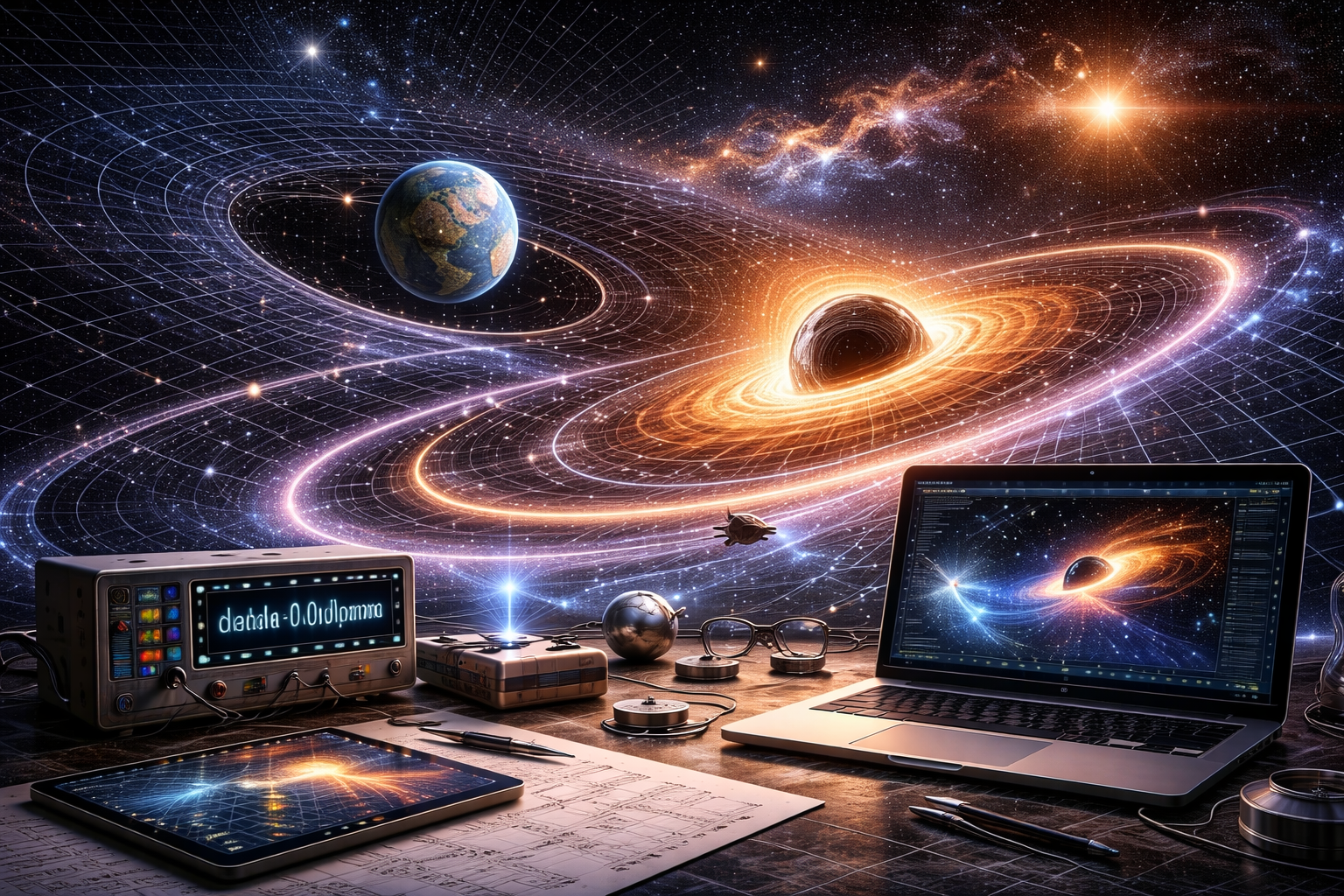
Gravity becomes one of the deepest subjects in physics when it is no longer treated merely as a force acting across space, but as a manifestation of the structure of spacetime itself. In Newtonian mechanics, gravitation is described as an attractive force between masses. In general relativity, that picture is reconstructed. Matter and energy influence the geometry of spacetime, and motion under gravity is understood as motion within that geometry. Gravity is therefore not simply added to spacetime as an external interaction. It is built into spacetime’s curvature, metric structure, causal organization, and measurement framework.
This shift matters because it transforms what counts as explanation. A falling body is no longer explained only through a force vector pointing downward. Light deflection, gravitational redshift, perihelion precession, time dilation in gravitational fields, black holes, cosmological expansion, and gravitational waves all become intelligible through the geometry of spacetime. Einstein’s 1916 paper The Foundation of the General Theory of Relativity is the decisive primary source because it develops gravitation as a theory in which the metric structure of spacetime itself carries physical meaning. Schwarzschild’s 1916 solution then shows how Einstein’s field equations yield exact gravitational geometry outside a spherical mass, while modern observations such as LIGO’s direct detection of gravitational waves show that spacetime dynamics are physically measurable.
This article develops Gravity, Curvature, and the Structure of Spacetime as a foundational topic within the Physics knowledge series. It explains the equivalence principle, spacetime curvature, geodesic motion, Einstein’s field equations, Schwarzschild geometry, gravitational time dilation, black holes, gravitational waves, constants, and relativistic metrology. It also follows the mathematics-first and computation-aware structure used throughout the series while keeping the article body readable. Selected R and Python workflows appear here, while the full GitHub repository contains advanced research-style computational workflow structure for Schwarzschild radii, gravitational time-dilation factors, effective potentials, weak-field comparisons, gravitational-wave strain examples, spacetime metadata, SQL schemas, C/C++/Fortran/Rust examples, and reproducible general-relativity workflows.
Main Library
Publications
Article Map
Physics
Related Topic
Earth Science
Related Topic
Mathematical Thinking
Related Topic
Astronomy
Why Gravity and Spacetime Matter
Gravity and spacetime matter because they reconstruct one of the most familiar physical phenomena into one of the deepest theoretical structures in science. Gravity is everywhere in experience: falling, weight, orbit, tides, planetary motion, stellar collapse, galactic structure, and cosmological evolution all depend on it. Yet general relativity shows that these are not best understood as isolated force effects acting inside a fixed stage. They are manifestations of how matter, energy, and geometry are linked.
This matters conceptually because general relativity changes the meaning of motion. In curved spacetime, freely falling objects do not behave as though they are being pulled by a Newtonian force in the ordinary sense. Rather, they follow geodesic structure determined by the metric. Gravity becomes inseparable from the structure of measurement itself, because rods, clocks, light paths, causal cones, and proper time are all affected by the geometry in which they are embedded.
It also matters historically because general relativity is one of the great syntheses of modern physics. It preserves the relativistic demand for invariant law while generalizing spacetime from flat Minkowski structure to dynamical curvature. It links astronomy, cosmology, black-hole physics, gravitational-wave observation, and high-precision timekeeping within one conceptual framework.
Einstein and the Geometric Turn
Einstein’s 1916 foundation paper sits at the center of general relativity because it develops gravitation as a theory in which the quantities representing the gravitational field also define the metric properties of spacetime. This is the geometric turn. In many classical field theories, one begins with a background arena and then places fields inside it. In general relativity, the arena itself becomes dynamical. Geometry acquires physical content.
The metric tensor is therefore not just a passive bookkeeping device for distances. It is part of the gravitational field description. The structure that tells clocks how to tick and rulers how to measure is also the structure shaped by matter and energy. This is why general relativity feels more radical than a new inverse-square law or a correction to Newtonian force. It changes the ontological status of space, time, and measurement.
The theory also redefines explanation. In Newtonian gravity, the planet’s orbit is explained by a force acting across space. In general relativity, the orbit is explained by spacetime geometry and the geodesic motion of bodies within that geometry. Gravity becomes less like a force imposed on space and more like the curvature structure through which motion is made intelligible.
The Equivalence Principle
The equivalence principle is one of the conceptual foundations of general relativity. In broad terms, it expresses the local equivalence between gravitational and inertial effects. A freely falling observer can, in a sufficiently small region, eliminate the local appearance of gravity. Conversely, accelerated motion can mimic certain gravitational effects.
This principle is powerful because it shifts gravity away from the model of an ordinary force. If gravitation can locally disappear in free fall, then it cannot be a force in quite the same way as electromagnetism in flat spacetime. It must instead be bound up with the coordinate and geometric structure through which motion is described.
The equivalence principle also explains why general relativity is not merely an astronomical theory. It begins with a local statement about frames, acceleration, and measurement, then expands into a global theory of curved spacetime. The theory’s cosmological and black-hole consequences grow out of a principle that first concerns the experience of local free fall.
Curvature, Metric, and Geodesics
General relativity describes spacetime through a metric tensor that determines intervals, causal structure, and the geometry of motion. In flat spacetime, special relativity uses the Minkowski interval. In general relativity, the interval becomes:
ds^2 = g_{\mu\nu} dx^\mu dx^\nu
\]
Interpretation: The metric tensor defines spacetime intervals, clock rates, distances, and causal structure.
where \(g_{\mu\nu}\) is the metric tensor. This expression matters because the metric is the object that tells spacetime how distances, times, and causal relations are measured. If the metric changes from place to place, the geometry is no longer globally flat in the ordinary special-relativistic sense.
Curvature enters because the metric need not have the flat structure of Minkowski spacetime everywhere. Matter and energy alter geometry, and altered geometry changes the trajectories of bodies and light. Freely falling objects follow geodesics, which are the natural curves determined by the spacetime connection and metric. Gravitational motion is therefore reinterpreted as geometry-guided motion.
A planet orbiting a star and a light ray passing near a massive body are both responding to spacetime structure. The difference from the Newtonian picture is not only mathematical. It is conceptual: the worldline itself is shaped by geometry.
Einstein’s Field Equations
The central mathematical statement of general relativity is Einstein’s field equation. In one standard form it is written as:
G_{\mu\nu} + \Lambda g_{\mu\nu} =
\frac{8\pi G}{c^4}T_{\mu\nu}
\]
Interpretation: Einstein’s field equations relate spacetime curvature to matter-energy content.
where \(G_{\mu\nu}\) is the Einstein tensor, \(\Lambda\) is the cosmological constant, \(g_{\mu\nu}\) is the metric tensor, \(G\) is Newton’s gravitational constant, \(c\) is the speed of light, and \(T_{\mu\nu}\) is the stress-energy tensor.
This equation is important because it links geometry and matter-energy in a formally explicit way. The left-hand side describes spacetime curvature structure; the right-hand side describes the energy and momentum content of matter and fields. The equation therefore expresses one of the most profound claims in physics: matter-energy shapes spacetime geometry, and spacetime geometry shapes motion.
Its significance is not only theoretical. It is the basis for concrete predictions and models: Mercury’s perihelion precession correction, light bending near the Sun, gravitational redshift, black-hole solutions, cosmological expansion models, and gravitational-wave propagation.
Schwarzschild Geometry
Schwarzschild’s 1916 solution is one of the most important exact solutions of Einstein’s field equations. It describes the spacetime outside a static, spherically symmetric, non-rotating mass. In standard coordinates, the Schwarzschild metric may be written as:
ds^2 =
-\left(1-\frac{2GM}{rc^2}\right)c^2dt^2
+
\left(1-\frac{2GM}{rc^2}\right)^{-1}dr^2
+
r^2d\Omega^2
\]
Interpretation: The Schwarzschild metric describes spacetime outside a static, spherical, non-rotating mass.
where \(d\Omega^2\) represents the angular part. This solution matters because it shows how Einstein’s field equations generate concrete spacetime structure around a mass. It also introduces one of the most famous quantities in gravitational physics, the Schwarzschild radius:
r_s = \frac{2GM}{c^2}
\]
Interpretation: The Schwarzschild radius gives the characteristic horizon scale for a non-rotating black hole.
This radius marks the characteristic horizon scale of the simplest non-rotating black-hole geometry. It is not merely an algebraic curiosity. It is the scale at which causal structure becomes radically different from the ordinary weak-field gravitational world. Schwarzschild geometry therefore sits at the crossroads of classical tests of general relativity, black-hole theory, relativistic astrophysics, and computational spacetime modeling.
Gravitational Time Dilation and Redshift
One of the most important measurable consequences of general relativity is gravitational time dilation. Clocks in stronger gravitational fields run differently from clocks farther away. In Schwarzschild geometry, a stationary clock at radius \(r\) outside a spherical mass runs at a rate related to coordinate time by:
d\tau =
dt\sqrt{1-\frac{2GM}{rc^2}}
\]
Interpretation: A stationary clock closer to a spherical mass accumulates less proper time relative to distant coordinate time.
Using the Schwarzschild radius, this can also be written as:
d\tau =
dt\sqrt{1-\frac{r_s}{r}}
\]
Interpretation: The clock-rate factor depends on distance from the Schwarzschild radius.
This means that timekeeping is not globally uniform in a gravitational field. It depends on position relative to the mass-energy distribution. This is one of the clearest examples of how relativity changes measurement itself rather than merely adding a correction to motion.
Gravitational redshift follows from the same structure. Light climbing out of a gravitational well is shifted in frequency relative to observers at higher potential. The lesson is profound: gravitation affects clocks, spectra, radiation, and causal comparison, not only the motion of massive bodies.
Black Holes and Horizons
Black holes are one of the most dramatic consequences of general relativity. In the simplest static case, they arise when mass is concentrated such that the Schwarzschild radius becomes physically relevant to the exterior geometry. The event horizon is not a material surface in the ordinary sense. It is a causal boundary beyond which outgoing light rays no longer escape to distant observers.
This matters because black holes are not merely dense stars with strong Newtonian gravity. They are spacetime configurations with distinctive causal structure. Horizons, singularity questions, geodesic incompleteness, photon spheres, accretion dynamics, and strong-field curvature all belong to the general-relativistic framework rather than to classical force intuition alone.
Modern black-hole science is also observational. Black holes are inferred through stellar orbits, accretion disks, X-ray emission, gravitational waves, and horizon-scale imaging. The Event Horizon Telescope’s imaging of supermassive black holes, LIGO’s black-hole merger detections, and high-resolution studies of galactic centers show that black-hole physics is now not only a mathematical consequence of relativity but an empirical research program.
Gravitational Waves
General relativity predicts that accelerating mass distributions can generate gravitational waves: propagating disturbances in spacetime curvature. These are not waves traveling through a material medium. They are dynamical changes in the geometry of spacetime itself. In the weak-field approximation, gravitational waves can be treated as small perturbations propagating at the speed of light.
LIGO’s 2016 announcement of the first direct detection of gravitational waves from a binary black-hole merger transformed this prediction into direct observation. The detection did not merely add another successful test to general relativity. It opened gravitational-wave astronomy, allowing astrophysical systems to be studied through spacetime strain rather than electromagnetic radiation alone.
Gravitational waves therefore extend general relativity from static curvature and orbital dynamics into observational spacetime dynamics. They show that geometry can not only curve, but propagate information across the universe.
Measurement, Constants, and Relativistic Metrology
General relativity is deeply connected to measurement science. The speed of light is an exact defining constant of the SI, and modern length measurement is tied to the fixed numerical value of \(c\). At the same time, clock comparison and synchronization must be handled carefully in contexts where relativity matters. This is especially important for global timing systems, navigation, geodesy, spaceflight, and high-precision metrology.
Relativity is therefore not only a theoretical framework for astrophysics or cosmology. It is part of the infrastructure of real measurement. Modern standards of time and length depend on an environment in which relativistic effects are acknowledged and handled rather than ignored.
This is one of the clearest signs that general relativity is not a remote abstraction. It is woven into the quantitative basis of contemporary science and technology, from satellite navigation to gravitational-wave observatories to relativistic corrections in precision timing.
Mathematical Lens
A mathematics-first treatment of general relativity begins with tensors, invariants, covariant structure, and geometry. The metric tensor \(g_{\mu\nu}\) defines spacetime intervals and the causal-metrical structure of events. From the metric one constructs the connection coefficients, curvature tensors, Ricci tensor, scalar curvature, and Einstein tensor.
The invariant spacetime interval is:
ds^2 = g_{\mu\nu}dx^\mu dx^\nu
\]
Interpretation: The spacetime interval is determined by the metric tensor and coordinate differentials.
Geodesic motion may be written through the geodesic equation:
\frac{d^2x^\mu}{d\tau^2}
+
\Gamma^\mu_{\alpha\beta}
\frac{dx^\alpha}{d\tau}
\frac{dx^\beta}{d\tau}
=
0
\]
Interpretation: The geodesic equation describes free-fall motion as motion determined by spacetime geometry.
These expressions matter because they show how gravity is encoded mathematically not as a force term added to flat motion, but as a change in geometric structure that determines inertial paths themselves.
The curvature content of the theory is summarized through Einstein’s field equation:
G_{\mu\nu} + \Lambda g_{\mu\nu}
=
\frac{8\pi G}{c^4}T_{\mu\nu}
\]
Interpretation: Curvature, cosmological constant, metric structure, and stress-energy are linked in Einstein’s field equations.
The mathematics lens should also emphasize limits. In weak-field, low-speed regimes, general relativity must reproduce Newtonian gravity approximately. This limiting correspondence matters because general relativity is not disconnected from earlier physics. It is a deeper theory whose classical approximation recovers the older gravitational picture when curvature is weak and velocities are small.
Variables, Units, and Spacetime Interpretation
General relativity depends on variables that connect geometry, matter, measurement, and motion. The table below summarizes several central quantities.
| Symbol or Term | Meaning | Typical Unit or Type | Spacetime Interpretation |
|---|---|---|---|
| \(g_{\mu\nu}\) | Metric tensor | tensor field | Defines spacetime intervals, clock rates, distances, and causal structure |
| \(ds^2\) | Spacetime interval | m² or time-equivalent form | Invariant measure of separation between nearby events |
| \(\Gamma^\mu_{\alpha\beta}\) | Connection coefficient | geometric object | Encodes how coordinates change along curves and appears in geodesic motion |
| \(G_{\mu\nu}\) | Einstein tensor | curvature tensor expression | Summarizes curvature structure in Einstein’s field equations |
| \(T_{\mu\nu}\) | Stress-energy tensor | energy density, pressure, flux terms | Represents matter-energy content and momentum flow |
| \(G\) | Newtonian gravitational constant | m³ kg⁻¹ s⁻² | Sets gravitational coupling strength in the classical and relativistic limits |
| \(c\) | Speed of light in vacuum | m/s | Defines relativistic causal scale and appears in metric and field equations |
| \(M\) | Mass | kg | Source parameter in Schwarzschild geometry and many gravitational models |
| \(r_s\) | Schwarzschild radius | m | Characteristic horizon scale for a non-rotating black hole |
| \(d\tau/dt\) | Clock-rate factor | dimensionless | Relates proper time to coordinate time in a gravitational field |
Note: General-relativistic quantities are geometric and physical at the same time. Coordinate choices matter, but invariant intervals, proper time, curvature, and stress-energy provide the deeper structure.
The table shows why general relativity is simultaneously geometrical and physical. Its symbols are not abstract decoration. They connect curvature, measurement, motion, matter-energy, and observable effects.
Worked Example: Schwarzschild Radius and Clock Rates
A compact but powerful worked example combines Schwarzschild radius with gravitational time dilation. For a spherical mass \(M\), the Schwarzschild radius is:
r_s = \frac{2GM}{c^2}
\]
Interpretation: Schwarzschild radius gives the characteristic horizon scale for a non-rotating black-hole solution.
This gives the characteristic horizon scale of the simplest non-rotating black-hole solution. Now consider a stationary clock at radius \(r\) outside the mass. Its proper time relates to coordinate time through:
d\tau =
dt\sqrt{1-\frac{r_s}{r}}
\]
Interpretation: The clock-rate factor approaches one far from the mass and becomes smaller near the Schwarzschild radius.
This immediately shows two important features. First, when \(r \gg r_s\), the factor is close to one and relativistic correction is small. Second, as \(r\) approaches \(r_s\), the rate difference becomes substantial. The example therefore compresses much of the subject into one relation: geometry alters time itself.
The same calculation also shows why interpretation matters. The Schwarzschild coordinate time \(t\) is not simply “time everywhere.” Proper time \(d\tau\) is what a local clock measures along its worldline. General relativity therefore requires careful attention to which time, which observer, and which coordinate system are being used.
Computational Modeling
Computational modeling helps make general relativity concrete without pretending that every example requires full numerical relativity. Schwarzschild radii can be computed for different masses. Clock-rate factors can be scanned over radius. Weak-field and strong-field regimes can be compared. Effective-potential workflow examples can illustrate orbital structure. Simple gravitational-wave strain functions can show how tiny fractional distortions are represented in detector data. Metadata schemas can preserve masses, radii, constants, source provenance, and model assumptions.
The selected examples below focus on Schwarzschild radius and gravitational time dilation because they are foundational and readable. The GitHub repository extends the same logic into richer computational workflow structure: R parameter exploration, Python Schwarzschild modeling, Julia orbital effective-potential examples, C++ clock-rate sweeps, Fortran radius tables, SQL spacetime metadata, Rust command-line utilities, C examples, documentation, and reproducible sample data.
R Workflow: Time Dilation Across Radius
R is especially useful when the goal is to compare relativistic effects across parameter ranges and summarize weak-field versus strong-field behavior. The following workflow computes the Schwarzschild radius for Earth and evaluates the clock-rate factor outside a spherical mass.
# Gravitational Time Dilation Outside a Spherical Mass
#
# This workflow computes the Schwarzschild radius:
#
#   r_s = 2*G*M/c^2
#
# and the Schwarzschild clock-rate factor:
#
#   d_tau/dt = sqrt(1 - r_s/r)
#
# Example:
#   Earth mass is used as a weak-field example.
#
# Interpretation:
#   The factor is close to 1 far from the Schwarzschild radius.
#   Strong-field effects become more visible when r approaches r_s.

library(tibble)
library(dplyr)

gravitational_constant <- 6.67430e-11
speed_of_light <- 299792458
earth_mass_kg <- 5.972e24

schwarzschild_radius <-
  2 * gravitational_constant * earth_mass_kg / speed_of_light^2

radius_table <- tibble(
  radius_m = seq(7e6, 5e7, length.out = 500)
) %>%
  mutate(
    radius_km = radius_m / 1000,
    schwarzschild_radius_m = schwarzschild_radius,
    clock_factor = sqrt(1 - schwarzschild_radius_m / radius_m),
    fractional_time_difference = 1 - clock_factor
  )

summary_table <- radius_table %>%
  summarise(
    schwarzschild_radius_m = first(schwarzschild_radius_m),
    minimum_radius_km = min(radius_km),
    maximum_radius_km = max(radius_km),
    minimum_clock_factor = min(clock_factor),
    maximum_fractional_time_difference = max(fractional_time_difference)
  )

print(head(radius_table, 10))
print(summary_table)
This workflow gives a clean tabular view of how weak-field relativistic timing varies with radius. It can later be extended to satellite-clock comparisons, parameter sweeps across different masses, or uncertainty-aware metrology contexts.
Python Workflow: Schwarzschild Radius and Clock Factors
Python is especially strong for spacetime functions, symbolic extensions, numerical parameter sweeps, and later geodesic-related modeling. The following workflow computes Schwarzschild radii and time-dilation factors for several masses.
"""
Schwarzschild Radius and Clock-Rate Factors

This workflow computes:

    r_s = 2*G*M/c^2

and the Schwarzschild time-dilation factor for a stationary clock:

    d_tau/dt = sqrt(1 - r_s/r)

The calculation is educational workflow example for Schwarzschild geometry.
It is not a full numerical-relativity simulation.
"""

import numpy as np
import pandas as pd

GRAVITATIONAL_CONSTANT = 6.67430e-11
SPEED_OF_LIGHT = 299_792_458.0

def schwarzschild_radius(mass_kg: float) -> float:
    """
    Compute the Schwarzschild radius for a non-rotating spherical mass.

    Parameters
    ----------
    mass_kg:
        Mass in kilograms.

    Returns
    -------
    float
        Schwarzschild radius in meters.
    """
    return 2.0 * GRAVITATIONAL_CONSTANT * mass_kg / SPEED_OF_LIGHT**2

def clock_rate_factor(
    radius_m: np.ndarray,
    schwarzschild_radius_m: float,
) -> np.ndarray:
    """
    Compute the Schwarzschild clock-rate factor for stationary clocks.

    Parameters
    ----------
    radius_m:
        Radius values outside the Schwarzschild radius.
    schwarzschild_radius_m:
        Schwarzschild radius in meters.

    Returns
    -------
    np.ndarray
        Dimensionless factor d_tau/dt.
    """
    if np.any(radius_m <= schwarzschild_radius_m):
        raise ValueError("All radius values must be outside the Schwarzschild radius.")

    return np.sqrt(1.0 - schwarzschild_radius_m / radius_m)

def main() -> None:
    """
    Compute Schwarzschild radii and clock factors for illustrative masses.
    """
    objects = pd.DataFrame(
        {
            "object": ["Earth", "Sun", "Ten solar masses"],
            "mass_kg": [5.972e24, 1.98847e30, 10.0 * 1.98847e30],
        }
    )

    objects["schwarzschild_radius_m"] = objects["mass_kg"].apply(
        schwarzschild_radius
    )
    objects["schwarzschild_radius_km"] = (
        objects["schwarzschild_radius_m"] / 1000.0
    )

    print("Schwarzschild radii:")
    print(objects.to_string(index=False))

    solar_mass = 1.98847e30
    rs_sun = schwarzschild_radius(solar_mass)
    radius = np.linspace(1.05 * rs_sun, 20.0 * rs_sun, 1000)

    clock_table = pd.DataFrame(
        {
            "radius_over_rs": radius / rs_sun,
            "clock_factor": clock_rate_factor(radius, rs_sun),
        }
    )

    print("\nClock-rate factors near a one-solar-mass Schwarzschild radius:")
    print(clock_table.head(12).round(8).to_string(index=False))

    print("\nSummary:")
    print(clock_table.describe().round(8).to_string())

if __name__ == "__main__":
    main()
This workflow makes the geometric effect on clock rates computationally visible. It can later be extended into effective potentials, photon-sphere analysis, weak-field approximations, coordinate comparisons, or simple geodesic orbit models.
GitHub Repository
The article body includes only selected computational examples so the conceptual and mathematical argument remains readable. The full repository contains the expanded computational infrastructure: R time-dilation summaries, Python Schwarzschild-radius and clock-rate workflows, Julia effective-potential examples, C++ radius and clock-factor sweeps, Fortran Schwarzschild tables, SQL spacetime metadata, Rust command-line utilities, C examples, documentation, and reproducible sample data.
Complete Code Repository
The full code distribution for this article, including selected article examples and advanced research-style computational workflow structure for Schwarzschild geometry, gravitational time dilation, effective-potential exploration, weak-field comparison, gravitational-wave strain examples, spacetime metadata, reproducibility documentation, and performance-oriented scientific computing, is available on GitHub.
From General Relativity to Modern Physics
General relativity does not remain a theory of planetary correction terms or static stars. It becomes one of the central frameworks of modern physics. It informs cosmology, black-hole theory, gravitational-wave astronomy, relativistic astrophysics, high-precision timing, space navigation, and the deepest unresolved questions about quantum gravity.
This is why gravity and spacetime belong near the center of the Physics knowledge series. They reveal that the world’s large-scale structure is inseparable from geometry, and that measurement itself becomes frame-, potential-, and curvature-sensitive when precision and theory are taken seriously.
General relativity is therefore not merely an extension of special relativity. It is a reconstruction of gravitation as geometry and one of the great syntheses of mathematical and physical thought. The open frontier is equally profound: how this geometric theory of gravity can be reconciled with quantum mechanics remains one of the central unsolved problems of modern physics.
Related Articles
- What Is Physics?
- Motion, Force, and the Foundations of Classical Mechanics
- Relativity and the Reconstruction of Space and Time
- Light, Waves, and the Physics of Radiation
- Electromagnetism and the Unification of Fields
- Cosmology and the History of the Universe
- Galaxies, Black Holes, and the Large-Scale Universe
- Quantum Mechanics and the Limits of Classical Intuition
- Quantum Fields, Particles, and the Standard Model
- Physics Beyond the Standard Model
- Experiment, Instruments, and the Material Practice of Physics
- Mathematical Methods in Physics
Further Reading
- Bureau International des Poids et Mesures (2025) The International System of Units: SI Brochure, 9th edition, version 3.02. Available at: https://www.bipm.org/en/si-brochure-9 (Accessed: 24 April 2026).
- Einstein, A. (1916) The Foundation of the General Theory of Relativity. Available at: https://sites.pitt.edu/~jdnorton/teaching/cosmology_2025/pdf/Einstein_Extension_Relativity_1916.pdf (Accessed: 24 April 2026).
- LIGO Laboratory (2016) Gravitational Waves Detected 100 Years After Einstein’s Prediction. Available at: https://www.ligo.caltech.edu/news/ligo20160211 (Accessed: 24 April 2026).
- LIGO Laboratory (n.d.) What Are Gravitational Waves? Available at: https://www.ligo.caltech.edu/page/what-are-gw (Accessed: 24 April 2026).
- NASA Goddard Space Flight Center (n.d.) Black Holes, Imagine the Universe! Available at: https://imagine.gsfc.nasa.gov/science/objects/black_holes1.html (Accessed: 24 April 2026).
- NASA Astronomy Picture of the Day (n.d.) Gravitational Principles and Mathematics. Available at: https://apod.nasa.gov/htmltest/gifcity/nslens_math.html (Accessed: 24 April 2026).
- NIST (n.d.) CODATA Value: Newtonian Constant of Gravitation. Available at: https://physics.nist.gov/cgi-bin/cuu/Value?bg= (Accessed: 24 April 2026).
- NIST (n.d.) CODATA Value: Speed of Light in Vacuum. Available at: https://physics.nist.gov/cgi-bin/cuu/Value?c= (Accessed: 24 April 2026).
- Schwarzschild, K. (1916/1999 translation) On the Gravitational Field of a Mass Point According to Einstein’s Theory. Available at: https://arxiv.org/abs/physics/9905030 (Accessed: 24 April 2026).
- Stanford Encyclopedia of Philosophy (2024) The Hole Argument. Available at: https://plato.stanford.edu/entries/spacetime-holearg/ (Accessed: 24 April 2026).
References
- Bureau International des Poids et Mesures (2025) The International System of Units: SI Brochure, 9th edition, version 3.02. Available at: https://www.bipm.org/en/si-brochure-9 (Accessed: 24 April 2026).
- Einstein, A. (1916) The Foundation of the General Theory of Relativity. Available at: https://sites.pitt.edu/~jdnorton/teaching/cosmology_2025/pdf/Einstein_Extension_Relativity_1916.pdf (Accessed: 24 April 2026).
- LIGO Laboratory (2016) Gravitational Waves Detected 100 Years After Einstein’s Prediction. Available at: https://www.ligo.caltech.edu/news/ligo20160211 (Accessed: 24 April 2026).
- LIGO Laboratory (n.d.) What Are Gravitational Waves? Available at: https://www.ligo.caltech.edu/page/what-are-gw (Accessed: 24 April 2026).
- NASA Goddard Space Flight Center (n.d.) Black Holes, Imagine the Universe! Available at: https://imagine.gsfc.nasa.gov/science/objects/black_holes1.html (Accessed: 24 April 2026).
- NASA Astronomy Picture of the Day (n.d.) Gravitational Principles and Mathematics. Available at: https://apod.nasa.gov/htmltest/gifcity/nslens_math.html (Accessed: 24 April 2026).
- NIST (n.d.) CODATA Value: Newtonian Constant of Gravitation. Available at: https://physics.nist.gov/cgi-bin/cuu/Value?bg= (Accessed: 24 April 2026).
- NIST (n.d.) CODATA Value: Speed of Light in Vacuum. Available at: https://physics.nist.gov/cgi-bin/cuu/Value?c= (Accessed: 24 April 2026).
- Schwarzschild, K. (1916/1999 translation) On the Gravitational Field of a Mass Point According to Einstein’s Theory. Available at: https://arxiv.org/abs/physics/9905030 (Accessed: 24 April 2026).