
Last Updated May 10, 2026
Climate economics, transition policy, and decarbonization belong together because climate change is not a narrow environmental problem added onto an otherwise stable economy. It is a structural economic-system risk that reaches into energy, industry, transport, buildings, food systems, water security, insurance, public health, labor productivity, finance, infrastructure, migration, territorial planning, and the long-run viability of communities. Climate economics examines how emissions, climate damages, energy systems, investment, risk, inequality, and public policy interact within economic life. Transition policy concerns the institutional strategies through which states, firms, workers, households, and regions attempt to move from fossil-fuel dependence toward lower-emissions systems. Decarbonization refers to the reduction of greenhouse gas emissions across electricity, transport, industry, buildings, agriculture, land use, and wider infrastructure.
These themes matter because the same fossil-energy systems that powered modern industrial growth also created atmospheric instability. Coal, oil, and gas were not simply fuels; they became embedded in settlement patterns, transportation systems, building stock, industrial processes, trade routes, fiscal systems, geopolitical relations, and everyday expectations of mobility, heat, electricity, and consumption. Transition therefore cannot be reduced to a cleaner fuel swap. It requires the reorganization of capital stock, public infrastructure, productive capacity, land use, finance, labor markets, and political legitimacy under ecological time pressure.
Climate economics is especially important because it forces economic analysis to confront time, uncertainty, irreversibility, inequality, and collective risk at planetary scale. Emissions accumulate; damages unfold unevenly; costs and benefits are distributed across countries, generations, sectors, firms, households, and territories. Transition policy is equally important because decarbonization will not happen automatically through awareness, consumer preference, or market signals alone. It requires standards, public investment, industrial strategy, credible regulation, social protection, institutional capacity, and durable public trust.
Main Library
Publications
Article Map
Economic Systems
Related Topic
Sustainable Development
Related Topic
Environmental Systems
Related Topic
Risk & Resilience
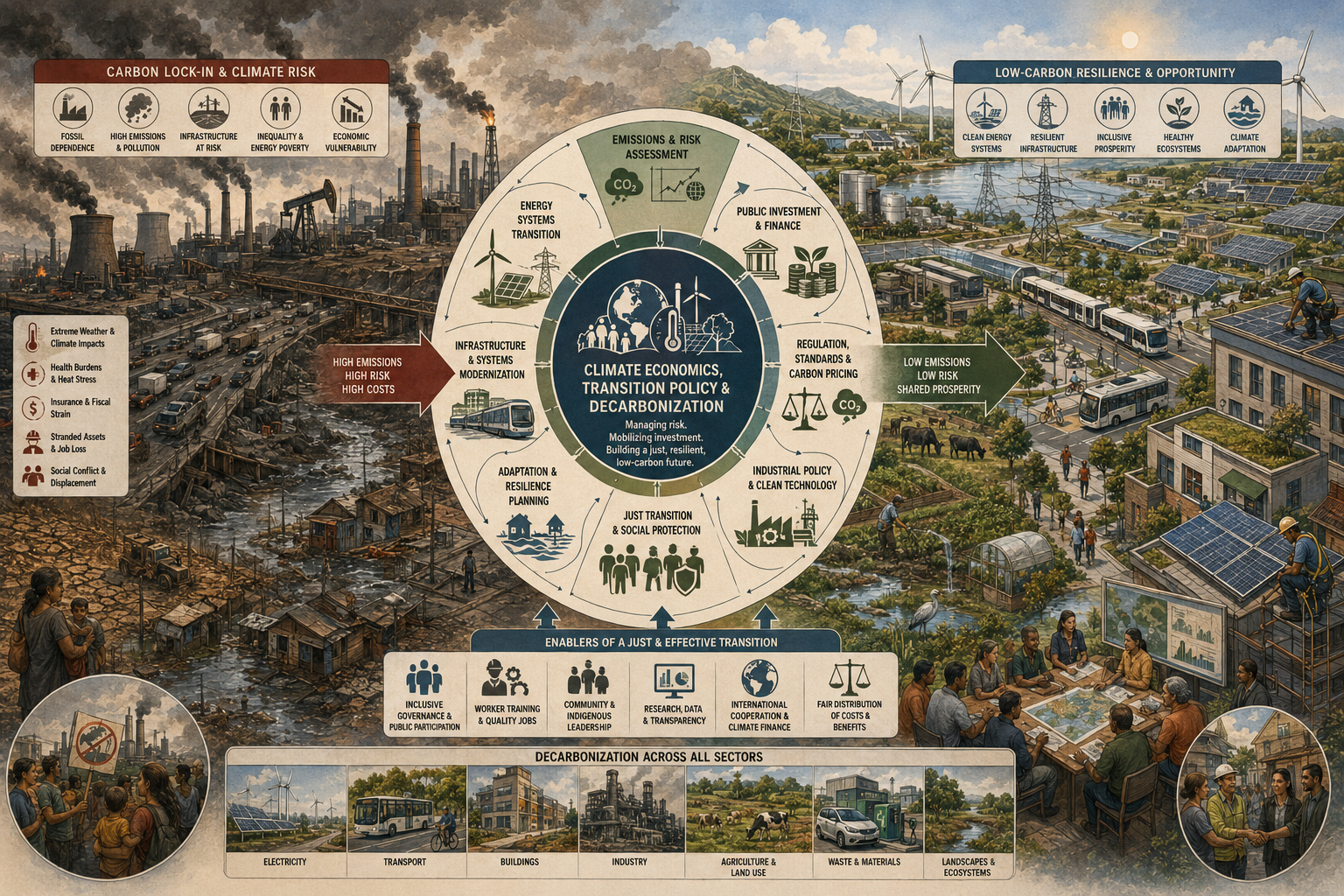
Within a sustainable systems framework, climate economics, transition policy, and decarbonization should be examined not only in terms of emissions efficiency, but in terms of justice, resilience, public capacity, industrial capability, territorial fairness, and institutional credibility. A society may lower carbon intensity while leaving energy poverty, extractive transition burdens, regional decline, weak public infrastructure, or fragile supply chains unresolved. The deeper question is whether decarbonization can be organized as a durable social transformation rather than as a narrow technical fix layered onto economic systems still oriented toward ecological overshoot and unequal adjustment.
Why This Topic Matters
Climate change is often discussed in environmental language, but its effects are economic in the deepest sense. Heat reduces labor productivity. Floods damage housing, infrastructure, public budgets, and insurance systems. Drought reshapes agriculture, water access, energy generation, and migration pressure. Wildfire disrupts health systems, property markets, utilities, and regional viability. Storms, sea-level rise, ecosystem stress, and disease shifts all interact with existing inequalities and institutional weaknesses.
Climate economics matters because it places those interactions at the center of analysis. It asks how emissions are generated, how damages propagate through economies, how transition costs and benefits are distributed, and what kinds of policy mix can move systems toward lower-carbon operation without social breakdown or political backlash.
Transition policy matters because decarbonization is not a single switch. It involves grids, buildings, transport systems, industrial process heat, planning law, public procurement, transmission lines, supply chains, workforce development, land use, finance, and long-lived capital stock. The relevant question is not whether cleaner technologies exist somewhere, but whether institutions can deploy them at scale with enough legitimacy and coordination to change the direction of the system.
For that reason, climate economics, transition policy, and decarbonization belong near the center of contemporary political economy. They concern how societies govern systemic risk, reallocate investment, and decide who will bear the costs and benefits of structural change.
They also clarify that climate transition is not only about replacing fuels. It is about reorganizing economic life under ecological constraint and doing so fast enough to preserve habitable, governable, and socially legitimate futures.
Without that broader lens, climate policy can become technically correct but politically brittle: capable of measuring emissions, but unable to transform the institutions that keep producing them.
The central question is therefore not whether decarbonization is necessary. The deeper question is whether societies can build transition pathways that are fast, fair, credible, and materially capable enough to work.
What Climate Economics Is
Climate economics studies the relationships among emissions, climate change, damages, mitigation, adaptation, energy systems, public finance, investment, inequality, and policy. It asks how greenhouse gas emissions are generated by economic activity, how climatic change feeds back into production and welfare, and how institutions can steer economies toward lower-carbon pathways while managing transition risks.
This matters because climate change creates both flow problems and stock problems. Annual emissions are flows, but their accumulation in the atmosphere produces long-lived stock effects. The damage is delayed, cumulative, uncertain, and unevenly distributed. Standard short-run market reasoning struggles with this combination of long time horizons, nonlinear thresholds, irreversible loss, and intergenerational responsibility.
Climate economics therefore requires a wider conception of risk than ordinary cost-benefit reasoning often supplies. It must address uncertainty, catastrophe risk, distribution, discounting, infrastructure lock-in, public investment, and the ethical difficulty of comparing present costs with future harm.
A serious account therefore treats climate economics as a framework for understanding systemic transformation rather than as a side branch of environmental policy.
Its central concern is how economies organized around carbon-intensive systems can be restructured under time pressure without ignoring justice, resilience, capability, or public legitimacy.
Climate economics also challenges the idea that economic growth can be evaluated separately from the physical systems that make it possible. A growing economy whose emissions destabilize climate systems is not simply producing more output; it is also increasing future damage, uncertainty, and adaptation burden.
The field therefore asks how economic systems should be governed when their ordinary functioning threatens the planetary conditions on which future economic life depends.
What Transition Policy Is
Transition policy refers to the public strategies used to steer economic systems away from fossil-fuel dependence and toward lower-emissions structures. It includes carbon pricing, regulation, industrial policy, infrastructure investment, public procurement, standards, innovation policy, social protection, labor policy, regional transition support, and institutional planning.
This matters because transition is not only a matter of changing relative prices. Existing systems are stabilized by infrastructure, ownership patterns, incumbent interests, habits of use, building stock, transport networks, power-market design, debt structures, utility regulation, and geopolitical dependencies. Transition policy exists because markets alone do not reliably solve coordination problems of this scale, speed, and uncertainty.
Transition policy also reflects political economy. Some policies shift burdens visibly onto households. Others mobilize public investment and industrial capacity. Some create new capabilities; others create backlash by asking people to pay more without giving them viable alternatives. Policy design therefore affects legitimacy as much as emissions.
A serious framework therefore treats transition policy as an institutional architecture rather than a single instrument.
The issue is how states and societies build credible pathways from one energy and production order to another.
Transition policy must also coordinate time. Infrastructure takes years to build. Workers need real pathways into new sectors. Firms need credible rules. Households need affordable options. Public agencies need administrative capacity. Delayed action makes every later transition harder.
Good transition policy therefore combines direction, investment, protection, discipline, and learning. It does not assume that announcing targets is the same as building the capacity to meet them.
What Decarbonization Means
Decarbonization means reducing greenhouse gas emissions across the systems that generate them. In practice this involves changing electricity generation, transport systems, buildings, industrial processes, agriculture, land use, infrastructure, and sometimes consumption patterns and urban form.
This matters because carbon is embedded in physical systems, not only in fuels. Roads and settlement patterns shape transport demand. Building quality shapes heating and cooling demand. Power grids shape electrification feasibility. Industrial equipment shapes process emissions. Agricultural practices shape land emissions, methane, nitrous oxide, soil carbon, and food-system resilience.
Decarbonization also has temporal and spatial unevenness. Some sectors can move relatively quickly, such as electricity in places with supportive institutions and grid capacity. Others, such as steel, cement, shipping, aviation, and parts of agriculture, are harder to transform and often require longer industrial and infrastructural shifts.
A serious account therefore treats decarbonization as structural rather than cosmetic.
It is not simply about cleaner consumption choices, but about reshaping the material organization of economies around lower-emissions systems.
This distinction matters because emissions can fall in one place while being shifted elsewhere through supply chains, imported goods, or outsourced production. Decarbonization must therefore be evaluated through production, consumption, trade, infrastructure, and territorial justice together.
The central test is whether emissions decline in absolute terms while wellbeing, resilience, and fairness improve rather than deteriorate.
Climate Change as Economic System Risk
Climate change is not a single-sector problem. It is a system risk that affects productivity, infrastructure, food systems, insurance markets, fiscal stability, public health, migration pressures, financial stability, and political legitimacy. Heat, flood, drought, wildfire, storm intensity, sea-level rise, and ecosystem disruption interact with existing inequalities and institutional weaknesses.
This matters because climate risks compound. A flood does not only damage property; it disrupts transport, work, schooling, public budgets, health services, and insurance. Heat affects labor capacity, energy demand, crop yields, housing conditions, and health systems at the same time. Climate risk propagates through supply chains and public institutions, not only through isolated damage estimates.
The system-risk perspective also changes how economics should think about prevention. Mitigation is not only an environmental virtue. It is part of reducing future macroeconomic instability and protecting the public foundations of social life.
A serious framework therefore treats climate change as a threat to the governability and resilience of economic systems, not merely as a line item in damage estimates.
Its significance lies partly in the way it amplifies fragility across already stressed infrastructures and unequal societies.
System risk also means that the benefits of mitigation are often broader than avoided emissions alone. Lower dependence on volatile fossil systems can improve energy security. Cleaner air can improve public health. Better buildings can reduce energy poverty. Resilient infrastructure can reduce disaster losses.
Climate economics must therefore account for co-benefits, avoided instability, and reduced vulnerability—not only direct carbon accounting.
Externalities, Market Failure, and Price-Only Thinking
Climate economics is often introduced through the language of externalities: emitters impose costs not fully reflected in market prices. This is a useful starting point, but it is not sufficient by itself. Climate change is not a small deviation from otherwise efficient markets. It is a structural failure in systems whose price signals ignore cumulative atmospheric damage and long-run ecological destabilization.
This matters because policy framed only around correcting prices may underestimate the scale of institutional reorganization required. Carbon pricing can be useful, but it does not by itself build grids, retrofit buildings, retrain workers, expand public transit, reorganize supply chains, develop clean industry, or resolve energy poverty.
Price-only thinking can also create distributional backlash if burdens fall visibly on households while incumbents remain protected or public alternatives remain weak. A fuel charge without transit, retrofit support, or household compensation may be economically elegant but politically fragile.
A serious account therefore treats climate policy as broader than the correction of a textbook market failure.
It is a problem of structural coordination, investment, and justice as much as price misalignment.
This does not mean prices are irrelevant. Carbon prices, fuel taxes, performance markets, and emissions trading systems can help redirect incentives. But they work best inside wider policy packages that include standards, public investment, infrastructure, social protection, and credible long-term rules.
The deeper policy question is not whether emissions should carry a cost. It is how price signals, public capacity, and institutional design can work together to transform systems rather than merely penalize people inside systems they cannot individually change.
Carbon Lock-In, Infrastructure, and Path Dependence
Carbon-intensive systems persist partly because they are embedded in durable infrastructure. Roads, pipelines, refineries, suburban land use, gas networks, industrial equipment, airport systems, vehicle fleets, power plants, ports, and building stock all create path dependence. People and firms make choices within infrastructures they did not individually design.
This matters because even when cleaner options become cheaper on paper, existing systems continue to shape behavior. A commuter cannot easily abandon car dependence where transit is weak. A household cannot electrify heating easily in a poorly insulated building with inadequate grid support. An industrial firm cannot switch processes overnight if capital stock has decades of expected life remaining.
Carbon lock-in also gives incumbent sectors political influence. Existing asset owners have incentives to defend asset values, delay phaseout, or demand compensation. The transition therefore becomes a conflict over time, stranded assets, public support, and the future of sunk investments.
A serious framework therefore treats decarbonization as a path-dependence problem rather than a simple technology-choice problem.
What matters is not only which innovations exist, but how quickly institutions can overcome infrastructures built for a different energy order.
Lock-in also means that delay is costly even when no immediate emissions target is missed. Every new fossil asset, inefficient building, highway-dependent development, or carbon-intensive industrial plant can create decades of future constraint.
Transition policy must therefore govern new investment as carefully as existing emissions. Avoiding new lock-in is often cheaper than reversing it later.
Energy Systems and the Political Economy of Transition
Energy systems sit at the heart of decarbonization because electricity, fuels, heating, cooling, and industrial energy use structure much of the emissions profile of modern economies. Power generation can often decarbonize faster than other sectors, but electrification then shifts pressure onto grids, storage, transmission, demand management, distribution systems, and mineral supply chains.
This matters because energy transition is not merely substitution. It changes ownership patterns, territorial politics, utility models, public investment needs, labor demand, and geopolitical dependencies. Renewable energy can reduce fuel imports in some contexts, but it also raises new questions about land use, mineral sourcing, grid planning, and system balancing.
Energy systems are also politically sensitive because energy prices affect households and firms directly. Transition policy that ignores affordability, reliability, and trust can quickly lose legitimacy even when its climate logic is sound.
A serious account therefore treats energy transition as both a technical and political-economic process.
Its success depends on whether lower-carbon energy can be made reliable, affordable, and institutionally credible at scale.
Energy transition also changes public authority. Grid planning, transmission approval, interconnection queues, public utility regulation, storage policy, and demand response all become central economic questions. They are not merely technical details; they determine whether electrification can actually happen.
The energy transition is therefore a test of coordination capacity. Without public planning and investment, clean generation can expand while the system needed to use it remains blocked.
Carbon Pricing, Regulation, and Public Investment
Three broad tools recur in climate policy: pricing, regulation, and public investment. Carbon pricing seeks to alter incentives by making emissions more costly. Regulation sets standards, phaseouts, efficiency requirements, or performance obligations. Public investment builds the infrastructure, capacity, and alternatives that markets alone may underprovide.
This matters because no single instrument is enough. Pricing can encourage shifts, but it works unevenly across sectors and social groups. Regulation can force change, but it requires enforcement capacity and political durability. Public investment can accelerate transition, but it demands fiscal room, administrative competence, and long-run planning.
The most credible transition strategies combine these tools. Pricing without alternatives can provoke backlash. Regulation without investment can overpromise. Investment without standards can drift. The policy mix matters more than the elegance of any single instrument.
A serious framework therefore evaluates climate policy as an integrated institutional package.
The relevant question is whether the mix is strong enough to move systems while fair enough to remain politically sustainable.
Policy sequencing also matters. Building affordable alternatives before imposing visible costs can improve legitimacy. Standards can create markets for new technology. Public procurement can reduce risk for emerging sectors. Carbon pricing can reinforce shifts once alternatives exist.
The strongest transition policy is therefore not a choice between market and state. It is a disciplined coordination strategy that uses prices, rules, investment, and public capacity together.
Industrial Policy, Clean Technology, and Strategic Capability
Decarbonization is also an industrial question. Batteries, grid equipment, heat pumps, insulation materials, public transit systems, electrolysers, low-carbon steel, clean cement, and clean-manufacturing inputs all require production capacity, logistics, research, training, standards, finance, and coordinated investment.
This matters because transition can create new developmental opportunities as well as new dependencies. States and regions that build clean-technology capability may gain productive depth, skilled employment, public revenue, and strategic resilience. Those that rely entirely on imported transition systems may reduce some emissions while remaining vulnerable to supply shocks or geopolitical concentration.
Industrial policy therefore matters not only for competitiveness, but for the credibility of transition itself. If decarbonization is experienced mainly as deindustrialization, price burden, or import dependence, political support may weaken.
A serious account therefore treats climate transition as a strategic-capability project rather than only as an environmental obligation.
Who builds the low-carbon economy, where, and under what labor and industrial conditions are core questions of climate economics.
Clean industrial policy also raises accountability questions. Public subsidies, tax credits, procurement, and loan guarantees should produce public returns: emissions reductions, domestic capability, decent work, regional inclusion, learning, and infrastructure resilience.
Without such discipline, industrial policy can become private windfall under green branding. With discipline, it can become a tool for building the material capacity needed for a credible transition.
Transport, Buildings, and the Material Work of Decarbonization
Much of decarbonization happens in ordinary systems of daily life. Transport emissions depend on urban form, transit, vehicle fleets, logistics, freight systems, and infrastructure. Building emissions depend on insulation, heating systems, cooling demand, electricity supply, design standards, and retrofit capacity. These are not marginal sectors. They are where carbon meets everyday routine.
This matters because decarbonization here is materially and administratively demanding. Retrofitting buildings at scale requires skilled labor, finance, standards, inspections, supply chains, consumer trust, and often public support. Transport transition requires more than electric cars. It also involves transit, walkability, freight systems, land use, road design, and territorial planning.
These sectors also reveal the social politics of transition. Households experience costs, disruption, and benefits directly. A poorly designed transition can look like higher bills, limited options, and bureaucratic friction. A better-designed one can improve comfort, mobility, health, affordability, and local resilience.
A serious framework therefore places everyday infrastructure at the center of climate policy.
Decarbonization becomes durable when it improves ordinary life rather than appearing only as sacrifice layered onto fragile systems.
This is especially important for low-income households, renters, rural communities, and people living in inefficient buildings or car-dependent areas. Without public support, they may face transition costs without realistic control over the systems that produce those costs.
The built environment therefore makes justice concrete. Climate policy succeeds when homes, streets, transit, heating, cooling, and daily mobility become cleaner and more secure together.
Industry, Heavy Emissions, and Hard-to-Abate Sectors
Heavy industry remains one of the most difficult parts of decarbonization. Steel, cement, chemicals, shipping, aviation, and high-temperature process industries often depend on fossil energy, embodied carbon, or complex supply systems that are difficult to replace quickly.
This matters because these sectors are foundational to infrastructure, trade, construction, agriculture, defense, and manufacturing. Delay here has economy-wide implications, but transition costs and technological uncertainty are also high. Some pathways depend on electrification, some on hydrogen, some on carbon capture, some on material substitution, and some on reduced demand or redesigned systems.
Industrial transition therefore requires strong policy coordination. Firms may underinvest where uncertainty is high and returns are distant. Public guarantees, standards, procurement, research, infrastructure, and strategic planning can be decisive.
A serious account therefore treats hard-to-abate sectors as a central test of climate policy seriousness.
They reveal whether transition strategy is merely symbolic or capable of reshaping the deepest material layers of industrial civilization.
Demand also matters. Lower-carbon steel and cement are important, but so are building reuse, material efficiency, circular construction, public planning, and infrastructure design that reduces unnecessary material throughput.
Hard-to-abate does not mean impossible to govern. It means that technology, demand, procurement, standards, and industrial strategy must be coordinated deliberately rather than left to fragmented market adjustment.
Agriculture, Land Use, and Carbon-Society Relations
Decarbonization is not only about energy and industry. Land use and agriculture shape emissions, carbon sequestration, biodiversity, water systems, food security, and rural livelihoods. Food systems generate emissions through fertilizer use, livestock systems, land conversion, energy use, transport, cold chains, and waste, while landscapes also serve as carbon sinks and ecological infrastructure.
This matters because land is multifunctional. It supports food, livelihoods, biodiversity, water regulation, settlement, culture, and climate goals at the same time. Climate policy that treats land only as a carbon ledger can create conflict with food security, local rights, ecological complexity, and rural dignity.
Agricultural transition also reveals the social depth of decarbonization. Farming systems are embedded in subsidies, property regimes, trade systems, debt structures, cultural identity, and rural politics. Change requires more than technical recommendations.
A serious framework therefore treats land use as a socio-ecological transition arena rather than a residual emissions category.
The question is how to align climate goals with food systems, ecological renewal, and rural dignity rather than reducing one to the language of the other.
Regenerative agriculture, agroecology, soil-carbon practices, methane reduction, food-waste reduction, and dietary shifts can all matter, but each must be governed through justice, evidence, and context rather than slogans.
Land policy is therefore climate policy, food policy, biodiversity policy, and social policy at once.
Finance, Risk, Disclosure, and the Cost of Capital
Finance shapes decarbonization by influencing which projects receive capital, at what cost, and under what expectations of risk and return. Climate-related disclosure, transition risk assessment, green investment, stranded-asset analysis, and central-bank concern with financial stability have all pushed climate into the domain of finance.
This matters because the cost of capital affects the speed of transition. Clean infrastructure often has high upfront cost and long payoff periods. Policy credibility, public guarantees, disclosure frameworks, and development finance can lower risk and accelerate investment. Conversely, uncertainty and weak institutions can slow even economically sensible projects.
Finance also carries political risk. The language of green finance can be used seriously, or it can become a thin overlay on unchanged extraction if disclosure is weak and capital continues to favor short-horizon returns.
A serious account therefore treats finance as a transition lever, but not as a substitute for public strategy.
Capital will matter enormously, yet the direction of transition still depends on rules, institutions, and public purpose rather than on markets discovering the future by themselves.
Financial systems also need to recognize physical risk. Climate damages can affect mortgages, insurance, municipal bonds, agricultural credit, infrastructure finance, and sovereign risk. Ignoring these links can produce mispriced assets and delayed adjustment.
Climate finance is therefore not only about mobilizing capital for clean projects. It is about governing risk, disclosure, credit, public guarantees, and long-term investment in ways that support real decarbonization rather than paper alignment.
Adaptation, Loss and Damage, and Residual Climate Burden
Mitigation is essential, but some climate damage is already unavoidable. Adaptation concerns efforts to reduce vulnerability through infrastructure, planning, public health systems, water management, disaster readiness, ecosystem restoration, heat protection, insurance reform, and territorial resilience. Loss and damage refers to harms that adaptation cannot fully prevent, especially in vulnerable countries and communities with limited responsibility for historic emissions.
This matters because climate economics cannot be only about future emissions pathways. It must also address present burdens and unequal exposure. Flood defenses, heat adaptation, crop shifts, insurance reform, relocation support, and resilient infrastructure all require public capacity and distributive judgment.
Loss and damage also raises ethical and geopolitical questions. Who pays for harms that were not symmetrically caused? Which institutions are responsible when vulnerability and historic emissions are deeply unequal?
A serious framework therefore treats adaptation and residual burden as integral to climate economics rather than as afterthoughts once mitigation is discussed.
A transition that ignores unavoidable damage will remain incomplete and politically unstable.
Adaptation must also avoid becoming a privatized survival burden. Households cannot individually retrofit whole regions, rebuild public-health systems, redesign watersheds, or finance climate migration. These are public and collective challenges.
Climate resilience therefore depends on public infrastructure, social protection, local knowledge, ecological restoration, and institutions that refuse to leave the most exposed communities to adapt alone.
Just Transition, Labor, and Regional Inequality
Decarbonization creates uneven consequences across workers, communities, and regions. Fossil-fuel extraction zones, industrial clusters, logistics systems, refinery towns, carbon-intensive supply chains, and utility workforces may face job loss, declining tax bases, weakened local identity, and regional decline if transition is managed badly. At the same time, new industries can generate new employment and capability where policy is strategic and credible.
This matters because transition is lived locally. Aggregate emissions gains are not enough if particular communities experience the process mainly as abandonment. Just transition therefore concerns compensation, retraining, local investment, labor standards, public services, public revenue replacement, and the distribution of new opportunity.
Labor also matters because transition requires work: retrofitting, grid expansion, transit construction, remediation, ecosystem restoration, clean manufacturing, building upgrades, and infrastructure maintenance all depend on skilled labor systems.
A serious account therefore places labor and place at the center of decarbonization.
Climate policy becomes more durable when transition is organized as shared reconstruction rather than selective sacrifice.
Just transition is also about dignity. Workers and communities should not be treated as residual costs of climate policy. They should be treated as participants in rebuilding the productive base of a lower-carbon economy.
The question is not whether some sectors must change. They must. The question is whether that change is governed with foresight, respect, investment, and democratic accountability.
Global Inequality, Historical Responsibility, and Climate Cooperation
Climate change is global, but responsibility and capability are not evenly distributed. Wealthier countries have contributed more to historic emissions, while poorer countries often face greater vulnerability and have less fiscal room for adaptation and transition. At the same time, emerging economies seek development space, energy access, industrial growth, and public infrastructure.
This matters because climate cooperation depends on legitimacy. Demands for rapid decarbonization will face resistance if they appear to preserve inequality by asking poorer countries to constrain development without corresponding finance, technology support, or recognition of unequal historic responsibility.
Global cooperation also matters materially. Supply chains, emissions leakage, trade rules, climate finance, technology transfer, debt, mineral access, food systems, and industrial policy all shape whether decarbonization becomes coordinated or fragmented.
A serious framework therefore treats climate transition as a question of global political economy rather than only national policy design.
The challenge is to reconcile decarbonization with development, sovereignty, and fairness in a world of unequal starting points.
Historical responsibility does not remove the need for all countries to reduce emissions. But it changes what fairness requires: finance, technology, adaptation support, debt reform, capacity-building, and recognition that the path to low-carbon development cannot simply replicate the constraints imposed on countries that did not create the bulk of the problem.
Climate cooperation succeeds only when it becomes credible as a development and justice project, not merely as an emissions-control regime.
Governance, Credibility, and the Problem of Implementation
Many climate strategies fail not in announcement but in implementation. Targets are easier to declare than to finance, coordinate, permit, enforce, and sustain. Grids stall in planning and interconnection processes. Retrofit programs fail through weak administration. Standards lack enforcement. Public opposition rises where transition appears imposed without visible benefit or institutional reliability.
This matters because credibility is one of the scarcest resources in transition politics. Households, firms, investors, and workers adjust more effectively when they believe rules will persist and public institutions can carry them through. Repeated policy reversal raises cost and slows change.
Governance also matters because climate policy is multi-level. Local governments, utilities, national regulators, development banks, industrial agencies, public-health systems, labor institutions, and international organizations all interact. Weak coordination across levels can undermine otherwise sound policy design.
A serious account therefore treats implementation capacity as a core part of climate economics rather than as an administrative afterthought.
Decarbonization succeeds when institutions can translate ambition into ordinary durable practice across sectors and territories.
Credibility is built through visible delivery: lower bills, better infrastructure, reliable transit, good jobs, faster permitting, accountable subsidies, transparent rules, and public services that make transition tangible.
Climate policy is therefore not only about the future. It must prove itself in the present through competent institutions people can trust.
Historical Lessons from Energy Transitions and Climate Delay
Historical energy transitions were rarely simple substitutions. New energy systems often layered onto old ones for long periods rather than replacing them rapidly. Coal, oil, gas, electricity, nuclear power, and modern renewables each developed through infrastructures, institutions, capital stock, labor systems, and political settlements that took decades to build.
This matters because it clarifies both difficulty and urgency. Decarbonization must move faster than past transitions if climate goals are to remain plausible, but it must do so in a world already deeply locked into carbon-intensive assets and unequal development patterns.
History also shows that delay has political economy. Incumbent sectors defend asset values. States dependent on hydrocarbon revenue face fiscal risks. Consumers adapt to cheap carbon-intensive mobility and heating. Financial systems discount long-run harm. Delay is not accidental; it is institutionally produced.
A serious historical perspective therefore treats climate transition as a struggle against both material inertia and organized postponement.
The future will depend not only on invention, but on whether institutions can overcome structures built to extend the life of the old system.
History also warns against technological determinism. Technologies become transformative only when embedded in institutions, infrastructure, finance, labor, public legitimacy, and policy. Solar panels, batteries, heat pumps, and clean industry matter, but they do not deploy themselves.
The historical lesson is therefore not that transition is impossible. It is that transition must be governed deliberately because inherited systems do not retire simply because better alternatives exist.
Climate Economics and Sustainable Systems
Within sustainable systems, climate economics is not a specialized corner of policy. It is one of the clearest tests of whether modern economies can govern themselves under long-horizon ecological constraint. Decarbonization reveals whether societies can reorganize energy, industry, land use, infrastructure, finance, labor, and everyday life without allowing inequality, fragility, and delay to harden into crisis.
This changes the meaning of transition success. Success is not only lower emissions in statistical terms. It is whether lower emissions are achieved through systems that remain socially legitimate, materially resilient, and institutionally capable of supporting broad-based life.
Sustainable systems therefore require more than cleaner technology. They require credible transition policy, public investment, social protection, territorial fairness, institutional capacity, and the willingness to confront carbon lock-in as a structural problem rather than as a matter of consumer preference alone.
In this sense, climate economics becomes a systems question. It asks whether decarbonization can be organized as a durable reconstruction of collective life rather than as a sequence of isolated policy patches.
This also means that sustainability cannot be treated as separate from energy, industry, labor, finance, and public institutions. Climate transition is precisely where those systems meet.
A sustainable transition would reduce emissions while improving public health, energy security, housing quality, mobility, regional opportunity, ecological resilience, and global fairness. It would build capacity rather than merely impose restraint.
The central challenge is to make decarbonization not only technically plausible, but socially credible, economically productive, and institutionally durable.
How Climate Transition Systems Should Be Judged
Climate transition systems should not be judged only by announced targets or aggregate emissions curves. A broader economic systems framework asks whether decarbonization is fast enough, fair enough, institutionally credible, fiscally grounded, industrially capable, and resilient enough to endure political and ecological stress.
| Dimension | Narrow Question | Systems Question |
|---|---|---|
| Emissions | Are emissions falling? | Are absolute emissions falling fast enough across all major sectors, including hard-to-abate systems? |
| Intensity | Is the economy becoming cleaner per unit of output? | Are intensity gains large enough to overcome scale effects, rebound, and demand growth? |
| Infrastructure | Are clean technologies available? | Are grids, buildings, transit, logistics, industrial systems, and public institutions able to deploy them at scale? |
| Policy Mix | Is there a carbon price? | Do pricing, regulation, standards, investment, procurement, and social protection reinforce one another? |
| Investment | Is capital flowing? | Are public finance, private capital, policy credibility, and cost-of-capital conditions aligned with transition speed? |
| Lock-In | Are old assets retiring? | Are new fossil dependencies being prevented while existing carbon-intensive systems are phased down credibly? |
| Labor | Are jobs created? | Are workers and regions protected, retrained, invested in, and included in new productive opportunity? |
| Adaptation | Are damages being managed? | Are vulnerability, infrastructure, health systems, insurance, relocation, and public services being strengthened? |
| Global Equity | Are countries cooperating? | Are historical responsibility, development need, climate finance, technology support, and vulnerability addressed fairly? |
| Credibility | Are targets announced? | Can institutions finance, enforce, coordinate, and maintain transition policy across political cycles? |
This framework prevents a common mistake: treating decarbonization as a purely technical emissions pathway detached from social and institutional reality. A transition can be well-modeled but poorly governed. It can be efficient in theory but unjust in practice. It can announce ambitious goals while lacking the public capacity to implement them.
The central issue is therefore not only whether climate policy exists. The deeper question is whether climate policy is capable of reorganizing the systems that produce emissions while strengthening the systems that allow people to live securely through the transition.
Mathematical Lens
Mathematics can clarify climate economics by making emissions drivers, intensity change, investment conditions, damage risk, and transition fairness explicit. These equations do not determine what policy is just, but they help show what must be examined.
1. Emissions Identity
E = Y \times EI
\]
Interpretation: Total emissions \(E\) depend on economic activity or output \(Y\) and emissions intensity \(EI\). This highlights that emissions can fall through lower carbon intensity, lower energy intensity, changes in output composition, or changes in total activity.
2. Kaya-Style Decomposition
CO_2 = Population \times Income\ per\ Capita \times Energy\ Intensity \times Carbon\ Intensity
\]
Interpretation: A Kaya-style decomposition separates demographic, income, energy-efficiency, and fuel-mix drivers of emissions. It helps clarify why decarbonization requires changes in energy systems as well as changes in economic structure.
3. Decarbonization Rate
DR = \frac{EI_{old} – EI_{new}}{Time}
\]
Interpretation: The decarbonization rate \(DR\) measures how quickly emissions intensity is falling over time. It is useful for comparing actual transition speed with climate targets.
4. Transition Investment
TI = f(Public\ Investment, Private\ Capital, Policy\ Credibility, Cost\ of\ Capital)
\]
Interpretation: Transition investment \(TI\) depends on both public and private finance, but also on credibility, risk, and the cost of capital. Decarbonization speed depends on coordinated investment conditions, not price signals alone.
5. Climate Damage
CD = f(Temperature, Exposure, Vulnerability, Adaptation\ Capacity)
\]
Interpretation: Climate damage \(CD\) is socially mediated. Physical hazards matter, but so do exposure, vulnerability, infrastructure, public health, income, and adaptation capacity.
6. Just Transition
JT = f(Retraining, Regional\ Investment, Income\ Support, Public\ Services)
\]
Interpretation: Just transition \(JT\) depends on whether workers and regions receive credible pathways, not merely compensation language. Retraining, investment, income support, public services, and labor standards all matter.
7. Carbon Lock-In
CLI = f(Capital\ Stock\ Life, Infrastructure\ Dependence, Incumbent\ Power, Replacement\ Readiness)
\]
Interpretation: Carbon lock-in \(CLI\) shows why emissions persist even when cleaner technologies exist. Long-lived assets, inherited infrastructures, incumbent power, and weak replacement systems slow transition.
8. Practical Interpretation
The mathematical lens clarifies several structural points. Total emissions depend on both activity and intensity. Energy efficiency and carbon intensity are distinct drivers. Transition speed depends on credible investment conditions. Climate damages depend on vulnerability and adaptation as well as warming itself. Social legitimacy depends on how transition costs and benefits are distributed.
Formalization helps clarify mechanism, but it does not determine what discount rate is ethically acceptable, how burdens should be shared across countries, or what level of transitional disruption is politically tolerable. Those remain institutional, ecological, ethical, and political questions.
Python Workflow: Climate Economics, Transition Policy, and Decarbonization
Python is useful for turning climate-economics concepts into reproducible calculations. The following compact workflow models emissions, decarbonization rate, transition investment, climate-damage risk, carbon lock-in, and just transition conditions.
# Climate Economics, Transition Policy, and Decarbonization
# Simple Python workflow

import pandas as pd

# Emissions identity
output = 950
emissions_intensity = 0.42
emissions = output * emissions_intensity

print("Total emissions:", round(emissions, 2))

# Decarbonization rate
old_intensity = 0.52
new_intensity = 0.42
years = 5

decarbonization_rate = (old_intensity - new_intensity) / years

print("Annual decarbonization rate:", round(decarbonization_rate, 3))

# Transition investment score
public_investment = 0.71
private_capital = 0.63
policy_credibility = 0.67
cost_of_capital_support = 0.60

transition_investment_score = (
    0.28 * public_investment
    + 0.24 * private_capital
    + 0.26 * policy_credibility
    + 0.22 * cost_of_capital_support
)

print("Transition investment score:", round(transition_investment_score, 3))

# Climate damage risk
temperature_stress = 0.74
exposure = 0.68
vulnerability = 0.62
adaptation_capacity = 0.46

damage_risk = (
    0.28 * temperature_stress
    + 0.26 * exposure
    + 0.24 * vulnerability
    + 0.22 * (1 - adaptation_capacity)
)

print("Climate damage risk:", round(damage_risk, 3))

# Carbon lock-in
capital_stock_life = 0.72
infrastructure_dependence = 0.78
incumbent_power = 0.64
replacement_readiness = 0.42

carbon_lock_in = (
    0.28 * capital_stock_life
    + 0.28 * infrastructure_dependence
    + 0.22 * incumbent_power
    + 0.22 * (1 - replacement_readiness)
)

print("Carbon lock-in score:", round(carbon_lock_in, 3))

# Just transition score
retraining = 0.58
regional_investment = 0.62
income_support = 0.55
public_services = 0.64
labor_standards = 0.60

just_transition_score = (
    0.20 * retraining
    + 0.24 * regional_investment
    + 0.18 * income_support
    + 0.20 * public_services
    + 0.18 * labor_standards
)

print("Just transition score:", round(just_transition_score, 3))

df = pd.DataFrame({
    "Metric": [
        "Total Emissions",
        "Annual Decarbonization Rate",
        "Transition Investment Score",
        "Climate Damage Risk",
        "Carbon Lock-In Score",
        "Just Transition Score"
    ],
    "Value": [
        emissions,
        decarbonization_rate,
        transition_investment_score,
        damage_risk,
        carbon_lock_in,
        just_transition_score
    ]
})

print(df)
This workflow is useful because it links emissions intensity, investment credibility, damage vulnerability, infrastructure lock-in, and social adjustment within one simplified transition frame. It helps show why climate transition cannot be reduced to emissions accounting alone. A credible transition must also manage finance, infrastructure, labor, adaptation, and legitimacy.
The full GitHub repository expands this example into sector emissions pathways, policy-mix scoring, transition-investment scenarios, carbon-lock-in analysis, hard-to-abate sector comparisons, adaptation and vulnerability metrics, just-transition scoring, global equity indicators, implementation credibility, SQL queries, R and Stata replication workflows, Julia simulations, and article-ready figures.
R Workflow: Climate Economics, Transition Policy, and Decarbonization
R is useful for emissions summaries, climate-policy comparisons, transition-investment tables, and article-ready graphics. The following compact workflow performs the same emissions, decarbonization-rate, investment, damage-risk, lock-in, and just-transition calculations in R.
# Climate Economics, Transition Policy, and Decarbonization
# Simple R workflow

# Emissions identity
output <- 950
emissions_intensity <- 0.42
emissions <- output * emissions_intensity

cat("Total emissions:", round(emissions, 2), "\n")

# Decarbonization rate
old_intensity <- 0.52
new_intensity <- 0.42
years <- 5

decarbonization_rate <- (old_intensity - new_intensity) / years

cat("Annual decarbonization rate:", round(decarbonization_rate, 3), "\n")

# Transition investment score
public_investment <- 0.71
private_capital <- 0.63
policy_credibility <- 0.67
cost_of_capital_support <- 0.60

transition_investment_score <- (
  0.28 * public_investment +
  0.24 * private_capital +
  0.26 * policy_credibility +
  0.22 * cost_of_capital_support
)

cat("Transition investment score:", round(transition_investment_score, 3), "\n")

# Climate damage risk
temperature_stress <- 0.74
exposure <- 0.68
vulnerability <- 0.62
adaptation_capacity <- 0.46

damage_risk <- (
  0.28 * temperature_stress +
  0.26 * exposure +
  0.24 * vulnerability +
  0.22 * (1 - adaptation_capacity)
)

cat("Climate damage risk:", round(damage_risk, 3), "\n")

# Carbon lock-in
capital_stock_life <- 0.72
infrastructure_dependence <- 0.78
incumbent_power <- 0.64
replacement_readiness <- 0.42

carbon_lock_in <- (
  0.28 * capital_stock_life +
  0.28 * infrastructure_dependence +
  0.22 * incumbent_power +
  0.22 * (1 - replacement_readiness)
)

cat("Carbon lock-in score:", round(carbon_lock_in, 3), "\n")

# Just transition score
retraining <- 0.58
regional_investment <- 0.62
income_support <- 0.55
public_services <- 0.64
labor_standards <- 0.60

just_transition_score <- (
  0.20 * retraining +
  0.24 * regional_investment +
  0.18 * income_support +
  0.20 * public_services +
  0.18 * labor_standards
)

cat("Just transition score:", round(just_transition_score, 3), "\n")

summary_df <- data.frame(
  Metric = c(
    "Total Emissions",
    "Annual Decarbonization Rate",
    "Transition Investment Score",
    "Climate Damage Risk",
    "Carbon Lock-In Score",
    "Just Transition Score"
  ),
  Value = c(
    emissions,
    decarbonization_rate,
    transition_investment_score,
    damage_risk,
    carbon_lock_in,
    just_transition_score
  )
)

print(summary_df)
This R workflow is deliberately compact for article readability. In the full repository, R reads structured sector-emissions, policy-package, transition-investment, carbon-lock-in, damage-adaptation, just-transition, hard-to-abate, global-equity, and implementation-credibility scenarios; calculates emissions, decarbonization rates, policy-mix scores, transition-investment scores, lock-in scores, damage-risk scores, just-transition scores, and article-ready graphics.
Future Economic Systems articles can extend this foundation with greenhouse-gas inventories, sectoral energy balances, input-output tables, capital-stock data, climate-damage functions, vulnerability indices, household-energy-expenditure data, labor-market data, regional fiscal data, finance and cost-of-capital data, and international climate-finance datasets.
GitHub Repository
The article body includes selected computational examples so the conceptual, ecological, institutional, and mathematical argument remains readable. The full repository contains the expanded research infrastructure: Python climate-economics analysis, R emissions and policy summaries, Stata applied climate-policy replication workflows, SQL transition-policy scenario tables, Julia decarbonization simulations, emissions identities, Kaya-style decomposition, sector pathways, policy-mix scoring, transition-investment analysis, carbon lock-in, climate-damage risk, hard-to-abate sectors, adaptation, just transition, global equity, implementation credibility, documentation, reproducible sample data, and article-ready figures and tables.
Complete Code Repository
The full code distribution for this article, including selected article examples and advanced research-style computational scaffolding for emissions identities, sector decarbonization, carbon pricing, regulation, public investment, transition finance, carbon lock-in, climate damages, adaptation capacity, hard-to-abate sectors, just transition, global burden-sharing, implementation credibility, reproducibility documentation, and cross-language economic analysis, is available on GitHub.
Conclusion
Climate economics, transition policy, and decarbonization are central to economic analysis because they show that the future of production, energy, public stability, and human wellbeing cannot be separated from the climate conditions on which they depend. The issue is not only how to reduce emissions efficiently, but how to reorganize infrastructure, industry, land use, labor, finance, and public institutions under ecological time pressure.
To understand an economy seriously, one must therefore ask not only how much it produces, but how carbon-intensive its systems remain, how quickly capital stock can change, who bears transitional costs, how adaptation burdens are distributed, and whether public institutions are strong enough to guide decarbonization without deepening inequality or fragility. These questions reveal whether climate transition is being treated as a real structural transformation or merely as rhetoric layered onto a system still organized for delay.
The serious study of climate economics also requires moving beyond narrow price-only policy and technology optimism. Prices matter. Technologies matter. But neither is sufficient without public capacity, credible implementation, social protection, industrial strategy, global cooperation, and a clear understanding of carbon lock-in.
In a sustainable economic system, decarbonization must be fast enough to reduce climate danger, fair enough to maintain legitimacy, and institutionally grounded enough to endure. The goal is not simply to lower emissions on paper. It is to build a lower-carbon economy capable of supporting health, dignity, resilience, and shared prosperity within ecological limits.
Related Reading
- Economic Systems
- Ecological Economics and the Embedded Economy
- Natural Capital, Resource Use, and Environmental Constraint
- Circular Economy and Regenerative Production
- Public Finance, State Capacity, and Collective Goods
- Industrial Policy and the Developmental State
- Planetary Boundaries
- Sustainable Development
- Environmental Systems
- Risk & Resilience
Further Reading
- Intergovernmental Panel on Climate Change (IPCC) (2023). AR6 Synthesis Report: Climate Change 2023. Available at: https://www.ipcc.ch/report/ar6/syr/
- International Energy Agency (IEA) (2023). Net Zero Roadmap: A Global Pathway to Keep the 1.5 °C Goal in Reach. Available at: https://www.iea.org/reports/net-zero-roadmap-a-global-pathway-to-keep-the-15-0c-goal-in-reach
- International Renewable Energy Agency (IRENA) (2023). World Energy Transitions Outlook 2023. Available at: https://www.irena.org/Publications/2023/Jun/World-Energy-Transitions-Outlook-2023
- Organisation for Economic Co-operation and Development (OECD) (n.d.). Climate change, investment, and policy alignment. Available at: https://www.oecd.org/environment/cc/
- Stern, N. (2007). The Economics of Climate Change: The Stern Review. Cambridge: Cambridge University Press. Available at: https://www.cambridge.org/core/books/economics-of-climate-change/3F09F4C2F140C1E2D36F2D91FD4D4E7B
- United Nations Framework Convention on Climate Change (UNFCCC) (n.d.). Climate governance and international cooperation. Available at: https://unfccc.int/
- United Nations Environment Programme (UNEP) (2023). Emissions Gap Report 2023. Available at: https://www.unep.org/resources/emissions-gap-report-2023
- World Bank (n.d.). Climate change and development. Available at: https://www.worldbank.org/en/topic/climatechange
References
- Intergovernmental Panel on Climate Change (IPCC) (2023). AR6 Synthesis Report: Climate Change 2023. Available at: https://www.ipcc.ch/report/ar6/syr/
- International Energy Agency (IEA) (2023). Net Zero Roadmap: A Global Pathway to Keep the 1.5 °C Goal in Reach. Available at: https://www.iea.org/reports/net-zero-roadmap-a-global-pathway-to-keep-the-15-0c-goal-in-reach
- International Renewable Energy Agency (IRENA) (2023). World Energy Transitions Outlook 2023. Available at: https://www.irena.org/Publications/2023/Jun/World-Energy-Transitions-Outlook-2023
- Organisation for Economic Co-operation and Development (OECD) (n.d.). Climate change, investment, and policy alignment. Available at: https://www.oecd.org/environment/cc/
- Stern, N. (2007). The Economics of Climate Change: The Stern Review. Cambridge: Cambridge University Press. Available at: https://www.cambridge.org/core/books/economics-of-climate-change/3F09F4C2F140C1E2D36F2D91FD4D4E7B
- United Nations Environment Programme (UNEP) (2023). Emissions Gap Report 2023. Available at: https://www.unep.org/resources/emissions-gap-report-2023
- United Nations Framework Convention on Climate Change (UNFCCC) (n.d.). Climate governance and international cooperation. Available at: https://unfccc.int/
- World Bank (n.d.). Climate change and development. Available at: https://www.worldbank.org/en/topic/climatechange