
Last Updated May 9, 2026
Industrial policy and the developmental state are central to economic analysis because they address a question that markets alone do not settle: how societies build productive capacity, technological depth, strategic sectors, and long-run economic resilience under conditions of uncertainty and international competition. Industrial policy concerns the deliberate use of public authority to shape the structure of production, learning, investment, and coordination. The developmental state refers to a form of state organization capable of pursuing these objectives with enough coherence, administrative capacity, and long-term orientation to influence structural transformation in durable ways.
These ideas matter because development does not occur only through spontaneous market sorting. Economies do not automatically move from low-productivity activities into high-learning, high-capability sectors simply because prices exist. Investment in new industries is risky, coordination problems are pervasive, skills and supplier ecosystems take time to build, and private capital often hesitates where long horizons, uncertain returns, or infrastructure dependence are strong. Industrial policy emerges in response to these difficulties. It is the attempt to organize structural change rather than merely wait for it.
The developmental state matters because industrial policy is only as effective as the institutions that carry it. Announcing strategic priorities is not enough. Successful transformation requires agencies capable of learning, coordinating finance, managing infrastructure, supporting exports, setting standards, disciplining underperformance, and adapting strategy when conditions change. The state must therefore be more than present. It must be capable, credible, and developmentally oriented.
Main Library
Publications
Article Map
Economic Systems
Related Topic
Sustainable Development
Related Topic
Institutions & Governance
Related Topic
Risk & Resilience
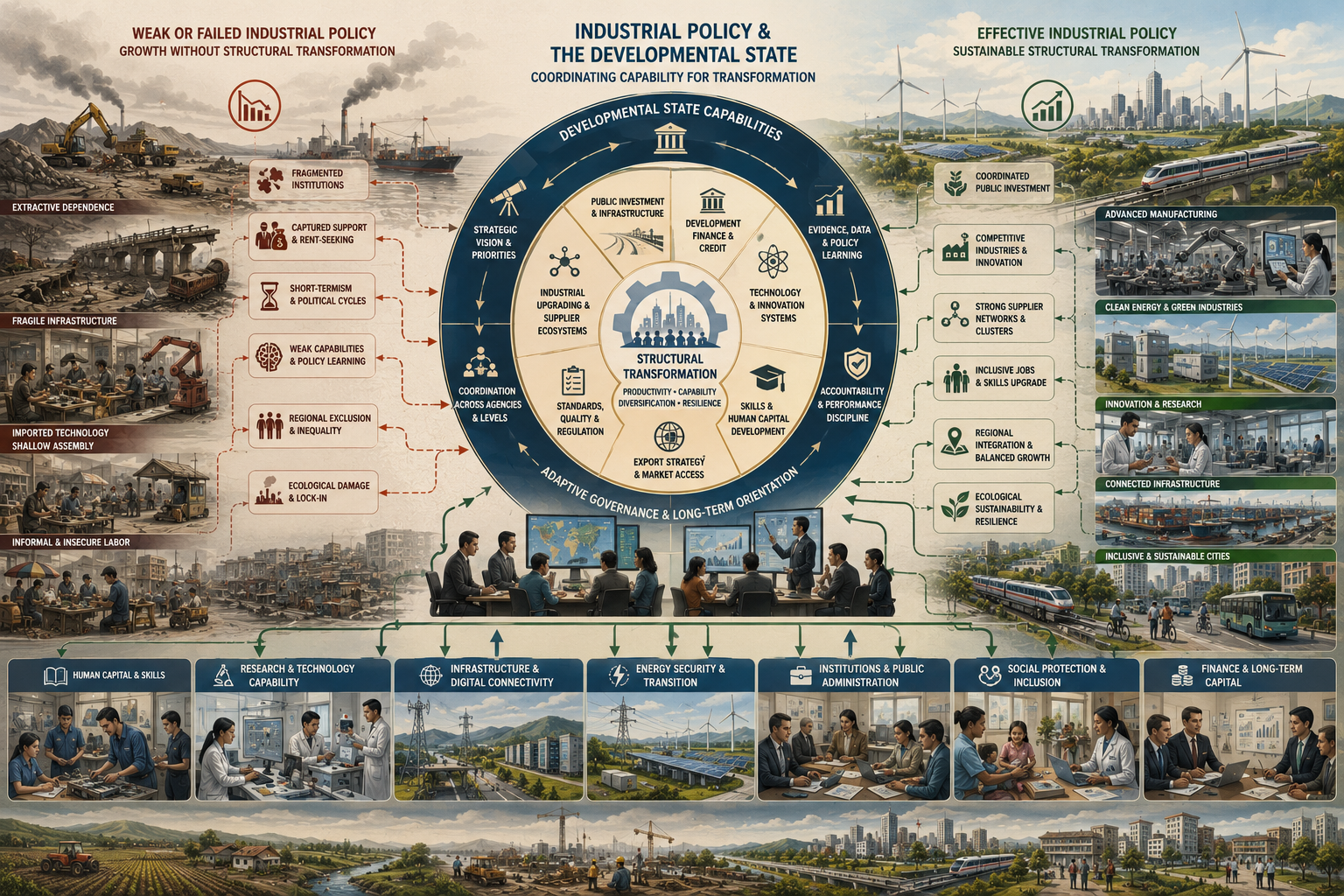
Within a sustainable systems framework, industrial policy and the developmental state must be judged not only by how much output they generate, but by what kinds of systems they build. A state may support industry while deepening ecological damage, regional inequality, labor insecurity, or external dependency. A stronger developmental approach asks whether public strategy is creating resilient infrastructure, productive learning, energy transition, territorial integration, and long-horizon capability rather than merely protecting incumbent interests or subsidizing fragile growth. The serious study of industrial policy therefore asks not only whether the state intervenes, but how, for whom, with what discipline, and toward what developmental future.
Why This Topic Matters
Industrial policy and the developmental state matter because economic development depends not only on the quantity of investment, but on its direction, coordination, and learning effects across the wider economy. A country may attract capital without building domestic capability. It may liberalize trade without upgrading productive structure. It may grow through resource extraction or real-estate expansion while remaining weak in manufacturing, technology, energy systems, or infrastructure. Industrial policy matters because it addresses the problem of direction: what should be built, how should it be supported, and how can structural transformation be made more likely rather than left to chance.
This matters analytically because markets do not always solve developmental problems efficiently. New sectors face uncertainty, missing suppliers, inadequate skills, weak infrastructure, shallow finance, and limited export knowledge. Private actors may rationally avoid these risks even when the social gains from successful upgrading would be large. Developmental states emerge in part because collective strategy can sometimes solve problems that decentralized investment alone leaves unresolved.
These issues also matter politically. Industrial policy allocates resources, favors certain capabilities over others, and influences which regions, sectors, and classes gain institutional support. That makes it a site of power as well as policy. The central question is not whether industrial policy is political, but whether it is politically organized in ways that support learning, discipline, and broad development rather than capture, patronage, and stagnation.
It also matters historically. Many of the most significant episodes of industrial transformation have involved strategic state action in trade, finance, technology, infrastructure, procurement, and export development. Industrial policy is therefore not an exception to modern development history. It is one of its recurring features.
For this reason, the study of industrial policy belongs at the heart of political economy. It asks how public institutions shape productive possibility, and whether development is being governed as a long-term structural project or merely observed as an outcome of market fluctuation.
At its deepest level, the issue is whether a society possesses the institutional means to alter its own economic trajectory. Industrial policy is one of the clearest expressions of the claim that structural change need not be treated as fate.
That question is especially urgent under conditions of climate transition, geopolitical fragmentation, supply-chain insecurity, and technological rivalry. Societies are no longer debating industrial policy only as a tool of late development. They are also debating it as a way to rebuild productive sovereignty, reduce strategic dependence, accelerate decarbonization, and preserve public capacity in an unstable world economy.
What Industrial Policy Is
Industrial policy refers to the deliberate use of public tools to influence the sectoral composition, technological sophistication, and productive capability of the economy. These tools may include subsidies, public investment, development finance, tariff policy, local-content rules, export promotion, state procurement, research support, training systems, standards, infrastructure provision, and strategic regulation.
This matters because industrial policy is often misunderstood as simply subsidizing industry. In reality, it is broader than manufacturing alone and deeper than subsidy alone. It is about shaping structural transformation. A policy that supports clean energy manufacturing, semiconductor ecosystems, agricultural upgrading, logistics corridors, or industrial research is industrial policy insofar as it seeks to alter the productive structure of the economy.
Industrial policy also differs from general business support. Broad tax cuts or deregulation may affect firms, but they are not automatically industrial policy unless they are designed to shape structural capability in a purposeful way. What distinguishes industrial policy is strategic selectivity, even if that selectivity is sometimes broad and system-oriented rather than narrowly sectoral.
A serious treatment therefore understands industrial policy as a problem of coordination and capability-building. It concerns how the state can help move an economy toward more complex, productive, and strategically valuable forms of activity.
It also concerns time. Industrial policy usually aims at sectors or capabilities whose full returns emerge only over years or decades. It is therefore one of the clearest examples of public action oriented toward developmental futures rather than immediate market signals alone.
Industrial policy is thus best understood as a governing framework for structural possibility. It is less about isolated interventions than about building an environment in which learning, upgrading, and sectoral deepening become progressively more feasible.
This means industrial policy may be explicit or implicit. A state that funds defense technology, protects intellectual property, builds ports, subsidizes energy, purchases vaccines, supports universities, or shapes procurement markets is already influencing industrial structure. The question is not whether governments shape production, but whether they do so coherently, transparently, and in service of defensible public goals.
What the Developmental State Is
The developmental state is a state form characterized by sufficient administrative capacity, strategic orientation, and relative autonomy to pursue long-horizon structural transformation. It is not merely a large state, nor simply a state that spends heavily. It is a state whose institutions are organized well enough to guide investment, coordinate industrial upgrading, support learning, and discipline performance in pursuit of developmental goals.
This matters because not all states that intervene developmentally are effective. Some states announce industrial ambitions but lack implementation capacity. Others distribute subsidies without discipline. Others still are captured by short-term political coalitions or private interests. The developmental state concept exists to distinguish strategic and capable intervention from weaker or more fragmented forms of state action.
The developmental state also implies institutional coherence. Ministries, development banks, infrastructure agencies, export promotion bodies, education systems, and planning institutions need not be perfectly unified, but they must be capable of working toward overlapping goals with enough continuity to support structural change.
A research-grade treatment therefore treats the developmental state as an institutional achievement, not a slogan. It asks whether the state can actually learn, coordinate, finance, monitor, and revise developmental strategy over time.
This means that the developmental state is partly about organizational quality and partly about political settlement. It requires a degree of legitimacy, continuity, and insulation from purely predatory uses of public power if long-horizon transformation is to remain credible.
It also requires developmental intelligence: the ability to distinguish between sectors worth building, rents worth tolerating temporarily, failures that should be ended, and capabilities whose social value exceeds their immediate private profitability.
The developmental state is therefore not the opposite of markets. It is a state capable of shaping the conditions under which markets can move into higher-capability forms. It does not abolish private initiative; it attempts to organize private initiative around structural transformation rather than letting it remain confined to short-term, low-risk, or rent-seeking activity.
Why Markets Alone Do Not Transform Economies
Markets coordinate many kinds of activity effectively, but structural transformation presents problems markets alone do not always solve. New sectors often require complementary investments that no single firm can justify making first. Skills may be missing, suppliers absent, infrastructure incomplete, demand uncertain, and financing too short-term for technological upgrading. These are classic developmental coordination problems.
This matters because private actors can behave rationally and still produce underdevelopment. A firm may decline to enter a promising sector because ports are weak. Port investment may not be justified unless export firms already exist. Banks may avoid long-horizon lending because industrial capabilities are not yet proven. Skilled workers may not train for jobs that do not yet exist. Each actor waits, and transformation stalls.
Industrial policy emerges partly to address this collective-action problem. The state can coordinate complementary investments, reduce uncertainty, provide finance, build infrastructure, and create temporary protection or support long enough for new sectors to become viable.
For this reason, the case for industrial policy does not begin from the claim that markets are useless. It begins from the observation that structural transformation often requires coordination beyond what decentralized price signals alone reliably generate.
This also explains why developmental timing matters. By the time markets clearly reveal the profitability of a sector, the crucial learning window may already belong to competitors elsewhere. Waiting passively for certainty can itself be a developmental choice with long-run consequences.
Markets are often efficient at allocating within a structure that already exists. Industrial policy addresses the harder question of how the structure itself changes.
This distinction is essential. If the existing structure is marked by commodity dependence, low-productivity services, fragile logistics, shallow finance, or foreign technological dependence, then “neutral” policy may simply reproduce that structure. Industrial policy is one way societies attempt to break that path dependency.
Coordination Failures, Learning, and the Case for Public Strategy
One of the strongest arguments for industrial policy lies in the economics of learning. New productive sectors often require firms, workers, suppliers, engineers, financiers, and regulators to learn together. The returns from that learning can spill over broadly, but the costs of initial experimentation are often borne narrowly by first movers.
This matters because private investors may underinvest in activities with large spillovers. Training workers, developing suppliers, building standards, or entering export markets can generate knowledge that benefits competitors and related sectors later. From a narrow firm perspective, these spillovers may reduce the incentive to invest at all. From a societal perspective, they may be exactly what makes development possible.
Public strategy can help solve this problem by socializing some early costs of experimentation, building institutions for shared learning, and coordinating complementary investments whose private return is initially uncertain but whose developmental return may be high.
A research-grade framework therefore sees industrial policy not only as protection or subsidy, but as organized learning policy. The developmental question is how societies create conditions under which firms can move into higher-capability activities without bearing impossible first-mover risk alone.
Learning also implies revision. Effective industrial strategy does not assume perfect foresight. It creates mechanisms through which institutions can discover, correct, and upgrade over time. The developmental state is therefore not omniscient; it is, at its best, capable of structured learning under uncertainty.
Industrial policy succeeds most when it transforms uncertainty from a reason for paralysis into an organized field of experimentation, feedback, and cumulative capability-building.
This learning perspective also changes how failure should be interpreted. Some policy experiments will fail. The question is whether failure becomes hidden patronage or useful information. A capable developmental state learns from failure, terminates weak programs, and reallocates support toward more promising capability-building pathways.
Sector Selection, Strategic Priorities, and the Problem of Picking
One of the most debated issues in industrial policy is whether states should pick winners. The phrase is often used critically, but it oversimplifies the real problem. States rarely choose winners in a vacuum. More often, they identify strategic priorities, capability gaps, infrastructure needs, or sectors with strong learning and linkage potential, then try to create conditions under which domestic capability can develop.
This matters because no industrial strategy is truly non-selective. Even choosing general infrastructure, education, or tax incentives privileges some sectors and regions more than others. The relevant question is not whether selection occurs, but whether it is informed, revisable, and disciplined by developmental criteria rather than patronage or ideology alone.
Sector selection is difficult because future competitiveness is uncertain. Yet uncertainty is not a reason to abandon strategy altogether. It is a reason to design institutions capable of experimentation, feedback, performance assessment, and exit when policies fail.
A serious framework therefore replaces the slogan of picking winners with a better question: how should states identify, support, test, and revise strategic priorities under uncertainty while minimizing capture and maximizing learning?
This is also where institutional humility matters. Strong industrial policy does not rest on the fantasy of perfect prediction. It rests on the ability to identify plausible strategic directions, monitor results, and reallocate support when evidence changes.
The real issue is less winner-picking than possibility-structuring: how to create enough density of support, infrastructure, finance, and learning that selected areas can reveal whether they are truly developmentally generative.
Good sector selection therefore depends on criteria: learning potential, domestic linkages, export possibility, resilience value, labor absorption, technological spillovers, energy implications, regional effects, and ecological compatibility. A sector that looks attractive on output alone may be weak if it creates few domestic linkages or locks the economy into fragile external dependence.
Finance, Credit, and the Direction of Investment
Structural transformation depends heavily on finance. New sectors require patient capital, long-horizon credit, working-capital support, and often forms of developmental lending that private finance may undersupply. Industrial policy therefore often involves development banks, directed credit, credit guarantees, concessional lending, or public coordination with private finance.
This matters because financial systems do not automatically fund what is socially transformative. Banks may prefer collateralized real-estate lending over industrial upgrading. Capital markets may reward short-term returns over capability-building. Foreign lenders may provide funds on terms that deepen dependence rather than domestic learning. The direction of investment is therefore a governance problem as well as a market outcome.
Developmental states frequently matter because they can organize finance toward strategic ends. This does not mean all directed credit is effective. But it does mean that leaving financial allocation entirely to short-horizon criteria may systematically underfund industrial transformation.
A research-grade perspective therefore places finance inside industrial policy rather than beside it. The question is not only whether money is available, but in what currency, for what duration, under what risks, and toward which productive uses.
Directed finance also creates accountability challenges. If public credit is extended without discipline, loss socialization and political favoritism can grow. The developmental question is therefore not simply how to direct finance, but how to tie financial support to upgrading, performance, and public purpose.
Finance is therefore never neutral in development. It either reinforces an existing structure of accumulation or helps reorient that structure toward more complex and resilient forms of production.
In sustainable systems, the direction of credit becomes even more important. Industrial upgrading, grid modernization, clean technology, resilient logistics, water systems, and regional clusters all require financing that can tolerate long horizons. A financial system that rewards short-term speculative return while starving productive capability is itself a barrier to development.
Exports, Competitiveness, and Global Market Entry
Export success has often been central to industrial upgrading because access to larger markets can support scale, foreign-exchange earnings, productivity pressure, and learning from international competition. Many developmental strategies have therefore emphasized export promotion, trade facilitation, exchange-rate management, and support for firms entering world markets.
This matters because domestic demand alone may be insufficient to sustain certain high-productivity sectors, especially in smaller or poorer economies. Export capability can help firms move beyond local market constraints and integrate into wider technological and commercial networks.
But export orientation is not sufficient by itself. Countries can export primary commodities or low-value assembly work without achieving deeper transformation. The developmental issue is whether export participation supports learning, domestic linkages, technological progression, and increasingly sophisticated production.
A serious framework therefore treats exports as a means, not an end. The goal is not simply to sell abroad, but to use external integration to strengthen domestic productive capability and reduce structural vulnerability.
This also means competitiveness cannot be reduced to low wages alone. Durable export success depends on logistics, quality, standards, supplier reliability, energy systems, engineering capacity, and institutions that support firms under real international pressure.
Export discipline can also serve as a developmental test. Firms shielded only by domestic protection may never confront the productivity demands required for durable upgrading. External markets can therefore act as one of the arenas in which industrial support is validated or exposed as weak.
At the same time, export discipline must be understood within a world economy marked by uneven power. Standards, intellectual property, market access, sanctions, logistics, and currency conditions all shape the terms on which firms enter global markets. Export promotion is therefore not merely firm strategy; it is also geopolitical and institutional strategy.
Technology, Capability, and Industrial Learning
Industrial policy is deeply tied to technology because structural transformation often depends on moving into more complex products, processes, and organizational forms. Yet technology transfer alone is not enough. Development requires domestic capability to absorb, adapt, maintain, and eventually improve technologies rather than merely import them.
This matters because countries can industrialize shallowly if technological dependence remains permanent. Firms may assemble imported components using foreign designs and remain vulnerable to external suppliers, foreign intellectual property, or shifting geopolitical controls. By contrast, deeper capability involves engineering, standards, supplier development, research systems, and institutional memory.
Industrial learning therefore has a cumulative logic. Technical schools, apprenticeships, public research institutes, industrial extension services, and technology partnerships can all help build local competence. Without such systems, industrial policy may create production volume without real upgrading.
A research-grade account thus treats technology as embedded capability rather than purchased equipment. The development question is whether industrial strategy is deepening domestic knowledge or simply financing temporary access to externally controlled systems.
This is especially important in contemporary sectors such as semiconductors, batteries, advanced materials, digital infrastructure, and clean technology. In such fields, manufacturing scale without technical depth may offer short-term gains while leaving long-term sovereignty weak.
Capability-building therefore depends on whether firms, universities, labs, standards bodies, suppliers, and public agencies form a system of ongoing technical learning rather than a temporary production arrangement.
Technological depth also affects resilience. A country that cannot maintain, repair, adapt, or redesign the technologies it depends on remains vulnerable even where production statistics look impressive. Industrial learning is therefore a question of sovereignty, not only productivity.
Infrastructure, Energy, and the Material Basis of Industrial Policy
Industrial policy depends on more than firm incentives. It requires a material base: reliable electricity, transport corridors, ports, water systems, industrial land, digital infrastructure, and logistics capacity. Productive upgrading is difficult where power is unstable, freight unreliable, or basic public systems underbuilt.
This matters because infrastructure is not background. It shapes which sectors can emerge, which regions can industrialize, and how costly coordination becomes. Energy systems are especially important because they influence production cost, export competitiveness, resilience, and ecological trajectory at the same time.
An industrial strategy that ignores energy and infrastructure risks becoming symbolic rather than transformative. Firms cannot learn, export, or scale reliably if the physical systems underpinning production remain weak. The developmental state therefore typically involves not only sector support, but public works, utilities, and territorial integration.
A serious framework therefore treats industrial policy as materially grounded. The question is not simply which sectors to favor, but whether the infrastructural and energetic basis exists for those sectors to become viable and resilient over time.
Infrastructure also shapes developmental sequence. Sometimes the most strategic industrial policy is not a subsidy to firms, but the prior creation of ports, grids, standards labs, freight systems, and public institutions that allow an industrial ecosystem to exist at all.
The material basis of industrial strategy also reveals its temporal depth. Grids, rail systems, ports, water systems, and industrial corridors take time to build and even longer to integrate. Developmental states differ partly by whether they can sustain these commitments across political cycles.
Energy transition makes this material basis even more important. Industrial competitiveness will increasingly depend on reliable low-carbon electricity, resilient grids, storage, industrial heat solutions, and reduced exposure to fossil fuel volatility. Energy policy and industrial policy are therefore no longer separable domains.
Labor, Skills, and the Social Organization of Upgrading
Structural transformation depends on labor as much as capital. New sectors require technicians, engineers, skilled operators, managers, maintenance workers, logisticians, and adaptive production cultures. Industrial policy therefore often succeeds or fails on the basis of education systems, vocational training, labor relations, and the wider social organization of work.
This matters because capability is embodied in people as well as machinery. A country may import advanced technology yet remain weak in productive depth if it cannot train workers, retain expertise, or create institutions that connect education to industrial need.
Labor also matters because development strategy can follow very different social paths. Some industrial models rely on repression, labor discipline, and weak social protection. Others attempt to combine upgrading with broader social inclusion, stable labor institutions, and rising skill formation. These are not morally neutral variations. They affect legitimacy, demand, inequality, and the durability of the developmental project.
A research-grade treatment therefore places labor inside industrial policy rather than treating it as a cost to be minimized. The relevant question is whether the economy is building human capability and productive dignity alongside sectoral upgrading.
Skills policy is therefore not auxiliary. It is one of the central mechanisms through which industrial strategy becomes socially embedded. Without institutional pathways from schooling to productive work, sectoral ambitions often remain shallower than official plans suggest.
Labor institutions also affect learning quality. High-turnover, insecure, deskilled labor systems may reduce costs in the short run while weakening the accumulation of tacit knowledge and production depth needed for more advanced transformation.
A sustainable developmental state must therefore treat workers not merely as inputs, but as carriers of learning. Productivity gains that depend on fear, precarity, and low wages may be fragile if they fail to build durable skill systems, trust, and social legitimacy.
Discipline, Reciprocity, and Performance Conditionality
One of the strongest lessons from developmental-state analysis is that support without discipline often fails. Subsidies, credit, protection, or procurement support may be justified to help firms enter difficult sectors, but such support is most developmentally valuable when tied to performance requirements such as export targets, productivity improvement, technological upgrading, domestic supplier development, emissions reduction, or learning benchmarks.
This matters because industrial policy can otherwise degenerate into permanent protection for politically connected but uncompetitive firms. Developmental states are often distinguished not only by activism, but by reciprocity: firms receive support, but they are expected to deliver measurable performance in return.
Performance conditionality also matters because uncertainty is real. Some supported activities will fail. A capable developmental state must be able to withdraw support, restructure strategy, or reallocate resources when evidence shows that learning is not occurring or capability is not deepening.
A serious framework therefore views discipline as central, not optional. Industrial policy succeeds less through blind protection than through structured reciprocity between public support and developmental performance.
This is where state quality is tested most sharply. It is relatively easy to announce support. It is much harder to monitor firms, resist capture, and end support when performance does not justify continuation. Developmental states differ not only in ambition, but in their capacity to say no.
Reciprocity is therefore one of the core institutional distinctions between developmental policy and patronage. Where support is conditional, strategy can learn. Where support is unconditional, strategy often congeals into rent distribution.
Conditionality should not be designed so rigidly that learning becomes impossible. But it must be strong enough that public support remains connected to public purpose. The goal is neither punishment nor unconditional generosity, but a disciplined learning relationship between firms and the developmental state.
Industrial Policy Risks: Capture, Rent-Seeking, and Policy Failure
Industrial policy carries real risks. Public support can be captured by politically connected firms, distorted into rent distribution, insulated from evaluation, or used to preserve inefficient sectors indefinitely. Bureaucracies may lack information, become rigid, or pursue prestige projects disconnected from real capability formation. These are genuine dangers, not ideological inventions.
This matters because developmental strategy requires realism about failure. Poorly designed industrial policy can waste resources, entrench oligarchies, deepen corruption, and delay necessary adjustment. The existence of market failure does not guarantee competent state response.
But the possibility of policy failure is not itself an argument for passivity. Markets also fail, often at large scale and with major social cost. The relevant comparison is not ideal market versus flawed state, but imperfect governance options under real developmental constraints.
A research-grade treatment therefore asks how institutional design can reduce capture: transparent criteria, performance review, competitive pressure, technical expertise, independent evaluation, and administrative insulation from purely predatory political demands.
The core issue is not whether industrial policy is risky. It is whether those risks are being managed in ways commensurate with the risks of non-strategy, dependency, underinvestment, and structural stagnation that can result when transformative sectors are left entirely to short-horizon market selection.
Policy failure also has temporal forms. Some strategies fail immediately; others appear successful for years before hidden inefficiencies, ecological costs, or political capture become visible. Developmental evaluation must therefore remain longitudinal, not merely short-term.
The danger of capture is also a reason to strengthen public capacity rather than abandon it. A weak state is not protected from capture by refusing industrial policy; it may simply be captured through tax privileges, procurement, land allocation, financial deregulation, or infrastructure placement without calling those choices industrial strategy.
Regional Development, Clusters, and Territorial Strategy
Industrial transformation is spatial as well as sectoral. Production tends to cluster geographically because firms benefit from supplier proximity, labor pools, transport links, shared infrastructure, and local knowledge ecosystems. Industrial policy therefore often involves regional strategy as much as sector strategy.
This matters because development can become territorially uneven. Dynamic clusters may emerge in a few metropolitan cores while large regions remain bypassed. Without territorial strategy, industrial success may coexist with deep regional inequality, infrastructural neglect, and political fragmentation.
Regional industrial policy can help build logistics corridors, secondary-city manufacturing zones, specialized supplier districts, technology parks, or energy-intensive industrial regions linked to strategic infrastructure. But such efforts require more than industrial parks on paper. They require sustained investment, governance, and real integration into wider national and international networks.
A serious account therefore treats territory as part of industrial policy design. The question is not only what sectors to build, but where, with what infrastructure, and how regional inclusion can be made part of structural transformation.
Clusters also show why development is relational. Firms rarely become competitive in isolation. They develop inside ecosystems of transport, standards, education, utilities, suppliers, and public institutions that make regional concentration productive rather than merely congested.
Territorial strategy therefore matters not only for fairness, but for productivity. A country that wastes large parts of its geography through weak infrastructure, shallow institutions, or absent regional planning narrows its own developmental horizon.
Strong cluster policy also avoids mistaking real ecosystems for real-estate branding. A cluster is not simply an industrial park, technology campus, or special economic zone. It is a dense system of skills, suppliers, infrastructure, finance, standards, and learning relationships that can actually raise productive capability over time.
Industrial Policy in an Age of Climate Transition and Geopolitics
Industrial policy has returned to prominence partly because climate transition, supply-chain insecurity, technological rivalry, and geopolitical fragmentation have made productive sovereignty more urgent. Clean energy manufacturing, batteries, grid infrastructure, semiconductors, strategic minerals, and resilient logistics are increasingly treated as developmental and security priorities at once.
This matters because contemporary industrial policy is not only about late industrialization in the traditional sense. It is also about reorganizing existing advanced economies, reducing strategic dependencies, and building low-carbon infrastructures capable of supporting future development under tighter ecological constraints.
The climate transition intensifies the case for public strategy because new sectors require coordinated investment in energy systems, standards, financing, land use, and infrastructure. Left entirely to fragmented short-term incentives, transition may proceed too slowly, unevenly, or in ways that deepen inequality and geopolitical dependence.
A research-grade framework therefore treats modern industrial policy as part of a wider reorganization of political economy under climate stress and international rivalry. The question is not simply whether states are returning, but what kinds of industrial futures they are now trying to build.
This also means that industrial policy today is increasingly judged by multiple criteria at once: productivity, resilience, emissions, employment, strategic autonomy, territorial balance, and the capacity to avoid reproducing older extractive or high-carbon developmental models under new names.
Climate-era industrial policy therefore demands a thicker conception of development. It is no longer enough to build capacity alone; the question is whether capacity is being built in forms that remain viable under ecological pressure, energy transition, and geopolitical instability.
Geopolitical industrial policy also raises difficult ethical questions. Strategic autonomy can support resilience, but it can also justify exclusion, resource nationalism, militarization, or new forms of extraction. A sustainable industrial strategy must therefore distinguish legitimate resilience from narrow nationalism or greenwashed competition for control over global supply chains.
Finance, Debt, and Developmental Sovereignty
Industrial transformation requires capital, but the source and structure of that capital matter profoundly. Economies dependent on volatile foreign borrowing, externally denominated debt, or short-horizon capital flows may discover that developmental ambitions remain constrained by refinancing risk, exchange-rate pressure, and the priorities of external creditors.
This matters because industrial policy requires strategic patience, while many financial systems reward short-term liquidity, rapid turnover, and collateralized certainty. Productive upgrading may therefore be less attractive to dominant financial actors than real estate, extractive rents, or speculative assets. Developmental sovereignty depends partly on whether public institutions can create financial channels aligned with structural transformation rather than merely with short-term profitability.
Public development banks, sovereign investment vehicles, long-horizon industrial credit, and coordinated financial regulation can help reduce this mismatch. But they also require competence and discipline. Financial support without developmental criteria can quickly become another route for patronage and fragility.
A research-grade treatment therefore places finance inside the developmental-state question itself. The issue is not simply whether a country has access to capital, but whether it can govern capital in ways compatible with learning, resilience, and structural depth.
Developmental sovereignty in this sense does not require autarky. It requires enough institutional command over financing terms, maturities, priorities, and external exposure that structural strategy is not continually subordinated to immediate funding pressure.
Debt matters because it can either build capability or narrow the future. Borrowing to finance energy systems, industrial upgrading, skills, and infrastructure can support transformation if governance is strong and returns are broad. Borrowing to sustain imports, speculation, or politically connected projects may deepen vulnerability instead.
Industrial policy therefore requires fiscal and financial judgment. The question is not only what to build, but how to finance it without creating new dependencies that weaken the very sovereignty industrial strategy is meant to strengthen.
Historical Lessons from Developmental States
Historical experience suggests that developmental states have often combined several recurring features: capable bureaucracies, strategic coordination with finance, export orientation or disciplined market testing, strong investment in infrastructure and education, and mechanisms for reciprocity between state support and firm performance. Yet no single model fits all cases.
This matters because developmental success has never been reducible to one policy instrument. Protection alone did not create industrial depth. Nor did openness alone. What mattered repeatedly was the interaction among institutions, finance, learning, external markets, and public discipline.
History also shows that developmental states were often embedded in particular geopolitical conditions, labor regimes, and political settlements. Their successes therefore cannot simply be copied mechanically. But their broader lessons remain important: structural change usually requires strategy, capability, and institutions able to sustain complexity over time.
A research-grade perspective therefore uses the developmental-state tradition diagnostically rather than as myth. The goal is not to romanticize past models, but to understand what institutional features allowed some societies to transform productive structures more successfully than others.
Historical perspective also cautions against selective memory. Many developmental successes involved coercion, uneven inclusion, ecological cost, or heavy geopolitical backing. Contemporary industrial strategy therefore requires learning from historical capability without reproducing historical blind spots.
History also suggests that durable transformation is rarely the result of one grand plan. More often it emerges from repeated rounds of institution-building, sectoral adjustment, infrastructural expansion, export learning, and policy correction that gradually thicken the productive structure over time.
The larger lesson is that industrial policy must be historically serious. It should neither pretend that markets alone built modern productive systems nor assume that every state intervention is developmental. The evidence points toward a more demanding conclusion: transformation requires capable public institutions, but capability itself must be built, disciplined, and governed.
Industrial Policy and Sustainable Systems
Within sustainable systems, industrial policy must be judged by whether it builds resilient, low-fragility, and socially viable productive structures rather than merely expanding output. An industrial strategy that deepens fossil dependence, polluting infrastructure, labor precarity, or regional abandonment may succeed in narrow growth terms while failing developmentally in the broader sense.
This changes the meaning of the developmental state. A contemporary developmental state must be capable not only of promoting industry, but of steering transformation toward energy transition, infrastructural resilience, territorial inclusion, and long-horizon ecological viability. That requires coordination across industrial policy, energy policy, labor systems, finance, transport, and public investment.
Sustainable industrial policy therefore involves more than green rhetoric attached to existing subsidy regimes. It requires real changes in the direction of finance, the design of infrastructure, the management of materials and energy, the treatment of labor, and the capacity of public institutions to govern complexity over time.
In this sense, industrial policy becomes a systems question. It asks whether public strategy is creating productive structures capable of supporting collective life under uncertainty, or whether it is merely subsidizing short-run accumulation while postponing deeper structural vulnerability.
This also means that sustainability is not external to industrial policy. It is part of the criterion by which industrial policy should now be judged. The developmental question is no longer only how to industrialize, but how to build technologically capable, territorially integrated, and ecologically durable systems of production at the same time.
A sustainable developmental state would therefore be one that can align industrial upgrading with public resilience: stronger grids, lower emissions, broader skills, more secure labor, stronger regions, and infrastructures that make future adaptation easier rather than harder.
The deepest test is whether industrial policy helps a society build the capacity to flourish without reproducing the fragilities that made older development models unstable: ecological depletion, labor insecurity, regional abandonment, concentrated rents, and external dependency. Industrial policy becomes sustainable only when it strengthens the systems that make future collective life possible.
How Industrial Policy Systems Should Be Judged
Industrial policy systems should not be judged only by subsidy totals, manufacturing output, or the number of firms supported. A broader economic systems framework asks whether public strategy is building productive capability, disciplining support, reducing dependency, strengthening infrastructure, deepening learning, and improving resilience across sectors and regions.
| Dimension | Narrow Question | Systems Question |
|---|---|---|
| Sector Strategy | Which sectors receive support? | Do selected sectors deepen learning, linkages, resilience, productivity, and strategic capability? |
| Public Support | How large are subsidies or incentives? | Is support tied to exports, productivity, employment quality, domestic linkages, emissions reduction, and learning? |
| Development Finance | Is capital available? | Does finance flow toward long-horizon productive capability or toward speculation and dependency? |
| Technology | Is advanced equipment being used? | Can domestic firms absorb, adapt, maintain, and improve technology over time? |
| Infrastructure | Are industrial sites available? | Do energy, transport, water, digital, and logistics systems support reliable upgrading? |
| Labor | Are jobs being created? | Are skills, wages, learning, labor security, and productive dignity improving alongside output? |
| Governance | Does the state intervene? | Can institutions monitor performance, resist capture, withdraw failed support, and revise strategy? |
| Sustainability | Is industrial capacity expanding? | Does industrial strategy reduce ecological damage, energy vulnerability, regional exclusion, and long-run fragility? |
This framework prevents a common mistake: confusing industrial policy with subsidy policy. Subsidies may be part of industrial policy, but the deeper issue is whether public strategy builds a more capable economic structure. An industrial policy that transfers public money without learning, discipline, linkages, or resilience is not developmental in the strong sense.
The central question is therefore not simply whether the state is active. The deeper question is whether public authority is organized well enough to build capability, govern uncertainty, reduce fragility, and widen future possibility.
Mathematical Lens
Mathematics can clarify industrial policy and the developmental state by making sectoral shares, productivity, export performance, public support, domestic linkages, capability depth, and capture risk explicit. These equations do not decide which sectors should be supported, but they help reveal what must be measured if industrial policy is to remain connected to developmental performance.
1. Sectoral Output Share
s_i = \frac{Y_i}{Y}
\]
Interpretation: The sectoral output share \(s_i\) compares output in sector \(i\), \(Y_i\), with total output \(Y\). This helps track whether targeted sectors are gaining economic weight over time.
2. Sectoral Productivity
LP_i = \frac{Y_i}{L_i}
\]
Interpretation: Sectoral labor productivity \(LP_i\) equals sector output \(Y_i\) divided by labor employed in that sector \(L_i\). Industrial policy often aims to increase this through capability-building, training, technology adoption, and organizational learning.
3. Export Performance Ratio
XR_i = \frac{X_i}{Y_i}
\]
Interpretation: The export ratio \(XR_i\) compares exports from sector \(i\), \(X_i\), with sector output \(Y_i\). It can help assess whether supported sectors are reaching external markets successfully.
4. Support Intensity
SI_i = \frac{Public\ Support_i}{Y_i}
\]
Interpretation: Support intensity \(SI_i\) compares public support to sector output. This helps identify whether a sector is receiving support proportionate to its developmental performance or becoming overly dependent on public backing.
5. Public Support Conditionality
P_i = f(Exports, Productivity, Learning, Employment, Domestic\ Linkage, Emissions)
\]
Interpretation: A performance score \(P_i\) can link public support to exports, productivity, learning, employment, domestic linkages, and emissions outcomes. This expresses the principle that support should be tied to measurable developmental results rather than granted without reciprocity.
6. Domestic Linkage
DL = f(Suppliers, Skills, Infrastructure, Finance)
\]
Interpretation: Domestic linkage \(DL\) can be represented as a function of supplier networks, skills, infrastructure, and finance. Higher linkage implies that sectoral growth is more likely to generate wider spillovers across the economy instead of remaining enclaved.
7. Capability Depth
C = f(Engineering, R\&D, Standards, Maintenance, Training)
\]
Interpretation: Capability depth \(C\) reflects whether an economy can absorb, adapt, maintain, and improve technology rather than merely import it. This helps distinguish shallow production from deeper industrial learning.
8. Capture Risk
CR = f(Concentration, Lobbying, Weak\ Evaluation, Open\text{-}Ended\ Support, Poor\ Performance)
\]
Interpretation: Capture risk \(CR\) rises where market concentration, lobbying intensity, weak evaluation, open-ended support, and poor performance reinforce one another. This formalizes the need to monitor industrial policy as a governance system, not only as an economic program.
9. Practical Interpretation
The mathematical lens clarifies several structural points. Industrial policy is partly about changing sectoral shares over time. Productivity and learning within sectors matter as much as scale. Export performance can indicate whether supported sectors are becoming internationally competitive. Public support is developmentally stronger when tied to performance and learning. Supplier depth, skills, infrastructure, and finance determine whether growth spills over widely or remains enclaved. Capture risk must be monitored because public support can become rent distribution if discipline is weak.
Formalization helps clarify mechanism, but it does not determine which sectors deserve support, how much protection is justified, or how tradeoffs between resilience, employment, sovereignty, and ecological goals should be resolved. Those remain institutional, historical, and political questions.
Python Workflow: Industrial Policy and the Developmental State
Python is useful for turning industrial-policy concepts into reproducible calculations. The following compact workflow models sectoral output share, sectoral productivity, export performance, support intensity, performance conditionality, domestic linkage, and capture risk.
# Industrial Policy and the Developmental State
# Simple Python workflow

import pandas as pd

# Strategic sector indicators
sector_output = 180
total_output = 1200
sector_labor = 55
sector_exports = 72
public_support = 40

sector_share = sector_output / total_output
sector_productivity = sector_output / sector_labor
export_ratio = sector_exports / sector_output
support_intensity = public_support / sector_output

print("Sector output share:", round(sector_share, 3))
print("Sector productivity:", round(sector_productivity, 2))
print("Export ratio:", round(export_ratio, 3))
print("Support intensity:", round(support_intensity, 3))

# Conditional support indicators
productivity_gain = 0.12
employment_gain_index = 0.70
local_supplier_share = 0.46
export_growth = 0.10
emissions_reduction = 0.18

performance_score = (
    0.24 * productivity_gain / 0.20
    + 0.18 * employment_gain_index
    + 0.20 * local_supplier_share
    + 0.18 * export_growth / 0.20
    + 0.20 * emissions_reduction / 0.40
)

print("Performance score:", round(performance_score, 3))

# Domestic linkage score
supplier_depth = 0.62
skills_alignment = 0.58
infrastructure_reliability = 0.70
patient_finance = 0.55

domestic_linkage_score = (
    0.28 * supplier_depth
    + 0.24 * skills_alignment
    + 0.26 * infrastructure_reliability
    + 0.22 * patient_finance
)

print("Domestic linkage score:", round(domestic_linkage_score, 3))

# Capture risk score
market_concentration = 0.65
lobbying_intensity = 0.60
evaluation_weakness = 0.50
open_ended_support = 0.70
performance_shortfall = 0.45

capture_risk = (
    0.22 * market_concentration
    + 0.20 * lobbying_intensity
    + 0.20 * evaluation_weakness
    + 0.18 * open_ended_support
    + 0.20 * performance_shortfall
)

print("Capture risk:", round(capture_risk, 3))

df = pd.DataFrame({
    "Metric": [
        "Sector Share",
        "Sector Productivity",
        "Export Ratio",
        "Support Intensity",
        "Performance Score",
        "Domestic Linkage Score",
        "Capture Risk"
    ],
    "Value": [
        sector_share,
        sector_productivity,
        export_ratio,
        support_intensity,
        performance_score,
        domestic_linkage_score,
        capture_risk
    ]
})

print(df)
This workflow is useful because it links public support to sectoral scale, productivity, exports, domestic linkages, environmental performance, and governance risk rather than treating industrial policy as subsidy alone. It makes visible the central developmental question: is public support building capability, or merely transferring resources?
The full GitHub repository expands this example into strategic-sector comparisons, support-conditionality models, development-finance alignment, infrastructure and energy readiness, skills and labor upgrading, capture-risk scoring, regional cluster analysis, green industrial policy scenarios, SQL queries, R and Stata replication workflows, Julia simulations, and article-ready figures.
R Workflow: Industrial Policy and the Developmental State
R is useful for industrial-policy summaries, strategic-sector comparisons, support-performance tables, and publication-ready graphics. The following compact workflow performs the same sectoral, productivity, export, support, linkage, and capture-risk calculations in R.
# Industrial Policy and the Developmental State
# Simple R workflow

# Strategic sector indicators
sector_output <- 180
total_output <- 1200
sector_labor <- 55
sector_exports <- 72
public_support <- 40

sector_share <- sector_output / total_output
sector_productivity <- sector_output / sector_labor
export_ratio <- sector_exports / sector_output
support_intensity <- public_support / sector_output

cat("Sector output share:", round(sector_share, 3), "\n")
cat("Sector productivity:", round(sector_productivity, 2), "\n")
cat("Export ratio:", round(export_ratio, 3), "\n")
cat("Support intensity:", round(support_intensity, 3), "\n")

# Conditional support indicators
productivity_gain <- 0.12
employment_gain_index <- 0.70
local_supplier_share <- 0.46
export_growth <- 0.10
emissions_reduction <- 0.18

performance_score <- (
  0.24 * productivity_gain / 0.20 +
  0.18 * employment_gain_index +
  0.20 * local_supplier_share +
  0.18 * export_growth / 0.20 +
  0.20 * emissions_reduction / 0.40
)

cat("Performance score:", round(performance_score, 3), "\n")

# Domestic linkage score
supplier_depth <- 0.62
skills_alignment <- 0.58
infrastructure_reliability <- 0.70
patient_finance <- 0.55

domestic_linkage_score <- (
  0.28 * supplier_depth +
  0.24 * skills_alignment +
  0.26 * infrastructure_reliability +
  0.22 * patient_finance
)

cat("Domestic linkage score:", round(domestic_linkage_score, 3), "\n")

# Capture risk score
market_concentration <- 0.65
lobbying_intensity <- 0.60
evaluation_weakness <- 0.50
open_ended_support <- 0.70
performance_shortfall <- 0.45

capture_risk <- (
  0.22 * market_concentration +
  0.20 * lobbying_intensity +
  0.20 * evaluation_weakness +
  0.18 * open_ended_support +
  0.20 * performance_shortfall
)

cat("Capture risk:", round(capture_risk, 3), "\n")

summary_df <- data.frame(
  Metric = c(
    "Sector Share",
    "Sector Productivity",
    "Export Ratio",
    "Support Intensity",
    "Performance Score",
    "Domestic Linkage Score",
    "Capture Risk"
  ),
  Value = c(
    sector_share,
    sector_productivity,
    export_ratio,
    support_intensity,
    performance_score,
    domestic_linkage_score,
    capture_risk
  )
)

print(summary_df)
This R workflow is deliberately compact for article readability. In the full repository, R reads structured strategic-sector, support-conditionality, development-finance, infrastructure-energy, skills-labor, capture-risk, regional-cluster, and green-industrial-policy scenarios; calculates sectoral output shares, productivity, export ratios, support intensity, performance scores, finance alignment, capture risk, and green industrial scores; and visualizes how industrial-policy strategies differ across institutional conditions.
Future Economic Systems articles can extend this foundation with sectoral output data, firm-level productivity data, subsidy records, public procurement records, export performance data, development-bank lending, patent and R&D indicators, skills data, supplier-network data, emissions metrics, infrastructure indicators, and regional cluster statistics.
GitHub Repository
The article body includes selected computational examples so the conceptual, institutional, and mathematical argument remains readable. The full repository contains the expanded research infrastructure: Python strategic-sector and conditionality analysis, R industrial-policy summaries, Stata applied industrial-policy replication workflows, SQL industrial strategy scenario tables, Julia learning and support simulations, sectoral output shares, productivity indicators, export ratios, support intensity, domestic linkages, development finance, infrastructure readiness, skills systems, capture risk, regional clusters, green industrial policy, documentation, reproducible sample data, and article-ready figures and tables.
Complete Code Repository
The full code distribution for this article, including selected article examples and advanced research-style computational scaffolding for strategic sectors, productivity, export performance, public support conditionality, development finance, credit direction, domestic linkages, infrastructure readiness, energy reliability, labor and skills systems, capture risk, regional clusters, green industrial policy, reproducibility documentation, and cross-language economic analysis, is available on GitHub.
Conclusion
Industrial policy and the developmental state are central to economic analysis because they show how public institutions can influence the direction, depth, and quality of structural transformation. Development does not depend only on whether markets allocate resources efficiently in the short run. It also depends on whether societies can solve coordination failures, build capabilities, organize finance, support learning, and create the infrastructures on which more complex production depends.
To understand an economic system seriously, one must therefore ask not only whether the state intervenes, but how intervention is structured, how performance is disciplined, how finance is directed, how labor and technology are integrated, and whether industrial strategy is producing resilient and broadly developmental forms of productive capacity. These questions reveal whether public strategy is widening future possibility or merely redistributing rents under the language of development.
The serious study of industrial policy also requires a sober view of both markets and states. Markets can underprovide coordination, learning, and long-horizon investment. States can fail through capture, incompetence, rigidity, or patronage. The relevant question is not which institution is perfect, but how societies can build governance systems capable of directing investment, learning from failure, disciplining support, and sustaining transformation under uncertainty.
In a sustainable economic system, industrial policy must be more than a growth strategy. It must become a strategy for building the productive foundations of a livable future: resilient infrastructure, low-carbon energy, skilled labor, regional inclusion, technological capability, public learning, and institutions strong enough to align private activity with long-run public purpose. The developmental state, at its best, is the state organized around that task.
Related Reading
- Economic Systems
- Growth, Development, and Structural Transformation
- Fiscal Policy, Taxation, and Public Investment
- Capital, Investment, and the Dynamics of Accumulation
- Labor, Wages, Productivity, and the Social Organization of Work
- Inflation, Energy Shocks, and Supply Constraints
- Monetary Policy, Central Banking, and Financial Conditions
- Sustainable Development
- Institutions & Governance
- Risk & Resilience
Further Reading
- International Labour Organization (ILO) (n.d.). Industrial policy, employment and just transition. Available at: https://www.ilo.org/
- Organisation for Economic Co-operation and Development (OECD) (n.d.). Industrial policy. Available at: https://www.oecd.org/en/topics/industrial-policy.html
- United Nations Conference on Trade and Development (UNCTAD) (n.d.). Industrial policy and development. Available at: https://unctad.org/
- United Nations Industrial Development Organization (UNIDO) (n.d.). Industrial development and policy. Available at: https://www.unido.org/
- World Bank (n.d.). Competitiveness. Available at: https://www.worldbank.org/en/topic/competitiveness
- World Bank (n.d.). Industry. Available at: https://www.worldbank.org/en/topic/industry
- World Trade Organization (WTO) (n.d.). Trade and industrial policy resources. Available at: https://www.wto.org/
References
- International Labour Organization (ILO) (n.d.). Industrial policy, employment and just transition. Available at: https://www.ilo.org/
- Organisation for Economic Co-operation and Development (OECD) (n.d.). Industrial policy. Available at: https://www.oecd.org/en/topics/industrial-policy.html
- United Nations Conference on Trade and Development (UNCTAD) (n.d.). Industrial policy and development. Available at: https://unctad.org/
- United Nations Industrial Development Organization (UNIDO) (n.d.). Industrial development and policy. Available at: https://www.unido.org/
- World Bank (n.d.). Competitiveness. Available at: https://www.worldbank.org/en/topic/competitiveness
- World Bank (n.d.). Industry. Available at: https://www.worldbank.org/en/topic/industry
- World Trade Organization (WTO) (n.d.). Trade and industrial policy resources. Available at: https://www.wto.org/