
Last Updated May 9, 2026
Inflation is one of the most consequential features of modern economic life because it alters wages, savings, debt burdens, public budgets, investment decisions, and the everyday capacity of households to secure basic necessities. Yet inflation is not a single, uniform process. Prices can rise because aggregate demand is strong, because wages and profits are being renegotiated across the economy, because exchange rates weaken, because financial speculation affects key commodities, or because the supply of essential goods is disrupted. Energy shocks and supply constraints are especially important because they reveal that inflation is not always a simple matter of excessive demand. It may also emerge from bottlenecks, geopolitical disruption, infrastructure fragility, ecological stress, or dependence on critical inputs whose scarcity cascades through the wider system.
Energy occupies a central place in this analysis because it enters almost everything. Transport, electricity, heating, industrial production, fertilizers, food systems, logistics, construction materials, digital infrastructure, and public services all depend directly or indirectly on energy availability and cost. When energy prices rise sharply, the effect is rarely confined to one sector. It spreads through production chains, distribution systems, household budgets, and expectations about future costs. This is why energy shocks have historically played such a large role in inflationary episodes: they strike at one of the foundational inputs of modern economic organization.
Supply constraints matter because they reveal the physical and institutional limits within which economies operate. A modern economy may appear flexible in ordinary times while depending on fragile shipping routes, concentrated suppliers, just-in-time inventories, imported fuels, vulnerable grids, or climate-sensitive agricultural systems. When those systems are disrupted, price increases can become widespread even without a conventional demand boom. Inflation then becomes a signal not just of monetary imbalance, but of material dependence, logistical fragility, and inadequate resilience.
Main Library
Publications
Article Map
Economic Systems
Related Topic
Sustainable Development
Related Topic
Institutions & Governance
Related Topic
Risk & Resilience
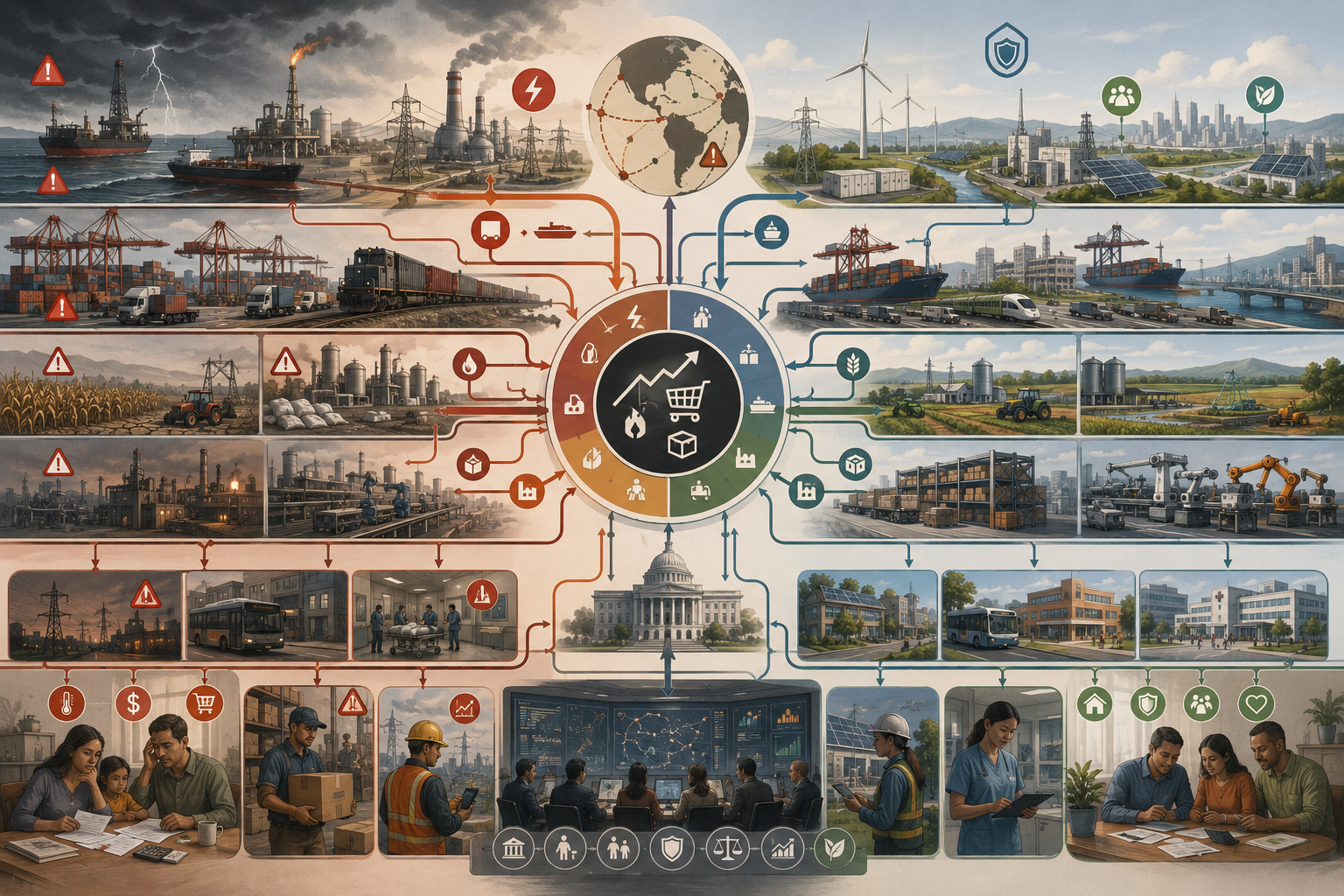
Within a sustainable systems framework, inflation, energy shocks, and supply constraints must be understood not only as short-run macroeconomic disturbances, but as indicators of deeper structural vulnerability. A society may suppress prices temporarily while leaving fragile energy systems, concentrated supply chains, undermaintained infrastructure, and ecological exposure intact. The serious study of inflation therefore requires more than price monitoring alone. It requires attention to material dependence, system design, distributional burden, public capacity, and the long-horizon resilience of the economic order itself.
Why This Topic Matters
Inflation, energy shocks, and supply constraints matter because they affect how societies experience economic stress in immediate and concrete ways. Rising fuel costs alter commuting and heating decisions. Higher electricity prices affect household budgets and industrial margins. More expensive food, transport, building materials, and manufactured goods can weaken living standards even where wages or headline growth initially appear strong. Inflation is therefore not merely a statistical phenomenon. It is a lived reorganization of purchasing power across the economy.
This matters analytically because inflation is often discussed too abstractly, as if it were always the result of excessive demand or loose money alone. In reality, many inflationary episodes involve disturbances to the supply side of the economy: critical inputs become scarce, transport systems slow, weather damages harvests, wars disrupt fuel flows, grids strain, and concentrated suppliers gain pricing power under pressure. These processes do not fit neatly into a single-market explanation.
These issues also matter politically. Inflation redistributes burden. Some firms can pass on higher costs; others cannot. Some households have savings buffers; others do not. Some governments can cushion energy price spikes through fiscal support; others face financial or institutional limits. The question of inflation is therefore always also a question of who absorbs shock, who retains bargaining power, and how public authority responds when the ordinary price system no longer reflects smooth coordination.
It is also a question of preparedness. Inflationary pressure caused by energy and supply fragility often reveals failures that were built long before the price spike itself. Underinvestment in infrastructure, overreliance on fragile imports, shallow inventories, weak public storage capacity, and lack of adaptive planning can all turn manageable shocks into economy-wide strain.
For this reason, inflation analysis belongs not only to monetary economics, but also to political economy, infrastructure analysis, ecological analysis, and systems thinking. A society’s price instability often reveals how its energy base, logistical architecture, market structure, household security, and institutional capacities are actually organized beneath the surface of ordinary growth.
Inflation also shapes trust. When households see essential prices rising faster than incomes, they may lose confidence not only in markets, but in public institutions, employers, utilities, and political leadership. This is why inflation is so destabilizing: it makes abstract macroeconomic disorder visible at the grocery store, gas pump, utility bill, rent payment, and public budget.
What Inflation Is
Inflation is a sustained rise in the general price level over time. In practical terms, it means that money buys less than before across a broad set of goods and services. But a serious definition requires more than saying that prices go up. Individual prices change constantly in any market economy. Inflation becomes macroeconomically significant when those changes are sufficiently widespread, persistent, and socially consequential that the purchasing power of money, wages, budgets, savings, and contracts is meaningfully altered.
This matters because inflation should not be confused with isolated price spikes alone. A jump in one commodity may remain localized if the rest of the price system adjusts around it. But if energy, transport, food, rents, and intermediate goods all begin transmitting that increase through the wider economy, then inflation becomes systemic. The difference lies partly in spread, partly in persistence, and partly in how expectations and institutions respond.
Inflation also matters because it interacts with contracts. Wages, debts, pensions, taxes, leases, procurement systems, public budgets, and long-term service agreements are all written in monetary terms. When prices move rapidly, the relation among these contracts becomes unstable. Some actors adjust quickly, while others remain locked into nominal commitments that no longer correspond to real cost or real income. Inflation is therefore a disturbance in the monetary coordination of economic life, not merely a sequence of rising price tags.
For that reason, inflation must be analyzed as both a macroeconomic and an institutional process. It involves not just prices, but the structures through which prices are formed, passed through, contested, indexed, subsidized, regulated, and stabilized.
It also involves time. Inflation changes the meaning of promises made in money terms. It alters the real burden of debts, the real value of savings, and the practical credibility of long-term planning. Price instability is therefore always also a disturbance in the temporal order of the economy.
A sustainable economic systems perspective adds one further point: inflation can reveal whether the material systems behind money are stable enough to support monetary promises. If food, energy, transport, housing, and public services become repeatedly vulnerable to disruption, then price instability is not simply a monetary symptom. It is evidence that the physical and institutional foundations of economic life require repair.
Not All Inflation Is the Same
Inflation can arise through several different mechanisms. Demand-led inflation occurs when aggregate demand grows faster than the economy’s short-run productive capacity. Cost-push inflation occurs when key inputs become more expensive and firms pass those increases through prices. Exchange-rate depreciation can raise import costs and intensify domestic prices. Wage-price spirals may emerge when workers seek compensation for higher living costs and firms then raise prices further to protect margins. Asset-price booms can also spill into broader inflation where housing, land, energy, or food are central to household expenditure.
This matters because policy depends on diagnosis. If inflation is driven mainly by overheating demand, monetary tightening may cool the system effectively. But if inflation is being driven by war-related fuel disruption, drought, grid failure, port congestion, concentrated supplier power, or climate-sensitive food systems, then reducing demand alone may not restore price stability cleanly. It may simply reduce employment and wages while leaving essential costs elevated.
A research-grade understanding therefore resists single-cause explanations. Inflation often involves several mechanisms interacting at once. A supply shock can begin the process; expectations can spread it; wage bargaining can respond to it; firms may use pricing power to protect or expand margins; financial conditions can alter its persistence; and public policy can either cushion or intensify its effects.
The deeper lesson is that inflation is not one thing. It is a family of processes, and serious macroeconomic analysis begins by distinguishing among them rather than collapsing them into a single ideological story.
This distinction is crucial because the social and political meaning of inflation changes with its cause. Inflation generated by strong, wage-led demand in a tight labor market is not the same as inflation generated by energy scarcity, failing harvests, war, logistics breakdown, or geopolitical fracture. The same headline rate may conceal very different underlying realities and therefore call for very different responses.
Inflation analysis should therefore ask: Which prices are rising first? Which sectors are transmitting the shock? Which households are most exposed? Which firms can pass through costs? Which public institutions can cushion the burden? And what structural dependencies made the economy vulnerable in the first place?
Energy as a System-Wide Input
Energy is a system-wide input because it powers extraction, transport, manufacturing, electricity generation, data centers, heating, cooling, refrigeration, irrigation, logistics, and the daily functioning of households and public institutions. Modern economies are not just monetized systems; they are energy-intensive systems. This means that changes in energy cost or availability can alter the production possibility of the whole economy.
This matters because energy inflation is not like a price shock in a narrowly consumed luxury good. When oil, gas, coal, or electricity prices rise sharply, firms across many sectors face higher costs simultaneously. Fertilizer becomes more expensive, freight becomes costlier, food systems strain, manufacturing margins tighten, digital infrastructure consumes more expensive power, and household utility burdens grow. Energy shocks therefore propagate through both industrial structure and daily life.
Energy also has infrastructural significance. The vulnerability of an economy to energy inflation depends partly on grid design, fuel mix, storage capacity, import dependence, transmission resilience, public transit availability, building efficiency, and the degree to which transport and industry are locked into particular energy forms. Inflationary pressure is therefore linked not only to markets, but to technical and political choices made over decades.
A serious account of inflation must therefore treat energy not as one sector among many, but as a foundational system input whose instability can reshape the whole macroeconomic environment.
Energy is also distinctive because its price often has symbolic and expectation-setting power. Fuel and utility costs are highly visible to firms and households alike. When they move sharply, they can influence broader perceptions of inflation even before all indirect pass-through effects have fully materialized.
For sustainable systems, this means that energy transition is also inflation strategy. Reducing dependence on volatile imported fuels, improving efficiency, hardening grids, expanding storage, and building resilient public transport can reduce exposure to future price shocks. Energy policy is therefore not separate from macroeconomic stability; it is one of its foundations.
How Energy Shocks Spread Through the Economy
Energy shocks spread through the economy in several stages. First, direct users of fuel and electricity face higher costs. Then transport, freight, and logistics systems transmit those costs into wholesale and retail prices. Energy-intensive industries such as chemicals, metals, cement, glass, fertilizer, and food processing may reduce output or raise prices further. Households then confront higher bills for heating, transport, and basic goods, which changes both spending patterns and wage demands.
This matters because the macroeconomic effect of an energy shock is rarely confined to the first-round increase. The important question is pass-through: how much of the original increase becomes embedded in production costs, household budgets, and pricing behavior elsewhere. Some sectors can absorb costs temporarily. Others cannot. The inflationary outcome depends on industrial structure, competition, bargaining strength, inventory buffers, contract duration, and fiscal response.
Energy shocks also affect expectations. Businesses may raise prices in anticipation of future energy increases. Workers may seek wage adjustments to avoid real-income decline. Credit conditions may tighten if inflation leads central banks to raise rates. Governments may face pressure to subsidize fuel, utilities, transit, food, or public services. In this way, an energy shock can move from a sector-specific disturbance to a broader inflationary environment.
This is why energy inflation often becomes politically explosive. It compresses real incomes, weakens confidence, raises business uncertainty, and creates pressure on macroeconomic policy and social protection systems at the same time.
In severe cases, energy shocks can also become quantity shocks as well as price shocks. Firms may reduce production because energy is not only more expensive, but insufficiently available. At that point inflation and output weakness can coincide, producing the particularly difficult condition in which higher prices arrive alongside slower growth and weaker employment.
The pass-through process also exposes inequality between sectors. Firms with strong margins, pricing power, and long-term contracts may protect themselves. Small businesses, public service providers, and low-income households may not. Energy inflation therefore travels through the economy along lines of power as much as along lines of cost.
Supply Constraints, Bottlenecks, and Physical Limits
Supply constraints occur when the economy cannot increase the availability of particular goods, services, or inputs quickly enough to meet existing or rising demand. These constraints may arise from capacity limits, labor shortages, transport delays, infrastructure failures, raw-material scarcity, regulatory lags, conflict, or weather disruption. Bottlenecks become macroeconomically important when they occur in key nodes of the system.
This matters because not all economies are equally flexible. A model of smooth substitution may suggest that prices adjust and output reallocates without much difficulty. In practice, critical inputs are often concentrated, specialized, slow to replace, and tied to physical infrastructure that cannot expand overnight. Semiconductor shortages, fertilizer disruptions, port congestion, damaged power systems, water scarcity, and drought-affected food supply all illustrate how physical limits can become monetary stress.
Supply constraints also reveal the difference between nominal and real adjustment. Prices can move immediately; real capacity often cannot. This means inflation may accelerate faster than the underlying system can adapt, especially where investment lead times are long, ecological constraints are binding, or political coordination is weak.
The deeper lesson is that inflation is sometimes a message from the real economy to the monetary economy. It signals that claims on goods, energy, transport, housing, or food have outrun the system’s immediate capacity to deliver them.
Supply constraints also demonstrate that market economies remain physically embedded. However abstract finance or monetary policy may appear, the real economy still depends on mines, grids, roads, ships, pipelines, warehouses, ports, workers, soils, water, ecosystems, and public infrastructure. When those systems strain, price stability strains with them.
For this reason, supply-side inflation is often a systems-design problem. The question is not simply how to reduce demand enough to match constrained supply. The deeper question is how to build productive, logistical, ecological, and institutional capacity so that ordinary shocks do not become economy-wide scarcity signals.
Supply-Chain Fragility and Global Interdependence
Modern production depends heavily on global supply chains structured around specialization, scale, speed, and cost minimization. Components are sourced across borders, inventories are often kept lean, and logistical timing becomes critical to continuous production. This can increase efficiency in stable conditions, but it can also create fragility when disruption hits a key node.
This matters because inflationary pressure can emerge from logistics as much as from production itself. If shipping lanes are blocked, ports congested, containers unavailable, insurance costs rising, or key producers interrupted by war, pandemic, cyberattack, labor disruption, or disaster, firms may face higher costs and slower delivery even when underlying demand remains relatively normal. Prices then reflect friction and scarcity rather than ordinary expansion alone.
Global interdependence also means that one country’s inflation may be imported from elsewhere. Exchange-rate shifts, fuel markets, fertilizer shortages, export bans, food crises, shipping disruptions, or geopolitical confrontation can transmit cost pressure internationally. Open economies are therefore especially sensitive to price shocks originating beyond their borders.
A research-grade analysis must therefore connect inflation to trade structure, shipping systems, input concentration, inventory strategy, industrial policy, and geopolitical dependence. Price stability is partly an achievement of resilient logistics and diversified supply, not only of prudent macroeconomic management.
Globalization therefore changes the inflation question. It is no longer enough to ask whether domestic demand is too strong. One must also ask whether the economy’s external dependencies are too brittle, too concentrated, or too vulnerable to shocks originating outside domestic policy control.
Resilience does not require complete isolation or autarky. It requires intelligent redundancy, diversified sourcing, strategic reserves, transparent supply-chain risk, domestic and regional capability in essential sectors, and public institutions capable of coordinating response when private logistics fail. The goal is not to eliminate interdependence, but to make interdependence less brittle.
Cost-Push Inflation and Distributional Conflict
Cost-push inflation occurs when rising input costs lead firms to increase prices in order to protect margins or maintain viability. But the story does not end there. Once prices begin rising, workers, suppliers, lenders, landlords, utilities, public agencies, and governments may all seek to protect their own real position. Inflation then becomes a form of distributional conflict over who will absorb the loss implied by scarcity or higher system cost.
This matters because inflation is not only an economic mechanism. It is also a social contest. If energy becomes more expensive, someone must bear the burden: firms through lower profit, workers through lower real wages, households through reduced consumption, or the public sector through subsidies and transfers. The path inflation takes depends on bargaining power, market structure, public capacity, and institutional design.
Distributional conflict is especially important when the initial shock cannot be eliminated quickly. Under those conditions, inflation may persist not because demand is continuously excessive, but because no stable settlement has yet been reached about how real loss will be shared.
This is one reason inflation often becomes politically charged. It is not just about price indices. It is about whose incomes remain protected, whose contracts are adjusted, whose margins are defended, whose bills are subsidized, and whose living standards are quietly cut when the system comes under pressure.
A research-grade treatment should therefore resist the temptation to treat inflation as a purely technical malfunction. It is often a contested adjustment process in which scarcity, power, contracts, and institutions interact. The final inflation path partly reflects the unresolved politics of burden-sharing.
The distributional question is especially urgent when essential goods are involved. If the burden of energy and food inflation falls disproportionately on low-income households, then inflation becomes a mechanism of social harm even before it becomes a macroeconomic emergency. Anti-inflation policy must therefore ask not only how fast prices fall, but who is protected while the adjustment occurs.
Inflation Expectations, Wages, and Price Setting
Inflation expectations matter because firms and households do not respond only to present prices. They also respond to what they believe future prices will be. If businesses expect costs to keep rising, they may raise prices sooner or more aggressively. If workers expect real wages to erode further, they may push harder for nominal increases. Once these responses become generalized, inflation can become more persistent than the original shock alone would have implied.
This matters because expectations are socially formed rather than purely abstract. They are shaped by recent experience, institutional credibility, media narratives, bargaining structures, contract length, indexation practices, and public policy signals. Expectations are not independent forces floating above the economy; they are embedded in price-setting and wage-setting institutions.
Wages are especially important here. A serious analysis should reject simplistic claims that wages always cause inflation or that wages are irrelevant. In reality, wages mediate how supply shocks are distributed. If wages do not adjust at all, households absorb the shock through lower real income. If wages adjust rapidly and fully everywhere, firms may try to pass costs on further. The inflationary outcome depends on the broader balance among productivity, margins, bargaining power, competition, and policy response.
For this reason, stable macroeconomic order requires more than suppressing expectations rhetorically. It requires institutions capable of coordinating price, wage, fiscal, and supply responses in ways that prevent temporary shocks from hardening into generalized instability.
Expectations therefore matter most where the economy lacks a credible pathway back to orderly adjustment. When actors believe that energy systems, logistics, or public policy will remain unreliable, they may act defensively in ways that make inflation harder to stabilize even if the original shock begins to ease.
Credibility is not only a central-bank property. It is also a property of energy policy, infrastructure reliability, competition enforcement, public communication, and household protection. When people see that the system can actually reduce vulnerability, expectations become easier to stabilize because the promised path back to order looks materially plausible.
Monetary Policy and the Limits of Demand Management
Central banks often respond to inflation by tightening monetary policy through higher interest rates or tighter liquidity conditions. This can reduce demand, cool credit growth, and weaken price pressures where inflation is being sustained by broad excess spending. But supply-driven inflation poses a more difficult problem. Raising rates does not produce more fuel, repair a port, rebuild a grid, restore a harvest, diversify suppliers, or reverse drought damage in agriculture.
This matters because demand management can treat the symptom while leaving the cause intact. If inflation is driven mainly by energy or supply shocks, tighter policy may reduce wage growth, employment, and investment before it meaningfully resolves the original bottleneck. The economy then faces a harder tradeoff: slower growth and weaker labor markets without an equally rapid restoration of low prices.
This does not mean monetary policy is irrelevant. It still influences expectations, financing conditions, exchange rates, and the risk that temporary cost shocks spill into broader pricing behavior. But it does mean that rate policy alone is an incomplete tool in supply-constrained environments.
A research-grade perspective therefore treats inflation management as plural rather than singular. It may require monetary policy, but also energy policy, industrial capacity, public investment, targeted support, trade coordination, strategic reserves, competition policy, and institutional efforts to prevent opportunistic price amplification.
This is one of the key lessons of supply-side inflation: macroeconomic stabilization cannot be reduced to managing spending aggregates alone. Where bottlenecks are real, the long-run resolution is often productive and infrastructural rather than merely monetary.
The danger of relying too heavily on demand suppression is that it can undermine the very investment needed to fix the supply problem. If higher rates discourage grid upgrades, energy efficiency, public transit, housing supply, storage, industrial upgrading, and climate adaptation, then short-run anti-inflation policy may weaken long-run anti-inflation capacity. Policy must therefore distinguish between demand that overheats the economy and investment that expands resilience.
Household Burdens, Energy Poverty, and Social Stress
Inflation driven by energy and essential goods is especially severe for households because it affects items that are difficult to avoid. Households can delay some discretionary purchases, but they cannot easily stop heating homes, commuting to work, refrigerating food, paying utility bills, or buying basic staples. This makes energy and food inflation particularly regressive in effect.
This matters because low-income households spend a larger share of their income on essentials. Even moderate energy shocks can therefore create energy poverty, where families are forced to reduce heating or cooling, delay bill payment, cut food quality, accumulate debt, or sacrifice other necessities simply to maintain basic life conditions. Inflation then becomes a social stress multiplier rather than only a macroeconomic statistic.
Household stress also feeds back into the wider economy. Reduced discretionary spending weakens demand elsewhere. Debt burdens rise. Mental and physical strain intensify. Local economies suffer. Political anger grows. What begins as an input-cost problem can therefore become a broader crisis of household reproduction and social legitimacy.
For this reason, inflation policy must consider lived burden as well as aggregate indicators. Stability that is purchased through household exhaustion is not genuine stability.
In this sense, energy poverty is not a niche welfare issue. It is part of macroeconomic resilience itself. An economy in which large numbers of households cannot absorb essential-cost shocks is one in which supply disruptions are far more likely to become socially destabilizing.
A sustainable inflation strategy must therefore include household protection, building efficiency, weatherization, affordable public transit, fair utility regulation, and targeted support for essential needs. These are not merely social add-ons. They are mechanisms that prevent price shocks from becoming broader breakdowns in household security and macroeconomic demand.
Profits, Market Power, and Price Amplification
Supply shocks do not move through perfectly competitive markets alone. In some sectors, firms with market power may widen margins under cover of generalized inflation, raising prices beyond what immediate cost changes require. Where industries are concentrated, consumers have few alternatives and price-setting becomes less disciplined by competition.
This matters because inflation can be amplified by structure. A system already characterized by concentrated energy markets, dominant shipping firms, consolidated food processing, or oligopolistic retail sectors may transmit shocks more aggressively than a more competitive system would. Price increases can then reflect not only scarcity, but the institutional power to define scarcity’s monetary meaning.
This does not mean all profits during inflation are opportunistic. Some firms are genuinely absorbing or reallocating real cost increases. But a serious analysis must remain open to the role of market power in intensifying inflationary outcomes, especially when public narratives reduce all price increases to anonymous macro forces.
The deeper issue is that inflation is filtered through institutional structure. Market concentration, contract practices, procurement systems, and pricing norms affect how far and how fast shocks spread.
For that reason, anti-inflation policy may sometimes require competition policy, anti-profiteering enforcement, transparency in margins, public procurement reform, or sector-specific regulatory scrutiny alongside more familiar macroeconomic tools. The architecture of markets shapes the architecture of prices.
Market power also matters because it changes the politics of burden-sharing. If firms can preserve or expand margins while households and workers absorb real losses, inflation becomes a channel through which inequality can deepen. A serious systems approach must therefore ask not only whether costs rose, but how pricing power translated those costs into final prices and profits.
Infrastructure Capacity and the Politics of Resilience
Inflationary episodes linked to energy and supply disruption often reveal deeper failures of infrastructure and system design. Weak grids, inadequate storage, undermaintained pipelines, brittle rail systems, congested ports, insufficient public transit, inefficient buildings, weak water systems, and lack of strategic reserves all reduce the economy’s capacity to absorb shocks without price instability.
This matters because resilience is built before crisis. Infrastructure that appears excessive in calm periods may prove indispensable during disruption. Spare capacity, redundancy, public storage, diversified supply, and well-maintained transport systems are not inefficiencies in the pejorative sense. They are often the means by which economies avoid cascading price pressure when conditions change.
The politics of resilience is therefore central to inflation analysis. A society that underinvests in maintenance and redundancy may enjoy lower apparent cost in normal times while becoming much more inflation-prone under stress. Price stability is partly a function of infrastructural preparedness.
This is one reason energy and supply inflation should be linked to public investment strategy. The question is not only how to lower prices now, but how to build systems that are less vulnerable to repeated future shock.
Infrastructure decisions also shape distribution. Better grids, storage, transit, housing efficiency, and public logistics do not only lower systemic cost. They can reduce the extent to which vulnerable households are forced to absorb volatility through private hardship, debt, or geographic isolation.
Infrastructure also shapes speed of recovery. A system with resilient ports, distributed energy, public transit options, local food capacity, and strong public agencies can adapt more quickly when supply shocks occur. A system with brittle infrastructure and weak public capacity must rely more heavily on price adjustment, private suffering, and emergency improvisation.
Climate Risk, Resource Pressure, and Future Supply Shocks
Future inflationary risk is likely to be shaped increasingly by climate disruption, water stress, biodiversity loss, resource depletion, and weather volatility. Drought can damage crops and hydropower. Heat can reduce labor productivity and strain electricity demand. Storms and floods can disrupt transport, storage, and industrial sites. Insurance retreat can raise housing and infrastructure costs long before physical loss becomes catastrophic.
This matters because inflation may become structurally more tied to ecological conditions. The older distinction between economic and environmental shocks becomes less convincing when environmental disruption directly affects food, energy, logistics, public health, insurance, housing, and settlement patterns. Supply constraints are then not temporary anomalies, but recurring features of a stressed system.
Resource pressure also matters for transition. Building more resilient and lower-carbon systems may itself require large volumes of minerals, grid expansion, storage technologies, construction materials, and industrial adaptation. If poorly managed, the transition process can generate new bottlenecks even as it seeks to reduce older ones.
A serious macroeconomic framework must therefore incorporate ecological constraint into inflation analysis. Long-run price stability cannot be separated from the material conditions of energy, land, water, infrastructure, and climate resilience.
This does not make inflation purely environmental. It does mean that the future macroeconomy will increasingly be shaped by how well societies manage the interface between energy transition, resource dependency, ecological stress, and public investment. Price stability will be part of that broader systems challenge.
Climate-aware inflation policy must therefore distinguish between temporary price pressure and structural exposure. A drought-driven food shock, a wildfire-driven insurance shock, a grid-failure electricity shock, and a fossil-fuel geopolitical shock may all show up as price increases. But each requires different forms of resilience-building if future recurrence is to be reduced.
Historical Lessons from Energy- and Supply-Driven Inflation
Historical inflationary episodes linked to oil shocks, war disruption, harvest failure, industrial bottlenecks, exchange-rate stress, and supply-chain breakdown show that price instability often reflects deeper structural dependence. The lesson is not that every period is identical, but that economies repeatedly discover how vulnerable they are through inflationary episodes that expose hidden assumptions about abundance, logistics, and coordination.
This matters because historical memory helps prevent analytical overreaction in the wrong direction. Supply-driven inflation can tempt observers into falsely simple conclusions: either that demand never matters, or that monetary restraint alone must solve everything. Historical episodes suggest a more complex reality. Some shocks fade quickly. Others persist because institutions fail to coordinate adjustment, because energy dependence remains unresolved, because market power amplifies pass-through, or because distributional conflict keeps the process alive.
The deeper lesson is that inflation often reveals which parts of the economy had been quietly running without sufficient redundancy, adaptability, or strategic foresight. Price spikes become the visible surface of much older structural decisions.
A research-grade approach therefore treats historical comparison as a tool for diagnosis rather than slogan. The point is not to invoke past crises rhetorically, but to ask what they teach about infrastructure, bargaining, monetary limits, household protection, and the politics of resilience under real scarcity.
Historical comparison also reminds us that policy mixes matter. Inflation has been addressed through monetary tightening, fiscal restraint, subsidies, price controls, wage bargaining, strategic reserves, energy diversification, rationing, industrial policy, and public investment at different times and places. No single instrument has universal authority. The appropriate response depends on the structure of the shock and the institutional capacity of the society facing it.
Inflation, Energy Shocks, and Sustainable Systems
Within sustainable systems, inflation should be interpreted not only as a short-run price problem, but as a diagnostic signal of how the economy is materially organized. Repeated energy and supply shocks suggest systems that are too dependent on concentrated fuels, fragile logistics, undermaintained infrastructure, or ecologically unstable production. In that sense, inflation can reveal structural unsustainability before it is fully acknowledged elsewhere.
This changes the meaning of anti-inflation policy. Tightening demand may sometimes be necessary, but lasting resilience requires system redesign: diversified energy sources, grid reliability, storage capacity, public transport, resilient agriculture, strategic reserves, regional redundancy, and industrial capability able to absorb shocks without transmitting them instantly into household hardship.
Sustainable systems therefore require a broader conception of price stability. Stable prices depend partly on public investment, ecological stewardship, supply security, and reduced exposure to volatile fossil dependence. They are not secured by monetary discipline alone.
In this sense, inflation analysis becomes inseparable from systems design. The question is whether the economy is organized in ways that convert inevitable shocks into manageable adjustment or in ways that magnify them into recurring monetary and social strain.
This also means that price stability is inseparable from resilience-building. A society that wants fewer inflationary shocks in the future must invest not only in monetary credibility, but in energy transition, infrastructural redundancy, public capacity, and the ecological foundations of continued production itself.
Sustainable price stability is therefore not passive. It is built through choices about energy systems, public transit, housing efficiency, food security, supply-chain governance, industrial policy, labor security, public services, and ecological adaptation. Inflation is not only something to be suppressed after it appears. It is something to be prevented through the design of less brittle economic systems.
How Inflation Systems Should Be Judged
Inflation systems should not be judged only by headline price indices or central-bank target ranges. A broader economic systems framework asks what caused the price pressure, how costs were transmitted, who absorbed the burden, which infrastructures failed, and whether policy reduced future vulnerability or merely suppressed symptoms.
| Dimension | Narrow Question | Systems Question |
|---|---|---|
| Inflation Rate | How fast are prices rising? | Which prices are rising, why are they rising, and how broadly are they spreading? |
| Energy | Are fuel and utility prices rising? | How dependent is the economy on volatile energy inputs, fragile grids, and imported fuels? |
| Supply Constraints | Are goods scarce? | Which physical, logistical, ecological, or institutional bottlenecks are limiting real capacity? |
| Households | Are consumers paying more? | Which households face energy poverty, food stress, debt accumulation, or real wage erosion? |
| Firms | Are firms passing through costs? | Which sectors have the market power to amplify shocks through margins or pricing control? |
| Policy | Will interest rates reduce inflation? | Does policy match the cause of inflation, or does it suppress demand while leaving supply fragility intact? |
| Infrastructure | Are systems operating? | Are grids, ports, transit, storage, logistics, housing, and food systems resilient enough to absorb shocks? |
| Sustainability | Have prices stabilized? | Has the economy reduced future exposure to energy, climate, supply-chain, and household-security shocks? |
This framework prevents a common mistake: treating inflation as a single macroeconomic malfunction detached from real systems. A price spike may be temporary, but repeated price vulnerability often reveals deeper exposure. If essential systems remain brittle, inflation may return whenever energy, climate, logistics, or geopolitics strain the economy.
The central question is therefore not simply whether inflation falls in the short run. The deeper question is whether the economy becomes less vulnerable to future shocks while protecting households and preserving the public capacity needed for long-run resilience.
Mathematical Lens
Mathematics can clarify inflation, energy shocks, and supply constraints by making relationships among price levels, energy pass-through, real wages, household burdens, bottlenecks, and import prices explicit. These equations do not determine how burdens should be shared, but they help reveal the mechanisms through which supply shocks become economy-wide price pressure.
1. Inflation Rate
\pi = \frac{P_t – P_{t-1}}{P_{t-1}}
\]
Interpretation: Inflation \(\pi\) is the percentage change in the general price level from \(P_{t-1}\) to \(P_t\). This captures inflation as a broad change in purchasing power over time rather than a single isolated price movement.
2. Energy Cost Pass-Through
\Delta P = \alpha \Delta E + \beta \Delta W + \gamma \Delta M
\]
Interpretation: A sector’s price change \(\Delta P\) can be modeled as a weighted response to energy costs \(\Delta E\), wage costs \(\Delta W\), and other material inputs \(\Delta M\). The coefficients \(\alpha\), \(\beta\), and \(\gamma\) represent pass-through sensitivity.
3. Real Wage Effect
w_r = \frac{w_n}{P}
\]
Interpretation: The real wage \(w_r\) equals the nominal wage \(w_n\) divided by the price level \(P\). If prices rise faster than nominal wages, households absorb inflation through lower purchasing power.
4. Supply Constraint Representation
Y \leq \min(K, L, E, S)
\]
Interpretation: Output \(Y\) may be constrained by the scarcest critical input among capital \(K\), labor \(L\), energy \(E\), and supply availability \(S\). This reflects the idea that some bottlenecks cannot be solved instantly through price adjustment alone.
5. Household Energy Burden
HEB = \frac{Energy\ Spending}{Household\ Income}
\]
Interpretation: Household energy burden \(HEB\) measures the share of income absorbed by energy spending. Higher values indicate greater exposure to fuel, electricity, heating, cooling, and utility-cost shocks.
6. Import Price Transmission
\Delta P_m = \Delta P_{world} + \Delta ER
\]
Interpretation: The domestic-currency price of imports can rise because world prices rise \(\Delta P_{world}\), because the exchange rate effect \(\Delta ER\) increases import costs, or both. This helps explain why imported energy and commodity shocks can intensify when a domestic currency weakens.
7. Market-Power Amplification
\Delta P_{final} = \Delta C + \mu
\]
Interpretation: Final price increases may reflect direct cost increases \(\Delta C\) plus a margin or markup component \(\mu\). This simplified expression makes visible that pricing power can amplify inflation beyond immediate input-cost pressure.
8. Resilience-Adjusted Inflation Pressure
\pi_{risk} = f(E_d, I_m, B_s, M_p, R^{-1})
\]
Interpretation: Inflation risk \(\pi_{risk}\) may rise with energy dependence \(E_d\), import exposure \(I_m\), bottleneck severity \(B_s\), and market power \(M_p\), while falling as resilience \(R\) improves. This frames inflation vulnerability as a systems property rather than a price statistic alone.
9. Practical Interpretation
The mathematical lens clarifies several structural points. Inflation is a change in the general price level, not a single isolated price move. Energy costs can transmit broadly through production and household budgets. Real wages depend on the relation between nominal income and prices. Output may be constrained by scarce inputs rather than by demand alone. Household burdens rise sharply when essential-energy spending takes a larger share of income. Imported shocks can intensify through exchange-rate deterioration. Market power can amplify cost shocks into larger final price increases.
Formalization helps clarify mechanism, but it does not determine how burden should be shared, which sectors deserve protection, or what level of public intervention is justified. Those remain institutional, ethical, and political questions.
Python Workflow: Inflation, Energy Shocks, and Supply Constraints
Python is useful for turning inflation and supply-shock concepts into reproducible calculations. The following compact workflow models inflation rates, energy-cost pass-through, real-wage erosion, household energy burden, import-price transmission, and a simple supply bottleneck.
# Inflation, Energy Shocks, and Supply Constraints
# Simple Python workflow

import pandas as pd

# Inflation rate
P_t = 112
P_t_1 = 105
inflation_rate = (P_t - P_t_1) / P_t_1
print("Inflation rate:", round(inflation_rate, 3))

# Stylized energy pass-through
delta_E = 0.20
delta_W = 0.04
delta_M = 0.06
alpha = 0.5
beta = 0.3
gamma = 0.2

delta_P = alpha * delta_E + beta * delta_W + gamma * delta_M
print("Estimated price pass-through:", round(delta_P, 3))

# Real wage effect
nominal_wage = 28
price_level = 1.12
real_wage = nominal_wage / price_level
print("Real wage:", round(real_wage, 2))

# Household energy burden
energy_spending = 320
transport_fuel_spending = 180
household_income = 2800

heb = energy_spending / household_income
combined_energy_transport_burden = (energy_spending + transport_fuel_spending) / household_income

print("Household energy burden:", round(heb, 3))
print("Combined energy and transport burden:", round(combined_energy_transport_burden, 3))

# Import price transmission
delta_world_price = 0.18
delta_exchange_rate = 0.07
delta_import_price = delta_world_price + delta_exchange_rate
print("Import price shock:", round(delta_import_price, 3))

# Supply bottleneck representation
capital_capacity = 0.92
labor_capacity = 0.88
energy_capacity = 0.70
supply_availability = 0.82

effective_output_capacity = min(
    capital_capacity,
    labor_capacity,
    energy_capacity,
    supply_availability
)

print("Effective output capacity:", round(effective_output_capacity, 3))

df = pd.DataFrame({
    "Metric": [
        "Inflation Rate",
        "Price Pass-Through",
        "Real Wage",
        "Household Energy Burden",
        "Combined Energy and Transport Burden",
        "Import Price Shock",
        "Effective Output Capacity"
    ],
    "Value": [
        inflation_rate,
        delta_P,
        real_wage,
        heb,
        combined_energy_transport_burden,
        delta_import_price,
        effective_output_capacity
    ]
})

print(df)
This workflow is useful because it connects price dynamics, energy costs, exchange-rate exposure, wage purchasing power, household stress, and supply constraints within one simple analytical frame. It shows why inflation cannot be understood only as a monetary indicator when the underlying shock comes from energy, logistics, imports, or bottlenecked capacity.
The full GitHub repository expands this example into price-index scenarios, sector energy pass-through, household energy-burden analysis, real-wage calculations, import-price transmission, supply-bottleneck modeling, market-power amplification, resilience-policy scoring, SQL queries, R and Stata replication workflows, Julia simulations, and article-ready figures.
R Workflow: Inflation, Energy Shocks, and Supply Constraints
R is useful for inflation summaries, household-burden analysis, sector pass-through tables, and publication-ready graphics. The following compact workflow performs the same inflation, pass-through, real-wage, household-burden, import-price, and supply-constraint calculations in R.
# Inflation, Energy Shocks, and Supply Constraints
# Simple R workflow

# Inflation rate
P_t <- 112
P_t_1 <- 105
inflation_rate <- (P_t - P_t_1) / P_t_1
cat("Inflation rate:", round(inflation_rate, 3), "\n")

# Stylized energy pass-through
delta_E <- 0.20
delta_W <- 0.04
delta_M <- 0.06
alpha <- 0.5
beta <- 0.3
gamma <- 0.2

delta_P <- alpha * delta_E + beta * delta_W + gamma * delta_M
cat("Estimated price pass-through:", round(delta_P, 3), "\n")

# Real wage effect
nominal_wage <- 28
price_level <- 1.12
real_wage <- nominal_wage / price_level
cat("Real wage:", round(real_wage, 2), "\n")

# Household energy burden
energy_spending <- 320
transport_fuel_spending <- 180
household_income <- 2800

heb <- energy_spending / household_income
combined_energy_transport_burden <- (energy_spending + transport_fuel_spending) / household_income

cat("Household energy burden:", round(heb, 3), "\n")
cat("Combined energy and transport burden:", round(combined_energy_transport_burden, 3), "\n")

# Import price transmission
delta_world_price <- 0.18
delta_exchange_rate <- 0.07
delta_import_price <- delta_world_price + delta_exchange_rate
cat("Import price shock:", round(delta_import_price, 3), "\n")

# Supply bottleneck representation
capital_capacity <- 0.92
labor_capacity <- 0.88
energy_capacity <- 0.70
supply_availability <- 0.82

effective_output_capacity <- min(
  capital_capacity,
  labor_capacity,
  energy_capacity,
  supply_availability
)

cat("Effective output capacity:", round(effective_output_capacity, 3), "\n")

summary_df <- data.frame(
  Metric = c(
    "Inflation Rate",
    "Price Pass-Through",
    "Real Wage",
    "Household Energy Burden",
    "Combined Energy and Transport Burden",
    "Import Price Shock",
    "Effective Output Capacity"
  ),
  Value = c(
    inflation_rate,
    delta_P,
    real_wage,
    heb,
    combined_energy_transport_burden,
    delta_import_price,
    effective_output_capacity
  )
)

print(summary_df)
This R workflow is deliberately compact for article readability. In the full repository, R reads structured price-index, sector pass-through, household, import, bottleneck, market-power, and resilience-policy scenarios; calculates inflation paths, estimated sector price changes, household energy burden, real wages, import-price transmission, effective output capacity, and bottleneck pressure; and visualizes how energy and supply shocks differ across institutional conditions.
Future Economic Systems articles can extend this foundation with CPI and PCE data, energy price series, input-output tables, household expenditure surveys, import price indices, exchange-rate data, sector concentration measures, public utility data, climate-risk indicators, and supply-chain resilience metrics.
GitHub Repository
The article body includes selected computational examples so the conceptual, institutional, and mathematical argument remains readable. The full repository contains the expanded research infrastructure: Python inflation and pass-through analysis, R household-burden summaries, Stata applied macroeconomic replication workflows, SQL inflation and supply-shock scenario tables, Julia supply-constraint simulations, price-index paths, energy pass-through by sector, real-wage analysis, household energy-burden modeling, import-price transmission, supply bottlenecks, market-power amplification, resilience-policy scoring, documentation, reproducible sample data, and article-ready figures and tables.
Complete Code Repository
The full code distribution for this article, including selected article examples and advanced research-style computational scaffolding for inflation rates, energy shocks, supply constraints, cost pass-through, real wages, household energy burden, import-price transmission, exchange-rate exposure, bottleneck stress, market-power amplification, infrastructure resilience, policy scenarios, reproducibility documentation, and cross-language economic analysis, is available on GitHub.
Conclusion
Inflation, energy shocks, and supply constraints are central to economic analysis because they show how price instability can emerge from material dependence, infrastructural fragility, and the transmission of scarcity through monetary and contractual systems. Inflation is not always a simple excess-demand story. It may also express disruption in energy systems, logistics, input supply, bargaining relations, market concentration, and the institutional capacity of an economy to absorb shock without widespread pass-through.
To understand an economic system seriously, one must therefore ask not only whether prices are rising, but why they are rising, how the burden is being distributed, which infrastructures and dependencies are making the system vulnerable, and whether public policy is merely suppressing symptoms or building resilience. These questions reveal whether inflation is a temporary disturbance within a robust order or a warning that the deeper design of the economy is materially and institutionally unstable.
The serious study of inflation also shows why price stability cannot be secured by monetary tools alone. Interest rates, expectations management, and fiscal restraint may matter, but they do not replace energy security, infrastructure capacity, resilient supply chains, household protection, competition policy, public investment, and ecological adaptation. When inflation emerges from supply fragility, anti-inflation policy must include the work of making the real economy less fragile.
In a sustainable economic system, price stability should be understood as a property of resilient social and material organization. Energy systems must be reliable and transition-ready. Supply chains must be diversified and governable. Households must be protected from essential-cost shocks. Public institutions must have the capacity to intervene before scarcity becomes social breakdown. Inflation is therefore not only a warning about prices. It is a warning about the systems beneath prices.
Related Reading
- Economic Systems
- Macroeconomic Stability, Business Cycles, and Crisis
- Money, Banking, Credit, and Financial Intermediation
- Finance, Leverage, and Systemic Risk
- Capital, Investment, and the Dynamics of Accumulation
- Public Finance, State Capacity, and Collective Goods
- Risk & Resilience
- Sustainable Development
- Energy Security, Grid Fragility, and Resilience
Further Reading
- Bank for International Settlements (BIS) (n.d.). Inflation, commodity shocks, and macro-financial stability. Available at: https://www.bis.org/
- International Energy Agency (IEA) (n.d.). Energy security and market analysis. Available at: https://www.iea.org/
- International Monetary Fund (IMF) (n.d.). Inflation. Available at: https://www.imf.org/en/Topics/inflation
- International Monetary Fund (IMF) (n.d.). Commodity Prices and Forecasts. Available at: https://www.imf.org/en/Research/commodity-prices
- Organisation for Economic Co-operation and Development (OECD) (n.d.). Inflation. Available at: https://www.oecd.org/en/topics/inflation.html
- World Bank (n.d.). Energy. Available at: https://www.worldbank.org/en/topic/energy
- World Bank (n.d.). Commodity Markets. Available at: https://www.worldbank.org/en/research/commodity-markets
References
- Bank for International Settlements (BIS) (n.d.). Inflation, commodity shocks, and macro-financial stability. Available at: https://www.bis.org/
- International Energy Agency (IEA) (n.d.). Energy security and market analysis. Available at: https://www.iea.org/
- International Monetary Fund (IMF) (n.d.). Inflation. Available at: https://www.imf.org/en/Topics/inflation
- Organisation for Economic Co-operation and Development (OECD) (n.d.). Inflation. Available at: https://www.oecd.org/en/topics/inflation.html
- World Bank (n.d.). Energy. Available at: https://www.worldbank.org/en/topic/energy
- World Bank (n.d.). Commodity Markets. Available at: https://www.worldbank.org/en/research/commodity-markets