
Last Updated August 5, 2026
Scarcity is one of the foundational problems of economic life, but it is often introduced too thinly: as if economics begins and ends with limited resources facing unlimited wants. That definition is useful as a starting point, but it is not adequate for understanding how societies actually organize material life. Scarcity is not only a condition of finitude. It is also shaped by institutions, infrastructure, power, law, technology, ecological limits, public goods, distribution, and the time horizon through which a society decides what to protect, defer, consume, maintain, or sacrifice.
In the most basic sense, scarcity means that human needs, claims, aspirations, and obligations exceed the immediately available means for satisfying them. Time is finite. Labor is limited. Land, water, energy, care, infrastructure, institutional attention, financial capacity, and ecological absorptive capacity cannot be directed everywhere at once. Because these means are bounded, every society must decide how they will be used, who will command them, which needs will be protected, which wants will be privileged, and what forms of life will be materially supported or neglected.
Scarcity therefore gives rise to allocation: the process through which a society directs available resources across competing purposes, sectors, classes, territories, institutions, and generations. Allocation is not merely a technical problem of efficient resource use. It is one of the core ways a society reveals its values, power structure, public priorities, and underlying conception of the good life.
Main Library
Publications
Article Map
Economic Systems
Related Topic
Sustainable Development
Related Topic
Institutions & Governance
Related Topic
Risk & Resilience
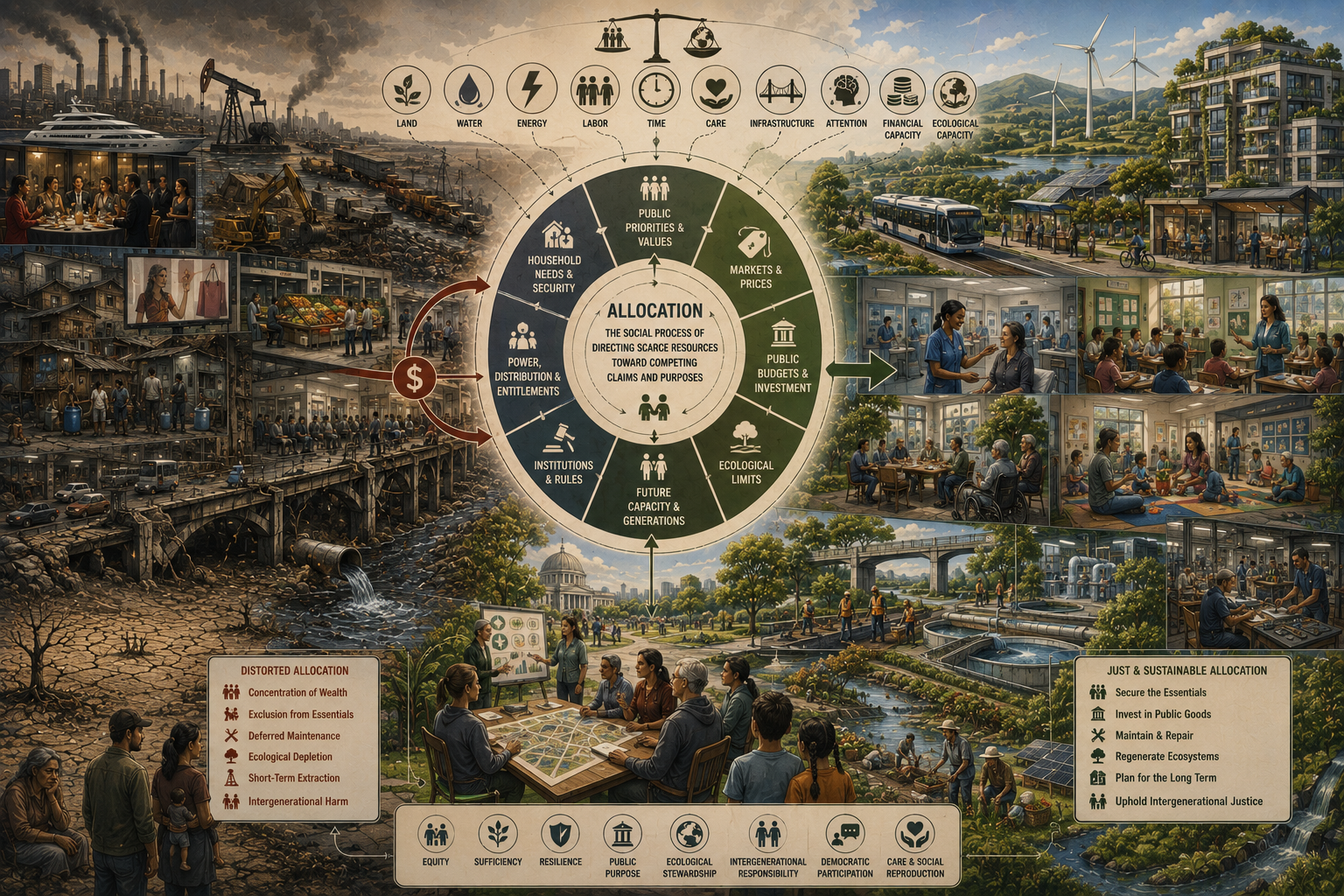
Within a sustainable systems framework, scarcity becomes deeper still. The question is not only how scarce goods are distributed among present uses, but how production, distribution, public decision-making, and ecological stewardship are organized under conditions of planetary constraint. Scarcity opens directly onto the larger question of what an economy is for: whether it exists only to satisfy purchasing power in the present, or whether it should sustain a durable, just, and ecologically viable form of collective life.
Why Scarcity Is Foundational
Economics begins with scarcity because scarcity makes choice unavoidable. If all goods were available in limitless quantity, if all labor could be performed without fatigue, if all infrastructure could be built without cost, and if nature could absorb unlimited extraction and waste without consequence, then economic coordination would lose much of its urgency. But real societies do not inhabit such a world. They inhabit a world of limits, trade-offs, bottlenecks, delays, vulnerabilities, unequal access, and ecological thresholds.
Scarcity matters because it means every economic order must prioritize. It must decide whether resources go to luxury consumption or public health, military expansion or education, debt service or infrastructure renewal, private enrichment or social protection, immediate output or long-term resilience, fossil-energy lock-in or ecological transition. These are allocation questions, but they are never merely technical. They are moral, political, institutional, and ecological questions.
Scarcity therefore belongs at the center of economic systems rather than at the edge of microeconomic theory. It is the condition that forces a society to organize itself materially. It is the pressure under which institutions reveal what they are designed to protect.
A society’s treatment of scarcity shows whether essential goods are treated as rights, commodities, public responsibilities, private burdens, or privileges of purchasing power. It shows whether future generations are treated as claimants or afterthoughts. It shows whether ecological systems are understood as foundations of life or as inventories to be liquidated.
For this reason, scarcity is not a beginner’s concept to be left behind after introductory economics. It is one of the deepest concepts in political economy, sustainable development, public finance, ecological economics, and institutional analysis. It asks what a society does when not everything can be done at once.
Beyond the Textbook Definition of Scarcity
The standard definition of scarcity describes a condition in which limited resources confront unlimited wants. That definition is useful as a first approximation, but it can mislead if treated as complete. It risks suggesting that scarcity is purely natural, universally experienced in the same way, and analytically separable from institutions and power. None of these assumptions holds in any serious account of economic life.
A stronger conception distinguishes among several forms of scarcity.
| Form of Scarcity | Meaning | Example |
|---|---|---|
| Physical scarcity | Real material limits in land, labor, water, energy, time, or ecological capacity. | A drought reduces freshwater availability; a region lacks enough skilled labor for critical infrastructure repair. |
| Institutional scarcity | Shortages created or intensified by weak governance, poor coordination, underinvestment, or administrative incapacity. | Housing permits, transit gaps, fragmented health systems, or weak public procurement restrict access despite available wealth. |
| Distributional scarcity | Deprivation produced by inequality, exclusion, market dependence, legal barriers, or concentrated command over resources. | Food exists in abundance, but households lack income or entitlement to access it securely. |
| Temporal scarcity | The conflict between present use and future capacity. | Deferred maintenance lowers visible costs today while increasing infrastructure fragility tomorrow. |
| Ecological scarcity | Resource use, pollution, or throughput exceeds regenerative or absorptive capacity. | Climate instability, aquifer depletion, biodiversity loss, or soil degradation narrows future options. |
This distinction matters because what appears as scarcity at the household level may be an allocation failure at the societal level. Housing can be scarce for millions even where urban wealth is abundant. Care can be scarce even where total income is high. Water can be scarce because of drought, but also because of governance failure, pollution, unequal access, or infrastructural neglect. Food insecurity can persist in the midst of aggregate abundance.
Scarcity also changes historically. Innovation can reduce some scarcities while intensifying others. Productivity growth can lower the cost of manufactured goods while increasing resource throughput. Digitization can expand access to information while concentrating platform power. Energy abundance can raise living standards while deepening ecological instability. The meaning of scarcity is always bound up with the structure of production, the organization of access, and the ecological foundations of the economy.
Allocation as a Civilizational Problem
If scarcity is the condition, allocation is the practical and institutional response. Allocation refers to the directing of resources, labor, time, land, money, public authority, and collective attention among competing uses. It includes the familiar allocation of private goods through markets and prices, but it extends much further.
Public budgets allocate. Tax systems allocate. Welfare states allocate. Credit systems allocate. Planning institutions allocate. Infrastructure strategies allocate. Household care arrangements allocate. Property rights allocate. Legal entitlements allocate. Even neglect allocates, because failing to maintain a bridge, a hospital, a water system, a forest, or a care system directs scarcity toward someone.
Allocation is therefore not simply an economic procedure. It is one of the primary ways a civilization orders material life. Through allocation, a society decides whether children are educated, whether elders are cared for, whether rural regions are abandoned or connected, whether energy systems are made clean or merely cheap, whether speculative gains outrank public stability, and whether future generations inherit capacity or exhaustion.
Seen this way, allocation cannot be exhausted by the language of efficiency. Efficiency matters, but it is only one criterion among others. A society may allocate efficiently according to market prices while allocating irrationally according to human need, democratic legitimacy, public health, ecological continuity, or intergenerational responsibility. It may optimize transactions while misordering life.
The deeper question is not only whether allocation is efficient, but whether it is sane, just, durable, and compatible with the reproduction of society itself.
Material Life and Social Reproduction
The phrase organization of material life points to the fact that economics is about more than transactions. It concerns the provisioning of existence. Food, shelter, water, warmth, transport, medicine, education, sanitation, care, communication, safety, and infrastructure maintenance are not secondary details. They are the practical substance of material life.
To organize material life is to organize the conditions under which people can survive, work, learn, raise children, age, recover from illness, participate in public life, and plan beyond the next emergency. This includes formal production, but it also includes social reproduction: the care work, maintenance work, institutional continuity, and ecological stewardship that make future production possible.
Scarcity is often experienced most sharply here. It appears not first as a theoretical proposition, but as rent burden, overcrowded housing, fragile transport, overstretched hospitals, energy insecurity, care exhaustion, degraded public space, polluted water, food insecurity, and insecure access to basic services.
A serious economics of scarcity must therefore remain close to the material infrastructure of everyday life. Otherwise it becomes an abstract theory of choice severed from the lived organization of dependence and survival.
Social reproduction is especially important because many systems rely on unpaid, underpaid, feminized, racialized, or invisible labor to sustain the conditions of economic activity. A formal economy can appear productive while exhausting households, caregivers, communities, and ecosystems. That is not an accounting detail. It is a sign that scarcity has been displaced into hidden domains rather than resolved.
Markets, Prices, and Their Limits
Markets are one way of allocating scarce resources. Prices can aggregate dispersed information, coordinate decentralized decisions, and register relative pressure on supply and demand. Under appropriate conditions, markets can be powerful tools for organizing many private goods and discovering certain forms of efficiency.
But market allocation should not be confused with allocation as such. Markets operate within preexisting legal, infrastructural, financial, and political conditions. They depend on contract enforcement, property rights, transport systems, monetary stability, information systems, and institutions capable of upholding rules. They also depend on prior distributions of income and wealth.
A market does not ask whether someone can pay because of justice or cannot pay because of exclusion. It registers effective demand. In that sense, market allocation is always shaped by prior distributions of power.
Markets also have characteristic blind spots. They struggle with public goods, common-pool resources, long time horizons, systemic risk, and harms that are diffuse, delayed, or difficult to price. They often treat purchasing power as the decisive signal even where need is greatest elsewhere. They can coordinate exchange effectively while misallocating care, resilience, environmental protection, or long-term infrastructure.
Their limitations do not make markets useless. They make them partial. The question is not whether markets allocate, but what kinds of goods they allocate well, under what institutional conditions, and what complementary or corrective structures are required when price signals conflict with social need or ecological reality.
States, Public Goods, and the Allocation of Priorities
States and public institutions are central allocators in every complex economy. They tax, spend, regulate, subsidize, insure, stabilize, plan, procure, build, and repair. They fund infrastructure, education, health systems, environmental protection, courts, research, public safety, social protection, and disaster response. Through budgets and law, they establish which collective needs will be met publicly, which privately, and which not at all.
This means allocation is always partly a matter of public priority. Every budget expresses a hierarchy of concern. A society that underfunds preventive health while subsidizing environmentally destructive activity is making an allocation decision. A society that neglects water systems, housing, or transit while protecting speculative wealth is making an allocation decision. A society that chooses long-term resilience over short-term extraction is also making an allocation decision.
Public goods make this especially clear. Some goods are difficult to provide adequately through private markets because their benefits are widely shared, difficult to exclude, or dependent on long time horizons. Public health capacity, resilient infrastructure, clean air, basic scientific research, climate adaptation, and certain forms of environmental protection belong to this category. If these are left entirely to private calculation, they tend to be underprovided relative to social need.
Allocation therefore requires institutions capable of acting on a wider horizon than the isolated transaction. The question is not only how much the state spends, but what kind of public capacity it builds: administrative capacity, planning capacity, fiscal capacity, regulatory capacity, emergency capacity, scientific capacity, and democratic capacity.
Distribution, Power, and Exclusion
Scarcity is never experienced uniformly. It is filtered through class, geography, race, property, citizenship, labor status, debt, disability, household structure, care responsibility, and political voice. Two households living in the same city can inhabit entirely different economies: one buffered by assets, networks, insurance, and public insulation; the other exposed to price shocks, eviction risk, care scarcity, debt collection, heat exposure, and degraded infrastructure.
This brings power to the center of allocation. Who commands scarce housing? Who gains access to cheap credit? Who controls land, energy, water, logistics, and productive assets? Who bears inflation, austerity, pollution, displacement, or infrastructural neglect? Which regions are invested in and which are written off? Which households are protected by public systems and which must purchase security privately?
These are not secondary political complications imposed on an otherwise neutral economy. They are part of the economy’s structure.
Once this is understood, allocation appears not as a frictionless sorting of resources, but as a contested ordering of social claims. Every economic system contains rules of entitlement and exposure. Some groups enjoy secure access to essentials, while others encounter scarcity as routine insecurity. Institutions can mitigate this by socializing risk, expanding access, and protecting basic goods. Or they can intensify scarcity by privatizing vulnerability and concentrating command over resources.
Scarcity is therefore always entangled with the politics of distribution. It is not enough to ask whether resources exist in aggregate. One must ask who can reach them, under what conditions, at what price, with what dignity, and with what protections against arbitrary loss.
Ecological Scarcity and Biophysical Constraint
Within sustainable systems, scarcity must be understood in biophysical as well as economic terms. Economies are not disembodied circuits of exchange. They are material systems that depend on energy, land, minerals, forests, soils, biodiversity, freshwater, climatic stability, and the capacity of ecosystems to absorb waste. These conditions are not optional inputs. They are enabling foundations.
Ecological scarcity changes the meaning of allocation. The problem is no longer only how to divide scarce goods among present claimants, but how much extraction, land conversion, pollution, and throughput a society can sustain without undermining the ecological basis of future life. Under these conditions, allocation becomes inseparable from planetary boundaries, resource governance, and long-range stewardship.
This also means conventional abundance can conceal deeper scarcity. A society may enjoy cheap goods, rapid consumption, and high measured output while drawing down soils, aquifers, forests, fisheries, climate stability, or biodiversity. What appears abundant in market time may be profoundly scarce in ecological time.
A sustainable understanding of scarcity must therefore include thresholds, regeneration rates, cumulative harms, irreversible damage, and the difference between income derived from stewardship and income derived from liquidation. Ecological depletion can make the present look richer by making the future poorer.
Time, Uncertainty, and Future Capacity
Scarcity is always temporal. Resources directed toward one use today are unavailable for other uses now, and often unavailable for future uses as well. A society that allocates heavily toward immediate consumption may weaken investment in infrastructure, education, public health, ecosystem repair, or adaptive capacity. A society that neglects maintenance may inherit fragility disguised as savings. A society that treats future harms as external to present calculation may simply be shifting scarcity forward in time.
Uncertainty deepens the problem. Allocation decisions must often be made without complete knowledge of future shocks, ecological tipping points, technological change, demographic pressures, financial conditions, or geopolitical instability. A wise economic system therefore does not allocate only for present efficiency. It allocates for resilience, redundancy, repair capacity, and room for adaptation.
One of the deepest tasks of allocation is preserving future optionality. A society must decide not only what to maximize now, but what capabilities to keep open. This includes institutional capacity, public trust, ecological integrity, infrastructural robustness, fiscal capacity, social cohesion, and technical competence.
Scarcity handled poorly narrows the future. Scarcity handled well disciplines priorities without destroying possibility.
Scarcity Within Sustainable Systems
A sustainable systems perspective widens the allocation question beyond present consumption and firm-level efficiency. It asks how economic systems can allocate in ways that preserve the conditions of long-term human flourishing. This includes the provisioning of essentials, the protection of public goods, the reduction of avoidable vulnerability, and the maintenance of ecological viability.
Under this lens, scarcity becomes a systems problem. Housing scarcity is tied to land use, finance, wages, zoning, transport, speculation, and public provision. Water scarcity is tied to climate, infrastructure, agriculture, pricing, governance, pollution, and watershed management. Energy scarcity is tied to infrastructure, geopolitics, technology, affordability, transition strategy, and grid resilience. Care scarcity is tied to households, labor markets, welfare design, gendered expectations, aging, disability, and public investment.
Scarcity is therefore rarely singular. It emerges from interacting structures.
This is why sustainable systems thinking matters. It resists the temptation to treat each scarcity as isolated and each remedy as narrowly sectoral. Instead, it asks how institutions, incentives, infrastructures, and ecosystems interact, and how allocation can be reorganized to reduce systemic vulnerability rather than merely shifting burdens from one domain to another.
Sustainable allocation does not mean eliminating trade-offs. It means facing them honestly, expanding the time horizon, accounting for hidden dependence, and refusing to call a system efficient when it is merely exporting its costs to the poor, the future, or the Earth system.
How Allocation Should Be Judged
A narrow economic view often judges allocation by whether resources flow to their highest-valued use under prevailing prices. That criterion has analytical value, but it is insufficient for assessing the organization of material life. A broader framework must ask additional questions.
| Criterion | Guiding Question | Why It Matters |
|---|---|---|
| Productive adequacy | Does allocation sustain the goods, services, capacities, and infrastructures necessary for collective life? | Scarce resources must support real provisioning, not only measured transactions. |
| Equity | Are burdens, protections, and access distributed in ways consistent with dignity and legitimacy? | Scarcity becomes unjust when insecurity is systematically concentrated. |
| Institutional coherence | Do public systems, markets, households, and infrastructures reinforce rather than undermine one another? | Fragmented allocation can generate avoidable scarcity. |
| Resilience | Can the system absorb shocks without cascading deprivation, institutional breakdown, or prolonged insecurity? | Efficient systems can still be fragile if they lack buffers and repair capacity. |
| Ecological viability | Does allocation preserve regenerative and absorptive capacities? | Present abundance can conceal future depletion. |
| Intergenerational responsibility | Does allocation pass forward usable capacity rather than hidden damage? | Scarcity should not be displaced onto future generations. |
These questions reveal a basic truth: allocation can be efficient in a narrow sense while failing in a civilizational one. A society may optimize exchange and still misorganize life. The deeper standard is whether scarce means are being directed toward a form of prosperity that can be maintained without sacrificing justice, resilience, or the future.
A Taxonomy of Scarcity and Allocation Mechanisms
Scarcity analysis becomes more precise when it distinguishes the source of constraint from the mechanism used to allocate under that constraint. A drought, a shortage of trained nurses, an underfunded transit system, a speculative housing market, a monopoly, a legal exclusion, and a damaged power grid can all produce scarcity, but they require different remedies.
The same is true of allocation. Markets allocate through willingness and ability to pay. Public budgets allocate through political and administrative authority. Queues allocate through waiting. Lotteries allocate through chance. Rights-based systems establish protected claims. Triage allocates by urgency and expected benefit. Planning allocates through forecasts, standards, and negotiated priorities.
| Scarcity source | Typical allocation response | Primary risk |
|---|---|---|
| Physical shortage | Rationing, substitution, conservation, capacity expansion. | Ignoring unequal need or ecological regeneration. |
| Distributional exclusion | Income support, entitlement, public provision, price regulation. | Treating aggregate abundance as adequate access. |
| Institutional incapacity | Staffing, maintenance, procurement, coordination, simplification. | Misdiagnosing governance failure as natural scarcity. |
| Temporal bottleneck | Queues, scheduling, reserves, phased investment. | Allowing delay to become hidden denial. |
| Ecological overshoot | Caps, standards, restoration, demand reduction, substitution. | Optimizing current use while degrading future capacity. |
A rigorous allocation process should therefore begin with diagnosis. It should ask whether the binding constraint is material, financial, institutional, spatial, legal, informational, ecological, or political before selecting an instrument.
Need, Demand, Entitlement, and Effective Access
Need is not the same as market demand. Demand is filtered through income, credit, price, information, time, documentation, mobility, and institutional eligibility. A household can urgently need food, housing, medicine, transport, or care without appearing as effective demand in a market.
Entitlements determine whether a person has a recognized claim. These can arise through income, property, employment, citizenship, insurance, social rights, public programs, community membership, or emergency status. Allocation systems are partly systems of entitlement: they specify who may claim what, through which institution, and under what conditions.
Effective access depends on more than nominal availability. A clinic may exist but be unreachable. A benefit may be legally available but administratively inaccessible. Housing may be vacant while unaffordable. Water may be physically present but polluted or controlled through exclusionary infrastructure.
Effective\ Access = Availability \times Affordability \times Eligibility \times Usability
\]
Interpretation: If any essential access condition approaches zero, formal availability can coexist with practical deprivation.
Allocation should therefore be evaluated through actual use and capability, not only supply. The test is whether people can obtain the service safely, reliably, affordably, and with dignity.
Provisioning Systems and the Foundational Economy
The foundational economy consists of systems that make everyday life possible: food, housing, water, energy, care, health, education, sanitation, communication, transport, finance, and public administration. These sectors differ from discretionary consumption because failure quickly produces insecurity and cascading social harm.
Provisioning analysis follows the full system. It examines production capacity, workforce, infrastructure, finance, regulation, logistics, distribution, maintenance, access, and resilience. A shortage at any point can limit the service delivered.
Essential systems often combine public, private, household, cooperative, and nonprofit provision. The relevant question is not whether one institutional form is always superior. It is whether responsibilities, incentives, capacities, and accountability are aligned with reliable service.
Foundational systems also interact. Housing location affects transport and energy burden. Water systems affect health. Childcare affects labor supply. Digital access affects eligibility and employment. Allocation decisions should therefore be tested for cross-system effects.
A materially secure economy is not one in which every commodity is abundant. It is one in which essential provisioning remains dependable across income, place, disability, age, and crisis.
Opportunity Cost, Shadow Prices, and Nonmarket Value
Every allocation has an opportunity cost: the value of the best alternative forgone. This concept helps reveal trade-offs, but market prices do not necessarily capture all opportunity costs. Unpaid care, ecological damage, public trust, option value, resilience, and future capacity may have little or no market price while remaining economically decisive.
Shadow prices estimate the marginal social value of a constrained resource. They can represent avoided emissions, hospital capacity, water reliability, travel time, biodiversity, or the value of relaxing a bottleneck. Their usefulness depends on assumptions about distribution, uncertainty, and the objective being optimized.
Social\ Opportunity\ Cost = Market\ Cost + External\ Cost + Capacity\ Cost + Distributional\ Cost
\]
Interpretation: Social cost includes burdens that may not appear in the transaction price.
Shadow pricing should remain transparent. A model that assigns a high value to aggregate output and a low value to care, resilience, or ecological loss is not neutral. It embodies a hierarchy of values.
Where monetization is unreliable or ethically inappropriate, multi-criteria analysis can preserve distinct dimensions rather than forcing everything into one price.
Queues, Lotteries, Rationing, and Triage
When price is rejected or insufficient, scarcity does not disappear. It is allocated through another mechanism. Waiting lists allocate through time. Lotteries allocate through chance. Administrative rules allocate through category. Triage allocates through urgency, prognosis, and expected benefit. Political discretion allocates through authority.
Queues can appear equal because everyone waits, but waiting costs are uneven. People with flexible employment, transport, childcare, language skills, or institutional knowledge can tolerate delay more easily. A long queue can therefore ration access regressively.
Lotteries can be defensible when claims are genuinely equal and priority cannot be justified. They are weaker where need, vulnerability, or expected benefit differs substantially.
Rationing criteria should be public, relevant, consistently applied, reviewable, and protected from discrimination. Emergency triage should avoid social-worth judgments and should not use disability, age, or wealth as crude proxies for expected clinical benefit.
No mechanism eliminates moral choice. Each determines whose claims count, which burdens are visible, and what kind of inequality is accepted.
Multi-Criteria Allocation and Social Objectives
Many allocation decisions involve objectives that cannot be reduced credibly to one measure. A public investment may affect productivity, equity, emissions, resilience, health, regional balance, and institutional capacity. Multi-criteria analysis makes those objectives explicit.
Score_j = \sum_{k=1}^{m} w_k z_{jk}
\]
Interpretation: Option \(j\) is evaluated across normalized criterion \(z_{jk}\) with weight \(w_k\).
The arithmetic is simple; governance is not. Who chooses the criteria? Who sets the weights? Are minimum thresholds allowed to be traded away? How are affected communities represented? How are uncertainty and irreversible harm handled?
Some criteria should operate as constraints rather than weights. A project should not compensate for violating a legal right or ecological threshold by scoring highly on short-run output. Minimum service levels, safety standards, and protected claims can define a feasible set before options are ranked.
Good multi-criteria analysis reports sensitivity. If a recommendation changes dramatically under small adjustments to weights, the result is politically and analytically fragile.
Public Budgets, Fiscal Space, and State Capacity
Public budgets allocate financial authority, but money alone does not create real capacity. A government can authorize spending without having enough engineers, nurses, contractors, equipment, land, data, or administrative capability to deliver the intended service.
Fiscal space depends on revenue, debt, interest costs, monetary institutions, external constraints, political legitimacy, and macroeconomic conditions. Real-resource space depends on labor, technology, supply chains, energy, and productive capacity. Confusing the two can produce either needless austerity or inflationary overload.
Budget quality should therefore be assessed through execution, maintenance, distribution, and outcomes. A capital budget can build facilities that operating budgets cannot staff. Emergency appropriations can remain unspent because procurement systems are weak. Subsidies can preserve access or lock in harmful activity.
State capacity is itself an allocation object. Tax administration, statistics, inspection, planning, procurement, courts, public employment, laboratories, and local government require sustained investment.
A society that repeatedly cuts administrative capacity may create artificial scarcity in precisely the institutions needed to manage real scarcity.
Inflation, Bottlenecks, and Real-Resource Constraints
When nominal spending expands faster than available supply, allocation can occur through inflation. Prices rise, purchasing power shifts, and households with limited income or weak bargaining power lose access first.
Inflation can result from broad excess demand, sector-specific bottlenecks, energy and food shocks, exchange-rate pressure, market concentration, conflict, climate damage, or disrupted logistics. The allocation response should match the cause.
Interest-rate increases may reduce general demand but cannot directly produce food, housing, electricity, medicine, or port capacity. Supply investment, reserves, competition policy, targeted support, trade measures, and public provision may be more relevant to specific constraints.
Price controls can protect access temporarily but may create shortages if supply, compensation, enforcement, and distribution are ignored. Universal subsidies can stabilize prices while consuming large fiscal resources and benefiting high users disproportionately.
Inflation policy is therefore also allocation policy. It determines how adjustment is distributed among wages, profits, debtors, creditors, public budgets, and essential consumption.
Maintenance Backlogs and Critical Infrastructure
Maintenance is allocation across time. Deferred repair can reduce visible expenditure now while increasing failure probability, service disruption, replacement cost, and inequality later.
Infrastructure condition should be treated as a stock. Roads, bridges, water systems, grids, schools, hospitals, public housing, digital networks, and flood defenses deliver services only if inspection, staffing, parts, and preventive work are funded.
Capacity_{t+1}=Capacity_t+Investment_t-Depreciation_t-Damage_t
\]
Interpretation: New investment does not increase usable capacity when depreciation and damage exceed additions.
Maintenance scarcity is often institutional rather than technical. Capital grants may be politically attractive, while routine operations are fragmented across agencies and budget cycles.
Risk-based maintenance should consider consequence, condition, redundancy, exposure, and repair lead time. Equity matters because failure burdens are often concentrated in communities with older infrastructure and less political influence.
Housing, Land, and Spatial Allocation
Housing scarcity is shaped by land, construction capacity, finance, infrastructure, zoning, ownership concentration, vacancy, speculation, income, and public provision. Aggregate unit counts alone do not describe access.
Location is part of housing allocation. A nominally affordable home can create high transport, energy, childcare, and time costs. Infrastructure decisions determine which land becomes usable and which communities receive opportunity.
Markets allocate housing strongly through purchasing power. Public housing, vouchers, rent regulation, land trusts, cooperative ownership, planning, taxation, and homelessness services alter entitlements and bargaining power.
Allocation should distinguish emergency shelter, permanent housing, accessibility, overcrowding, security of tenure, climate exposure, and neighborhood services. New supply is essential in many places, but the type, price, location, tenure, and ownership of supply matter.
Land has option value. Irreversible development can foreclose agriculture, habitat, flood storage, public space, or future infrastructure. Spatial allocation should therefore operate across generations and systems.
Care, Time, and Social-Reproductive Capacity
Care scarcity is often allocated inside households through unpaid labor, reduced employment, exhaustion, or unmet need. Because much care is outside formal markets, its scarcity can remain statistically invisible.
Childcare, elder care, disability support, health care, education, household maintenance, and emotional labor sustain workers and communities. When public systems are weak, households absorb the burden, usually unevenly by gender, class, race, migration status, and family structure.
Time-use data reveal allocation that monetary accounts miss. A policy can reduce public expenditure while increasing unpaid work and limiting labor-force participation, education, sleep, or health.
Care capacity depends on staffing, wages, training, scheduling, facilities, immigration policy, family leave, and community networks. It cannot be expanded indefinitely through appeals to vocation or family responsibility.
A sustainable economy should treat care as productive infrastructure and allocate sufficient public, household, and organizational capacity to reproduce social life without systematic exhaustion.
Health-Care Priority Setting and Universal Coverage
Health systems allocate through budgets, insurance, clinical guidelines, waiting lists, geographic distribution, workforce, technology assessment, and bedside judgment. Formal coverage does not guarantee timely care or financial protection.
Priority setting should consider severity, expected health gain, cost, equity, prevention, feasibility, and system capacity. Cost-effectiveness can improve population health but should not operate as the sole criterion where rare disease, disability, geographic inequity, or catastrophic need is involved.
Universal health coverage aims to ensure access to needed quality services without financial hardship. The WHO–World Bank 2025 monitoring report found continued progress but substantial remaining gaps, illustrating how service and financial allocation remain central.
Emergency triage differs from long-term priority setting. Crisis standards may temporarily allocate scarce beds, oxygen, or medicine, while routine systems should invest to reduce recurring scarcity.
Health allocation must also account for prevention. Underfunding sanitation, primary care, vaccination, mental health, or public-health laboratories can create expensive downstream demand.
Food Security, Prices, and Entitlement Failure
Food insecurity can exist amid adequate global production. Access depends on income, prices, land, employment, public support, conflict, logistics, storage, household power, and nutrition-sensitive services.
High food-price inflation reallocates purchasing power away from low-income households because food represents a larger share of their budgets. Families may reduce diet quality, health spending, education, or other essentials before reducing calories.
The 2025 State of Food Security and Nutrition in the World emphasizes the effect of elevated food-price inflation on access to healthy diets and calls for coordinated macroeconomic, social-protection, trade, data, and agrifood-system measures.
Emergency food assistance is necessary during crisis, but long-term food security also depends on resilient production, transport, markets, storage, soil, water, farmer livelihoods, and rights.
Allocation should distinguish calories, nutrition, cultural suitability, stability, and agency. A system that provides cheap energy-dense food while nutritious diets remain unaffordable does not solve material scarcity adequately.
Water Scarcity, Basin Governance, and Essential Use
Water allocation must reconcile household need, ecosystems, agriculture, industry, energy, navigation, culture, and future recharge. The binding constraint can be physical shortage, pollution, storage, infrastructure loss, affordability, or governance.
Basin-level analysis is essential because upstream extraction affects downstream users and ecosystems. Groundwater depletion can conceal scarcity by allowing current use to exceed recharge.
Sustainable\ Withdrawal \leq Recharge – Ecological\ Reserve
\]
Interpretation: Human withdrawal must preserve the flows required for long-term system function.
Essential household use and public health should receive protected priority. Pricing can encourage conservation but should not deny basic access. Large users may require permits, caps, monitoring, and scarcity-contingent reductions.
Water allocation should incorporate drought triggers, shared data, Indigenous and customary rights, ecosystem thresholds, leakage reduction, reuse, and conflict-resolution institutions.
Energy Reliability, Affordability, and Load Allocation
Energy scarcity appears through insufficient generation, fuel shortage, grid congestion, outage, high prices, or inability to pay. Reliable systems require generation, networks, storage, demand flexibility, maintenance, reserves, and fuel diversity.
During shortage, load shedding allocates electricity through planned or unplanned interruption. Critical facilities, medically vulnerable households, water systems, communications, and emergency services require protection.
Affordability policy can use lifeline tariffs, targeted transfers, arrears protection, efficiency investment, or public provision. Broad price suppression may protect households but weaken conservation or utility finance if poorly designed.
The energy transition creates new allocation questions. Grid connections, transmission capacity, clean technology subsidies, and critical minerals must be directed across regions and sectors while maintaining current reliability.
Demand management can reduce scarcity without reducing welfare when it shifts flexible loads, improves buildings, or eliminates waste. It becomes unjust when essential consumption is curtailed because low-income users lack efficient equipment or alternatives.
Critical Minerals, Strategic Reserves, and Supply Concentration
Critical-mineral scarcity is not determined by geology alone. Demand growth, mine development time, processing concentration, trade controls, recycling, substitution, environmental limits, and geopolitical risk shape availability.
The IEA’s 2026 outlook emphasizes resilience, diversification, supply concentration, trade restrictions, and continuing concern about copper and other strategic materials. A market can appear balanced globally while remaining vulnerable to the loss of one major supplier.
Allocation tools include strategic reserves, long-term contracts, recycling, material efficiency, substitution, diversified processing, public finance, and priority rules during disruption.
Criticality is sector-specific. A small mineral market can have large consequences if the material has few substitutes and is essential to grids, semiconductors, health equipment, aerospace, or defense.
Security policy should not erase environmental justice or community rights. Rapid extraction can shift scarcity into water, land, labor, health, and ecological systems.
Emergency Allocation, Disaster Logistics, and Reserves
Emergencies compress time and damage normal allocation channels. Roads fail, information becomes uncertain, prices spike, inventories disappear, and institutions face simultaneous demands.
Preparedness should identify essential goods, critical populations, reserve levels, suppliers, transport, mutual-aid agreements, communication, and decision authority before crisis.
Emergency allocation should prioritize survival, medical urgency, restoration of critical systems, and equitable access. First-come-first-served rules can disadvantage remote, disabled, low-income, or digitally excluded populations.
Reserves create carrying cost and obsolescence risk, but zero inventory creates fragility. Rotation, distributed storage, supplier diversity, and transparent release rules can balance efficiency and readiness.
Post-event review should compare plans with actual distribution: who received aid, how quickly, through which channels, and where bottlenecks or discrimination occurred.
Algorithmic Allocation, Data, and Automated Exclusion
Algorithms increasingly allocate credit, insurance, employment, housing access, health attention, public benefits, platform visibility, and investigative resources. They can improve consistency and speed, but they can also scale hidden assumptions and historical inequality.
An allocation model requires an objective, data, constraints, thresholds, and an error policy. Each creates distributive effects. Optimizing fraud detection can increase false denials. Optimizing throughput can reduce attention to complex cases. Predicting cost can differ from predicting need.
Governance should include data quality, relevance, subgroup performance, explainability, appeal, human authority, monitoring, and correction. Automated scarcity should not become unreviewable exclusion.
Allocation systems also shape behavior. A score can redirect staff, alter documentation, and change which people seek help. Evaluation should therefore include system effects rather than model accuracy alone.
High-stakes allocation should preserve a meaningful path to challenge facts, criteria, and outcome.
Participatory Allocation, Democratic Legitimacy, and Conflict
Allocation creates winners, losers, delays, and obligations. Legitimacy depends not only on outcomes but on whether affected people can understand, influence, and contest the process.
Participatory budgeting, citizen assemblies, community planning, worker representation, and stakeholder panels can surface local knowledge and competing values. Participation is strongest when it affects real decisions rather than merely collecting opinion.
Representation matters. Time, language, disability, digital access, and organizational resources shape who participates. Deliberation can reproduce inequality unless support is provided.
Technical expertise remains necessary. Democratic allocation does not mean voting on every engineering fact. It means experts explain constraints and options while legitimate institutions decide values, priorities, and acceptable risk.
Conflict cannot always be eliminated. A fair process clarifies disagreement, protects rights, records reasons, and creates review mechanisms rather than pretending that optimization has made politics disappear.
Intergenerational Allocation, Option Value, and Irreversibility
Future generations cannot participate directly in present markets or elections, yet current allocation determines the infrastructure, debt, ecosystems, technology, and institutional capacity they inherit.
Discounting converts future effects into present values, but a high discount rate can make distant catastrophe appear economically minor. Ethical analysis should distinguish impatience, expected growth, uncertainty, inequality, and irreversible harm.
Option value is the value of keeping future choices open. Conserving land, biodiversity, fiscal capacity, public trust, strategic skills, and infrastructure flexibility can be rational even when the immediate return is uncertain.
Irreversible actions require stronger safeguards. Extinction, aquifer collapse, toxic contamination, and permanent land conversion cannot be repaired easily through later spending.
Intergenerational allocation should use long horizons, threshold constraints, scenario analysis, maintenance accounting, and explicit representation of future claims.
Robust Decision-Making Under Deep Uncertainty
Some allocation problems lack reliable probabilities. Climate tipping points, migration, technological change, conflict, and cascading infrastructure failure can create deep uncertainty.
Robust decision-making asks which options perform acceptably across many plausible futures rather than optimizing for one forecast. It favors flexibility, modular investment, monitoring, trigger points, and reversible steps where possible.
Robustness(a)=\min_{s \in S} Performance(a,s)
\]
Interpretation: A robust action performs tolerably even in the most challenging plausible scenario.
Resilience can justify redundancy and reserves that appear inefficient under average conditions. The relevant comparison is not lowest expected cost alone, but avoided catastrophic loss and speed of recovery.
Adaptive pathways specify when to escalate, defer, substitute, or revise an allocation as evidence changes. This prevents plans from becoming rigid commitments to obsolete assumptions.
Global Allocation, Trade, Debt, and Development Space
Global allocation is structured by trade, finance, currency hierarchy, debt, intellectual property, technology, aid, taxation, and political power. Countries do not face scarcity with equal capacity to borrow, import, insure, or influence prices.
Trade can expand access and specialization, but dependence on concentrated supply creates vulnerability. Export restrictions during crisis can protect domestic users while intensifying scarcity elsewhere.
Debt service competes with health, education, infrastructure, adaptation, and social protection. The UN’s 2025 SDG assessment emphasizes a multitrillion-dollar annual financing gap in developing countries, showing that global financial abundance does not automatically translate into development allocation.
Development space includes the ability to build institutions, diversify production, mobilize revenue, manage capital flows, and invest over long horizons. Conditional finance can provide resources while narrowing policy choice.
Global allocation should be judged by capability, resilience, responsibility, and need as well as contractual claim and market power.
The 2024–2026 Allocation Context
UNEP’s Global Resources Outlook 2024 reports that resource extraction tripled over the previous five decades and could rise substantially again by 2060 without systemic change. It also documents major distributional differences in resource use and environmental impact.
FAO’s 2025 food-security report shows how food-price inflation can reduce effective access to healthy diets even where food exists in aggregate. The WHO–World Bank 2025 universal-health-coverage report similarly distinguishes service availability from financial protection and effective access.
The IEA’s 2026 critical-minerals outlook emphasizes that allocation must address concentration, trade restrictions, diversification, strategic resilience, and environmental and social performance rather than aggregate supply alone.
The UN’s 2025 SDG reporting highlights a large financing gap for developing countries while noting that global financial assets are far larger. This is a clear example of distributional and institutional scarcity: resources exist, but allocation channels do not direct them adequately toward public need.
Together these sources reinforce the article’s central claim. Scarcity is never only about physical quantity. It is also about entitlement, infrastructure, price, finance, institutional capacity, resilience, and ecological limits.
Worked Diagnostic: Allocating a Constrained Public-Investment Budget
Consider a fictional regional government with a fixed five-year capital envelope. It faces aging water infrastructure, a housing shortage, hospital crowding, flood risk, unreliable transit, and pressure to attract a large industrial facility.
Step 1: Define the decision and protected claims
Specify the budget, time horizon, legal duties, minimum service standards, and populations facing immediate harm.
Step 2: Diagnose each scarcity
Separate physical shortage, maintenance failure, distributional exclusion, staffing bottleneck, ecological exposure, and institutional incapacity.
Step 3: Map system interdependence
Identify how water, housing, transport, health, industry, energy, land, and flood protection affect one another.
Step 4: Establish baselines and counterfactuals
Estimate failure risk, unmet need, future cost, climate exposure, service loss, and distribution if no action is taken.
Step 5: Define criteria and constraints
Use adequacy, equity, resilience, ecological viability, deliverability, maintenance, and future option value, while protecting non-negotiable thresholds.
Step 6: Generate portfolios rather than isolated projects
Compare balanced packages of repair, capacity expansion, demand management, public provision, and institutional strengthening.
Step 7: Stress-test uncertainty and implementation
Test inflation, delay, workforce shortages, extreme weather, revenue loss, and industrial-demand growth.
Step 8: Publish reasons, triggers, and review
Document the chosen portfolio, rejected alternatives, distributional effects, milestones, and conditions for reallocation.
| Weak approach | Attraction | Failure |
|---|---|---|
| Fund the highest financial return | Simple and investment-oriented. | Can neglect essential services, rights, and resilience. |
| Divide funds equally | Appears neutral. | Ignores different need, urgency, capacity, and consequence. |
| Systems portfolio | Combines thresholds, interdependence, equity, and delivery. | Requires transparent judgment and continuing review. |
The diagnostic shows why allocation quality depends on problem definition, institutional capacity, and cross-system consequence rather than a single efficiency score.
A Practical Method for Scarcity and Allocation Analysis
1. Define the scarce service or capability
State what people or institutions need to accomplish rather than beginning with a preferred project or commodity.
2. Identify the binding constraints
Separate material, financial, workforce, institutional, legal, spatial, informational, temporal, and ecological constraints.
3. Map claims and entitlements
Identify need, rights, eligibility, purchasing power, existing access, and groups exposed to denial.
4. Trace the provisioning system
Map production, infrastructure, staffing, finance, logistics, maintenance, governance, and use.
5. Establish minimum thresholds
Protect safety, dignity, legal rights, essential services, and ecological boundaries before ranking discretionary gains.
6. Define objectives and measures
Use adequacy, equity, resilience, efficiency, ecological viability, deliverability, and future capacity.
7. Compare allocation mechanisms
Test markets, budgets, rights, queues, rationing, lotteries, planning, and community governance against the problem.
8. Generate portfolios
Combine demand reduction, maintenance, capacity expansion, substitution, redistribution, and institutional reform.
9. Test distribution and burden
Identify who pays, waits, travels, loses access, performs unpaid work, or bears ecological harm.
10. Stress-test uncertainty
Evaluate shocks, delays, inflation, failure, demand growth, and changing ecological conditions.
11. Build implementation capacity
Assign authority, staff, procurement, data, maintenance, appeals, and correction mechanisms.
12. Publish, monitor, and revise
Record reasons, indicators, review dates, trigger points, and actual outcomes.
Common Pitfalls in Scarcity and Allocation Analysis
- Treating every scarcity as natural: Institutional failure, inequality, and exclusion often create or intensify deprivation.
- Equating demand with need: Purchasing power filters which claims markets recognize.
- Assuming price is neutral: Price allocates toward ability to pay and can deny essentials.
- Ignoring hidden allocation: Queues, complexity, geography, and unpaid care ration access silently.
- Optimizing one sector: Housing, water, health, transport, energy, and care are interdependent.
- Counting capital without operations: Facilities require staffing, maintenance, supplies, and administration.
- Using one metric: Output, cost-effectiveness, or return cannot represent every legitimate objective.
- Trading away thresholds: Rights, safety, and ecological boundaries should not be offset casually by aggregate gain.
- Neglecting distribution: Average improvement can coexist with concentrated insecurity.
- Assuming the forecast is correct: Deep uncertainty requires robust and adaptive portfolios.
- Underinvesting in state capacity: Weak data, procurement, staffing, and maintenance create artificial scarcity.
- Ending at adoption: Actual delivery, access, appeals, and correction determine whether allocation works.
The central mistake is to treat allocation as a technical ranking exercise detached from entitlement, power, implementation, ecology, and time.
Mathematical Lens
Mathematics can clarify scarcity and allocation because it makes constraints explicit. But formalization should not be mistaken for social judgment. Equations can reveal trade-offs; they cannot decide what a society should value.
The Basic Scarcity Constraint
R < D
\]
Interpretation: \(R\) represents available resources, capacities, or means; \(D\) represents total desired uses, needs, claims, or demands. Scarcity means not all ends can be satisfied at once.
Allocation as a Constraint Problem
x_1 + x_2 + \cdots + x_n \leq R
\]
Interpretation: Resources must be distributed across competing uses such as housing, health care, education, energy, infrastructure, care, and ecological restoration.
\max W(x_1,x_2,\ldots,x_n)
\]
Interpretation: A society may be understood as choosing some objective function \(W\). The crucial question is what \(W\) represents: output, welfare, equity, resilience, sustainability, political stability, or some combination of these.
Intertemporal Allocation
R_t = C_t + I_t + M_t + E_t
\]
Interpretation: Present resources \(R_t\) can be allocated to consumption \(C_t\), investment \(I_t\), maintenance \(M_t\), and ecological or social repair \(E_t\). A society that neglects maintenance and repair may mistake decay for savings.
Ecological Scarcity
U_t \leq G_t
\]
Interpretation: \(U_t\) represents resource use or ecological burden; \(G_t\) represents regenerative or absorptive capacity. If use persistently exceeds regeneration, present abundance is being purchased through future depletion.
Need, Demand, and Effective Access
A_e = f(N,Y,P,I)
\]
Interpretation: Effective access \(A_e\) depends on need \(N\), income or purchasing power \(Y\), price \(P\), and institutional access \(I\). Deprivation can persist even when goods exist in aggregate because need and effective demand are not the same thing.
The mathematical lens is useful because it clarifies that scarcity is fundamentally about constraints; allocation always implies trade-offs; present use competes with future capacity; ecological depletion can be expressed as use exceeding regeneration; and need is not the same as access. But formalization does not resolve the moral and political questions. Efficiency is not the same as justice. Allocation is not just a technical exercise. The mathematics is most useful when it remains connected to institutions, power, ecology, and lived material life.
Python Workflow: Scarcity and Allocation
Python is useful for turning scarcity and allocation concepts into reproducible scenario analysis. The following compact workflow models a public allocation problem and compares a baseline with a resilience-oriented alternative.
from dataclasses import dataclass

@dataclass
class AllocationPortfolio:
    adequacy: float
    equity: float
    resilience: float
    ecological_viability: float
    deliverability: float
    maintenance: float
    protected_thresholds: bool

    def score(self) -> float:
        if not self.protected_thresholds:
            return 0.0
        return (
            0.22 * self.adequacy
            + 0.20 * self.equity
            + 0.18 * self.resilience
            + 0.16 * self.ecological_viability
            + 0.12 * self.deliverability
            + 0.12 * self.maintenance
        )

portfolios = {
    "baseline": AllocationPortfolio(
        adequacy=0.58, equity=0.46, resilience=0.41,
        ecological_viability=0.38, deliverability=0.82,
        maintenance=0.42, protected_thresholds=True,
    ),
    "repair_and_resilience": AllocationPortfolio(
        adequacy=0.76, equity=0.72, resilience=0.84,
        ecological_viability=0.73, deliverability=0.68,
        maintenance=0.88, protected_thresholds=True,
    ),
    "growth_first": AllocationPortfolio(
        adequacy=0.61, equity=0.38, resilience=0.44,
        ecological_viability=0.29, deliverability=0.74,
        maintenance=0.33, protected_thresholds=False,
    ),
}

for name, portfolio in portfolios.items():
    print(name, round(portfolio.score(), 3))
This compact example makes the structure of trade-offs visible. Increasing infrastructure, care, and ecological restoration requires reducing other allocations unless total resources expand. The question is not only whether the new allocation is efficient, but whether it better preserves future capacity, reduces vulnerability, and supports material life under constraint.
The full GitHub repository expands this workflow into allocation-scenario tables, effective-access metrics, household deprivation indicators, ecological regeneration constraints, intertemporal capacity paths, SQL queries, R visualizations, Stata replication, and Julia simulations.
R Workflow: Allocation Scenarios
R is useful for scenario summaries, distribution-sensitive analysis, and publication-ready graphics. The following compact workflow performs the same allocation comparison and prepares a scenario table.
portfolio_score <- function(
  adequacy,
  equity,
  resilience,
  ecological_viability,
  deliverability,
  maintenance,
  protected_thresholds
) {
  if (!protected_thresholds) {
    return(0)
  }

  (
    0.22 * adequacy +
    0.20 * equity +
    0.18 * resilience +
    0.16 * ecological_viability +
    0.12 * deliverability +
    0.12 * maintenance
  )
}

portfolios <- data.frame(
  Portfolio = c("Baseline", "Repair and Resilience", "Growth First"),
  Adequacy = c(0.58, 0.76, 0.61),
  Equity = c(0.46, 0.72, 0.38),
  Resilience = c(0.41, 0.84, 0.44),
  Ecological_Viability = c(0.38, 0.73, 0.29),
  Deliverability = c(0.82, 0.68, 0.74),
  Maintenance = c(0.42, 0.88, 0.33),
  Protected_Thresholds = c(TRUE, TRUE, FALSE)
)

portfolios$Score <- mapply(
  portfolio_score,
  portfolios$Adequacy,
  portfolios$Equity,
  portfolios$Resilience,
  portfolios$Ecological_Viability,
  portfolios$Deliverability,
  portfolios$Maintenance,
  portfolios$Protected_Thresholds
)

print(portfolios)
This R workflow is deliberately simple for article readability. In the full repository, R summarizes allocation scenarios, calculates weighted allocation scores, evaluates effective access by household group, and produces graphics that show how resource priorities shift across scenarios.
Future Economic Systems articles can extend this foundation with public-budget data, household microdata, distribution-weighted welfare functions, ecological footprint indicators, social accounting matrices, and resilience-focused planning models.
Go Workflow: Allocation Release Gate
The Go workflow provides a dependency-free implementation of threshold protection and portfolio scoring for adequacy, equity, resilience, ecological viability, deliverability, and maintenance.
package main

import "fmt"

type Portfolio struct {
	Adequacy            float64
	Equity              float64
	Resilience          float64
	EcologicalViability float64
	Deliverability      float64
	Maintenance         float64
	ProtectedThresholds bool
}

func (p Portfolio) Score() float64 {
	if !p.ProtectedThresholds {
		return 0
	}
	return 0.22*p.Adequacy +
		0.20*p.Equity +
		0.18*p.Resilience +
		0.16*p.EcologicalViability +
		0.12*p.Deliverability +
		0.12*p.Maintenance
}

func main() {
	portfolio := Portfolio{
		Adequacy:            0.76,
		Equity:              0.72,
		Resilience:          0.84,
		EcologicalViability: 0.73,
		Deliverability:      0.68,
		Maintenance:         0.88,
		ProtectedThresholds: true,
	}
	fmt.Printf("Allocation portfolio score: %.3f\n", portfolio.Score())
}
Structured Research and Scenario-Analysis Companion
The companion build models scarcity and allocation as a transparent systems assessment. It separates need coverage, productive capacity, institutional capacity, distribution, ecological pressure, maintenance, resilience, administrative burden, public legitimacy, implementation readiness, and uncertainty.
| Output | Purpose | Safeguard |
|---|---|---|
| Synthetic allocation diagnostics | Compare fictional provisioning systems under constraint. | No profile represents a real budget, community, or policy. |
| Mechanism comparison | Compare markets, rights, public provision, queues, rationing, and planning. | A score does not establish legal or political legitimacy. |
| Stress scenarios | Test shocks to capacity, maintenance, ecology, demand, and administration. | Results remain conditional on synthetic inputs. |
| Uncertainty ensemble | Show how limited evidence broadens allocation-risk ranges. | Quantification cannot replace public judgment. |
| Validation and checksums | Preserve reproducibility and file integrity. | Technical validity is not policy correctness. |
Python, R, and Go workflows are included in the bundle. They must not be used to deny benefits, triage patients, allocate emergency supplies, determine a public budget, or replace affected-community participation and qualified analysis.
GitHub Repository
The article body includes selected computational examples so the conceptual, institutional, and mathematical argument remains readable. The full repository contains the expanded research infrastructure: Python allocation scenario modeling, R distribution-sensitive summaries, Stata applied-economics replication workflows, SQL scenario and access tables, Julia intertemporal capacity simulations, ecological regeneration constraints, documentation, reproducible sample data, and article-ready figures and tables.
The full code distribution for this article, including selected article examples and advanced research-style computational scaffolding for scarcity constraints, public allocation trade-offs, effective access, distributional deprivation, ecological regeneration, maintenance, intertemporal capacity, reproducibility documentation, and cross-language economic analysis, is available on GitHub.
Conclusion
Scarcity is the condition that makes economics necessary, but it should never be reduced to a simple slogan about finite means and infinite wants. Scarcity is also a problem of institutional design, public priority, distribution, infrastructure, care, ecological limit, and power. It is experienced through the concrete organization of material life: housing, energy, food, transport, health systems, education, care, environmental quality, public goods, and access to security.
Allocation is the practical response to scarcity, and the quality of that response reveals the character of the economic system itself. It shows what a society values, whom it protects, what time horizon it inhabits, and whether it is preserving or consuming the foundations of its own continuity.
For that reason, scarcity and allocation are not merely introductory economic concepts. They are among the deepest questions any society must answer if it hopes to organize material life justly, resiliently, and within ecological limits.
Related Reading
- Economic Systems
- What Is an Economic System?
- Production, Distribution, and Exchange in Human Societies
- Households, Firms, Markets, and States
- Externalities, Public Goods, and Collective Provision
- Ecological Economics and the Embedded Economy
- Sustainable Development
- Risk & Resilience
Further Reading
- United Nations (2025–2026) The Sustainable Development Goals: Financing and implementation context. Available at: https://www.un.org/sustainabledevelopment/development-goals/
- International Energy Agency (2026) Global Critical Minerals Outlook 2026. Available at: https://www.iea.org/reports/global-critical-minerals-outlook-2026/executive-summary
- World Health Organization and World Bank (2025) Tracking Universal Health Coverage: 2025 Global Monitoring Report. Available at: https://www.who.int/teams/health-financing-and-economics/global-monitoring-report/2025
- FAO, IFAD, UNICEF, WFP and WHO (2025) The State of Food Security and Nutrition in the World 2025. Available at: https://www.fao.org/agrifood-economics/publications/detail/en/c/1740904/
- Daly, H. E. and Farley, J. (2011). Ecological Economics: Principles and Applications. 2nd edn. Washington, DC: Island Press.
- International Monetary Fund (IMF) (n.d.). Externalities: Prices Do Not Capture All Costs. Available at: https://www.imf.org/en/publications/fandd/issues/series/back-to-basics/externalities
- International Monetary Fund (IMF) (2021). What Are Global Public Goods? Finance & Development. Available at: https://www.imf.org/en/publications/fandd/issues/2021/12/global-public-goods-chin-basics
- Leontief, W. (1986). Input-Output Economics. 2nd edn. New York: Oxford University Press.
- Organisation for Economic Co-operation and Development (OECD) (n.d.). Measuring Well-being and Progress. Available at: https://www.oecd.org/en/topics/measuring-well-being-and-progress.html
- Organisation for Economic Co-operation and Development (OECD) (2020). Systemic Thinking for Policy Making. Available at: https://www.oecd.org/en/publications/systemic-thinking-for-policy-making_879c4f7a-en.html
- Polanyi, K. (2001 [1944]). The Great Transformation: The Political and Economic Origins of Our Time. Boston: Beacon Press.
- Raworth, K. (2017). Doughnut Economics: Seven Ways to Think Like a 21st-Century Economist. London: Random House Business.
- United Nations Environment Programme (UNEP) and International Resource Panel (2024). Global Resources Outlook 2024. Available at: https://www.unep.org/resources/Global-Resource-Outlook-2024
- World Bank (2021). Green, Resilient, and Inclusive Development. Available at: https://documents.worldbank.org/en/publication/documents-reports/documentdetail/285171633074966748/green-resilient-and-inclusive-development
References
- International Monetary Fund (IMF) (n.d.). Externalities: Prices Do Not Capture All Costs. Available at: https://www.imf.org/en/publications/fandd/issues/series/back-to-basics/externalities
- International Monetary Fund (IMF) (2021). What Are Global Public Goods? Finance & Development. Available at: https://www.imf.org/en/publications/fandd/issues/2021/12/global-public-goods-chin-basics
- Organisation for Economic Co-operation and Development (OECD) (n.d.). Economic Policy. Available at: https://www.oecd.org/en/topics/economic-policy.html
- Organisation for Economic Co-operation and Development (OECD) (n.d.). Public Policy and Resource Allocation. Paris: OECD. Available at: https://www.oecd.org/en/publications/public-policy-and-resource-allocation_5k9158wpf727-en.html
- Organisation for Economic Co-operation and Development (OECD) (2020). Systemic Thinking for Policy Making. Paris: OECD. Available at: https://www.oecd.org/en/publications/systemic-thinking-for-policy-making_879c4f7a-en.html
- United Nations Environment Programme (UNEP) and International Resource Panel (2024). Global Resources Outlook 2024. Nairobi: UNEP. Available at: https://www.unep.org/resources/Global-Resource-Outlook-2024
- World Bank (2021). Green, Resilient, and Inclusive Development. Washington, DC: World Bank. Available at: https://documents.worldbank.org/en/publication/documents-reports/documentdetail/285171633074966748/green-resilient-and-inclusive-development