
Last Updated May 3, 2026
Persian myth, folklore, and epic tradition constitute a major field of cultural, literary, religious, and historical inquiry in which cosmogony, sacred kingship, heroic memory, moral struggle, supernatural encounter, courtly imagination, oral storytelling, manuscript painting, and civilizational self-understanding converge. As a major category within the Mythology knowledge series, this pillar studies the Persian archive not as a narrow collection of heroic tales nor as a single canonical mythology, but as a vast and layered tradition extending from older Iranian religious cosmology to epic poetry, prose romance, popular storytelling, performance, visual culture, and later Persianate literary memory.
The archive is not contained in one text alone. It survives across Avestan scripture, Middle Persian cosmological and legendary writings, New Persian epic poetry, oral heroic cycles, prose romance, manuscript illustration, coffeehouse painting, naqqāli performance, and modern national, literary, and cinematic afterlives. Any comprehensive treatment must therefore attend not only to individual figures such as Jamshid, Zahhak, Faridun, Rostam, Sohrab, Siyavash, Esfandiyar, Kay Khosrow, Iskandar, and the Simurgh, but also to the historical processes by which myths of creation, kingship, heroic combat, dynastic succession, cosmic struggle, moral testing, and eschatological renewal were repeatedly reworked across languages, religions, courts, regions, performance traditions, and visual media.
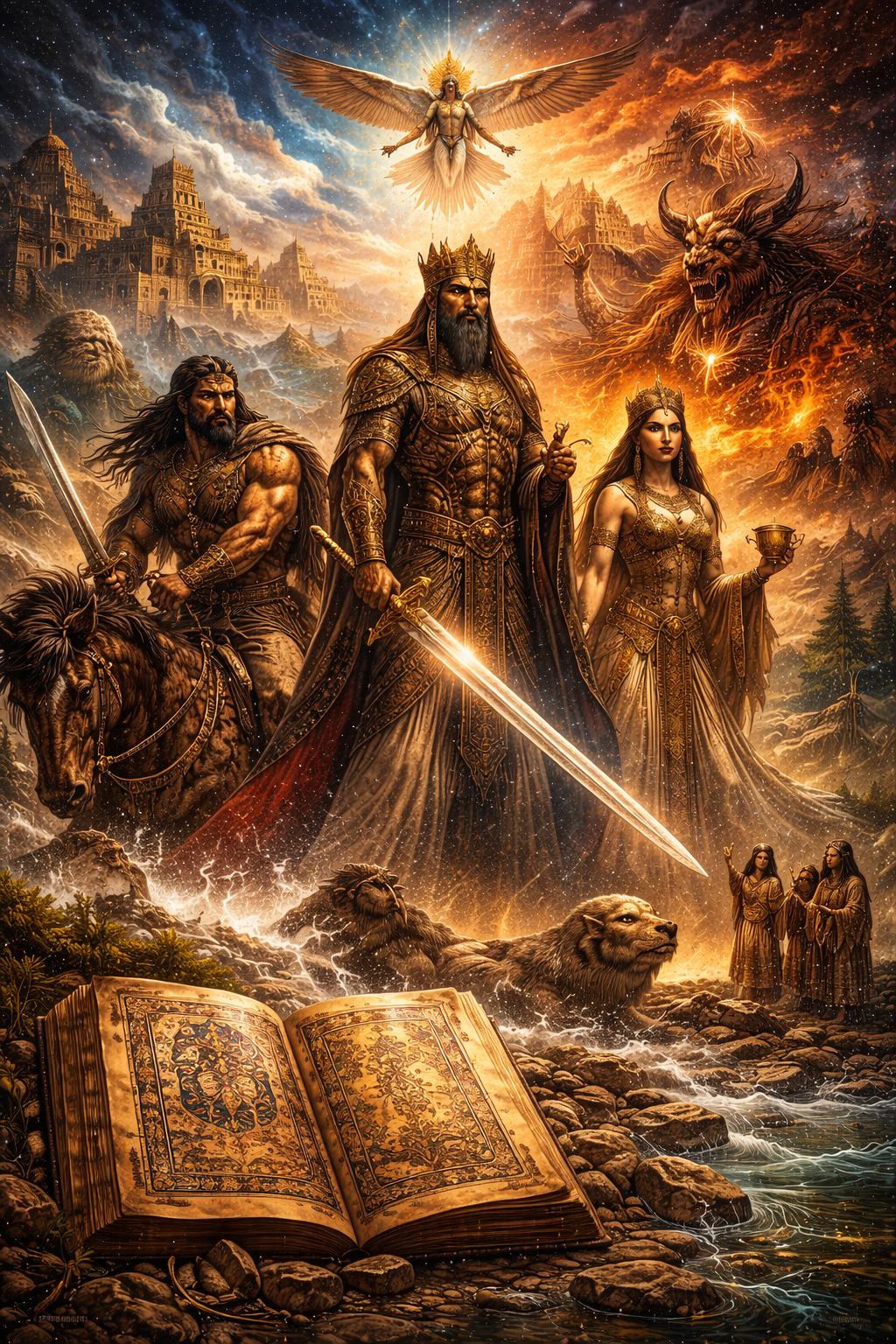
The field is structured by several deeply connected layers. The first is the older Iranian religious and cosmological archive preserved in the Avesta and later Zoroastrian Middle Persian texts such as the Bundahišn, where creation, cosmic dualism, sacred order, kingship, eschatology, and the struggle between beneficent and destructive powers are central. The second is the epic and folkloric archive most fully crystallized in Ferdowsi’s Shahnameh, which gathers mythic kings, heroic champions, dynastic memory, courtly ethics, tragic kinship, frontier conflict, and the imaginative geography of Iran into one of the great epics of world literature. A third layer consists of later prose romances, popular epics, oral storytelling traditions, illustrated manuscripts, coffeehouse painting, and modern reinterpretations that extend well beyond Ferdowsi without abandoning the world he helped monumentalize.
Persian myth, folklore, and epic tradition preserve one of the great civilizational imaginations of the world: a narrative universe ordered by justice and kingship, haunted by catastrophe and exile, animated by heroic striving, and shaped by the tension between worldly glory and moral transience. From the primordial worlds of Zoroastrian cosmology to the tragic grandeur of Rostam, Sohrab, Siyavash, Zahhak, Jamshid, Faridun, Kay Khosrow, Esfandiyar, and Iskandar in Persian memory, this field illuminates not only Iranian literary and religious history, but broader questions of sovereignty, ethical order, historical memory, frontier conflict, fate, eschatology, and the endurance of epic form.
This pillar approaches Persian myth, folklore, and epic tradition as a layered cultural system rather than as a simple catalogue of kings, heroes, monsters, and marvels. It asks how creation becomes moral struggle, how glory legitimates and endangers kingship, how tyranny becomes monstrous, how heroic strength becomes tragic burden, how women mediate lineage and catastrophe, how the Simurgh and other nonhuman beings carry wisdom and danger, how Islamic-era Persianate culture reinterpreted older Iranian memory, and how oral, visual, and popular traditions kept epic alive beyond the manuscript page.
Why This Field Matters
Persian myth, folklore, and epic tradition matter because they preserve one of the world’s great archives of civilizational memory. The tradition gathers creation, cosmic struggle, sacred kingship, heroic strength, moral testing, dynastic succession, monstrous tyranny, frontier conflict, tragic kinship, dream, prophecy, eschatological renewal, and poetic monument into a single expansive field. It is not merely a collection of stories. It is a way of imagining world-order, political legitimacy, ethical responsibility, and the fate of a people across time.
The field also matters because Persian myth stands at the intersection of religion and literature. Older Iranian materials preserve a cosmological and moral universe shaped by sacred order, destructive opposition, purity, eschatology, and renewal. Ferdowsi’s Shahnameh transforms much of this inherited memory into epic poetry, giving mythic and legendary Iran a durable literary architecture. Later prose romances, oral traditions, manuscript illustrations, and popular performances then expand the archive into new forms of wonder, heroism, and public memory.
Persian epic is especially important because it gives heroic grandeur a tragic conscience. The tradition does not simply celebrate victory. It repeatedly shows that glory can fail, kings can fall, heroes can be blind, kinship can become catastrophe, and justice can require terrible cost. Rostam is not merely strong; his strength is morally burdened. Jamshid is not merely radiant; his radiance collapses into overreach. Zahhak is not merely evil; he is the deformation of sovereignty into monstrosity. Siyavash is not merely innocent; his innocence becomes political tragedy.
This field also matters because Persian mythic memory remains alive. It continues to shape literary identity, ethical reflection, visual art, national imagination, theater, cinema, children’s literature, translation, diaspora memory, and global understanding of Iranian and Persianate culture. The tradition endures because it joins mythic depth to human questions that remain unresolved: how power should be used, how justice survives tyranny, how grief becomes memory, how civilization confronts disorder, and how human beings live between glory and transience.
The Problem of the Archive
A research-grade account must begin with the archive itself. Persian myth, folklore, and epic tradition does not survive in one single text, scripture, or literary canon. It is layered across Avestan scripture, Middle Persian theological writings, New Persian epic poetry, dynastic chronicles, prose romances, popular heroic cycles, regional storytelling, oral recitation, manuscript painting, coffeehouse performance, and modern reinterpretation. Each layer preserves myth differently.
The older Iranian religious archive is not identical to the later New Persian epic archive, even where names, royal lineages, motifs, and moral structures overlap. Avestan and Middle Persian materials preserve cosmology, ritual order, eschatology, beneficent and destructive powers, sacred kingship, and final renewal. Ferdowsi’s Shahnameh preserves and reshapes Iranian heroic memory within an Islamic-era Persian literary world. Later popular epics, romances, and oral traditions expand the archive beyond Ferdowsi, often creating alternate or supplementary narrative worlds.
This means that Persian mythology must be read through continuity and transformation at once. A figure such as Jamshid may belong to sacred kingship, civilizational invention, royal glory, and tragic downfall. Zahhak may be read as tyrant, monster, demonic corruption, political allegory, and mythic warning. Rostam belongs to heroic lineage, Sistan regional memory, courtly service, national imagination, and tragic ethical failure. The archive does not reduce such figures to single meanings.
The problem of the archive is therefore not a limitation but a strength. Persian myth survives because it has been continually revoiced: in ritual memory, epic poetry, courtly manuscript, oral narration, visual painting, popular performance, and modern interpretation. It is a civilizational archive precisely because it has never been only one thing.
Myth Without a Single Canon
Persian myth, folklore, and epic tradition is best approached as a plural and historically adaptive field rather than as a closed canon. Ferdowsi’s Shahnameh is central, but it is not the whole tradition. The Avesta, the Bundahišn, Middle Persian legendary materials, prose romances such as the Darab-nama, heroic expansions such as the Borzu-nama and Bahman-nama, oral storytelling, naqqāli, manuscript painting, and later folklore all preserve different dimensions of the mythic archive.
This plurality matters because Persian mythic memory is not confined to one genre. Scripture preserves sacred order; cosmology organizes creation and eschatology; epic poetry monumentalizes kingship and heroic tragedy; romance opens worlds of adventure and wonder; folklore preserves local supernatural imagination; performance gives the archive voice, gesture, and communal immediacy; illustration gives myth visual form.
The absence of one controlling canon also allows for historical layering. Older Iranian religious cosmology can survive beneath, beside, or within later Islamic-era literary forms. Heroic figures can be moralized, historicized, celebrated, criticized, or visualized differently across time. Stories can move from court manuscript to coffeehouse wall, from royal epic to village narration, from scholarly edition to children’s retelling, from sacred memory to national symbol.
A serious pillar must therefore keep the whole field open. Persian myth is not only Ferdowsi, not only Zoroastrian cosmology, not only heroic folklore, and not only national literature. It is a long, layered, multilingual, religious, poetic, and performative archive of Iranian and Persianate cultural memory.
Indo-Iranian Background and the Deep Prehistory of Myth
A strongest-sense account of Persian myth begins by acknowledging that the surviving Iranian archive emerges from an older Indo-Iranian background. The extant Avestan and later Zoroastrian materials preserve only part of a deeper prehistory of shared mythic language, divine typology, sacrificial symbolism, heroic patterning, and cosmological imagination. Even when later Persian tradition becomes distinctly Iranian in structure and memory, it still carries traces of an older world of inherited mythic forms.
This matters because Persian mythology is not created from nothing in the surviving textual record. It develops from older strata of language, ritual, and cosmological imagination that help explain both continuity and transformation. Themes of sacred order, cosmic struggle, heroic combat, kingship, divine favor, and world-renewal are not isolated literary inventions. They belong to a long history of Iranian mythic thought.
Comparative Indo-Iranian study must be handled carefully. The purpose is not to dissolve Persian myth into a generic ancient Indo-European or Indo-Iranian background, but to understand the deeper inheritance from which Iranian traditions developed. Persian myth has its own historical trajectory, but that trajectory begins before New Persian epic and before later literary canonization.
The deep prehistory of the archive gives Persian myth its depth of time. The stories that later become epic, folklore, or romance often carry much older symbolic pressures: order and chaos, truth and falsehood, divine power and demonic opposition, heroic trial and cosmic consequence.
The Avesta and the Older Iranian Religious Archive
The Avesta remains the foundational surviving textual archive for older Iranian cosmology, sacred order, divine conflict, ritual imagination, and eschatological expectation. It does not read like a later epic. It preserves hymns, invocations, ritual structures, sacred beings, moral struggle, and cosmological assumptions. Creation, purity, truth, divine beneficence, and the threat of destructive forces are already central.
This matters because later Persian myth and epic cannot be fully understood without the older Iranian religious horizon from which they partly descend, even when later materials secularize, monumentalize, or literarize what was once more directly bound to ritual and religious cosmology. The Avesta belongs at the beginning of the field because it preserves the sacred grammar of older Iranian imagination.
The Avestan archive also clarifies why Persian myth is so often moralized. The conflict between beneficent order and destructive force is not merely narrative conflict. It is a cosmic and ethical structure. Human beings, rulers, ritual specialists, and communities are situated within a world where truth, purity, right action, and sacred alignment have cosmic significance.
To read Persian epic without this background risks flattening its moral architecture. Even when later epic narratives are not doctrinal in a narrow sense, they inherit a universe in which kingship, tyranny, justice, deception, and renewal remain charged with more than worldly meaning.
Middle Persian Cosmology and the Bundahišn
The Middle Persian archive, and especially the Bundahišn, is indispensable because it offers one of the most systematic preserved accounts of Iranian cosmology, creation, the ordering of the world, earthly creatures, sacred kingship, and eschatological structure. It helps bridge the older scriptural world and the later epic imagination by organizing a cosmological narrative universe in which the moral architecture of existence is already visible.
The Bundahišn matters because Persian myth is not only heroic. It is cosmological. The world has structure, stages, adversaries, sacred order, and an end toward which it moves. Creation is not merely a beginning; it is the opening of a moral drama. Eschatology is not merely an ending; it is the promised renewal and purification of the world.
Middle Persian cosmological texts also preserve the relation between myth and classification. They describe lands, creatures, waters, mountains, stars, demons, sacred beings, and world-structure in ways that reveal myth as an ordering system. The cosmos becomes intelligible through sacred taxonomy and narrative relation.
This gives the Persian archive an unusually long horizon. It moves from creation to final renovation, from the ordering of the world to the restoration of the world, from sacred beginning to moral culmination. Without this horizon, Persian mythology becomes too narrowly epic and not fully cosmological.
Creation, Dualism, and the Moral Structure of the World
One of the defining features of older Iranian mythology is the intimate relation between cosmology and ethics. Creation is not neutral background. It is the stage of a profound struggle between beneficent and destructive powers, sacred order and violation, truth and falsehood. Dualism here is not merely abstract metaphysics. It organizes moral life, kingship, purity, time, human action, and eschatology.
This matters because much of Persian epic and legendary imagination inherits a world in which disorder is not simply political incompetence or personal vice. Disorder can become cosmic rebellion, demonic corruption, monstrous sovereignty, or failure of alignment with rightful order. Persian myth repeatedly links politics, ethics, and cosmology in ways that remain visible even when the later archive becomes more literary than doctrinal.
The moral structure of the world also gives Persian myth its seriousness. Kingship is tested by justice; heroes are judged by loyalty and restraint; monsters represent more than physical danger; tyrants deform the moral order; prophetic signs matter because time itself is morally charged. The universe is not indifferent to action.
At the same time, Persian myth does not reduce complexity to simple moral formula. Its greatest episodes often arise when competing goods collide: loyalty and justice, kingship and truth, heroic obedience and moral judgment, family and state, glory and humility. The moral world is structured, but human life within it remains tragically difficult.
Sacred Kingship, Glory, and the Problem of Rule
Persian myth and epic are repeatedly structured by the question of legitimate rule. Kingship is not merely force or inheritance. It is tested by justice, wisdom, self-command, glory, and right relation to sacred order. The ruler may be magnificent and still fall. He may begin with radiance and end in excess, isolation, or ruin. Persian narrative memory therefore treats sovereignty as morally charged and perpetually unstable.
The concept of royal glory is crucial. Glory may legitimate rule, but it can also be lost through arrogance, deception, injustice, or misalignment with sacred order. Kingship is therefore conditional. It depends on ethical and cosmic relation, not merely dynastic possession.
This makes Persian myth one of the great archives of political imagination. It preserves not only heroic combat but a sustained meditation on the conditions of rightful rule, the seductions of domination, the danger of pride, and the fragility of civilizational order. The best king preserves order; the failed king becomes a cause of disorder.
Persian epic also shows that good kingship is difficult because rule requires judgment under pressure. A king must protect the realm, honor heroes, restrain desire, recognize truth, and remain aligned with justice. Failure in any of these domains can produce catastrophe.
Mythic Kings from Hushang to Jamshid
The early mythic kings—figures such as Hushang, Tahmuras, and Jamshid—organize the earliest royal stages of the Iranian world-picture. These kings belong not only to dynastic sequence but to civilizational invention, sacred order, technology, ritualization, and the shaping of human life itself. They stand at the junction of mythic time and cultural beginnings.
Hushang and Tahmuras are associated with early ordering powers: the discovery or control of fire, the taming of forces, the beginning of crafts, and the disciplining of danger. Their reigns are not simply political episodes. They are moments in which human civilization takes form.
Jamshid is especially important because he reveals the tragic structure of Persian sovereignty. His reign is marked by radiance, prosperity, expansion, social ordering, and civilizational brilliance. Yet this same glory becomes vulnerable to pride. The king who organizes the world can lose the very legitimacy that made his order possible.
This early royal sequence shows that Persian kingship is from the outset both political and cosmogonic. The king does not merely govern; he participates in ordering the world. But because rule is morally charged, the fall of the king becomes a cosmic and civilizational danger.
Zahhak, Faridun, and the Overthrow of Monstrous Sovereignty
The confrontation between Zahhak and Faridun remains one of the central mythic dramas of Persian tradition. Zahhak is not simply a bad king. He is monstrous kingship itself: devouring, parasitic, tyrannical, corrupted, and aligned with disorder. The serpents growing from his shoulders make visible the moral deformation of sovereignty. His rule consumes the young and turns political power into predation.
Faridun, by contrast, becomes the restorer of rightful order. His rise and victory mark the overthrow of monstrous sovereignty and the reestablishment of just rule. The story is one of the clearest places where Persian myth makes the struggle between order and anti-order politically intelligible.
This matters because Persian mythology repeatedly imagines tyranny as more than injustice. Tyranny is deformation of the human and cosmic order. It is not only misrule; it is a condition in which the realm itself is fed to corruption. The tyrant becomes monstrous because his rule violates the structure of life.
The Zahhak-Faridun cycle also gives Persian myth one of its most enduring political images: justice must sometimes be restored by resisting a power that has become inhuman. Myth here becomes a language of anti-tyranny and civilizational renewal.
The Kayanian World and the Heroic Age
The Kayanian dynasty and its surrounding heroic world are central to Persian epic because they bind kingship to prophecy, warfare, dynastic succession, sacred legitimacy, and the emergence of great champions. Here the epic imagination deepens into a world of courts, advisors, rival powers, border conflict, inherited grievance, and repeated moral testing.
Kay Khosrow is especially important because he becomes one of the great sacred-political ideals of the tradition. His kingship is marked not only by power but by justice, restraint, spiritual gravity, and eventual withdrawal. He stands as a counterimage to corrupted sovereignty: the king who knows that rule must remain accountable to a higher order.
The Kayanian world matters because Persian myth and epic are not organized only around isolated heroes. They are structured by dynastic worlds. Memory is collective, royal, and civilizational, and the heroic age is inseparable from the fate of the kingdom it serves.
The Kayanian cycle also intensifies the tragic relation between king and hero. Heroes defend the realm, but kings are not always worthy of them. Loyalty becomes morally difficult when royal command and justice diverge. This tension gives Persian epic much of its ethical force.
Iran, Turan, and the Frontier Imagination
The Iran–Turan structure is central to Persian epic. The frontier is not merely a geographic border; it is a zone of rivalry, kinship fracture, civilizational opposition, exile, recognition, and tragic entanglement. Turan is not only an enemy realm. It is part of the imaginative architecture through which Iran comes to know itself.
This matters because frontier conflict structures some of the epic’s deepest tragedies. War across the frontier often involves divided lineage, hidden kinship, exile, marriage alliance, misrecognition, and the collision of personal and civilizational loyalties. The border is where identity becomes unstable.
The Iran–Turan opposition must also be read with care. It should not be reduced to a simple moral geography of good and evil. Persian epic repeatedly complicates enmity through kinship, nobility, betrayal, and shared humanity. The adversary realm can produce figures of dignity, tragedy, and moral force.
The frontier imagination reveals a deeper structure: civilizations define themselves at their edges, but those edges are porous. The tragedy of epic often occurs when the enemy is also kin, when the foreign is also familiar, and when recognition arrives too late.
Ferdowsi and the Epic Reconstitution of Iranian Memory
Ferdowsi’s Shahnameh remains the monumental act through which Persian heroic memory, mythic kingship, and dynastic sequence are gathered into durable literary architecture. It is a work of preservation, selection, poetic discipline, moral ordering, and civilizational reconstitution. Without it, the Iranian mythic archive would be far less coherent in later literary memory.
Ferdowsi does not merely preserve stories. He orders a world. The poem transforms inherited material into a moral, political, and aesthetic structure through which Iran can imagine its origins, crises, heroes, kings, betrayals, losses, and renewals. The Shahnameh is therefore both archive and epic act of cultural memory.
The poem’s scale matters. It moves from mythic beginnings through heroic ages and into more recognizably historical memory. This structure gives Persian epic a vast temporal arc: creation, kingship, rise, fall, invasion, restoration, tragedy, and succession. The fate of Iran becomes narratable across generations.
The Shahnameh also matters because it preserves pre-Islamic Iranian memory within an Islamic-era Persian language and literary context. It does not erase later history; it creates continuity across rupture. This makes the poem one of the most important works of cultural preservation in world literature.
Rostam, the Sistan Cycle, and the Architecture of Heroism
Rostam stands at the center of Persian heroic imagination not simply because he is powerful, but because he embodies the burdens and contradictions of epic strength itself. The Sistan cycle gives Persian myth one of its strongest heroic structures: lineage, monstrous combat, rescue, loyalty, pride, tragic blindness, and service to kings whose worth is uneven.
Rostam is the champion through whom heroism becomes both glory and curse. He protects Iran, defeats monsters, rescues kings, and embodies a scale of strength beyond ordinary human measure. Yet his greatness does not prevent catastrophe. Indeed, the magnitude of his power often intensifies the consequences of error.
His relationship with Rakhsh is central to his heroic identity. Rakhsh is not merely a horse but a companion, force, and extension of the hero’s embodied power. Together they move through a world where wilderness, monster, court, and battlefield are all arenas of trial.
Persian epic rarely treats strength as simple triumph. The great hero protects civilization while also carrying the possibility of irreparable catastrophe. Rostam’s greatness is inseparable from grief, misrecognition, and the knowledge that even heroic power cannot master fate.
Tragic Kinship, Recognition, and the Ethics of Epic
Persian epic is one of the world’s great traditions of tragic kinship. The catastrophe of fathers and sons, the late arrival of recognition, and the unbearable conjunction of loyalty and ignorance recur with unusual force. The story of Rostam and Sohrab is the most famous case, but the logic runs deeper: epic identity is repeatedly destabilized by blood ties, dynastic obligation, exile, concealment, and fatal misrecognition.
The tragedy of Rostam and Sohrab is powerful because the enemy is not truly foreign. The battlefield hides kinship. Recognition comes only when action can no longer be undone. The story turns heroic combat into unbearable moral knowledge.
This matters because Persian epic is not only about defeating monsters or preserving kingdoms. It is equally about the ethical cost of conflict inside kinship itself. Heroism is shadowed by grief, and recognition often comes only at the point where it can no longer save.
Tragic kinship also reveals the limits of public identity. A warrior may fight for king, realm, and honor, yet discover too late that the private bond of blood has been destroyed by the public logic of war. This is one of the deepest ethical insights of Persian epic.
Siyavash, Esfandiyar, and the Moral Cost of Destiny
Siyavash and Esfandiyar help reveal how Persian epic repeatedly tests innocence, obligation, kingship, and fate. Siyavash brings exile, purity, betrayal, and martyr-like tragedy into the center of the Iranian imagination. His story shows how innocence can become politically unbearable in a world governed by suspicion, desire, and power.
Esfandiyar introduces a different tension: heroic obligation under a sovereignty that demands too much. His conflict with Rostam is not a simple clash between good and evil. It is a tragic confrontation between obedience, royal command, heroic dignity, spiritual destiny, and political manipulation.
These figures matter because Persian epic repeatedly refuses easy moral binaries. The tragic may arise not only from evil but from conflicting forms of legitimacy, impossible obedience, and the burden of inherited destiny. A hero may be righteous and still be destroyed. A command may be lawful and still be morally catastrophic.
Siyavash and Esfandiyar therefore deepen the ethical structure of the archive. They show that Persian epic is not merely heroic celebration; it is a sustained meditation on innocence, duty, and the cost of living under kingship and fate.
Simurgh, Rakhsh, Divs, Peris, and the Creaturely World of Epic
A fully comprehensive pillar must broaden the creaturely and wonder-world of Persian narrative beyond kings and champions. The Simurgh is especially important as a figure of wisdom, rescue, threshold knowledge, nonhuman sovereignty, and maternal protection. She belongs to a mythic ecology where birds, animals, demons, mountains, and enchanted beings mediate human destiny.
Rakhsh, Rostam’s horse, is also central. He is not merely an accessory to the hero but part of the architecture of heroic identity. Rakhsh carries strength, recognition, loyalty, and survival. In epic terms, the hero’s animal companion is a moral and physical extension of the heroic world.
Divs, peris, dragons, speaking creatures, monstrous beings, and enchanted presences populate a world in which the boundary between human and nonhuman is morally and symbolically charged. These beings may threaten, deceive, guide, test, protect, or reveal hidden knowledge.
This matters because Persian epic and folklore are not anthropocentric in a narrow sense. Animal and hybrid presences often mediate wisdom, danger, protection, or temptation. They help make the Persian archive mythic rather than merely historical.
Dragons, Demons, and the Ecology of Mythic Danger
Monstrous beings in Persian myth are not random wonders. Dragons, divs, demonic powers, serpentine figures, and tyrannical creatures make visible the fragility of order and the constant nearness of chaos. They populate an ecology of danger in which forests, mountains, deserts, frontiers, courts, and battlefields can all become sites of spiritual and political threat.
Dragons and demons often embody more than physical danger. They may represent greed, false sovereignty, demonic corruption, uncontrolled appetite, environmental menace, or the deformation of order into violence. Their defeat is therefore not only heroic spectacle. It is symbolic restoration.
This ecology of danger connects Persian epic to older Iranian moral cosmology. Disorder may become visible as monster, tyrant, demon, or corrupted king. The hero’s combat against such beings dramatizes the defense of the human world against forces that would consume or deform it.
Persian myth continually tests civilization against what threatens to overwhelm it. Monsters are often the narrative forms through which disorder becomes visible, localizable, and resistible.
Dream, Prophecy, and the Imagination of Foreknowledge
Dream, prophecy, omen, and foreknowledge are central to the Persian archive because they bind epic action to a larger structure of fate and moral consequence. Kings and heroes act in a world where warning is possible but not always intelligible, and where knowledge may arrive symbolically, too late, or in forms that deepen rather than resolve anxiety.
Dreams are powerful because they reveal the future without necessarily making it avoidable. Prophecy may clarify destiny, but clarity does not always grant control. The hero or ruler may receive signs, yet still move toward catastrophe through pride, ignorance, obligation, or the pressure of events.
This matters because Persian epic is haunted by a time-consciousness larger than immediate action. The future presses on the present through symbolic disclosure. The dream does not merely interrupt the narrative; it shows that human action unfolds within a moral and temporal order larger than human intention.
Foreknowledge therefore adds tragic gravity. To know, half-know, misread, or know too late becomes part of the ethical experience of epic life. Persian myth often asks whether human beings can act rightly when the future is both signaled and obscure.
Women, Love, Lineage, and the Gendered World of Persian Epic
A strongest-sense synthesis must give full weight to women in Persian epic and folklore. Figures such as Rudabeh, Tahmineh, Sudabeh, Gordafarid, Farangis, Manizheh, and others are essential to the archive’s structure of lineage, love, alliance, desire, protection, betrayal, mourning, and transmission. Women in Persian epic are not decorative figures placed around male combat. They often stand at the hinge points of history.
Rudabeh and Tahmineh are especially important because they mediate heroic lineage. Through them, dynastic and heroic futures are formed. Love and union are not merely private romance; they shape the next generation of epic consequence. Maternal recognition, concealment, and grief become central to the ethics of the tradition.
Other women reveal the danger of desire, the politics of courtly vulnerability, the courage of resistance, or the tragedy of impossible loyalty. Persian epic’s emotional life depends on them. They shape how kinship, legitimacy, exile, memory, and mourning become narratable.
This matters because Persian epic is not sustained by male combat alone. Women often stand at the hinge points of transmission, kinship, legitimacy, and memory. A full pillar should therefore treat gender as structurally central to epic world-making, not as supplementary ornament.
Iskandar and the Reworking of World Conquest
The figure of Iskandar shows how Persian epic and romance can absorb and transform global historical memory. Alexander is not received passively. He is reworked into the Persian archive as conqueror, seeker, ruler, philosopher-king, and figure of wonder, becoming part of a larger Persianate imagination of sovereignty and world-history.
This matters because Persian mythic tradition is not closed. It can incorporate foreign conquerors into its own moral and narrative order. The archive grows not only by preservation but by reconfiguration. Iskandar becomes a figure through whom Persian literature thinks conquest, knowledge, legitimacy, travel, marvel, and the limits of worldly power.
The Persian Iskandar tradition also shows how history becomes romance. A conqueror enters a world of sages, strange lands, marvelous encounters, philosophical questions, and moral testing. The historical Alexander is transformed into a narrative vehicle for Persianate reflection on world rule.
Through Iskandar, Persian myth and epic demonstrate their extraordinary absorptive power. Even the invader can be reimagined within the archive’s ethical and symbolic grammar.
Prose Romance, Popular Epic, and Worlds Beyond the Shahnameh
A fully comprehensive pillar must widen beyond Ferdowsi into prose romance, popular epic, and heroic expansions such as the Darab-nama, Bahman-nama, Borzu-nama, and related cycles. These works reveal a Persian narrative universe more expansive, digressive, wondrous, and experimental than a purely Shahnameh-centered approach can capture.
Popular prose and verse traditions generate alternate heroic emphases, new marvels, different modes of narrative pleasure, and expanded worlds of adventure. They may amplify secondary characters, invent new generations, elaborate dynastic conflicts, or bring the epic imagination into more romance-driven forms.
This matters because Persian mythic tradition is not exhausted by its highest canonical epic. The broader archive includes romance, adventure, wonder travel, heroic extension, courtly intrigue, supernatural encounter, and regional elaboration. These materials show how epic memory lives beyond monumental form.
A truly comprehensive pillar must therefore keep this wider field visible. Ferdowsi is central, but the Persian mythic imagination is larger than Ferdowsi alone.
Folklore, Wonder Tale, and Later Popular Continuities
Persian folklore belongs centrally to the field. Divs, peri, dragons, enchanted realms, demon-kings, saint-like figures, talking animals, magical helpers, moralized wonder tales, local heroic cycles, and supernatural landscapes inhabit a broad narrative world shaped by Zoroastrian, Islamic, courtly, oral, and regional influences.
Folklore here is not merely the residue of high epic. It is an active domain of local imagination and long-duration continuity. Motifs from epic can enter folk storytelling; folk beings can reappear in literary romance; religious symbols can become wonder-tale structures; local landscapes can become sites of supernatural memory.
This matters because the Persian archive did not survive only through court literature. It also persisted in household storytelling, oral wonder-tale patterns, regional variants, moral tales, magical helpers, and popular heroic memory. These less formal settings kept mythic motifs alive and adaptable.
Folklore also reveals the ordinary life of myth. Where epic monumentalizes kings and heroes, folklore often preserves the fears, hopes, moral lessons, humor, and supernatural imagination of everyday communities.
Islamic-Era Reinterpretation and Persianate Transmission
A comprehensive synthesis must emphasize Islamic-era reinterpretation. Older Iranian myths and heroic memories were not simply carried forward unchanged. They were recontextualized within Islamic historiography, courtly adab, ethical reflection, Sufi-inflected imagination, Persianate kingship, and broader literary production. This transmission did not erase the older archive. It reframed it.
Ferdowsi’s Shahnameh itself belongs to this complex historical situation. It preserves pre-Islamic Iranian memory in New Persian literary form, but it does so within a world already transformed by Islamic history. The poem’s achievement lies partly in its ability to carry older memory across religious and historical rupture.
Persianate transmission further expanded the archive beyond Iran. Persian epic, romance, courtly models, illustrated manuscripts, and storytelling traditions circulated across Central Asia, South Asia, Anatolia, and other Persianate cultural zones. The archive became transregional without ceasing to carry Iranian memory.
Persian myth survives not only through fidelity to origins but through reinterpretive adaptability. The archive remains alive precisely because it can move through new religious, linguistic, and literary orders without losing symbolic power.
Naqqāli, Performance, and the Living Transmission of Epic
Persian epic did not live on the page alone. Naqqāli and related performance traditions kept heroic and mythic material socially alive through recitation, gesture, interpretation, improvisation, dramatic pacing, and public storytelling. Epic performance transforms the archive from literary monument into living communal memory.
Performance matters because it can emphasize different values than written text: immediacy, emotional force, audience response, heroic charisma, moral explanation, and embodied interpretation. The performer does not merely repeat the epic. He interprets it for a listening community.
Naqqāli also links elite and popular memory. Stories associated with the Shahnameh enter public spaces, coffeehouses, gatherings, and local performance cultures. The archive becomes social, vocal, gestural, and collective.
The Persian epic archive is therefore performative as well as literary. Its survival depends not only on manuscripts and printed editions, but on voice, memory, theatrical presence, and the continued desire of communities to hear the old stories again.
Illustrated Manuscripts, Coffeehouse Painting, and Visual Afterlives
The visual afterlife of Persian myth is essential. Illustrated Shahnameh manuscripts, later manuscript traditions, lithographs, coffeehouse painting, and popular visual epic traditions helped preserve and reinterpret the epic world through color, gesture, costume, creature imagery, landscape, battle, court scene, and dramatic composition. Visual culture does not merely decorate epic; it becomes another mode of narrative emphasis and memory.
Illustrated manuscripts are especially important because they show how courts and workshops read the epic visually. Which scenes are chosen? Which heroes are emphasized? How are monsters depicted? How is royal authority staged? How do color, architecture, costume, and gesture transform narrative into visual theology and political memory?
Coffeehouse painting gives the archive a different public life. Heroic episodes, martyr-like scenes, battles, and moral confrontations become large, dramatic, accessible images. The epic world moves from manuscript page to popular visual environment.
Persian myth and epic have always been multimedia in the broad civilizational sense: textual, oral, pictorial, and performative at once. A strongest-sense pillar must keep those afterlives visible.
Modern National, Literary, and Cinematic Afterlives
Persian myth has not remained medieval property. It continues to shape modern Iranian and Persianate cultural imagination through nationalist uses of Ferdowsi, educational canonization, modern poetic rewritings, illustrated editions, children’s retellings, theater, cinema, television, animation, diaspora memory, and public heritage culture.
Modern uses of the Shahnameh are complex. The epic can serve as literary monument, national archive, ethical resource, children’s inheritance, artistic inspiration, or political symbol. Its figures can be reinterpreted for modern questions: tyranny, resistance, identity, exile, gender, justice, and the preservation of language.
Film, theater, and visual media extend myth into new sensory forms. Rostam, Zahhak, Simurgh, and other figures can be adapted for contemporary audiences through image, sound, animation, and dramatic performance. These adaptations often simplify, but they also keep the archive socially visible.
Modern afterlives are part of the field, not external to it. Myth survives by re-entry into new media and new ideological worlds. Each generation inherits the epic by changing how it is seen, heard, taught, and remembered.
Eschatology, Renewal, and the End of the Iranian World-Picture
A fully comprehensive synthesis must return at the end to eschatology. The older Iranian archive does not merely narrate origins, kings, and battles. It also imagines the end: judgment, final struggle, restoration, purification, and renewal of the world. This eschatological horizon is one of the defining features of Iranian mythic imagination and distinguishes it sharply from purely cyclical or purely heroic systems.
The concept of final renovation gives Iranian myth a powerful moral arc. Creation is not simply followed by decline; cosmic conflict moves toward restoration. The world’s disorder is real, but it is not ultimate. Evil may deform the world, but the world is imagined as capable of renewal.
This horizon also clarifies why Persian myth is so ethically charged. The struggle between truth and falsehood, justice and tyranny, beneficent order and destructive power is not only historical. It belongs to a cosmic drama that moves toward final resolution.
Persian myth is therefore a long-duration moral universe. It moves from creation to world-renewal, from sacred beginning to final restoration. Without that horizon, the field becomes too narrowly epic and not fully cosmological.
Major Questions of Interpretation
This pillar is organized around several major questions. How should Persian myth, folklore, and epic be studied when its archive includes Avestan scripture, Middle Persian cosmology, New Persian epic, prose romance, oral performance, manuscript painting, popular storytelling, and modern media? What does it mean to study Persian myth without reducing it either to Zoroastrian religious texts or to Ferdowsi’s Shahnameh alone?
The pillar also asks how sacred kingship, royal glory, monstrous tyranny, heroic strength, tragic kinship, frontier conflict, women’s roles, nonhuman beings, dreams, prophecy, and eschatology shape the Persian mythic imagination. How do Zahhak, Faridun, Jamshid, Rostam, Sohrab, Siyavash, Esfandiyar, Iskandar, and the Simurgh preserve different kinds of cultural memory? How do oral and visual traditions keep epic alive beyond the page?
These questions keep the category from becoming a simple inventory of heroes and monsters. They open Persian myth, folklore, and epic tradition as a field of religious, literary, political, ethical, performative, visual, and comparative inquiry. The tradition is not only a collection of ancient stories. It is one of the great symbolic systems through which Iranian and Persianate worlds imagined order, tyranny, grief, justice, heroism, mortality, and renewal.
Expanded Article Architecture
The following structure gathers the pillar into a long-range architecture suitable for a major mythology knowledge series. It is designed to support older Iranian cosmology, Zoroastrian source traditions, Middle Persian mythic systems, Ferdowsi’s Shahnameh, heroic cycles, prose romance, folklore, oral performance, visual afterlives, Persianate transmission, and modern reception. All entries below should be treated as planned unless already completed elsewhere on the site.
Foundations and Source Problems
- What Is Persian Myth, Folklore & Epic Tradition? (planned)
- The Problem of Sources in Persian Mythology and Epic (planned)
- Persian Myth Without a Single Canon (planned)
- Scripture, Epic, Romance, Performance, and Image in Persian Mythic Memory (planned)
- How to Read Persian Myth Across Languages and Periods (planned)
- Iranian Memory and the Civilizational Imagination of Epic (planned)
Older Iranian and Zoroastrian Backgrounds
- Indo-Iranian Background and the Deep Prehistory of Iranian Myth (planned)
- The Avesta and the Earliest Iranian Mythic Archive (planned)
- The Bundahišn and the Zoroastrian Order of Creation (planned)
- From Avestan Myth to Persian Epic: Continuity and Transformation (planned)
- Ahura Mazda, Angra Mainyu, and the Dual Imagination of Order and Disorder (planned)
- Creation, Cosmic Struggle, and the Moral Structure of the World (planned)
- Sacred Order, Truth, and the Mythic Ethics of Iranian Cosmology (planned)
Creation, Eschatology, and Cosmic Order
- Creation, Dualism, and the Moral Architecture of the Iranian World (planned)
- Sacred Time and the Stages of World History in Iranian Myth (planned)
- Demons, Destructive Powers, and the Violation of Order (planned)
- Eschatology, Frashokereti, and the Renewal of the World (planned)
- Judgment, Purification, and the Final Restoration of Creation (planned)
- Why Persian Myth Moves from Creation to Renewal (planned)
Sacred Kingship, Glory, and Early Royal Myth
- Sacred Kingship, Glory, and the Problem of Rule in Persian Myth (planned)
- Hushang, Tahmuras, and the First Kings of Iran (planned)
- Jamshid, Glory, and the Tragedy of Excess (planned)
- The Pishdadian Kings and the Mythic Foundations of Iran (planned)
- Royal Glory, Justice, and the Loss of Legitimate Power (planned)
- Technology, Civilization, and the First Ordering of Human Life (planned)
Tyranny, Monstrous Rule, and Restoration
- Zahhak, Tyranny, and the Politics of Monstrous Rule (planned)
- Faridun and the Restoration of Justice (planned)
- The Serpentine King and the Mythic Image of Devouring Sovereignty (planned)
- Kaveh the Blacksmith and the Popular Memory of Resistance (planned)
- The Division of the World and the Iran–Turan Imagination (planned)
- Tyranny, Demonization, and the Moral Limits of Kingship (planned)
Kayanian Kingship and the Heroic Age
- The Kayanian Dynasty and the Heroic Age of Kingship (planned)
- Kay Khosrow and the Sacred Ideal of Rule (planned)
- Kay Kavus, Folly, and the Fragility of Royal Judgment (planned)
- Gushtasp, Religion, Kingship, and the Burden of Command (planned)
- Kings, Advisors, and Champions in the Kayanian World (planned)
- Dynastic Succession and the Moral Testing of Power (planned)
Iran, Turan, and Frontier Conflict
- Iran, Turan, and the Frontier Imagination (planned)
- Frontier War, Kinship Fracture, and Civilizational Identity (planned)
- Afrasiyab and the Epic Imagination of Turan (planned)
- Exile, Borderlands, and the Tragedy of Divided Lineage (planned)
- Enemies, Kin, and the Ethics of Recognition Too Late (planned)
- The Frontier as Moral and Mythic Space in Persian Epic (planned)
Ferdowsi and the Shahnameh
- Ferdowsi’s Shahnameh and the Making of Iran’s Epic Memory (planned)
- The Shahnameh as History, Myth, and Political Memory (planned)
- Ferdowsi, Language, and the Reconstitution of Iranian Memory (planned)
- The Architecture of the Shahnameh: Mythic, Heroic, and Historical Time (planned)
- Epic Poetry as Cultural Preservation in Persian Literature (planned)
- Why the Shahnameh Still Matters (planned)
Rostam and the Sistan Cycle
- Rostam and the Heroic Architecture of the Shahnameh (planned)
- Rostam, Rakhsh, and the Embodied Power of Heroism (planned)
- The Seven Labors of Rostam and the Trial Structure of Heroic Power (planned)
- Rostam as Protector, Rebel, and Tragic Champion (planned)
- The Sistan Cycle and Regional Memory in Persian Epic (planned)
- Heroic Strength and the Burden of Irreparable Consequence (planned)
Tragic Kinship and Recognition
- Rostam and Sohrab: Tragic Recognition and the Catastrophe of Kinship (planned)
- Rostam and Esfandiyar: Fate, Kingship, and the Limits of Heroism (planned)
- Siyavash, Innocence, Exile, and the Tragic Imagination (planned)
- Fathers, Sons, and the Ethics of Misrecognition in Persian Epic (planned)
- Blood, Loyalty, and the Public Cost of Private Ignorance (planned)
- Why Persian Epic Turns Heroism into Grief (planned)
Women, Love, Lineage, and Courtly Power
- Rudabeh, Tahmineh, and the Women of Persian Epic (planned)
- Women, Love, Lineage, and the Gendered World of Persian Epic (planned)
- Gordafarid, Martial Courage, and Gendered Heroism (planned)
- Manizheh, Love, Exile, and Loyalty Across the Frontier (planned)
- Sudabeh, Desire, Accusation, and Courtly Danger (planned)
- Mothers, Wives, and the Transmission of Epic Memory (planned)
Supernatural Beings, Animals, and Mythic Danger
- Simurgh, Rakhsh, and the Creaturely Worlds of Persian Myth (planned)
- Divs, Peris, and the Supernatural Worlds of Persian Story (planned)
- Dragons, Demons, and the Ecology of Mythic Danger (planned)
- The Simurgh as Wisdom, Rescue, and Nonhuman Sovereignty (planned)
- White Div, Demon Combat, and the Trial of the Hero (planned)
- Animals, Companions, and the Moral Ecology of Persian Epic (planned)
Dream, Prophecy, Wisdom, and Hidden Knowledge
- Dream, Prophecy, and the Epic Imagination of Foreknowledge (planned)
- Magic, Wisdom, and the Counsel of the Hidden World (planned)
- Omens, Warnings, and the Tragic Logic of Too-Late Knowledge (planned)
- Sages, Advisors, and the Moral Interpretation of Power (planned)
- Foreknowledge, Fate, and Human Responsibility in Persian Epic (planned)
- Hidden Knowledge and the Limits of Royal Judgment (planned)
Iskandar, World Conquest, and Persianate Reworking
- Iskandar and the Persian Reimagining of World Conquest (planned)
- Alexander as Seeker, Ruler, and Figure of Wonder in Persian Tradition (planned)
- World Travel, Marvels, and the Romance of Sovereignty (planned)
- Foreign Conquerors and the Absorptive Power of Persian Epic Memory (planned)
- Iskandar Between History, Myth, and Moralized Kingship (planned)
Prose Romance and Popular Epic Beyond Ferdowsi
- Popular Epic Beyond Ferdowsi: Bahman-nama, Darab-nama, Borzu-nama, and Related Traditions (planned)
- The Darab-nama and the Wonder Worlds of Persian Romance (planned)
- The Bahman-nama and the Expansion of Kayanian Memory (planned)
- The Borzu-nama and the Heroic Afterlife of Rostam’s Line (planned)
- Persian Prose Romance and the Adventure Logic of Mythic Memory (planned)
- Regional Heroic Cycles and the Wider Persian Epic Archive (planned)
Folklore, Wonder Tale, and Popular Continuities
- Folklore, Wonder Tale, and the Later Popular Life of Persian Myth (planned)
- Peris, Divs, Talking Animals, and Magical Helpers in Persian Folklore (planned)
- Enchanted Realms and Moral Testing in Persian Wonder Tales (planned)
- Household Storytelling and the Popular Transmission of Mythic Motifs (planned)
- Saintly Figures, Local Legends, and the Islamic Reframing of Wonder (planned)
- Persian Folklore Between Epic, Religion, and Oral Memory (planned)
Islamic-Era and Persianate Transmission
- Islamic Historiography, Adab, and the Reframing of Iranian Legendary Memory (planned)
- Persianate Courts and the Transregional Life of Epic Memory (planned)
- Iranian Myth in Central Asian, South Asian, and Ottoman-Persianate Worlds (planned)
- Epic Memory Across Religious and Linguistic Transformation (planned)
- How Persian Myth Survived by Reinterpretation (planned)
Performance and Living Transmission
- Naqqāli, Oral Performance, and the Living Transmission of Persian Epic (planned)
- The Epic Storyteller as Interpreter of Heroic Memory (planned)
- Coffeehouse Performance and the Public Life of the Shahnameh (planned)
- Voice, Gesture, and Communal Response in Persian Epic Recitation (planned)
- Performance as Cultural Memory in Persian Mythic Tradition (planned)
Visual Culture and Manuscript Afterlives
- Illustrated Manuscripts and the Visual Afterlife of the Shahnameh (planned)
- Coffeehouse Painting and the Popular Image of Persian Heroism (planned)
- The Great Mongol Shahnameh and the Politics of Epic Illustration (planned)
- Tahmasp’s Shahnameh and the Courtly Visual Imagination of Epic (planned)
- Manuscript Painting as Mythic Interpretation (planned)
- Monsters, Kings, and Heroes in Persian Visual Culture (planned)
Modern Reception and Comparative Afterlives
- Persian Myth in Modern National and Literary Imagination (planned)
- Persian Myth, Folklore & Epic in Comparative Perspective (planned)
- Ferdowsi in Modern Iran and the Politics of Cultural Memory (planned)
- Persian Epic in Children’s Literature, Theater, Film, and Animation (planned)
- Diaspora Memory and the Global Afterlife of Persian Epic (planned)
- Why Persian Myth, Folklore & Epic Tradition Still Matter (planned)
Closing Perspective
Persian myth, folklore, and epic tradition reveal one of the great long-duration symbolic archives of world culture. They preserve creation and final renewal, sacred kingship and royal collapse, monstrous tyranny and popular resistance, heroic strength and tragic blindness, frontier conflict and kinship fracture, nonhuman wisdom and demonic danger, oral performance and illustrated memory. Their power lies not in a single fixed canon, but in a layered continuity of scripture, cosmology, epic, romance, folklore, performance, and visual art.
This is what makes the category so important within Mythology. Persian mythic culture shows how mythology can be religious and literary, royal and popular, oral and pictorial, ancient and modern, Iranian and Persianate, heroic and tragic, cosmological and political. It also shows why mythology must be studied through text, ritual, performance, image, language, history, and cultural memory, not only through story summary.
The strongest reason to study this field is that Persian myth, folklore, and epic tradition clarifies how human beings imagine civilization under the pressure of time. Kings rise and fall; heroes win and grieve; tyrants deform the world; justice must be restored; death cannot be escaped; glory does not last; yet memory, poetry, and moral order endure. Persian epic makes that truth unforgettable.
Related Reading
- Mythology
- Persian Traditions
- Persian Poetry and Cultural Memory
- Persian Thought
- Arabian and Levantine Myth, Folklore, and Sacred Narrative
- Turkic and Ottoman Myth, Epic, and Folklore
- Indus Region Myth, Folklore, and Sacred Narrative
- Comparative Sacred Themes
Primary Sources
Zoroastrian and Cosmological Texts
- The Avesta. The central surviving scriptural corpus of Zoroastrianism and a foundational source for older Iranian cosmology, sacred order, divine conflict, ritual imagination, and eschatological expectation. English texts and translations are available through Avesta.org: https://www.avesta.org/
- Vendidad. Important for mythic geography, ritual order, purity, law, and the struggle against destructive forces. English translation available at Avesta.org: https://www.avesta.org/vendidad/vd_eng.html
- Bundahišn (“Creation”). A major Middle Persian cosmological text central to Zoroastrian accounts of creation, earthly creatures, cosmic structure, and the ordering of the Iranian world-picture. English translation available at Avesta.org: https://www.avesta.org/mp/bundahis.html
Epic and Heroic Traditions
- Ferdowsi, Shahnameh (Book of Kings). The foundational New Persian epic preserving mythic kingship, heroic memory, dynastic succession, tragic kinship, and the civilizational imagination of Iran. English translation available through Project Gutenberg: https://www.gutenberg.org/ebooks/10315
- Shahnameh manuscript and visual traditions. Illustrated manuscript folios are essential for tracing the visual narration of Persian myth and epic. British Museum collection search: https://www.britishmuseum.org/collection
- Borzu-nama and related heroic poems. Major witnesses to the expansion of the Persian heroic world beyond Ferdowsi and the development of later epic cycles.
- Darab-nama, Bahman-nama, and related prose romances. Essential for the wonder-worlds, adventure structures, and narrative expansions of Persian mythic memory beyond the Shahnameh.
Performance and Visual Traditions
- Naqqāli performance traditions. Important for understanding the living oral and dramatic transmission of Persian epic, including recitation, gesture, interpretation, and communal memory.
- Illustrated Shahnameh folios and manuscript cycles. Essential for the visual narration of Persian myth, heroic combat, kingship, and supernatural beings.
- Coffeehouse painting and popular visual epic traditions. Important for the modern social life of heroic memory and the public image of Persian mythic figures.
Research Platforms and Scholarly Gateways
- Encyclopaedia Iranica. Essential scholarly reference for Iranian history, mythology, Zoroastrianism, Persian literature, the Shahnameh, epic cycles, manuscript traditions, and Persianate culture: https://iranicaonline.org/
- Avesta.org, Zoroastrian Archives. Useful for open access to Avestan and Middle Persian textual materials: https://www.avesta.org/
- Cambridge University Press resources on the Shahnameh and Persian epic tradition, including scholarship on Ferdowsi as world literature: https://www.cambridge.org/core
Further Reading
- Encyclopaedia Iranica (n.d.) ‘Šāh-nāma’. Essential for the epic, historical, manuscript, and popular-narrative dimensions of the Persian epic archive. https://iranicaonline.org/
- Avesta.org (n.d.) ‘AVESTA: Zoroastrian Archives’. Useful for open access to the Avesta and Middle Persian cosmological materials. https://www.avesta.org/
- Avesta.org (n.d.) ‘Vendidad’. Important for ritual order, purity, mythic geography, and the struggle against destructive forces. https://www.avesta.org/vendidad/vd_eng.html
- Avesta.org (n.d.) ‘The Bundahishn’. A major resource for Middle Persian cosmology and the Zoroastrian order of creation. https://www.avesta.org/mp/bundahis.html
- British Museum (n.d.) illustrated Shahnameh folio records. Valuable for tracing the visual transmission of Persian epic. https://www.britishmuseum.org/collection
- Ferdowsi (1888–1905) The Shahnameh of Ferdowsi. Translated by A.G. and E. Warner. London: Kegan Paul, Trench, Trübner & Co. Public-domain English translation available through Project Gutenberg: https://www.gutenberg.org/ebooks/10315
- Davis, D. (2006) Shahnameh: The Persian Book of Kings. New York: Viking.
- Davidson, O.M. (1994) Poet and Hero in the Persian Book of Kings. Ithaca, NY: Cornell University Press.
- Khaleghi-Motlagh, D. (ed.) (1987–2008) Shahnameh. Critical edition. New York: Bibliotheca Persica.
- de Jong, A. (1997) Traditions of the Magi: Zoroastrianism in Greek and Latin Literature. Leiden: Brill.
- Boyce, M. (1975–1991) A History of Zoroastrianism. Leiden: Brill.
- Yarshater, E. (1983) Cambridge History of Iran, Volume 3: The Seleucid, Parthian and Sasanian Periods. Cambridge: Cambridge University Press.
- Meisami, J.S. (1999) Persian Historiography to the End of the Twelfth Century. Edinburgh: Edinburgh University Press.
- Hanaway, W.L. (1971) Persian Popular Romances Before the Safavid Period. New York: Columbia University Press.
- Yamamoto, K. (2003) The Oral Background of Persian Epics: Storytelling and Poetry. Leiden: Brill.
References
- Avesta.org (n.d.) ‘AVESTA: Zoroastrian Archives’. Available at: https://www.avesta.org/
- Avesta.org (n.d.) ‘Vendidad (English)’. Available at: https://www.avesta.org/vendidad/vd_eng.html
- Avesta.org (n.d.) ‘The Bundahishn (“Creation”), or Knowledge from the Zand’. Available at: https://www.avesta.org/mp/bundahis.html
- Boyce, M. (1975–1991) A History of Zoroastrianism. Leiden: Brill.
- British Museum (n.d.) illustrated Shahnameh folio records. Available at: https://www.britishmuseum.org/collection
- Cambridge University Press (n.d.) Cambridge Core. Available at: https://www.cambridge.org/core
- Davidson, O.M. (1994) Poet and Hero in the Persian Book of Kings. Ithaca, NY: Cornell University Press.
- Davis, D. (2006) Shahnameh: The Persian Book of Kings. New York: Viking.
- de Jong, A. (1997) Traditions of the Magi: Zoroastrianism in Greek and Latin Literature. Leiden: Brill.
- Encyclopaedia Iranica (n.d.) Encyclopaedia Iranica. Available at: https://iranicaonline.org/
- Ferdowsi (1888–1905) The Shahnameh of Ferdowsi. Translated by A.G. and E. Warner. London: Kegan Paul, Trench, Trübner & Co. Available at: https://www.gutenberg.org/ebooks/10315
- Hanaway, W.L. (1971) Persian Popular Romances Before the Safavid Period. New York: Columbia University Press.
- Khaleghi-Motlagh, D. (ed.) (1987–2008) Shahnameh. Critical edition. New York: Bibliotheca Persica.
- Meisami, J.S. (1999) Persian Historiography to the End of the Twelfth Century. Edinburgh: Edinburgh University Press.
- Yamamoto, K. (2003) The Oral Background of Persian Epics: Storytelling and Poetry. Leiden: Brill.
- Yarshater, E. (1983) Cambridge History of Iran, Volume 3: The Seleucid, Parthian and Sasanian Periods. Cambridge: Cambridge University Press.