
Last Updated May 8, 2026
Community resilience, trust, and local capacity belong together because resilience is not only built through infrastructure, formal planning, emergency management, or national policy. It is also built through relationships, local organizations, lived experience, practical knowledge, mutual aid, communication networks, public trust, and the ability of communities to act before, during, and after disruption. Floods, heatwaves, droughts, disease outbreaks, infrastructure failures, food shocks, displacement, and economic stress are always experienced somewhere, by specific people, through specific institutions, histories, vulnerabilities, and capacities.
Community resilience is therefore not an abstract slogan. It is visible in whether neighbors check on one another during heat, whether warnings are trusted, whether local organizations can reach vulnerable residents, whether health workers know community needs, whether evacuation support is accessible, whether mutual aid networks can mobilize quickly, whether public agencies listen, whether local knowledge is respected, and whether recovery strengthens rather than weakens the people most affected.
Main Library
Publications
Article Map
Risk & Resilience
Related Topic
Sustainable Development
Related Topic
Planetary Boundaries
Related Topic
Systems Thinking
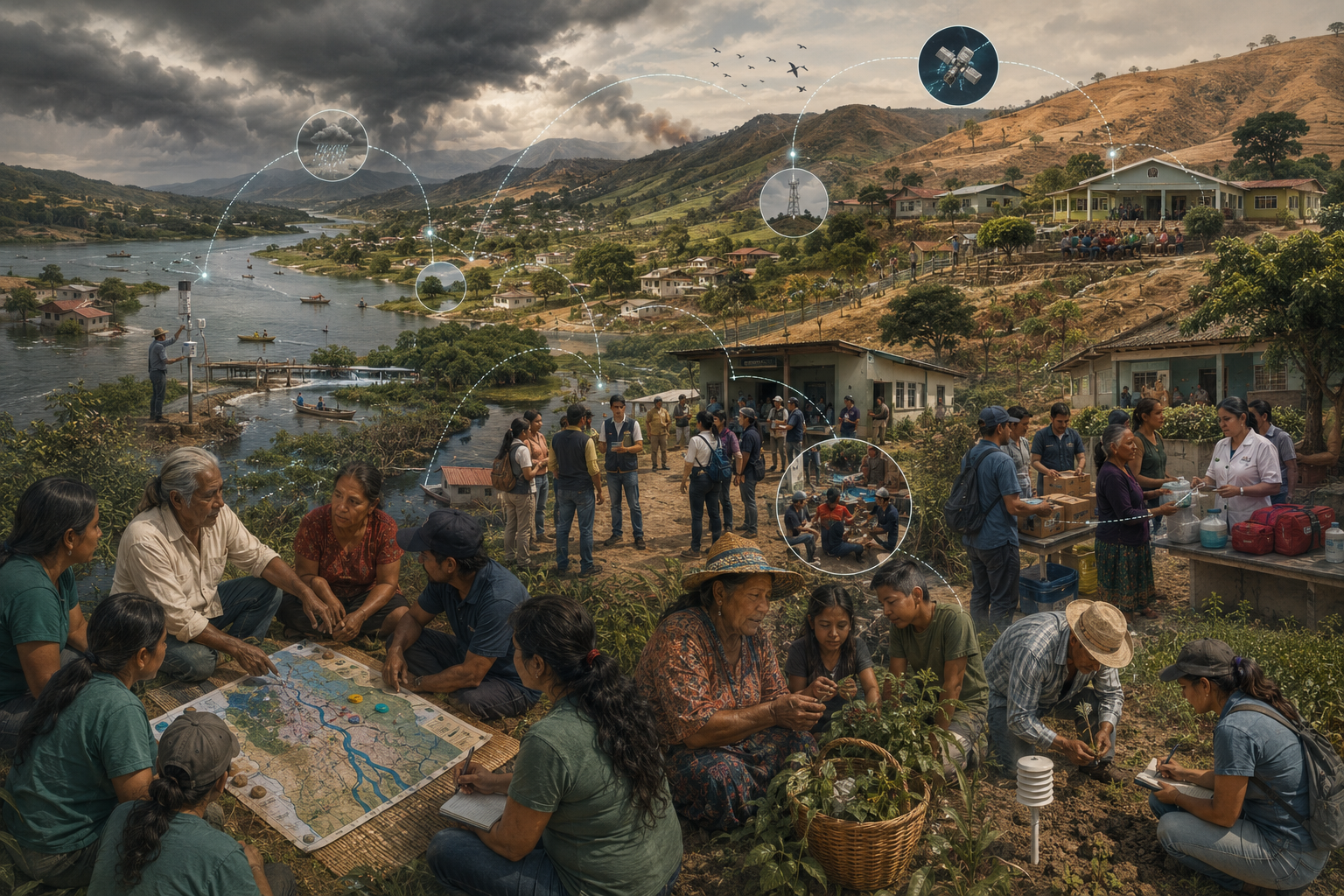
This article builds on What Is Risk and Resilience in Sustainable Systems? by focusing on the local and relational foundations of resilience. It connects closely with Social Vulnerability and Risk Distribution, Public Health Resilience and Systemic Risk, Conflict, Fragility, and Resilience Under Stress, and Compound Climate Events and Cascading Social Risk, because trust, local capacity, and community organization shape whether formal systems can actually protect people under stress.
The central argument is that resilience cannot be delivered to communities as a finished product. It must be co-produced with them. Formal science, public institutions, infrastructure investment, and emergency planning are essential, but they become more effective when joined with local knowledge, trusted communication, community leadership, inclusive participation, and the practical capacities people already use to survive disruption. A resilient system can learn downward, upward, sideways, and reciprocally.
Why Community Resilience Matters
Community resilience matters because stress is experienced through the actual geography of social life. A heatwave is not simply a temperature anomaly; it becomes dangerous through housing, age, disability, energy access, tree canopy, labor conditions, cooling access, medical vulnerability, social isolation, and public communication. A flood is not simply water; it becomes disaster through drainage, housing, transport, warnings, insurance, evacuation, mold, recovery aid, and whether people have the resources to leave or return.
This means resilience is always local, even when risk is global. Climate change may be planetary, but its effects are mediated through neighborhoods, watersheds, workplaces, households, clinics, schools, farms, transit networks, and community institutions. Disease outbreaks may cross borders, but response depends on local trust, health access, communication channels, community health workers, and the ability to act collectively. Infrastructure failures may be technical, but their consequences depend on who lives alone, who depends on powered medical devices, who has transportation, and who receives support.
Formal systems often underestimate these local conditions. A city may have an emergency plan, but that plan may fail if residents do not trust warnings, cannot access shelters, lack transportation, speak languages not covered by official alerts, fear authorities, or depend on informal networks that planners ignore. A resilience plan that does not understand community life can be technically impressive and practically brittle.
Community resilience also matters because communities are often the first to notice change and the first to respond. Local residents may notice altered water flow, unusual illness patterns, shifting crop conditions, dangerous infrastructure, social stress, or early signs of displacement before these patterns appear in official datasets. Community organizations often know who is isolated, who needs medication, who lacks cooling, who is undocumented, who needs translation, and who may be missed by formal systems.
This does not mean communities should be left to carry risk alone. Community resilience is not an excuse for public disinvestment. It is a reason to build institutions that listen, resource, protect, and co-produce resilience with the people who live with risk every day.
What Community Resilience Means
Community resilience refers to the capacity of communities to anticipate, absorb, adapt to, respond to, and recover from stress while preserving essential relationships, functions, knowledge, and capacity for future action. It includes emergency response, but it is not limited to emergency response. It includes social ties, local leadership, public trust, mutual aid, cultural memory, local organizations, practical knowledge, inclusive institutions, and the ability to learn from disruption.
A community is not resilient simply because it endures suffering. Endurance under neglect should not be mistaken for resilience. Many communities survive repeated harm because they have been forced to do so without adequate public protection. Real resilience requires reducing exposure, strengthening capacity, protecting rights, and ensuring that communities are not asked to absorb preventable risk indefinitely.
Community resilience has several dimensions. Social resilience includes relationships, trust, mutual aid, inclusion, and shared capacity to act. Institutional resilience includes local governance, public services, trusted agencies, schools, clinics, civil society, and emergency systems. Economic resilience includes livelihoods, savings, local businesses, food access, social protection, and recovery resources. Ecological resilience includes healthy environments, natural buffers, water systems, soils, and ecosystems. Cultural resilience includes memory, identity, belonging, language, ceremony, and place-based meaning.
These dimensions are connected. A neighborhood with strong social ties but no drainage, weak healthcare, unsafe housing, and poor public investment remains exposed. A city with strong infrastructure but low trust and social fragmentation may still struggle during crisis. A rural area with deep ecological knowledge but no resources to act may remain vulnerable. Community resilience therefore depends on both internal capacities and external support.
The strongest definition is relational: community resilience emerges when local knowledge, social networks, institutional support, public investment, environmental conditions, and trusted governance reinforce one another. It is not a property communities possess alone. It is produced through relationships among people, place, institutions, and systems.
Trust as Resilience Infrastructure
Trust is resilience infrastructure. It determines whether people believe warnings, share information, seek care, evacuate, vaccinate, use shelters, report hazards, participate in planning, accept guidance, and cooperate under uncertainty. Without trust, even well-designed systems can fail. A warning that is not believed may not function as a warning. A service that people fear using may not function as a service. A public meeting that communities experience as performative may not function as participation.
Trust is built before crisis. It comes from competence, honesty, consistency, fairness, respect, language access, disability access, rights protection, and follow-through. It is weakened by neglect, corruption, discrimination, police violence, medical racism, environmental injustice, broken promises, inaccessible services, and extractive consultation. Communities do not owe trust to institutions that have repeatedly harmed or ignored them.
Trust is also distributed unevenly. Some communities may trust local clinics but not national authorities. Others may trust faith leaders, tenant organizers, Indigenous governments, disability advocates, worker centers, mutual aid networks, local journalists, or community health workers more than official agencies. A resilient system understands these trust geographies and works through them respectfully.
Trust does not mean blind agreement. In a healthy resilience system, trust includes the ability to question, contest, and hold institutions accountable. Communities may trust a process more when they know disagreement is allowed and grievances will be heard. Suppressing criticism can create the appearance of order while weakening legitimacy.
In emergencies, trust becomes operational capacity. It affects response speed, compliance, information quality, resource distribution, and recovery. A system with low trust must spend precious time overcoming fear, confusion, misinformation, and institutional distance. A system with deep trust can mobilize faster because communication channels and relationships already exist.
Treating trust as infrastructure changes policy. It means investing in community relationships, local organizations, public transparency, accessible communication, and accountable governance before disaster arrives. Trust is not soft. It is one of the conditions that allows technical systems to work.
Local Capacity and Mutual Aid
Local capacity includes the skills, relationships, institutions, resources, and practices communities use to prepare for, respond to, and recover from disruption. It includes formal organizations such as schools, clinics, local governments, neighborhood associations, emergency volunteers, cooperatives, faith institutions, tenant unions, worker centers, Indigenous governments, and community-based organizations. It also includes informal practices such as checking on neighbors, sharing food, translating information, offering transportation, organizing cooling support, and coordinating care.
Mutual aid is one expression of local capacity. During crisis, people often organize outside formal systems because formal systems are too slow, inaccessible, mistrusted, or overwhelmed. Mutual aid can identify needs quickly, reach people missed by agencies, adapt to context, and sustain dignity. It is not charity. At its best, it is reciprocal care rooted in shared vulnerability and collective responsibility.
But mutual aid should not become a substitute for public obligation. When communities must repeatedly provide food, medicine, shelter, cooling, evacuation support, translation, and recovery aid because public systems fail, mutual aid becomes evidence of both community strength and institutional failure. Resilience should support mutual aid without using it as an excuse for austerity or abandonment.
Local capacity also depends on resources. Volunteers burn out. Community organizations need funding, staff, space, data, communication tools, legal protection, transportation, and decision-making authority. Asking communities to participate without resourcing them reproduces inequality. Wealthier communities may have grant writers, stable nonprofits, and political access; marginalized communities may have high need but fewer institutional resources. Capacity-building must address this imbalance.
A serious resilience strategy maps both needs and assets. It asks: Who already organizes care? Which institutions are trusted? Which local groups can reach vulnerable residents? Which networks communicate quickly? What resources do they lack? What formal systems do they need access to? What barriers prevent them from influencing planning? Local capacity becomes resilient when it is recognized, supported, and connected to public systems without being absorbed or controlled by them.
Local Knowledge and Place-Based Observation
Local knowledge is practical, place-based understanding developed through repeated observation, lived experience, cultural memory, and everyday problem-solving in specific environments. It may include knowledge of water behavior, seasonal change, soil conditions, disease patterns, heat exposure, flood routes, social networks, informal care systems, evacuation constraints, food access, infrastructure weak points, and the local meaning of risk.
This knowledge is valuable because it is situated. It emerges from living with a place over time. A resident may know which underpass floods first, which households need help during outages, which road becomes unsafe during heavy rain, which building overheats, which landlord ignores repairs, which language channels work, and which public messages will be distrusted. These details may not appear in official datasets, yet they can determine whether resilience plans succeed.
Local knowledge is not anti-scientific. It can complement formal science by adding fine-grained context, social interpretation, historical memory, and practical feasibility. Scientific models may identify flood risk at a regional scale; local knowledge can reveal which drainage channel is blocked, which residents cannot evacuate, and which shelters people will avoid. Epidemiological data may show disease spread; local knowledge can reveal barriers to testing, care, isolation, or trust.
Local knowledge also helps interpret weak signals. Communities may notice environmental or social changes before institutions do: unusual water levels, shifting pest patterns, crop stress, respiratory illness, heat stress, price changes, or emerging conflict. These observations do not replace monitoring systems, but they can improve early detection when institutions are willing to listen.
The challenge is ethical documentation and use. Local knowledge should not be extracted, simplified, or used without consent. It should not be treated as free data for outside experts. It belongs to communities and must be handled through respectful participation, attribution, benefit sharing, and protection against misuse. A resilience framework that values local knowledge must also value the people who hold it.
Indigenous and Local Knowledge Systems
Indigenous and local knowledge systems are especially important in resilience, adaptation, and disaster-risk reduction because they often contain long histories of environmental observation, land stewardship, seasonal interpretation, hazard memory, ecological relationships, and community response. These knowledge systems may include practices related to water, fire, food, soil, biodiversity, weather, health, mobility, shelter, governance, and intergenerational learning.
The terms Indigenous knowledge and local knowledge should not be collapsed carelessly. Indigenous knowledge is rooted in distinct peoples, histories, sovereignty, culture, language, land relationships, and rights. Local knowledge can refer more broadly to place-based knowledge held by communities through experience. They may overlap, but they are not interchangeable. Treating them as the same can erase Indigenous rights and political status.
Indigenous knowledge should not be treated merely as a source of useful environmental data. It is part of living knowledge systems connected to governance, identity, spirituality, land, law, responsibility, and intergenerational continuity. A respectful resilience framework must therefore recognize rights, consent, sovereignty, intellectual property, and the danger of extraction.
At the same time, formal institutions often undervalue these knowledge systems. Disaster-risk reduction, climate adaptation, conservation, and development programs may consult communities symbolically while retaining decision-making power elsewhere. They may cite Indigenous knowledge while ignoring Indigenous governance. They may borrow practices without addressing land rights, historical dispossession, or ongoing exclusion.
A stronger approach treats Indigenous and local knowledge as part of co-produced resilience. Scientific knowledge, public policy, local observation, and Indigenous governance can inform one another when relationships are reciprocal and accountable. This requires more than inviting community representatives to meetings. It requires shared authority, long-term trust, adequate resources, and respect for knowledge protocols.
Early Warning and Community Action
Early warning depends on more than data. A forecast, alert, sensor, or official message becomes protective only when people receive it, understand it, trust it, and have the capacity to act. Community resilience is therefore central to early warning. Local networks turn information into action.
Formal early-warning systems can identify hazards: storms, floods, heat, drought, disease outbreaks, wildfire smoke, landslides, or infrastructure failure. But local interpretation often determines what happens next. Residents may know which households need evacuation support, which roads become impassable, which areas lack phone access, which elders live alone, which tenants fear authorities, which languages are needed, and which local leaders can mobilize quickly.
Community action also depends on practical resources. A warning to evacuate means little without transportation, fuel, accessible shelters, pet support, childcare, medical continuity, disability support, and protection from job loss or legal risk. A heat warning means little without cooling, water, safe public space, outreach, and labor protections. A disease warning means little without testing, paid leave, care access, and trust.
Local knowledge can strengthen early warning by adding observations that formal systems may miss. River behavior, animal movement, soil moisture, crop stress, unusual illness, infrastructure deterioration, and social tension may all serve as local signals. These signals should be evaluated carefully, but they should not be dismissed because they are not produced by formal institutions.
The best early-warning systems are therefore hybrid. They combine scientific monitoring, public agencies, community organizations, local knowledge, trusted messengers, accessible communication, and pre-arranged support. Warning must be linked to capacity. Otherwise, early warning becomes early awareness without early protection.
Institutions, Participation, and Co-Production
Community resilience becomes stronger when institutions support meaningful participation and co-production rather than treating communities as passive recipients of services. Co-production means that knowledge, plans, priorities, and actions are developed with communities, not merely delivered to them. It recognizes that formal institutions and local actors each hold partial knowledge.
Participation is often weakened by shallow consultation. Agencies may hold meetings after decisions are already made, ask communities to validate predetermined plans, use inaccessible language, exclude people without time or transportation, or consult only the most visible local leaders. This creates the appearance of inclusion without shifting power.
Meaningful participation asks different questions. Who is missing from the room? Who is paid for their time? Who has authority to change the plan? Whose knowledge is treated as evidence? Who receives data and results? Who controls implementation? Who benefits? Who bears risk? Who can challenge harm? These questions move participation from symbolism toward accountability.
Co-production is especially important for communities facing historical exclusion. People who have experienced environmental racism, medical neglect, displacement, policing, extractive research, or broken promises may not trust formal processes. Institutions must earn participation through transparency, repair, and long-term commitment.
Public agencies still matter. Community-led resilience does not mean institutions withdraw. It means institutions support local capacity through funding, legal authority, data access, technical support, service delivery, infrastructure investment, and accountability. Communities should not be expected to solve structural problems alone.
The strongest resilience systems connect scales: local knowledge, municipal planning, regional infrastructure, national policy, scientific monitoring, and international support. Each level has a role. The challenge is building relationships that allow information, authority, and resources to flow in multiple directions.
Limits, Power, and the Risk of Romanticizing the Local
Local knowledge and community resilience should not be romanticized. Communities are not homogeneous. They include power differences, conflicts, exclusions, inequalities, and contested interpretations. Some voices may dominate while others are marginalized. Gender, caste, race, class, age, disability, citizenship, land ownership, religion, and political affiliation can shape whose knowledge is recognized.
A community leader may not represent everyone. A traditional practice may be valuable in one context and harmful or insufficient in another. Local knowledge may be incomplete under rapidly changing climate conditions. Community networks may be strong for some residents and weak for others. Mutual aid may be uneven. Local institutions may be captured, exclusionary, patriarchal, or under-resourced. These realities do not make local knowledge unimportant; they make ethical engagement necessary.
Romanticizing the local can also allow institutions to avoid responsibility. If communities are described as naturally resilient, public agencies may feel less pressure to provide infrastructure, healthcare, housing, income support, emergency services, or environmental protection. Celebrating community strength can become harmful when it masks abandonment.
A serious resilience framework must therefore hold two truths at once. Communities possess essential knowledge, capacity, and agency. Communities also deserve public investment, rights protection, and structural support. Local capacity is not a substitute for justice.
This is especially important in disaster recovery. Communities may organize heroic responses because they must. But resilience should not require heroism. The goal is to build systems where mutual aid, public services, infrastructure, and institutional accountability reinforce one another, reducing the need for repeated emergency improvisation.
The local should be respected, not idealized. Respect means listening carefully, recognizing internal diversity, protecting marginalized voices, compensating participation, sharing authority, and connecting community knowledge to material change.
Toward Trust-Based Resilience
Trust-based resilience begins with relationships before crisis. It invests in community organizations, local leadership, public communication, accessible services, and participatory planning long before hazards arrive. It treats trust not as a public-relations outcome, but as a core resilience capacity.
First, trust-based resilience strengthens local institutions. Schools, clinics, libraries, community centers, faith institutions, tenant groups, worker centers, Indigenous governments, neighborhood associations, disability organizations, and local nonprofits often become resilience nodes during crisis. They need resources, staff, space, communication tools, and formal recognition.
Second, it makes public systems accessible. Warnings, shelters, healthcare, aid applications, evacuation plans, cooling centers, and recovery programs must be multilingual, disability-accessible, culturally competent, trauma-informed, and safe for people with different legal statuses. A service that people cannot safely use is not a resilient service.
Third, it connects local knowledge with scientific knowledge. Monitoring systems, forecasts, risk maps, and official data should be interpreted alongside lived experience and place-based observation. This improves accuracy, legitimacy, and practical action.
Fourth, it protects community agency. Participation should influence decisions, not merely decorate them. Communities should have power over priorities, implementation, monitoring, and evaluation. Local actors should be compensated for expertise.
Fifth, it measures distribution. Trust-based resilience asks who benefits from planning, who receives investment, who remains exposed, who is displaced, who is heard, and who recovers. If resilience gains are captured by already protected groups, the system is not equitable.
Finally, trust-based resilience learns. After each disruption, institutions and communities should examine what worked, what failed, who was missed, and what must change. Learning must be linked to funding and accountability. Otherwise, communities are repeatedly asked to recount harm without seeing repair.
The goal is not merely community preparedness. The goal is a resilience system where community capacity, public institutions, scientific knowledge, and justice reinforce one another.
Mathematical Lens: Community Resilience, Trust, and Local Capacity
Community resilience, trust, and local capacity can be represented as relationships among hazard pressure, exposure, vulnerability, social trust, local organizational capacity, mutual aid strength, communication access, local knowledge, institutional support, participation quality, and recovery capacity. Let \(H_i\) represent hazard pressure for community \(i\), \(E_i\) exposure, \(V_i\) vulnerability, \(T_i\) social and institutional trust, \(O_i\) local organizational capacity, \(M_i\) mutual aid strength, \(C_i\) communication access, \(K_i\) local knowledge integration, \(S_i\) institutional support, \(P_i\) participation quality, and \(R_i\) recovery capacity.
A community hazard pressure score can be written as:
X_i = H_iE_i(1 + \alpha V_i)
\]
Interpretation: Community-level hazard pressure rises when hazard intensity, exposure, and social vulnerability reinforce one another.
A local resilience capacity score can be represented as:
L_i = \ell_1T_i + \ell_2O_i + \ell_3M_i + \ell_4C_i + \ell_5K_i + \ell_6S_i + \ell_7P_i + \ell_8R_i
\]
Interpretation: Local resilience capacity rises when trust, organizations, mutual aid, communication, local knowledge, institutional support, participation, and recovery systems reinforce one another.
A trust-adjusted response capacity score can be written as:
A_i = (O_i + M_i + C_i + K_i)(1 + \beta T_i)
\]
Interpretation: Local response becomes more effective when organizational capacity, mutual aid, communication, and local knowledge are strengthened by trust.
A participation legitimacy score can be represented as:
G_i = P_i(1 + \gamma S_i)(1 – \theta Z_i)
\]
Interpretation: Participation becomes more legitimate when institutional support is strong and exclusion pressure is low.
A community resilience gap can then be written as:
\Delta_i = \max(0, X_i – A_i – G_i)
\]
Interpretation: A resilience gap appears when hazard pressure exceeds trust-adjusted response capacity and legitimate participation.
A cumulative trust update can be written as:
T_{i,t+1} = T_{i,t} + \lambda F_{i,t} – \mu B_{i,t}
\]
Interpretation: Trust increases when institutions follow through and decreases when promises are broken, services fail, or communities are excluded.
| Term | Meaning | Interpretive role |
|---|---|---|
| \(X_i\) | Community hazard pressure | Represents hazard pressure, exposure, and vulnerability at the local level. |
| \(L_i\) | Local resilience capacity | Represents trust, organizations, mutual aid, communication, knowledge, support, participation, and recovery capacity. |
| \(A_i\) | Trust-adjusted response capacity | Represents the ability of local networks to act effectively when trust is strong. |
| \(G_i\) | Participation legitimacy | Represents meaningful participation supported by institutions and weakened by exclusion. |
| \(\Delta_i\) | Community resilience gap | Identifies where hazard pressure exceeds local capacity, trust, and legitimate participation. |
| \(T_{i,t+1}\) | Updated trust | Represents trust as dynamic, shaped by follow-through and institutional behavior over time. |
This mathematical lens is not meant to reduce community resilience to a single number. It clarifies the structure of analysis: local resilience depends on hazard pressure, vulnerability, trust, organizations, mutual aid, communication, knowledge, institutional support, participation, recovery capacity, and whether institutions keep their promises.
Advanced Python Workflow: Community Resilience and Trust Diagnostics
The following Python workflow models community resilience as relationships among hazard pressure, exposure, vulnerability, trust, local organizational capacity, mutual aid, communication access, local knowledge integration, institutional support, participation quality, recovery capacity, exclusion pressure, follow-through, and broken-promise pressure.
from pathlib import Path
import numpy as np
import pandas as pd

BASE_DIR = Path("articles/community-resilience-trust-and-local-capacity")
DATA_FILE = BASE_DIR / "data" / "community_resilience_trust_panel.csv"
OUTPUT_DIR = BASE_DIR / "outputs"


def load_data():
    df = pd.read_csv(DATA_FILE)

    numeric_cols = [
        col for col in df.columns
        if col not in {"community_id", "community_name", "region", "risk_context"}
    ]

    for col in numeric_cols:
        if ((df[col] < 0) | (df[col] > 1)).any():
            raise ValueError(f"{col} must be scaled between 0 and 1.")

    return df


def score_communities(df):
    scored = df.copy()

    scored["community_hazard_pressure"] = (
        scored["hazard_pressure"]
        * scored["exposure"]
        * (1 + 0.40 * scored["social_vulnerability"])
    )

    scored["local_resilience_capacity"] = (
        0.16 * scored["trust_level"]
        + 0.15 * scored["local_organizational_capacity"]
        + 0.14 * scored["mutual_aid_strength"]
        + 0.13 * scored["communication_access"]
        + 0.14 * scored["local_knowledge_integration"]
        + 0.12 * scored["institutional_support"]
        + 0.08 * scored["participation_quality"]
        + 0.08 * scored["recovery_capacity"]
    )

    scored["trust_adjusted_response_capacity"] = (
        (
            0.28 * scored["local_organizational_capacity"]
            + 0.25 * scored["mutual_aid_strength"]
            + 0.24 * scored["communication_access"]
            + 0.23 * scored["local_knowledge_integration"]
        )
        * (1 + 0.35 * scored["trust_level"])
    ).clip(0, 1.5)

    scored["participation_legitimacy"] = (
        scored["participation_quality"]
        * (1 + 0.25 * scored["institutional_support"])
        * (1 - 0.35 * scored["exclusion_pressure"])
    ).clip(0, 1.5)

    scored["community_resilience_gap"] = np.maximum(
        0,
        scored["community_hazard_pressure"]
        - scored["trust_adjusted_response_capacity"]
        - scored["participation_legitimacy"],
    )

    scored["updated_trust_projection"] = (
        scored["trust_level"]
        + 0.30 * scored["institutional_follow_through"]
        - 0.35 * scored["broken_promise_pressure"]
        - 0.20 * scored["exclusion_pressure"]
    ).clip(0, 1)

    scored["diagnostic_priority"] = np.select(
        [
            scored["trust_level"] < 0.42,
            scored["local_organizational_capacity"] < 0.42,
            scored["communication_access"] < 0.42,
            scored["local_knowledge_integration"] < 0.42,
            scored["participation_quality"] < 0.42,
            scored["community_resilience_gap"] > 0.35,
        ],
        [
            "repair_trust_and_public_accountability",
            "resource_local_organizations",
            "strengthen_accessible_communication",
            "integrate_local_and_scientific_knowledge",
            "improve_participation_and_shared_authority",
            "close_community_resilience_gap",
        ],
        default="monitor_and_strengthen_local_capacity",
    )

    return scored.sort_values(
        ["community_resilience_gap", "community_hazard_pressure"],
        ascending=False,
    ).reset_index(drop=True)


def main():
    OUTPUT_DIR.mkdir(parents=True, exist_ok=True)

    raw = load_data()
    scored = score_communities(raw)

    region_summary = (
        scored.groupby("region")
        .agg(
            communities=("community_id", "count"),
            mean_hazard_pressure=("community_hazard_pressure", "mean"),
            mean_local_capacity=("local_resilience_capacity", "mean"),
            mean_response_capacity=("trust_adjusted_response_capacity", "mean"),
            mean_participation_legitimacy=("participation_legitimacy", "mean"),
            mean_resilience_gap=("community_resilience_gap", "mean"),
            mean_updated_trust=("updated_trust_projection", "mean"),
        )
        .reset_index()
        .sort_values("mean_resilience_gap", ascending=False)
    )

    scored.to_csv(OUTPUT_DIR / "community_resilience_trust_scores.csv", index=False)
    region_summary.to_csv(OUTPUT_DIR / "community_resilience_region_summary.csv", index=False)

    print(scored.round(3).to_string(index=False))
    print(region_summary.round(3).to_string(index=False))


if __name__ == "__main__":
    main()
This workflow operationalizes the article’s central claim: community resilience is not only a function of hazard exposure or emergency planning. It depends on trust, local organizations, mutual aid, communication access, local knowledge, institutional support, participation quality, recovery capacity, and whether institutions follow through over time.
Advanced R Workflow: Local Capacity Dashboarding
The following R workflow creates dashboard-ready outputs for comparing community hazard pressure, local resilience capacity, trust-adjusted response capacity, participation legitimacy, community resilience gaps, updated trust projections, regional summaries, risk-context summaries, and long-format visualization data.
library(readr)
library(dplyr)
library(tidyr)

base_dir <- "articles/community-resilience-trust-and-local-capacity"
data_file <- file.path(base_dir, "data", "community_resilience_trust_panel.csv")
output_dir <- file.path(base_dir, "outputs")

dir.create(output_dir, recursive = TRUE, showWarnings = FALSE)

communities <- read_csv(data_file, show_col_types = FALSE)

score_communities <- function(df) {
  df %>%
    mutate(
      community_hazard_pressure =
        hazard_pressure *
        exposure *
        (1 + 0.40 * social_vulnerability),

      local_resilience_capacity =
        0.16 * trust_level +
        0.15 * local_organizational_capacity +
        0.14 * mutual_aid_strength +
        0.13 * communication_access +
        0.14 * local_knowledge_integration +
        0.12 * institutional_support +
        0.08 * participation_quality +
        0.08 * recovery_capacity,

      trust_adjusted_response_capacity =
        pmin(
          1.5,
          (
            0.28 * local_organizational_capacity +
            0.25 * mutual_aid_strength +
            0.24 * communication_access +
            0.23 * local_knowledge_integration
          ) *
          (1 + 0.35 * trust_level)
        ),

      participation_legitimacy =
        pmin(
          1.5,
          participation_quality *
          (1 + 0.25 * institutional_support) *
          (1 - 0.35 * exclusion_pressure)
        ),

      community_resilience_gap =
        pmax(
          0,
          community_hazard_pressure -
          trust_adjusted_response_capacity -
          participation_legitimacy
        ),

      updated_trust_projection =
        pmin(
          1,
          pmax(
            0,
            trust_level +
            0.30 * institutional_follow_through -
            0.35 * broken_promise_pressure -
            0.20 * exclusion_pressure
          )
        ),

      diagnostic_priority = case_when(
        trust_level < 0.42 ~
          "repair_trust_and_public_accountability",
        local_organizational_capacity < 0.42 ~
          "resource_local_organizations",
        communication_access < 0.42 ~
          "strengthen_accessible_communication",
        local_knowledge_integration < 0.42 ~
          "integrate_local_and_scientific_knowledge",
        participation_quality < 0.42 ~
          "improve_participation_and_shared_authority",
        community_resilience_gap > 0.35 ~
          "close_community_resilience_gap",
        TRUE ~
          "monitor_and_strengthen_local_capacity"
      )
    ) %>%
    arrange(desc(community_resilience_gap), desc(community_hazard_pressure))
}

scored <- score_communities(communities)

region_summary <- scored %>%
  group_by(region) %>%
  summarise(
    communities = n(),
    mean_hazard_pressure = mean(community_hazard_pressure),
    mean_local_capacity = mean(local_resilience_capacity),
    mean_response_capacity = mean(trust_adjusted_response_capacity),
    mean_participation_legitimacy = mean(participation_legitimacy),
    mean_resilience_gap = mean(community_resilience_gap),
    mean_updated_trust = mean(updated_trust_projection),
    .groups = "drop"
  ) %>%
  arrange(desc(mean_resilience_gap))

context_summary <- scored %>%
  group_by(risk_context) %>%
  summarise(
    communities = n(),
    mean_hazard_pressure = mean(hazard_pressure),
    mean_trust = mean(trust_level),
    mean_local_capacity = mean(local_resilience_capacity),
    mean_participation_quality = mean(participation_quality),
    mean_resilience_gap = mean(community_resilience_gap),
    .groups = "drop"
  ) %>%
  arrange(desc(mean_resilience_gap))

dashboard_long <- scored %>%
  select(
    community_id,
    community_name,
    region,
    risk_context,
    community_hazard_pressure,
    local_resilience_capacity,
    trust_adjusted_response_capacity,
    participation_legitimacy,
    community_resilience_gap,
    updated_trust_projection
  ) %>%
  pivot_longer(
    cols = c(
      community_hazard_pressure,
      local_resilience_capacity,
      trust_adjusted_response_capacity,
      participation_legitimacy,
      community_resilience_gap,
      updated_trust_projection
    ),
    names_to = "metric",
    values_to = "value"
  )

write_csv(scored, file.path(output_dir, "r_community_resilience_trust_scores.csv"))
write_csv(region_summary, file.path(output_dir, "r_region_summary.csv"))
write_csv(context_summary, file.path(output_dir, "r_context_summary.csv"))
write_csv(dashboard_long, file.path(output_dir, "r_dashboard_long.csv"))

print(scored)
print(region_summary)
print(context_summary)
The R workflow complements the Python workflow by producing dashboard-oriented outputs. It is especially useful for comparing neighborhoods, municipalities, rural regions, watershed communities, public-health districts, local disaster-risk-reduction areas, and community-based resilience programs. A production version could connect to surveys, participatory mapping, local organization inventories, emergency-response records, social vulnerability data, trust surveys, communication-access measures, disaster-loss records, recovery-program outcomes, and community-led planning processes.
Engineering Extensions in the GitHub Repository
The accompanying repository can extend the article beyond conceptual explanation into reproducible community-resilience analysis. The article folder is designed around a synthetic community resilience and trust indicator panel, advanced Python diagnostics, advanced R dashboarding, SQL schema scaffolding, scenario outputs, uncertainty analysis, documentation, and extensible scoring logic.
The article body foregrounds Python and R because they are accessible languages for data analysis, scenario modeling, uncertainty analysis, and dashboard preparation. Additional languages can strengthen the repository where they serve a real analytical purpose. SQL can support structured records for communities, local organizations, hazards, participation processes, trust indicators, recovery support, source provenance, and auditability. Go can support lightweight scoring services. Rust can support reliable command-line validation tools. C and C++ can support compact numerical kernels for trust-adjusted response capacity or resilience-gap scoring. Fortran can support numerical resilience-gap calculations and legacy scientific-computing workflows where useful.
The deeper purpose of the repository is not to turn trust, knowledge, or community life into false precision. It is to make assumptions visible. By separating hazard pressure, exposure, vulnerability, trust, local organizations, mutual aid, communication access, local knowledge integration, institutional support, participation quality, exclusion pressure, recovery capacity, follow-through, and broken-promise pressure, the workflow allows users to inspect how final interpretations are produced.
GitHub Repository
Complete Code Repository
The full code directory for this article, including advanced Python diagnostics, advanced R dashboard workflow, synthetic community resilience and trust data, SQL schema, scenario outputs, uncertainty analysis, documentation, and systems-level extensions, is available on GitHub.
Common Misunderstandings
A common misunderstanding is that community resilience means communities should take care of themselves without public support. In reality, community resilience requires public investment, rights protection, institutional support, and material resources.
Another misunderstanding is that trust is secondary to technical planning. Technical systems often fail when people do not trust the institutions communicating risk or delivering services.
A third misunderstanding is that local knowledge is anti-scientific. Local knowledge and scientific knowledge can strengthen one another when treated as complementary rather than hierarchical.
A fourth misunderstanding is that community participation means holding a meeting. Meaningful participation requires shared authority, compensation, accessibility, accountability, and the ability to change decisions.
A fifth misunderstanding is that communities are homogeneous. Communities contain differences in power, identity, access, vulnerability, and voice. Resilience planning must ask whose knowledge is being recognized and whose is being excluded.
A final misunderstanding is that mutual aid proves institutions are unnecessary. Mutual aid often reveals community strength, but it can also reveal public-system failure. The goal is to make mutual aid and public systems reinforce one another.
Conclusion
Community resilience, trust, and local capacity are foundational to risk and resilience because systems do not protect people in the abstract. They protect people through relationships, institutions, places, services, knowledge, communication, and action. When trust is strong, local organizations are resourced, knowledge is respected, participation is meaningful, and institutions follow through, communities are better able to interpret risk, act early, protect vulnerable residents, and recover without deepening inequality.
The central lesson is that resilience must be co-produced. Scientific knowledge, public agencies, infrastructure systems, and emergency plans are essential, but they become more legitimate and effective when connected to local knowledge, mutual aid, trusted messengers, community leadership, and lived experience. Resilience is strongest when systems learn from communities, not only about them.
The computational workflows attached to this article extend that argument into practice. They separate community hazard pressure, local resilience capacity, trust-adjusted response capacity, participation legitimacy, community resilience gaps, and updated trust projections. They show why some communities require trust repair, some require stronger local organizations, some require accessible communication, some require better integration of local and scientific knowledge, some require more meaningful participation, and some require deeper institutional support.
Community resilience is not a substitute for public responsibility. It is the local foundation that makes public responsibility real.
Return to the Risk & Resilience knowledge series.
Related Reading
- Risk & Resilience
- What Is Risk and Resilience in Sustainable Systems?
- Social Vulnerability and Risk Distribution
- Public Health Resilience and Systemic Risk
- Conflict, Fragility, and Resilience Under Stress
- Compound Climate Events and Cascading Social Risk
- Water Security, Drought, Flood, and Resilience
- Food System Fragility and Resilience
- Sustainable Development
- Systems Thinking
Further Reading
- Assistant Secretary for Preparedness and Response (n.d.) Community Resilience. Available at: https://aspr.hhs.gov/at-risk/Pages/community_resilience.aspx.
- Intergovernmental Panel on Climate Change (2023) AR6 Synthesis Report: Climate Change 2023. Available at: https://www.ipcc.ch/report/ar6/syr/.
- Intergovernmental Panel on Climate Change (2022) Summary for Policymakers: Climate Change 2022: Impacts, Adaptation and Vulnerability. Available at: https://www.ipcc.ch/report/ar6/wg2/chapter/summary-for-policymakers/.
- Intergovernmental Panel on Climate Change (2019) FAQ 7.1: How can Indigenous knowledge and local knowledge inform land-based mitigation and adaptation options? Available at: https://www.ipcc.ch/srccl/faqs/faqs-chapter-7/.
- United Nations Educational, Scientific and Cultural Organization (n.d.) Disaster Risk Reduction. Available at: https://www.unesco.org/en/links/disaster-risk-reduction.
- United Nations Educational, Scientific and Cultural Organization (2014) Local and Indigenous Knowledge for Community Resilience. Available at: https://unesdoc.unesco.org/ark:/48223/pf0000228711.
- United Nations Office for Disaster Risk Reduction (n.d.) Local Resilience. Available at: https://www.undrr.org/our-work/local-resilience.
- United Nations Office for Disaster Risk Reduction (2020) Traditional and Indigenous Knowledges for Disaster Risk Reduction. Available at: https://www.undrr.org/words-into-action/traditional-and-indigenous-knowledges-drr.
- United Nations Office for Disaster Risk Reduction (2022) Why Community-Based Disaster Risk Reduction Fails to Learn from Local Knowledge? Experiences from Malawi. Available at: https://www.undrr.org/publication/why-community-based-disaster-risk-reduction-fails-learn-local-knowledge-experiences.
- World Health Organization (n.d.) Strengthening Community Readiness for Health Emergencies. Available at: https://www.who.int/activities/strengthening-community-readiness-for-health-emergencies.
- World Health Organization, Regional Office for South-East Asia (2024) Strategic Action Framework for Strengthening Community Readiness and Resilience to Health Emergencies. Available at: https://www.who.int/publications/i/item/9789290229629.
References
- Assistant Secretary for Preparedness and Response (n.d.) Community Resilience. Available at: https://aspr.hhs.gov/at-risk/Pages/community_resilience.aspx.
- Intergovernmental Panel on Climate Change (2023) AR6 Synthesis Report: Climate Change 2023. Available at: https://www.ipcc.ch/report/ar6/syr/.
- Intergovernmental Panel on Climate Change (2022) Summary for Policymakers: Climate Change 2022: Impacts, Adaptation and Vulnerability. Available at: https://www.ipcc.ch/report/ar6/wg2/chapter/summary-for-policymakers/.
- Intergovernmental Panel on Climate Change (2019) FAQ 7.1: How can Indigenous knowledge and local knowledge inform land-based mitigation and adaptation options? Available at: https://www.ipcc.ch/srccl/faqs/faqs-chapter-7/.
- United Nations Educational, Scientific and Cultural Organization (n.d.) Disaster Risk Reduction. Available at: https://www.unesco.org/en/links/disaster-risk-reduction.
- United Nations Educational, Scientific and Cultural Organization (2014) Local and Indigenous Knowledge for Community Resilience. Available at: https://unesdoc.unesco.org/ark:/48223/pf0000228711.
- United Nations Office for Disaster Risk Reduction (n.d.) Local Resilience. Available at: https://www.undrr.org/our-work/local-resilience.
- United Nations Office for Disaster Risk Reduction (2020) Traditional and Indigenous Knowledges for Disaster Risk Reduction. Available at: https://www.undrr.org/words-into-action/traditional-and-indigenous-knowledges-drr.
- United Nations Office for Disaster Risk Reduction (2022) Why Community-Based Disaster Risk Reduction Fails to Learn from Local Knowledge? Experiences from Malawi. Available at: https://www.undrr.org/publication/why-community-based-disaster-risk-reduction-fails-learn-local-knowledge-experiences.
- World Health Organization (n.d.) Strengthening Community Readiness for Health Emergencies. Available at: https://www.who.int/activities/strengthening-community-readiness-for-health-emergencies.
- World Health Organization, Regional Office for South-East Asia (2024) Strategic Action Framework for Strengthening Community Readiness and Resilience to Health Emergencies. Available at: https://www.who.int/publications/i/item/9789290229629.