
Last Updated May 4, 2026
Existential thought examines the human condition through freedom, anxiety, inwardness, choice, responsibility, meaning, finitude, embodiment, alienation, and becoming. As a major category within the Philosophy knowledge series, this pillar studies existential thought not as a single doctrine, rigid school, or mood of despair, but as a family of philosophical, literary, political, psychological, and spiritual approaches that confront what it means for a human being to exist as a self under conditions of uncertainty, mortality, conflict, ambiguity, and moral burden.
This field begins not from abstract systems alone, but from lived existence itself. It asks how persons confront alienation, absurdity, despair, authenticity, faith, ambiguity, love, temporality, embodiment, social pressure, historical violence, and the demands of freedom. It asks what it means to become a self rather than merely occupy a role, how human beings live under the pressure of choice, why existence can feel unstable, exposed, or fractured, and how persons evade or take responsibility for what they are becoming.
The study of existential thought occupies a central place in philosophy because it insists that questions of freedom, meaning, death, responsibility, selfhood, and inward struggle cannot be reduced to impersonal theory without losing what is most important in them. Existential thinkers repeatedly argue that philosophy must reckon with the situated, finite, embodied, and often anxious character of human life. To study existential thought is therefore to study one of the most searching philosophical traditions for understanding moral seriousness, inward conflict, fragility, and the drama of becoming a person.
The goal of this pillar is not to reduce existential thought to atheism, despair, mood, or the Parisian postwar scene alone. It is to show why existential thought remains philosophically indispensable precisely because no single moral script, metaphysical system, political identity, religious formula, or social role can fully settle what it means to exist as a finite self. Existential philosophy remains alive because human beings repeatedly confront contingency, loss, responsibility, historical pressure, and the demand to become someone without ever possessing final certainty about what that becoming should be.
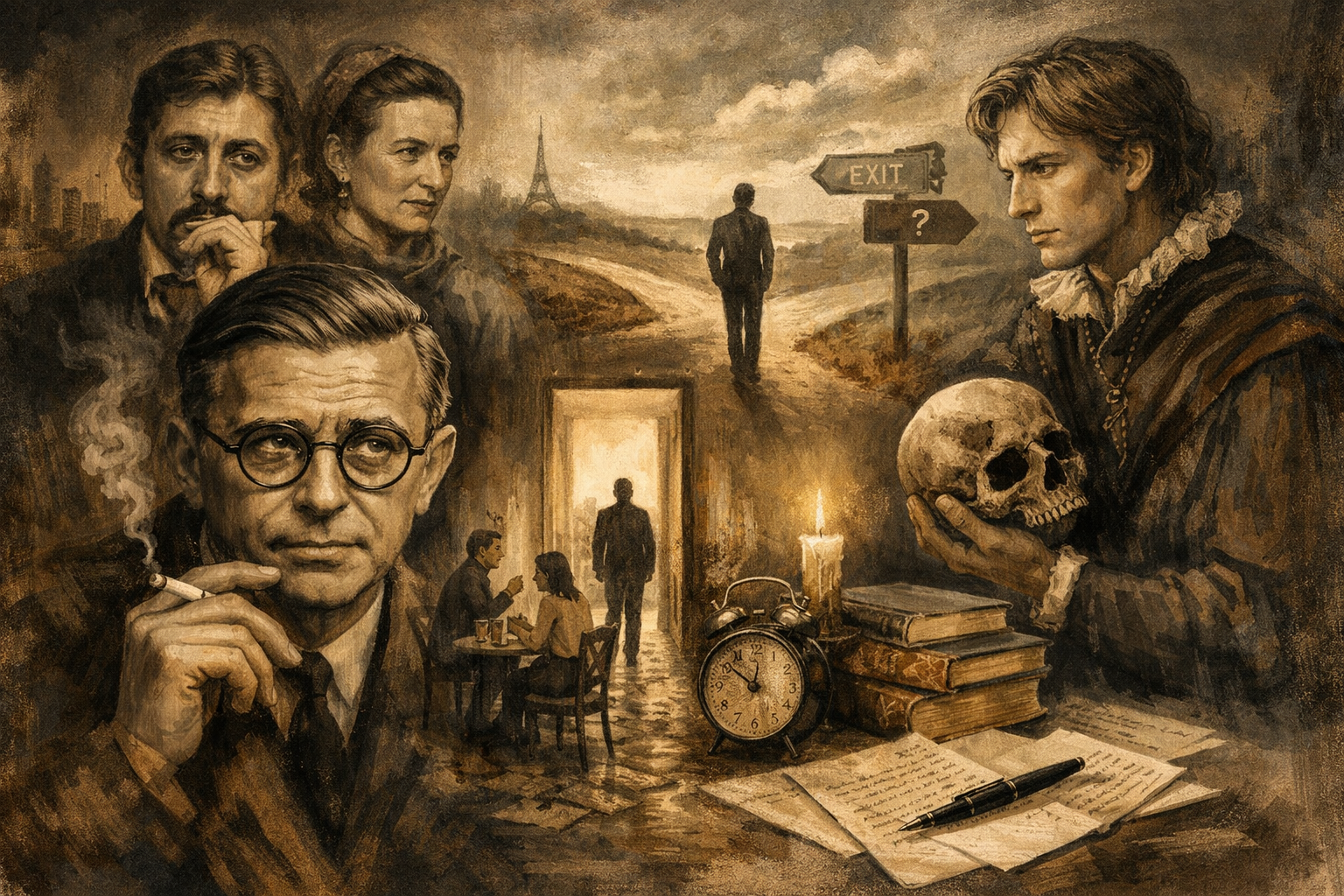
Existential thought is especially important to a broader philosophy architecture because it provides one of the strongest lenses for selfhood, inwardness, moral struggle, ambiguity, and the fragility of meaning. In this respect, the category links not only to Ethics and Moral Philosophy and Political Philosophy and Justice, but also to Metaphysics, Greek and Roman Thought, Russian Thought, Persian Thought, and Islamic and Mystical Thought. Existential questions sit behind debates about authenticity, conscience, despair, freedom, embodiment, mortality, oppression, moral responsibility, historical violence, and the possibility of living truthfully under pressure.
Existential thought is also one of the places where philosophy most clearly meets literature. Novels, plays, journals, memoirs, and essays are not merely secondary illustrations of existential ideas. They are among the forms in which existential truth becomes visible. Hamlet’s hesitation, Dostoevsky’s tortured freedom, Kafka’s estrangement, Proust’s memory, Beauvoir’s embodied ambiguity, Camus’s absurd lucidity, and Sartre’s dramatization of bad faith all show that the existential problem is lived before it is systematized. This makes existential thought unusually powerful for a knowledge architecture that treats philosophy, literature, moral psychology, politics, and cultural memory as interrelated rather than separate domains.
Why Existential Thought Matters
Existential thought matters because it begins from a problem many philosophical systems try to move beyond too quickly: that human beings must live their lives from within. Existence is always concrete, situated, and personal. One does not exist in general; one exists as this person, in this time, under these conditions, with this vulnerability, freedom, memory, embodiment, and irreversibility.
This perspective matters because human beings are not merely objects in the world. They are beings for whom their own being is at issue. They must choose, interpret, commit, fail, suffer, love, evade, remember, and continue under conditions that do not always provide clear foundations or stable moral scripts. Existential thought takes seriously the possibility that freedom is not merely empowering but burdensome, that selfhood is achieved rather than given, and that meaning is confronted through anxiety, action, attention, and responsibility rather than simply received from inherited systems.
Existential thought also matters because modern life intensifies many of its central concerns. Mass society, bureaucratic order, technological mediation, ideological conformity, war, social leveling, and the commodification of personality can make it easier for individuals to disappear into roles, routines, and public expectations. Existential philosophy therefore remains crucial wherever persons struggle to preserve moral seriousness, inward freedom, truthfulness, and responsibility under conditions of impersonality and pressure.
Within a broader philosophy architecture, existential thought provides one of the strongest lenses for selfhood, inwardness, moral struggle, and the fragility of meaning. It deepens ethics by asking what responsibility feels like from within, deepens political thought by examining conformity, oppression, and complicity, and deepens spiritual thought by confronting despair, transcendence, and the possibility that existence itself may exceed conceptual mastery.
The Scope of Existential Inquiry
Existential thought is not a single problem but a field of interrelated inquiries. It asks what it means to become a self, how freedom operates under conditions of finitude, how anxiety and despair disclose the human situation, what authenticity could mean in a socially structured world, how embodiment shapes subjectivity, and whether meaning is found, made, received, or continually struggled over. It also asks how literature, drama, memoir, testimony, and philosophy together reveal truths about existence that no purely abstract system can fully capture.
This breadth is one reason existential thought has remained philosophically powerful. It moves across psychology, ethics, metaphysics, politics, religion, literature, and phenomenology without belonging wholly to any one of them. It concerns both inner life and public life, both selfhood and history, both singular experience and collective structures of domination or conformity.
A research-grade treatment of existential thought must therefore include religious and atheistic existentialism, phenomenological and literary existentialism, existential ethics, existential politics, embodiment, gender, memory, death, absurdity, oppression, colonial violence, bureaucracy, literature, and the relation between selfhood and world. It must also recognize that existential thought is not exhausted by its French twentieth-century expression, important though that moment remains.
The scope of existential inquiry is ultimately defined by a recurring question: what does it mean to live truthfully as a finite self? Different thinkers answer this question in different ways. Kierkegaard turns toward inwardness, despair, and faith. Nietzsche turns toward nihilism, self-overcoming, and value creation. Heidegger turns toward being, death, and worldhood. Sartre turns toward freedom, bad faith, and responsibility. Beauvoir turns toward ambiguity, embodiment, oppression, and relational freedom. Camus turns toward absurdity, revolt, and moral measure. Literary traditions dramatize these problems through characters whose lives expose the difficulty of consciousness under pressure.
Major Intellectual Lineages
The study of existential thought draws on several major intellectual lineages. One foundational lineage begins with Søren Kierkegaard, widely called the father of existentialism, whose work foregrounds anxiety, despair, inwardness, faith, repetition, subjectivity, and the problem of becoming a self. Kierkegaard matters because he refuses to let philosophy dissolve the individual into system, insisting instead on the inward drama of existence, decision, and relation to the absolute.
A second lineage runs through Friedrich Nietzsche, whose critique of morality, nihilism, herd conformity, ressentiment, and inherited metaphysical certainties helps shape existentialism’s confrontation with value after the collapse of transcendent guarantees. Nietzsche transforms existential thought by asking what becomes of responsibility, greatness, self-creation, and truthfulness after the death of inherited absolutes.
A third lineage emerges in twentieth-century phenomenological and existential philosophy, especially through Heidegger, Sartre, Beauvoir, and Merleau-Ponty. This lineage is especially important because it transforms existential themes into sustained engagements with ontology, freedom, embodiment, ethics, politics, and lived experience. It asks not only how a self feels, but what it means to exist as a being-in-the-world, with others, under time, history, and mortality.
A fourth lineage includes religious and theistic existential thinkers such as Gabriel Marcel, who resisted reducing existential thought to atheism, despair, or absurdity alone. This line preserves existential seriousness about mystery, fidelity, presence, hope, and transcendence while retaining the inward, lived character of the existential problematic.
A fifth lineage lies in literature and dramatic form. Existential thought often achieves philosophical intensity through novels, plays, journals, memoirs, and essays rather than treatises alone. Dostoevsky, Proust, Kafka, Stendhal, Balzac, Shakespearean tragedy, and the French existential literary world all help reveal the unstable drama of freedom, memory, shame, death, self-deception, ambition, and moral choice.
A sixth lineage extends existential inquiry beyond Europe into anti-colonial, Black, and situated critiques of personhood under domination. Here the existential problem is not only inwardness in general, but existence under racialization, violence, occupation, humiliation, and historical denial. This makes existential thought answerable to a wider human world than the European canon alone.
Taken together, these lineages show that existential thought is not a single unified doctrine. It is a many-sided tradition of reflection on existence, selfhood, freedom, contingency, meaning, and responsibility. Its enduring force lies in its refusal to let philosophy forget that human life is lived from within and that the question of how to exist cannot be answered once and for all by abstract system alone.
The French Existentialist Moment
Existentialism became a historically distinctive intellectual formation in mid-twentieth-century France. In this period, existential thought moved beyond specialist philosophy into novels, plays, essays, journalism, memoir, and public argument. It became both a philosophy and a literary-public style of confronting freedom, complicity, ambiguity, violence, and the difficulty of meaning after war, occupation, and ideological fracture.
This French moment matters because existentialism was not merely theorized; it was staged. It entered public life through cafés, journals, theatres, novels, and polemics, becoming a way of thinking about moral burden under historical pressure. The postwar setting gave existential themes unusual force: responsibility could no longer remain abstract when collaboration, resistance, guilt, injustice, and political commitment were matters of living memory.
French existentialism also matters because it fused philosophy with literary form. Fiction and drama did not simply popularize prior doctrines; they became media through which existential claims could be dramatized. The literary dimension was not ornamental. It allowed freedom, absurdity, bad faith, oppression, embodiment, and revolt to appear as lived situations rather than as propositions alone.
The French moment remains important because it shows existential thought as a public philosophy. It asks what freedom means after catastrophe, what responsibility means under history, and whether thought can remain morally serious when the inherited frameworks of meaning have been shattered by war, violence, ideology, and complicity.
Sartre, Freedom, Bad Faith, and Existence
Jean-Paul Sartre stands at the center of twentieth-century existential thought because he gave the tradition one of its most forceful philosophical articulations. His work turns on the claim that human beings are not defined by a fixed essence that precedes their choices. They exist first, then make themselves through projects, actions, refusals, and commitments. This makes freedom central, but it also makes freedom heavy. Human beings are answerable for what they do with the fact of existing.
Sartre’s significance lies partly in the way he exposes self-deception. Bad faith names the attempt to flee one’s freedom by hiding in roles, scripts, excuses, or identities treated as fixed things. One lies to oneself in order to avoid the burden of being a free being who must choose. Existential thought becomes especially sharp here because it shows that the great temptation is not only error but evasion.
Sartre also matters because he made existentialism public. He helped transform it into a philosophical language for freedom, commitment, situation, and moral seriousness in the modern world. Even where later thinkers depart from him, Sartre remains decisive because he places responsibility at the center of philosophy and refuses to let persons imagine themselves as innocent spectators of their own lives.
Sartre’s strongest existential insight is that freedom is not merely a capacity one possesses, but a condition one cannot escape. Even refusal, evasion, and passivity are ways of taking up one’s situation. The human being is condemned to be free because there is no final script that can relieve the burden of choosing. This makes Sartre one of the most severe philosophers of responsibility in the modern tradition.
Beauvoir, Freedom, Ambiguity, and Oppression
Any serious account of existential thought requires Simone de Beauvoir to stand near its center rather than at its margins. Beauvoir is not merely an associate of existentialism; she is one of its most original and indispensable philosophers. Her work expands existential freedom into an ethical and political problem by showing that freedom is always exercised within situations shaped by embodiment, dependence, inequality, gender, and oppression.
Beauvoir’s importance lies partly in the way she transforms the place of the other. Rather than treating the other primarily as a threat to freedom, she shows that the other is necessary to freedom’s realization. This prevents existentialism from collapsing into isolated subjectivism. Freedom becomes relational, situated, embodied, and entangled with the realities of domination, reciprocity, labor, sex, and social life.
Beauvoir also expands existential thought through the category of ambiguity. Human beings are neither pure transcendence nor pure thinghood, neither wholly free nor wholly determined. They live in tension between body and project, self and other, vulnerability and possibility. This makes existential ethics more serious and more realistic, because it acknowledges that freedom is always exercised under conditions not of one’s choosing.
Her work is essential because it shows that existentialism becomes morally incomplete if it speaks of freedom without speaking of oppression. Freedom is not only an inward burden. It is also a social and political problem. Persons may be formally free while living under structures that constrain, distort, or deny their possibilities. Beauvoir therefore moves existential thought toward a more serious account of embodiment, gender, mutual recognition, and the ethics of liberation.
Camus, Absurdity, Revolt, and Moral Measure
Albert Camus occupies a distinctive and complicated place in existential thought. He was not an academic philosopher in the narrow sense, yet he made one of the twentieth century’s most powerful contributions to moral and philosophical reflection through essays, novels, journalism, and drama. He matters not because he fits neatly inside the category of existentialism, but because he confronts absurdity, nihilism, justice, and revolt with unusual clarity.
Camus’s philosophical force lies in the way he confronts a world without guaranteed metaphysical meaning while refusing both resignation and fanaticism. He is not simply a thinker of absurdity; he is also a thinker of limit, measure, dignity, solidarity, and refusal. He asks how one can live lucidly in an indifferent world without surrendering to murder, ideological intoxication, or the destruction of truth and justice.
The literary power of Camus is part of his philosophical significance. His novels and essays do not merely illustrate prefabricated claims. They dramatize the tension between indifference and solidarity, estrangement and responsibility, absurdity and action. This makes Camus central to a deeper understanding of French existentialism and its literary reach, even if the label sits somewhat uneasily on his work.
Camus is especially important because he refuses false consolations without embracing nihilism. His thought turns on a difficult discipline: to see clearly, to refuse lies, to resist injustice, and to preserve measure even when no final metaphysical guarantee arrives to settle the meaning of human life. In this respect, revolt becomes not only political but existential. It is the refusal to let absurdity become permission for cruelty.
Kierkegaard, Faith, Despair, and Inwardness
Kierkegaard stands near the origin of existential thought because he refused to let philosophy treat existence as something that could be grasped from nowhere. For him, subjectivity, inwardness, repetition, despair, anxiety, and faith are not marginal themes but decisive features of human life. A self is not simply a thing among things. It is a relation that must become itself under conditions of freedom, fragility, and possible failure.
This matters because Kierkegaard gives existential thought one of its strongest accounts of inward struggle. Despair is not merely sadness; it is the failure to become oneself rightly. Anxiety is not merely fear; it is the vertigo of possibility. Faith is not mere assent but a risky, lived relation that cannot be replaced by objective certainty alone.
Kierkegaard’s influence remains profound because he shows that philosophy cannot honestly address existence without confronting the interior life of decision, guilt, responsibility, and transcendence. His work preserves the existential claim that truth, if it is to matter, must be lived and not merely contemplated.
Kierkegaard also matters because he resists the reduction of existence to social identity, public opinion, or intellectual system. The self must become itself, but it can fail to do so in many ways: by dissolving into the crowd, by hiding behind aesthetic distraction, by despairing of possibility, by refusing dependence, or by attempting to secure itself without relation to the absolute. Existential thought inherits from Kierkegaard the conviction that becoming a self is difficult, inward, and morally dangerous.
Nietzsche, Nihilism, Self-Overcoming, and Value
Nietzsche does not belong to existentialism in a simple doctrinal sense, yet he is indispensable to its development. His diagnosis of nihilism, herd conformity, ressentiment, and the exhaustion of inherited values decisively shaped later existential concerns. He asks what happens when the highest values lose their power, when metaphysical guarantees collapse, and when human beings must confront the task of valuation without inherited certainty.
Nietzsche matters because he transforms freedom into a question of strength, style, truthfulness, and self-overcoming. He refuses both passive resignation and moral complacency. In doing so, he makes existential thought more severe. Human beings are not merely free; they are confronted with the burden of creating, affirming, or revaluing life under conditions in which inherited meaning may no longer bind.
His influence remains enduring because he pushes existential thought toward questions of power, interpretation, critique, and the courage required to live without metaphysical consolation while still refusing emptiness.
Nietzsche also deepens existential thought by making value itself a problem. If inherited moral systems conceal resentment, fear, weakness, or life-denial, then authenticity cannot mean simply obeying tradition. But if inherited values collapse, human beings face the danger of nihilism. Nietzsche’s challenge is therefore not merely destructive. It asks whether a more truthful, stronger, and more life-affirming relation to existence is possible after the loss of metaphysical guarantees.
Heidegger, Being, Death, and Authenticity
Heidegger transformed existential thought by linking it to ontology. In his work, the human being is not merely a chooser but a being for whom Being itself is in question. Existence is structured by thrownness, projection, care, temporality, and being-toward-death. These concepts made existential inquiry more radically philosophical by treating the human condition not just as psychological struggle, but as a mode of being-in-the-world.
This matters because Heidegger deepens existential reflection beyond voluntarism. Freedom is not simple self-assertion. It takes place within thrown conditions, histories, languages, and worlds not of one’s choosing. Death becomes central because it discloses the singular finitude that no public abstraction can absorb on one’s behalf.
Heidegger also makes visible the tension between authenticity and the everyday. The danger is not simply moral weakness but absorption into the anonymous public world of “the they,” where existence is leveled into convention, chatter, and distraction. Whether one accepts or resists Heidegger’s larger project, his contribution to existential thought remains decisive.
Heidegger’s thought also requires careful moral and historical handling. His influence on existential philosophy is enormous, but his political entanglements cannot be ignored. A serious pillar should treat his ontology and his historical failures together, not as a simple cancellation and not as an excuse. Existential thought is strongest when it refuses to let brilliance escape responsibility.
Proustian Inwardness, Memory, and Becoming
Proust does not belong to existentialism in the strict historical sense, yet a Proustian line of inwardness greatly enriches existential thought. His work offers one of the most searching literary investigations of memory, selfhood, desire, jealousy, time, and the unstable relation between lived experience and reflective understanding. If existentialism asks what it means to become a self under conditions of contingency and finitude, Proust shows how that becoming is inseparable from recollection, loss, and the slow reinterpretation of one’s own life.
A Proustian existential register matters because it shifts attention from dramatic choice alone to temporal depth. The self is not only what it chooses in decisive moments; it is also what it discovers through involuntary memory, delay, repetition, longing, and the uneven return of the past. This gives existential inwardness a richer phenomenology. The human being does not simply choose forward. It also becomes legible backward, through time, memory, and the painful reconstruction of meaning.
Proust therefore enlarges the existential field even without belonging to its formal canon. He shows that selfhood is not merely asserted but uncovered, not merely projected but remembered, and not merely acted out but interpreted through the strange persistence of time within consciousness.
This matters for existential thought because memory complicates freedom. A person is not only what they decide to be now; they are also shaped by what returns, what was misunderstood, what was lost, and what only later becomes intelligible. Proustian inwardness reveals that existence is temporal not only because it moves toward death, but because the past remains unfinished within the self.
Hamlet and the Prehistory of Existential Consciousness
Hamlet is not an existentialist work in the historical sense, but it stands as one of the great prehistories of existential consciousness. The play returns obsessively to mortality, hesitation, conscience, action, corruption, and the burden of inward reflection. Hamlet is not merely deciding what to do; he is confronting what it means to act at all in a world where the moral ground beneath action has become unstable.
The play matters for existential thought because Hamlet experiences existence as a problem. He is thrown into a rotten world, made answerable to a demand for action he cannot simply absorb into inherited script or public role. The graveyard reflections, the “to be or not to be” meditation, and his obsession with death and seeming all bring him close to questions later existentialism would name more explicitly: the weight of mortality, the instability of identity, the paralysis of reflection, and the difficulty of authentic action.
Hamlet also helps reveal that existential thought did not emerge out of nowhere in the nineteenth and twentieth centuries. Shakespeare’s tragedy already stages the inward fracture between action and consciousness, role and self, public duty and private truth. It can therefore be read as a profound precursor text for existential seriousness, especially where philosophy meets literature in the drama of human self-questioning.
The play also dramatizes the danger of consciousness turned against action. Hamlet sees too much, doubts too deeply, and cannot easily inhabit the inherited forms of revenge, honor, or obedience. This makes him one of the great literary figures of existential hesitation: a self caught between the demand to act and the impossibility of acting innocently.
Existence, Freedom, and the Self
One of the most important claims in existential thought is that human existence cannot be understood in the same way as the existence of things. Human beings do not merely have properties; they must interpret themselves, choose themselves, and live in relation to possibilities. Existence is therefore not a static condition but an ongoing task.
Freedom is central, but existential freedom is not superficial voluntarism. It is the condition in which persons are answerable for what they do, evade, affirm, or become. This is why existential thought often links freedom to anguish, burden, seriousness, and exposure rather than to simple celebration.
The self, in this tradition, is not a finished substance passively waiting to be described. It is a task, a relation, or a becoming. Existential thought therefore matters wherever philosophy must address not only what a person is, but what a person is doing with the fact of being a person at all.
This understanding of selfhood distinguishes existential thought from theories that reduce human beings to fixed essence, social role, biological function, or rational abstraction. Existential thought insists that human beings are unfinished. They are made through choices, memories, refusals, relationships, failures, and commitments. To exist is to be implicated in the making of one’s own life.
Anxiety, Despair, and the Burden of Choice
Existential thought is often associated with anxiety, despair, dread, absurdity, and estrangement, but these themes are philosophically important because they disclose something about human freedom and finitude. Anxiety reveals possibility. Despair reveals the failure to become oneself or the collapse of sustaining forms of meaning. The absurd marks the tension between human demands for intelligibility and a world that may not yield such reassurance on command.
These affective states are not treated merely as psychological episodes. They are philosophically revealing because they interrupt routines of conformity and force individuals to confront the instability of borrowed meanings. Existential thinkers are therefore interested not in mood for its own sake, but in what certain moods disclose about existence, freedom, contingency, and moral exposure.
At its deepest, existential thought treats these states as thresholds. They are moments in which human life becomes visible to itself as unfinished, contingent, and answerable.
Anxiety can paralyze, but it can also reveal freedom. Despair can destroy, but it can also expose a false form of selfhood. Absurdity can lead to nihilism, but it can also provoke revolt, lucidity, and refusal. Existential thought is therefore not a philosophy of emotional collapse. It is a philosophy of what difficult states disclose when human beings can no longer hide inside inherited meanings.
Authenticity, Ambiguity, and the Crowd
Existential thought is deeply concerned with the tendency of persons to disappear into public roles, inherited scripts, and conformist patterns of social life. Authenticity does not mean self-expression in a superficial contemporary sense. It means taking up one’s existence as one’s own rather than dissolving it in social leveling, routine, role-playing, or bad faith.
Yet existential thought also resists easy simplifications. Human beings are always situated among others, shaped by history, embodiment, language, dependency, and political order. This is why existentialism often turns toward ambiguity rather than total self-transparency. At its strongest, it examines the tension between freedom and situation, selfhood and sociality, interior life and public world.
The critique of “the crowd,” public opinion, or anonymous sociality is therefore not simply elitist disdain. It is a warning about the ease with which moral seriousness can be surrendered to conformity, distraction, ideology, or the comfort of not choosing.
Authenticity is difficult because the self cannot simply retreat from society. Human beings need language, relation, recognition, and shared worlds. The existential problem is therefore not how to become untouched by others, but how to live truthfully among others without becoming absorbed by anonymous expectation, false identity, or borrowed certainty.
Embodiment, Gender, and Situation
A more comprehensive existential treatment must foreground embodiment and situation. Human beings do not choose from nowhere. They choose as sexed, gendered, vulnerable, mortal, and socially placed beings. Existential freedom is therefore always mediated by body, labor, language, history, and inequality.
This matters because existential thought becomes ethically and politically stronger when it abandons the fantasy of abstract freedom. Beauvoir is central here, but the issue extends further: oppression is not merely an obstacle outside freedom; it can shape the very horizon within which possibilities appear. The lived body is not a secondary complication. It is one of the conditions of existence itself.
A research-grade existential pillar should therefore make clear that freedom, ambiguity, selfhood, and responsibility are inseparable from situated life. Existential thought does not become less serious when it turns to embodiment, gender, and oppression. It becomes more honest.
Embodiment also deepens existential philosophy because it shows that the self is not a pure consciousness trapped in a body. The body is how one appears, acts, suffers, desires, ages, works, is seen, is limited, and encounters the world. Existential freedom is never freedom from embodiment. It is freedom lived through embodiment.
Existential Thought Beyond Atheism
Popular accounts often identify existentialism almost entirely with atheism, absurdity, or the claim that life has no inherent meaning. But the tradition is broader and more internally diverse than that. Kierkegaard is indispensable to its origins, Marcel offers a deeply relational and spiritually serious form of existential philosophy, and religious existential currents preserve questions of grace, fidelity, transcendence, and hope that cannot be reduced to despair or nihilism alone.
This matters because existential thought is not finally united by a single theological conclusion, but by a shared seriousness about existence, freedom, inwardness, and the difficulty of becoming a self. Some existential thinkers locate redemption in faith, others in lucidity, others in revolt, commitment, ethical relation, or artistic truthfulness. What binds them is the conviction that human life cannot be honestly understood without confronting finitude, responsibility, and the question of how one is to exist in the face of uncertainty.
Existential thought therefore extends beyond atheism without losing its edge. It remains a philosophy of exposure, not of easy consolation.
This broader frame also allows existential thought to connect more deeply with religious and mystical traditions. Questions of inwardness, despair, selfhood, repentance, transcendence, fidelity, and spiritual struggle are not external to existential inquiry. They are part of its wider field. Existential thought remains powerful precisely because it can be theistic, atheistic, agnostic, tragic, literary, political, and spiritual without ceasing to ask the same severe question: how should one exist?
Existential Politics, History, and Responsibility
Existential thought is sometimes misread as purely inward or apolitical, but many of its strongest forms are deeply concerned with history, oppression, violence, and responsibility under public conditions. Sartre, Beauvoir, Camus, Fanon, and others reveal that freedom is lived under institutions, wars, ideological conflicts, and social structures that demand political judgment.
This matters because existential freedom is not a private possession. It is compromised, enabled, wounded, and burdened by history. Questions of complicity, resistance, occupation, oppression, colonial violence, and moral measure all enter the existential field because the self is never formed outside the public world.
A research-grade existential pillar should therefore show that existential thought does not turn away from politics. It turns toward politics by asking what responsibility, truthfulness, and freedom mean when history itself becomes a site of guilt, violence, and action.
This political dimension is essential because existential thought refuses innocence. To exist is to be situated in history, and to be situated in history is to inherit conditions one did not choose but must nevertheless respond to. Existential politics asks how persons act under pressure, what they owe to others, and how they preserve moral seriousness when public life is shaped by violence, ideology, and domination.
Literature, Memory, and the Drama of Consciousness
Existential thought has often reached its greatest intensity through literature. Novels, plays, memoirs, journals, and essays do not merely popularize existential ideas after the fact. They are among the forms in which existential truth becomes legible. Consciousness, shame, hesitation, estrangement, memory, bad faith, revolt, and moral fracture can often be dramatized more powerfully than they can be codified in abstract propositions.
This matters because existential philosophy is unusually attentive to the textures of lived life. Literature allows freedom, guilt, time, embodiment, absurdity, and desire to appear as situations rather than as concepts alone. That is why writers such as Dostoevsky, Proust, Kafka, Stendhal, Balzac, Camus, Beauvoir, and others belong near the existential conversation even when they are not all “existentialists” in a strict doctrinal sense.
Existential thought is therefore inseparable from style, voice, scene, temporality, and narrative form. Its seriousness lies partly in the fact that it knows philosophical truth must often be shown as well as argued.
Literature also preserves the ambiguity of existence. A philosophical proposition may try to clarify, but a novel or drama can hold contradiction, hesitation, shame, desire, failure, and self-deception in motion. Existential literature does not always resolve the problem of existence. It makes the problem visible.
Core Themes in Existential Thought
One major theme in this field is existence itself. Existential thought asks what it means to exist as a concrete, finite, situated self rather than as an abstract human essence.
A second theme is freedom. Existential thinkers examine the burden, ambiguity, and responsibility of choosing under conditions where certainty and fixed norms may be unstable or incomplete.
A third theme is anxiety, despair, absurdity, and estrangement. These are treated not merely as moods, but as revelatory conditions that disclose possibility, finitude, contingency, and the instability of borrowed meaning.
A fourth theme is authenticity. Existential thought repeatedly asks how persons might live their own lives rather than dissolve into conformity, public scripts, bad faith, or the anonymous comfort of the crowd.
A fifth theme is embodiment, relationship, and situation. Human beings are never pure choosers detached from history, dependency, gender, social form, or other persons, and existential thought remains powerful in part because it takes this complexity seriously.
A sixth theme is literary-philosophical form. Existential thought has often reached its greatest intensity through novels, plays, memoirs, and essays, where consciousness, decision, estrangement, and moral conflict can be dramatized rather than merely stated.
A seventh theme is politics and responsibility. Existential thought asks what freedom, guilt, complicity, and action mean under war, oppression, public pressure, colonial violence, and historical crisis.
An eighth theme is mortality. Death is not simply an event at the end of life; it shapes the urgency, fragility, and singularity of existence.
A ninth theme is meaning. Existential thought asks whether meaning is inherited, made, discovered, received, contested, or continually re-created under conditions of uncertainty.
Finally, this field raises persistent questions of transcendence and moral seriousness. Existential thought endures because it confronts the possibility that existence is both exposed and answerable, tragic and open, contingent and yet still ethically weighty.
Expanded Article Architecture
The following structure gathers the Existential Thought pillar into a long-range article architecture. It preserves the planned article sequence from the source draft while adding short descriptions for each planned article.
Foundations of Existential Thought
- What Is Existential Thought? (planned)
Introduces existential thought as a philosophical and literary inquiry into freedom, anxiety, selfhood, meaning, responsibility, finitude, and lived existence.
Kierkegaard and Existential Inwardness
- Kierkegaard and the Birth of Existential Inwardness (planned)
Studies Kierkegaard as a founding figure of existential thought, emphasizing subjectivity, inwardness, faith, despair, and the difficulty of becoming a self. - Kierkegaard on Anxiety, Faith, and the Self (planned)
Examines anxiety as the dizziness of possibility, faith as lived risk, and selfhood as a relation that must become itself. - Repetition, Despair, and the Difficulty of Becoming a Self (planned)
Explores Kierkegaard’s account of repetition, despair, and the inner struggle through which a person either becomes or fails to become a self.
Nietzsche, Nihilism, and Self-Overcoming
- Nietzsche, Nihilism, and Self-Overcoming (planned)
Introduces Nietzsche’s diagnosis of nihilism, herd conformity, ressentiment, and the challenge of creating value after inherited certainties collapse. - Nietzsche on Value, Style, and the Revaluation of Life (planned)
Studies Nietzsche’s account of style, self-overcoming, critique, strength, and the revaluation of inherited moral frameworks.
Heidegger and Existential Phenomenology
- Heidegger, Being-in-the-World, and Finitude (planned)
Examines Heidegger’s account of human existence as being-in-the-world, structured by thrownness, care, temporality, and finitude. - Heidegger, Anxiety, Worldhood, and Being-toward-Death (planned)
Studies anxiety, worldhood, and death as conditions that disclose the singularity and urgency of existence. - Authenticity, Everydayness, and the Problem of “the They” (planned)
Explores Heidegger’s critique of anonymous public existence, conformity, chatter, and the leveling power of everydayness. - Merleau-Ponty, Embodiment, and the Lived World (planned)
Introduces Merleau-Ponty’s account of embodiment, perception, and the lived world as central to existential phenomenology. - Perception, Body, and Situation in Existential Phenomenology (planned)
Studies how perception, bodily orientation, situation, and world-involvement shape existential experience.
The French Existentialist Moment
- The French Existentialist Moment (planned)
Examines mid-twentieth-century French existentialism as a public, literary, philosophical, and political response to war, occupation, freedom, and responsibility. - Sartre, Freedom, and Bad Faith (planned)
Studies Sartre’s account of radical freedom, self-deception, role-playing, and the attempt to evade responsibility. - Sartre and the Burden of Human Responsibility (planned)
Explores Sartre’s claim that human beings are responsible for what they make of themselves under conditions without fixed essence. - Existence, Essence, and the Problem of Selfhood (planned)
Examines the existential claim that existence precedes essence and what this means for identity, freedom, and self-creation. - Freedom, Choice, and the Burden of Responsibility (planned)
Studies existential freedom as a burden of choice, action, refusal, evasion, and moral accountability. - Anxiety, Dread, and the Disclosure of Possibility (planned)
Explores anxiety and dread as conditions that reveal freedom, possibility, contingency, and the absence of guaranteed scripts. - Despair, Failure, and the Difficulty of Becoming a Self (planned)
Examines despair as a failure of selfhood and as one of existential thought’s central ways of thinking about fractured life. - Authenticity, Conformity, and the Critique of the Crowd (planned)
Studies authenticity as the difficult work of living one’s existence rather than dissolving into public opinion, role, or social leveling.
Beauvoir, Ambiguity, Embodiment, and Relation
- Simone de Beauvoir and the Ethics of Ambiguity (planned)
Introduces Beauvoir’s account of ambiguity, freedom, embodiment, interdependence, and ethical responsibility. - Beauvoir, Oppression, and the Freedom of the Other (planned)
Studies Beauvoir’s argument that freedom is relational and that oppression distorts both selfhood and the conditions of possible liberation. - Embodiment, Gender, and Existential Situation (planned)
Examines embodiment and gender as existential conditions that shape freedom, possibility, vulnerability, and social reality. - Love, Recognition, and the Risk of the Other (planned)
Explores love and recognition as existential relations marked by vulnerability, dependence, projection, and the risk of domination. - Friendship, Fidelity, and Existential Relation (planned)
Studies friendship and fidelity as modes of relation in which freedom, trust, responsibility, and continuity are tested.
Camus, Absurdity, and Revolt
- Albert Camus and the Philosophy of the Absurd (planned)
Introduces Camus’s account of absurdity as the confrontation between human longing for meaning and a world without final reassurance. - Camus on Revolt, Justice, and Moral Measure (planned)
Examines Camus’s defense of revolt, limit, solidarity, dignity, and moral measure against nihilism and ideological violence. - Absurdity, Lucidity, and the Refusal of Nihilism (planned)
Studies lucidity as a disciplined response to absurdity that refuses both false consolation and destructive nihilism.
Religious Existentialism and Transcendence
- Gabriel Marcel and the Mystery of Presence (planned)
Studies Marcel’s religious existentialism through presence, fidelity, hope, mystery, relation, and resistance to objectifying human life. - Religious Existentialism and the Problem of Transcendence (planned)
Examines theistic and religious existential traditions that address faith, grace, despair, inwardness, and relation to the absolute. - Faith, Hope, and Existence Beyond System (planned)
Studies faith and hope as existential orientations that cannot be reduced to abstract proof or systematic doctrine. - Existential Thought Beyond Atheism (planned)
Explores existential thought as broader than atheism, including religious, spiritual, and theistic forms of existential seriousness.
Literature, Memory, and Nineteenth-Century Selfhood
- Proust, Memory, and Existential Inwardness (planned)
Studies Proustian memory, time, desire, jealousy, and retrospective self-understanding as existential problems of becoming. - Stendhal, Ambition, Desire, and the Drama of Becoming a Self (planned)
Examines ambition, desire, social performance, and self-making in Stendhal as part of the literary prehistory of existential thought. - Balzac, Social Ambition, Modernity, and the Making of the Self (planned)
Studies Balzac’s world of social ambition, money, class, and modernity as a field where selfhood is shaped and distorted by society. - Realism, Society, and Existential Selfhood in Nineteenth-Century Fiction (planned)
Explores how realist fiction dramatizes the formation of selfhood under social pressure, ambition, desire, and historical change. - Hamlet and the Prehistory of Existential Consciousness (planned)
Reads Hamlet as a precursor figure for existential consciousness through hesitation, mortality, conscience, inwardness, and the burden of action.
Dostoevsky, Kafka, and the Drama of Consciousness
- Dostoevsky, Freedom, Guilt, and the Burden of Consciousness (planned)
Studies Dostoevsky’s exploration of freedom, guilt, suffering, conscience, rebellion, redemption, and moral responsibility. - The Underground Man and the Revolt Against Rational Systems (planned)
Examines the Underground Man as a figure of spite, freedom, self-consciousness, rebellion, and resistance to rationalist systems. - Crime, Conscience, and Redemption in Dostoevsky (planned)
Studies crime, guilt, confession, punishment, suffering, and redemption as existential and spiritual problems. - Kafka, Bureaucracy, and Existential Estrangement (planned)
Examines Kafka’s world of opacity, bureaucracy, alienation, judgment, and the collapse of human legibility. - Kafka, Law, and the Experience of Judgment (planned)
Studies Kafka’s treatment of law, guilt, accusation, authority, and the terrifying instability of judgment. - Alienation, Bureaucracy, and the Collapse of Human Legibility (planned)
Explores alienation under bureaucratic systems where persons become unreadable, powerless, and estranged from meaningful recognition.
Existential Literature, Politics, and Historical Responsibility
- French Existentialism and the Literary Imagination (planned)
Studies how novels, plays, essays, and memoirs shaped existentialism as a literary and public philosophy. - Existentialism, Politics, and Historical Responsibility (planned)
Examines existential responsibility under war, occupation, violence, ideology, complicity, and political action. - Freedom, Violence, and the Burden of Commitment (planned)
Studies the difficult relation between freedom, political commitment, violence, moral judgment, and historical action. - Death, Finitude, and the Meaning of Human Limits (planned)
Explores death and finitude as conditions that shape urgency, responsibility, singularity, and the search for meaning.
Fanon, Black Existentialism, and Anti-Colonial Thought
- Fanon, Embodiment, and Existence Under Colonial Violence (planned)
Studies Fanon’s account of embodied existence under colonial violence, racialization, humiliation, and the struggle for liberation. - Black Existentialism and the Problem of Freedom (planned)
Examines Black existential thought through freedom, dignity, embodiment, racism, social negation, resistance, and selfhood under domination. - Existential Thought and Anti-Colonial Struggle (planned)
Studies existential freedom, violence, liberation, colonial power, and historical responsibility in anti-colonial contexts. - Existentialism Beyond Europe (planned)
Expands existential inquiry beyond the European canon into wider global contexts of domination, freedom, exile, history, and selfhood.
Contemporary Relevance
- Existential Thought in an Age of Complexity (planned)
Examines existential concerns under contemporary conditions of technological mediation, bureaucracy, ecological anxiety, social fragmentation, and institutional complexity. - Why Existential Thought Still Matters (planned)
Concludes the series by explaining why existential thought remains vital for philosophy, literature, ethics, politics, psychology, and the study of human meaning.
Closing Perspective
Existential thought remains indispensable because it refuses to let philosophy forget the person who must live. It does not allow freedom to remain an abstraction, responsibility to remain a doctrine, death to remain a biological fact, or meaning to remain a slogan. It asks how human beings exist from within: anxious, embodied, finite, historical, relational, wounded, hopeful, evasive, and answerable.
This does not make existential thought merely subjective. On the contrary, it is one of the strongest traditions for connecting inward life to public reality. It asks how persons become themselves under history, how they evade responsibility through bad faith or conformity, how oppression shapes possibility, how literature reveals moral consciousness, and how politics becomes existential when freedom and violence enter the same field.
The strongest reason to study existential thought is that its questions remain unavoidable. How should one live when no inherited script is enough? What does freedom require when every choice is situated? What does authenticity mean among others? How does one face death without trivializing life? How can one resist despair without lying? These are not only philosophical questions. They are questions every human life eventually meets.
Related Reading
- Ethics and Moral Philosophy — for virtue, moral responsibility, dignity, practical wisdom, duty, and the good life.
- Political Philosophy and Justice — for freedom, domination, oppression, justice, authority, and collective responsibility.
- Metaphysics — for being, selfhood, time, finitude, causation, identity, and the structure of existence.
- Greek and Roman Thought — for classical traditions of virtue, mortality, philosophical discipline, tragedy, and the examined life.
- Russian Thought — for Dostoevsky, suffering, freedom, moral responsibility, spiritual crisis, and historical depth.
- Persian Thought — for longing, mortality, beauty, poetic inwardness, spiritual transformation, and the soul’s search for meaning.
- Islamic and Mystical Thought — for inward transformation, remembrance, spiritual discipline, selfhood, law, revelation, and transcendence.
Further Reading
- Aho, K. (2023). Existentialism. Stanford Encyclopedia of Philosophy. Available at: https://plato.stanford.edu/entries/existentialism/.
- Cooper, D.E. (1999). Existentialism: A Reconstruction. 2nd edn. Oxford: Blackwell.
- Crowell, S. (2012). The Cambridge Companion to Existentialism. Cambridge: Cambridge University Press.
- Macquarrie, J. (1972). Existentialism. Harmondsworth: Penguin.
- Reynolds, J. (2022). Jean-Paul Sartre. Stanford Encyclopedia of Philosophy. Available at: https://plato.stanford.edu/entries/sartre/.
- Solomon, R.C. (2005). Existentialism. 2nd edn. Oxford: Oxford University Press.
- Webber, J. (2018). Rethinking Existentialism. Oxford: Oxford University Press.
- Wicks, R. (2020). Existentialism. In: Oxford Bibliographies.
References
- Aho, K. (2023). Existentialism. Stanford Encyclopedia of Philosophy. Available at: https://plato.stanford.edu/entries/existentialism/.
- Bergoffen, D. (2004). Simone de Beauvoir. Stanford Encyclopedia of Philosophy. Available at: https://plato.stanford.edu/entries/beauvoir/.
- Britannica. (n.d.). Existentialism. Available at: https://www.britannica.com/topic/existentialism.
- Britannica. (n.d.). Existentialism: Historical Survey of Existentialism. Available at: https://www.britannica.com/topic/existentialism/Historical-survey-of-existentialism.
- Britannica. (n.d.). French Literature: The Mid-20th Century. Available at: https://www.britannica.com/art/French-literature/The-mid-20th-century.
- Britannica. (n.d.). Albert Camus. Available at: https://www.britannica.com/biography/Albert-Camus.
- Britannica. (n.d.). Hamlet. Available at: https://www.britannica.com/topic/Hamlet-by-Shakespeare.
- Internet Encyclopedia of Philosophy. (n.d.). Existentialism. Available at: https://iep.utm.edu/existent/.
- Internet Encyclopedia of Philosophy. (n.d.). Albert Camus. Available at: https://iep.utm.edu/albert-camus/.
- Internet Encyclopedia of Philosophy. (n.d.). Simone de Beauvoir. Available at: https://iep.utm.edu/simone-de-beauvoir/.
- Reynolds, J. (2022). Jean-Paul Sartre. Stanford Encyclopedia of Philosophy. Available at: https://plato.stanford.edu/entries/sartre/.