
Last Updated May 3, 2026
Technology, infrastructure, and everyday systems examine how human beings live with material systems, technical artifacts, built environments, communication networks, platforms, utilities, maintenance regimes, and logistical arrangements in the course of daily life. In cultural anthropology, technologies are not treated as neutral tools imposed on passive users, but as social objects whose meaning, adoption, use, refusal, repair, and consequences are shaped by culture, trust, habit, inequality, institutional power, and lived context. Infrastructure is approached not merely as engineering substrate, but as a set of systems that organize movement, connection, circulation, access, dependence, repair, exclusion, and everyday possibility.
This content pillar brings together the major domains through which cultural anthropology studies technology, infrastructure, and everyday systems. It examines roads, mobility, transportation networks, water systems, electricity grids, communication platforms, data infrastructures, logistics chains, digital services, smart systems, maintenance labor, repair cultures, breakdown, workarounds, household technologies, platform dependency, digital divides, protocols, standards, built environments, ecological infrastructures, and the social life of technical order. It treats technology not as an external force acting on society, but as a lived sociotechnical field through which people work, communicate, move, access services, wait, adapt, endure failure, and create ordinary life.
Current Space
Cultural Anthropology
Related Topic
Development & Modernity
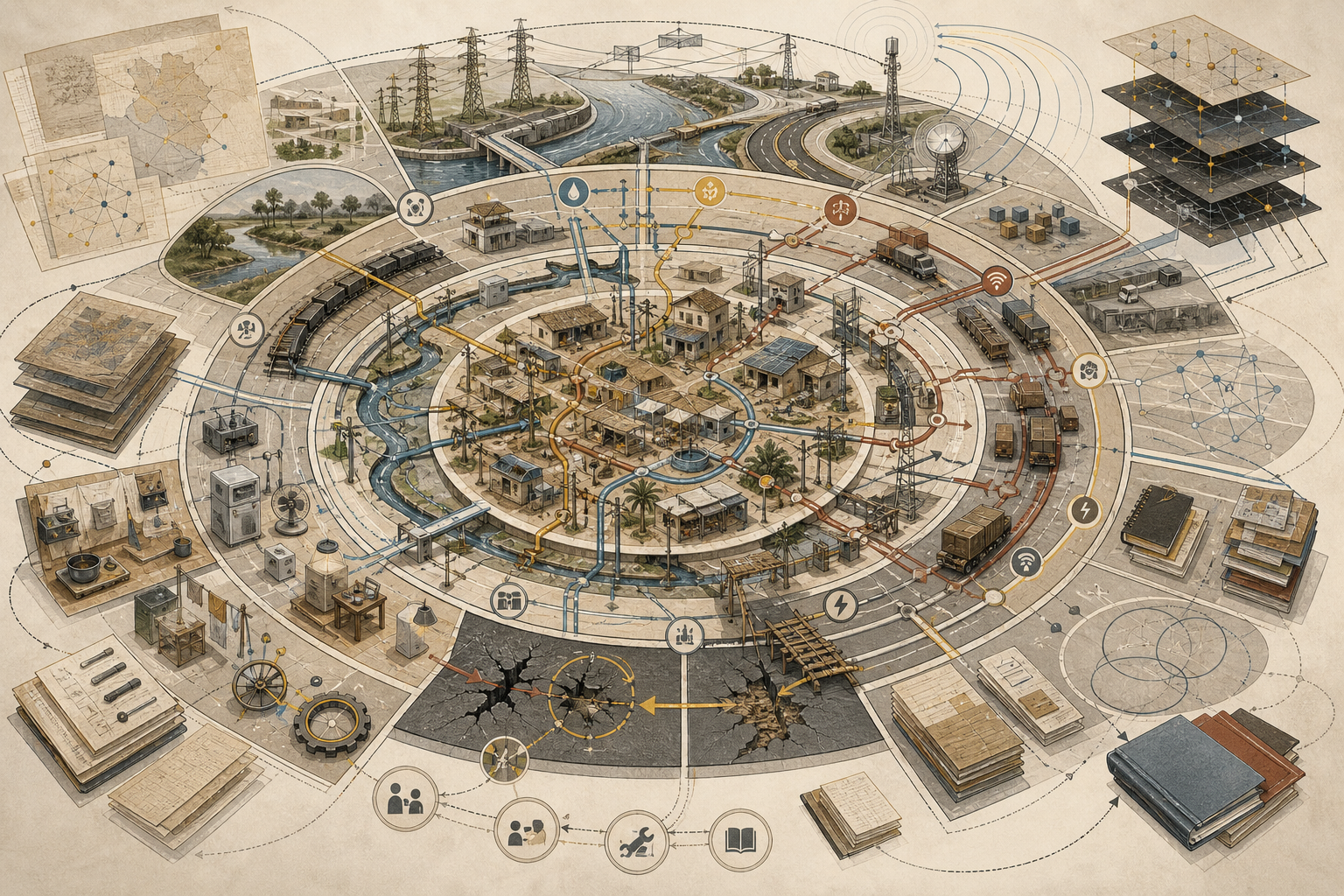
This series also approaches the anthropology of technology and infrastructure as a field that benefits from careful research infrastructure: infrastructure case files, maintenance logs, breakdown records, repair narratives, platform-use notes, access maps, household technology profiles, digital divide examples, logistics case notes, protocol inventories, source catalogs, interview guides, fieldnote templates, ethical review notes, qualitative codebooks, and reproducible research documentation. Cultural anthropology cannot reduce technology to devices, design specifications, adoption metrics, or engineering diagrams alone. Technology is lived through trust, frustration, dependency, improvisation, skill, exclusion, repair, waiting, habit, institutional encounter, and unequal access. Yet research repositories can strengthen this work by making sources, interpretive decisions, fieldnote structures, methodological assumptions, and ethical concerns more transparent.
For that reason, this pillar integrates cultural anthropology with open research workflows where appropriate. Python may support synthetic infrastructure inventories, repair-event metadata, platform-access examples, digital-service catalogs, logistics records, breakdown examples, and research utilities. R may support qualitative-code summaries, repair and maintenance tables, access-pattern summaries, platform-use comparisons, and reproducible research reports. SQL may support structured catalogs for sources, infrastructures, systems, users, maintenance events, breakdowns, workarounds, repair actions, access constraints, platform encounters, interview excerpts, and interpretive memos. Markdown and notebooks may support research logs, literature reviews, concept maps, reflexive memos, methods documentation, and article-level research packages. These tools do not replace anthropological interpretation. They help make sociotechnical research more organized, auditable, and reusable while preserving context, ethics, reflexivity, and the central anthropological responsibility of interpretation.
Technology, infrastructure, and everyday systems therefore appear here not only as contemporary anthropological concerns, but also as a research architecture for studying how technical systems become ordinary social worlds. The aim of the series is to preserve the interpretive and critical richness of infrastructure anthropology while building a more transparent scholarly workflow around concepts, cases, systems, access, maintenance, repair, breakdown, and everyday technical life. In that sense, this pillar treats technology not simply as innovation, but as a lived system of dependence, coordination, possibility, vulnerability, and repair.
Technology, Infrastructure, and Everyday Systems Research Repository
The Technology, Infrastructure, and Everyday Systems knowledge series is supported by an open research repository with article-level folders, annotated bibliographies, research notes, infrastructure-case templates, maintenance and repair logs, breakdown records, platform-access examples, ethical fieldwork guidance, qualitative codebooks, synthetic teaching datasets, source metadata, SQL research schemas, Python and R workflow examples, notebooks, and reproducible research scaffolding where appropriate.
View the Technology, Infrastructure, and Everyday Systems Research Repository
Technology, Infrastructure, and Everyday Systems as a Foundational Anthropological Field
Technology, infrastructure, and everyday systems occupy a central place in cultural anthropology because contemporary life is increasingly mediated by technical environments that structure perception, mobility, care, work, communication, exchange, authority, and opportunity. People do not merely use infrastructures from the outside. They rely on them, improvise around them, endure their failures, repair their breakdowns, and build social worlds through them. To study technology in this sense is to study how social life is patterned by systems that are often backgrounded precisely because they are so essential.
Anthropology has increasingly treated technology as something more than a collection of devices, innovations, or engineering achievements. In a stronger analytical sense, technological life refers to the patterned ways people encounter tools, platforms, systems, infrastructures, protocols, and built environments that mediate communication, labor, coordination, movement, exchange, service access, governance, and survival. Technologies do not arrive in empty space. They enter households, workplaces, neighborhoods, roads, schools, clinics, markets, platforms, data environments, and institutional settings already structured by inequality, social expectation, moral interpretation, and practical dependence.
This perspective matters because infrastructures often recede into the background when they function smoothly, becoming visible only in moments of interruption, exclusion, or failure. Roads, power lines, ports, telecom systems, water networks, fiber-optic cables, logistics hubs, software protocols, standards, databases, forms, and maintenance regimes make possible the circulation of people, commodities, information, energy, waste, and authority. Yet they also sort access, expose vulnerability, distribute waiting, and shape unequal life chances. Anthropological attention to infrastructure therefore reveals how technical systems become ordinary conditions of social life rather than exceptional achievements of engineering.
A serious anthropology of technical systems therefore asks not only how technologies are designed, but how they are inhabited, maintained, domesticated, repaired, mistrusted, repurposed, resisted, and made meaningful in ordinary life. It asks how infrastructures organize mobility and exclusion, how platforms shape labor and visibility, how data systems classify people, how repair work sustains daily order, how breakdown exposes hidden dependencies, and how technical systems become cultural and political systems.
Infrastructure as Lived Order
Infrastructure may be understood as lived order. It organizes how people move, communicate, wait, work, access services, pay bills, receive care, store water, charge devices, commute, participate in markets, and imagine proximity or distance. Roads do not merely connect locations; they reorder trade, time, migration, policing, extraction, aspiration, and risk. Power grids do not merely deliver electricity; they shape domestic routine, industrial possibility, education, communication, and vulnerability to breakdown. Digital systems do not simply transmit information; they condition visibility, recognition, exclusion, ranking, participation, and dependence.
This lived character of infrastructure becomes visible when official design and everyday use diverge. A road may be planned for transport but used for trade, protest, policing, migration, or extraction. A water network may be designed as a utility but lived as a daily negotiation among pressure, storage, repair, citizenship, and unequal access. A platform may present itself as convenience while functioning as labor discipline, reputational infrastructure, payment system, or gatekeeping mechanism. A database may be built for efficiency while becoming a site where people must prove identity, eligibility, compliance, or worthiness.
Infrastructure as lived order also explains why technical systems are political even when they appear neutral. Decisions about what gets built, maintained, connected, digitized, subsidized, monitored, automated, or repaired shape whose lives are supported and whose are rendered precarious. Uneven access to infrastructure is not just an engineering issue. It is a distribution of recognition, risk, waiting, mobility, and opportunity. Anthropology is therefore especially attentive to the fact that infrastructure is experienced differently across class, region, neighborhood, gender, age, race, caste, disability, citizenship status, and institutional position.
To study infrastructure anthropologically is therefore to study how technical systems enter ordinary life as conditions of possibility. Infrastructure is not merely beneath society. It is part of society’s practical architecture.
Technology and Infrastructure as Interpretive Research Practice
The anthropology of technology and infrastructure is an interpretive research practice because technical systems do not reveal themselves fully through design documents, system diagrams, engineering specifications, adoption metrics, or platform analytics. Those materials matter, but they do not tell the whole story. Anthropologists ask how systems are experienced, how people learn to use them, how infrastructures are maintained, how breakdown is narrated, how technical failure is managed, how access is distributed, and how users interpret systems that govern their daily lives.
This requires close attention to the difference between designed function and lived function. A platform may be designed for communication but used for kinship, migration, informal trade, political rumor, gig work, emotional care, or bureaucratic navigation. A database may be designed for administration but experienced as surveillance, exclusion, recognition, or vulnerability. A water system may be designed for distribution but lived through leaks, pressure schedules, storage practices, political claims, informal repair, and unequal citizenship. A logistics system may be designed for efficiency but experienced through warehouse labor, delivery pressure, supply interruptions, and hidden maintenance.
Interpretive infrastructure research also requires reflexivity. Researchers often work near powerful systems: states, utilities, platforms, telecom providers, transport agencies, logistics firms, software systems, urban planners, development institutions, and data infrastructures. Fieldwork may involve workers whose labor is invisible, users whose access is precarious, communities affected by infrastructure projects, or institutions whose systems may expose sensitive information. A research repository for this pillar can support careful work by organizing sources, infrastructure maps, repair records, fieldnote templates, breakdown logs, platform-use notes, ethical restrictions, and interpretive memos. But the central scholarly task remains contextual interpretation.
The goal is not to turn technical life into metadata detached from experience. It is to make the research process more careful: to distinguish system design from lived use, to document uncertainty, to protect vulnerable users and workers, to avoid exposing sensitive infrastructure information, and to interpret technical systems in relation to trust, inequality, maintenance, and everyday practice.
What This Pillar Studies
This pillar studies technology as social practice, infrastructure as lived order, and everyday systems as the background arrangements through which daily life becomes possible. It examines how people encounter roads, water systems, electricity grids, telecom networks, logistics chains, digital platforms, household devices, databases, smart systems, transport networks, maintenance regimes, and communication infrastructures. It asks how technologies enter routines, how infrastructures become visible in breakdown or exclusion, and how technical systems interact with existing values, norms, household practices, and informal orders.
At the level of everyday practice, the pillar examines device use, household routines, commuting, charging, water storage, repair, platform navigation, paperwork, digital access, payments, waiting, troubleshooting, informal workarounds, and the embodied skills of living with systems. At the level of infrastructure, it examines transportation, water, electricity, communication, logistics, data, standards, protocols, ports, pipelines, networks, and maintenance labor. At the level of power, it examines access, exclusion, surveillance, automation, platform governance, data visibility, technical dependency, infrastructural inequality, and the uneven distribution of breakdown.
The pillar also studies maintenance and repair. Technical systems are often celebrated at moments of innovation, rollout, disruption, or scale. But everyday life depends more persistently on the labor that keeps systems working after they are built: maintenance, patching, cleaning, monitoring, troubleshooting, workaround, replacement, diagnosis, and repair. Anthropology treats maintenance not as secondary to innovation, but as one of the central practices through which technical worlds endure.
Finally, this pillar studies technical life as ambivalent. Technologies can expand mobility, access, communication, care, safety, and opportunity. They can also deepen dependency, surveillance, exclusion, inequality, environmental burden, labor discipline, and institutional vulnerability. Anthropology therefore asks not whether technology is good or bad in the abstract, but how technical systems become meaningful and consequential in specific social worlds.
Major Intellectual Lineages
The anthropology of technology and infrastructure draws on several major intellectual traditions. One important lineage comes from science and technology studies and adjacent anthropological work that treats technologies not as autonomous drivers of change, but as sociotechnical formations embedded in institutions, material practices, standards, classifications, and cultural worlds. In this tradition, technical systems are understood as made, interpreted, stabilized, contested, and repaired through human practice rather than as self-explanatory objects.
A second lineage centers on the ethnography of infrastructure. This tradition emphasizes that infrastructures are relational, ecological, mundane, embedded, and often invisible until breakdown. It asks how standards, plugs, roads, forms, pipes, wires, databases, and protocols organize action while receding into the background. Infrastructure becomes an ethnographic object precisely because it is both ordinary and powerful: it appears boring until it fails, excludes, or reorganizes the conditions of everyday life.
A third lineage comes from the anthropology of infrastructure itself, which studies roads, railways, airports, ports, pipelines, fiber-optic cables, logistics centers, water systems, data systems, and built environments as systems of circulation and political possibility. This scholarship emphasizes that infrastructures connect and channel movement while also halting, differentiating, and reorganizing social life. It places special weight on how infrastructures shape affective experience, political belonging, aspiration, waiting, and uneven access.
A fourth lineage emerges from media anthropology, digital anthropology, and platform studies. This work examines how communication technologies, digital services, mobile devices, social media, platforms, data systems, and algorithmic infrastructures organize everyday attention, labor, identity, social connection, and public participation. It broadens infrastructure beyond roads and utilities alone to include cultural and communication systems that structure recognition, visibility, and interaction.
A fifth lineage centers on maintenance, breakdown, and repair. This tradition challenges innovation-centered accounts of technology by asking what happens after systems are built: who maintains them, who notices when they break, who bears inconvenience, who repairs them, who improvises around failure, and what kinds of labor remain hidden behind ordinary function. From this perspective, repair is not merely a technical act. It is a social practice of restoring, negotiating, and sometimes reimagining order.
Taken together, these lineages show that technology and infrastructure are not peripheral to anthropology. They are among the discipline’s central pathways for understanding how contemporary life is coordinated, interrupted, repaired, stratified, and made ordinary. Anthropology’s contribution lies in showing that technical systems are always social systems: they are built into ordinary life, depend on interpretation and maintenance, and organize everyday possibility in uneven ways.
Technology in Everyday Life
Anthropology approaches technology not only as innovation but as ordinary practice. Devices, platforms, networks, and tools become meaningful through use, interpretation, improvisation, habit, repair, refusal, and social embedding. A mobile phone may be a communication device, payment tool, labor interface, migration lifeline, kinship medium, surveillance risk, entertainment platform, archive, and bureaucratic access point at once. A platform may appear as convenience while also functioning as labor discipline, social ranking system, reputational infrastructure, or administrative gatekeeper.
This everyday perspective is crucial because it shows that technical adoption is never purely functional. People accept, refuse, mistrust, repurpose, domesticate, share, repair, or route around technologies through local values, practical constraints, generational differences, social expectation, prior institutional experiences, and existing systems of knowledge. Anthropology helps explain why the same technology can appear emancipatory in one setting, extractive in another, and mundane in a third.
Technologies also transform social relationships by changing what is easy, visible, expected, or possible. A messaging app may intensify kin obligations across distance. A delivery platform may reorganize labor time. A payment system may change household finance. A data system may redefine eligibility. A smart device may shift responsibility from institutions to users. A transit system may expand mobility while also producing new forms of surveillance or exclusion. Technologies become social not only when they are distributed, but when they are folded into the rhythms and moral worlds of daily life.
Maintenance, Breakdown, and Repair
One of anthropology’s most important contributions to the study of infrastructure is its attention to maintenance, breakdown, and repair. Technical systems are often imagined through moments of innovation and rollout, but everyday life depends more persistently on what keeps systems going after they are built. Maintenance labor, patching, workaround, improvisation, troubleshooting, cleaning, updating, monitoring, and informal repair are essential to how infrastructures endure. Infrastructure is therefore not a finished object but an ongoing accomplishment.
Breakdown is especially revealing because it makes infrastructures visible. When water stops flowing, signals fail, bridges crack, platforms freeze, deliveries stall, electricity collapses, roads flood, databases reject records, or payment systems lock users out, people confront the social and political conditions that were previously hidden in ordinary function. Anthropology treats these moments not simply as failures, but as ethnographic openings into how systems depend on institutions, maintenance regimes, unequal labor, standards, funding, expertise, and assumptions about whose inconvenience matters.
Repair, in turn, shows how communities and workers actively reconstitute order under conditions of fragility. Repair may be formal or informal, professional or improvised, visible or invisible, temporary or transformative. It may preserve existing systems, expose their inequalities, or create alternative ways of living with technical fragility. A serious anthropology of repair therefore asks not only how systems are fixed, but who is expected to fix them, who is blamed for failure, who receives service, who waits, and what kinds of worlds are maintained through repair.
Core Themes in the Anthropology of Technical Life
One major theme in this field is sociotechnical embedding. Anthropology studies how tools, platforms, systems, and infrastructures enter existing social worlds rather than replacing them from above. This includes attention to how technology interacts with kinship, work, governance, ritual, household practice, informal economies, professional culture, and moral expectation.
A second major theme is access and inequality. Technical systems distribute opportunity unevenly. Digital access, transport connectivity, platform inclusion, utility provision, data visibility, service eligibility, and repair availability all affect who participates, who is recognized, who waits, who is excluded, and who remains marginalized. Infrastructure is therefore not simply a public good or technical network. It is a system of differentiated access.
A third theme is infrastructure and circulation. Infrastructures organize the movement of humans, commodities, information, money, energy, waste, and authority. Anthropology asks how such circulation is enabled, slowed, sorted, blocked, or redirected, and how mobility infrastructures reshape geography, labor, aspiration, policing, extraction, and dependency.
A fourth theme is maintenance and repair. Technical systems persist through care, adjustment, cleaning, labor, monitoring, diagnosis, and institutional support. Anthropology studies how systems endure through visible and invisible work rather than through design alone.
A fifth theme is visibility and backgrounding. Many infrastructures disappear into ordinary life until they fail. Anthropology is attentive to this oscillation between invisibility and sudden salience because it reveals how dependence, vulnerability, and institutional design are distributed across everyday life.
A sixth theme is technical power. Platforms, networks, protocols, standards, and infrastructures shape behavior not only through direct command but through design, access control, categorization, default settings, interoperability, maintenance priorities, and built assumptions about efficiency, order, and user conduct. Anthropology therefore studies how power is exercised through everyday systems that may appear merely technical.
Technology, Infrastructure, and Everyday Systems Pillar Map
The map below organizes the Technology, Infrastructure, and Everyday Systems series into conceptual domains, moving from anthropology of technology and infrastructure into roads, water, electricity, communication, platforms, data systems, logistics, maintenance, repair, breakdown, access, inequality, smart systems, households, ecology, and research practice.
This pillar is organized to move from foundations and first principles into sociotechnical systems, infrastructure studies, roads, mobility, water, electricity, communication networks, digital platforms, data infrastructures, logistics, supply chains, maintenance, repair, breakdown, workarounds, access inequality, digital divides, built environments, household technologies, smart systems, automated coordination, ecological infrastructures, technical power, and everyday order. Research infrastructure is integrated where it strengthens scholarly practice, especially through annotated bibliographies, infrastructure-case templates, system inventories, repair logs, breakdown records, access maps, qualitative codebooks, fieldnote templates, synthetic teaching datasets, Python utilities, R summaries, SQL research catalogs, and reproducible notebooks. The goal is a pillar that remains fully anthropological while making its research practices more transparent, organized, systems-aware, and ethically responsible.
Foundations of Technology and Infrastructure Anthropology
- What Is Technology in Anthropological Thought? (planned) — A foundational article defining technology as social practice, material culture, institutional system, and lived form of mediation rather than neutral tool or autonomous force.
- Infrastructure and the Organization of Everyday Life (planned) — A major article on infrastructure as lived order, background dependency, circulation, access, and social possibility.
- Technology as Social Practice (planned) — An article on how technologies become meaningful through use, habit, trust, refusal, improvisation, domestic routine, and moral interpretation.
- Sociotechnical Systems and the Anthropology of Design (planned) — An article on sociotechnical embedding, system design, user worlds, institutional assumptions, and unintended consequences.
- The Ethnography of Infrastructure (planned) — A Star-oriented article on infrastructure as relational, embedded, mundane, ecological, and visible through breakdown.
- Emic and Etic Categories in Technology Research (planned) — A methodological article on distinguishing user categories, design categories, institutional categories, and researcher categories.
Mobility, Transport, and Infrastructural Order
- Roads, Mobility, and Infrastructural Order (planned) — A major article on roads as systems of movement, trade, policing, extraction, aspiration, access, and territorial transformation.
- Transport Networks and the Unequal Geography of Mobility (planned) — An article on buses, railways, ports, airports, informal transport, commuting, and unequal access to movement.
- Waiting, Delay, and the Temporal Life of Infrastructure (planned) — An article on queues, transit delays, project delays, maintenance schedules, bureaucratic waiting, and infrastructural time.
- Corridors, Ports, and the Logistics of Global Connection (planned) — An article on transport corridors, ports, warehouses, logistics hubs, containers, supply chains, and global circulation.
- Mobility, Disability, and Infrastructure Access (planned) — An article on how built environments and transport systems enable or restrict movement for disabled, elderly, and mobility-constrained users.
- Infrastructure, Policing, and the Control of Movement (planned) — A critical article on checkpoints, roads, transit systems, borders, surveillance, and the regulation of mobility.
Water, Electricity, Utilities, and Everyday Dependence
- Water Systems, Access, and Everyday Dependence (planned) — A major article on water networks, pressure, storage, citizenship, access, repair, scarcity, and everyday dependence.
- Electricity, Power, and the Rhythms of Daily Life (planned) — An article on grids, outages, charging, domestic routine, work, education, communication, and energy vulnerability.
- Sanitation, Waste, and the Hidden Labor of Urban Systems (planned) — An article on sanitation, waste collection, drainage, sewage, repair, environmental health, and invisible infrastructure labor.
- Utility Failure, Household Strategy, and Infrastructure Inequality (planned) — An article on how households adapt to water shortages, outages, billing problems, service interruptions, and unreliable systems.
- Metering, Billing, and the Administrative Life of Utilities (planned) — An article on meters, bills, records, debt, disconnection, customer service, and the bureaucratic interface of infrastructure.
- Energy Transitions and the Social Life of Technical Change (planned) — An article on renewable energy, grid modernization, household adoption, energy justice, and the cultural mediation of transition.
Communication, Media, Platforms, and Digital Systems
- Communication Infrastructure and Social Connection (planned) — A major article on phones, internet, telecom networks, messaging, kinship, migration, work, and everyday communication.
- Platforms, Protocols, and Digital Everyday Systems (planned) — An article on platforms as infrastructures of labor, identity, payment, ranking, visibility, and participation.
- Data Infrastructures and the Politics of Visibility (planned) — A critical article on databases, records, eligibility, identity, datafication, visibility, exclusion, and administrative recognition.
- The Digital Divide and Uneven Access to Systems (planned) — An article on connectivity, devices, literacy, affordability, disability, language, geography, and institutional access.
- Digital Services, Bureaucratic Access, and Everyday Administration (planned) — An article on online forms, portals, authentication, digital ID, service delivery, and the work users perform to access institutions.
- Media, Attention, and the Infrastructure of Public Life (planned) — An article on communication systems, media platforms, public attention, social participation, and information circulation.
Logistics, Supply Chains, and Circulation
- Logistics, Supply Chains, and Infrastructures of Circulation (planned) — A major article on warehouses, ports, containers, delivery networks, inventory systems, global trade, and hidden labor.
- Warehouses, Delivery Platforms, and the Labor of Circulation (planned) — An article on fulfillment centers, delivery work, algorithmic routing, time pressure, worker surveillance, and platform logistics.
- Food Supply Chains and Everyday Dependence (planned) — An article on distribution, refrigeration, trucking, markets, food access, shortage, waste, and household vulnerability.
- Medical Supply Chains and Infrastructure Fragility (planned) — An article on medicines, equipment, cold chains, clinics, procurement, crisis vulnerability, and public health infrastructure.
- Standards, Barcodes, Containers, and the Technical Order of Trade (planned) — An article on standardization, interoperability, labeling, containerization, and the hidden technical systems of circulation.
- Supply Chain Breakdown and the Visibility of Global Dependence (planned) — An article on shortages, delays, crisis logistics, dependency, repair, rerouting, and the lived effects of global system failure.
Maintenance, Repair, Breakdown, and Workarounds
- Maintenance, Repair, and the Labor of Keeping Systems Alive (planned) — A major article on maintenance labor, repair work, upkeep, troubleshooting, and the social importance of keeping systems functioning.
- Breakdown, Failure, and the Social Visibility of Infrastructure (planned) — An article on how outages, leaks, crashes, delays, and service failures reveal hidden dependencies and inequalities.
- Informal Workarounds and Everyday Technical Adaptation (planned) — An article on improvisation, patching, sharing, informal repair, parallel systems, and practical adaptation to unreliable infrastructure.
- Repair Cultures, Right to Repair, and Technical Autonomy (planned) — An article on repair knowledge, device repair, maintenance rights, planned obsolescence, and community technical autonomy.
- Invisible Labor and the Maintenance of Technical Worlds (planned) — An article on cleaners, technicians, clerks, repair workers, drivers, moderators, operators, and others whose labor keeps systems alive.
- Broken World Thinking and the Anthropology of Fragility (planned) — A Jackson-oriented article on breakdown, repair, care, maintenance, and the fragility of human and technical worlds.
Households, Devices, and Domesticated Technologies
- Households, Devices, and the Domestication of Technology (planned) — A major article on how domestic technologies enter routines of care, communication, work, entertainment, safety, and household coordination.
- Mobile Phones, Kinship, and Everyday Communication (planned) — An article on phones as kinship infrastructure, migration lifeline, payment tool, work interface, archive, and emotional presence.
- Household Automation, Smart Devices, and Domestic Responsibility (planned) — An article on smart devices, domestic labor, monitoring, privacy, energy use, convenience, and shifting responsibility.
- Payment Systems, Mobile Money, and Everyday Exchange (planned) — An article on digital payments, remittances, informal exchange, trust, fees, exclusion, and household finance.
- Technology, Aging, and Care Infrastructure (planned) — An article on medical devices, communication tools, monitoring systems, elder care, disability, and the technical mediation of care.
- Repair, Sharing, and Household Technical Economies (planned) — An article on device sharing, secondhand systems, repair, charging, informal markets, and household adaptation under constraint.
Smart Systems, Automation, and Technical Governance
- Smart Systems, Governance, and Automated Coordination (planned) — A major article on smart cities, sensors, automated systems, digital governance, monitoring, and the cultural life of technical coordination.
- Algorithms, Platforms, and Everyday Rule-Making (planned) — An article on algorithmic sorting, ranking, recommendation, eligibility, moderation, and the everyday governance of users.
- Surveillance, Sensors, and the Politics of Technical Visibility (planned) — A critical article on sensors, monitoring, data collection, safety claims, privacy, and unequal exposure to surveillance.
- Digital Identity, Authentication, and Institutional Access (planned) — An article on logins, IDs, biometrics, credentials, verification, exclusion, and the technical production of recognition.
- Interoperability, Standards, and the Hidden Politics of Compatibility (planned) — An article on protocols, standards, APIs, forms, records, devices, and the politics of systems working together.
- AI Systems, Infrastructure, and Everyday Dependence (planned) — An article on AI as infrastructure, automated decision support, invisible dependency, monitoring, accountability, and system failure.
Built Environments, Ecology, and Infrastructural Futures
- Built Environments, Ecological Systems, and Technical Order (planned) — A major article on how infrastructure interacts with land, water, energy, weather, waste, and ecological systems.
- Infrastructure, Climate Risk, and Everyday Adaptation (planned) — An article on heat, flooding, storms, grid stress, drainage, roads, housing, and unequal infrastructural vulnerability.
- Green Infrastructure and the Cultural Life of Urban Adaptation (planned) — An article on trees, wetlands, drainage, parks, cooling, restoration, public space, and environmental justice.
- Infrastructure Ruins, Abandonment, and the Temporality of Technical Systems (planned) — An article on unfinished, decaying, suspended, or abandoned infrastructures and the futures they promise or betray.
- Infrastructure, Extraction, and Environmental Burden (planned) — An article on energy systems, mining, logistics, pipelines, waste, land transformation, and uneven ecological costs.
- Technology, Infrastructure, and the Social Production of Everyday Order (planned) — A capstone article on how technical systems organize ordinary life through access, maintenance, repair, circulation, recognition, and power.
Research Methods, Ethics, and Technical Systems Repositories
- Fieldnotes, System Maps, and the Documentation of Technical Life (planned) — A methodological article on documenting infrastructures, platforms, devices, routines, breakdowns, repair, and everyday technical dependence.
- Interviewing About Technology, Access, Breakdown, and Repair (planned) — A research-practice article on ethical interviews about system dependence, exclusion, maintenance, workarounds, and technical vulnerability.
- Infrastructure Maps, Access Records, and Ethical Representation (planned) — An article on documenting systems without exposing sensitive infrastructure, workers, users, or vulnerable communities.
- Codebooks for Technology, Infrastructure, and Everyday Systems (planned) — A practical article on qualitative coding for access, breakdown, repair, maintenance, platform use, data visibility, logistics, and technical power.
- Technical Systems Data, Confidentiality, and Anthropological Ethics (planned) — A critical article on why infrastructure and platform research can expose workers, users, communities, security vulnerabilities, and institutional risks.
- Digital Research Repositories for Infrastructure Anthropology (planned) — A practical article on organizing sources, notes, synthetic examples, repair logs, system inventories, ethics notes, and reproducible workflows without reducing infrastructure to data.
Python Workflow: Infrastructure Inventory, Breakdown, and Repair Metadata
A useful Python workflow for this pillar is a synthetic infrastructure inventory, breakdown, and repair-metadata workflow. The workflow can begin with a small synthetic teaching dataset containing infrastructure identifiers, system types, access conditions, maintenance status, breakdown events, repair actions, affected users, workaround descriptions, institutional actors, and ethical sensitivity flags. Python can be used to validate records, summarize system types, identify breakdown categories, track repair events, flag sensitive infrastructure records, and export structured tables for research review. In a more advanced version, the workflow can incorporate platform-access notes, service-interruption records, logistics events, user interviews, maintenance observations, and links between breakdown narratives and interpretive memos.
This workflow belongs naturally with articles on infrastructure, water systems, electricity, digital services, maintenance, repair, breakdown, workarounds, logistics, platform access, and technical systems ethics. It demonstrates how research infrastructure can support interpretation without replacing it. The purpose is not to automate the study of infrastructure or expose real system vulnerabilities. The purpose is to show how synthetic examples and transparent documentation can help researchers think carefully about access, maintenance, repair, breakdown, and everyday technical dependence while foregrounding consent, confidentiality, security, and context.
R Workflow: Access, Maintenance, and Everyday System Code Summaries
A useful R workflow for this pillar is an access, maintenance, and everyday-system code-summary workflow. The workflow can begin with a synthetic coding table containing excerpt identifiers, system types, access categories, maintenance practices, breakdown types, repair actions, workaround themes, user impacts, and researcher memos. R can be used to summarize code frequencies, compare breakdown types across systems, visualize maintenance and repair patterns, and create reproducible tables for article drafting. In a more advanced version, the workflow can incorporate qualitative coding for platform exclusion, digital access, water interruption, electricity outage, logistics delay, technical dependency, and everyday workaround practices.
This workflow belongs naturally with articles on infrastructure, digital systems, access inequality, repair, breakdown, logistics, and household technologies. It demonstrates that computational summaries can support infrastructure anthropology only when they remain subordinate to ethnographic interpretation. A table showing that “breakdown,” “workaround,” and “access constraint” co-occur in a synthetic corpus does not explain technical life by itself. It simply identifies a pattern that requires close reading, participant context, institutional history, technical context, and ethical care.
Fieldwork Ethics and the Sensitivity of Technical Systems Research
Technical systems research requires particular ethical care because information about infrastructure, platforms, access, breakdown, repair, logistics, utilities, security, data systems, or institutional workflows can place people and systems at risk. A fieldnote about a platform loophole, undocumented workaround, infrastructure vulnerability, maintenance failure, worker practice, data process, utility access route, informal repair network, or security weakness can expose users, workers, communities, institutions, or systems to harm.
For that reason, research infrastructure for this pillar must treat technical systems data as sensitive by default. Real fieldnotes, interviews, system maps, access records, platform logs, outage records, repair documentation, or infrastructure diagrams should not be stored in public repositories unless there is explicit permission, careful anonymization, and a clear ethical basis. Synthetic teaching datasets are preferable for public code examples. System maps should be generalized. Fieldnotes should separate public observations from confidential information. Technical vulnerabilities should not be published in ways that enable exploitation.
Ethical technical-systems research also requires attention to power. Researchers may work near utilities, platforms, employers, logistics firms, public agencies, infrastructure operators, software systems, and communities whose access is precarious. Workers may face retaliation for discussing repair, maintenance, breakdown, safety, or informal practices. Users may depend on systems that classify, rank, exclude, or surveil them. The researcher’s responsibility is not merely to describe technical systems, but to avoid increasing vulnerability. A repository can support this responsibility by including consent notes, restricted-data warnings, anonymization guidance, synthetic-data practices, and clear distinctions between public examples and real research material.
Technology, Infrastructure, and Power
Technical systems often exercise power by shaping what is possible before people make explicit choices. A road may make one place accessible and another remote. A database may recognize one person and reject another. A platform may make one worker visible and another invisible. A payment system may enable participation for some while excluding those without documents, connectivity, accounts, literacy, or trust. A utility may distribute not only water or electricity, but also time, waiting, vulnerability, and institutional recognition.
This power is often hidden because technical systems present themselves as neutral. A form appears procedural. A protocol appears technical. A routing system appears efficient. A platform rule appears automated. A utility bill appears administrative. Yet each of these systems embeds assumptions about users, institutions, language, mobility, identity, address, documentation, risk, payment, time, and compliance. Anthropology reveals that technical neutrality often conceals cultural and political design.
At the same time, people reinterpret and reroute technical systems. They share devices, repair tools, bypass broken services, build informal networks, create parallel systems, use platforms against their intended purpose, and develop expertise from below. Technical power is therefore not absolute. It is lived, negotiated, resisted, hacked, repaired, and sometimes remade through everyday practice.
Infrastructure and Modern Institutions
Modern institutions depend on infrastructure, but infrastructure does not operate only through technical design. Schools depend on roads, electricity, water, databases, schedules, documents, and communication systems. Clinics depend on supply chains, cold storage, records, transport, devices, and trust. Courts depend on documents, buildings, filing systems, procedures, and digital access. Welfare systems depend on databases, eligibility categories, online forms, call centers, payment systems, and authentication. Platforms depend on users, moderators, code, standards, logistics, data centers, and maintenance.
This matters because institutional access is increasingly infrastructural. People may have rights on paper but lack access to the systems required to claim them. They may need a phone, address, login, ID number, electricity, connectivity, literacy, language proficiency, transport, or time to navigate institutions. Infrastructure therefore mediates citizenship, care, education, work, welfare, finance, health, and participation.
Infrastructure also shapes institutional trust. A system that repeatedly fails, excludes, delays, misclassifies, or demands excessive user labor can erode legitimacy. A system that is reliable, repairable, accessible, and accountable can support public trust. To understand modern institutions anthropologically is therefore also to understand the infrastructures through which institutions are encountered.
Technology, Infrastructure, and Everyday Systems in a Wider Intellectual Context
Technology, infrastructure, and everyday systems occupy a distinctive place in human knowledge because they explain how social life becomes technically mediated. They show that communities are not organized only by kinship, symbols, institutions, environments, or markets. They are also organized by roads, pipes, wires, devices, platforms, databases, forms, standards, schedules, maintenance regimes, logistics systems, and the everyday labor required to keep technical worlds functioning.
This wider intellectual significance makes infrastructure anthropology indispensable for understanding contemporary life. Development, sustainability, public health, education, logistics, digital governance, climate adaptation, energy transition, urban planning, platform labor, and AI systems all depend on infrastructures. Yet infrastructure is not self-executing. It requires maintenance, repair, interpretation, access, trust, funding, labor, and everyday use.
A serious Technology, Infrastructure, and Everyday Systems pillar therefore belongs within a larger architecture of cultural anthropology, infrastructure studies, science and technology studies, media studies, digital anthropology, urban studies, development studies, environmental anthropology, governance, ethics, and systems intelligence. It gives readers a way to understand technology not as a separate domain of innovation, but as the everyday architecture through which social life is coordinated, interrupted, repaired, and made possible.
Related Reading
- Cultural Anthropology
- Power, Norms, and Institutions
- Development, Modernity, and Global Change
- Environment, Place, and Ecological Knowledge
- Technology & Systems Intelligence
- Intelligent Infrastructure Systems
Further Reading
- Anand, N. (2017). Hydraulic City: Water and the Infrastructures of Citizenship in Mumbai. Durham: Duke University Press. https://www.dukeupress.edu/hydraulic-city
- Appel, H., Anand, N., and Gupta, A. (eds.) (2018). The Promise of Infrastructure. Durham: Duke University Press. https://sarpress.org/the-promise-of-infrastructure/
- Graham, S. and Marvin, S. (2001). Splintering Urbanism: Networked Infrastructures, Technological Mobilities and the Urban Condition. London: Routledge. https://www.routledge.com/Splintering-Urbanism-Networked-Infrastructures-Technological-Mobilities-and-the-Urban-Condition/Graham-Marvin/p/book/9780415189651
- Jackson, S. J. (2014). “Rethinking Repair.” In T. Gillespie, P. J. Boczkowski, and K. A. Foot (eds.), Media Technologies: Essays on Communication, Materiality, and Society. Cambridge, MA: MIT Press. https://direct.mit.edu/books/edited-volume/3021/chapter/82557/Rethinking-Repair
- Knox, H. and Gambino, E. (2023). Infrastructure. Open Encyclopedia of Anthropology. https://www.anthroencyclopedia.com/entry/infrastructure
- Larkin, B. (2013). “The Politics and Poetics of Infrastructure.” Annual Review of Anthropology, 42, pp. 327–343. https://www.annualreviews.org/content/journals/10.1146/annurev-anthro-092412-155522
- Star, S. L. (1999). “The Ethnography of Infrastructure.” American Behavioral Scientist, 43(3), pp. 377–391. https://journals.sagepub.com/doi/10.1177/00027649921955326
- Suchman, L. (2007). Human-Machine Reconfigurations: Plans and Situated Actions. 2nd edn. Cambridge: Cambridge University Press.
References
- Anand, N. (2017). Hydraulic City: Water and the Infrastructures of Citizenship in Mumbai. Durham: Duke University Press. https://www.dukeupress.edu/hydraulic-city
- Appel, H., Anand, N., and Gupta, A. (eds.) (2018). The Promise of Infrastructure. Durham: Duke University Press. https://sarpress.org/the-promise-of-infrastructure/
- Bowker, G. C. and Star, S. L. (1999). Sorting Things Out: Classification and Its Consequences. Cambridge, MA: MIT Press.
- Brown, N. (2019). Media. In Perspectives: An Open Introduction to Cultural Anthropology. American Anthropological Association. https://perspectives.americananthro.org/second-edition/Chapters/Media.pdf
- Cowen, D. (2014). The Deadly Life of Logistics: Mapping Violence in Global Trade. Minneapolis: University of Minnesota Press.
- Edwards, P. N. (2003). “Infrastructure and Modernity: Force, Time, and Social Organization in the History of Sociotechnical Systems.” In T. J. Misa, P. Brey, and A. Feenberg (eds.), Modernity and Technology. Cambridge, MA: MIT Press.
- Graham, S. and Marvin, S. (2001). Splintering Urbanism: Networked Infrastructures, Technological Mobilities and the Urban Condition. London: Routledge. https://www.routledge.com/Splintering-Urbanism-Networked-Infrastructures-Technological-Mobilities-and-the-Urban-Condition/Graham-Marvin/p/book/9780415189651
- Harvey, P. and Knox, H. (2015). Roads: An Anthropology of Infrastructure and Expertise. Ithaca: Cornell University Press.
- Jackson, S. J. (2014). “Rethinking Repair.” In T. Gillespie, P. J. Boczkowski, and K. A. Foot (eds.), Media Technologies: Essays on Communication, Materiality, and Society. Cambridge, MA: MIT Press. https://direct.mit.edu/books/edited-volume/3021/chapter/82557/Rethinking-Repair
- Knox, H. and Gambino, E. (2023). Infrastructure. Open Encyclopedia of Anthropology. https://www.anthroencyclopedia.com/entry/infrastructure
- Larkin, B. (2013). “The Politics and Poetics of Infrastructure.” Annual Review of Anthropology, 42, pp. 327–343. https://www.annualreviews.org/content/journals/10.1146/annurev-anthro-092412-155522
- Miller, D. and Horst, H. A. (eds.) (2012). Digital Anthropology. London: Berg.
- Star, S. L. (1999). “The Ethnography of Infrastructure.” American Behavioral Scientist, 43(3), pp. 377–391. https://journals.sagepub.com/doi/10.1177/00027649921955326
- Suchman, L. (2007). Human-Machine Reconfigurations: Plans and Situated Actions. 2nd edn. Cambridge: Cambridge University Press.