
Last Updated August 4, 2026
Work matters for development because livelihoods are one of the main ways people secure income, dignity, social participation, agency, and protection against vulnerability over the course of their lives. Employment is not only a macroeconomic output. It is one of the principal institutions through which people convert ability into survival, effort into security, and social participation into a meaningful place in the world. To speak of work seriously in development terms is therefore to ask not only whether jobs exist, but whether people can secure livelihoods under conditions of fairness, safety, dignity, and reasonable stability.
Work is also one of the places where development becomes morally testable. A society may grow, industrialize, digitize, urbanize, and raise output while still leaving large numbers of people trapped in unsafe work, informal work, unstable contracts, unpaid care burdens, discrimination, wage theft, platform precarity, or livelihoods too fragile to support a dignified life. The developmental question is therefore not employment alone, but the quality, protection, recognition, and sustainability of the livelihood systems through which people live.
Main Library
Publications
Article Map
Sustainable Development
Related Topic
Economic Systems
Related Topic
Risk & Resilience
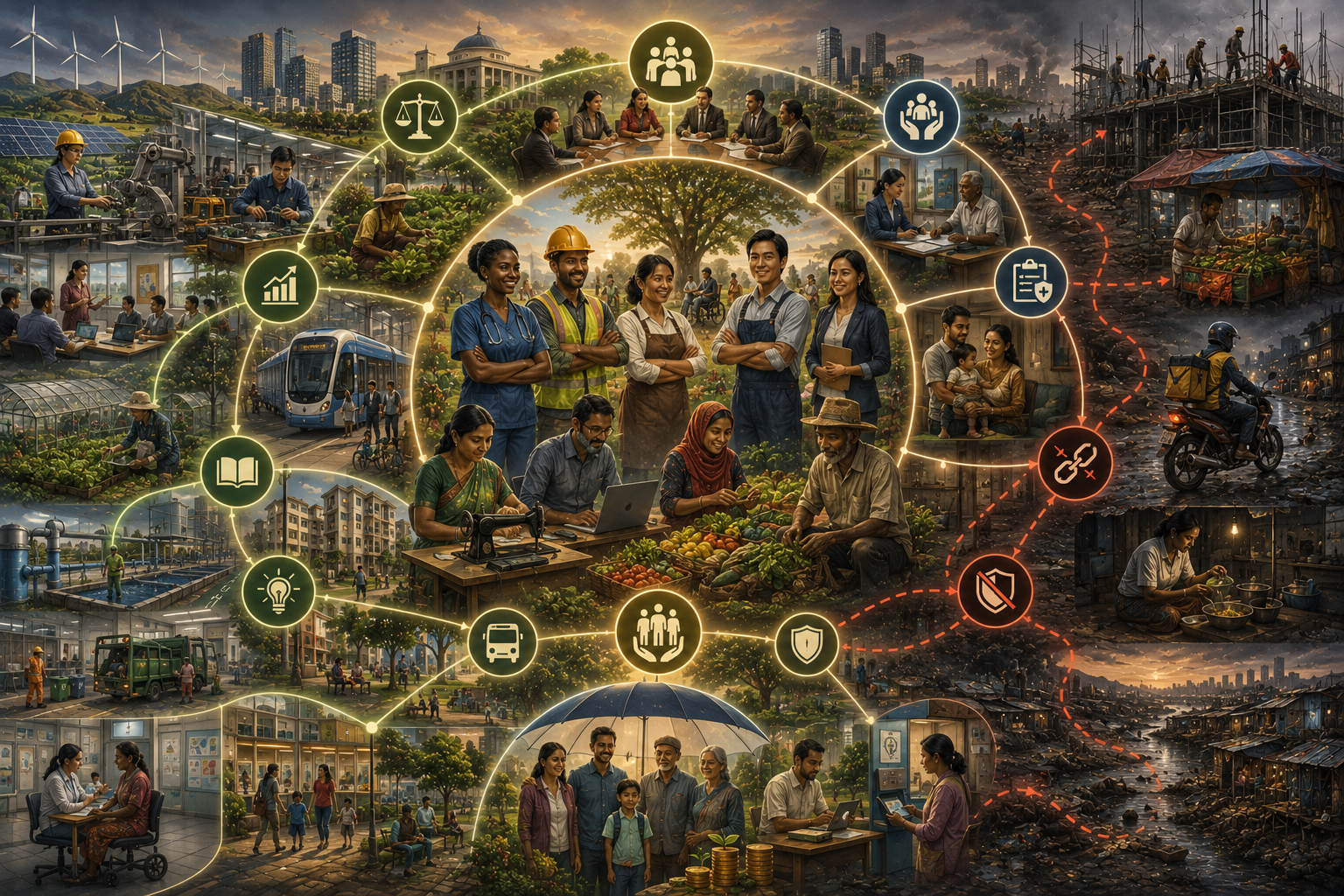
The 2030 Agenda places this issue at the center of sustainable development. Goal 8 commits the international community to promote sustained, inclusive and sustainable economic growth, full and productive employment, and decent work for all. The Agenda also states that the world should create conditions for shared prosperity and decent work for all. This is significant because work is not treated as a side effect of development. It is treated as one of the processes through which development becomes materially real in people’s lives.
UN and ILO frameworks reinforce this broader view by treating decent work not as a moral afterthought to growth, but as part of the institutional architecture of sustainable development. The ILO’s decent-work framing centers employment creation, rights at work, social protection, and social dialogue. This matters because it moves the concept of work beyond mere labor absorption. It frames employment as a developmental condition tied to security, rights, productivity, inclusion, and the social institutions that protect people from being treated as disposable inputs.
The Global Labour-Market Context in 2026
The headline global unemployment rate can create a misleading impression of stability. The International Labour Organization projects unemployment at 4.9 per cent in 2026, but estimates a much larger global jobs gap of roughly 408 million people who want paid work but cannot access it. Nearly 300 million workers remain in extreme working poverty, while about 2.1 billion workers are in informal employment, often without reliable rights, income security, or social protection (ILO, 2026a). These figures show why development analysis must look beyond unemployment alone.
The global picture is therefore one of stable averages and persistent structural deficits. Employment can expand while job quality stagnates. Labour markets can absorb people while leaving them underemployed, informally employed, involuntarily self-employed, or trapped in work that does not provide a viable income. Aggregate resilience can coexist with deep insecurity at household level.
Inequality also remains embedded in access to work. Women account for only about two-fifths of global employment and are substantially less likely than men to participate in the labour force. Youth unemployment remains far above the adult rate, and roughly 260 million young people are not in employment, education, or training (ILO, 2026a). These are not temporary mismatches alone. They reflect care constraints, discrimination, weak school-to-work transitions, insufficient labour demand, spatial inequality, conflict, disability exclusion, and the uneven geography of productive investment.
The current context also demonstrates why a “job” cannot be the endpoint of analysis. The real test is whether labour systems generate work that is productive, adequately rewarded, safe, rights-protecting, socially insured, and compatible with agency. A labour market may look statistically calm while households experience volatile hours, unaffordable housing, rising debt, heat exposure, digital surveillance, or the persistent fear of losing access to work.
What Work Means in Human Development
Work is often reduced to employment in the narrow sense of wage labor. But developmentally, work is broader. It includes the activities through which people sustain themselves and others, secure income, contribute to households and communities, care for dependents, produce goods, provide services, maintain social life, and participate in the wider economy. This is one reason livelihood language matters. It reminds us that human survival and security depend not only on formal jobs, but on wider systems of earning, producing, caring, sharing, adapting, and coping.
The human-development perspective helps clarify why work matters so deeply. Development is about expanding people’s choices and opportunities, not merely enlarging output. Work shapes whether people can secure those opportunities in practice. It affects income, but also self-respect, social membership, routine, future planning, mobility, household stability, and resilience against shock. To be excluded from decent work is often to be excluded from one of the main channels through which human capability becomes materially sustainable.
Work also mediates the relationship between the economy and everyday life. Macroeconomic growth may appear strong in national accounts, but people experience development through wages, hours, safety, bargaining power, social protection, transport costs, childcare, food prices, rent, health risks, and the stability of income over time. A rising economy that does not generate secure livelihood pathways can leave households economically active but developmentally fragile.
For this reason, work should not be treated as just another market variable. It is one of the principal ways development is lived. A society that expands GDP while leaving large portions of its population without secure livelihood pathways may improve economically while remaining socially brittle and developmentally incomplete. This places the article in direct continuity with From Economic Growth to Human Development.
Work is therefore both instrumental and intrinsic. It matters because it produces income, goods, services, and public revenue. But it also matters because dignified work helps people participate in the world as agents rather than as disposable units of production.
Livelihoods, Employment, and Economic Security
Livelihoods and employment are related but not identical. Employment usually refers to work relationships counted in labor markets, while livelihoods refer more broadly to the means through which people sustain life and secure a measure of continuity. Livelihoods may include formal employment, informal work, self-employment, farming, care work, household production, remittances, seasonal work, small enterprise, platform work, and community-based systems of support. The distinction matters because development analysis can miss real vulnerability if it looks only at headline employment rates.
A person may be “working” yet still lack security, regularity, safety, rights, bargaining power, or enough income to live with dignity. A household may depend on multiple unstable livelihood sources while still being counted as economically active. A worker may hold a job but remain one illness, rent increase, injury, dismissal, drought, platform-account suspension, or unpaid-care shock away from deprivation. Employment statistics can therefore conceal livelihood insecurity.
This is why decent employment matters more than employment alone. It is not enough that labor markets absorb workers if they do so under terms that leave households one shock away from collapse. Low-paid, hazardous, insecure, or rights-denying work may provide subsistence, but it does not necessarily provide a viable developmental pathway. A society can have high work participation and still fail the test of livelihood security.
Economic security is crucial here. Livelihood insecurity narrows people’s ability to plan, invest in health or education, maintain housing, care for family members, build savings, avoid debt, or participate in society without fear of immediate disruption. Development therefore depends not only on labor-force inclusion, but on whether work creates stable enough conditions for people to live and project themselves into the future.
This section also complements Poverty, Deprivation, and Multidimensional Development, because livelihood insecurity is one of the main ways poverty becomes cumulative across food, housing, health, education, debt, and social participation.
The Jobs Gap, Underemployment, and Working Poverty
Unemployment measures only people who are without work, available for work, and actively seeking it under a given statistical definition. It does not fully capture discouraged workers, people who want additional hours, workers who cannot search because of care responsibilities, people attached to marginal livelihoods, or those who accept severely inadequate work because no better option exists. The broader jobs gap is therefore a more developmentally revealing measure of unmet demand for paid work.
Underemployment matters because time, skills, and earning capacity can all be underused. A worker may have a few hours of paid activity but need full-time work. A trained worker may be employed in a role that does not use their capabilities. A rural household may be busy throughout the year but obtain too little income from fragmented and climate-sensitive activities. These conditions can coexist with a low measured unemployment rate.
Working poverty adds another layer. Employment does not eliminate poverty when wages, productivity, hours, or social protection are insufficient. Nearly 300 million workers remained in extreme working poverty in the ILO’s 2026 assessment, demonstrating that labour participation and a dignified livelihood are not equivalent (ILO, 2026a). Working poverty is often concentrated in informal agriculture, domestic work, small-scale commerce, subcontracting, casual labour, and other sectors where workers have limited bargaining power and public protection.
A serious employment strategy must therefore distinguish at least five problems: lack of work, insufficient hours, low productivity, inadequate remuneration, and missing protection. Each requires a different response. Public employment services may help matching; macroeconomic and industrial policy may expand demand; infrastructure and enterprise support may raise productivity; wage institutions and collective bargaining may improve distribution; and universal social protection may reduce the cost of shocks. Treating all labour insecurity as unemployment produces incomplete policy.
The distinction also changes how success should be measured. A programme that places people quickly into unstable work may improve placement statistics while doing little for household security. Developmental evaluation should track earnings, hours, retention, safety, access to benefits, career progression, and the distribution of gains—not only whether a person entered employment.
Work, Recognition, and Social Membership
Work also matters because it shapes social membership. In most societies, access to decent work strongly influences whether individuals are recognized as full participants in collective life. Work often determines not only income, but status, legitimacy, routine, belonging, institutional standing, and the sense of having a place within the social order. To be excluded from stable livelihood systems is therefore not merely to lose earnings. It is often to lose security, recognition, and social foothold.
This is one reason unemployment and precarious work can be so corrosive even when they are statistically normalized. The problem is not only that income falls. It is that people are deprived of one of the main structures through which adult life is organized. They may lose the capacity to plan, support others, participate publicly, or imagine continuity in the future. Work, in this sense, is tied not just to material welfare but to the practical experience of belonging.
Recognition also matters for kinds of work that are socially necessary but undervalued. Care workers, domestic workers, agricultural workers, informal traders, sanitation workers, delivery workers, migrant workers, and platform workers may sustain society while receiving limited dignity, weak protection, or low public recognition. A development framework that values work only through wage levels or formal employment status risks missing the social importance of labor that keeps households, cities, food systems, and care systems functioning.
Work also creates relational identities. People are workers, caregivers, providers, organizers, craftspeople, professionals, farmers, drivers, builders, teachers, healers, cleaners, cooks, technicians, and public servants. These roles connect individuals to communities. When work is degrading, invisible, or insecure, the harm is not only economic. It affects how people are seen and how they see themselves.
A development framework that takes work seriously must therefore ask not only whether labor demand is strong, but whether economic systems are generating roles through which people can live with enough stability, dignity, and recognition to participate fully in society. Livelihood systems are social institutions as much as economic ones. This section also aligns naturally with Inequality and Inclusive Development.
What Decent Work Means
The idea of decent work is central because it links labor participation to rights, dignity, safety, and fairness. The concept prevents employment from being treated as developmentally sufficient regardless of conditions. Work may exist and still be degrading, dangerous, coercive, underpaid, insecure, discriminatory, or socially invisible. Once this is recognized, the developmental question becomes more demanding: not whether people work, but whether the terms of work are compatible with human dignity and long-run security.
Decent work implies more than being occupied. It points toward work that is productive, fairly rewarded, reasonably secure, rights-protecting, and compatible with bodily safety and social dignity. It also implies recognition that labour rights, occupational health and safety, freedom from forced labour and child labour, freedom of association, access to social protection, and social dialogue are part of the architecture of development rather than optional ethical embellishments.
The ILO’s decent-work framework is especially important because it connects employment creation, rights at work, social protection, and social dialogue. These pillars show that decent work is not a single employment indicator. It is a systems concept. A worker may have employment but lack rights. A worker may have rights in law but lack enforcement. A worker may have income but lack social protection. A worker may have formal status but no meaningful voice. Decent work requires these dimensions to be brought together.
To center decent work is therefore to ask not just whether economic systems absorb labor, but under what terms. A development strategy that generates employment while normalizing insecurity, exploitation, unsafe conditions, or exclusion remains developmentally compromised even if macroeconomic growth appears strong. Work must be evaluated by its contribution to capability, security, dignity, and social inclusion.
Decent work is also a sustainability issue. A society cannot sustain human development over time if its labor systems depend on exhaustion, informality, forced vulnerability, suppressed wages, weak protection, or invisible care burdens. The quality of work is part of the quality of development itself.
Work as a Capability Condition
Work should also be understood as a capability condition. It is one of the institutions through which people gain the material basis for health, shelter, mobility, education, food security, care, and social participation. But work also matters in a deeper sense: it shapes agency. Secure and dignified work can widen a person’s practical freedom to plan, decide, support others, organize, resist exploitation, and exercise a meaningful place in society. Insecure and degrading work can narrow that freedom even where some income is earned.
This capability framing matters because it distinguishes work from mere labor extraction. The developmental value of work depends on whether it enlarges human possibility or traps people in cycles of instability and exhaustion. Work that is unsafe, underpaid, erratic, or rights-denying may keep people alive while still weakening the very capabilities development is supposed to expand.
Work also supports capability indirectly through households. A secure livelihood can stabilize children’s education, healthcare access, housing, nutrition, and long-term planning. A fragile livelihood can transmit insecurity across generations. When adults cannot rely on work to support basic life conditions, children may be pulled into labor, schooling may be interrupted, healthcare may be delayed, diets may deteriorate, and debt may accumulate.
Seen this way, employment policy belongs to human development, not only to macroeconomics. The question is not only how to match workers to vacancies, but how to organize labor systems so that livelihoods support rather than undermine human flourishing. This includes education and training, labor standards, industrial policy, care systems, transport, housing, health, social protection, and public institutions capable of enforcing rights.
This section pairs especially well with Health, Education, and Human Capability Expansion. Health and education help people enter work with capability; decent work helps sustain health, learning, dignity, and security across the life course.
Productive Employment and the Quality of Growth
Work is deeply connected to the quality of growth. More people in decent and productive jobs can support stronger and more inclusive development, and stronger development can create more resources for decent jobs. But this relationship is not automatic. Growth can occur without generating enough productive employment, and employment can expand without becoming more decent. That is why the quality of growth matters as much as its rate.
Growth that is concentrated, job-poor, highly financialized, extractive, or heavily dependent on insecure labor may raise output while leaving livelihoods precarious. Productive employment must therefore be understood as a qualitative as well as quantitative goal. The relevant question is not simply whether economic activity expands, but whether it expands in ways that strengthen broad-based capability, security, wages, skills, public revenue, social protection, and labor inclusion.
Productivity is important because low-productivity work can trap households in poverty even when people work long hours. But productivity should not be pursued in isolation from employment quality. Productivity gains that intensify insecurity, erode bargaining power, eliminate livelihoods without transition support, or deepen exclusion may improve efficiency while weakening development. A serious development framework must evaluate productivity through its relationship to decent livelihoods rather than treating it as an independent good.
The relationship between growth and work is also sectoral. A country may grow through capital-intensive sectors that generate limited employment, while large parts of the workforce remain in informal or low-productivity work. Or it may build growth pathways through manufacturing, services, care, infrastructure, green transition, agriculture, and local enterprise that generate wider livelihood opportunities. Industrial and development strategy therefore shape whether growth becomes employment-rich and capability-expanding.
This logic is consistent with recent UN, ILO, and World Bank emphasis on more and better jobs, not jobs in the abstract. Work must be productive enough to support development, but decent enough to support human dignity.
Wages, Labour Income, and Bargaining Power
Wages are one of the central mechanisms through which productivity becomes human development. When productivity rises but labour income does not keep pace, economic gains can become increasingly detached from household security. The ILO has noted that global output per worker rose substantially between 2014 and 2024 while labour’s share of income declined; had the labour income share remained at its earlier level, global labour income in 2024 would have been markedly higher (ILO, 2025a). This illustrates why productivity growth alone cannot guarantee inclusive development.
Pay is shaped by institutions as well as individual skill. Minimum wages, collective bargaining, wage-setting practices, competition policy, occupational segregation, public-sector standards, procurement, employment classification, and the power to leave a bad job all influence remuneration. Where workers have little bargaining power, labour markets can normalize wages that are legally compliant yet insufficient for housing, food, transport, care, and health.
Income security also depends on predictability. A nominally adequate hourly wage may not support a household if hours fluctuate sharply, shifts are cancelled without compensation, seasonal gaps are long, or workers spend substantial unpaid time waiting for tasks. Platform workers and on-call workers can experience high variability even when average hourly earnings appear acceptable. Measurement should therefore distinguish posted rates from net earnings after expenses, waiting time, equipment, transport, taxes, and social-insurance contributions.
Bargaining power is not simply an industrial-relations issue. It affects health, family stability, debt, housing, and the capacity to refuse unsafe work. Workers with savings, social protection, legal status, and collective representation can exercise more meaningful choice. Workers facing immediate destitution may accept conditions that appear voluntary in contract but are coercive in practice.
A decent-work strategy should therefore combine wage floors with enforcement, collective bargaining, pay transparency, predictable scheduling, equal-pay measures, and social protection. The purpose is not to eliminate wage differences, but to ensure that labour markets do not convert structural vulnerability into permanently inadequate compensation.
Informality, Precarity, and Unequal Work
One of the central realities of development is that many people work under conditions of informality or precarity. Informal work may provide survival, but it often does so without stable contracts, adequate protection, legal recognition, social insurance, bargaining power, or reliable income. Precarity can also exist within formal sectors through temporary contracts, weak enforcement, subcontracting, low bargaining power, misclassification, unstable scheduling, platform control, or dependency on algorithms and ratings.
Informality and precarity are therefore not marginal labor-market abnormalities. In many settings, they are normal forms of work organization. This is precisely why they matter for development. A society may report strong participation in work while leaving large numbers of people without predictable earnings, enforceable rights, or protection against disruption. Economic activity may continue, yet livelihood security remains weak.
Informal and precarious work often shifts risk downward. Employers, platforms, contractors, consumers, or public systems may benefit from flexible labor while workers carry the costs of injury, illness, equipment, downtime, transport, lack of insurance, unpaid waiting time, and income fluctuation. This creates development systems in which workers are counted as employed but remain exposed to private risk without collective protection.
Precarity also interacts with housing, health, and food security. Irregular income can make rent unaffordable, delay healthcare, reduce diet quality, increase debt, and make schooling less stable. For workers in cities, precarious work and precarious housing can reinforce one another: unstable earnings make secure housing harder to obtain, while insecure housing and long commutes make stable work harder to sustain.
From a human-development standpoint, labor inclusion alone is too weak a benchmark. A society can have high labor participation and still fail to provide broad-based livelihood security if large numbers of workers remain trapped in unstable and low-protection work arrangements. Development requires not just work, but work that reduces rather than reproduces vulnerability. This section also aligns with Urbanization, Housing, and Basic Services, since precarious work and precarious urban life are often mutually reinforcing.
Formalization as a System Transition
Formalization is often described as registering firms or workers, but durable formalization is a broader institutional transition. Workers and enterprises move toward formality when the legal, fiscal, administrative, and economic systems make compliance possible, valuable, and enforceable. Registration without productivity, market access, social protection, or administrative simplicity may produce paperwork without security.
Informality has multiple causes. Some enterprises remain informal because they are small, low-productivity, geographically remote, or unable to absorb compliance costs. Some employers use informality to evade wages, taxes, and labour obligations. Some workers are misclassified as independent contractors even when platforms or firms exercise substantial control. Migrants may be pushed into informality by legal status. Care workers and domestic workers may be excluded by the private setting in which work occurs. A single policy cannot address all of these pathways.
A systems approach links enterprise development with worker protection. Simplified registration, digital public infrastructure, access to finance, bookkeeping support, public procurement, cooperatives, market facilities, and sectoral upgrading can help small enterprises become viable. At the same time, inspection, liability across contracting chains, employment-status tests, wage enforcement, and accessible remedy are needed where informality reflects deliberate evasion.
Social protection can be a bridge rather than a reward received only after formalization. The ILO’s 2026 policy work emphasizes extending protection across all types of employment and combining contributory and tax-financed mechanisms so that workers are not excluded because their employment relationship is non-standard or their earnings are intermittent (ILO, 2026b). Portable benefits and subsidized contributions can help workers move across jobs without falling out of coverage.
Formalization should therefore be evaluated by substantive outcomes: greater income stability, rights coverage, social insurance, safer work, improved productivity, and stronger voice. A worker who receives a formal contract but remains underpaid, misclassified, or unable to claim rights has not experienced meaningful formalization. The goal is not merely to make labour visible to the state, but to make protection real for workers.
Labour Rights, Social Protection, and Security
Work becomes developmentally meaningful when it is connected to rights and protection. Employment, decent work, and social protection belong together because security in work does not arise spontaneously from markets alone. It depends on institutional frameworks that reduce exposure to exploitation, income collapse, workplace harm, discrimination, forced labor, child labor, arbitrary dismissal, and household crisis. The UN’s SDG framework treats employment, decent work for all, and social protection as directly linked policy domains, while the ILO presents social protection and rights at work as core pillars of the decent-work agenda.
Social protection matters because livelihoods are vulnerable to illness, unemployment, underemployment, disability, childbirth, caregiving demands, injury, aging, family shocks, and macroeconomic disruption. Without protection against those risks, even working households may remain one setback away from severe deprivation. Labour rights matter because dignity and security in work depend on more than earnings; they depend on voice, enforceability, safety, and the ability to resist arbitrary or abusive conditions.
Rights also require institutions. A right that exists on paper but cannot be enforced is not yet a working development right. Labour inspection, access to remedy, courts, unions, collective bargaining, workplace safety systems, anti-discrimination law, wage enforcement, social insurance, and public administration all shape whether work becomes secure in practice. Workers most in need of protection are often those least able to claim it: informal workers, migrants, domestic workers, platform workers, subcontracted workers, agricultural workers, and workers in fragmented supply chains.
Social dialogue is essential because labor systems are conflictual by nature. Workers and employers often have different interests over wages, hours, safety, flexibility, classification, and control. Development that ignores worker voice tends to treat labor as an input rather than as a rights-bearing human relationship. Social dialogue provides a way to make labor governance more democratic and responsive.
This is why decent employment cannot be separated from institutions. Development requires labor systems in which people are not simply exposed to market outcomes, but supported by frameworks that make work safer, fairer, and more sustainable across the life course. Work without protection can generate output while leaving development socially brittle.
Social Dialogue, Collective Voice, and Workplace Democracy
Social dialogue includes negotiation, consultation, and information exchange among governments, employers, and workers. It operates through collective bargaining, tripartite institutions, workplace committees, sectoral councils, and other arrangements that allow competing interests to be addressed through structured representation. The ILO treats social dialogue as one of the four pillars of decent work because rights and policy are more durable when workers and employers participate in shaping them.
Voice matters at several levels. At the workplace, workers often possess information about hazards, production bottlenecks, discrimination, scheduling, and algorithmic management that formal systems overlook. At sector level, bargaining can prevent competition from being based on suppressed labour standards. At national level, social dialogue can improve the legitimacy of wage policy, social insurance reform, industrial strategy, and climate transition.
Collective voice also changes the distribution of risk. An individual worker may find it difficult to challenge unsafe conditions, wage theft, or opaque ratings. Collective representation can convert a private grievance into a governable institutional issue. This is especially important in fissured workplaces where labour is organized through subcontractors, franchises, agencies, platforms, or supply chains that diffuse responsibility.
Meaningful dialogue requires enabling conditions: freedom of association, protection against retaliation, access to information, representative organizations, bargaining in good faith, and institutions capable of enforcing agreements. Consultation without power can become symbolic. Conversely, well-designed dialogue can help organizations adopt technology, restructure production, or respond to climate risks without treating workers as passive recipients of decisions.
The 2026 International Labour Conference renewed attention to social dialogue and tripartism alongside platform work and gender equality. This matters because digital and ecological transformations are not merely technical transitions. They redistribute income, control, risk, and opportunity. Workers need a role in determining how those transitions occur.
Occupational Safety, Health, Violence, and Climate Exposure
Decent work must protect life and health. Occupational safety and health includes visible hazards such as machinery, chemicals, falls, and physical injury, but also psychosocial risks, excessive hours, violence and harassment, infectious disease, ergonomic strain, and climate-related heat. A job that systematically damages health cannot be treated as a successful development outcome.
Climate change is making workplace protection more urgent. Outdoor workers in agriculture, construction, transport, waste management, and delivery are exposed to rising temperatures, while indoor workers may face dangerous heat where ventilation and cooling are inadequate. Excessive heat reduces productivity, increases dehydration and illness, and can be fatal. The ILO’s review of heat at work emphasizes that many national legal systems still rely on general provisions that do not adequately address intensifying heat risk (ILO, 2024a).
Protection requires more than individual advice to drink water or take breaks. Employers and public authorities need heat-action plans, exposure thresholds, rest schedules, shaded or cooled areas, acclimatization, emergency procedures, health surveillance, and enforcement. Workers must be able to stop dangerous work without retaliation. Climate adaptation should therefore be integrated into labour inspection, public procurement, building codes, transport planning, and social protection.
Violence and harassment are also labour risks. They can be physical, sexual, psychological, or economic and may occur in workplaces, homes, transport routes, digital channels, or interactions with clients. Domestic workers, care workers, migrants, platform workers, and workers in public-facing roles can face particular exposure. Convention No. 190 provides an international framework for preventing and addressing violence and harassment in the world of work.
Occupational health should be measured through leading indicators as well as recorded injuries. Near misses, heat exposure, excessive hours, worker-reported strain, turnover, sickness absence, and grievance patterns can reveal risk before catastrophic harm occurs. A strong safety system learns from workers rather than waiting for bodies to provide the evidence.
Migration, Supply Chains, and Distributed Responsibility
Migration is a major livelihood strategy and a structural feature of many labour markets. Migrant workers sustain agriculture, construction, domestic work, logistics, care, hospitality, manufacturing, and other sectors, yet may face recruitment debt, tied visas, document retention, wage theft, hazardous work, discrimination, and limited access to remedy. Legal status can make workers economically essential while politically and institutionally vulnerable.
Responsibility is often distributed across recruitment agencies, lead firms, subcontractors, labour brokers, franchise systems, and purchasing practices. A supplier may violate labour standards, but price pressure and delivery schedules imposed elsewhere in the chain can contribute to the violation. Governance therefore needs to look beyond the immediate employer to the commercial relationships that shape working conditions.
Effective protection includes fair recruitment, enforceable contracts in languages workers understand, freedom to change employers, access to unions and public services, portability of social protection, cross-border cooperation, and effective complaint channels. Remedy must be accessible without requiring workers to risk deportation, retaliation, or destitution.
Public and private procurement can also shape work. Governments, universities, hospitals, and large firms can require labour standards, disclose subcontracting, monitor high-risk sectors, and correct purchasing practices that make compliance impossible. Human-rights due diligence is strongest when it identifies the business decisions that create risk rather than treating audits as proof that no problem exists.
Supply-chain governance should avoid shifting compliance costs onto the smallest suppliers or workers. The aim is shared responsibility: lead firms, investors, procuring bodies, contractors, and public authorities should each address the risks they control. A development model that relies on hidden labour exploitation is not made sustainable by the geographic distance between consumers and workers.
Youth, Gender, and Unequal Access to Livelihoods
Access to decent livelihoods is not evenly distributed. Young people, women, migrants, disabled people, racialized groups, informal workers, rural workers, care workers, and other structurally disadvantaged groups often encounter narrower pathways into secure employment. This is not only a fairness problem. It is a capability problem. When entire groups face blocked access to stable livelihoods, development loses a substantial part of its human potential.
This challenge is especially acute for youth. Large cohorts entering working age need pathways into productive, dignified, and protected work. Where economies cannot generate sufficient quality jobs, young people may enter adulthood through prolonged unemployment, underemployment, informality, unpaid family work, migration pressure, debt, or platform precarity. The problem is not only lost income. It is delayed life formation: delayed housing, family formation, savings, civic participation, and self-confidence.
Gendered exclusion matters as well. Care burdens, occupational segregation, wage gaps, discrimination, unsafe transport, harassment, weak childcare systems, and unequal recognition of unpaid work all shape access to decent livelihoods. Women may enter employment under conditions that still require them to carry disproportionate unpaid labor. In such cases, labor-force participation may rise while time poverty, exhaustion, and insecurity persist.
Other exclusions also matter. Migrant workers may be essential to economies while facing legal precarity. Disabled workers may face inaccessible workplaces and discriminatory assumptions. Rural workers may lack transport, finance, training, or market access. Informal workers may lack recognition and protection. Workers in conflict or climate-affected regions may experience livelihood collapse through shocks they did little to cause.
Inclusive development therefore requires more than generic job growth. It requires attention to who gets access to stable livelihoods, under what terms, and with what institutional support. Otherwise, work can reproduce exclusion while appearing economically successful in the aggregate. This section complements Gender, Exclusion, and Development Justice.
Care Work, Unpaid Labour, and the Hidden Economy
Care work is central to development because households, labor markets, and public systems depend on it. Children are raised, older people are supported, illness is managed, food is prepared, homes are maintained, emotional life is sustained, and communities are reproduced through labor that is often unpaid, underpaid, feminized, or treated as private rather than economic. A development model that ignores care work misunderstands the foundations of the economy itself.
Unpaid care work shapes labor-market access. People with heavy care responsibilities may have less time for paid work, education, rest, civic participation, or health. This burden is often gendered. When care systems are weak, households absorb the cost, and women and girls frequently carry disproportionate responsibility. This can produce time poverty even when formal rights or employment opportunities exist.
Paid care work is also often undervalued. Domestic workers, childcare workers, eldercare workers, health aides, cleaners, and other care-related workers provide services that are essential to social reproduction, but they may receive low wages, weak protection, informal status, or limited recognition. The social necessity of the work does not automatically translate into decent conditions for workers.
Care therefore belongs in any serious account of decent work. Social protection, childcare, eldercare, paid leave, disability support, healthcare, caregiver protections, and recognition of unpaid labor are not peripheral social policies. They are part of the infrastructure that allows people to participate in livelihoods without sacrificing health, dignity, or family stability.
To make work decent, development systems must make care visible. A society cannot build inclusive livelihoods if the care labor supporting those livelihoods remains hidden, unsupported, or unequally imposed.
Technology, Productivity, and the Future of Work
Work and livelihoods are being reshaped by technology, productivity change, artificial intelligence, automation, platform labor, surveillance systems, digital management, and new forms of labor-market intermediation. Technological transformation can expand opportunity in some areas while creating new risks around classification, rights, protection, privacy, algorithmic control, wage instability, and income security in others. This is developmentally important because the future of work is not simply about efficiency. It is about whether technological change widens or narrows decent livelihood pathways.
Platform work is a clear example. Digital platforms can create flexible earning opportunities and connect workers to demand. But they can also intensify precarity through opaque algorithms, misclassification, rating systems, unilateral account deactivation, unpaid waiting time, weak bargaining power, and gaps in social protection. The 2026 adoption of the first international labour standard dedicated to the platform economy confirms the need to govern these work arrangements rather than assuming that digital mediation automatically produces freedom.
Technology should therefore be judged by whether it augments human capability, reduces drudgery, improves safety, broadens meaningful work, and strengthens social protection rather than intensifying insecurity or fragmentation. A labor-saving innovation may be efficient while still socially costly if it displaces vulnerability downward onto workers and households without adequate transition support.
Artificial intelligence deepens these questions. AI may support productivity, training, health, education, and public administration, but it may also reorganize work, automate tasks, intensify monitoring, and concentrate gains among firms or countries already positioned to benefit. The human-development issue is not whether technology advances, but whether people retain meaningful choices, protections, capabilities, and voice as work changes.
For sustainable development, the future of work is a governance question. Productivity, automation, platforms, and labor-market transitions must be shaped so that efficiency does not come at the expense of dignity, rights, and broad-based livelihood security.
Artificial Intelligence, Algorithmic Management, and Worker Data
Artificial intelligence is changing tasks, hiring, scheduling, supervision, performance evaluation, customer interaction, and organizational design. The ILO’s refined global exposure index estimates that roughly one in four workers is in an occupation with some exposure to generative AI, while only a much smaller share is in the highest exposure category. The most likely near-term outcome is task transformation rather than the wholesale disappearance of occupations, although effects will vary by sector, country, gender, and management choice (ILO and NASK, 2025).
Exposure is not destiny. Whether AI augments workers or displaces them depends on how firms redesign jobs, whether productivity gains are shared, whether workers receive training, and whether social protection supports transition. An organization can use AI to reduce drudgery and improve accessibility, or to intensify workloads, deskill roles, and concentrate control. The technology does not choose the institutional arrangement.
Algorithmic management deserves specific attention. Systems may allocate tasks, set prices, rank workers, predict turnover, flag “risk,” or recommend discipline. These systems can create opacity and procedural injustice when workers cannot understand or contest consequential decisions. Biased data and proxy variables can reproduce discrimination even when protected characteristics are not explicitly included.
Worker-data governance should therefore include purpose limitation, data minimization, security, notice, access, correction, meaningful explanation, human review, and limits on intrusive surveillance. Automated systems should not make irreversible employment decisions without accountable human judgment. Collective bargaining and worker consultation can help determine which systems are acceptable and what evidence is required before deployment.
AI governance also needs outcome monitoring. Accuracy alone is insufficient. Organizations should examine error distribution, disparate impact, workload, autonomy, wage effects, safety, appeals, and whether the technology changes the power to negotiate. Productivity gains that depend on invisible unpaid labour, constant monitoring, or intensified stress are not neutral efficiency improvements.
Platform Work and Convention No. 193
Digital labour platforms connect workers and clients through systems that often combine market intermediation with algorithmic control. They can widen access to income and allow new forms of enterprise, but they can also obscure the employment relationship, shift operating costs to workers, and make access to work dependent on opaque ratings or unilateral account deactivation.
In June 2026, the International Labour Conference adopted the Convention concerning Decent Work in the Platform Economy, 2026 (No. 193), the first international labour standard dedicated specifically to platform work. It applies to online and location-based platform work and extends key protections regardless of whether a worker is classified as an employee or self-employed (ILO, 2026c). The Convention recognizes that classification cannot be the only gateway to fundamental rights and appropriate protection.
The standard addresses freedom of association and collective bargaining, non-discrimination, forced and child labour, occupational safety and health, minimum-wage protection, termination or deactivation, and other conditions shaped by platform control. Its significance lies not only in individual provisions but in establishing that digital innovation does not sit outside labour governance.
Implementation will require national legislation, inspection capacity, access to platform data, tests for employment status, clear responsibility across jurisdictions, and procedures that allow workers to challenge automated decisions. Platforms may operate transnationally, while labour law is largely national. Cooperation among regulators will therefore be essential.
The Convention also creates a benchmark for broader algorithmic work. Even outside platform firms, employers increasingly use digital systems to distribute tasks and evaluate performance. The underlying principle is transferable: technology should be governed so that workers retain rights, safety, voice, and fair treatment. Innovation can expand opportunity, but it should not create a zone in which contractual design overrides human dignity.
Climate Transition, Green Jobs, and Livelihood Risk
Climate change is also reshaping work. Heat stress, extreme weather, crop failure, water stress, coastal risk, infrastructure disruption, disease burdens, and climate-related displacement can all damage livelihoods. Agriculture, construction, transport, informal work, fisheries, tourism, outdoor labor, and small enterprises are especially exposed in many settings. Climate risk is therefore not only an environmental issue. It is a labor and livelihood issue.
The green transition creates opportunities as well as risks. Renewable energy, building retrofits, public transit, ecosystem restoration, climate-resilient agriculture, circular materials, water systems, and adaptation infrastructure can generate employment. But the transition will not be just automatically. Workers and communities dependent on fossil-intensive sectors, climate-exposed livelihoods, or vulnerable regions need transition support, training, income protection, local investment, and voice in planning.
A just transition approach asks whether climate policy protects workers and communities while shifting economies toward ecological viability. Without this, climate action may be experienced as job loss, regional decline, energy insecurity, or elite-led restructuring. With stronger institutions, climate transition can become a source of decent work, public investment, skills development, and resilience.
Climate adaptation is also a livelihood strategy. Protecting workers from heat, strengthening disaster recovery, supporting climate-resilient farming, extending social protection, upgrading infrastructure, and investing in resilient local economies can prevent environmental shocks from becoming household crises. The future of work therefore depends on both mitigation and adaptation.
Sustainable development requires labor systems that can survive and shape ecological transition. Work cannot be treated as separate from climate risk because livelihoods are one of the first places where environmental change becomes social harm.
Work, Livelihoods, and Sustainable Development
The relationship between work and sustainable development is deeper than the claim that jobs reduce poverty. Work shapes whether people can secure income, plan for the future, participate in society, care for others, withstand shocks, and occupy a recognized place in collective life. It also shapes whether growth is socially rooted or weakly shared. Where decent livelihoods expand, development becomes more inhabitable. Where they contract or degrade, development becomes more brittle even if output indicators improve.
Sustainable development therefore requires labor systems capable of generating livelihoods without normalizing exploitation, extreme insecurity, forced vulnerability, discrimination, or social exclusion. It also requires transitions—technological, urban, ecological, demographic, and institutional—that do not simply displace risk onto workers. A society cannot claim durable development if its employment systems leave large numbers of people economically active but developmentally insecure.
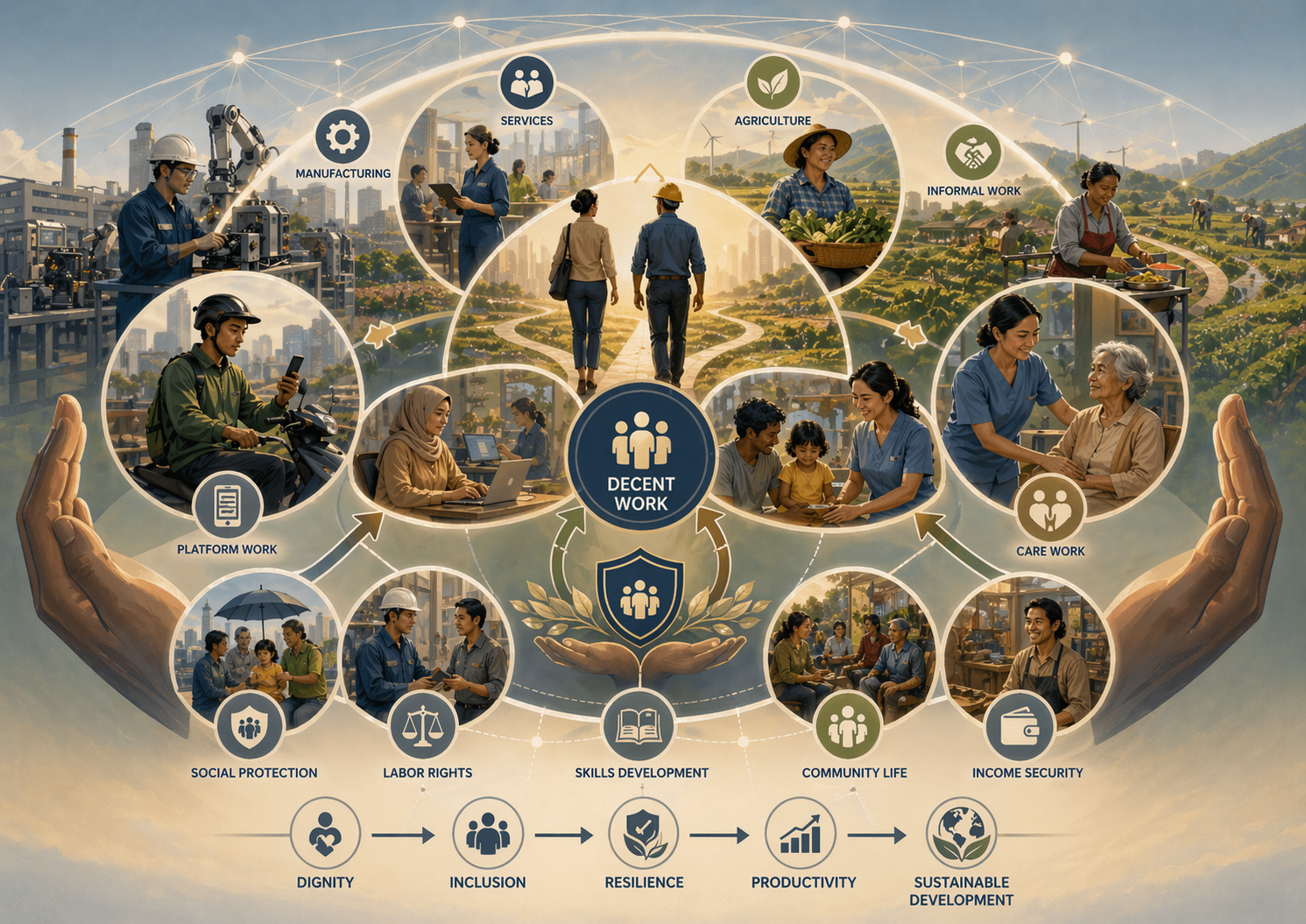
Work belongs to the material core of sustainable development because it connects macroeconomic structure to lived human possibility. It is one of the main ways societies translate productive capacity into security, dignity, and shared social membership. That is why decent work is not peripheral to sustainability. It is one of its essential social conditions.
This section aligns closely with The 2030 Agenda and the Logic of the SDGs. Goal 8 is not only about growth. It is about the quality of the relationship between growth, work, rights, inclusion, and the systems that allow people to live with stability and dignity.
Work also connects to many other development systems: education builds capacity for work; health sustains work; housing stabilizes work; transport enables work; social protection protects workers from shocks; gender justice redistributes access to work and care; climate policy reshapes future livelihoods. Decent work is therefore a cross-cutting development condition rather than a narrow labor-market category.
Policy Portfolios for Decent Livelihoods
Labour insecurity is produced by interacting systems, so isolated programmes rarely suffice. Skills training cannot create jobs where demand is absent. Wage regulation cannot protect workers if inspection is weak. Social insurance tied only to standard employment will exclude many informal and platform workers. Climate policy can create green jobs while harming regions that lack transition support. Effective strategy therefore requires a portfolio.
A comprehensive portfolio combines macroeconomic stability, employment-rich investment, industrial and sector policy, enterprise development, public infrastructure, education and training, labour standards, social protection, care systems, worker voice, and place-based transition support. The balance will differ by context, but the components must reinforce one another.
Public investment can shape labour demand directly and indirectly. Infrastructure, housing, care, health, education, ecosystem restoration, transit, and digital public systems can create jobs while expanding capabilities. Procurement can require apprenticeships, wage standards, accessibility, local participation, and safe working conditions. Sector strategies can improve productivity while preventing gains from being captured entirely by firms with market power.
Active labour-market programmes are most useful when connected to real opportunities. A 2026 ILO–World Bank review of 228 studies across 62 countries found measurable positive effects from well-designed youth programmes, with outcomes varying by design, participant group, and context (ILO and World Bank, 2026). Training, employment services, entrepreneurship support, wage subsidies, and public works should therefore be selected on evidence rather than ideology.
Implementation capacity is itself part of the policy. Governments need labour-market information, benefit administration, inspectors, employment services, local partnerships, and mechanisms for learning. Employers need support to comply and invest. Worker organizations and civil society need access to information and participation. A policy portfolio should identify who is responsible, how resources flow, what sequence is realistic, and how harms will be corrected.
Measurement: From Employment Counts to Livelihood Quality
Employment statistics are indispensable, but they answer only part of the development question. A strong measurement system should distinguish access to work, adequacy of hours, earnings, informality, contract stability, safety, social protection, rights, voice, care constraints, discrimination, and transition risk. It should also show how these conditions differ across gender, age, disability, migration status, region, occupation, and household income.
No single composite index can represent decent work objectively. Weighting choices encode judgments about whether higher employment can compensate for weak safety, whether income can compensate for missing rights, and whether average gains can compensate for severe burdens on a minority. For this reason, dashboards should retain the underlying dimensions and identify bottlenecks rather than reporting only one score.
Useful indicators include the jobs gap, unemployment, labour-force participation, time-related underemployment, NEET rates, employment-to-population ratios, working poverty, median wages, labour-income share, wage arrears, informality, temporary and involuntary part-time work, occupational injury, excessive hours, social-protection coverage, union density, collective-bargaining coverage, and labour-inspection reach. Platform and AI-era systems also need indicators on algorithmic decisions, deactivation, appeals, surveillance, unpaid time, and worker-data complaints.
Administrative data can improve timeliness but may exclude workers outside formal systems. Household and labour-force surveys can capture broader experience but may miss rapidly changing forms of work. Worker-led data, qualitative research, inspections, grievance records, and platform disclosures can reveal mechanisms that aggregate statistics conceal. Triangulation is therefore essential.
Measurement should support action. Each indicator should be linked to an institutional owner, a threshold or interpretation, and a response pathway. A dashboard that repeatedly displays wage theft, heat exposure, or benefit exclusion without triggering correction risks converting harm into routine information. Visibility becomes developmental only when it changes authority, resources, and behaviour.
A Practical Method for Assessing Work and Livelihood Systems
A disciplined assessment can move from headline employment statistics toward the structures that determine whether work supports human development.
1. Define the livelihood system
Identify the geographic area, sectors, worker groups, employment relationships, unpaid work, and household dependencies inside the analysis. Make subcontracting, migration, and platform mediation visible.
2. Describe access to work
Measure unemployment, the jobs gap, underemployment, inactivity caused by care or disability barriers, and the quality of school-to-work transitions.
3. Examine job quality
Assess earnings, hours, predictability, safety, autonomy, training, progression, and whether work is compatible with health and family life.
4. Map informality and contractual control
Distinguish survival self-employment, genuinely independent enterprise, dependent contracting, misclassification, casual work, and informal employment inside formal firms.
5. Evaluate rights and remedy
Identify applicable standards, inspection capacity, access to unions, complaint channels, retaliation risks, and whether workers can obtain timely remedy.
6. Assess social protection
Map coverage for sickness, injury, unemployment, maternity, disability, old age, and care. Identify exclusions created by contribution rules or employment status.
7. Analyse distribution
Disaggregate by gender, age, disability, migration status, race or ethnicity where appropriate, location, occupation, and income. Look for concentrated burden hidden by averages.
8. Trace care and household effects
Examine unpaid care, childcare availability, transport, housing costs, debt, and how livelihood instability affects nutrition, education, and health.
9. Test technological and climate transitions
Identify task exposure, algorithmic control, heat risk, sector decline, green opportunities, and the support required for workers to move without loss of dignity.
10. Build an intervention portfolio
Connect demand-side investment, enterprise upgrading, standards, protection, care, skills, voice, and local transition support. Specify sequencing and responsible institutions.
11. Define outcomes and safeguards
Track earnings, retention, safety, social protection, rights, mobility, and distributional effects. Establish safeguards against displacement, surveillance, exclusion, and burden shifting.
12. Create a learning cycle
Combine quantitative monitoring with worker feedback, evaluation, and periodic review. Revise policy when evidence shows that formal compliance is not producing substantive security.
Worked Diagnostic: A City with High Employment and Fragile Livelihoods
Consider a city reporting low unemployment and rising service-sector employment. A superficial assessment might conclude that the labour market is performing well. A livelihood diagnostic, however, finds that a large share of workers are employed through subcontractors and platforms; median hours vary sharply; housing and transport costs consume much of earnings; care workers are underpaid; young people cycle through short placements; and outdoor workers face increasing heat exposure.
The first problem is measurement. Unemployment does not capture workers who need more hours or those accepting unstable work because no alternative exists. The city therefore adds time-related underemployment, earnings volatility, job tenure, and the jobs gap to its dashboard. Data are disaggregated by gender, age, neighbourhood, disability, and migration status.
The second problem is fragmented responsibility. Lead firms claim that contractors set wages, platforms classify workers as independent, and public agencies award contracts primarily on price. The city revises procurement to require wage floors, disclosure of subcontractors, heat protections, access to remedy, and evidence of social-insurance contributions. Joint liability is introduced for serious violations in high-risk sectors.
The third problem is missing support. Workers cannot accept training or stable shifts because childcare and transport are unreliable. The city expands childcare near employment centres, coordinates evening transit, and links training stipends to real vacancies. Social-protection enrolment is made portable across employers and platforms.
The fourth problem is weak voice. A sector council brings together workers, employers, platforms, community organizations, and public agencies. Workers can report unpaid time, deactivation, harassment, and heat risk without retaliation. Data from the council inform inspection priorities.
Success is not defined as the number of people placed in work. The city tracks net earnings after expenses, hours predictability, injury and heat incidents, benefit coverage, retention, appeals, progression, and household stress. The intervention is treated as a learning portfolio rather than a one-time programme. This example illustrates the central principle of the article: employment becomes development only when institutions convert economic activity into durable capability and security.
Uncertainty, Causal Evaluation, and Ethical Limits
Labour systems are dynamic, and causal claims require care. Employment may rise after a programme because of broader economic recovery rather than the intervention. Wages may improve while hours fall. Formalization may increase measured compliance while pushing the most vulnerable workers out of visible employment. AI adoption may raise productivity but redistribute stress or income in ways that appear only later.
Evaluation should therefore combine theory of change, baseline evidence, comparison groups where feasible, process tracing, and distributional analysis. Randomized evaluations can be valuable for some programmes, but many labour policies operate at sectoral or institutional scale and require quasi-experimental, comparative, or mixed-method designs. Qualitative evidence is essential for understanding why workers do or do not use protections.
Composite scoring also has limits. Results depend on definitions, normalization, weights, thresholds, missing data, and the assumption that dimensions can compensate for one another. The upgraded workflow below reports both a weighted score and a weakest-dimension floor so that high employment access cannot fully conceal severe rights or safety deficits. It also uses uncertainty ensembles to show whether rankings are robust to plausible changes in weights.
Ethically, diagnostic tools should not determine benefit eligibility, sanctions, hiring, or dismissal without due process. Labour-market data can expose undocumented workers, union activity, disability, health conditions, or household vulnerability. Data collection should use clear purpose limits, minimum necessary detail, security, and meaningful participation.
Finally, local knowledge matters. A global framework cannot specify what dignity, fair pay, or reasonable security requires in every context. Standards provide a floor, not a substitute for democratic judgment. Workers and affected communities should help define problems, interpret evidence, and decide which trade-offs are acceptable.
Why This Matters for Sustainable Development
Work, livelihoods, and decent employment matter for sustainable development because work is not simply a market transaction. It is one of the main ways people secure dignity, income, agency, recognition, and a practical place within society. A serious development framework must therefore ask not only whether labor is being used, but whether livelihoods are being formed under conditions of fairness, protection, and real possibility.
This is why decent work matters so much. Full and productive employment is not enough if work remains unsafe, rights-denying, insecure, discriminatory, or insufficient for a decent life. Where livelihoods remain fragile, development may advance in averages while remaining unstable in substance. Goal 8 and the ILO’s decent-work architecture both reinforce this broader developmental reading.
To take work seriously is to take human development seriously. It is to recognize that sustainable development is not finally about output alone, but about whether economic systems create livelihoods through which people can live, plan, care, participate, and flourish with dignity over time. That is one of the clearest tests of whether development is genuinely inclusive, socially grounded, and durable.
Development becomes credible when workers are not treated as disposable inputs into growth, but as rights-bearing human beings whose livelihoods, safety, voice, care responsibilities, and futures are part of the purpose of development itself.
Conclusion: Work as a Development Institution
Work is not merely the sale of labour time. It is an institution that distributes income, risk, recognition, learning, health, voice, and future possibility. The developmental quality of a labour system depends on whether people can obtain work, whether that work is decent, and whether institutions protect them when markets, technology, health, or climate conditions change.
This perspective rejects two shortcuts. The first is to treat job creation as sufficient regardless of job quality. The second is to demand ideal jobs while ignoring the urgent need for income and productive opportunity. Sustainable policy must pursue both more work and better work, while protecting people during the transition.
The practical agenda is therefore institutional: employment-rich investment, productive transformation, fair wages, formalization, universal social protection, care systems, safety, rights enforcement, social dialogue, and governance of technology and climate change. These elements are mutually reinforcing. Skills become more valuable when jobs exist. Productivity becomes more inclusive when workers can bargain. Formalization becomes durable when enterprises are viable and protection is portable. Innovation becomes legitimate when workers participate in its design.
The ultimate measure is not whether labour markets look efficient from a distance. It is whether people can build lives through work without surrendering safety, dignity, agency, or the ability to care for others. Development becomes credible when economic systems treat workers not as adjustable costs, but as rights-bearing human beings whose capabilities are part of the purpose of production.
Mathematical Lens
Work-related development burden can be clarified by thinking in terms of employment access, job quality, protection, and vulnerability rather than labor absorption alone. Let \(D_w\) represent developmentally relevant labour stress, \(E\) employment access, \(Q\) quality and dignity of work, \(P\) protection and rights security, and \(V\) livelihood vulnerability:
D_w = -\alpha E – \beta Q – \gamma P + \delta V
\]
Interpretation: Labour stress falls when employment access, work quality, and rights protection improve, and rises when livelihood vulnerability remains high.
This captures the article’s core point: the developmental value of work depends not just on whether people are employed, but on whether work is secure, rights-protecting, and stabilizing across the life course.
We can also express labour fragility as a weighted function of informality, precarity, and exclusion:
R_w = w_1 I + w_2 C + w_3 X
\]
Interpretation: Labour fragility rises when informality, contract or income instability, and structural exclusion reinforce one another.
Here, \(I\) is informality pressure, \(C\) is contract or income instability, and \(X\) is structural exclusion from decent livelihood pathways. Higher \(R_w\) means a society faces a more fragile livelihood system.
Finally, decent-work resilience can be represented as a function of productive employment, social protection, and rights enforcement:
P_r = \lambda Y + \mu S + \nu L
\]
Interpretation: Decent-work resilience increases when productive employment generation, social protection coverage, and labour-rights enforcement improve together.
Here, \(Y\) is productive employment generation, \(S\) is social protection coverage, and \(L\) is labour-rights enforcement. This helps show why similar employment rates can produce very different developmental outcomes across places.
| Term | Meaning | Interpretive role |
|---|---|---|
| \(D_w\) | Labour stress | Represents the degree to which work systems generate insecurity, exclusion, or rights-related burden. |
| \(E\) | Employment access | Represents meaningful access to work and livelihood pathways. |
| \(Q\) | Quality and dignity of work | Represents wages, safety, respect, stability, autonomy, and non-degrading work conditions. |
| \(P\) | Protection and rights security | Represents labour rights, social protection, enforcement, voice, and protection from exploitation. |
| \(V\) | Livelihood vulnerability | Represents exposure to income shocks, illness, unemployment, informality, precarity, and weak buffers. |
| \(R_w\) | Labour fragility | Represents the combined risk from informality, instability, and exclusion from decent work. |
| \(P_r\) | Decent-work resilience | Represents the ability of labour systems to sustain secure and rights-protecting livelihoods over time. |
The equations are conceptual rather than predictive. Their value is to make visible the structure of the problem: decent work depends on employment access, quality, protection, social dialogue, social protection, and vulnerability reduction working together.
Advanced Python Workflow: Non-Compensatory Decent-Work Diagnostics
The upgraded Python workflow treats decent work as a multidimensional condition rather than a single employment variable. It calculates six positive dimensions—employment access, job quality, rights and voice, social protection, safety and health, and transition readiness—using geometric aggregation within each dimension. It then combines a weighted capacity score with the weakest dimension so that severe failure in rights or safety cannot be fully concealed by strong performance elsewhere.
from __future__ import annotations

import csv
import math
from pathlib import Path
from statistics import fmean

INPUT_FILE = Path("data/work_livelihoods_panel.csv")
OUTPUT_FILE = Path("outputs/tables/work_livelihoods_scores.csv")

POSITIVE_DIMENSIONS = {
    "employment_access": ["employment_access", "hours_adequacy"],
    "job_quality": ["earnings_adequacy", "schedule_predictability", "career_progression"],
    "rights_and_voice": ["rights_enforcement", "collective_voice", "remedy_access"],
    "social_protection": ["social_protection", "income_security", "care_support"],
    "safety_and_health": ["occupational_safety", "heat_protection", "violence_prevention"],
    "transition_readiness": ["skills_access", "technology_governance", "just_transition_support"],
}

RISK_FIELDS = [
    "informality_risk",
    "precarity_risk",
    "working_poverty_risk",
    "youth_exclusion_risk",
    "gender_exclusion_risk",
    "platform_control_risk",
    "climate_livelihood_risk",
]

DIMENSION_WEIGHTS = {
    "employment_access": 0.16,
    "job_quality": 0.19,
    "rights_and_voice": 0.18,
    "social_protection": 0.17,
    "safety_and_health": 0.15,
    "transition_readiness": 0.15,
}


def clamp(value: float) -> float:
    return max(0.0, min(1.0, value))


def geometric_mean(values: list[float]) -> float:
    if any(value <= 0 for value in values):
        return 0.0
    return math.exp(fmean(math.log(value) for value in values))


def read_rows(path: Path) -> list[dict[str, str]]:
    if not path.exists():
        raise FileNotFoundError(f"Missing input file: {path}")
    with path.open(newline="", encoding="utf-8") as handle:
        rows = list(csv.DictReader(handle))
    if not rows:
        raise ValueError("Input dataset is empty")
    return rows


def validate(rows: list[dict[str, str]]) -> None:
    required = {"territory", "region", "territory_type"}
    for fields in POSITIVE_DIMENSIONS.values():
        required.update(fields)
    required.update(RISK_FIELDS)

    missing = sorted(required - set(rows[0]))
    if missing:
        raise ValueError(f"Missing columns: {missing}")

    for row_number, row in enumerate(rows, start=2):
        for field in required - {"territory", "region", "territory_type"}:
            try:
                value = float(row[field])
            except ValueError as exc:
                raise ValueError(f"Row {row_number}, {field}: not numeric") from exc
            if not 0.0 <= value <= 1.0:
                raise ValueError(f"Row {row_number}, {field}: outside [0, 1]")


def score_row(row: dict[str, str]) -> dict[str, object]:
    dimensions: dict[str, float] = {}
    for dimension, fields in POSITIVE_DIMENSIONS.items():
        values = [float(row[field]) for field in fields]
        # Geometric aggregation limits full compensation for a severe weakness.
        dimensions[dimension] = geometric_mean(values)

    weighted_capacity = sum(
        dimensions[name] * DIMENSION_WEIGHTS[name] for name in DIMENSION_WEIGHTS
    )
    weakest_dimension = min(dimensions, key=dimensions.get)
    floor_score = dimensions[weakest_dimension]
    non_compensatory_capacity = 0.70 * weighted_capacity + 0.30 * floor_score

    risk_pressure = fmean(float(row[field]) for field in RISK_FIELDS)
    decent_work_risk = clamp(0.62 * (1.0 - non_compensatory_capacity) + 0.38 * risk_pressure)

    if decent_work_risk >= 0.75:
        risk_band = "extreme"
    elif decent_work_risk >= 0.55:
        risk_band = "high"
    elif decent_work_risk >= 0.35:
        risk_band = "moderate"
    else:
        risk_band = "lower"

    output: dict[str, object] = {
        "territory": row["territory"],
        "region": row["region"],
        "territory_type": row["territory_type"],
        **{f"dimension_{key}": round(value, 4) for key, value in dimensions.items()},
        "weighted_capacity": round(weighted_capacity, 4),
        "weakest_dimension": weakest_dimension,
        "weakest_dimension_score": round(floor_score, 4),
        "non_compensatory_capacity": round(non_compensatory_capacity, 4),
        "risk_pressure": round(risk_pressure, 4),
        "decent_work_risk": round(decent_work_risk, 4),
        "risk_band": risk_band,
    }
    return output


def write_rows(path: Path, rows: list[dict[str, object]]) -> None:
    path.parent.mkdir(parents=True, exist_ok=True)
    with path.open("w", newline="", encoding="utf-8") as handle:
        writer = csv.DictWriter(handle, fieldnames=list(rows[0]))
        writer.writeheader()
        writer.writerows(rows)


def main() -> None:
    rows = read_rows(INPUT_FILE)
    validate(rows)
    scored = [score_row(row) for row in rows]
    scored.sort(key=lambda row: float(row["decent_work_risk"]), reverse=True)
    write_rows(OUTPUT_FILE, scored)
    print(f"Wrote {len(scored)} scored territories to {OUTPUT_FILE}")


if __name__ == "__main__":
    main()
The output retains every dimension, names the binding constraint, reports risk pressure, and creates a non-compensatory risk score. The weights are explicit and should be treated as analytical assumptions rather than universal truths.
Python Workflow: Weight and Measurement Uncertainty
The uncertainty workflow runs 500 reproducible trials. It perturbs weights, measurement values, the importance assigned to the weakest dimension, and the balance between capacity and risk pressure. The resulting percentiles and probability of high or extreme risk reveal whether a territory’s classification is robust or dependent on narrow assumptions.
from __future__ import annotations

import csv
import random
from pathlib import Path
from statistics import fmean

from work_livelihoods_decent_employment_workflow import (
    DIMENSION_WEIGHTS,
    INPUT_FILE,
    OUTPUT_FILE,
    POSITIVE_DIMENSIONS,
    RISK_FIELDS,
    clamp,
    geometric_mean,
    read_rows,
    validate,
)

ENSEMBLE_OUTPUT = Path("outputs/tables/work_livelihoods_uncertainty.csv")
TRIALS = 500
SEED = 20260804


def percentile(values: list[float], p: float) -> float:
    ordered = sorted(values)
    position = (len(ordered) - 1) * p
    lower = int(position)
    upper = min(lower + 1, len(ordered) - 1)
    fraction = position - lower
    return ordered[lower] * (1 - fraction) + ordered[upper] * fraction


def sample_weights(rng: random.Random) -> dict[str, float]:
    raw = {
        name: max(0.02, rng.gauss(weight, 0.035))
        for name, weight in DIMENSION_WEIGHTS.items()
    }
    total = sum(raw.values())
    return {name: value / total for name, value in raw.items()}


def trial_score(row: dict[str, str], weights: dict[str, float], rng: random.Random) -> float:
    dimensions = {}
    for dimension, fields in POSITIVE_DIMENSIONS.items():
        values = [clamp(float(row[field]) + rng.gauss(0.0, 0.025)) for field in fields]
        dimensions[dimension] = geometric_mean(values)

    weighted = sum(dimensions[name] * weights[name] for name in weights)
    floor = min(dimensions.values())
    floor_share = rng.uniform(0.20, 0.40)
    capacity = (1 - floor_share) * weighted + floor_share * floor

    risks = [clamp(float(row[field]) + rng.gauss(0.0, 0.025)) for field in RISK_FIELDS]
    risk_pressure = fmean(risks)
    risk_share = rng.uniform(0.32, 0.44)
    return clamp((1 - risk_share) * (1 - capacity) + risk_share * risk_pressure)


def main() -> None:
    rows = read_rows(INPUT_FILE)
    validate(rows)
    rng = random.Random(SEED)
    results = []

    for row in rows:
        scores = []
        for _ in range(TRIALS):
            scores.append(trial_score(row, sample_weights(rng), rng))
        results.append({
            "territory": row["territory"],
            "mean_risk": round(fmean(scores), 4),
            "p05_risk": round(percentile(scores, 0.05), 4),
            "p50_risk": round(percentile(scores, 0.50), 4),
            "p95_risk": round(percentile(scores, 0.95), 4),
            "probability_high_or_extreme": round(
                sum(score >= 0.55 for score in scores) / TRIALS, 4
            ),
            "trials": TRIALS,
            "seed": SEED,
        })

    results.sort(key=lambda row: float(row["mean_risk"]), reverse=True)
    ENSEMBLE_OUTPUT.parent.mkdir(parents=True, exist_ok=True)
    with ENSEMBLE_OUTPUT.open("w", newline="", encoding="utf-8") as handle:
        writer = csv.DictWriter(handle, fieldnames=list(results[0]))
        writer.writeheader()
        writer.writerows(results)
    print(f"Wrote uncertainty results to {ENSEMBLE_OUTPUT}")


if __name__ == "__main__":
    main()
Uncertainty analysis does not solve the normative problem of weighting. It makes that problem visible. A ranking that changes substantially under plausible assumptions should be presented as uncertain rather than authoritative.
R Workflow: Regional Diagnostics and Robustness Visualization
The base R workflow reads the Python outputs, summarizes multidimensional conditions by region, and produces separate visualizations for regional risk and territory-level uncertainty intervals. It intentionally avoids package dependencies so that the analytical logic remains portable and inspectable.
# Base R workflow for decent-work diagnostics and uncertainty summaries.

input_path <- file.path("outputs", "tables", "work_livelihoods_scores.csv")
uncertainty_path <- file.path("outputs", "tables", "work_livelihoods_uncertainty.csv")
output_path <- file.path("outputs", "tables", "work_livelihoods_region_summary_r.csv")
figures_dir <- file.path("outputs", "figures")

dir.create(dirname(output_path), recursive = TRUE, showWarnings = FALSE)
dir.create(figures_dir, recursive = TRUE, showWarnings = FALSE)

if (!file.exists(input_path)) {
  stop(paste("Missing", input_path, "Run the Python workflow first."))
}

scores <- read.csv(input_path, stringsAsFactors = FALSE)

mean_or_na <- function(x) {
  if (all(is.na(x))) return(NA_real_)
  mean(x, na.rm = TRUE)
}

region_summary <- aggregate(
  cbind(
    decent_work_risk,
    weighted_capacity,
    weakest_dimension_score,
    risk_pressure,
    dimension_employment_access,
    dimension_job_quality,
    dimension_rights_and_voice,
    dimension_social_protection,
    dimension_safety_and_health,
    dimension_transition_readiness
  ) ~ region,
  data = scores,
  FUN = mean_or_na
)

names(region_summary)[-1] <- paste0("average_", names(region_summary)[-1])
region_summary <- region_summary[order(region_summary$average_decent_work_risk, decreasing = TRUE), ]
write.csv(region_summary, output_path, row.names = FALSE)

png(file.path(figures_dir, "regional_decent_work_risk.png"), width = 1200, height = 700)
barplot(
  region_summary$average_decent_work_risk,
  names.arg = region_summary$region,
  las = 2,
  ylab = "Average decent-work risk",
  main = "Decent-work risk by region"
)
grid()
dev.off()

if (file.exists(uncertainty_path)) {
  uncertainty <- read.csv(uncertainty_path, stringsAsFactors = FALSE)
  uncertainty <- uncertainty[order(uncertainty$mean_risk, decreasing = TRUE), ]
  write.csv(
    uncertainty,
    file.path("outputs", "tables", "work_livelihoods_uncertainty_ranked_r.csv"),
    row.names = FALSE
  )

  png(file.path(figures_dir, "territory_uncertainty_intervals.png"), width = 1200, height = 700)
  x <- seq_len(nrow(uncertainty))
  plot(
    x,
    uncertainty$mean_risk,
    ylim = range(c(uncertainty$p05_risk, uncertainty$p95_risk)),
    xaxt = "n",
    xlab = "Territory",
    ylab = "Decent-work risk",
    main = "Uncertainty intervals by territory",
    pch = 19
  )
  arrows(
    x,
    uncertainty$p05_risk,
    x,
    uncertainty$p95_risk,
    angle = 90,
    code = 3,
    length = 0.04
  )
  axis(1, at = x, labels = uncertainty$territory, las = 2, cex.axis = 0.8)
  grid()
  dev.off()
}

print(region_summary)
The visual outputs should be read alongside the underlying dimensions. A regional average can hide sharp differences among worker groups, occupations, and local labour markets.
GitHub Repository
The companion repository supports multidimensional decent-work assessment, bottleneck diagnosis, uncertainty analysis, worker-group disaggregation, scenario testing, and transparent publication of assumptions and limitations.
View the Full GitHub Repository
articles/work-livelihoods-and-decent-employment/
├── article/
│   ├── work-livelihoods-and-decent-employment.html
│   └── work-livelihoods-and-decent-employment.md
├── python/
│   ├── work_livelihoods_decent_employment_workflow.py
│   ├── work_livelihoods_uncertainty_ensemble.py
│   ├── distributional_diagnostics.py
│   ├── scenario_portfolio_analysis.py
│   └── tests/
├── r/
│   ├── work_livelihoods_diagnostics.R
│   ├── regional_gap_analysis.R
│   └── distributional_visualization.R
├── data/
│   ├── work_livelihoods_panel.csv
│   ├── indicator_dictionary.csv
│   └── data_provenance.md
├── sql/
│   ├── schema_workers.sql
│   ├── schema_employment_relationships.sql
│   ├── schema_social_protection.sql
│   ├── schema_workplace_risks.sql
│   └── schema_model_runs.sql
├── docs/
│   ├── methodology.md
│   ├── assumptions_and_limitations.md
│   ├── labour_standards_crosswalk.md
│   ├── responsible_use.md
│   └── implementation_guide.md
└── outputs/
    ├── tables/
    └── figures/
The data model should retain worker-group and territorial disaggregation, indicator provenance, reference periods, uncertainty, and the institutional owner responsible for each intervention. Sensitive microdata should not be committed to a public repository.
Related Articles
- From Economic Growth to Human Development
- Economic Growth and Human Progress
- Poverty, Deprivation, and Multidimensional Development
- Inequality and Inclusive Development
- Health, Education, and Human Capability Expansion
- Urbanization, Housing, and Basic Services
- Gender, Exclusion, and Development Justice
- Risk, Shock, and Fragility in Development Systems
- The 2030 Agenda and the Logic of the SDGs
- Human Development Indicators and Their Limits
Further Reading
- International Labour Organization (2026) Employment and Social Trends 2026. Geneva: ILO.
- International Labour Organization (2026) Universal Social Protection in Changing Labour Markets: Protecting Workers in All Types of Employment. Geneva: ILO.
- International Labour Organization (2026) Convention concerning Decent Work in the Platform Economy, 2026 (No. 193). Geneva: ILO.
- International Labour Organization and World Bank (2026) The Impact of Active Labour Market Programmes on Youth. Geneva and Washington, DC.
- International Labour Organization (2025) Generative AI and Jobs: A Refined Global Index of Occupational Exposure. Geneva: ILO.
- International Labour Organization (2025) Green Employment Diagnostics for a Just Transition. Geneva: ILO.
- International Labour Organization (2024) World Social Protection Report 2024–26. Geneva: ILO.
- International Labour Organization (2024) Heat at Work: Implications for Safety and Health. Geneva: ILO.
- Sen, A. (1999) Development as Freedom. Oxford: Oxford University Press.
- Standing, G. (2011) The Precariat: The New Dangerous Class. London: Bloomsbury Academic.
References
- International Labour Organization (1948) Freedom of Association and Protection of the Right to Organise Convention, 1948 (No. 87). Geneva: ILO. Available at: ILO NORMLEX.
- International Labour Organization (1949) Right to Organise and Collective Bargaining Convention, 1949 (No. 98). Geneva: ILO. Available at: ILO NORMLEX.
- International Labour Organization (1981) Occupational Safety and Health Convention, 1981 (No. 155). Geneva: ILO.
- International Labour Organization (2011) Domestic Workers Convention, 2011 (No. 189). Geneva: ILO.
- International Labour Organization (2019) Violence and Harassment Convention, 2019 (No. 190). Geneva: ILO.
- International Labour Organization (2024a) Heat at Work: Implications for Safety and Health. Geneva: ILO. Available at: ILO.
- International Labour Organization (2024b) World Social Protection Report 2024–26: Universal Social Protection for Climate Action and a Just Transition. Geneva: ILO. Available at: ILO.
- International Labour Organization (2025a) World Employment and Social Outlook: May 2025 Update. Geneva: ILO.
- International Labour Organization (2025b) Green Employment Diagnostics for a Just Transition. Geneva: ILO. Available at: ILO.
- International Labour Organization (2025c) Advancing Decent Work and the Care Economy: An Essential Component of Social Development. Geneva: ILO. Available at: ILO.
- International Labour Organization and NASK (2025) Generative AI and Jobs: A Refined Global Index of Occupational Exposure. ILO Working Paper 140. Geneva: ILO. Available at: ILO.
- International Labour Organization (2026a) Employment and Social Trends 2026. Geneva: ILO. Available at: ILO.
- International Labour Organization (2026b) Universal Social Protection in Changing Labour Markets: Protecting Workers in All Types of Employment. Geneva: ILO. Available at: ILO.
- International Labour Organization (2026c) Convention concerning Decent Work in the Platform Economy, 2026 (No. 193). Geneva: ILO. Available at: ILO.
- International Labour Organization (2026d) Resolution concerning the ILO Transformative Agenda for Gender Equality in the World of Work. Geneva: ILO.
- International Labour Organization and World Bank (2026) The Impact of Active Labour Market Programmes on Youth. Geneva and Washington, DC. Available at: ILO.
- United Nations (2011) Guiding Principles on Business and Human Rights. New York and Geneva: United Nations.
- United Nations (2015) Transforming Our World: The 2030 Agenda for Sustainable Development. New York: United Nations. Available at: United Nations.
- United Nations (n.d.) Goal 8: Decent Work and Economic Growth. New York: United Nations. Available at: United Nations.
- United Nations Development Programme (2025) Human Development Report 2025: A Matter of Choice—People and Possibilities in the Age of AI. New York: UNDP.
- Sen, A. (1999) Development as Freedom. Oxford: Oxford University Press.