
Last Updated May 6, 2026
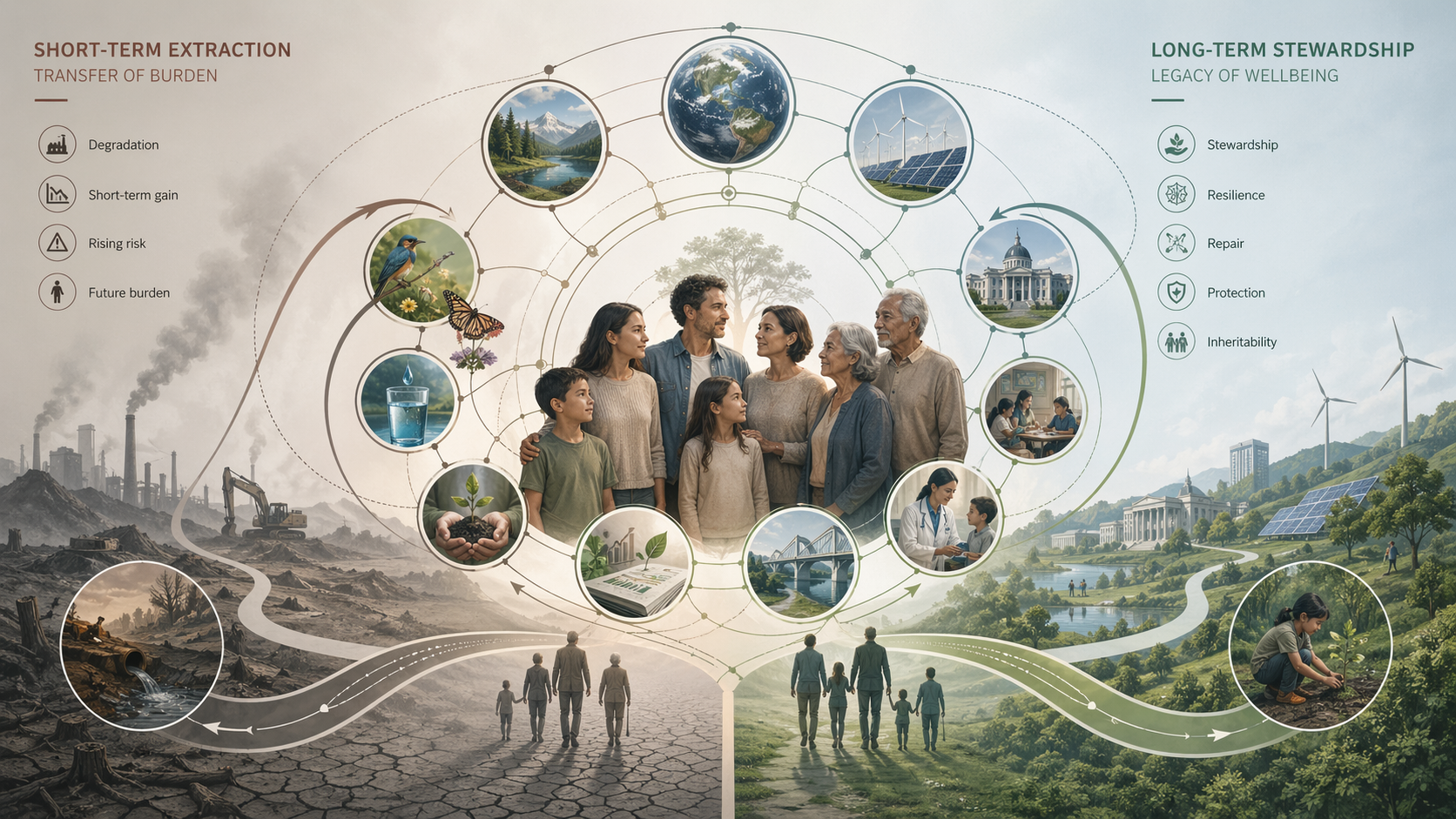
Intergenerational justice concerns what present generations owe to future ones, while long-term stewardship concerns how those obligations are translated into durable forms of care, restraint, institutional design, ecological responsibility, and public governance. Together, these ideas extend sustainable development beyond present welfare and immediate political horizons. They ask whether human societies are meeting current needs in ways that preserve the material, ecological, cultural, institutional, and civic conditions under which future people can also live secure, dignified, and meaningful lives.
In this sense, intergenerational justice is not an abstract ethical add-on to sustainable development. It is one of the principles that gives the concept its long-range moral force. Once future generations enter the definition of development, progress can no longer be judged only by current output, current consumption, current welfare, or current political satisfaction. It must also be judged by what present societies leave behind: institutions, infrastructures, ecosystems, debts, risks, knowledge, public trust, and possibilities.
Main Library
Publications
Article Map
Sustainable Development
Related Topic
Risk & Resilience

The modern language of sustainable development is inseparable from this intergenerational horizon. The Brundtland Report’s defining formula—meeting the needs of the present without compromising the ability of future generations to meet their own needs—turned temporal responsibility into a criterion of developmental legitimacy. Once future generations enter the frame, development can no longer be judged solely by present output, present welfare, or present political satisfaction. It must also be judged by inheritability: what kind of world, what kinds of institutions, and what range of future options remain possible because of decisions made now.
This temporal turn has become even more important as sustainability science and global governance have deepened the discussion. The 2030 Agenda presents sustainable development as a plan of action for people, planet, prosperity, peace, and partnership. UNESCO’s Declaration on the Responsibilities of the Present Generations Towards Future Generations makes this principle more explicit by articulating responsibilities relating to peace, the environment, cultural heritage, and the conditions of future life. More recent UN work on duties to the future and the Declaration on Future Generations adopted through the Summit of the Future process reinforces the idea that future-regard is not only ethical language but also a question of institutional design, public decision-making, and governance.
What Is Intergenerational Justice?
Intergenerational justice is the principle that present generations have obligations to future generations, and that these obligations should shape the way social, economic, ecological, and political systems are organized. It asks whether current societies are using their power, resources, technologies, infrastructures, and institutions in ways that preserve rather than diminish the conditions of future life. These conditions include not only material wealth, but ecological stability, cultural continuity, public knowledge, institutional credibility, peace, public health, and the possibility of self-determined development.
The importance of intergenerational justice lies in the fact that the future is structurally vulnerable. Future persons cannot vote, bargain, organize politically in the present, file claims against present governments, or directly resist the imposition of risks created before they are born. This creates a temporal asymmetry of power. Present generations can consume resources, emit pollution, weaken institutions, defer maintenance, accumulate debt, lock in infrastructure, and generate long-run hazards while externalizing a substantial portion of the costs onto those who come later.
Intergenerational justice is therefore an attempt to correct this asymmetry by insisting that future interests count morally even when future persons are politically absent. It asks societies to treat future people not as abstractions, but as morally relevant persons whose lives will be shaped by present decisions. Future generations may not exist yet as political actors, but the consequences imposed upon them are real. The fact that they cannot speak now does not mean present generations have no obligations toward them.
In sustainable development, this principle becomes especially important because many of the effects of present action are delayed. Climate change, biodiversity decline, freshwater depletion, soil degradation, long-lived waste, public debt, infrastructure lock-in, and institutional erosion do not respect electoral calendars. They accumulate through time. To invoke intergenerational justice is therefore to insist that time itself must enter the ethics of development. This places the article in direct continuity with The Brundtland Definition and Its Legacy.
Intergenerational justice also changes how success is evaluated. A society may appear successful if it increases output, expands consumption, builds infrastructure, and satisfies present demand. But if those achievements are secured by destabilizing climate systems, depleting ecological foundations, weakening public institutions, or transferring unmanageable risks to future people, then the moral quality of that success becomes doubtful. The central question is not only what present societies gain, but what they make possible—or impossible—for those who inherit the consequences.
What Long-Term Stewardship Means
Long-term stewardship is the practical counterpart of intergenerational justice. If justice identifies obligations, stewardship concerns how those obligations are enacted. Stewardship involves managing inherited systems and shared resources in ways that preserve their durability, regenerative capacity, civic legitimacy, and social usefulness over time. It is often associated with environmental care, but in a broader sustainable-development context it also includes the stewardship of public institutions, infrastructures, fiscal capacity, knowledge systems, democratic norms, legal protections, and social trust.
The term matters because it resists a purely extractive or possessive model of development. Stewardship implies that present generations are not absolute owners of the systems they inhabit. They are temporary beneficiaries and custodians whose decisions shape what future generations inherit. This does not mean freezing all change, rejecting innovation, or treating preservation as an end in itself. Stewardship is compatible with development, infrastructure, experimentation, repair, and transformation. What it rejects is the idea that development remains legitimate even when it systematically degrades the basis of future flourishing.
Understood in this way, stewardship is not sentimental. It is a principle of disciplined use under conditions of shared inheritance. It asks whether societies are preserving continuity or producing avoidable fragility. It asks whether infrastructures are being maintained or merely expanded, whether ecosystems are being restored or silently depleted, whether public institutions are being strengthened or hollowed out, and whether present comfort is being subsidized by future risk.
Stewardship also implies humility. Present societies cannot fully know the values, needs, technologies, or aspirations of future generations. But they can preserve the conditions under which future people retain meaningful freedom to choose. A stable climate, functioning ecosystems, resilient institutions, public knowledge, cultural memory, and usable infrastructure do not dictate the future; they keep future choice open. The opposite of stewardship is not only destruction. It is foreclosure: the narrowing of future options through present negligence or excess.
Sustainable development becomes more serious when stewardship is understood as a mode of governance rather than merely a moral disposition. It requires institutions, budgets, laws, metrics, and public habits capable of carrying long-term responsibility into practical decisions. That is why this article connects closely to Growth, Limits, and the Problem of Overshoot. Overshoot is what happens when societies consume the future as a hidden subsidy for present expansion. Stewardship is the discipline of refusing that bargain.
Brundtland and the Moral Entry of Future Generations
The Brundtland Report remains the most influential point of entry for thinking about intergenerational justice in sustainable development. Its defining formula made future generations central to the concept by declaring that development must meet present needs without compromising the ability of future generations to meet their own. That formulation did several important things at once. It preserved the urgency of present need, especially for poorer populations, while also insisting that present prosperity loses legitimacy if it is secured by weakening the basis of future wellbeing.
This was a major conceptual shift. Development could no longer be treated only as a present-tense project of growth, modernization, industrialization, or welfare expansion. Once future generations entered the frame, development became accountable to time. It had to be assessed not only by what it produced now, but by what conditions it left in place for later. In that sense, Brundtland did not simply add a moral flourish to development language. It redefined the criterion of developmental legitimacy.
The Brundtland formulation is powerful because it refuses two false choices. It refuses the idea that poverty reduction and environmental responsibility are separate moral worlds. It also refuses the idea that future protection requires indifference to current deprivation. The report’s logic is not “future generations instead of present needs.” It is “present needs without future foreclosure.” That distinction remains essential. A sustainability ethic that ignores current poverty is morally inadequate. A development strategy that satisfies current demand by undermining future life is also morally inadequate.
This temporal dimension helps explain why Brundtland remains so enduring. It provides a bridge between poverty reduction and ecological restraint, between current justice and future responsibility, between development and stewardship. Later frameworks have added indicators, governance mechanisms, planetary-boundary science, climate-risk assessment, human-development measurement, and resilience thinking. But they continue to operate within a horizon that Brundtland helped establish: development must be judged by its effects across time.
That continuity is visible in From Economic Growth to Human Development. Once development is understood as the expansion of human capability rather than output alone, the question becomes whether present capability expansion is being achieved in ways that preserve future capability. Intergenerational justice gives human development its long horizon.
Temporal Asymmetry and Absent Representation
One of the deepest reasons intergenerational justice matters is that future persons are subject to decisions in whose making they cannot participate. This is not merely a philosophical curiosity. It is a structural feature of politics. Present institutions allocate land, shape energy systems, incur debts, permit emissions, establish legal frameworks, build infrastructure, approve technologies, and define regulatory baselines whose effects may persist for decades or centuries. Future generations inherit those decisions without having had a voice in them.
This asymmetry makes stewardship a problem of representation as well as morality. Political systems are typically designed to aggregate current interests, not future ones. Budget cycles, electoral incentives, quarterly reporting, campaign finance, lobbying pressure, and short-term performance metrics all privilege the present. Intergenerational justice therefore asks whether a just society can rely exclusively on present preference aggregation when present choices are capable of foreclosing future options. In many cases, the answer is no. Some form of institutionalized future-regard becomes necessary.
The point is not that the future should dominate the present, nor that current deprivation should be ignored in the name of hypothetical posterity. The point is that the future is structurally underrepresented. Intergenerational justice attempts to correct that imbalance by treating long-term consequences as morally and politically relevant even when immediate incentives point elsewhere. It asks institutions to recognize that absence from present politics does not equal absence from moral concern.
This problem is especially visible in environmental governance. A decision to approve high-emission infrastructure, weaken biodiversity protections, defer water-system maintenance, or permit toxic accumulation may benefit current actors while imposing risks on people who do not yet exist. It is also visible in public finance. Borrowing can be justified when it builds durable public capacity, but it becomes intergenerationally problematic when debt finances present consumption while leaving future societies with weaker institutions, damaged ecosystems, or diminished resilience.
Temporal asymmetry also complements Trade-Offs, Synergies, and Policy Coherence. Many trade-offs are not only between sectors; they are between times. The benefits of a policy may appear now while the costs emerge later. A coherent sustainable-development framework must therefore ask not only how policies interact across domains, but how they distribute burdens across generations.
Justice Across Time
Justice across time is difficult because future persons are not present to articulate their own preferences and because the consequences of present action are often uncertain, delayed, cumulative, and unevenly distributed. Yet uncertainty does not eliminate responsibility. If anything, uncertainty under conditions of large, cumulative, or irreversible risk strengthens the need for caution, foresight, and institutional humility. Intergenerational justice does not require exact prediction of future needs. It requires that present generations refrain from foreclosing future possibility through reckless depletion, preventable destabilization, or institutional myopia.
This means that intergenerational justice is not simply about equality between generations in a narrow distributive sense. It is also about preserving options, avoiding irreversible harm, maintaining resilience, and refusing to consume future stability as a hidden subsidy for current benefit. A society may pass on advanced technologies and material wealth, but if it also passes on destabilized climate systems, degraded ecosystems, weakened public institutions, long-lived pollution, unaffordable infrastructure burdens, or entrenched systemic vulnerability, the moral assessment becomes far more complicated.
Justice across time also raises the question of thresholds. Some harms can be repaired; others are difficult or impossible to reverse on human time scales. Species extinction, major ecosystem collapse, irreversible cultural loss, nuclear contamination, long-lived toxins, and climate tipping dynamics all alter the moral structure of decision-making because they limit the ability of future people to recover what present generations damage. The possibility of irreversibility makes stewardship more than prudent management. It makes restraint a moral requirement in some domains.
One of the strengths of intergenerational justice as a concept is that it widens the evaluative frame. It asks not only what current societies enjoy, but what they are normalizing, locking in, and externalizing. It asks whether present gains are created through repair and capability-building or through depletion and burden transfer. It also asks whether future generations will inherit meaningful agency or merely the consequences of choices they did not make.
This is why intergenerational justice belongs so naturally within sustainable development. Development is not only about what is built; it is also about what kinds of futures become easier or harder to inhabit because of what is built today. That logic links naturally to Sustainable Development as a Systems Problem, where delayed effects, feedback loops, and institutional coordination are central to understanding development under constraint.
Planetary Stability, Safe Operating Space, and Future Conditions
Contemporary Earth-system science gives intergenerational justice greater material precision. The planetary-boundaries framework highlights the importance of maintaining Earth-system stability and resilience within a safe operating space for humanity. This matters for justice across generations because future wellbeing is not possible under arbitrary environmental conditions. Climate regulation, freshwater systems, biosphere integrity, land systems, ocean chemistry, and biogeochemical cycles are not external amenities. They are part of the background structure that makes social and economic life possible.
This insight changes the meaning of stewardship. Stewardship is no longer only about prudent use of discrete resources. It becomes a question of whether current development pathways are preserving the stability conditions of the Earth system itself. If the safe operating space is eroded, then future generations inherit not just fewer resources, but a more volatile, less predictable, and more fragile planetary context in which to pursue their own development.
Intergenerational justice therefore cannot be reduced to wealth transfer or fiscal prudence. It must also include the integrity of ecological systems. Future generations do not only inherit public debt or infrastructure. They inherit atmospheric conditions, hydrological systems, biodiversity, climate risk, soil conditions, pollution burdens, and the cumulative ecological consequences of present economic life. Long-term stewardship is inseparable from Earth-system responsibility because future development depends on planetary conditions that present systems are actively reshaping.
This also reframes the meaning of “natural capital.” Ecological systems are not merely assets to be managed for future economic use. They are conditions of life, health, culture, settlement, agriculture, public order, and meaningful freedom. A development pathway that degrades those systems may leave future generations with more built infrastructure but less capacity to live well. The question is not only whether future people inherit wealth, but whether they inherit a world in which wealth remains usable and life remains secure.
This section sits in direct relation to Boundary Transgression and Development Fragility, Freshwater Change and Development Risk, and Anthropocene and Planetary Boundaries. These pieces make clear that future-oriented justice now has an Earth-system dimension: present development must be evaluated against the stability conditions that future societies will need to survive and flourish.
Institutions, Trusteeship, and Long-Horizon Governance
Intergenerational justice is often discussed as an ethical principle, but it also requires institutional expression. Without institutions capable of representing long-term interests, present-biased systems tend to dominate public decision-making. Electoral cycles, quarterly reporting, fiscal short-termism, immediate consumption pressures, and crisis-driven politics all favor present claims over future resilience. Stewardship therefore depends on whether institutions can function, at least in part, as trustees of long-term conditions rather than merely brokers of immediate demand.
UNESCO’s 1997 declaration makes this institutional dimension explicit by affirming responsibilities regarding peace, the environment, the common heritage of humanity, and the conditions of future life. More recent UN-system work on duties to the future and intergenerational equity continues this line of thought by treating future-regard as an issue of governance and institutional design rather than sentiment alone. The Declaration on Future Generations further reinforces this by situating long-term responsibility within the broader Summit of the Future agenda.
Long-horizon governance includes more than environmental regulation. It includes preserving public knowledge, maintaining trustworthy institutions, managing debt responsibly, sustaining infrastructures, protecting commons, regulating long-lived risks, and building resilience against foreseeable systemic shocks. It also includes the ability to evaluate policies across time: what looks efficient now may be costly later; what looks expensive now may preserve future freedom; what looks politically inconvenient now may prevent future harm.
Trusteeship should not be understood as anti-democratic paternalism. At its best, it means designing democratic systems that are less captured by immediacy. This can include independent scientific assessment, public-interest regulation, long-term budget offices, future-generations commissioners, climate councils, constitutional or statutory duties, public audit institutions, national risk registers, participatory foresight processes, and stronger forms of policy review. These mechanisms do not replace democratic accountability. They widen the field of accountability to include people and conditions not fully represented in ordinary electoral cycles.
Stewardship becomes most meaningful when present societies create institutions capable of transmitting possibility rather than fragility. This governance dimension complements The 2030 Agenda and the Logic of the SDGs, because the 2030 Agenda is not only a statement of goals. It is an effort to build review, coordination, and implementation structures around long-term development priorities. Intergenerational justice gives that institutional project its temporal depth.
Intergenerational Justice, Inequality, and Uneven Responsibility
One of the most important complications in intergenerational justice is that responsibility is not evenly distributed. Present generations are not homogeneous, and neither are future generations. Some groups consume far more resources, emit far more pollution, control far more capital, and possess far greater power to shape long-term systems than others. Likewise, some future populations are likely to inherit far more severe risks than others because of geography, poverty, ecological exposure, public-health vulnerability, and weak institutions. Intergenerational justice therefore cannot be adequately understood without intragenerational justice.
This means that stewardship cannot simply be framed as a generalized moral appeal to “humanity.” It must also ask who is producing long-term harms, who benefits from present arrangements, who is most likely to bear future instability, and who has the power to alter the path. Policies that protect long-term ecological conditions but entrench present deprivation are unjust. Policies that expand present affluence by externalizing systemic risks onto poorer populations or future generations are also unjust. Sustainable development must therefore hold present inequality and future responsibility together rather than treating them as separate moral questions.
This is one reason the 2030 Agenda matters. Its emphasis on poverty eradication, inclusion, and shared effort implies that long-term stewardship cannot be separated from current social justice. Future-oriented ethics that disregard the poor are inadequate, but so are development strategies that satisfy current needs by locking in future instability. The challenge is to govern both forms of justice together.
The climate crisis illustrates the problem sharply. High-income and high-consuming societies have contributed disproportionately to cumulative emissions, while many lower-income and climate-vulnerable societies face severe exposure with fewer resources for adaptation. Intergenerational justice is therefore not only a question of what the present owes the future. It is also a question of which present actors owe which future communities, under what histories of responsibility and capacity. A universal appeal to future generations becomes morally thin if it ignores unequal responsibility in the present.
This makes the article closely aligned with From Economic Growth to Human Development, Inequality and Inclusive Development, and Growth, Limits, and the Problem of Overshoot. Together, these articles show that development justice must be both present-facing and future-facing. It must meet urgent human needs now without making future people inherit the consequences of avoidable harm.
Stewardship in Policy and Public Decision-Making
To speak of stewardship in policy terms is to ask how long-term responsibility enters concrete decision-making. This includes land use, water systems, energy transition, biodiversity protection, education, public health, infrastructure planning, debt management, cultural preservation, technology governance, and public investment. In each of these areas, the issue is not only whether policy solves present problems, but whether it preserves or degrades the future conditions of solution.
Long-term stewardship often requires design choices that appear less efficient in the short run but are more resilient over time. Redundancy, precaution, restoration, maintenance, resilience-building, and commons protection may not generate immediate output gains in the same way as extraction, rapid buildout, or deferred maintenance. Yet they are central to intergenerational justice because they preserve system capacity for those who come later. Stewardship therefore requires a different evaluative language than short-term efficiency alone.
This is also why future-oriented governance is difficult. Political systems often reward visible present gains, while stewardship asks decision-makers to protect conditions whose beneficiaries are partly absent. The practical challenge of intergenerational justice is therefore institutionalizing concern for the future without relying on sentiment alone. At its strongest, stewardship changes the question from “What can we extract or consume now?” to “What patterns of use, investment, repair, and restraint preserve the ability of future societies to govern, adapt, and flourish?”
Policy stewardship also requires better treatment of maintenance. Many societies celebrate new infrastructure while neglecting the maintenance of existing systems: bridges, water pipes, schools, public-health capacity, transit networks, flood defenses, digital systems, civic institutions, and ecological buffers. Deferred maintenance is often an intergenerational transfer. It gives present budgets an appearance of discipline while moving risk and cost into the future. A stewardship lens treats maintenance not as a dull administrative expense, but as a moral and developmental obligation.
Public decision-making must also become more precautionary where harms are large, cumulative, or irreversible. Precaution does not mean paralysis. It means recognizing that some systems cannot be safely governed by waiting for complete certainty. In climate, biodiversity, chemical pollution, nuclear waste, and long-lived infrastructure, waiting too long can foreclose options. Stewardship therefore requires institutions that can act under uncertainty without either exaggerating fear or dismissing risk.
Future Generations in Global Governance
The global governance conversation around future generations has become more explicit in recent years. The UN system’s “Duties to the Future” work treats intergenerational equity as a practical governance concern, emphasizing that present institutions need common principles for thinking and acting in relation to future people. The Declaration on Future Generations advances this logic at the level of multilateral political commitment by asking states and institutions to take the interests and needs of future generations more seriously in decision-making.
This matters because sustainable development is no longer only a national planning issue. Many long-term risks are transboundary or planetary: climate change, biodiversity loss, freshwater stress, ocean degradation, debt vulnerability, conflict risk, nuclear danger, artificial intelligence, pandemics, and technological systems with long-term social consequences. Future generations will inherit the combined effects of decisions made across jurisdictions, sectors, and institutions. No single state can steward the future alone.
Future-generations governance therefore requires coordination across scales. Local decisions shape land, housing, water, and infrastructure. National decisions shape public finance, law, energy systems, health systems, and education. International decisions shape climate finance, debt structures, trade, technology access, conflict prevention, human rights, and planetary commons. A serious intergenerational framework must connect these scales rather than treating future-regard as a symbolic statement detached from institutional machinery.
The Declaration on Future Generations also matters because it places future-regard into a broader political vocabulary of participation, sustainable development, peace, human rights, science, and institutional responsibility. It does not solve the problem by itself. Declarations do not automatically change budgets, laws, infrastructures, or emissions pathways. But they can help establish normative expectations and create language through which publics, institutions, and civil society can hold decision-makers accountable.
The key test is implementation. Future-generations language becomes meaningful when it influences planning, budgeting, impact assessment, risk governance, education, scientific advice, public participation, and international cooperation. It becomes weak when it remains ceremonial. Intergenerational justice therefore requires both normative declaration and institutional translation.
Critiques, Tensions, and Open Questions
Intergenerational justice is sometimes criticized for being too abstract, too speculative, or too easily invoked to moralize present politics. There is some truth in these concerns. Future generations cannot speak directly, and present actors may invoke “the future” selectively to justify their own agendas. Stewardship language can also become paternal, vague, or politically evasive if it is not tied to concrete institutional, ecological, and distributive analysis.
Yet these difficulties do not weaken the concept so much as clarify its demands. Intergenerational justice cannot rest on sentiment or symbolism alone. It needs substantive criteria: preserving options, avoiding irreversible harm, maintaining ecological resilience, protecting essential institutions, sustaining public knowledge, preventing unjust burden transfer, and refusing to treat delayed costs as morally irrelevant. The stronger the concept becomes institutionally and materially, the less vulnerable it is to rhetorical misuse.
Another tension concerns uncertainty. Present generations do not know exactly what future generations will value. But this uncertainty does not justify indifference. It strengthens the case for preserving the basic conditions that make future self-determination possible: a stable climate, functioning ecosystems, robust institutions, public knowledge, peace, and room for adaptation. Stewardship is not about dictating the future. It is about not foreclosing it.
A final tension concerns urgency in the present. Some argue that severe deprivation now justifies postponing long-term concerns. But this sets up a false opposition. Sustainable development exists precisely because current justice and future justice are intertwined. Poverty reduction, public health, education, energy access, and infrastructure remain urgent. But if these are pursued through pathways that lock in ecological destabilization or institutional fragility, then present development may become future harm. The task is not to choose present justice or future justice, but to design development pathways that honor both.
The open question is institutional: how can societies make future-regard strong enough to matter without making it technocratic, paternal, or detached from democratic life? The answer will not come from one mechanism. It will require a combination of public participation, science, law, education, independent review, fiscal responsibility, ecological limits, social justice, and institutional humility.
Why This Matters for Sustainable Development
Intergenerational justice and long-term stewardship matter because they clarify the time horizon of sustainable development. Without them, sustainability can collapse into present-day management: cleaner growth, better indicators, more efficient systems, or narrower environmental protection. Those things matter, but they do not exhaust the meaning of sustainable development. The deeper question is whether present societies are preserving the conditions that allow future societies to meet their own needs and define their own paths.
This is why intergenerational justice is one of the organizing principles of the entire sustainable-development tradition. It links the Brundtland definition to planetary boundaries, systems thinking, risk governance, policy coherence, public institutions, and development justice. It shows that the future is not a distant abstraction. The future is already being shaped through present infrastructure, present emissions, present debt, present land use, present education, present law, and present institutional trust.
Long-term stewardship also prevents sustainable development from becoming merely aspirational. It asks what systems must be maintained, repaired, redesigned, protected, or restrained. It asks what kinds of growth are inheritability-enhancing and what kinds are burden-transferring. It asks whether present gains are compatible with future freedom. It asks whether societies are transmitting capability or fragility.
The ultimate moral question is not whether present generations should sacrifice everything for unknown future people. It is whether present generations can act with enough justice, restraint, repair, and imagination to leave future people a world in which meaningful development remains possible. Sustainable development becomes credible only when it can answer that question honestly.
Intergenerational justice therefore gives sustainable development its deepest temporal discipline. It reminds societies that they are not only living in the present. They are also building an inheritance.
Mathematical Lens
Intergenerational justice can be expressed as a problem of preserving future viable conditions under present use, delayed risk, and institutional bias. Let \(J_t\) represent intergenerational justice at time \(t\), \(C_t\) present capability fulfillment, \(F_{t+n}\) preserved future conditions, \(R_{t+n}\) delayed transferred risk, and \(B_t\) present-biased institutional discounting:
J_t = \alpha C_t + \beta F_{t+n} – \gamma R_{t+n} – \delta B_t
\]
Interpretation: Intergenerational justice rises when present capability is improved while future conditions are preserved, and falls when delayed risks and present-biased institutions transfer burdens forward.
This captures the article’s core point: legitimate development must meet present needs while preserving the conditions under which future people can also flourish.
We can also express stewardship failure as a weighted function of ecological degradation, institutional erosion, and burden transfer:
S_f = w_1 E + w_2 I + w_3 T
\]
Interpretation: Stewardship failure increases when ecological degradation, institutional erosion, and transferred future burdens accumulate together.
Here, \(E\) is ecological degradation, \(I\) is institutional erosion, and \(T\) is transferred future burden through debt, lock-in, deferred maintenance, pollution, or delayed risk. Higher \(S_f\) means present systems are consuming the future as a hidden subsidy.
Finally, long-horizon stewardship capacity can be represented as:
L = \lambda G + \mu P + \nu R
\]
Interpretation: Long-horizon stewardship capacity increases when governance capacity, precautionary planning, and resilience preservation are strengthened together.
Here, \(G\) is governance capacity, \(P\) is precautionary planning, and \(R\) is resilience preservation. This helps show why similar present gains can differ sharply in moral quality depending on whether they preserve continuity for those who come later.
| Term | Meaning | Interpretive role |
|---|---|---|
| \(J_t\) | Intergenerational justice at time \(t\) | Represents whether present development preserves future inheritability. |
| \(C_t\) | Present capability fulfillment | Represents current human development, poverty reduction, health, education, and public capability. |
| \(F_{t+n}\) | Preserved future conditions | Represents ecological, institutional, cultural, and material conditions left for future generations. |
| \(R_{t+n}\) | Delayed transferred risk | Represents risks deferred into the future through emissions, debt, degradation, lock-in, or neglect. |
| \(B_t\) | Present-biased institutional discounting | Represents short-term political or economic incentives that undervalue future effects. |
| \(S_f\) | Stewardship failure | Represents the degree to which present systems transfer fragility rather than continuity. |
| \(L\) | Long-horizon stewardship capacity | Represents the institutional ability to govern for future conditions. |
The equations are conceptual rather than predictive. Their value is to make visible the temporal structure of sustainable development: present welfare, future conditions, delayed risk, institutional bias, and stewardship capacity must be evaluated together.
Advanced Python Workflow: Intergenerational Justice and Long-Term Stewardship Risk Scoring
This Python workflow translates the article’s core argument into a structured long-horizon-justice model. Rather than treating stewardship as rhetoric, it scores territories across future burden transfer, ecological degradation, institutional erosion, adaptive capacity, and justice-sensitive exposure. That makes it possible to compare not only where long-term risks are rising, but where present development most strongly consumes the future as a hidden subsidy.
from __future__ import annotations

import pandas as pd
import numpy as np

INPUT_FILE = "intergenerational_justice_long_term_stewardship_panel.csv"
OUTPUT_FILE = "intergenerational_justice_long_term_stewardship_scores.csv"


def load_data(path: str) -> pd.DataFrame:
    """
    Load a territory-level intergenerational justice dataset.

    All *_index columns should be normalized to [0, 1].
    Higher values should mean more of the named property.

    Examples:
      - future_burden_transfer_index: higher = stronger burden transfer
      - ecological_degradation_index: higher = more ecological degradation
      - governance_capacity_index: higher = stronger governance capacity
      - resilience_preservation_index: higher = stronger preservation of resilience
    """
    df = pd.read_csv(path)

    required_columns = [
        "territory_name",
        "country_or_region",
        "territory_type",
        "future_burden_transfer_index",
        "ecological_degradation_index",
        "institutional_erosion_index",
        "public_debt_lock_in_index",
        "infrastructure_lock_in_index",
        "climate_risk_transfer_index",
        "future_representation_gap_index",
        "deferred_maintenance_index",
        "long_lived_pollution_index",
        "governance_capacity_index",
        "precautionary_planning_index",
        "resilience_preservation_index",
        "public_participation_index",
        "justice_exposure_index",
        "sustainable_development_alignment_index",
    ]

    missing = [col for col in required_columns if col not in df.columns]

    if missing:
        raise ValueError(f"Missing required columns: {missing}")

    return df


def validate_indices(df: pd.DataFrame) -> pd.DataFrame:
    """Validate that all *_index fields are complete and normalized to [0, 1]."""
    index_columns = [col for col in df.columns if col.endswith("_index")]

    for col in index_columns:
        if df[col].isna().any():
            raise ValueError(f"Column '{col}' contains missing values.")

        if ((df[col] < 0) | (df[col] > 1)).any():
            raise ValueError(f"Column '{col}' contains values outside [0, 1].")

    return df


def compute_scores(df: pd.DataFrame) -> pd.DataFrame:
    """
    Compute future-burden pressure, stewardship capacity,
    and intergenerational justice risk.

    Future-burden pressure rises with burden transfer, ecological degradation,
    institutional erosion, debt and infrastructure lock-in, climate risk transfer,
    representation gaps, deferred maintenance, and long-lived pollution.

    Stewardship capacity rises with governance capacity, precautionary planning,
    resilience preservation, participation, and sustainable-development alignment.
    """
    df = df.copy()

    df["future_burden_score"] = (
        0.14 * df["future_burden_transfer_index"] +
        0.13 * df["ecological_degradation_index"] +
        0.12 * df["institutional_erosion_index"] +
        0.10 * df["public_debt_lock_in_index"] +
        0.10 * df["infrastructure_lock_in_index"] +
        0.12 * df["climate_risk_transfer_index"] +
        0.12 * df["future_representation_gap_index"] +
        0.09 * df["deferred_maintenance_index"] +
        0.08 * df["long_lived_pollution_index"]
    ).clip(lower=0, upper=1)

    df["stewardship_capacity_score"] = (
        0.26 * df["governance_capacity_index"] +
        0.22 * df["precautionary_planning_index"] +
        0.20 * df["resilience_preservation_index"] +
        0.14 * df["public_participation_index"] +
        0.10 * df["sustainable_development_alignment_index"] +
        0.08 * (1 - df["justice_exposure_index"])
    ).clip(lower=0, upper=1)

    df["intergenerational_justice_risk_score"] = (
        0.50 * df["future_burden_score"] +
        0.20 * (1 - df["stewardship_capacity_score"]) +
        0.12 * df["ecological_degradation_index"] +
        0.08 * df["future_representation_gap_index"] +
        0.05 * df["deferred_maintenance_index"] +
        0.05 * df["justice_exposure_index"]
    ).clip(lower=0, upper=1)

    df["risk_band"] = np.select(
        [
            df["intergenerational_justice_risk_score"] >= 0.80,
            df["intergenerational_justice_risk_score"] >= 0.60,
            df["intergenerational_justice_risk_score"] >= 0.40,
        ],
        [
            "Extreme intergenerational justice risk",
            "High intergenerational justice risk",
            "Moderate intergenerational justice risk",
        ],
        default="Lower intergenerational justice risk",
    )

    df["inheritability_gap"] = (
        df["future_burden_score"] - df["stewardship_capacity_score"]
    )

    df["inheritability_warning"] = np.select(
        [
            df["inheritability_gap"] >= 0.35,
            df["inheritability_gap"] >= 0.20,
            df["inheritability_gap"] >= 0.05,
        ],
        [
            "Severe future-burden transfer",
            "High future-burden transfer",
            "Moderate future-burden transfer",
        ],
        default="Lower future-burden transfer or stronger stewardship capacity",
    )

    return df


def build_summary(df: pd.DataFrame) -> pd.DataFrame:
    """Return a ranked summary table for review or reporting."""
    columns = [
        "territory_name",
        "country_or_region",
        "territory_type",
        "future_burden_score",
        "stewardship_capacity_score",
        "intergenerational_justice_risk_score",
        "risk_band",
        "inheritability_gap",
        "inheritability_warning",
    ]

    summary = df[columns].copy()

    summary = summary.sort_values(
        by=[
            "intergenerational_justice_risk_score",
            "future_burden_score",
            "stewardship_capacity_score",
        ],
        ascending=[False, False, True],
    ).reset_index(drop=True)

    return summary


def main() -> None:
    df = load_data(INPUT_FILE)
    df = validate_indices(df)
    scored = compute_scores(df)
    summary = build_summary(scored)

    summary.to_csv(OUTPUT_FILE, index=False)

    print("Intergenerational justice and long-term stewardship scoring complete.")
    print(summary.to_string(index=False))


if __name__ == "__main__":
    main()
This workflow is intentionally transparent. It does not claim that intergenerational justice can be reduced to a single objective score. Instead, it makes assumptions visible: future burden transfer, ecological degradation, institutional erosion, debt, lock-in, climate risk, representation gaps, deferred maintenance, long-lived pollution, governance capacity, precaution, resilience, participation, justice exposure, and sustainable-development alignment are treated as distinct components. The value of the model is diagnostic. It helps identify where present development may be transmitting fragility rather than continuity.
Advanced R Workflow: Future Burden Transfer, Institutional Stewardship, and Governance Risk
This R workflow is designed for the part of the article that emphasizes burden transfer, absent representation, and long-horizon governance. It compares settings across ecological degradation, institutional erosion, future burden transfer, stewardship capacity, participation, and sustainable-development alignment, then builds grouped summaries that help show where present systems are most likely to transmit fragility rather than continuity.
library(readr)
library(dplyr)

input_file <- "intergenerational_justice_long_term_stewardship_country_panel.csv"
region_output_file <- "cross_region_intergenerational_summary.csv"
territory_output_file <- "cross_territory_intergenerational_summary.csv"

ij_df <- read_csv(input_file, show_col_types = FALSE)

required_cols <- c(
  "territory_name",
  "country_or_region",
  "territory_type",
  "future_burden_transfer_index",
  "ecological_degradation_index",
  "institutional_erosion_index",
  "public_debt_lock_in_index",
  "infrastructure_lock_in_index",
  "climate_risk_transfer_index",
  "future_representation_gap_index",
  "deferred_maintenance_index",
  "long_lived_pollution_index",
  "governance_capacity_index",
  "precautionary_planning_index",
  "resilience_preservation_index",
  "public_participation_index",
  "justice_exposure_index",
  "sustainable_development_alignment_index"
)

missing_cols <- setdiff(required_cols, names(ij_df))

if (length(missing_cols) > 0) {
  stop(paste("Missing required columns:", paste(missing_cols, collapse = ", ")))
}

index_cols <- names(ij_df)[grepl("_index$", names(ij_df))]

invalid_index_cols <- index_cols[
  vapply(
    ij_df[index_cols],
    function(x) any(is.na(x) | x < 0 | x > 1),
    logical(1)
  )
]

if (length(invalid_index_cols) > 0) {
  stop(
    paste(
      "Index columns must be complete and normalized to [0, 1]:",
      paste(invalid_index_cols, collapse = ", ")
    )
  )
}

ij_df <- ij_df %>%
  mutate(
    intergenerational_justice_proxy = (
      future_burden_transfer_index +
      ecological_degradation_index +
      institutional_erosion_index +
      public_debt_lock_in_index +
      infrastructure_lock_in_index +
      climate_risk_transfer_index +
      future_representation_gap_index +
      deferred_maintenance_index +
      long_lived_pollution_index +
      (1 - governance_capacity_index) +
      (1 - precautionary_planning_index) +
      (1 - resilience_preservation_index) +
      (1 - public_participation_index) +
      justice_exposure_index +
      (1 - sustainable_development_alignment_index)
    ) / 15,
    stewardship_capacity = (
      governance_capacity_index +
      precautionary_planning_index +
      resilience_preservation_index +
      public_participation_index +
      sustainable_development_alignment_index
    ) / 5,
    inheritability_gap = intergenerational_justice_proxy - stewardship_capacity,
    risk_band = case_when(
      intergenerational_justice_proxy >= 0.75 ~ "Extreme intergenerational justice risk",
      intergenerational_justice_proxy >= 0.55 ~ "High intergenerational justice risk",
      intergenerational_justice_proxy >= 0.35 ~ "Moderate intergenerational justice risk",
      TRUE ~ "Lower intergenerational justice risk"
    )
  )

region_summary <- ij_df %>%
  group_by(country_or_region) %>%
  summarise(
    avg_intergenerational_justice_proxy = mean(intergenerational_justice_proxy, na.rm = TRUE),
    avg_stewardship_capacity = mean(stewardship_capacity, na.rm = TRUE),
    avg_future_burden_transfer = mean(future_burden_transfer_index, na.rm = TRUE),
    avg_ecological_degradation = mean(ecological_degradation_index, na.rm = TRUE),
    avg_institutional_erosion = mean(institutional_erosion_index, na.rm = TRUE),
    avg_climate_risk_transfer = mean(climate_risk_transfer_index, na.rm = TRUE),
    avg_future_representation_gap = mean(future_representation_gap_index, na.rm = TRUE),
    avg_deferred_maintenance = mean(deferred_maintenance_index, na.rm = TRUE),
    avg_public_participation = mean(public_participation_index, na.rm = TRUE),
    avg_inheritability_gap = mean(inheritability_gap, na.rm = TRUE),
    observations = n(),
    .groups = "drop"
  ) %>%
  mutate(
    regional_risk_band = case_when(
      avg_intergenerational_justice_proxy >= 0.75 ~ "Extreme intergenerational justice risk",
      avg_intergenerational_justice_proxy >= 0.55 ~ "High intergenerational justice risk",
      avg_intergenerational_justice_proxy >= 0.35 ~ "Moderate intergenerational justice risk",
      TRUE ~ "Lower intergenerational justice risk"
    )
  ) %>%
  arrange(desc(avg_intergenerational_justice_proxy))

territory_summary <- ij_df %>%
  group_by(territory_type) %>%
  summarise(
    avg_intergenerational_justice_proxy = mean(intergenerational_justice_proxy, na.rm = TRUE),
    avg_stewardship_capacity = mean(stewardship_capacity, na.rm = TRUE),
    avg_future_burden_transfer = mean(future_burden_transfer_index, na.rm = TRUE),
    avg_ecological_degradation = mean(ecological_degradation_index, na.rm = TRUE),
    avg_institutional_erosion = mean(institutional_erosion_index, na.rm = TRUE),
    avg_climate_risk_transfer = mean(climate_risk_transfer_index, na.rm = TRUE),
    avg_future_representation_gap = mean(future_representation_gap_index, na.rm = TRUE),
    avg_deferred_maintenance = mean(deferred_maintenance_index, na.rm = TRUE),
    avg_public_participation = mean(public_participation_index, na.rm = TRUE),
    avg_inheritability_gap = mean(inheritability_gap, na.rm = TRUE),
    observations = n(),
    .groups = "drop"
  ) %>%
  arrange(desc(avg_intergenerational_justice_proxy))

write_csv(region_summary, region_output_file)
write_csv(territory_summary, territory_output_file)

cat("Cross-region intergenerational summary exported to:", region_output_file, "\n")
print(region_summary)

cat("\nCross-territory intergenerational summary exported to:", territory_output_file, "\n")
print(territory_summary)
This workflow helps distinguish present performance from future inheritability. A territory may appear stable in present indicators while transferring risk through ecological degradation, deferred maintenance, institutional erosion, climate exposure, or weak representation of future interests. Conversely, strong stewardship capacity can reduce long-term risk even where development pressures remain high. The workflow therefore treats intergenerational justice as a systems-governance issue rather than a rhetorical appeal to the future.
GitHub Repository
Complete Code Repository
The full code distribution for this article, including intergenerational-risk scoring workflows, stewardship diagnostics, SQL materials, optional monitoring support tooling, supporting documentation, and repository structure, is available on GitHub.
Related Articles
- The Brundtland Definition and Its Legacy
- Growth, Limits, and the Problem of Overshoot
- From Economic Growth to Human Development
- Sustainable Development as a Systems Problem
- Trade-Offs, Synergies, and Policy Coherence
- Boundary Transgression and Development Fragility
- Freshwater Change and Development Risk
- The 2030 Agenda and the Logic of the SDGs
- Development Under Deep Uncertainty
- Scenario Planning for Sustainable Futures
Further Reading
- World Commission on Environment and Development (1987) Our Common Future. New York: United Nations. Available at: https://digitallibrary.un.org/record/139811
- United Nations (2015) Transforming our world: the 2030 Agenda for Sustainable Development. New York: United Nations. Available at: https://sdgs.un.org/2030agenda
- UNESCO (1997) Declaration on the Responsibilities of the Present Generations Towards Future Generations. Paris: UNESCO. Available at: https://www.unesco.org/en/legal-affairs/declaration-responsibilities-present-generations-towards-future-generations
- United Nations System Chief Executives Board for Coordination (n.d.) Duties to the Future. New York: United Nations System CEB. Available at: https://unsceb.org/topics/duties-future
- United Nations System Chief Executives Board for Coordination (2023) Duties to the Future through an Intergenerational Equity Lens. New York: United Nations System CEB. Available at: https://unsceb.org/sites/default/files/2023-02/HLCP%20Duties%20to%20the%20Future%20discussion%20paper%20%28public%29.pdf
- United Nations System Chief Executives Board for Coordination (n.d.) United Nations System Common Principles on Future Generations. New York: United Nations System CEB. Available at: https://unsceb.org/united-nations-system-common-principles-future-generations
- United Nations (2024) Declaration on Future Generations. New York: United Nations. Available at: https://www.un.org/en/summit-of-the-future/declaration-on-future-generations
- United Nations (2024) Pact for the Future. New York: United Nations. Available at: https://www.un.org/en/summit-of-the-future/pact-for-the-future
- Rockström, J. et al. (2009) ‘A safe operating space for humanity’, Nature, 461, pp. 472–475. Available at: https://www.nature.com/articles/461472a
- Richardson, K. et al. (2023) ‘Earth beyond six of nine planetary boundaries’, Science Advances, 9(37), eadh2458. Available at: https://www.science.org/doi/10.1126/sciadv.adh2458
- IPCC (2023) Climate Change 2023: Synthesis Report. Geneva: Intergovernmental Panel on Climate Change. Available at: https://www.ipcc.ch/report/ar6/syr/
References
- World Commission on Environment and Development (1987) Our Common Future. New York: United Nations. Available at: https://digitallibrary.un.org/record/139811
- United Nations (2015) Transforming our world: the 2030 Agenda for Sustainable Development. New York: United Nations. Available at: https://sdgs.un.org/2030agenda
- UNESCO (1997) Declaration on the Responsibilities of the Present Generations Towards Future Generations. Paris: UNESCO. Available at: https://www.unesco.org/en/legal-affairs/declaration-responsibilities-present-generations-towards-future-generations
- UNESCO (n.d.) Declarations. Paris: UNESCO. Available at: https://www.unesco.org/en/legal-affairs/standard-setting/declarations
- United Nations System Chief Executives Board for Coordination (n.d.) Duties to the Future. New York: United Nations System CEB. Available at: https://unsceb.org/topics/duties-future
- United Nations System Chief Executives Board for Coordination (2023) Duties to the Future through an Intergenerational Equity Lens. New York: United Nations System CEB. Available at: https://unsceb.org/sites/default/files/2023-02/HLCP%20Duties%20to%20the%20Future%20discussion%20paper%20%28public%29.pdf
- United Nations System Chief Executives Board for Coordination (2024) Duties to the Future through an Intergenerational Equity Lens: Frequently Asked Questions. New York: United Nations System CEB. Available at: https://unsceb.org/sites/default/files/2024-01/FAQ%20on%20Duties%20to%20the%20future%20through%20an%20intergenerational%20equity%20lens%20%28HLCP%20core%20group%20on%20duties%20to%20the%20future%29.pdf
- United Nations System Chief Executives Board for Coordination (n.d.) United Nations System Common Principles on Future Generations. New York: United Nations System CEB. Available at: https://unsceb.org/united-nations-system-common-principles-future-generations
- United Nations (2024) Declaration on Future Generations. New York: United Nations. Available at: https://www.un.org/en/summit-of-the-future/declaration-on-future-generations
- United Nations (2024) Pact for the Future. New York: United Nations. Available at: https://www.un.org/en/summit-of-the-future/pact-for-the-future
- United Nations (2024) The Declaration on Future Generations as at 9 September 2024. New York: United Nations. Available at: https://www.un.org/pga/wp-content/uploads/sites/108/2024/09/The-Declaration-on-Future-Generations-as-at-9-September-2024.pdf
- Rockström, J., Steffen, W., Noone, K., Persson, Å., Chapin, F.S. III, Lambin, E., Lenton, T.M., Scheffer, M., Folke, C., Schellnhuber, H.J., Nykvist, B., de Wit, C.A., Hughes, T., van der Leeuw, S., Rodhe, H., Sörlin, S., Snyder, P.K., Costanza, R., Svedin, U., Falkenmark, M., Karlberg, L., Corell, R.W., Fabry, V.J., Hansen, J., Walker, B., Liverman, D., Richardson, K., Crutzen, P. and Foley, J. (2009) ‘A safe operating space for humanity’, Nature, 461, pp. 472–475. Available at: https://www.nature.com/articles/461472a
- Steffen, W., Richardson, K., Rockström, J., Cornell, S.E., Fetzer, I., Bennett, E.M., Biggs, R., Carpenter, S.R., de Vries, W., de Wit, C.A., Folke, C., Gerten, D., Heinke, J., Mace, G.M., Persson, L.M., Ramanathan, V., Reyers, B. and Sörlin, S. (2015) ‘Planetary Boundaries: Guiding Human Development on a Changing Planet’, Science, 347(6223). Available at: https://www.science.org/doi/10.1126/science.1259855
- Richardson, K., Steffen, W., Lucht, W., Bendtsen, J., Cornell, S.E., Donges, J.F., Drüke, M., Fetzer, I., Bala, G., von Bloh, W., Feulner, G., Fiedler, S., Gerten, D., Gleeson, T., Hofmann, M., Huiskamp, W., Kummu, M., Mohan, C., Nogués-Bravo, D., Petri, S., Porkka, M., Rahmstorf, S., Schaphoff, S., Thonicke, K., Tobian, A., Virkki, V., Wang-Erlandsson, L., Weber, L. and Rockström, J. (2023) ‘Earth beyond six of nine planetary boundaries’, Science Advances, 9(37), eadh2458. Available at: https://www.science.org/doi/10.1126/sciadv.adh2458
- IPCC (2023) Climate Change 2023: Synthesis Report. Geneva: Intergovernmental Panel on Climate Change. Available at: https://www.ipcc.ch/report/ar6/syr/