
Last Updated August 8, 2026
Data quality metrics and observability have become central to modern data systems because trustworthy analytics depends not only on storing, integrating, and transforming data, but on knowing whether data remains fit for use as it moves through operational and analytical environments. In smaller systems, teams may rely on informal familiarity with tables, manual spot checks, or ad hoc dashboard review. In larger systems, that approach breaks down. Pipelines run continuously, schemas drift, upstream applications change behavior, business definitions evolve, and downstream reports, models, dashboards, semantic layers, APIs, and operational decisions inherit errors long before anyone notices. Under those conditions, organizations need more than occasional validation. They need a disciplined way to measure data quality and observe data-system behavior in near real time.
Data quality metrics provide the evaluative layer of this problem. They help organizations determine whether data is accurate, complete, timely, consistent, valid, unique, structurally coherent, semantically stable, and otherwise fit for a defined purpose. Observability provides the monitoring and diagnostic layer. It helps teams detect anomalies, drift, breakages, freshness failures, schema changes, distribution shifts, lineage impacts, and downstream reliability risks across complex pipelines and data products. Together, these capabilities move data quality from a periodic auditing exercise to an operational discipline embedded within the life of the system itself.
Main Library
Publications
Article Map
Data Systems & Analytics
Related Topic
Artificial Intelligence Systems
Related Topic
Intelligent Infrastructure Systems
Related Topic
Economic Systems
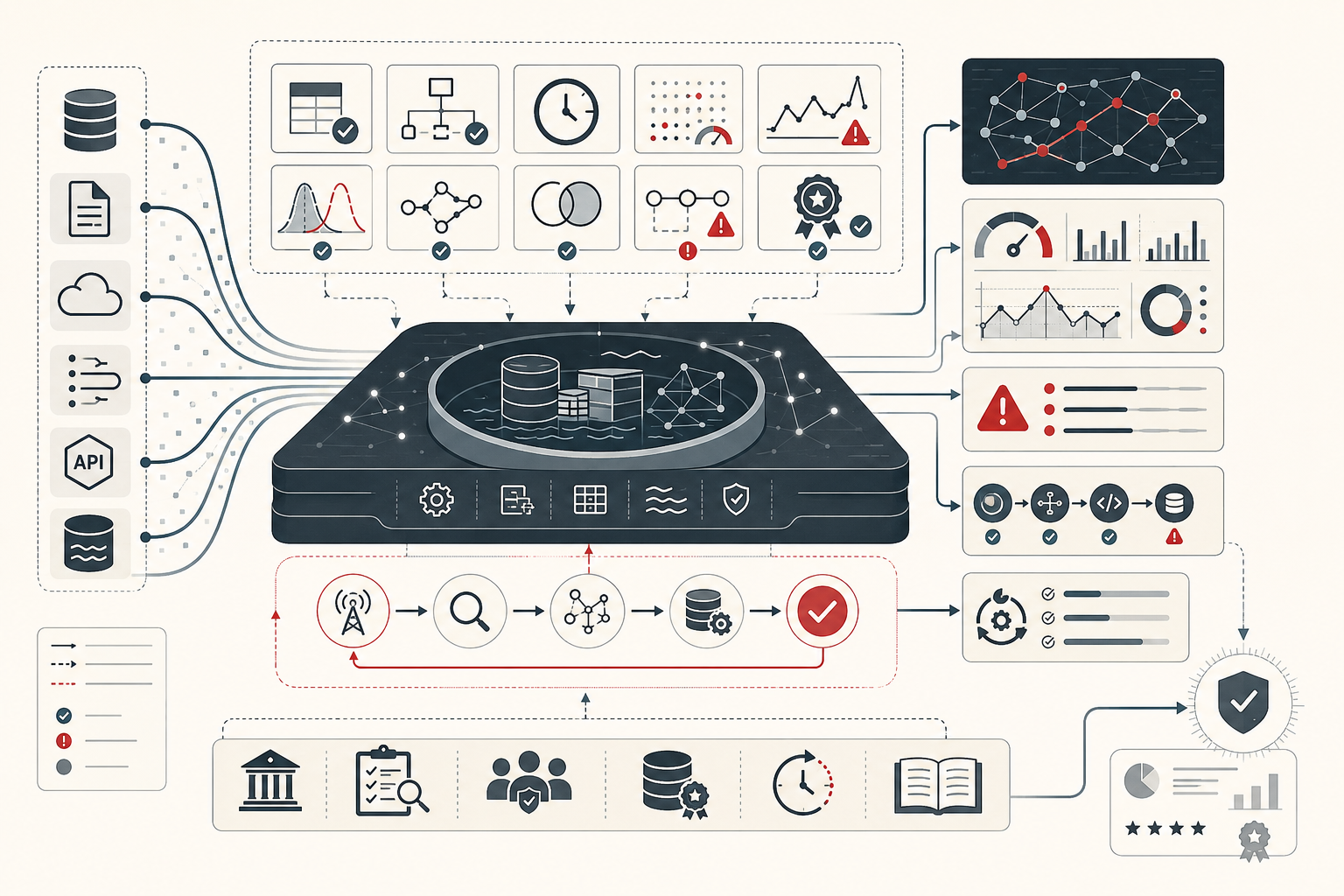
This article builds on the themes developed in Database Systems and Data Architecture, Data Governance and Stewardship, Metadata, Data Catalogs, and Lineage, Master Data Management and Entity Resolution, Analytics Engineering and Semantic Layers, and Reproducible Analytics and Versioned Data Workflows. If metadata helps explain what data assets are, lineage helps trace how they move, and reproducibility helps preserve execution history, then data quality metrics and observability help determine whether those assets remain trustworthy as they evolve across time.
A unifying thesis: data quality as institutional measurement
At the highest level, data quality should not be understood merely as a checklist of defects. It is a problem of institutional measurement. Data systems do not simply store reality; they render selected aspects of reality into representational form through classifications, forms, interfaces, instrumentation, workflows, sensors, identifiers, transformations, and business rules. What organizations call “quality” is therefore inseparable from the adequacy of those representations for specific uses. A dataset may be structurally neat and technically accessible yet still fail as a measurement instrument if it captures the wrong units, misclassifies the underlying phenomenon, lags beyond decision relevance, or changes meaning without warning.
This is why the language of fitness for use remains indispensable. A dataset that is perfectly adequate for exploratory analysis may be insufficient for executive reporting. A daily refresh may be acceptable for historical planning and unacceptable for fraud detection. A field may be complete and type-valid while still mismeasuring the thing it claims to represent. Data quality is therefore not one universal property attached to a dataset forever. It is an evaluated relationship among data, context, purpose, decision consequence, and time.
Once this is recognized, observability can be understood as the temporal extension of measurement discipline. It asks whether the conditions that once made a dataset trustworthy are still holding in operation. In that sense, observability is not just a technical convenience. It is an institutional method for preserving epistemic trust over time.
Why data quality needs measurement
Organizations often claim that they care about data quality, but many do so in abstract terms. The phrase becomes a general aspiration rather than an operational discipline. The problem is that data quality is not self-evident. A dashboard may look polished while containing stale values. A model may run successfully on features whose distributions have shifted sharply from historical norms. A pipeline may complete without error while silently dropping records. A master table may remain queryable while accumulating duplicate entities or invalid classifications. A semantic metric may keep its name while its business logic changes underneath. Without measurement, these failures remain latent.
Data quality metrics matter because they convert vague concerns into inspectable signals. They allow teams to ask concrete questions. How many required values are missing? How many records violate a business rule? How many duplicates exist for a supposedly unique entity? What percentage of records arrived within the expected window? Has the distribution of a key variable changed materially from its historical baseline? Has the number of rows dropped or spiked unexpectedly? Are reference values still valid against controlled vocabularies? Are dashboards consuming data that recently failed a critical test? Such questions are essential if quality is to become governable rather than rhetorical.
Measurement also matters because quality is contextual. Minor latency may be acceptable for monthly planning but not for operational alerting. A modest level of missingness may be tolerable in exploratory work but not in executive reporting. A slight schema shift may be manageable in a research notebook but catastrophic in a production feature pipeline. Quality metrics therefore help articulate not only whether data is “good” in the abstract, but whether it is sufficiently reliable for a specific decision, workflow, or governance requirement.
What data quality actually means
Data quality is best understood as the degree to which data is fit for a defined use. That formulation is more useful than treating quality as a single universal property. Data does not become high quality simply because it is structured neatly or stored in a modern platform. It becomes high quality when its condition aligns with the semantic, operational, analytical, ethical, and governance requirements of the task at hand.
This means that quality has multiple dimensions. Accuracy concerns whether values correctly represent the real-world phenomenon or system state they claim to describe. Completeness concerns whether required information is present. Consistency concerns whether the same concept is represented coherently across systems and time. Validity concerns whether values conform to structural rules, type expectations, domains, or business constraints. Timeliness concerns whether data is current enough for its intended use. Uniqueness concerns whether duplicate records undermine entity integrity. Integrity concerns whether relationships among records remain structurally coherent, such as valid keys and expected referential links.
These dimensions are related but not interchangeable. A dataset may be complete but inaccurate. It may be timely but inconsistent across systems. It may be structurally valid but semantically misleading. It may pass all technical tests and still be unfit for a particular decision because the underlying measurement frame is wrong. A mature quality program therefore avoids collapsing these concerns into a single vague score without preserving their interpretive differences.
Core data quality dimensions
Accuracy
Accuracy concerns whether data correctly represents the real-world object, event, condition, or status it is intended to capture. Accuracy is often the most intuitively important quality dimension, yet it is also one of the hardest to verify because it frequently requires comparison with an authoritative source, external truth condition, validated operational process, audit sample, or reconciliation target. In many environments, accuracy cannot be measured continuously in a pure sense and must instead be approximated through reconciliation, field audits, instrumentation checks, steward review, or downstream anomaly detection.
Completeness
Completeness measures whether required fields, records, entities, periods, or populations are present. Missing data is not always a defect, but when absence violates business expectations or analytical requirements, completeness becomes a critical quality signal. Completeness may be assessed at the field level, record level, entity level, temporal coverage level, or population coverage level. A missing optional marketing preference is different from a missing regulatory classification, clinical field, payroll attribute, or entity key.
Validity
Validity concerns whether values conform to defined formats, types, allowable ranges, business rules, reference lists, and structural constraints. A future date where no future event should exist, a negative quantity where only non-negative values are allowed, a code outside the approved domain, or a malformed identifier can all represent validity issues. Validity checks are among the most operationally useful because they can often be automated at scale.
Consistency
Consistency concerns whether the same concept is represented coherently across datasets, systems, periods, and consumption surfaces. A customer status that means one thing in CRM and another in billing, or a metric definition that changes silently between quarters, represents a consistency failure. Consistency is especially important in enterprise reporting and cross-functional analytics because inconsistency often produces disputes that appear technical but are actually semantic.
Timeliness and freshness
Timeliness concerns whether data is available within the timeframe required for its intended use. Freshness is a closely related observability concept that measures how recently data was updated or arrived relative to expectation. A dataset can be accurate and complete yet still operationally unfit if it is stale. Freshness thresholds therefore matter heavily in monitoring pipelines, dashboards, alerts, data products, and decision-support systems.
Uniqueness
Uniqueness concerns whether supposed duplicates undermine the integrity of records or entities. This dimension is especially important in customer, supplier, facility, product, account, patient, household, and employee domains, where duplication distorts counts, aggregation, service coordination, risk assessment, and model features. It connects directly with the challenges explored in Master Data Management and Entity Resolution.
Integrity
Integrity refers to the soundness of structural relationships within the data environment. This includes referential integrity, hierarchical validity, key relationships, lineage coherence, and alignment between dependent datasets. Integrity problems often indicate that data may be structurally queryable while still logically broken. A fact table may load, but if its foreign keys do not link correctly to customer, product, facility, or time dimensions, analytical meaning becomes unstable.
From quality dimensions to quality metrics
A quality dimension becomes operational only when it is translated into metrics, thresholds, and decision rules. It is not enough to say that completeness matters. One must define what completeness means for a specific dataset and what level of missingness is acceptable. It is not enough to value freshness. One must specify the expected update cadence and what deviation constitutes an incident. It is not enough to say that a metric should be consistent. One must define which source of truth, semantic layer, glossary, or certified metric definition governs that consistency.
Examples of quality metrics include null-rate percentages for required columns, duplicate-record rates for master entities, domain-conformance rates for controlled values, schema compliance checks, row-count variance relative to expected ranges, late-arrival counts, distribution shift scores, reconciliation rates against source systems, business-rule violation counts, referential-integrity failure counts, and semantic-definition drift indicators. These metrics allow teams to monitor not only whether data exists, but whether it remains within expected operating bounds.
Quality metrics are strongest when they are tied to material use cases. A missing postal code in a marketing segmentation table may be tolerable if unused, but missing regulatory classification in a compliance report may be critical. Mature programs therefore link metrics to downstream consequences rather than treating all defects as equally important.
Observability as epistemic visibility under partial knowledge
Data observability extends the idea of monitoring from infrastructure into the behavior of data itself. In software and platform engineering, observability concerns the ability to infer the internal state of a system from emitted signals. Applied to data systems, this means being able to detect and diagnose failures in data quality, movement, transformation, semantic meaning, and reliability before those failures cascade into dashboards, models, APIs, data products, or decisions.
But observability should not be overstated. It never provides total visibility. Data teams do not inspect the whole system directly; they infer its condition from traces, logs, metadata, lineage, runtime outputs, quality checks, distribution summaries, incident histories, and downstream symptoms. In other words, observability is a practice of diagnosis under partial knowledge. This matters because the limits of telemetry are real. A pipeline can succeed while semantics fail. A schema can remain stable while meaning changes. A distribution can move for legitimate business reasons rather than data defects. Strong observability therefore depends not only on signal collection but on contextual interpretation.
This framing makes observability more than a tooling pattern. It becomes an epistemic discipline: a structured way of reasoning from incomplete evidence about whether a data system is still behaving within trusted bounds.
Data quality at rest, data in motion, and data product reliability
One of the most important clarifications in serious quality work is that not all reliability problems occur at the same layer. Data quality at rest concerns the condition of stored datasets: are values complete, accurate, valid, unique, and consistent? Data quality in motion concerns the behavior of ingestion, transformation, synchronization, and publication processes: are records arriving on time, being dropped, duplicated, delayed, truncated, or reshaped unexpectedly? Data product reliability concerns whether a delivered analytical asset—a dashboard, feature table, semantic model, API, report, or curated product—meets the service expectations of its consumers.
These layers overlap, but they should not be collapsed. A pipeline may be operationally healthy while the data it delivers is semantically broken. A dataset may be structurally valid while violating freshness commitments to consumers. A dashboard may load normally while depending on stale or partially reconciled inputs. A feature table may refresh on schedule while its input distribution has shifted enough to undermine model behavior. The best observability programs distinguish these layers explicitly because each implies different metrics, responsibilities, and remediation paths.
This is also where service-level thinking becomes useful. A data product may have expectations for freshness, completeness, schema stability, incident response, reconciliation, or consumer notification. These can be framed as service-level objectives or operational commitments between producers and consumers. Observability makes those commitments inspectable rather than rhetorical.
The core pillars of data observability
Freshness
Freshness monitoring tracks whether data has arrived or been updated within its expected window. It helps identify stale datasets, delayed pipelines, broken schedules, or failed refresh cycles. Freshness is one of the most widely used observability signals because lateness is both common and often highly consequential.
Volume
Volume monitoring tracks unexpected changes in row counts, event counts, file counts, message throughput, or record volume. A sudden drop may indicate ingestion failure, filtering mistakes, upstream outages, source-system changes, or schema mismatches. A sudden spike may indicate duplication, replay issues, event storms, or source misconfiguration. Volume anomalies are frequently the first visible signal of a deeper defect.
Schema
Schema observability tracks changes in structure, such as new columns, dropped columns, type shifts, naming changes, altered field constraints, or incompatible payload structures. Schema drift is especially important in loosely coupled systems where downstream transformations assume stable structural expectations.
Distribution
Distribution monitoring examines whether the statistical shape of values remains within expected bounds. A change in averages, proportions, ranges, category frequencies, variance, missingness, or tail behavior can indicate upstream behavior change, instrumentation error, model drift, or altered business processes. Distributional anomalies are particularly important for analytics and machine learning contexts.
Lineage-aware impact
Observability becomes more powerful when connected to lineage. If a dataset fails freshness checks or exhibits abnormal volume, lineage helps identify which dashboards, reports, semantic metrics, APIs, feature pipelines, notebooks, or models may be affected. This connection turns isolated alerts into actionable incident response. It also reinforces the importance of the concerns discussed in Metadata, Data Catalogs, and Lineage.
Drift as a family of failure modes
One of the most important deepening moves in data quality analysis is to treat drift not as a single phenomenon but as a family of distinct failure modes. Schema drift occurs when structure changes: fields appear, disappear, rename, or shift type. Distribution drift occurs when the statistical shape of values changes materially. Concept drift occurs when the relationship between inputs and outcomes changes, particularly in predictive settings. Semantic drift occurs when a field keeps the same name and structure but changes meaning because upstream business logic, classification rules, measurement practice, or organizational process has changed.
These forms of drift matter because they produce different risks and require different responses. Schema drift may break pipelines immediately. Distribution drift may quietly distort analysis without breaking infrastructure. Concept drift may degrade model performance even when raw data appears stable. Semantic drift is often the most dangerous because it preserves surface continuity while undermining interpretive continuity. A metric may continue to populate, trend smoothly, and pass type checks even after the classification logic underneath it has changed enough to alter what the metric actually means.
For that reason, semantic drift deserves special emphasis. It is the failure mode most likely to evade purely technical observability. Detecting it often requires metadata discipline, lineage awareness, steward review, versioned business definitions, data contracts, and change-management practices that connect logic changes to downstream interpretive consequences. In high-maturity environments, observability is therefore not only about signal thresholds. It is also about guarding meaning.
A mathematical lens for data quality and observability
Data quality and observability can also be evaluated through a mathematical lens. The purpose is not to reduce institutional trust to a simplistic score, but to make the dimensions of reliability explicit. A dataset’s reliability depends on multiple quality signals, the seriousness of its downstream use, its observability coverage, and the organization’s ability to remediate defects when they occur.
Q_d = w_A A_d + w_C C_d + w_V V_d + w_T T_d + w_U U_d + w_I I_d
\]
Interpretation: Quality \(Q_d\) for dataset \(d\) can be modeled as a weighted combination of accuracy \(A_d\), completeness \(C_d\), validity \(V_d\), timeliness \(T_d\), uniqueness \(U_d\), and integrity \(I_d\).
The weights should be explicit:
w_A + w_C + w_V + w_T + w_U + w_I = 1
\]
Interpretation: The scoring model should reveal how much weight is assigned to each quality dimension. A finance reporting table may weight accuracy, reconciliation, and integrity heavily, while an operational alerting stream may weight freshness and volume stability more heavily.
Observability can be modeled as the degree to which the system exposes enough signals to detect and diagnose failure:
O_d = \frac{F_d + V_d’ + S_d + D_d + L_d + R_d}{6}
\]
Interpretation: Observability \(O_d\) for dataset \(d\) can be approximated as the average of freshness coverage \(F_d\), volume coverage \(V_d’\), schema monitoring \(S_d\), distribution monitoring \(D_d\), lineage visibility \(L_d\), and remediation tracking \(R_d\). The prime distinguishes volume \(V_d’\) from validity \(V_d\).
Trust risk can then be expressed as a function of criticality and reliability:
R_d = K_d \times (1 – Q_d O_d)
\]
Interpretation: Trust risk \(R_d\) rises when a dataset is critical \(K_d\) but quality \(Q_d\) and observability \(O_d\) are weak. A low-risk sandbox dataset and a certified finance mart should not be governed with the same thresholds.
A final lens focuses on remediation, because detection alone is not enough:
M = \frac{1}{n}\sum_{i=1}^{n}(A_i + Z_i + N_i)
\]
Interpretation: Remediation maturity \(M\) can be estimated across incidents by combining acknowledgement \(A_i\), resolution \(Z_i\), and notification \(N_i\). A team that detects incidents quickly but fails to notify consumers or resolve root causes remains operationally weak.
This mathematical lens helps shift the conversation from “do we have quality checks?” to “which datasets are reliable enough for their intended use, which signals are observable, which failures affect downstream consumers, and how quickly can we respond?”
Python Workflow: Data Quality and Observability Scorecard
The following Python workflow shows how a data platform can score datasets using quality checks, observability events, baseline coverage, lineage visibility, incident status, and certification status. In production, these inputs might come from a data catalog, quality-check framework, lineage service, pipeline orchestration logs, incident-management system, and semantic layer.
#!/usr/bin/env python3
"""
Python Workflow: Data Quality and Observability Scorecard

This compact workflow evaluates datasets as operational data products.
It combines quality checks, observability signals, baseline coverage,
lineage visibility, incident state, and certification status.
"""

from __future__ import annotations

from dataclasses import dataclass


@dataclass
class Dataset:
    dataset_id: str
    name: str
    criticality: str
    certification_status: str


@dataclass
class ReliabilitySignals:
    quality_score: float
    observability_score: float
    baseline_coverage: float
    lineage_coverage: float
    open_incidents: int


def criticality_weight(criticality: str) -> float:
    weights = {
        "high": 1.0,
        "medium": 0.7,
        "low": 0.4,
    }
    return weights.get(criticality, 0.5)


def certification_score(status: str) -> float:
    scores = {
        "certified": 1.0,
        "reviewed": 0.7,
        "uncertified": 0.2,
    }
    return scores.get(status, 0.0)


def reliability_score(dataset: Dataset, signals: ReliabilitySignals) -> float:
    incident_penalty = min(signals.open_incidents * 0.2, 0.5)

    return round(
        max(
            0.0,
            0.30 * signals.quality_score
            + 0.20 * signals.observability_score
            + 0.15 * signals.baseline_coverage
            + 0.15 * signals.lineage_coverage
            + 0.10 * certification_score(dataset.certification_status)
            + 0.10 * (1.0 - incident_penalty),
        ),
        3,
    )


def trust_risk(dataset: Dataset, signals: ReliabilitySignals) -> float:
    return round(
        criticality_weight(dataset.criticality)
        * (1.0 - reliability_score(dataset, signals)),
        3,
    )


def main() -> None:
    examples = [
        (
            Dataset(
                dataset_id="ds_revenue_mart",
                name="Revenue Mart",
                criticality="high",
                certification_status="certified",
            ),
            ReliabilitySignals(
                quality_score=1.0,
                observability_score=1.0,
                baseline_coverage=0.9,
                lineage_coverage=1.0,
                open_incidents=0,
            ),
        ),
        (
            Dataset(
                dataset_id="ds_usage_events",
                name="Product Usage Events",
                criticality="high",
                certification_status="certified",
            ),
            ReliabilitySignals(
                quality_score=0.6,
                observability_score=0.4,
                baseline_coverage=1.0,
                lineage_coverage=1.0,
                open_incidents=0,
            ),
        ),
        (
            Dataset(
                dataset_id="ds_legacy_extract",
                name="Legacy KPI Extract",
                criticality="low",
                certification_status="uncertified",
            ),
            ReliabilitySignals(
                quality_score=0.0,
                observability_score=0.4,
                baseline_coverage=0.3,
                lineage_coverage=1.0,
                open_incidents=1,
            ),
        ),
    ]

    for dataset, signals in examples:
        print(
            dataset.dataset_id,
            dataset.name,
            "reliability_score=",
            reliability_score(dataset, signals),
            "trust_risk=",
            trust_risk(dataset, signals),
        )


if __name__ == "__main__":
    main()
This workflow separates quality from criticality. A low-quality dataset is not equally risky in every context. A high-criticality finance mart, feature table, compliance report, executive dashboard, or operational alerting stream requires stricter expectations than a low-use exploratory extract. Scoring does not replace judgment, but it makes review criteria visible.
R Workflow: Data Quality, Incident, Baseline, and Remediation Summary
The following R workflow summarizes quality dimensions, observability events, baselines, incidents, and lineage impact. It supports a recurring governance review: which quality dimensions are failing, where alerting is concentrated, which baselines are in place, which incidents remain open, and which downstream assets may be affected?
#!/usr/bin/env Rscript

# R Workflow: Data Quality, Incident, Baseline, and Remediation Summary
#
# This workflow summarizes quality checks, observability events,
# baselines, incidents, and lineage impact using base R.

quality_checks <- data.frame(
  check_id = c("qc001", "qc002", "qc003", "qc004", "qc005", "qc006"),
  dataset_id = c(
    "ds_customer_360",
    "ds_customer_360",
    "ds_revenue_mart",
    "ds_revenue_mart",
    "ds_usage_events",
    "ds_usage_events"
  ),
  quality_dimension = c(
    "completeness",
    "uniqueness",
    "accuracy",
    "freshness",
    "volume",
    "distribution"
  ),
  status = c("warn", "pass", "pass", "pass", "warn", "warn"),
  severity = c("medium", "low", "high", "medium", "high", "high"),
  stringsAsFactors = FALSE
)

observability_events <- data.frame(
  event_id = c("obs001", "obs002", "obs003", "obs004"),
  dataset_id = c(
    "ds_customer_360",
    "ds_usage_events",
    "ds_usage_events",
    "ds_legacy_extract"
  ),
  event_type = c("quality", "volume", "distribution", "integrity"),
  alert_status = c("warn", "triggered", "triggered", "triggered"),
  stringsAsFactors = FALSE
)

baselines <- data.frame(
  baseline_id = c("base001", "base002", "base003", "base004"),
  dataset_id = c(
    "ds_customer_360",
    "ds_revenue_mart",
    "ds_usage_events",
    "ds_usage_events"
  ),
  baseline_type = c("proportion", "freshness_hours", "volume", "distribution_shift"),
  stringsAsFactors = FALSE
)

incidents <- data.frame(
  incident_id = c("inc001", "inc002", "inc003", "inc004"),
  dataset_id = c(
    "ds_customer_360",
    "ds_usage_events",
    "ds_legacy_extract",
    "ds_supplier_fulfillment"
  ),
  severity = c("medium", "high", "medium", "medium"),
  status = c("resolved", "resolved", "open", "in_review"),
  root_cause_category = c(
    "upstream_optional_field_change",
    "upstream_event_instrumentation_change",
    "undocumented_legacy_logic",
    "controlled_vocabulary_drift"
  ),
  time_to_ack_hours = c(2, 1, 8, 4),
  time_to_resolve_hours = c(18, 12, 0, 0),
  consumer_notified = c(TRUE, TRUE, FALSE, TRUE),
  stringsAsFactors = FALSE
)

lineage_impact <- data.frame(
  upstream_dataset = c(
    "ds_customer_360",
    "ds_revenue_mart",
    "ds_usage_events",
    "ds_usage_events"
  ),
  downstream_asset = c(
    "dash_customer_health",
    "dash_executive_revenue",
    "feature_product_activity",
    "notebook_growth_review"
  ),
  asset_type = c("dashboard", "dashboard", "feature_table", "notebook"),
  impact_level = c("high", "high", "high", "medium"),
  stringsAsFactors = FALSE
)

dimension_summary <- aggregate(
  check_id ~ quality_dimension + status + severity,
  data = quality_checks,
  FUN = length
)

names(dimension_summary) <- c(
  "quality_dimension",
  "status",
  "severity",
  "check_count"
)

event_summary <- aggregate(
  event_id ~ event_type + alert_status,
  data = observability_events,
  FUN = length
)

names(event_summary) <- c(
  "event_type",
  "alert_status",
  "event_count"
)

baseline_summary <- aggregate(
  baseline_id ~ baseline_type,
  data = baselines,
  FUN = length
)

names(baseline_summary) <- c(
  "baseline_type",
  "baseline_count"
)

incident_summary <- aggregate(
  incident_id ~ severity + status + root_cause_category,
  data = incidents,
  FUN = length
)

names(incident_summary) <- c(
  "severity",
  "status",
  "root_cause_category",
  "incident_count"
)

impact_summary <- aggregate(
  downstream_asset ~ impact_level + asset_type,
  data = lineage_impact,
  FUN = length
)

names(impact_summary) <- c(
  "impact_level",
  "asset_type",
  "dependency_count"
)

dir.create("outputs", showWarnings = FALSE, recursive = TRUE)

write.csv(dimension_summary, "outputs/quality_dimension_summary_r.csv", row.names = FALSE)
write.csv(event_summary, "outputs/observability_event_summary_r.csv", row.names = FALSE)
write.csv(baseline_summary, "outputs/baseline_summary_r.csv", row.names = FALSE)
write.csv(incident_summary, "outputs/incident_summary_r.csv", row.names = FALSE)
write.csv(impact_summary, "outputs/lineage_impact_summary_r.csv", row.names = FALSE)

cat("Wrote data quality, incident, baseline, and remediation summaries.\n")
This workflow distinguishes detection from assurance. A dataset can have many checks and still be weak if incidents remain unresolved, baselines do not match consumer expectations, lineage impact is unknown, or consumers are not notified when certified assets fail.
Observability versus monitoring
Although the terms are sometimes used interchangeably, monitoring and observability are not identical. Monitoring typically refers to checking predefined metrics or known conditions. Observability is broader. It involves the ability to understand emerging, unfamiliar, or system-level failures through a rich enough set of signals and context. In data systems, simple monitoring might alert a team when a scheduled job fails. Observability would also help detect that the job succeeded but produced anomalous values, broke downstream dependencies, or caused a freshness incident in a user-facing dashboard.
This distinction matters because many serious data failures are not infrastructure failures. They are interpretation failures, transformation failures, timing failures, reconciliation failures, semantic failures, or silent statistical failures. The pipeline runs. The table exists. The dashboard renders. Yet the content is incomplete, stale, inconsistent, or semantically shifted. Observability is valuable precisely because it aims to detect those silent failures that traditional system-status monitoring can miss.
Monitoring answers the question, “Did a known signal violate a known threshold?” Observability asks a broader question: “Can we understand what changed, where it changed, why it changed, who is affected, and what should happen next?”
Rule-based checks, statistical baselines, and learned anomaly detection
Data quality management often combines three broad forms of detection. The first is rule-based validation. These checks test whether data conforms to explicit expectations: non-null constraints, valid ranges, uniqueness rules, referential integrity, permissible values, and business logic conditions. Rule-based checks are powerful because they are interpretable and directly tied to definitions.
The second form is baseline-oriented statistical monitoring. Here the system evaluates whether observed behavior departs materially from historical or expected patterns. This might include row-count variance, shifts in category frequencies, unusual null-rate increases, or major changes in average values. These methods are especially useful because many failures are not simple violations of static rules but meaningful deviations from historical norms.
The third form is learned anomaly detection, in which the system uses more adaptive statistical or model-based methods to identify unexpected patterns that may not have been explicitly specified in advance. This can be valuable in high-volume or fast-changing systems, but it also introduces interpretability challenges. Learned detection is strongest when paired with strong lineage, metadata, and steward review; otherwise it can create opaque alerts without actionable diagnosis.
Mature programs use all three approaches in a layered way. Rules provide explicit control. Baselines provide historical sensitivity. Learned anomaly detection provides coverage for emergent failure modes. Together they create a stronger quality and observability posture than any one approach alone.
Fit-for-purpose thresholds and service levels
Not all datasets need the same quality thresholds. This is one of the most important principles in serious data quality management. A bronze-layer exploratory ingestion table may tolerate more defects than a certified finance reporting table. A near-real-time operational alerting dataset may require stricter freshness tolerances than a monthly planning dataset. A feature store used in production inference may require tighter stability constraints than a research sandbox.
For that reason, quality programs benefit from explicit service levels or data product expectations. These might specify required freshness windows, acceptable null rates, incident escalation conditions, reconciliation standards, schema stability rules, consumer notification expectations, or severity thresholds for particular domains. Such thresholds clarify that quality is not merely about technical ideals but about operational commitments between data producers and data consumers. They also connect naturally to data contracts, stewardship, and governance.
The principle is simple: quality thresholds should be proportionate to consequence. Data that supports public reporting, regulatory submissions, financial decisions, safety-critical operations, model inference, or executive decisions should receive stronger quality and observability expectations than low-risk exploratory assets.
Data contracts and quality assurance
Data contracts formalize expectations between producers and consumers of data. They may define schema commitments, semantic definitions, refresh cadence, quality expectations, ownership roles, backward-compatibility rules, and notification responsibilities when changes occur. Quality metrics and observability make these contracts operational. Without measurement and monitoring, a contract remains aspirational. With them, it becomes enforceable or at least inspectable.
This matters especially in decentralized or domain-oriented data environments. When teams publish data products for others to consume, quality expectations must be visible and testable. Observability allows producers to monitor whether their data products remain within agreed bounds, while consumers gain more confidence that the assets they depend on are not silently degrading.
A good data contract is therefore not only a schema document. It is a trust agreement. It connects technical structure, business meaning, service expectations, escalation rules, and change-management obligations. Data quality metrics are the evidence that the agreement is being honored.
Incident response, root-cause analysis, and error propagation
One of the most underdeveloped parts of many data quality programs is what happens after detection. Alerts are only the beginning. Mature observability requires an incident discipline: triage, severity assessment, lineage-aware impact analysis, root-cause investigation, remediation, communication, and post-incident learning. Otherwise organizations become good at noticing problems but poor at resolving them.
Root-cause analysis is particularly important because many downstream defects are symptoms rather than origins. A stale dashboard may originate in a delayed upstream API. A duplicate spike may originate in replay logic. A distribution shift may reflect a business-process change rather than an ingestion error. A reconciliation failure may expose a semantic disagreement rather than a technical defect. Observability should therefore help teams move from symptom recognition to causal explanation.
Error propagation also matters. A defect in one dataset may propagate through joins, aggregations, semantic layers, dashboards, experimentation systems, data products, APIs, and machine-learning models. Without lineage and impact awareness, organizations tend to remediate locally while underestimating systemic consequences. High-maturity environments therefore treat quality incidents as networked events inside a dependency graph rather than isolated anomalies.
Quality metrics in analytics and machine learning
Quality and observability are especially important in analytics and machine learning because many defects do not remain localized. A missingness spike in one source field may propagate into dashboards, forecasting models, segmentation systems, experiment analysis, or feature pipelines. A subtle change in category encoding may alter feature distributions. Duplicate entities may inflate counts and bias training sets. Label leakage or inconsistent temporal joins may create models that appear accurate in evaluation while failing in production.
For this reason, data quality monitoring should extend beyond raw ingestion tables into feature pipelines, training datasets, semantic layers, metrics definitions, and downstream reporting artifacts. Observability in these environments is not only about engineering reliability. It is about protecting inferential integrity. If the data substrate degrades, analytical conclusions degrade with it, even when the model or report continues to run without visible failure.
AI systems intensify this requirement. Retrieval systems, fine-tuning datasets, evaluation sets, prompt-grounding corpora, embeddings, feature stores, and monitoring datasets all depend on data quality. A weak data foundation can produce confident but misleading AI outputs. Quality metrics and observability are therefore part of AI governance as well as data governance.
Metadata, lineage, and observability
Observability is far more useful when connected to metadata and lineage. Metadata provides the semantic and governance context needed to interpret incidents. A freshness failure matters more when the system knows that the affected table supports a critical compliance report or executive dashboard. A schema change matters more when the changed column is documented as a certified metric dependency. Lineage reveals where the issue will propagate and which consumers may be affected.
This integration is one reason standards and frameworks matter. The ISO/IEC 25012 data quality model formalizes data quality characteristics as a structured model rather than an improvised checklist. The W3C Data Quality Vocabulary provides a framework for describing dataset quality in a way that supports user judgment about fitness for purpose. The W3C Data on the Web Best Practices emphasizes that data should be discoverable and understandable by both humans and machines. DCAT 3 provides an interoperability-oriented vocabulary for data catalogs, which matters because observability gains force when alerts can be tied to cataloged, owned, documented assets. Meanwhile, OpenLineage treats lineage as interoperable metadata about datasets, jobs, and runs, which is directly relevant to observability because impact analysis and root-cause investigation depend on knowing how assets relate.
This is why observability should not be implemented as a detached alert stream. It should be integrated into the broader knowledge structure of the data platform. Alerts should be attributable to owned assets, linked to documented definitions, and connected to downstream dependencies wherever possible. Such integration helps transform noisy monitoring into governed operational response.
Governance, stewardship, and the economics of remediation
Data quality problems do not resolve themselves simply because they are detected. Organizations need operating models for triage, ownership, escalation, and remediation. Which team owns freshness for a given dataset? Who investigates a failed reconciliation? When does a volume anomaly become an incident? Which stakeholders must be notified if a certified dashboard is affected? How are quality exceptions documented, approved, or tolerated temporarily?
These questions place data quality squarely within governance and stewardship. A mature environment treats quality incidents much like operational incidents in software systems: they are assigned, tracked, communicated, and resolved through defined workflows. This requires ownership clarity and institutional discipline, not merely tooling. It also underscores why the themes developed in Data Governance and Stewardship remain central here.
There is also an economics of remediation. Some defects are expensive to prevent fully and cheaper to detect quickly. Others are so consequential that preventive controls are justified even at substantial cost. High-maturity quality management therefore requires explicit judgment about where to invest in prevention, where to invest in fast detection, where temporary tolerance is acceptable, and where defects are too costly to tolerate. Quality is not only a technical problem. It is a problem of institutional prioritization under constrained attention and limited governance capacity.
Common failure modes
Organizations often struggle with data quality and observability in predictable ways. One failure mode is overreliance on generic metrics that are easy to compute but weakly tied to business impact. Another is excessive alerting without prioritization, which produces fatigue and reduces trust in the monitoring system. A third is quality theater: teams define many rules but lack ownership or remediation processes, so violations accumulate without consequence.
A fourth failure mode is focusing only on structural validity while ignoring semantic drift. A field may still contain values of the correct type while its meaning has shifted materially. A fifth is treating observability as an engineering-only concern, detached from business definitions, data contracts, stewardship, and downstream use. A sixth is assuming that certification at one moment guarantees continuing reliability, even in environments where upstream systems and processes change constantly.
A seventh is poor lineage integration. Alerts fire, but teams cannot quickly determine which dashboards, models, APIs, or consumers are affected. An eighth is weak incident follow-through: problems are detected but not resolved, not communicated, not documented, or not converted into prevention improvements. A ninth is single-score oversimplification, where a vague quality grade hides which dimension is actually failing and why it matters.
These failures show that data quality is not simply about measurement volume. It is about designing a disciplined relationship between metrics, meaning, ownership, and action.
Implementation principles
Start with critical data products. Begin with datasets, pipelines, semantic metrics, dashboards, reports, APIs, feature tables, and models whose failure would create material operational, analytical, regulatory, reputational, or decision risk. Not everything requires the same depth of monitoring immediately.
Define quality in context. Translate broad quality dimensions into domain-specific metrics, thresholds, and business rules tied to real use cases rather than generic ideals.
Combine rules with baselines and adaptive detection. Use explicit validation rules for known expectations, statistical baselines for historical sensitivity, and more adaptive anomaly detection where system scale and volatility justify it.
Connect observability to lineage. Alerts become more useful when teams can see which downstream data products, models, dashboards, APIs, and decisions may be affected.
Assign clear ownership. Each critical dataset or data product should have identified owners or stewards responsible for quality expectations and incident response.
Measure remediation, not just detection. Detection coverage matters, but teams should also track mean time to acknowledge, mean time to resolve, recurrence rates, unresolved exception burdens, consumer notifications, and trust impacts.
Treat quality as operational, not ceremonial. Quality metrics should inform decisions, escalation, and trust signals. They should not exist merely to populate dashboards about dashboards.
| Control | Purpose | Failure it prevents |
|---|---|---|
| Quality dimensions | Separate accuracy, completeness, validity, consistency, timeliness, uniqueness, and integrity | Vague “quality” claims that hide distinct failure modes |
| Fit-for-purpose thresholds | Align quality expectations with decision context and criticality | Over-monitoring low-risk assets and under-protecting critical products |
| Freshness monitoring | Detects delayed or stale datasets | Dashboards, reports, or alerts using outdated data |
| Volume and distribution baselines | Detects unexpected shifts in record counts or value patterns | Silent drops, replays, instrumentation errors, and drift |
| Schema monitoring | Tracks structural changes in fields, types, and constraints | Broken transformations and incompatible downstream assumptions |
| Lineage-aware impact | Connects incidents to affected dashboards, models, APIs, and data products | Local remediation that ignores systemic downstream effects |
| Incident response | Defines triage, ownership, severity, communication, and remediation | Alerts without action or accountability |
| Remediation metrics | Tracks acknowledgement, resolution, recurrence, and consumer notification | Quality programs that detect problems but do not improve reliability |
GitHub Repository
This article can be paired with a companion code workflow that models data quality and observability as operational assurance for data products. The example includes a dataset registry, quality-check inventory, observability events, baselines, incidents, lineage-impact records, SQL schemas, scorecard scripts, typed contracts, governance checklists, incident documentation, and multi-language examples across Python, R, Julia, SQL, Go, Rust, C, C++, TypeScript, and Terraform placeholders.
The companion repository provides a vendor-neutral data quality and observability scaffold with dataset reliability scoring, quality-dimension summaries, incident review, baseline coverage, lineage-impact analysis, SQL governance queries, typed contracts, documentation, and CI smoke-test patterns.
Conclusion
Data quality metrics and observability are essential to modern data systems because they make reliability inspectable in environments where silent failure is common and downstream dependence is high. Quality metrics define what trustworthy data means in operational terms. Observability helps detect when real systems deviate from those expectations through freshness failures, schema drift, anomalous volumes, distribution shifts, integrity problems, semantic drift, broken dependencies, and incident patterns.
Together, these capabilities move organizations from episodic validation to continuous assurance. More importantly, they help preserve epistemic trust: the ability of people and institutions to rely on data products with justified confidence rather than habit, hope, or interface polish. That is why data quality metrics and observability are not peripheral technical refinements. They are part of the institutional infrastructure required for serious analytics, responsible reporting, reliable data products, and defensible decision quality.
Related articles
- Data Systems and Analytics knowledge series
- Database Systems and Data Architecture
- Data Governance and Stewardship
- Metadata, Data Catalogs, and Lineage
- Master Data Management and Entity Resolution
- Analytics Engineering and Semantic Layers
- Model Evaluation and Performance Metrics
Further reading
- Batini, C. and Scannapieco, M. (2016) Data and Information Quality: Dimensions, Principles and Techniques. Cham: Springer.
- Kleppmann, M. (2017) Designing Data-Intensive Applications. Sebastopol: O’Reilly Media.
- Redman, T.C. (2008) Data Driven: Profiting from Your Most Important Business Asset. Boston: Harvard Business Press.
- Taleb, N.N. (2012) Antifragile: Things That Gain from Disorder. New York: Random House.
- Zaveri, A. et al. (2016) ‘Quality assessment for linked data: A survey’, Semantic Web, 7(1), pp. 63–93.
- Zeng, M.L. and Qin, J. (2016) Metadata. 2nd edn. Chicago: ALA Neal-Schuman.
References
- Batini, C. and Scannapieco, M. (2016) Data and Information Quality: Dimensions, Principles and Techniques. Cham: Springer.
- ISO (2008) ISO/IEC 25012:2008 Software engineering — Software product Quality Requirements and Evaluation (SQuaRE) — Data quality model. Geneva: International Organization for Standardization. Available at: https://www.iso.org/standard/35736.html
- OpenLineage (n.d.) About OpenLineage. Available at: https://openlineage.io/docs/
- OpenLineage (n.d.) Object Model. Available at: https://openlineage.io/docs/next/spec/object-model/
- Redman, T.C. (2008) Data Driven: Profiting from Your Most Important Business Asset. Boston: Harvard Business Press.
- W3C (2016) Data Quality Vocabulary. Available at: https://www.w3.org/TR/vocab-dqv/
- W3C (2017) Data on the Web Best Practices. Available at: https://www.w3.org/TR/dwbp/
- W3C (2024) Data Catalog Vocabulary (DCAT) – Version 3. Available at: https://www.w3.org/TR/vocab-dcat-3/
- Zaveri, A. et al. (2016) ‘Quality assessment for linked data: A survey’, Semantic Web, 7(1), pp. 63–93.
- Zeng, M.L. and Qin, J. (2016) Metadata. 2nd edn. Chicago: ALA Neal-Schuman.