
Last Updated May 10, 2026
Robustness and adversarial resilience in machine learning concern whether an AI system continues to behave dependably when inputs are perturbed, environments shift, data pipelines degrade, or an adversary deliberately tries to induce failure. Standard model evaluation usually asks whether a system performs well on held-out data that resembles the training distribution. Deployed AI systems face a harder problem. They encounter noisy inputs, corrupted records, compression artifacts, sensor failures, changing user behavior, unfamiliar environments, manipulated prompts, poisoned data, hostile queries, and downstream systems that may amplify small errors into larger consequences.
The central argument of this article is that robustness should not be treated as a narrow technical add-on to machine learning. It is part of what model quality means when AI systems operate in the world. A model that performs well only under clean benchmark conditions may be statistically impressive but operationally fragile. A serious AI system must be evaluated under stress, governed through explicit threat models, monitored during deployment, and supported by fallback procedures when confidence declines.
Adversarial resilience extends robustness into security, governance, and system design. It asks what happens when someone deliberately probes, perturbs, poisons, extracts, bypasses, or manipulates the model or its surrounding infrastructure. A machine learning system can appear accurate and still remain fragile under worst-case perturbations, distribution shift, prompt injection, model extraction, data poisoning, hidden backdoors, or cascading failures across dependent services. Robustness is therefore not only a model property. It is a lifecycle discipline.
Main Library
Publications
Article Map
Artificial Intelligence Systems
Related Topic
Data Systems & Analytics
Related Topic
Institutions & Governance
Related Topic
Risk & Resilience
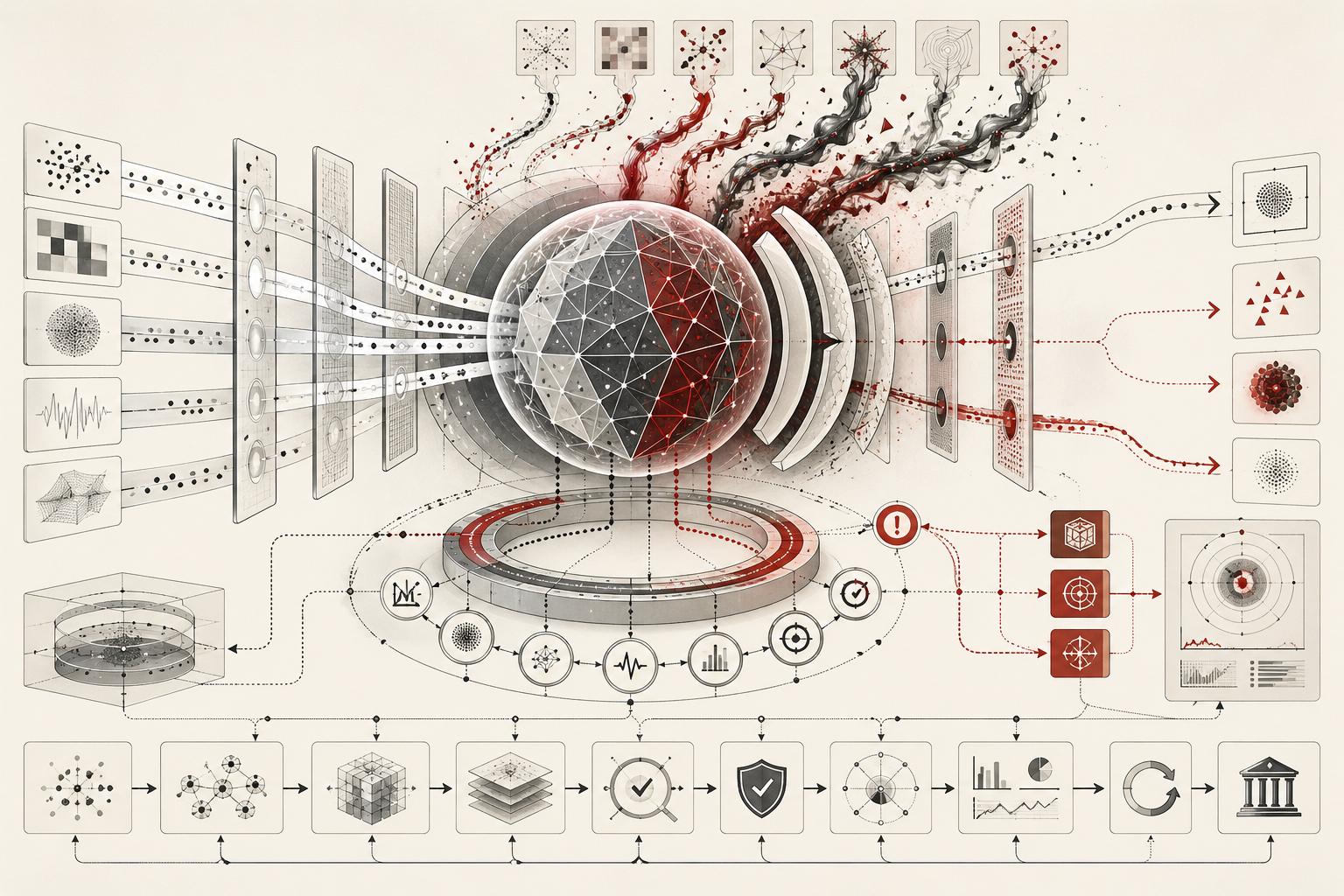
This article develops Robustness and Adversarial Resilience in Machine Learning as an advanced article within the Artificial Intelligence Systems knowledge series. It explains adversarial examples, perturbation geometry, threat models, attacker knowledge, evasion, poisoning, model extraction, privacy attacks, backdoors, robust optimization, adversarial training, evaluation discipline, false security, certification, physical-world robustness, distribution shift, runtime monitoring, resilience governance, and system-level failure propagation. Selected Python and R examples appear here, while the full GitHub repository contains expanded computational scaffolding for robustness diagnostics, adversarial perturbation experiments, evaluation metadata, SQL schemas, resilience checklists, model-card notes, audit documentation, and advanced Jupyter notebooks.
Why Robustness and Adversarial Resilience Matter
Robustness matters because machine learning systems are deployed in environments that differ from clean benchmark conditions. A model trained on curated data may encounter sensor noise, compression artifacts, missing values, domain drift, unusual cases, changing user behavior, new equipment, new language, adversarial probes, or maliciously crafted inputs. When the model is embedded in a high-stakes system, these failures can affect safety, security, reliability, fairness, institutional trust, and downstream decision quality.
Adversarial resilience matters because machine learning systems can become targets. Attackers may attempt to cause misclassification, degrade service, poison training data, extract model behavior, infer private information, trigger hidden backdoors, manipulate prompts, or bypass detection. These attacks may occur before training, during training, at deployment, at inference time, or through the surrounding workflow. NIST’s adversarial machine learning taxonomy is useful because it treats adversarial ML as a lifecycle security problem rather than a narrow image-classification issue.
The central lesson is that model performance must be evaluated against stress. Standard accuracy answers one question: how often does the model predict correctly under the evaluated distribution? Robustness asks a different question: how stable is the model when the input, data-generating process, attacker behavior, or deployment environment changes? In operational AI systems, both questions matter.
Clean\ Accuracy \neq Operational\ Reliability
\]
Interpretation: A model can perform well on ordinary evaluation data while remaining fragile under perturbation, shift, attack, corrupted inputs, or deployment stress.
Robustness also matters because AI systems increasingly participate in larger institutional processes. A classification model may prioritize medical images for review. A fraud model may shape access to financial services. A computer-vision model may inform autonomous navigation. A language model may summarize policy, draft operational guidance, or retrieve institutional knowledge. In these settings, a failure is not just a wrong prediction. It can become an unsafe action, unfair denial, misleading explanation, regulatory breach, or cascading system failure.
| System Context | What Can Go Wrong? | Why Robustness Matters | Governance Need |
|---|---|---|---|
| Computer vision | Small perturbations, blur, lighting, occlusion, or stickers can alter predictions. | Perception errors may affect inspection, diagnosis, surveillance, or autonomous systems. | Physical-world testing, uncertainty routing, and human review. |
| Language models | Prompt injection, poisoned retrieval context, hallucinated support, or adversarial instructions can distort output. | Generated text may be mistaken for verified knowledge or institutional policy. | Retrieval controls, source validation, tool-use limits, and audit logs. |
| Fraud and security systems | Attackers may probe thresholds, evade detection, or mimic legitimate behavior. | Models face strategic adversaries who adapt to system behavior. | Threat modeling, rate limits, monitoring, red teaming, and incident response. |
| Public-sector decision support | Distribution shift, missing data, or biased proxies can degrade decision quality. | Model fragility can affect rights, benefits, services, and institutional trust. | Documentation, appeal pathways, impact assessment, and human accountability. |
| Infrastructure and industrial systems | Sensor drift, cyber compromise, corrupted telemetry, or edge-case conditions can cause failure. | Local model errors can propagate through critical systems. | Fail-safe design, fallback logic, redundancy, and operational resilience planning. |
Note: Robustness is not only about resisting attacks. It is about dependable behavior under realistic stress, uncertainty, and operational change.
Foundations of Robustness in Machine Learning
Robustness can be defined broadly as stability of behavior under perturbation, uncertainty, or environmental change. A robust model should not change its output arbitrarily when irrelevant details change, when small measurement noise appears, when realistic input variation occurs, or when the deployment environment differs from training data. A resilient system should also detect, contain, and recover from failures when robustness is imperfect.
This distinction matters. Robustness is often treated as a model property. Resilience is a system property. A model may be robust to a bounded mathematical perturbation but deployed inside a fragile pipeline. Conversely, a model may not be perfectly robust, but the system around it may include monitoring, fallback rules, human review, anomaly detection, rollback, redundancy, and incident response that prevent local errors from becoming severe harm.
Robustness must always be specified relative to a perturbation set, distributional assumption, or threat model. A classifier may be robust to random Gaussian noise but fragile to worst-case perturbations. A vision model may be robust to small pixel changes but fragile to lighting, rotation, blur, occlusion, or sensor artifacts. A language model may handle paraphrase but fail under prompt injection, adversarial instructions, or poisoned retrieval context. A model is not simply “robust” in the abstract; it is robust against specified stresses under specified assumptions.
Robustness = Stability\ Under\ Specified\ Stress
\]
Interpretation: Robustness claims are meaningful only when the relevant perturbations, distributions, threat models, and deployment assumptions are clearly stated.
| Layer | Robustness Question | Common Stress | Evidence Artifact |
|---|---|---|---|
| Input layer | Can the system handle noise, missingness, corruption, or manipulation? | Blur, compression, malformed records, prompt injection, corrupted telemetry. | Input validation report, anomaly logs, data-quality tests. |
| Model layer | Does the model remain stable under allowed perturbations or shift? | Adversarial examples, distribution shift, out-of-distribution cases. | Robustness evaluation, model card, benchmark report. |
| Pipeline layer | Can preprocessing, retrieval, tool use, and post-processing resist failure? | Poisoned retrieval, schema drift, tool misuse, stale sources. | Pipeline audit, lineage metadata, version-control records. |
| Interface layer | Do users understand confidence, uncertainty, limitations, and escalation pathways? | Overtrust, ambiguous warnings, hidden failures, misleading explanations. | User-facing disclosure, review workflow, escalation protocol. |
| Governance layer | Who monitors, owns, reviews, and corrects robustness failures? | Unassigned incidents, unreviewed drift, outdated threat model. | Risk register, incident log, owner matrix, audit trail. |
Note: Strong robustness practice evaluates not only the model, but the system in which the model operates.
Adversarial Examples and the Geometry of Failure
Adversarial examples are inputs intentionally modified so that a model makes an incorrect prediction while the modified input remains close to the original under some mathematical or perceptual criterion. Their importance is not limited to the fact that models can be fooled. They reveal that model decision boundaries may behave very differently from human perceptual similarity.
An adversarial example can be represented as:
x’ = x + \delta
\]
Interpretation: An adversarial input \(x’\) is formed by adding perturbation \(\delta\) to original input \(x\).
A common constraint is:
\left\|x’-x\right\|_p \leq \epsilon
\]
Interpretation: The adversarial input must remain within an allowed perturbation radius \(\epsilon\) under norm \(p\).
The adversarial objective is often:
f(x’) \neq y
\]
Interpretation: The perturbed input causes the model to produce an incorrect label or output.
Szegedy and colleagues showed that neural networks can misclassify inputs after carefully chosen perturbations that appear minor to humans. Goodfellow, Shlens, and Szegedy later argued that adversarial vulnerability can arise from the approximately linear behavior of high-dimensional models. Even small changes across many dimensions can accumulate into a large change in model activation. This helped shift the field away from treating adversarial examples as rare curiosities and toward understanding them as evidence of brittle geometry in learned decision boundaries.
The key conceptual mismatch is this: two inputs can appear nearly identical to humans while lying on opposite sides of a model’s decision boundary. Standard accuracy may hide this fragility because held-out test points do not necessarily probe nearby worst-case directions.
| Concept | Meaning | Why It Matters | Governance Question |
|---|---|---|---|
| Perturbation | A small change to input data. | May expose unstable model behavior. | What perturbations are realistic for this use case? |
| Norm bound | A mathematical limit on perturbation size. | Defines an attack constraint for evaluation. | Does the norm reflect meaningful real-world similarity? |
| Decision boundary | The model’s separation between classes or outputs. | May behave differently from human perceptual categories. | Has boundary fragility been tested near important cases? |
| Transferability | Adversarial examples may affect more than one model. | Black-box attackers may exploit surrogate models. | Has the system been tested against transfer attacks? |
| Physical robustness | Attacks may survive printing, photographing, sensor capture, or environmental change. | Digital robustness may not imply deployed robustness. | Has testing included realistic physical pipelines? |
Note: Adversarial examples are not only a security problem. They reveal how learned representations can diverge from human, institutional, or physical notions of similarity.
Human\ Similarity \neq Model\ Similarity
\]
Interpretation: Inputs that appear similar to people may not be close in the way a model organizes its decision boundary.
Threat Models, Attacker Knowledge, and Objectives
Adversarial resilience cannot be evaluated without an explicit threat model. A threat model defines what the attacker wants, what the attacker knows, what the attacker can change, when the attack occurs, how much access the attacker has, and what constraints limit the attack. Without this, robustness claims are often vague or misleading.
A threat model can be represented as:
\mathcal{T}=(G,A,K,C,L)
\]
Interpretation: A threat model includes attacker goal \(G\), actions \(A\), knowledge \(K\), capabilities \(C\), and lifecycle stage \(L\).
Attacker knowledge is often described as white-box, gray-box, or black-box. In a white-box setting, the attacker may know architecture, parameters, gradients, and defense mechanisms. In a black-box setting, the attacker may only query the model or rely on transferability from a surrogate model. Gray-box settings fall between these extremes.
Attacker objectives also differ. Some attacks are targeted: the attacker wants a specific wrong output. Others are untargeted: any wrong output is enough. Some attacks seek evasion at inference time. Others seek poisoning during training, extraction after deployment, privacy leakage through membership inference, or degradation of availability. Robustness evaluation must match the relevant attacker objective.
| Dimension | Question | Examples | Why It Matters |
|---|---|---|---|
| Goal | What does the attacker want? | Misclassification, targeted output, data theft, denial of service, hidden backdoor. | Different goals require different tests and defenses. |
| Capability | What can the attacker change? | Input pixels, prompts, training records, labels, retrieval documents, API queries. | Defines the feasible attack surface. |
| Knowledge | What does the attacker know? | White-box gradients, black-box queries, partial architecture knowledge. | Shapes attack strength and evaluation design. |
| Timing | When does the attack occur? | Before training, during training, at deployment, at inference, after output publication. | Connects robustness to the AI lifecycle. |
| Constraint | What limits the attacker? | Norm bound, perceptibility, query budget, physical feasibility, access control. | Prevents evaluation from becoming unrealistic or underspecified. |
| Consequence | What happens if the attack succeeds? | Safety failure, privacy loss, fraud, misinformation, service disruption, governance breach. | Determines risk tolerance and required safeguards. |
Note: Robustness claims should always be attached to a documented threat model, not stated as universal properties.
No\ Threat\ Model \rightarrow No\ Meaningful\ Robustness\ Claim
\]
Interpretation: Without attacker assumptions, access conditions, perturbation limits, and lifecycle scope, robustness claims are too vague to govern.
Evasion, Poisoning, Extraction, Privacy, and Backdoor Attacks
Adversarial machine learning includes several distinct attack classes. Treating them as one generic “adversarial risk” obscures the design problem. A defense against one attack class does not automatically protect against another.
- Evasion attacks: the attacker manipulates inputs at inference time to cause incorrect outputs.
- Poisoning attacks: the attacker corrupts training data, labels, feedback, or fine-tuning examples to alter the learned model.
- Backdoor or trojan attacks: the attacker inserts a hidden trigger that causes malicious behavior under specific conditions.
- Model extraction attacks: the attacker queries the model to reconstruct behavior, steal intellectual property, or build a surrogate model.
- Privacy attacks: the attacker infers sensitive information about training data, membership, memorized content, or model behavior.
- Availability attacks: the attacker degrades system performance, increases costs, exhausts resources, or causes denial of service.
- Retrieval and tool attacks: the attacker manipulates retrieved context, tool calls, connectors, or system instructions around the model.
A poisoning attack can be written conceptually as:
D_{\mathrm{train}}’ = D_{\mathrm{train}} \cup D_{\mathrm{poison}}
\]
Interpretation: A poisoned training set includes malicious or corrupted examples added to the original training data.
A backdoor behavior can be represented as:
f(x+\tau)=y_{\mathrm{target}}
\]
Interpretation: When trigger \(\tau\) is present, the model outputs attacker-chosen target \(y_{\mathrm{target}}\).
These distinctions matter because defenses are attack-specific. Adversarial training against bounded evasion does not automatically prevent poisoning. Input filtering does not automatically prevent extraction. Differential privacy does not automatically prevent adversarial examples. Retrieval grounding does not automatically prevent prompt injection. Robustness must be designed against the relevant class of threat.
| Attack Class | Lifecycle Stage | Primary Target | Example Defense | Defense Limitation |
|---|---|---|---|---|
| Evasion | Inference | Input-output behavior | Adversarial training, detection, input validation. | May fail against stronger or different attacks. |
| Poisoning | Training or fine-tuning | Training data and learning process | Data provenance, outlier review, trusted data pipelines. | Subtle poisons may evade simple filters. |
| Backdoor | Training, fine-tuning, model supply chain | Hidden trigger behavior | Model inspection, trigger search, supply-chain controls. | Triggers can be rare, compositional, or hard to detect. |
| Extraction | Deployment | Model behavior or parameters | Rate limits, monitoring, output controls, watermarking. | Useful APIs may still reveal model behavior through queries. |
| Privacy inference | Deployment or release | Training membership or memorized data | Differential privacy, redaction, memorization testing. | Privacy guarantees depend on assumptions and implementation. |
| Prompt injection | Inference and tool use | Instructions, retrieved content, tool execution | Instruction hierarchy, content isolation, tool permissions. | Natural-language boundaries can remain difficult to enforce. |
Note: Attack classes differ by timing, access, objective, and system surface. A resilience program should map each class to controls, tests, owners, and evidence.
Robust Optimization and Adversarial Training
Madry and colleagues reframed adversarial robustness as a robust optimization problem. The goal is not merely to minimize average training loss, but to minimize worst-case loss within a permitted perturbation set. This provides a principled way to think about adversarial training.
A standard empirical risk objective is:
\min_{\theta}\frac{1}{n}\sum_{i=1}^{n}\ell(f_{\theta}(x_i),y_i)
\]
Interpretation: Standard training minimizes average loss over observed examples.
A robust optimization objective can be written as:
\min_{\theta}\frac{1}{n}\sum_{i=1}^{n}
\max_{\delta \in \Delta}
\ell(f_{\theta}(x_i+\delta),y_i)
\]
Interpretation: Robust training minimizes worst-case loss over allowed perturbations \(\Delta\).
Adversarial training incorporates perturbed examples into the learning process. This often improves empirical robustness against the attack family used in training. But it has costs. It can be computationally expensive, reduce clean accuracy, depend heavily on the perturbation model, and fail when evaluated against stronger or different attacks. Robust training therefore improves resilience only relative to explicit assumptions.
A useful operational rule is: never treat adversarial training as a universal defense. Treat it as one component in a broader robustness strategy that includes evaluation, monitoring, certification where feasible, fallback design, and governance.
| Design Choice | Question | Tradeoff | Documentation Need |
|---|---|---|---|
| Perturbation set | What changes are allowed during training? | Narrow sets may miss realistic attacks; broad sets may be expensive or unrealistic. | Define \(\Delta\), norm type, radius, and task rationale. |
| Attack strength | How hard does the inner maximization search? | Weak attacks produce false robustness; strong attacks increase cost. | Record method, iterations, restarts, and parameters. |
| Clean accuracy | How well does the model perform on normal inputs? | Adversarial training may reduce clean performance. | Report clean and robust metrics together. |
| Compute budget | How much training cost is acceptable? | Robust training can be substantially more expensive. | Record hardware, runtime, and reproducibility settings. |
| Deployment fit | Do training stresses match real-world risk? | Training against the wrong stress may create misplaced confidence. | Connect training assumptions to the threat model. |
Note: Robust optimization is powerful because it makes attacker assumptions explicit, but its guarantees remain conditional on the perturbation set and evaluation method.
Robust\ Training \neq Universal\ Defense
\]
Interpretation: Adversarial training improves robustness against specified attacks, but it does not eliminate poisoning, extraction, privacy leakage, prompt injection, or deployment shift.
Evaluation, Attack Strength, and False Security
A major lesson of adversarial machine learning is that weak evaluation can create illusions of security. Carlini and Wagner showed that defenses that appeared strong could fail under stronger, adaptive attacks. Athalye, Carlini, and Wagner later emphasized that some defenses appeared robust because they obscured gradients rather than genuinely improving security. Croce and Hein’s AutoAttack framework helped raise the evaluation standard by combining diverse parameter-free attacks for more reliable adversarial robustness assessment.
An empirical robust accuracy metric can be written as:
A_{\mathrm{robust}}=
\frac{1}{n}\sum_{i=1}^{n}
\mathbf{1}\left[f_{\theta}(x_i+\delta_i^*)=y_i\right]
\]
Interpretation: Robust accuracy measures the fraction of examples still classified correctly after strong adversarial perturbation.
The adversarial perturbation is typically chosen to maximize loss:
\delta_i^*=\arg\max_{\delta \in \Delta}
\ell(f_{\theta}(x_i+\delta),y_i)
\]
Interpretation: The attack searches for the allowed perturbation that most increases model loss.
Evaluation must avoid gradient masking, weak attacks, incomplete threat models, and cherry-picked metrics. A serious robustness evaluation should include adaptive attacks, transfer attacks, black-box attacks when relevant, corruption tests, ablations, and transparent reporting of assumptions. Evaluation should report not only the final robust accuracy, but the attack configuration, perturbation budget, failure cases, confidence behavior, runtime cost, and whether the defense was tested by someone independent from the model builders.
False security is worse than known fragility. A system known to be fragile can be constrained, monitored, or kept out of high-risk deployment. A system incorrectly believed to be robust may be deployed with inadequate safeguards.
| Failure Pattern | Description | Why It Misleads | Better Practice |
|---|---|---|---|
| Weak attack | The evaluation attack is poorly tuned or too shallow. | The defense appears stronger than it is. | Use strong baselines, multiple attacks, restarts, and adaptive testing. |
| Gradient masking | The defense disrupts gradients without removing vulnerability. | Gradient-based attacks fail, but other attacks may succeed. | Test black-box, transfer, adaptive, and gradient-free attacks. |
| Cherry-picked budget | Only favorable perturbation radii are reported. | Robustness curve is hidden. | Report performance across multiple perturbation budgets. |
| Unclear threat model | Attacker goals, knowledge, or access are not specified. | Readers cannot interpret the robustness claim. | Document attacker assumptions and lifecycle stage. |
| Narrow metric | Only robust accuracy is reported. | Confidence, calibration, fairness, latency, and failure severity may be ignored. | Use a multi-metric evaluation report. |
Note: Robustness evaluation is itself a security-sensitive process. Weak testing can become a pathway to unsafe deployment.
Weak\ Evaluation \rightarrow False\ Security
\]
Interpretation: A model may appear robust if the evaluation procedure is weaker than the threats it will face.
Verification, Certification, and Formal Guarantees
Empirical attacks can show that a model is vulnerable, but they cannot prove that no adversarial examples exist. Verification and certification methods attempt to provide stronger guarantees: within a specified perturbation region, the model’s prediction cannot change, or the model is certified robust with a specified radius.
A certification statement can be written as:
\forall x’ \; \left(\left\|x’-x\right\|_p \leq \epsilon \rightarrow f(x’)=f(x)\right)
\]
Interpretation: For every allowed perturbation within radius \(\epsilon\), the model prediction remains unchanged.
Mixed-integer programming, convex relaxations, interval bound propagation, randomized smoothing, abstract interpretation, and other methods have been used to certify robustness under specific assumptions. These methods matter because they can provide lower bounds on robustness rather than relying only on attack success or failure.
However, certification has limitations. It often scales poorly to very large models, may apply only to certain architectures or norms, and may certify robustness against a narrow perturbation class while leaving other failure modes unaddressed. A certified image classifier may still fail under distribution shift, data poisoning, backdoor triggers, sensor artifacts, or downstream misuse. Formal guarantees are powerful, but they must be interpreted carefully.
| Approach | What It Provides | Useful For | Limitation |
|---|---|---|---|
| Exact verification | Attempts to prove robustness properties exactly. | Small networks or constrained settings. | May not scale to modern deep models. |
| Convex relaxation | Bounds model behavior using tractable approximations. | Certified lower bounds on robustness. | Bounds may be loose or architecture-specific. |
| Interval bound propagation | Propagates input intervals through the network. | Efficient robustness certificates. | May be conservative or limited by model structure. |
| Randomized smoothing | Certifies robustness for smoothed classifiers. | Probabilistic certification under certain norms. | May require many samples and specific assumptions. |
| Runtime verification | Checks outputs or actions against constraints during deployment. | Agents, robotics, tool use, and high-impact workflows. | Cannot cover all model internals or unforeseen states. |
Note: Certification narrows uncertainty under defined assumptions. It does not eliminate the need for monitoring, governance, and system-level resilience.
Certified\ Radius \neq Total\ System\ Safety
\]
Interpretation: A formal guarantee may be valuable within a defined perturbation region while leaving other risks outside the certificate.
Physical-World Robustness and Deployment Risk
Adversarial fragility is not confined to digital tensors. Adversarial examples can survive physical capture pipelines such as printing, photographing, camera capture, sensor noise, lighting changes, or environmental transformation. This matters because many deployed AI systems perceive the world through cameras, microphones, sensors, logs, documents, scanners, or user interfaces rather than idealized digital arrays.
Physical-world robustness introduces additional complexity. Lighting, viewpoint, distance, blur, occlusion, compression, sensor noise, weather, calibration, and environmental context can all change model behavior. A perturbation that works digitally may fail physically, but a physical attack may also exploit weaknesses not captured by digital tests.
A physical perception pipeline can be represented as:
x_{\mathrm{sensor}} = P(x_{\mathrm{world}},\eta)
\]
Interpretation: Sensor input depends on the physical world state \(x_{\mathrm{world}}\) and environmental or sensor noise \(\eta\).
Deployment robustness therefore requires testing the sensing pipeline, not just the model. Autonomous systems, robotics, medical imaging, industrial inspection, surveillance, infrastructure monitoring, and environmental sensing all require robustness evaluation under realistic physical conditions.
| Stressor | Example | Model Risk | Testing Need |
|---|---|---|---|
| Lighting and weather | Glare, shadows, fog, rain, snow, smoke. | Visual features shift or disappear. | Scenario testing across environmental conditions. |
| Viewpoint and distance | Object angle, scale, partial visibility. | Classifier confidence may change sharply. | Physical capture and sensor-position testing. |
| Sensor noise | Calibration drift, low resolution, compression artifacts. | Input distribution deviates from training data. | Sensor-specific robustness evaluation. |
| Physical perturbation | Stickers, patches, printed patterns, adversarial objects. | Model may misclassify real-world objects. | Red-team physical attack testing. |
| Human interaction | Misread interface, ambiguous instruction, unsafe reliance. | Output can be misunderstood or overtrusted. | Human factors and user-centered safety review. |
Note: Deployed robustness depends on the full perception and action pipeline, not only digital model behavior.
Distribution Shift, Corruption, and Non-Adversarial Stress
Not all robustness failures are caused by attackers. Models can fail when the data distribution changes. This may happen because user populations change, sensors are upgraded, language shifts, policies change, seasonal patterns appear, rare events occur, economic conditions shift, climate hazards intensify, or the model itself alters the environment it predicts.
Distribution shift can be represented as:
P_{\mathrm{train}}(X,Y) \neq P_{\mathrm{deploy}}(X,Y)
\]
Interpretation: The training distribution differs from the deployment distribution.
Corruption robustness asks whether a model remains stable when inputs are degraded by blur, noise, compression, missingness, artifacts, or measurement error. Out-of-distribution robustness asks whether the model detects unfamiliar inputs rather than confidently misclassifying them. Temporal robustness asks whether performance remains stable over time.
These forms of robustness are not identical to adversarial robustness, but they are operationally related. A system that cannot handle natural stress may also be easier to attack. Conversely, a system trained only for norm-bounded adversarial robustness may still fail under real-world corruptions.
| Shift Type | Description | Example | Monitoring Signal |
|---|---|---|---|
| Covariate shift | Input distribution changes while the task remains similar. | New camera, new sensor, new user population. | Feature drift, embedding drift, input statistics. |
| Label shift | Class proportions change in deployment. | Different fraud prevalence or disease prevalence. | Class distribution, prediction distribution, outcome audits. |
| Concept drift | The relationship between inputs and outputs changes. | Fraud tactics evolve or language use changes. | Performance decay, calibration drift, error patterns. |
| Corruption | Inputs degrade due to noise, artifacts, or missingness. | Blurred image, compressed audio, incomplete record. | Data-quality checks and corruption benchmarks. |
| Out-of-distribution input | The input is outside the model’s intended domain. | New object type, unseen language, unusual case. | Uncertainty, distance to training data, abstention rate. |
Note: Robustness programs should treat natural shift and adversarial attack as related but distinct sources of operational fragility.
Distribution\ Shift \rightarrow Evaluation\ Drift \rightarrow Governance\ Risk
\]
Interpretation: When deployment conditions diverge from development assumptions, old evaluation results may no longer support current use.
Accuracy, Robustness, and System-Level Tradeoffs
Robustness changes system design because it often creates tradeoffs. Adversarial training may increase robust accuracy while reducing clean accuracy or increasing compute cost. Certification may strengthen assurance but restrict architecture or scale. Runtime detection may catch attacks but increase latency or false positives. Redundancy may improve resilience but increase complexity and maintenance burden.
These tradeoffs can be represented as:
J = \alpha A_{\mathrm{clean}} + \beta A_{\mathrm{robust}} – \gamma C – \delta L
\]
Interpretation: A system objective may balance clean accuracy, robust accuracy, computational cost \(C\), and latency \(L\).
The right tradeoff depends on use case. A low-stakes recommendation engine, a medical imaging model, a fraud detector, an autonomous system, and a public-sector eligibility model do not need identical robustness profiles. The severity of failure, attacker incentives, scale of deployment, availability of human review, and reversibility of harm all shape the robustness requirement.
Robustness should therefore be governed as a risk-based design choice, not a generic benchmark score.
| Tradeoff | Potential Benefit | Potential Cost | Governance Question |
|---|---|---|---|
| Clean accuracy versus robust accuracy | Better performance under stress. | Possible reduction in ordinary benchmark performance. | Which metric matters more for the use case? |
| Security versus usability | Stronger controls against abuse. | More friction for legitimate users. | Where should access be constrained? |
| Certification versus flexibility | Stronger formal assurance. | Restricted architecture or scale. | Which components require formal guarantees? |
| Monitoring versus privacy | Better detection of attack or drift. | More logging and data-retention risk. | What monitoring is necessary and proportionate? |
| Redundancy versus complexity | More fallback capacity. | More systems to maintain and audit. | Does redundancy reduce or increase operational fragility? |
Note: Robustness is not free. The goal is not maximum robustness in the abstract, but appropriate resilience for the system’s risk profile.
Monitoring, Detection, and Runtime Resilience
Even strong defenses are incomplete. Real deployments need monitoring, anomaly detection, logging, incident response, fallback logic, and rollback procedures. Runtime resilience asks what happens after the model encounters suspicious input, drift, attack, failure, or unexpected behavior.
A runtime resilience loop can be represented as:
Observe \rightarrow Detect \rightarrow Contain \rightarrow Recover \rightarrow Learn
\]
Interpretation: Resilient AI systems monitor behavior, detect anomalies, contain damage, recover service, and update controls.
Runtime resilience includes:
- input anomaly detection;
- data provenance checks;
- confidence and uncertainty monitoring;
- distribution-shift detection;
- model-version control;
- rate limits and access controls;
- human escalation for high-risk cases;
- fallback models or rule-based safety modes;
- incident review and post-mortem learning.
This operational layer matters because adversarial resilience is rarely perfect. The practical question is often not whether attacks are possible, but how quickly the system detects them, how much damage they can cause, and whether failures remain local or cascade.
| Control | Purpose | Evidence Produced | Failure if Missing |
|---|---|---|---|
| Input monitoring | Detect anomalous, corrupted, or suspicious inputs. | Input-quality logs, anomaly scores, blocked requests. | Attack or drift may go unnoticed. |
| Uncertainty routing | Escalate low-confidence or out-of-domain cases. | Review queue, uncertainty thresholds, escalation records. | The model may act confidently in unfamiliar conditions. |
| Rate limiting | Reduce probing, extraction, and denial-of-service risk. | Query logs, access events, abuse alerts. | Attackers can cheaply explore system behavior. |
| Fallback logic | Preserve service or safety under model failure. | Fallback activation logs and decision traces. | Local errors can interrupt operations or create harm. |
| Incident response | Contain, investigate, correct, and learn from failures. | Incident reports, root-cause analysis, corrective actions. | Failures repeat without institutional memory. |
Note: Runtime resilience turns robustness from a benchmark result into an operational discipline.
Robustness in Larger AI Systems
Modern AI systems are rarely single models. They are pipelines of data ingestion, retrieval, preprocessing, embedding, model inference, ranking, tool use, interface presentation, human review, logging, monitoring, and governance. Robustness must therefore be assessed at multiple levels.
A model may be robust locally but fragile inside a larger system if upstream data is poisoned, retrieved context is manipulated, prompts are injected, tools are misused, or downstream users overtrust outputs. Conversely, a moderately fragile model may be made safer through layered defenses, uncertainty routing, human review, redundancy, and conservative deployment boundaries.
A system-level robustness view can be written as:
R_{\mathrm{system}} = r(R_{\mathrm{model}},R_{\mathrm{data}},R_{\mathrm{pipeline}},R_{\mathrm{interface}},R_{\mathrm{governance}})
\]
Interpretation: System robustness depends on model, data, pipeline, interface, and governance resilience.
This connects adversarial resilience directly to AI Safety and System Reliability, Systemic Risk, Feedback Loops, and Cascading Failures in AI Systems, Model Validation, Benchmarking, and Generalization Theory, and AI Governance and Regulatory Systems. Robustness is a technical issue, but it is also a systems issue.
| Stack Component | Fragility Mode | Resilience Control | Audit Question |
|---|---|---|---|
| Data source | Poisoned, stale, biased, or corrupted data. | Provenance, validation, source review, lineage. | Can each critical record be traced to a trustworthy source? |
| Retrieval layer | Weak, manipulated, or irrelevant context. | Source ranking, metadata filters, citation checks. | Did retrieved evidence support the output? |
| Model layer | Adversarial examples, overconfidence, hallucination, drift. | Robustness evaluation, calibration, monitoring. | Was the model reliable under relevant stress? |
| Tool layer | Unsafe tool execution or instruction hijacking. | Permissions, sandboxing, tool-use policy. | Could model output trigger unauthorized action? |
| Human review | Rubber-stamping, overload, unclear authority. | Decision rights, escalation thresholds, reviewer training. | Could the reviewer meaningfully contest the output? |
| Governance layer | Unowned risk, stale controls, missing incident response. | Risk registers, model cards, audit trails, owner matrix. | Who is responsible for correction when robustness fails? |
Note: A robust model inside a fragile system is still a fragile AI system.
Governance, Documentation, and Lifecycle Control
Robustness governance should cover the full AI lifecycle: data sourcing, model training, evaluation, deployment, monitoring, incident response, retraining, retirement, and post-deployment review. The key governance question is not simply whether the model has a robustness score. The stronger question is whether the organization knows what threats were considered, what tests were performed, what failure modes remain, who owns the controls, and how the system will respond when conditions change.
Model cards, risk registers, evaluation reports, security reviews, audit logs, incident reports, and deployment approvals become the evidence infrastructure for adversarial resilience. Without documentation, robustness claims become difficult to reproduce, contest, or improve.
| Artifact | What It Records | Why It Matters | Owner |
|---|---|---|---|
| Threat model | Attacker goals, knowledge, capabilities, access, and lifecycle stage. | Defines the scope of adversarial resilience. | Security, ML engineering, risk, and product owners. |
| Robustness evaluation report | Clean accuracy, robust accuracy, attacks, budgets, failures, assumptions. | Shows what the model was tested against. | ML evaluation and independent review teams. |
| Model card | Intended use, limitations, performance, risks, monitoring needs. | Communicates model behavior and boundaries. | Model owner and governance team. |
| Risk register | Known vulnerabilities, controls, residual risk, owners, review dates. | Turns robustness failures into managed institutional risks. | Risk, compliance, and system owner. |
| Monitoring log | Drift, anomalies, blocked inputs, confidence changes, incidents. | Supports runtime detection and correction. | Operations and reliability teams. |
| Incident report | Failure event, root cause, impact, containment, corrective action. | Creates institutional memory and accountability. | Incident response owner and affected business unit. |
Note: Documentation is not bureaucracy when it makes robustness claims traceable, reviewable, and correctable.
Robustness\ Evidence = Tests + Assumptions + Failures + Owners
\]
Interpretation: A mature robustness program documents not only success metrics, but also evaluation assumptions, known limits, failure cases, and responsible owners.
Limits and Open Problems
Despite more than a decade of research, adversarial robustness remains unresolved. Open problems include scalable certification for large models, robustness beyond norm-bounded perturbations, physical-world resilience, robustness for multimodal and foundation models, defenses against adaptive attackers, secure retrieval-augmented generation, prompt injection, poisoning of web-scale data, and the relationship between robustness, fairness, privacy, and interpretability.
A deeper problem is that robustness is not a single metric. A system may be robust to one perturbation type and fragile to another. It may be robust in laboratory testing and fragile in deployment. It may resist known attacks and fail against adaptive adversaries. It may preserve prediction stability while still producing harmful downstream effects. This is why robustness claims must remain specific, conditional, and auditable.
The broader lesson is that robustness cannot be treated as optional in high-stakes AI. A system that performs well only in benign conditions may be statistically impressive but operationally unsafe. Robustness and adversarial resilience belong at the center of machine-learning system design.
| Open Problem | Why It Remains Difficult | System Consequence |
|---|---|---|
| Foundation model robustness | Large models combine language, tools, retrieval, memory, and multimodal inputs. | Failures can cross from model output into external action. |
| Prompt injection | Instructions, content, and data often share natural-language channels. | Malicious text can influence model behavior or tool use. |
| Data poisoning at scale | Training data may come from massive, weakly curated corpora. | Poisoned or low-quality data can be hard to trace. |
| Adaptive adversaries | Attackers change tactics after observing defenses. | Static defenses degrade over time. |
| Robustness and fairness | Robust training can affect subgroups differently. | Security improvements may create or hide unequal performance. |
| Scalable certification | Formal methods struggle with model size and complexity. | High-assurance deployment remains difficult for large systems. |
Note: Robustness remains an active research area because real AI systems face shifting environments, adaptive adversaries, and layered sociotechnical consequences.
Mathematical Lens
A model maps input to output:
\hat{y}=f_{\theta}(x)
\]
Interpretation: Model \(f_{\theta}\) produces prediction \(\hat{y}\) from input \(x\).
An adversarial input is formed by perturbation:
x’=x+\delta
\]
Interpretation: Perturbation \(\delta\) modifies original input \(x\) into adversarial input \(x’\).
The perturbation is constrained:
\left\|\delta\right\|_p \leq \epsilon
\]
Interpretation: The perturbation must remain within allowed radius \(\epsilon\) under norm \(p\).
The attack maximizes loss:
\delta^*=\arg\max_{\delta \in \Delta}\ell(f_{\theta}(x+\delta),y)
\]
Interpretation: The strongest perturbation in allowed set \(\Delta\) is the one that maximizes model loss.
Robust training minimizes worst-case loss:
\min_{\theta}\frac{1}{n}\sum_{i=1}^{n}\max_{\delta \in \Delta}\ell(f_{\theta}(x_i+\delta),y_i)
\]
Interpretation: Robust optimization trains the model against worst-case perturbations.
Clean accuracy is:
A_{\mathrm{clean}}=\frac{1}{n}\sum_{i=1}^{n}\mathbf{1}\left[f_{\theta}(x_i)=y_i\right]
\]
Interpretation: Clean accuracy measures performance on unperturbed examples.
Robust accuracy is:
A_{\mathrm{robust}}=\frac{1}{n}\sum_{i=1}^{n}\mathbf{1}\left[f_{\theta}(x_i+\delta_i^*)=y_i\right]
\]
Interpretation: Robust accuracy measures performance after adversarial perturbation.
Distribution shift is:
P_{\mathrm{train}}(X,Y)\neq P_{\mathrm{deploy}}(X,Y)
\]
Interpretation: Deployment data differs from training data.
System resilience can be summarized as:
R_{\mathrm{system}} = r(R_{\mathrm{model}},R_{\mathrm{data}},R_{\mathrm{pipeline}},R_{\mathrm{interface}},R_{\mathrm{governance}})
\]
Interpretation: Operational resilience depends on model robustness, data integrity, pipeline controls, user interface design, and governance capacity.
This mathematical lens shows that robustness is about worst-case loss, stability under perturbation, distributional uncertainty, and system-level resilience.
Variables and System Interpretation
| Symbol or Term | Meaning | Typical Type | System Interpretation |
|---|---|---|---|
| \(x\) | Original input | Image, text, signal, tabular record, prompt, or sensor input. | Input processed by the model. |
| \(x’\) | Perturbed input | Modified input. | Input after noise, corruption, shift, or adversarial manipulation. |
| \(\delta\) | Perturbation | Vector or transformation. | Change applied to the original input. |
| \(\epsilon\) | Perturbation budget | Nonnegative scalar. | Maximum allowed perturbation size. |
| \(p\) | Norm type | \(1\), \(2\), infinity, or task-specific metric. | Defines how perturbation size is measured. |
| \(f_{\theta}\) | Model | Parameterized function. | System being evaluated or attacked. |
| \(\ell\) | Loss function | Scalar objective. | Quantity the attacker tries to increase and trainer tries to reduce. |
| \(\Delta\) | Allowed perturbation set | Constraint set. | Defines attacker capability in the threat model. |
| \(A_{\mathrm{clean}}\) | Clean accuracy | Metric. | Accuracy on unperturbed evaluation data. |
| \(A_{\mathrm{robust}}\) | Robust accuracy | Metric. | Accuracy under adversarial or stress-tested inputs. |
| \(\mathcal{T}\) | Threat model | Structured assumption set. | Defines attacker goal, capability, knowledge, action, and lifecycle stage. |
| \(R_{\mathrm{system}}\) | System resilience | Composite system property. | Ability to maintain, detect, contain, recover, and learn under stress. |
Note: Symbols are useful only when connected to system assumptions. In robustness work, the mathematical object and the operational context must be defined together.
Worked Example: Clean Accuracy versus Robust Accuracy
Suppose a classifier is evaluated on 1,000 examples. On clean examples, it classifies 940 correctly:
A_{\mathrm{clean}}=\frac{940}{1000}=0.94
\]
Interpretation: The model has 94 percent clean accuracy under ordinary evaluation conditions.
After applying a specified adversarial perturbation procedure, the model classifies only 710 examples correctly:
A_{\mathrm{robust}}=\frac{710}{1000}=0.71
\]
Interpretation: Under the specified attack, the model retains 71 percent robust accuracy.
The robustness gap is:
Gap = A_{\mathrm{clean}} – A_{\mathrm{robust}} = 0.94 – 0.71 = 0.23
\]
Interpretation: The model loses 23 percentage points of accuracy under adversarial stress.
This does not mean the model is universally unsafe. It means the model is fragile under this particular evaluation condition. The interpretation depends on the perturbation budget, attack method, task, deployment setting, and consequence of error. A 23-point gap may be unacceptable in a safety-critical system, tolerable in a low-stakes exploratory system, or a signal that the model needs fallback controls before deployment.
| Metric | Value | Interpretation | Governance Response |
|---|---|---|---|
| Clean accuracy | 0.94 | Strong performance on unperturbed data. | Useful but incomplete evidence. |
| Robust accuracy | 0.71 | Substantial degradation under specified attack. | Requires risk review before deployment. |
| Robustness gap | 0.23 | Twenty-three percentage point performance drop. | Document failure mode and compare with tolerance thresholds. |
| Threat model | Specified attack and perturbation budget. | Defines what the result means. | Record assumptions in model card and evaluation report. |
| Residual risk | Use-case dependent. | Depends on consequences, reversibility, and available review. | Set deployment limits, monitoring, and fallback controls. |
Note: Robustness metrics are not self-interpreting. They require a threat model, use-case risk assessment, and deployment context.
Computational Modeling
Computational robustness work should be reproducible, transparent, and assumption-aware. A useful workflow does not merely report a final score. It records the dataset, model version, perturbation method, perturbation budget, random seeds, attack parameters, evaluation hardware, clean metrics, robust metrics, failure examples, and governance interpretation.
A serious robustness workflow should include:
- a clearly stated threat model;
- clean baseline evaluation;
- stress testing across multiple perturbation budgets;
- strong attack baselines rather than weak demonstrations;
- error analysis of failure cases;
- comparison across subgroups or operational segments where relevant;
- logs that allow the evaluation to be reproduced;
- model-card and risk-register outputs for governance review.
The following Python and R examples are deliberately educational. They are not substitutes for full adversarial evaluation frameworks. Their purpose is to show the structure of a robustness workflow: compare clean and stressed performance, record assumptions, summarize degradation, and create evidence artifacts for review.
Evaluation = Metrics + Parameters + Failure\ Cases + Reproducible\ Evidence
\]
Interpretation: Robustness evaluation should produce an auditable record, not only a final accuracy number.
Python Workflow: Adversarial Perturbation and Robustness Diagnostics
Python is useful for modeling adversarial perturbation, robust accuracy, and stress-test reporting. The following workflow simulates clean and perturbed predictions across increasing perturbation budgets.
# Robustness and Adversarial Resilience in Machine Learning
# Python workflow: adversarial perturbation and robustness diagnostics.
#
# This educational workflow simulates:
# - clean model predictions
# - perturbation budgets
# - robust accuracy degradation
# - robustness gaps
# - governance-ready evaluation outputs
#
# It is not a substitute for full adversarial evaluation libraries.
# Its purpose is to show the structure of a reproducible robustness audit.

from pathlib import Path
import numpy as np
import pandas as pd


OUTPUT_DIR = Path("outputs")
OUTPUT_DIR.mkdir(parents=True, exist_ok=True)


def simulate_clean_labels(n: int, seed: int = 42) -> pd.DataFrame:
    """Create synthetic labels and clean model predictions."""
    rng = np.random.default_rng(seed)

    y_true = rng.integers(0, 2, size=n)

    # Simulate a strong clean classifier with about 94% accuracy.
    clean_correct = rng.random(n) < 0.94
    y_pred_clean = np.where(clean_correct, y_true, 1 - y_true)

    return pd.DataFrame(
        {
            "record_id": np.arange(1, n + 1),
            "y_true": y_true,
            "y_pred_clean": y_pred_clean,
            "clean_correct": clean_correct,
        }
    )


def simulate_robust_predictions(df: pd.DataFrame, epsilons: list[float], seed: int = 7) -> pd.DataFrame:
    """Simulate robust accuracy degradation as perturbation budget increases."""
    rng = np.random.default_rng(seed)
    rows = []

    for epsilon in epsilons:
        # Higher epsilon means stronger perturbation and greater failure probability.
        # This is a synthetic stress curve, not a real attack.
        degradation_probability = min(0.65, epsilon * 1.15)

        perturbed_failure = rng.random(len(df)) < degradation_probability

        y_pred_robust = np.where(
            perturbed_failure,
            1 - df["y_pred_clean"].to_numpy(),
            df["y_pred_clean"].to_numpy(),
        )

        robust_correct = y_pred_robust == df["y_true"].to_numpy()

        clean_accuracy = float(df["clean_correct"].mean())
        robust_accuracy = float(robust_correct.mean())

        rows.append(
            {
                "epsilon": epsilon,
                "clean_accuracy": clean_accuracy,
                "robust_accuracy": robust_accuracy,
                "robustness_gap": clean_accuracy - robust_accuracy,
                "records_evaluated": len(df),
            }
        )

    return pd.DataFrame(rows)


def assign_risk_band(results: pd.DataFrame) -> pd.DataFrame:
    """Assign interpretive risk bands based on degradation."""
    results = results.copy()

    conditions = [
        results["robustness_gap"] < 0.10,
        results["robustness_gap"].between(0.10, 0.25, inclusive="left"),
        results["robustness_gap"] >= 0.25,
    ]

    choices = ["low_degradation", "moderate_degradation", "high_degradation"]

    results["risk_band"] = np.select(conditions, choices, default="unclassified")

    return results


def write_governance_memo(results: pd.DataFrame) -> None:
    """Write a plain-language governance memo for model review."""
    worst_case = results.loc[results["robustness_gap"].idxmax()]

    memo = f"""# Robustness Evaluation Memo

Records evaluated: {int(worst_case["records_evaluated"])}
Maximum perturbation budget reviewed: {results["epsilon"].max():.2f}
Clean accuracy: {worst_case["clean_accuracy"]:.3f}
Worst robust accuracy: {results["robust_accuracy"].min():.3f}
Largest robustness gap: {worst_case["robustness_gap"]:.3f}
Highest risk band observed: {worst_case["risk_band"]}

Interpretation:
- Clean accuracy alone is not sufficient evidence for deployment readiness.
- Robustness should be interpreted relative to the perturbation budget and threat model.
- Larger robustness gaps should trigger risk review, additional evaluation, or deployment constraints.
- The evaluation should be repeated with stronger attacks, realistic corruptions, and deployment-specific stressors.
"""

    (OUTPUT_DIR / "python_robustness_governance_memo.md").write_text(memo)


def main() -> None:
    records = simulate_clean_labels(n=1000)

    epsilons = [0.00, 0.05, 0.10, 0.15, 0.20, 0.25, 0.30, 0.40, 0.50]

    results = simulate_robust_predictions(records, epsilons)
    results = assign_risk_band(results)

    records.to_csv(OUTPUT_DIR / "python_clean_prediction_records.csv", index=False)
    results.to_csv(OUTPUT_DIR / "python_robustness_stress_results.csv", index=False)

    summary = (
        results.groupby("risk_band", as_index=False)
        .agg(
            mean_clean_accuracy=("clean_accuracy", "mean"),
            mean_robust_accuracy=("robust_accuracy", "mean"),
            mean_robustness_gap=("robustness_gap", "mean"),
            max_epsilon=("epsilon", "max"),
        )
        .sort_values("mean_robustness_gap")
    )

    summary.to_csv(OUTPUT_DIR / "python_robustness_summary_by_risk_band.csv", index=False)

    write_governance_memo(results)

    print("Robustness stress-test results")
    print(results)

    print("\nSummary by risk band")
    print(summary)


if __name__ == "__main__":
    main()
This example is deliberately simple. Its purpose is not to replace strong adversarial evaluation, but to show the conceptual structure: evaluate clean performance, perturb inputs under a defined budget, measure robust accuracy, report degradation, and produce auditable evidence.
R Workflow: Robustness Stress Testing and Failure Summary
R is useful for reporting robustness degradation across perturbation budgets and stress scenarios. The following workflow simulates clean accuracy and robust accuracy under increasing perturbation severity.
# Robustness and Adversarial Resilience Diagnostics
# R workflow: robustness stress testing and failure summary.
#
# This educational workflow simulates:
# - perturbation budgets
# - clean accuracy
# - robust accuracy
# - robustness gaps
# - stress-test reporting
# - governance-ready outputs

set.seed(42)

epsilons <- seq(0, 0.50, by = 0.05)

clean_accuracy <- rep(0.94, length(epsilons))

# Synthetic robust accuracy curve with degradation under stronger perturbation.
robust_accuracy <- pmax(
  0.30,
  clean_accuracy - 0.70 * epsilons + rnorm(length(epsilons), mean = 0, sd = 0.015)
)

robustness_results <- data.frame(
  epsilon = epsilons,
  clean_accuracy = clean_accuracy,
  robust_accuracy = robust_accuracy
)

robustness_results$robustness_gap <-
  robustness_results$clean_accuracy - robustness_results$robust_accuracy

robustness_results$risk_band <- ifelse(
  robustness_results$robustness_gap < 0.10,
  "low_degradation",
  ifelse(
    robustness_results$robustness_gap < 0.25,
    "moderate_degradation",
    "high_degradation"
  )
)

summary_table <- aggregate(
  cbind(clean_accuracy, robust_accuracy, robustness_gap) ~ risk_band,
  data = robustness_results,
  FUN = mean
)

dir.create("outputs", recursive = TRUE, showWarnings = FALSE)

write.csv(
  robustness_results,
  "outputs/r_robustness_stress_test_results.csv",
  row.names = FALSE
)

write.csv(
  summary_table,
  "outputs/r_robustness_summary_by_risk_band.csv",
  row.names = FALSE
)

governance_memo <- paste0(
  "# Robustness Stress-Test Memo\n\n",
  "Maximum epsilon tested: ", max(robustness_results$epsilon), "\n",
  "Clean accuracy: ", round(mean(robustness_results$clean_accuracy), 3), "\n",
  "Minimum robust accuracy: ", round(min(robustness_results$robust_accuracy), 3), "\n",
  "Maximum robustness gap: ", round(max(robustness_results$robustness_gap), 3), "\n\n",
  "Interpretation:\n",
  "- Clean accuracy should be reported alongside robust accuracy.\n",
  "- Robustness gaps should be interpreted against the documented threat model.\n",
  "- High degradation bands should trigger additional evaluation or deployment limits.\n",
  "- Stress testing should be repeated under realistic deployment conditions.\n"
)

writeLines(governance_memo, "outputs/r_robustness_governance_memo.md")

print("Robustness results")
print(robustness_results)

print("Summary table")
print(summary_table)

print("Governance memo")
cat(governance_memo)
This workflow treats robustness as a stress-test curve rather than a single score. That is closer to real evaluation practice, where performance should be measured across perturbation budgets, attacker assumptions, corruption types, and deployment conditions.
GitHub Repository
The article body includes selected computational examples so the conceptual and mathematical argument remains readable. The full repository contains expanded computational infrastructure: advanced Jupyter notebooks, adversarial perturbation labs, robust accuracy diagnostics, distribution-shift experiments, runtime resilience documentation, SQL metadata schemas, model-card notes, governance checklists, and reproducible outputs.
Complete Code Repository
The full code distribution for this article includes Python, R, SQL, Rust, Go, Julia, documentation templates, robustness diagnostics, adversarial perturbation experiments, evaluation metadata, reproducible notebooks, and audit scaffolding for studying robustness and adversarial resilience in deployed AI systems.
From Robustness to Resilient AI Systems
Robustness and adversarial resilience show that machine learning quality cannot be reduced to benchmark accuracy. A model may perform well on clean data yet fail under small perturbations, shifted environments, corrupted sensors, poisoned data, hostile prompts, or adaptive adversaries. A serious AI system must therefore be evaluated under stress and governed as an operational system.
The central lesson is that robustness is conditional. It depends on the perturbation set, threat model, attacker knowledge, evaluation method, deployment environment, and system consequence. A robustness claim without these assumptions is incomplete. In high-stakes AI, developers and institutions should document what a model has been tested against, what it has not been tested against, what defenses are in place, what monitoring exists, and what fallback procedures are available.
The future of adversarial resilience will require layered assurance: stronger empirical attacks, better certification methods, physical-world testing, distribution-shift monitoring, runtime detection, secure data pipelines, governance documentation, and incident response. Robustness is not a one-time model property. It is a lifecycle discipline.
The strongest AI systems will not be the ones that simply report high clean accuracy. They will be the systems that know their operating limits, detect when conditions move outside those limits, preserve evidence of what happened, escalate uncertain cases, recover from failure, and update controls after incidents. Robustness becomes resilience when it is embedded in monitoring, documentation, ownership, and accountable correction.
Within the Artificial Intelligence Systems knowledge series, this article belongs near AI Safety and System Reliability, Model Validation, Benchmarking, and Generalization Theory, Systemic Risk, Feedback Loops, and Cascading Failures in AI Systems, Real-Time AI Systems and Autonomous Decision-Making, AI Governance and Regulatory Systems, and Trust, Interpretability, and User-Centered AI Systems. It provides the security and stress-testing layer for understanding whether AI systems remain dependable when conditions are difficult, uncertain, shifted, or hostile.
Related Articles
- Artificial Intelligence Systems
- AI Safety and System Reliability
- Model Validation, Benchmarking, and Generalization Theory
- Systemic Risk, Feedback Loops, and Cascading Failures in AI Systems
- Real-Time AI Systems and Autonomous Decision-Making
- AI Governance and Regulatory Systems
- Trust, Interpretability, and User-Centered AI Systems
- Bias, Fairness, and Accountability in Artificial Intelligence
- Retrieval-Augmented Generation and AI Knowledge Systems
Further Reading
- Vassilev, A., Oprea, A., Fordyce, A. and Anderson, H. (2024) Adversarial Machine Learning: A Taxonomy and Terminology of Attacks and Mitigations. NIST AI 100-2e2023. National Institute of Standards and Technology. Available at: https://csrc.nist.gov/pubs/ai/100/2/e2023/final
- Goodfellow, I.J., Shlens, J. and Szegedy, C. (2015) ‘Explaining and Harnessing Adversarial Examples’, International Conference on Learning Representations. Available at: https://arxiv.org/abs/1412.6572
- Madry, A., Makelov, A., Schmidt, L., Tsipras, D. and Vladu, A. (2018) ‘Towards Deep Learning Models Resistant to Adversarial Attacks’, International Conference on Learning Representations. Available at: https://arxiv.org/abs/1706.06083
- Carlini, N. and Wagner, D. (2017) ‘Towards Evaluating the Robustness of Neural Networks’, IEEE Symposium on Security and Privacy. Available at: https://arxiv.org/abs/1608.04644
- Croce, F. and Hein, M. (2020) ‘Reliable Evaluation of Adversarial Robustness with an Ensemble of Diverse Parameter-Free Attacks’, Proceedings of the 37th International Conference on Machine Learning. Available at: https://arxiv.org/abs/2003.01690
- Athalye, A., Carlini, N. and Wagner, D. (2018) ‘Obfuscated Gradients Give a False Sense of Security: Circumventing Defenses to Adversarial Examples’, Proceedings of the 35th International Conference on Machine Learning. Available at: https://arxiv.org/abs/1802.00420
- Hendrycks, D. and Dietterich, T. (2019) ‘Benchmarking Neural Network Robustness to Common Corruptions and Perturbations’, International Conference on Learning Representations. Available at: https://arxiv.org/abs/1903.12261
- Cohen, J., Rosenfeld, E. and Kolter, Z. (2019) ‘Certified Adversarial Robustness via Randomized Smoothing’, Proceedings of the 36th International Conference on Machine Learning. Available at: https://arxiv.org/abs/1902.02918
References
- Athalye, A., Carlini, N. and Wagner, D. (2018) ‘Obfuscated Gradients Give a False Sense of Security: Circumventing Defenses to Adversarial Examples’, Proceedings of the 35th International Conference on Machine Learning. Available at: https://arxiv.org/abs/1802.00420
- Biggio, B., Nelson, B. and Laskov, P. (2012) ‘Poisoning Attacks against Support Vector Machines’, Proceedings of the 29th International Conference on Machine Learning. Available at: https://arxiv.org/abs/1206.6389
- Carlini, N. and Wagner, D. (2017) ‘Towards Evaluating the Robustness of Neural Networks’, IEEE Symposium on Security and Privacy. Available at: https://arxiv.org/abs/1608.04644
- Carlini, N. et al. (2019) ‘The Secret Sharer: Evaluating and Testing Unintended Memorization in Neural Networks’, USENIX Security Symposium. Available at: https://www.usenix.org/conference/usenixsecurity19/presentation/carlini
- Cohen, J., Rosenfeld, E. and Kolter, Z. (2019) ‘Certified Adversarial Robustness via Randomized Smoothing’, Proceedings of the 36th International Conference on Machine Learning. Available at: https://arxiv.org/abs/1902.02918
- Croce, F. and Hein, M. (2020) ‘Reliable Evaluation of Adversarial Robustness with an Ensemble of Diverse Parameter-Free Attacks’, Proceedings of the 37th International Conference on Machine Learning. Available at: https://arxiv.org/abs/2003.01690
- Goodfellow, I.J., Shlens, J. and Szegedy, C. (2015) ‘Explaining and Harnessing Adversarial Examples’, International Conference on Learning Representations. Available at: https://arxiv.org/abs/1412.6572
- Gu, T., Dolan-Gavitt, B. and Garg, S. (2017) ‘BadNets: Identifying Vulnerabilities in the Machine Learning Model Supply Chain’, arXiv. Available at: https://arxiv.org/abs/1708.06733
- Hendrycks, D. and Dietterich, T. (2019) ‘Benchmarking Neural Network Robustness to Common Corruptions and Perturbations’, International Conference on Learning Representations. Available at: https://arxiv.org/abs/1903.12261
- Kurakin, A., Goodfellow, I. and Bengio, S. (2017) ‘Adversarial Examples in the Physical World’, International Conference on Learning Representations Workshop. Available at: https://arxiv.org/abs/1607.02533
- Madry, A., Makelov, A., Schmidt, L., Tsipras, D. and Vladu, A. (2018) ‘Towards Deep Learning Models Resistant to Adversarial Attacks’, International Conference on Learning Representations. Available at: https://arxiv.org/abs/1706.06083
- Papernot, N. et al. (2016) ‘The Limitations of Deep Learning in Adversarial Settings’, IEEE European Symposium on Security and Privacy. Available at: https://arxiv.org/abs/1511.07528
- Sharif, M. et al. (2016) ‘Accessorize to a Crime: Real and Stealthy Attacks on State-of-the-Art Face Recognition’, Proceedings of the 2016 ACM SIGSAC Conference on Computer and Communications Security. Available at: https://dl.acm.org/doi/10.1145/2976749.2978392
- Szegedy, C. et al. (2014) ‘Intriguing Properties of Neural Networks’, International Conference on Learning Representations. Available at: https://arxiv.org/abs/1312.6199
- Vassilev, A., Oprea, A., Fordyce, A. and Anderson, H. (2024) Adversarial Machine Learning: A Taxonomy and Terminology of Attacks and Mitigations. NIST AI 100-2e2023. National Institute of Standards and Technology. Available at: https://csrc.nist.gov/pubs/ai/100/2/e2023/final