
Last Updated May 10, 2026
AI systems in organizations and institutions refer to the integration of machine learning, algorithmic decision-making, data infrastructure, workflow automation, and human oversight into structured social systems such as firms, public agencies, universities, hospitals, platforms, nonprofits, courts, and regulatory bodies. These systems do not merely improve efficiency. They reshape how organizations process information, allocate authority, coordinate work, justify decisions, manage risk, preserve institutional memory, and maintain legitimacy within broader social, legal, economic, and political environments.
Organizations have long been understood as information-processing systems operating under uncertainty. Classical organizational theory emphasized bounded rationality: decision-makers rarely optimize perfectly because they face limited attention, incomplete information, time constraints, cognitive limits, political pressures, organizational routines, and institutional norms. AI systems extend organizational information-processing capacity by making prediction, classification, ranking, recommendation, retrieval, simulation, summarization, and automation available at scale. Yet AI does not eliminate bounded rationality. It redistributes it. Human cognitive limits are joined by new limits involving data quality, model validity, interpretability, governance capacity, automation bias, vendor dependence, institutional trust, and accountability.
The central argument of this article is that organizational AI should not be understood as tool adoption alone. It is institutional redesign. When AI enters an organization, it changes who sees information, which evidence counts, how work is routed, where discretion resides, how authority is exercised, how decisions are justified, and who can challenge outcomes. The decisive question is therefore not simply whether an AI model is accurate. It is whether the organization can embed AI into workflows, decision rights, oversight structures, labor practices, public obligations, and accountability systems without weakening human judgment, institutional legitimacy, or the rights and dignity of affected people.
Main Library
Publications
Article Map
Artificial Intelligence Systems
Related Topic
Data Systems & Analytics
Related Topic
Institutions & Governance
Related Topic
Economic Systems
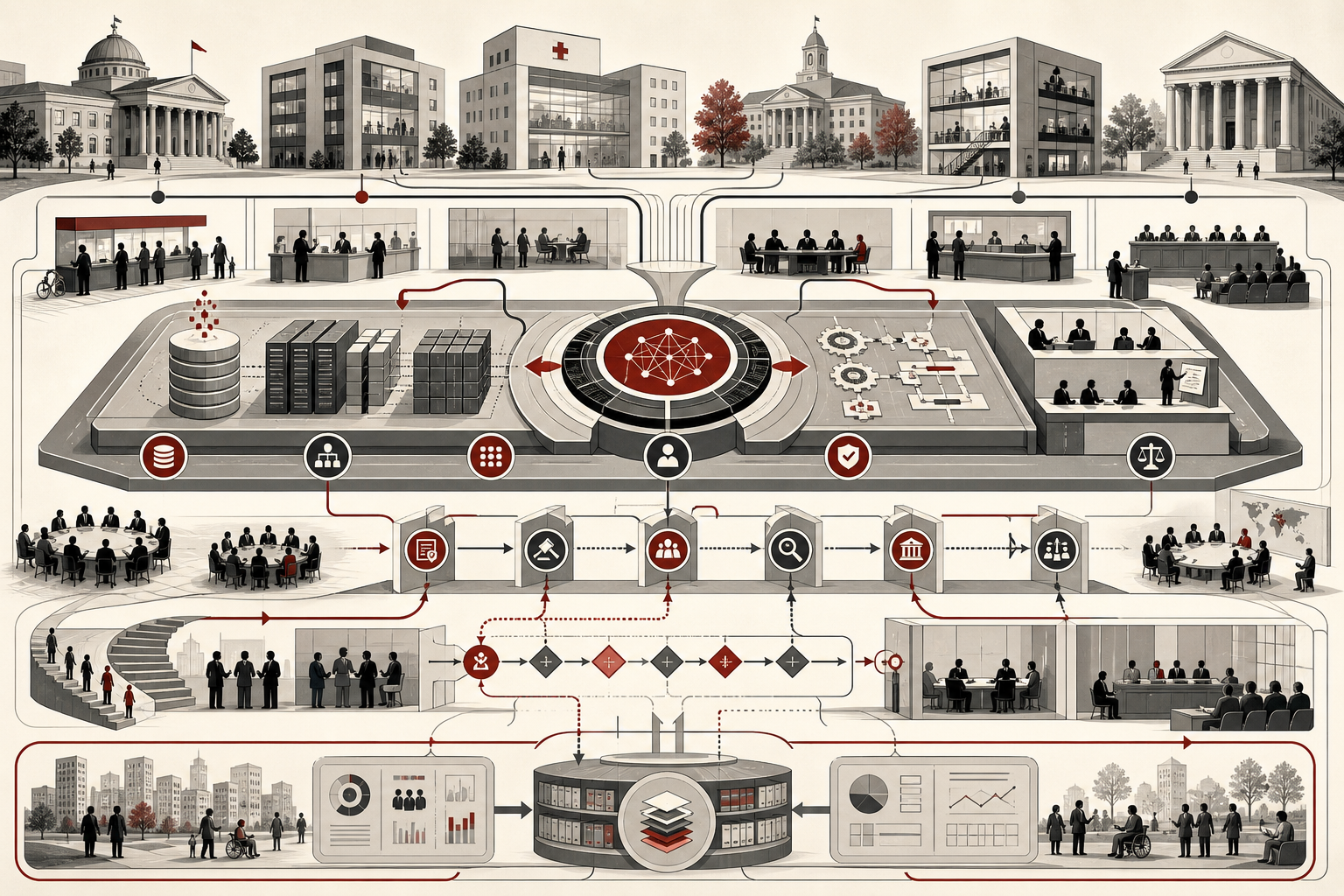
This article develops AI Systems in Organizations and Institutions as an advanced article within the Artificial Intelligence Systems knowledge series. It explains organizations as information-processing systems, bounded rationality, algorithmic rationality, AI-mediated decision structures, human–AI collaboration, workflow transformation, organizational knowledge, authority and power, institutional theory, legitimacy, public-sector AI, labor, skill, risk, accountability, governance, organizational constraints, and institutional learning. Selected Python and R examples appear here, while the full GitHub repository contains expanded computational scaffolding for organizational AI-readiness scoring, human–AI decision allocation, workflow-risk diagnostics, governance maturity modeling, public-sector risk review, SQL metadata, institutional accountability checklists, and advanced Jupyter notebooks.
Why Organizational AI Matters
AI systems matter in organizations because organizations are not merely collections of individuals using tools. They are structured systems of roles, routines, authority, incentives, records, norms, workflows, policies, and decision rights. When AI enters an organization, it does not simply give employees a faster way to complete tasks. It can change how work is seen, routed, measured, governed, contested, and justified.
The organizational question is therefore not simply whether an AI model is accurate. The deeper question is whether the organization can use the model responsibly. That requires valid data, appropriate workflow integration, meaningful human oversight, clear accountability, staff training, risk management, contestability, documentation, monitoring, and institutional legitimacy. A model that performs well in isolation can still fail organizationally when inserted into a fragile workflow, misaligned incentive system, opaque vendor stack, or rights-affecting public decision process.
A technically strong AI system can fail if employees do not trust it, managers misuse it, affected people cannot contest it, governance is weak, incentives distort use, or the system conflicts with professional norms. Conversely, a modest AI system can create real value when it is embedded in a well-governed workflow where humans understand its limits and retain meaningful responsibility.
Organizational\ AI = Model + Workflow + Authority + Governance + Trust
\]
Interpretation: AI becomes organizationally meaningful only when models are connected to workflows, authority structures, governance controls, and institutional trust.
| Dimension | Core Question | Failure Mode | Organizational Requirement |
|---|---|---|---|
| Data validity | Does the input data represent the relevant organizational reality? | Model optimizes weak proxies, biased records, or incomplete data. | Data governance, measurement review, and provenance. |
| Workflow fit | Does AI fit the actual work process? | Model output is technically useful but operationally unusable. | Workflow redesign and frontline participation. |
| Decision authority | Who has the right to act on AI output? | Authority shifts without responsibility. | Decision-right mapping and escalation rules. |
| Human oversight | Can humans meaningfully challenge, correct, or override the system? | Human review becomes symbolic rubber-stamping. | Time, training, authority, and documentation for reviewers. |
| Institutional legitimacy | Is AI use appropriate for the organization’s role and obligations? | Efficiency gains undermine trust, fairness, dignity, or due process. | Risk review, public accountability, and stakeholder confidence. |
| Lifecycle governance | Can the system be monitored, audited, updated, or retired? | AI becomes embedded but unmanaged. | Use-case inventory, monitoring, incident response, audit, and retirement criteria. |
Note: Organizational AI succeeds when technical capability is matched with institutional capacity.
Organizations as Information-Processing Systems
Organizations can be conceptualized as information-processing systems that make decisions under uncertainty. They collect information, interpret signals, allocate attention, coordinate action, resolve ambiguity, maintain routines, and learn from feedback. In this view, management is partly the design of information flows: who knows what, when they know it, how they interpret it, and how decisions follow.
A simple organizational information-processing model can be written as:
Information \rightarrow Interpretation \rightarrow Decision \rightarrow Action \rightarrow Feedback
\]
Interpretation: Organizations transform information into decisions, actions, and feedback through structured processes.
AI systems extend this cycle by introducing machine prediction, classification, optimization, retrieval, summarization, anomaly detection, and automated action. In organizational terms, AI increases the speed, scale, and replicability of information processing. It can search large datasets, detect patterns, summarize documents, forecast demand, classify risk, route cases, recommend actions, monitor performance, and generate decision-support evidence.
But AI systems also alter what an organization notices. If a model scores some outcomes and ignores others, the organization may increasingly attend to the scored outcomes. If a dashboard makes some risks visible and others invisible, management attention shifts. If an algorithm sorts people, cases, customers, assets, claims, or alerts, it can reshape organizational priorities before a human decision-maker ever intervenes.
| Organizational Function | Traditional Pattern | AI-Mediated Pattern | Governance Concern |
|---|---|---|---|
| Information collection | Records, reports, meetings, forms, observations. | Continuous logs, sensors, documents, transactions, embeddings, platform data. | What is visible, missing, biased, or overmeasured? |
| Interpretation | Professional judgment, managerial routines, expert review. | Model outputs, summaries, risk scores, classifications, recommendations. | Does interpretation remain contextual and accountable? |
| Attention allocation | Managers and professionals decide what matters. | Dashboards, rankings, alerts, triage scores, automated prioritization. | Which issues become visible or invisible? |
| Decision-making | Human judgment within formal and informal routines. | AI-supported, AI-structured, or AI-executed decisions. | Who retains authority and responsibility? |
| Action | Human execution through workflows and procedures. | Automated routing, generation, intervention, scheduling, or control. | Can actions be halted, reviewed, appealed, or reversed? |
| Feedback | Reports, audits, outcomes, lessons learned. | Monitoring data, retraining signals, performance dashboards, incident logs. | Does feedback improve learning or reinforce errors? |
Note: AI changes organizational information flow, and information flow changes organizational power.
Bounded Rationality and Algorithmic Rationality
Bounded rationality describes decision-making under cognitive and informational limits. Human actors do not usually optimize across all possible alternatives. They satisfice, use heuristics, rely on routines, follow norms, respond to incentives, and make decisions within organizational constraints.
A bounded-rationality decision can be represented as:
Decision = \arg\max_{a \in A’} U(a), \quad A’ \subset A
\]
Interpretation: Decision-makers choose from a limited perceived set of alternatives \(A’\), not from all possible alternatives \(A\).
AI systems can expand \(A’\) by searching more alternatives, evaluating more cases, and detecting patterns that humans would miss. They can process information at a scale no individual or committee could match. But AI creates its own bounded rationality. A model is bounded by training data, feature definitions, optimization targets, architecture, measurement limits, evaluation design, deployment context, and governance constraints.
Algorithmic rationality can be represented as:
AI\ Output = f(Data,Model,Objective,Constraints,Context)
\]
Interpretation: AI outputs are shaped by data, model design, objectives, constraints, and deployment context.
This means AI does not replace imperfect human judgment with pure rationality. It replaces one bounded decision regime with a hybrid regime in which human and algorithmic limits interact. The central organizational challenge is designing decision systems where those limits are known, monitored, documented, and governed.
| Dimension | Human Limit | Algorithmic Limit | Organizational Design Response |
|---|---|---|---|
| Attention | People cannot process all available information. | Models attend only to measured and encoded variables. | Combine human context with model-assisted triage. |
| Search | Humans consider limited alternatives. | AI considers alternatives defined by model and objective. | Review whether search space excludes important options. |
| Memory | Human memory is selective and fallible. | AI memory depends on data storage, retrieval, and documentation. | Preserve records, provenance, and decision rationale. |
| Interpretation | Humans rely on judgment, norms, and experience. | Models may be opaque, brittle, or proxy-driven. | Require explanation, uncertainty, and escalation for high-risk decisions. |
| Consistency | Humans may decide inconsistently. | AI may consistently apply flawed rules or biased patterns. | Audit both inconsistency and systematic error. |
| Accountability | Responsibility may be diffused across roles. | Model agency can obscure human ownership. | Assign clear owners for AI use, review, and outcomes. |
Note: The goal is not to replace bounded human judgment with supposedly perfect algorithmic judgment. The goal is to design accountable hybrid decision systems.
AI in Organizational Decision-Making
AI systems increasingly participate in organizational decisions across hiring, finance, marketing, logistics, healthcare, education, public administration, customer service, law, risk management, cybersecurity, maintenance, procurement, research, and strategy. In some cases, AI supports decisions. In others, it structures the decision environment. In more automated systems, it may execute decisions directly within defined constraints.
An AI-mediated decision process can be represented as:
X \rightarrow \hat{Y} \rightarrow Recommendation \rightarrow Human\ Review \rightarrow Decision
\]
Interpretation: Data \(X\) produces a prediction \(\hat{Y}\), which informs a recommendation, human review, and final decision.
Organizational decisions vary. Some require speed, consistency, and repetition. Others require discretion, explanation, professional ethics, negotiation, context, or due process. AI tends to perform best when the decision space is clearly defined, the outcome is measurable, large volumes of relevant data exist, the cost of delay is high, patterns are stable enough to generalize, and decisions can be monitored and corrected.
AI becomes more risky when the construct is poorly measured, the decision affects rights or dignity, the context changes quickly, the outcome is contested or normative, explanation and appeal are required, or the organization lacks monitoring and accountability capacity.
| Decision Type | AI Fit | Example | Governance Requirement |
|---|---|---|---|
| Low-risk routing | Often strong. | Customer-support queue routing or document classification. | Monitoring, error correction, and periodic review. |
| Repetitive operational decision | Often useful with controls. | Procurement anomaly detection or inventory forecasting. | Human override and drift monitoring. |
| Expert decision support | Useful when advisory. | Clinical triage, legal research, infrastructure maintenance planning. | Professional review, uncertainty reporting, and documentation. |
| Rights-affecting decision | High caution. | Employment, benefits, credit, education, policing, immigration. | Due process, auditability, contestability, fairness review. |
| High-speed safety decision | Requires real-time assurance. | Autonomous response, medical device alerts, infrastructure emergency control. | Runtime assurance, fail-safe design, and incident review. |
| Strategic or ethical judgment | Supportive, not substitutive. | Organizational strategy, public policy, crisis response. | Human-led deliberation and transparent reasoning. |
Note: The same AI capability can be appropriate in one organizational decision and inappropriate in another.
Human–AI Decision Structures
Organizations can configure human and AI decision-making in multiple ways. These configurations determine where authority, responsibility, interpretation, and oversight reside.
Common structures include human-only decisions, AI decision support, human-in-the-loop decisions, human-on-the-loop supervision, full delegation, aggregated decision-making, and escalation architectures where routine cases are automated while ambiguous, high-risk, or contested cases escalate to humans.
A decision-allocation function can be written as:
Mode(d)=f(Risk_d,Complexity_d,Reversibility_d,Interpretability_d,Time_d)
\]
Interpretation: The appropriate decision mode for decision \(d\) depends on risk, complexity, reversibility, interpretability, and time sensitivity.
The best structure depends on the decision. Low-risk, frequent, reversible decisions may be suitable for automation. Medium-risk decisions may be suitable for AI support with human review. High-risk, ambiguous, rights-affecting, or ethically sensitive decisions require stronger human judgment, documentation, and contestability.
Human oversight should not be symbolic. A human reviewer must have enough time, information, authority, training, and independence to challenge the system. Otherwise, “human-in-the-loop” becomes a formal label rather than a real accountability mechanism.
| Decision Structure | How It Works | Appropriate For | Failure Mode |
|---|---|---|---|
| Human-only | Humans decide without AI support. | Highly contextual, ethical, contested, or sensitive decisions. | May be slow, inconsistent, or poorly informed. |
| AI decision support | AI provides evidence, forecasts, summaries, or recommendations. | Expert workflows where humans retain judgment. | Automation bias or overreliance. |
| Human-in-the-loop | AI output requires human approval before action. | Moderate-risk decisions requiring review. | Reviewer rubber-stamps outputs without meaningful scrutiny. |
| Human-on-the-loop | AI acts while humans supervise and intervene when needed. | Operational systems with continuous monitoring. | Humans may miss failures or intervene too late. |
| Full delegation | AI executes decisions automatically within constraints. | Low-risk, reversible, highly routine decisions. | Automation scales unnoticed error. |
| Escalation architecture | Routine cases are automated; difficult or risky cases escalate. | High-volume systems with varying risk levels. | Escalation thresholds may miss vulnerable or unusual cases. |
| Aggregated judgment | Human and AI judgments are combined. | Forecasting, expert review, and complex assessment. | Combination rules may obscure responsibility. |
Note: Human oversight must be designed as an operational capability, not merely asserted as a governance principle.
Workflow Transformation and Organizational Change
AI systems transform workflows by changing how tasks are sequenced, assigned, monitored, and evaluated. They can automate repetitive work, augment expert judgment, coordinate operations, summarize information, route cases, generate drafts, detect anomalies, support real-time decisions, and standardize procedural steps.
A workflow transformation can be represented as:
Workflow_0 \rightarrow Workflow_{AI}
\]
Interpretation: AI changes the original workflow into an AI-mediated workflow with different roles, steps, dependencies, and controls.
These changes can produce gains in speed, consistency, and scale. But they can also create new dependencies. A workflow may become brittle if employees lose skill, if the AI system fails silently, if workers cannot override outputs, if vendor systems change without notice, if data quality deteriorates, or if organizational incentives reward unquestioned automation.
AI-mediated workflow change often creates new roles: AI product owners, model risk managers, prompt and workflow designers, human–AI interaction specialists, AI auditors, data stewards, model monitoring analysts, escalation reviewers, responsible AI governance leads, and procurement reviewers. This means AI adoption is not only software adoption. It is organizational redesign.
| Workflow Change | Potential Benefit | Organizational Risk | Governance Response |
|---|---|---|---|
| Automated triage | Faster routing and prioritization. | Important cases may be misclassified or deprioritized. | Escalation rules, monitoring, and error review. |
| AI-generated drafts | Reduced administrative burden. | Errors, hallucinations, or tone problems become institutional records. | Human review, source verification, and documentation. |
| Predictive scoring | Earlier detection of risk or opportunity. | Scores may become de facto decisions. | Threshold governance and explanation requirements. |
| Workflow automation | Lower delay and greater consistency. | Automation may lock in poor processes. | Process redesign before automation. |
| Worker monitoring | Operational visibility and performance feedback. | Surveillance, pressure, deskilling, and loss of trust. | Labor governance, transparency, and proportionality review. |
| Knowledge retrieval | Faster access to documents, precedents, and expertise. | Summaries may obscure source evidence or uncertainty. | Provenance, source links, and audit trails. |
Note: AI workflow redesign should preserve accountability, expertise, review, and reversibility where decisions matter.
Organizational Knowledge, Learning, and Memory
AI systems affect organizational knowledge. They can preserve knowledge by capturing documents, workflows, cases, decisions, and institutional histories in searchable form. They can accelerate learning by analyzing patterns across large datasets. They can help organizations remember prior cases, detect recurring issues, standardize best practices, and identify weak signals across fragmented records.
But AI can also weaken organizational memory. If employees rely on systems without understanding underlying reasoning, expertise may decay. If organizational knowledge becomes embedded in proprietary models or vendor platforms, institutional memory may become dependent on external infrastructure. If generated summaries replace primary records, organizations may lose evidentiary depth. If past practice is biased, AI can turn flawed institutional memory into operational infrastructure.
Organizational learning can be represented as:
Experience_t \rightarrow Data_t \rightarrow Model_{t+1} \rightarrow Practice_{t+1}
\]
Interpretation: Organizational experience becomes data, data shapes future models, and models reshape future practice.
This feedback loop can improve performance when data is valid and governance is strong. It can also reinforce bad habits when past practice contains bias, outdated assumptions, or institutional blind spots. AI turns organizational memory into operational infrastructure, making data governance and feedback-loop monitoring essential.
| Knowledge Function | AI Contribution | Risk | Responsible Design |
|---|---|---|---|
| Institutional memory | Preserves searchable records, cases, decisions, and documents. | Summaries replace primary evidence. | Maintain source records and provenance. |
| Organizational learning | Detects patterns across workflows and outcomes. | Past bias becomes future recommendation. | Feedback-loop and bias monitoring. |
| Expertise sharing | Makes expert knowledge accessible across teams. | Context and tacit judgment may be flattened. | Combine AI retrieval with expert review. |
| Training and onboarding | Supports faster learning and knowledge discovery. | Workers may learn simplified or generated versions of practice. | Anchor training in verified materials and mentorship. |
| Process improvement | Identifies bottlenecks, recurring errors, and operational variation. | Only measured processes improve; unmeasured harms persist. | Use qualitative review and stakeholder feedback. |
Note: AI can strengthen organizational memory only when it preserves evidence, context, and human expertise rather than replacing them with opaque summaries.
Authority, Power, and Control
AI systems alter the distribution of authority within organizations. Decision authority may shift from frontline professionals to centralized data teams, from managers to model outputs, from departments to platforms, from tacit expertise to measurable signals, or from public institutions to private vendors.
Authority can be represented as:
Authority_{AI}=f(Model\ Control,Data\ Access,Workflow\ Integration,Approval\ Rights)
\]
Interpretation: AI-related authority depends on who controls models, data, workflows, and approval rights.
This creates a responsibility gap. An algorithm may influence or structure a decision, but responsibility remains with the organization. If no one can explain, contest, monitor, or override the system, authority has moved without accountability.
AI also creates new forms of managerial control. Systems can monitor workers, score performance, allocate tasks, prioritize cases, schedule labor, standardize judgment, and evaluate compliance. These uses may improve coordination, but they may also intensify surveillance, reduce autonomy, and make work more opaque. Organizational AI should therefore be evaluated not only by productivity, but by its effects on dignity, discretion, expertise, trust, and power.
| Authority Shift | How It Happens | Potential Benefit | Institutional Risk |
|---|---|---|---|
| From frontline judgment to scoring systems | Risk scores, rankings, alerts, and recommendations structure decisions. | Greater consistency and evidence access. | Professional discretion narrows without open debate. |
| From departments to data/platform teams | Central teams control models, dashboards, and data pipelines. | Standardization and technical expertise. | Operational knowledge may be displaced by technical control. |
| From internal institutions to vendors | Organizations rely on proprietary AI systems or cloud platforms. | Fast adoption and specialized capability. | Vendor dependence, opacity, lock-in, and accountability gaps. |
| From qualitative judgment to measurable signals | Dashboards and scores define what counts as performance. | Improved visibility and coordination. | Unmeasured values, harms, and contexts disappear. |
| From human explanation to model authority | AI output becomes hard to challenge because it appears objective. | Decision support can reduce inconsistency. | Algorithmic authority can weaken contestability. |
Note: AI governance must ask not only what a system predicts, but whose authority it strengthens and whose judgment it weakens.
Institutional Theory, Legitimacy, and AI Adoption
AI adoption is not purely a technical decision. Institutional theory emphasizes that organizations operate within environments shaped by law, norms, professional expectations, market pressures, regulatory obligations, and legitimacy concerns. Organizations adopt technologies not only because they improve efficiency, but because they signal modernity, compliance, competitiveness, innovation, or alignment with institutional expectations.
Institutional pressure can be represented as:
Adoption = f(Efficiency,Legitimacy,Regulation,Competition,Norms)
\]
Interpretation: AI adoption depends on efficiency, legitimacy, regulation, competition, and institutional norms.
The logic of appropriateness is especially important. Organizations ask not only “What is efficient?” but “What is appropriate for an organization like ours, in a situation like this, with responsibilities like these?” A hospital, court, school, bank, newsroom, public agency, university, nonprofit, or scientific institution cannot treat AI adoption as a generic technology upgrade. Each operates under different professional obligations.
Institutional legitimacy depends on whether AI use is perceived as lawful, competent, fair, transparent, accountable, and aligned with the organization’s role. When AI adoption violates institutional identity or public trust, technical performance may not be enough to justify use.
| Institutional Pressure | How It Shapes Adoption | Possible Benefit | Possible Risk |
|---|---|---|---|
| Efficiency pressure | Organizations adopt AI to reduce cost, delay, or workload. | Improved service capacity and operational speed. | Efficiency overwhelms fairness, judgment, or due process. |
| Competitive pressure | Firms adopt AI because rivals do. | Innovation and productivity improvement. | Rushed adoption without governance readiness. |
| Regulatory pressure | Rules require documentation, risk management, and oversight. | Stronger governance and auditability. | Compliance becomes performative rather than substantive. |
| Professional norms | Fields define appropriate uses of judgment, evidence, and automation. | Protects domain standards and expertise. | Norms may lag technical possibilities or public expectations. |
| Legitimacy pressure | Organizations adopt or avoid AI based on trust and reputation. | Encourages public accountability. | Organizations may signal responsibility without changing practice. |
| Vendor ecosystem pressure | AI becomes bundled into enterprise platforms and workflows. | Lower adoption friction. | Quiet diffusion of AI without deliberate institutional review. |
Note: AI adoption is shaped by institutional environments, not just technical opportunity.
AI in Public Institutions and Governance
AI in public institutions raises especially serious questions because public organizations exercise authority over rights, benefits, enforcement, safety, services, infrastructure, and democratic accountability. Public-sector AI systems may support eligibility decisions, fraud detection, resource allocation, policing, tax administration, healthcare triage, infrastructure planning, environmental monitoring, immigration processing, procurement, emergency response, and citizen services.
A public-sector AI decision can be represented as:
Public\ Decision = f(Law,Evidence,AI\ Output,Due\ Process,Accountability)
\]
Interpretation: Public-sector AI decisions must integrate law, evidence, AI outputs, due process, and accountability.
Public institutions must meet higher standards than private efficiency. They must preserve transparency, due process, equal treatment, accessibility, non-discrimination, explainability where required, contestability, records management, procurement accountability, and democratic legitimacy.
This connects directly to AI Governance and Regulatory Systems. Public AI systems should be governed through risk assessment, documentation, human oversight, impact evaluation, procurement review, monitoring, and public accountability. AI used in rights-affecting or safety-affecting contexts requires especially strong safeguards.
| Public Obligation | AI-Specific Question | Failure Mode | Governance Practice |
|---|---|---|---|
| Legality | Is AI use authorized and consistent with applicable law? | Automation exceeds statutory authority or procedural rules. | Legal review and use-case authorization. |
| Due process | Can affected people understand and contest consequential decisions? | People cannot challenge opaque or automated determinations. | Notice, explanation, appeal, and records. |
| Equal treatment | Does the system produce unequal error, burden, or exclusion? | Historic bias becomes automated public authority. | Fairness testing, subgroup review, and impact assessment. |
| Accessibility | Can all affected communities access the system and its remedies? | Digital systems exclude people with language, disability, access, or literacy barriers. | Accessible design and non-digital alternatives. |
| Procurement accountability | Can the agency evaluate vendor claims and retain oversight? | Public authority becomes dependent on opaque private systems. | Contractual transparency, audit rights, and documentation requirements. |
| Democratic legitimacy | Is AI use publicly justifiable and institutionally appropriate? | Efficiency is used to bypass public accountability. | Public reporting, oversight, and participatory review where appropriate. |
Note: Public-sector AI must be evaluated through law, public accountability, due process, rights, and institutional legitimacy—not efficiency alone.
Labor, Skill, Professional Judgment, and Organizational Identity
AI systems affect labor not only by automating tasks, but by changing the meaning of work. Professional judgment may be augmented, constrained, monitored, or displaced. Workflows may become more data-driven, more standardized, or more dependent on platform-mediated outputs. Employees may need new skills in interpretation, oversight, prompt design, validation, domain review, escalation, and governance.
Human skill can be represented as:
Skill_{future}=Domain\ Expertise + AI\ Literacy + Critical\ Judgment + Governance\ Awareness
\]
Interpretation: Future organizational skill combines domain expertise, AI literacy, critical judgment, and governance awareness.
Organizations should avoid treating workers as passive recipients of AI outputs. Effective adoption requires participation from domain experts, frontline staff, managers, legal teams, compliance officers, technologists, unions or worker representatives where relevant, and affected communities. Workers often understand workflow realities that model developers miss.
AI adoption also affects identity. Professionals may resist AI when it appears to devalue expertise, increase surveillance, or transfer judgment to opaque systems. They may embrace AI when it reduces administrative burden, improves service quality, supports learning, and preserves meaningful discretion. Organizational legitimacy depends on how AI changes work, not merely on whether it improves aggregate performance metrics.
| Labor Dimension | Possible Benefit | Possible Harm | Organizational Response |
|---|---|---|---|
| Administrative burden | AI reduces repetitive documentation and search tasks. | Generated work may create review burden or hidden errors. | Design AI to remove low-value work without lowering standards. |
| Professional judgment | AI supports better evidence access and decision support. | Workers defer to model output even when context matters. | Train workers to challenge, interpret, and override AI. |
| Skill development | AI can support learning, coaching, and knowledge retrieval. | Deskilling occurs if workers stop practicing core judgment. | Preserve skill-building and reflective practice. |
| Worker autonomy | AI can reduce routine burdens and improve coordination. | Monitoring and algorithmic management reduce discretion. | Set boundaries for surveillance and task control. |
| Organizational identity | AI can reinforce mission when used responsibly. | AI can conflict with professional norms or public purpose. | Align AI adoption with institutional values and responsibilities. |
Note: AI adoption changes work. Responsible organizations treat workers as co-designers and stewards, not merely as end users of automation.
Risks, Failure Modes, and Organizational Fragility
AI systems introduce organizational risks that extend beyond model error. These include automation bias, overreliance, deskilling, hidden bias, unclear responsibility, weak escalation, opaque vendor systems, data-quality failures, privacy breaches, adversarial misuse, distribution shift, workflow brittleness, and public legitimacy failure.
An organizational AI risk function can be represented as:
Risk_{org}=f(Model\ Error,Workflow\ Coupling,Opacity,Overreliance,Governance\ Gap)
\]
Interpretation: Organizational AI risk depends on model error, workflow coupling, opacity, overreliance, and governance gaps.
Organizational fragility increases when AI systems become deeply embedded but poorly understood. A system may work well under normal conditions but fail under distribution shift, staffing changes, vendor updates, data interruptions, adversarial pressure, regulatory review, or public controversy.
A fragility condition can be written as:
Fragility \uparrow \quad \mathrm{when} \quad Dependency \uparrow \ \mathrm{and}\ Understanding \downarrow
\]
Interpretation: Organizational fragility rises when dependency on AI increases while organizational understanding decreases.
This connects to Systemic Risk, Feedback Loops, and Cascading Failures in AI Systems. Organizational AI risk is not only about bad predictions. It is about how errors propagate through decisions, incentives, workflows, reputations, markets, public services, and institutions.
| Risk | How It Appears | Consequence | Control |
|---|---|---|---|
| Automation bias | Humans overtrust AI recommendations. | Errors are accepted without scrutiny. | Reviewer training, uncertainty display, and challenge prompts. |
| Overreliance | Organization depends on AI for tasks it no longer understands. | Capability collapses when system fails. | Fallback procedures and skill preservation. |
| Workflow brittleness | AI-mediated workflow works only under narrow assumptions. | Small disruptions produce large operational failures. | Stress testing, redundancy, and manual override. |
| Responsibility gap | No person or team owns AI outcomes. | Failures become difficult to investigate or repair. | Named owners, review bodies, and incident roles. |
| Vendor opacity | Organization relies on systems it cannot inspect. | Weak auditability and procurement dependence. | Contractual transparency, audit rights, and exit plans. |
| Legitimacy failure | AI use conflicts with public, professional, or institutional expectations. | Trust declines even if efficiency improves. | Stakeholder review, explanation, and public accountability. |
Note: Organizational AI risk emerges from the interaction between model behavior, workflow dependence, institutional responsibility, and human trust.
Governance, Accountability, and Oversight
Governance mechanisms are required to ensure that AI systems are used responsibly within organizations. Governance should define who owns the system, who approves deployment, who monitors performance, who handles incidents, who reviews harms, who can override outputs, and who is accountable for outcomes.
An organizational AI governance loop can be represented as:
Design \rightarrow Approve \rightarrow Deploy \rightarrow Monitor \rightarrow Audit \rightarrow Improve
\]
Interpretation: Organizational AI governance should operate as a lifecycle process from design through improvement.
Key governance mechanisms include AI use-case inventories, risk classification, impact assessments, model and dataset documentation, human oversight design, access controls, role responsibilities, procurement and vendor review, testing and validation before deployment, subgroup performance and fairness review, monitoring and incident reporting, escalation and override procedures, periodic audit, and retirement criteria.
Governance should be proportional to risk. A low-risk internal summarization tool does not require the same controls as an AI system used for employment, credit, healthcare, education, policing, public benefits, or infrastructure safety. But every organizational AI system requires some governance because every system changes information flow, responsibility, and behavior.
| Governance Control | Purpose | Evidence Produced | Why It Matters |
|---|---|---|---|
| Use-case inventory | Track where AI is used across the organization. | AI system register and owner list. | Organizations cannot govern systems they cannot see. |
| Risk classification | Determine oversight level by potential harm. | Risk tier and review requirements. | Governance effort becomes proportional to consequence. |
| Impact assessment | Evaluate effects on rights, safety, fairness, labor, and public trust. | Impact report and mitigation plan. | Prevents narrow technical evaluation from dominating. |
| Human oversight design | Define when and how humans review or override AI. | Escalation rules and reviewer responsibilities. | Prevents symbolic oversight. |
| Model and data documentation | Record intended use, data, limitations, performance, and risks. | Model cards, data cards, lineage records. | Supports auditability and accountability. |
| Monitoring and incident response | Detect drift, failures, harms, and misuse after deployment. | Monitoring dashboards, alerts, incident logs. | Governance continues after launch. |
| Retirement criteria | Define when a system should be paused, replaced, or removed. | Sunset thresholds and decommissioning records. | Prevents outdated or harmful AI from remaining embedded. |
Note: AI governance should be operational, documented, and lifecycle-based—not a one-time approval form.
Limits and Organizational Constraints
Organizations face significant constraints when implementing AI systems. These include limited technical expertise, inadequate data infrastructure, weak governance capacity, organizational inertia, misalignment between technical tools and institutional goals, procurement dependence, poor change management, unclear ownership, resistance from workers or stakeholders, and lack of public trust.
A deployment readiness condition can be represented as:
AI\ Readiness = f(Data,Infrastructure,Skills,Governance,Workflow,Trust)
\]
Interpretation: AI readiness depends on data, infrastructure, skills, governance, workflow alignment, and trust.
These constraints show why AI adoption is as much an organizational challenge as a technical one. A model may be available, but the organization may not be ready. Without governance, training, workflow redesign, and accountability, AI adoption can create confusion, risk, and institutional distrust.
The strongest organizations will not simply adopt more AI. They will build the capacity to evaluate, integrate, govern, monitor, and learn from AI systems while preserving human responsibility.
| Constraint | How It Limits AI Adoption | Failure Pattern | Stronger Practice |
|---|---|---|---|
| Weak data infrastructure | Models depend on incomplete, siloed, or poorly documented data. | AI projects fail at integration stage. | Build data governance before scaling AI. |
| Limited AI literacy | Staff cannot interpret outputs or challenge limitations. | Overtrust, misuse, or rejection. | Train users, reviewers, managers, and leaders. |
| Poor workflow fit | AI does not match actual work conditions. | Tools are ignored, misused, or workaround-prone. | Co-design with frontline and domain experts. |
| Governance immaturity | No system for approval, monitoring, audit, or incident response. | AI becomes unmanaged shadow infrastructure. | Create lifecycle governance and ownership structures. |
| Vendor dependence | Organization cannot inspect or modify critical systems. | Lock-in, opacity, and weak accountability. | Procurement standards, audit rights, and exit plans. |
| Trust deficit | Workers or affected communities distrust AI use. | Legitimate systems fail socially, or illegitimate systems are imposed. | Transparency, participation, appeal, and accountability. |
Note: Organizational readiness is not a purchase decision. It is a capacity-building process.
Mathematical Lens
An organizational information-processing cycle is:
Information \rightarrow Interpretation \rightarrow Decision \rightarrow Action \rightarrow Feedback
\]
Interpretation: Organizations transform information into decisions, actions, and feedback.
A bounded-rationality decision can be represented as:
Decision = \arg\max_{a \in A’} U(a), \quad A’ \subset A
\]
Interpretation: Decision-makers choose from a limited perceived set of alternatives rather than the full set of possible actions.
An AI-mediated decision process is:
X \rightarrow \hat{Y} \rightarrow Recommendation \rightarrow Human\ Review \rightarrow Decision
\]
Interpretation: Data produces a model output, which becomes a recommendation subject to human review and decision authority.
A decision-allocation function is:
Mode(d)=f(Risk_d,Complexity_d,Reversibility_d,Interpretability_d,Time_d)
\]
Interpretation: The appropriate human–AI decision mode depends on decision risk, complexity, reversibility, interpretability, and time sensitivity.
An authority function is:
Authority_{AI}=f(Model\ Control,Data\ Access,Workflow\ Integration,Approval\ Rights)
\]
Interpretation: AI-related authority depends on control over models, data, workflows, and approval rights.
An organizational risk function is:
Risk_{org}=f(Model\ Error,Workflow\ Coupling,Opacity,Overreliance,Governance\ Gap)
\]
Interpretation: Organizational AI risk depends on model error, workflow coupling, opacity, overreliance, and governance gaps.
An AI governance loop is:
Design \rightarrow Approve \rightarrow Deploy \rightarrow Monitor \rightarrow Audit \rightarrow Improve
\]
Interpretation: Governance should follow the AI system across design, approval, deployment, monitoring, audit, and improvement.
AI readiness can be represented as:
AI\ Readiness = f(Data,Infrastructure,Skills,Governance,Workflow,Trust)
\]
Interpretation: Organizational AI readiness depends on data, infrastructure, skills, governance, workflow fit, and trust.
This mathematical lens shows that organizational AI is not only a model-performance issue. It is a problem of decision allocation, authority, workflow coupling, institutional legitimacy, governance capacity, and readiness.
Variables and System Interpretation
| Symbol or Term | Meaning | Typical Type | System Interpretation |
|---|---|---|---|
| \(A\) | Full action set | Decision space. | All possible actions an organization could theoretically consider. |
| \(A’\) | Perceived action set | Bounded decision set. | Limited set of actions visible or feasible to decision-makers. |
| \(U(a)\) | Utility of action \(a\) | Objective or preference function. | How the organization values an available action. |
| \(X\) | Input data | Features or records. | Information used by the AI system. |
| \(\hat{Y}\) | Model output | Prediction, score, classification, or recommendation. | AI-generated signal used in organizational decision-making. |
| \(Mode(d)\) | Decision mode for decision \(d\) | Allocation rule. | Whether the decision is human-led, AI-supported, supervised, or automated. |
| \(Risk_d\) | Decision risk | Risk score. | Potential harm, rights impact, safety impact, or institutional consequence of decision \(d\). |
| \(Authority_{AI}\) | AI-mediated authority | Organizational power variable. | Degree to which AI systems influence or control decisions. |
| \(Risk_{org}\) | Organizational AI risk | Risk construct. | Risk created by model error, workflow coupling, opacity, overreliance, and governance gaps. |
| \(AI\ Readiness\) | Organizational readiness | Maturity construct. | Capacity to adopt, integrate, govern, monitor, and improve AI responsibly. |
| Bounded rationality | Decision-making under limits. | Organizational theory concept. | Human and organizational decision-making constrained by attention, information, time, and routines. |
| Institutional legitimacy | Social and legal acceptance. | Institutional theory concept. | Whether AI use is seen as lawful, appropriate, fair, competent, and accountable. |
Note: Organizational AI should be evaluated through decision quality, workflow fit, accountability, legitimacy, risk, and governance capacity—not technical performance alone.
Worked Example: Allocating a Decision Between Human and AI
Suppose an organization is deciding how to use AI in three workflows: customer-support routing, employee performance review, and emergency infrastructure response.
Define a simplified decision-risk score:
Risk_d=0.4H_d+0.3R_d+0.2I_d+0.1O_d
\]
Interpretation: Decision risk depends on potential harm \(H_d\), rights impact \(R_d\), irreversibility \(I_d\), and opacity \(O_d\).
For customer-support routing:
Risk_{support}=0.22
\]
Interpretation: Customer-support routing is relatively low risk and may be suitable for AI automation with monitoring.
For employee performance review:
Risk_{employee}=0.78
\]
Interpretation: Employee evaluation is high risk because it affects opportunity, dignity, employment, and fairness.
For emergency infrastructure response:
Risk_{infrastructure}=0.91
\]
Interpretation: Emergency infrastructure decisions are very high risk because they affect safety and public welfare.
A simple allocation rule might be:
Mode(d)=
\begin{cases}
Automated, & Risk_d < 0.30\\
AI\ Supported, & 0.30 \leq Risk_d < 0.70\\
Human\ Led, & Risk_d \geq 0.70
\end{cases}
\]
Interpretation: Low-risk decisions may be automated, medium-risk decisions may be AI-supported, and high-risk decisions should remain human-led with strong oversight.
This example shows why organizational AI governance should classify decisions, not only models. The same AI capability may be acceptable in one workflow and inappropriate in another.
| Workflow | Risk Score | Suggested Mode | Reason |
|---|---|---|---|
| Customer-support routing | 0.22 | Monitored automation. | Lower harm, high volume, reversible routing decisions. |
| Employee performance review | 0.78 | Human-led with AI support. | High rights, dignity, employment, and fairness implications. |
| Emergency infrastructure response | 0.91 | Human-led or runtime-assured decision support. | Safety-critical, time-sensitive, and potentially irreversible consequences. |
Note: Decision allocation should be based on harm, rights impact, reversibility, opacity, time sensitivity, and governance capacity.
Computational Modeling
Computational modeling can make organizational AI governance concrete. A readiness model can score whether an organization has the data, infrastructure, skills, governance, workflow alignment, and trust needed for AI adoption. A decision-allocation model can recommend whether a workflow should be automated, AI-supported, or human-led. A risk model can estimate organizational fragility from model opacity, workflow coupling, overreliance, and governance gaps. A SQL schema can document AI use cases, workflow owners, decision modes, risk reviews, human oversight, audit findings, and institutional accountability.
The selected examples below use lightweight synthetic workflows so the article remains readable and WordPress-friendly. The GitHub repository extends the same logic into advanced notebooks, decision-allocation diagnostics, organizational readiness scoring, workflow-risk modeling, governance maturity analysis, SQL metadata schemas, audit checklists, and reproducible outputs.
Organizational\ AI\ Review = Readiness + Risk + Workflow\ Fit + Governance\ Maturity
\]
Interpretation: Organizational AI review should combine technical readiness, decision risk, workflow fit, and governance maturity.
Python Workflow: Organizational AI Readiness and Decision Allocation
Python is useful for simulating organizational AI readiness, workflow risk, and decision allocation. The following workflow scores organizational AI use cases and recommends oversight modes.
"""
AI Systems in Organizations and Institutions

Python workflow: organizational AI readiness and decision allocation.

This educational example demonstrates:
1. organizational AI readiness scoring
2. workflow decision-risk scoring
3. human-AI decision-allocation recommendations
4. governance-gap diagnostics
5. governance-ready output files

It uses synthetic data for illustration.
"""

from __future__ import annotations

from pathlib import Path
import pandas as pd


OUTPUT_DIR = Path("outputs")
OUTPUT_DIR.mkdir(parents=True, exist_ok=True)


def build_use_case_table() -> pd.DataFrame:
    """Create synthetic organizational AI use cases."""
    return pd.DataFrame(
        {
            "use_case": [
                "customer_support_routing",
                "employee_performance_review",
                "clinical_triage_support",
                "procurement_anomaly_detection",
                "public_benefits_eligibility",
                "infrastructure_emergency_response",
            ],
            "data_quality": [0.86, 0.62, 0.78, 0.82, 0.66, 0.74],
            "infrastructure": [0.82, 0.70, 0.76, 0.84, 0.68, 0.80],
            "staff_ai_literacy": [0.74, 0.58, 0.72, 0.76, 0.60, 0.70],
            "governance_maturity": [0.72, 0.50, 0.74, 0.78, 0.55, 0.82],
            "workflow_fit": [0.88, 0.44, 0.70, 0.86, 0.52, 0.68],
            "trust": [0.78, 0.42, 0.66, 0.80, 0.48, 0.70],
            "harm_potential": [0.20, 0.74, 0.86, 0.40, 0.88, 0.94],
            "rights_impact": [0.18, 0.82, 0.72, 0.24, 0.92, 0.70],
            "irreversibility": [0.14, 0.68, 0.78, 0.32, 0.75, 0.90],
            "opacity": [0.40, 0.66, 0.58, 0.50, 0.72, 0.52],
        }
    )


def score_use_cases(use_cases: pd.DataFrame) -> pd.DataFrame:
    """Score AI readiness, decision risk, governance gap, and recommended mode."""
    scored = use_cases.copy()

    scored["ai_readiness"] = (
        0.20 * scored["data_quality"]
        + 0.16 * scored["infrastructure"]
        + 0.16 * scored["staff_ai_literacy"]
        + 0.22 * scored["governance_maturity"]
        + 0.16 * scored["workflow_fit"]
        + 0.10 * scored["trust"]
    )

    scored["decision_risk"] = (
        0.40 * scored["harm_potential"]
        + 0.30 * scored["rights_impact"]
        + 0.20 * scored["irreversibility"]
        + 0.10 * scored["opacity"]
    )

    scored["recommended_mode"] = scored.apply(recommend_decision_mode, axis=1)

    scored["governance_gap"] = (
        scored["decision_risk"] - scored["governance_maturity"]
    )

    scored["requires_governance_action"] = scored["governance_gap"] > 0.15

    return scored


def recommend_decision_mode(row: pd.Series) -> str:
    """Recommend a human-AI decision structure based on risk and readiness."""
    if row["decision_risk"] >= 0.70:
        return "human_led_with_ai_support_and_strong_review"

    if row["decision_risk"] >= 0.40:
        return "human_in_the_loop"

    if row["ai_readiness"] >= 0.70:
        return "monitored_automation"

    return "ai_decision_support_only"


def build_governance_summary(scored: pd.DataFrame) -> pd.DataFrame:
    """Summarize organizational AI readiness and risk."""
    return pd.DataFrame(
        [
            {
                "metric": "mean_ai_readiness",
                "value": scored["ai_readiness"].mean(),
            },
            {
                "metric": "mean_decision_risk",
                "value": scored["decision_risk"].mean(),
            },
            {
                "metric": "share_requiring_governance_action",
                "value": scored["requires_governance_action"].mean(),
            },
            {
                "metric": "share_high_risk_decisions",
                "value": (scored["decision_risk"] >= 0.70).mean(),
            },
            {
                "metric": "share_human_led_recommended",
                "value": (
                    scored["recommended_mode"]
                    == "human_led_with_ai_support_and_strong_review"
                ).mean(),
            },
        ]
    )


def write_governance_memo(scored: pd.DataFrame, summary: pd.DataFrame) -> None:
    """Write a plain-language governance memo for organizational AI review."""
    memo = "# Organizational AI Readiness and Decision Allocation Memo\n\n"

    memo += "Highest-risk AI use cases:\n"
    high_risk = scored.sort_values("decision_risk", ascending=False).head(3)

    for _, row in high_risk.iterrows():
        memo += (
            f"- {row['use_case']}: decision_risk={row['decision_risk']:.3f}, "
            f"ai_readiness={row['ai_readiness']:.3f}, "
            f"recommended_mode={row['recommended_mode']}\n"
        )

    memo += "\nGovernance summary:\n"
    for _, row in summary.iterrows():
        memo += f"- {row['metric']}: {row['value']:.3f}\n"

    memo += (
        "\nInterpretation:\n"
        "- Organizational AI decisions should be allocated by risk, readiness, and governance maturity.\n"
        "- High-risk, rights-affecting, safety-affecting, or irreversible decisions require strong human review.\n"
        "- Low-risk decisions may be suitable for monitored automation when readiness is high.\n"
        "- Governance gaps should be resolved before deployment or expansion.\n"
    )

    (OUTPUT_DIR / "python_organizational_ai_governance_memo.md").write_text(memo)


def main() -> None:
    use_cases = build_use_case_table()
    scored = score_use_cases(use_cases)
    summary = build_governance_summary(scored)

    scored.to_csv(
        OUTPUT_DIR / "python_organizational_ai_use_cases.csv",
        index=False,
    )

    summary.to_csv(
        OUTPUT_DIR / "python_organizational_ai_governance_summary.csv",
        index=False,
    )

    write_governance_memo(scored, summary)

    display_cols = [
        "use_case",
        "ai_readiness",
        "decision_risk",
        "recommended_mode",
        "governance_gap",
        "requires_governance_action",
    ]

    print("Organizational AI use-case scoring")
    print(scored[display_cols].sort_values("decision_risk", ascending=False))

    print("\nGovernance summary")
    print(summary)


if __name__ == "__main__":
    main()
This workflow shows why organizational AI decisions should be allocated by risk, readiness, and governance maturity rather than by technical feasibility alone.
R Workflow: Institutional AI Governance and Workflow Risk Scoring
R is useful for scoring institutional readiness, workflow risk, and governance coverage across organizational AI use cases.
# AI Systems in Organizations and Institutions
#
# R workflow: institutional AI governance and workflow risk scoring.
#
# This educational workflow simulates:
# - organizational AI readiness scoring
# - decision risk scoring
# - governance gap analysis
# - institutional oversight classification
# - governance-ready outputs

use_cases <- data.frame(
  use_case = c(
    "customer_support_routing",
    "employee_performance_review",
    "clinical_triage_support",
    "procurement_anomaly_detection",
    "public_benefits_eligibility",
    "infrastructure_emergency_response"
  ),
  data_quality = c(0.86, 0.62, 0.78, 0.82, 0.66, 0.74),
  infrastructure = c(0.82, 0.70, 0.76, 0.84, 0.68, 0.80),
  staff_ai_literacy = c(0.74, 0.58, 0.72, 0.76, 0.60, 0.70),
  governance_maturity = c(0.72, 0.50, 0.74, 0.78, 0.55, 0.82),
  workflow_fit = c(0.88, 0.44, 0.70, 0.86, 0.52, 0.68),
  trust = c(0.78, 0.42, 0.66, 0.80, 0.48, 0.70),
  harm_potential = c(0.20, 0.74, 0.86, 0.40, 0.88, 0.94),
  rights_impact = c(0.18, 0.82, 0.72, 0.24, 0.92, 0.70),
  irreversibility = c(0.14, 0.68, 0.78, 0.32, 0.75, 0.90),
  opacity = c(0.40, 0.66, 0.58, 0.50, 0.72, 0.52)
)

use_cases$ai_readiness <-
  0.20 * use_cases$data_quality +
  0.16 * use_cases$infrastructure +
  0.16 * use_cases$staff_ai_literacy +
  0.22 * use_cases$governance_maturity +
  0.16 * use_cases$workflow_fit +
  0.10 * use_cases$trust

use_cases$decision_risk <-
  0.40 * use_cases$harm_potential +
  0.30 * use_cases$rights_impact +
  0.20 * use_cases$irreversibility +
  0.10 * use_cases$opacity

use_cases$recommended_mode <- ifelse(
  use_cases$decision_risk >= 0.70,
  "human_led_with_ai_support_and_strong_review",
  ifelse(
    use_cases$decision_risk >= 0.40,
    "human_in_the_loop",
    ifelse(
      use_cases$ai_readiness >= 0.70,
      "monitored_automation",
      "ai_decision_support_only"
    )
  )
)

use_cases$governance_gap <-
  use_cases$decision_risk - use_cases$governance_maturity

use_cases$requires_governance_action <-
  use_cases$governance_gap > 0.15

governance_summary <- data.frame(
  metric = c(
    "mean_ai_readiness",
    "mean_decision_risk",
    "share_requiring_governance_action",
    "share_high_risk_decisions",
    "share_human_led_recommended"
  ),
  value = c(
    mean(use_cases$ai_readiness),
    mean(use_cases$decision_risk),
    mean(use_cases$requires_governance_action),
    mean(use_cases$decision_risk >= 0.70),
    mean(
      use_cases$recommended_mode ==
        "human_led_with_ai_support_and_strong_review"
    )
  )
)

dir.create("outputs", recursive = TRUE, showWarnings = FALSE)

write.csv(
  use_cases,
  "outputs/r_organizational_ai_use_cases.csv",
  row.names = FALSE
)

write.csv(
  governance_summary,
  "outputs/r_organizational_ai_governance_summary.csv",
  row.names = FALSE
)

memo <- paste0(
  "# Institutional AI Governance and Workflow Risk Memo\n\n",
  "Mean AI readiness: ",
  round(mean(use_cases$ai_readiness), 3), "\n",
  "Mean decision risk: ",
  round(mean(use_cases$decision_risk), 3), "\n",
  "Share requiring governance action: ",
  round(mean(use_cases$requires_governance_action), 3), "\n",
  "Share high-risk decisions: ",
  round(mean(use_cases$decision_risk >= 0.70), 3), "\n\n",
  "Interpretation:\n",
  "- AI adoption should be evaluated at the workflow and decision level.\n",
  "- High-risk decisions require strong human review, documentation, and contestability.\n",
  "- Governance gaps indicate that risk exceeds current institutional control capacity.\n",
  "- Organizational readiness depends on data quality, infrastructure, skills, governance maturity, workflow fit, and trust.\n"
)

writeLines(
  memo,
  "outputs/r_organizational_ai_governance_memo.md"
)

print("Organizational AI use cases ordered by decision risk")
print(use_cases[order(-use_cases$decision_risk), ])

print("Governance summary")
print(governance_summary)

cat(memo)
This workflow treats organizational AI adoption as a governance and institutional-readiness problem. The same AI system may require different oversight depending on workflow risk, rights impact, reversibility, opacity, and organizational maturity.
GitHub Repository
The article body includes selected computational examples so the conceptual and mathematical argument remains readable. The full repository contains expanded computational infrastructure: advanced Jupyter notebooks, organizational AI-readiness scoring, decision-allocation models, workflow-risk diagnostics, governance maturity scoring, SQL metadata schemas, public-sector AI review templates, institutional accountability checklists, and reproducible outputs.
Complete Code Repository
The full code distribution for this article includes Python, R, SQL, Julia, governance documentation, organizational AI readiness diagnostics, decision-allocation scoring, workflow-risk analysis, governance maturity modeling, public-sector AI review templates, reproducible outputs, and audit scaffolding for studying AI systems in organizations and institutions.
From Tools to Institutional Systems
AI systems in organizations and institutions show that artificial intelligence is not simply a technical capability added to existing workflows. It is a sociotechnical system that changes how organizations see, decide, coordinate, justify, monitor, and learn. AI can increase speed, scale, and consistency, but it can also shift authority, obscure responsibility, intensify surveillance, automate flawed assumptions, deepen vendor dependence, and weaken institutional legitimacy when governance is inadequate.
The central lesson is that AI adoption must be designed at the level of the organization, not only at the level of the model. Organizations need data governance, workflow redesign, staff training, human oversight, impact assessment, monitoring, auditability, and accountability. They must classify decisions by risk, determine where AI should support or automate, preserve meaningful human judgment, and ensure that affected people can understand and contest consequential decisions.
Within the Artificial Intelligence Systems knowledge series, this article belongs near Artificial Intelligence in Decision Support Systems, Human–AI Interaction and Interface Design, AI Governance and Regulatory Systems, Data Governance, Provenance, and Lineage in AI Systems, Bias, Fairness, and Accountability in Artificial Intelligence, Systemic Risk, Feedback Loops, and Cascading Failures in AI Systems, and The Future of Artificial Intelligence Systems. It provides the organizational and institutional layer for understanding how AI capability becomes decision power, workflow infrastructure, public authority, and institutional responsibility.
The final point is institutional. AI systems do not govern themselves. They are adopted, configured, interpreted, trusted, resisted, monitored, and justified by organizations. The question is not whether organizations will use AI. The question is whether they will build the institutional capacity to use it without surrendering judgment, accountability, fairness, and public trust.
Related Articles
- Artificial Intelligence Systems
- Artificial Intelligence in Decision Support Systems
- Human–AI Interaction and Interface Design
- Trust, Interpretability, and User-Centered AI Systems
- AI Governance and Regulatory Systems
- Data Governance, Provenance, and Lineage in AI Systems
- Data Quality, Bias, and Measurement in Machine Learning
- Bias, Fairness, and Accountability in Artificial Intelligence
- Systemic Risk, Feedback Loops, and Cascading Failures in AI Systems
- The Future of Artificial Intelligence Systems
Further Reading
- March, J.G. and Simon, H.A. (1958) Organizations. New York: Wiley. Available at: https://www.wiley.com/en-us/Organizations%2C%2B2nd%2BEdition-p-9780631186311
- Simon, H.A. (1991) ‘Bounded Rationality and Organizational Learning’, Organization Science, 2(1), pp. 125–134. Available at: https://www.jstor.org/stable/2634943
- Shrestha, Y.R., Ben-Menahem, S.M. and von Krogh, G. (2019) ‘Organizational Decision-Making Structures in the Age of Artificial Intelligence’, California Management Review, 61(4), pp. 66–83. Available at: https://journals.sagepub.com/doi/10.1177/0008125619862257
- March, J.G. and Olsen, J.P. (2004) ‘The Logic of Appropriateness’. ARENA Working Paper. Available at: https://www.sv.uio.no/arena/english/research/publications/arena-working-papers/pdf/2001-2010/wp04_9.pdf
- NIST (2023) Artificial Intelligence Risk Management Framework (AI RMF 1.0). Available at: https://www.nist.gov/publications/artificial-intelligence-risk-management-framework-ai-rmf-10
- ISO (2023) ISO/IEC 42001:2023 Artificial intelligence — Management system. Available at: https://www.iso.org/standard/42001
- European Commission (2025) ‘AI Act’. Available at: https://digital-strategy.ec.europa.eu/en/policies/regulatory-framework-ai
- OECD (2019; updated) ‘OECD AI Principles’. Available at: https://www.oecd.org/en/topics/sub-issues/ai-principles.html
- Office of Management and Budget (2024) M-24-10: Advancing Governance, Innovation, and Risk Management for Agency Use of Artificial Intelligence. Available at: https://www.whitehouse.gov/wp-content/uploads/2024/03/M-24-10-Advancing-Governance-Innovation-and-Risk-Management-for-Agency-Use-of-Artificial-Intelligence.pdf
References
- European Commission (2025) ‘AI Act’. Available at: https://digital-strategy.ec.europa.eu/en/policies/regulatory-framework-ai
- ISO (2023) ISO/IEC 42001:2023 Artificial intelligence — Management system. Available at: https://www.iso.org/standard/42001
- March, J.G. and Olsen, J.P. (2004) ‘The Logic of Appropriateness’. ARENA Working Paper. Available at: https://www.sv.uio.no/arena/english/research/publications/arena-working-papers/pdf/2001-2010/wp04_9.pdf
- March, J.G. and Simon, H.A. (1958) Organizations. New York: Wiley. Available at: https://www.wiley.com/en-us/Organizations%2C%2B2nd%2BEdition-p-9780631186311
- NIST (2023) Artificial Intelligence Risk Management Framework (AI RMF 1.0). Available at: https://www.nist.gov/publications/artificial-intelligence-risk-management-framework-ai-rmf-10
- OECD (2019; updated) ‘OECD AI Principles’. Available at: https://www.oecd.org/en/topics/sub-issues/ai-principles.html
- Office of Management and Budget (2024) M-24-10: Advancing Governance, Innovation, and Risk Management for Agency Use of Artificial Intelligence. Available at: https://www.whitehouse.gov/wp-content/uploads/2024/03/M-24-10-Advancing-Governance-Innovation-and-Risk-Management-for-Agency-Use-of-Artificial-Intelligence.pdf
- Shrestha, Y.R., Ben-Menahem, S.M. and von Krogh, G. (2019) ‘Organizational Decision-Making Structures in the Age of Artificial Intelligence’, California Management Review, 61(4), pp. 66–83. Available at: https://journals.sagepub.com/doi/10.1177/0008125619862257
- Simon, H.A. (1991) ‘Bounded Rationality and Organizational Learning’, Organization Science, 2(1), pp. 125–134. Available at: https://www.jstor.org/stable/2634943