
Last Updated June 2, 2026
Resilience and sustainable development belong together because long-term human flourishing depends on systems that can endure disturbance, adapt under uncertainty, remain within ecological limits, reduce unequal vulnerability, and preserve the conditions that future generations need to live with dignity. Resilience asks how systems respond to shock, stress, variability, feedback, and transformation. Sustainable development asks whether present development pathways are ecologically viable, socially just, economically durable, and intergenerationally defensible. Their integration provides a stronger framework than either concept can offer alone.
Development can appear successful in the short run while eroding the foundations of future resilience. Economic growth can deplete soils, destabilize climate systems, weaken biodiversity, increase debt, intensify inequality, and create infrastructure lock-in. Infrastructure can be efficient under normal conditions but brittle under flood, heat, cyber disruption, supply-chain failure, or fuel shock. Communities can be described as resilient while bearing unfair exposure, unsafe housing, public-health burden, energy insecurity, and political exclusion. Institutions can persist while restoring systems that remain unjust or ecologically destructive. These failures show why resilience without sustainability can become maladaptive, and sustainability without resilience can become fragile.
This article examines resilience and sustainable development as an integrated systems framework. It explains how resilience thinking complements the Brundtland conception of sustainable development, how the Sustainable Development Goals require adaptive capacity and risk governance, why planetary boundaries and safe-and-just Earth-system boundaries matter, how climate-resilient development links mitigation, adaptation, equity, and institutional choice, and why long-term viability must be understood through feedback loops, thresholds, social-ecological systems, ecological integrity, economic sufficiency, and justice. It also provides applied R and Python workflows for comparing sustainable resilience pathways under uncertainty.
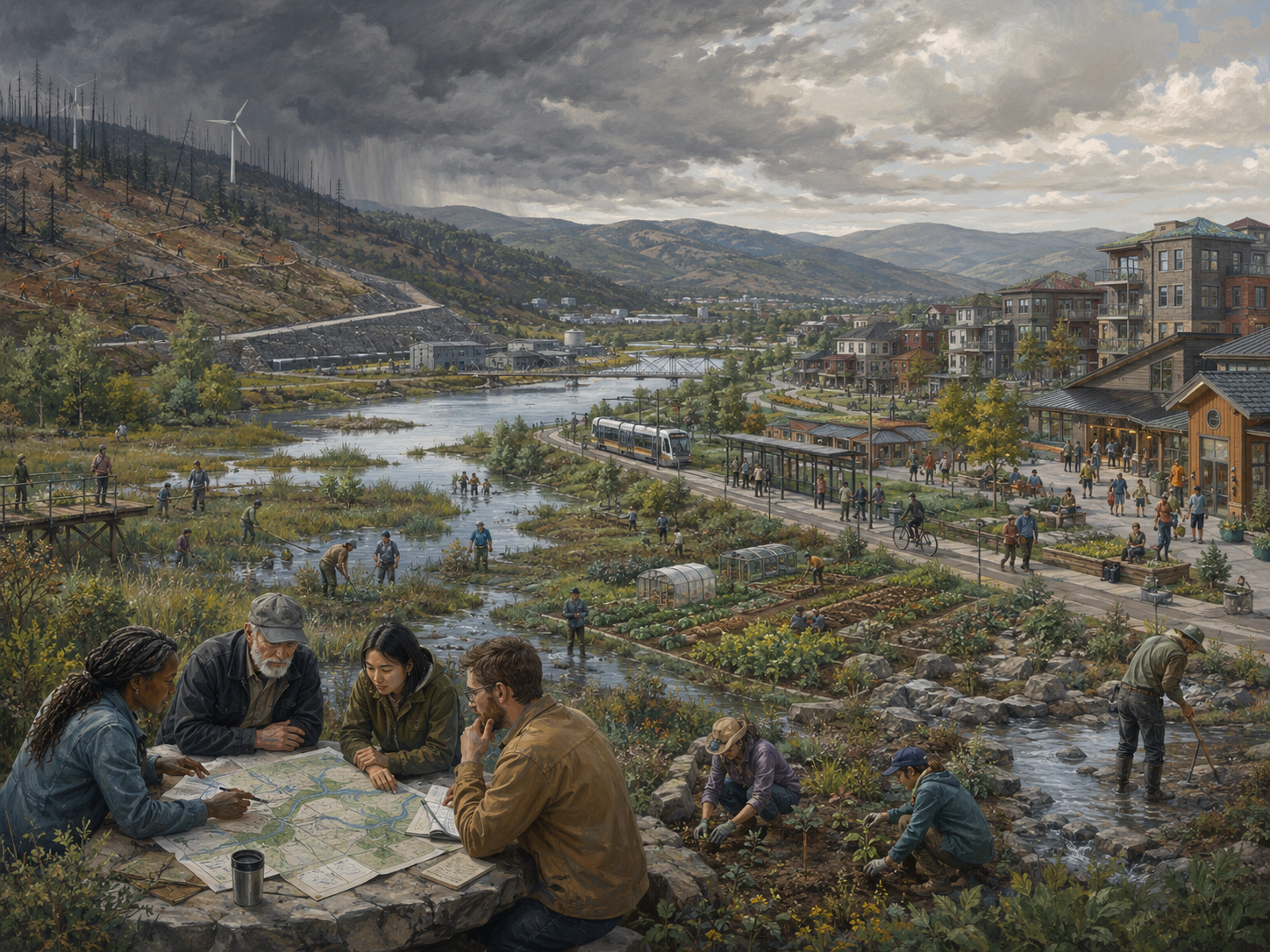
What Resilience and Sustainable Development Mean
Resilience refers to the capacity of a system to absorb disturbance, maintain essential function, adapt to changing conditions, and transform when existing arrangements become unsafe, unjust, or no longer viable. Sustainable development refers to development that meets present needs while preserving the ability of future generations to meet their own needs. The first concept is primarily dynamic: it concerns how systems behave through time under disturbance. The second is normative and intergenerational: it concerns what kinds of development pathways are desirable, just, and ecologically possible.
Resilience thinking helps explain why systems do not always respond gradually to pressure. Social, ecological, economic, infrastructural, and institutional systems can absorb stress for a time, then shift abruptly when thresholds are crossed. Sustainable development helps define the values and constraints that should guide those systems: human wellbeing, poverty reduction, dignity, equity, ecological integrity, intergenerational responsibility, and long-term viability. Together, they ask not only whether systems can persist, but whether the systems that persist are worth sustaining.
This distinction matters because resilience is not automatically good. A fossil-fuel regime can be resilient. A corrupt institution can be resilient. A discriminatory housing market can be resilient. A destructive development model can persist through subsidies, coercion, inertia, and concentrated power. Sustainable development places resilience inside a broader ethical and ecological frame. It asks whether resilience supports life, justice, future capacity, and ecological stability—or whether it merely protects an unsustainable status quo.
| Concept | Core question | Risk if isolated |
|---|---|---|
| Resilience | Can the system absorb disturbance, adapt, recover, and transform? | May preserve harmful, unjust, or ecologically destructive systems. |
| Sustainable development | Can present needs be met without undermining future needs? | May remain aspirational if systems cannot withstand shocks and uncertainty. |
| Climate-resilient development | Can adaptation, mitigation, justice, and development choices be aligned? | May fail if climate action is separated from everyday development decisions. |
| Sustainable resilience | Can systems endure and adapt while remaining just, viable, and within ecological limits? | Requires difficult tradeoffs, governance capacity, and long-term accountability. |
| Just transformation | When must systems change rather than persist? | Can be weakened if transformation is imposed without rights, consent, or participation. |
The integration of resilience and sustainable development therefore produces a stronger analytical question: how can systems remain viable under disturbance without compromising ecological stability, social justice, and future human possibility?
Why Integration Matters
The integration of resilience and sustainable development matters because many systems that appear successful are actually transferring risk across time, place, population, or ecological domain. A city may grow economically while increasing heat exposure and housing insecurity. A supply chain may reduce costs while losing redundancy. A water system may serve present demand while depleting aquifers. A region may attract investment while destroying wetlands that buffer flood risk. A national economy may expand while increasing carbon emissions and ecological overshoot. These are not separate failures; they are failures of systems viability.
Resilience thinking contributes the language of disturbance, adaptive capacity, feedback, thresholds, redundancy, diversity, learning, and transformation. Sustainable development contributes the language of needs, rights, equity, ecological limits, intergenerational justice, poverty reduction, and human wellbeing. Integrated, they prevent two opposite mistakes: treating sustainability as a static end-state and treating resilience as mere persistence.
Without resilience, sustainability plans can assume stable conditions that no longer exist. Without sustainability, resilience plans can strengthen systems that should be redesigned. The two frameworks correct each other. Resilience asks whether a development pathway can withstand shocks. Sustainability asks whether the pathway deserves to continue.
Why the integration is necessary
Short-term success can create long-term fragility
Optimization for growth, efficiency, or output can reduce redundancy, diversity, ecological integrity, and adaptive capacity.
Environmental degradation weakens future resilience
Climate change, biodiversity loss, soil degradation, water stress, and pollution reduce the capacity of systems to absorb disturbance.
Inequality amplifies risk
Unequal exposure, housing insecurity, energy burden, health vulnerability, and political exclusion weaken collective resilience.
Infrastructure lock-in shapes decades of risk
Land use, energy systems, transport networks, buildings, and water systems create path dependencies that are difficult to reverse.
Institutions determine adaptation capacity
Public trust, administrative competence, legal authority, finance, and coordination determine whether strategies become reality.
Future generations inherit today’s system choices
Unsustainable development shifts costs onto people who did not choose the pathway but must live with its consequences.
Integration matters because the central challenge is not simply how to survive disruption. It is how to change development pathways before disruption becomes irreversible loss.
Sustainable Development as Long-Term Viability
Sustainable development is often summarized through the Brundtland formulation: meeting present needs without compromising the ability of future generations to meet their own. That definition remains powerful because it links development to intergenerational obligation. Development is not merely present production, consumption, income, or infrastructure expansion. It is a pathway through time. It must be judged by the future capacity it preserves or destroys.
Long-term viability requires more than balancing “environment,” “economy,” and “society” as three separate pillars. These domains are deeply interdependent. Economies are embedded in societies. Societies are embedded in ecosystems. Institutions shape access, distribution, risk, and legitimacy. Infrastructure mediates energy, water, mobility, housing, and production. Culture shapes values and behavior. Ecological systems provide the biophysical foundation of development. Treating these domains as separate can obscure the dependencies that make development possible.
Sustainable development therefore requires asking whether a pathway can continue without undermining its own foundations. Does it preserve ecological function? Does it reduce poverty and vulnerability? Does it protect rights? Does it maintain public trust? Does it strengthen adaptive capacity? Does it avoid locking future generations into dangerous, expensive, or unjust systems? These are viability questions, not merely policy preferences.
| Viability condition | Development question | Failure if neglected |
|---|---|---|
| Ecological integrity | Does development preserve the living systems and Earth-system processes it depends on? | Climate instability, biodiversity loss, water stress, soil degradation, pollution, and ecosystem collapse. |
| Social inclusion | Does development reduce vulnerability and expand real access to wellbeing? | Growth coexists with displacement, exclusion, poor health, insecurity, and unrest. |
| Economic sufficiency | Does the economy provide livelihoods, public capacity, and resilience without overshoot? | Development becomes dependent on extraction, debt, precarity, and externalized costs. |
| Institutional capacity | Can governance systems coordinate, enforce, learn, and adapt? | Plans remain symbolic, fragmented, underfunded, or captured. |
| Intergenerational responsibility | Does the pathway preserve options for future people? | Present benefits become inherited risk, loss, and constraint. |
Sustainable development is best understood as long-term systems viability: the capacity to meet human needs while protecting the ecological, social, economic, and institutional conditions that make future needs possible.
Resilience as Dynamic Capacity
Resilience adds a dynamic lens to sustainable development. It asks how systems respond when assumptions fail. A development pathway may appear sustainable under average conditions but fail under heat, flood, drought, disease, economic shock, social conflict, supply-chain disruption, cyberattack, or institutional breakdown. Resilience analysis tests whether systems can function under stress.
Resilience includes several capacities. Absorptive capacity allows systems to withstand disturbance without severe loss of function. Adaptive capacity allows systems to adjust behavior, rules, infrastructure, technology, and relationships as conditions change. Transformative capacity allows systems to change deeper structures when incremental adjustment is insufficient. In sustainable development, all three matter. Absorption protects essential functions. Adaptation manages changing conditions. Transformation prevents systems from clinging to pathways that are no longer viable.
Dynamic capacity also requires learning. Systems that recover without learning may repeat the same failure. A coastal community that rebuilds the same exposed housing after every storm is not becoming more resilient. A food system that recovers from drought while continuing soil degradation remains fragile. A city that restores services after a heatwave without addressing tree canopy, housing quality, cooling access, and energy poverty has not transformed its risk structure. Resilience must include memory and revision.
| Resilience capacity | Meaning | Sustainable development relevance |
|---|---|---|
| Absorptive capacity | Ability to withstand disruption without severe loss of essential function | Protects lives, services, infrastructure, ecosystems, and livelihoods during shocks. |
| Adaptive capacity | Ability to adjust practices, rules, designs, investments, and behavior | Allows development pathways to respond to climate, technology, demographic, and ecological change. |
| Transformative capacity | Ability to change underlying structures when old systems are no longer viable | Enables shifts in energy, land use, housing, transport, food, water, governance, and economic systems. |
| Learning capacity | Ability to convert experience, data, and failure into changed practice | Prevents repeated restoration of vulnerable systems. |
| Equity capacity | Ability to reduce unequal exposure, access barriers, and recovery burdens | Strengthens legitimacy, cooperation, and durable wellbeing. |
Resilience is sustainable when dynamic capacity is directed toward viable, just, and ecologically bounded futures rather than toward preserving brittle or harmful systems.
Core Dimensions of Sustainable Resilience
Sustainable resilience depends on several interacting dimensions. These dimensions are not separate boxes. Ecological integrity affects public health and livelihoods. Social inclusion affects institutional legitimacy and adaptive capacity. Economic sufficiency affects investment, household security, and public finance. Infrastructure affects emissions, exposure, and service continuity. Governance affects every dimension through rules, budgets, authority, accountability, and learning.
Ecological Integrity
Ecological integrity refers to the condition of ecosystems, biodiversity, soils, watersheds, climate systems, oceans, forests, wetlands, and biogeochemical cycles that support life. Sustainable resilience requires protecting these systems because they are not optional background conditions. They regulate flood risk, heat, water, food, disease, carbon, habitat, cultural continuity, and long-term development possibility.
Social Inclusion and Equity
Social inclusion ensures that resilience and development strategies reduce vulnerability rather than concentrating risk. Equity includes access to housing, energy, water, health, mobility, education, food, finance, political voice, information, and recovery. It also includes recognition of historical injustice and the unequal distribution of environmental harm.
Adaptive Capacity
Adaptive capacity is the ability to learn, monitor, adjust, innovate, revise rules, and change practice as conditions shift. It depends on knowledge systems, public trust, institutional memory, participation, funding, scenario planning, and the willingness to change assumptions. Sustainable development without adaptive capacity becomes brittle under uncertainty.
Economic Sufficiency and Resilience
Economic sufficiency refers to the ability to provide livelihoods, basic security, public goods, productive capacity, and financial stability without depending on ecological overshoot or social precarity. A sustainable economy must be resilient to shocks, but it must also reduce extractive pressure, debt dependence, inequality, and vulnerability.
Infrastructure and Service Continuity
Infrastructure supports energy, water, sanitation, transport, housing, communications, healthcare, food systems, education, and emergency response. Sustainable resilience requires infrastructure that is low-carbon, maintainable, accessible, climate-adapted, affordable, and capable of preserving essential services during disruption.
Governance and Institutional Learning
Governance determines whether resilience and sustainability goals are translated into enforceable rules, investment, accountability, public participation, and adaptive learning. Institutions must coordinate across scales, protect rights, prevent capture, preserve public trust, and revise policy when evidence, risks, or social conditions change.
| Dimension | Primary function | Failure if neglected |
|---|---|---|
| Ecological integrity | Maintains the biophysical conditions that support life and development | Development undermines climate stability, biodiversity, water, soil, food, and health. |
| Social inclusion and equity | Reduces unequal vulnerability and expands real access to wellbeing | Resilience becomes unequal, illegitimate, and socially unstable. |
| Adaptive capacity | Enables learning, adjustment, and transformation under uncertainty | Systems become locked into obsolete assumptions and brittle pathways. |
| Economic sufficiency | Provides livelihoods, public capacity, and stability without overshoot | Growth depends on extraction, debt, precarity, or externalized harm. |
| Infrastructure and service continuity | Preserves essential services while reducing emissions and exposure | Disruption cascades through energy, water, health, transport, food, and housing. |
| Governance and institutional learning | Coordinates collective action, public legitimacy, accountability, and reform | Strategies remain fragmented, underfunded, symbolic, or captured. |
Sustainable resilience is strongest when these dimensions reinforce one another: ecological restoration reduces hazard exposure, inclusive governance builds trust, resilient infrastructure protects essential services, economic security strengthens adaptive capacity, and institutional learning prevents repeated failure.
Planetary Boundaries and Earth-System Risk
The planetary boundaries framework identifies critical Earth-system processes whose stability supports a safe operating space for humanity. These include climate change, biosphere integrity, land-system change, freshwater change, biogeochemical flows, ocean acidification, stratospheric ozone depletion, atmospheric aerosol loading, and novel entities. The framework is important for sustainable development because it makes clear that human development operates inside biophysical constraints, not outside them.
Resilience thinking strengthens this perspective by asking how Earth-system and social systems behave as boundaries are approached or crossed. Ecological pressures do not always produce smooth, linear change. Climate systems, ecosystems, hydrological systems, fisheries, forests, soils, and ice systems can shift abruptly when thresholds are crossed. As ecological stability weakens, development risks become more frequent, more expensive, more unequal, and harder to manage.
Planetary boundaries also challenge narrow development metrics. Gross domestic product can rise while ecological integrity declines. Urban expansion can increase property values while destroying flood buffers. Agricultural output can increase while degrading soils, groundwater, biodiversity, and future production. Industrial activity can create present income while shifting climate and pollution burdens onto future generations and marginalized communities. A resilience-informed sustainability framework must therefore measure whether development remains within the conditions that make development possible.
| Earth-system process | Development relevance | Resilience concern |
|---|---|---|
| Climate change | Affects heat, sea level, storms, drought, food, water, health, migration, and infrastructure | Can intensify compound risks and push systems beyond design assumptions. |
| Biosphere integrity | Supports ecosystem function, food systems, disease regulation, cultural value, and livelihoods | Biodiversity loss reduces redundancy, adaptive capacity, and ecological recovery. |
| Freshwater change | Shapes drinking water, agriculture, ecosystems, energy, sanitation, and public health | Water stress can cascade into food, energy, conflict, migration, and ecosystem decline. |
| Land-system change | Determines habitat, carbon storage, flood risk, food production, and cultural landscapes | Deforestation and land conversion can reduce resilience and increase hazard exposure. |
| Biogeochemical flows | Nitrogen and phosphorus cycles affect agriculture, water quality, oceans, and ecosystems | Nutrient overload can trigger eutrophication, dead zones, and ecosystem regime shifts. |
| Novel entities and pollution | Chemicals, plastics, and industrial substances affect health and ecosystems | Persistent pollution can accumulate beyond institutional and ecological response capacity. |
Planetary boundaries shift sustainable development from a vague aspiration to a systems constraint: development must operate inside the ecological conditions that sustain life.
Safe and Just Boundaries
Planetary boundaries focus on Earth-system stability. Safe-and-just boundary work adds an essential justice dimension: the question is not only whether biophysical systems remain stable, but whether people are protected from significant harm and whether access to resources is distributed fairly. This matters because ecological thresholds and social thresholds are linked. A climate pathway can be biophysically dangerous and socially unjust at the same time. A water allocation system can stay within aggregate limits while denying basic access to some communities. A transition can reduce emissions while shifting costs onto workers, Indigenous peoples, low-income households, or countries with the least historical responsibility.
Safe-and-just framing strengthens sustainable resilience by rejecting the idea that ecological safety and human justice can be separated. A development pathway that protects ecological systems while excluding vulnerable people will lack legitimacy and may reproduce harm. A development pathway that expands human consumption while breaching Earth-system limits will undermine future wellbeing. The task is to design development within boundaries that are both biophysically safe and socially just.
This is especially important under climate change. The people most exposed to heat, drought, flood, food insecurity, displacement, and pollution are often those least responsible for the drivers of risk. Sustainable resilience therefore requires rights-based adaptation, loss-and-damage awareness, fair transition policy, inclusive planning, environmental justice, and global responsibility. Justice is not an optional moral supplement. It is part of what makes resilience stable and development legitimate.
| Boundary question | Safe dimension | Just dimension |
|---|---|---|
| Climate | Can warming and climate extremes be limited enough to preserve Earth-system stability? | Are vulnerable communities protected, and are responsibilities and costs distributed fairly? |
| Water | Can freshwater systems maintain ecological and hydrological function? | Do all people have reliable access to safe water and sanitation? |
| Land | Can land systems maintain biodiversity, carbon storage, and ecological function? | Are Indigenous rights, food security, housing needs, and cultural landscapes protected? |
| Nutrients and pollution | Can biogeochemical and chemical pressures remain within ecological tolerance? | Are pollution burdens prevented from falling disproportionately on marginalized communities? |
| Biodiversity | Can ecosystems retain functional diversity and recovery capacity? | Are conservation and restoration pursued without dispossession or exclusion? |
Sustainable resilience is not only about staying within limits. It is about building fair, dignified, and accountable ways of living within those limits.
Sustainable Development Goals and Resilience
The Sustainable Development Goals provide a global policy architecture for poverty reduction, health, education, gender equality, water, energy, decent work, infrastructure, reduced inequalities, cities, consumption, climate action, life below water, life on land, peace, justice, and partnership. They are not a resilience framework by themselves, but resilience is embedded across their logic. Goals related to food, water, energy, health, cities, climate, ecosystems, institutions, and inequality cannot be achieved durably if systems collapse under shocks.
Resilience helps interpret the SDGs as interacting system goals rather than independent policy targets. Progress on one goal can support or undermine another. Renewable energy can reduce emissions but may create land, mining, labor, or equity concerns if poorly governed. Agricultural productivity can reduce hunger while increasing water stress and nutrient pollution if unsustainable. Urban development can expand housing while increasing heat, flood, or transport vulnerability if poorly planned. Economic growth can reduce poverty or deepen inequality depending on distribution, labor conditions, ecological pressure, and public capacity.
A resilience-informed SDG approach asks whether progress is robust under disturbance, whether benefits are equitably distributed, whether ecological systems remain viable, and whether institutions can adapt. It also asks whether development pathways avoid shifting costs across borders, generations, ecosystems, or marginalized populations.
| SDG cluster | Resilience connection | Sustainability risk if fragmented |
|---|---|---|
| Poverty, hunger, health, education, and equality | Social protection, care systems, food security, public health, and human capability reduce vulnerability | Human development gains can be reversed by shocks if systems lack protection and redundancy. |
| Water, energy, infrastructure, and cities | Service continuity and adaptive infrastructure protect essential functions | Infrastructure can lock in emissions, exposure, inequality, or resource pressure. |
| Climate, oceans, land, and biodiversity | Ecological integrity supports long-term resilience and risk reduction | Development can degrade the systems that buffer disturbance. |
| Work, production, consumption, and inequality | Economic resilience depends on livelihoods, fair distribution, and reduced overshoot | Growth can become brittle, extractive, or socially destabilizing. |
| Institutions and partnerships | Governance capacity determines whether goals are coordinated, funded, enforced, and adapted | Targets remain symbolic without legitimacy, coordination, accountability, and learning. |
Resilience thinking helps convert the SDGs from a list of goals into a dynamic systems agenda: development must be integrated, adaptive, equitable, and robust under future stress.
Climate-Resilient Development
Climate-resilient development is one of the clearest examples of resilience and sustainable development integration. It connects adaptation, mitigation, equity, governance, finance, technology, ecosystem protection, infrastructure, and everyday development choices. It recognizes that climate action is not separate from development. Energy systems, cities, housing, agriculture, transport, public health, water, finance, land use, and institutions all shape climate risk and development possibility.
Climate-resilient development also highlights tradeoffs and constraints. Some adaptation measures reduce immediate risk but increase emissions or ecological harm. Some mitigation measures reduce emissions but create land conflict, mineral extraction burdens, or energy-access inequities. Some infrastructure investments protect assets while encouraging development in exposed areas. Some development choices reduce poverty but increase long-term exposure if they ignore climate risk. Integrated planning is necessary because single-goal optimization can create future fragility.
Effective climate-resilient development requires mitigation, adaptation, loss-and-damage awareness, inclusive governance, ecological restoration, public finance, technology assessment, rights protection, and local participation. It also requires recognizing that the window for some options narrows as warming and ecological degradation increase. Delayed action can reduce adaptive options, increase costs, and force more disruptive transformations later.
Climate-resilient development priorities
Mitigation and adaptation together
Reducing emissions and preparing for climate impacts must be planned as linked development choices.
Risk-informed infrastructure
Buildings, grids, roads, water systems, housing, and public facilities should be designed for future hazards, not only past conditions.
Just transition
Workers, communities, Indigenous peoples, and low-income households must be protected as energy and land-use systems change.
Nature-based and ecosystem-based approaches
Wetlands, forests, soils, watersheds, reefs, and urban green systems can reduce risk while supporting biodiversity and wellbeing.
Adaptive governance
Policies need monitoring, revision, public accountability, and coordination across sectors and scales.
Equity-centered planning
Climate resilience is weak if it protects assets while leaving people exposed, displaced, or excluded.
Climate-resilient development shows why resilience and sustainability cannot be separated: development choices shape climate risk, and climate risk reshapes development possibility.
Social-Ecological Systems
Resilience and sustainable development converge most clearly in Social-Ecological Systems. A social-ecological system is not a social system plus an environmental system. It is a coupled system in which livelihoods, governance, culture, ecological processes, economic activity, infrastructure, knowledge, and identity are interdependent. Agriculture, fisheries, forests, watersheds, coastal zones, cities, energy landscapes, and food systems all operate as social-ecological systems.
In these systems, ecological degradation becomes social risk, and social decisions become ecological pressure. Deforestation can increase flood risk, reduce biodiversity, intensify heat, and weaken livelihoods. Poor governance can produce overfishing, water depletion, pollution, and land conflict. Economic insecurity can increase pressure on ecosystems when people lack alternatives. Infrastructure can fragment habitats or restore ecological function depending on design. Social inequality can determine who benefits from resources and who bears environmental harm.
Sustainable development requires preserving ecological function while supporting human wellbeing. Resilience thinking adds the need for adaptive capacity, disturbance response, feedback recognition, and threshold awareness. A social-ecological system can remain productive for a time while losing resilience through soil degradation, groundwater depletion, species loss, institutional distrust, or livelihood narrowing. By the time collapse becomes visible, recovery may be difficult.
| Social-ecological linkage | Development role | Resilience concern |
|---|---|---|
| Watersheds | Provide drinking water, irrigation, hydropower, flood regulation, ecosystems, and cultural value | Deforestation, pollution, drought, and extraction can trigger cascading social and ecological stress. |
| Food systems | Support nutrition, livelihoods, land use, trade, health, culture, and ecosystems | Soil loss, water stress, biodiversity decline, and supply-chain fragility weaken future food security. |
| Coastal systems | Support fisheries, tourism, ports, housing, cultural identity, and storm buffering | Sea-level rise, reef loss, erosion, and development pressure can force transformation or relocation. |
| Urban ecosystems | Influence heat, air quality, stormwater, mental health, biodiversity, and public space | Unequal tree canopy and green space deepen heat and health vulnerability. |
| Forests and drylands | Support biodiversity, carbon, livelihoods, water cycles, and Indigenous stewardship | Fire, extraction, fragmentation, and governance failure can produce regime shifts. |
Social-ecological systems make the integration unavoidable: human development depends on ecological resilience, and ecological resilience depends on social choices.
Development Domains and Cross-System Resilience
Resilience appears across every domain of sustainable development, but the domains are interdependent. Environmental resilience supports food, water, health, livelihoods, and disaster risk reduction. Economic resilience supports household security, public finance, social protection, and adaptive investment. Community resilience supports care, mutual aid, trusted communication, and local action. Infrastructure resilience supports service continuity. Institutional resilience supports coordination, accountability, and learning. Weakness in one domain can undermine the rest.
This is why siloed development strategies often fail. A housing strategy that ignores heat and flood risk may increase future vulnerability. An energy strategy that ignores affordability may create energy insecurity. A conservation strategy that ignores community rights may produce conflict. A disaster plan that ignores economic precarity may fail because people cannot evacuate, miss work, or rebuild. A public-health plan that ignores water, housing, food, and trust will struggle under crisis.
Cross-system resilience requires understanding dependencies before they fail. Energy systems support water, communications, health, food storage, transport, and housing safety. Water systems support health, agriculture, energy, sanitation, and ecosystems. Food systems depend on soils, water, energy, labor, transport, finance, and climate. Institutions coordinate all of these systems through rules, budgets, data, trust, and enforcement.
| Development domain | Resilience function | Cross-system dependency |
|---|---|---|
| Environment | Maintains ecological buffers, biodiversity, carbon storage, water quality, and resource renewal | Supports health, food, water, livelihoods, cultural continuity, and disaster risk reduction. |
| Economy | Provides livelihoods, investment, production, finance, and public revenue | Depends on ecological systems, institutions, infrastructure, labor, and social stability. |
| Community | Provides social trust, mutual aid, local knowledge, care, and collective action | Depends on housing, health, communication, services, local economy, and institutional legitimacy. |
| Infrastructure | Provides energy, water, mobility, communications, housing, health facilities, and public services | Depends on finance, governance, maintenance, climate adaptation, and social access. |
| Institutions | Provide coordination, rules, legitimacy, public finance, accountability, and learning | Depend on trust, capacity, evidence, participation, and political stability. |
Sustainable resilience is a cross-system property. It cannot be achieved by optimizing one sector while weakening the systems that sector depends on.
Adaptive Capacity and Transformation
Adaptive Capacity in Complex Systems is central to sustainable development because development conditions change. Climate baselines shift. Technologies evolve. Demographics change. Ecosystems degrade or recover. Markets fluctuate. Institutions gain or lose trust. Infrastructure ages. Cultural expectations shift. A pathway that cannot adapt to changing conditions becomes brittle, even if it initially appears sustainable.
Adaptive capacity includes monitoring, learning, experimentation, flexible governance, local knowledge, public finance, institutional memory, diversity, redundancy, scenario planning, and the ability to revise assumptions. It is not merely innovation in a technological sense. It includes social, ecological, institutional, and cultural learning. Adaptation may involve changing crops, redesigning buildings, revising land-use rules, strengthening public health, shifting energy systems, restoring ecosystems, or changing economic incentives.
Transformation becomes necessary when adaptation within the existing system cannot produce a viable future. Fossil-dependent energy systems, car-dependent urban forms, extractive land-use regimes, brittle global supply chains, exclusionary housing markets, and overdrawn water systems may require structural change rather than marginal improvement. Transformation should be guided by justice because disruptive change can create new winners and losers.
Adaptation and transformation priorities
Monitor slow variables
Soil health, groundwater, infrastructure age, public trust, debt, inequality, and biodiversity often change before crisis becomes visible.
Use scenario planning
Development strategies should be tested against climate, economic, demographic, technological, and governance uncertainty.
Preserve diversity and options
Diverse livelihoods, energy sources, ecosystems, institutions, and knowledge systems prevent lock-in and collapse.
Fund learning capacity
Adaptation requires staff, data, monitoring, community participation, evaluation, and the ability to implement lessons.
Identify transformation thresholds
Some systems require relocation, redesign, economic transition, or governance reform rather than repeated repair.
Protect justice during change
Workers, communities, Indigenous peoples, renters, low-income households, and future generations must not bear transition costs unfairly.
Adaptive capacity allows sustainable development to remain responsive; transformative capacity allows it to remain honest when existing systems are no longer viable.
Risk, Uncertainty, and Long-Term Planning
Sustainable development requires planning under uncertainty. Future climate conditions, technology pathways, migration patterns, economic shocks, geopolitical tensions, ecological changes, and social movements cannot be predicted with precision. Conventional planning that assumes stable baselines can produce fragile systems when conditions shift. Resilience thinking offers tools for planning under uncertainty: scenarios, stress tests, adaptive pathways, redundancy, monitoring, early warning, and flexible governance.
Risk is not only the probability of a hazard. It is a function of hazard, exposure, vulnerability, capacity, and response. Sustainable development can reduce risk by limiting exposure, reducing vulnerability, strengthening capacity, and changing the systems that create hazards. Disaster risk reduction, climate adaptation, public health, infrastructure planning, and social protection all become part of development strategy.
Long-term planning must account for compound risk. Heatwaves can coincide with power outages. Drought can coincide with food price shocks. Floods can coincide with housing shortages. Pandemics can coincide with misinformation and economic instability. Cyber disruption can coincide with storm damage. Development strategies should be tested against interacting hazards, not only isolated scenarios.
| Planning tool | Resilience contribution | Sustainable development value |
|---|---|---|
| Scenario planning | Explores multiple plausible futures rather than a single forecast | Supports flexible pathways under climate, economic, and social uncertainty. |
| Stress testing | Tests systems under extreme or compound conditions | Reveals hidden fragility before failure becomes public harm. |
| Adaptive pathways | Links near-term actions to future decision points | Avoids premature lock-in while preserving options. |
| Early warning indicators | Tracks slow variables, thresholds, and emerging risk | Enables preventive action before crisis becomes irreversible. |
| Redundancy and diversity | Provides backup capacity, alternative pathways, and response options | Reduces brittleness in infrastructure, livelihoods, ecosystems, and institutions. |
| Participatory planning | Incorporates local knowledge, lived risk, and public legitimacy | Improves fairness, feasibility, and accountability. |
Long-term planning for sustainable resilience should not ask only what future is likely. It should ask what futures are possible, what futures are dangerous, what options should be preserved, and what pathways remain just under stress.
Feedback Loops and System Dynamics
Resilience and sustainability are shaped by Feedback Loops in Resilient Systems. Feedback loops explain why development policies can create unintended consequences. A policy may solve one problem while reinforcing another. A road expansion may reduce congestion temporarily while encouraging more driving, emissions, land consumption, and long-term congestion. A subsidy may protect households during energy price spikes while preserving fossil-fuel dependence. A flood-control structure may reduce frequent flooding while encouraging development in hazardous areas, increasing catastrophic loss when defenses fail.
Positive feedback amplifies change. It can accelerate growth, innovation, trust, ecological recovery, or social cooperation. It can also accelerate inequality, ecological degradation, debt, misinformation, land speculation, and climate instability. Negative feedback stabilizes systems by counteracting change, but it can also preserve harmful equilibria. Development governance must understand which loops are active, who benefits from them, and where leverage points exist.
Feedback thinking also clarifies why social and ecological systems must be considered together. Poverty can drive ecological exploitation, which degrades livelihoods, which deepens poverty. Ecological restoration can reduce risk, improve livelihoods, strengthen trust, and support further stewardship. Public trust can increase cooperation, improve crisis outcomes, and strengthen trust further. Corruption can weaken services, reduce trust, lower compliance, and increase corruption opportunities. Development pathways are feedback structures.
| Feedback loop | Direction | Development implication |
|---|---|---|
| Growth-overshoot loop | Economic output increases resource pressure, which degrades ecological systems and future production capacity | Growth must be evaluated against ecological limits and resource pressure. |
| Trust-cooperation loop | Fair institutions increase cooperation; cooperation improves outcomes; outcomes strengthen trust | Legitimacy is a resilience resource. |
| Displacement-vulnerability loop | Hazards displace residents; social networks weaken; recovery capacity declines; future vulnerability rises | Recovery must include anti-displacement and social protection. |
| Restoration-stewardship loop | Ecological restoration reduces risk and builds local benefits, strengthening support for further restoration | Nature-based strategies can become reinforcing when benefits are shared. |
| Infrastructure lock-in loop | Built systems shape behavior, investment, politics, and future development choices | Long-lived infrastructure must be evaluated through lifecycle resilience and emissions. |
Sustainable resilience requires changing the feedback loops that reproduce vulnerability, overshoot, and exclusion—not merely treating their symptoms.
Thresholds, Regime Shifts, and Overshoot
System Thresholds and Tipping Points are central to the integration of resilience and sustainable development. A system may absorb pressure for a long time before shifting abruptly into a new regime. Forests can shift toward savanna-like conditions. Lakes can shift from clear to eutrophic states. Fisheries can collapse. Housing markets can cross affordability thresholds. Institutions can lose legitimacy. Infrastructure systems can fail after deferred maintenance accumulates. Household debt can become crisis. These threshold dynamics matter because they make delayed action dangerous.
Overshoot occurs when resource use, pollution, emissions, extraction, or social burden exceed the regenerative or absorptive capacity of the system. Overshoot is not only environmental. Social systems can experience overshoot when caregiving burdens, housing costs, work stress, inequality, administrative burden, or public distrust exceed what communities and institutions can absorb. Economic systems can experience overshoot through debt, speculation, asset bubbles, or supply-chain strain. Sustainable resilience requires recognizing overshoot before collapse becomes obvious.
Regime shifts are difficult because returning to the old state may be expensive, slow, or impossible. A degraded ecosystem may not recover quickly even after pressure is reduced. A displaced community may not reassemble after housing loss. A collapsed institution may not regain trust through a single reform. A water system depleted beyond recharge may constrain development for generations. Threshold awareness therefore strengthens intergenerational responsibility.
| Threshold domain | Slow variable | Potential regime shift |
|---|---|---|
| Ecological systems | Biodiversity, soil health, water quality, groundwater, habitat connectivity | Ecosystem function declines, recovery becomes difficult, and livelihoods weaken. |
| Climate systems | Greenhouse-gas concentration, warming, ice loss, ocean heat, carbon sinks | Climate extremes intensify and adaptation options narrow. |
| Infrastructure | Maintenance backlog, asset age, design mismatch, underinvestment, climate exposure | Service failure becomes chronic or cascading. |
| Community systems | Housing insecurity, trust, population retention, social networks, health burden | Displacement, decline, or loss of collective capacity accelerates. |
| Institutions | Trust, staffing, fiscal capacity, legitimacy, accountability, learning | Governance becomes brittle, contested, captured, or unable to act. |
Threshold thinking changes development strategy: the goal is not only to recover from shocks, but to avoid trajectories that make recovery impossible or unjust.
Equity and Sustainable Resilience
Equity is not external to sustainable resilience. It is one of its core conditions. Unequal societies are often less resilient because risk is concentrated, trust is weaker, public health is poorer, political legitimacy is strained, and recovery is uneven. People with fewer resources, weaker legal protection, less secure housing, lower political voice, poorer health, and higher environmental exposure have less capacity to adapt. When their vulnerability is ignored, system-wide resilience claims become misleading.
Sustainable development must address poverty, inequality, exclusion, colonial legacies, racialized harm, gendered vulnerability, disability access, Indigenous rights, labor precarity, informal settlements, environmental racism, and unequal exposure to climate and pollution. Resilience strategies that ignore these conditions can deepen injustice. A flood protection project can raise land values and displace renters. A carbon market can restrict Indigenous land use. A green infrastructure project can trigger gentrification. A disaster recovery program can favor homeowners over renters. A digital adaptation platform can exclude people without internet access.
Equity also strengthens resilience. Inclusive planning improves information quality because affected communities understand local risk. Social protection improves adaptive capacity because households are less likely to collapse under shock. Public trust improves cooperation. Fair distribution improves legitimacy. Rights-based governance reduces conflict. Sustainable resilience is therefore both ethical and functional: just systems are often more capable systems.
| Equity dimension | Sustainable resilience question | Failure if ignored |
|---|---|---|
| Distribution | Who receives benefits and who bears costs? | Transition and adaptation reproduce inequality. |
| Recognition | Whose knowledge, history, identity, and rights are acknowledged? | Planning erases marginalized voices and lived experience. |
| Participation | Who has power over decisions? | Engagement becomes symbolic and legitimacy weakens. |
| Capability | Who has the real ability to prepare, adapt, recover, and thrive? | Formal access hides practical exclusion. |
| Intergenerational justice | What burdens are shifted onto future people? | Present development consumes future options. |
Equity makes resilience durable because systems that protect only some people cannot claim to be socially sustainable.
Economic Systems and Development Pathways
Economic systems shape sustainable resilience because production, consumption, labor, finance, trade, investment, public revenue, and distribution determine how societies meet needs and manage risk. Economic resilience is not simply the ability of markets to rebound. It is the ability of economic arrangements to protect livelihoods, maintain essential production, reduce vulnerability, support public capacity, and adapt without ecological overshoot or social collapse.
Many economic systems are resilient in a narrow sense but unsustainable in a broader sense. Fossil-fuel systems, extractive commodity economies, debt-driven growth models, precarious labor systems, speculative housing markets, and fragile just-in-time supply chains can persist because they are supported by infrastructure, subsidies, institutions, and political power. Their persistence may protect short-term output while increasing climate risk, inequality, resource depletion, and future instability.
Sustainable economic resilience requires moving beyond the assumption that growth alone solves development problems. The quality, distribution, ecological footprint, and institutional basis of economic activity matter. A viable development pathway should support livelihoods, reduce poverty, strengthen public goods, preserve ecological function, and maintain adaptive capacity. Economic efficiency should be evaluated alongside redundancy, fairness, repairability, localization where appropriate, circularity, and public purpose.
Economic pathway priorities
Livelihood diversity
Diverse livelihoods reduce dependence on single sectors, fragile supply chains, or extractive resource bases.
Circular production
Repair, reuse, remanufacturing, recycling, and material efficiency reduce resource pressure and waste.
Public goods investment
Health, education, infrastructure, research, ecosystems, and social protection build adaptive capacity.
Financial stability
Debt, speculation, insurance gaps, and fiscal fragility can undermine long-term resilience.
Just transition
Workers and communities affected by structural change need protection, participation, and new pathways.
Ecological accounting
Economic performance should account for emissions, biodiversity loss, water stress, pollution, and future costs.
Economic development becomes sustainable resilience when it supports human capability without eroding the ecological and social foundations that future economies require.
Infrastructure, Urbanization, and Service Continuity
Infrastructure is one of the main ways development becomes durable—or brittle. Energy systems, water networks, sanitation, roads, transit, housing, communications, ports, hospitals, schools, food distribution, and public spaces shape emissions, exposure, access, health, economic opportunity, and disaster response. Infrastructure decisions often last for decades, which makes them central to intergenerational responsibility.
Sustainable infrastructure must do several things at once. It must provide essential services, reduce emissions, withstand future climate conditions, remain affordable, avoid ecological damage, support repair and maintenance, and reduce unequal vulnerability. Infrastructure designed only for lowest initial cost can create long-term fragility. Infrastructure designed only for asset protection can ignore service access. Infrastructure designed only for growth can lock in sprawl, emissions, heat exposure, flood risk, and car dependence.
Urbanization makes the integration especially important. Cities concentrate people, infrastructure, economic activity, emissions, innovation, and risk. Urban development can reduce per-capita resource use and expand services when planned well. It can also intensify heat islands, flooding, displacement, pollution, housing insecurity, and infrastructure stress when planned poorly. Urban resilience and sustainable development therefore require land-use planning, housing justice, transit, green infrastructure, energy systems, public health, local economies, and participatory governance to be designed together.
| Infrastructure system | Sustainable development role | Resilience requirement |
|---|---|---|
| Energy | Powers homes, health, water, industry, transport, communications, and public services | Low-carbon, affordable, reliable, distributed where useful, cyber-secure, and climate-adapted. |
| Water and sanitation | Supports health, food, ecosystems, dignity, and economic activity | Safe, redundant, watershed-aware, drought- and flood-resilient, and accessible to all. |
| Housing | Provides shelter, stability, health, family life, and community continuity | Affordable, efficient, heat-safe, flood-aware, accessible, and protected from displacement. |
| Transport | Connects people to work, care, education, food, services, and emergency movement | Low-emission, accessible, redundant, multimodal, and functional during disruption. |
| Digital infrastructure | Supports communication, data, services, education, finance, and coordination | Secure, inclusive, resilient to outages, privacy-protective, and not a substitute for human access. |
| Green and blue infrastructure | Supports flood protection, cooling, biodiversity, recreation, health, and water quality | Maintained, equitable, culturally appropriate, and protected from green displacement. |
Infrastructure is sustainable and resilient when it protects essential services, reduces ecological pressure, and strengthens public life rather than locking future generations into expensive vulnerability.
Institutions, Governance, and Public Capacity
Sustainable resilience depends on institutions because long-term development cannot be coordinated by technical fixes alone. Institutions set rules, allocate budgets, regulate markets, protect rights, enforce standards, manage public services, coordinate emergencies, resolve conflict, and preserve institutional memory. Without capable and legitimate institutions, sustainability and resilience goals remain slogans.
Institutional Resilience is especially important because many sustainability transitions require coordinated public action over long time horizons. Energy transitions require regulation, investment, public consent, grid planning, worker support, and land-use governance. Water resilience requires watershed management, infrastructure finance, ecological restoration, and fair allocation. Climate adaptation requires public health, housing, land-use planning, disaster risk reduction, and social protection. Biodiversity protection requires enforcement, stewardship, Indigenous rights, and land governance.
Governance must also guard against capture and maladaptation. Powerful actors may benefit from unsustainable systems and resist change. Short political cycles may discourage long-term investment. Fragmented agencies may create gaps. Technical expertise may be used to exclude public participation. Emergency authority may bypass rights. Resilient governance requires accountability, transparency, participation, administrative capacity, independent oversight, and adaptive learning.
Governance capacities for sustainable resilience
Public legitimacy
People are more likely to cooperate with difficult transitions when institutions are trusted, fair, transparent, and accountable.
Administrative capacity
Plans require staff, budgets, data systems, procurement, enforcement, and field-level capability.
Cross-sector coordination
Energy, water, housing, food, health, ecosystems, and finance require integrated governance.
Adaptive learning
Institutions must revise rules, standards, budgets, and practices as conditions and evidence change.
Rights protection
Transitions and emergency measures must protect due process, Indigenous rights, labor rights, disability access, and participation.
Anti-capture safeguards
Public purpose must be protected against concentrated power, corruption, lobbying dominance, and narrow private interests.
Public capacity is not a secondary implementation detail. It is one of the conditions that determines whether sustainable resilience is possible.
Maladaptive Resilience and Unsustainable Lock-In
Resilience becomes maladaptive when systems remain stable by preserving harm. An economy can remain resilient by continuing fossil extraction. A city can remain prosperous by displacing low-income residents to exposed areas. A food system can maintain output through chemical dependence, soil depletion, and exploitative labor. A flood-control system can protect development temporarily while encouraging riskier land use. A political institution can maintain order through exclusion or suppression. These systems persist, but their persistence is not sustainable.
Unsustainable lock-in occurs when infrastructure, institutions, incentives, markets, habits, and political power make harmful pathways difficult to change. Fossil-fuel infrastructure creates economic and political dependencies. Car-oriented urban form creates land-use and mobility lock-in. Industrial agriculture can lock regions into input dependence, soil degradation, and water stress. Housing markets can lock communities into segregation and displacement. Digital systems can lock institutions into surveillance, data extraction, or platform dependency.
Resilience thinking helps identify lock-in by asking what system structures reproduce current behavior. Sustainable development helps evaluate whether those structures should persist. Together, they reveal that some systems should not be made more resilient in their existing form. They should be transformed.
| Lock-in pattern | How it persists | Sustainable resilience response |
|---|---|---|
| Fossil-fuel dependency | Infrastructure, subsidies, jobs, political influence, market design, and consumer systems | Just transition, clean energy, efficiency, public investment, worker support, and demand reduction. |
| Car-dependent urbanization | Roads, zoning, parking, land value, commute patterns, and weak transit | Transit-oriented development, walkability, housing reform, cycling infrastructure, and land-use change. |
| Exposed development | Property markets, insurance gaps, local revenue incentives, and flood-control confidence | Risk-informed land use, buyouts with justice, restoration, disclosure, and anti-displacement protections. |
| Extractive economies | Commodity dependence, external investment, weak regulation, and limited local alternatives | Livelihood diversification, local value creation, ecological restoration, and community ownership. |
| Administrative exclusion | Complex procedures, documentation barriers, digital-only access, language gaps, and stigma | Administrative burden reduction, accessible services, navigators, language access, and rights-based design. |
Sustainable resilience requires distinguishing between capacities that should be strengthened and structures that should be deliberately transformed.
Measuring Resilience and Sustainability
Measuring resilience and sustainability together requires more than a single composite score. A system may score well on current economic output while failing ecological integrity. It may score well on emissions while failing equity. It may score well on infrastructure hardening while failing affordability. It may score well on recovery time while displacing vulnerable residents. Measurement must therefore be multidimensional, dynamic, disaggregated, and decision-oriented.
Useful indicators include ecological integrity, emissions, biodiversity, water stress, land use, social vulnerability, health, housing, energy burden, food security, livelihoods, infrastructure continuity, institutional trust, public finance, adaptive capacity, and intergenerational risk. But indicators should not become decorative dashboards. They should trigger action. If thresholds are approached, policy should change. If risks are concentrated, investment should shift. If recovery is unequal, rules should be revised. If institutions do not implement lessons, accountability should follow.
Measurement should also distinguish between performance, trajectory, and resilience. Performance asks how a system is doing now. Trajectory asks where it is going. Resilience asks how it behaves under disturbance. Sustainability asks whether the trajectory remains viable and just over time. A serious measurement system must include all four.
| Measurement domain | Example indicators | Interpretive caution |
|---|---|---|
| Ecological integrity | Emissions, biodiversity, water quality, soil health, land cover, nutrient flows, pollution, ecosystem services | Aggregate indicators may hide local harm or irreversible thresholds. |
| Social wellbeing | Health, poverty, education, food access, housing, safety, energy burden, participation, rights protection | Averages can hide inequality and exclusion. |
| Economic resilience | Livelihood diversity, debt, savings, small business continuity, public finance, supply-chain diversity, employment quality | GDP growth can mask precarity and ecological externalization. |
| Infrastructure continuity | Outage duration, service access, asset condition, maintenance backlog, redundancy, climate exposure | Asset-level metrics may miss whether people can access essential services. |
| Institutional capacity | Trust, staffing, coordination, budget, enforcement, learning, transparency, corruption controls, implementation | Plans and reports do not prove governance capacity. |
| Adaptive capacity | Scenario planning, monitoring, experimentation, policy revision, local knowledge, finance, institutional learning | Capacity claims are weak unless they change decisions. |
| Intergenerational viability | Emissions pathway, resource depletion, infrastructure lock-in, debt, ecological restoration, option preservation | Present benefits may conceal future constraints. |
Measurement should reveal whether development is resilient, whether resilience is sustainable, and whether both are just.
A Practical Framework for Sustainable Resilience Planning
A practical sustainable resilience process should begin with the question of essential functions and long-term viability: what must continue, what must change, and what limits must not be exceeded? It should examine ecological constraints, social vulnerability, economic dependencies, infrastructure exposure, institutional capacity, feedback loops, thresholds, and justice. The result should be a pathway portfolio rather than a single project.
| Step | Question | Output |
|---|---|---|
| Define long-term wellbeing | What human needs, rights, capabilities, and community functions must development support? | Wellbeing goals grounded in health, dignity, livelihood, care, participation, culture, and future capacity. |
| Map ecological limits | Which ecological processes constrain the development pathway? | Climate, water, biodiversity, land, soil, pollution, nutrient, and ecosystem-function constraints. |
| Map systems dependencies | What systems support essential functions? | Energy, water, food, housing, transport, health, finance, ecosystems, institutions, and community networks. |
| Assess vulnerability and equity | Who is exposed, underprotected, excluded, or burdened? | Disaggregated vulnerability analysis with historical injustice, access barriers, and participation gaps. |
| Identify feedback loops | What dynamics reproduce vulnerability, overshoot, or resilience? | Systems map of reinforcing and balancing loops, leverage points, and unintended consequences. |
| Identify thresholds and lock-in | Where could gradual stress become abrupt change? | Threshold indicators for ecosystems, infrastructure, housing, institutions, finance, health, and trust. |
| Design pathway portfolio | What combination of mitigation, adaptation, equity, infrastructure, governance, and economic strategy is needed? | Portfolio of actions with sequencing, triggers, costs, benefits, tradeoffs, and responsible institutions. |
| Stress test scenarios | How does the pathway perform under compound disturbance? | Scenario results for climate extremes, economic shocks, public-health crises, supply-chain disruption, and governance failure. |
| Build adaptive governance | How will decisions be revised as evidence and conditions change? | Monitoring system, review cycles, public accountability, participation, and decision triggers. |
| Track justice and future capacity | Who benefits now, who bears costs, and what options are preserved for the future? | Equity metrics, intergenerational indicators, public reporting, and corrective mechanisms. |
Sustainable resilience planning becomes meaningful when it links ecological limits, human wellbeing, institutional capacity, and adaptive learning into a shared pathway for long-term viability.
Mathematical Lens: Modeling Viability, Adaptive Capacity, and Development Under Constraint
Resilience and sustainable development cannot be reduced to a single equation, but formal models can clarify the dimensions that must be balanced. One useful abstraction treats long-term system viability \(V_i\) as a function of resilience, ecological integrity, social inclusion, economic sufficiency, institutional capacity, adaptive capacity, and resource pressure:
V_i = w_r R_i + w_e E_i + w_s S_i + w_m M_i + w_g G_i + w_a A_i – w_p P_i
\]
Interpretation: \(R_i\) represents resilience under disturbance, \(E_i\) ecological integrity, \(S_i\) social inclusion, \(M_i\) economic sufficiency, \(G_i\) governance capacity, \(A_i\) adaptive capacity, and \(P_i\) resource pressure or ecological overshoot.
Development quality over time can be represented dynamically. Let development quality at time \(t\) be \(D_t\), disturbance intensity be \(K_t\), adaptive response be \(A_t\), ecological overshoot be \(O_t\), and equity protection be \(J_t\):
D_{t+1} = D_t – \alpha K_t + \beta A_t – \gamma O_t + \delta J_t
\]
Interpretation: Development quality depends not only on present performance, but on disturbance, adaptive response, ecological overshoot, and justice-oriented protection.
A pathway framing is useful because sustainable resilience is not produced by one intervention alone. If each development pathway \(j\) has probability \(p_j\) of remaining viable under future stress and constraint, expected sustainable resilience can be represented as:
E(P) = \sum_{j=1}^{n} p_j V_j
\]
Interpretation: Sustainable resilience emerges from how ecological, social, economic, infrastructural, and institutional strategies interact across time.
Overshoot risk can be modeled as a penalty when resource pressure exceeds a safe boundary \(B\):
V_i^{*} = V_i – \lambda \max(0, P_i – B)
\]
Interpretation: When resource pressure exceeds a boundary, the adjusted viability score falls. This prevents present development performance from hiding future ecological risk.
An equity-adjusted form can include a penalty for unequal vulnerability \(U_i\):
V_i^{**} = V_i^{*} – \theta U_i
\]
Interpretation: A pathway is less viable when its resilience depends on unequal exposure, exclusion, displacement, or future burden shifting.
These equations do not replace ecological science, public deliberation, Indigenous knowledge, economics, engineering, governance, or ethics. Their value lies in making assumptions explicit so development pathways can be compared, stress-tested, and challenged.
Advanced R Workflow: Comparing Sustainable Resilience Pathways
The R workflow below compares sustainable resilience pathways across resilience, ecological integrity, social inclusion, economic sufficiency, governance capacity, adaptive capacity, resource pressure, and implementation burden. It then shows how rankings shift under different strategic priorities.
# Install packages if needed:
# install.packages(c("tidyverse", "scales"))

library(tidyverse)
library(scales)

# -------------------------------------------------------------------
# Example sustainable resilience pathways.
# Higher resource_pressure and implementation_burden are penalties.
# Values are synthetic and for methodological demonstration only.
# -------------------------------------------------------------------

pathways <- tibble(
  pathway = c(
    "Distributed Renewable Infrastructure",
    "Circular Regional Production System",
    "Inclusive Urban Resilience Transition",
    "Climate-Resilient Food and Water Strategy",
    "Ecosystem Restoration and Livelihood Diversification",
    "Public Health Housing and Heat Resilience Compact"
  ),
  resilience = c(8.5, 8.1, 8.3, 8.7, 8.4, 8.6),
  ecological_integrity = c(8.2, 8.8, 7.9, 8.4, 9.0, 7.8),
  social_inclusion = c(7.8, 7.9, 8.8, 8.1, 8.2, 9.0),
  economic_sufficiency = c(8.0, 8.4, 8.1, 8.2, 7.9, 8.0),
  governance_capacity = c(7.8, 7.9, 8.3, 8.1, 8.0, 8.2),
  adaptive_capacity = c(8.4, 8.2, 8.5, 8.6, 8.7, 8.3),
  resource_pressure = c(4.0, 3.7, 4.2, 3.9, 3.5, 4.1),
  implementation_burden = c(3.5, 3.3, 3.6, 3.4, 3.2, 3.1)
)

# -------------------------------------------------------------------
# Weighted viability value function.
# -------------------------------------------------------------------

score_pathways <- function(data, wr, we, ws, wm, wg, wa, wp, wi) {
  data %>%
    mutate(
      viability_value =
        wr * resilience +
        we * ecological_integrity +
        ws * social_inclusion +
        wm * economic_sufficiency +
        wg * governance_capacity +
        wa * adaptive_capacity -
        wp * resource_pressure -
        wi * implementation_burden,
      diagnostic = case_when(
        resource_pressure >= 4.2 ~ "resource-pressure review needed",
        social_inclusion < 8.0 ~ "social-inclusion safeguards need strengthening",
        ecological_integrity < 8.0 ~ "ecological-integrity safeguards need strengthening",
        governance_capacity < 8.0 ~ "governance-capacity review needed",
        TRUE ~ "promising but requires scenario validation"
      )
    ) %>%
    arrange(desc(viability_value))
}

# -------------------------------------------------------------------
# Scenario weights for different priorities.
# -------------------------------------------------------------------

scenarios <- tribble(
  ~scenario,                 ~wr,  ~we,  ~ws,  ~wm,  ~wg,  ~wa,  ~wp,  ~wi,
  "Balanced",                0.18, 0.17, 0.16, 0.14, 0.14, 0.15, 0.04, 0.02,
  "Resilience-first",        0.38, 0.13, 0.12, 0.10, 0.10, 0.12, 0.03, 0.02,
  "Ecology-first",           0.13, 0.38, 0.12, 0.10, 0.10, 0.12, 0.03, 0.02,
  "Inclusion-first",         0.12, 0.13, 0.38, 0.10, 0.10, 0.12, 0.03, 0.02,
  "Governance-first",        0.12, 0.13, 0.12, 0.10, 0.36, 0.12, 0.03, 0.02,
  "Adaptation-first",        0.12, 0.13, 0.12, 0.10, 0.10, 0.36, 0.05, 0.02,
  "Constraint-sensitive",    0.15, 0.16, 0.14, 0.12, 0.12, 0.14, 0.14, 0.03,
  "Implementation-aware",    0.16, 0.16, 0.15, 0.13, 0.13, 0.14, 0.04, 0.09
)

# -------------------------------------------------------------------
# Evaluate pathways across scenarios.
# -------------------------------------------------------------------

scenario_results <- scenarios %>%
  rowwise() %>%
  do(
    score_pathways(
      pathways,
      wr = .$wr,
      we = .$we,
      ws = .$ws,
      wm = .$wm,
      wg = .$wg,
      wa = .$wa,
      wp = .$wp,
      wi = .$wi
    ) %>%
      mutate(scenario = .$scenario)
  ) %>%
  ungroup()

ranked_results <- scenario_results %>%
  group_by(scenario) %>%
  arrange(desc(viability_value), .by_group = TRUE) %>%
  mutate(rank = row_number()) %>%
  ungroup()

print(ranked_results)

# -------------------------------------------------------------------
# Visualize ranking shifts across priorities.
# -------------------------------------------------------------------

ggplot(ranked_results, aes(x = pathway, y = viability_value, group = scenario)) +
  geom_point(size = 3) +
  geom_line(aes(color = scenario), linewidth = 1) +
  coord_flip() +
  labs(
    title = "Sustainable Resilience Pathway Value Across Priority Scenarios",
    x = "Pathway",
    y = "Weighted Viability Value",
    color = "Scenario"
  ) +
  theme_minimal(base_size = 12)

# -------------------------------------------------------------------
# Summarize which pathways rank first most often.
# -------------------------------------------------------------------

top_rank_summary <- ranked_results %>%
  filter(rank == 1) %>%
  count(pathway, name = "times_ranked_first") %>%
  arrange(desc(times_ranked_first))

print(top_rank_summary)

# -------------------------------------------------------------------
# Export results for review.
# -------------------------------------------------------------------

write_csv(ranked_results, "sustainable_resilience_pathway_rankings.csv")
write_csv(top_rank_summary, "sustainable_resilience_top_rank_summary.csv")
This workflow shows why sustainable resilience decisions depend on planning priorities. A distributed renewable infrastructure pathway, circular production pathway, inclusive urban transition, food-water strategy, ecosystem-livelihood pathway, and public health housing compact may rank differently depending on whether the system prioritizes resilience, ecology, inclusion, governance, adaptation, resource constraints, or implementation feasibility.
Advanced Python Workflow: Uncertainty Analysis for Long-Term Development Choices
The Python workflow below extends the same logic with Monte Carlo simulation. Instead of assuming fixed values, it models uncertainty across resilience, ecological integrity, social inclusion, economic sufficiency, governance capacity, adaptive capacity, resource pressure, and implementation burden.
# Install packages if needed:
# pip install pandas numpy matplotlib

import numpy as np
import pandas as pd
import matplotlib.pyplot as plt

# ---------------------------------------------------------------------
# Example sustainable resilience pathways.
# Values are synthetic and for methodological demonstration only.
# Higher resource_pressure and implementation_burden are penalties.
# ---------------------------------------------------------------------

pathways = pd.DataFrame({
    "pathway": [
        "Distributed Renewable Infrastructure",
        "Circular Regional Production System",
        "Inclusive Urban Resilience Transition",
        "Climate-Resilient Food and Water Strategy",
        "Ecosystem Restoration and Livelihood Diversification",
        "Public Health Housing and Heat Resilience Compact"
    ],
    "resilience": [8.5, 8.1, 8.3, 8.7, 8.4, 8.6],
    "ecological_integrity": [8.2, 8.8, 7.9, 8.4, 9.0, 7.8],
    "social_inclusion": [7.8, 7.9, 8.8, 8.1, 8.2, 9.0],
    "economic_sufficiency": [8.0, 8.4, 8.1, 8.2, 7.9, 8.0],
    "governance_capacity": [7.8, 7.9, 8.3, 8.1, 8.0, 8.2],
    "adaptive_capacity": [8.4, 8.2, 8.5, 8.6, 8.7, 8.3],
    "resource_pressure": [4.0, 3.7, 4.2, 3.9, 3.5, 4.1],
    "implementation_burden": [3.5, 3.3, 3.6, 3.4, 3.2, 3.1]
})

# ---------------------------------------------------------------------
# Baseline weights.
# ---------------------------------------------------------------------

weights = {
    "resilience": 0.18,
    "ecological_integrity": 0.17,
    "social_inclusion": 0.16,
    "economic_sufficiency": 0.14,
    "governance_capacity": 0.14,
    "adaptive_capacity": 0.15,
    "resource_pressure": 0.04,
    "implementation_burden": 0.02
}

benefit_columns = [
    "resilience",
    "ecological_integrity",
    "social_inclusion",
    "economic_sufficiency",
    "governance_capacity",
    "adaptive_capacity"
]

penalty_columns = ["resource_pressure", "implementation_burden"]

# ---------------------------------------------------------------------
# Weighted viability value function.
# ---------------------------------------------------------------------

def compute_viability_value(df, weights_dict):
    result = df.copy()
    result["viability_value"] = (
        weights_dict["resilience"] * result["resilience"]
        + weights_dict["ecological_integrity"] * result["ecological_integrity"]
        + weights_dict["social_inclusion"] * result["social_inclusion"]
        + weights_dict["economic_sufficiency"] * result["economic_sufficiency"]
        + weights_dict["governance_capacity"] * result["governance_capacity"]
        + weights_dict["adaptive_capacity"] * result["adaptive_capacity"]
        - weights_dict["resource_pressure"] * result["resource_pressure"]
        - weights_dict["implementation_burden"] * result["implementation_burden"]
    )

    result["diagnostic"] = np.select(
        [
            result["resource_pressure"] >= 4.2,
            result["social_inclusion"] < 8.0,
            result["ecological_integrity"] < 8.0,
            result["governance_capacity"] < 8.0,
            result["implementation_burden"] >= 3.6
        ],
        [
            "resource-pressure review needed",
            "social-inclusion safeguards need strengthening",
            "ecological-integrity safeguards need strengthening",
            "governance-capacity review needed",
            "implementation-burden review needed"
        ],
        default="promising but requires scenario validation"
    )

    return result.sort_values("viability_value", ascending=False)

baseline_results = compute_viability_value(pathways, weights)
print("Baseline sustainable resilience ranking:")
print(baseline_results[["pathway", "viability_value", "diagnostic"]])

# ---------------------------------------------------------------------
# Monte Carlo simulation.
# Allow values to vary around current estimates.
# ---------------------------------------------------------------------

np.random.seed(42)
n_simulations = 5000
simulation_rows = []

for simulation_id in range(n_simulations):
    simulated = pathways.copy()

    for col in benefit_columns + penalty_columns:
        simulated[col] = np.random.normal(
            loc=pathways[col],
            scale=0.6
        )
        simulated[col] = simulated[col].clip(1, 10)

    simulated_results = compute_viability_value(simulated, weights)

    for rank, (_, row) in enumerate(simulated_results.iterrows(), start=1):
        simulation_rows.append({
            "simulation_id": simulation_id,
            "pathway": row["pathway"],
            "rank": rank,
            "viability_value": row["viability_value"],
            "diagnostic": row["diagnostic"],
            "winner": simulated_results.iloc[0]["pathway"]
        })

simulation = pd.DataFrame(simulation_rows)

summary = (
    simulation
    .groupby("pathway")
    .agg(
        mean_viability_value=("viability_value", "mean"),
        median_viability_value=("viability_value", "median"),
        probability_ranked_first=("rank", lambda x: (x == 1).mean() * 100),
        probability_top_two=("rank", lambda x: (x <= 2).mean() * 100),
        probability_bottom_two=("rank", lambda x: (x >= 5).mean() * 100),
        resource_pressure_review_rate=("diagnostic", lambda x: (x == "resource-pressure review needed").mean() * 100),
        implementation_review_rate=("diagnostic", lambda x: (x == "implementation-burden review needed").mean() * 100)
    )
    .reset_index()
    .sort_values("probability_ranked_first", ascending=False)
)

print("\nPathway robustness under uncertainty:")
print(summary)

# ---------------------------------------------------------------------
# Plot robustness under uncertainty.
# ---------------------------------------------------------------------

plt.figure(figsize=(10, 6))
plt.bar(summary["pathway"], summary["probability_ranked_first"])
plt.xticks(rotation=20, ha="right")
plt.ylabel("Probability of Ranking First (%)")
plt.title("Robustness of Sustainable Resilience Pathways Under Uncertainty")
plt.tight_layout()
plt.show()

# ---------------------------------------------------------------------
# Plot resource-pressure review rates.
# ---------------------------------------------------------------------

plt.figure(figsize=(10, 6))
plt.bar(summary["pathway"], summary["resource_pressure_review_rate"])
plt.xticks(rotation=20, ha="right")
plt.ylabel("Resource-Pressure Review Rate (%)")
plt.title("How Often Pathways Trigger Resource-Pressure Review")
plt.tight_layout()
plt.show()

# ---------------------------------------------------------------------
# Export summary for reporting.
# ---------------------------------------------------------------------

baseline_results.to_csv("sustainable_resilience_baseline_results.csv", index=False)
simulation.to_csv("sustainable_resilience_uncertainty_simulation.csv", index=False)
summary.to_csv("sustainable_resilience_uncertainty_summary.csv", index=False)
This workflow shows why sustainable resilience decisions should be evaluated under uncertainty. A pathway that appears strongest under fixed assumptions may not remain robust when ecological integrity, inclusion, governance, adaptive capacity, resource pressure, and implementation burden vary. It also shows why a high aggregate viability value should not end the review process if resource pressure, social inclusion, ecological integrity, or governance capacity remain weak.
GitHub Repository
The companion GitHub repository for this article is designed as an advanced sustainable-resilience modeling scaffold. It translates resilience, ecological integrity, social inclusion, economic sufficiency, governance capacity, adaptive capacity, resource pressure, implementation burden, pathway uncertainty, and threshold risk into reproducible workflows for long-term development analysis.
Complete Code Repository
Companion code for sustainable resilience pathway modeling, including viability scoring, ecological-integrity and social-inclusion diagnostics, resource-pressure review, equity-adjusted development value, Monte Carlo uncertainty analysis, responsible-use notes, and multi-language computational examples.
The companion article directory is articles/resilience-and-sustainable-development/. It is structured to support a professional modeling workflow: Python for uncertainty analysis and scenario simulation; R for pathway comparison and ranking sensitivity; SQL for pathways, indicators, constraints, scenarios, model runs, and outputs; Julia for viability pathway examples; and Rust, Go, C, C++, and Fortran for lightweight diagnostic and simulation utilities.
The modeling objective is to explore how resilience, ecological integrity, social inclusion, economic sufficiency, governance capacity, adaptive capacity, resource pressure, and implementation burden shape long-term development choices under uncertainty. The scaffold includes synthetic data, validation notes, responsible-use documentation, generated outputs, and notebook placeholders.
This repository extends the article from conceptual integration into applied pathway modeling. It gives readers a reproducible foundation for examining when development strategies remain viable, when they risk ecological overshoot or social exclusion, and how priorities shift under different uncertainty assumptions.
Conclusion
Resilience and sustainable development belong together because long-term viability requires both dynamic capacity and normative direction. Systems must be able to absorb shocks, adapt, learn, and transform. But they must also remain within ecological limits, reduce inequality, protect rights, preserve future capacity, and support human wellbeing. Resilience without sustainability can preserve destructive systems. Sustainability without resilience can fail under disturbance. Their integration is therefore essential.
Seen clearly, sustainable resilience shifts the focus from short-term performance to long-term systems viability. It asks whether development pathways can endure disruption, avoid ecological overshoot, reduce unequal vulnerability, preserve future options, and transform when existing systems are no longer viable. It also asks who benefits, who bears costs, who participates, and whose future is being protected or compromised.
The field is weakened when resilience and sustainability are treated as separate agendas, technical slogans, or branding language. It is strongest when they guide serious analysis of social-ecological systems, planetary boundaries, public institutions, infrastructure, economic pathways, climate-resilient development, and justice. Sustainable resilience is not a promise that systems will never fail. It is a disciplined commitment to building systems that learn, adapt, protect life, and remain accountable to present and future generations.
In the broader Resilience Thinking series, this article connects institutional resilience, adaptive governance, social vulnerability, local knowledge, economic resilience, ecological resilience, infrastructure resilience, climate resilience, and just transformation. The central lesson is that development is not truly sustainable unless it is resilient, and resilience is not worth defending unless it supports just and sustainable futures.
Related Articles
- Institutional Resilience
- Adaptive Governance and Resilience
- Social-Ecological Systems
- Economic Resilience
- Community Resilience
- Infrastructure Resilience
- Disaster Risk Reduction and Resilience
- Resilience Metrics and Measurement
Further Reading
- Intergovernmental Panel on Climate Change (IPCC) (2022) Climate Change 2022: Impacts, Adaptation and Vulnerability, Chapter 18: Climate Resilient Development Pathways. Available at: https://www.ipcc.ch/report/ar6/wg2/chapter/chapter-18/.
- Raworth, K. (2017) Doughnut Economics: Seven Ways to Think Like a 21st-Century Economist. White River Junction, VT: Chelsea Green. Available at: https://www.kateraworth.com/doughnut/.
- Rockström, J. et al. (2009) ‘A safe operating space for humanity’, Nature, 461, pp. 472–475. Available at: https://doi.org/10.1038/461472a.
- Rockström, J. et al. (2023) ‘Safe and just Earth system boundaries’, Nature, 619, pp. 102–111. Available at: https://www.nature.com/articles/s41586-023-06083-8.
- Sachs, J.D. (2015) The Age of Sustainable Development. New York: Columbia University Press. Available at: https://cup.columbia.edu/book/the-age-of-sustainable-development/9780231173155.
- Stockholm Resilience Centre (no date) Planetary Boundaries. Available at: https://www.stockholmresilience.org/research/planetary-boundaries.html.
- United Nations (2015) Transforming Our World: The 2030 Agenda for Sustainable Development. Available at: https://sdgs.un.org/2030agenda.
- World Commission on Environment and Development (1987) Our Common Future. Available at: https://sustainabledevelopment.un.org/content/documents/5987our-common-future.pdf.
References
- Earth Commission (2023) Safe and Just Earth System Boundaries. Available at: https://earthcommission.org/safe-and-just-earth-system-boundaries/.
- Intergovernmental Panel on Climate Change (IPCC) (2022) Climate Change 2022: Impacts, Adaptation and Vulnerability, Chapter 18: Climate Resilient Development Pathways. Available at: https://www.ipcc.ch/report/ar6/wg2/chapter/chapter-18/.
- Raworth, K. (2017) Doughnut Economics: Seven Ways to Think Like a 21st-Century Economist. White River Junction, VT: Chelsea Green. Available at: https://www.kateraworth.com/doughnut/.
- Richardson, K. et al. (2023) ‘Earth beyond six of nine planetary boundaries’, Science Advances, 9(37), eadh2458. Available at: https://www.science.org/doi/10.1126/sciadv.adh2458.
- Rockström, J. et al. (2009) ‘A safe operating space for humanity’, Nature, 461, pp. 472–475. Available at: https://doi.org/10.1038/461472a.
- Rockström, J. et al. (2023) ‘Safe and just Earth system boundaries’, Nature, 619, pp. 102–111. Available at: https://www.nature.com/articles/s41586-023-06083-8.
- Sachs, J.D. (2015) The Age of Sustainable Development. New York: Columbia University Press. Available at: https://cup.columbia.edu/book/the-age-of-sustainable-development/9780231173155.
- Steffen, W. et al. (2015) ‘Planetary boundaries: Guiding human development on a changing planet’, Science, 347(6223), 1259855. Available at: https://www.science.org/doi/10.1126/science.1259855.
- Stockholm Resilience Centre (no date) Planetary Boundaries. Available at: https://www.stockholmresilience.org/research/planetary-boundaries.html.
- United Nations (2015) Transforming Our World: The 2030 Agenda for Sustainable Development. Available at: https://sdgs.un.org/2030agenda.
- United Nations (1987) Report of the World Commission on Environment and Development: Our Common Future. Available at: https://sustainabledevelopment.un.org/content/documents/5987our-common-future.pdf.