
Last Updated June 4, 2026
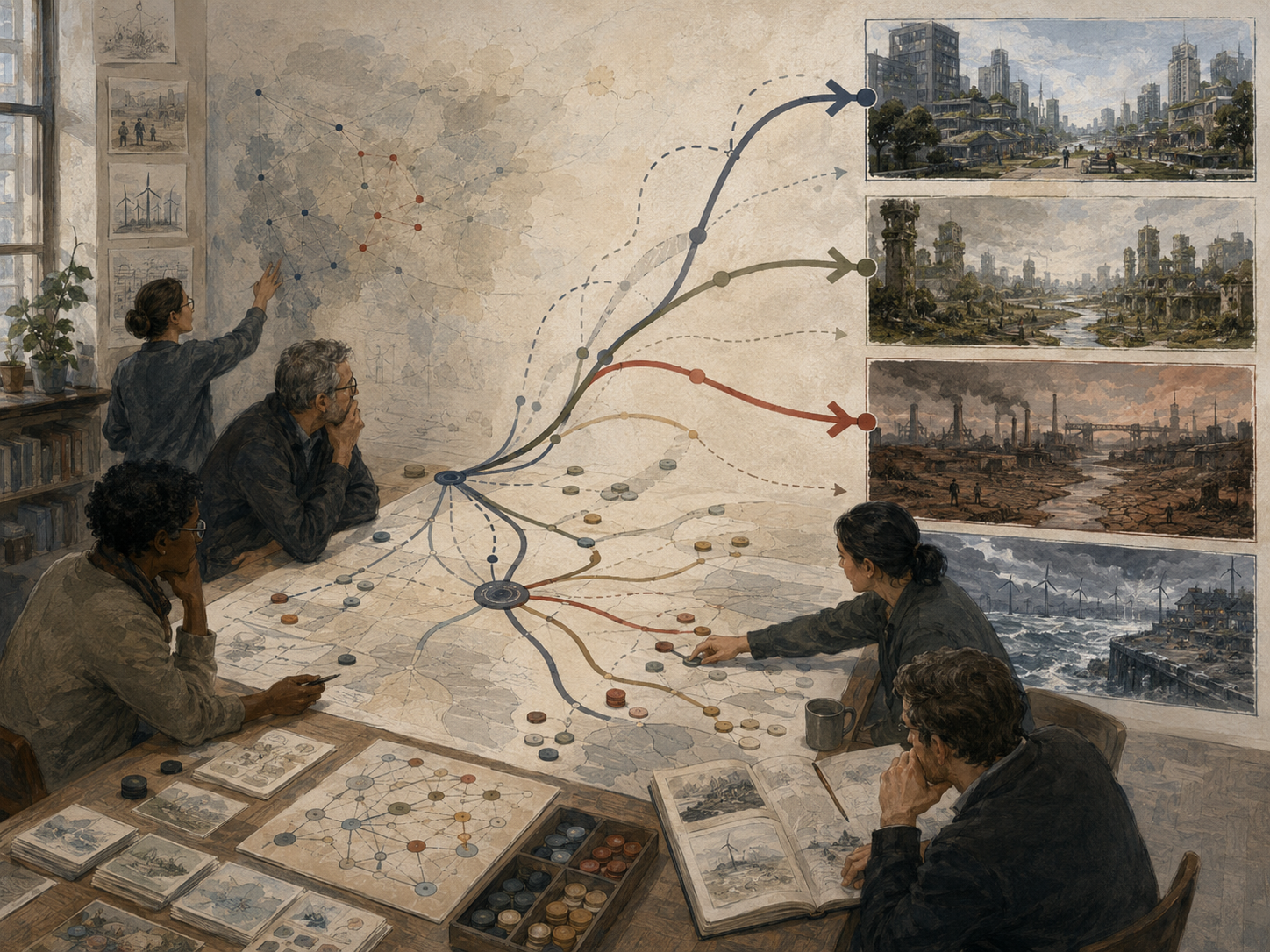
Scenario planning and futures thinking are strategic methods for exploring uncertainty, anticipating alternative trajectories, and preparing organizations to operate under multiple plausible future conditions. Rather than attempting to predict a single outcome, these approaches construct structured accounts of how the future might unfold, allowing decision-makers to test assumptions, identify risks, discover opportunities, and design more resilient strategies.
In complex systems—where technological change, geopolitical dynamics, environmental constraints, institutional behavior, market shifts, infrastructure limits, and human choices interact—linear forecasting often fails. Scenario planning addresses this limitation by treating uncertainty as a central feature of strategic analysis rather than a temporary obstacle. Futures thinking extends this orientation by examining long-term transformations, emerging signals, structural shifts, and possible future conditions that may reshape the environment in which decisions are made.
At its deepest level, scenario planning changes the strategic posture of an organization. It moves decision-makers away from dependence on one expected future and toward a more robust discipline of preparedness. OECD describes strategic foresight as a structured and systematic approach to exploring plausible futures, while Shell’s scenarios work emphasizes that scenarios are not predictions but tools that stretch thinking by asking “what if?” questions about different possible worlds.
Scenario planning is therefore not a retreat from rigor. It is a more realistic form of rigor for environments where the future cannot be reduced to a single line. It helps organizations explore uncertainty without pretending to master it, generate ideas without detaching from evidence, and prepare strategies that remain viable across different conditions.
This article examines scenario planning and futures thinking as core practices in strategic ideation. It explores the limits of prediction, the structure of scenarios, long-term orientation, the use of scenarios in ideation, strategic stress testing, uncertainty as a resource, integration with systems thinking, organizational implications, critical limitations, ethical concerns, and practical methods for using scenario work to improve strategic choice.
Main Library
Publications
Article Map
Strategic Ideation
Related Topic
Futures Thinking
Related Topic
Systems Thinking
Related Topic
Resilience Thinking
The Limits of Prediction in Complex Systems
Traditional forecasting methods often assume that future conditions can be extrapolated from past trends. This approach can be useful in stable environments where variables change gradually, relationships remain consistent, and disruptions are limited. But it becomes unreliable when systems are influenced by nonlinear dynamics, feedback loops, adaptive behavior, institutional change, technological breakthroughs, environmental shocks, or geopolitical volatility.
Complex systems rarely move in straight lines. Small changes can produce large consequences, while large interventions may have limited effects. Feedback loops can amplify or dampen change. Delays can hide consequences until after decisions have already been made. Actors can adapt to incentives in ways that alter the system itself. Under these conditions, prediction can create false confidence.
Scenario planning responds to this limitation by shifting from prediction to exploration. Instead of asking only what will happen, it asks what could happen under different combinations of drivers, uncertainties, constraints, and choices. This reframing expands the strategic horizon and reduces dependence on a single expected future.
| Predictive planning assumption | Scenario planning response | Strategic implication |
|---|---|---|
| The future can be forecast from current trends. | Several plausible futures should be explored. | Strategy must be tested across conditions, not only optimized for a baseline forecast. |
| Uncertainty is a weakness in planning. | Uncertainty is a feature of complex systems. | Organizations need structured uncertainty analysis. |
| The most likely future should dominate planning. | Low-probability, high-consequence futures may still matter. | Robustness, resilience, and option value become important. |
| Strategy should be built around one expected environment. | Strategy should be tested against multiple possible environments. | Plans need flexibility, triggers, and adaptive pathways. |
| Forecast error is a failure of analysis. | Some uncertainty cannot be eliminated. | Strategic quality depends on preparedness, not perfect prediction. |
The UK Government Office for Science’s Futures Toolkit presents scenarios as a core futures-thinking method, while OECD’s foresight toolkit places scenario creation and stress testing at the center of resilient long-range strategic work. Both approaches recognize that scenario planning is not meant to replace analysis. It is meant to improve strategic analysis when the future is uncertain.
The value of scenario planning is not that it predicts the right future. It prepares organizations to think more intelligently across several plausible ones.
The Structure of Scenarios
Scenarios are internally consistent narratives that describe alternative future states. They are typically constructed around key uncertainties: factors that are both highly consequential and difficult to predict. By varying these uncertainties, organizations can generate multiple plausible futures, each with distinct implications for strategy.
A strong scenario is not merely an imaginative story. It is a structured strategic tool. It should identify the driving forces shaping the future, clarify critical uncertainties, explain how conditions could unfold over time, describe the resulting future environment, and translate that environment into implications for present decisions.
Scenario structure matters because weak scenarios can become speculative fiction, vague brainstorming, or decorative workshop output. Strong scenarios help organizations test assumptions, expose blind spots, identify vulnerabilities, compare options, and design strategies that can adapt as conditions change.
| Scenario element | Purpose | Strategic question |
|---|---|---|
| Focal issue | Defines the strategic question or decision the scenario set is meant to inform. | What decision requires futures thinking? |
| Time horizon | Sets the relevant future period for analysis. | Are we exploring 5, 10, 20, or 50 years ahead? |
| Driving forces | Identifies broad forces shaping the future. | What technological, social, political, economic, ecological, or institutional forces matter? |
| Critical uncertainties | Highlights variables that are consequential and unpredictable. | Which uncertainties could change strategic conditions most dramatically? |
| Scenario logic | Explains why each future is internally coherent. | How do the drivers and uncertainties combine? |
| Narrative description | Makes the future understandable and discussable. | What would this future feel like for organizations, users, communities, or systems? |
| Strategic implications | Connects the scenario to present action. | What risks, opportunities, vulnerabilities, and choices does this future reveal? |
| Signals and indicators | Identifies evidence that one pathway may be emerging. | What should we monitor over time? |
OECD foresight materials and the UK Futures Toolkit both emphasize that scenario work should support implications for present strategy rather than remain an imaginative exercise alone. Scenarios are useful when they help decision-makers see present choices differently.
A scenario becomes strategic when it connects plausible future conditions to decisions that must be made now.
Futures Thinking and Long-Term Orientation
Futures thinking extends beyond discrete scenarios to consider long-term transformations. It examines how systems evolve over decades, how emerging technologies may reshape industries, how institutional arrangements may shift, how ecological constraints may accumulate, and how social values, infrastructures, and governance systems may change.
This long-term orientation is particularly important for sustainability, infrastructure, energy transition, health systems, education, demographic change, artificial intelligence, climate adaptation, economic development, public governance, and global risk. Many of the most important strategic conditions do not appear suddenly. They accumulate gradually before becoming decisive.
Futures thinking helps organizations move beyond short-term optimization. It encourages leaders to ask what capabilities, relationships, knowledge systems, infrastructures, and governance models may be needed under future conditions that are not yet fully visible. UNDP’s foresight manual presents foresight as a practical discipline for long-range development challenges, emphasizing methods for anticipating transformation rather than reacting after patterns have hardened.
| Short-term strategy focus | Futures-thinking expansion | Strategic value |
|---|---|---|
| Current performance | Future viability | Prevents near-term optimization from weakening long-term resilience. |
| Known stakeholders | Future affected groups | Expands the ethical and social boundary of strategy. |
| Existing capabilities | Emerging capability requirements | Supports earlier investment in learning, systems, and infrastructure. |
| Current risks | Emerging and cascading risks | Improves preparedness for complex disruption. |
| Present market conditions | Alternative future environments | Improves option design and strategic flexibility. |
| Immediate implementation | Long-term adaptation pathways | Connects action today to future choices. |
Long-term thinking does not mean ignoring present constraints. It means interpreting present decisions in relation to the futures they may enable, foreclose, or make more difficult to navigate.
Long-term thinking matters because many strategic conditions become decisive only after they have been accumulating quietly for years.
Scenario Planning as a Tool for Ideation
Scenario planning is not only a tool for risk management. It is also a powerful method for strategic ideation. By exposing teams to alternative futures, scenarios challenge assumptions and expand the range of possible solutions. Ideas that may seem unnecessary, marginal, or impractical under one expected future may become essential under another.
This matters because organizations often generate ideas inside the boundaries of current expectations. They imagine improvements to the present rather than alternatives for different future conditions. Scenario planning widens the idea space by making the future plural. It invites teams to ask what different futures would require, what capabilities would matter, what current assumptions would fail, and which ideas might become valuable under conditions that are not yet dominant.
Scenario-based ideation can also help teams escape incrementalism. A scenario involving regulatory disruption may generate ideas about compliance infrastructure, public trust, governance, and transparency. A climate-stress scenario may generate ideas about redundancy, local resilience, resource efficiency, or adaptive supply chains. A technological acceleration scenario may generate ideas about human oversight, data architecture, workforce transition, or new service models.
| Scenario ideation prompt | What it reveals | Example idea type |
|---|---|---|
| What would become fragile in this future? | Dependencies, vulnerabilities, and hidden assumptions. | Resilience investments, redundancy, contingency pathways. |
| What would become more valuable? | Capabilities, assets, relationships, and knowledge systems. | New capabilities, training, partnerships, platform redesign. |
| Who would be most affected? | Equity, legitimacy, access, and burden issues. | Stakeholder engagement, accessibility, ethical safeguards. |
| What would we regret not preparing for? | Delayed risks and opportunity costs. | Early-warning systems, option investments, adaptive governance. |
| What current strategy would fail? | Assumptions that depend on one expected future. | Portfolio diversification, strategic flexibility, modular pathways. |
| What would we do differently if this future were already emerging? | Present actions that are justified by future readiness. | Pilots, experiments, capability development, signal monitoring. |
Classic scenario-planning literature from Pierre Wack and Paul Schoemaker, as well as contemporary public-sector foresight toolkits, emphasizes that scenarios can stretch strategic thinking. They help decision-makers consider not only what is likely, but what is plausible, consequential, neglected, or difficult to imagine from the present.
Scenario planning strengthens ideation by forcing ideas to perform under more than one imagined future.
Stress Testing Strategies
One of the most important uses of scenario planning is stress testing. Strategies can be evaluated against different future conditions to assess their resilience, fragility, flexibility, and dependency structure. This process reveals vulnerabilities, highlights assumptions, identifies failure points, and clarifies the conditions under which a strategy may need to change.
Stress testing is especially useful when a strategy appears strong under the baseline scenario. A plan may perform well if growth continues, regulation remains stable, costs remain predictable, trust remains intact, or technology evolves gradually. But it may fail under disruption, scarcity, political change, market fragmentation, climate stress, or institutional legitimacy crisis. Scenario stress testing asks whether the strategy can survive conditions other than the one it was designed for.
Stress testing also helps organizations identify adaptive strategies: approaches that can be adjusted as conditions change. These may include staged investments, modular systems, diverse portfolios, reversible decisions, contingency plans, early-warning indicators, governance triggers, and flexible implementation pathways.
| Stress-test question | Strategic insight | Possible response |
|---|---|---|
| Under which scenario does this strategy perform worst? | Worst-case vulnerability. | Strengthen robustness or create contingency pathways. |
| Which assumptions fail first? | Fragile dependencies. | Monitor assumptions and define trigger conditions. |
| What capabilities are missing? | Future readiness gaps. | Invest in capability development or partnerships. |
| Where does the strategy create burden? | Hidden costs for users, workers, communities, or partners. | Redesign implementation and governance. |
| What decisions become irreversible? | Lock-in risk. | Preserve option value and design staged commitments. |
| What would signal that this scenario is emerging? | Monitoring and adaptation needs. | Create indicators, dashboards, review cycles, and decision thresholds. |
OECD’s foresight toolkit explicitly frames scenario work as a way to stress-test assumptions and strategies so organizations can develop more resilient plans under disruption. The key is not merely to imagine futures, but to use those futures to test present commitments.
A scenario becomes strategically useful when it forces the organization to ask not only “Would this work?” but “Under what future conditions would this stop working?”
Uncertainty as a Strategic Resource
In conventional planning, uncertainty is often treated as a problem to be minimized. Scenario planning reframes uncertainty as a resource. By exploring multiple possibilities, organizations can gain a deeper understanding of the system, identify overlooked risks, surface hidden opportunities, and avoid premature closure around one expected future.
This does not mean uncertainty is inherently good. Uncertainty can be dangerous, costly, destabilizing, and ethically consequential. But uncertainty can also be analytically productive when it is structured. Scenario planning gives teams a way to work with uncertainty without reducing it to false precision.
Shell’s scenario tradition is influential in this respect. Shell’s public scenarios work emphasizes that the point is not to forecast likely events or outcomes, but to stretch decision-makers to consider remote possibilities and different structures of change. In other words, uncertainty becomes strategically useful when it is organized into disciplined inquiry.
| Unstructured uncertainty | Structured uncertainty | Strategic benefit |
|---|---|---|
| Vague anxiety about the future. | Named drivers and uncertainties. | Improves sensemaking. |
| Overreliance on one forecast. | Multiple plausible scenarios. | Reduces strategic tunnel vision. |
| Conflicting assumptions remain hidden. | Assumptions are surfaced and compared. | Improves debate quality. |
| Risks are discussed abstractly. | Risks are explored under concrete future conditions. | Improves preparedness. |
| Ideas are judged against today’s conditions. | Ideas are tested against alternative futures. | Expands strategic creativity. |
| Uncertainty produces paralysis. | Uncertainty produces options and trigger conditions. | Supports action under uncertainty. |
Uncertainty becomes a strategic resource when it is neither denied nor romanticized, but organized into disciplined exploration.
Integration with Systems Thinking
Scenario planning is closely related to systems thinking. Both approaches emphasize interdependence, feedback, dynamic behavior, uncertainty, and indirect consequences. Scenarios often become stronger when they incorporate system models, causal structures, stakeholder relationships, feedback loops, delays, and explicit assumptions about how changes in one part of the system may propagate elsewhere.
A scenario that ignores system structure may still be vivid, but it will be weak as a strategic tool. It may describe a future without explaining how that future emerges. It may list trends without identifying causal relationships. It may dramatize disruption without showing feedback dynamics, capacity constraints, incentives, or path dependence.
Systems thinking strengthens scenario work by helping teams ask how the future unfolds, not only what the future looks like. It pushes scenario planning beyond storytelling into structural analysis.
| Systems concept | Contribution to scenario planning | Scenario question |
|---|---|---|
| Feedback loops | Shows how change may amplify or stabilize over time. | What dynamics reinforce or counteract this future? |
| Delays | Explains why consequences may appear slowly. | Which effects may emerge only after decisions are made? |
| Interdependence | Connects sectors, actors, institutions, and infrastructures. | How might change in one domain cascade into another? |
| Path dependence | Shows how past decisions constrain future options. | What inherited commitments shape this future? |
| Nonlinearity | Explains tipping points, thresholds, and disproportionate effects. | Where might small changes create large consequences? |
| Boundary critique | Questions what the scenario includes and excludes. | Whose future is represented, and whose is missing? |
Scenario planning becomes especially powerful when paired with systems mapping. A scenario can describe a plausible future, while a systems map can help explain the dynamics that make that future possible. Together, they support strategic analysis that is both imaginative and structurally informed.
The best scenarios are not just imaginative. They are structurally informed.
Organizational Implications
Effective scenario planning requires organizational capabilities that support exploration, synthesis, decision use, and learning. It is not enough to run a workshop and produce a set of scenario narratives. The organization must be able to connect those scenarios to strategy, investment, governance, communication, measurement, and implementation.
This requires cross-functional collaboration, access to diverse data sources, attention to weak signals, capacity to synthesize complexity, willingness to challenge assumptions, and mechanisms for translating scenario insights into present decisions. It also requires leadership support. Scenarios that surface uncomfortable possibilities may be ignored if the organization only wants confirmation of its preferred future.
Futures work often fails when it is separated from decision pathways. A beautiful scenario report may have little value if it does not influence resource allocation, risk review, innovation portfolios, policy design, infrastructure planning, stakeholder engagement, or strategic sequencing. OECD and UK government foresight materials both emphasize that futures methods need to be embedded into practical pathways for decision use rather than treated as isolated exercises.
| Organizational capability | Why it matters | Failure mode if absent |
|---|---|---|
| Cross-functional participation | Scenarios require multiple perspectives and domains of knowledge. | Scenarios reflect one department’s assumptions. |
| Weak-signal monitoring | Organizations need early indicators of emerging change. | Scenarios are not connected to ongoing intelligence. |
| Decision linkage | Scenario insights must affect present choices. | Futures work becomes decorative. |
| Leadership sponsorship | Uncomfortable futures require protection and legitimacy. | Scenarios avoid politically difficult implications. |
| Strategic communication | Scenario insights must be understandable without oversimplification. | Futures work becomes either opaque or superficial. |
| Learning memory | Organizations need to preserve assumptions, signals, and revisions over time. | Scenario insights disappear after the workshop. |
Scenario planning creates value only when the organization is willing to let alternative futures challenge present assumptions.
Core Dimensions of Scenario Planning and Futures Thinking
Scenario planning and futures thinking can be evaluated through several core dimensions. These dimensions help distinguish serious strategic foresight from speculative storytelling, trend commentary, or workshop theater.
1. Focal Question Clarity
Scenario work should begin with a clear strategic question. Without a focal question, scenarios may become broad, interesting, and unusable. The question should specify the decision, domain, system, or strategic uncertainty being explored.
2. Driver Analysis
Strong scenario work identifies the forces shaping possible futures. These may include technological change, policy shifts, economic conditions, social values, ecological constraints, demographic trends, institutional behavior, and geopolitical dynamics.
3. Critical Uncertainty Selection
Scenarios should focus on uncertainties that are both consequential and unpredictable. If a variable is predictable, it may belong in the baseline context. If it is uncertain but not consequential, it may not deserve to structure the scenario set.
4. Plausibility and Internal Coherence
Scenarios should be plausible without claiming to be probable. Each scenario should explain how drivers and uncertainties combine into a coherent future environment.
5. Meaningful Divergence
A scenario set should contain futures that differ in strategically meaningful ways. If all scenarios lead to the same conclusions, the set may not stretch thinking enough.
6. Strategic Implications
Scenarios should reveal risks, opportunities, assumptions, vulnerabilities, options, and decision points. The value of a scenario is measured by what it helps the organization see and decide.
7. Signal Monitoring
Scenario work should identify indicators that suggest one future pathway may be becoming more plausible. Without monitoring, scenarios remain static narratives.
8. Adaptive Pathways
Scenario planning should support decisions that preserve flexibility, avoid premature lock-in, and define when strategies should adjust as evidence changes.
| Dimension | Diagnostic question | Useful output |
|---|---|---|
| Focal question clarity | What decision or uncertainty is being explored? | Scenario brief. |
| Driver analysis | What forces are shaping the future? | Driver map. |
| Critical uncertainties | Which uncertainties are both consequential and unpredictable? | Uncertainty matrix. |
| Plausibility and coherence | Does each scenario make structural sense? | Scenario logic review. |
| Meaningful divergence | Do the scenarios differ enough to test strategy? | Scenario set comparison. |
| Strategic implications | What does each future reveal about present choices? | Implications table. |
| Signal monitoring | What indicators should be tracked? | Signal dashboard or monitoring plan. |
| Adaptive pathways | What should change if one future begins to emerge? | Trigger and pathway map. |
Scenario work becomes strategically useful when it combines uncertainty, structure, divergence, implication, monitoring, and adaptive decision design.
Core Principles of Strategic Scenario Work
Strategic scenario work requires discipline. The following principles help organizations use futures thinking to strengthen strategy rather than generate attractive narratives that do not affect decisions.
1. Explore Plausibility, Not Prediction
Scenarios are not forecasts. Their purpose is to explore plausible futures that are strategically relevant, not to identify the single future that will occur.
2. Structure Uncertainty
Scenario planning should organize uncertainty through drivers, assumptions, uncertainties, narratives, implications, and signals. Unstructured uncertainty produces anxiety; structured uncertainty produces strategic insight.
3. Test Assumptions
Scenarios should reveal what present strategies assume about the future. Assumptions that remain hidden cannot be challenged, monitored, or revised.
4. Stress Test Strategies
Each scenario should be used to test whether current strategies remain viable under different future conditions. A strategy that works only in the expected future may be fragile.
5. Include Systems Dynamics
Strong scenarios consider feedback loops, delays, path dependence, constraints, incentives, interdependencies, and cascading effects.
6. Protect Diverse Perspectives
Scenario work should include multiple viewpoints, including people who may experience future conditions differently. Otherwise, scenarios may reproduce institutional blind spots.
7. Connect Futures to Present Decisions
Scenario planning should inform strategy, investment, governance, implementation, communication, and monitoring. Futures work that does not affect decisions remains incomplete.
8. Monitor and Revise Over Time
Scenarios should not be treated as finished products. Signals, assumptions, and strategic implications should be revisited as conditions change.
| Principle | Protects against | Practical test |
|---|---|---|
| Plausibility, not prediction | False certainty. | Does the scenario set explore more than one serious future? |
| Structure uncertainty | Vague speculation. | Are drivers, uncertainties, and implications explicit? |
| Test assumptions | Strategic tunnel vision. | Which assumptions fail in each scenario? |
| Stress test strategies | Baseline-only planning. | How does each strategy perform across futures? |
| Include systems dynamics | Flat storytelling. | Do scenarios explain feedback, delays, and interdependencies? |
| Protect diverse perspectives | Institutional bias. | Whose futures are included or excluded? |
| Connect to decisions | Workshop theater. | What changes because of the scenario work? |
| Monitor and revise | Static scenario reports. | Which signals will be tracked over time? |
The purpose of strategic scenario work is not to imagine futures for their own sake. It is to improve present judgment under uncertainty.
Limitations and Critical Perspectives
Despite its strengths, scenario planning has important limitations. Scenarios are shaped by human judgment, institutional context, available evidence, facilitation choices, political constraints, and the assumptions of participants. Their quality depends on who is included, what data is considered, which uncertainties are prioritized, and how implications are interpreted.
There is also a risk of producing scenarios that are either too narrow or too broad. Narrow scenarios may confirm existing strategy rather than challenge it. Overly broad scenarios may be vivid but difficult to act on. Some scenario exercises produce elegant narratives without clear decision relevance. Others become abstract futures workshops that generate energy but leave no lasting strategic effect.
Scenario planning can also create false sophistication. Because scenario sets often look structured, organizations may treat them as more complete or neutral than they really are. A scenario matrix can conceal political choices. A polished narrative can hide weak assumptions. A futures workshop can appear participatory while privileging institutional voices. A scenario report can name uncertainty without actually changing investment, governance, or implementation.
| Limitation | Strategic risk | Corrective practice |
|---|---|---|
| Judgment dependence | Scenarios reflect the assumptions of their creators. | Use diverse participation, evidence review, and assumption transparency. |
| Narrow scenario range | Futures work confirms the expected future. | Include divergent, uncomfortable, and high-consequence scenarios. |
| Overly broad narratives | Scenarios become interesting but not actionable. | Start with a focal strategic question. |
| False neutrality | Power shapes which futures are treated as plausible. | Conduct representation and power review. |
| Weak decision linkage | Scenario work does not affect strategy. | Connect scenarios to decisions, triggers, and resource allocation. |
| Static output | Scenarios become outdated reports. | Monitor signals and revise scenarios over time. |
To address these challenges, scenario planning should be combined with empirical analysis, stakeholder input, systems thinking, ethical review, and continuous refinement. UNDP’s foresight manual is especially useful because it frames foresight methods as practical and iterative rather than as a finished product. Shell’s scenarios guidance similarly emphasizes that scenarios are one input among many in decision-making, not a substitute for strategy itself.
The danger is not that scenarios are imperfect. It is that organizations may treat them as complete, neutral, or sufficient when they are only one disciplined way of exploring uncertainty.
Ethics, Power, and Representation in Futures Work
Scenario planning is not ethically neutral. Futures are imagined from particular positions, by particular people, for particular purposes. The process can either expand strategic imagination or reproduce existing power structures. It can invite affected communities into future-making, or it can allow institutions to define futures on behalf of others.
This matters because scenarios influence present decisions. They can affect investment, policy, technology development, infrastructure planning, environmental strategy, organizational priorities, and public narratives. If some groups are excluded from scenario work, their futures may be ignored. If some possibilities are labeled unrealistic because they challenge institutional interests, scenario planning can become a mechanism of strategic closure rather than openness.
Ethical futures work requires attention to participation, representation, dignity, power, uncertainty, and accountability. It should ask who defines the focal question, whose knowledge counts, whose risks are visible, whose burdens are modeled, and who benefits from the strategies that scenario work supports.
| Ethical issue | Why it matters | Responsible practice |
|---|---|---|
| Representation | Excluded groups may disappear from future planning. | Include affected stakeholders and diverse forms of knowledge. |
| Power | Institutions may define what futures are considered plausible. | Make assumptions and exclusions explicit. |
| Burden shifting | Strategies may protect organizations while externalizing costs. | Stress test burden across users, workers, communities, and ecosystems. |
| Temporal justice | Future generations cannot participate directly in present decisions. | Consider long-term consequences and intergenerational responsibility. |
| False inevitability | Scenarios may frame some futures as unavoidable. | Distinguish plausible futures from preferred or imposed futures. |
| Accountability | Futures work can influence decisions without clear responsibility. | Document how scenario insights affect strategy and governance. |
Responsible scenario planning does not merely ask what futures are possible. It asks who gets to imagine them, who bears their consequences, and how present choices shape what becomes possible.
A Practical Scenario Planning and Futures Thinking Audit
A scenario planning audit helps teams determine whether their futures work is strategically useful, structurally grounded, ethically responsible, and connected to decisions. It can be used before a scenario workshop, during scenario development, after scenario synthesis, or when integrating scenario insights into strategy.
1. Define the Focal Strategic Question
Clarify the decision, uncertainty, system, or strategic issue that the scenario work is meant to inform. Avoid beginning with a vague desire to “think about the future.”
2. Set the Time Horizon
Choose a time horizon long enough for meaningful change but specific enough for strategic relevance. Different issues may require different horizons.
3. Map Driving Forces
Identify the technological, economic, political, ecological, social, cultural, institutional, and infrastructural forces shaping possible futures.
4. Select Critical Uncertainties
Prioritize uncertainties that are both highly consequential and difficult to predict. These uncertainties should structure the scenario set.
5. Develop Scenario Logic
Create internally coherent narratives that explain how each future could emerge. Avoid disconnected lists of trends.
6. Check Scenario Divergence
Ensure that scenarios differ in ways that matter for strategy. A scenario set should stretch thinking, not provide minor variations of the same future.
7. Stress Test Strategies
Evaluate current and proposed strategies across scenarios. Identify where each strategy is robust, fragile, flexible, or dependent on specific assumptions.
8. Identify Signals and Indicators
Define what evidence would suggest that a scenario pathway is emerging. Connect signals to monitoring routines and review cadence.
9. Review Ethics and Representation
Assess whose futures are included, whose burdens are considered, and how power shapes what is treated as plausible or realistic.
10. Link Scenarios to Decisions
Translate scenario insights into strategic options, trigger conditions, adaptive pathways, capability investments, governance changes, or learning priorities.
| Audit step | Core question | Useful output |
|---|---|---|
| Focal question | What decision does the scenario work inform? | Scenario planning brief. |
| Time horizon | How far ahead should the analysis look? | Time-horizon rationale. |
| Driving forces | What forces are shaping the future? | Driver map. |
| Critical uncertainties | Which uncertainties matter most? | Uncertainty matrix. |
| Scenario logic | How could each future emerge? | Scenario narratives. |
| Divergence | Do scenarios differ enough to challenge strategy? | Scenario comparison table. |
| Stress testing | How do strategies perform across futures? | Robustness and vulnerability review. |
| Signals | What should be monitored? | Signal and indicator plan. |
| Ethics | Whose futures and burdens are represented? | Ethics and representation review. |
| Decision linkage | What changes because of the scenario work? | Strategic options and trigger conditions. |
A serious scenario planning audit should leave behind not only future narratives, but present decisions, monitored signals, strategic options, and learning commitments.
Mathematical Lens: Scenario Sets, Strategic Robustness, and Uncertainty
A scenario set can be represented conceptually as:
\Pi = \{S_1, S_2, \dots, S_n\}
\]
Interpretation: \(\Pi\) is the set of plausible scenarios, and each \(S_i\) is an internally coherent future state defined by different combinations of drivers, constraints, uncertainties, and system dynamics.
Strategic robustness can then be represented as:
R(a) = \min_{S_i \in \Pi} V(a, S_i)
\]
Interpretation: \(R(a)\) is the robustness of action \(a\) across the scenario set, and \(V(a, S_i)\) is the value or viability of that action in scenario \(S_i\). This highlights one of the deepest insights of scenario planning: the best strategy is not always the one that performs best in the expected case, but the one that remains viable across multiple possible futures.
A simple way to represent uncertainty-weighted strategic thinking is:
U(a) = \sum_{i=1}^{n} w_i V(a, S_i)
\]
Interpretation: \(U(a)\) is the uncertainty-weighted value of action \(a\). The weights \(w_i\) do not need to be treated as precise probabilities. They may represent strategic salience, concern, plausibility, or decision attention.
Scenario stress can be represented conceptually as:
F(a) = \max_{S_i \in \Pi} [D(S_i) – C(a, S_i)]
\]
Interpretation: \(F(a)\) is the fragility of action \(a\), \(D(S_i)\) is the difficulty or disruption level of scenario \(S_i\), and \(C(a, S_i)\) is the capability of the action or strategy to cope with that scenario.
The mathematical lens clarifies the strategic function of scenarios: they allow organizations to compare actions across futures, examine robustness, identify fragility, and reason about uncertainty without pretending to eliminate it.
Advanced R Workflow: Comparing Strategy Performance Across Scenarios
The R workflow below compares stylized strategies across multiple scenarios using robustness, flexibility, and scenario-specific performance. It is designed as an evergreen illustration of how strategies can be assessed against several plausible futures instead of one forecast.
# Install packages if needed.
# install.packages(c("tidyverse"))

library(tidyverse)

# ------------------------------------------------------------
# R Workflow: Comparing Strategy Performance Across Scenarios
# Purpose:
#   Build stylized scenario profiles across strategic options.
# ------------------------------------------------------------

strategies <- tibble(
  strategy = c(
    "Short-Term Optimization Strategy",
    "Balanced Adaptive Strategy",
    "Resilience-Oriented Strategy",
    "Transformational Bet Strategy"
  ),
  scenario_1 = c(0.84, 0.74, 0.68, 0.52),  # Stable growth
  scenario_2 = c(0.41, 0.71, 0.75, 0.82),  # Technological disruption
  scenario_3 = c(0.36, 0.67, 0.79, 0.58),  # Environmental stress
  scenario_4 = c(0.48, 0.70, 0.73, 0.64),  # Institutional fragmentation
  flexibility = c(0.28, 0.73, 0.82, 0.61),
  implementation_readiness = c(0.86, 0.74, 0.66, 0.44)
)

strategies <- strategies %>%
  mutate(
    robustness = pmin(scenario_1, scenario_2, scenario_3, scenario_4),
    average_performance = (scenario_1 + scenario_2 + scenario_3 + scenario_4) / 4,
    volatility = apply(select(., scenario_1, scenario_2, scenario_3, scenario_4), 1, sd),
    foresight_profile =
      0.30 * robustness +
      0.25 * average_performance +
      0.20 * flexibility +
      0.15 * implementation_readiness -
      0.10 * volatility
  )

print(strategies)

strategies_long <- strategies %>%
  pivot_longer(
    cols = c(scenario_1, scenario_2, scenario_3, scenario_4),
    names_to = "scenario",
    values_to = "performance"
  )

ggplot(strategies_long, aes(x = scenario, y = performance, fill = strategy)) +
  geom_col(position = "dodge") +
  labs(
    title = "Strategy Performance Across Scenarios",
    x = "Scenario",
    y = "Performance",
    fill = "Strategy"
  ) +
  theme_minimal(base_size = 12)

ggplot(strategies, aes(x = reorder(strategy, foresight_profile), y = foresight_profile)) +
  geom_col() +
  coord_flip() +
  labs(
    title = "Scenario-Based Strategic Profile",
    x = "Strategy",
    y = "Profile Score"
  ) +
  theme_minimal(base_size = 12)

ggplot(strategies, aes(x = reorder(strategy, robustness), y = robustness)) +
  geom_col() +
  coord_flip() +
  labs(
    title = "Worst-Case Robustness Across Scenarios",
    x = "Strategy",
    y = "Worst-case performance"
  ) +
  theme_minimal(base_size = 12)

write_csv(strategies, "scenario_strategy_profiles.csv")
This workflow is not a universal scoring model. Its value is methodological: it helps teams compare whether strategies are brittle, robust, flexible, volatile, implementation-ready, or dependent on one favorable future.
Advanced Python Workflow: Simulating Strategic Resilience Across Alternative Futures
The Python workflow below simulates stylized strategies under several possible futures, showing how adaptive and resilience-oriented options may outperform brittle short-term strategies when conditions diverge from the baseline expectation.
# Install packages if needed:
# pip install pandas numpy matplotlib

import numpy as np
import pandas as pd
import matplotlib.pyplot as plt

# ------------------------------------------------------------
# Python Workflow: Simulating Strategic Resilience Across Futures
# Purpose:
#   Compare stylized strategic options under alternative
#   future conditions.
# ------------------------------------------------------------

futures = [
    "Stable Growth",
    "Tech Disruption",
    "Environmental Stress",
    "Institutional Fragmentation"
]

strategies = {
    "Short-Term Optimization Strategy": [0.84, 0.41, 0.36, 0.48],
    "Balanced Adaptive Strategy": [0.74, 0.71, 0.67, 0.70],
    "Resilience-Oriented Strategy": [0.68, 0.75, 0.79, 0.73],
    "Transformational Bet Strategy": [0.52, 0.82, 0.58, 0.64]
}

flexibility = {
    "Short-Term Optimization Strategy": 0.28,
    "Balanced Adaptive Strategy": 0.73,
    "Resilience-Oriented Strategy": 0.82,
    "Transformational Bet Strategy": 0.61
}

implementation_readiness = {
    "Short-Term Optimization Strategy": 0.86,
    "Balanced Adaptive Strategy": 0.74,
    "Resilience-Oriented Strategy": 0.66,
    "Transformational Bet Strategy": 0.44
}

rows = []

for strategy, values in strategies.items():
    for future, value in zip(futures, values):
        rows.append({
            "strategy": strategy,
            "future": future,
            "performance": value,
            "flexibility": flexibility[strategy],
            "implementation_readiness": implementation_readiness[strategy]
        })

df = pd.DataFrame(rows)
print(df.head())

summary = (
    df.groupby("strategy")
    .agg(
        mean_performance=("performance", "mean"),
        worst_case=("performance", "min"),
        best_case=("performance", "max"),
        volatility=("performance", "std"),
        flexibility=("flexibility", "mean"),
        implementation_readiness=("implementation_readiness", "mean")
    )
    .reset_index()
)

summary["scenario_profile"] = (
    0.30 * summary["worst_case"] +
    0.25 * summary["mean_performance"] +
    0.20 * summary["flexibility"] +
    0.15 * summary["implementation_readiness"] -
    0.10 * summary["volatility"]
)

print(summary.sort_values("scenario_profile", ascending=False))

plt.figure(figsize=(10, 6))
for strategy in df["strategy"].unique():
    subset = df[df["strategy"] == strategy]
    plt.plot(subset["future"], subset["performance"], marker="o", label=strategy)

plt.ylabel("Performance")
plt.title("Strategic Resilience Across Alternative Futures")
plt.legend()
plt.xticks(rotation=20)
plt.tight_layout()
plt.show()

summary.to_csv("scenario_resilience_summary.csv", index=False)
df.to_csv("scenario_resilience_profiles.csv", index=False)
This simulation is intentionally stylized. Its value is conceptual: scenario-based analysis can reveal when a strategy is strong only under one future, robust across several futures, or promising but difficult to implement.
GitHub Repository
The companion repository for this article will provide advanced strategist-facing workflows for scenario planning diagnostics, futures-thinking methods, driver mapping, uncertainty matrices, scenario logic review, strategy stress testing, robustness scoring, signal monitoring, adaptive pathway design, ethical futures review, and scenario learning memory.
Complete Code Repository
The companion code includes Python, R, Julia, SQL, Rust, Go, C++, Fortran, C, documentation, synthetic datasets, outputs, and notebook placeholders for applied scenario planning and futures thinking analysis.
The repository structure is designed to support professional strategic analysis rather than generic coding demonstrations. The python/ folder can model scenario robustness, uncertainty mapping, strategy stress tests, signal monitoring, and future-pathway analysis. The r/ folder can compare strategic performance across scenario sets and visualize robustness profiles. The julia/ folder can support sensitivity analysis for futures uncertainty, scenario divergence, and strategic robustness. The sql/ folder can define schemas for scenarios, drivers, uncertainties, signals, strategy options, stress tests, adaptive pathways, governance reviews, and learning-memory records.
Additional folders can support command-line diagnostics, lower-level scoring utilities, and reproducible documentation. The rust/ folder can provide a command-line scenario stress-test scaffold. The go/ folder can provide scenario comparison utilities. The cpp, fortran, and c folders can provide efficient scoring examples and low-level utilities. The docs, data, outputs, and notebooks folders can support article notes, modeling principles, synthetic datasets, generated outputs, and notebook placeholders.
This code should be understood as a transparent learning and modeling scaffold. It is intended for synthetic-data research, methods demonstration, institutional learning, strategic analysis, and reproducible workflow development. It is not a substitute for participatory foresight, ethical review, domain expertise, expert judgment, accountable governance, or responsible implementation.
Conclusion
Scenario planning and futures thinking provide essential tools for navigating uncertainty in strategic ideation. By exploring multiple plausible futures, organizations can develop more resilient, adaptable, and forward-looking strategies. They can test assumptions, identify vulnerabilities, imagine alternative pathways, and prepare for futures that do not resemble the baseline forecast.
In a world characterized by rapid change and complex interaction, the ability to think beyond a single predicted future is a critical strategic capability. Scenario planning does not eliminate uncertainty, but it transforms uncertainty into a source of inquiry. It helps organizations ask better questions, generate more robust ideas, and design strategies that remain viable when conditions change.
Used poorly, scenarios become speculative storytelling, workshop theater, or polished reports disconnected from decisions. Used well, they become disciplined instruments of strategic imagination, structural analysis, and practical preparedness.
Better strategies emerge when organizations stop asking only what future they expect and begin asking what futures their strategies must be ready to face.
Related Articles
- Strategic Ideation
- Prototype Evidence and Strategic Learning
- Strategic Foresight and Long-Term Thinking
- Decision-Making Under Uncertainty
- Risk, Tradeoffs, and Strategic Choices
- Option Value and Strategic Flexibility
- Portfolio Thinking in Strategic Ideation
- Complex Systems and Strategic Uncertainty
- Systems Modeling
- Futures Thinking
Further Reading
- Organisation for Economic Co-operation and Development (OECD) (no date) Strategic Foresight. Available at: OECD.
- Organisation for Economic Co-operation and Development (OECD) (2025) Foresight Toolkit for Resilient Public Policy. Paris: OECD Publishing. Available at: OECD.
- Schoemaker, P.J.H. (1995) ‘Scenario planning: A tool for strategic thinking’, Sloan Management Review, 36(2), pp. 25–40.
- Shell International (no date) What are Shell Scenarios? Available at: Shell.
- United Nations Development Programme (UNDP) (2018) Foresight Manual: Empowered Futures for the 2030 Agenda. New York: UNDP. Available at: UNDP.
- UK Government Office for Science (2024) The Futures Toolkit. London: Government Office for Science. Available at: UK Government.
- Wack, P. (1985) ‘Scenarios: Uncharted waters ahead’, Harvard Business Review, 63(5), pp. 73–89.
- Wilkinson, A. and Kupers, R. (2013) The Essence of Scenarios: Learning from the Shell Experience. Amsterdam: Amsterdam University Press.
References
- Organisation for Economic Co-operation and Development (OECD) (no date) Strategic Foresight. Available at: OECD.
- Organisation for Economic Co-operation and Development (OECD) (2025) Foresight Toolkit for Resilient Public Policy. Paris: OECD Publishing. Available at: OECD.
- Schoemaker, P.J.H. (1995) ‘Scenario planning: A tool for strategic thinking’, Sloan Management Review, 36(2), pp. 25–40.
- Shell International (no date) What are Shell Scenarios? Available at: Shell.
- United Nations Development Programme (UNDP) (2018) Foresight Manual: Empowered Futures for the 2030 Agenda. New York: UNDP. Available at: UNDP.
- UK Government Office for Science (2024) The Futures Toolkit. London: Government Office for Science. Available at: UK Government.
- Wack, P. (1985) ‘Scenarios: Uncharted waters ahead’, Harvard Business Review, 63(5), pp. 73–89.
- Wilkinson, A. and Kupers, R. (2013) The Essence of Scenarios: Learning from the Shell Experience. Amsterdam: Amsterdam University Press.