
Last Updated June 4, 2026
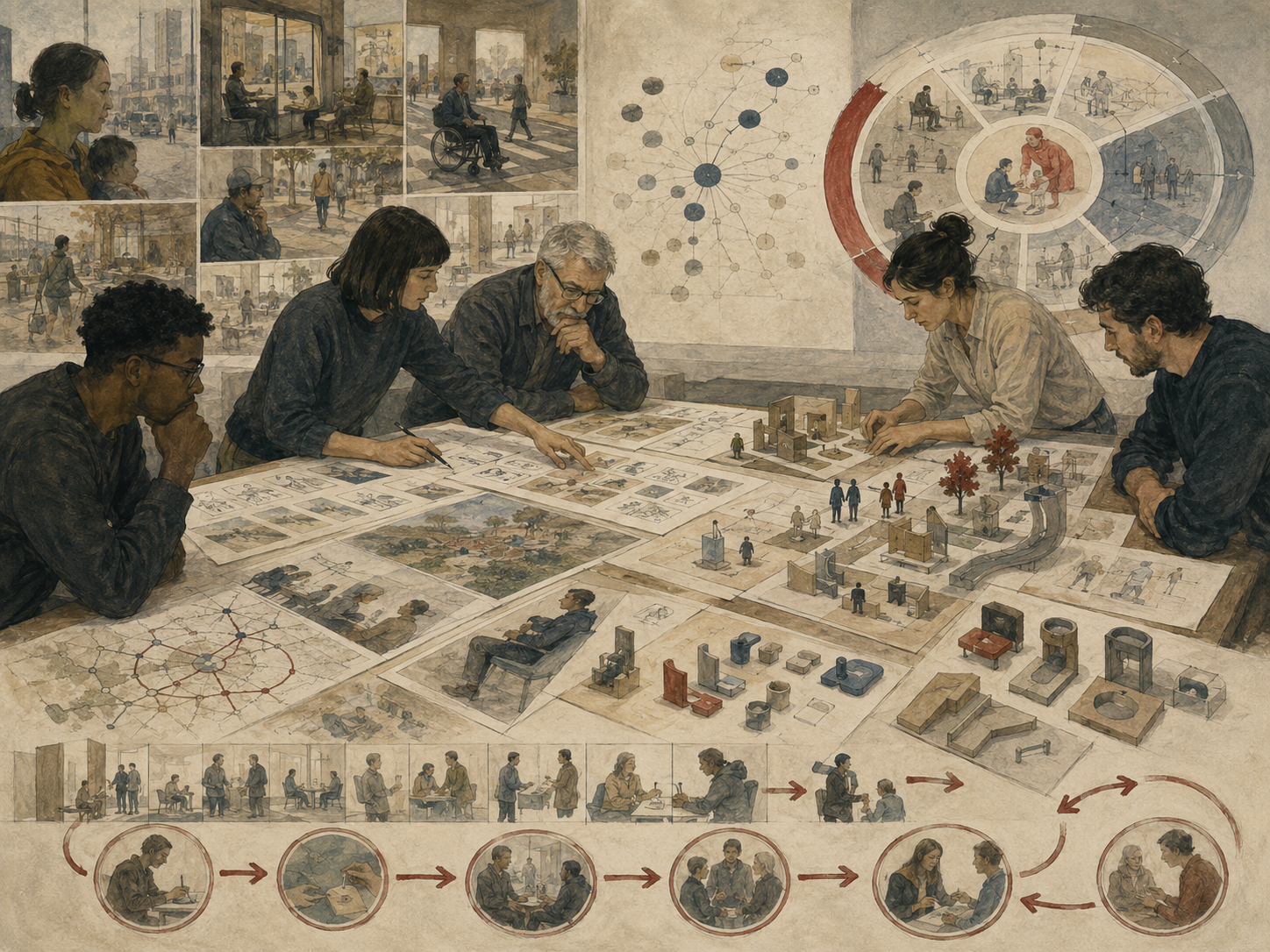
Design thinking is a human-centered, iterative, and experimentally oriented approach to strategic problem solving that integrates empathy, framing, ideation, prototyping, testing, and learning. In strategic contexts, design thinking is not simply a creativity technique, workshop format, or innovation slogan. At its strongest, it is a disciplined method for generating insight under uncertainty, especially when problems are ill-structured, stakeholder needs are contested, evidence is incomplete, and conventional planning models struggle to produce meaningful change.
Design thinking matters because many strategic problems are not fully given at the outset. Leaders may begin with a symptom, mandate, performance gap, user complaint, institutional pressure, or opportunity signal, but the real problem may sit elsewhere: in trust, incentives, access, culture, governance, workflow, power, information, burden, or system structure. Design thinking gives strategists a way to investigate these conditions before prematurely committing to solutions.
Although design thinking is often associated with product development, user experience, and innovation workshops, its broader significance lies in how it reorganizes strategic inquiry. It shifts attention away from abstract optimization performed at a distance and toward situated understanding, iterative testing, and learning through contact with real users, stakeholders, systems, and constraints. It treats problem definition itself as exploratory. It recognizes that meaningful innovation often requires cycles of observation, synthesis, hypothesis, prototyping, feedback, and revision.
At its deepest level, design thinking offers a practical theory of inquiry for environments where the task is not merely to choose well among known options, but to discover what the relevant problem actually is. IDEO’s public framing presents design thinking as a human-centered approach to innovation, while Stanford d.school’s widely used model organizes the process around empathize, define, ideate, prototype, and test. Those formulations simplify a larger intellectual tradition, but they point toward the same strategic insight: when the environment is ambiguous and the problem is not fully understood, strategy must learn its way forward rather than assume certainty in advance.
This article examines design thinking as a foundation of strategic ideation. It explains why design thinking matters for ambiguous problems, how it emerged from design theory and problem-solving research, why empathy should be understood as disciplined inquiry rather than sentiment, how problem framing and reframing shape strategic possibility, why prototyping functions as a method of learning, how design thinking connects to systems thinking, where it fails when used superficially, and how organizations can turn design thinking from a workshop method into a durable strategic capability.
Main Library
Publications
Article Map
Strategic Ideation
Related Topic
Systems Thinking
Related Topic
Design Thinking
Related Topic
Futures Thinking
Why Design Thinking Matters in Strategic Ideation
Many strategic processes begin with a predefined problem, move quickly toward analysis, and then attempt to identify the best available solution. This sequence can work when objectives are clear, variables are stable, decision criteria are agreed upon, and constraints are known. It works less well when the problem is ambiguous, socially embedded, institutionally contested, or dynamically changing. In such situations, the problem cannot be solved well because it has not yet been understood well.
Design thinking matters because it treats uncertainty not as a temporary obstacle to clear away before strategy begins, but as a defining feature of many strategic environments. It provides a framework for working through ambiguity rather than pretending it does not exist. This is especially important in innovation strategy, public service design, sustainability transitions, digital transformation, organizational learning, institutional reform, and complex stakeholder environments where the challenge is not merely choosing among known alternatives but discovering what the relevant alternatives are.
In strategic ideation, design thinking helps teams move from premature solutioning toward disciplined inquiry. It slows the rush to answer and strengthens the quality of the question. It encourages strategists to observe real contexts, listen to stakeholders, map experiences, identify friction, surface assumptions, generate multiple possibilities, and test ideas before scaling them. This changes the strategic posture from “we know what needs to be done” to “we need to learn what is actually happening before deciding what should be done.”
| Strategic problem | Design thinking contribution | Risk if ignored |
|---|---|---|
| Ambiguous problem definition | Uses inquiry, observation, and reframing to clarify the real challenge. | The team solves a symptom or inherited problem statement. |
| Weak stakeholder understanding | Investigates lived experience, constraints, needs, and friction. | The strategy is designed from institutional assumptions. |
| Premature solutioning | Separates problem exploration from solution commitment. | The first plausible idea becomes the plan. |
| High uncertainty | Uses prototypes and tests to learn before scaling. | Resources are committed before assumptions are examined. |
| Complex implementation context | Reveals workflow, incentive, trust, and adoption barriers. | The idea looks good in theory but fails in practice. |
Design thinking is foundational to strategic ideation because it links imagination to disciplined inquiry. It helps teams generate ideas without detaching those ideas from human experience, institutional context, and evidence from use.
Historical and Intellectual Foundations
Design thinking draws from multiple intellectual traditions rather than a single origin point. Its development reflects contributions from design practice, engineering, architecture, systems theory, management studies, cognitive science, planning theory, and organizational learning. The term has been popularized through innovation consultancies and design schools, but the deeper tradition is older and more serious than the workshop language often associated with it.
Herbert Simon’s work on the sciences of the artificial was especially influential because it framed design as the transformation of existing conditions into preferred ones. This formulation is strategically important. It treats design not as decoration or surface form, but as a general mode of intelligent action concerned with how artifacts, institutions, systems, processes, and environments are intentionally shaped. Simon’s framing helps explain why design thinking can matter for strategy, governance, organizational development, and systems change, not only for products or interfaces.
Later design-methodology scholars such as Nigel Cross, Bryan Lawson, and Richard Buchanan deepened the understanding of design as a distinct way of knowing. Their work emphasized that designers do not merely solve given problems; they often participate in defining the problem space, reframing constraints, working with incomplete information, and exploring alternative futures. This matters for strategic ideation because strategic problems are frequently open-ended. They involve judgment, values, tradeoffs, and interpretation rather than technical optimization alone.
Practice-based institutions such as IDEO and Stanford d.school helped popularize design thinking as an accessible innovation framework. Their versions emphasize empathy, problem definition, ideation, prototyping, and testing. These models are useful because they make design inquiry teachable and operational. Yet popularization has also created the risk of simplification. Design thinking can be reduced to brainstorming rituals, sticky notes, persona templates, or lightweight workshops detached from domain knowledge, implementation authority, or structural analysis.
| Tradition | Contribution to design thinking | Strategic implication |
|---|---|---|
| Design methodology | Treats design as a distinctive mode of inquiry and problem solving. | Strategy can be understood as intentional shaping, not only analysis. |
| Planning theory | Highlights wicked and ill-structured problems. | Some problems require reframing rather than linear solution selection. |
| Cognitive science | Examines how people reason, frame, search, and decide under limits. | Strategic ideation must account for bounded rationality and bias. |
| Systems thinking | Shows how feedback, structure, and context shape outcomes. | Human-centered ideas must still be tested against system dynamics. |
| Organizational learning | Emphasizes experimentation, reflection, and adaptation. | Design thinking becomes a capability when institutions learn from use. |
The intellectual foundation of design thinking is not a single method, but an integrated view of inquiry: problems are shaped, understood, tested, and revised through interaction with people, systems, and evidence.
Design Thinking as a Response to Ill-Structured Problems
One of the strongest reasons for the enduring relevance of design thinking is its suitability for ill-structured or wicked problems. Wicked problems are not simply difficult problems. They are problems in which causes are entangled, stakeholders disagree, system boundaries are contested, evidence is incomplete, values conflict, and proposed solutions change the nature of the problem itself.
Rittel and Webber’s classic planning argument and Buchanan’s design-theory work are foundational here. They show why linear problem solving becomes inadequate when the problem itself is unstable or multiply interpreted. In such conditions, the task is not merely to choose the optimal solution from a fixed set. The task is to understand what kind of problem is being faced, whose interpretation matters, which boundaries are being drawn, what constraints are real, and what forms of intervention are ethically and practically possible.
Design thinking responds to this by making interpretation an explicit part of the process. It accepts that different stakeholders may experience the same system differently, that assumptions may be flawed, and that strategic insight often depends on reframing the problem rather than refining the solution. This makes it valuable in policy design, organizational systems, public services, sustainability strategy, digital transformation, education, health systems, and institutional innovation, where technical effectiveness and human experience are inseparable.
| Ill-structured problem feature | Design thinking response | Strategic value |
|---|---|---|
| Problem boundaries are unclear. | Uses inquiry and reframing to test boundaries. | Prevents teams from solving a partial or convenient version of the problem. |
| Stakeholders disagree. | Investigates different experiences, incentives, and interpretations. | Improves legitimacy and reduces blind spots. |
| Causes are entangled. | Uses mapping, synthesis, and iterative testing. | Helps distinguish symptoms from deeper mechanisms. |
| Solutions change the problem. | Uses prototypes and feedback loops. | Allows strategy to learn from intervention effects. |
| Evidence is incomplete. | Uses small tests to generate situated evidence. | Reduces premature commitment under uncertainty. |
Design thinking does not eliminate complexity. It provides a disciplined way of engaging complexity without pretending that the situation is simpler than it is.
Core Principles of Design Thinking
Design thinking can be understood through several core principles. These principles are most powerful when treated as disciplined practices rather than workshop slogans.
1. Human-Centeredness
Design thinking begins from the premise that strategies, products, services, policies, and systems are experienced by real people situated within social, institutional, economic, technological, and cultural contexts. Human-centeredness does not mean that user preference is the only criterion that matters. It means that strategic design must take lived experience seriously rather than relying exclusively on abstract assumptions or internal administrative logic.
2. Problem Framing and Reframing
In design thinking, the problem is not assumed to be self-evident. Early inquiry often reveals that the initial problem statement was incomplete, overly narrow, framed from the wrong institutional vantage point, or based on a symptom rather than a cause. Reframing allows teams to shift from surface descriptions to deeper strategic questions.
3. Divergence and Convergence
Design thinking depends on deliberate movement between expansive and selective modes of thought. Divergence widens the idea space, surfaces unexpected possibilities, and resists premature closure. Convergence narrows that space through synthesis, evaluation, strategic fit, feasibility, evidence, and decision judgment.
4. Experimentation and Prototyping
A core insight of design thinking is that understanding often emerges through making. Prototypes are not merely near-final models. They are learning tools that make ideas visible, testable, discussable, and revisable before resources and authority are fully committed.
5. Iterative Learning
Design thinking is not linear in a strict sense. It moves through cycles of inquiry, synthesis, ideation, prototyping, testing, and feedback. Each cycle can refine both the solution and the problem frame itself.
6. Materialization of Ideas
Design thinking externalizes ideas so they can be examined. A sketch, journey map, storyboard, service blueprint, prototype, simulation, or policy mock-up can reveal assumptions that remain invisible in discussion alone.
7. Collaborative Sensemaking
Design thinking brings multiple forms of knowledge into the process: user experience, frontline expertise, technical knowledge, strategic judgment, domain expertise, and institutional constraints. The value often comes from synthesis across perspectives.
8. Learning Before Scale
Design thinking encourages teams to test ideas at lower cost before scaling them. This does not remove risk, but it can reveal misunderstandings, adoption barriers, capacity gaps, and unintended effects early enough for revision.
| Principle | Core question | Strategic risk reduced |
|---|---|---|
| Human-centeredness | How is the system experienced by those affected? | Designing from internal assumptions. |
| Problem framing | Are we solving the right problem? | Solving symptoms instead of causes. |
| Divergence and convergence | Are we widening and narrowing at the right moments? | Premature closure or endless ideation. |
| Prototyping | How can we make the idea testable? | Committing to untested abstractions. |
| Iteration | What should change based on what we learned? | Rigid execution after weak early assumptions. |
| Collaboration | Whose knowledge is needed to understand the problem? | Single-perspective strategy. |
The core principles of design thinking work together: human-centered inquiry improves framing, framing improves ideation, prototypes test assumptions, and iteration converts feedback into strategic learning.
The Classic Design Thinking Process
A widely recognized version of design thinking includes five modes: empathize, define, ideate, prototype, and test. These modes are useful when treated as interacting practices rather than rigid checkpoints. Mature design thinking often moves backward and forward among them as evidence changes the team’s understanding.
1. Empathize
Empathize involves understanding the perspectives, frustrations, needs, behaviors, constraints, tradeoffs, and contexts of relevant stakeholders. It can include interviews, observation, contextual inquiry, journey mapping, shadowing, service safaris, diary studies, participatory research, and frontline listening. In strategic ideation, empathy provides evidence that abstract analysis often misses.
2. Define
Define synthesizes inquiry into a clearer articulation of the challenge. This is not a mechanical summary of user comments. It is an interpretive act that clarifies what problem matters, for whom, under what conditions, and why. A strong definition guides ideation without closing down possibility too early.
3. Ideate
Ideation generates multiple possible responses to the framed problem. Useful techniques include “how might we” questions, analogical transfer, lateral prompts, scenario prompts, constraint-based creativity, counterfactual exploration, morphological analysis, and structured brainstorming. The purpose is not novelty for its own sake, but a wider and better-structured option space.
4. Prototype
Prototypes externalize ideas in low-cost forms that can be discussed, tested, and revised. A prototype may be a sketch, storyboard, interface mock-up, service blueprint, process simulation, policy draft, governance model, role-play, workflow, or lightweight digital artifact. What matters is learnability, not polish.
5. Test
Testing gathers evidence from those affected by the proposed design or from realistic implementation conditions. It reveals misunderstandings, friction points, adoption barriers, unintended consequences, and overlooked opportunities. Testing can validate, revise, or invalidate both the idea and the problem frame.
| Mode | Primary output | Strategic question | Common failure |
|---|---|---|---|
| Empathize | Stakeholder insight and contextual evidence. | What is the lived experience of the problem? | Performative listening without decision influence. |
| Define | Problem frame or design question. | What problem are we actually addressing? | Summarizing symptoms instead of reframing causes. |
| Ideate | Option set or concept portfolio. | What alternative responses are possible? | Settling on familiar ideas too early. |
| Prototype | Testable representation of an idea. | What assumption can we make visible? | Overpolishing instead of learning. |
| Test | Feedback, evidence, and revision signals. | What did reality reveal? | Treating feedback as validation only. |
The classic process is best understood not as a sequence to complete, but as a learning architecture for moving between insight, framing, creativity, evidence, and revision.
Empathy as Inquiry, Not Sentiment
Among the most misunderstood aspects of design thinking is empathy. In popular treatments, empathy is sometimes reduced to kindness, emotional resonance, or generic user-centered rhetoric. In rigorous practice, empathy is better understood as a method of situated inquiry. It is a disciplined effort to understand how actors perceive their conditions, what constraints shape their choices, what tradeoffs they face, what histories affect trust, and how system design is experienced from within.
This distinction matters because sentiment alone does not produce strategic clarity. What matters is interpretive precision. Design teams must uncover not only what stakeholders say they want, but how they navigate competing priorities, where institutional friction accumulates, what behaviors reveal unmet needs, which workarounds signal system failure, and how different stakeholder groups experience the same environment differently.
Empathy is therefore not anti-analytic. It is a way of generating forms of evidence that are often missing from standard strategic analysis. Metrics may show that adoption is low; empathy-oriented inquiry can reveal why. A dashboard may show process delay; contextual inquiry can reveal that the delay is caused by unclear authority, emotional labor, mistrust, access barriers, or frontline workarounds invisible in formal data.
| Misunderstanding | More rigorous interpretation | Strategic implication |
|---|---|---|
| Empathy means being nice. | Empathy is disciplined inquiry into lived experience. | It produces evidence about friction, trust, burden, and meaning. |
| Empathy means asking users what they want. | Empathy examines behavior, context, constraints, and tradeoffs. | It avoids confusing stated preference with strategic need. |
| Empathy replaces analysis. | Empathy adds situated evidence to analysis. | It complements data, systems analysis, and domain expertise. |
| Empathy guarantees legitimacy. | Empathy must influence decisions to matter. | Listening without authority becomes performative. |
Empathy becomes strategically useful when it reveals what abstract institutional analysis cannot see: burden, friction, trust, meaning, workaround, fear, hope, and lived constraint.
Design Thinking and Strategic Reframing
One of the most powerful contributions of design thinking is its capacity to reframe strategic questions. A declining adoption rate, for example, may initially be framed as a communication problem. Empathic inquiry and systems observation may reveal that the deeper issue lies in trust, friction, institutional legitimacy, incentive design, workflow burden, or service architecture. The resulting strategic intervention may therefore look entirely different from what the original diagnosis suggested.
This reframing function makes design thinking especially relevant for leadership and organizational strategy. Many institutional failures persist not because solutions are unavailable, but because the challenge has been framed in administratively convenient rather than structurally accurate terms. Design thinking helps destabilize that convenience. It creates conditions under which alternative interpretations can emerge and become actionable.
Strategic reframing is not merely a creative move. It changes the option space. If the problem is framed as lack of awareness, the likely solution is communication. If it is framed as lack of trust, the solution may require governance, transparency, accountability, repair, or participation. If it is framed as workflow burden, the solution may require process redesign. If it is framed as incentive misalignment, the solution may require policy or measurement change.
| Initial frame | Possible reframing | Different strategic response |
|---|---|---|
| Users are not adopting the tool. | The tool does not fit their workflow or trust conditions. | Workflow redesign, trust-building, participatory testing. |
| Employees resist change. | The change creates burden without authority or support. | Capacity building, role clarity, incentive review. |
| Customers do not understand the offer. | The offer does not solve the problem as experienced. | Problem reframing and value proposition redesign. |
| Stakeholders are disengaged. | Participation has not influenced real decisions. | Governance redesign and decision traceability. |
| The service is inefficient. | The service is optimized for the institution, not the user journey. | Journey mapping and service pathway redesign. |
In practice, design thinking often creates value not first by improving the answer, but by changing the question.
Design Thinking and Systems Thinking
Design thinking is often presented as human-centered, while systems thinking is presented as structurally oriented. In mature strategic practice, they are complementary. Design thinking contributes fine-grained understanding of lived experience, friction, meaning, user behavior, and stakeholder interaction. Systems thinking contributes insight into feedback loops, interdependence, incentives, delays, leverage points, path dependence, and unintended consequences.
Without design thinking, systems analysis can become overly abstract, treating stakeholders as variables rather than situated actors. Without systems thinking, design thinking can become too localized, solving immediate experiential problems while neglecting broader structural dynamics. Together, they allow ideation to remain both humane and analytically robust.
This synthesis is especially important in sustainability, public systems, governance, technology, organizational transformation, health, education, infrastructure, and climate adaptation. In these domains, interventions must work at both experiential and systemic levels. A service may feel humane at the front end while shifting burden to workers. A policy may reduce one problem while creating feedback effects elsewhere. A digital tool may improve access for some users while excluding others. Design thinking and systems thinking must therefore inform each other.
| Design thinking adds | Systems thinking adds | Combined strategic value |
|---|---|---|
| Lived experience and user context. | Feedback loops and structural interdependence. | Strategies that are both usable and system-aware. |
| Journey mapping and friction analysis. | Leverage point and delay analysis. | Better identification of where intervention can matter. |
| Prototype learning and stakeholder testing. | Scenario, unintended consequence, and system response review. | Lower risk of localized fixes that create broader harm. |
| Empathy and participatory inquiry. | Boundary setting and causal structure. | More responsible and robust strategic framing. |
Design thinking asks how people experience the system. Systems thinking asks how the system produces that experience. Strategic ideation needs both.
Design Thinking in Organizations
In organizational settings, design thinking can function as both a problem-solving method and a cultural orientation. As a method, it structures innovation processes around inquiry, reframing, ideation, prototyping, and testing. As a cultural orientation, it encourages curiosity, iterative learning, tolerance for ambiguity, cross-functional collaboration, and attention to how systems are experienced by people.
Organizations that successfully adopt design thinking often exhibit several characteristics. They allow exploratory work before premature performance metrics dominate. They treat frontline observation as strategically valuable. They create prototypes early rather than debating abstractions indefinitely. They allow user insight to challenge internal assumptions. They connect workshops to decision authority. They accept that not every strong strategic move begins with a spreadsheet or forecast; some begin with close attention to how systems are actually experienced.
At the same time, design thinking can fail institutionally when it is reduced to performative workshop culture. Sticky notes, brainstorming rituals, empathy maps, and canvas templates do not by themselves produce strategic insight. The method only becomes meaningful when it is tied to serious inquiry, domain knowledge, implementation capacity, accountable decision-making, and willingness to revise institutional assumptions.
| Organizational condition | Design thinking succeeds when… | Design thinking fails when… |
|---|---|---|
| Leadership | Leaders allow evidence to challenge assumptions. | Leaders use design thinking to validate existing decisions. |
| Culture | Teams tolerate ambiguity and early imperfection. | Teams demand certainty before learning can occur. |
| Governance | Insights influence decisions, priorities, and resources. | Workshops produce artifacts with no authority. |
| Capacity | Teams have time and skill to conduct inquiry and testing. | Design thinking is compressed into superficial sessions. |
| Measurement | Metrics include learning, behavior, outcomes, and burden. | Only activity counts and outputs are tracked. |
Design thinking becomes organizationally serious when it changes how decisions are made, not merely how workshops are facilitated.
Design Thinking and Innovation Under Uncertainty
One reason design thinking remains strategically powerful is that it allows organizations to act under uncertainty without requiring premature certainty. Interviews, observations, prototypes, pilots, experiments, and iterative testing create learning loops that reduce risk not by prediction alone, but by contact with reality. This matters because many innovation failures arise not from lack of creativity, but from committing too heavily to untested assumptions.
Design thinking changes the temporal structure of strategy. Instead of requiring full certainty at the front end and then moving into execution, it allows discovery and execution to interact. Small tests inform larger decisions. Early feedback prevents expensive misalignment. Learning becomes embedded in the design process rather than postponed until after rollout.
This is especially important when the strategic environment contains uncertainty about user behavior, stakeholder legitimacy, technical feasibility, implementation capacity, future demand, institutional trust, or system response. In such contexts, a single plan can become brittle. A design-thinking approach allows the organization to treat early concepts as hypotheses and build evidence through staged learning.
| Uncertainty type | Design thinking response | Example evidence |
|---|---|---|
| Need uncertainty | Investigate user problems and lived experience. | Interviews, observation, journey maps. |
| Adoption uncertainty | Test whether people understand, value, and use the idea. | Prototype tests, behavioral pilots. |
| Feasibility uncertainty | Build low-cost representations of the solution. | Workflow prototypes, technical mock-ups, simulations. |
| Legitimacy uncertainty | Include affected stakeholders in inquiry and review. | Participatory sessions, decision traceability. |
| System uncertainty | Combine prototypes with systems review. | Feedback mapping, burden-shift analysis, scenario testing. |
Design thinking is not opposed to rigor. It is a different form of rigor: one based on iterative evidence, situated observation, and adaptive refinement.
The Strategic Value of Prototyping
Prototyping is one of the most underestimated foundations of design thinking. In many strategic environments, stakeholders debate proposals in abstract form for too long. This encourages rhetorical confidence, positional rigidity, and false clarity. Prototypes disrupt this pattern by turning abstract claims into something observable. Once a service flow, governance mechanism, interface, program concept, policy pathway, or process model is rendered concretely, its weaknesses become easier to see.
Prototyping also supports intellectual humility. It reminds teams that an idea is a hypothesis rather than a finished truth. This is particularly important for strategic ideation because early concepts often feel compelling when they are still underdescribed. A prototype introduces friction, forcing the idea into contact with implementation conditions.
A prototype can test many different things: comprehension, desirability, usability, workflow fit, stakeholder legitimacy, burden, trust, technical feasibility, operational capacity, governance logic, decision usefulness, or evidence transfer. But no prototype tests everything. A prototype is strategically useful only when the team knows what assumption it is testing and what decision will follow from the evidence.
| Prototype type | What it can test | What it cannot prove by itself |
|---|---|---|
| Sketch or storyboard | Concept comprehension and sequence logic. | Adoption, implementation, or impact. |
| Journey map | Experience, friction, burden, and touchpoints. | Causal impact without further evidence. |
| Service blueprint | Frontstage and backstage process dependencies. | Long-term organizational capacity. |
| Clickable prototype | Usability, interpretation, navigation, early desirability. | Full-scale behavioral change. |
| Policy or governance simulation | Decision logic, actor response, unintended consequences. | Political feasibility under real pressure. |
| Pilot | Operational feasibility and early behavior under realistic conditions. | Guaranteed scale transfer. |
A prototype is valuable not because it looks finished, but because it makes uncertainty visible soon enough to matter.
From Design Thinking to Institutional Capability
At its strongest, design thinking is not just a project method but an institutional capability. It develops an organization’s ability to ask better questions, observe more carefully, reframe more intelligently, generate better options, test ideas earlier, and learn more quickly from interaction with stakeholders and systems. This capability is especially valuable in volatile contexts, where organizations must repeatedly adapt to shifting conditions without relying exclusively on legacy routines.
For a knowledge platform concerned with strategy, systems intelligence, and sustainable change, the importance of design thinking lies partly in traceability. Each stage of the process creates artifacts of reasoning: research notes, observation records, journey maps, problem statements, opportunity frames, idea portfolios, prototypes, test plans, feedback logs, revision decisions, and implementation learning records. These artifacts make the logic of innovation more inspectable.
This matters because strategic quality improves when the path from insight to intervention can be examined, challenged, revised, and preserved. Design thinking becomes part of institutional memory. It helps future teams understand not only what was decided, but what was learned, which assumptions were tested, why the problem frame changed, and how the strategy evolved.
| Capability | Design thinking artifact | Institutional value |
|---|---|---|
| Observation | Interview notes, field observations, journey maps. | Preserves evidence of lived experience. |
| Framing | Problem statements, “how might we” questions, opportunity maps. | Shows how the strategic question evolved. |
| Ideation | Idea portfolios, concept sketches, option maps. | Documents alternatives considered. |
| Prototyping | Mock-ups, service blueprints, simulations, pilots. | Makes assumptions visible and testable. |
| Testing | Feedback logs, evidence summaries, revision records. | Connects learning to decisions. |
| Institutional memory | Decision records and learning archives. | Prevents repeated mistakes and preserves strategic reasoning. |
Design thinking becomes strategically foundational when it is not merely used on projects, but embedded in how the institution learns.
Ethics, Power, and Participation
Design thinking is often described as human-centered, but human-centered language can conceal ethical weakness if participation is shallow, selective, extractive, or disconnected from decision-making. Listening to users is not the same as sharing power. Gathering stories is not the same as respecting agency. Inviting feedback is not the same as allowing affected stakeholders to influence the strategy.
Ethical design thinking requires attention to who defines the problem, whose experience counts as evidence, who is invited into the process, who is excluded, who bears the burden of participation, who benefits from the final design, and who can challenge or revise the outcome. It also requires attention to power: institutions often control timelines, resources, categories, metrics, and decision rights. A participatory session can still reproduce institutional assumptions if the structure of authority remains unchanged.
This is especially important in public systems, sustainability work, health, education, social services, technology, AI, labor systems, and environmental design. In these contexts, a solution may be desirable from one vantage point while imposing risk, surveillance, burden, exclusion, or loss of agency elsewhere. Design thinking must therefore include ethical review, harm mapping, burden analysis, redress pathways, and accountability mechanisms.
| Ethical question | Why it matters | Design response |
|---|---|---|
| Who defines the problem? | Problem framing shapes the entire option space. | Use participatory framing and boundary critique. |
| Whose evidence counts? | Metrics can erase lived burden and informal knowledge. | Combine quantitative, qualitative, and experiential evidence. |
| Who bears participation burden? | Engagement can ask the most affected groups to do unpaid labor. | Design respectful, compensated, accessible participation. |
| Who benefits and who bears risk? | Design can shift cost to less powerful groups. | Use burden-shift and distributional analysis. |
| Who can revise the design? | Feedback without decision influence is performative. | Create decision traceability and redress mechanisms. |
Design thinking is ethically serious only when human-centered inquiry affects power, decision-making, burden, and accountability.
Common Criticisms and Limitations
Design thinking has attracted substantial criticism, and some of that criticism is justified. The problem is rarely design thinking at its strongest. The problem is often the thin version: design thinking as ritual, branding, workshop performance, or generic innovation theater detached from expertise, evidence, systems, ethics, and authority.
1. Generic Method Without Domain Knowledge
Human-centered curiosity is valuable, but it cannot substitute for technical, regulatory, scientific, financial, historical, or operational expertise. Design thinking fails when teams use empathy and ideation to bypass hard domain knowledge.
2. Workshop Theater
Design thinking can become performative when organizations run workshops, collect sticky notes, and produce polished artifacts without changing decisions, budgets, authority, or implementation pathways.
3. Power Blindness
Some design-thinking practices underplay politics, conflict, structural inequality, and institutional power. Not every problem can be solved by empathy and prototyping alone.
4. Localism and System Neglect
Design thinking can focus too narrowly on immediate experience while ignoring feedback loops, system incentives, governance structures, long-term effects, and burden shifting.
5. Prototype Overclaiming
Teams may treat positive prototype feedback as proof of adoption, implementation viability, or long-term impact. Early tests should be interpreted carefully.
6. Participation Without Power
Stakeholders may be consulted without meaningful influence over framing, decisions, resources, or revision. This can produce legitimacy language without legitimate process.
7. Speed Pressure
Organizations sometimes compress design thinking into fast workshops. Speed can be useful, but shallow inquiry produces shallow insight.
8. Weak Evaluation
Design thinking can produce compelling stories and artifacts without rigorous evidence about outcomes, behavior change, system effects, or ethical consequences.
| Limitation | Symptom | Corrective practice |
|---|---|---|
| Generic method | Teams ideate without domain expertise. | Integrate technical, institutional, and scientific knowledge. |
| Workshop theater | Artifacts are produced but decisions do not change. | Connect design work to governance and implementation authority. |
| Power blindness | Conflict and structural inequality are ignored. | Use power mapping, ethical review, and participatory governance. |
| System neglect | Local user experience improves while broader harms emerge. | Combine design thinking with systems thinking. |
| Prototype overclaiming | Early feedback is treated as proof of impact. | Define what each prototype can and cannot validate. |
| Weak evaluation | Success is measured by workshops and outputs. | Track behavior, outcomes, learning, and unintended consequences. |
These critiques do not invalidate design thinking. They clarify that design thinking must be practiced with depth, domain knowledge, systems awareness, ethical seriousness, and decision authority.
A Practical Design Thinking Audit
A design thinking audit helps teams distinguish serious human-centered strategic inquiry from superficial design theater. It can be used before launching an innovation process, reviewing an existing initiative, designing a prototype, or assessing whether design thinking is functioning as an institutional capability.
1. Clarify the Problem Frame
Ask whether the problem is inherited, assumed, or actually investigated. Identify who framed it, whose experience shaped it, and what alternative frames remain possible.
2. Review Stakeholder Understanding
Assess whether the team has evidence about lived experience, constraints, behaviors, incentives, trust, burden, and context. Do not treat internal assumptions as user knowledge.
3. Test Reframing Quality
Ask whether inquiry changed the team’s understanding of the problem. If the frame never changed, the process may have confirmed rather than learned.
4. Evaluate the Option Space
Check whether the team generated a diverse set of ideas or moved quickly toward a familiar solution. Strong ideation widens the option space before narrowing it.
5. Assess Prototype Quality
Ask what each prototype is designed to test. A prototype should be connected to assumptions, evidence, and decision-making rather than treated as a polished demonstration.
6. Review Testing and Evidence
Distinguish feedback, preference, usability, adoption, implementation feasibility, system response, and outcome evidence. Do not overclaim what a test proves.
7. Add Systems Review
Identify feedback loops, incentives, delays, burden shifts, capacity constraints, and unintended consequences. Human-centered design should not ignore structural dynamics.
8. Conduct Ethical Review
Ask who benefits, who bears burden, who has voice, what harms are possible, and who can challenge or revise the design.
9. Connect to Decision Authority
Determine whether design insights influence strategy, priorities, budgets, governance, implementation, or revision. Without decision authority, design thinking becomes advisory theater.
10. Preserve Institutional Learning
Archive problem frames, assumptions, prototypes, evidence, revisions, and decisions so future teams can understand how strategic learning occurred.
| Audit step | Core question | Useful output |
|---|---|---|
| Problem frame | What problem are we really solving? | Problem frame and boundary note. |
| Stakeholder understanding | What do we know from lived experience? | Research synthesis and journey evidence. |
| Reframing | How did inquiry change the question? | Reframed design challenge. |
| Option space | Did we explore enough alternatives? | Idea portfolio. |
| Prototypes | What assumptions are being tested? | Prototype-test plan. |
| Evidence | What did testing actually show? | Evidence and limits summary. |
| Systems context | What feedback or unintended effects may occur? | System response review. |
| Ethics | Who benefits, bears burden, or has power? | Ethical design review. |
| Decision authority | How will learning affect decisions? | Decision and escalation pathway. |
| Institutional learning | How will the reasoning be preserved? | Design learning record. |
A serious design thinking process should leave behind not only concepts and prototypes, but a traceable record of inquiry, framing, assumptions, evidence, decisions, and learning.
Mathematical Lens: Iteration, Framing, and Strategic Learning
A stylized representation of iterative design learning can be written as:
S_{t+1} = S_t + f(E_t)
\]
Interpretation: \(S_t\) is the current solution state, \(E_t\) is evidence generated from observation, prototyping, or testing at time \(t\), and \(f(E_t)\) is the update function. The formula captures the core logic of design thinking: solutions evolve as evidence is incorporated rather than remaining fixed from the outset.
Problem reframing can be represented conceptually as:
P’ = g(P, I)
\]
Interpretation: \(P\) is the initial problem frame, \(I\) is insight produced through inquiry, and \(P’\) is the reframed problem. One of the most important outcomes of design thinking is not only improved solutions, but improved definitions of the challenge itself.
A simplified design-learning value model can be written as:
V = H + L + A
\]
Interpretation: \(V\) is strategic value, \(H\) is human-centered fit, \(L\) is learning generated through iteration, and \(A\) is adaptability under changing conditions. The formula is simplified, but it captures why design thinking matters strategically: it improves fit, accelerates learning, and increases the capacity to revise action under uncertainty.
A prototype’s learning value can be represented as:
L_p = R_a – R_{a,t+1}
\]
Interpretation: \(L_p\) is the learning value of prototype \(p\). It measures how much the prototype reduces risk around assumption \(a\). A prototype is strategically useful when it reduces uncertainty that matters for the decision.
The mathematical lens clarifies the deeper structure of design thinking: inquiry changes the problem frame, prototypes reduce assumption risk, and iteration improves strategic fit over time.
Advanced R Workflow: Comparing Design Thinking Capability Profiles
The R workflow below compares stylized organizational contexts across empathy depth, reframing capacity, prototyping strength, testing quality, systems awareness, ethical review, decision linkage, and adaptability. It is designed as an evergreen illustration of how design thinking functions as an institutional capability rather than a single workshop exercise.
# Install packages if needed.
# install.packages(c("tidyverse"))

library(tidyverse)

# ------------------------------------------------------------
# R Workflow: Comparing Design Thinking Capability Profiles
# Purpose:
#   Build stylized profiles across organizations using
#   empathy depth, reframing capacity, prototyping strength,
#   testing quality, systems awareness, ethical review,
#   decision linkage, and adaptability.
# ------------------------------------------------------------

contexts <- tibble(
  context = c(
    "Planning-Dominant Organization",
    "Balanced Innovation Organization",
    "Prototype-Driven Learning Organization",
    "Superficial Workshop-Only Organization",
    "Systems-Aware Design Organization"
  ),
  empathy_depth = c(0.28, 0.72, 0.81, 0.39, 0.78),
  reframing_capacity = c(0.31, 0.76, 0.84, 0.34, 0.82),
  prototyping_strength = c(0.24, 0.74, 0.88, 0.41, 0.76),
  testing_quality = c(0.29, 0.73, 0.86, 0.36, 0.80),
  systems_awareness = c(0.35, 0.68, 0.72, 0.30, 0.90),
  ethical_review = c(0.42, 0.70, 0.74, 0.34, 0.86),
  decision_linkage = c(0.36, 0.72, 0.78, 0.28, 0.80),
  adaptability = c(0.33, 0.77, 0.89, 0.42, 0.84)
)

contexts <- contexts %>%
  mutate(
    design_thinking_profile =
      0.14 * empathy_depth +
      0.14 * reframing_capacity +
      0.13 * prototyping_strength +
      0.13 * testing_quality +
      0.13 * systems_awareness +
      0.11 * ethical_review +
      0.12 * decision_linkage +
      0.10 * adaptability,
    superficiality_risk =
      0.30 * (1 - decision_linkage) +
      0.25 * (1 - testing_quality) +
      0.20 * (1 - ethical_review) +
      0.15 * (1 - systems_awareness) +
      0.10 * (1 - reframing_capacity)
  )

print(contexts)

contexts_long <- contexts %>%
  pivot_longer(
    cols = c(
      empathy_depth,
      reframing_capacity,
      prototyping_strength,
      testing_quality,
      systems_awareness,
      ethical_review,
      decision_linkage,
      adaptability
    ),
    names_to = "dimension",
    values_to = "value"
  )

ggplot(contexts_long, aes(x = dimension, y = value, fill = context)) +
  geom_col(position = "dodge") +
  labs(
    title = "Design Thinking Capability Dimensions",
    x = "Dimension",
    y = "Value",
    fill = "Context"
  ) +
  theme_minimal(base_size = 12) +
  coord_flip()

ggplot(contexts, aes(x = reorder(context, design_thinking_profile), y = design_thinking_profile)) +
  geom_col() +
  coord_flip() +
  labs(
    title = "Design Thinking Capability Profile",
    x = "Context",
    y = "Profile Score"
  ) +
  theme_minimal(base_size = 12)

ggplot(contexts, aes(x = reorder(context, superficiality_risk), y = superficiality_risk)) +
  geom_col() +
  coord_flip() +
  labs(
    title = "Risk of Superficial Design Thinking",
    x = "Context",
    y = "Risk Score"
  ) +
  theme_minimal(base_size = 12)

write_csv(contexts, "design_thinking_capability_profiles.csv")
This workflow should not be treated as a universal scoring system. Its purpose is to make design thinking capability visible across dimensions that matter for strategic practice: inquiry depth, reframing quality, experimentation, systems awareness, ethical review, and connection to decision-making.
Advanced Python Workflow: Simulating Iterative Design Learning
The Python workflow below simulates stylized organizational contexts over time, showing how empathy, reframing, experimentation, systems awareness, and decision linkage strengthen strategic learning across repeated cycles.
# Install packages if needed:
# pip install pandas numpy matplotlib

import numpy as np
import pandas as pd
import matplotlib.pyplot as plt

# ------------------------------------------------------------
# Python Workflow: Simulating Iterative Design Learning
# Purpose:
#   Compare organizations whose strategic learning depends on
#   empathy, reframing, prototyping, testing, systems awareness,
#   and decision linkage.
# ------------------------------------------------------------

time_steps = np.arange(1, 31)

def simulate_context(
    empathy,
    reframing,
    experimentation,
    systems_awareness,
    decision_linkage,
    initial_state=0.35,
    friction=0.04
):
    state = np.zeros(len(time_steps))
    state[0] = initial_state

    for t in range(1, len(time_steps)):
        learning_gain = (
            0.14 * empathy +
            0.16 * reframing +
            0.18 * experimentation +
            0.14 * systems_awareness +
            0.18 * decision_linkage
        )

        decay = friction * (1 - decision_linkage)
        state[t] = state[t - 1] + learning_gain / 6 - decay
        state[t] = np.clip(state[t], 0, 1.8)

    return state

planning_dominant = simulate_context(
    empathy=0.28,
    reframing=0.31,
    experimentation=0.24,
    systems_awareness=0.35,
    decision_linkage=0.36
)

balanced_innovation = simulate_context(
    empathy=0.72,
    reframing=0.76,
    experimentation=0.74,
    systems_awareness=0.68,
    decision_linkage=0.72
)

prototype_driven = simulate_context(
    empathy=0.81,
    reframing=0.84,
    experimentation=0.88,
    systems_awareness=0.72,
    decision_linkage=0.78
)

systems_aware_design = simulate_context(
    empathy=0.78,
    reframing=0.82,
    experimentation=0.76,
    systems_awareness=0.90,
    decision_linkage=0.80
)

superficial_workshop = simulate_context(
    empathy=0.39,
    reframing=0.34,
    experimentation=0.41,
    systems_awareness=0.30,
    decision_linkage=0.28
)

df = pd.DataFrame({
    "time": time_steps,
    "Planning-Dominant Organization": planning_dominant,
    "Balanced Innovation Organization": balanced_innovation,
    "Prototype-Driven Learning Organization": prototype_driven,
    "Systems-Aware Design Organization": systems_aware_design,
    "Superficial Workshop-Only Organization": superficial_workshop
})

print(df.head())

plt.figure(figsize=(10, 6))
for col in df.columns[1:]:
    plt.plot(df["time"], df[col], label=col)

plt.xlabel("Time Step")
plt.ylabel("Strategic Learning Quality")
plt.title("Iterative Design Learning Over Time")
plt.legend()
plt.tight_layout()
plt.show()

final_scores = df.drop(columns=["time"]).iloc[-1].sort_values(ascending=False)
print(final_scores)

df.to_csv("design_thinking_learning_simulation.csv", index=False)
This simulation is intentionally stylized. Its value is conceptual: design thinking improves strategic learning when inquiry, reframing, testing, systems awareness, and decision linkage reinforce one another over time.
GitHub Repository
The companion repository for this article will provide advanced strategist-facing workflows for design thinking capability assessment, human-centered inquiry review, problem reframing analysis, prototype-test design, design-learning simulation, stakeholder evidence review, systems-aware design diagnostics, ethical design checks, decision-linkage scoring, and institutional learning records.
Complete Code Repository
The companion code includes Python, R, Julia, SQL, Rust, Go, C++, Fortran, C, documentation, synthetic datasets, outputs, and notebook placeholders for applied design thinking analysis in strategic ideation workflows.
The repository structure is designed to support professional strategic analysis rather than generic coding demonstrations. The python/ folder can model design thinking capability, empathy depth, reframing quality, prototype learning value, testing quality, systems awareness, ethical review, decision linkage, and institutional learning over time. The r/ folder can compare capability profiles and visualize design maturity across organizational contexts. The julia/ folder can support learning-rate and scenario-comparison examples. The sql/ folder can define schemas for design challenges, stakeholders, observations, journey maps, problem frames, ideas, prototypes, tests, feedback, evidence, revisions, implementation decisions, and learning records.
Additional folders can support command-line diagnostics, lower-level scoring utilities, and reproducible documentation. The rust/ folder can provide a command-line design thinking diagnostics scaffold. The go/ folder can provide design capability evaluation utilities. The cpp, fortran, and c folders can provide efficient scoring examples and low-level utilities. The docs, data, outputs, and notebooks folders can support article notes, modeling principles, synthetic datasets, generated outputs, and notebook placeholders.
This code should be understood as a transparent learning and modeling scaffold. It is intended for synthetic-data research, methods demonstration, institutional learning, strategic analysis, and reproducible workflow development. It is not a substitute for stakeholder engagement, ethical review, domain expertise, accountable governance, or participatory judgment.
Conclusion
Design thinking foundations lie in a distinctive understanding of strategy under uncertainty. Problems are not always fully given. Stakeholder experience matters. Framing is iterative. Ideas must be generated expansively and tested concretely. Learning emerges through cycles of observation, synthesis, experimentation, feedback, and revision. These principles make design thinking more than a workshop method or innovation slogan. They make it a disciplined approach to strategic ideation in complex environments.
Its enduring value comes from the combination of human-centered inquiry and iterative rigor. Design thinking does not replace analysis, expertise, systems reasoning, ethics, or implementation discipline. It complements them by ensuring that strategy remains connected to lived experience, adaptive learning, and the possibility that the most important insight may be that the problem itself must be redefined.
Used superficially, design thinking can become theater: attractive artifacts, energetic workshops, and familiar language without serious inquiry or decision influence. Used rigorously, it becomes a strategic capability. It helps organizations observe more carefully, frame more honestly, generate better options, prototype earlier, test assumptions, include stakeholders, detect burden, and learn before commitment becomes difficult to reverse.
Design thinking is foundational to strategic ideation because it teaches institutions to learn before they lock in, to test before they scale, and to treat human experience as evidence rather than decoration.
Related Articles
- Strategic Ideation
- Empathy and User-Centered Ideation
- Journey Mapping and Experience Design
- Prototyping and Rapid Experimentation
- Feedback Loops in Design Thinking
- Participatory Ideation and Co-Design
- Prototype Evidence and Strategic Learning
- Problem Framing and Problem Definition
- Systems Thinking in Ideation
- Theory of Change and Strategic Logic
Further Reading
- Brown, T. (2008) ‘Design thinking’, Harvard Business Review, 86(6), pp. 84–92.
- Brown, T. (2009) Change by Design: How Design Thinking Transforms Organizations and Inspires Innovation. New York: HarperBusiness.
- Buchanan, R. (1992) ‘Wicked problems in design thinking’, Design Issues, 8(2), pp. 5–21. Available at: https://doi.org/10.2307/1511637
- Cross, N. (2011) Design Thinking: Understanding How Designers Think and Work. Oxford: Berg.
- IDEO (no date) Design Thinking. Available at: https://designthinking.ideo.com/
- Lawson, B. (2006) How Designers Think: The Design Process Demystified. 4th edn. Oxford: Architectural Press.
- Norman, D.A. (2013) The Design of Everyday Things. Revised and expanded edn. New York: Basic Books.
- Rittel, H.W.J. and Webber, M.M. (1973) ‘Dilemmas in a general theory of planning’, Policy Sciences, 4(2), pp. 155–169. Available at: https://doi.org/10.1007/BF01405730
- Simon, H.A. (1996) The Sciences of the Artificial. 3rd edn. Cambridge, MA: MIT Press. Available at: https://mitpress.mit.edu/9780262690232/the-sciences-of-the-artificial/
- Stanford d.school (no date) Design Thinking Bootleg. Available at: https://dschool.stanford.edu/tools/design-thinking-bootleg
References
- Brown, T. (2008) ‘Design thinking’, Harvard Business Review, 86(6), pp. 84–92.
- Brown, T. (2009) Change by Design: How Design Thinking Transforms Organizations and Inspires Innovation. New York: HarperBusiness.
- Buchanan, R. (1992) ‘Wicked problems in design thinking’, Design Issues, 8(2), pp. 5–21. Available at: https://doi.org/10.2307/1511637
- Cross, N. (2011) Design Thinking: Understanding How Designers Think and Work. Oxford: Berg.
- IDEO (no date) Design Thinking. Available at: https://designthinking.ideo.com/
- Lawson, B. (2006) How Designers Think: The Design Process Demystified. 4th edn. Oxford: Architectural Press.
- Norman, D.A. (2013) The Design of Everyday Things. Revised and expanded edn. New York: Basic Books.
- Rittel, H.W.J. and Webber, M.M. (1973) ‘Dilemmas in a general theory of planning’, Policy Sciences, 4(2), pp. 155–169. Available at: https://doi.org/10.1007/BF01405730
- Simon, H.A. (1996) The Sciences of the Artificial. 3rd edn. Cambridge, MA: MIT Press. Available at: https://mitpress.mit.edu/9780262690232/the-sciences-of-the-artificial/
- Stanford d.school (no date) Design Thinking Bootleg. Available at: https://dschool.stanford.edu/tools/design-thinking-bootleg