
Last Updated May 19, 2026
Cognitive constraints in organizational decision making refer to the limits of human attention, memory, perception, reasoning, and judgment that shape how institutions interpret problems and choose among alternatives. These constraints include bounded rationality, limited attention, finite working memory, information overload, heuristic reasoning, framing effects, social influence, incentive pressure, and the difficulty of coordinating knowledge across complex systems. In cognitive psychology, they explain why decision makers rarely see all relevant information, compare all available options, or anticipate all consequences. In organizations, they become structural forces that shape strategy, governance, risk recognition, and institutional performance.
Organizations are often described as rational systems, but they are made of people whose cognitive capacities are limited and whose decisions are filtered through routines, hierarchies, dashboards, meetings, incentives, professional norms, political pressures, and incomplete feedback. Herbert Simon’s bounded-rationality tradition remains foundational because it reframed decision making as the work of agents who are goal-directed but cognitively constrained, not fully optimizing machines. The question is not whether organizations are rational or irrational in some simple sense. The deeper question is how bounded minds make consequential decisions inside systems that amplify, distribute, conceal, or correct cognitive limits.
Understanding these constraints requires connecting attention, working memory, decision making, problem solving, behavioral economics, human-computer interaction, and organizational theory. What appears at the institutional level as delay, misalignment, escalation, groupthink, strategic drift, or failure to respond to evidence often has cognitive roots in what individuals and groups can notice, remember, compare, challenge, and revise under real conditions of complexity.
Main Library
Publications
Article Map
Cognitive Psychology
Related Topic
Artificial Intelligence Systems
Related Topic
Data Systems & Analytics
Related Topic
Economic Systems
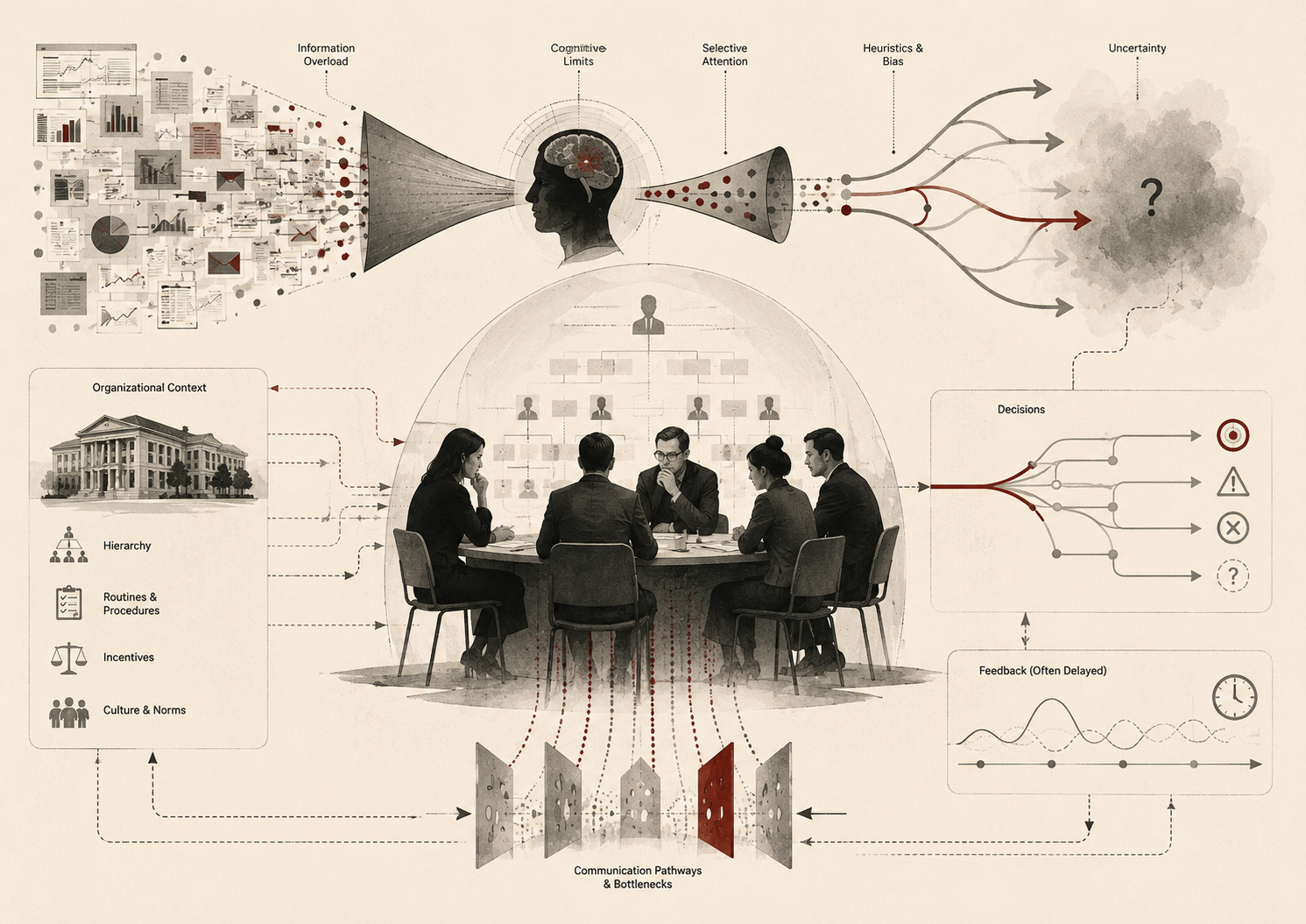
Organizational decisions are not made only at the moment a manager signs off on a plan. They are formed earlier, in the way evidence is gathered, problems are named, risks are categorized, alternatives are made visible, dissent is treated, and trade-offs are translated into institutional language. Cognitive constraints therefore belong at the center of organizational analysis, because they help explain both individual judgment and the patterned behavior of institutions.
Bounded rationality and organizational decision architecture
Bounded rationality explains why organizational decision makers rarely optimize across all possible alternatives. They operate with limited information, limited time, limited attention, limited computational capacity, and uncertain consequences. Instead of exhaustively comparing every available option, decision makers often satisfice: they select an alternative that appears good enough under the circumstances rather than one that is provably optimal.
This is not a minor deviation from rational decision theory. It is one of the basic conditions of institutional life. In a complex organization, the number of relevant facts, stakeholders, causal pathways, scenarios, constraints, and trade-offs usually exceeds what any individual or team can fully process. Strategic planning, budgeting, hiring, procurement, compliance, crisis response, product design, research management, public administration, and organizational change all occur under conditions of partial knowledge.
Bounded rationality therefore does not mean that decision makers are irrational. It means that rationality is always exercised under limits. Organizational intelligence depends on how institutions manage those limits: what they simplify, what they ignore, what they measure, what they delegate, what they escalate, what they routinize, and what they preserve for deliberation.
In this sense, every organization has a decision architecture. That architecture includes formal governance structures, informal norms, review processes, data systems, meeting rhythms, approval thresholds, performance metrics, documentation practices, and channels for dissent. These structures determine which signals receive attention, which alternatives become legitimate, which risks become visible, and which decisions can be made without exhausting cognitive resources.
Good decision architecture does not remove bounded rationality. It works with it. It reduces avoidable overload, clarifies responsibility, preserves critical uncertainty, and creates conditions in which limited human cognition can still produce responsible institutional judgment.
The organization as a cognitive system
An organization can be understood as a cognitive system because it senses, filters, stores, interprets, and acts on information. It receives signals from customers, citizens, markets, employees, regulators, technologies, suppliers, communities, ecosystems, and competitors. It converts those signals into reports, meetings, alerts, categories, metrics, narratives, and decisions. Some signals are amplified. Others are ignored. Some become actionable knowledge. Others remain noise.
This cognitive-system view shifts attention away from the idea that decisions are made by isolated minds. In practice, organizational cognition is distributed across people, artifacts, documents, software systems, routines, physical spaces, dashboards, forms, models, and institutional memory. A budget spreadsheet, a risk register, a compliance checklist, a customer-support queue, a meeting agenda, and a machine-learning dashboard are all cognitive artifacts. They shape what the organization can notice and do.
The strengths of this arrangement are significant. Organizations can divide labor, preserve memory, coordinate expertise, and make decisions that no individual could make alone. But the weaknesses are equally important. Distributed cognition can fragment responsibility, bury warning signs, delay feedback, create redundant reporting burdens, and allow decisions to appear rational inside one part of the institution while failing at the level of the whole system.
Organizational cognition is therefore both a capacity and a vulnerability. Institutions can think better than individuals when they integrate knowledge well. They can think worse than individuals when hierarchy, silos, incentives, technology, and routines distort what is seen, remembered, or questioned.
Attention and information processing
Attention determines which information enters the decision process at all. In organizational environments, attention is continually divided across meetings, deadlines, stakeholder demands, performance targets, reporting requirements, technological alerts, compliance obligations, and external shocks. Because attention is limited, decision makers cannot attend equally to everything. They must select, prioritize, suppress, or defer.
This matters because organizations rarely suffer only from too little information. Many suffer from too much information distributed unevenly across actors whose attention is already overloaded. Important cues may be available somewhere in the system but still fail to shape action because they do not become salient at the right level, in the right form, at the right time.
Attention is also structured institutionally. What leaders ask about becomes visible. What dashboards measure becomes routine. What reporting systems require becomes administratively real. What incentives reward becomes urgent. What professional cultures dismiss becomes difficult to raise. Organizational attention is therefore not just a psychological phenomenon. It is a governance problem.
William Ocasio’s attention-based view of the firm is useful here because it emphasizes that organizational behavior depends on how firms channel and distribute the attention of decision makers. What decision makers do depends partly on which issues and answers are brought into focus by rules, resources, relationships, procedures, and communication structures. The organization does not merely process information; it organizes attention.
This has practical consequences. Risk management fails when weak signals never reach decision forums. Strategy fails when attention is captured by short-term metrics. Innovation fails when attention is locked into existing product categories. Public institutions fail when visible crises consume attention while slower structural harms remain peripheral. Better decision systems therefore require better attentional design: fewer meaningless signals, clearer escalation pathways, stronger anomaly detection, and deliberate attention to what the organization is structurally inclined to miss.
Working memory, cognitive load, and task complexity
Working memory is the limited mental workspace used to hold and manipulate information during reasoning. It matters for organizational decision making because many institutional choices require simultaneous attention to budgets, timelines, legal constraints, technical feasibility, stakeholder effects, risk probabilities, operational dependencies, and future scenarios. When too many elements must be held in mind at once, reasoning degrades.
Working-memory limits help explain why complex decisions are often simplified into a small number of salient indicators. A project may be reduced to cost and timeline. A public-policy choice may be reduced to polling and budget impact. A hiring decision may be reduced to credentials and interview impressions. A strategic investment may be reduced to a forecast, a confidence narrative, or a benchmark against competitors.
Simplification is not always bad. Organizations need abstraction. The problem arises when simplification hides the features that matter most. A dashboard may reduce uncertainty to a color-coded status. A risk matrix may collapse causal complexity into a severity-probability score. A meeting summary may convert contested evidence into a managerial conclusion. These tools can help cognition, but they can also compress reality too aggressively.
Cognitive load increases when decision makers must process unfamiliar information, compare many alternatives, resolve ambiguity, manage emotional pressure, and coordinate with multiple stakeholders. High load tends to increase reliance on heuristics, defaults, prior commitments, authority signals, and familiar categories. This is why decision quality often depends less on intelligence in the abstract than on the design of the decision environment.
Good organizational design reduces unnecessary cognitive load without suppressing necessary complexity. It separates routine from exceptional decisions, provides structured comparisons, preserves uncertainty labels, limits irrelevant reporting, standardizes recurring tasks, and creates space for slow deliberation when consequences are high.
Cognitive biases in organizational decisions
Cognitive biases influence how decision makers interpret evidence, estimate risk, evaluate alternatives, and revise beliefs. In organizations, biases rarely remain isolated at the level of individual judgment. They can become embedded in routines, cultures, status hierarchies, planning assumptions, incentive systems, and recurring decision patterns.
Several biases are especially important in organizational settings:
- Confirmation bias — privileging information that supports existing assumptions, preferred strategies, or leadership narratives.
- Anchoring — remaining too dependent on initial numbers, forecasts, budgets, deadlines, valuations, or strategic frames.
- Overconfidence — overestimating predictive accuracy, control, competence, market knowledge, or implementation capacity.
- Availability bias — giving disproportionate weight to recent, vivid, emotionally salient, or easily recalled events.
- Escalation of commitment — continuing to invest in a failing course of action because prior investment, reputation, or identity is at stake.
- Status quo bias — preferring existing arrangements because change requires effort, uncertainty, political negotiation, or accountability.
- Groupthink — suppressing disagreement or alternative interpretation in order to preserve cohesion, hierarchy, or perceived consensus.
These biases interact with organizational structure. A leader’s overconfidence can become a department’s planning assumption. A team’s confirmation bias can become a product roadmap. A board’s anchoring can become a budget constraint. A culture of deference can make dissent cognitively available but politically unusable.
Biases also become more consequential when feedback is delayed. In many organizational decisions, the effects of a choice may not become visible for months or years. This weakens learning. If a flawed strategy appears successful in the short term, confirmation bias may be reinforced. If a harmful decision produces diffuse consequences, responsibility may be displaced. Organizations often need formal mechanisms to detect errors that ordinary experience does not make obvious.
The goal is not to imagine a bias-free organization. That is unrealistic. The goal is to build institutions that make bias easier to notice, challenge, and correct before it becomes systemic failure.
Decision framing and organizational context
The way a decision is framed affects how it is evaluated. In organizations, framing is shaped by language, reporting formats, metrics, incentive structures, legal categories, professional norms, cultural assumptions, and institutional routines. The same underlying issue may be interpreted differently depending on whether it is framed as a cost, an investment, a compliance risk, an innovation opportunity, a reputational threat, a labor issue, a technical defect, or a moral failure.
Framing is powerful because it defines what kind of problem people believe they are solving. If an employee-retention problem is framed only as a compensation issue, leadership may overlook management quality, workload, identity, dignity, trust, or institutional culture. If environmental risk is framed only as regulatory exposure, the organization may miss ecological harm, community justice, long-term resilience, and intergenerational obligation. If algorithmic bias is framed only as technical model performance, ethical and governance questions may be treated as secondary.
Organizational categories can therefore narrow moral and strategic imagination. A spreadsheet can make some harms visible and others invisible. A legal memo can define what is permissible while leaving unresolved what is responsible. A dashboard can emphasize what is measurable while obscuring what is socially important. A project plan can create the impression of control even when causal uncertainty remains high.
Better framing practices include deliberately restating the problem in multiple ways, separating evidence from interpretation, asking who benefits from the current frame, identifying what the frame excludes, and inviting affected stakeholders into the interpretation process. In high-stakes decisions, the first question should not be “What should we do?” but “What kind of problem have we decided this is?”
Formalizing organizational decision constraints
Organizational decision making can be formalized as the interaction between available cognitive capacity and institutional demand. Let the total cognitive burden imposed by a decision be:
L_{\text{org}} = L_i + L_u + L_c + L_p
\]
Interpretation: Total organizational decision load can be represented as the combined burden of information load, uncertainty load, coordination load, and political or institutional load.
Here, \(L_i\) is information load, \(L_u\) is uncertainty load, \(L_c\) is coordination load, and \(L_p\) is political or institutional load. This formulation is useful because it shows that organizations do not face informational difficulty alone. They also face interpretive difficulty, coordination difficulty, and the difficulty of making decisions inside structures of power, reputation, identity, and accountability.
If decision capacity at time \(t\) is \(K_t\), then effective decision making requires:
L_{\text{org}} \leq K_t
\]
Interpretation: When organizational decision load exceeds available capacity, the institution becomes more likely to simplify, delay, satisfice, defer to authority, or rely on familiar routines.
Capacity is not only an individual trait. It depends on staffing, expertise, time, decision-support tools, psychological safety, institutional memory, documentation, coordination structures, and the quality of available evidence. A decision that exceeds capacity in one organization may be manageable in another because the second organization has better systems for distributing cognition.
One can also express the probability of selecting option \(j\) as a function of perceived value, cognitive effort, and institutional salience:
Pr(j) =
\frac{\exp(\beta_1 V_j – \beta_2 E_j + \beta_3 S_j)}
{\sum_{k=1}^{n} \exp(\beta_1 V_k – \beta_2 E_k + \beta_3 S_k)}
\]
Interpretation: Options that appear valuable, require less cognitive effort, or are more institutionally salient may become more likely to be selected, even when they are not substantively optimal.
In this expression, \(V_j\) is perceived value, \(E_j\) is effort cost, and \(S_j\) is salience within the organization. The equation captures a central institutional fact: alternatives that are easier to explain, easier to measure, easier to defend, or easier to place within existing routines may be chosen over alternatives that are more appropriate but harder to process.
Distributed decision error can also be expressed as the mismatch between organizational reality \(R\) and the collectively held representation \(\hat{R}\):
\epsilon = \|R – \hat{R}\|
\]
Interpretation: Decision error increases as the organization’s internal representation of reality diverges from the external conditions it must act within.
As this mismatch grows, the organization may continue making internally coherent decisions that are poorly matched to external conditions. This helps explain why systemic failure can occur even when no single actor appears irrational. The internal model may be stable, professional, and well documented while still being wrong.
Complexity and information overload
Modern organizations operate in environments characterized by complexity, speed, interdependence, uncertainty, and abundant data. Decision makers must process large volumes of information while also accounting for causal delay, nonlinear effects, competing priorities, and multiple stakeholder perspectives.
Information overload occurs when the quantity, speed, ambiguity, or fragmentation of input exceeds what can be meaningfully integrated. Under overload, decision makers often simplify. They rely more heavily on dashboards, filters, defaults, summaries, heuristics, prior commitments, expert authority, and short-horizon indicators. These simplifications may be necessary, but they can also distort institutional judgment.
Overload is not solved by adding more data. In many organizations, additional data can make the problem worse by increasing the burden of interpretation. A flood of metrics may create the appearance of visibility while reducing the time available for sensemaking. A dashboard may make the measurable parts of a system vivid while pushing qualitative, ethical, historical, ecological, or political factors into the background.
Complex systems also produce interaction effects. A decision in one unit may change constraints elsewhere. A technology upgrade may alter labor practices. A budget cut may weaken maintenance capacity. A communication failure may become a safety failure. A compliance decision may become a reputational crisis. Because consequences are distributed, no single decision maker may have a full view of the causal system.
Organizations need methods for reducing overload without flattening reality. Useful approaches include scenario planning, premortems, causal maps, tiered escalation rules, cross-functional review, red-team analysis, decision logs, uncertainty registers, and explicit separation between routine monitoring and high-stakes interpretation.
Coordination and distributed cognition
Organizational decision making is rarely contained within one mind. It is distributed across teams, departments, tools, documents, procedures, technologies, and workflows. This makes distributed cognition central to organizational performance. Decision quality depends not only on individual competence but also on whether knowledge is shared, integrated, preserved, challenged, and made usable across the system.
Distributed cognition can improve decision making by allowing organizations to combine expertise. Engineers, analysts, frontline workers, legal counsel, community representatives, managers, finance teams, and external experts may each hold different parts of the relevant knowledge. When coordination works, the organization can reason across perspectives. When coordination fails, each part may act rationally within its own limited frame while the institution as a whole makes poor decisions.
Common distributed-cognition failures include:
- Silos, where relevant knowledge remains trapped within departments or professional groups.
- Handoff loss, where meaning is distorted as information moves through layers of summary and approval.
- Documentation gaps, where decisions are made without preserving assumptions, uncertainty, or dissent.
- Tool dependence, where cognitive work is outsourced to systems that users do not fully understand.
- Responsibility diffusion, where no actor feels accountable for the whole decision.
Distributed cognition also has an ethical dimension. Frontline workers, marginalized communities, junior staff, patients, citizens, or affected users often see consequences that senior decision makers do not. If institutions fail to create channels through which this knowledge can shape decisions, they are not merely missing information. They are reproducing unequal attention and unequal voice.
Good coordination therefore requires more than efficiency. It requires epistemic justice: a serious institutional commitment to hearing from the people and positions that are most likely to observe hidden failure, neglected harm, or lived consequences.
Power, incentives, and institutional salience
Cognitive constraints do not operate in neutral environments. They are shaped by power. What becomes visible inside an organization often depends on who has authority, whose knowledge counts, whose discomfort matters, whose evidence is trusted, and whose disagreement carries risk.
Institutional salience is partly cognitive and partly political. A metric becomes salient because it is easy to track, but also because leadership treats it as important. A risk becomes salient because it is vivid, but also because it threatens legally or financially powerful actors. A community harm may remain invisible because it is difficult to measure, but also because the affected group lacks institutional power.
Incentives can intensify cognitive narrowing. When promotion, funding, reputation, or organizational survival depends on a preferred narrative, decision makers may unconsciously filter evidence in ways that protect that narrative. A team may discount negative findings because the project is already publicly committed. A company may understate risk because the business model depends on growth. A public agency may resist acknowledging failure because accountability would be politically costly.
This does not mean that all organizational decisions are cynical. Often, the problem is more subtle. People may sincerely believe the frame that the institution rewards them for adopting. Cognitive bias and institutional incentive can converge. The organization teaches people what to notice and what to ignore.
Responsible decision design therefore requires mechanisms that protect inconvenient evidence. These include independent review, whistleblower protections, audit trails, community consultation, dissent channels, conflict-of-interest disclosure, rotating devil’s advocacy, and governance structures that separate evidence assessment from political approval.
Cognitive constraints and strategic decision making
Strategic decisions involve long time horizons, uncertain consequences, ambiguous evidence, and high stakes. They are especially vulnerable to cognitive constraints because the organization must imagine future states that cannot be directly observed. Leaders must reason from partial data, imperfect models, contested assumptions, and incomplete feedback.
Strategic cognition depends on representation. If the future is represented as a market forecast, one set of decisions follows. If it is represented as a climate-risk landscape, another follows. If it is represented as a labor-capacity problem, a technological transition, a legitimacy crisis, or a public-interest obligation, the strategic field changes. The organization’s mental model defines which futures appear plausible and which actions appear rational.
Long-range decisions are particularly vulnerable to overconfidence. Forecasts may be treated as more precise than they are. Scenario ranges may be narrowed for executive clarity. Weak signals may be dismissed because they do not fit existing strategy. Early warnings may be rationalized as temporary noise. Strategic drift often begins when an organization’s internal representation remains stable while the external environment changes.
Strategic decision making also involves identity. Organizations prefer strategies that preserve a coherent sense of who they are. This can support continuity and mission. It can also prevent adaptation. A university, company, agency, nonprofit, or research institution may reject necessary change because the change threatens the institution’s self-understanding.
Improving strategic decision making requires practices that make uncertainty visible rather than embarrassing. Organizations should preserve competing hypotheses, revisit assumptions, maintain decision records, compare forecasts against outcomes, conduct premortems, and create conditions in which strategic dissent is treated as a resource rather than disloyalty.
Technology, data, and decision-support systems
Digital tools, analytics systems, dashboards, knowledge bases, simulation platforms, and decision-support systems can help organizations manage cognitive constraints. They can reduce search cost, organize evidence, preserve institutional memory, identify anomalies, compare alternatives, visualize uncertainty, and support coordination across teams.
At the same time, technology can introduce new cognitive problems. Dashboards can encourage overreliance on what is measurable. Automated scoring systems can create false precision. Recommendation systems can narrow attention. Predictive models can obscure assumptions. Alerts can produce fatigue. Generative AI tools can accelerate drafting and analysis while also producing plausible but unreliable summaries when not carefully governed.
Technology does not eliminate bounded rationality. It redistributes it. A decision-support system may reduce memory burden for users while increasing dependence on model design, interface choices, data quality, and organizational interpretation. If users cannot understand how a system frames evidence, ranks options, or represents uncertainty, the tool may improve efficiency while weakening judgment.
This is why alignment between cognition and technology matters. Decision-support systems should be cognitively legible. They should show uncertainty, preserve provenance, distinguish data from interpretation, make assumptions inspectable, allow users to challenge outputs, and support human responsibility rather than displacing it.
Human-computer interaction is central here. A technically sophisticated system can still fail if it overwhelms users, hides uncertainty, encourages automation bias, or presents information in ways that are visually clear but cognitively misleading. Better tools support better thinking. They do not merely produce more output.
Implications for organizational design
Recognizing cognitive constraints has direct implications for organizational design. Structures, processes, and decision systems can be designed to support better judgment by reducing avoidable mental burden, improving information flow, preserving uncertainty, and making critical knowledge easier to interpret.
Useful design responses include:
- Reduce unnecessary cognitive load by simplifying routine workflows, removing redundant reporting, and standardizing recurring decisions.
- Separate routine decisions from high-stakes decisions so that complex issues receive appropriate deliberation rather than being forced through ordinary approval channels.
- Use structured decision templates that require assumptions, alternatives, uncertainties, affected groups, evidence quality, and dissenting views to be recorded.
- Create explicit escalation pathways for weak signals, anomalies, safety concerns, ethical risks, and frontline observations.
- Preserve institutional memory through decision logs, after-action reviews, model documentation, and transparent revision histories.
- Design dashboards for interpretation, not just display, by including uncertainty ranges, source notes, definitions, and contextual warnings.
- Protect dissent through review processes that make disagreement legitimate and psychologically safe.
- Include affected stakeholders when decisions have social, ecological, public, or ethical consequences beyond the organization itself.
These approaches do not create perfect rationality. They create better conditions for bounded but more responsible reasoning. The goal is not to replace human judgment with procedure. It is to build institutional environments in which human judgment has a better chance of being informed, reflective, accountable, and responsive to evidence.
Organizational design should therefore be understood as cognitive design. Every form, meeting, dashboard, approval process, reporting line, and governance structure changes what the organization can think about. The ethical question is whether those structures help the organization see reality more clearly or help it avoid what it would rather not know.
Contemporary research and interdisciplinary integration
Current research on cognitive constraints in organizations integrates cognitive psychology, behavioral economics, organizational psychology, management theory, human-computer interaction, decision science, and ethics. This interdisciplinary field has moved beyond a simple view of heuristics as errors. In many contexts, heuristics can be adaptive, fast, frugal, and effective, especially when uncertainty is high and exhaustive optimization is impossible.
The key question is not whether organizations should use heuristics. They always do. The question is whether the heuristic fits the environment, whether its limits are understood, whether it is open to correction, and whether it is being used to support responsible judgment or merely to simplify inconvenient complexity.
Research on moral decision-making in organizations adds another layer. Organizational judgment is not only technical. It also involves responsibility, harm, trust, dignity, fairness, and legitimacy. Moral cognition is shaped by context, identity, emotion, incentives, social norms, and institutional climate. An organization can be analytically sophisticated while ethically narrow if its decision systems do not make harm visible or accountability meaningful.
Research on attention, working memory, bounded rationality, prospect theory, distributed cognition, and organizational routines all point toward a shared conclusion: institutions do not decide through disembodied rationality. They decide through bounded minds embedded in social systems, technological infrastructures, power relations, and histories of prior decisions.
This makes cognitive psychology essential for understanding organizational life. It helps explain why intelligent people working in serious institutions can still miss obvious risks, repeat flawed assumptions, suppress dissent, overtrust models, or escalate failing strategies. It also shows how better design can support better reasoning.
R code for organizational-decision data
The following R workflow illustrates analyses relevant to cognitive constraints in organizations, including information load, attention effects, satisficing, response time, and decision quality under uncertainty. It assumes a trial-level dataset in which participants or organizational units make repeated decisions under different cognitive and institutional conditions.
# Install packages if needed:
# pak::pak(c("tidyverse", "lme4", "lmerTest", "emmeans", "performance", "broom.mixed"))

library(tidyverse)
library(lme4)
library(lmerTest)
library(emmeans)
library(performance)
library(broom.mixed)

# Expected columns:
# participant, unit, condition, info_load, attention_score,
# uncertainty_level, coordination_load, institutional_pressure,
# decision_quality, chose_satisficing, response_time

dat <- read_csv("organizational_decision_trials.csv") %>%
  mutate(
    participant = factor(participant),
    unit = factor(unit),
    condition = factor(condition),
    chose_satisficing = as.integer(chose_satisficing),
    cognitive_burden = info_load + uncertainty_level + coordination_load + institutional_pressure
  )

# -----------------------------
# 1. Descriptive profile
# -----------------------------

condition_summary <- dat %>%
  group_by(condition) %>%
  summarise(
    n_trials = n(),
    mean_info_load = mean(info_load, na.rm = TRUE),
    mean_attention = mean(attention_score, na.rm = TRUE),
    mean_uncertainty = mean(uncertainty_level, na.rm = TRUE),
    mean_coordination = mean(coordination_load, na.rm = TRUE),
    mean_pressure = mean(institutional_pressure, na.rm = TRUE),
    mean_quality = mean(decision_quality, na.rm = TRUE),
    satisficing_rate = mean(chose_satisficing, na.rm = TRUE),
    mean_response_time = mean(response_time, na.rm = TRUE),
    .groups = "drop"
  )

print(condition_summary)

# -----------------------------
# 2. Decision quality model
# -----------------------------
# Mixed-effects model estimating how information load, attention,
# uncertainty, coordination load, and institutional pressure predict
# decision quality while accounting for repeated observations by participant.

quality_model <- lmer(
  decision_quality ~
    info_load +
    attention_score +
    uncertainty_level +
    coordination_load +
    institutional_pressure +
    condition +
    (1 + info_load | participant),
  data = dat,
  REML = FALSE
)

summary(quality_model)
anova(quality_model)
performance::check_model(quality_model)

# Estimated marginal means by condition
emmeans(quality_model, ~ condition)

# -----------------------------
# 3. Satisficing-choice model
# -----------------------------
# Logistic mixed-effects model estimating the probability that a participant
# selects a good-enough option rather than continuing to search or optimize.

satisficing_model <- glmer(
  chose_satisficing ~
    info_load +
    attention_score +
    uncertainty_level +
    coordination_load +
    institutional_pressure +
    condition +
    (1 | participant),
  data = dat,
  family = binomial(),
  control = glmerControl(optimizer = "bobyqa")
)

summary(satisficing_model)
performance::check_model(satisficing_model)

# Condition-level predicted probabilities
emmeans(satisficing_model, ~ condition, type = "response")

# -----------------------------
# 4. Response-time model
# -----------------------------
# Response times are usually skewed, so this model uses log response time.

rt_dat <- dat %>%
  filter(response_time >= 150) %>%
  mutate(log_rt = log(response_time))

rt_model <- lmer(
  log_rt ~
    info_load +
    attention_score +
    uncertainty_level +
    coordination_load +
    institutional_pressure +
    condition +
    (1 | participant),
  data = rt_dat,
  REML = FALSE
)

summary(rt_model)
performance::check_model(rt_model)

# -----------------------------
# 5. Organizational burden index
# -----------------------------
# This model asks whether aggregate cognitive burden predicts lower
# decision quality after accounting for experimental condition.

burden_model <- lmer(
  decision_quality ~ cognitive_burden + condition + (1 | participant),
  data = dat,
  REML = FALSE
)

summary(burden_model)

# -----------------------------
# 6. Visualization
# -----------------------------

ggplot(dat, aes(x = cognitive_burden, y = decision_quality)) +
  geom_point(alpha = 0.35) +
  geom_smooth(method = "lm", se = TRUE) +
  facet_wrap(~ condition) +
  labs(
    title = "Cognitive burden and organizational decision quality",
    x = "Cognitive burden index",
    y = "Decision quality"
  ) +
  theme_minimal()
This workflow is meant to support empirical analysis rather than serve as a fixed model of organizational decision making. Researchers can extend it with random effects for teams, departments, cases, decision tasks, or time periods. They can also add variables for psychological safety, dissent, model trust, leadership pressure, decision reversibility, or feedback delay.
Python code for organizational-decision data
The Python workflow below parallels the R analysis and is useful for organizational decision experiments, overload studies, strategic-choice simulations, and decision-support evaluation. It uses pandas, statsmodels, and matplotlib to model decision quality, satisficing, response time, and cognitive burden.
import numpy as np
import pandas as pd
import statsmodels.formula.api as smf
import statsmodels.api as sm
import matplotlib.pyplot as plt

# Expected columns:
# participant, unit, condition, info_load, attention_score,
# uncertainty_level, coordination_load, institutional_pressure,
# decision_quality, chose_satisficing, response_time

df = pd.read_csv("organizational_decision_trials.csv")

categorical_cols = ["participant", "unit", "condition"]
for col in categorical_cols:
    df[col] = df[col].astype("category")

df["chose_satisficing"] = df["chose_satisficing"].astype(int)

df["cognitive_burden"] = (
    df["info_load"]
    + df["uncertainty_level"]
    + df["coordination_load"]
    + df["institutional_pressure"]
)

# -----------------------------
# 1. Descriptive profile
# -----------------------------

condition_summary = (
    df.groupby("condition")
    .agg(
        n_trials=("decision_quality", "size"),
        mean_info_load=("info_load", "mean"),
        mean_attention=("attention_score", "mean"),
        mean_uncertainty=("uncertainty_level", "mean"),
        mean_coordination=("coordination_load", "mean"),
        mean_pressure=("institutional_pressure", "mean"),
        mean_quality=("decision_quality", "mean"),
        satisficing_rate=("chose_satisficing", "mean"),
        mean_response_time=("response_time", "mean"),
    )
    .reset_index()
)

print(condition_summary)

# -----------------------------
# 2. Decision quality model
# -----------------------------
# Mixed model with participant-level random intercepts.

quality_model = smf.mixedlm(
    "decision_quality ~ info_load + attention_score + uncertainty_level "
    "+ coordination_load + institutional_pressure + condition",
    data=df,
    groups=df["participant"],
)

quality_result = quality_model.fit(method="lbfgs")
print(quality_result.summary())

# -----------------------------
# 3. Satisficing model
# -----------------------------
# Logistic model with participant-clustered standard errors.

satisficing_model = smf.glm(
    "chose_satisficing ~ info_load + attention_score + uncertainty_level "
    "+ coordination_load + institutional_pressure + condition",
    data=df,
    family=sm.families.Binomial(),
)

satisficing_result = satisficing_model.fit(
    cov_type="cluster",
    cov_kwds={"groups": df["participant"]},
)

print(satisficing_result.summary())

# -----------------------------
# 4. Response-time model
# -----------------------------
# Response time is log-transformed because raw response times are usually skewed.

rt_df = df[df["response_time"] >= 150].copy()
rt_df["log_rt"] = np.log(rt_df["response_time"])

rt_model = smf.mixedlm(
    "log_rt ~ info_load + attention_score + uncertainty_level "
    "+ coordination_load + institutional_pressure + condition",
    data=rt_df,
    groups=rt_df["participant"],
)

rt_result = rt_model.fit(method="lbfgs")
print(rt_result.summary())

# -----------------------------
# 5. Cognitive burden model
# -----------------------------

burden_model = smf.mixedlm(
    "decision_quality ~ cognitive_burden + condition",
    data=df,
    groups=df["participant"],
)

burden_result = burden_model.fit(method="lbfgs")
print(burden_result.summary())

# -----------------------------
# 6. Visualization
# -----------------------------

fig, ax = plt.subplots(figsize=(8, 5))

for condition, group in df.groupby("condition"):
    ax.scatter(
        group["cognitive_burden"],
        group["decision_quality"],
        alpha=0.4,
        label=str(condition),
    )

ax.set_xlabel("Cognitive burden index")
ax.set_ylabel("Decision quality")
ax.set_title("Cognitive burden and organizational decision quality")
ax.legend(title="Condition")
plt.tight_layout()
plt.show()
This code can be adapted for observational organizational data, experimental decision tasks, simulated decision environments, or audits of decision-support systems. In applied work, the most important step is not only model fitting. It is careful construct design: defining what counts as information load, uncertainty, coordination load, institutional pressure, decision quality, and satisficing in a way that fits the organization being studied.
GitHub Repository
The companion repository provides reusable code and research scaffolding for studying cognitive constraints in organizational decision making, including workflows for decision-quality modeling, satisficing analysis, information-load measurement, and cognitive-burden evaluation.
Complete Code Repository
Access the full companion repository for this article, including reproducible analysis materials and code workflows for organizational decision data.
Conclusion
Cognitive constraints in organizational decision making refer to the limits of human attention, memory, processing, judgment, and coordination that shape how institutions interpret problems and choose among alternatives. These limits do not disappear inside formal structures. They become distributed, aggregated, amplified, hidden, or corrected through routines, technologies, incentives, hierarchies, documents, meetings, dashboards, and governance systems.
Cognitive psychology shows why this matters. Organizations do not decide through abstract rationality alone. They decide through bounded minds operating inside complex social and institutional systems. Understanding those constraints helps explain why institutions simplify, satisfice, misframe, overtrust models, suppress dissent, coordinate imperfectly, and sometimes fail despite intelligence and professionalism.
The same analysis also points toward repair. Better organizational decision making does not require pretending that human beings can become perfectly rational. It requires designing institutions that respect cognitive limits: clearer information environments, better attention structures, stronger feedback loops, protected dissent, thoughtful decision-support systems, and governance practices that make uncertainty, harm, and responsibility visible.
Organizational cognition is therefore an ethical and strategic problem. The central question is not only how organizations can decide faster or more efficiently. It is how they can think more truthfully, remember more responsibly, hear more broadly, and act with greater accountability under conditions of complexity.
Related articles
- Cognitive Psychology
- Attention in Cognitive Psychology
- Working Memory in Cognitive Psychology
- Decision Making in Cognitive Psychology
- Problem Solving in Cognitive Psychology
- Cognitive Psychology and Behavioral Economics
- Cognition and Human-Computer Interaction
- Cognitive Systems and Artificial Intelligence
Further reading
- Cyert, R.M. and March, J.G. (1963) A Behavioral Theory of the Firm. Englewood Cliffs, NJ: Prentice-Hall.
- Gigerenzer, G., Reb, J. and Luan, S. (2022) ‘Smart heuristics for individuals, teams, and organizations’, Annual Review of Organizational Psychology and Organizational Behavior, 9, pp. 171–198. Available at: https://www.annualreviews.org/doi/10.1146/annurev-orgpsych-012420-090506.
- Hutchins, E. (1995) Cognition in the Wild. Cambridge, MA: MIT Press.
- Kahneman, D. (2011) Thinking, Fast and Slow. New York: Farrar, Straus and Giroux.
- March, J.G. (1994) A Primer on Decision Making: How Decisions Happen. New York: Free Press.
- Ocasio, W. (1997) ‘Towards an attention-based view of the firm’, Strategic Management Journal, 18(S1), pp. 187–206. Available at: https://doi.org/10.1002/(SICI)1097-0266(199707)18:1+%3C187::AID-SMJ936%3E3.0.CO;2-K.
- Payne, J.W., Bettman, J.R. and Johnson, E.J. (1993) The Adaptive Decision Maker. Cambridge: Cambridge University Press.
- Simon, H.A. (1997) Administrative Behavior: A Study of Decision-Making Processes in Administrative Organizations. 4th edn. New York: Free Press.
- Wheeler, G. (2018) ‘Bounded rationality’, Stanford Encyclopedia of Philosophy. Available at: https://plato.stanford.edu/entries/bounded-rationality/.
References
- Cowan, N. (2001) ‘The magical number 4 in short-term memory: A reconsideration of mental storage capacity’, Behavioral and Brain Sciences, 24(1), pp. 87–114. Available at: https://doi.org/10.1017/S0140525X01003922.
- Cyert, R.M. and March, J.G. (1963) A Behavioral Theory of the Firm. Englewood Cliffs, NJ: Prentice-Hall.
- Gigerenzer, G., Reb, J. and Luan, S. (2022) ‘Smart heuristics for individuals, teams, and organizations’, Annual Review of Organizational Psychology and Organizational Behavior, 9, pp. 171–198. Available at: https://www.annualreviews.org/doi/10.1146/annurev-orgpsych-012420-090506.
- Hutchins, E. (1995) Cognition in the Wild. Cambridge, MA: MIT Press.
- Kahneman, D. (2011) Thinking, Fast and Slow. New York: Farrar, Straus and Giroux.
- Kahneman, D. and Tversky, A. (1979) ‘Prospect theory: An analysis of decision under risk’, Econometrica, 47(2), pp. 263–291. Available at: https://www.jstor.org/stable/1914185.
- Kouchaki, M. and Smith, I.H. (2025) ‘Moral decision-making in organizations’, Annual Review of Organizational Psychology and Organizational Behavior, 12, pp. 45–72. Available at: https://www.annualreviews.org/content/journals/10.1146/annurev-orgpsych-110622-045715.
- March, J.G. (1994) A Primer on Decision Making: How Decisions Happen. New York: Free Press.
- Miller, G.A. (1956) ‘The magical number seven, plus or minus two: Some limits on our capacity for processing information’, Psychological Review, 63(2), pp. 81–97. Available at: https://doi.org/10.1037/h0043158.
- Ocasio, W. (1997) ‘Towards an attention-based view of the firm’, Strategic Management Journal, 18(S1), pp. 187–206. Available at: https://doi.org/10.1002/(SICI)1097-0266(199707)18:1+%3C187::AID-SMJ936%3E3.0.CO;2-K.
- Payne, J.W., Bettman, J.R. and Johnson, E.J. (1993) The Adaptive Decision Maker. Cambridge: Cambridge University Press.
- Simon, H.A. (1997) Administrative Behavior: A Study of Decision-Making Processes in Administrative Organizations. 4th edn. New York: Free Press.
- Wheeler, G. (2018) ‘Bounded rationality’, Stanford Encyclopedia of Philosophy. Available at: https://plato.stanford.edu/entries/bounded-rationality/.