
Last Updated May 25, 2026
The future of behavioral economics in governance and policy lies not merely in the refinement of nudges, but in the broader recognition that institutions themselves are behavioral systems. Laws, defaults, digital interfaces, administrative procedures, disclosure regimes, platform architectures, public-service workflows, and regulatory environments do not operate on abstract rational agents. They operate on persons with limited attention, uneven information, social preferences, habit persistence, bounded foresight, contextual judgment, unequal resources, and varying levels of institutional trust. For that reason, governance in the twenty-first century increasingly depends on whether institutions can be designed in ways that are psychologically realistic, normatively defensible, publicly accountable, and administratively durable.
Behavioral economics began as a challenge to narrow models of rational choice, but its long-run significance lies in something larger. It has become a framework for understanding how incentives, cognition, institutions, social environments, and information systems interact. What first appeared as a corrective to orthodox assumptions about decision-making now shapes debates about tax compliance, savings policy, public health, consumer protection, climate governance, administrative burden, algorithmic regulation, digital platforms, public-service delivery, and institutional legitimacy. The field’s future therefore lies not only in better descriptions of individual behavior, but in the design of institutions capable of governing under real human conditions.
Main Library
Publications
Article Map
Behavioral Economics
Related Topic
Decision Science
Related Topic
Institutions & Governance
Related Topic
Sustainable Development
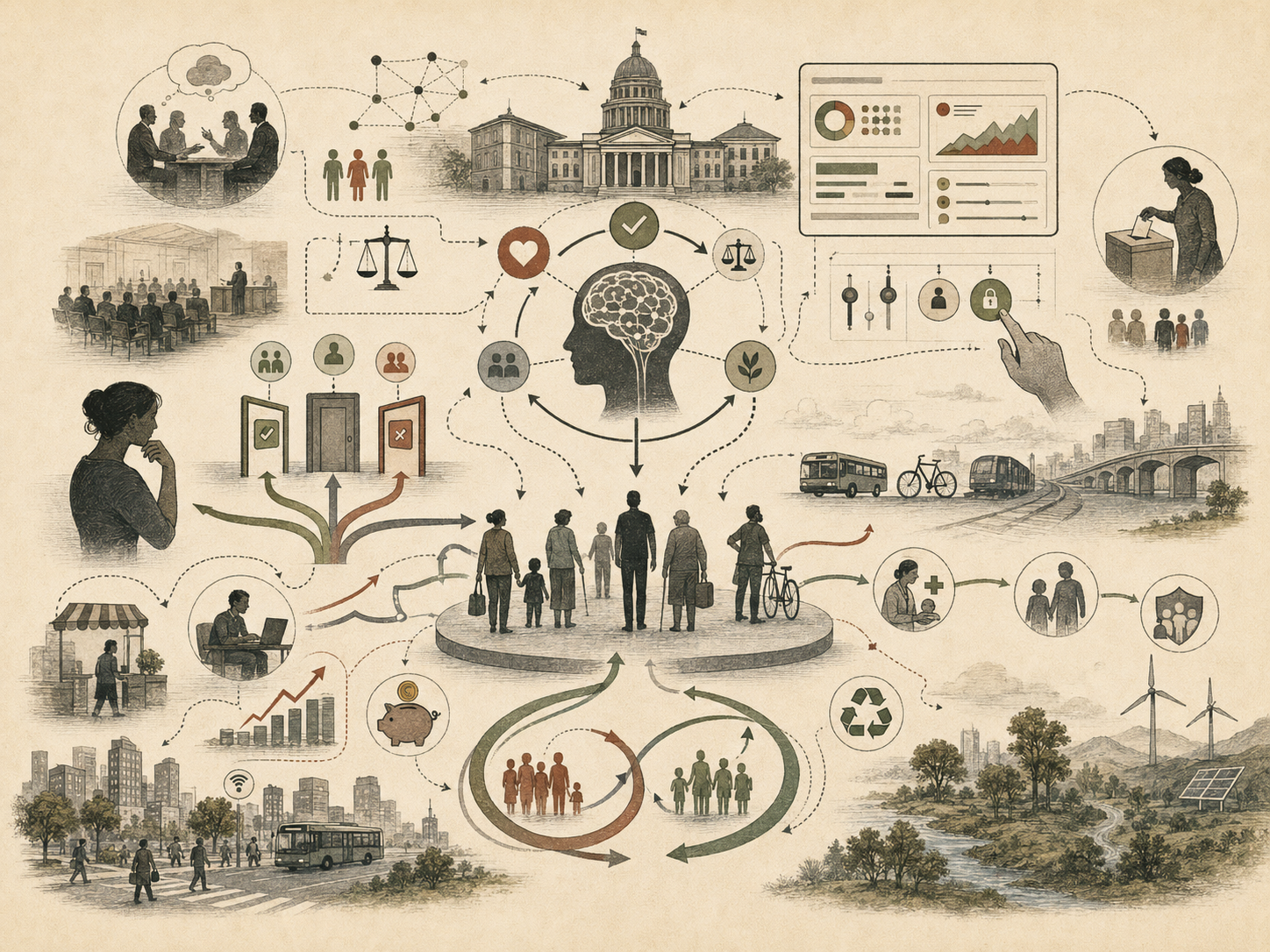
Behavioral economics matters for governance because the success of public institutions depends on how people encounter rules in practice. A technically valid policy can fail if it is too complex, too mistrusted, too burdensome, too poorly timed, or too detached from the lived conditions of the people it expects to serve. A legally available benefit may remain unused if enrollment is confusing. A disclosure requirement may satisfy formal transparency while leaving citizens no more informed. A penalty may exist on paper while compliance remains weak because legitimacy has eroded. A digital service may appear efficient while quietly shifting cognitive burden onto the public.
The future of the field therefore requires moving beyond a narrow image of behavioral economics as a toolkit of nudges. Nudges remain important, but they are only one layer of a larger governance problem. The deeper question is how institutions can become behaviorally literate: capable of understanding attention, trust, friction, default effects, social norms, time horizons, digital choice architecture, and unequal access as central features of policy design rather than afterthoughts. Behavioral economics will be most valuable where it helps institutions become clearer, fairer, more legitimate, and more capable of delivering public value under conditions of human limitation.
From Cognitive Biases to Institutional Design
Behavioral economics is often introduced through familiar concepts such as heuristics, framing effects, loss aversion, present bias, anchoring, status quo bias, and bounded rationality. That history matters. It shows that human judgment regularly departs from the image of a fully informed agent who processes all relevant information, calculates expected utility consistently, and updates beliefs without distortion. But the field becomes too small if it is treated merely as a catalogue of individual departures from rationality.
The more important development is that behavioral economics has forced policy and governance scholars to reconsider the behavioral assumptions embedded in institutions themselves. Every regulatory system presumes something about how people interpret information, respond to incentives, perceive risk, process paperwork, trust authorities, understand rights, evaluate costs, and adapt to changing rules. If those assumptions are unrealistic, policy design fails even when the rule appears formally sound.
Administrative burdens discourage participation. Complex disclosures go unread. Public benefits remain underclaimed. Warnings lose force when overused. Financial incentives underperform when they are poorly timed or cognitively obscure. Compliance programs fail when they ignore trust, legitimacy, and social norms. Digital services exclude people when they assume universal access, stable documentation, high literacy, and uninterrupted attention.
Behavioral economics therefore matters to governance because it relocates analysis from abstract choice to institutional interaction. It asks not only how individuals decide, but how real decision-makers behave under bureaucracy, digital mediation, social influence, political distrust, scarcity, complexity, and uncertainty. That shift has made the field increasingly relevant to public administration, regulatory design, institutional reform, consumer protection, environmental policy, and technology governance.
The movement from bias to design also changes the ethical stakes. If institutions know that defaults, salience, burden, and framing shape behavior, they cannot pretend that the design of procedures is neutral. A form can include or exclude. A default can enable or manipulate. A disclosure can inform or obscure. A reminder can support action or become coercive pressure. Behavioral economics makes these design choices visible, and therefore makes them subject to ethical and democratic scrutiny.
The Rise of Behavioral Public Policy
One of the clearest signs of this institutional turn has been the global rise of behavioral public policy. Behavioral approaches are now used across consumer protection, education, energy, environment, finance, health, labor markets, taxation, development policy, climate action, public-service delivery, and administrative reform. Governments and international organizations have recognized that policy implementation is not a mechanical afterthought. It is a behavioral process.
The appeal of behavioral public policy has several sources. First, many interventions are relatively low-cost compared with large-scale fiscal programs. Simplifying a letter, changing a default, sending a timely reminder, redesigning a form, or clarifying a choice interface can produce measurable effects. Second, behavioral interventions often address the practical gap between formal eligibility and actual uptake. A policy may exist, but people may not use it unless the path into the policy is legible and low-friction. Third, behavioral public policy offers a way to test assumptions empirically through randomized trials, field experiments, administrative data, and iterative evaluation.
The World Bank’s World Development Report 2015: Mind, Society, and Behavior helped establish behavioral reasoning as central to development policy rather than peripheral to it. Development problems are often shaped not only by resources and incentives, but by mental models, social norms, scarcity, cognitive load, and institutional trust. Similarly, OECD work on behavioral science has documented the spread of behavioral methods across public-policy domains while also emphasizing the need for ethical principles, transparency, and institutional capacity.
Within the United Nations system and related international development organizations, behavioral science has also become more visible as a practical resource for addressing complex institutional challenges. These uses vary widely, from improving service uptake to strengthening public communication, supporting climate action, reducing administrative burdens, and improving institutional responsiveness.
What explains this expansion? Part of the answer is empirical. Governments have found that relatively small changes in wording, default design, reminder timing, simplification, social comparison, and comparison framing can materially affect participation, compliance, and program uptake. Another part of the answer is conceptual. Policymakers increasingly understand that implementation depends on whether rules can be understood, trusted, acted upon, and sustained by real people in real environments.
Yet this rise also creates risks. Behavioral public policy can be oversold. It can become a substitute for deeper reform. It can be used to shift responsibility from institutions to individuals. It can produce narrow improvements in uptake while leaving larger structures of inequality intact. The future of behavioral public policy therefore depends on whether it matures beyond isolated interventions into a broader discipline of accountable institutional design.
Governance as a Behavioral System
Behavioral economics becomes especially powerful when governance is treated as a system of structured interaction rather than a one-directional instrument of control. Institutions do not simply issue commands. They generate signals, shape defaults, allocate attention, construct categories, distribute burdens, define eligibility, communicate legitimacy, and create expectations about fairness, reciprocity, and enforcement.
This is why behaviorally informed governance extends beyond nudging. It includes the design of forms, deadlines, consent flows, warnings, disclosure mandates, complaint systems, eligibility procedures, inspections, procurement environments, administrative portals, audit trails, appeals processes, and public communications. In each case, the behavior of citizens, firms, officials, and organizations depends on cognitive load, interpretability, time pressure, institutional trust, and social meaning.
A behaviorally informed institution attempts to reduce unnecessary administrative friction, improve comprehensibility, and align procedure with realistic human capacities. But it must also recognize that institutions themselves can display behavioral pathologies. Organizations become overconfident, inattentive to low-probability risk, dependent on routines, biased toward measurable outputs, vulnerable to conformity pressures, and slow to update when evidence changes. Governance is behavioral on both sides of the interface: in the public and in the institution that governs.
This perspective connects closely to Behavioral Regulation and Institutional Design and Behavioral Economics and Organizational Decision-Making. It also suggests that the future of the field lies in a stronger dialogue with public administration, political economy, institutional economics, organizational psychology, systems thinking, and data governance.
Governance as a behavioral system also requires attention to feedback. Institutions learn from complaints, failures, audits, uptake rates, appeals, frontline staff, service delays, and public trust. But they may ignore or misinterpret those signals if incentives reward compliance with procedure rather than responsiveness to outcomes. A behaviorally literate governance system must therefore ask how evidence travels inside institutions, whose experience is measured, whose frustration is invisible, and how policy can adapt without becoming arbitrary.
Administrative Burden, Access, and Institutional Friction
One of the most important future directions for behavioral economics in governance is the study of administrative burden. Administrative burden refers to the learning costs, compliance costs, and psychological costs people face when trying to access public services, comply with rules, or exercise rights. These burdens are not minor technical inconveniences. They shape who receives benefits, who complies with regulation, who participates in public life, and who is effectively excluded.
Learning costs arise when people must discover whether a program exists, understand eligibility, interpret rules, or compare options. Compliance costs arise when people must gather documents, complete forms, attend appointments, navigate portals, or meet deadlines. Psychological costs arise when the process creates stigma, stress, humiliation, distrust, fear, or frustration. Behavioral economics matters because each of these burdens interacts with attention, scarcity, present bias, loss aversion, and trust.
Administrative burden is not evenly distributed. People with time, education, stable housing, reliable internet, flexible work, and institutional familiarity can often absorb complexity. People facing poverty, disability, language barriers, unstable employment, caregiving responsibilities, immigration insecurity, or distrust of institutions may experience the same process as far more difficult. A behaviorally informed policy must therefore ask not only whether a service is formally available, but whether the path to the service is behaviorally and materially accessible.
This has major implications for governance. Simplification is not cosmetic. Plain-language forms, automatic enrollment, pre-filled applications, integrated data systems, human assistance, multilingual access, reasonable deadlines, and clear appeal rights can determine whether a policy reaches its intended population. Conversely, burden can operate as a hidden form of rationing. A state can preserve a formal right while making it difficult enough to exercise that many eligible people never receive it.
The future of behavioral economics should treat administrative burden as a central governance problem because it links psychology, inequality, bureaucracy, and institutional legitimacy. Reducing unnecessary friction is not merely an efficiency improvement. It is a democratic and ethical obligation when the burden blocks access to public goods, rights, or protections.
Trust, Legitimacy, and Compliance
Behavioral governance cannot be understood without trust. People do not respond to rules only by calculating penalties. They interpret institutions through histories of fairness, competence, corruption, exclusion, responsiveness, and credibility. A formally valid policy may fail when people do not trust the institution behind it. A costly regulation may receive cooperation when people believe it is fair, necessary, and applied consistently.
Trust changes how information is processed. The same message can be accepted, ignored, resisted, or reinterpreted depending on the credibility of the messenger. The same administrative requirement can feel legitimate in one context and punitive in another. The same enforcement action can be understood as necessary public protection or as arbitrary coercion. Behavioral economics therefore must move beyond individual cognition into relational governance.
Legitimacy also affects compliance through reciprocity. People are more likely to comply when they believe others are complying, when institutions are not exempting powerful actors, and when burdens are distributed fairly. Perceived hypocrisy can weaken cooperation. Elite exemption can damage norm adherence. Inconsistent enforcement can teach people that rules are negotiable or performative.
This is especially important in domains such as taxation, public health, environmental regulation, and climate policy. Compliance depends not only on penalties, but on whether people believe the system is credible, fair, and worth supporting. Behavioral economics helps explain why punitive approaches can underperform when they ignore trust, and why cooperative approaches can succeed when they reduce friction while strengthening legitimacy.
For future policy design, this means trust cannot be treated as a soft communication variable. It is part of the behavioral infrastructure of governance. Institutions that repeatedly burden, confuse, exclude, or mislead the public degrade the very conditions under which future policies can work.
Digital Governance, Platforms, and Algorithmic Environments
The behavioral turn in governance has become even more consequential in digital systems. Recommendation engines, ranking systems, friction design, notification architectures, defaults, dark patterns, personalization systems, consent banners, subscription flows, and interface timing now structure vast domains of economic and civic life. In these environments, platform design is not simply technical implementation. It is behavioral governance.
Digital platforms increasingly organize how individuals discover information, compare options, express preferences, remain engaged, consent to data practices, evaluate risks, and make purchases. As a result, firms become architects of attention and choice environments at massive scale. Behavioral economics is especially well equipped to analyze how salience is manipulated, how defaults preserve lock-in, how algorithmic ranking shapes perceived relevance, how repeated prompts affect self-control, and how disclosure design can either clarify or obscure meaningful consent.
These developments have pushed behavioral reasoning toward digital regulation and consumer protection. The relevant question is no longer only whether individuals are informed, but whether the information environment has been structured in ways that exploit predictable vulnerabilities. A user may technically consent without understanding. A consumer may technically be free to cancel while facing deliberate friction. A voter may technically have access to information while ranking systems amplify outrage or misinformation. A worker may technically accept terms while algorithmic management makes meaningful refusal impractical.
This article therefore sits in close relation to Behavioral Design in Technology Systems and Behavioral Economics and Digital Platforms. The future of governance will increasingly depend on whether institutions can regulate environments that are themselves designed to steer behavior continuously.
Digital governance also expands the evidentiary responsibilities of behavioral economics. Platform effects can be personalized, opaque, and rapidly changing. Traditional disclosure may be insufficient when the decision environment is adaptive. Regulators may need audit rights, interface testing, behavioral impact assessments, algorithmic transparency, data-access provisions, and stronger rules against manipulative design. Behavioral economics can help define what counts as meaningful choice in environments where attention is deliberately engineered.
Behavioral Economics and Sustainability Governance
Behavioral economics also matters because many of the defining governance challenges of this century are collective-action problems shaped by individual and organizational behavior. Climate mitigation, energy transition, water conservation, public-health resilience, sustainable consumption, waste reduction, biodiversity protection, and disaster preparedness all depend not only on prices and technologies, but on the everyday decision environments through which people act.
Environmental policy often confronts delayed benefits, dispersed harms, uncertainty, unequal burdens, and coordination problems. These conditions are difficult for human decision-making. Present bias makes future harms less motivating than immediate costs. Limited attention makes environmental information difficult to sustain. Social norms shape whether conservation feels ordinary or exceptional. Trust affects whether people accept policy burdens. Defaults determine whether green choices require active effort or become the path of least resistance.
But behavioral sustainability policy should not be reduced to small green nudges. Durable sustainability governance requires the integration of price signals, infrastructure, public investment, regulation, administrative simplification, credible information, social legitimacy, and fair burden-sharing. Behavioral design is most useful when it helps institutions translate formal policy into real uptake, not when it substitutes for deeper structural reform.
This is why Behavioral Economics and Sustainable Consumption and Behavioral Insights in Environmental Policy belong within the same intellectual architecture. They show how person-level patterns such as present bias, norm sensitivity, loss aversion, attention scarcity, and friction avoidance scale into institutional outcomes of enormous ecological significance.
The future of behavioral economics in sustainability governance will therefore depend on integration. Behavioral insight should inform climate communication, energy program design, adaptation planning, disaster preparedness, conservation behavior, circular-economy systems, and public trust. But it must do so in a way that recognizes inequality, avoids blaming individuals for structural failures, and keeps democratic legitimacy at the center of policy design.
An Analytical Framework for Behaviorally Informed Governance
A useful formalization of governance under behavioral assumptions begins with a simple compliance or participation decision. Let an individual choose whether to comply with a rule, enroll in a program, or follow a public directive. Let perceived utility from compliance be:
U_C = B – P_f \phi + S + T – A
\]
Interpretation: Compliance utility depends on perceived benefit, expected enforcement, social or normative value, institutional trust, and administrative burden.
Here, \(B\) is the perceived private benefit of compliance, \(P_f\) is the probability of detection or enforcement, \(\phi\) is the perceived penalty for noncompliance, \(S\) is the normative or social benefit from being seen as compliant, \(T\) is institutional trust or legitimacy, and \(A\) is administrative burden or friction cost. Compliance occurs when \(U_C \geq U_N\), where \(U_N\) is the utility of noncompliance.
Even if formal penalties are large, compliance can remain weak when trust is low, burden is high, benefits are cognitively distant, or the institution lacks legitimacy. This helps explain why enforcement-only models often underperform in environments characterized by distrust, overload, procedural complexity, or perceived unfairness.
We can also model salience explicitly. Suppose the perceived value of benefits depends on an attention weight \(\omega \in [0,1]\):
U_C = \omega B – P_f \phi + S + T – A
\]
Interpretation: When attention is low, real benefits may be behaviorally discounted even if the program is objectively valuable.
In highly complex or overloaded environments, \(\omega\) may be small. The problem is not that benefits do not exist, but that they are behaviorally discounted by weak salience. Simplification, reminder timing, clear interfaces, plain language, trusted messengers, and well-designed enrollment processes can then be interpreted as efforts to raise \(\omega\), not merely to communicate better.
For intertemporal governance questions, such as tax filing, retirement saving, preventive care, education investment, climate adaptation, or disaster preparedness, present bias is often relevant. A quasi-hyperbolic agent evaluates delayed benefits according to:
U_C = -C_0 + \beta \sum_{t=1}^{T} \delta^t B_t + S + T – A
\]
Interpretation: Present bias can make short-run costs or hassle dominate long-run benefits, especially when public programs require active enrollment or repeated effort.
Here, \(C_0\) is the immediate cost of action, \(\delta\) is the long-run discount factor, and \(\beta\) captures present bias, with \(0 < \beta \leq 1\). When \(\beta < 1\), short-run hassle or cost can overwhelm long-run benefit. In such settings, effective governance may depend less on increasing the nominal value of \(B_t\) than on lowering \(C_0\) and \(A\), or on using defaults and precommitment structures that reduce the need for repeated active choice.
Institutional legitimacy can also be modeled as a multiplier rather than an additive term. Let effective compliance value be:
U_C = \tau(\omega B + S – A) – P_f \phi
\]
Interpretation: Institutional legitimacy can amplify or weaken the perceived value of benefits, norms, and burdens.
Here, \(\tau\) represents perceived institutional legitimacy. If \(\tau\) is low, even well-designed programs may underperform because citizens discount the credibility or fairness of the institution itself. This highlights a central point: governance effectiveness is not only behavioral in the narrow cognitive sense. It is relational and political.
A behaviorally informed governance model therefore does not simply add bias variables to rational-choice theory. It recognizes that behavior emerges from the interaction of incentives, salience, trust, burden, norms, timing, digital architecture, and institutional history. The equations clarify the logic, but the practical work lies in measurement, evaluation, democratic accountability, and context-sensitive design.
The Behavioral Limits of Institutions Themselves
Behavioral economics is often applied to citizens, consumers, patients, taxpayers, students, workers, or households. But governance systems are made of organizations, and organizations also have behavioral limits. Public agencies, regulators, ministries, courts, firms, universities, and international organizations do not process information perfectly. They operate through routines, incentives, professional cultures, internal politics, reporting systems, time constraints, and institutional memory.
This matters because many policy failures are not caused only by public noncompliance. They are caused by institutional misperception. Agencies may overestimate public understanding, underestimate paperwork burden, misread trust, ignore frontline knowledge, rely on outdated categories, or treat low uptake as lack of interest rather than evidence of friction. Regulators may become captured by the industries they oversee. Organizations may resist updating procedures because change threatens budgets, status, or established routines.
A behavioral economics of governance should therefore study both sides of the policy relationship. Citizens are boundedly rational, but so are institutions. Officials face cognitive load. Agencies anchor on existing procedures. Organizations become status quo biased. Performance metrics can narrow attention. Hierarchies can suppress dissent. Risk models can create false confidence. Procurement systems can privilege procedural compliance over substantive effectiveness.
The future of the field should therefore connect behavioral economics with organizational psychology, institutional analysis, and systems learning. Better governance requires not only behaviorally informed services for the public, but behaviorally realistic institutions capable of reflection, correction, and adaptation.
This is especially important in crisis governance. Pandemics, climate disasters, financial shocks, infrastructure failures, and technological disruptions expose the behavioral limits of institutions under stress. The question is not only whether citizens comply with guidance. It is whether institutions can communicate clearly, update quickly, coordinate across silos, maintain public trust, and learn from failure without defensiveness.
Ethics, Critique, and the Limits of Behavioral Steering
The expansion of behavioral economics into governance has generated justified criticism. Some objections are methodological: effect sizes can be context-dependent, interventions do not always generalize, publication bias can distort evidence, and replication may be uneven across domains. Other objections are normative: subtle steering may become manipulative, behavioral interventions may obscure structural inequality, policymakers may overstate what can be achieved through choice architecture alone, and institutions may use behavioral insight to optimize compliance rather than justice.
These criticisms are not peripheral. They are central to the field’s maturation. A behaviorally informed governance framework must distinguish between interventions that help people act on their considered interests and interventions that exploit predictability for institutional convenience. It must also ask whether a policy addresses root causes or merely optimizes behavior within unjust structures.
Ethically defensible behavioral governance should satisfy several tests. It should be transparent enough to be publicly understood. It should be proportionate to the public purpose. It should preserve meaningful agency wherever possible. It should be evaluated for unequal effects across populations. It should be contestable through democratic institutions. It should not use cognitive vulnerability as a shortcut around consent, rights, or public debate.
These standards matter because behavioral tools can be used for very different ends. A reminder can help someone receive a benefit, or it can pressure someone into a choice they do not understand. A default can reduce friction, or it can bury a costly option. A disclosure can inform, or it can satisfy legal formalities while shifting responsibility to the user. A platform interface can help people navigate complexity, or it can exploit attention for profit.
In that sense, the future of behavioral economics depends on ethical restraint as much as technical sophistication. The field becomes more rather than less credible when it acknowledges limits, context sensitivity, the problem of unequal burden, and the danger of reducing governance to invisible steering.
The Future of the Field
The future of behavioral economics in governance and policy will likely develop across several fronts at once. First, the field will continue to move from isolated interventions toward systems-level design. Rather than asking only whether a reminder works, researchers and policymakers will ask how entire service pathways shape behavior from awareness to enrollment, compliance, appeal, retention, and long-term outcome.
Second, behavioral economics will deepen its engagement with digital regulation. Digital environments make behavioral architecture continuous, scalable, personalized, and often opaque. This requires new methods for auditing interfaces, measuring manipulation, evaluating consent, and governing algorithmic choice environments. The behavioral question is no longer only how people respond to a form or letter, but how platforms structure attention, emotion, comparison, and habit over time.
Third, the field will become more explicitly linked to administrative burden, implementation science, and institutional trust. Public policy cannot be evaluated only at the level of statute or budget. It must be evaluated at the level of lived encounter: whether people can understand it, access it, trust it, and act on it without unreasonable burden.
Fourth, behavioral economics will face increasing pressure to articulate a coherent welfare framework. If institutions steer behavior, they must justify the direction of steering. Welfare cannot be inferred merely from observed choice when choices are shaped by default, friction, misinformation, scarcity, and manipulation. But neither can policymakers assume that they know what people should choose. The future field must therefore combine behavioral evidence with public reasoning, rights, deliberation, and democratic accountability.
Fifth, behavioral economics will need to engage more seriously with distribution and power. Policies do not operate on a uniform population. Cognitive bandwidth, time, money, institutional trust, digital access, exposure to risk, and ability to absorb delay are unequally distributed. A mature behavioral public policy cannot ignore this. It must integrate behavioral realism with social protection, institutional accountability, and a clear understanding of who benefits from design and who bears its burdens.
The field’s future therefore lies not in ever more clever nudges, but in building psychologically literate institutions that can govern complex societies without pretending that human beings are frictionless calculators. That is a larger and more demanding ambition. It is also the one that gives behavioral economics its enduring significance.
R Workflow: Modeling Compliance Under Friction, Salience, and Trust
The following R workflow simulates compliance rates under different governance designs. It incorporates administrative burden, salience, trust, norm sensitivity, present bias, and penalty structure, allowing analysts to compare behaviorally informed administrative reforms against enforcement-heavy models. The data are synthetic and intended for methods demonstration, not for operational scoring or individual-level decision-making.
# Future of Behavioral Economics in Governance and Policy
# R workflow: compliance under friction, salience, and trust
# Synthetic data only. This is a research-scaffolding example.

set.seed(123)

n <- 8000

agents <- data.frame(
  trust = pmin(pmax(rnorm(n, 0.55, 0.20), 0), 1),
  salience = pmin(pmax(rnorm(n, 0.50, 0.18), 0), 1),
  norm_sensitivity = pmin(pmax(rnorm(n, 0.45, 0.20), 0), 1),
  burden_sensitivity = pmin(pmax(rnorm(n, 0.60, 0.16), 0), 1),
  present_bias = pmin(pmax(rbeta(n, 2, 4), 0.05), 0.99)
)

policy_grid <- expand.grid(
  admin_burden = c(0.10, 0.25, 0.40),
  reminder_salience = c(0.20, 0.50, 0.80),
  trust_signal = c(0.30, 0.60, 0.85),
  penalty_strength = c(0.20, 0.50, 0.80)
)

simulate_compliance <- function(
  df,
  admin_burden,
  reminder_salience,
  trust_signal,
  penalty_strength
) {
  perceived_benefit <- 0.8 * reminder_salience * df$salience
  social_component <- 0.7 * df$norm_sensitivity
  trust_component <- 1.0 * trust_signal * df$trust
  burden_component <- 1.2 * admin_burden * df$burden_sensitivity
  present_bias_cost <- 0.7 * df$present_bias * admin_burden
  enforcement_component <- 0.9 * penalty_strength

  utility_compliance <- perceived_benefit +
    social_component +
    trust_component +
    enforcement_component -
    burden_component -
    present_bias_cost

  p_compliance <- plogis(utility_compliance - 0.5)
  compliance_draw <- rbinom(length(p_compliance), 1, p_compliance)

  data.frame(
    compliance_probability = p_compliance,
    complied = compliance_draw
  )
}

results_list <- vector("list", nrow(policy_grid))

for (i in seq_len(nrow(policy_grid))) {
  g <- policy_grid[i, ]

  sim <- simulate_compliance(
    agents,
    admin_burden = g$admin_burden,
    reminder_salience = g$reminder_salience,
    trust_signal = g$trust_signal,
    penalty_strength = g$penalty_strength
  )

  results_list[[i]] <- data.frame(
    admin_burden = g$admin_burden,
    reminder_salience = g$reminder_salience,
    trust_signal = g$trust_signal,
    penalty_strength = g$penalty_strength,
    mean_compliance_prob = mean(sim$compliance_probability),
    realized_compliance_rate = mean(sim$complied)
  )
}

results <- do.call(rbind, results_list)
results <- results[order(-results$realized_compliance_rate), ]

print(head(results, 15))

if (requireNamespace("dplyr", quietly = TRUE)) {
  library(dplyr)

  comparison <- results %>%
    group_by(admin_burden, penalty_strength) %>%
    summarize(
      avg_compliance = mean(realized_compliance_rate),
      .groups = "drop"
    ) %>%
    arrange(desc(avg_compliance))

  print(comparison)
}
This kind of model is useful because it captures a recurrent institutional finding: lowering burden and improving trust can outperform purely punitive approaches, especially when citizens face overloaded or uncertain administrative environments. The model also makes the underlying assumptions visible. Analysts can vary burden, salience, trust, and penalties to explore how different governance designs might perform under different behavioral conditions.
Python Workflow: Comparing Governance Regimes Under Behavioral Assumptions
The Python workflow below compares three stylized governance regimes: enforcement-heavy, simplification-first, and trust-plus-salience. It simulates behavioral responses across a heterogeneous population and estimates both compliance and welfare-relevant outcomes. The purpose is not to predict actual compliance in a specific jurisdiction, but to clarify how different institutional logics can be represented and compared.
# Future of Behavioral Economics in Governance and Policy
# Python workflow: comparing governance regimes under behavioral assumptions
# Synthetic data only. This is a research-scaffolding example.

import numpy as np
import pandas as pd

rng = np.random.default_rng(123)
n = 12000

citizens = pd.DataFrame({
    "trust": np.clip(rng.normal(0.55, 0.20, n), 0, 1),
    "salience": np.clip(rng.normal(0.50, 0.18, n), 0, 1),
    "norm_sensitivity": np.clip(rng.normal(0.45, 0.20, n), 0, 1),
    "burden_sensitivity": np.clip(rng.normal(0.60, 0.16, n), 0, 1),
    "present_bias": np.clip(rng.beta(2, 4, n), 0.05, 0.99),
    "income": rng.lognormal(np.log(50000), 0.55, n)
})

def evaluate_regime(
    df,
    admin_burden,
    reminder_salience,
    trust_signal,
    penalty_strength
):
    """
    Evaluate a synthetic governance regime.

    The model compares compliance and welfare under different assumptions
    about burden, salience, trust, and enforcement.
    """
    private_benefit = 0.8 * reminder_salience * df["salience"].values
    norm_component = 0.7 * df["norm_sensitivity"].values
    trust_component = 1.0 * trust_signal * df["trust"].values
    burden_cost = 1.2 * admin_burden * df["burden_sensitivity"].values
    present_bias_cost = 0.7 * df["present_bias"].values * admin_burden
    enforcement_component = 0.9 * penalty_strength

    utility_compliance = (
        private_benefit +
        norm_component +
        trust_component +
        enforcement_component -
        burden_cost -
        present_bias_cost
    )

    compliance_prob = 1 / (1 + np.exp(-(utility_compliance - 0.5)))
    comply = rng.binomial(1, compliance_prob)

    social_gain = 1.0 * comply
    admin_cost = 0.4 * admin_burden
    coercion_cost = 0.3 * penalty_strength

    welfare = utility_compliance + social_gain - admin_cost - coercion_cost

    return {
        "compliance_rate": comply.mean(),
        "mean_compliance_prob": compliance_prob.mean(),
        "mean_welfare": welfare.mean()
    }

regimes = {
    "enforcement_heavy": {
        "admin_burden": 0.35,
        "reminder_salience": 0.30,
        "trust_signal": 0.35,
        "penalty_strength": 0.85
    },
    "simplification_first": {
        "admin_burden": 0.10,
        "reminder_salience": 0.55,
        "trust_signal": 0.50,
        "penalty_strength": 0.35
    },
    "trust_plus_salience": {
        "admin_burden": 0.12,
        "reminder_salience": 0.80,
        "trust_signal": 0.80,
        "penalty_strength": 0.30
    }
}

rows = []

for name, params in regimes.items():
    outcome = evaluate_regime(citizens, **params)
    outcome["regime"] = name
    rows.append(outcome)

results = pd.DataFrame(rows)[[
    "regime",
    "compliance_rate",
    "mean_compliance_prob",
    "mean_welfare"
]]

print(results.sort_values("mean_welfare", ascending=False))

citizens["income_quintile"] = pd.qcut(
    citizens["income"],
    5,
    labels=["Q1", "Q2", "Q3", "Q4", "Q5"]
)

distribution_rows = []

for name, params in regimes.items():
    for quintile in citizens["income_quintile"].unique():
        subset = citizens.loc[citizens["income_quintile"] == quintile].copy()
        outcome = evaluate_regime(subset, **params)
        outcome["regime"] = name
        outcome["income_quintile"] = quintile
        distribution_rows.append(outcome)

distribution = pd.DataFrame(distribution_rows)
print(distribution.sort_values(["regime", "income_quintile"]))
For research and policy teams, this kind of exercise is useful because it shifts evaluation from anecdotal intervention success toward explicit comparison of institutional logics. The relevant question is not simply whether an intervention works, but under what behavioral assumptions, for whom, and with what welfare and legitimacy trade-offs. It also encourages analysts to evaluate distributional effects rather than rely on average compliance alone.
GitHub Repository
The companion repository provides reproducible scaffolding for the computational side of this article, including synthetic data, behavioral compliance simulations, governance-regime comparisons, documentation, SQL schemas, and multi-language scientific-computing examples for behavioral public-policy analysis.
Conclusion
The future of behavioral economics in governance and policy lies in its movement from the margins of economic critique to the center of institutional design. The field now matters because it illuminates how rules are encountered in practice: through limited attention, administrative friction, present bias, social comparison, institutional trust, digital interfaces, unequal access, and legitimacy judgments. These are not minor deviations from ideal theory. They are the actual conditions under which governance succeeds or fails.
Its future significance will depend on whether it can remain both empirically grounded and normatively serious. Behavioral economics is at its best when it helps institutions become more legible, fair, effective, accountable, and realistic about human conduct. It is at its weakest when it mistakes subtle steering for genuine reform, treats psychology as a substitute for justice, or uses design to make public resistance less visible rather than to make institutions more responsive.
The most important next step for the field is therefore not merely better intervention design, but the construction of institutions that are behaviorally literate, ethically constrained, publicly contestable, and capable of governing complex societies under real conditions of uncertainty. That requires better evidence, but also better judgment. It requires experimentation, but also legitimacy. It requires design, but also democracy.
Behavioral economics will remain useful wherever governance depends on human action. But its highest contribution will be to show that institutions cannot govern well by pretending that people are frictionless calculators. They must govern in ways that respect human limits, reduce unnecessary burden, protect autonomy, account for inequality, and make public systems easier to understand, trust, and use.
Related Articles
- Behavioral Economics
- Behavioral Regulation and Institutional Design
- Behavioral Economics and Organizational Decision-Making
- Behavioral Design in Technology Systems
- Behavioral Economics and Digital Platforms
- Behavioral Economics and Sustainable Consumption
- Behavioral Insights in Environmental Policy
- Nudge Theory and Behavioral Public Policy
- Institutions & Governance
- Decision Science
Further Reading
- OECD (2017) Behavioural Insights and Public Policy. Paris: OECD Publishing. Available at: https://www.oecd.org/en/publications/behavioural-insights-and-public-policy_9789264270480-en.html.
- OECD (2022) Good Practice Principles for Ethical Behavioural Science in Public Policy. Paris: OECD Publishing. Available at: https://www.oecd.org/en/publications/good-practice-principles-for-ethical-behavioural-science-in-public-policy_e19a9be9-en.html.
- OECD (2024) Behavioural Science. Available at: https://www.oecd.org/en/topics/behavioural-science.html.
- OECD (2025) Mind Shift, Green Lift: Six Behavioural Science Trends for Environmental Policy. Paris: OECD Publishing. Available at: https://www.oecd.org/en/publications/mind-shift-green-lift_162c5a27-en.html.
- Shafir, E. (ed.) (2013) The Behavioral Foundations of Public Policy. Princeton, NJ: Princeton University Press. Available at: https://press.princeton.edu/books/hardcover/9780691137568/the-behavioral-foundations-of-public-policy.
- Sunstein, C.R. (2021) Behavioral Science and Public Policy. Cambridge: Cambridge University Press. Available at: https://www.cambridge.org/core/books/behavioral-science-and-public-policy/AD17A0FCDB0FD44D9F018F765BCEFEBE.
- United Nations Development Programme (2024) Harnessing Behavioural Insights to Tackle Complex Development Challenges. Available at: https://www.undp.org/sites/g/files/zskgke326/files/2024-05/policy_brief_2-_2024_-_harnessing_behavioural_insights_to_tackle_complex_development_challenges_final.pdf.
- World Bank (2015) World Development Report 2015: Mind, Society, and Behavior. Washington, DC: World Bank. Available at: https://www.worldbank.org/en/publication/wdr2015.
References
- Akerlof, G.A. and Kranton, R.E. (2000) ‘Economics and identity’, Quarterly Journal of Economics, 115(3), pp. 715–753. Available at: https://academic.oup.com/qje/article-abstract/115/3/715/1828151.
- Kahneman, D. (2011) Thinking, Fast and Slow. New York: Farrar, Straus and Giroux. Available at: https://us.macmillan.com/books/9780374533557/thinkingfastandslow.
- Kahneman, D. and Tversky, A. (1979) ‘Prospect theory: An analysis of decision under risk’, Econometrica, 47(2), pp. 263–291. Available at: https://www.jstor.org/stable/1914185.
- Laibson, D. (1997) ‘Golden eggs and hyperbolic discounting’, Quarterly Journal of Economics, 112(2), pp. 443–478. Available at: https://academic.oup.com/qje/article/112/2/443/1870925.
- Mullainathan, S., Schwartzstein, J. and Congdon, W.J. (2012) ‘A reduced-form approach to behavioral public finance’, Annual Review of Economics, 4, pp. 511–540. Available at: https://www.annualreviews.org/doi/10.1146/annurev-economics-080511-110920.
- OECD (2017) Behavioural Insights and Public Policy. Paris: OECD Publishing. Available at: https://www.oecd.org/en/publications/behavioural-insights-and-public-policy_9789264270480-en.html.
- OECD (2022) Good Practice Principles for Ethical Behavioural Science in Public Policy. Paris: OECD Publishing. Available at: https://www.oecd.org/en/publications/good-practice-principles-for-ethical-behavioural-science-in-public-policy_e19a9be9-en.html.
- OECD (2024) Behavioural Science. Available at: https://www.oecd.org/en/topics/behavioural-science.html.
- OECD (2025) Mind Shift, Green Lift: Six Behavioural Science Trends for Environmental Policy. Paris: OECD Publishing. Available at: https://www.oecd.org/en/publications/mind-shift-green-lift_162c5a27-en.html.
- Shafir, E. (ed.) (2013) The Behavioral Foundations of Public Policy. Princeton, NJ: Princeton University Press. Available at: https://press.princeton.edu/books/hardcover/9780691137568/the-behavioral-foundations-of-public-policy.
- Simon, H.A. (1955) ‘A behavioral model of rational choice’, Quarterly Journal of Economics, 69(1), pp. 99–118. Available at: https://www.jstor.org/stable/1884852.
- Sunstein, C.R. (2021) Behavioral Science and Public Policy. Cambridge: Cambridge University Press. Available at: https://www.cambridge.org/core/books/behavioral-science-and-public-policy/AD17A0FCDB0FD44D9F018F765BCEFEBE.
- Thaler, R.H. (2015) Misbehaving: The Making of Behavioral Economics. New York: W.W. Norton. Available at: https://wwnorton.com/books/misbehaving/.
- Thaler, R.H. and Sunstein, C.R. (2008) Nudge: Improving Decisions About Health, Wealth, and Happiness. New Haven, CT: Yale University Press. Available at: https://yalebooks.yale.edu/book/9780300122237/nudge/.
- United Nations Development Programme (2024) Harnessing Behavioural Insights to Tackle Complex Development Challenges. Available at: https://www.undp.org/sites/g/files/zskgke326/files/2024-05/policy_brief_2-_2024_-_harnessing_behavioural_insights_to_tackle_complex_development_challenges_final.pdf.
- World Bank (2015) World Development Report 2015: Mind, Society, and Behavior. Washington, DC: World Bank. Available at: https://www.worldbank.org/en/publication/wdr2015.