
Last Updated May 25, 2026
Behavioral economics in organizational decision-making examines how judgment, incentives, institutional structure, social process, and governance architecture shape choice inside firms, governments, nonprofits, universities, hospitals, and complex administrative systems. This is not a peripheral question. Organizations allocate capital, govern risk, structure labor, interpret regulation, manage crises, approve technologies, evaluate environmental trade-offs, and shape the material conditions under which markets and societies operate. If those decisions are formed under bounded rationality, distorted incentives, conformity pressure, status competition, incomplete information, and institutional inertia, then behavioral economics becomes indispensable not only for understanding individual choice, but for understanding how modern systems actually behave.
Traditional economics often models organizations as if they behaved like coherent optimizing entities. In practice, organizations are coalitions of actors, routines, reporting structures, aspiration levels, internal politics, professional identities, dashboards, incentives, and incomplete models of the world. They do not simply maximize. They search, infer, imitate, delay, escalate commitment, protect status, respond to metrics, preserve narratives, and interpret uncertainty through institutional culture. Behavioral economics therefore helps explain why sophisticated organizations routinely misjudge risk, persist in failing strategies, discount long-term threats, reward visible but shallow performance, and generate outcomes that standard rational-choice accounts struggle to explain.
Main Library
Publications
Article Map
Behavioral Economics
Related Topic
Organizational Psychology
Related Topic
Institutions & Governance
Related Topic
Decision Science
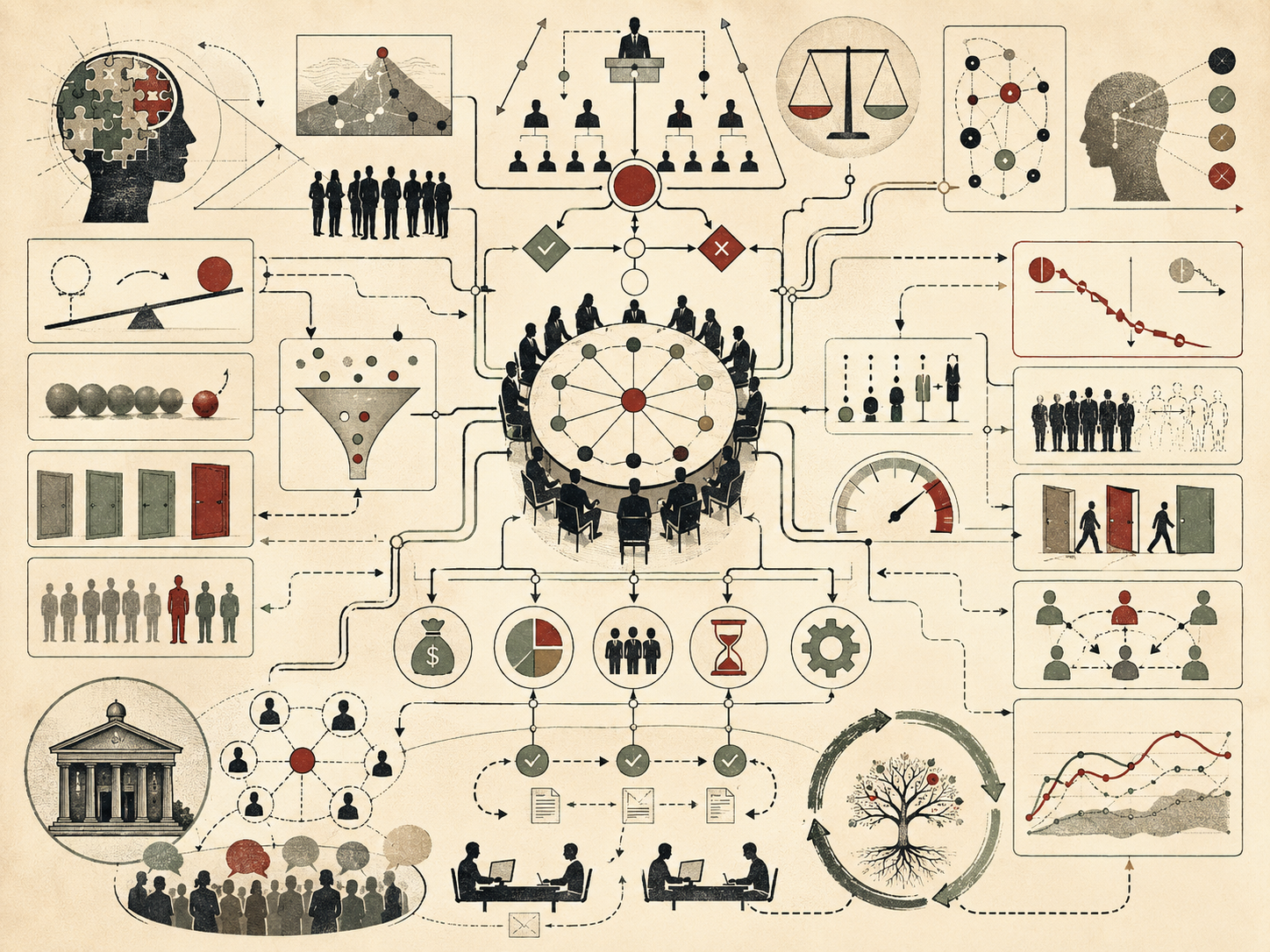
Organizational decision-making is one of the clearest places where behavioral economics becomes a theory of institutions rather than only a theory of individual error. The central issue is not whether individual managers sometimes make mistakes. They do. The deeper issue is that organizations can systematically produce error even when staffed by intelligent, trained, and well-intentioned people. Incentives can narrow attention. Hierarchy can silence dissent. Metrics can reward the appearance of progress. Group loyalty can suppress uncertainty. Prior investment can distort continuation decisions. Culture can define which facts are speakable. Under those conditions, decision failure is not merely personal failure. It is institutional design failure.
This article treats organizations as behavioral systems: structured environments that shape judgment, distribute attention, reward some forms of evidence, penalize others, and translate uncertainty into action. It connects behavioral economics with organizational psychology, institutional economics, public administration, governance, risk management, sustainability, and decision science. The goal is not to portray organizations as irrational in a simplistic sense, but to explain why rationality inside organizations is bounded, social, political, and architecturally shaped.
Organizations as Behavioral Systems
Organizations occupy a central place in modern economic and political life. Corporations organize production, investment, employment, logistics, infrastructure, and technological development. Governments regulate markets, deliver public goods, administer benefits, manage public risk, and coordinate crisis response. Universities, hospitals, nonprofits, foundations, professional associations, and multilateral institutions coordinate complex forms of collective action. Yet these organizations do not decide as unified, omniscient minds. They decide through committees, hierarchies, dashboards, routines, internal bargaining, professional cultures, institutional memory, time-constrained interpretation, and competing incentives.
This is why the behavioral perspective matters. Organizations are not merely containers within which individuals act. They are structured behavioral environments. Incentives determine what becomes visible. Reporting systems determine what counts as evidence. Culture determines which concerns are speakable. Hierarchy determines who can dissent. Metrics determine which goals are rewarded. Review procedures determine whether assumptions are tested or merely performed. Under those conditions, decision quality depends not only on the intelligence of leaders, but on the behavioral architecture of the institution itself.
Behavioral economics is especially useful because it links micro-level judgment to macro-level institutional outcomes. A single biased forecast may be a cognitive issue. But when many forecasts are shaped by career incentives, confirmation pressure, short-term metrics, and executive narratives, the problem becomes organizational. A single ignored warning may reflect individual error. But when a system repeatedly suppresses bad news, discounts dissent, and rewards optimism, the error is structural.
Seen this way, organizational decision-making is inseparable from political economy. Firms do not simply react to markets; they shape them. Public institutions do not simply implement policy; they interpret, sequence, and translate it through administrative behavior. Behavioral economics therefore provides an essential bridge between individual judgment and system-level outcomes. It explains how bounded rationality becomes embedded in routines, how incentives become cognitive filters, and how institutional design can either amplify or discipline human limitation.
The most important implication is that organizations should not be evaluated only by their formal charts, policies, or mission statements. They should also be evaluated by their behavioral operating systems: how information travels, how uncertainty is handled, how dissent is protected, how incentives are aligned, how errors are surfaced, and how decisions are reviewed after consequences become visible.
Bounded Rationality in Organizational Choice
Herbert Simon’s concept of bounded rationality remains foundational for understanding organizations. Decision-makers operate under conditions of limited information, finite cognitive capacity, incomplete foresight, and constrained time. They therefore satisfice rather than optimize, using rules of thumb, aspiration levels, routines, and simplified representations of highly complex problems. This is not merely a weakness. It is a practical necessity. No organization can calculate every possible future, evaluate every alternative, or process every signal in full.
Within organizations, bounded rationality is amplified by scale and complexity. Strategic decisions often involve uncertain market trajectories, regulatory shifts, technological change, competitor behavior, macroeconomic volatility, geopolitical disruption, public legitimacy, supply-chain fragility, and internal execution risk. No executive team possesses a complete model of these interacting variables. Even highly data-rich organizations face interpretation problems: which signals matter, which scenarios are plausible, which anomalies deserve attention, and which risks are being hidden by the categories already in use.
Organizational bounded rationality is different from individual bounded rationality because institutions create their own filters. A person may be cognitively limited, but an organization can also be procedurally limited. It may lack the right data, fail to connect departments, suppress weak signals, reward overly confident forecasts, or define success in ways that exclude long-term harm. The organization does not simply inherit human limitation; it organizes it.
As a result, organizations frequently rely on heuristics that are functional but imperfect. Forecasts become overconfident. Existing strategy becomes a reference point. New information is filtered through prior commitments. Early success produces false generalization. Familiar categories dominate interpretation. Recent crises become overly available. Leadership narratives become anchors. These patterns are not signs of incompetence alone. They are predictable features of decision-making under bounded institutional cognition.
Common distortions in organizational settings include overconfidence in planning, confirmation bias in evidence review, escalation of commitment to failing projects, status quo bias in incumbent processes, availability-driven responses to recent shocks, and anchoring on prior budgets, timelines, or strategic commitments. Behavioral economics helps explain why these distortions persist even in organizations filled with experts. Expertise improves judgment, but it does not eliminate incentives, hierarchy, identity, or institutional blind spots.
A behaviorally literate organization therefore does not assume that expertise alone will protect decision quality. It designs processes that compensate for predictable limits: structured debate, independent review, pre-mortems, scenario comparison, decision logs, red teams, dissent channels, staged funding, and post-decision learning. These mechanisms are not bureaucratic overhead when used well. They are institutional supports for bounded rationality.
Incentives, Metrics, and Behavioral Distortion
Organizations do not merely think badly; they can also be induced to think badly by the way they are measured. Incentive systems are meant to align individual action with institutional goals, but in practice they often narrow attention toward what is legible, immediate, and rewarded. Quarterly targets can suppress long-term investment. Sales quotas can invite manipulation. Risk-transfer incentives can encourage fragility. Administrative metrics can reward procedural completion rather than substantive outcome. Innovation targets can encourage activity that looks experimental without producing learning.
This is one reason behavioral economics should not be reduced to a psychology of bias. Organizational behavior is shaped by incentive architecture as much as by cognition. Agents inside institutions respond not only to money, but to status, promotion, recognition, blame avoidance, peer expectations, professional identity, and the social meaning of performance. The result is often a divergence between formal purpose and operational behavior.
Institutional metrics can also create self-reinforcing distortions. What gets measured gets managed, but what gets managed is often what can be counted rather than what matters. This introduces a form of behavioral narrowing. Leaders may act rationally relative to internal metrics while producing irrational outcomes relative to the organization’s deeper mission or to broader social welfare. The organization becomes optimized around proxies.
Metric distortion is especially dangerous when the proxy becomes a target. A hospital may improve recorded throughput while degrading patient experience. A school may raise test scores while narrowing learning. A platform may increase engagement while worsening user welfare. A company may improve short-term margin while weakening resilience. A public agency may reduce processing time while increasing erroneous denials. These are not merely measurement errors; they are behavioral effects of institutional design.
Incentive systems also change what employees are willing to say. If bad news is punished, bad news travels slowly. If optimistic projections are rewarded, forecasts become inflated. If dissent threatens career advancement, teams learn to self-censor. If aggressive targets are celebrated regardless of collateral damage, the organization creates moral hazard inside its own culture.
This perspective connects closely to fairness and reciprocity in economic behavior, because compliance and effort inside institutions are shaped not only by material reward, but by legitimacy, reciprocity, and perceptions of procedural fairness. People are more likely to sustain effort when they believe rules are fair, leaders are accountable, and burdens are shared. They are more likely to disengage, game metrics, or withhold information when the system feels arbitrary, extractive, or hypocritical.
The policy implication is direct: organizational incentives must be evaluated behaviorally, not only formally. A compensation plan, performance dashboard, audit procedure, or promotion system should be judged by the behavior it predictably produces under pressure. Good governance asks not only what an incentive intends, but what it makes easy, what it makes risky, what it hides, and what it teaches people to ignore.
Group Dynamics and Collective Judgment
Organizational decisions are rarely individual decisions. They emerge through teams, committees, boards, review structures, leadership networks, working groups, advisory panels, and cross-functional processes. This creates opportunities for distributed intelligence, but also introduces additional behavioral risks. Groups can pool knowledge, correct individual error, and broaden perspective. They can also suppress dissent, intensify confidence, diffuse responsibility, and produce consensus without genuine understanding.
Groupthink can suppress disagreement when cohesion is mistaken for wisdom. Information cascades can cause members to follow what they believe others believe. Hierarchical pressure can prevent junior participants from surfacing unwelcome evidence. Diffusion of responsibility can weaken accountability. Reputation concerns can make people defend positions they privately doubt. In some settings, collective decision-making produces more caution than wisdom; in others, it produces unjustified boldness because shared responsibility dilutes perceived personal risk.
Groups also produce framing effects. The first interpretation placed on a problem can anchor discussion. The order in which evidence is presented can shape perceived importance. A senior leader’s casual preference can become an implicit directive. A favored strategic narrative can transform ambiguous data into confirming evidence. Once a group has publicly aligned around a view, changing course can require not only analytical revision but social reversal.
These patterns matter because organizations often face high-stakes environments where flawed collective judgment has large downstream consequences: financial crises, failed mergers, defective products, unsafe infrastructure, public-sector mismanagement, organizational scandals, regulatory failures, and delayed responses to environmental or technological threats. Behavioral economics complements organizational sociology and decision science by clarifying how such failures can arise systematically rather than accidentally.
The solution is not to romanticize dissent or assume that disagreement always improves judgment. Poorly structured conflict can become performative, defensive, or politically motivated. The aim is disciplined disagreement: processes that separate evidence from status, test assumptions before commitments harden, give minority views procedural protection, and require leaders to engage with contrary information before decisions become irreversible.
Useful mechanisms include anonymous pre-meeting input, independent risk review, rotating devil’s advocates, red-team assessments, decision logs, structured pre-mortems, after-action reviews, and explicit criteria for escalation. The common purpose is to reduce the behavioral pressure to conform before the organization has adequately understood the decision.
Decision-Making Under Uncertainty
Organizations operate under uncertainty rather than risk in the narrow sense. Many strategic decisions cannot be assigned stable probabilities. Firms must act despite ambiguous signals about market structure, regulatory direction, geopolitical instability, technological substitution, public legitimacy, capital availability, ecological disruption, and competitor response. Public institutions must act under uncertainty about compliance, public trust, administrative capacity, crisis severity, and long-term consequences. Under such conditions, strategy becomes an exercise in interpretation as much as calculation.
Behavioral research shows that uncertainty often shifts decision-makers toward simplified stories, scenario anchors, and analogies to prior experience. Those tools are unavoidable and sometimes useful. Analogies help organizations learn from history. Scenarios help make uncertainty discussable. Narratives help coordinate action. But they also make institutions vulnerable to analogical overreach, narrative lock-in, and strategic inertia. When leaders become committed to one explanatory frame, contradictory evidence may be downgraded rather than incorporated.
Organizational uncertainty is also political. Different groups inside the same institution may benefit from different interpretations. A product team may frame uncertainty as opportunity. A risk team may frame it as exposure. A finance team may frame it as capital discipline. A sustainability team may frame it as long-term liability. A communications team may frame it as reputational risk. The organization’s final decision may reflect not the best interpretation, but the interpretation most aligned with power, incentives, and institutional habit.
For this reason, high-quality organizational decision-making often depends on mechanisms that improve judgment rather than assuming it. These include structured pre-mortems, independent review functions, scenario comparison, adversarial evaluation, diversified leadership teams, staged commitments, and disciplined post-decision learning. Such mechanisms do not eliminate bias, but they can reduce the chance that an institution mistakes confidence for knowledge.
Uncertainty also requires humility about data. Data-rich organizations can still be poor decision-makers if they treat dashboards as reality rather than representations. Measurement systems may lag emerging risk, exclude qualitative knowledge, undercount marginalized experience, or reward backward-looking optimization. Behavioral economics helps explain why organizations may overtrust quantification when it provides a feeling of control under uncertainty.
A mature organization therefore combines analytics with interpretive discipline. It asks what is measured, what is missing, who benefits from the current interpretation, how the decision could fail, and what signals would justify revision. This is a behavioral practice, not merely a technical one.
Escalation of Commitment and Sunk-Cost Dynamics
Escalation of commitment is one of the most important behavioral dynamics in organizational life. It occurs when decision-makers continue investing in a failing course of action because of prior investment, reputational exposure, identity, internal politics, or the desire to justify earlier choices. Under rational-choice theory, sunk costs should not determine whether a project continues. Under organizational reality, sunk costs often become emotionally, politically, and institutionally powerful.
Escalation is especially likely when responsibility for the original decision remains visible. A leader who approved a project may interpret negative evidence as a threat to judgment or status. A team that built a strategy may become attached to its success. A division whose budget depends on continuation may frame failure as temporary. A board may delay reversal because reversal implies prior oversight failure. In each case, the organization protects the story of the decision rather than updating cleanly.
Escalation can also be embedded in process. Large projects often have staged approvals, but the review gates may be weak, symbolic, or controlled by actors already invested in continuation. Forecasts may be revised to justify additional funding. Risk registers may list concerns without changing decisions. Postponement may be framed as prudence while the organization loses the opportunity to exit. The result is a slow transformation of uncertainty into commitment.
Behavioral economics helps identify why escalation is so persistent. Loss aversion makes abandonment feel like realizing a loss. Status quo bias favors continuation. Confirmation bias filters evidence. Career incentives discourage reversal. Group dynamics protect consensus. Organizational identity makes the project feel like a test of competence. These forces interact, which is why simple reminders that sunk costs are irrelevant rarely work.
Better organizational design requires structural counterweights: independent review teams, exit criteria defined before investment, staged funding with real stop authority, external audits, post-decision learning, and cultures where reversal can be interpreted as disciplined learning rather than failure. The goal is not to punish ambitious projects. It is to prevent prior commitment from becoming a substitute for present evidence.
Risk Governance, Forecasting, and Institutional Blind Spots
Organizations are not only decision-making systems; they are risk-processing systems. They identify, rank, ignore, transfer, insure, communicate, and sometimes manufacture risk. Behavioral economics is essential for understanding this process because risk perception inside organizations is shaped by incentives, salience, familiarity, hierarchy, and institutional memory.
Some risks become highly visible because they are recent, quantifiable, assigned to a powerful office, or tied to regulatory exposure. Other risks remain weakly visible because they are slow-moving, cross-departmental, difficult to measure, politically inconvenient, or borne by people outside the organization. This creates institutional blind spots. A firm may overmanage financial risk while undermanaging ecological risk. A public agency may track compliance metrics while missing public trust erosion. A platform may monitor engagement while ignoring psychological harm or social externalities.
Forecasting is particularly vulnerable to behavioral distortion. Forecasts can anchor budgets, justify projects, shape investor expectations, and define strategic confidence. Yet forecasts often reflect incentives as well as evidence. Teams may understate implementation risk to secure approval. Executives may prefer optimistic scenarios because pessimism threatens momentum. Analysts may adjust assumptions subtly to align with leadership expectations. Once a forecast becomes part of an official plan, it can become politically difficult to revise.
Risk governance therefore needs more than better models. It requires institutional arrangements that protect truth-telling. Strong risk systems create channels for weak signals, protect dissent, separate evaluation from project advocacy, document assumptions, and revisit forecasts after outcomes are known. They also distinguish between measurable risk and systemic uncertainty.
Behavioral economics contributes by explaining why organizations often fail to act on warning signs even when information exists. The problem is frequently not absence of data, but failure of attention, interpretation, status protection, and incentives. A risk signal must pass through an organization’s behavioral filters before it becomes action.
Behavioral Governance and Institutional Design
As behavioral insights have matured, organizations have increasingly applied them to internal governance. Risk committees, audit functions, independent model validation, escalation thresholds, review gates, red-team exercises, decision logs, and after-action reviews can all be understood as attempts to engineer better judgment through institutional design.
This moves the field beyond the narrow idea that behavioral economics is about correcting individual error after the fact. In organizations, the deeper task is to design systems that make error less likely, dissent more possible, incentives less distorting, and learning more durable. Governance becomes a behavioral technology.
Behavioral governance asks several practical questions. Who has authority to challenge a decision? What evidence is required before approval? What assumptions are documented? What happens when forecasts fail? Are people rewarded for surfacing risk early? Are exit criteria defined before sunk costs accumulate? Are review bodies independent enough to resist the project’s internal advocates? Are long-term consequences visible in short-term decision processes?
These questions matter because organizations often formalize governance without changing behavior. A committee may exist but lack power. A risk review may occur but arrive too late. A dashboard may report metrics that are easy to game. A code of conduct may state values that incentive systems contradict. Behavioral governance is concerned with actual decision effects, not symbolic compliance.
This perspective aligns directly with Behavioral Regulation and Institutional Design, where the central question is how rules, oversight structures, and review procedures can produce better decisions under real human constraints. It also ties organizational behavior to governance more broadly: institutions govern others only as well as they govern themselves.
Good behavioral governance is not anti-managerial. It does not assume leaders are untrustworthy. It assumes that all decision-makers are bounded, socially embedded, and incentive-sensitive. Its purpose is to support better judgment by designing institutional conditions under which evidence, dissent, long-term consequences, and ethical constraints can survive organizational pressure.
Organizational Culture and Behavioral Norms
Culture matters because incentives never operate alone. They are interpreted through norms. Two organizations with similar formal structures may behave very differently depending on whether internal culture rewards candor or conformity, inquiry or deference, responsibility or blame avoidance, experimentation or image protection.
Culture shapes what kinds of uncertainty can be acknowledged, how bad news travels upward, whether mistakes are hidden or surfaced, and whether ethical concerns are treated as serious constraints or public-relations problems. In this sense, organizational culture is not soft background context. It is part of the decision architecture itself.
Behavioral economics helps here by clarifying how social norms affect action inside institutions. Individuals take cues from peers, leaders, and tacit expectations. When a culture normalizes aggressive targets, silence under pressure, or the dismissal of weak signals, behavior shifts accordingly. Conversely, organizations that institutionalize constructive disagreement, reflective review, and procedural fairness are more likely to identify error before it scales into failure.
Norms can also determine whether formal governance is meaningful. An organization may have an ethics hotline, but if employees believe retaliation is likely, the hotline is not behaviorally accessible. A firm may have sustainability goals, but if promotion depends on short-term margin, long-term environmental commitments remain fragile. A public agency may state a commitment to equity, but if frontline staff are overloaded and procedures remain opaque, the declared norm does not become operational behavior.
Culture therefore must be understood as a system of behavioral expectations. It tells people what is rewarded, what is risky, what is admirable, what is naive, what is speakable, and what is ignored. Behavioral economics gives culture analytical clarity by connecting norms to incentives, attention, risk perception, and social approval.
A serious organizational culture is not created by slogans. It is created by repeated decisions: who gets promoted, who is protected when they tell the truth, which metrics matter, how leaders respond to failure, whether dissent is welcomed before crisis, and whether values remain binding when they become inconvenient.
Digital Platforms, Dashboards, and Algorithmic Management
Organizational decision-making is increasingly mediated by digital systems. Dashboards, productivity platforms, ranking tools, performance analytics, enterprise software, algorithmic scheduling, predictive models, and automated decision-support systems now shape what managers see, how workers are evaluated, and which risks become visible. These systems can improve decision quality, but they can also intensify behavioral distortion.
Dashboards focus attention. What appears on the dashboard becomes salient; what is absent becomes easier to ignore. Metrics displayed in real time can accelerate response, but they can also create short-termism, anxiety, gaming, and false precision. A platform that tracks productivity may increase output while degrading autonomy, trust, learning, or safety. A predictive model may help allocate resources while embedding historical bias or concealing uncertainty behind a score.
Algorithmic management adds another layer. When workers are assigned tasks, evaluated, ranked, or disciplined through opaque systems, the organization’s behavioral environment changes. Employees may adapt to the metric rather than the mission. Managers may defer to model outputs because algorithmic authority appears objective. Accountability may diffuse when harmful decisions are attributed to systems rather than people.
Behavioral economics is essential here because digital systems are choice architectures. They set defaults, structure attention, rank information, create feedback loops, and define friction. Inside organizations, this means software is not only a tool. It is governance infrastructure.
The future of organizational decision-making will therefore require behavioral audits of digital tools. Organizations should ask how dashboards shape attention, how models express uncertainty, how ranking systems affect cooperation, how metrics can be gamed, how automated prompts influence judgment, and whether digital systems support or undermine institutional learning. Technical validation is necessary, but not sufficient. The behavioral effects of the system must also be evaluated.
Organizational Decision-Making and Sustainability
Behavioral organizational analysis is especially important in sustainability contexts. Firms, regulators, utilities, financial institutions, universities, infrastructure operators, and public agencies must make decisions about energy transition, supply-chain resilience, environmental risk, capital allocation, climate adaptation, procurement, reporting, and long-term regulatory change. Yet many of these decisions impose short-run cost in exchange for uncertain, delayed, or socially distributed benefit.
This creates predictable behavioral friction. Present bias can favor near-term performance over long-horizon resilience. Status quo bias can slow transition away from incumbent technologies. Incentive design can reward visible quarterly performance over less visible ecological risk mitigation. Group dynamics can encourage institutions to underreact to systemic environmental threats until disruption becomes acute. Forecasting systems can discount low-probability, high-impact events because they are difficult to model or politically inconvenient.
Organizations are also central to the gap between sustainability commitments and sustainability behavior. Many institutions publicly endorse environmental goals while maintaining procurement systems, investment criteria, travel policies, product strategies, and reporting structures that continue business as usual. Behavioral economics helps explain why this happens. Commitments are easy when abstract; implementation becomes difficult when costs, trade-offs, and internal resistance become concrete.
These problems connect directly to Behavioral Economics and Sustainable Consumption and Behavioral Insights in Environmental Policy. Sustainable transition is not only a matter of households changing behavior. It is also a matter of organizations redesigning how they evaluate time, risk, responsibility, investment, and accountability under ecological constraint.
For sustainability governance, behavioral organizational design should include long-horizon metrics, climate-risk review, scenario planning, procurement reform, carbon-aware capital allocation, dissent-protecting risk processes, and incentives that do not punish managers for making prudent long-term investments. Without these structures, sustainability can remain a branding layer rather than a decision architecture.
An Analytical Framework for Organizational Decision-Making
A simple behavioral model of organizational choice begins by treating a strategic decision as a comparison among alternatives whose perceived value depends on more than expected financial return. Let the organization evaluate project \(j\) according to:
V_j = \pi_j – \rho_j + \sigma_j – \kappa_j + \eta_j
\]
Interpretation: The perceived value of a project depends not only on expected payoff and risk, but also on status rewards, complexity costs, and fit with organizational norms or strategic narratives.
Here, \(\pi_j\) is expected payoff, \(\rho_j\) is perceived risk, \(\sigma_j\) is status or career benefit to decision-makers, \(\kappa_j\) is cognitive or administrative complexity, and \(\eta_j\) is alignment with prevailing organizational norms or strategic narratives.
In a purely instrumental model, only \(\pi_j\) and \(\rho_j\) would dominate. But organizational behavior often depends heavily on \(\sigma_j\), \(\kappa_j\), and \(\eta_j\). A risky but prestigious initiative may be overselected. A high-value but complex option may be avoided. A project aligned with leadership narrative may survive contrary evidence longer than it should. A project that protects an incumbent division may be favored over one that better serves the organization’s long-term mission.
Escalation of commitment can be represented by allowing prior investment \(I_{t-1}\) to distort continuation value:
V^{cont}_t = E_t[\pi_t] – \rho_t + \lambda I_{t-1}
\]
Interpretation: Prior investment should not determine continuation under rational choice, but organizational behavior often gives sunk costs behavioral weight through reputation, justification, and loss aversion.
Here, \(\lambda > 0\) captures the behavioral weight placed on sunk costs, reputational defense, internal justification, or identity attachment. Under rational choice, sunk costs should not affect continuation. Under organizational behavioral dynamics, they often do.
Aspiration-based search, central to behavioral theories of the firm, can be modeled by comparing observed performance \(P_t\) to an aspiration level \(A_t\). Search intensity \(S_t\) rises when performance falls below aspiration:
S_t = \max(0, A_t – P_t)
\]
Interpretation: Organizations search more actively when performance falls below aspiration, but may become inertial when performance remains acceptable even if better alternatives exist.
This captures a common organizational pattern: firms search more actively for alternatives when results disappoint, but may become inertial when performance remains merely acceptable. Satisficing can prevent unnecessary churn, but it can also preserve underperformance when aspiration levels are too low or internally convenient.
Group conformity can be represented by allowing each decision-maker’s expressed preference \(x_i\) to shift toward perceived group consensus \(\bar{x}\):
x_i’ = (1-\theta)x_i + \theta \bar{x}
\]
Interpretation: As conformity pressure rises, expressed preferences move toward perceived consensus, reducing the independence of organizational judgment.
Here, \(0 \leq \theta \leq 1\) measures conformity pressure. As \(\theta\) rises, formal discussion may preserve the appearance of plurality while materially compressing genuine independence of judgment.
Finally, a review structure can be modeled as a corrective factor \(R\) that reduces the behavioral influence of sunk costs, overconfidence, and prestige incentives:
V^{review}_j = \pi_j – \rho_j + (1-R)\sigma_j – \kappa_j + \eta_j + (1-R)\lambda I_{t-1}
\]
Interpretation: Strong independent review can reduce the decision weight of prestige, sunk costs, and internal justification, making continuation decisions more evidence-sensitive.
These stylized models help clarify that organizational behavior is not simply irrational. It is structured by aspiration levels, prestige incentives, sunk-cost effects, complexity avoidance, conformity dynamics, and review strength. Behavioral economics gives these forces analytical visibility so that organizations can design better decision systems rather than merely exhort people to be less biased.
R Workflow: Simulating Escalation, Incentives, and Review Structures
The following R workflow simulates project continuation inside an organization where managers differ in overconfidence, sunk-cost sensitivity, incentive exposure, project complexity, and responsiveness to independent review. It is designed as a practical starting point for governance analysis rather than as a toy example. The data are synthetic and intended for methods demonstration, not for operational scoring or evaluation of real employees.
# Behavioral Economics in Organizational Decision-Making
# R workflow: escalation, incentives, and review structures
# Synthetic data only. This is a research-scaffolding example.

set.seed(101)

n_projects <- 4000

projects <- data.frame(
  project_id = seq_len(n_projects),

  # Expected financial upside and perceived risk.
  expected_payoff = rnorm(n_projects, mean = 0.12, sd = 0.10),
  risk = pmin(pmax(rnorm(n_projects, mean = 0.25, sd = 0.10), 0), 1),

  # Behavioral and organizational decision variables.
  sunk_cost = rgamma(n_projects, shape = 3, scale = 0.12),
  prestige_value = pmin(pmax(rnorm(n_projects, mean = 0.18, sd = 0.08), 0), 1),
  complexity = pmin(pmax(rnorm(n_projects, mean = 0.35, sd = 0.12), 0), 1),
  overconfidence = pmin(pmax(rnorm(n_projects, mean = 0.20, sd = 0.10), 0), 0.6),

  # Review structures vary in strength.
  review_strength = sample(c(0.1, 0.4, 0.8), n_projects, replace = TRUE),

  # Sustainability relevance or long-horizon strategic value.
  long_horizon_value = pmin(pmax(rnorm(n_projects, mean = 0.20, sd = 0.12), 0), 1)
)

# Continuation score.
# Strong review reduces the influence of sunk costs and overconfidence.
continuation_score <- with(
  projects,
  expected_payoff +
    prestige_value -
    risk -
    complexity +
    0.9 * sunk_cost +
    0.7 * overconfidence -
    0.8 * review_strength * sunk_cost -
    0.5 * review_strength * overconfidence +
    0.3 * long_horizon_value
)

projects$continue_prob <- plogis(continuation_score)
projects$continue_decision <- rbinom(n_projects, 1, projects$continue_prob)

review_summary <- aggregate(
  cbind(continue_prob, continue_decision) ~ review_strength,
  data = projects,
  FUN = mean
)

print(review_summary)

projects$likely_escalation <- with(
  projects,
  sunk_cost > 0.35 & overconfidence > 0.25
)

subset_summary <- aggregate(
  cbind(continue_prob, continue_decision) ~ review_strength + likely_escalation,
  data = projects,
  FUN = mean
)

print(subset_summary)

# Estimate a simple logistic model if stats is available.
model <- glm(
  continue_decision ~ expected_payoff + risk + sunk_cost +
    prestige_value + complexity + overconfidence +
    review_strength + long_horizon_value,
  data = projects,
  family = binomial(link = "logit")
)

print(summary(model))

# Save outputs for reproducibility.
dir.create("outputs/tables", recursive = TRUE, showWarnings = FALSE)
write.csv(projects, "outputs/tables/synthetic_project_portfolio.csv", row.names = FALSE)
write.csv(review_summary, "outputs/tables/review_strength_summary.csv", row.names = FALSE)
write.csv(subset_summary, "outputs/tables/escalation_review_summary.csv", row.names = FALSE)

# Analysts can extend this model by adding:
# - group conformity effects
# - aspiration levels and performance feedback
# - multi-stage funding gates
# - heterogeneous incentive systems across business units
# - risk committee independence
# - sustainability investment review structures
This structure is useful because it makes explicit how independent review can weaken escalation dynamics by counteracting sunk-cost attachment and managerial overconfidence rather than relying on exhortation alone. It also makes the relationship between governance structure and decision behavior testable. Instead of saying “avoid escalation,” the model asks which review conditions reduce escalation-prone continuation decisions.
Python Workflow: Comparing Organizational Regimes Under Behavioral Assumptions
The Python workflow below compares three organizational regimes: metric-heavy short-termism, balanced governance, and high-accountability adaptive review. It simulates project approval decisions and expected organizational welfare under differing behavioral conditions. The example is synthetic, but it gives analysts a reproducible scaffold for comparing governance logics rather than merely describing organizational bias in general terms.
# Behavioral Economics in Organizational Decision-Making
# Python workflow: comparing organizational regimes under behavioral assumptions
# Synthetic data only. This is a research-scaffolding example.

from __future__ import annotations

import numpy as np
import pandas as pd

rng = np.random.default_rng(101)

n = 6000

projects = pd.DataFrame({
    "project_id": np.arange(1, n + 1),
    "expected_payoff": rng.normal(0.12, 0.10, n),
    "risk": np.clip(rng.normal(0.25, 0.10, n), 0, 1),
    "sunk_cost": rng.gamma(shape=3.0, scale=0.12, size=n),
    "prestige_value": np.clip(rng.normal(0.18, 0.08, n), 0, 1),
    "complexity": np.clip(rng.normal(0.35, 0.12, n), 0, 1),
    "overconfidence": np.clip(rng.normal(0.20, 0.10, n), 0, 0.6),
    "long_horizon_value": np.clip(rng.normal(0.20, 0.12, n), 0, 1)
})

def evaluate_regime(
    df: pd.DataFrame,
    short_term_pressure: float,
    review_strength: float,
    conformity_pressure: float,
    long_horizon_weight: float
) -> dict[str, float]:
    """
    Evaluate a synthetic organizational governance regime.

    short_term_pressure:
        Higher values make prestige and short-run visible gains more influential.

    review_strength:
        Higher values reduce the influence of sunk costs and overconfidence.

    conformity_pressure:
        Higher values compress independent judgment toward group consensus.

    long_horizon_weight:
        Higher values make long-term strategic or sustainability value more visible.
    """
    perceived_value = (
        df["expected_payoff"].values
        + df["prestige_value"].values * short_term_pressure
        - df["risk"].values
        - df["complexity"].values
        + 0.9 * df["sunk_cost"].values
        + 0.7 * df["overconfidence"].values
        - 0.8 * review_strength * df["sunk_cost"].values
        - 0.5 * review_strength * df["overconfidence"].values
        + long_horizon_weight * df["long_horizon_value"].values
    )

    consensus = perceived_value.mean()
    adjusted_value = (
        (1 - conformity_pressure) * perceived_value
        + conformity_pressure * consensus
    )

    approve_prob = 1 / (1 + np.exp(-adjusted_value))
    approve = rng.binomial(1, approve_prob)

    realized_welfare = (
        approve * (
            df["expected_payoff"].values
            - df["risk"].values
            - 0.5 * df["complexity"].values
            + 0.6 * df["long_horizon_value"].values
        )
        - approve * 0.4 * df["sunk_cost"].values
    )

    escalation_risk = (
        (df["sunk_cost"].values > 0.35)
        & (df["overconfidence"].values > 0.25)
        & (approve == 1)
    )

    return {
        "approval_rate": float(approve.mean()),
        "mean_approval_prob": float(approve_prob.mean()),
        "mean_welfare": float(realized_welfare.mean()),
        "escalation_prone_approval_rate": float(escalation_risk.mean())
    }

regimes = {
    "metric_heavy_short_termism": {
        "short_term_pressure": 1.3,
        "review_strength": 0.15,
        "conformity_pressure": 0.65,
        "long_horizon_weight": 0.10
    },
    "balanced_governance": {
        "short_term_pressure": 0.9,
        "review_strength": 0.55,
        "conformity_pressure": 0.35,
        "long_horizon_weight": 0.35
    },
    "high_accountability_adaptive_review": {
        "short_term_pressure": 0.7,
        "review_strength": 0.85,
        "conformity_pressure": 0.20,
        "long_horizon_weight": 0.60
    }
}

rows = []

for name, params in regimes.items():
    result = evaluate_regime(projects, **params)
    result["regime"] = name
    rows.append(result)

results = pd.DataFrame(rows)[[
    "regime",
    "approval_rate",
    "mean_approval_prob",
    "mean_welfare",
    "escalation_prone_approval_rate"
]]

print(results.sort_values("mean_welfare", ascending=False))

projects["risk_quintile"] = pd.qcut(
    projects["risk"],
    5,
    labels=["Q1", "Q2", "Q3", "Q4", "Q5"]
)

distribution_rows = []

for name, params in regimes.items():
    for quintile in projects["risk_quintile"].unique():
        subset = projects.loc[projects["risk_quintile"] == quintile].copy()
        result = evaluate_regime(subset, **params)
        result["regime"] = name
        result["risk_quintile"] = str(quintile)
        distribution_rows.append(result)

distribution = pd.DataFrame(distribution_rows)

print(distribution.sort_values(["regime", "risk_quintile"]))

# Save reproducible outputs.
from pathlib import Path

output_dir = Path("outputs/tables")
output_dir.mkdir(parents=True, exist_ok=True)

projects.to_csv(output_dir / "synthetic_organizational_projects.csv", index=False)
results.to_csv(output_dir / "organizational_regime_summary.csv", index=False)
distribution.to_csv(output_dir / "organizational_regime_risk_distribution.csv", index=False)

# This framework can be extended to model:
# - board review processes
# - regulatory approval systems
# - capital allocation committees
# - innovation pipelines
# - sustainability investment review structures
# - public-sector administrative decisions
# - algorithmic-management regimes
For organizational analysts, the value of this type of model is that it allows governance structures to be compared explicitly. The question becomes not only whether a team makes mistakes, but which organizational regime predictably generates those mistakes and which institutional reforms reduce them. A metric-heavy regime may look efficient while preserving escalation and short-termism. A high-accountability adaptive regime may approve fewer projects, but produce higher welfare by reducing sunk-cost continuation and making long-horizon value more visible.
GitHub Repository
The companion repository provides reproducible scaffolding for the computational side of this article, including synthetic project portfolios, organizational-regime simulations, escalation-of-commitment models, review-structure comparisons, decision-governance documentation, SQL schemas, and multi-language scientific-computing examples for organizational behavioral analysis.
Interpretive Limits and Ethical Cautions
Behavioral economics is powerful in organizational analysis because it reveals recurring patterns of judgment, incentive distortion, and institutional failure. Yet it should not be used as a simplistic vocabulary for blaming individuals. Calling a decision biased does not by itself explain the institutional conditions that produced it. Nor does it prove that an outside observer would have made a better choice under the same constraints.
Organizational decisions are made under pressure. Leaders face incomplete information, conflicting goals, stakeholder demands, legal obligations, market uncertainty, budget constraints, and limited time. Behavioral economics should therefore be used with humility. Its purpose is not to mock decision-makers for imperfection, but to design institutions that better account for predictable human and organizational limits.
There is also an ethical risk in using behavioral analysis for manipulation. Organizations can use behavioral insights to improve learning, protect dissent, reduce escalation, and align incentives with mission. They can also use them to pressure employees, optimize compliance, exploit status anxiety, intensify surveillance, or make harmful practices more efficient. A behaviorally sophisticated organization is not automatically a humane or responsible one.
For this reason, behavioral governance should be tied to accountability, transparency, procedural fairness, and worker voice. Decision systems should not merely improve managerial control. They should improve institutional judgment, reduce avoidable harm, protect the integrity of evidence, and support morally serious organizational responsibility.
Finally, organizational behavior must be analyzed in relation to power. Not everyone inside an organization experiences the same incentives, risks, or freedom to dissent. A senior executive and a frontline employee may both be “inside” the same institution, but their ability to challenge decisions differs dramatically. A serious behavioral economics of organizations must therefore examine hierarchy, voice, retaliation risk, and unequal exposure to consequences.
Conclusion
Behavioral economics in organizational decision-making reveals that firms and institutions do not fail only because they lack information or face external shocks. They also fail because judgment is bounded, incentives distort attention, groups suppress dissent, metrics narrow imagination, and institutional routines protect established commitments long after evidence has shifted. These are not anomalies. They are recurring features of organizational life.
The significance of the field lies in showing that better outcomes require more than better leaders. They require better institutional design: review structures that challenge escalation, cultures that permit dissent, metrics that do not cannibalize mission, and governance systems that recognize how real people decide under pressure. In that sense, organizational decision-making is one of the clearest places where behavioral economics becomes a theory of institutions rather than simply a theory of individual error.
A mature behavioral economics of organizations should therefore ask how institutions can become more reflective, less defensive, more evidence-sensitive, and more capable of learning from failure. It should ask how incentives can be designed without narrowing moral responsibility, how dashboards can inform without distorting, how hierarchy can coordinate without silencing, and how long-term risks can be made visible before crisis forces recognition.
The central lesson is not that organizations are irrational. It is that organizational rationality must be built. It depends on structures that protect truth-telling, reward learning, discipline overconfidence, reduce sunk-cost escalation, and keep institutional purpose from being consumed by short-term metrics. Behavioral economics gives organizations a language for understanding these failures. Good governance turns that language into design.
Related Articles
- Behavioral Economics
- Behavioral Regulation and Institutional Design
- Fairness and Reciprocity in Economic Behavior
- Behavioral Economics and Sustainable Consumption
- Behavioral Insights in Environmental Policy
- Choice Architecture and Decision Environments
- The Future of Behavioral Economics in Governance and Policy
- Organizational Psychology
- Institutions & Governance
- Decision Science
Further Reading
- Argyris, C. and Schön, D.A. (1978) Organizational Learning: A Theory of Action Perspective. Reading, MA: Addison-Wesley.
- Cyert, R.M. and March, J.G. (1992) A Behavioral Theory of the Firm. 2nd edn. Cambridge, MA: Blackwell. Available at: https://www.wiley.com/en-au/Behavioral%2BTheory%2Bof%2BFirm%2C%2B2nd%2BEdition-p-9780631174516.
- Janis, I.L. (1982) Groupthink: Psychological Studies of Policy Decisions and Fiascoes. 2nd edn. Boston: Houghton Mifflin.
- Kahneman, D. (2011) Thinking, Fast and Slow. New York: Farrar, Straus and Giroux. Available at: https://us.macmillan.com/books/9780374533557/thinkingfastandslow.
- March, J.G. (1994) A Primer on Decision Making: How Decisions Happen. New York: Free Press.
- Simon, H.A. (1997) Administrative Behavior. 4th edn. New York: Free Press. Available at: https://www.simonandschuster.com/books/Administrative-Behavior-4th-Edition/Herbert-A-Simon/9780684835822.
- Staw, B.M. (1976) ‘Knee-deep in the big muddy: A study of escalating commitment to a chosen course of action’, Organizational Behavior and Human Performance, 16(1), pp. 27–44.
- Thaler, R.H. (2015) Misbehaving: The Making of Behavioral Economics. New York: W.W. Norton. Available at: https://wwnorton.com/books/9780393354775.
- Wheeler, G. (2018) ‘Bounded Rationality’, Stanford Encyclopedia of Philosophy. Available at: https://plato.stanford.edu/entries/bounded-rationality/.
References
- Argyris, C. and Schön, D.A. (1978) Organizational Learning: A Theory of Action Perspective. Reading, MA: Addison-Wesley.
- Cyert, R.M. and March, J.G. (1992) A Behavioral Theory of the Firm. 2nd edn. Cambridge, MA: Blackwell. Available at: https://www.wiley.com/en-au/Behavioral%2BTheory%2Bof%2BFirm%2C%2B2nd%2BEdition-p-9780631174516.
- Janis, I.L. (1982) Groupthink: Psychological Studies of Policy Decisions and Fiascoes. 2nd edn. Boston: Houghton Mifflin.
- Kahneman, D. (2011) Thinking, Fast and Slow. New York: Farrar, Straus and Giroux. Available at: https://us.macmillan.com/books/9780374533557/thinkingfastandslow.
- March, J.G. (1994) A Primer on Decision Making: How Decisions Happen. New York: Free Press.
- March, J.G. and Simon, H.A. (1958) Organizations. New York: Wiley.
- Samuelson, W. and Zeckhauser, R. (1988) ‘Status quo bias in decision making’, Journal of Risk and Uncertainty, 1(1), pp. 7–59. Available at: https://link.springer.com/article/10.1007/BF00055564.
- Simon, H.A. (1955) ‘A behavioral model of rational choice’, Quarterly Journal of Economics, 69(1), pp. 99–118. Available at: https://www.jstor.org/stable/1884852.
- Simon, H.A. (1997) Administrative Behavior. 4th edn. New York: Free Press. Available at: https://www.simonandschuster.com/books/Administrative-Behavior-4th-Edition/Herbert-A-Simon/9780684835822.
- Staw, B.M. (1976) ‘Knee-deep in the big muddy: A study of escalating commitment to a chosen course of action’, Organizational Behavior and Human Performance, 16(1), pp. 27–44.
- Thaler, R.H. (2015) Misbehaving: The Making of Behavioral Economics. New York: W.W. Norton. Available at: https://wwnorton.com/books/9780393354775.
- Wheeler, G. (2018) ‘Bounded Rationality’, Stanford Encyclopedia of Philosophy. Available at: https://plato.stanford.edu/entries/bounded-rationality/.