
Last Updated May 25, 2026
Behavioral regulation examines how regulatory systems, legal frameworks, and institutional procedures can be designed around realistic models of human decision-making rather than idealized assumptions of frictionless rational response. Regulation does not operate on abstract agents who perfectly process information, calculate incentives, and comply whenever the expected penalty exceeds the expected gain. It operates on people, firms, public agencies, platforms, and institutions navigating complexity, limited attention, procedural burdens, time pressure, social influence, administrative friction, organizational incentives, uncertainty, and uneven trust in public authority.
Behavioral economics matters for regulation because many regulatory failures are not failures of formal rulemaking alone. They are failures of implementation under real cognitive, institutional, and organizational conditions. A rule may be legally valid but behaviorally inaccessible. A disclosure may satisfy a statutory requirement while failing to inform anyone meaningfully. A benefit may exist while eligible people fail to claim it. A compliance pathway may be rational on paper but too difficult, confusing, costly, or mistrusted in practice. Behavioral regulation begins from this gap between formal policy design and real-world response.
Main Library
Publications
Article Map
Behavioral Economics
Related Topic
Institutions & Governance
Related Topic
Decision Science
Related Topic
Data Systems & Analytics
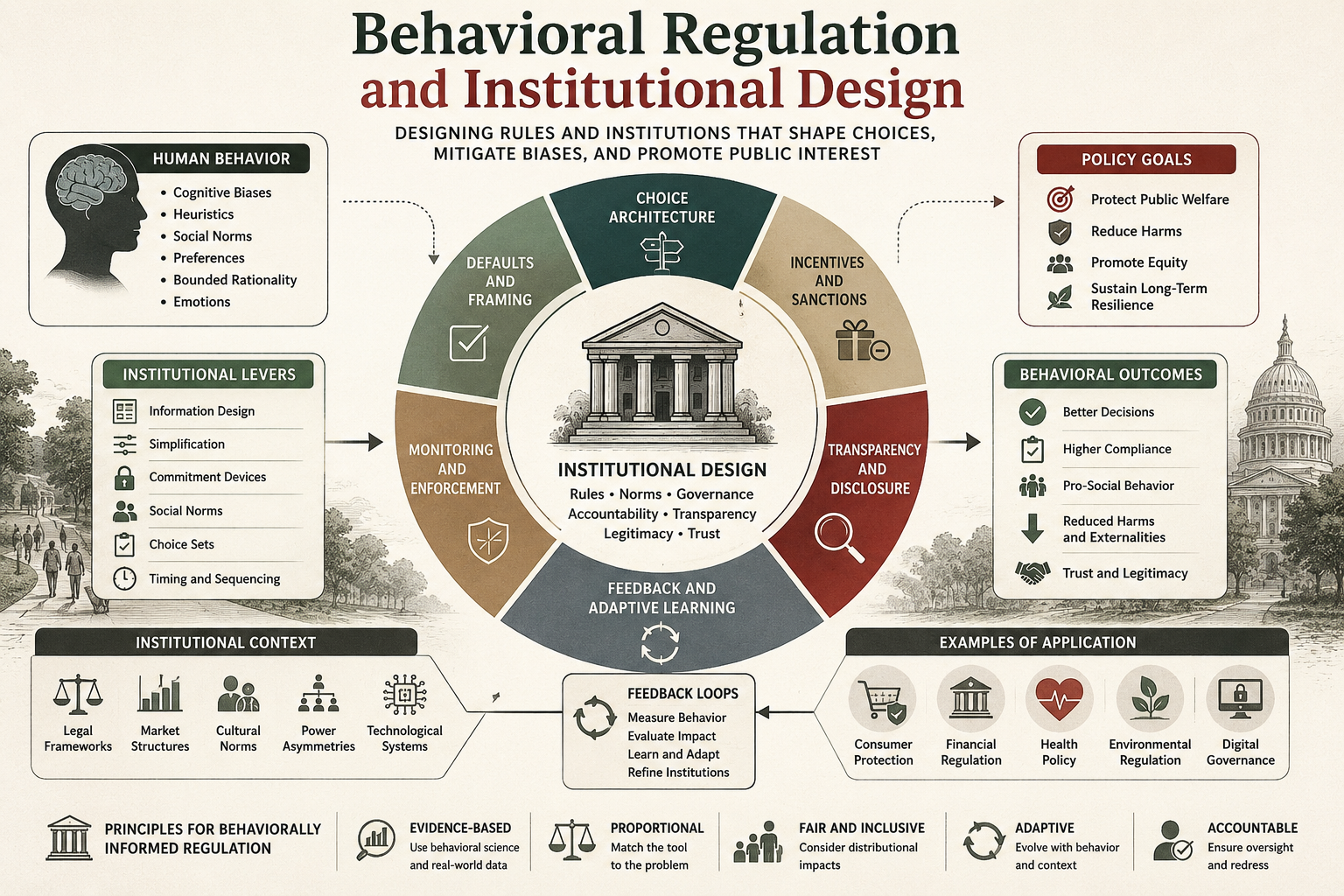
Traditional regulatory analysis often emphasizes mandates, prohibitions, taxes, subsidies, monitoring, liability, licensing, inspections, and enforcement. These tools remain indispensable. But a growing body of behavioral public policy, administrative science, institutional economics, and applied behavioral research has shown that policy outcomes also depend on whether rules are legible, disclosures are understandable, forms are navigable, deadlines are salient, defaults are well designed, burdens are proportionate, and institutions are trusted.
Behavioral regulation therefore expands the meaning of regulation itself. It treats governance not only as the creation of rules, but as the design of decision environments, administrative procedures, compliance pathways, information systems, feedback structures, and institutional relationships. Properly understood, it is not a soft alternative to regulation. It is a more realistic account of how regulation actually works when human beings and organizations must interpret, use, comply with, contest, and administer rules under imperfect conditions.
The field is especially important in modern regulatory domains where the object being regulated is itself a behavioral architecture: digital platforms, algorithmic interfaces, privacy systems, financial products, consumer disclosures, public-benefit portals, tax administration, environmental compliance systems, labor platforms, automated decision systems, and health or safety regimes. In these settings, regulatory design must address not only outcomes, but the behavioral mechanisms that produce those outcomes.
The Limits of Traditional Regulation
Classical regulatory models typically rely on a familiar set of instruments: legal mandates, prohibitions, taxes, subsidies, monitoring, sanctions, liability rules, and licensing systems. These mechanisms remain central to effective governance. Without enforceable rules, credible sanctions, and institutional authority, many domains of public welfare would be exposed to fraud, pollution, unsafe products, financial abuse, discrimination, labor exploitation, market manipulation, privacy invasion, and systemic risk.
Yet traditional regulatory models often presume that regulated actors will understand the rule, correctly interpret its consequences, and respond in a relatively stable way to incentives and enforcement. This assumption is frequently too thin. People and organizations operate under limited information, bounded attention, institutional pressure, time constraints, procedural overload, social norms, status incentives, and uncertainty about what rules require in practice.
Compliance failures therefore do not always arise from deliberate evasion. A person may miss a deadline because a notice was unclear. A small business may violate a rule because guidance was fragmented across agencies. A consumer may accept a privacy setting because refusal is buried under confusing interface steps. A firm may underinvest in compliance because internal metrics reward short-term throughput more than legal risk reduction. A public agency may fail to reach eligible beneficiaries because the enrollment system assumes time, literacy, documentation, and trust that many people do not possess.
This is one reason behaviorally naive regulation can underperform even when rules are technically sound. A disclosure that no one can understand, a form that is too complex to complete, a compliance process that imposes excessive hassle, or a legal notice delivered at the wrong moment may weaken the real-world effectiveness of the underlying rule. The problem is not always a lack of law. It is often a mismatch between legal design and human behavior.
Behavioral economics therefore helps regulatory analysis move beyond a narrow deterrence model. It does not deny that actors respond to penalties. It shows that penalties operate inside a broader decision environment shaped by trust, salience, norms, burden, loss framing, default structure, institutional experience, and perceived legitimacy. A sanction that is theoretically strong may be behaviorally irrelevant if the rule is unnoticed, misunderstood, or inaccessible. Conversely, a modest intervention that simplifies action, increases trust, or makes compliant behavior easier may produce large gains where formal deterrence alone has failed.
The limit of traditional regulation is not that it is too strong. In many domains, regulation is too weak, too fragmented, or too easily captured. The limit is that formal authority does not automatically become practical compliance. Behavioral regulation focuses on the institutional pathway from rule to action.
Behaviorally Informed Regulation
Behaviorally informed regulation seeks to address the gap between formal rule design and real-world response. Instead of relying only on deterrence, disclosure, or price-based incentives, it asks how regulatory environments can be designed so that compliance becomes easier, clearer, more salient, more trusted, and more socially reinforced. This can include simplified communication, better sequencing of decisions, improved default structures, timely reminders, pre-filled forms, plain-language guidance, reduced administrative burden, social-norm feedback, and more usable appeal or correction mechanisms.
These strategies overlap with Choice Architecture and Decision Environments and Nudge Theory and Behavioral Public Policy, but behavioral regulation should not be collapsed into nudging alone. Its scope is broader. It includes the design of institutions, procedures, forms, oversight systems, administrative capacity, enforcement discretion, compliance support, appeals processes, digital portals, audits, and feedback loops. A rule may be substantively justified yet behaviorally ineffective if the path to compliance is badly designed.
Behaviorally informed regulation can operate in several ways. It can reduce learning costs by making rules easier to understand. It can reduce compliance costs by simplifying steps required to act. It can reduce psychological costs by making institutions less intimidating, opaque, or stigmatizing. It can increase salience by delivering information when action is possible. It can strengthen legitimacy by making procedures fairer and more transparent. It can improve enforcement by distinguishing intentional evasion from confusion, burden, or system failure.
In public administration, these distinctions matter. A tax authority may improve compliance not only through audits, but through clearer letters, pre-populated returns, reminders, and easier payment systems. A benefits agency may increase lawful enrollment by reducing documentation burdens and simplifying renewal. A consumer protection regulator may improve market outcomes by requiring disclosures that are actually comprehensible. An environmental regulator may improve compliance by making permit obligations clearer and by providing technical support for small firms. A privacy regulator may protect users by constraining manipulative interface design rather than relying only on formal consent.
Behavioral regulation does not replace traditional policy instruments. It complements them by addressing the cognitive, procedural, informational, and institutional frictions that often determine whether a policy works in practice. Strong regulation still requires authority, accountability, monitoring, enforcement, and public legitimacy. Behavioral design helps ensure that regulatory authority is usable, intelligible, and responsive to the conditions under which people and organizations actually act.
A behaviorally informed regulator therefore asks different questions. What does the regulated actor see first? What information is salient? Which action is the default? What steps are required? Where do people drop out? Which groups face the highest burden? Does the process communicate respect or suspicion? Does the rule feel legitimate? Are errors easy to correct? Is compliance easier than noncompliance? Are enforcement actions aimed at strategic evasion, or are they punishing people for administrative failure?
These questions turn regulation into a design discipline as well as a legal and economic discipline. They do not make regulation less serious. They make it more operationally realistic.
Institutional Design and Governance
Institutional design plays a critical role in shaping economic behavior because institutions do more than set rules. They structure what counts as relevant information, how choices are sequenced, which actions are easy, which require repeated effort, which forms of evidence are recognized, and what kinds of behavior are interpreted as normal, suspicious, expected, or legitimate. Behavioral economics highlights that institutions are themselves decision environments.
This makes institutional design central to domains such as financial-market oversight, consumer protection, environmental regulation, public-health administration, tax compliance, privacy governance, labor regulation, public benefits, licensing, and professional standards. The regulatory question is not only what rule should exist, but how the rule will be encountered by the people subject to it. If governance systems ignore complexity, attention limits, trust, or social dynamics, then even formally strong rules may generate weak outcomes.
Behaviorally informed institutional design treats regulation as a problem of governance architecture. It asks how forms, timing, messaging, defaults, verification processes, escalation channels, appeal rights, accountability structures, and enforcement priorities can be designed to improve decision quality and compliance without eroding legitimacy. It also asks how institutions can learn from implementation failures rather than attributing every problem to individual noncompliance.
This matters because institutions often create the very behaviors they later punish. If a program is difficult to access, uptake will be lower. If a form is confusing, errors will increase. If a regulator communicates only through threatening language, trust may decline. If the compliant path requires more effort than the noncompliant path, compliance will suffer. If firms are evaluated only on narrow metrics, they may comply superficially while evading the spirit of the rule. Institutional design shapes incentives and cognition simultaneously.
Institutional design also affects equity. Administrative burdens are rarely distributed evenly. People with more time, education, legal support, digital access, language fluency, documentation, and institutional familiarity are better able to navigate complex systems. Small businesses may lack the compliance departments available to large firms. Low-income households may struggle with paperwork, transportation, digital portals, and time off work. Behavioral regulation therefore intersects with distributive justice: a formally equal rule can have unequal effects when the process of compliance is unequally burdensome.
Good institutional design reduces unnecessary burden while preserving accountability. It does not mean removing every requirement. Some verification is necessary. Some enforcement is justified. Some friction protects against fraud, coercion, error, or harm. The central design question is whether the burden is proportionate, intelligible, and targeted to the public purpose being served.
Behavioral Regulation as Public Economics
Behavioral regulation belongs within public economics because it concerns how governments and institutions design rules to improve welfare under real constraints. Traditional public economics examines externalities, public goods, market failures, taxation, redistribution, information asymmetry, and social welfare. Behavioral public economics adds that policy instruments operate through agents whose attention, expectations, perceptions, trust, and cognitive capacity are limited.
This changes how regulation should be evaluated. A policy instrument cannot be assessed only by its statutory text or theoretical incentive properties. It must also be assessed by take-up, compliance, distributional incidence, administrative cost, behavioral burden, error rates, and welfare effects. A mandate that people cannot understand may underperform. A subsidy that eligible people cannot claim may be regressive in practice. A disclosure that satisfies legal formalities but overwhelms users may protect firms more than consumers. A regulatory portal that reduces agency labor while increasing public confusion may shift costs rather than improve welfare.
Behavioral regulation also complicates simple efficiency narratives. A policy that appears cheaper because it shifts administrative burden onto citizens may not be cheaper in social terms. The time, stress, confusion, and lost access imposed on regulated actors are real costs. Similarly, a disclosure regime may appear less intrusive than substantive regulation, but if it fails to inform users while preserving harmful market practices, it may be weaker and less efficient than more direct rules.
An economist-facing approach should therefore measure both behavioral outcomes and welfare outcomes. Did compliance rise? Did welfare improve? Were benefits distributed fairly? Did administrative costs fall or merely shift? Did the intervention reduce fraud without excluding legitimate users? Did simplified compliance increase lawful behavior without weakening accountability? Did behavioral design support autonomy or exploit bounded rationality?
In this sense, behavioral regulation is not anti-economics. It is better economics. It insists that the costs and benefits of regulation include not only monetary incentives and penalties, but also the institutional conditions that determine whether people can act on the incentives the law creates.
Administrative Burden, Access, and Compliance
Administrative burden is one of the most important concepts for behavioral regulation. It refers to the learning costs, compliance costs, and psychological costs that individuals or organizations face when interacting with public systems. Learning costs include discovering that a rule, benefit, or obligation exists and understanding what it requires. Compliance costs include forms, documents, appointments, portals, verification, waiting, travel, and repeated steps. Psychological costs include stress, stigma, fear, distrust, shame, frustration, and the cognitive load of navigating an opaque institution.
Administrative burden matters because it changes behavior. People may fail to claim benefits, renew eligibility, correct errors, comply with tax obligations, apply for permits, report violations, or participate in public programs not because they reject the policy, but because the process is too difficult. In regulated markets, firms may undercomply because regulatory guidance is fragmented, reporting systems are duplicative, or compliance steps are poorly integrated into ordinary workflows.
Burden can also act as a hidden policy instrument. Sometimes it is accidental: outdated forms, poorly designed websites, fragmented agencies, and legacy rules accumulate over time. Sometimes it is strategic: burdens may be used to discourage claims, reduce program costs, screen applicants, or preserve discretion. Behavioral regulation must be honest about both possibilities.
From a welfare perspective, administrative burden has several effects. It reduces take-up among eligible people. It increases error. It shifts costs from institutions to the public. It can worsen inequality because people with fewer resources face higher effective burden. It can reduce trust in public institutions. It can create compliance gaps that are later misinterpreted as unwillingness rather than access failure.
Reducing burden is therefore not merely customer-service reform. It is regulatory design. Examples include pre-filled forms, automatic enrollment, plain-language notices, integrated eligibility systems, mobile-friendly portals, multilingual support, trusted community intermediaries, clear appeal rights, simplified renewal, and proactive outreach. For firms, it may include harmonized reporting, safe-harbor guidance, technical assistance, compliance templates, and clearer sequencing of obligations.
But burden reduction must be balanced with accountability. Some verification protects public funds, safety, and fairness. The policy question is not whether burden should be zero, but whether it is necessary, proportionate, evidence-based, and fairly distributed. Behavioral regulation treats burden as a measurable regulatory variable, not as an incidental inconvenience.
Trust, Legitimacy, and Procedural Justice
Trust and legitimacy are central to regulatory compliance. People and organizations are more likely to comply with rules when they believe institutions are competent, fair, transparent, and oriented toward legitimate public purposes. They are less likely to comply when regulators appear arbitrary, captured, punitive, hypocritical, discriminatory, or indifferent to real constraints.
Behavioral economics and procedural justice research converge on an important point: compliance is not driven only by expected penalty. It is also shaped by whether people perceive the rule as legitimate and the process as fair. A person may comply with a tax obligation because they believe others are also paying, because the system is understandable, because the authority is trusted, and because public goods are visible. A firm may invest in compliance when regulators provide clear expectations and predictable enforcement. Conversely, low trust can make even accurate information ineffective.
Trust is not merely a psychological variable. It is historical and institutional. Communities that have experienced discrimination, neglect, over-policing, environmental harm, predatory markets, or administrative exclusion may have strong reasons to distrust new regulatory initiatives. Behavioral regulation must not treat distrust as a defect in the public. It should ask whether institutions have earned trust through fairness, accountability, and responsiveness.
Procedural justice matters because people respond not only to outcomes but to how decisions are made. Was the rule explained? Was the process respectful? Were affected people heard? Was enforcement consistent? Could errors be corrected? Were burdens justified? Were powerful actors held accountable? These questions shape whether regulation is experienced as legitimate governance or arbitrary control.
Trust also affects firm behavior. Regulated businesses may be more likely to cooperate when enforcement is predictable, guidance is clear, and regulators distinguish good-faith compliance from strategic evasion. But trust should not mean regulatory capture or excessive deference. A credible regulator combines fairness with independence, support with enforcement, and legitimacy with authority.
Behavioral regulation therefore treats trust as both an input and an outcome. Institutions need enough trust for rules to work, but regulatory design also produces or destroys trust over time.
Behavioral Insights Units and Experimental Governance
Over the last decade and a half, governments and international institutions have increasingly incorporated behavioral science into policymaking through dedicated teams, applied research groups, administrative trials, and experimental policy programs. These units often work through field experiments, randomized evaluations, rapid-cycle testing, administrative-data analysis, and iterative policy redesign. Applications have included tax-compliance letters, simplified benefit applications, energy-conservation feedback, public-health messaging, consumer disclosures, pension enrollment, court reminders, and program renewal.
The broader significance of these efforts lies not in any single intervention, but in the institutionalization of evidence-based experimentation within governance itself. This reflects a deeper shift in regulatory thought. Instead of assuming that policy effects can be inferred from formal design alone, behavioral regulation increasingly treats implementation as an empirical question. What matters is not only whether a policy is principled, but whether people can and do respond to it as intended.
Experimental governance can improve policy quality by comparing alternative messages, forms, deadlines, defaults, reminder schedules, application flows, and compliance supports. It can reveal where people drop out of a process, which groups are excluded, which communications are misunderstood, and which interventions have no effect. It can also help agencies stop relying on inherited procedures that have never been tested.
Yet behavioral insights units also raise institutional concerns. If behavioral experimentation is used only to increase compliance with existing policy, without questioning whether the policy is fair, legitimate, or structurally adequate, it can become technocratic. If experiments are conducted without transparency, consent safeguards, distributional analysis, or democratic accountability, they may weaken public trust. If behavioral teams focus only on small optimizations while ignoring larger regulatory failures, they may become a substitute for reform rather than a pathway to it.
The strongest model of experimental governance is not “nudge first.” It is learning governance: define the public problem, examine institutional burden, test implementation pathways, evaluate welfare and distribution, document limitations, and revise policy openly. Behavioral experiments should help public institutions learn, not simply make people easier to manage.
Behavioral Regulation in Digital Economies
Digital systems have made behavioral regulation even more important. Online platforms, algorithmic systems, marketplaces, apps, data-driven interfaces, recommender systems, privacy dashboards, financial technologies, and automated decision systems shape economic behavior through recommendation, interface design, targeting, ranking, defaults, notifications, friction asymmetry, and personalization. In these environments, the regulated object is often itself a behavioral architecture.
That is why consumer protection, algorithmic transparency, platform accountability, privacy governance, manipulative interface design, digital labor regulation, and automated decision-making have moved closer to the center of regulatory debate. Behavioral economics helps explain how digital environments can exploit inertia, salience, fatigue, limited attention, present bias, social comparison, and information asymmetry at scale.
Regulation in digital economies must therefore address not only outcomes, but the behavioral mechanisms through which those outcomes are produced. A subscription service may retain users because they are satisfied, or because cancellation is difficult. A privacy regime may collect consent because users understand and agree, or because refusal is buried in a confusing flow. A platform may increase engagement because content is valuable, or because ranking systems amplify emotional arousal. A financial app may increase trading because it improves access, or because interface cues encourage overconfidence and present-focused risk-taking.
This is closely related to Behavioral Design in Technology Systems and Behavioral Economics and Digital Platforms, where institutional power increasingly operates through the construction of choice environments rather than through direct command alone. Digital regulation must therefore be behaviorally literate. It must examine defaults, ranking, salience, dark patterns, consent fatigue, switching costs, recommendation objectives, algorithmic opacity, and the ability of users to understand, refuse, correct, appeal, and exit.
Digital markets also reveal a limit of disclosure-based regulation. In many online settings, users face dense terms, repeated consent prompts, time pressure, and complex data flows that cannot realistically be evaluated at the moment of choice. Formal disclosure may protect firms legally while failing users behaviorally. Behavioral regulation asks whether the system actually supports comprehension and autonomy, not merely whether a notice exists.
For regulators, this means interface design can itself become a regulatory object. The law may need to constrain manipulative friction, require symmetry between enrollment and cancellation, prohibit misleading urgency cues, mandate usable privacy controls, audit recommender objectives, and protect users from exploitative personalization. In digital economies, behavioral regulation is not peripheral. It is central to market governance.
Disclosure, Consent, and Comprehension
Disclosure has long been one of the preferred tools of light-touch regulation. Rather than prohibiting products or mandating outcomes, regulators often require firms or agencies to disclose information so that individuals can make informed choices. This approach appears attractive because it respects choice, imposes relatively low direct constraint, and fits market-oriented regulatory traditions. But behavioral economics shows that disclosure frequently fails when it assumes unlimited attention, literacy, numeracy, time, and motivation.
People do not read every disclosure. They cannot process every risk. They may misunderstand probabilities, ignore long-term consequences, overweight salient features, or accept defaults because refusal requires effort. Even when information is technically available, it may not be usable. A mortgage disclosure, privacy policy, nutrition label, financial-risk statement, medical consent form, or consumer-product warning can satisfy formal requirements while failing to support meaningful comprehension.
Behavioral regulation therefore asks whether disclosure is clear, timely, comparable, salient, and connected to a feasible action. A disclosure delivered after the decision is effectively made may be weak. A disclosure that buries key terms in dense text may be performative. A disclosure that requires expertise to interpret may shift responsibility onto the user without transferring real understanding. In digital systems, repeated consent prompts can produce consent fatigue, where users click through not because they agree, but because they want to continue the task.
This does not mean disclosure is useless. Well-designed disclosure can improve decisions when it is simple, standardized, timely, comparable, and linked to real choice. But disclosure should not be used as a substitute for substantive protections where meaningful choice is unrealistic. A user cannot meaningfully consent to a data ecosystem they cannot understand. A consumer cannot effectively evaluate every complex financial product. A patient cannot absorb every risk under stress. A small firm cannot monitor every regulatory update without support.
The future of disclosure regulation should therefore move from formal information provision to comprehension-oriented design. The test should not be “was information made available?” but “could the intended audience understand and act on it under realistic conditions?”
Enforcement, Deterrence, and Behavioral Compliance
Behavioral regulation does not reject enforcement. Enforcement is essential when actors strategically violate rules, harm others, conceal information, exploit market power, pollute, discriminate, defraud, or ignore safety obligations. Without credible enforcement, regulation can become symbolic. The behavioral question is not whether enforcement matters, but how it interacts with burden, trust, norms, and institutional design.
Classical deterrence models emphasize expected penalty: the probability of detection multiplied by sanction severity. This logic is important, but incomplete. People and firms often misperceive probabilities, discount future penalties, overestimate their ability to avoid detection, follow social norms, or respond to the perceived legitimacy of the authority. Enforcement can also have different effects depending on whether it is perceived as fair, arbitrary, targeted, discriminatory, or captured.
For individuals, harsh enforcement against confusing rules can reduce trust and discourage engagement with institutions. For firms, unpredictable or opaque enforcement can produce defensive compliance, legal formalism, or strategic minimalism rather than substantive risk reduction. Conversely, clear expectations, credible monitoring, proportional sanctions, and technical assistance can improve compliance while preserving legitimacy.
A behaviorally informed enforcement system distinguishes among types of noncompliance. Some actors evade strategically and require deterrence. Others misunderstand. Others lack capacity. Others face conflicting rules, burdensome processes, or inaccessible systems. Treating all noncompliance as intentional evasion can be inefficient and unjust. Treating all noncompliance as confusion can be naive. Good regulation classifies the problem before selecting the tool.
Enforcement can also shape norms. Visible, fair enforcement against serious violators can strengthen cooperative expectations by signaling that free-riding is not tolerated. But selective or unequal enforcement can weaken legitimacy by signaling that the powerful are exempt. Behavioral compliance depends on whether people believe the system is both effective and fair.
The best regulatory systems combine deterrence, support, simplification, monitoring, and institutional learning. They make compliance easier for those willing to comply and enforcement credible against those who exploit the system.
Policy Evaluation and Behavioral Experiments
A defining feature of behavioral regulation is its emphasis on empirical testing. Rather than assuming that a disclosure, reminder, default, sanction, letter, portal, or administrative simplification will work in theory, policymakers increasingly evaluate interventions through experiments, field evidence, administrative data, and quasi-experimental analysis. This allows institutions to compare alternative designs and revise them iteratively.
Such approaches can improve policy quality, but they also require humility. Behavioral effects are often context-dependent. What works for one population, one administrative setting, or one domain may not generalize cleanly to another. A reminder may work for people who intended to comply but forgot; it may not work for people facing structural barriers. A simplified form may increase uptake among some groups while leaving others excluded. A default may increase participation while raising ethical concerns if costs are not transparent.
Experimental governance becomes more credible when it treats context sensitivity as a core feature of applied policy design rather than as an inconvenience to be ignored. It should include subgroup analysis, distributional analysis, cost-effectiveness, welfare accounting, and qualitative evidence where appropriate. A statistically significant increase in compliance is not the only relevant outcome. Policymakers should also ask who benefited, who was burdened, whether errors changed, whether trust improved, and whether the intervention was legitimate.
The strongest behavioral policy evaluation combines randomized trials where feasible with administrative-data analysis, process tracing, user research, legal analysis, and ethical review. Regulation is not a laboratory exercise alone. It is institutional action in contexts shaped by power, law, history, and public values.
The result is a more realistic picture of regulation: neither purely top-down command nor purely market correction, but a process of institutional learning under uncertainty.
Ethical Considerations
Behaviorally informed regulation raises serious ethical questions because regulatory systems can steer behavior subtly as well as explicitly. That raises concerns about transparency, manipulation, democratic legitimacy, proportionality, autonomy, contestability, and the protection of vulnerable groups. The central issue is not whether regulation influences behavior; regulation always does. The issue is whether the influence is justified, intelligible, accountable, and aligned with public values.
Behavioral regulation is strongest when it improves people’s ability to comply with legitimate rules, reduces unnecessary friction, supports informed choice, increases access to public goods, and makes governance more workable under real-world constraints. It is weakest when it becomes a technocratic substitute for democratic deliberation or a way of bypassing public justification through invisible steering.
Ethical behavioral regulation should meet several tests. First, the public purpose should be clear and legitimate. Second, the mechanism should be transparent enough to be publicly defensible. Third, the intervention should be proportionate to the problem. Fourth, people should retain meaningful avenues for refusal, correction, appeal, or exit where appropriate. Fifth, distributional effects should be assessed. Sixth, behavioral tools should not be used to obscure structural failure, shift burdens onto individuals, or manipulate people into accepting unjust conditions.
There is also a difference between making a legitimate action easier and making an illegitimate action harder to refuse. Pre-filling a tax form, simplifying a benefit renewal, or designing clearer safety instructions can support agency. Hiding cancellation, burying privacy refusal, or using fear to push consent undermines agency. Behavioral regulation must distinguish supportive design from manipulative steering.
Democratic accountability matters because behavioral tools can be powerful precisely when they are subtle. Public institutions should document behavioral interventions, evaluate them openly, and remain accountable for their normative assumptions. The goal is not to make governance invisible. It is to make governance more usable, fair, and effective without abandoning public justification.
Empirical and Policy-Evaluation Lens
A professional economist-facing treatment of behavioral regulation should move beyond general claims that simplification or nudging works. It should ask what can be identified, estimated, compared, and evaluated. Regulatory interventions can be studied through randomized controlled trials, field experiments, administrative-data analysis, natural experiments, regression discontinuity, difference-in-differences designs, event studies, audit studies, and structural models of compliance.
The core empirical challenge is separating regulatory design effects from selection effects. People who comply may already be more motivated, better informed, or less burdened. Firms that respond to guidance may already have stronger internal compliance systems. Agencies that adopt behavioral redesign may differ from agencies that do not. A simple comparison between compliers and noncompliers can therefore mislead.
Randomized field experiments can estimate average treatment effects of reminders, simplified notices, default assistance, social-norm messages, or reduced documentation. Panel methods can compare behavior before and after a regulatory redesign. Difference-in-differences can compare treated and untreated jurisdictions or agencies when rollout is staggered. Regression discontinuity can exploit eligibility or enforcement thresholds. Audit studies can examine whether regulated systems respond differently to standardized applicants or users.
Good policy evaluation should also distinguish compliance outcomes from welfare outcomes. Compliance is important, but compliance is not welfare by itself. A burdensome rule may increase compliance while imposing high cost. A simplified process may increase uptake and welfare. A harsh sanction may deter violation but reduce trust or produce avoidance. A digital consent requirement may increase formal agreement without improving comprehension. Economist-facing behavioral regulation therefore needs welfare accounting as well as treatment-effect estimation.
Heterogeneity is especially important. Effects may differ by income, firm size, language, digital access, legal sophistication, trust, prior institutional experience, cognitive load, or organizational capacity. A design that works on average may fail the groups most burdened by the system. Behavioral regulation should include distributional analysis as part of evaluation, not as an afterthought.
An Analytical Framework for Behavioral Regulation
A simple way to formalize behaviorally informed regulation is to model compliance as depending on more than penalties and material incentives. Let the net perceived utility of compliance be:
U_C = B + \alpha T + \beta N + \gamma D – C – A – \lambda L
\]
Interpretation: Compliance depends on perceived benefit, institutional trust, social norms, default or assistance design, direct cost, administrative burden, and perceived loss relative to the status quo.
Here, \(B\) is the perceived private or institutional benefit of compliance, \(T\) is trust in the regulator or institution, \(N\) is normative or social support for compliance, \(D\) captures whether compliant behavior is assisted by a beneficial default, simplification, or procedural aid, \(C\) is the direct material cost, \(A\) is administrative burden, and \(L\) is the perceived loss relative to the status quo. Parameters \(\alpha, \beta, \gamma, \lambda > 0\) reflect behavioral sensitivity.
This immediately shows why formally sound regulation may underperform. If administrative burden is high, trust is low, or the rule is coded as a loss of convenience or autonomy, then compliance may remain weak even when sanctions exist. Regulation then fails not because no rule was issued, but because the real decision environment is poorly designed.
Enforcement can be added explicitly. Let expected sanction for noncompliance be \(p \cdot s\), where \(p\) is the perceived probability of detection and \(s\) is sanction severity. Then compliance occurs when:
U_C \geq U_N = G – ps
\]
Interpretation: Compliance occurs when the perceived utility of compliance exceeds the perceived utility of noncompliance after accounting for expected sanction.
Here, \(G\) is the perceived gain from noncompliance. Traditional deterrence models focus heavily on \(p\) and \(s\). Behavioral regulation broadens the analysis by showing that \(A\), \(T\), \(N\), and \(D\) may be equally important in practice.
Administrative simplification can be modeled as a reduction in \(A\). Defaults and procedural assistance can be captured by \(D\). Norm messaging raises \(N\). Institutional legitimacy raises \(T\). These variables often move behavior more effectively than marginal changes in sanction severity because they act directly on the frictions and expectations that shape real decision-making.
For policy evaluation, the average treatment effect of a regulatory design intervention \(R\) can be expressed as:
\tau = E[Y_i(1) – Y_i(0)]
\]
Interpretation: The treatment effect compares compliance or welfare under the regulatory design intervention with the counterfactual outcome without it.
But a professional policy evaluation should include welfare, not only compliance. Let total welfare from regulatory regime \(r\) be:
W(r) = B_P(r) + B_S(r) – C_C(r) – C_A(r) – C_E(r)
\]
Interpretation: Regulatory welfare depends on private benefits, social benefits, compliance costs, administrative costs, and enforcement costs.
This framework helps prevent a common error: assuming that higher compliance is always better. Higher compliance with a legitimate, welfare-enhancing rule may be desirable. But compliance can be increased through excessive burden, fear, manipulation, or over-enforcement. Behavioral regulation should therefore ask whether a design improves public welfare, institutional legitimacy, and distributional fairness, not only whether it changes behavior.
R Workflow: Compliance, Burden, Trust, and Welfare
The following R workflow simulates compliance across regulated agents who vary in trust, burden sensitivity, norm responsiveness, loss aversion, and private gain from noncompliance. It compares multiple regulatory environments and estimates how compliance and welfare change under burden reduction, default assistance, norm signaling, trust signaling, and sanction strength. The data are synthetic and intended for economist-facing research scaffolding, teaching, and methods demonstration.
# Behavioral Regulation and Institutional Design
# R workflow: compliance, burden, trust, and welfare
# Synthetic data only. Economist-facing research scaffold.

set.seed(505)

n_agents <- 9000

agents <- data.frame(
  agent_id = seq_len(n_agents),
  trust = pmin(pmax(rnorm(n_agents, 0.55, 0.20), 0), 1),
  norm_sensitivity = pmin(pmax(rnorm(n_agents, 0.48, 0.19), 0), 1),
  burden_sensitivity = pmin(pmax(rnorm(n_agents, 0.60, 0.16), 0), 1),
  loss_aversion = pmin(pmax(rnorm(n_agents, 2.00, 0.40), 1), 4),
  private_gain_noncompliance = pmin(pmax(rnorm(n_agents, 0.30, 0.12), 0), 1),
  compliance_capacity = pmin(pmax(rnorm(n_agents, 0.62, 0.20), 0), 1)
)

policy_grid <- expand.grid(
  admin_burden = c(0.08, 0.18, 0.32),
  trust_signal = c(0.25, 0.55, 0.85),
  norm_signal = c(0.20, 0.50, 0.80),
  default_assistance = c(0, 1),
  sanction_strength = c(0.25, 0.55, 0.85)
)

simulate_compliance <- function(
  df,
  admin_burden,
  trust_signal,
  norm_signal,
  default_assistance,
  sanction_strength
) {
  utility_compliance <- with(
    df,
    0.7 * trust * trust_signal +
      0.8 * norm_sensitivity * norm_signal +
      0.6 * default_assistance +
      0.4 * compliance_capacity -
      1.1 * burden_sensitivity * admin_burden -
      0.3 * loss_aversion * admin_burden
  )

  utility_noncompliance <- with(
    df,
    private_gain_noncompliance - sanction_strength
  )

  net_utility <- utility_compliance - utility_noncompliance
  compliance_prob <- plogis(net_utility)
  complied <- rbinom(nrow(df), 1, compliance_prob)

  social_benefit <- 0.90 * complied
  compliance_cost <- admin_burden * df$burden_sensitivity
  enforcement_cost <- 0.20 * sanction_strength
  administrative_cost <- 0.10 + 0.25 * admin_burden

  total_welfare <- utility_compliance +
    social_benefit -
    compliance_cost -
    enforcement_cost -
    administrative_cost

  data.frame(
    compliance_prob = compliance_prob,
    complied = complied,
    social_benefit = social_benefit,
    compliance_cost = compliance_cost,
    enforcement_cost = enforcement_cost,
    administrative_cost = administrative_cost,
    total_welfare = total_welfare
  )
}

results_list <- vector("list", nrow(policy_grid))

for (i in seq_len(nrow(policy_grid))) {
  g <- policy_grid[i, ]

  sim <- simulate_compliance(
    agents,
    admin_burden = g$admin_burden,
    trust_signal = g$trust_signal,
    norm_signal = g$norm_signal,
    default_assistance = g$default_assistance,
    sanction_strength = g$sanction_strength
  )

  results_list[[i]] <- data.frame(
    admin_burden = g$admin_burden,
    trust_signal = g$trust_signal,
    norm_signal = g$norm_signal,
    default_assistance = g$default_assistance,
    sanction_strength = g$sanction_strength,
    mean_compliance_prob = mean(sim$compliance_prob),
    realized_compliance_rate = mean(sim$complied),
    mean_social_benefit = mean(sim$social_benefit),
    mean_compliance_cost = mean(sim$compliance_cost),
    mean_total_welfare = mean(sim$total_welfare)
  )
}

results <- do.call(rbind, results_list)
results <- results[order(-results$mean_total_welfare), ]

print(head(results, 15))

if (requireNamespace("dplyr", quietly = TRUE)) {
  library(dplyr)

  burden_effects <- results %>%
    group_by(trust_signal, norm_signal, default_assistance, sanction_strength) %>%
    summarize(
      low_burden_rate = realized_compliance_rate[admin_burden == 0.08],
      high_burden_rate = realized_compliance_rate[admin_burden == 0.32],
      burden_gap = low_burden_rate - high_burden_rate,
      low_burden_welfare = mean_total_welfare[admin_burden == 0.08],
      high_burden_welfare = mean_total_welfare[admin_burden == 0.32],
      welfare_gap = low_burden_welfare - high_burden_welfare,
      .groups = "drop"
    ) %>%
    arrange(desc(welfare_gap))

  print(burden_effects)
}

agents$trust_quartile <- cut(
  agents$trust,
  breaks = quantile(agents$trust, probs = seq(0, 1, 0.25)),
  include.lowest = TRUE,
  labels = paste0("Q", 1:4)
)

distribution_rows <- list()

for (q in levels(agents$trust_quartile)) {
  subset <- agents[agents$trust_quartile == q, ]

  sim <- simulate_compliance(
    subset,
    admin_burden = 0.08,
    trust_signal = 0.85,
    norm_signal = 0.80,
    default_assistance = 1,
    sanction_strength = 0.55
  )

  distribution_rows[[length(distribution_rows) + 1]] <- data.frame(
    trust_quartile = q,
    compliance_rate = mean(sim$complied),
    mean_total_welfare = mean(sim$total_welfare),
    mean_compliance_cost = mean(sim$compliance_cost)
  )
}

distribution <- do.call(rbind, distribution_rows)
print(distribution)

dir.create("outputs/tables", recursive = TRUE, showWarnings = FALSE)
write.csv(results, "outputs/tables/r_regulatory_policy_grid.csv", row.names = FALSE)
write.csv(distribution, "outputs/tables/r_distributional_regulatory_summary.csv", row.names = FALSE)
This simulation makes visible a recurring regulatory lesson: lower burden, higher trust, supportive default design, and appropriate norm signaling can materially improve compliance even before sanctions are intensified. It also shows why compliance and welfare should be evaluated together. A sanction-heavy regime may increase compliance while lowering welfare through high enforcement and burden costs. An integrated behavioral regime may improve compliance by making lawful action easier and more legitimate.
Python Workflow: Comparing Regulatory Regimes Under Behavioral Assumptions
The Python workflow below compares three stylized regulatory regimes: sanction-heavy deterrence, simplification-plus-trust, and integrated behavioral regulation. It estimates compliance, social benefit, administrative cost, enforcement cost, and total welfare under heterogeneous behavioral parameters. It also includes a synthetic experimental layer that can support treatment-effect estimation.
# Behavioral Regulation and Institutional Design
# Python workflow: regulatory regimes, compliance, and welfare
# Synthetic data only. Economist-facing research scaffold.

from __future__ import annotations

from pathlib import Path

import numpy as np
import pandas as pd

rng = np.random.default_rng(505)

n = 12000

agents = pd.DataFrame({
    "agent_id": np.arange(1, n + 1),
    "trust": np.clip(rng.normal(0.55, 0.20, n), 0, 1),
    "norm_sensitivity": np.clip(rng.normal(0.48, 0.19, n), 0, 1),
    "burden_sensitivity": np.clip(rng.normal(0.60, 0.16, n), 0, 1),
    "loss_aversion": np.clip(rng.normal(2.00, 0.40, n), 1, 4),
    "private_gain_noncompliance": np.clip(rng.normal(0.30, 0.12, n), 0, 1),
    "compliance_capacity": np.clip(rng.normal(0.62, 0.20, n), 0, 1)
})

def evaluate_regime(
    df: pd.DataFrame,
    admin_burden: float,
    trust_signal: float,
    norm_signal: float,
    default_assistance: int,
    sanction_strength: float
) -> dict[str, float]:
    """
    Evaluate a regulatory regime under behavioral assumptions.

    admin_burden:
        Procedural hassle associated with compliance.

    trust_signal:
        Strength of institutional legitimacy and confidence cues.

    norm_signal:
        Strength of communicated social expectation to comply.

    default_assistance:
        Whether the compliant path is simplified or partially prefilled.

    sanction_strength:
        Severity of expected penalty for noncompliance.
    """
    utility_compliance = (
        0.7 * df["trust"].values * trust_signal
        + 0.8 * df["norm_sensitivity"].values * norm_signal
        + 0.6 * default_assistance
        + 0.4 * df["compliance_capacity"].values
        - 1.1 * df["burden_sensitivity"].values * admin_burden
        - 0.3 * df["loss_aversion"].values * admin_burden
    )

    utility_noncompliance = (
        df["private_gain_noncompliance"].values - sanction_strength
    )

    net_utility = utility_compliance - utility_noncompliance
    compliance_prob = 1 / (1 + np.exp(-net_utility))
    comply = rng.binomial(1, compliance_prob)

    social_benefit = 0.90 * comply
    compliance_cost = admin_burden * df["burden_sensitivity"].values
    enforcement_cost = 0.20 * sanction_strength
    administrative_cost = 0.10 + 0.25 * admin_burden

    total_welfare = (
        utility_compliance
        + social_benefit
        - compliance_cost
        - enforcement_cost
        - administrative_cost
    )

    return {
        "compliance_rate": float(comply.mean()),
        "mean_compliance_prob": float(compliance_prob.mean()),
        "mean_social_benefit": float(social_benefit.mean()),
        "mean_compliance_cost": float(compliance_cost.mean()),
        "mean_enforcement_cost": float(enforcement_cost),
        "mean_administrative_cost": float(administrative_cost),
        "mean_total_welfare": float(total_welfare.mean())
    }

regimes = {
    "sanction_heavy_deterrence": {
        "admin_burden": 0.28,
        "trust_signal": 0.20,
        "norm_signal": 0.20,
        "default_assistance": 0,
        "sanction_strength": 0.85
    },
    "simplification_plus_trust": {
        "admin_burden": 0.08,
        "trust_signal": 0.80,
        "norm_signal": 0.45,
        "default_assistance": 1,
        "sanction_strength": 0.35
    },
    "integrated_behavioral_regulation": {
        "admin_burden": 0.10,
        "trust_signal": 0.75,
        "norm_signal": 0.65,
        "default_assistance": 1,
        "sanction_strength": 0.55
    }
}

rows = []

for name, params in regimes.items():
    out = evaluate_regime(agents, **params)
    out["regime"] = name
    rows.append(out)

results = pd.DataFrame(rows)[[
    "regime",
    "compliance_rate",
    "mean_compliance_prob",
    "mean_social_benefit",
    "mean_compliance_cost",
    "mean_enforcement_cost",
    "mean_administrative_cost",
    "mean_total_welfare"
]]

print(results.sort_values("mean_total_welfare", ascending=False))

agents["trust_group"] = pd.qcut(
    agents["trust"],
    4,
    labels=["low", "medium", "high", "very_high"]
)

dist_rows = []

for name, params in regimes.items():
    for group in agents["trust_group"].unique():
        subset = agents.loc[agents["trust_group"] == group].copy()
        out = evaluate_regime(subset, **params)
        out["regime"] = name
        out["trust_group"] = str(group)
        dist_rows.append(out)

distribution = pd.DataFrame(dist_rows)
print(distribution.sort_values(["regime", "trust_group"]))

# Synthetic experimental dataset for treatment-effect estimation.
experimental = agents.copy()
experimental["treatment"] = rng.choice(
    ["sanction_heavy_deterrence", "simplification_plus_trust", "integrated_behavioral_regulation"],
    size=len(experimental),
    p=[0.34, 0.33, 0.33]
)

def assign_outcome(row):
    params = regimes[row["treatment"]]
    tmp = pd.DataFrame([row])
    outcome = evaluate_regime(tmp, **params)
    return pd.Series(outcome)

outcome_df = experimental.apply(assign_outcome, axis=1)
experimental = pd.concat([experimental, outcome_df], axis=1)

experimental["simplification_treat"] = (
    experimental["treatment"] == "simplification_plus_trust"
).astype(int)

experimental["integrated_treat"] = (
    experimental["treatment"] == "integrated_behavioral_regulation"
).astype(int)

try:
    import statsmodels.api as sm

    X = experimental[[
        "simplification_treat",
        "integrated_treat",
        "trust",
        "norm_sensitivity",
        "burden_sensitivity",
        "loss_aversion",
        "compliance_capacity"
    ]]
    X = sm.add_constant(X)

    for outcome in ["compliance_rate", "mean_total_welfare", "mean_social_benefit"]:
        model = sm.OLS(experimental[outcome], X).fit(cov_type="HC1")
        print(f"\nOutcome: {outcome}")
        print(model.summary().tables[1])

except ImportError:
    print("statsmodels not installed; skipping regression table.")

output_dir = Path("outputs/tables")
output_dir.mkdir(parents=True, exist_ok=True)

results.to_csv(output_dir / "regulatory_regime_summary.csv", index=False)
distribution.to_csv(output_dir / "regulatory_distributional_summary.csv", index=False)
experimental.to_csv(output_dir / "synthetic_regulatory_policy_experiment.csv", index=False)
For analysts, the value of this comparison is that it treats regulatory design as a choice among institutional logics rather than a binary choice between hard law and soft nudging. The relevant question is which configuration of burden, trust, norms, defaults, and sanctions produces the strongest welfare outcome under realistic behavioral conditions. The workflow can be extended to tax compliance, benefits administration, consumer disclosures, environmental permitting, workplace safety, financial regulation, privacy consent, licensing, and public-health compliance.
Stata Replication Note: Compliance Policy Evaluation
For an economist-facing repository, the companion code should support Stata as well as R and Python. The article-level GitHub folder should include a Stata workflow that imports the synthetic experiment dataset, estimates treatment effects, reports robust standard errors, and exports regression tables. A compact Stata pattern for this article would look like this:
clear all
set more off

* Behavioral Regulation and Institutional Design
* Stata policy-evaluation scaffold using synthetic data.

global ROOT "`c(pwd)'"
global TABLES "$ROOT/outputs/tables"
global REG "$ROOT/outputs/regression_tables"

capture mkdir "$REG"

import delimited "$TABLES/synthetic_regulatory_policy_experiment.csv", clear varnames(1)

label variable simplification_treat "Simplification plus trust treatment"
label variable integrated_treat "Integrated behavioral regulation treatment"
label variable compliance_rate "Simulated compliance outcome"
label variable mean_total_welfare "Simulated total welfare"
label variable mean_social_benefit "Simulated social benefit"

local controls trust norm_sensitivity burden_sensitivity loss_aversion compliance_capacity
local outcomes compliance_rate mean_total_welfare mean_social_benefit

tempname handle
postfile `handle' str35 outcome str35 term double estimate double std_error double p_value double n using "$REG/stata_regulatory_policy_estimates.dta", replace

foreach y of local outcomes {
    regress `y' simplification_treat integrated_treat `controls', vce(robust)

    foreach x in simplification_treat integrated_treat {
        local b = _b[`x']
        local se = _se[`x']
        local p = 2 * ttail(e(df_r), abs(_b[`x'] / _se[`x']))
        local n = e(N)
        post `handle' ("`y'") ("`x'") (`b') (`se') (`p') (`n')
    }
}

postclose `handle'

use "$REG/stata_regulatory_policy_estimates.dta", clear
export delimited using "$REG/stata_regulatory_policy_estimates.csv", replace

display "Stata regulatory policy-evaluation workflow complete."
The purpose of including Stata is to make the repository useful to economists, policy analysts, and graduate-level applied researchers who commonly work across Stata, R, and Python. The full repository scaffold should also include identification notes, robustness plans, replication instructions, synthetic panel data, treatment-effect estimation, and sensitivity tests for assumptions about administrative cost, enforcement cost, sanction intensity, compliance burden, trust, and social benefit.
GitHub Repository
The companion repository provides reproducible scaffolding for the computational side of this article, including synthetic regulatory-policy datasets, compliance simulations, treatment-effect estimation, welfare analysis, administrative-burden diagnostics, distributional summaries, robustness checks, Stata/R/Python workflows, SQL metadata structures, and scientific-computing examples for behavioral regulation research.
This article is supported by an article-level folder in the Behavioral Economics computational repository, with synthetic panel and experiment-style datasets, causal-inference workflows, welfare analysis, econometric identification notes, policy-evaluation scripts, robustness and sensitivity checks, Stata/R/Python workflows, SQL metadata structures, and scientific-computing examples for studying administrative burden, trust, norm signaling, default assistance, deterrence, compliance, institutional legitimacy, and regulatory design.
Interpretive Limits and Cautions
Behavioral regulation is powerful, but it can be misused or overstated. Regulation should not be reduced to nudges, reminders, interface tweaks, or compliance optimization. Many public problems require substantive law, redistribution, investment, public capacity, structural reform, enforcement, and democratic accountability. Behavioral design can improve implementation, but it cannot substitute for the political and institutional work of governing unequal power.
There is also a danger of blaming individuals for failing to navigate systems that were poorly designed. A person who misses a deadline may be responding to confusion, stress, language barriers, unstable housing, disability, lack of digital access, or distrust rooted in prior institutional harm. A small firm that struggles with compliance may face fragmented rules and limited capacity. Behavioral regulation should make systems more usable rather than pathologizing the people who struggle with them.
Ethically, behavioral tools should not be used to manipulate people into accepting unjust rules, obscure regulatory costs, or bypass democratic deliberation. The fact that an intervention changes behavior does not make it legitimate. The public purpose must be justified, the mechanism must be defensible, and the distributional effects must be examined.
Behavioral evidence also has limits. Effects are often context-dependent, short-lived, or sensitive to implementation details. A tax-letter intervention may not generalize to environmental permitting. A reminder that works for one population may fail another. A simplified digital portal may help people with internet access while excluding others. Professional policy evaluation should therefore include robustness checks, subgroup analysis, replication, qualitative inquiry, and clear documentation of assumptions.
The strongest use of behavioral economics in regulation is not to make people comply quietly with inadequate systems. It is to design public institutions that are more understandable, accessible, legitimate, accountable, and effective under real human conditions.
Conclusion
Behavioral regulation shows that effective governance depends on more than formally correct rules and properly calibrated penalties. It depends on whether institutions are designed for real human behavior: limited attention, procedural fatigue, social influence, trust sensitivity, bounded foresight, organizational pressure, and unequal capacity. In many domains, compliance is not only a matter of deterrence. It is also a matter of whether lawful action is understandable, feasible, legitimate, and supported by usable institutional design.
The significance of the field lies in broadening regulation from a narrow theory of command and response into a richer theory of governance architecture. Its best applications reduce unnecessary burden, improve administrative intelligibility, strengthen institutional legitimacy, protect autonomy, support access, and make compliance easier without sacrificing accountability. Its risks arise when subtle steering replaces transparent justification or when behavioral technique is used to avoid deeper structural reform.
Properly developed, behavioral regulation is not less regulatory than traditional regulation. It is more realistic about how regulation actually works. It recognizes that rules must travel through notices, forms, portals, deadlines, agencies, firms, households, platforms, courts, appeals, audits, and public trust before they become lived governance. It asks how those pathways can be designed so that public purposes are not defeated by friction, confusion, burden, distrust, or institutional blindness.
The central lesson is that regulatory systems are behavioral systems. They shape action not only through commands and sanctions, but through architecture, process, salience, legitimacy, and experience. A mature regulatory state must therefore combine law, economics, public administration, data, ethics, and behavioral science to build institutions that are not only authoritative, but usable, fair, and worthy of trust.
Related Articles
- Behavioral Economics
- Nudge Theory and Behavioral Public Policy
- Choice Architecture and Decision Environments
- Behavioral Economics in Organizational Decision-Making
- The Future of Behavioral Economics in Governance and Policy
- Behavioral Design in Technology Systems
- Behavioral Economics and Digital Platforms
- Behavioral Insights in Environmental Policy
- Fairness and Reciprocity in Economic Behavior
- Trust and Cooperation in Economic Systems
Further Reading
- Benartzi, S. et al. (2017) ‘Should governments invest more in nudging?’, Psychological Science, 28(8), pp. 1041–1055. Available at: https://journals.sagepub.com/doi/10.1177/0956797617702501.
- Behavioural Insights Team (n.d.) ‘Our history’. Available at: https://www.bi.team/about-us/our-history/.
- Hallsworth, M. (2023) A Manifesto for Applying Behavioral Science. Cambridge, MA: MIT Press. Available at: https://mitpress.mit.edu/9780262546195/a-manifesto-for-applying-behavioral-science/.
- Herd, P. and Moynihan, D.P. (2018) Administrative Burden: Policymaking by Other Means. New York: Russell Sage Foundation. Available at: https://www.russellsage.org/publications/administrative-burden.
- Kahneman, D. (2011) Thinking, Fast and Slow. New York: Farrar, Straus and Giroux. Available at: https://us.macmillan.com/books/9780374533557/thinkingfastandslow.
- OECD (2017) Behavioural Insights and Public Policy. Paris: OECD Publishing. Available at: https://www.oecd.org/en/publications/behavioural-insights-and-public-policy_9789264270480-en.html.
- OECD (2022) Good Practice Principles for Ethical Behavioural Science in Public Policy. Paris: OECD. Available at: https://www.oecd.org/en/publications/good-practice-principles-for-ethical-behavioural-science-in-public-policy_e19a9be9-en.html.
- Sunstein, C.R. (2014) Why Nudge? The Politics of Libertarian Paternalism. New Haven, CT: Yale University Press. Available at: https://global.oup.com/academic/product/why-nudge-9780300197860.
- Thaler, R.H. (2015) Misbehaving: The Making of Behavioral Economics. New York: W.W. Norton. Available at: https://wwnorton.com/books/9780393354775.
- World Bank (2015) World Development Report 2015: Mind, Society, and Behavior. Washington, DC: World Bank. Available at: https://www.worldbank.org/en/publication/wdr2015.
References
- Benartzi, S. et al. (2017) ‘Should governments invest more in nudging?’, Psychological Science, 28(8), pp. 1041–1055. Available at: https://journals.sagepub.com/doi/10.1177/0956797617702501.
- Behavioural Insights Team (n.d.) ‘Our history’. Available at: https://www.bi.team/about-us/our-history/.
- Hallsworth, M. (2023) A Manifesto for Applying Behavioral Science. Cambridge, MA: MIT Press. Available at: https://mitpress.mit.edu/9780262546195/a-manifesto-for-applying-behavioral-science/.
- Herd, P. and Moynihan, D.P. (2018) Administrative Burden: Policymaking by Other Means. New York: Russell Sage Foundation. Available at: https://www.russellsage.org/publications/administrative-burden.
- Kahneman, D. (2011) Thinking, Fast and Slow. New York: Farrar, Straus and Giroux. Available at: https://us.macmillan.com/books/9780374533557/thinkingfastandslow.
- OECD (2017) Behavioural Insights and Public Policy. Paris: OECD Publishing. Available at: https://www.oecd.org/en/publications/behavioural-insights-and-public-policy_9789264270480-en.html.
- OECD (2022) Good Practice Principles for Ethical Behavioural Science in Public Policy. Paris: OECD. Available at: https://www.oecd.org/en/publications/good-practice-principles-for-ethical-behavioural-science-in-public-policy_e19a9be9-en.html.
- Sunstein, C.R. (2014) Why Nudge? The Politics of Libertarian Paternalism. New Haven, CT: Yale University Press. Available at: https://global.oup.com/academic/product/why-nudge-9780300197860.
- Thaler, R.H. (2015) Misbehaving: The Making of Behavioral Economics. New York: W.W. Norton. Available at: https://wwnorton.com/books/9780393354775.
- World Bank (2015) World Development Report 2015: Mind, Society, and Behavior. Washington, DC: World Bank. Available at: https://www.worldbank.org/en/publication/wdr2015.