
Last Updated May 25, 2026
Present bias refers to the tendency for individuals to give disproportionately greater weight to immediate rewards, costs, temptations, and pressures than to future benefits or future harms. In behavioral economics, present bias is one of the central mechanisms explaining why people often make choices that conflict with their own long-term goals. People may intend to save money, exercise, study, repay debt, reduce harmful consumption, complete a project, invest in preventive care, or support long-term public goods. Yet when the moment of action arrives, the immediate option often becomes psychologically stronger than the delayed one.
Present bias is not simply impatience. It is a systematic feature of intertemporal choice: the present moment is behaviorally different from future moments. A reward available now feels more vivid than a larger reward later. A cost incurred now feels heavier than a larger cost later. A temptation available now can overpower a plan made yesterday. A benefit that arrives years from now can appear abstract, even when it is objectively valuable. This makes present bias one of the most important concepts for understanding personal finance, consumer credit, retirement saving, health behavior, education, procrastination, digital distraction, environmental policy, and institutional short-termism.
Main Library
Publications
Article Map
Behavioral Economics
Related Topic
Economic Systems
Related Topic
Institutions & Governance
Related Topic
Stewardship & Ethics
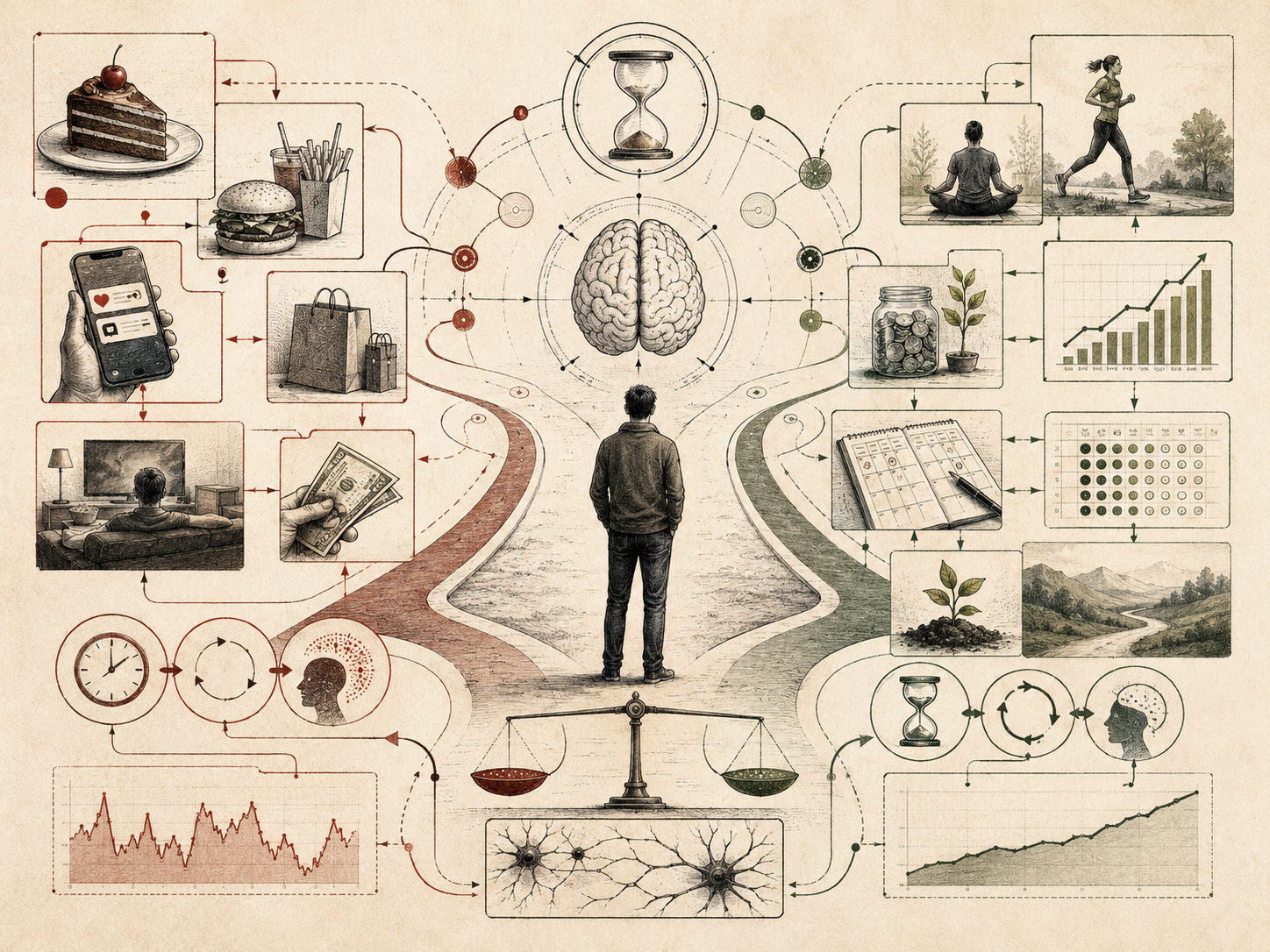
Many economic decisions involve tradeoffs between immediate outcomes and delayed consequences. Individuals must decide whether to save or spend, borrow or repay, study or postpone, exercise or rest, consume now or conserve for later, act on climate risk or defer responsibility, and invest in long-term resilience or satisfy short-term demands. Traditional economic models often assume that individuals evaluate these tradeoffs with stable preferences over time. Behavioral economics shows that real decision-making often departs from that assumption. People may prefer the patient option when both choices are in the future, then reverse the preference when the smaller-sooner reward becomes immediate.
The importance of present bias lies in its reach. It affects households, firms, governments, platforms, and institutions. At the household level, it helps explain under-saving, debt persistence, procrastination, and health-behavior gaps. At the institutional level, it helps explain short-term budget cycles, deferred maintenance, weak preventive investment, and delayed response to slow-moving risks. At the technological level, it helps explain why platforms designed around instant feedback, frictionless consumption, and continuous attention can intensify present-oriented behavior. Present bias is therefore both a psychological concept and a governance problem.
What Present Bias Means
Present bias describes a tendency to give special weight to immediate experience. A person may know that a delayed reward is larger, more beneficial, or more aligned with long-term welfare, yet choose the smaller immediate reward because it is psychologically vivid. Likewise, a person may know that avoiding a present cost will create a larger future cost, yet delay action because the immediate burden feels more salient than the future consequence.
The concept is central to behavioral economics because it challenges the assumption that preferences are stable across time. Under a stable-preference model, a person who prefers saving to spending tomorrow should still prefer saving when tomorrow becomes today, unless new information arrives. Present bias shows that the timing of the choice itself can change behavior. The closer an option comes to the present, the more motivational force it gains.
This does not mean people are incapable of caring about the future. People often have deep long-term goals. They want financial security, health, learning, stable relationships, meaningful work, social contribution, environmental sustainability, and institutional resilience. The problem is that future-oriented goals must compete with present-moment incentives. When temptation, stress, fatigue, convenience, social pressure, or emotional relief is immediate, long-term intention can lose practical control over action.
Present bias helps explain why intentions can be sincere and still fail. A person can sincerely intend to save money next month, exercise tomorrow, begin the assignment this weekend, avoid unnecessary debt, or reduce screen time. The intention is real. But when the decision moment arrives, the immediate alternative may become more attractive than it appeared during planning. This is why present bias is often discussed alongside self-control and commitment devices, time discounting, mental accounting, and choice architecture.
Present bias is therefore not merely a personal weakness. It is a predictable feature of decision-making under time, uncertainty, and temptation. Because it is predictable, it can be studied, modeled, and addressed through better institutional design.
The Psychology of Immediate Reward
Immediate rewards are powerful because they are concrete. They can be consumed, felt, avoided, clicked, purchased, postponed, or relieved now. Future rewards require imagination. A future retirement balance, future health improvement, future degree, future climate benefit, or future institutional resilience is cognitively more abstract than a present pleasure or present burden. This asymmetry gives the present a psychological advantage.
Immediate rewards are also emotionally salient. They activate desire, relief, curiosity, comfort, belonging, status, or escape. A future reward may be larger but emotionally cooler. A person may know that saving is better than spending, but the purchase is vivid. A person may know that exercise is beneficial, but the couch is present. A person may know that completing a difficult task would reduce future stress, but avoidance provides immediate relief. Present bias operates through this gap between intellectual recognition and motivational force.
Immediate costs have the same structure. A preventive health appointment, tax filing, household repair, insurance decision, difficult conversation, study session, or climate investment may produce future benefit, but the present cost is felt now. People often delay actions whose benefits are delayed and whose costs are immediate. The delay is not necessarily caused by ignorance. It often results from the disproportionate weight of present discomfort.
This makes present bias closely related to bounded rationality. Human attention is limited. People cannot continuously optimize across all future consequences. They respond to what is salient, emotionally charged, easy, and immediate. Present bias is therefore a temporal form of bounded rationality: the future matters, but it is often underweighted relative to the present decision environment.
Present bias also interacts with stress. Scarcity, insecurity, fatigue, and overload can intensify present-oriented behavior because the future becomes harder to plan for when immediate survival, relief, or cognitive load dominates. This is why present bias should not be moralized. A person under financial strain may discount the future not because they lack character, but because the present is genuinely demanding. Behavioral analysis must therefore remain sensitive to social and material context.
Present Bias and Intertemporal Choice
Intertemporal choice concerns decisions that distribute costs and benefits across time. Almost every important economic and social decision has an intertemporal dimension. Saving requires current sacrifice for future security. Education requires current effort for future capability. Preventive health requires current inconvenience for future wellbeing. Environmental protection requires current restraint for future planetary stability. Institutional maintenance requires current spending to prevent future breakdown.
Traditional intertemporal-choice models often assume that individuals discount the future at a stable rate. This does not mean the future is valued equally with the present; discounting allows for patience or impatience. But it implies consistency: the relative value of two future outcomes should not radically change merely because time passes. Present bias violates this consistency by giving the current moment extra weight.
The result is preference reversal. A person may prefer $120 in one month to $100 today when both are framed from a distance. But when $100 becomes immediately available, the person may choose it. A student may prefer studying tomorrow to watching videos tomorrow when planning today, but when tomorrow arrives, the immediate entertainment option becomes stronger. A worker may prefer increasing retirement contributions next year but resist the same increase when it reduces current take-home pay.
Present bias therefore explains why planning and action often diverge. People are not always changing their minds because new facts appear. They are reweighting the same tradeoff as immediacy changes. The future self inherits decisions made by the present self, while the present self is repeatedly tempted to defer costs and pull rewards forward.
This temporal conflict is central to household finance, health behavior, climate policy, infrastructure planning, and organizational governance. Systems that rely on repeated active future-oriented choice often underperform because each decision point reactivates present bias. Systems that automate, default, precommit, or reduce immediate friction can help future-oriented choices survive the moment of action.
Hyperbolic and Quasi-Hyperbolic Discounting
Present bias is commonly modeled through hyperbolic or quasi-hyperbolic discounting. These models formalize the idea that people discount near-future rewards more sharply than distant-future rewards. Unlike exponential discounting, which applies a stable discount rate across time, hyperbolic models allow the present to receive special weight. This creates time-inconsistent preferences.
Time inconsistency means that a plan made for the future may not be implemented when the future arrives. A person may plan to save next month, but when next month becomes the present, spending becomes more attractive. A person may plan to begin work tomorrow, but when tomorrow becomes today, postponement becomes attractive. The preference ordering changes not because the options changed, but because one option became immediate.
David Laibson’s work on hyperbolic discounting is especially important because it connects present bias to household saving, illiquid assets, and the demand for commitment. If people understand that future selves may be tempted, they may value structures that restrict future access to resources. Retirement accounts, withdrawal penalties, automatic payroll deduction, and other commitment mechanisms can be interpreted partly as responses to present-biased preferences.
Quasi-hyperbolic discounting often uses two parameters: \(\beta\), which captures present bias, and \(\delta\), which captures ordinary patience over future periods. When \(\beta < 1\), future utility is downweighted relative to the present. This produces the behavioral distinctiveness of “now.” Even if a person is patient across future periods, they may still overweight the current period relative to all later periods.
The theoretical importance of this framework is that it explains why people may demand constraints on themselves. In a standard model, restricting one’s future choices may look irrational. In a present-biased model, voluntary commitment can be rational because the planner self anticipates future preference reversal. Commitment becomes a tool for protecting long-term intention from future immediacy.
The Planning-Action Gap
One of the most visible consequences of present bias is the planning-action gap. People often make plans they genuinely endorse but fail to execute. The gap appears in saving, exercise, learning, project completion, debt repayment, health behavior, sustainable consumption, and digital attention. It is not simply a gap between knowledge and ignorance. It is a gap between reflective preference and present-moment motivation.
Planning usually occurs in a cooler psychological state. The future is abstract, the temptation is distant, and the long-term goal is easier to endorse. Action occurs in a hotter psychological state. The temptation is near, the effort is concrete, and the reward or relief is immediate. The same person can therefore behave differently across time without hypocrisy or confusion. The decision context has changed.
This gap explains why information campaigns often have limited effects. A person may fully understand the benefits of saving, exercise, preventive care, or environmental responsibility and still fail to act when immediate costs arise. Information is necessary, but it is often insufficient. Present bias is not primarily an information deficit. It is a temporal-motivation problem.
Commitment devices, defaults, reminders, deadlines, automatic enrollment, recurring transfers, friction, and accountability systems all address the planning-action gap by changing the action environment. They reduce the need to remake the long-term decision under present temptation. The goal is not to eliminate human weakness, but to design systems that recognize when human intention is most fragile.
The planning-action gap also matters for organizations and governments. A government may plan infrastructure maintenance but defer spending during budget pressure. A firm may endorse worker training but delay investment under quarterly targets. A platform may claim to support user wellbeing but optimize for immediate engagement. Present bias is therefore not only individual. Institutions also face planning-action gaps when short-term incentives dominate long-term commitments.
Present Bias in Economic Behavior
Present bias influences many everyday economic decisions. It contributes to under-saving, consumer credit dependence, impulsive consumption, repeated postponement, delayed preventive investment, low retirement participation, costly borrowing, and failure to complete welfare-enhancing actions. The pattern is not that people disregard the future entirely. Rather, the present receives disproportionate weight at the moment of choice.
Consumer credit illustrates the mechanism. Borrowing brings consumption into the present and pushes repayment into the future. Present bias can therefore make debt attractive even when future repayment will be painful. Credit cards, buy-now-pay-later products, payday loans, and subscription-based consumption all interact with this tendency by separating immediate consumption from delayed cost. The more distant or obscured the repayment, the easier it becomes for present desire to dominate.
Saving is the mirror image. Saving imposes a present cost for a future benefit. Present bias makes this difficult because the sacrifice is immediate while the reward is delayed. Even when people endorse the goal of saving, they may postpone action. This is why automatic enrollment, payroll deduction, default escalation, and goal-based savings accounts can be powerful: they reduce the need for repeated active sacrifice.
Present bias also affects labor and education. People may delay training, studying, credential completion, job applications, or difficult work because the cost is immediate and the reward is delayed. Procrastination is not only a time-management issue. It is an intertemporal-choice issue. The person is repeatedly choosing immediate relief over future benefit.
Economic behavior under present bias is therefore shaped by timing, salience, friction, defaults, and payment architecture. Small changes in the structure of choice can alter whether the present or the future dominates the decision.
Personal Finance, Debt, and Saving
Personal finance is one of the clearest domains where present bias matters. Financial security depends heavily on choices that require present sacrifice for future benefit: saving, investing, repaying debt, buying insurance, maintaining emergency reserves, avoiding high-cost borrowing, and planning for retirement. Each of these decisions competes against immediate consumption and present needs.
Under present bias, people may delay saving even when they know it is important. The benefit of saving is future security, while the cost is reduced current spending. If the immediate sacrifice is vivid and the future benefit is abstract, saving loses motivational force. This helps explain why default-based retirement systems often outperform opt-in systems. They make saving happen before the worker must actively choose sacrifice.
Present bias also supports debt persistence. Minimum payments, deferred interest, promotional financing, and delayed billing can make debt feel manageable in the present while increasing future obligations. A purchase made today may feel separate from repayment later. The future self pays for the present self’s consumption. This temporal separation is one reason consumer credit can become behaviorally risky.
Emergency savings reveal a more complex pattern. Present bias may reduce saving, but financial insecurity can also make present needs legitimately urgent. A household with unstable income may prioritize immediate expenses because future planning is constrained by present scarcity. Behavioral analysis should not treat all low saving as self-control failure. Income, wages, housing costs, medical risk, debt burden, and social protection matter.
The best personal-finance designs recognize both realities. They use automatic transfers, labeled accounts, defaults, reminders, and commitment structures to support long-term goals, while preserving flexibility for real emergencies. A harsh commitment device may increase savings but harm households facing volatility. Present bias should be addressed with institutional humility, not moral judgment.
Health, Education, Productivity, and Habit Formation
Present bias strongly affects health behavior because healthy choices often involve immediate costs and delayed benefits. Exercise requires effort now. Preventive care requires time now. Healthier eating may require planning, cost, and restraint now. Sleep discipline requires giving up late-night stimulation now. The benefits are real, but many are delayed, uncertain, or gradual.
This helps explain why health knowledge often fails to produce behavior change. A person may know what would improve long-term health but still choose immediate comfort, convenience, taste, or avoidance. Present bias turns health behavior into a repeated struggle between future wellbeing and present incentives. Commitment devices, habit routines, reminders, social support, pre-scheduled appointments, and default healthy options can reduce the burden of repeated self-control.
Education and learning show the same structure. Studying, practice, reading, writing, and skill development are investments. They require present effort for future capability. The delayed reward may be large but abstract. Immediate entertainment, social interaction, rest, or avoidance can dominate. This is why deadlines, staged assignments, study groups, learning streaks, and scheduled practice can help: they move future goals into present structure.
Productivity is also shaped by present bias. Difficult work often produces delayed benefit, while distraction produces immediate relief. The cost of starting is immediate. The satisfaction of completion is delayed. Digital environments intensify the problem by making low-effort rewards continuously available. The result is not merely laziness; it is an attention environment that rewards present gratification repeatedly.
Habit formation can be understood as a way to reduce the recurring power of present bias. Once a behavior becomes routine, it requires less active deliberation. The person no longer has to repeatedly choose the delayed benefit against immediate temptation. Good habit design lowers the immediate cost of the desired action, raises the friction of the undesired action, and creates feedback that makes progress visible sooner.
Digital Platforms and the Architecture of Immediacy
Digital platforms are among the most important modern environments for present bias. Many platforms are designed around immediate reward: notifications, likes, infinite scroll, autoplay, one-click purchase, algorithmic novelty, instant feedback, short-form video, recommendation loops, frictionless checkout, and gamified engagement. These features make the present continuously salient.
The problem is not simply that digital platforms offer entertainment or convenience. The problem is that they can engineer immediacy at scale. They reduce the time between impulse and action. They make rewards frequent, variable, and emotionally salient. They lower friction for consumption while raising friction for disengagement. In doing so, they strengthen the present-oriented side of decision-making.
Present bias is especially important for digital finance. Trading apps, buy-now-pay-later interfaces, payment platforms, subscription systems, gaming economies, and promotional dashboards can all separate present action from future cost. A purchase, trade, or subscription can feel immediate and easy, while repayment, risk, or cumulative cost appears later. This is a behavioral design issue, not just a consumer knowledge issue.
Digital tools can also help counter present bias. Screen-time limits, savings automation, habit trackers, reminder systems, default contribution tools, app blockers, scheduled focus modes, and commitment apps can support long-term goals. The same design principles that can exploit present bias can also be used to protect users from it.
The ethical distinction depends on alignment. A platform that helps users act on goals they endorse is using behavioral design supportively. A platform that exploits immediacy to maximize engagement, spending, trading, or subscription retention is using behavioral design manipulatively. Present bias therefore belongs at the center of digital governance, consumer protection, and technology ethics.
Commitment Devices and Choice Architecture
One of the most important responses to present bias is the commitment device. A commitment device changes the future decision environment so that long-term goals are more likely to survive immediate temptation. It may restrict future options, raise the cost of deviation, automate beneficial action, create accountability, or make future consequences more salient.
Common examples include automatic retirement contributions, payroll deductions, withdrawal penalties, savings lockboxes, recurring deposits, debt repayment schedules, precommitted deadlines, exercise reservations, public pledges, website blockers, self-exclusion programs, and default enrollment. The logic is simple: because future preferences may shift when temptation becomes immediate, the present self can create structures that protect future behavior.
Commitment devices work because they modify the choice environment rather than relying solely on willpower. Willpower must be repeatedly exercised at the moment of temptation. Commitment changes the conditions under which temptation appears. A payroll deduction removes money from discretionary spending before the decision occurs. A deadline makes delay costly. A blocked website adds friction. A public commitment creates reputational accountability.
Commitment devices can be soft or hard. Soft commitments include reminders, defaults, plans, social accountability, and progress tracking. Hard commitments include penalties, lock-ins, contracts, and restricted access. Stronger commitment is not always better. A strict savings lockbox may help one household and harm another facing emergency liquidity needs. A penalty may motivate one person and punish another under stress.
This is why commitment design must be evaluated by welfare, not compliance alone. A device that increases saving but worsens hardship may not be welfare-improving. A device that reduces screen time but increases anxiety may have mixed effects. A device that helps people implement reflective goals, preserves appropriate flexibility, and avoids exploitation is more defensible than one that simply forces behavior.
Present Bias and Sustainability
Present bias has major implications for sustainability and environmental policy. Many sustainability challenges require current action for future benefit. Climate mitigation, biodiversity protection, resilient infrastructure, soil conservation, water management, pollution control, and disaster preparedness often require immediate cost, investment, restraint, or coordination. The benefits may be delayed, distributed, uncertain, or experienced by future generations.
This creates a severe intertemporal problem. The present bears the cost of action, while the future receives much of the benefit. If individuals, firms, and governments overweight present costs and underweight future harms, sustainability policy will be systematically delayed. The delay is not necessarily caused by ignorance of risk. It may reflect the political and psychological weight of immediate costs.
Climate policy illustrates the problem. Reducing emissions, changing infrastructure, transforming energy systems, protecting ecosystems, and investing in adaptation all require near-term effort. The worst harms of inaction may unfold over decades. Present bias therefore contributes to underinvestment in long-term planetary stability. It interacts with political cycles, lobbying, discount rates, inequality, and institutional short-termism.
Behavioral policy can help by making future consequences more salient, reducing upfront friction, shifting defaults, creating durable rules, and designing commitment mechanisms for long-term public goods. Examples include automatic energy-efficiency standards, infrastructure resilience requirements, default renewable-energy options, long-term climate targets, conservation commitments, and public investment rules that protect future interests.
However, sustainability policy must also account for distribution. Present costs are not equally borne. A policy that asks low-income households to absorb immediate costs for future environmental benefit may be unjust if support is inadequate. The challenge is to design institutions that overcome present bias while protecting those already facing present scarcity. Long-term responsibility and immediate justice must be held together.
Institutional Design and Behavioral Governance
Present bias is not only an individual decision problem. It is also an institutional design problem. Institutions often face incentives to prioritize immediate performance, short-term budgets, quarterly metrics, election cycles, current consumption, and visible near-term wins over long-term resilience. The same temporal distortion that affects individuals can affect organizations, firms, governments, and societies.
Retirement systems provide one example. If participation requires active enrollment, procrastination and present bias can reduce saving. Automatic enrollment and automatic escalation change the default so that long-term saving becomes easier. These systems do not eliminate choice, but they recognize that requiring repeated active future-oriented decisions produces predictable underperformance.
Public budgeting provides another example. Deferred maintenance, underfunded infrastructure, weak public-health preparation, delayed climate adaptation, and insufficient institutional investment often reflect the political attractiveness of postponement. The benefits of prevention are often invisible when it works. The costs of action are immediate and politically salient. Present bias therefore contributes to institutional fragility.
Digital governance also matters. Platforms can amplify present bias through design choices that reward immediate engagement. Financial platforms can reduce friction for spending, borrowing, trading, or subscription renewal. Public policy must therefore evaluate decision environments, not only formal choice availability. A choice that is technically available may still be behaviorally distorted if the environment heavily favors immediacy.
Behavioral governance asks how institutions can be designed to function under real temporal psychology. Useful tools include defaults, deadlines, reminders, staged commitments, automatic escalation, long-term budgeting rules, independent oversight, resilience funds, disclosure timing, cooling-off periods, and friction around high-risk immediate choices. The aim is not to remove freedom, but to make long-term welfare more institutionally durable.
Ethical Questions: Autonomy, Welfare, and Manipulation
Present bias creates ethical challenges because the same behavioral knowledge can be used to help people or exploit them. A retirement default can support long-term welfare. A frictionless credit interface can encourage costly borrowing. A reminder can help someone complete a goal. A notification system can capture attention for platform profit. A commitment device can support autonomy. A dark pattern can undermine it.
The ethical question is not whether design influences behavior. All design influences behavior. The question is whether the influence is transparent, user-aligned, welfare-improving, contestable, and respectful of agency. Behavioral economics becomes ethically dangerous when institutions use present bias to increase engagement, debt, consumption, gambling, speculative trading, or subscription retention while claiming to preserve formal choice.
Autonomy is not always maximized by leaving people alone in environments designed around temptation. A person may autonomously choose commitment because they understand their own future vulnerability. Automatic savings, app blockers, self-exclusion programs, and deadline structures can support agency when they help people act on goals they endorse. Constraint can sometimes be autonomy-preserving when it is chosen, transparent, and aligned with reflective welfare.
At the same time, stronger intervention requires stronger justification. Hard commitment, penalties, default enrollment, cooling-off periods, and restrictions can become paternalistic or harmful if poorly designed. They may burden people facing emergencies, unstable income, disability, caregiving responsibilities, or changing circumstances. Ethical behavioral design must preserve meaningful exit and flexibility where appropriate.
Present bias should therefore be addressed through a welfare-and-dignity lens. The goal is not to make people comply with institutional preferences. The goal is to support people and societies in acting on long-term goals they have reason to value, while protecting them from manipulative environments that exploit the behavioral power of now.
Empirical and Policy-Evaluation Lens
A professional economist-facing treatment of present bias should ask what can be measured, identified, estimated, and evaluated. Present bias can be studied through laboratory experiments, field experiments, retirement-plan data, savings products, credit behavior, health adherence, education programs, app usage, consumer transactions, energy consumption, and public-policy interventions.
The empirical challenge is that present bias is often latent. Researchers observe choices, but the same choice can arise from different mechanisms. Under-saving may reflect present bias, but it may also reflect low income, high expenses, debt, medical risk, housing instability, or lack of access. Procrastination may reflect present bias, but it may also reflect stress, unclear instructions, workload, depression, caregiving duties, or institutional barriers. Careful research design is necessary.
Useful empirical strategies include randomized commitment offers, default changes, reminder interventions, timing variation, deadline experiments, savings automation, field experiments with delayed rewards, and structural estimation of discounting parameters. Researchers can compare opt-in versus opt-out designs, immediate versus delayed incentives, soft versus hard commitment, and high-friction versus low-friction choice environments.
Outcomes should be evaluated carefully. Increased saving may be beneficial, but not if it creates harmful liquidity constraints. Reduced screen time may be beneficial, but not if the intervention is coercive or stressful. Increased repayment may reduce interest costs, but not if it leaves households without emergency reserves. Behavioral interventions must be evaluated by welfare, not behavior change alone.
Heterogeneity is central. Present bias may be stronger in some contexts than others. Commitment devices may help sophisticated present-biased individuals who demand them, but may be less effective for naive individuals who underestimate future temptation. Interventions may differ by income, education, age, stress, digital access, employment stability, household risk, and institutional trust. A single average treatment effect can hide important distributional consequences.
A rigorous policy evaluation should ask: What behavior changed? Was the change welfare-improving? Did it preserve autonomy? Did it reduce future harm without increasing present hardship? Who benefited? Who was burdened? Did the intervention address present bias, or did it merely shift responsibility onto individuals? These questions turn present bias from a psychological label into a serious institutional research agenda.
An Analytical Framework for Present Bias
A standard way to formalize present bias is through quasi-hyperbolic discounting. Let an individual evaluate outcomes \(x_t\) over periods \(t = 0, 1, \dots, T\). Utility from the perspective of the present can be written as:
U_0 = u(x_0) + \beta \sum_{t=1}^{T}\delta^t u(x_t)
\]
Interpretation: The parameter \(\beta\) captures the special weight of the present, while \(\delta\) captures ordinary patience over future periods.
When \(\beta = 1\), the model reduces to standard exponential discounting. When \(0 < \beta < 1\), all future utilities are discounted relative to present utility. This makes “now” behaviorally special. The person may be patient across future periods but still strongly prefer immediate reward over delayed reward when one option is available now.
Consider a choice between a smaller immediate reward \(S\) and a larger delayed reward \(L\). The immediate reward is chosen when:
u(S_0) > \beta\delta^d u(L_d)
\]
Interpretation: Present bias makes the immediate reward more attractive by discounting the delayed reward through \(\beta\) and \(\delta^d\).
This formalizes why smaller-sooner rewards can displace larger-later rewards. The larger reward may be objectively preferable from a long-run perspective, but present bias reduces its motivational value at the moment of choice.
Time inconsistency appears when a person evaluates two future options differently depending on whether one has become immediate. From period \(0\), the person may prefer \(L\) over \(S\) when both are future outcomes:
\beta\delta^{d_L}u(L) > \beta\delta^{d_S}u(S)
\]
Interpretation: When both rewards are future rewards, the present-bias term applies to both, so the larger-later option may be preferred.
But when \(S\) becomes immediate, the comparison changes:
u(S) > \beta\delta^{d}u(L)
\]
Interpretation: Once the smaller reward becomes immediate, it no longer receives the same future discount, making preference reversal possible.
Commitment devices can be modeled as adding a cost \(k\) to deviation or reducing the utility of temptation. Suppose planned action \(P\) competes with tempting action \(T\). The future self follows the plan when:
U(P) \geq U(T) – k
\]
Interpretation: Commitment works by making deviation less attractive, not by eliminating present bias itself.
In a savings context, let \(sY_t\) represent planned savings from income \(Y_t\), and let \(C_t\) represent immediate consumption temptation. Saving occurs when:
\beta\delta V(sY_t) \geq u(C_t)
\]
Interpretation: Saving fails when immediate consumption utility outweighs the discounted value of future wealth.
A default or automation mechanism can shift the comparison by adding implementation support \(A_t\) and deviation cost \(k_t\):
\beta\delta V(sY_t) + A_t \geq u(C_t) – k_t
\]
Interpretation: Automation and commitment help future-oriented behavior survive immediate temptation.
For policy evaluation, the effect of a present-bias intervention can be represented as:
\tau = E[Y_i(1) – Y_i(0)]
\]
Interpretation: The treatment effect compares outcomes under an intervention, such as a default or commitment device, with outcomes under a comparison condition.
A broader welfare expression should include future benefit, present cost, flexibility, and burden:
W_i = F_i – C_i + G_i – B_i
\]
Interpretation: Welfare depends on future gains, immediate costs, flexibility or goal progress, and behavioral or administrative burden.
This framework prevents simplistic conclusions. Present-bias interventions should not be judged only by whether they change behavior. They should be judged by whether they improve welfare under real constraints.
R Workflow: Simulating Present Bias, Delay, and Commitment
The following R workflow simulates a synthetic population with heterogeneous present bias, discounting, temptation strength, sophistication, and liquidity need. It compares delayed-choice rates across weak, medium, and strong commitment regimes and reports heterogeneity by present-bias quartile. The workflow is designed as an economist-facing scaffold for intertemporal-choice research, behavioral public policy, household finance, health behavior, and sustainability-governance analysis.
# Present Bias and Immediate Reward
# R workflow: present bias, delayed rewards, commitment, and welfare
# Synthetic data only. Economist-facing research scaffold.

set.seed(1616)

n_agents <- 2500
n_periods <- 36

agents <- data.frame(
  agent_id = 1:n_agents,
  beta = runif(n_agents, 0.50, 1.00),
  delta = runif(n_agents, 0.94, 0.99),
  temptation_strength = runif(n_agents, 50, 260),
  sophistication = runif(n_agents, 0.20, 1.00),
  liquidity_need = runif(n_agents, 0.05, 0.35),
  future_goal_value = runif(n_agents, 150, 420)
)

simulate_commitment_regime <- function(regime_name, commitment_cost, reminder_strength, flexibility) {

  history <- vector("list", n_periods)

  cumulative_delayed_choices <- rep(0, n_agents)
  cumulative_welfare <- rep(0, n_agents)

  for (t in seq_len(n_periods)) {

    delayed_reward <- agents$future_goal_value * runif(n_agents, 0.80, 1.25)

    immediate_temptation <- agents$temptation_strength * runif(n_agents, 0.80, 1.30)

    present_biased_delayed_value <- agents$beta *
      (agents$delta ^ (n_periods - t)) *
      delayed_reward

    commitment_support <- commitment_cost +
      reminder_strength * agents$sophistication * 40

    hardship_adjustment <- agents$liquidity_need * (1 - flexibility) * 25

    immediate_value <- immediate_temptation -
      commitment_support +
      hardship_adjustment

    choose_delayed <- as.integer(present_biased_delayed_value >= immediate_value)

    period_welfare <- choose_delayed * delayed_reward -
      (1 - choose_delayed) * 0.25 * delayed_reward -
      hardship_adjustment

    cumulative_delayed_choices <- cumulative_delayed_choices + choose_delayed
    cumulative_welfare <- cumulative_welfare + period_welfare

    history[[t]] <- data.frame(
      period = t,
      agent_id = agents$agent_id,
      regime = regime_name,
      beta = agents$beta,
      delta = agents$delta,
      sophistication = agents$sophistication,
      liquidity_need = agents$liquidity_need,
      delayed_reward = delayed_reward,
      immediate_temptation = immediate_temptation,
      discounted_delayed_value = present_biased_delayed_value,
      immediate_value = immediate_value,
      choose_delayed = choose_delayed,
      cumulative_delayed_choices = cumulative_delayed_choices,
      cumulative_welfare = cumulative_welfare,
      commitment_cost = commitment_cost,
      reminder_strength = reminder_strength,
      flexibility = flexibility
    )
  }

  do.call(rbind, history)
}

weak_commitment <- simulate_commitment_regime(
  regime_name = "weak_commitment",
  commitment_cost = 20,
  reminder_strength = 0.10,
  flexibility = 0.95
)

medium_commitment <- simulate_commitment_regime(
  regime_name = "medium_commitment",
  commitment_cost = 70,
  reminder_strength = 0.45,
  flexibility = 0.75
)

strong_commitment <- simulate_commitment_regime(
  regime_name = "strong_commitment",
  commitment_cost = 140,
  reminder_strength = 0.80,
  flexibility = 0.55
)

panel <- rbind(weak_commitment, medium_commitment, strong_commitment)

final_period <- panel[panel$period == n_periods, ]

regime_summary <- aggregate(
  cbind(choose_delayed, cumulative_delayed_choices, cumulative_welfare) ~ regime,
  data = final_period,
  FUN = mean
)

panel$beta_quartile <- cut(
  panel$beta,
  breaks = quantile(panel$beta, probs = seq(0, 1, 0.25)),
  include.lowest = TRUE,
  labels = paste0("Q", 1:4)
)

beta_heterogeneity <- aggregate(
  cbind(choose_delayed, cumulative_delayed_choices, cumulative_welfare) ~ regime + beta_quartile,
  data = panel[panel$period == n_periods, ],
  FUN = mean
)

print(regime_summary)
print(beta_heterogeneity)

dir.create("outputs/tables", recursive = TRUE, showWarnings = FALSE)

write.csv(panel, "outputs/tables/r_present_bias_panel.csv", row.names = FALSE)
write.csv(regime_summary, "outputs/tables/r_present_bias_regime_summary.csv", row.names = FALSE)
write.csv(beta_heterogeneity, "outputs/tables/r_present_bias_beta_heterogeneity.csv", row.names = FALSE)
This workflow shows how commitment regimes can increase delayed-choice rates, especially for agents with stronger present bias. It also keeps flexibility visible, which matters because commitment can become harmful when people face genuine liquidity needs or hardship.
Python Workflow: Comparing Intertemporal Regimes Under Present Bias
The following Python workflow compares weak, medium, and strong commitment regimes under present-biased preferences. It creates synthetic agent-period data, produces regime-level summaries, estimates treatment effects, and prepares heterogeneity tables by present-bias quartile and liquidity-need quartile. The workflow is designed for professional behavioral-economics and public-policy scaffolding.
# Present Bias and Immediate Reward
# Python workflow: intertemporal regimes, commitment, delayed choice, and welfare
# Synthetic data only. Economist-facing research scaffold.

from __future__ import annotations

from pathlib import Path

import numpy as np
import pandas as pd

rng = np.random.default_rng(1616)

n_agents = 3000
n_periods = 36

agents = pd.DataFrame({
    "agent_id": np.arange(1, n_agents + 1),
    "beta": rng.uniform(0.50, 1.00, n_agents),
    "delta": rng.uniform(0.94, 0.99, n_agents),
    "temptation_strength": rng.uniform(50, 260, n_agents),
    "sophistication": rng.uniform(0.20, 1.00, n_agents),
    "liquidity_need": rng.uniform(0.05, 0.35, n_agents),
    "future_goal_value": rng.uniform(150, 420, n_agents),
})

def simulate_commitment_regime(
    regime_name: str,
    commitment_cost: float,
    reminder_strength: float,
    flexibility: float
) -> pd.DataFrame:
    """Simulate present-biased choice under a commitment regime."""
    cumulative_delayed_choices = np.zeros(n_agents)
    cumulative_welfare = np.zeros(n_agents)
    rows = []

    for period in range(1, n_periods + 1):
        delayed_reward = agents["future_goal_value"].to_numpy() * rng.uniform(0.80, 1.25, n_agents)
        immediate_temptation = agents["temptation_strength"].to_numpy() * rng.uniform(0.80, 1.30, n_agents)

        discounted_delayed_value = (
            agents["beta"].to_numpy()
            * (agents["delta"].to_numpy() ** (n_periods - period))
            * delayed_reward
        )

        commitment_support = (
            commitment_cost
            + reminder_strength * agents["sophistication"].to_numpy() * 40
        )

        hardship_adjustment = agents["liquidity_need"].to_numpy() * (1 - flexibility) * 25

        immediate_value = immediate_temptation - commitment_support + hardship_adjustment

        choose_delayed = (discounted_delayed_value >= immediate_value).astype(int)

        period_welfare = (
            choose_delayed * delayed_reward
            - (1 - choose_delayed) * 0.25 * delayed_reward
            - hardship_adjustment
        )

        cumulative_delayed_choices += choose_delayed
        cumulative_welfare += period_welfare

        rows.append(pd.DataFrame({
            "period": period,
            "agent_id": agents["agent_id"],
            "regime": regime_name,
            "beta": agents["beta"],
            "delta": agents["delta"],
            "sophistication": agents["sophistication"],
            "liquidity_need": agents["liquidity_need"],
            "delayed_reward": delayed_reward,
            "immediate_temptation": immediate_temptation,
            "discounted_delayed_value": discounted_delayed_value,
            "immediate_value": immediate_value,
            "choose_delayed": choose_delayed,
            "period_welfare": period_welfare,
            "cumulative_delayed_choices": cumulative_delayed_choices,
            "cumulative_welfare": cumulative_welfare,
            "commitment_cost": commitment_cost,
            "reminder_strength": reminder_strength,
            "flexibility": flexibility,
            "medium_commitment_treat": int(regime_name == "medium_commitment"),
            "strong_commitment_treat": int(regime_name == "strong_commitment"),
        }))

    return pd.concat(rows, ignore_index=True)

regimes = {
    "weak_commitment": {
        "commitment_cost": 20,
        "reminder_strength": 0.10,
        "flexibility": 0.95,
    },
    "medium_commitment": {
        "commitment_cost": 70,
        "reminder_strength": 0.45,
        "flexibility": 0.75,
    },
    "strong_commitment": {
        "commitment_cost": 140,
        "reminder_strength": 0.80,
        "flexibility": 0.55,
    },
}

panel = pd.concat(
    [simulate_commitment_regime(name, **params) for name, params in regimes.items()],
    ignore_index=True
)

final = panel.loc[panel["period"] == n_periods].copy()

summary = final.groupby("regime").agg(
    agents=("agent_id", "count"),
    mean_choose_delayed=("choose_delayed", "mean"),
    mean_cumulative_delayed_choices=("cumulative_delayed_choices", "mean"),
    mean_cumulative_welfare=("cumulative_welfare", "mean"),
    mean_commitment_cost=("commitment_cost", "mean"),
    mean_reminder_strength=("reminder_strength", "mean"),
    mean_flexibility=("flexibility", "mean"),
).reset_index()

print(summary.sort_values("mean_cumulative_welfare", ascending=False))

try:
    import statsmodels.api as sm

    outcomes = [
        "choose_delayed",
        "cumulative_delayed_choices",
        "cumulative_welfare"
    ]

    for outcome in outcomes:
        X = final[[
            "medium_commitment_treat",
            "strong_commitment_treat",
            "beta",
            "delta",
            "sophistication",
            "liquidity_need",
            "commitment_cost",
            "reminder_strength",
            "flexibility"
        ]]
        X = sm.add_constant(X)

        model = sm.OLS(final[outcome], X).fit(cov_type="HC1")

        print(f"\nOutcome: {outcome}")
        print(model.summary().tables[1])

except ImportError:
    print("statsmodels is not installed; skipping regression table.")

final["beta_quartile"] = pd.qcut(final["beta"], 4, labels=["Q1", "Q2", "Q3", "Q4"])
final["liquidity_quartile"] = pd.qcut(final["liquidity_need"], 4, labels=["Q1", "Q2", "Q3", "Q4"])

beta_heterogeneity = final.groupby(["regime", "beta_quartile"], observed=False).agg(
    mean_choose_delayed=("choose_delayed", "mean"),
    mean_cumulative_delayed_choices=("cumulative_delayed_choices", "mean"),
    mean_cumulative_welfare=("cumulative_welfare", "mean"),
).reset_index()

liquidity_heterogeneity = final.groupby(["regime", "liquidity_quartile"], observed=False).agg(
    mean_choose_delayed=("choose_delayed", "mean"),
    mean_cumulative_delayed_choices=("cumulative_delayed_choices", "mean"),
    mean_cumulative_welfare=("cumulative_welfare", "mean"),
).reset_index()

output_dir = Path("outputs/tables")
output_dir.mkdir(parents=True, exist_ok=True)

panel.to_csv(output_dir / "synthetic_present_bias_panel.csv", index=False)
final.to_csv(output_dir / "synthetic_present_bias_experiment.csv", index=False)
summary.to_csv(output_dir / "present_bias_regime_summary.csv", index=False)
beta_heterogeneity.to_csv(output_dir / "present_bias_beta_heterogeneity.csv", index=False)
liquidity_heterogeneity.to_csv(output_dir / "present_bias_liquidity_heterogeneity.csv", index=False)
For analysts and policymakers, the key lesson is that present bias can be durable and predictable, but its consequences depend heavily on design. A strong commitment structure may increase delayed choice, but if it reduces flexibility too much, it may not maximize welfare for people facing real hardship or liquidity constraints.
Stata Replication Note: Present Bias and Delayed Choice
For an economist-facing repository, the companion code should support Stata as well as R and Python. The article-level GitHub folder should include a Stata workflow that imports the synthetic present-bias experiment, estimates treatment effects, reports robust standard errors, and exports regression tables. A compact Stata pattern for this article would look like this:
clear all
set more off

* Present Bias and the Psychology of Immediate Reward
* Stata intertemporal-choice evaluation workflow using synthetic data.

global ROOT "`c(pwd)'"
global TABLES "$ROOT/outputs/tables"
global REG "$ROOT/outputs/regression_tables"

capture mkdir "$REG"

import delimited "$TABLES/synthetic_present_bias_experiment.csv", clear varnames(1)

label variable medium_commitment_treat "Medium commitment treatment"
label variable strong_commitment_treat "Strong commitment treatment"
label variable choose_delayed "Delayed choice indicator"
label variable cumulative_delayed_choices "Cumulative delayed choices"
label variable cumulative_welfare "Synthetic cumulative welfare"

local controls beta delta sophistication liquidity_need commitment_cost reminder_strength flexibility
local outcomes choose_delayed cumulative_delayed_choices cumulative_welfare

tempname handle
postfile `handle' str55 outcome str55 term double estimate double std_error double p_value double n using "$REG/stata_present_bias_estimates.dta", replace

foreach y of local outcomes {
    regress `y' medium_commitment_treat strong_commitment_treat `controls', vce(robust)

    foreach x in medium_commitment_treat strong_commitment_treat {
        local b = _b[`x']
        local se = _se[`x']
        local p = 2 * ttail(e(df_r), abs(_b[`x'] / _se[`x']))
        local n = e(N)
        post `handle' ("`y'") ("`x'") (`b') (`se') (`p') (`n')
    }
}

postclose `handle'

use "$REG/stata_present_bias_estimates.dta", clear
export delimited using "$REG/stata_present_bias_estimates.csv", replace

* Heterogeneity by present-bias quartile.
import delimited "$TABLES/synthetic_present_bias_experiment.csv", clear varnames(1)

xtile beta_quartile = beta, nq(4)

tempname h
postfile `h' str30 group str55 term double estimate double std_error double p_value double n using "$REG/stata_present_bias_beta_heterogeneity.dta", replace

forvalues q = 1/4 {
    regress cumulative_delayed_choices medium_commitment_treat strong_commitment_treat `controls' if beta_quartile == `q', vce(robust)

    foreach x in medium_commitment_treat strong_commitment_treat {
        local b = _b[`x']
        local se = _se[`x']
        local p = 2 * ttail(e(df_r), abs(_b[`x'] / _se[`x']))
        local n = e(N)
        post `h' ("beta_q`q'") ("`x'") (`b') (`se') (`p') (`n')
    }
}

postclose `h'

use "$REG/stata_present_bias_beta_heterogeneity.dta", clear
export delimited using "$REG/stata_present_bias_beta_heterogeneity.csv", replace

display "Stata present-bias evaluation workflow complete."
The purpose of including Stata is to make the repository useful to economists, behavioral public policy researchers, household-finance analysts, health economists, education researchers, institutional designers, and graduate-level applied researchers who commonly work across Stata, R, and Python. The full repository scaffold should also include identification notes, robustness plans, replication instructions, synthetic intertemporal-choice panels, present-bias heterogeneity, commitment-regime treatment effects, welfare diagnostics, and flexibility analysis.
GitHub Repository
The companion repository provides reproducible scaffolding for the computational side of this article, including synthetic intertemporal-choice datasets, present-bias simulations, quasi-hyperbolic discounting workflows, commitment-regime evaluation, delayed-choice models, treatment-effect estimation, heterogeneity analysis, welfare diagnostics, robustness checks, Stata/R/Python workflows, SQL metadata structures, and scientific-computing examples for behavioral economics research.
Complete Code Repository
This article is supported by an article-level folder in the Behavioral Economics computational repository, with synthetic intertemporal-choice and present-bias datasets, causal-inference workflows, quasi-hyperbolic discounting simulations, commitment-regime diagnostics, delayed-choice models, welfare and flexibility analysis, econometric identification notes, policy-evaluation scripts, robustness and sensitivity checks, Stata/R/Python workflows, SQL metadata structures, and scientific-computing examples for studying present bias, immediate reward, time-inconsistent preferences, delayed gratification, self-control, commitment devices, savings behavior, health behavior, digital platforms, sustainability governance, and institutional design.
Interpretive Limits and Cautions
Present bias is a powerful concept, but it should not be used to explain every short-term decision. People may prioritize immediate needs because they face real scarcity, unstable income, medical risk, unsafe housing, debt pressure, caregiving burdens, or institutional barriers. A household that spends rather than saves may not be irrational; it may be constrained. Behavioral explanations are strongest when they are paired with structural analysis.
There is also a risk of moralizing procrastination. Delayed action may reflect present bias, but it may also reflect overload, unclear expectations, lack of support, anxiety, depression, poor institutional design, or unrealistic demands. Treating all delay as self-control failure can misread the problem and lead to punitive interventions.
Commitment devices must also be evaluated carefully. A strong commitment can help people act on long-term goals, but it can also reduce flexibility when conditions change. Withdrawal penalties, lock-ins, hard deadlines, and strict defaults may harm people facing emergencies or unequal resources. Stronger commitment is not automatically better.
Digital design raises additional concerns. Platforms can use knowledge of present bias to support users or to exploit them. A budgeting app may help a person save. A trading app may encourage impulsive speculation. A screen-time tool may support attention. A social platform may intensify compulsive use. The ethical status of behavioral design depends on whose welfare the design serves.
Finally, present bias should not become an excuse for institutions to shift responsibility onto individuals. Climate delay, retirement insecurity, health inequity, debt vulnerability, and educational inequality are not merely products of individual impatience. They are also shaped by wages, prices, policy, infrastructure, institutional incentives, and power. Behavioral economics should deepen accountability, not narrow it.
Conclusion
Present bias is one of the most important behavioral mechanisms in intertemporal choice because it explains why individuals, institutions, and societies often favor immediate rewards or immediate relief over larger long-term benefits. The problem is not simply impatience. It is that the present moment receives special psychological weight, creating systematic conflict between planning and action.
This helps explain under-saving, consumer debt, procrastination, health-behavior gaps, digital distraction, policy delay, infrastructure neglect, and weak response to long-term environmental risk. People often care about the future, but future-oriented behavior must survive the powerful pull of now. Without supportive structures, good intentions are often not enough.
The mature lesson of present bias is not that people are irrational in a simplistic sense. It is that decision-making happens in time, under pressure, with limited attention, emotional salience, and unequal constraints. Better outcomes require better environments: defaults, reminders, commitment devices, reduced friction for beneficial action, appropriate friction around harmful immediacy, and institutions that protect long-term welfare.
In that sense, present bias provides one of the clearest bridges between behavioral economics, household finance, health behavior, digital design, sustainability policy, and institutional governance. It reminds us that the future does not merely need to be valued in theory. It needs to be protected in the architecture of choice.
Related Articles
- Behavioral Economics
- Time Discounting and Long-Term Decision-Making
- Self-Control and Commitment Devices in Behavioral Economics
- Mental Accounting in Personal Finance
- Bounded Rationality in Economic Decision-Making
- Loss Aversion and Risk Perception
- Framing Effects in Consumer Choice
- Choice Architecture and Decision Environments
- Nudge Theory and Behavioral Public Policy
- Behavioral Insights in Environmental Policy
Further Reading
- Ainslie, G. (1992) Picoeconomics: The Strategic Interaction of Successive Motivational States within the Person. Cambridge: Cambridge University Press. Available at: https://www.cambridge.org/core/books/picoeconomics/1442781F68E179BB47131B6C541956A6.
- Benartzi, S. and Thaler, R.H. (2004) ‘Save more tomorrow: Using behavioral economics to increase employee saving’, Journal of Political Economy, 112(S1), pp. S164–S187. Available at: https://www.journals.uchicago.edu/doi/10.1086/380085.
- Frederick, S., Loewenstein, G. and O’Donoghue, T. (2002) ‘Time discounting and time preference: A critical review’, Journal of Economic Literature, 40(2), pp. 351–401. Available at: https://www.aeaweb.org/articles?id=10.1257/002205102320161311.
- Kahneman, D. (2011) Thinking, Fast and Slow. New York: Farrar, Straus and Giroux. Available at: https://us.macmillan.com/books/9780374533557/thinkingfastandslow.
- Laibson, D. (1997) ‘Golden eggs and hyperbolic discounting’, Quarterly Journal of Economics, 112(2), pp. 443–478. Available at: https://academic.oup.com/qje/article/112/2/443/1870925.
- O’Donoghue, T. and Rabin, M. (1999) ‘Doing it now or later’, American Economic Review, 89(1), pp. 103–124. Available at: https://www.aeaweb.org/articles?id=10.1257/aer.89.1.103.
- O’Donoghue, T. and Rabin, M. (2015) ‘Present bias: Lessons learned and to be learned’, American Economic Review, 105(5), pp. 273–279. Available at: https://www.aeaweb.org/articles?id=10.1257/aer.p20151085.
- Thaler, R.H. (2015) Misbehaving: The Making of Behavioral Economics. New York: W.W. Norton. Available at: https://wwnorton.com/books/misbehaving/.
- Thaler, R.H. and Sunstein, C.R. (2021) Nudge: The Final Edition. New Haven, CT: Yale University Press. Available at: https://yalebooks.yale.edu/book/9780300262285/nudge/.
References
- Ainslie, G. (1992) Picoeconomics: The Strategic Interaction of Successive Motivational States within the Person. Cambridge: Cambridge University Press. Available at: https://www.cambridge.org/core/books/picoeconomics/1442781F68E179BB47131B6C541956A6.
- Benartzi, S. and Thaler, R.H. (2004) ‘Save more tomorrow: Using behavioral economics to increase employee saving’, Journal of Political Economy, 112(S1), pp. S164–S187. Available at: https://www.journals.uchicago.edu/doi/10.1086/380085.
- Frederick, S., Loewenstein, G. and O’Donoghue, T. (2002) ‘Time discounting and time preference: A critical review’, Journal of Economic Literature, 40(2), pp. 351–401. Available at: https://www.aeaweb.org/articles?id=10.1257/002205102320161311.
- Kahneman, D. (2011) Thinking, Fast and Slow. New York: Farrar, Straus and Giroux. Available at: https://us.macmillan.com/books/9780374533557/thinkingfastandslow.
- Laibson, D. (1997) ‘Golden eggs and hyperbolic discounting’, Quarterly Journal of Economics, 112(2), pp. 443–478. Available at: https://academic.oup.com/qje/article/112/2/443/1870925.
- O’Donoghue, T. and Rabin, M. (1999) ‘Doing it now or later’, American Economic Review, 89(1), pp. 103–124. Available at: https://www.aeaweb.org/articles?id=10.1257/aer.89.1.103.
- O’Donoghue, T. and Rabin, M. (2015) ‘Present bias: Lessons learned and to be learned’, American Economic Review, 105(5), pp. 273–279. Available at: https://www.aeaweb.org/articles?id=10.1257/aer.p20151085.
- Thaler, R.H. (2015) Misbehaving: The Making of Behavioral Economics. New York: W.W. Norton. Available at: https://wwnorton.com/books/misbehaving/.
- Thaler, R.H. and Sunstein, C.R. (2021) Nudge: The Final Edition. New Haven, CT: Yale University Press. Available at: https://yalebooks.yale.edu/book/9780300262285/nudge/.