
Last Updated May 25, 2026
Time discounting describes how individuals, households, firms, governments, and institutions evaluate outcomes that occur at different points in time. In behavioral economics, it is one of the most important concepts for understanding why immediate rewards, immediate costs, and immediate pressures so often dominate long-term welfare. People may know that saving, studying, exercising, maintaining infrastructure, reducing debt, preventing disease, or investing in sustainability would produce greater value over time. Yet the present often feels more urgent, more concrete, and more emotionally compelling than the future.
Time discounting is not merely a technical matter of calculating present value. It is a window into the psychology and governance of long-term decision-making. It helps explain under-saving, consumer borrowing, procrastination, delayed preventive care, underinvestment in education, difficulty sustaining healthy habits, weak infrastructure maintenance, and insufficient action on environmental risk. The concept sits at the center of intertemporal choice because many of the most consequential decisions in economic life ask people to trade short-run convenience, relief, or gratification against future security, capability, resilience, and responsibility.
Main Library
Publications
Article Map
Behavioral Economics
Related Topic
Economic Systems
Related Topic
Institutions & Governance
Related Topic
Stewardship & Ethics
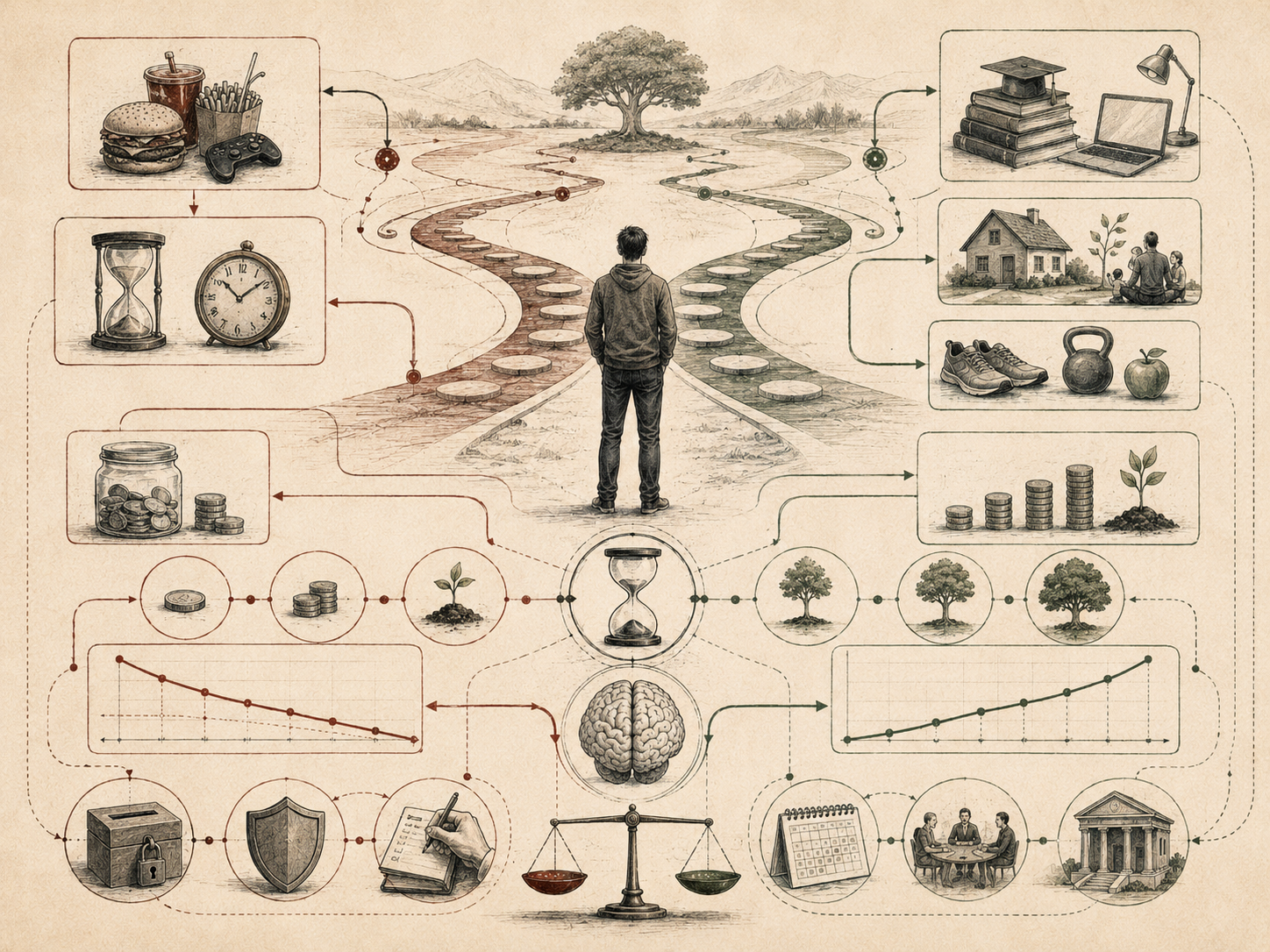
Classical economic models treat discounting as a necessary part of rational decision-making. A benefit available today may reasonably be valued more than the same benefit available later because today’s resources can be consumed, invested, used to reduce risk, or held against uncertainty. But behavioral economics shows that real-world discounting often departs from stable, dynamically consistent models. People do not merely discount the future; they often discount it unevenly, emotionally, contextually, and sometimes self-defeatingly.
This is why time discounting belongs beside present bias, self-control and commitment devices, mental accounting, bounded rationality, and behavioral public policy. Together, these concepts explain why long-run plans often fail at the point of action and why better decision environments can be more effective than information alone.
The Concept of Time Discounting
Time discounting refers to the way future outcomes are valued relative to present outcomes. If a person prefers $100 today to $100 one year from now, that preference reflects discounting. In some cases, discounting is reasonable. Money today can be invested, used for urgent needs, or protected against uncertainty. Future outcomes may be less certain than present outcomes. People also have finite lives, changing circumstances, and legitimate reasons to value present wellbeing.
In economic theory, discounting provides a way to compare benefits and costs that occur at different times. A future benefit is converted into present value by applying a discount factor. The more heavily the future is discounted, the less weight delayed benefits receive in present decision-making. This framework is central to saving, investment, borrowing, health behavior, education, climate policy, infrastructure planning, cost-benefit analysis, and welfare economics.
Behavioral economics does not reject discounting. It asks whether the way people actually discount the future is stable, coherent, and welfare-enhancing. Many decisions suggest that it often is not. Individuals may strongly prefer a larger future reward when both options are distant, then reverse their preference when a smaller reward becomes immediate. They may plan to save next month, study tomorrow, exercise later, or repay debt after the next paycheck, but repeatedly postpone when the future becomes the present.
This pattern matters because long-term welfare is built through cumulative choices. Retirement savings, education, health, debt reduction, skill formation, institutional trust, ecological resilience, and public infrastructure all depend on actions whose benefits often unfold over time. When future benefits are persistently undervalued, private and collective systems become fragile. Time discounting therefore helps explain not only individual behavior, but also the temporal structure of economic and political life.
The concept is especially important because it sits between personal psychology and institutional design. A person’s discount rate is not shaped by personality alone. It is influenced by income security, stress, trust, inflation, credit access, health risk, family obligations, cultural expectations, platform design, policy rules, and institutional reliability. If the future feels uncertain or inaccessible, people may rationally place more weight on the present. A serious treatment of time discounting must therefore distinguish impatience from insecurity and behavioral bias from structural constraint.
Rational Discounting and Present Value
Standard economic models begin with the assumption that future value can be converted into present value. If a future payoff is certain and the discount rate is known, present value can be calculated with precision. This is a powerful tool for investment analysis, public budgeting, financial planning, and cost-benefit analysis. It allows decision-makers to compare projects with different timelines and to ask whether a future benefit is worth a present cost.
The simplest logic is that a dollar today is not equivalent to a dollar tomorrow if today’s dollar can earn a return, reduce debt, purchase protection, or provide immediate utility. Discounting also reflects uncertainty: a future payoff may not occur, or the person may not be able to access it. In this rational sense, discounting is not a bias. It is a way of making intertemporal comparisons under opportunity cost and uncertainty.
However, rational discounting depends on consistency. If preferences are dynamically consistent, then the relative ranking of two future options should remain stable as time passes, unless new information changes the situation. A person who prefers receiving $120 in thirty-one days over $100 in thirty days should also prefer $120 tomorrow over $100 today if the time difference is the same and no new information has appeared. The relative tradeoff is structurally equivalent.
Observed behavior often violates this pattern. People may prefer the larger-later reward when both options are future options, but choose the smaller-sooner reward when it becomes immediately available. This is the transition from discounting as rational valuation to discounting as behavioral instability. The present moment has special psychological force, and that force can change the decision.
Present-value analysis is therefore a benchmark, not a full description of human decision-making. It tells us how future outcomes might be valued under stable assumptions. Behavioral time discounting asks why people often depart from those assumptions, when those departures matter, and how decision environments can be designed to protect long-term welfare without ignoring legitimate present needs.
Behavioral Time Discounting
Behavioral time discounting refers to the empirical and psychological reality that people often discount future outcomes more steeply, unevenly, or contextually than standard models predict. A person may choose immediate consumption over saving even when they recognize the importance of future security. A student may delay studying despite valuing the degree. A household may use costly credit because present consumption is vivid while repayment is delayed. A government may defer maintenance because current spending pressure outweighs future risk.
The future is psychologically distant. Its benefits require imagination, abstraction, and trust. The present is concrete. It can be felt now. This difference makes future outcomes vulnerable to underweighting, especially when the present contains temptation, stress, urgency, social pressure, or emotional relief. Behavioral discounting therefore arises not only from impatience but from salience, emotion, cognitive load, uncertainty, and context.
One key insight is that future-oriented behavior requires more than knowledge. A person may know that saving, exercise, preventive care, education, or climate action is beneficial and still fail to act. Knowledge alone does not eliminate the gap between recognizing future value and choosing present sacrifice. The immediate cost must be paid now, while the future benefit remains delayed and uncertain.
Behavioral discounting also interacts with scarcity. People facing unstable income, debt pressure, housing insecurity, poor health, or institutional distrust may have rational reasons to prioritize the present. A high discount rate can reflect a world in which the future is genuinely uncertain. This is why behavioral economics must be careful: not every present-oriented choice is a cognitive mistake. Sometimes the present is weighted heavily because the person’s circumstances make future planning difficult or risky.
The strongest use of behavioral time discounting is therefore diagnostic, not moralistic. It helps identify when long-term welfare is being undermined by predictable temporal bias, and when present-oriented behavior is better understood as a response to constraint. Good policy must address both.
Hyperbolic and Quasi-Hyperbolic Discounting
Hyperbolic discounting describes a pattern in which people discount the near future much more steeply than the distant future. In contrast to exponential discounting, where the discount rate is stable across time, hyperbolic discounting allows the value of delay to change sharply as outcomes approach the present. This helps explain preference reversals and time-inconsistent behavior.
Under exponential discounting, a delay of one week has the same proportional effect whether it occurs now or a year from now. Under hyperbolic discounting, waiting one week from today can feel much more costly than waiting one week at some distant future point. This makes the present uniquely powerful. The immediate reward is not merely earlier; it is psychologically discontinuous from later rewards.
This framework explains why people often make plans they later abandon. A person may decide on Sunday that they will begin saving next month, study on Wednesday, exercise tomorrow morning, or start a difficult task after lunch. When the future remains future, the long-term plan is easier to endorse. But when the action becomes immediate, the cost or temptation becomes more salient, and the decision can reverse.
Quasi-hyperbolic discounting formalizes this pattern with a present-bias parameter, usually denoted \(\beta\), and a conventional discount factor, usually denoted \(\delta\). The \(\delta\) parameter captures ordinary patience over future periods, while \(\beta\) captures the special discount applied to all future outcomes relative to the present. This structure allows a person to be patient across future periods while still overweighting immediate experience.
The importance of this model is that it explains demand for commitment. If people anticipate that their future selves may reverse plans when temptation becomes immediate, they may choose rules, defaults, restrictions, deadlines, automatic transfers, or penalties that protect long-term goals. Commitment devices are therefore not irrational constraints on freedom. In many cases, they are tools that the reflective self uses to protect future action from foreseeable temporal inconsistency.
Time Discounting and Present Bias
Present bias is a specific form of time discounting in which immediate outcomes receive disproportionate weight relative to all future outcomes. Time discounting is the broader concept: it concerns how future value is reduced relative to present value. Present bias identifies the especially sharp discontinuity between now and later. The present is not simply the first point on a timeline; it is a psychologically privileged position.
This distinction matters because not all discounting is problematic. Some discounting reflects opportunity cost, uncertainty, mortality, investment potential, and rational preference. Present bias becomes behaviorally important when it creates preference reversals, self-control problems, underinvestment, procrastination, or repeated conflict between plans and actions. The person may care deeply about the future, but the immediate alternative dominates at the moment of choice.
Present bias explains why people often prefer future discipline but present indulgence. They may want a future self to save, exercise, study, eat well, spend less, sleep more, or reduce screen time. Yet when the future self becomes the present self, the immediate reward or relief becomes more powerful. This is the behavioral core of many long-term decision failures.
The connection between time discounting and present bias is especially important for policy. If future-oriented behavior fails because people lack information, then education may be enough. If it fails because the present receives disproportionate weight, then information alone will often be weak. Defaults, automation, reminders, deadlines, commitment devices, reduced friction for beneficial behavior, and appropriate friction around harmful immediacy may be necessary.
Present bias also clarifies why some digital environments are so powerful. Platforms that deliver immediate feedback, instant purchase, short-form novelty, one-click consumption, variable rewards, and frictionless borrowing do not merely offer choices. They reshape the temporal structure of choice by making immediate action unusually salient and easy. In doing so, they intensify a behavioral tendency already present in human decision-making.
Personal Finance, Saving, Debt, and Retirement
Personal finance is one of the clearest domains where time discounting shapes outcomes. Saving requires present sacrifice for future security. Debt repayment requires giving up current spending to reduce future costs. Retirement planning requires allocating resources to a future self who may feel abstract. Emergency funds require protecting money for events that may not occur. Each decision asks the present self to honor the future.
Under steep discounting, future financial security loses force. A person may know that saving is important, but immediate consumption feels more concrete. A household may intend to pay down debt but postpone because the present budget feels tight. A worker may value retirement but delay enrollment because the benefit is distant and the current reduction in take-home pay is immediate. These are not simply failures of arithmetic. They are failures of temporal motivation and institutional design.
Consumer credit is especially sensitive to discounting. Borrowing pulls consumption forward and pushes repayment into the future. If future repayment is heavily discounted, credit can feel cheaper than it is. Credit cards, deferred-interest promotions, payday loans, buy-now-pay-later tools, and subscription systems can all exploit the temporal separation between consumption and payment. The more distant, fragmented, or hidden the future cost, the easier it is for present desire to dominate.
Retirement systems reveal the value of behavioral design. Automatic enrollment, payroll deduction, default contribution rates, employer matching, automatic escalation, and target-date funds help future-oriented behavior occur without requiring repeated active decisions. These tools do not eliminate discounting, but they reduce the number of moments in which the worker must choose future security against present spending.
At the same time, financial policy must remain sensitive to liquidity needs. A household facing income volatility, medical risk, caregiving demands, or housing insecurity may rationally prioritize present access to funds. A retirement lock-in that helps one worker may harm another who needs flexibility. Good policy must distinguish destructive present bias from legitimate present need.
Health, Education, Productivity, and Habit Formation
Time discounting is central to health behavior because many health investments impose immediate costs and produce delayed benefits. Exercise requires effort now. Preventive care requires time now. Healthier eating may cost more or require planning now. Sleep discipline requires giving up immediate stimulation now. The benefits are real, but they are often delayed, uncertain, or cumulative.
This helps explain why health knowledge does not always produce health behavior. People may understand the future benefits of prevention but still avoid the immediate inconvenience. A person may know that a screening, appointment, medication routine, or dietary change matters, but the present cost dominates. Behavioral health policy therefore often uses reminders, defaults, appointment scheduling, social support, reduced friction, and commitment structures to bring future benefits into present action.
Education and skill formation follow the same pattern. Studying, practicing, reading, writing, and training are investments. They require present effort for delayed capability. The payoff may come through future grades, degrees, employment, confidence, or skill. But the immediate cost is visible: boredom, difficulty, fatigue, anxiety, or lost leisure. Time discounting helps explain procrastination as an intertemporal-choice problem rather than merely a character flaw.
Productivity also depends on discounting. Difficult work often has delayed benefits, while distraction offers immediate relief. The cost of starting is now; the satisfaction of completion comes later. Digital environments intensify this tradeoff by providing constant low-effort rewards. Habit formation helps by changing the temporal structure of action. When a behavior becomes routine, it no longer requires repeated deliberation against immediate temptation.
In these domains, better outcomes usually require more than motivation. They require environments that make future-oriented action easier at the moment when present-oriented alternatives are strongest. Timely prompts, visible progress, staged deadlines, social accountability, automation, and friction around harmful immediacy all help translate long-term goals into behavior.
Institutional Short-Termism and Governance
Time discounting does not only affect individuals. Institutions also discount the future. Firms may underinvest in maintenance, worker development, safety, resilience, or environmental responsibility because short-term returns dominate. Governments may defer infrastructure repair, public-health preparation, climate adaptation, pension funding, or institutional reform because current costs are politically visible while future benefits are delayed. Organizations may sacrifice long-term trust for short-term metrics.
Institutional short-termism is partly a structural problem. Election cycles, quarterly reporting, annual budgets, performance targets, political incentives, investor pressure, and media attention all make the present highly salient. Long-term benefits are often diffuse, uncertain, or credited to future leaders. Prevented disasters rarely receive the same recognition as visible emergency response. Maintenance is less politically dramatic than new construction. Prevention is less visible than crisis management.
Time discounting therefore helps explain why systems become fragile despite awareness of risk. A bridge may need maintenance, but repair can be postponed. A public-health system may need preparedness, but funding can be delayed. A city may need climate adaptation, but the worst harms may appear years later. A company may need culture repair, but quarterly results dominate. The future loses in institutional competition with the present.
Behavioral governance responds by designing institutions that give the future more weight. Examples include long-term budgeting rules, independent oversight bodies, infrastructure maintenance funds, climate targets with interim milestones, automatic stabilizers, resilience audits, pension funding requirements, public-health preparedness mandates, and transparency systems that make future risks visible today.
The central institutional question is not whether future benefits matter in principle. Most institutions say they do. The question is whether the system has mechanisms strong enough to protect future-oriented action when present pressures intensify. Time discounting is therefore a governance problem as much as a psychological one.
Time Discounting and Sustainability
Sustainability is one of the most consequential domains of time discounting. Climate mitigation, biodiversity protection, soil health, water security, pollution control, public infrastructure, disaster preparedness, and ecological restoration all require present action for delayed benefit. The costs are often immediate. The gains may be distributed across decades, places, populations, and generations.
Discount rates shape how societies evaluate those tradeoffs. A high discount rate gives much less weight to future harms and benefits, making long-term environmental action appear less urgent. A low discount rate gives greater weight to future welfare, strengthening the case for prevention, mitigation, and resilience. This is why debates over climate economics and sustainability policy often become debates over the ethical and empirical meaning of discounting.
The issue is not only technical. It is moral and political. Future people cannot fully represent themselves in present decisions. Ecosystems do not vote. Slow-moving harms often lack the emotional force of immediate crises. If institutions discount the future steeply, they may underinvest in planetary stability even when long-term consequences are severe and foreseeable.
Behavioral time discounting also interacts with inequality. The immediate costs of sustainability policy are not evenly distributed. People facing poverty, energy insecurity, food insecurity, housing instability, or precarious work cannot be asked to absorb present costs without support. A just sustainability policy must address present hardship while protecting future welfare. Long-term responsibility and immediate justice are not opposing goals; they must be designed together.
Sustainability governance therefore requires institutions that make future harms visible, reduce upfront burdens, distribute costs fairly, and create durable commitments. Carbon policy, infrastructure investment, conservation rules, resilience planning, clean-energy defaults, public finance, and adaptation programs all must confront the behavioral and institutional tendency to postpone.
Implications for Policy Design
Recognizing time discounting changes how policy should be designed. If long-term action fails because people or institutions undervalue future outcomes at the moment of choice, then simply providing information may not be enough. People may already know what they should do. The problem is that the decision environment gives too much practical power to the present.
Effective policy can respond by changing timing, salience, friction, defaults, and commitment structure. Automatic enrollment makes future-oriented behavior the default. Payroll deduction moves saving before discretionary spending. Reminders bring future obligations into present attention. Milestones divide distant goals into near-term action. Commitment devices increase the cost of deviation. Subsidies reduce immediate costs. Cooling-off periods slow impulsive decisions. Disclosures become more effective when they are timely, clear, and connected to action.
Policy design should also distinguish soft from hard interventions. Soft tools include reminders, labels, prompts, goal-setting, defaults, and planning aids. Hard tools include penalties, lock-ins, restrictions, mandates, and legally binding commitments. Harder tools may be justified when stakes are high, harms are severe, or externalities are substantial, but they also create greater risks of paternalism, rigidity, and unequal burden.
The welfare standard matters. A policy that increases saving but worsens hardship is not automatically successful. A policy that reduces consumption but increases stress may have mixed effects. A policy that improves long-term outcomes for affluent households while burdening low-income households may be unjust. Behavioral policy must evaluate welfare, distribution, autonomy, and flexibility, not only the targeted behavior.
Good policy works with human temporal psychology without reducing people to bias. It asks what future-oriented goals people have reason to endorse, what present barriers prevent action, what structural constraints shape discounting, and what institutions can do to make long-term welfare more practically attainable.
Digital Platforms and the Compression of Time
Digital platforms have changed the temporal structure of decision-making. Many digital environments compress the distance between impulse and action: one-click purchasing, autoplay, instant messaging, short-form video, frictionless checkout, algorithmic recommendations, real-time trading, app notifications, infinite scroll, and buy-now-pay-later financing. These features make immediate reward faster, more salient, and easier to access.
This matters because time discounting is sensitive to friction and immediacy. A delayed cost that is hidden or separated from a present reward will often receive less weight. A subscription that renews automatically may feel less costly than repeated active payment. A buy-now-pay-later purchase may feel more affordable because payment is moved into the future. A trading app may make speculation feel immediate and game-like while risk unfolds later.
Digital systems can also support better intertemporal decisions. Budgeting apps can show future obligations. Savings tools can automate transfers. Calendar systems can create commitments. Health apps can schedule reminders. Learning platforms can break future goals into daily practice. Screen-time tools can add friction to distraction. The same design capacity that can exploit discounting can also help people manage it.
The ethical distinction depends on alignment. A user-aligned design helps people act on goals they reflectively endorse. An exploitative design uses immediacy to increase engagement, spending, borrowing, trading, or subscription retention despite long-term user harm. Digital governance should therefore pay attention not only to privacy and data, but to the temporal architecture of choice.
Platforms are now major institutions of time. They decide what appears now, what can be postponed, what is frictionless, what is hidden, and what future consequences are made visible. Time discounting should be part of any serious analysis of digital power.
Ethical Questions: Future Welfare, Autonomy, and Intergenerational Justice
Time discounting raises ethical questions because it affects whose welfare counts and when. Discounting a future benefit may be rational in private finance, but the ethical meaning changes when future harms fall on other people, vulnerable communities, or future generations. A private decision to consume now may impose costs later on children, workers, ecosystems, taxpayers, or distant populations. Intertemporal choice is often also social choice.
Autonomy is central. People should not be treated as incapable of making their own tradeoffs. Present consumption can be meaningful, urgent, restorative, or necessary. A policy that assumes all present-oriented behavior is irrational can become paternalistic and unjust. But autonomy is also undermined when institutions exploit time discounting through hidden costs, manipulative defaults, subscription traps, predatory credit, or engagement systems designed to overpower attention.
Commitment can support autonomy when it helps people act on goals they endorse under reflection. A retirement default, savings automation, cooling-off period, or self-exclusion tool may protect long-term agency. But commitment can become coercive if it is imposed without transparency, exit, flexibility, or regard for unequal circumstances. The ethical question is whether the structure supports human agency or substitutes institutional control for it.
Intergenerational justice is especially important. Future people cannot bargain with the present. If current institutions heavily discount future welfare, they can justify underinvestment in climate stability, public health, infrastructure, debt sustainability, biodiversity, and social resilience. Discounting becomes ethically dangerous when it turns future suffering into a small present-value inconvenience.
A morally serious approach to time discounting must therefore combine behavioral realism with justice. It must recognize the pull of the present, protect people under present hardship, resist manipulative exploitation, and build institutions capable of honoring future welfare.
Empirical and Policy-Evaluation Lens
A professional economist-facing treatment of time discounting should ask what can be measured, identified, estimated, and evaluated. Time discounting can be studied through experimental choices between smaller-sooner and larger-later rewards, field experiments on savings and debt, retirement-plan defaults, health adherence programs, education interventions, digital-platform behavior, energy consumption, and policy responses to long-term risk.
The empirical challenge is that discounting is not directly observed. Researchers observe choices, but the same choice can reflect different mechanisms. A person may choose immediate money because of impatience, present bias, liquidity need, income insecurity, distrust, uncertainty, debt pressure, or urgent household obligations. A government may delay climate action because of present bias, political incentives, lobbying, fiscal constraints, or distributional conflict. Careful research design is necessary.
Useful empirical strategies include randomized commitment offers, default changes, savings automation, timing variation, delayed-reward experiments, reminder interventions, field experiments with upfront-cost reduction, and structural estimation of discounting parameters. Researchers can compare exponential and hyperbolic models, estimate heterogeneity, and test whether interventions improve long-term outcomes without increasing present hardship.
Outcome choice is critical. A policy that increases saving may reduce liquidity. A policy that increases preventive care may increase stress or administrative burden if poorly designed. A policy that delays consumption may improve future welfare for some groups and harm others. Evaluation should include behavior, welfare, autonomy, flexibility, distribution, and long-term resilience.
Heterogeneity is central. Discounting may vary by income, age, health, trust, inflation expectations, stress, debt burden, cultural context, employment stability, and institutional reliability. Present-oriented behavior may be more adaptive under scarcity than under security. Average treatment effects can obscure these differences. Serious policy analysis should ask not only whether discounting can be changed, but whose future becomes more secure and whose present becomes more burdened.
An Analytical Framework for Time Discounting
A basic intertemporal model compares utility across time. Under standard exponential discounting, present utility from a stream of outcomes \(x_t\) can be written as:
U_0 = \sum_{t=0}^{T} \delta^t u(x_t)
\]
Interpretation: Future utility is discounted by the factor \(\delta^t\), where \(0 < \delta \leq 1\).
When \(\delta\) is close to 1, the future receives substantial weight. When \(\delta\) is low, future outcomes receive much less weight. This model is dynamically consistent: the relative weighting of future periods remains stable as time passes.
Present value can be written for monetary benefits as:
PV = \frac{FV}{(1+r)^t}
\]
Interpretation: A future value \(FV\) is converted into present value using a discount rate \(r\) over \(t\) periods.
Behavioral economics modifies this framework by allowing the present to receive special weight. In quasi-hyperbolic form:
U_0 = u(x_0) + \beta \sum_{t=1}^{T}\delta^t u(x_t)
\]
Interpretation: The parameter \(\beta\) captures present bias, while \(\delta\) captures ordinary patience across future periods.
When \(0 < \beta < 1\), all future outcomes are downweighted relative to the present. This helps explain why a person may prefer a larger-later reward in advance but switch to a smaller-sooner reward when the smaller reward becomes immediate.
A choice between an immediate reward \(S\) and a delayed reward \(L\) can be represented as:
\text{Choose } L \text{ if } \beta\delta^d u(L) \geq u(S)
\]
Interpretation: The delayed reward must overcome both ordinary delay discounting and the present-bias penalty.
A commitment device can modify the immediate option by adding a deviation cost \(k\), reminder support \(A\), or implementation structure:
\beta\delta^d u(L) + A \geq u(S) – k
\]
Interpretation: Commitment and implementation support help delayed benefits compete with immediate reward.
For policy evaluation, the effect of a discounting-related intervention can be represented as:
\tau = E[Y_i(1) – Y_i(0)]
\]
Interpretation: The treatment effect compares outcomes under an intervention with outcomes under a comparison condition.
A broader welfare expression should include future gains, present costs, flexibility, and burden:
W_i = F_i – C_i + L_i – B_i
\]
Interpretation: Welfare depends on future gains, immediate costs, liquidity or flexibility value, and behavioral or administrative burden.
This framework prevents a narrow conclusion that lower discounting is always better. A person or institution may value the present for valid reasons. The policy question is whether intertemporal choices support welfare, dignity, resilience, and justice across time.
R Workflow: Simulating Discounting, Delay, and Long-Term Choice
The following R workflow simulates a synthetic population with heterogeneous discount factors, present-bias parameters, immediate rewards, delayed rewards, liquidity needs, and commitment support. It compares exponential discounting, present-biased discounting, and present-biased discounting with commitment support. The workflow is designed as an economist-facing scaffold for intertemporal-choice research, behavioral public policy, household finance, health behavior, education, and sustainability governance.
# Time Discounting and Long-Term Decision-Making
# R workflow: exponential discounting, present bias, and commitment support
# Synthetic data only. Economist-facing research scaffold.

set.seed(1717)

n_agents <- 2500
n_periods <- 36

agents <- data.frame(
  agent_id = 1:n_agents,
  beta = runif(n_agents, 0.55, 1.00),
  delta = runif(n_agents, 0.93, 0.99),
  immediate_reward_base = runif(n_agents, 80, 190),
  future_goal_value = runif(n_agents, 140, 320),
  sophistication = runif(n_agents, 0.20, 1.00),
  liquidity_need = runif(n_agents, 0.05, 0.35)
)

simulate_discount_regime <- function(regime_name, use_present_bias, commitment_support, flexibility) {

  history <- vector("list", n_periods)
  cumulative_delayed_choices <- rep(0, n_agents)
  cumulative_welfare <- rep(0, n_agents)

  for (t in seq_len(n_periods)) {

    delayed_reward <- agents$future_goal_value * runif(n_agents, 0.80, 1.30)
    immediate_reward <- agents$immediate_reward_base * runif(n_agents, 0.85, 1.25)

    if (use_present_bias) {
      delayed_value <- agents$beta * (agents$delta ^ (n_periods - t)) * delayed_reward
    } else {
      delayed_value <- (agents$delta ^ (n_periods - t)) * delayed_reward
    }

    support_value <- commitment_support * agents$sophistication * 50
    flexibility_penalty <- agents$liquidity_need * (1 - flexibility) * 30

    immediate_value <- immediate_reward - support_value + flexibility_penalty

    choose_delayed <- as.integer(delayed_value >= immediate_value)

    period_welfare <- choose_delayed * delayed_reward -
      (1 - choose_delayed) * 0.20 * delayed_reward -
      flexibility_penalty

    cumulative_delayed_choices <- cumulative_delayed_choices + choose_delayed
    cumulative_welfare <- cumulative_welfare + period_welfare

    history[[t]] <- data.frame(
      period = t,
      agent_id = agents$agent_id,
      regime = regime_name,
      beta = agents$beta,
      delta = agents$delta,
      sophistication = agents$sophistication,
      liquidity_need = agents$liquidity_need,
      delayed_reward = delayed_reward,
      immediate_reward = immediate_reward,
      delayed_value = delayed_value,
      immediate_value = immediate_value,
      choose_delayed = choose_delayed,
      period_welfare = period_welfare,
      cumulative_delayed_choices = cumulative_delayed_choices,
      cumulative_welfare = cumulative_welfare,
      commitment_support = commitment_support,
      flexibility = flexibility
    )
  }

  do.call(rbind, history)
}

exponential <- simulate_discount_regime(
  regime_name = "exponential_discounting",
  use_present_bias = FALSE,
  commitment_support = 0.00,
  flexibility = 1.00
)

present_biased <- simulate_discount_regime(
  regime_name = "present_biased_discounting",
  use_present_bias = TRUE,
  commitment_support = 0.00,
  flexibility = 1.00
)

commitment_supported <- simulate_discount_regime(
  regime_name = "present_bias_with_commitment_support",
  use_present_bias = TRUE,
  commitment_support = 0.70,
  flexibility = 0.75
)

panel <- rbind(exponential, present_biased, commitment_supported)

final_period <- panel[panel$period == n_periods, ]

regime_summary <- aggregate(
  cbind(choose_delayed, cumulative_delayed_choices, cumulative_welfare) ~ regime,
  data = final_period,
  FUN = mean
)

panel$beta_quartile <- cut(
  panel$beta,
  breaks = quantile(panel$beta, probs = seq(0, 1, 0.25)),
  include.lowest = TRUE,
  labels = paste0("Q", 1:4)
)

beta_heterogeneity <- aggregate(
  cbind(choose_delayed, cumulative_delayed_choices, cumulative_welfare) ~ regime + beta_quartile,
  data = panel[panel$period == n_periods, ],
  FUN = mean
)

print(regime_summary)
print(beta_heterogeneity)

dir.create("outputs/tables", recursive = TRUE, showWarnings = FALSE)

write.csv(panel, "outputs/tables/r_time_discounting_panel.csv", row.names = FALSE)
write.csv(regime_summary, "outputs/tables/r_time_discounting_regime_summary.csv", row.names = FALSE)
write.csv(beta_heterogeneity, "outputs/tables/r_time_discounting_beta_heterogeneity.csv", row.names = FALSE)
This simulation shows how present-biased discounting can reduce delayed choice relative to exponential discounting, while commitment support can partially restore long-term action. The workflow also keeps flexibility visible, which matters because rigid commitment can impose costs on people facing genuine liquidity needs.
Python Workflow: Comparing Intertemporal Regimes Under Different Discount Structures
The following Python workflow compares exponential discounting, present-biased discounting, and present-biased discounting with commitment support. It produces synthetic agent-period data, regime-level summaries, treatment-effect estimates, and heterogeneity tables by present-bias and liquidity-need quartiles. The workflow is designed for professional behavioral-economics, public-policy, household-finance, and sustainability-governance scaffolding.
# Time Discounting and Long-Term Decision-Making
# Python workflow: exponential discounting, present bias, commitment support, and welfare
# Synthetic data only. Economist-facing research scaffold.

from __future__ import annotations

from pathlib import Path

import numpy as np
import pandas as pd

rng = np.random.default_rng(1717)

n_agents = 3000
n_periods = 36

agents = pd.DataFrame({
    "agent_id": np.arange(1, n_agents + 1),
    "beta": rng.uniform(0.55, 1.00, n_agents),
    "delta": rng.uniform(0.93, 0.99, n_agents),
    "immediate_reward_base": rng.uniform(80, 190, n_agents),
    "future_goal_value": rng.uniform(140, 320, n_agents),
    "sophistication": rng.uniform(0.20, 1.00, n_agents),
    "liquidity_need": rng.uniform(0.05, 0.35, n_agents),
})

def simulate_discount_regime(
    regime_name: str,
    use_present_bias: bool,
    commitment_support: float,
    flexibility: float
) -> pd.DataFrame:
    """Simulate long-term choice under a discounting regime."""
    cumulative_delayed_choices = np.zeros(n_agents)
    cumulative_welfare = np.zeros(n_agents)
    rows = []

    for period in range(1, n_periods + 1):
        delayed_reward = agents["future_goal_value"].to_numpy() * rng.uniform(0.80, 1.30, n_agents)
        immediate_reward = agents["immediate_reward_base"].to_numpy() * rng.uniform(0.85, 1.25, n_agents)

        if use_present_bias:
            delayed_value = (
                agents["beta"].to_numpy()
                * (agents["delta"].to_numpy() ** (n_periods - period))
                * delayed_reward
            )
        else:
            delayed_value = (
                agents["delta"].to_numpy() ** (n_periods - period)
            ) * delayed_reward

        support_value = commitment_support * agents["sophistication"].to_numpy() * 50
        flexibility_penalty = agents["liquidity_need"].to_numpy() * (1 - flexibility) * 30

        immediate_value = immediate_reward - support_value + flexibility_penalty

        choose_delayed = (delayed_value >= immediate_value).astype(int)

        period_welfare = (
            choose_delayed * delayed_reward
            - (1 - choose_delayed) * 0.20 * delayed_reward
            - flexibility_penalty
        )

        cumulative_delayed_choices += choose_delayed
        cumulative_welfare += period_welfare

        rows.append(pd.DataFrame({
            "period": period,
            "agent_id": agents["agent_id"],
            "regime": regime_name,
            "beta": agents["beta"],
            "delta": agents["delta"],
            "sophistication": agents["sophistication"],
            "liquidity_need": agents["liquidity_need"],
            "delayed_reward": delayed_reward,
            "immediate_reward": immediate_reward,
            "delayed_value": delayed_value,
            "immediate_value": immediate_value,
            "choose_delayed": choose_delayed,
            "period_welfare": period_welfare,
            "cumulative_delayed_choices": cumulative_delayed_choices,
            "cumulative_welfare": cumulative_welfare,
            "commitment_support": commitment_support,
            "flexibility": flexibility,
            "present_bias_treat": int(regime_name == "present_biased_discounting"),
            "commitment_support_treat": int(regime_name == "present_bias_with_commitment_support"),
        }))

    return pd.concat(rows, ignore_index=True)

panel = pd.concat([
    simulate_discount_regime(
        regime_name="exponential_discounting",
        use_present_bias=False,
        commitment_support=0.00,
        flexibility=1.00
    ),
    simulate_discount_regime(
        regime_name="present_biased_discounting",
        use_present_bias=True,
        commitment_support=0.00,
        flexibility=1.00
    ),
    simulate_discount_regime(
        regime_name="present_bias_with_commitment_support",
        use_present_bias=True,
        commitment_support=0.70,
        flexibility=0.75
    )
], ignore_index=True)

final = panel.loc[panel["period"] == n_periods].copy()

summary = final.groupby("regime").agg(
    agents=("agent_id", "count"),
    mean_choose_delayed=("choose_delayed", "mean"),
    mean_cumulative_delayed_choices=("cumulative_delayed_choices", "mean"),
    mean_cumulative_welfare=("cumulative_welfare", "mean"),
    mean_commitment_support=("commitment_support", "mean"),
    mean_flexibility=("flexibility", "mean"),
).reset_index()

print(summary.sort_values("mean_cumulative_welfare", ascending=False))

try:
    import statsmodels.api as sm

    outcomes = [
        "choose_delayed",
        "cumulative_delayed_choices",
        "cumulative_welfare"
    ]

    for outcome in outcomes:
        X = final[[
            "present_bias_treat",
            "commitment_support_treat",
            "beta",
            "delta",
            "sophistication",
            "liquidity_need",
            "commitment_support",
            "flexibility"
        ]]
        X = sm.add_constant(X)

        model = sm.OLS(final[outcome], X).fit(cov_type="HC1")

        print(f"\nOutcome: {outcome}")
        print(model.summary().tables[1])

except ImportError:
    print("statsmodels is not installed; skipping regression table.")

final["beta_quartile"] = pd.qcut(final["beta"], 4, labels=["Q1", "Q2", "Q3", "Q4"])
final["liquidity_quartile"] = pd.qcut(final["liquidity_need"], 4, labels=["Q1", "Q2", "Q3", "Q4"])

beta_heterogeneity = final.groupby(["regime", "beta_quartile"], observed=False).agg(
    mean_choose_delayed=("choose_delayed", "mean"),
    mean_cumulative_delayed_choices=("cumulative_delayed_choices", "mean"),
    mean_cumulative_welfare=("cumulative_welfare", "mean"),
).reset_index()

liquidity_heterogeneity = final.groupby(["regime", "liquidity_quartile"], observed=False).agg(
    mean_choose_delayed=("choose_delayed", "mean"),
    mean_cumulative_delayed_choices=("cumulative_delayed_choices", "mean"),
    mean_cumulative_welfare=("cumulative_welfare", "mean"),
).reset_index()

output_dir = Path("outputs/tables")
output_dir.mkdir(parents=True, exist_ok=True)

panel.to_csv(output_dir / "synthetic_time_discounting_panel.csv", index=False)
final.to_csv(output_dir / "synthetic_time_discounting_experiment.csv", index=False)
summary.to_csv(output_dir / "time_discounting_regime_summary.csv", index=False)
beta_heterogeneity.to_csv(output_dir / "time_discounting_beta_heterogeneity.csv", index=False)
liquidity_heterogeneity.to_csv(output_dir / "time_discounting_liquidity_heterogeneity.csv", index=False)
For analysts and policymakers, the key lesson is that future-oriented behavior depends not only on the objective value of delayed rewards, but on how delay is psychologically and institutionally structured. Time discounting can be modeled, but it must also be interpreted within real constraints, including liquidity risk, trust, uncertainty, and institutional design.
Stata Replication Note: Time Discounting and Long-Term Choice
For an economist-facing repository, the companion code should support Stata as well as R and Python. The article-level GitHub folder should include a Stata workflow that imports the synthetic time-discounting experiment, estimates treatment effects, reports robust standard errors, and exports regression tables. A compact Stata pattern for this article would look like this:
clear all
set more off

* Time Discounting and Long-Term Decision-Making
* Stata intertemporal-choice evaluation workflow using synthetic data.

global ROOT "`c(pwd)'"
global TABLES "$ROOT/outputs/tables"
global REG "$ROOT/outputs/regression_tables"

capture mkdir "$REG"

import delimited "$TABLES/synthetic_time_discounting_experiment.csv", clear varnames(1)

label variable present_bias_treat "Present-biased discounting treatment"
label variable commitment_support_treat "Present bias with commitment support treatment"
label variable choose_delayed "Delayed choice indicator"
label variable cumulative_delayed_choices "Cumulative delayed choices"
label variable cumulative_welfare "Synthetic cumulative welfare"

local controls beta delta sophistication liquidity_need commitment_support flexibility
local outcomes choose_delayed cumulative_delayed_choices cumulative_welfare

tempname handle
postfile `handle' str55 outcome str55 term double estimate double std_error double p_value double n using "$REG/stata_time_discounting_estimates.dta", replace

foreach y of local outcomes {
    regress `y' present_bias_treat commitment_support_treat `controls', vce(robust)

    foreach x in present_bias_treat commitment_support_treat {
        local b = _b[`x']
        local se = _se[`x']
        local p = 2 * ttail(e(df_r), abs(_b[`x'] / _se[`x']))
        local n = e(N)
        post `handle' ("`y'") ("`x'") (`b') (`se') (`p') (`n')
    }
}

postclose `handle'

use "$REG/stata_time_discounting_estimates.dta", clear
export delimited using "$REG/stata_time_discounting_estimates.csv", replace

* Heterogeneity by present-bias quartile.
import delimited "$TABLES/synthetic_time_discounting_experiment.csv", clear varnames(1)

xtile beta_quartile = beta, nq(4)

tempname h
postfile `h' str30 group str55 term double estimate double std_error double p_value double n using "$REG/stata_time_discounting_beta_heterogeneity.dta", replace

forvalues q = 1/4 {
    regress cumulative_delayed_choices present_bias_treat commitment_support_treat `controls' if beta_quartile == `q', vce(robust)

    foreach x in present_bias_treat commitment_support_treat {
        local b = _b[`x']
        local se = _se[`x']
        local p = 2 * ttail(e(df_r), abs(_b[`x'] / _se[`x']))
        local n = e(N)
        post `h' ("beta_q`q'") ("`x'") (`b') (`se') (`p') (`n')
    }
}

postclose `h'

use "$REG/stata_time_discounting_beta_heterogeneity.dta", clear
export delimited using "$REG/stata_time_discounting_beta_heterogeneity.csv", replace

display "Stata time-discounting evaluation workflow complete."
The purpose of including Stata is to make the repository useful to economists, behavioral public policy researchers, household-finance analysts, sustainability researchers, health economists, education researchers, institutional designers, and graduate-level applied researchers who commonly work across Stata, R, and Python. The full repository scaffold should include identification notes, robustness plans, replication instructions, synthetic intertemporal-choice panels, discount-structure comparisons, treatment-effect estimation, present-bias heterogeneity, welfare diagnostics, and flexibility analysis.
GitHub Repository
The companion repository provides reproducible scaffolding for the computational side of this article, including synthetic intertemporal-choice datasets, exponential and present-biased discounting simulations, quasi-hyperbolic discounting workflows, commitment-support evaluation, delayed-choice models, treatment-effect estimation, heterogeneity analysis, welfare diagnostics, robustness checks, Stata/R/Python workflows, SQL metadata structures, and scientific-computing examples for behavioral economics research.
Complete Code Repository
This article is supported by an article-level folder in the Behavioral Economics computational repository, with synthetic intertemporal-choice and time-discounting datasets, causal-inference workflows, exponential and quasi-hyperbolic discounting simulations, commitment-support diagnostics, delayed-choice models, welfare and flexibility analysis, econometric identification notes, policy-evaluation scripts, robustness and sensitivity checks, Stata/R/Python workflows, SQL metadata structures, and scientific-computing examples for studying time discounting, present bias, delayed gratification, self-control, commitment devices, savings behavior, health behavior, education, sustainability governance, digital platforms, and institutional design.
Interpretive Limits and Cautions
Time discounting is powerful, but it should not be used to explain every short-term decision as irrational. People often prioritize the present because the present is genuinely demanding. Low income, debt, unstable housing, medical needs, food insecurity, caregiving responsibilities, unsafe work, inflation, institutional distrust, and uncertain access to future resources can all make immediate needs more urgent than distant goals. In such cases, high discounting may reflect constrained reality rather than cognitive error.
There is also a risk of moralizing intertemporal choice. A person who does not save may be facing inadequate wages or volatile expenses. A student who procrastinates may be overwhelmed or unsupported. A patient who delays care may face cost, transportation, fear, or access barriers. A community that resists climate policy may be worried about present energy costs or job loss. Behavioral analysis should deepen explanation, not flatten it into personal failure.
Discounting also has legitimate uses. A future benefit should not always dominate a present need. People deserve present dignity, not only future optimization. A policy that sacrifices current wellbeing in the name of distant gains may be ethically unacceptable if burdens fall on those already disadvantaged. Long-term responsibility must be paired with immediate justice.
Commitment devices and defaults should also be used carefully. They can help people act on long-term goals, but they can also become coercive, rigid, or exploitative. Withdrawal penalties, lock-ins, automatic renewals, and default settings can protect welfare or undermine it depending on design. The ethical question is whether the structure supports reflective agency, preserves meaningful flexibility, and avoids institutional exploitation.
Finally, public discounting involves intergenerational ethics. The choice of discount rate in climate policy, infrastructure, public health, and ecological protection is not merely technical. It affects how much present institutions value future lives, future ecosystems, and future vulnerability. Discounting should therefore be treated as both an analytic tool and a moral choice.
Conclusion
Time discounting is central to behavioral economics because it explains why immediate outcomes often dominate decisions even when future gains are larger, more durable, or more aligned with long-term welfare. The concept begins with a rational insight: future outcomes must be compared with present outcomes. But behavioral evidence shows that people and institutions often discount the future unevenly, contextually, and sometimes in ways that undermine their own goals.
The importance of time discounting lies in its reach. It connects household saving, consumer debt, education, health behavior, productivity, digital platforms, climate policy, public infrastructure, and institutional governance. It shows why long-horizon welfare often depends not merely on better intentions, but on systems that help future-oriented decisions survive the pressures of the present.
The mature lesson is not that people should always value the future more than the present. Present needs matter. Liquidity matters. Dignity matters. Uncertainty matters. The lesson is that intertemporal choices should be designed and evaluated with honesty about human psychology, structural constraint, and ethical responsibility. Long-term planning fails when the future is abstract, unsupported, or institutionally weak.
In that sense, time discounting is one of the most important bridges between behavioral economics and public life. It reminds us that the future is not protected by being valuable in theory. It is protected by institutions, habits, policies, and decision environments strong enough to make future welfare actionable now.
Related Articles
- Behavioral Economics
- Present Bias and Immediate Reward
- Self-Control and Commitment Devices in Behavioral Economics
- Mental Accounting in Personal Finance
- Bounded Rationality in Economic Decision-Making
- Loss Aversion and Risk Perception
- Framing Effects in Consumer Choice
- Choice Architecture and Decision Environments
- Nudge Theory and Behavioral Public Policy
- Behavioral Insights in Environmental Policy
Further Reading
- Ainslie, G. (1992) Picoeconomics: The Strategic Interaction of Successive Motivational States within the Person. Cambridge: Cambridge University Press. Available at: https://www.cambridge.org/core/books/picoeconomics/1442781F68E179BB47131B6C541956A6.
- Arrow, K.J. et al. (2013) ‘Determining benefits and costs for future generations’, Science, 341(6144), pp. 349–350. Available at: https://www.science.org/doi/10.1126/science.1235665.
- Benartzi, S. and Thaler, R.H. (2004) ‘Save more tomorrow: Using behavioral economics to increase employee saving’, Journal of Political Economy, 112(S1), pp. S164–S187. Available at: https://www.journals.uchicago.edu/doi/10.1086/380085.
- Frederick, S., Loewenstein, G. and O’Donoghue, T. (2002) ‘Time discounting and time preference: A critical review’, Journal of Economic Literature, 40(2), pp. 351–401. Available at: https://www.aeaweb.org/articles?id=10.1257/002205102320161311.
- Laibson, D. (1997) ‘Golden eggs and hyperbolic discounting’, Quarterly Journal of Economics, 112(2), pp. 443–478. Available at: https://academic.oup.com/qje/article/112/2/443/1870925.
- O’Donoghue, T. and Rabin, M. (1999) ‘Doing it now or later’, American Economic Review, 89(1), pp. 103–124. Available at: https://www.aeaweb.org/articles?id=10.1257/aer.89.1.103.
- O’Donoghue, T. and Rabin, M. (2015) ‘Present bias: Lessons learned and to be learned’, American Economic Review, 105(5), pp. 273–279. Available at: https://www.aeaweb.org/articles?id=10.1257/aer.p20151085.
- Samuelson, P.A. (1937) ‘A note on measurement of utility’, Review of Economic Studies, 4(2), pp. 155–161. Available at: https://academic.oup.com/restud/article-abstract/4/2/155/1547877.
- Strotz, R.H. (1955) ‘Myopia and inconsistency in dynamic utility maximization’, Review of Economic Studies, 23(3), pp. 165–180. Available at: https://academic.oup.com/restud/article-abstract/23/3/165/1547858.
- Thaler, R.H. (2015) Misbehaving: The Making of Behavioral Economics. New York: W.W. Norton. Available at: https://wwnorton.com/books/misbehaving/.
References
- Ainslie, G. (1992) Picoeconomics: The Strategic Interaction of Successive Motivational States within the Person. Cambridge: Cambridge University Press. Available at: https://www.cambridge.org/core/books/picoeconomics/1442781F68E179BB47131B6C541956A6.
- Arrow, K.J. et al. (2013) ‘Determining benefits and costs for future generations’, Science, 341(6144), pp. 349–350. Available at: https://www.science.org/doi/10.1126/science.1235665.
- Benartzi, S. and Thaler, R.H. (2004) ‘Save more tomorrow: Using behavioral economics to increase employee saving’, Journal of Political Economy, 112(S1), pp. S164–S187. Available at: https://www.journals.uchicago.edu/doi/10.1086/380085.
- Frederick, S., Loewenstein, G. and O’Donoghue, T. (2002) ‘Time discounting and time preference: A critical review’, Journal of Economic Literature, 40(2), pp. 351–401. Available at: https://www.aeaweb.org/articles?id=10.1257/002205102320161311.
- Laibson, D. (1997) ‘Golden eggs and hyperbolic discounting’, Quarterly Journal of Economics, 112(2), pp. 443–478. Available at: https://academic.oup.com/qje/article/112/2/443/1870925.
- O’Donoghue, T. and Rabin, M. (1999) ‘Doing it now or later’, American Economic Review, 89(1), pp. 103–124. Available at: https://www.aeaweb.org/articles?id=10.1257/aer.89.1.103.
- O’Donoghue, T. and Rabin, M. (2015) ‘Present bias: Lessons learned and to be learned’, American Economic Review, 105(5), pp. 273–279. Available at: https://www.aeaweb.org/articles?id=10.1257/aer.p20151085.
- Samuelson, P.A. (1937) ‘A note on measurement of utility’, Review of Economic Studies, 4(2), pp. 155–161. Available at: https://academic.oup.com/restud/article-abstract/4/2/155/1547877.
- Strotz, R.H. (1955) ‘Myopia and inconsistency in dynamic utility maximization’, Review of Economic Studies, 23(3), pp. 165–180. Available at: https://academic.oup.com/restud/article-abstract/23/3/165/1547858.
- Thaler, R.H. (2015) Misbehaving: The Making of Behavioral Economics. New York: W.W. Norton. Available at: https://wwnorton.com/books/misbehaving/.