
Last Updated May 20, 2026
Cognitive biases are systematic patterns of deviation from normative, statistical, or criterion-based models of reasoning that emerge from the structure and constraints of human cognition. In cognitive psychology, biases are not treated as random mistakes or occasional lapses. They are understood as predictable outcomes of heuristics, limited capacity, selective attention, memory reconstruction, affective valuation, prior belief, and information-processing strategies that allow judgment and action under uncertainty. Bias reveals how the mind trades computational efficiency for accuracy in complex environments.
Cognitive biases arise from the interaction of core cognitive systems. Attention filters information. Memory supplies prior experience and reconstructive interpretation. Working memory constrains how much can be processed at once. Heuristics simplify complex tasks. Decision making integrates these inputs into action under time pressure, uncertainty, risk, and consequence. Because these systems operate under limitation, bias is not external to cognition. It is one recurrent consequence of cognition working the way it must.
Rather than treating biases as simple failures of rationality, contemporary research often frames them as features of an adaptive cognitive system. The same mechanisms that make thought efficient, scalable, and responsive can also misfire in environments where shortcut strategies no longer track the structure of the problem. Bias is therefore both a psychological phenomenon and a systems problem. It emerges inside individual minds, but it is shaped by environments, interfaces, institutions, incentives, categories, media systems, legal procedures, organizational routines, and algorithmic decision architectures.
Main Library
Publications
Article Map
Cognitive Psychology
Related Topic
Behavioral Economics
Related Topic
Artificial Intelligence Systems
Related Topic
Data Systems & Analytics
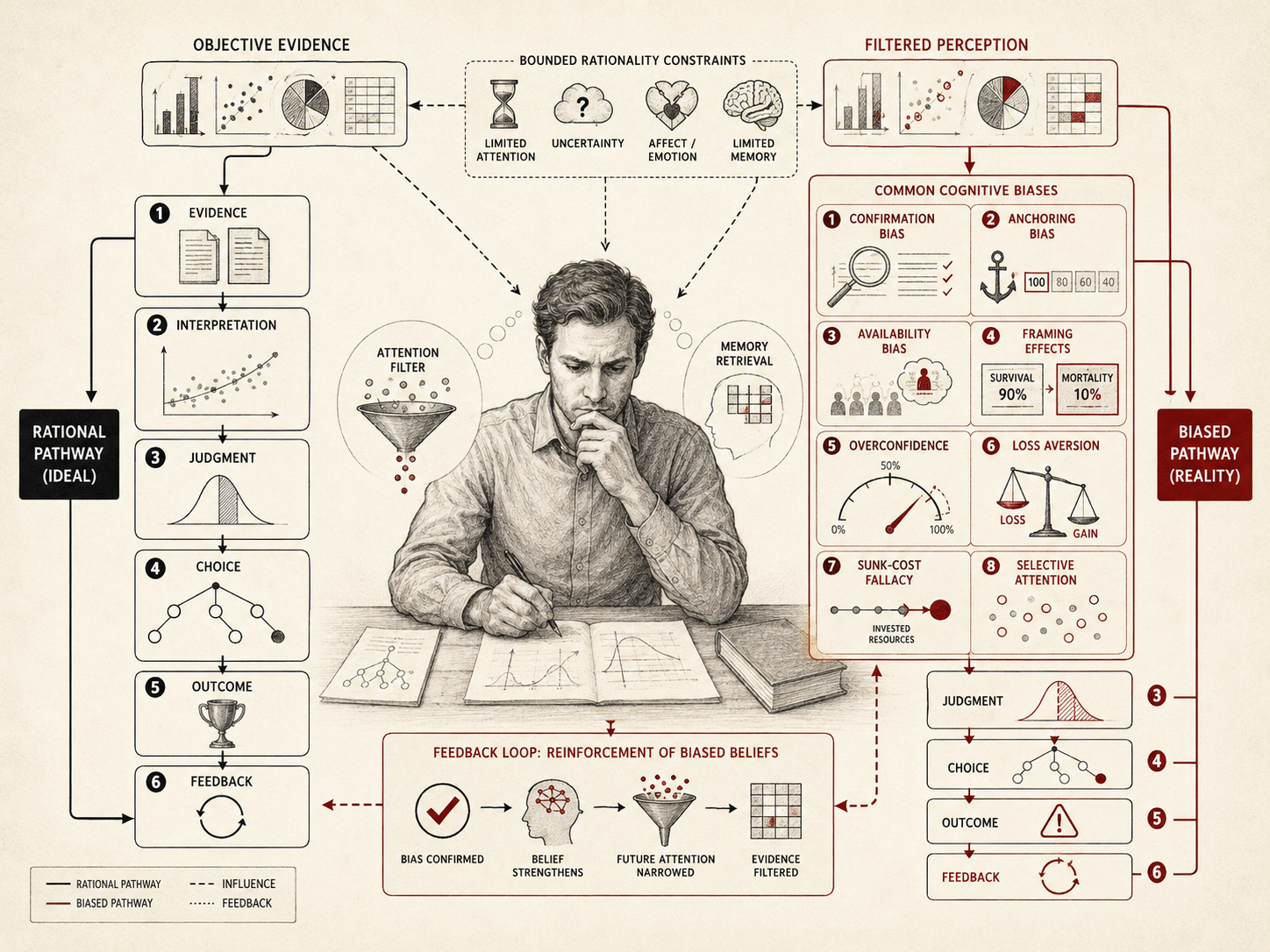
Cognitive-bias research matters because real decisions rarely occur in clean laboratory conditions. People decide under ambiguity, pressure, fatigue, scarcity, unequal information, social influence, institutional constraint, and imperfect feedback. Bias is not simply a matter of being “irrational.” It is a window into how bounded minds operate in bounded environments.
What are cognitive biases?
Cognitive biases are systematic tendencies for judgment to depart from formal standards such as logic, probability theory, Bayesian inference, expected-value reasoning, or externally validated evidence. Unlike random noise, biases recur in regular patterns. People do not simply make errors; they make certain kinds of errors repeatedly because the underlying cognitive mechanisms that produce those errors are structured and predictable.
This is why the study of bias became central to cognitive psychology and judgment-and-decision research. It showed that human judgment under uncertainty is not best explained as a sequence of isolated mistakes. It is better understood as the output of a mind using efficient approximations that work well often enough to be useful, but not universally enough to remain normatively accurate in every case.
Cognitive biases can involve attention, memory, perception, categorization, probability judgment, value assessment, emotional appraisal, social identity, institutional trust, and decision framing. They may appear when people estimate probabilities, interpret evidence, make predictions, choose among risky options, evaluate other people, remember past events, or assess their own knowledge.
Bias should therefore be distinguished from mere disagreement, ignorance, or error. A person can be wrong without being biased, and a biased process can sometimes produce a correct answer by chance. Bias refers to a patterned distortion in how information is selected, weighted, interpreted, remembered, or acted upon.
In research terms, cognitive bias usually requires comparison against some benchmark: a statistical model, a criterion outcome, an expert judgment, a base rate, a logically equivalent framing, a pre-outcome estimate, or a calibrated probability. The benchmark makes the deviation measurable.
Bias as a property of cognitive systems
Biases are best understood as emergent properties of cognitive architecture rather than isolated defects. Working memory limits how much information can be processed simultaneously. Attention restricts what information is selected. Memory introduces reconstruction, expectation, and selective retrieval. Affect gives rapid significance to situations before deliberate analysis is complete. Under these conditions, cognition must simplify.
The result is a system that is adaptive in broad terms but vulnerable to patterned distortion in specific contexts. A person cannot attend to everything, remember everything, calculate everything, or evaluate every possibility. Cognitive systems therefore prioritize what is salient, familiar, emotionally significant, recently experienced, socially reinforced, or easy to retrieve.
These priorities are not accidental. They often make cognition workable. In everyday life, a mind that treats every cue as equally important would be paralyzed. Bias emerges because the same selectivity that enables action can also produce distortion when the selected cues are misleading.
Several cognitive systems contribute to bias:
- Attention determines what becomes available for further processing.
- Memory shapes interpretation through retrieval, reconstruction, and prior experience.
- Working memory limits how many relations can be evaluated simultaneously.
- Affect supplies rapid evaluations of threat, benefit, trust, and significance.
- Language frames categories, causes, agents, and responsibility.
- Social cognition organizes identity, group membership, credibility, and status.
- Metacognition shapes confidence, uncertainty awareness, and error monitoring.
Bias is therefore not an anomaly appended to otherwise ideal reasoning. It is part of cognition under limitation. Bounded-rationality frameworks describe effective behavior as departing from perfect-rationality assumptions while remaining intelligible as adaptive action under constraint.
Origins of cognitive-bias research
The modern study of cognitive bias was established above all by the work of Amos Tversky and Daniel Kahneman in the 1970s. Their landmark work on judgment under uncertainty argued that people commonly rely on heuristics such as representativeness, availability, and anchoring, and that these heuristics can produce systematic departures from probability theory.
This research challenged classical economic assumptions of fully rational judgment and later became one of the foundations of behavioral economics. The importance of the heuristics-and-biases program was that it showed how intuitive judgment could be studied scientifically. Biases were not merely philosophical objections to rationality. They were experimentally observable, replicable patterns in judgment.
Tversky and Kahneman’s work also changed how psychologists, economists, policymakers, and decision scientists thought about uncertainty. It became clear that human beings often evaluate uncertain outcomes through subjective probability, reference points, emotional salience, and framing rather than through formal expected utility.
Later research extended this foundation. Prospect theory modeled decision making under risk through reference dependence, probability weighting, and loss aversion. Research on confirmation bias, overconfidence, hindsight bias, risk perception, debiasing, and decision architecture expanded the field beyond a small set of heuristics into a broad account of judgment under constraint.
At the same time, the field has become more nuanced. Some biases may reflect adaptive shortcuts in environments where speed, scarcity, and incomplete information matter. Others may reflect poor design, manipulative framing, unequal power, or institutional structures that push people toward distorted judgment. The modern study of bias therefore includes both cognition and context.
Heuristics and the structure of judgment
Heuristics are cognitive shortcuts that simplify complex decision problems. They allow people to respond quickly without exhaustively evaluating every possible outcome, probability, cue, or alternative. This is one reason they are useful. But because they are shortcuts, they can also misrepresent the structure of the environment.
Key heuristics include:
- Availability heuristic — estimating likelihood on the basis of recall ease.
- Representativeness heuristic — judging probability by similarity to a prototype or category.
- Anchoring heuristic — relying too heavily on an initial value or frame.
- Affect heuristic — using emotional response as a shortcut for risk or benefit.
- Recognition heuristic — treating recognized options as more important, credible, or valuable.
- Fluency heuristic — treating easily processed information as more familiar or true.
These heuristics reduce computational burden, which is why they are so prevalent. But they can produce systematic distortions when ease of recall, similarity, initial framing, emotional response, recognition, or fluency does not track the actual probability, value, or evidence structure of the case.
Heuristics are therefore not identical to biases. A heuristic is a strategy. A bias is a patterned distortion that may result from the strategy under particular conditions. Availability can be useful when memory reflects real exposure. It becomes biased when media salience or vividness substitutes for frequency. Anchoring can be useful when the anchor is informative. It becomes biased when an arbitrary starting point unduly controls the estimate.
This distinction matters because it prevents simplistic interpretations. Bias research should not treat all intuitive judgment as defective. It should ask when a shortcut fits the environment and when it fails.
Common cognitive biases
Many biases have been identified across domains of reasoning and choice. Among the most influential are:
- Confirmation bias — favoring information that supports existing beliefs or models.
- Anchoring bias — relying too heavily on an initial value or reference point.
- Availability bias — judging likelihood by what is easiest to recall.
- Representativeness bias — judging probability by similarity while underweighting base rates.
- Loss aversion — weighting losses more heavily than equivalent gains.
- Overconfidence — overestimating the accuracy of one’s knowledge, predictions, or judgment.
- Hindsight bias — treating past outcomes as having been more predictable than they were.
- Framing effects — responding differently to equivalent problems depending on presentation.
- Status quo bias — preferring existing conditions even when alternatives may be better.
- Omission bias — judging harms from action differently from harms from inaction.
- Bias blind spot — recognizing bias in others more readily than in oneself.
- Automation bias — over-relying on automated recommendations or system outputs.
These biases influence behavior in finance, medicine, law, public policy, technology, risk communication, journalism, education, hiring, scientific interpretation, and organizational life. Their broad relevance is one reason judgment-and-decision research remains central within psychology and behavioral science.
It is important, however, not to treat lists of biases as an explanation by themselves. Naming a bias does not explain the process that produced it. A rigorous account asks which mechanisms were involved, what information was available, how the task was framed, what incentives existed, what feedback was possible, and whether the environment made biased judgment more likely.
Formalizing cognitive bias: efficiency, distortion, and subjective weighting
Cognitive bias can be described formally as a difference between a normative estimate and the estimate produced by human judgment. Let the normative judgment for some quantity be \(J^*\), and the observed judgment be \(\hat{J}\). Bias can be represented as:
B=\hat{J}-J^*
\]
Interpretation: Bias \(B\) is the systematic deviation between observed judgment \(\hat{J}\) and a normative, criterion, or benchmark judgment \(J^*\).
The absolute magnitude of bias can be represented as:
|B|=|\hat{J}-J^*|
\]
Interpretation: Absolute bias measures how far judgment departs from the benchmark, regardless of direction.
Heuristic judgment can also be expressed as the use of a reduced cue set relative to a fuller normative model. If a normative model requires \(n\) inputs, but the mind relies only on \(k<n\), then:
\hat{J}=g(x_1,x_2,\dots,x_k),\qquad k<n
\]
Interpretation: The mind may use a simplified function \(g\) over fewer cues, reducing effort while increasing the possibility of distortion.
Calibration error can be formalized as the distance between confidence and actual accuracy:
CE=|\hat{c}-a|
\]
Interpretation: Calibration error \(CE\) measures the gap between subjective confidence \(\hat{c}\) and actual accuracy \(a\).
Overconfidence can be written as:
OC=\hat{c}-a
\]
Interpretation: Positive \(OC\) indicates that confidence exceeds observed accuracy.
Prospect-theoretic bias under risk can be represented through subjective value and probability weighting:
SV=\sum_{i=1}^{n}w(p_i)v(x_i)
\]
Interpretation: Subjective value \(SV\) depends on psychologically weighted probability \(w(p_i)\) and value \(v(x_i)\), not only objective probability and outcome magnitude.
A common stylized value function is:
v(x)=
\begin{cases}
x^{\alpha}, & x\geq 0\\
-\lambda(-x)^{\beta}, & x<0
\end{cases}
\]
Interpretation: When \(\lambda>1\), losses are weighted more heavily than equivalent gains.
One can also represent the efficiency-accuracy trade-off explicitly:
U=A-\lambda_EE
\]
Interpretation: The utility of a judgment process depends on expected accuracy \(A\), cognitive effort \(E\), and the effort penalty \(\lambda_E\).
These formalizations make cognitive bias measurable. They also clarify why bias is not the same as ignorance. Bias is structured deviation produced by a process that may be efficient, adaptive, incomplete, distorted, or institutionally shaped.
Why biases exist
Biases are not simply defects. They are often byproducts of adaptive strategies. In environments where time is limited, information is incomplete, and action cannot wait for exhaustive analysis, heuristic processing provides workable approximations that are often good enough.
From this perspective, bias is one cost of efficiency. Cognition prioritizes speed, tractability, and responsiveness over perfect calculation. A system that waited for full rational optimization before acting would often fail in practical environments, even if it were more normatively consistent in theory.
Biases may emerge because cognition must:
- select some information and ignore other information;
- retrieve some memories more easily than others;
- generalize from incomplete experience;
- act before uncertainty is resolved;
- preserve coherent beliefs and identities;
- manage cognitive load under pressure;
- convert complex probabilities into usable judgments;
- interpret social cues quickly;
- protect against perceived threat or loss.
These pressures do not make bias harmless. They make it intelligible. A bias can be both psychologically understandable and socially damaging. A clinician may rely on a pattern that usually works but fails for an atypical patient. A hiring manager may rely on fluency or familiarity in ways that reproduce inequality. An institution may use a simplified risk score that makes administration easier while misclassifying vulnerable people.
The key point is that bias often reflects the interaction of cognitive limits and environmental structure. Reducing bias therefore requires more than telling people to “be rational.” It requires better information environments, better procedures, better measurement, better feedback, and better safeguards.
Bias under uncertainty and risk
Biases become especially visible under uncertainty, where probabilities are ambiguous, contested, unknown, or emotionally charged. Prospect theory showed that people evaluate outcomes relative to reference points and exhibit loss aversion, meaning equivalent gains and losses are not treated symmetrically.
Under risk, decision makers may:
- overweight small probabilities;
- underweight moderate or high probabilities;
- avoid losses more strongly than they pursue gains;
- respond differently to equivalent gain and loss frames;
- treat vivid examples as more probable;
- prefer certainty even when expected value favors risk;
- become risk seeking in loss domains;
- underestimate slow, cumulative, or invisible risks.
These findings connect cognitive-bias research directly to risk perception and uncertainty, decision making, and behavioral economics. In real-world decisions, people do not simply maximize expected value. They interpret risk through emotion, reference points, trust, salience, loss, memory, identity, and institutional context.
Risk bias also has unequal consequences. Some groups face higher exposure to environmental hazards, medical risk, financial vulnerability, surveillance, labor danger, or administrative harm. What appears to one observer as “risk overestimation” may reflect another person’s lived exposure to genuine threat. Bias research must therefore distinguish distorted risk judgment from situated knowledge under unequal vulnerability.
Confirmation bias, evidence search, and belief protection
Confirmation bias refers to the tendency to seek, interpret, remember, or weight information in ways that support existing beliefs, expectations, hypotheses, or identities. It is one of the most important biases because it affects how people process evidence itself.
Confirmation bias can appear in several forms:
- selectively searching for confirming evidence;
- interpreting ambiguous evidence as supportive;
- discounting contradictory evidence;
- remembering belief-consistent evidence more easily;
- applying stricter standards to opposing claims;
- treating identity-threatening evidence as less credible;
- remaining confident despite weak or mixed support.
Klayman and Ha’s work is especially important because it showed that positive test strategies are not always irrational. Testing whether expected evidence is present can be informative under some conditions. The problem arises when positive testing becomes one-sided, when disconfirmation is not sought, or when the structure of the task makes confirming evidence less diagnostic than people assume.
Confirmation bias is therefore not merely stubbornness. It can emerge from ordinary hypothesis testing, memory, attention, identity protection, social belonging, and institutional incentives. In organizations, it may become especially powerful when leaders reward agreement, suppress dissent, or treat early assumptions as commitments.
Mitigation requires more than telling individuals to be open-minded. Useful safeguards include structured dissent, premortems, red teams, independent review, base-rate prompts, adversarial collaboration, transparent evidence standards, and decision logs that preserve what was known before outcomes occurred.
Overconfidence, calibration, and expertise
Overconfidence occurs when people’s confidence exceeds the accuracy of their judgments. It is closely related to calibration, the relationship between subjective certainty and actual correctness. A well-calibrated person who says they are 70 percent confident should be correct roughly 70 percent of the time across comparable judgments.
Overconfidence can take several forms:
- Overestimation — believing one’s performance is better than it is.
- Overplacement — believing one ranks higher than others.
- Overprecision — placing overly narrow confidence intervals around uncertain estimates.
- Illusion of explanatory depth — believing one understands a system more deeply than one does.
- Planning fallacy — underestimating time, cost, or difficulty of future tasks.
Overconfidence is especially dangerous in high-stakes domains because it can suppress information search, reduce willingness to seek second opinions, and make weak evidence feel sufficient. In medicine, law, finance, policy, engineering, and AI-assisted decision making, overconfidence can turn uncertainty into premature closure.
Expertise complicates the picture. Experts can be highly accurate in environments with valid cues and good feedback. But expertise can also produce overconfidence when feedback is delayed, ambiguous, biased, or absent. A domain may feel familiar without being predictable. Experience alone does not guarantee calibration.
Good calibration requires feedback, uncertainty tracking, probabilistic thinking, humility about error, and systems that reward correction rather than only confidence.
Framing, loss aversion, and prospect theory
Framing effects occur when equivalent information produces different judgments depending on how it is presented. A treatment described as having a 90 percent survival rate may be evaluated differently from one described as having a 10 percent mortality rate, even though the two descriptions are formally equivalent.
Framing effects show that decisions are not made only from objective content. They are made from interpreted content. The language of gain, loss, survival, mortality, success, failure, cost, savings, risk, safety, responsibility, or harm changes what becomes salient.
Prospect theory provides one of the most influential accounts of such effects. It argues that people evaluate outcomes relative to reference points rather than only final states, that losses loom larger than gains, and that probabilities are psychologically weighted rather than treated linearly.
Loss aversion helps explain why people may resist changes framed as losses, reject beneficial gambles when potential loss is salient, or become risk seeking when trying to avoid sure losses. Probability weighting helps explain why people may overpay for small chances of large gains or overreact to small chances of catastrophic harm.
These patterns are not confined to laboratory gambles. They affect insurance, investment, public health messaging, climate risk, legal settlement, organizational change, safety regulation, and personal decision making.
Framing therefore raises an ethical design question: is information being framed to clarify consequences, or to manipulate perception?
Memory, hindsight, and narrative reconstruction
Many cognitive biases involve memory. Human memory is reconstructive, not a neutral recording of the past. People remember events through schemas, expectations, current knowledge, emotional significance, and later outcomes. This makes memory useful but vulnerable to distortion.
Hindsight bias occurs when people treat past outcomes as having been more predictable than they were before they occurred. Once an outcome is known, the mind reconstructs earlier evidence in light of what happened. Causes become clearer, warnings seem more obvious, and uncertainty fades from memory.
This has major consequences for evaluation. After a project fails, observers may exaggerate how obvious the failure was. After a medical diagnosis is known, earlier symptoms may seem more diagnostic. After a legal or policy outcome occurs, decision makers may be judged as if they should have known what only became clear later.
Memory-based bias also appears in availability effects. Events that are vivid, emotionally charged, recent, repeated, or narratively coherent are easier to recall. Ease of recall can then be mistaken for frequency or probability.
Decision systems can reduce hindsight and memory bias by preserving decision records, pre-outcome forecasts, uncertainty estimates, evidence logs, and contemporaneous reasoning. The point is not to eliminate human interpretation, but to protect evaluation from the illusion that the past was clearer than it actually was.
Bias in groups and organizations
Groups can reduce individual bias by bringing diverse information, perspectives, and error checks into decision making. But groups can also amplify bias when social dynamics suppress dissent, reward conformity, or concentrate authority.
Organizational biases include:
- Groupthink — prioritizing harmony or loyalty over critical evaluation.
- Escalation of commitment — continuing a failing course of action because of prior investment.
- Status quo bias — preferring existing arrangements even when alternatives are better.
- Authority bias — overweighting views of high-status individuals.
- Shared-information bias — discussing information known by many while neglecting unique information held by few.
- Outcome bias — judging decision quality mainly by outcome rather than process quality under uncertainty.
Organizations are vulnerable to bias because they often convert uncertainty into procedure, hierarchy, metrics, and narrative. A bad assumption can become embedded in dashboards, policies, hiring rubrics, risk scores, performance targets, and review processes.
Reducing organizational bias requires structural safeguards: independent review, diverse teams, dissent channels, precommitment to criteria, decision audits, uncertainty tracking, external benchmarks, and accountability for process rather than only outcomes.
Bias mitigation is therefore not just individual training. It is institutional design.
Neuroscience of cognitive bias
Cognitive biases emerge from the interaction of neural systems involved in reasoning, valuation, affect, memory, salience, reward, conflict monitoring, and cognitive control. No single “bias center” exists. Bias is better understood as a property of distributed decision systems.
Fast appraisal systems help identify significance, threat, reward, and relevance. Memory systems retrieve prior experience and support pattern recognition. Cognitive-control systems support inhibition, comparison, rule use, and deliberation. Valuation systems help assign subjective worth to options and outcomes. These systems operate together, sometimes cooperatively and sometimes in tension.
This helps explain why bias is neither exclusively cognitive nor exclusively emotional. Affective response can distort judgment, but it can also carry useful information from prior experience. Deliberation can correct bias, but it can also rationalize prior beliefs. Bias often emerges from how multiple systems integrate under constraint.
Dual-process accounts sometimes distinguish between fast, intuitive processing and slower, reflective processing. This distinction is useful, but it should not be treated as a simple opposition between irrational emotion and rational thought. Intuition can be expert and adaptive. Slow reasoning can be motivated and biased. The key issue is whether the decision process is appropriate to the task, evidence, uncertainty, stakes, and feedback environment.
Applications in economics, policy, medicine, and law
Cognitive-bias research has had major influence on economics, public policy, law, medicine, organizational decision design, financial behavior, risk communication, and technology governance. Behavioral economics incorporates psychological findings into models of choice. Public policy uses behavioral insights to structure choice environments. Medicine uses bias research to study diagnostic error. Law uses it to examine evidence evaluation, credibility, hindsight, and sentencing.
In economics and finance, biases help explain loss aversion, under-saving, overtrading, panic selling, status quo preference, and distorted risk perception. In medicine, they help explain premature closure, availability-driven diagnosis, anchoring on first impressions, and overconfidence in uncertain cases. In law, they illuminate hindsight bias, framing, credibility judgments, racialized perception, and narrative coherence effects.
In public policy, bias research has influenced choice architecture: defaults, reminders, simplification, disclosure, and decision aids. These tools can help people make better decisions, but they also raise ethical questions. A nudge may support autonomy when it clarifies choices and reduces unnecessary burden. It may undermine autonomy when it manipulates salience or hides alternatives.
In organizations, bias research helps explain hiring discrimination, project escalation, forecasting error, performance evaluation distortion, and group decision failure. In technology, it matters for interface design, recommendation systems, automation reliance, and AI decision support.
The practical importance of cognitive-bias research lies in its ability to connect psychological mechanisms with real institutional outcomes.
Bias, institutions, and unequal power
Cognitive bias is often discussed as an individual problem, but many biases are amplified by institutional environments. Institutions decide what counts as evidence, whose testimony is credible, which categories matter, which risks are measured, which errors are tolerated, and which people bear the consequences of misclassification.
Institutional bias can emerge when cognitive shortcuts become embedded in procedures:
- risk scores that encode structural inequality;
- hiring filters that privilege familiar credentials;
- medical protocols that under-recognize symptoms in marginalized groups;
- legal judgments shaped by stereotypes and credibility heuristics;
- financial models that convert unequal histories into risk categories;
- public-benefit systems that treat administrative friction as fraud prevention;
- platform moderation systems that misread context, dialect, or political vulnerability.
These are not only psychological errors. They are errors with power. A biased individual judgment may affect one interaction. A biased institutional rule can scale harm across thousands or millions of decisions.
This matters especially for marginalized communities. Bias may appear in whose pain is believed, whose risk is taken seriously, whose speech is treated as threatening, whose mistakes are punished, whose expertise is recognized, and whose data are considered representative.
A serious account of cognitive bias must therefore include social and institutional context. Bias mitigation should not place all responsibility on individuals while leaving biased systems intact. It should examine procedures, data, defaults, categories, review rights, accountability, and unequal exposure to error.
Cognitive bias and artificial intelligence systems
Artificial intelligence systems interact with cognitive bias in several ways. They can reduce bias by providing structure, consistency, evidence retrieval, base-rate information, and decision support. They can also amplify bias by hiding uncertainty, presenting outputs fluently, automating flawed categories, reproducing historical patterns, or encouraging overreliance.
AI systems can trigger human biases such as:
- Automation bias — over-relying on system recommendations.
- Authority bias — treating model output as more objective than it is.
- Fluency bias — trusting outputs because they are well written or visually polished.
- Confirmation bias — using AI to generate support for existing beliefs.
- Anchoring — allowing the first model answer to shape later interpretation.
- Overconfidence — mistaking probabilistic output for certainty.
AI can also encode institutional bias when training data reflect unequal histories or when proxy variables stand in for protected or vulnerable characteristics. A model may appear neutral because it is mathematical, but its outputs can still reproduce patterns of exclusion, surveillance, misclassification, or unequal burden.
Good AI decision support should therefore make uncertainty visible, preserve source provenance, encourage verification, distinguish evidence from inference, disclose limits, allow contestation, and avoid presenting recommendations as final authority. It should support calibrated human judgment rather than replace uncertainty with fluent confidence.
The goal is not bias-free cognition or bias-free computation in a simplistic sense. The goal is accountable decision systems that recognize where bias enters, how it propagates, who is affected, and how correction is possible.
Mitigating cognitive bias
Although biases are deeply embedded in cognition, their effects can often be reduced through structured approaches. Bias mitigation should be understood as a design problem, not merely a matter of individual willpower.
Useful strategies include:
- Base-rate prompts — making prior probabilities visible before case details dominate judgment.
- Consider-the-opposite — deliberately generating reasons the favored conclusion might be wrong.
- Checklists — ensuring that critical evidence is not skipped under pressure.
- Premortems — imagining future failure and identifying plausible causes before commitment.
- Independent review — separating initial judgment from second evaluation.
- Statistical feedback — improving calibration through outcome tracking.
- Decision logs — preserving what was known and believed before outcomes occurred.
- Structured dissent — creating legitimate channels for disagreement.
- Reference-class forecasting — comparing plans with similar past cases.
- Uncertainty intervals — forcing explicit representation of uncertainty.
Research on debiasing shows that training, feedback, practice, incentives, and decision aids can improve judgment under some conditions. But no intervention eliminates bias universally. Some biases are resistant because they arise from motivation, identity, organizational incentives, institutional history, or environmental design rather than only from lack of awareness.
Effective mitigation depends on the bias, domain, stakes, feedback quality, decision structure, and power relations involved. In high-stakes institutional contexts, mitigation should include audits, transparency, appeal rights, diverse review, and monitoring for unequal error distribution.
The strongest debiasing systems combine cognitive tools with institutional safeguards.
R code for cognitive-bias data
The following R workflow illustrates analyses relevant to cognitive-bias research, including framing effects, confidence calibration, overconfidence, loss aversion, risky choice, debiasing condition, decision quality, institutional review flags, and response time.
# Install packages if needed:
# pak::pak(c("tidyverse", "lme4", "lmerTest", "emmeans", "broom.mixed"))

library(tidyverse)
library(lme4)
library(lmerTest)
library(emmeans)
library(broom.mixed)

# Expected columns:
# participant, condition, domain, trial, scenario_id, bias_type,
# frame, gain_loss, anchor_value, base_rate, representativeness,
# evidence_valence, confirmation_congruence, prior_belief,
# confidence_rating, actual_accuracy, calibration_error,
# overconfidence, probability, payoff, loss_aversion_lambda,
# probability_weight, subjective_value, chose_risky, choice_binary,
# correct, response_time_ms, cognitive_load, time_pressure,
# debiasing_condition, decision_quality, institutional_review_flag

dat <- read_csv("cognitive_bias_trials.csv") %>%
  mutate(
    participant = factor(participant),
    condition = factor(condition),
    domain = factor(domain),
    scenario_id = factor(scenario_id),
    bias_type = factor(bias_type),
    frame = factor(frame),
    gain_loss = factor(gain_loss),
    debiasing_condition = factor(debiasing_condition),
    chose_risky = as.integer(chose_risky),
    choice_binary = as.integer(choice_binary),
    correct = as.integer(correct),
    institutional_review_flag = as.integer(institutional_review_flag),
    log_rt = log(response_time_ms)
  )

# -----------------------------
# 1. Condition summary
# -----------------------------

condition_summary <- dat %>%
  group_by(condition) %>%
  summarise(
    n_trials = n(),
    participants = n_distinct(participant),
    mean_confidence = mean(confidence_rating, na.rm = TRUE),
    mean_accuracy = mean(actual_accuracy, na.rm = TRUE),
    mean_calibration_error = mean(calibration_error, na.rm = TRUE),
    mean_overconfidence = mean(overconfidence, na.rm = TRUE),
    risky_choice_rate = mean(chose_risky, na.rm = TRUE),
    correct_rate = mean(correct, na.rm = TRUE),
    mean_decision_quality = mean(decision_quality, na.rm = TRUE),
    review_flag_rate = mean(institutional_review_flag, na.rm = TRUE),
    mean_rt_ms = mean(response_time_ms, na.rm = TRUE),
    .groups = "drop"
  )

print(condition_summary)

# -----------------------------
# 2. Calibration-error model
# -----------------------------

calibration_model <- lmer(
  calibration_error ~
    condition +
    domain +
    bias_type +
    frame +
    gain_loss +
    confidence_rating +
    actual_accuracy +
    cognitive_load +
    time_pressure +
    debiasing_condition +
    (1 | participant) +
    (1 | scenario_id),
  data = dat,
  REML = FALSE
)

summary(calibration_model)

# -----------------------------
# 3. Overconfidence model
# -----------------------------

overconfidence_model <- lmer(
  overconfidence ~
    condition +
    domain +
    bias_type +
    confidence_rating +
    actual_accuracy +
    confirmation_congruence +
    cognitive_load +
    time_pressure +
    debiasing_condition +
    (1 | participant) +
    (1 | scenario_id),
  data = dat,
  REML = FALSE
)

summary(overconfidence_model)

# -----------------------------
# 4. Risky-choice model
# -----------------------------

risky_model <- glmer(
  chose_risky ~
    condition +
    frame * gain_loss +
    probability +
    payoff +
    probability_weight +
    subjective_value +
    loss_aversion_lambda +
    cognitive_load +
    time_pressure +
    debiasing_condition +
    (1 | participant) +
    (1 | scenario_id),
  data = dat,
  family = binomial(),
  control = glmerControl(optimizer = "bobyqa")
)

summary(risky_model)
emmeans(risky_model, ~ frame * gain_loss, type = "response")

# -----------------------------
# 5. Correct-decision model
# -----------------------------

correct_model <- glmer(
  correct ~
    condition +
    domain +
    bias_type +
    base_rate +
    representativeness +
    confirmation_congruence +
    confidence_rating +
    calibration_error +
    cognitive_load +
    time_pressure +
    debiasing_condition +
    (1 | participant) +
    (1 | scenario_id),
  data = dat,
  family = binomial(),
  control = glmerControl(optimizer = "bobyqa")
)

summary(correct_model)

# -----------------------------
# 6. Decision-quality model
# -----------------------------

quality_model <- lmer(
  decision_quality ~
    condition +
    domain +
    bias_type +
    correct +
    calibration_error +
    overconfidence +
    cognitive_load +
    time_pressure +
    debiasing_condition +
    institutional_review_flag +
    (1 | participant) +
    (1 | scenario_id),
  data = dat,
  REML = FALSE
)

summary(quality_model)

# -----------------------------
# 7. Institutional-review flag model
# -----------------------------

review_model <- glmer(
  institutional_review_flag ~
    condition +
    domain +
    bias_type +
    calibration_error +
    overconfidence +
    cognitive_load +
    time_pressure +
    decision_quality +
    debiasing_condition +
    (1 | participant) +
    (1 | scenario_id),
  data = dat,
  family = binomial(),
  control = glmerControl(optimizer = "bobyqa")
)

summary(review_model)

# -----------------------------
# 8. Response-time model
# -----------------------------

rt_model <- lmer(
  log_rt ~
    condition +
    domain +
    bias_type +
    calibration_error +
    cognitive_load +
    time_pressure +
    correct +
    debiasing_condition +
    (1 | participant) +
    (1 | scenario_id),
  data = dat,
  REML = FALSE
)

summary(rt_model)

# -----------------------------
# 9. Confidence calibration plot
# -----------------------------

ggplot(dat, aes(x = actual_accuracy, y = confidence_rating, color = condition)) +
  geom_point(alpha = 0.25) +
  geom_abline(slope = 1, intercept = 0, linetype = "dashed") +
  labs(
    title = "Confidence calibration by condition",
    x = "Actual accuracy",
    y = "Confidence rating"
  ) +
  theme_minimal()
This workflow can be adapted for framing experiments, anchoring studies, confirmation-bias tasks, overconfidence and calibration research, prospect-theory paradigms, base-rate neglect experiments, risk-perception studies, debiasing interventions, institutional decision audits, and human-AI decision-support evaluations. Researchers should model participant and scenario effects whenever possible because bias varies across individuals, tasks, domains, frames, and institutional settings.
Python code for cognitive-bias data
The Python examples below parallel the R workflow and are useful for calibration studies, framing experiments, risky-choice paradigms, debiasing evaluations, and decision-quality modeling.
import numpy as np
import pandas as pd
import statsmodels.formula.api as smf
import statsmodels.api as sm
import matplotlib.pyplot as plt

# Expected columns:
# participant, condition, domain, trial, scenario_id, bias_type,
# frame, gain_loss, anchor_value, base_rate, representativeness,
# evidence_valence, confirmation_congruence, prior_belief,
# confidence_rating, actual_accuracy, calibration_error,
# overconfidence, probability, payoff, loss_aversion_lambda,
# probability_weight, subjective_value, chose_risky, choice_binary,
# correct, response_time_ms, cognitive_load, time_pressure,
# debiasing_condition, decision_quality, institutional_review_flag

df = pd.read_csv("cognitive_bias_trials.csv")

categorical_cols = [
    "participant", "condition", "domain", "scenario_id",
    "bias_type", "frame", "gain_loss", "debiasing_condition"
]

for col in categorical_cols:
    df[col] = df[col].astype("category")

df["chose_risky"] = df["chose_risky"].astype(int)
df["choice_binary"] = df["choice_binary"].astype(int)
df["correct"] = df["correct"].astype(int)
df["institutional_review_flag"] = df["institutional_review_flag"].astype(int)
df["log_rt"] = np.log(df["response_time_ms"])

# -----------------------------
# 1. Condition summary
# -----------------------------

condition_summary = (
    df.groupby("condition", observed=True)
    .agg(
        n_trials=("correct", "size"),
        participants=("participant", "nunique"),
        mean_confidence=("confidence_rating", "mean"),
        mean_accuracy=("actual_accuracy", "mean"),
        mean_calibration_error=("calibration_error", "mean"),
        mean_overconfidence=("overconfidence", "mean"),
        risky_choice_rate=("chose_risky", "mean"),
        correct_rate=("correct", "mean"),
        mean_decision_quality=("decision_quality", "mean"),
        review_flag_rate=("institutional_review_flag", "mean"),
        mean_rt_ms=("response_time_ms", "mean"),
    )
    .reset_index()
)

print(condition_summary)

# -----------------------------
# 2. Calibration-error model
# -----------------------------

calibration_model = smf.ols(
    "calibration_error ~ condition + domain + bias_type "
    "+ frame + gain_loss + confidence_rating + actual_accuracy "
    "+ cognitive_load + time_pressure + debiasing_condition",
    data=df,
)

calibration_result = calibration_model.fit(
    cov_type="cluster",
    cov_kwds={"groups": df["participant"]},
)

print(calibration_result.summary())

# -----------------------------
# 3. Overconfidence model
# -----------------------------

overconfidence_model = smf.ols(
    "overconfidence ~ condition + domain + bias_type "
    "+ confidence_rating + actual_accuracy + confirmation_congruence "
    "+ cognitive_load + time_pressure + debiasing_condition",
    data=df,
)

overconfidence_result = overconfidence_model.fit(
    cov_type="cluster",
    cov_kwds={"groups": df["participant"]},
)

print(overconfidence_result.summary())

# -----------------------------
# 4. Risky-choice model
# -----------------------------

risky_model = smf.glm(
    "chose_risky ~ condition + frame * gain_loss "
    "+ probability + payoff + probability_weight + subjective_value "
    "+ loss_aversion_lambda + cognitive_load + time_pressure "
    "+ debiasing_condition",
    data=df,
    family=sm.families.Binomial(),
)

risky_result = risky_model.fit(
    cov_type="cluster",
    cov_kwds={"groups": df["participant"]},
)

print(risky_result.summary())

# -----------------------------
# 5. Correct-decision model
# -----------------------------

correct_model = smf.glm(
    "correct ~ condition + domain + bias_type + base_rate "
    "+ representativeness + confirmation_congruence "
    "+ confidence_rating + calibration_error "
    "+ cognitive_load + time_pressure + debiasing_condition",
    data=df,
    family=sm.families.Binomial(),
)

correct_result = correct_model.fit(
    cov_type="cluster",
    cov_kwds={"groups": df["participant"]},
)

print(correct_result.summary())

# -----------------------------
# 6. Decision-quality model
# -----------------------------

quality_model = smf.ols(
    "decision_quality ~ condition + domain + bias_type "
    "+ correct + calibration_error + overconfidence "
    "+ cognitive_load + time_pressure + debiasing_condition "
    "+ institutional_review_flag",
    data=df,
)

quality_result = quality_model.fit(
    cov_type="cluster",
    cov_kwds={"groups": df["participant"]},
)

print(quality_result.summary())

# -----------------------------
# 7. Institutional-review flag model
# -----------------------------

review_model = smf.glm(
    "institutional_review_flag ~ condition + domain + bias_type "
    "+ calibration_error + overconfidence + cognitive_load "
    "+ time_pressure + decision_quality + debiasing_condition",
    data=df,
    family=sm.families.Binomial(),
)

review_result = review_model.fit(
    cov_type="cluster",
    cov_kwds={"groups": df["participant"]},
)

print(review_result.summary())

# -----------------------------
# 8. Response-time model
# -----------------------------

rt_model = smf.ols(
    "log_rt ~ condition + domain + bias_type "
    "+ calibration_error + cognitive_load + time_pressure "
    "+ correct + debiasing_condition",
    data=df,
)

rt_result = rt_model.fit(
    cov_type="cluster",
    cov_kwds={"groups": df["participant"]},
)

print(rt_result.summary())

# -----------------------------
# 9. Confidence calibration plot
# -----------------------------

fig, ax = plt.subplots(figsize=(8, 5))

for condition, group in df.groupby("condition", observed=True):
    ax.scatter(
        group["actual_accuracy"],
        group["confidence_rating"],
        alpha=0.35,
        label=str(condition),
    )

ax.plot([0, 1], [0, 1], linestyle="--")
ax.set_xlabel("Actual accuracy")
ax.set_ylabel("Confidence rating")
ax.set_title("Confidence calibration by condition")
ax.legend(title="Condition")
plt.tight_layout()
plt.show()

# -----------------------------
# 10. Export summaries
# -----------------------------

condition_summary.to_csv("cognitive_bias_condition_summary.csv", index=False)
The Python workflow is intentionally transparent and extensible. It can be expanded with Bayesian hierarchical models, prospect-theory parameter estimation, calibration curves, Brier scores, signal-detection models, evidence-search logs, eye-tracking, mouse-tracking, response-time diffusion models, debiasing intervention analysis, institutional audit pipelines, and human-AI reliance studies.
GitHub Repository
The companion repository provides reusable code and research scaffolding for studying cognitive biases in decision making, including workflows for framing effects, anchoring, confirmation bias, overconfidence, calibration error, prospect-theory variables, loss aversion, probability weighting, risky choice, debiasing interventions, decision quality, response time, and institutional review flags.
Complete Code Repository
Access the full companion repository for this article, including reproducible analysis materials and multi-language code workflows for cognitive-bias and decision-making research.
Conclusion
Cognitive biases reveal how human reasoning operates under constraint. They are not random mistakes but structured outcomes of heuristic processing, limited capacity, selective attention, affective valuation, memory reconstruction, prior belief, and adaptive strategies. Understanding cognitive bias provides insight into how people interpret information, evaluate uncertainty, and make decisions under real-world conditions.
Bias research also shows why judgment cannot be understood by studying isolated individuals alone. Decisions occur inside environments. Interfaces frame choices. Institutions define categories. Social systems shape salience. Power affects whose evidence is believed. Algorithms automate proxies. Feedback may be delayed, unequal, or absent. Bias is therefore psychological, but it is also environmental and institutional.
As cognitive psychology continues to integrate with economics, neuroscience, public policy, organizational design, law, medicine, and artificial intelligence, the study of bias remains central to understanding how minds function in complex environments. It highlights both the limits of idealized rationality and the deeper logic of cognition under pressure, uncertainty, and consequence.
The central lesson is not that humans are irrational. It is that human rationality is bounded, selective, embodied, emotional, social, and institutionally situated. Better judgment requires better minds, but also better systems.
Related articles
- Cognitive Psychology
- Decision Making in Cognitive Psychology
- Heuristics in Cognitive Psychology
- Risk Perception and Uncertainty
- Mental Models in Cognitive Psychology
- Cognitive Load and Information Processing
- Metacognition: Thinking About Thinking
- Human-Computer Interaction in Cognitive Psychology
- Behavioral Economics
Further reading
- American Psychological Association (n.d.) Cognitive bias. APA Dictionary of Psychology. Available at: https://dictionary.apa.org/cognitive-bias.
- Arkes, H.R. (1991) ‘Costs and benefits of judgment errors: Implications for debiasing’, Psychological Bulletin, 110(3), pp. 486–498.
- Fischhoff, B. and Broomell, S.B. (2020) ‘Judgment and decision making’, Annual Review of Psychology, 71, pp. 331–355. Available at: https://www.annualreviews.org/content/journals/10.1146/annurev-psych-010419-050747.
- Gigerenzer, G. (2007) Gut Feelings: The Intelligence of the Unconscious. New York: Viking.
- Kahneman, D. (2011) Thinking, Fast and Slow. New York: Farrar, Straus and Giroux.
- Kahneman, D. and Tversky, A. (1979) ‘Prospect theory: An analysis of decision under risk’, Econometrica, 47(2), pp. 263–291. Available at: https://www.jstor.org/stable/1914185.
- Klayman, J. and Ha, Y.-W. (1987) ‘Confirmation, disconfirmation, and information in hypothesis testing’, Psychological Review, 94(2), pp. 211–228. Available at: https://pages.ucsd.edu/~mckenzie/KlaymanHaPsychReview1987.pdf.
- Larrick, R.P. (2004) ‘Debiasing’, in Koehler, D.J. and Harvey, N. (eds.) Blackwell Handbook of Judgment and Decision Making. Oxford: Blackwell, pp. 316–337. Available at: https://onlinelibrary.wiley.com/doi/10.1002/9780470752937.ch16.
- Morewedge, C.K., Yoon, H., Scopelliti, I., Symborski, C.W., Korris, J.H. and Kassam, K.S. (2015) ‘Debiasing decisions: Improved decision making with a single training intervention’, Policy Insights from the Behavioral and Brain Sciences, 2(1), pp. 129–140. Available at: https://journals.sagepub.com/doi/abs/10.1177/2372732215600886.
- Nickerson, R.S. (1998) ‘Confirmation bias: A ubiquitous phenomenon in many guises’, Review of General Psychology, 2(2), pp. 175–220.
- Simon, H.A. (1957) Models of Man: Social and Rational. New York: Wiley.
- Soll, J.B., Milkman, K.L. and Payne, J.W. (2015) ‘A user’s guide to debiasing’, in Keren, G. and Wu, G. (eds.) The Wiley Blackwell Handbook of Judgment and Decision Making. Chichester: Wiley Blackwell. Available at: https://www.katymilkman.com/s/39-2016_Handbook_of_JDM-bht6.pdf.
- Stanovich, K.E. and West, R.F. (2000) ‘Individual differences in reasoning: Implications for the rationality debate?’, Behavioral and Brain Sciences, 23(5), pp. 645–665. Available at: https://www.cambridge.org/core/journals/behavioral-and-brain-sciences/article/individual-differences-in-reasoning-implications-for-the-rationality-debate/5A390F26633336BB37F76D0B49418B37.
- Thaler, R.H. and Sunstein, C.R. (2008) Nudge: Improving Decisions about Health, Wealth, and Happiness. New Haven, CT: Yale University Press.
- Tversky, A. and Kahneman, D. (1974) ‘Judgment under uncertainty: Heuristics and biases’, Science, 185(4157), pp. 1124–1131. Available at: https://www.science.org/doi/10.1126/science.185.4157.1124.
- Wheeler, G. (2018) ‘Bounded rationality’, Stanford Encyclopedia of Philosophy. Available at: https://plato.stanford.edu/entries/bounded-rationality/.
References
- American Psychological Association (n.d.) Cognitive bias. APA Dictionary of Psychology. Available at: https://dictionary.apa.org/cognitive-bias.
- Arkes, H.R. (1991) ‘Costs and benefits of judgment errors: Implications for debiasing’, Psychological Bulletin, 110(3), pp. 486–498.
- Fischhoff, B. and Broomell, S.B. (2020) ‘Judgment and decision making’, Annual Review of Psychology, 71, pp. 331–355. Available at: https://www.annualreviews.org/content/journals/10.1146/annurev-psych-010419-050747.
- Kahneman, D. (2011) Thinking, Fast and Slow. New York: Farrar, Straus and Giroux.
- Kahneman, D. and Tversky, A. (1979) ‘Prospect theory: An analysis of decision under risk’, Econometrica, 47(2), pp. 263–291. Available at: https://www.jstor.org/stable/1914185.
- Klayman, J. and Ha, Y.-W. (1987) ‘Confirmation, disconfirmation, and information in hypothesis testing’, Psychological Review, 94(2), pp. 211–228. Available at: https://pages.ucsd.edu/~mckenzie/KlaymanHaPsychReview1987.pdf.
- Larrick, R.P. (2004) ‘Debiasing’, in Koehler, D.J. and Harvey, N. (eds.) Blackwell Handbook of Judgment and Decision Making. Oxford: Blackwell, pp. 316–337. Available at: https://onlinelibrary.wiley.com/doi/10.1002/9780470752937.ch16.
- Morewedge, C.K., Yoon, H., Scopelliti, I., Symborski, C.W., Korris, J.H. and Kassam, K.S. (2015) ‘Debiasing decisions: Improved decision making with a single training intervention’, Policy Insights from the Behavioral and Brain Sciences, 2(1), pp. 129–140. Available at: https://journals.sagepub.com/doi/abs/10.1177/2372732215600886.
- Nickerson, R.S. (1998) ‘Confirmation bias: A ubiquitous phenomenon in many guises’, Review of General Psychology, 2(2), pp. 175–220.
- Simon, H.A. (1957) Models of Man: Social and Rational. New York: Wiley.
- Soll, J.B., Milkman, K.L. and Payne, J.W. (2015) ‘A user’s guide to debiasing’, in Keren, G. and Wu, G. (eds.) The Wiley Blackwell Handbook of Judgment and Decision Making. Chichester: Wiley Blackwell. Available at: https://www.katymilkman.com/s/39-2016_Handbook_of_JDM-bht6.pdf.
- Stanovich, K.E. and West, R.F. (2000) ‘Individual differences in reasoning: Implications for the rationality debate?’, Behavioral and Brain Sciences, 23(5), pp. 645–665. Available at: https://www.cambridge.org/core/journals/behavioral-and-brain-sciences/article/individual-differences-in-reasoning-implications-for-the-rationality-debate/5A390F26633336BB37F76D0B49418B37.
- Thaler, R.H. and Sunstein, C.R. (2008) Nudge: Improving Decisions about Health, Wealth, and Happiness. New Haven, CT: Yale University Press.
- Tversky, A. and Kahneman, D. (1974) ‘Judgment under uncertainty: Heuristics and biases’, Science, 185(4157), pp. 1124–1131. Available at: https://www.science.org/doi/10.1126/science.185.4157.1124.
- Wheeler, G. (2018) ‘Bounded rationality’, Stanford Encyclopedia of Philosophy. Available at: https://plato.stanford.edu/entries/bounded-rationality/.