
Last Updated May 20, 2026
In-group bias refers to the tendency for individuals to evaluate, trust, favor, protect, excuse, reward, and morally interpret members of their own group more positively than members of other groups. Within social psychology, this bias is one of the foundational mechanisms through which social identity becomes socially consequential. Group membership does not merely organize belonging. It shapes perception, trust, empathy, moral judgment, resource allocation, institutional opportunity, and the boundaries of who receives the benefit of the doubt.
The significance of in-group bias lies in its ordinariness. It does not require explicit hatred, ideological extremism, or conscious hostility toward outsiders. People may favor their own group while sincerely believing they are fair-minded. Preferential trust, warmth, patience, and generosity toward insiders can still produce exclusionary outcomes when those advantages accumulate across repeated judgments, institutional decisions, hiring processes, disciplinary systems, political coalitions, and social networks.
For that reason, in-group bias is not simply a matter of private attitude. It is a mechanism through which social identity becomes behaviorally and institutionally real. It helps explain how small asymmetries in trust and evaluation can become durable patterns of advantage, and why social inequality often persists even where overt prejudice is publicly disavowed.
Main Library
Publications
Article Map
Social Psychology
Related Topic
Behavioral Economics
Related Topic
Institutions & Governance
Related Topic
Stewardship & Ethics
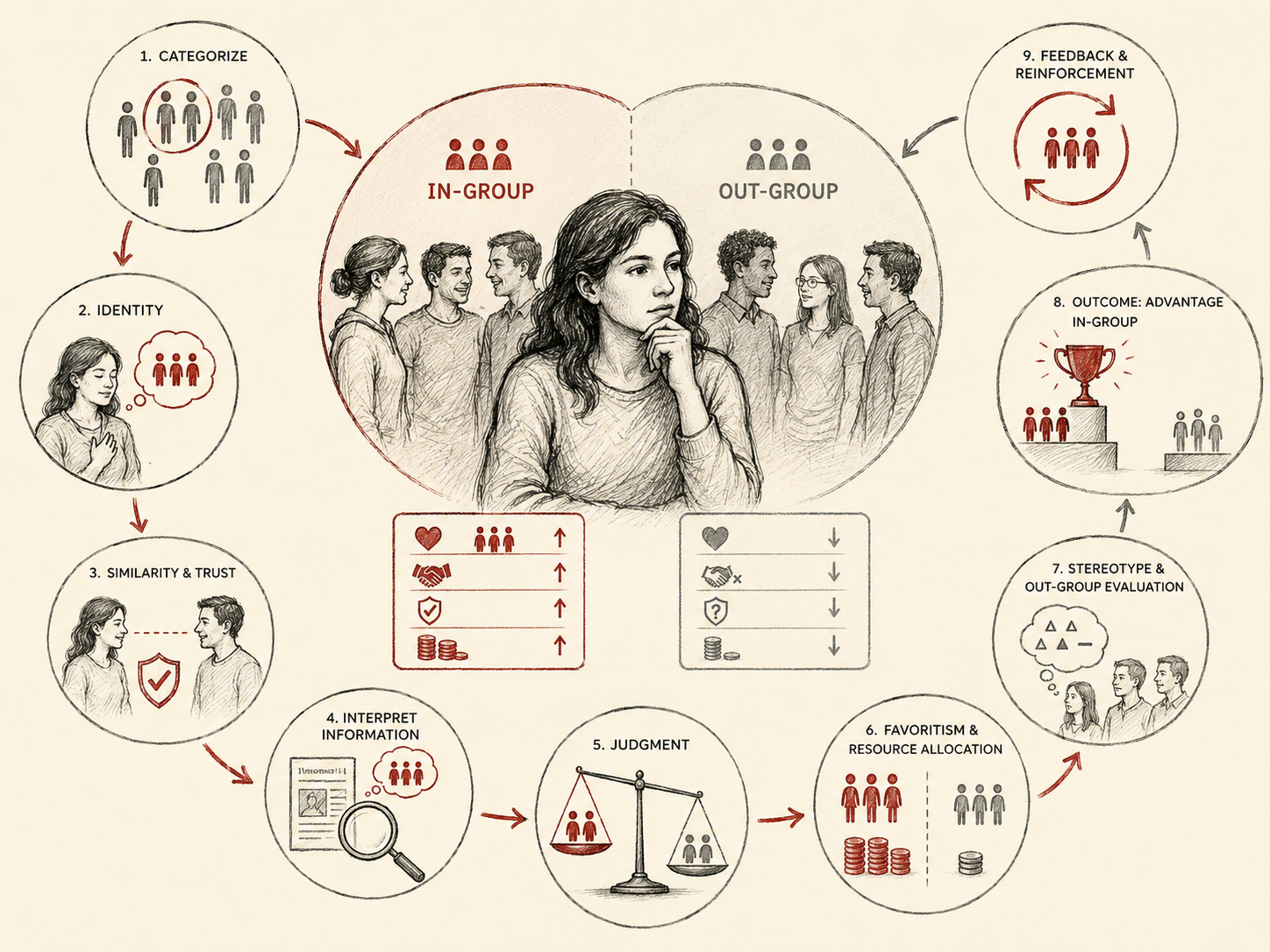
In-group bias connects directly to other major themes in this series, including social identity theory, stereotypes and prejudice, implicit bias, intergroup conflict, the contact hypothesis, social norms, and group polarization. Together these concepts explain how belonging becomes selective trust, how selective trust becomes unequal treatment, and how unequal treatment becomes durable social structure.
What is in-group bias?
In-group bias is the systematic tendency to prefer one’s own group over other groups. The group may be defined by nationality, religion, ethnicity, race, caste, language, gender, profession, political affiliation, school, organization, neighborhood, class position, institutional membership, sports team, or even an arbitrary category created in an experiment.
The bias can appear through many outcomes:
- higher trust for in-group members;
- greater warmth, empathy, or sympathy toward insiders;
- more favorable interpretation of ambiguous behavior;
- greater willingness to cooperate;
- more generous allocation of resources;
- more lenient moral judgment;
- greater willingness to forgive harm;
- stronger protection of in-group reputation;
- harsher judgment of equivalent out-group behavior;
- greater credibility granted to in-group testimony;
- more informal support, mentoring, referrals, and opportunity.
In-group bias is closely related to prejudice, but it is not identical to it. Prejudice often refers to negative attitudes toward an out-group. In-group bias emphasizes the positive valuation and preferential treatment of one’s own group. These two processes frequently interact, but they can be analytically separated. A person may favor insiders without consciously endorsing hostility toward outsiders. Yet when opportunities, sympathy, trust, and resources are distributed preferentially, outsiders may still be disadvantaged.
This distinction matters because social inequality does not always begin with open hostility. It may begin with quiet forms of familiarity, selective generosity, and the presumption that “our people” are more trustworthy, deserving, competent, normal, or understandable.
Social identity theory and the origins of the bias
The modern study of in-group bias is inseparable from social identity theory, developed most prominently by Henri Tajfel and John Turner. Social identity theory proposed that individuals derive part of their self-concept from the groups to which they belong. Because group membership contributes to personal identity, the status, dignity, and recognition of the group become psychologically important to the individual.
This insight transformed the study of intergroup relations. It suggested that group favoritism can emerge even in the absence of direct competition, personal history, or explicit hatred. Individuals do not merely belong to groups; they invest those groups with self-relevant meaning. As a result, enhancing the relative standing of the in-group can function as a form of self-enhancement.
In-group bias therefore reflects more than habit. It expresses the connection between collective identity and personal evaluation. What benefits the group may be experienced as affirming the self. What threatens the group may be experienced as threatening the self. When identity is salient, group boundaries can become emotionally and morally charged.
Social identity theory also helps explain why in-group bias may intensify under conditions of uncertainty, humiliation, status threat, marginalization, or political polarization. When people feel that their group is misunderstood, disrespected, declining, or under attack, favoritism toward the in-group may become not only psychologically rewarding but morally framed as loyalty or defense.
The minimal group paradigm
One of the most important empirical demonstrations of in-group bias came from Tajfel’s minimal group paradigm. In these experiments, participants were assigned to groups based on trivial or arbitrary criteria, such as aesthetic preferences or random classification. Despite the absence of real history, meaningful interaction, material conflict, or prior hostility, participants still favored members of their assigned group when allocating rewards.
The significance of these experiments was profound. They showed that group favoritism can emerge under extremely minimal conditions. Deep ideology is not required. Long histories of conflict are not required. Material competition is not always required. Merely dividing people into categories can be sufficient to generate preferential treatment.
This finding remains one of the strongest arguments against narrow explanations of bias. Intergroup favoritism cannot be reduced solely to personal animosity or resource competition. It is also rooted in the cognitive and identity-forming mechanisms through which people organize social life.
The minimal group paradigm does not imply that all forms of intergroup inequality are trivial or arbitrary. Real-world group relations are shaped by history, law, material power, institutional design, violence, segregation, and ideology. But the paradigm shows that the mind is highly responsive to categorical boundaries. Once a boundary becomes socially meaningful, even weakly, preference can follow.
In-group love, out-group hate, and asymmetric favoritism
A major interpretive question is whether intergroup bias is driven more by affection for the in-group or hostility toward the out-group. Marilynn Brewer’s influential formulation distinguished “in-group love” from “out-group hate.” This distinction is essential because many exclusionary outcomes may arise from favoritism toward insiders rather than explicit hostility toward outsiders.
In-group love can appear morally innocent to those who practice it. People may feel they are helping friends, supporting their community, rewarding familiar excellence, protecting their people, or choosing the person they trust. Yet the cumulative result may still disadvantage those outside the favored network.
Out-group hate is more openly hostile. It involves active contempt, fear, dehumanization, threat perception, punishment, or exclusion directed toward outsiders. In many real settings, in-group love and out-group hostility reinforce one another. But they should not be collapsed. A workplace can reproduce inequality through insider referrals without overt animus. A political community can excuse its own side while condemning identical behavior by opponents. A school can favor familiar cultural styles while claiming neutrality.
The distinction matters because interventions differ. Reducing hatred may require threat reduction, accountability, contact, and norm change. Reducing favoritism may require transparency, structured evaluation, fairness norms, institutional safeguards, and attention to how informal trust networks distribute advantage.
Why in-group bias occurs
In-group bias is resilient because it is sustained by several overlapping psychological and social mechanisms.
Identity protection
Because group membership forms part of the self, favoring the in-group can reinforce self-esteem. Positive evaluation of the group becomes a way of affirming one’s own identity. When the group is criticized, excluded, threatened, or humiliated, members may respond defensively because the group’s status feels personally relevant.
Cognitive simplification
Social categories help people navigate complex environments. Group-based judgments provide fast heuristics for trust, loyalty, shared norms, and perceived similarity. These shortcuts may feel efficient, but they can become inaccurate or unjust when category membership substitutes for individual evidence.
Normative reinforcement
Many groups frame solidarity and loyalty as moral obligations. Members may feel that favoring the in-group is not merely permitted but expected. Shared expectations therefore strengthen the bias through processes closely related to social norms and conformity.
Perceived security
People often associate familiarity with safety. In-group members may appear more predictable, trustworthy, or morally legible than outsiders, especially under conditions of uncertainty, threat, scarcity, or rapid social change.
Reciprocity and reputation
Favoring insiders may be reinforced by expectations of future reciprocity. People may help those who are embedded in the same network because support is likely to be remembered, returned, or socially rewarded.
Status defense
Where groups differ in status or power, in-group bias may protect existing hierarchy. Dominant groups may treat their norms as neutral standards, while marginalized groups may rely on in-group solidarity for survival, recognition, and mutual aid. These are not morally identical forms of group preference, which is why power matters in interpretation.
Together these mechanisms explain why in-group bias cannot be reduced to one cause. It is cognitive, emotional, normative, institutional, and relational at the same time.
Formalizing in-group bias
In-group bias can be represented as a differential in evaluation, trust, empathy, punishment, or allocation between in-group and out-group targets. Let \(R_{in}\) denote the level of trust, reward, sympathy, or positive judgment extended to an in-group member, and \(R_{out}\) the equivalent extended to an out-group member:
B=R_{in}-R_{out}
\]
Interpretation: When \(B>0\), in-group favoritism is present. The bias may appear as extra trust, warmth, generosity, forgiveness, or opportunity rather than explicit hostility.
In-group evaluation can be modeled as a function of identity salience \(S\), perceived threat \(T\), norm strength \(N\), and group identification \(G\):
R_{in}=f(S,T,N,G)
\]
Interpretation: Favoritism often intensifies when group identity is salient, threat is high, group norms reward loyalty, and group identification is strong.
A simple regression-style model can express this relationship:
Y_i=\beta_0+\beta_1I_i+\beta_2S_i+\beta_3T_i+\beta_4(I_i\times S_i)+\epsilon_i
\]
Interpretation: Outcome \(Y_i\), such as trust or allocation, depends on whether the target is an in-group member \(I_i\), identity salience \(S_i\), perceived threat \(T_i\), and their interaction.
A broader social-identity model can represent self-evaluation as partly dependent on group standing:
E=\alpha P+(1-\alpha)G_s
\]
Interpretation: Total self-evaluation \(E\) combines personal identity value \(P\) and group-status value \(G_s\), with \(\alpha\) representing the relative weight of personal identity.
Moral asymmetry can also be represented formally. If the same act \(A\) is performed by an in-group member \(i\) or an out-group member \(o\), then:
J(A_i)\neq J(A_o)
\]
Interpretation: Identical behavior may be judged differently depending on whether the actor belongs to the in-group or out-group.
In institutional settings, small repeated differentials may compound:
D_T=\sum_{t=1}^{T}(A_{in,t}-A_{out,t})
\]
Interpretation: Cumulative disadvantage \(D_T\) grows as repeated allocation differences accumulate across decisions over time.
These formal models are simplified, but they clarify an important point: in-group bias may be small in any single judgment and still consequential when repeated across systems of hiring, promotion, discipline, evaluation, credit, punishment, and access.
Trust, cooperation, and resource allocation
In-group bias is especially visible in trust and cooperation. People often trust in-group members more readily, assume they share norms, and expect reciprocity from them. In experimental games, organizational settings, and everyday social life, this can produce greater cooperation with insiders and more hesitation toward outsiders.
Trust asymmetry matters because trust is not merely an attitude. It is a gateway to opportunity. People offer information, referrals, mentorship, investment, patience, credit, forgiveness, and informal access to those they trust. When trust is unevenly distributed, opportunity becomes unevenly distributed as well.
Resource allocation is another core domain. In-group bias may affect who receives money, time, attention, help, office support, school discipline leniency, political protection, legal sympathy, hiring consideration, or organizational sponsorship. Even when people endorse formal equality, they may still distribute informal support unequally.
Scarcity often intensifies these dynamics. When resources appear limited, people may become more protective of the in-group. Threat narratives can also shift allocation from fairness toward loyalty. Under such conditions, in-group favoritism can be framed as responsibility, defense, realism, or care.
This is why in-group bias must be studied as both psychology and social infrastructure. The bias does not merely live in the mind; it travels through networks of trust and allocation.
In-group bias and moral judgment
One of the most consequential dimensions of in-group bias concerns moral evaluation. People frequently judge identical behavior differently depending on whether it is performed by an in-group or out-group member. Harmful behavior by members of one’s own group may be interpreted as an exception, a misunderstanding, a response to pressure, or the action of one flawed individual. Similar behavior by outsiders may be interpreted as evidence of deeper character defects or group tendencies.
This moral asymmetry has major implications for public life. It helps explain why political actors excuse misconduct by members of their own coalition while condemning similar actions by opponents. It helps explain why institutions may extend sympathy, patience, and second chances unevenly across social categories. It also helps explain why some victims are more readily believed, mourned, or humanized than others.
In-group bias affects not only preference but justice. It shapes whose motives are contextualized, whose mistakes are forgiven, whose pain is recognized, and whose harm is minimized. Moral double standards are among the most socially damaging forms of in-group bias because they allow groups to preserve a positive self-image while applying unequal standards to others.
This moral dimension also interacts with media and political identity. When group identity is highly salient, evidence may be filtered through loyalty. The same facts can be interpreted as understandable when “we” do it and unforgivable when “they” do it. In-group bias therefore helps explain why accountability can collapse under polarization.
In-group bias in organizations and institutions
In-group bias is not confined to interpersonal settings. It operates inside organizations, bureaucracies, professions, schools, political parties, courts, media systems, universities, workplaces, and public agencies. It often appears through informal judgments rather than explicit policy.
Examples include:
- hiring managers favoring candidates from familiar schools or networks;
- leaders interpreting insider mistakes more generously than newcomer mistakes;
- teams treating cultural fit as competence;
- faculty giving more informal support to students who resemble prior success models;
- political institutions protecting insiders from accountability;
- bureaucracies treating some citizens as credible and others as suspicious;
- professional networks circulating opportunities through familiar relationships;
- disciplinary systems punishing outsiders more harshly for equivalent conduct.
These patterns do not always arise from explicit discrimination. Often they emerge through informal trust networks, shared codes, assumptions about fit, selective mentoring, and unequal familiarity. Yet such dynamics can reproduce structural exclusion over time, especially when influential positions are filled through relational comfort rather than transparent evaluation.
In-group bias therefore provides a bridge between social psychology and institutional analysis. A small preference in one decision may seem harmless. But when similar preferences recur across hundreds or thousands of decisions, they become institutionalized advantage.
This is why organizational remedies must move beyond bias awareness alone. Structured evaluation, transparency, audit trails, diverse review panels, clear criteria, accountability, and interruption of informal favoritism are necessary because private intentions are not enough to prevent cumulative inequality.
In-group bias, stereotypes, and prejudice
Although analytically distinct, in-group bias is closely connected to stereotypes and prejudice. Favoring one’s own group often creates the conditions under which out-group members are judged more harshly, trusted less readily, or seen as less fully individual. Once the in-group becomes the implicit standard of normality, competence, morality, or legitimacy, outsiders are more likely to be evaluated through generalized assumptions.
This is one reason why in-group bias matters even when it appears mild. Preferential warmth toward insiders can coexist with abstract commitments to fairness while still producing exclusionary effects. Bias often enters not through explicit hostility but through unequal benefit of the doubt.
In-group bias may also contribute to stereotype maintenance. When in-group members violate expectations, their behavior may be individualized. When out-group members violate expectations, their behavior may be treated as confirming a group pattern. This asymmetry allows stereotypes to survive contradictory evidence.
Read alongside implicit bias, the concept also helps explain how subtle judgments can accumulate into durable asymmetries. Implicit associations may influence quick evaluations, while in-group favoritism structures who receives trust, attention, and generosity in the first place.
Cultural and political dimensions
In-group bias varies across contexts, but it becomes especially potent under uncertainty, threat, scarcity, humiliation, and polarization. Under such conditions, group identities become more salient, and loyalty may be framed as a moral imperative. Political entrepreneurs often exploit these dynamics by constructing narratives of belonging and exclusion, elevating in-group cohesion while portraying outsiders as dangerous, corrupt, parasitic, disloyal, alien, or untrustworthy.
This process can intensify nationalist sentiment, sectarianism, partisan antagonism, racial hierarchy, religious conflict, institutional mistrust, and democratic fragmentation. Once identity is mobilized defensively, in-group bias may become emotionally rewarding. The group offers belonging, dignity, certainty, and meaning, while outsiders are reduced to symbolic threats.
Political in-group bias can also undermine accountability. Partisans may excuse corruption, cruelty, incompetence, or hypocrisy from their own coalition while treating similar behavior by opponents as proof of moral collapse. This double standard is not merely a failure of logic. It reflects the psychological force of group identity when politics becomes a site of belonging and threat.
For this reason, in-group bias is central to any serious account of polarization. It helps explain why evidence alone often fails to change minds: facts are interpreted through group trust, group threat, and group loyalty.
Can in-group bias be reduced?
Research suggests that in-group bias is not fixed or irreversible. Its intensity can be moderated by institutional design, cross-group contact, superordinate identities, fairness norms, structured cooperation, accountability systems, and decision procedures that reduce discretionary favoritism.
Several approaches are especially important:
- Structured intergroup contact: Meaningful contact under equal-status, cooperative, institutionally supported conditions can reduce anxiety and soften group boundaries.
- Superordinate identity: People may reduce narrower bias when they see themselves as part of a broader shared group, such as a team, civic community, profession, or common project.
- Fairness norms: Clear norms of impartiality can weaken the moral legitimacy of favoritism.
- Transparent criteria: Structured evaluation reduces reliance on familiarity and fit.
- Accountability: Decisions are less likely to reproduce favoritism when decision makers must justify criteria and outcomes.
- Scarcity reduction: Less zero-sum competition can reduce defensive group protection.
- Institutional auditing: Repeated measurement can reveal small favoritism effects that accumulate over time.
At the same time, reducing in-group bias requires more than moral exhortation. Because the bias is tied to identity, belonging, security, and norms, it cannot be dissolved simply by telling people to be objective. Durable reduction depends on conditions that expand trust without demanding the erasure of identity.
The goal is not to eliminate all group belonging. Groups can provide meaning, solidarity, mutual aid, cultural survival, and political voice. The challenge is to prevent belonging from hardening into unequal moral worth.
In-group bias in the architecture of social influence
Within the broader architecture of social influence, in-group bias helps explain how group membership becomes behaviorally and institutionally consequential. Social identity theory explains why group attachment matters to the self. Conformity explains alignment with group expectations. Social norms explain how shared expectations regulate behavior. In-group bias adds the mechanism by which loyalty, trust, sympathy, and moral asymmetry become selectively distributed across social boundaries.
In-group bias also connects to intergroup conflict. Groups in conflict do not simply disagree. They interpret one another through identity-protective filters. The in-group’s actions become defensive; the out-group’s actions become aggressive. The in-group’s errors become exceptions; the out-group’s errors become evidence. The in-group’s suffering becomes central; the out-group’s suffering becomes less visible.
Seen in this larger framework, in-group bias is not a marginal interpersonal quirk. It is a central process through which groups reproduce solidarity internally while drawing psychological and moral boundaries externally.
Ethical and interpretive cautions
Although in-group bias is robust, it should not be treated as a total explanation of intergroup inequality. Structural exclusion may also be shaped by law, institutional incentives, historical domination, material competition, segregation, propaganda, state violence, and organizational design. Bias matters, but it operates within broader systems.
It is also important not to assume that every form of group solidarity is pathological. Marginalized communities often rely on in-group solidarity for survival, mutual aid, cultural continuity, safety, and political resistance. Such solidarity should not be equated with dominant-group favoritism that protects unequal power. Group preference must be interpreted in relation to status, history, vulnerability, and institutional context.
Several cautions follow:
- Do not treat all group attachments as equivalent.
- Do not confuse protective solidarity with exclusionary domination.
- Do not reduce structural inequality to individual bias alone.
- Do not measure only out-group hostility while ignoring in-group favoritism.
- Do not assume neutrality where familiar in-group norms define the standard.
- Do not overlook how small advantages accumulate across institutions.
- Do not design interventions that demand identity erasure as the price of fairness.
The strongest use of the concept situates in-group bias within a broader account of institutions, norms, history, and power rather than treating it as a self-sufficient explanation.
Measurement, data, and research design
In-group bias research uses minimal-group experiments, trust games, dictator games, resource-allocation tasks, moral-vignette experiments, hiring simulations, organizational audits, survey experiments, response-time methods, implicit measures, network analysis, and longitudinal designs.
Key variables include:
- target group relation;
- in-group target indicator;
- group identification;
- identity salience;
- perceived threat;
- norm strength;
- status asymmetry;
- trust rating;
- fairness rating;
- competence rating;
- warmth rating;
- empathy rating;
- moral blame;
- moral forgiveness;
- punishment severity;
- reward allocation;
- resource allocation;
- cooperation choice;
- institutional decision context;
- response time.
Strong designs should distinguish in-group favoritism from out-group derogation. A participant may rate an in-group target very positively while rating an out-group target neutrally. That is not the same as active hostility, but it still matters if the outcome is unequal opportunity. Researchers should therefore measure both positive preference and negative evaluation.
Institutional designs should also examine accumulation. A small trust advantage in one decision may appear modest. Across hiring, mentoring, evaluation, promotion, discipline, and resource allocation, however, repeated small advantages can produce large disparities. In-group bias research is strongest when it links micro-level judgment to cumulative social consequence.
R code for in-group bias research
The following R workflow models trust, fairness, resource allocation, moral blame, punishment severity, cooperation, and response time as functions of target group relation, identity salience, perceived threat, group identification, norms, and institutional context.
# Install packages if needed:
# pak::pak(c("tidyverse", "lme4", "lmerTest", "emmeans", "broom.mixed", "performance"))

library(tidyverse)
library(lme4)
library(lmerTest)
library(emmeans)
library(broom.mixed)
library(performance)

# Expected columns:
# participant, site_id, condition, trial, target_group_relation,
# ingroup_target, group_identification, identity_salience,
# perceived_threat, norm_strength, status_asymmetry,
# trust_rating, fairness_rating, competence_rating, warmth_rating,
# empathy_rating, moral_blame, moral_forgiveness,
# punishment_severity, reward_allocation, resource_allocation,
# cooperation_choice, response_time_ms, institutional_context

dat <- read_csv("ingroup_bias_trials.csv") %>%
  mutate(
    participant = factor(participant),
    site_id = factor(site_id),
    condition = factor(condition),
    target_group_relation = factor(target_group_relation),
    institutional_context = factor(institutional_context),
    ingroup_target = as.integer(ingroup_target),
    cooperation_choice = as.integer(cooperation_choice),
    log_response_time = log(response_time_ms)
  )

# -----------------------------
# 1. Descriptive summary
# -----------------------------

relation_summary <- dat %>%
  group_by(condition, target_group_relation) %>%
  summarise(
    n = n(),
    participants = n_distinct(participant),
    mean_trust = mean(trust_rating, na.rm = TRUE),
    mean_fairness = mean(fairness_rating, na.rm = TRUE),
    mean_competence = mean(competence_rating, na.rm = TRUE),
    mean_warmth = mean(warmth_rating, na.rm = TRUE),
    mean_empathy = mean(empathy_rating, na.rm = TRUE),
    mean_blame = mean(moral_blame, na.rm = TRUE),
    mean_forgiveness = mean(moral_forgiveness, na.rm = TRUE),
    mean_punishment = mean(punishment_severity, na.rm = TRUE),
    mean_reward = mean(reward_allocation, na.rm = TRUE),
    mean_resource = mean(resource_allocation, na.rm = TRUE),
    cooperation_rate = mean(cooperation_choice, na.rm = TRUE),
    .groups = "drop"
  )

print(relation_summary)

# -----------------------------
# 2. Trust model
# -----------------------------

trust_model <- lmer(
  trust_rating ~
    ingroup_target * identity_salience +
    group_identification +
    perceived_threat +
    norm_strength +
    status_asymmetry +
    condition +
    institutional_context +
    (1 | participant) +
    (1 | site_id),
  data = dat,
  REML = FALSE
)

summary(trust_model)
emmeans(trust_model, ~ ingroup_target)

# -----------------------------
# 3. Fairness model
# -----------------------------

fairness_model <- lmer(
  fairness_rating ~
    ingroup_target * identity_salience +
    group_identification +
    perceived_threat +
    norm_strength +
    status_asymmetry +
    condition +
    institutional_context +
    (1 | participant) +
    (1 | site_id),
  data = dat,
  REML = FALSE
)

summary(fairness_model)

# -----------------------------
# 4. Resource allocation model
# -----------------------------

allocation_model <- lmer(
  resource_allocation ~
    ingroup_target * identity_salience +
    group_identification +
    perceived_threat +
    norm_strength +
    status_asymmetry +
    condition +
    institutional_context +
    (1 | participant) +
    (1 | site_id),
  data = dat,
  REML = FALSE
)

summary(allocation_model)

# -----------------------------
# 5. Moral blame and punishment models
# -----------------------------

moral_blame_model <- lmer(
  moral_blame ~
    ingroup_target * identity_salience +
    group_identification +
    perceived_threat +
    norm_strength +
    status_asymmetry +
    condition +
    institutional_context +
    (1 | participant) +
    (1 | site_id),
  data = dat,
  REML = FALSE
)

punishment_model <- lmer(
  punishment_severity ~
    ingroup_target * identity_salience +
    group_identification +
    perceived_threat +
    norm_strength +
    status_asymmetry +
    condition +
    institutional_context +
    (1 | participant) +
    (1 | site_id),
  data = dat,
  REML = FALSE
)

summary(moral_blame_model)
summary(punishment_model)

# -----------------------------
# 6. Cooperation model
# -----------------------------

cooperation_model <- glmer(
  cooperation_choice ~
    ingroup_target * identity_salience +
    trust_rating +
    perceived_threat +
    norm_strength +
    condition +
    institutional_context +
    (1 | participant) +
    (1 | site_id),
  data = dat,
  family = binomial(),
  control = glmerControl(optimizer = "bobyqa")
)

summary(cooperation_model)

# -----------------------------
# 7. Response-time model
# -----------------------------

rt_model <- lmer(
  log_response_time ~
    ingroup_target * identity_salience +
    perceived_threat +
    norm_strength +
    condition +
    institutional_context +
    (1 | participant) +
    (1 | site_id),
  data = dat %>% filter(response_time_ms >= 150),
  REML = FALSE
)

summary(rt_model)

# -----------------------------
# 8. Bias differentials by condition
# -----------------------------

bias_differentials <- relation_summary %>%
  select(condition, target_group_relation, mean_trust, mean_fairness,
         mean_empathy, mean_blame, mean_punishment,
         mean_resource, cooperation_rate) %>%
  pivot_wider(
    names_from = target_group_relation,
    values_from = c(mean_trust, mean_fairness, mean_empathy,
                    mean_blame, mean_punishment,
                    mean_resource, cooperation_rate)
  ) %>%
  mutate(
    trust_bias = mean_trust_ingroup - mean_trust_outgroup,
    fairness_bias = mean_fairness_ingroup - mean_fairness_outgroup,
    empathy_bias = mean_empathy_ingroup - mean_empathy_outgroup,
    allocation_bias = mean_resource_ingroup - mean_resource_outgroup,
    blame_asymmetry = mean_blame_outgroup - mean_blame_ingroup,
    punishment_asymmetry = mean_punishment_outgroup - mean_punishment_ingroup,
    cooperation_bias = cooperation_rate_ingroup - cooperation_rate_outgroup
  )

print(bias_differentials)

# -----------------------------
# 9. Export outputs
# -----------------------------

write_csv(relation_summary, "ingroup_bias_relation_summary.csv")
write_csv(bias_differentials, "ingroup_bias_differentials.csv")

write_csv(
  tidy(trust_model, effects = "fixed", conf.int = TRUE),
  "ingroup_bias_trust_coefficients.csv"
)

write_csv(
  tidy(allocation_model, effects = "fixed", conf.int = TRUE),
  "ingroup_bias_allocation_coefficients.csv"
)

# -----------------------------
# 10. Visualization
# -----------------------------

ggplot(dat, aes(x = identity_salience, y = trust_rating, color = target_group_relation)) +
  geom_point(alpha = 0.30) +
  geom_smooth(method = "lm", se = FALSE) +
  labs(
    title = "Identity salience and trust by target group relation",
    x = "Identity salience",
    y = "Trust rating"
  ) +
  theme_minimal()
This workflow distinguishes multiple forms of in-group bias: trust bias, fairness bias, allocation bias, empathy bias, moral blame asymmetry, punishment asymmetry, and cooperation bias. It also models how identity salience and perceived threat interact with target group relation to predict unequal treatment.
Python code for in-group bias research
The Python workflow below parallels the R analysis and adds a simple institutional-accumulation simulation. This is useful for showing how small favoritism effects can compound across repeated decisions.
import numpy as np
import pandas as pd
import statsmodels.formula.api as smf
import statsmodels.api as sm
import matplotlib.pyplot as plt

# Expected columns:
# participant, site_id, condition, trial, target_group_relation,
# ingroup_target, group_identification, identity_salience,
# perceived_threat, norm_strength, status_asymmetry,
# trust_rating, fairness_rating, competence_rating, warmth_rating,
# empathy_rating, moral_blame, moral_forgiveness,
# punishment_severity, reward_allocation, resource_allocation,
# cooperation_choice, response_time_ms, institutional_context

df = pd.read_csv("ingroup_bias_trials.csv")

categorical_cols = [
    "participant", "site_id", "condition",
    "target_group_relation", "institutional_context"
]

for col in categorical_cols:
    df[col] = df[col].astype("category")

df["ingroup_target"] = df["ingroup_target"].astype(int)
df["cooperation_choice"] = df["cooperation_choice"].astype(int)
df["log_response_time"] = np.log(df["response_time_ms"])

# -----------------------------
# 1. Descriptive summary
# -----------------------------

relation_summary = (
    df.groupby(["condition", "target_group_relation"], observed=True)
    .agg(
        n=("trust_rating", "size"),
        participants=("participant", "nunique"),
        mean_trust=("trust_rating", "mean"),
        mean_fairness=("fairness_rating", "mean"),
        mean_competence=("competence_rating", "mean"),
        mean_warmth=("warmth_rating", "mean"),
        mean_empathy=("empathy_rating", "mean"),
        mean_blame=("moral_blame", "mean"),
        mean_forgiveness=("moral_forgiveness", "mean"),
        mean_punishment=("punishment_severity", "mean"),
        mean_reward=("reward_allocation", "mean"),
        mean_resource=("resource_allocation", "mean"),
        cooperation_rate=("cooperation_choice", "mean"),
    )
    .reset_index()
)

print(relation_summary)

# -----------------------------
# 2. Trust model
# -----------------------------

trust_model = smf.ols(
    "trust_rating ~ ingroup_target * identity_salience "
    "+ group_identification + perceived_threat + norm_strength "
    "+ status_asymmetry + condition + institutional_context",
    data=df,
)

trust_result = trust_model.fit(
    cov_type="cluster",
    cov_kwds={"groups": df["participant"]},
)

print(trust_result.summary())

# -----------------------------
# 3. Fairness model
# -----------------------------

fairness_model = smf.ols(
    "fairness_rating ~ ingroup_target * identity_salience "
    "+ group_identification + perceived_threat + norm_strength "
    "+ status_asymmetry + condition + institutional_context",
    data=df,
)

fairness_result = fairness_model.fit(
    cov_type="cluster",
    cov_kwds={"groups": df["participant"]},
)

print(fairness_result.summary())

# -----------------------------
# 4. Resource allocation model
# -----------------------------

allocation_model = smf.ols(
    "resource_allocation ~ ingroup_target * identity_salience "
    "+ group_identification + perceived_threat + norm_strength "
    "+ status_asymmetry + condition + institutional_context",
    data=df,
)

allocation_result = allocation_model.fit(
    cov_type="cluster",
    cov_kwds={"groups": df["participant"]},
)

print(allocation_result.summary())

# -----------------------------
# 5. Moral blame and punishment
# -----------------------------

blame_model = smf.ols(
    "moral_blame ~ ingroup_target * identity_salience "
    "+ group_identification + perceived_threat + norm_strength "
    "+ status_asymmetry + condition + institutional_context",
    data=df,
)

blame_result = blame_model.fit(
    cov_type="cluster",
    cov_kwds={"groups": df["participant"]},
)

print(blame_result.summary())

punishment_model = smf.ols(
    "punishment_severity ~ ingroup_target * identity_salience "
    "+ group_identification + perceived_threat + norm_strength "
    "+ status_asymmetry + condition + institutional_context",
    data=df,
)

punishment_result = punishment_model.fit(
    cov_type="cluster",
    cov_kwds={"groups": df["participant"]},
)

print(punishment_result.summary())

# -----------------------------
# 6. Cooperation model
# -----------------------------

cooperation_model = smf.glm(
    "cooperation_choice ~ ingroup_target * identity_salience "
    "+ trust_rating + perceived_threat + norm_strength "
    "+ condition + institutional_context",
    data=df,
    family=sm.families.Binomial(),
)

cooperation_result = cooperation_model.fit(
    cov_type="cluster",
    cov_kwds={"groups": df["participant"]},
)

print(cooperation_result.summary())

# -----------------------------
# 7. Bias differentials
# -----------------------------

wide = relation_summary.pivot(
    index="condition",
    columns="target_group_relation",
    values=[
        "mean_trust", "mean_fairness", "mean_empathy",
        "mean_blame", "mean_punishment", "mean_resource",
        "cooperation_rate"
    ],
)

bias = pd.DataFrame(index=wide.index)
bias["trust_bias"] = wide[("mean_trust", "ingroup")] - wide[("mean_trust", "outgroup")]
bias["fairness_bias"] = wide[("mean_fairness", "ingroup")] - wide[("mean_fairness", "outgroup")]
bias["empathy_bias"] = wide[("mean_empathy", "ingroup")] - wide[("mean_empathy", "outgroup")]
bias["allocation_bias"] = wide[("mean_resource", "ingroup")] - wide[("mean_resource", "outgroup")]
bias["blame_asymmetry"] = wide[("mean_blame", "outgroup")] - wide[("mean_blame", "ingroup")]
bias["punishment_asymmetry"] = wide[("mean_punishment", "outgroup")] - wide[("mean_punishment", "ingroup")]
bias["cooperation_bias"] = wide[("cooperation_rate", "ingroup")] - wide[("cooperation_rate", "outgroup")]
bias = bias.reset_index()

print(bias)

# -----------------------------
# 8. Institutional accumulation simulation
# -----------------------------

def simulate_institutional_accumulation(n_decisions=5000, seed=42):
    rng = np.random.default_rng(seed)

    contexts = rng.choice(
        ["hiring", "promotion", "grading", "discipline", "resource", "trust_game"],
        size=n_decisions
    )

    ingroup = rng.integers(0, 2, size=n_decisions)
    identity_salience = rng.uniform(0, 10, size=n_decisions)
    threat = rng.uniform(0, 10, size=n_decisions)
    fairness_norm = rng.uniform(0, 10, size=n_decisions)

    score = (
        50
        + ingroup * (1.8 + 0.30 * identity_salience + 0.22 * threat)
        - (1 - ingroup) * (0.35 * threat)
        - 0.45 * fairness_norm
        + rng.normal(0, 5, size=n_decisions)
    )

    selected = score >= np.quantile(score, 0.70)

    sim = pd.DataFrame({
        "decision_id": np.arange(1, n_decisions + 1),
        "institutional_context": contexts,
        "ingroup_target": ingroup,
        "identity_salience": identity_salience,
        "perceived_threat": threat,
        "fairness_norm": fairness_norm,
        "selection_score": score,
        "selected": selected.astype(int),
    })

    summary = (
        sim.groupby(["institutional_context", "ingroup_target"], observed=True)
        .agg(
            n=("selected", "size"),
            selection_rate=("selected", "mean"),
            mean_score=("selection_score", "mean"),
            mean_threat=("perceived_threat", "mean"),
            mean_identity_salience=("identity_salience", "mean"),
        )
        .reset_index()
    )

    return sim, summary

sim, sim_summary = simulate_institutional_accumulation()

print(sim_summary)

# -----------------------------
# 9. Visualization
# -----------------------------

fig, ax = plt.subplots(figsize=(8, 5))

for relation, group in df.groupby("target_group_relation", observed=True):
    ax.scatter(
        group["identity_salience"],
        group["trust_rating"],
        alpha=0.30,
        label=relation
    )

ax.set_xlabel("Identity salience")
ax.set_ylabel("Trust rating")
ax.set_title("Identity salience and trust by target relation")
ax.legend()
plt.tight_layout()
plt.show()

# -----------------------------
# 10. Export summaries
# -----------------------------

relation_summary.to_csv("ingroup_bias_relation_summary.csv", index=False)
bias.to_csv("ingroup_bias_differentials.csv", index=False)
sim.to_csv("ingroup_bias_institutional_accumulation.csv", index=False)
sim_summary.to_csv("ingroup_bias_institutional_accumulation_summary.csv", index=False)
This Python workflow is useful for both experimental and institutional analysis. It estimates in-group effects on trust, fairness, allocation, blame, punishment, and cooperation, then simulates how small favoritism effects can accumulate across repeated decisions.
Research data architecture
In-group bias research often depends on relational data: participants, sites, conditions, target group relations, repeated trials, institutional contexts, trust ratings, fairness judgments, moral evaluations, allocation decisions, cooperation choices, response times, and cumulative institutional outcomes. Rather than embedding database code directly in the WordPress article body, the companion GitHub repository includes the full SQL schema and example queries for researchers who want to reproduce or extend the data model.
The research data model is designed to support questions such as:
- How large is the trust differential between in-group and out-group targets?
- Does identity salience amplify in-group favoritism?
- Does perceived threat increase trust asymmetry or allocation bias?
- Do fairness norms reduce preferential treatment?
- How do moral blame and punishment differ when the same behavior is attributed to insiders or outsiders?
- Do bias patterns differ across hiring, promotion, grading, discipline, political judgment, and resource-allocation contexts?
- How can small decision-level favoritism effects accumulate into institutional inequality over time?
The GitHub repository contains the full database schema, example analytical queries, validation logic, and reproducible data workflow. Keeping executable SQL in GitHub avoids WordPress hosting restrictions while preserving the research-grade infrastructure for readers who want to inspect or reuse the model.
View the SQL research data architecture in GitHub.
GitHub repository
The companion repository provides reusable code and research scaffolding for studying in-group bias, including workflows for trust asymmetry, fairness ratings, moral judgment, resource allocation, punishment severity, cooperation choice, identity salience, perceived threat, fairness norms, institutional context, and cumulative decision-level favoritism.
Complete Code Repository
Access the full companion repository for this article, including reproducible analysis materials and multi-language code workflows for in-group bias research.
Why in-group bias matters
The enduring importance of in-group bias lies in its explanatory power. It reveals how ordinary patterns of belonging can produce unequal evaluation, asymmetrical empathy, selective trust, and preferential opportunity. It shows that exclusion does not always begin with explicit hatred. Often it begins with familiar loyalty, selective generosity, informal networks, and the presumption that “our people” deserve greater trust.
Understanding in-group bias is therefore essential for analyzing intergroup relations, political polarization, organizational inequality, institutional trust, moral double standards, and the everyday psychology of inclusion and exclusion. By examining how group membership shapes perception and judgment, social psychology clarifies one of the most persistent mechanisms through which social boundaries become moral boundaries.
In-group bias also clarifies why fairness requires more than good intentions. If people naturally extend more trust, patience, and opportunity to those they recognize as familiar, then just institutions must be designed to interrupt unequal familiarity. The point is not to eliminate belonging, but to prevent belonging from becoming a hidden system of unequal worth.
Related articles
- Social Psychology
- Social Identity Theory
- Stereotypes, Prejudice, and Discrimination
- Implicit Bias in Social Psychology
- Intergroup Conflict in Social Psychology
- The Contact Hypothesis
- Social Norms in Social Psychology
- Conformity and Social Influence
- Group Polarization in Social Psychology
- Collective Action and Social Change
- Behavioral Economics
- Institutions & Governance
Further reading
- American Psychological Association (n.d.) Prejudice, bias and discrimination. Available at: https://www.apa.org/topics/prejudice-discrimination.
- Balliet, D., Wu, J. and De Dreu, C.K.W. (2014) ‘Ingroup favoritism in cooperation: A meta-analysis’, Psychological Bulletin, 140(6), pp. 1556–1581. PubMed record available at: https://pubmed.ncbi.nlm.nih.gov/25222635/.
- Brewer, M.B. (1999) ‘The psychology of prejudice: Ingroup love and outgroup hate?’, Journal of Social Issues, 55(3), pp. 429–444.
- Hewstone, M., Rubin, M. and Willis, H. (2002) ‘Intergroup bias’, Annual Review of Psychology, 53, pp. 575–604. Available at: https://www.annualreviews.org/doi/10.1146/annurev.psych.53.100901.135109.
- Jetten, J. and Hornsey, M.J. (eds.) (2014) The Social Psychology of Inclusion and Exclusion. New York: Psychology Press.
- Spadaro, G. et al. (2024) ‘Identity and institutions as foundations of ingroup favoritism’, Social Psychological and Personality Science. Available at: https://journals.sagepub.com/doi/abs/10.1177/19485506231172330.
- Tajfel, H., Billig, M.G., Bundy, R.P. and Flament, C. (1971) ‘Social categorization and intergroup behaviour’, European Journal of Social Psychology, 1(2), pp. 149–178. Available at: https://onlinelibrary.wiley.com/doi/10.1002/ejsp.2420010202.
- Tajfel, H. and Turner, J.C. (1979) ‘An integrative theory of intergroup conflict’, in Austin, W.G. and Worchel, S. (eds.) The Social Psychology of Intergroup Relations. Monterey, CA: Brooks/Cole, pp. 33–47.
- Yamagishi, T. and Mifune, N. (2008) ‘Does shared group membership promote altruism? Fear, greed, and reputation’, Rationality and Society, 20(1), pp. 5–30.
References
- American Psychological Association (n.d.) Prejudice, bias and discrimination. Available at: https://www.apa.org/topics/prejudice-discrimination.
- Balliet, D., Wu, J. and De Dreu, C.K.W. (2014) ‘Ingroup favoritism in cooperation: A meta-analysis’, Psychological Bulletin, 140(6), pp. 1556–1581. PubMed record available at: https://pubmed.ncbi.nlm.nih.gov/25222635/.
- Brewer, M.B. (1999) ‘The psychology of prejudice: Ingroup love and outgroup hate?’, Journal of Social Issues, 55(3), pp. 429–444.
- Hewstone, M., Rubin, M. and Willis, H. (2002) ‘Intergroup bias’, Annual Review of Psychology, 53, pp. 575–604. Available at: https://www.annualreviews.org/doi/10.1146/annurev.psych.53.100901.135109.
- Jetten, J. and Hornsey, M.J. (eds.) (2014) The Social Psychology of Inclusion and Exclusion. New York: Psychology Press.
- Spadaro, G. et al. (2024) ‘Identity and institutions as foundations of ingroup favoritism’, Social Psychological and Personality Science. Available at: https://journals.sagepub.com/doi/abs/10.1177/19485506231172330.
- Tajfel, H., Billig, M.G., Bundy, R.P. and Flament, C. (1971) ‘Social categorization and intergroup behaviour’, European Journal of Social Psychology, 1(2), pp. 149–178. Available at: https://onlinelibrary.wiley.com/doi/10.1002/ejsp.2420010202.
- Tajfel, H. and Turner, J.C. (1979) ‘An integrative theory of intergroup conflict’, in Austin, W.G. and Worchel, S. (eds.) The Social Psychology of Intergroup Relations. Monterey, CA: Brooks/Cole, pp. 33–47.
- Yamagishi, T. and Mifune, N. (2008) ‘Does shared group membership promote altruism? Fear, greed, and reputation’, Rationality and Society, 20(1), pp. 5–30.