
Last Updated June 11, 2026
Stories do not remain the same when they move from voice to page, from page to image, from image to screen, from screen to platform, or from performance to archive. A story’s medium changes how it is remembered, paced, embodied, interpreted, circulated, and trusted.
Storytelling Across Oral, Literary, and Visual Media examines how narrative works differently across speech, performance, writing, print, literature, comics, photography, film, television, visual art, digital media, and multimodal forms. It treats media not as neutral containers but as meaning-making environments. Each medium gives story different affordances: voice gives presence, gesture gives embodiment, writing gives durability, print gives sequence and revision, image gives spatial compression, film gives motion and montage, and digital media gives circulation, remix, interactivity, and automation.
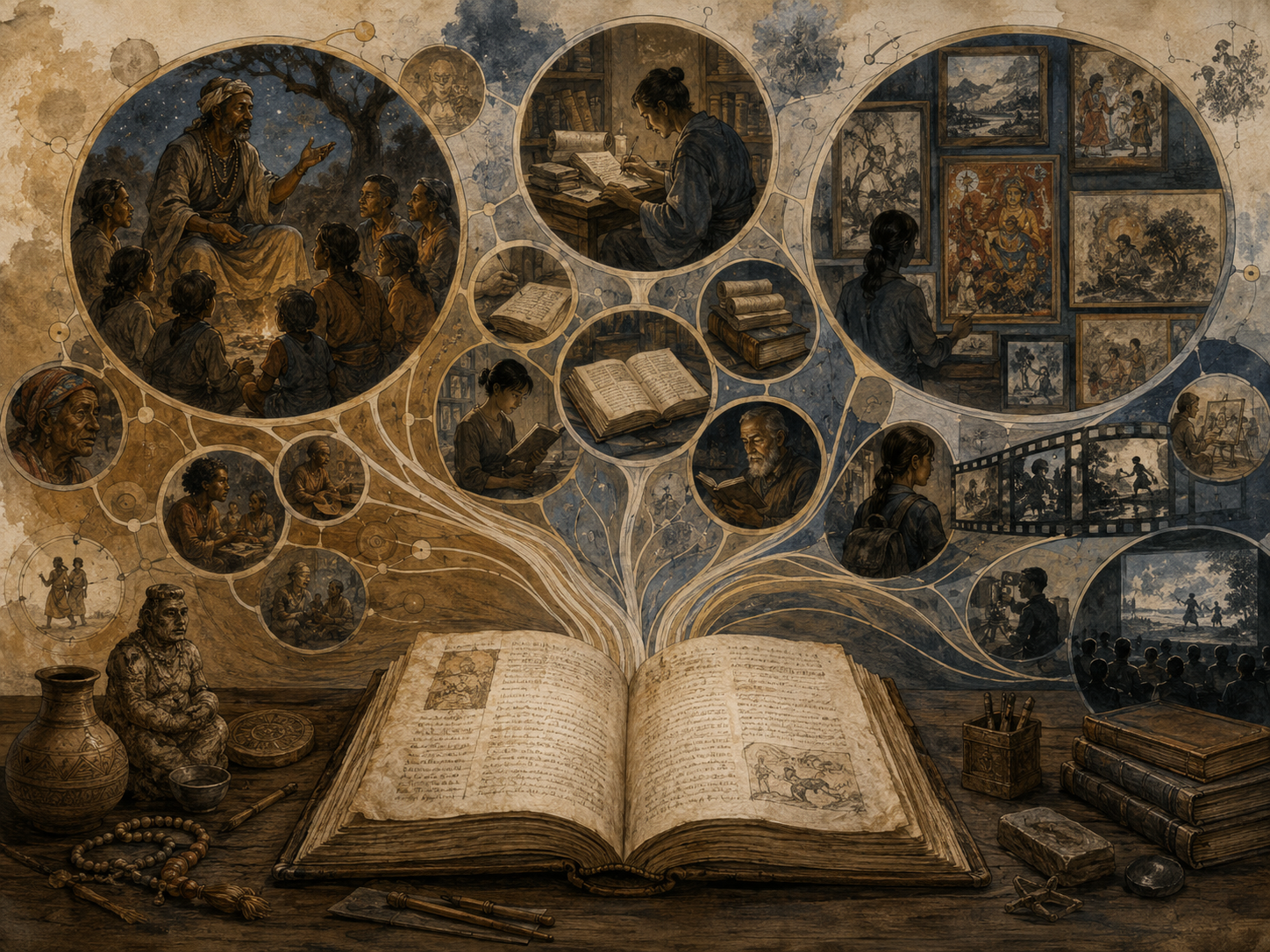
The same narrative event can change meaning when told aloud, written as memoir, staged as testimony, drawn as sequential art, photographed as evidence, filmed as scene, archived as record, or summarized by AI. Responsible media-aware storytelling asks not only what the story says, but how the medium shapes attention, authority, memory, embodiment, and interpretation.
Why Media Matter to Story
Media matter because stories are not transmitted through empty channels. A medium shapes what can be shown, heard, delayed, repeated, edited, embodied, circulated, and remembered. A story told aloud can change with audience response. A story written in a book can sustain interior reflection. A story drawn in panels can make time visible as spatial sequence. A story in film can control rhythm through image, sound, movement, and cut. A story on a platform can be fragmented, remixed, measured, and algorithmically amplified.
The medium affects authority. An oral witness may gain credibility through presence, voice, and risk. A written record may gain credibility through durability and citation. A photograph may be treated as evidence even though it still depends on framing, context, selection, and interpretation. A film may persuade through emotional immersion. A digital post may gain power through speed and network circulation.
Media also affect memory. Oral traditions preserve stories through performance, repetition, formula, and community practice. Literary works preserve stories through textual stability and rereading. Visual media preserve stories through image, icon, sequence, and affective recognition. Digital media preserve and distort stories through storage, search, remix, compression, and automation.
| Medium | Story strength | Risk |
|---|---|---|
| Oral performance | Embodied presence, memory, variation, audience relation. | Loss, distortion, romanticization, outsider transcription. |
| Writing | Durability, revision, citation, complex interiority. | Fixes one version and can detach story from performance context. |
| Print literature | Extended structure, pacing, voice, rereading. | Privileges literate forms and individual authorship. |
| Visual image | Immediate recognition, symbolism, spatial compression. | Appears self-evident while hiding framing and selection. |
| Film and television | Movement, sound, montage, performance, immersive time. | Emotional force may outrun context or evidence. |
| Digital platforms | Circulation, participation, remix, interactivity. | Fragmentation, algorithmic distortion, decontextualization. |
A story’s medium is not only how the story travels; it is part of how the story means.
Oral Storytelling
Oral storytelling is not simply storytelling before writing. It is a living mode of narrative shaped by memory, voice, formula, repetition, rhythm, gesture, audience response, and social occasion. Oral stories often exist as patterned variation rather than fixed text.
In oral traditions, narrative authority may come from performance skill, inherited responsibility, ritual context, community recognition, age, experience, lineage, or place. The storyteller may not be understood as an isolated author but as a participant in a living tradition. Repetition does not mean mechanical copying. It may be how memory, emphasis, identity, and communal continuity are maintained.
Oral storytelling also depends on relation. The story happens in time, between people. Audience response can shape pacing, emphasis, elaboration, humor, silence, and emotional force. A written transcript may preserve words but lose voice, timing, gesture, setting, and interaction.
| Oral feature | Narrative function | Interpretive question |
|---|---|---|
| Repetition | Supports memory, rhythm, emphasis, and participation. | What does repetition help the audience remember or feel? |
| Formula | Provides flexible building blocks for performance. | How does the storyteller vary inherited patterns? |
| Voice | Embodies authority, emotion, and relation. | What is lost when voice becomes text? |
| Gesture | Extends story through body and space. | How does meaning exceed words? |
| Audience response | Shapes timing, emphasis, and improvisation. | How does the audience co-produce the event? |
| Occasion | Links story to ritual, teaching, memory, or social need. | Why is this story told here and now? |
Oral storytelling shows that story can be an event before it is an object.
Performance, Gesture, and Presence
Performance adds body, timing, space, and presence to narrative. A story performed in a circle, on a stage, in a courtroom, in a ritual, in a classroom, in a protest, or in a family gathering carries meaning through more than words. Tone, pause, posture, breath, eye contact, silence, and movement all shape interpretation.
Performance also changes risk. A performed story exposes the speaker to an audience. It can produce solidarity, witness, vulnerability, authority, or confrontation. The same words may carry different force when spoken by a survivor, an elder, an actor, a leader, a comedian, a teacher, or a witness.
Performance is not merely delivery. It is a medium of relation. The audience may be addressed, challenged, invited, implicated, entertained, taught, or transformed. The story’s power emerges through the encounter.
| Performance element | Meaning effect | Risk |
|---|---|---|
| Pause | Creates suspense, grief, emphasis, or reflection. | May be flattened in transcription. |
| Gesture | Embodies action, relation, or memory. | May be misread across cultures. |
| Facial expression | Shapes credibility, irony, pain, or intimacy. | Audiences may overread affect. |
| Space | Places story within ritual, civic, theatrical, or domestic setting. | Context may be lost in recording. |
| Audience response | Creates feedback and co-presence. | Group reaction may pressure interpretation. |
| Embodied risk | Shows the cost of speaking. | Vulnerability may be exploited. |
Performance reminds us that storytelling can be a social act before it becomes a media artifact.
Writing, Literacy, and Durability
Writing changes storytelling by making narrative durable, revisable, portable, citational, and separable from the immediate event of telling. A written story can travel beyond the storyteller’s presence. It can be preserved, copied, annotated, translated, censored, canonized, disputed, and reread.
Writing also changes memory. Oral memory depends on social performance and repeated practice. Written memory can be externalized into documents, books, archives, inscriptions, letters, legal records, journals, and digital files. This can preserve stories, but it can also privilege what becomes written over what remains spoken, embodied, or informal.
Literacy allows certain kinds of narrative complexity: extended plotting, nested narration, interior monologue, reflective distance, documentary citation, fragmented chronology, and textual experimentation. Yet writing also risks becoming an authority filter. Stories without written records may be treated as less legitimate, even when they preserve deep knowledge.
| Written-medium feature | Narrative effect | Risk |
|---|---|---|
| Durability | Preserves story across time and distance. | Fixes one version as authoritative. |
| Revision | Allows refinement, structure, and complexity. | Can erase traces of performance or uncertainty. |
| Citation | Connects story to evidence and tradition. | Privileges documented authority over lived memory. |
| Interior narration | Represents thought, memory, and ambiguity. | May detach story from public and embodied context. |
| Archival storage | Makes stories searchable and recoverable. | Archive selection determines what survives. |
| Translation | Allows cross-language circulation. | May lose rhythm, cultural context, or relational meaning. |
Writing makes stories durable, but durability is not the same as completeness.
Literary Storytelling
Literary storytelling works through language as crafted form. It can use voice, style, metaphor, structure, interiority, rhythm, point of view, ambiguity, genre, and textual pattern to create meaning. Literature can slow perception, deepen interior experience, and hold contradictions that faster media may compress.
A literary work may tell events, but it also shapes how those events are known. A first-person narrator can create intimacy or unreliability. A fragmented structure can represent trauma, memory, modernity, or uncertainty. A long sentence can create breathless motion. A sparse style can make absence visible. A novel can hold multiple consciousnesses, histories, and social worlds at once.
Literary storytelling is especially strong at representing inwardness, ambiguity, memory, and interpretive delay. It asks readers to participate through imagination, inference, rereading, and attention to form.
| Literary device | Story function | Interpretive question |
|---|---|---|
| Point of view | Controls access to knowledge and feeling. | Who can see, know, or speak? |
| Style | Creates rhythm, tone, and worldview. | How does language itself shape reality? |
| Structure | Orders time, memory, and revelation. | Why is the story arranged this way? |
| Interior monologue | Represents consciousness and uncertainty. | What can literature show that public action cannot? |
| Metaphor | Connects domains of meaning. | What hidden comparison organizes the story? |
| Silence | Marks absence, repression, restraint, or trauma. | What is not said, and why? |
Literary storytelling makes narrative not only a sequence of events, but a form of attention.
Visual Storytelling
Visual storytelling organizes meaning through image, composition, color, scale, angle, gesture, sequence, symbol, contrast, framing, and spatial relation. A visual story can compress time into a single image or distribute action across multiple images.
Visual media can communicate quickly, but their speed is not simplicity. A painting, photograph, illustration, diagram, poster, memorial, map, or icon can carry layers of cultural memory, perspective, evidence, myth, and ideology. Visual stories often work by making relationships visible: foreground and background, center and margin, light and shadow, presence and absence, repetition and rupture.
The danger is that images can feel immediate and self-evident. Viewers may forget that every image is framed, selected, composed, cropped, staged, edited, or contextualized. Visual storytelling requires visual literacy.
| Visual feature | Story effect | Risk |
|---|---|---|
| Framing | Determines what is visible and excluded. | Audience mistakes frame for whole reality. |
| Composition | Organizes attention and hierarchy. | Power is embedded without being named. |
| Scale | Signals importance, intimacy, threat, or awe. | Exaggerates importance through visual dominance. |
| Color | Creates mood, symbolism, or contrast. | Manipulates emotion without context. |
| Icon | Condenses identity or memory. | Turns complexity into emblem. |
| Absence | Shows erasure, loss, silence, or exclusion. | May be missed without contextual knowledge. |
Visual storytelling shows that stories can be read spatially as well as sequentially.
Comics, Sequential Art, and Panels
Comics and graphic narrative tell stories through the relationship between image, text, panel, sequence, gutter, layout, pacing, and reader inference. A comic does not simply illustrate a written story. It creates meaning through the arrangement of visual units in space.
The panel frames a moment. The gutter between panels invites the reader to infer action, time, causality, emotion, or transformation. Page layout can slow reading, create simultaneity, emphasize rupture, or guide movement. Words and images may reinforce each other, contradict each other, or create meaning in tension.
Graphic narrative is especially powerful for memory, trauma, testimony, satire, historical compression, and embodied experience because it can show events, internal states, symbolic worlds, and documentary traces on the same page.
| Comics feature | Narrative function | Interpretive question |
|---|---|---|
| Panel | Frames a selected moment. | Why this moment and not another? |
| Gutter | Requires reader inference between moments. | What must the reader complete? |
| Page layout | Controls rhythm, emphasis, and simultaneity. | How does the page organize time? |
| Speech balloon | Embeds voice within image space. | How do speech and image interact? |
| Caption | Adds narration, memory, or commentary. | Does text confirm or complicate the image? |
| Visual style | Shapes tone, realism, abstraction, and identification. | How does drawing style affect truth and feeling? |
Comics show that narrative time can be arranged as visible space.
Film, Television, and Moving Images
Film and television tell stories through moving images, sound, editing, performance, camera movement, music, lighting, mise-en-scène, montage, rhythm, and duration. They can make time feel immediate, compressed, slowed, repeated, or fragmented.
Moving-image storytelling differs from prose because it gives viewers bodies, environments, faces, voices, and motion. It can show what characters do before explaining what they think. It can create suspense through crosscutting, memory through flashback, intimacy through close-up, scale through wide shot, and meaning through juxtaposition.
Film and television also shape narrative through industrial form. Episode structure, season arcs, genre conventions, streaming interfaces, cliffhangers, recaps, trailers, and franchise logic all affect how stories are made and received.
| Moving-image feature | Narrative function | Risk |
|---|---|---|
| Close-up | Creates intimacy, emotion, or scrutiny. | Overdirects viewer sympathy. |
| Montage | Links images into meaning through sequence. | Creates causal or emotional association too quickly. |
| Sound | Guides mood, setting, memory, and expectation. | Manipulates feeling beneath conscious attention. |
| Performance | Embodies character and conflict. | Actor presence may overshadow structural context. |
| Editing rhythm | Controls pace, suspense, and emphasis. | Speed can replace understanding. |
| Serial structure | Builds long-form attachment and development. | Extends narrative through delay and dependency. |
Moving images make story sensory, temporal, and affective at once.
Photography, Archives, and Evidence
Photography often carries a special claim to reality because it appears to show that something was there. Photographs can document events, preserve memory, expose harm, humanize history, and serve as public evidence. Yet photographs are never pure facts. They are framed, timed, selected, captioned, archived, edited, circulated, and interpreted.
A photograph can become a story when placed in sequence, captioned, archived, exhibited, shared, or remembered. A single image can imply before and after. A photo essay can create narrative progression. An archive can make images available for future interpretation, but archival selection also determines what becomes visible.
Photographic storytelling must therefore be read with care. Who took the image? For whom? Under what conditions? What is outside the frame? What caption guides interpretation? Who controls circulation? What risks does visibility create for the people shown?
| Photographic issue | Story function | Ethical question |
|---|---|---|
| Frame | Selects a visible portion of reality. | What is outside the image? |
| Caption | Guides interpretation. | Does the caption clarify or control meaning? |
| Sequence | Creates before, after, and causality. | Does the order imply more than evidence supports? |
| Archive | Preserves and organizes visual memory. | Whose images are saved, described, or suppressed? |
| Circulation | Creates public attention. | Does sharing increase risk or exploitation? |
| Evidence | Supports factual claims. | What verification and context are required? |
Photography can document reality, but documentary force still requires interpretation and care.
Media Affordances and Limits
Every medium affords some kinds of storytelling and resists others. Oral performance affords variation and presence, but it can be difficult to archive without loss. Literature affords interiority and complex structure, but it may not carry embodied presence. Visual media afford immediate recognition and spatial relation, but they can hide sequence or causality. Film affords movement and sound, but it can overdetermine emotion. Digital media afford participation and circulation, but they can fragment context.
Media-aware storytelling begins with affordances. The question is not “Which medium is best?” The question is “What does this story need, and what does this medium make possible or difficult?”
| Story need | Useful media affordance | Possible medium |
|---|---|---|
| Embodied witness | Voice, gesture, presence, risk. | Oral testimony, performance, video. |
| Interior reflection | Access to thought, memory, ambiguity. | Novel, memoir, essay, diary. |
| Spatial relation | Visible arrangement and contrast. | Image, map, diagram, installation. |
| Sequential inference | Reader participation across gaps. | Comics, storyboard, photo essay. |
| Temporal immersion | Motion, sound, duration, montage. | Film, television, video. |
| Participatory circulation | Sharing, remix, comment, iteration. | Digital platform, interactive media. |
A medium is an interpretive contract between story, maker, audience, and context.
Adaptation and Media Transfer
When stories move between media, they do not simply copy themselves. They are transformed. A novel adapted into film must externalize interior thought through performance, image, sound, structure, or voiceover. An oral story written down may lose audience interaction but gain durability. A photograph turned into documentary sequence may gain context but lose ambiguity. A comic adapted into animation changes the relation between panel, reader, and time.
Adaptation is not only a question of fidelity. It is a question of translation across affordances. What must be preserved? What must be transformed? What becomes impossible? What becomes newly possible? What does the new medium emphasize that the old medium left open?
Media transfer can also change power. A community story moved into a published book, museum exhibit, film, brand campaign, or AI-generated summary may gain visibility while losing control.
| Transfer | Gain | Loss or risk |
|---|---|---|
| Oral to written | Durability, citation, archive. | Loss of voice, gesture, occasion, audience relation. |
| Written to film | Embodiment, image, sound, shared viewing. | Loss of interiority or narrative ambiguity. |
| Image to narrative text | Context, explanation, sequence. | Loss of visual openness or immediacy. |
| Comic to animation | Motion, sound, performance. | Loss of reader-controlled pacing and panel inference. |
| Testimony to campaign | Public attention and mobilization. | Extraction, simplification, consent drift. |
| Archive to AI summary | Search, scale, accessibility. | Context loss, false coherence, omitted voices. |
Adaptation should be judged by responsible transformation, not mechanical sameness.
Digital and Platform Storytelling
Digital media intensify cross-media storytelling. A story may begin as a post, become a video, circulate as an image, be remixed into a meme, archived as evidence, expanded into a podcast, adapted into a documentary, and summarized by AI. Platform stories are often modular, networked, participatory, and unstable.
Digital platforms change narrative temporality. Stories unfold in feeds, threads, comments, updates, livestreams, archives, and search results. They can be immediate and persistent at the same time. They can invite participation while also exposing storytellers to surveillance, harassment, appropriation, and algorithmic distortion.
Platform storytelling also blurs producer and audience. Readers become sharers, commenters, remixers, critics, witnesses, archivists, and co-narrators. This can democratize voice, but it can also fragment authorship and accountability.
| Digital feature | Story effect | Risk |
|---|---|---|
| Feed | Places story among competing fragments. | Context is weakened by speed and adjacency. |
| Thread | Builds sequence through posts. | Meaning depends on platform order and visibility. |
| Comment | Turns audience into visible respondent. | Harassment or misreading reshapes story environment. | Remix | Allows participatory reinterpretation. | Original context and consent may disappear. |
| Algorithm | Amplifies circulation and discovery. | Attention is governed by opaque incentives. |
| Archive | Preserves searchable traces. | Persistence may create future vulnerability. |
Digital storytelling expands participation while making context governance more difficult.
AI and Multimodal Storytelling
AI systems can generate, summarize, translate, caption, illustrate, storyboard, animate, classify, and remix stories across media. A single prompt can produce text, image, audio, video, metadata, or structured summaries. These tools make cross-media transfer faster and more accessible.
They also create new risks. AI may flatten oral performance into transcript-like text, turn testimony into stylized content, generate images that imply documentary truth, remove cultural context, reproduce visual stereotypes, confuse adaptation with appropriation, or create persuasive multimodal narratives without clear sources.
Multimodal AI raises questions of authority and consent. Who owns the story being adapted? Who authorized the use of voice, likeness, style, memory, or cultural form? What evidence supports generated images? What is marked as fictional, illustrative, archival, or synthetic? How are uncertainty and provenance preserved?
| AI use | Possible benefit | Risk |
|---|---|---|
| Transcript summarization | Makes oral material searchable. | Loses tone, pause, gesture, and uncertainty. |
| Image generation | Visualizes concepts or scenes. | Creates synthetic images that feel documentary. |
| Storyboarding | Helps plan visual sequence. | Standardizes visual imagination through templates. |
| Translation | Expands access across languages. | Loses idiom, rhythm, and cultural meaning. |
| Audio synthesis | Improves accessibility and prototyping. | Voice imitation raises consent and identity concerns. |
| Multimodal adaptation | Transfers stories across formats quickly. | Confuses transformation with authorization. |
AI should support cross-media storytelling by preserving provenance, consent, and context—not by accelerating decontextualized transformation.
Ethics of Cross-Media Storytelling
The ethics of cross-media storytelling begins with the recognition that media transfer changes power. A story that belongs to a community, witness, family, artist, performer, or archive may acquire new audiences and new meanings when moved into another medium. Visibility can become recognition, but it can also become extraction.
Responsible cross-media storytelling asks: What medium originally carried this story? What context made it meaningful? What is lost in transfer? Who has authority to adapt it? What consent is required? What risks are created by circulation? What evidence or provenance must remain visible? What should not be translated?
Ethical media transfer is not simply technical conversion. It is stewardship.
| Ethical principle | Question | Warning sign |
|---|---|---|
| Consent | Who authorized this version and circulation? | Story is adapted because it is available. |
| Context | What cultural, historical, or performance setting matters? | The new medium detaches story from its occasion. |
| Provenance | Can the audience trace origin and transformation? | The adaptation hides source and process. |
| Medium honesty | Does the work disclose what is synthetic, staged, edited, or illustrative? | Generated material appears documentary. |
| Voice | Whose interpretation controls the adaptation? | Outside makers speak over original storytellers. |
| Care | What harm could new visibility create? | Circulation is treated as automatically beneficial. |
A story can travel responsibly only when the journey preserves dignity, authority, and context.
Examples of Cross-Media Story Analysis
The examples below show how the same story changes as it crosses media.
Oral story to transcript
Weak: The transcript is treated as the full story.
Stronger: The analysis asks what voice, gesture, audience response, rhythm, and occasion are missing.
Why it works: It prevents text from replacing performance context.
Memoir to documentary
Weak: The film is judged only by fidelity to events.
Stronger: The analysis asks how image, interview, archive, music, pacing, and editing reshape memory.
Why it works: It treats adaptation as medium-specific interpretation.
Photograph to public campaign
Weak: The image is used because it is powerful.
Stronger: The analysis asks who is shown, who consented, what caption guides meaning, and what risk circulation creates.
Why it works: It protects image subjects from becoming symbols without agency.
Novel to graphic narrative
Weak: The graphic version is treated as illustrated summary.
Stronger: The analysis asks how panel sequence, layout, visual style, and gutter inference create new meaning.
Why it works: It respects comics as narrative form.
Film to platform clip
Weak: A short clip is treated as representative of the whole film.
Stronger: The analysis asks what context, setup, pacing, and consequence are lost when a scene circulates alone.
Why it works: It distinguishes excerpt from narrative whole.
Archive to AI summary
Weak: The summary is accepted because it is fluent.
Stronger: The workflow audits source coverage, omitted voices, uncertainty, provenance, medium loss, and human review.
Why it works: It prevents automated coherence from replacing archival interpretation.
Cross-media analysis asks what each medium gives, what it removes, and who gains or loses authority in the transfer.
Mathematics, Computation, and Modeling
Cross-media storytelling should not be reduced to scores, but structured diagnostics can help evaluate whether a story is being transferred responsibly across media.
A medium-affordance fit score can estimate whether the selected medium supports the story’s needs:
M_f = \frac{E_b + I_d + S_q + T_c + A_r + C_x}{6}
\]
Interpretation: Medium fit \(M_f\) averages embodiment \(E_b\), interior depth \(I_d\), spatial quality \(S_q\), temporal control \(T_c\), audience relation \(A_r\), and contextual fit \(C_x\).
A media-transfer risk score can estimate how much meaning is lost or distorted in adaptation:
T_r = V_lw_v + C_lw_c + P_lw_p + A_sw_a + R_dw_r + (1 – G_r)w_g
\]
Interpretation: Transfer risk \(T_r\) rises with voice loss \(V_l\), context loss \(C_l\), provenance loss \(P_l\), audience shift \(A_s\), representational distortion \(R_d\), and weak governance review \(G_r\).
A multimodal coherence score can estimate whether text, image, sound, sequence, and context work together responsibly:
C_m = \frac{T_i + I_s + S_d + R_h + P_v + U_n}{6}
\]
Interpretation: Multimodal coherence \(C_m\) averages text-image integration \(T_i\), image-sequence logic \(I_s\), sound-design alignment \(S_d\), rhythm harmony \(R_h\), provenance visibility \(P_v\), and uncertainty notation \(U_n\).
An AI cross-media risk score can estimate whether automation is increasing distortion:
A_m = S_dw_s + C_lw_c + P_ow_p + V_iw_v + B_rw_b + (1 – H_r)w_h
\]
Interpretation: AI cross-media risk \(A_m\) rises with synthetic-documentary ambiguity \(S_d\), context loss \(C_l\), provenance opacity \(P_o\), voice or likeness imitation \(V_i\), bias reproduction \(B_r\), and weak human review \(H_r\).
| Modeling task | Governance question | Example output |
|---|---|---|
| Medium-fit audit | Does the medium support the story’s core needs? | Medium-affordance fit score. |
| Transfer audit | What is lost when the story moves between media? | Media-transfer risk score. |
| Multimodal audit | Do text, image, sound, sequence, and context work together? | Multimodal coherence score. |
| Consent audit | Who authorized adaptation, likeness, voice, and circulation? | Consent-governance note. |
| Archive audit | Are provenance and context preserved? | Provenance visibility score. |
| AI audit | Is automation creating synthetic authority or context loss? | AI cross-media risk score. |
Computation should make cross-media storytelling more accountable, not more efficient at stripping stories from their contexts.
Python Workflow: Cross-Media Story Governance Audit
The Python workflow below follows the advanced Catalyst Canvas standard: typed records, config-driven scoring, validation, governance notes, Canvas-card exports, CSV outputs, JSON outputs, markdown governance queues, and review priorities. The companion repository version includes the shared `python/catalyst_canvas/` layer plus article-specific data for medium fit, transfer risk, multimodal coherence, provenance, consent, and AI cross-media risk.
# run_cross_media_story_governance_audit.py
from __future__ import annotations

from dataclasses import dataclass
from pathlib import Path
import csv
import json
from hashlib import sha256
from statistics import mean
from typing import Any


ARTICLE_ROOT = Path(__file__).resolve().parents[1]
OUTPUTS = ARTICLE_ROOT / "outputs"


@dataclass(frozen=True)
class CrossMediaStoryGovernanceRecord:
    item: str
    transfer_context: str
    embodiment: float
    interior_depth: float
    spatial_quality: float
    temporal_control: float
    audience_relation: float
    contextual_fit: float
    voice_loss: float
    context_loss: float
    provenance_loss: float
    audience_shift: float
    representational_distortion: float
    governance_review: float
    text_image_integration: float
    image_sequence_logic: float
    sound_design_alignment: float
    rhythm_harmony: float
    provenance_visibility: float
    uncertainty_notation: float
    consent_clarity: float
    source_authority: float
    cultural_context: float
    reuse_boundaries: float
    synthetic_documentary_ambiguity: float
    provenance_opacity: float
    voice_likeness_imitation: float
    bias_reproduction: float
    human_review: float
    public_consequence: float
    owner: str = "editorial"
    status: str = "active"
    notes: str = ""


@dataclass(frozen=True)
class CrossMediaStoryGovernanceConfig:
    article_title: str = "Storytelling Across Oral, Literary, and Visual Media"
    article_slug: str = "storytelling-across-oral-literary-and-visual-media"
    medium_threshold: float = 0.45
    high_threshold: float = 0.62
    allowed_statuses: tuple[str, ...] = ("active", "archive", "review", "revise")


def validate_score(value: float, field_name: str) -> None:
    if value < 0 or value > 1:
        raise ValueError(f"{field_name} must be between 0 and 1.")


def validate_record(record: CrossMediaStoryGovernanceRecord, config: CrossMediaStoryGovernanceConfig) -> None:
    if not record.item.strip():
        raise ValueError("item is required.")
    if not record.transfer_context.strip():
        raise ValueError("transfer_context is required.")
    if record.status not in config.allowed_statuses:
        raise ValueError(f"Invalid status: {record.status}")

    for field_name, value in record.__dict__.items():
        if isinstance(value, float):
            validate_score(value, field_name)


def medium_affordance_fit(record: CrossMediaStoryGovernanceRecord) -> float:
    return mean([
        record.embodiment,
        record.interior_depth,
        record.spatial_quality,
        record.temporal_control,
        record.audience_relation,
        record.contextual_fit,
    ])


def media_transfer_risk(record: CrossMediaStoryGovernanceRecord) -> float:
    return min(
        1.0,
        record.voice_loss * 0.18
        + record.context_loss * 0.20
        + record.provenance_loss * 0.18
        + record.audience_shift * 0.14
        + record.representational_distortion * 0.18
        + (1 - record.governance_review) * 0.12,
    )


def multimodal_coherence(record: CrossMediaStoryGovernanceRecord) -> float:
    return mean([
        record.text_image_integration,
        record.image_sequence_logic,
        record.sound_design_alignment,
        record.rhythm_harmony,
        record.provenance_visibility,
        record.uncertainty_notation,
    ])


def consent_and_context_strength(record: CrossMediaStoryGovernanceRecord) -> float:
    return mean([
        record.consent_clarity,
        record.source_authority,
        record.cultural_context,
        record.reuse_boundaries,
        record.provenance_visibility,
        record.governance_review,
    ])


def ai_cross_media_risk(record: CrossMediaStoryGovernanceRecord) -> float:
    return min(
        1.0,
        record.synthetic_documentary_ambiguity * 0.20
        + record.context_loss * 0.18
        + record.provenance_opacity * 0.18
        + record.voice_likeness_imitation * 0.16
        + record.bias_reproduction * 0.16
        + (1 - record.human_review) * 0.12,
    )


def governance_priority_score(record: CrossMediaStoryGovernanceRecord, config: CrossMediaStoryGovernanceConfig) -> float:
    score = (
        media_transfer_risk(record) * 0.24
        + ai_cross_media_risk(record) * 0.22
        + (1 - medium_affordance_fit(record)) * 0.14
        + (1 - multimodal_coherence(record)) * 0.14
        + (1 - consent_and_context_strength(record)) * 0.12
        + record.public_consequence * 0.14
    )

    if record.status == "revise":
        score = max(score, config.high_threshold)
    elif record.status == "review":
        score = max(score, config.medium_threshold)

    return min(1.0, max(0.0, score))


def review_priority(record: CrossMediaStoryGovernanceRecord, config: CrossMediaStoryGovernanceConfig) -> str:
    score = governance_priority_score(record, config)
    if score >= config.high_threshold:
        return "high"
    if score >= config.medium_threshold:
        return "medium"
    return "standard"


def card_id(record: CrossMediaStoryGovernanceRecord, config: CrossMediaStoryGovernanceConfig) -> str:
    raw = f"{config.article_slug}|{record.item}|{record.transfer_context}"
    return sha256(raw.encode("utf-8")).hexdigest()[:16]


def governance_note(record: CrossMediaStoryGovernanceRecord, config: CrossMediaStoryGovernanceConfig) -> str:
    priority = review_priority(record, config)
    notes = []

    if priority == "high":
        notes.append("High-priority cross-media story governance review required.")
    elif priority == "medium":
        notes.append("Medium-priority review recommended before reuse.")
    else:
        notes.append("Standard editorial review sufficient.")

    if medium_affordance_fit(record) < 0.65:
        notes.append("Medium affordance fit is limited; check whether this medium supports embodiment, interiority, spatial relation, temporal control, audience relation, and context.")
    if media_transfer_risk(record) >= 0.55:
        notes.append("Media-transfer risk is elevated; review voice loss, context loss, provenance loss, audience shift, representational distortion, and governance review.")
    if multimodal_coherence(record) < 0.65:
        notes.append("Multimodal coherence is limited; strengthen text-image integration, sequence logic, sound alignment, rhythm, provenance, and uncertainty notation.")
    if consent_and_context_strength(record) < 0.65:
        notes.append("Consent and context strength is limited; review authorization, source authority, cultural context, reuse boundaries, provenance, and governance.")
    if ai_cross_media_risk(record) >= 0.55:
        notes.append("AI cross-media risk is elevated; review synthetic-documentary ambiguity, provenance opacity, voice or likeness imitation, bias reproduction, and human review.")
    if record.notes:
        notes.append(record.notes)

    return " ".join(notes)


def canvas_card(record: CrossMediaStoryGovernanceRecord, config: CrossMediaStoryGovernanceConfig) -> dict[str, Any]:
    return {
        "schema_version": "1.0.0",
        "card_id": card_id(record, config),
        "card_type": "cross_media_story_governance",
        "article_title": config.article_title,
        "article_slug": config.article_slug,
        "item": record.item,
        "transfer_context": record.transfer_context,
        "scores": {
            "medium_affordance_fit": round(medium_affordance_fit(record), 4),
            "media_transfer_risk": round(media_transfer_risk(record), 4),
            "multimodal_coherence": round(multimodal_coherence(record), 4),
            "consent_and_context_strength": round(consent_and_context_strength(record), 4),
            "ai_cross_media_risk": round(ai_cross_media_risk(record), 4),
            "governance_priority_score": round(governance_priority_score(record, config), 4),
        },
        "review": {
            "priority": review_priority(record, config),
            "owner": record.owner,
            "status": record.status,
            "governance_note": governance_note(record, config),
        },
    }


def write_csv(path: Path, rows: list[dict[str, Any]]) -> None:
    path.parent.mkdir(parents=True, exist_ok=True)
    fieldnames = list(rows[0].keys())
    with path.open("w", encoding="utf-8", newline="") as handle:
        writer = csv.DictWriter(handle, fieldnames=fieldnames)
        writer.writeheader()
        writer.writerows(rows)


def write_json(path: Path, payload: Any) -> None:
    path.parent.mkdir(parents=True, exist_ok=True)
    path.write_text(json.dumps(payload, indent=2), encoding="utf-8")


def write_markdown_queue(path: Path, rows: list[dict[str, Any]]) -> None:
    path.parent.mkdir(parents=True, exist_ok=True)
    lines = [
        "# Cross-Media Story Governance Queue",
        "",
        "| Item | Transfer context | Medium fit | Transfer risk | Multimodal coherence | AI risk | Priority | Owner |",
        "|---|---|---:|---:|---:|---:|---|---|",
    ]

    for row in rows:
        lines.append(
            f"| {row['item']} | {row['transfer_context']} | "
            f"{row['medium_affordance_fit']} | {row['media_transfer_risk']} | "
            f"{row['multimodal_coherence']} | {row['ai_cross_media_risk']} | "
            f"{row['review_priority']} | {row['owner']} |"
        )

    path.write_text("\n".join(lines) + "\n", encoding="utf-8")


def main() -> None:
    config = CrossMediaStoryGovernanceConfig()

    records = [
        CrossMediaStoryGovernanceRecord(
            "Oral story to transcript",
            "performance memory to written archive",
            0.72, 0.68, 0.42, 0.56, 0.44, 0.62,
            0.82, 0.76, 0.54, 0.46, 0.58, 0.62,
            0.62, 0.42, 0.20, 0.48, 0.64, 0.66,
            0.70, 0.74, 0.78, 0.68,
            0.30, 0.42, 0.22, 0.34, 0.82,
            0.88,
            "archive review", "review",
            "Preserve performance notes, voice metadata, speaker authority, and reuse boundaries."
        ),
        CrossMediaStoryGovernanceRecord(
            "Memoir to documentary",
            "literary interiority to moving-image adaptation",
            0.78, 0.54, 0.76, 0.82, 0.70, 0.72,
            0.42, 0.54, 0.38, 0.58, 0.46, 0.70,
            0.78, 0.74, 0.82, 0.76, 0.72, 0.68,
            0.76, 0.72, 0.70, 0.68,
            0.36, 0.42, 0.30, 0.38, 0.80,
            0.86,
            "editorial", "review",
            "Check interiority loss and image-sound emphasis."
        ),
        CrossMediaStoryGovernanceRecord(
            "Archive to AI-generated visual summary",
            "archival memory to synthetic multimodal output",
            0.40, 0.42, 0.70, 0.66, 0.48, 0.36,
            0.74, 0.86, 0.82, 0.68, 0.78, 0.34,
            0.44, 0.52, 0.40, 0.46, 0.28, 0.30,
            0.36, 0.42, 0.40, 0.30,
            0.92, 0.88, 0.64, 0.78, 0.26,
            0.94,
            "governance", "revise",
            "Escalate; synthetic output may create documentary ambiguity and provenance loss."
        ),
    ]

    rows = []
    cards = []

    for record in records:
        validate_record(record, config)
        cards.append(canvas_card(record, config))
        rows.append({
            "item": record.item,
            "transfer_context": record.transfer_context,
            "medium_affordance_fit": round(medium_affordance_fit(record), 4),
            "media_transfer_risk": round(media_transfer_risk(record), 4),
            "multimodal_coherence": round(multimodal_coherence(record), 4),
            "consent_and_context_strength": round(consent_and_context_strength(record), 4),
            "ai_cross_media_risk": round(ai_cross_media_risk(record), 4),
            "governance_priority_score": round(governance_priority_score(record, config), 4),
            "review_priority": review_priority(record, config),
            "owner": record.owner,
            "status": record.status,
            "governance_note": governance_note(record, config),
        })

    priority_order = {"high": 3, "medium": 2, "standard": 1}
    rows = sorted(
        rows,
        key=lambda row: (
            priority_order.get(str(row["review_priority"]), 0),
            float(row["governance_priority_score"]),
        ),
        reverse=True,
    )

    queue = [row for row in rows if row["review_priority"] != "standard"]
    queue_cards = [card for card in cards if card["review"]["priority"] != "standard"]

    write_csv(OUTPUTS / "tables" / "cross_media_story_governance_audit.csv", rows)
    write_csv(OUTPUTS / "tables" / "cross_media_story_governance_queue.csv", queue)
    write_json(OUTPUTS / "json" / "cross_media_story_governance_canvas_cards.json", cards)
    write_json(OUTPUTS / "json" / "cross_media_story_governance_queue.json", queue_cards)
    write_markdown_queue(OUTPUTS / "markdown" / "cross_media_story_governance_queue.md", queue)

    print("Cross-media story governance audit complete.")


if __name__ == "__main__":
    main()
This workflow helps identify when a story is being responsibly carried across media and when it is losing voice, context, provenance, consent, or interpretive integrity.
R Workflow: Media Affordance and Transfer Diagnostics
The R workflow below provides a portable base R diagnostic for medium-affordance fit, media-transfer risk, multimodal coherence, consent-context strength, and AI cross-media risk.
# cross_media_story_governance_diagnostics.R
# Base R workflow for Storytelling Across Oral, Literary, and Visual Media.

args <- commandArgs(trailingOnly = FALSE)
file_arg <- grep("^--file=", args, value = TRUE)

if (length(file_arg) > 0) {
  script_path <- normalizePath(sub("^--file=", "", file_arg[1]), mustWork = TRUE)
  article_root <- normalizePath(file.path(dirname(script_path), ".."), mustWork = TRUE)
} else {
  article_root <- getwd()
}

setwd(article_root)

tables_dir <- file.path(article_root, "outputs", "tables")
figures_dir <- file.path(article_root, "outputs", "figures")
dir.create(tables_dir, recursive = TRUE, showWarnings = FALSE)
dir.create(figures_dir, recursive = TRUE, showWarnings = FALSE)

records <- data.frame(
  item = c(
    "Oral story to transcript",
    "Memoir to documentary",
    "Archive to AI-generated visual summary"
  ),
  transfer_context = c(
    "performance memory to written archive",
    "literary interiority to moving-image adaptation",
    "archival memory to synthetic multimodal output"
  ),
  embodiment = c(0.72, 0.78, 0.40),
  interior_depth = c(0.68, 0.54, 0.42),
  spatial_quality = c(0.42, 0.76, 0.70),
  temporal_control = c(0.56, 0.82, 0.66),
  audience_relation = c(0.44, 0.70, 0.48),
  contextual_fit = c(0.62, 0.72, 0.36),
  voice_loss = c(0.82, 0.42, 0.74),
  context_loss = c(0.76, 0.54, 0.86),
  provenance_loss = c(0.54, 0.38, 0.82),
  audience_shift = c(0.46, 0.58, 0.68),
  representational_distortion = c(0.58, 0.46, 0.78),
  governance_review = c(0.62, 0.70, 0.34),
  text_image_integration = c(0.62, 0.78, 0.44),
  image_sequence_logic = c(0.42, 0.74, 0.52),
  sound_design_alignment = c(0.20, 0.82, 0.40),
  rhythm_harmony = c(0.48, 0.76, 0.46),
  provenance_visibility = c(0.64, 0.72, 0.28),
  uncertainty_notation = c(0.66, 0.68, 0.30),
  consent_clarity = c(0.70, 0.76, 0.36),
  source_authority = c(0.74, 0.72, 0.42),
  cultural_context = c(0.78, 0.70, 0.40),
  reuse_boundaries = c(0.68, 0.68, 0.30),
  synthetic_documentary_ambiguity = c(0.30, 0.36, 0.92),
  provenance_opacity = c(0.42, 0.42, 0.88),
  voice_likeness_imitation = c(0.22, 0.30, 0.64),
  bias_reproduction = c(0.34, 0.38, 0.78),
  human_review = c(0.82, 0.80, 0.26),
  public_consequence = c(0.88, 0.86, 0.94),
  owner = c("archive review", "editorial", "governance"),
  status = c("review", "review", "revise"),
  stringsAsFactors = FALSE
)

records$medium_affordance_fit <- rowMeans(records[, c(
  "embodiment",
  "interior_depth",
  "spatial_quality",
  "temporal_control",
  "audience_relation",
  "contextual_fit"
)])

records$media_transfer_risk <- pmin(
  1,
  records$voice_loss * 0.18 +
    records$context_loss * 0.20 +
    records$provenance_loss * 0.18 +
    records$audience_shift * 0.14 +
    records$representational_distortion * 0.18 +
    (1 - records$governance_review) * 0.12
)

records$multimodal_coherence <- rowMeans(records[, c(
  "text_image_integration",
  "image_sequence_logic",
  "sound_design_alignment",
  "rhythm_harmony",
  "provenance_visibility",
  "uncertainty_notation"
)])

records$consent_and_context_strength <- rowMeans(records[, c(
  "consent_clarity",
  "source_authority",
  "cultural_context",
  "reuse_boundaries",
  "provenance_visibility",
  "governance_review"
)])

records$ai_cross_media_risk <- pmin(
  1,
  records$synthetic_documentary_ambiguity * 0.20 +
    records$context_loss * 0.18 +
    records$provenance_opacity * 0.18 +
    records$voice_likeness_imitation * 0.16 +
    records$bias_reproduction * 0.16 +
    (1 - records$human_review) * 0.12
)

records$governance_priority_score <- pmin(
  1,
  records$media_transfer_risk * 0.24 +
    records$ai_cross_media_risk * 0.22 +
    (1 - records$medium_affordance_fit) * 0.14 +
    (1 - records$multimodal_coherence) * 0.14 +
    (1 - records$consent_and_context_strength) * 0.12 +
    records$public_consequence * 0.14
)

records$review_priority <- ifelse(
  records$status == "revise" | records$governance_priority_score >= 0.62,
  "high",
  ifelse(
    records$status == "review" | records$governance_priority_score >= 0.45,
    "medium",
    "standard"
  )
)

records <- records[order(records$governance_priority_score, decreasing = TRUE), ]

write.csv(records, file.path(tables_dir, "cross_media_story_governance_diagnostics.csv"), row.names = FALSE)
write.csv(records[records$review_priority != "standard", ], file.path(tables_dir, "cross_media_story_governance_queue.csv"), row.names = FALSE)

png(file.path(figures_dir, "medium_affordance_fit_scores.png"), width = 1200, height = 700)
barplot(
  records$medium_affordance_fit,
  names.arg = records$item,
  las = 2,
  ylab = "Medium affordance fit",
  main = "Medium Affordance Fit"
)
grid()
dev.off()

png(file.path(figures_dir, "media_transfer_risk_scores.png"), width = 1200, height = 700)
barplot(
  records$media_transfer_risk,
  names.arg = records$item,
  las = 2,
  ylab = "Media transfer risk",
  main = "Media Transfer Risk"
)
grid()
dev.off()

print(records[, c(
  "item",
  "transfer_context",
  "medium_affordance_fit",
  "media_transfer_risk",
  "multimodal_coherence",
  "ai_cross_media_risk",
  "review_priority"
)])
This workflow helps compare media transfer choices and identify high-risk transformations before publication or reuse.
GitHub Repository
The companion repository for this article supports cross-media story governance analysis as a Catalyst Canvas-ready module. It includes advanced additive `python/catalyst_canvas/` governance infrastructure, article-specific cross-media data, config-driven scoring, validation, governance notes, Canvas card generation, CSV/JSON/markdown exporters, CLI workflows, smoke tests, unit tests, R diagnostics, SQL structures, documentation, and reusable media-transfer review templates.
Complete Code Repository
Companion repository for the article, including advanced Catalyst Canvas-ready code for oral, literary, visual, film, digital, and AI-mediated storytelling; media-affordance scoring; transfer-risk analysis; multimodal coherence; consent and provenance review; JSON exports; Canvas cards; governance queues; and reproducible research workflows.
articles/storytelling-across-oral-literary-and-visual-media/
├── canvas/
│   ├── canvas_manifest.json
│   ├── input_schema.json
│   ├── output_schema.json
│   ├── catalyst_canvas_config.json
│   ├── catalyst_canvas_manifest.json
│   ├── catalyst_canvas_cards.json
│   └── catalyst_canvas_governance_queue.json
├── html/
├── css/
├── php/
├── java/
├── python/
│   ├── catalyst_canvas/
│   │   ├── __init__.py
│   │   ├── __main__.py
│   │   ├── cli.py
│   │   ├── models.py
│   │   ├── scoring.py
│   │   ├── validation.py
│   │   ├── governance.py
│   │   └── exporters.py
│   ├── cross_media_story_governance_canvas/
│   │   ├── __init__.py
│   │   ├── models.py
│   │   ├── scoring.py
│   │   ├── validation.py
│   │   ├── governance.py
│   │   └── exporters.py
│   ├── tests/
│   │   ├── test_catalyst_canvas.py
│   │   └── test_cross_media_story_governance_canvas.py
│   ├── run_catalyst_canvas_audit.py
│   └── run_cross_media_story_governance_audit.py
├── r/
│   ├── cross_media_story_governance_diagnostics.R
│   └── run_all_cross_media_story_governance_workflows.R
├── sql/
│   ├── canvas_schema.sql
│   └── canvas_queries.sql
├── docs/
│   ├── article_notes.md
│   ├── modeling_principles.md
│   ├── oral_storytelling.md
│   ├── performance_gesture_and_presence.md
│   ├── writing_literacy_and_durability.md
│   ├── literary_storytelling.md
│   ├── visual_storytelling.md
│   ├── comics_sequential_art_and_panels.md
│   ├── film_television_and_moving_images.md
│   ├── photography_archives_and_evidence.md
│   ├── media_affordances_and_limits.md
│   ├── adaptation_and_media_transfer.md
│   ├── digital_and_platform_storytelling.md
│   ├── ai_and_multimodal_storytelling.md
│   ├── ethical_risk.md
│   ├── responsible_use.md
│   ├── governance_notes.md
│   └── catalyst_canvas_upgrade_notes.md
├── data/
│   ├── cross_media_story_governance_claims.csv
│   ├── medium_affordance_notes.csv
│   ├── transfer_risk_notes.csv
│   ├── multimodal_coherence_notes.csv
│   ├── ai_cross_media_risk_notes.csv
│   └── catalyst_canvas_assessment.csv
├── outputs/
│   ├── figures/
│   ├── json/
│   ├── markdown/
│   └── tables/
├── notebooks/
├── shared/
│   ├── schemas/
│   ├── narrative-templates/
│   ├── story-archetypes/
│   ├── character-models/
│   ├── plot-structures/
│   ├── rhetorical-frameworks/
│   ├── cultural-memory/
│   ├── cross-media-story-governance/
│   └── governance/
├── tests/
└── README.md
Related Articles
- Oral Tradition, Performance, and Collective Memory
- Performance, Memory, and Variation in Oral Storytelling
- Storytelling as Intangible Cultural Heritage
- Adaptation and the Migration of Stories Across Media
- Digital Storytelling and Platform Culture
- Storytelling and the Ethics of Representation
A Practical Method for Reading Stories Across Media
1. Identify the original medium
Ask whether the story began as oral performance, written text, image, film, archive, testimony, digital post, or synthetic output.
2. Identify the target medium
Ask what the new medium adds and what it cannot carry.
3. Map the story need
Determine whether the story depends most on voice, body, memory, interiority, sequence, image, sound, archive, audience relation, or circulation.
4. Audit affordance fit
Ask whether the medium supports the story’s central meaning or forces the story into the wrong form.
5. Track loss and gain
Identify what is gained and what is lost in voice, context, sequence, audience, evidence, and emotional force.
6. Preserve provenance
Document source, author, community, performance context, archival status, adaptation process, and synthetic elements.
7. Review consent and authority
Ask who authorized adaptation, likeness, voice, cultural material, or public circulation.
8. Read the multimodal relation
Analyze how text, image, sound, sequence, rhythm, layout, and metadata interact.
9. Audit AI involvement
Check whether automation has generated, summarized, translated, visualized, or altered story material.
10. State the governance recommendation
Explain whether the story is ready for reuse, requires revision, needs consent review, or should remain in its original medium.
The method treats media transfer as interpretation, not conversion.
Common Pitfalls
Several pitfalls appear when stories move across oral, literary, and visual media.
- Medium neutrality: Treating media as containers rather than meaning-making forms.
- Transcript reduction: Treating written transcription as the full oral event.
- Visual immediacy: Treating images as self-evident evidence without context.
- Fidelity simplification: Judging adaptation only by sameness rather than responsible transformation.
- Interior loss: Moving literary works into visual media without solving for thought, ambiguity, and memory.
- Performance erasure: Losing voice, gesture, audience, place, and occasion.
- Context collapse: Circulating excerpts, clips, or images apart from their narrative frame.
- Archive flattening: Treating archival material as complete memory rather than selected record.
- AI synthetic authority: Allowing generated images or summaries to appear documentary.
- Consent drift: Reusing stories in new media beyond the authority originally granted.
The central pitfall is confusing movement across media with preservation of meaning.
Why Cross-Media Storytelling Requires Judgment
Storytelling across oral, literary, and visual media reveals that narrative is never only content. It is also voice, body, page, image, sequence, sound, archive, interface, platform, and memory. A story’s form shapes what audiences can notice, feel, question, and remember.
Oral storytelling gives narrative presence and variation. Writing gives durability and reflection. Literature gives interiority and structure. Images give spatial compression and symbolic force. Comics make time visible across panels. Film and television create moving, sounded worlds. Digital media accelerate circulation and participation. AI can transfer stories across media quickly, but speed increases the need for provenance, consent, context, and human judgment.
The goal is not to rank media. The goal is to understand what each medium makes possible and what each medium hides. A responsible storyteller does not simply ask, “How can this story travel?” The better question is: “What must be protected as this story changes form?”
Cross-media storytelling matters because stories do not survive by remaining unchanged. They survive by being carried carefully.
Further Reading
- Bordwell, D. (1985) Narration in the Fiction Film. Madison: University of Wisconsin Press. Google Books entry available at: https://books.google.com/books/about/Narration_in_the_Fiction_Film.html?id=HhJb5Ks2PvEC
- Chatman, S. (1978) Story and Discourse: Narrative Structure in Fiction and Film. Ithaca: Cornell University Press.
- Eisenstein, E.L. (1980) The Printing Press as an Agent of Change. Cambridge: Cambridge University Press.
- Havelock, E.A. (1986) The Muse Learns to Write: Reflections on Orality and Literacy from Antiquity to the Present. New Haven: Yale University Press.
- Jenkins, H. (2006) Convergence Culture: Where Old and New Media Collide. New York: New York University Press. Available at: https://nyupress.org/9780814742815/convergence-culture/
- Lord, A.B. (1960/2019) The Singer of Tales. Cambridge, MA: Harvard University Press. Available at: https://www.hup.harvard.edu/books/9780674975736
- McCloud, S. (1993) Understanding Comics: The Invisible Art. New York: HarperCollins. Available at: https://www.harpercollins.com/products/understanding-comics-scott-mccloud
- Mitchell, W.J.T. (1994) Picture Theory: Essays on Verbal and Visual Representation. Chicago: University of Chicago Press. Available at: https://press.uchicago.edu/ucp/books/book/chicago/P/bo3683962.html
- Ong, W.J. (1982/2012) Orality and Literacy: The Technologizing of the Word. 30th anniversary edn. London: Routledge. Available at: https://www.routledge.com/Orality-and-Literacy-30th-Anniversary-Edition/Ong/p/book/9780415538381
- Ryan, M.-L. (ed.) (2004) Narrative across Media: The Languages of Storytelling. Lincoln: University of Nebraska Press. Available at: https://www.nebraskapress.unl.edu/nebraska-paperback/9780803289932/narrative-across-media/
- Ryan, M.-L. (2001) Narrative as Virtual Reality: Immersion and Interactivity in Literature and Electronic Media. Baltimore: Johns Hopkins University Press.
- Wolf, M. (2007) Proust and the Squid: The Story and Science of the Reading Brain. New York: Harper.
References
- Bordwell, D. (1985) Narration in the Fiction Film. Madison: University of Wisconsin Press. Google Books entry available at: https://books.google.com/books/about/Narration_in_the_Fiction_Film.html?id=HhJb5Ks2PvEC
- Chatman, S. (1978) Story and Discourse: Narrative Structure in Fiction and Film. Ithaca: Cornell University Press.
- Eisenstein, E.L. (1980) The Printing Press as an Agent of Change. Cambridge: Cambridge University Press.
- Havelock, E.A. (1986) The Muse Learns to Write: Reflections on Orality and Literacy from Antiquity to the Present. New Haven: Yale University Press.
- Huang, T.-H.K., Ferraro, F., Mostafazadeh, N., Misra, I., Agrawal, A., Devlin, J., Girshick, R., He, X., Kohli, P., Batra, D., Zitnick, C.L., Parikh, D., Vanderwende, L., Galley, M. and Mitchell, M. (2016) ‘Visual Storytelling’. Available at: https://arxiv.org/abs/1604.03968
- Jenkins, H. (2006) Convergence Culture: Where Old and New Media Collide. New York: New York University Press. Available at: https://nyupress.org/9780814742815/convergence-culture/
- Jenkins, H. (2006) Convergence Culture: Where Old and New Media Collide. JSTOR. Available at: https://www.jstor.org/stable/j.ctt9qffwr
- Lord, A.B. (1960/2019) The Singer of Tales. Cambridge, MA: Harvard University Press. Available at: https://www.hup.harvard.edu/books/9780674975736
- McCloud, S. (1993) Understanding Comics: The Invisible Art. New York: HarperCollins. Available at: https://www.harpercollins.com/products/understanding-comics-scott-mccloud
- Mitchell, W.J.T. (1994) Picture Theory: Essays on Verbal and Visual Representation. Chicago: University of Chicago Press. Available at: https://press.uchicago.edu/ucp/books/book/chicago/P/bo3683962.html
- Murtagh, F., Ganz, A. and McKie, S. (2008) ‘The Structure of Narrative: The Case of Film Scripts’. Available at: https://arxiv.org/abs/0805.3799
- Ong, W.J. (1982/2012) Orality and Literacy: The Technologizing of the Word. 30th anniversary edn. London: Routledge. Available at: https://www.routledge.com/Orality-and-Literacy-30th-Anniversary-Edition/Ong/p/book/9780415538381
- Ryan, M.-L. (ed.) (2004) Narrative across Media: The Languages of Storytelling. Lincoln: University of Nebraska Press. Available at: https://www.nebraskapress.unl.edu/nebraska-paperback/9780803289932/narrative-across-media/
- Ryan, M.-L. (2001) Narrative as Virtual Reality: Immersion and Interactivity in Literature and Electronic Media. Baltimore: Johns Hopkins University Press.
- Varshney, K.R. (2025) ‘An Annotated Reading of The Singer of Tales in the LLM Era’. Available at: https://arxiv.org/abs/2502.05148
- Wolf, M. (2007) Proust and the Squid: The Story and Science of the Reading Brain. New York: Harper.