
Last Updated June 10, 2026
Story is not only a way to entertain, persuade, or preserve memory. It is one of the primary ways human beings understand experience. People use stories to connect events, interpret motives, organize time, assign causality, remember change, explain identity, and imagine what might happen next. Story gives experience a shape that isolated facts cannot provide on their own.
Story as a Mode of Human Understanding examines narrative as a cognitive, cultural, moral, and interpretive structure. It explains how stories help people move from scattered events to meaningful patterns, from time to sequence, from action to consequence, from experience to identity, and from uncertainty to possible interpretation. The article also considers the limits of story: narratives can clarify experience, but they can also oversimplify, distort causality, impose false coherence, or turn ambiguity into a premature conclusion.
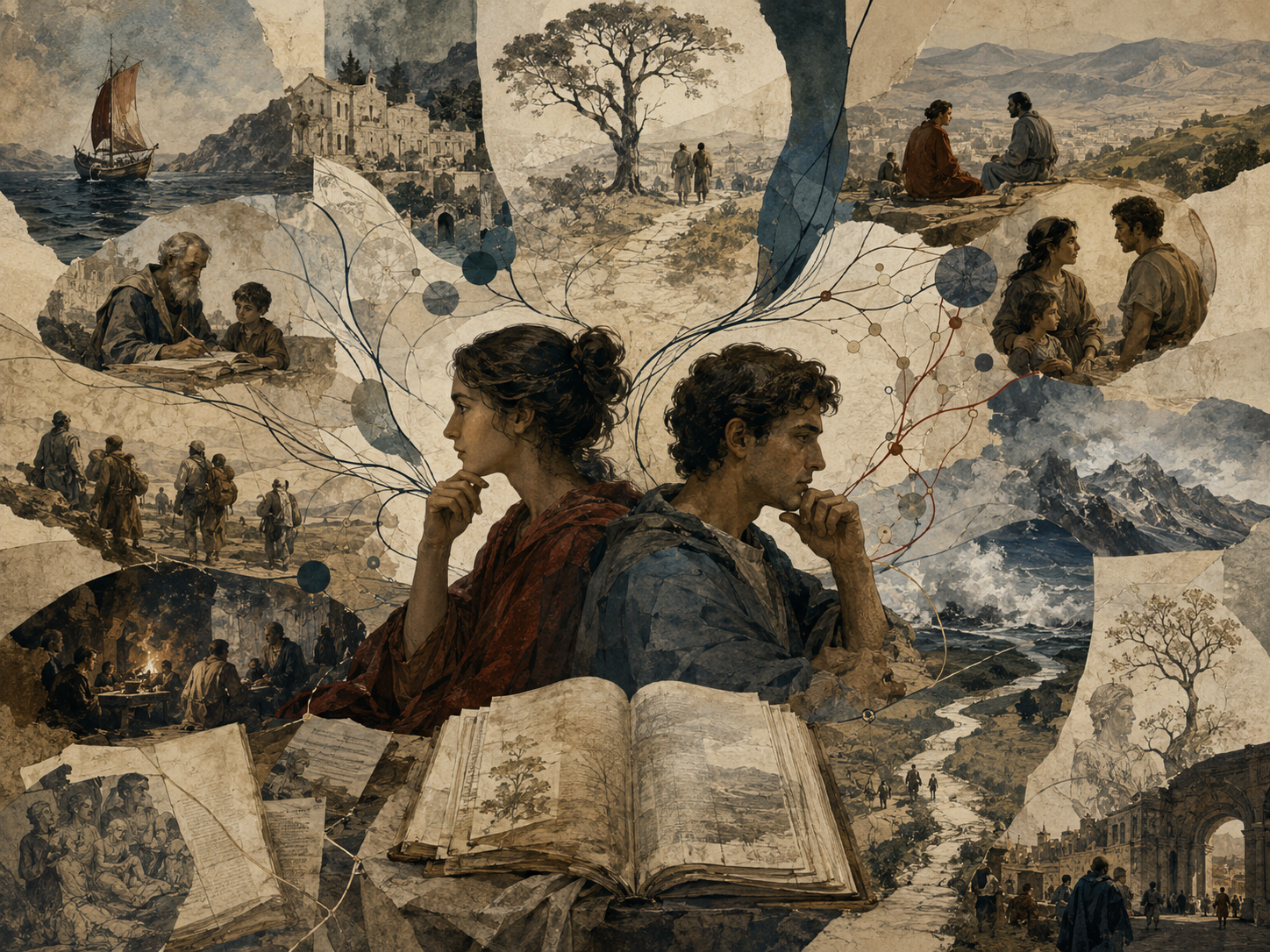
This article treats story as a structure of understanding rather than a decorative communication technique. It examines how people use narrative to organize time, make events intelligible, connect motives to actions, interpret change, form identity, construct possible worlds, reason morally, and communicate meaning across social life. It also includes computational workflows for auditing narrative sensemaking, event coherence, causal framing, interpretive risk, identity formation, and Catalyst Canvas-ready governance outputs for responsible narrative analysis.
Story and Understanding
Story is a mode of understanding because it connects experience across time. A list of events can tell us what happened. A story helps us understand why those events matter, how they relate, who was involved, what changed, and what remains unresolved. Story turns event into sequence, sequence into pattern, pattern into meaning, and meaning into memory.
This is why storytelling appears so naturally in human explanation. When someone asks why a relationship changed, why a community fractured, why an institution failed, why a discovery mattered, or why a decision was made, the answer often takes narrative form. People do not merely provide data points. They arrange events, motives, constraints, turning points, consequences, and interpretations.
Story is not the only way humans understand. Mathematical reasoning, scientific modeling, logical classification, statistical inference, visual mapping, and philosophical argument all provide forms of understanding. But narrative does something distinctive: it organizes human experience as temporally unfolding action under conditions of uncertainty, agency, interpretation, and consequence.
| Understanding problem | How story helps | Example |
|---|---|---|
| Events are disconnected. | Story creates sequence and relation. | A crisis timeline becomes a narrative of escalation, failure, response, and reform. |
| Motives are unclear. | Story links action to intention, pressure, belief, or constraint. | A decision is explained through competing obligations and limited information. |
| Consequences are hard to interpret. | Story connects actions to outcomes over time. | A policy decision becomes understandable through delayed effects. |
| Identity feels fragmented. | Story connects memory, change, and continuity. | A person interprets life through loss, learning, recovery, or vocation. |
| Values are abstract. | Story places values inside concrete situations. | Courage, loyalty, justice, or mercy appears through a difficult choice. |
| The future is uncertain. | Story imagines possible outcomes and paths. | Scenario narratives help people reason about long-term risks. |
Story matters because human understanding is not only about accuracy. It is also about orientation: knowing where we are in time, what has changed, what kind of situation we are in, what matters, and what might come next.
Narrative and Information
Information and narrative are related, but they are not the same. Information can be stored as data, facts, observations, claims, measurements, statements, or records. Narrative arranges selected information into a meaningful structure. It gives events order, emphasis, perspective, causality, and consequence.
This distinction is important because information alone does not explain itself. A set of facts about unemployment, migration, climate risk, organizational failure, public health, or technological adoption may be accurate but still difficult to understand. Narrative can help readers see how facts relate to lived experience, institutional decisions, social systems, and historical change.
At the same time, narrative can distort information. Because stories select, arrange, and emphasize, they can make weak evidence feel compelling, give coincidence the appearance of causality, or make a complex system look like a simple moral drama. Story is powerful because it organizes meaning. That same power creates ethical responsibility.
| Information form | Narrative function | Risk if mishandled |
|---|---|---|
| Fact | Provides a claim about what is the case. | A fact may be placed in a misleading frame. |
| Data point | Supports scale, trend, comparison, or change. | A single number may be overinterpreted. |
| Event | Gives narrative something to sequence. | Sequence may be mistaken for causation. |
| Example | Makes an abstract issue concrete. | A vivid example may be treated as representative. |
| Testimony | Brings lived experience into interpretation. | Experience may be appropriated or generalized too quickly. |
| Pattern | Connects events across time or cases. | A pattern may be imposed where evidence is thin. |
A responsible narrative mode of understanding does not treat story as a substitute for information. It treats story as a structure for interpreting information carefully.
Time, Sequence, and Meaning
Story gives time a structure. Human beings experience life as a flow of moments, but understanding requires more than succession. Narrative turns time into meaningful sequence by identifying beginnings, developments, turning points, delays, reversals, consequences, and endings. It makes temporal experience intelligible.
A story does not simply report that one thing happened after another. It asks which events belong together, which event counts as the beginning, which event changes the situation, which delay matters, what caused confusion, what consequence followed, and what remains open. The same events can become different stories depending on where the sequence begins and ends.
This is why narrative time matters. A policy failure may begin with a visible crisis, but a deeper story may begin years earlier with neglected infrastructure, poor incentives, ignored warnings, or institutional drift. A personal story may begin with a single event, but its meaning may depend on childhood, community, education, trauma, or long-term aspiration. Narrative sequence shapes understanding.
| Narrative time element | Understanding function | Analytical question |
|---|---|---|
| Beginning | Frames what the story treats as the origin of meaning. | Why does the story start here? |
| Sequence | Arranges events into order and development. | What order is used, and what alternative orders are possible? |
| Turning point | Marks a change in direction, knowledge, or consequence. | What event changes the situation? |
| Delay | Shows waiting, resistance, uncertainty, or accumulated pressure. | What happens because change does not occur immediately? |
| Reversal | Changes expectation and interpretation. | How does new information alter the story? |
| Ending | Creates closure, openness, warning, or continuation. | Does the ending resolve too much or too little? |
Story helps humans understand because it gives temporal experience shape. But the shape is always interpretive. Choosing the beginning and ending is already a form of meaning-making.
Causality and Consequence
Story helps people understand causality. It connects actions, choices, forces, pressures, institutions, accidents, motives, and consequences. A story can show how one event leads to another, how small decisions accumulate, how delayed effects appear, or how unintended consequences emerge.
Narrative causality is not the same as scientific causality. In science, causality often requires controlled comparison, mechanism, evidence, and testable inference. In story, causality is often interpretive. It may show plausible connection, moral responsibility, lived consequence, or practical understanding. This makes narrative powerful but also risky.
A story can clarify causality when it reveals sequence, mechanism, context, and consequence. It can distort causality when it selects only convenient events, ignores structural conditions, personalizes systemic problems, or assigns blame without evidence. Stories often make causality feel obvious, even when the evidence remains uncertain.
| Causal pattern | Narrative value | Risk |
|---|---|---|
| Direct cause | Shows how one action produces a visible outcome. | May oversimplify complex systems. |
| Accumulation | Shows how small events build over time. | May hide which events matter most. |
| Feedback | Shows how consequences reshape future action. | May be difficult to narrate linearly. |
| Delay | Shows effects appearing long after causes. | May make responsibility harder to see. |
| Contingency | Shows uncertainty, accident, and alternate possibilities. | May be erased by hindsight. |
A strong story does not merely say what happened. It helps the audience understand how events became consequential.
Motives, Agency, and Action
Story helps people understand action by connecting what people do to what they want, fear, believe, misunderstand, resist, inherit, or are forced to confront. Human action is rarely explained by event sequence alone. People act within constraints, relationships, institutions, cultures, habits, emotions, incentives, and uncertainties.
Agency is central to narrative understanding because stories ask who can act and how. A story may focus on an individual protagonist, a family, a community, an organization, a government, a movement, a system, or a distributed network of actors. The choice matters. If a story gives too much agency to one person, it may hide social structure. If it gives too much agency to structure, it may hide responsibility and choice.
Narrative understanding requires agency to be mapped carefully. Who acted? Who was acted upon? Who had power? Who lacked options? Who misunderstood the situation? Who benefited? Who was harmed? Who could have acted differently? These are narrative questions, but they are also ethical and political questions.
| Agency question | Why it matters | Example |
|---|---|---|
| Who acts? | Identifies the visible agent of change. | A leader, community, institution, platform, or movement. |
| Who cannot act? | Reveals constraint and unequal power. | People affected by decisions they did not control. |
| Who is blamed? | Shows how responsibility is assigned. | An individual may be blamed for a systemic failure. |
| Who is erased? | Identifies missing agency or experience. | Workers, communities, ecosystems, or historical actors may disappear. |
| Who interprets? | Shows whose perspective frames the story. | An official account may differ from lived experience. |
| Who changes? | Reveals transformation or its absence. | A protagonist learns, an institution reforms, or a system resists change. |
Story helps humans understand action because it connects choice to circumstance. It shows that action is never only movement; it is movement within meaning.
Memory and Interpretation
Story shapes memory by selecting, arranging, and interpreting the past. People remember through images, scenes, phrases, relationships, turning points, wounds, victories, failures, and unresolved questions. A story gives memory a structure that can be repeated, shared, revised, and contested.
Memory is not simply stored information. It is reconstructed through present concerns, available language, cultural frameworks, and social relationships. A personal memory changes meaning as a person ages. A community memory changes as new generations reinterpret it. An institutional memory changes when records are preserved, forgotten, sanitized, or reopened.
Story helps memory become meaningful, but it also creates memory risk. A story may preserve a painful truth, or it may make an incomplete account seem final. It may restore forgotten experience, or it may turn memory into myth. It may help communities heal, or it may sustain grievance, denial, nostalgia, or exclusion.
| Memory function | How story supports it | Risk |
|---|---|---|
| Selection | Identifies which events matter. | Important events may be omitted. |
| Sequence | Places memory in temporal relation. | Order may imply unsupported causality. |
| Interpretation | Explains what memory means. | Meaning may be imposed too narrowly. |
| Transmission | Makes memory repeatable across people and time. | Repetition may harden into unquestioned myth. |
| Repair | Allows silenced memory to return. | Repair may be symbolic without material accountability. |
| Contest | Allows competing accounts to challenge official memory. | Memory conflict may become polarized or manipulative. |
Story is one of memory’s main interpretive forms. It does not merely preserve the past; it tells people what kind of past they believe they have inherited.
Identity and Self-Understanding
Human beings often understand themselves through story. A person’s identity is not only a set of traits, roles, preferences, or labels. It is also an account of continuity and change: where one has been, what one has endured, what one values, what one regrets, what one hopes for, and what kind of future one imagines.
Narrative identity does not mean that the self is fictional. It means that self-understanding is interpretive and temporal. People organize memory into patterns of becoming. A person may understand life through a story of survival, responsibility, vocation, migration, recovery, service, rupture, reinvention, exile, or return. These stories help people make sense of continuity through change.
But identity stories can also constrain. A person may inherit a harmful story about who they are allowed to be. A group may impose a narrative of loyalty, sacrifice, shame, superiority, victimhood, or destiny. Institutions and nations also construct identity stories that may sustain belonging while excluding difference.
| Identity layer | Story function | Critical question |
|---|---|---|
| Personal identity | Connects memory, agency, loss, learning, and aspiration. | Does the story allow complexity and change? |
| Family identity | Preserves kinship memory, obligation, humor, hardship, and continuity. | Whose version of the family story dominates? |
| Community identity | Creates shared memory, place, belonging, and responsibility. | Who is included or excluded? |
| Professional identity | Connects work, skill, ethics, judgment, and contribution. | Does the story hide failure or exploitation? |
| Institutional identity | Explains founding, purpose, legitimacy, and reform. | Does the story acknowledge harm and accountability? |
| National identity | Frames origin, sacrifice, achievement, crisis, and future. | What histories are minimized or erased? |
Story helps humans understand who they are because identity is lived across time. But the stories of identity require care, because they can either expand or restrict human possibility.
Moral Understanding
Story is one of the main ways people understand moral life. Moral principles can be stated abstractly, but stories show what those principles mean under pressure. A story can dramatize loyalty, betrayal, courage, mercy, justice, obligation, care, cowardice, pride, remorse, repair, and responsibility.
Moral understanding often requires context. A rule may be clear in the abstract but difficult in a particular situation. Stories show competing duties, incomplete knowledge, unequal power, unintended consequences, and human vulnerability. They help people imagine what an action feels like from different positions.
This is why stories are central to religious teaching, law, literature, public testimony, ethics education, leadership, restorative justice, and civic life. They allow people to consider not only what happened, but what should have happened, what was owed, what harm remains, and what repair might require.
| Moral question | Storytelling contribution | Risk |
|---|---|---|
| What is the right thing to do? | Places ethical principles inside a concrete situation. | May oversimplify conflicting duties. |
| Who was harmed? | Makes consequences visible through experience. | May center only the most narratable suffering. |
| Who is responsible? | Connects action, omission, power, and consequence. | May assign blame too quickly. |
| What should be repaired? | Shows harm as temporal and relational. | May offer symbolic closure without material repair. |
| What should be remembered? | Connects moral judgment to memory. | May harden into grievance or myth. |
| What future is possible? | Imagines change, accountability, and reconciliation. | May promise transformation without evidence. |
Story helps moral understanding because ethics is not only rule application. It is interpretation of action, consequence, harm, responsibility, and possibility in human time.
Possible Worlds and Imagination
Story helps humans understand not only what happened, but what might happen. It creates possible worlds. A possible world may be fictional, speculative, historical, strategic, political, ethical, personal, or scientific. It allows people to test meanings, consequences, identities, fears, and hopes without immediately living them.
Imagination is not escape from understanding. It is often a condition of understanding. To understand a choice, people imagine alternatives. To understand a risk, they imagine futures. To understand another person, they imagine experience beyond their own. To understand a system, they imagine what might happen if one condition changes.
Possible-world thinking matters in literature, futures thinking, scenario planning, public policy, law, ethics, design, science fiction, education, and strategic communication. Stories can help people rehearse possibility, anticipate consequences, and recognize that the present is not the only imaginable world.
| Possible-world function | How story supports it | Use case |
|---|---|---|
| Alternative action | Imagines what could have been done differently. | Ethics, law, leadership, decision review. |
| Future consequence | Explores possible outcomes over time. | Scenario planning, risk analysis, climate futures. |
| Perspective-taking | Imagines another person’s experience or constraints. | Moral education, literature, conflict resolution. |
| Worldbuilding | Creates a coherent setting with rules, histories, and possibilities. | Fiction, games, speculative design, institutional foresight. |
| Counterfactual reasoning | Considers what might have happened if conditions changed. | History, policy analysis, strategic learning. |
| Hope and warning | Imagines desirable or dangerous futures. | Public narrative, sustainability communication, social change. |
Story helps humans understand because it expands the field of the imaginable. It lets people ask not only what is, but what could be, what could have been, and what should not become.
Social and Cultural Understanding
Stories help people understand social life. Human societies are made of institutions, roles, norms, identities, conflicts, memories, rituals, obligations, and shared expectations. Many of these cannot be understood through isolated facts alone. They require interpretation of relationships over time.
A community story may explain why a place matters. A professional story may explain what good judgment looks like. A national story may explain belonging, sacrifice, progress, decline, or conflict. A social movement story may connect private suffering to public injustice. An organizational story may explain why a mission exists, how change happened, or where trust broke down.
Social understanding through story is powerful because it creates shared frames. People can coordinate around a narrative of crisis, reform, duty, solidarity, or future possibility. But shared frames can also become exclusionary. A story may make one group’s experience central while treating others as background, threat, obstacle, or absence.
| Social field | Story function | Critical risk |
|---|---|---|
| Community | Preserves place, memory, belonging, and obligation. | May exclude internal difference. |
| Institution | Explains purpose, legitimacy, failure, and reform. | May become self-protective mythology. |
| Politics | Frames crisis, responsibility, threat, hope, and action. | May become propaganda or scapegoating. |
| Religion | Connects sacred time, ethical obligation, identity, and meaning. | May be misread outside context or used coercively. |
| Education | Transmits knowledge through sequence, example, and memory. | May oversimplify contested histories. |
| Media | Circulates public stories at scale. | May reward emotional intensity over careful interpretation. |
Story helps people understand social life because society itself is partly narrative: it is made of remembered pasts, interpreted presents, and imagined futures.
Story in Knowledge Systems
Story also operates inside knowledge systems. Research, education, journalism, science communication, policy explanation, organizational learning, and public scholarship all use narrative structures to make knowledge intelligible. A research article may tell the story of a question, method, result, limitation, and implication. A curriculum may tell the story of conceptual progression. A policy brief may tell the story of a problem, evidence, options, tradeoffs, and recommended action.
In this sense, story does not oppose knowledge. It can help knowledge become structured and communicable. A good explanation often has narrative movement: it begins with a problem, introduces context, defines terms, develops concepts, presents evidence, addresses uncertainty, and guides the audience toward a conclusion or next question.
The danger comes when story overwhelms inquiry. A knowledge system can become too attached to a preferred narrative. Evidence may be selected to fit the story. Contradictions may be minimized. Failure may be reframed as progress. Uncertainty may be hidden. A responsible knowledge system uses story to guide understanding while preserving the right to revise the story.
| Knowledge setting | Narrative structure | Governance need |
|---|---|---|
| Research article | Question, literature, method, findings, limitation, implication. | Make evidence and uncertainty explicit. |
| Curriculum | Foundation, progression, practice, application, reflection. | Sequence concepts without oversimplifying. |
| Policy explanation | Problem, affected groups, evidence, options, tradeoffs, decision. | Separate narrative framing from proof. |
| Journalism | Event, background, actors, stakes, evidence, consequence. | Avoid false balance, sensationalism, and unsupported causality. |
| Organizational learning | Failure, diagnosis, response, adaptation, institutional memory. | Preserve accountability and avoid mythic self-protection. |
| Content library | Article map, foundation, methods, examples, ethics, future directions. | Maintain links, references, metadata, and narrative coherence. |
Story as a mode of understanding is therefore central to knowledge architecture. It helps people learn not only what is known, but how knowledge is connected.
The Limits of Story as Understanding
Story is powerful because it creates coherence. But coherence is not always truth. Human beings are drawn to stories because they make experience intelligible, but this can lead to narrative overreach. A compelling story may feel complete before the evidence is sufficient. A story may make coincidence look like destiny, complexity look like intention, or structural failure look like individual blame.
One danger is false coherence. Life often includes accident, ambiguity, contradiction, and unresolved consequences. Story can impose order where the situation remains open. Another danger is hindsight. After an outcome occurs, people may arrange prior events as if the result was inevitable. A third danger is moral simplification. Stories often organize attention through characters and conflict, but not every issue is best understood through villains and heroes.
The limits of story do not make storytelling untrustworthy. They make narrative responsibility necessary. Good narrative understanding remains open to revision, evidence, complexity, and alternative interpretations.
| Narrative limitation | How it distorts understanding | Corrective practice |
|---|---|---|
| False coherence | Makes events seem more orderly than they were. | Name uncertainty and unresolved evidence. |
| Hindsight bias | Makes outcomes seem inevitable after they occur. | Recover uncertainty at the time decisions were made. |
| Hero-villain simplification | Reduces complex systems to moral roles. | Map institutions, incentives, constraints, and distributed agency. |
| Selection bias | Includes only events that support the preferred interpretation. | Ask what the story omits. |
| Emotional persuasion | Uses affect to make weak evidence feel strong. | Separate illustration from proof. |
| False closure | Ends a story before consequences are resolved. | Distinguish narrative ending from real-world repair. |
Story helps humans understand, but only when it remains accountable to evidence, context, uncertainty, and ethical care.
Examples of Narrative Understanding
The examples below show how story helps people understand complex experience while also revealing where narrative interpretation must be handled carefully.
Personal change
Weak: I changed because one event happened.
Stronger: One event became meaningful because it connected earlier pressure, present choice, and later transformation.
Why it works: It treats change as temporal and interpretive, not isolated.
Institutional failure
Weak: One leader caused the failure.
Stronger: The failure emerged through incentives, ignored warnings, weak governance, leadership choices, and delayed consequences.
Why it works: It connects agency to structure.
Moral judgment
Weak: The story proves who was right.
Stronger: The story reveals competing duties, unequal power, harm, responsibility, and unresolved repair.
Why it works: It keeps moral interpretation complex.
Public policy
Weak: The policy failed because people made bad choices.
Stronger: The policy outcome depended on design assumptions, institutional capacity, public trust, incentives, and feedback effects.
Why it works: It resists blame-centered simplification.
Cultural memory
Weak: This is the story of what happened.
Stronger: This is one remembered version of what happened, shaped by selection, authority, omission, and repetition.
Why it works: It treats memory as interpreted, not neutral.
Future scenario
Weak: This story predicts the future.
Stronger: This scenario explores one plausible future under stated assumptions and uncertainties.
Why it works: It separates possibility from prediction.
Narrative understanding is strongest when it connects events meaningfully without pretending that meaning is simple, final, or uncontested.
Mathematics, Computation, and Modeling
Story as a mode of understanding cannot be reduced to a formula, but modeling can help analyze whether a story supports understanding responsibly. A computational audit can evaluate event sequence, causal clarity, agency mapping, evidence strength, interpretive openness, memory function, identity formation, and ethical risk. These models should support human interpretation, not replace it.
A narrative understanding score can average the major components that make a story useful for sensemaking:
U_n = \frac{S + C + A + M + E + O}{6}
\]
Interpretation: Narrative understanding \(U_n\) averages sequence clarity \(S\), causal framing \(C\), agency mapping \(A\), memory integration \(M\), evidence support \(E\), and openness to revision \(O\).
A narrative overreach score can estimate the risk that a story imposes too much coherence:
R_o = (1 – E_s)w_e + H_bw_h + F_cw_f + S_bw_s + C_pw_c
\]
Interpretation: Narrative overreach \(R_o\) rises when evidence strength \(E_s\) is low, hindsight bias \(H_b\), false coherence \(F_c\), selection bias \(S_b\), and closure pressure \(C_p\) are high.
A moral understanding score can combine consequence visibility, agency clarity, harm recognition, responsibility mapping, and repair awareness:
M_u = \frac{V_c + A_c + H_r + R_m + R_a}{5}
\]
Interpretation: Moral understanding \(M_u\) averages consequence visibility \(V_c\), agency clarity \(A_c\), harm recognition \(H_r\), responsibility mapping \(R_m\), and repair awareness \(R_a\).
A possible-world value score can estimate how well a story supports imagination without false certainty:
P_w = \frac{A_l + C_f + U_s + I_d + R_v}{5}
\]
Interpretation: Possible-world value \(P_w\) averages alternative logic \(A_l\), consequence framing \(C_f\), uncertainty signaling \(U_s\), interpretive diversity \(I_d\), and revision value \(R_v\).
| Modeling task | Understanding question | Example output |
|---|---|---|
| Sequence audit | Does the story arrange events clearly? | Event sequence table, missing transition report. |
| Causal framing audit | Does the story distinguish sequence from causality? | Causal claim register, evidence-strength score. |
| Agency audit | Who acts, who is constrained, and who is omitted? | Agency map, responsibility notes. |
| Memory audit | What does the story preserve, select, or omit? | Memory function table, omission flags. |
| Moral audit | Does the story clarify harm, duty, and repair? | Moral understanding score, repair-awareness note. |
| Overreach audit | Where does the story impose false coherence? | Narrative risk queue, revision recommendations. |
A computational approach is useful when it makes narrative assumptions visible. It should help editors, researchers, educators, and analysts ask better questions about how stories support or distort understanding.
Python Workflow: Narrative Understanding Audit
The Python workflow below evaluates stories by sequence clarity, causal framing, agency mapping, memory integration, evidence support, interpretive openness, moral understanding, possible-world value, and overreach risk. The companion repository version extends this into a Catalyst Canvas-ready module with schemas, package-style Python, tests, JSON exports, Canvas cards, markdown governance queues, and reusable narrative-understanding templates.
# narrative_understanding_audit.py
# Dependency-light workflow for auditing story as a mode of understanding.

from __future__ import annotations

from dataclasses import dataclass
from pathlib import Path
import csv
import json
from statistics import mean

ARTICLE_ROOT = Path(__file__).resolve().parents[1]
OUTPUTS = ARTICLE_ROOT / "outputs"
TABLES = OUTPUTS / "tables"
JSON_DIR = OUTPUTS / "json"
MARKDOWN = OUTPUTS / "markdown"


@dataclass
class NarrativeUnderstandingItem:
    item: str
    story_type: str
    sequence_clarity: float
    causal_framing: float
    agency_mapping: float
    memory_integration: float
    evidence_support: float
    openness_to_revision: float
    consequence_visibility: float
    harm_recognition: float
    responsibility_mapping: float
    repair_awareness: float
    alternative_logic: float
    uncertainty_signaling: float
    interpretive_diversity: float
    hindsight_bias: float
    false_coherence: float
    selection_bias: float
    closure_pressure: float
    owner: str
    status: str

    def understanding_score(self) -> float:
        return mean([
            self.sequence_clarity,
            self.causal_framing,
            self.agency_mapping,
            self.memory_integration,
            self.evidence_support,
            self.openness_to_revision,
        ])

    def moral_understanding_score(self) -> float:
        return mean([
            self.consequence_visibility,
            self.agency_mapping,
            self.harm_recognition,
            self.responsibility_mapping,
            self.repair_awareness,
        ])

    def possible_world_score(self) -> float:
        return mean([
            self.alternative_logic,
            self.causal_framing,
            self.uncertainty_signaling,
            self.interpretive_diversity,
            self.openness_to_revision,
        ])

    def overreach_risk(self) -> float:
        return min(
            1.0,
            (1 - self.evidence_support) * 0.25
            + self.hindsight_bias * 0.20
            + self.false_coherence * 0.25
            + self.selection_bias * 0.15
            + self.closure_pressure * 0.15,
        )

    def review_priority(self) -> str:
        risk = self.overreach_risk()
        if self.status == "revise" or risk >= 0.50:
            return "high"
        if self.status == "review" or risk >= 0.35:
            return "medium"
        return "standard"


def write_csv(path: Path, rows: list[dict[str, object]]) -> None:
    path.parent.mkdir(parents=True, exist_ok=True)
    if not rows:
        raise ValueError(f"No rows to write: {path}")
    with path.open("w", encoding="utf-8", newline="") as handle:
        writer = csv.DictWriter(handle, fieldnames=list(rows[0].keys()))
        writer.writeheader()
        writer.writerows(rows)


def write_json(path: Path, payload: object) -> None:
    path.parent.mkdir(parents=True, exist_ok=True)
    path.write_text(json.dumps(payload, indent=2), encoding="utf-8")


def write_markdown_queue(path: Path, rows: list[dict[str, object]]) -> None:
    path.parent.mkdir(parents=True, exist_ok=True)
    lines = [
        "# Narrative Understanding Governance Queue",
        "",
        "| Item | Type | Understanding | Moral understanding | Overreach risk | Priority | Owner |",
        "|---|---|---:|---:|---:|---|---|",
    ]

    for row in rows:
        lines.append(
            f"| {row['item']} | {row['story_type']} | "
            f"{row['understanding_score']} | {row['moral_understanding_score']} | "
            f"{row['overreach_risk']} | {row['review_priority']} | {row['owner']} |"
        )

    path.write_text("\n".join(lines) + "\n", encoding="utf-8")


def main() -> None:
    items = [
        NarrativeUnderstandingItem(
            "Personal recovery narrative",
            "identity story",
            0.84, 0.76, 0.78, 0.86, 0.72, 0.70,
            0.80, 0.74, 0.76, 0.68,
            0.72, 0.66, 0.70,
            0.42, 0.44, 0.38, 0.46,
            "editorial", "active"
        ),
        NarrativeUnderstandingItem(
            "Institutional failure account",
            "organizational story",
            0.80, 0.72, 0.68, 0.74, 0.62, 0.58,
            0.76, 0.72, 0.70, 0.54,
            0.64, 0.56, 0.58,
            0.58, 0.62, 0.52, 0.60,
            "governance", "review"
        ),
        NarrativeUnderstandingItem(
            "Public crisis story",
            "public narrative",
            0.76, 0.64, 0.62, 0.70, 0.50, 0.46,
            0.78, 0.74, 0.58, 0.42,
            0.54, 0.40, 0.42,
            0.70, 0.78, 0.66, 0.72,
            "communications", "revise"
        ),
        NarrativeUnderstandingItem(
            "Scenario planning story",
            "possible-world narrative",
            0.82, 0.78, 0.70, 0.64, 0.74, 0.86,
            0.70, 0.62, 0.66, 0.58,
            0.90, 0.88, 0.82,
            0.34, 0.38, 0.36, 0.40,
            "research", "active"
        ),
        NarrativeUnderstandingItem(
            "Cultural memory account",
            "memory story",
            0.78, 0.70, 0.66, 0.90, 0.68, 0.64,
            0.74, 0.80, 0.66, 0.62,
            0.58, 0.60, 0.74,
            0.50, 0.56, 0.48, 0.54,
            "archive", "review"
        ),
    ]

    rows = []

    for item in items:
        rows.append({
            "item": item.item,
            "story_type": item.story_type,
            "sequence_clarity": item.sequence_clarity,
            "causal_framing": item.causal_framing,
            "agency_mapping": item.agency_mapping,
            "memory_integration": item.memory_integration,
            "evidence_support": item.evidence_support,
            "openness_to_revision": item.openness_to_revision,
            "moral_understanding_score": round(item.moral_understanding_score(), 3),
            "possible_world_score": round(item.possible_world_score(), 3),
            "understanding_score": round(item.understanding_score(), 3),
            "overreach_risk": round(item.overreach_risk(), 3),
            "review_priority": item.review_priority(),
            "owner": item.owner,
            "status": item.status,
        })

    rows = sorted(rows, key=lambda row: row["overreach_risk"], reverse=True)

    governance_queue = [
        row for row in rows
        if row["review_priority"] != "standard"
    ]

    write_csv(TABLES / "narrative_understanding_audit.csv", rows)
    write_csv(TABLES / "narrative_understanding_governance_queue.csv", governance_queue)

    write_json(JSON_DIR / "narrative_understanding_canvas_cards.json", rows)
    write_json(JSON_DIR / "narrative_understanding_governance_queue.json", governance_queue)

    write_markdown_queue(MARKDOWN / "narrative_understanding_governance_queue.md", governance_queue)

    print("Narrative understanding audit complete.")


if __name__ == "__main__":
    main()
This workflow helps identify stories that support understanding well and stories that require review because they overstate causality, impose false coherence, rush closure, or rely on weak evidence.
R Workflow: Narrative Understanding Diagnostics
The R workflow below creates a synthetic narrative-understanding dataset, calculates understanding score, moral understanding score, possible-world value, overreach risk, and review priority, then exports summary tables and base R plots. It is intentionally portable and uses only base R.
# narrative_understanding_diagnostics.R
# Base R workflow for story as a mode of human understanding.

args <- commandArgs(trailingOnly = FALSE)
file_arg <- grep("^--file=", args, value = TRUE)

if (length(file_arg) > 0) {
  script_path <- normalizePath(sub("^--file=", "", file_arg[1]), mustWork = TRUE)
  article_root <- normalizePath(file.path(dirname(script_path), ".."), mustWork = TRUE)
} else {
  article_root <- getwd()
}

setwd(article_root)

tables_dir <- file.path(article_root, "outputs", "tables")
figures_dir <- file.path(article_root, "outputs", "figures")
dir.create(tables_dir, recursive = TRUE, showWarnings = FALSE)
dir.create(figures_dir, recursive = TRUE, showWarnings = FALSE)

items <- data.frame(
  item = c(
    "Personal recovery narrative",
    "Institutional failure account",
    "Public crisis story",
    "Scenario planning story",
    "Cultural memory account"
  ),
  story_type = c(
    "identity story",
    "organizational story",
    "public narrative",
    "possible-world narrative",
    "memory story"
  ),
  sequence_clarity = c(0.84, 0.80, 0.76, 0.82, 0.78),
  causal_framing = c(0.76, 0.72, 0.64, 0.78, 0.70),
  agency_mapping = c(0.78, 0.68, 0.62, 0.70, 0.66),
  memory_integration = c(0.86, 0.74, 0.70, 0.64, 0.90),
  evidence_support = c(0.72, 0.62, 0.50, 0.74, 0.68),
  openness_to_revision = c(0.70, 0.58, 0.46, 0.86, 0.64),
  consequence_visibility = c(0.80, 0.76, 0.78, 0.70, 0.74),
  harm_recognition = c(0.74, 0.72, 0.74, 0.62, 0.80),
  responsibility_mapping = c(0.76, 0.70, 0.58, 0.66, 0.66),
  repair_awareness = c(0.68, 0.54, 0.42, 0.58, 0.62),
  alternative_logic = c(0.72, 0.64, 0.54, 0.90, 0.58),
  uncertainty_signaling = c(0.66, 0.56, 0.40, 0.88, 0.60),
  interpretive_diversity = c(0.70, 0.58, 0.42, 0.82, 0.74),
  hindsight_bias = c(0.42, 0.58, 0.70, 0.34, 0.50),
  false_coherence = c(0.44, 0.62, 0.78, 0.38, 0.56),
  selection_bias = c(0.38, 0.52, 0.66, 0.36, 0.48),
  closure_pressure = c(0.46, 0.60, 0.72, 0.40, 0.54),
  owner = c("editorial", "governance", "communications", "research", "archive"),
  status = c("active", "review", "revise", "active", "review"),
  stringsAsFactors = FALSE
)

items$understanding_score <- rowMeans(items[, c(
  "sequence_clarity",
  "causal_framing",
  "agency_mapping",
  "memory_integration",
  "evidence_support",
  "openness_to_revision"
)])

items$moral_understanding_score <- rowMeans(items[, c(
  "consequence_visibility",
  "agency_mapping",
  "harm_recognition",
  "responsibility_mapping",
  "repair_awareness"
)])

items$possible_world_score <- rowMeans(items[, c(
  "alternative_logic",
  "causal_framing",
  "uncertainty_signaling",
  "interpretive_diversity",
  "openness_to_revision"
)])

items$overreach_risk <- pmin(
  1,
  (1 - items$evidence_support) * 0.25 +
    items$hindsight_bias * 0.20 +
    items$false_coherence * 0.25 +
    items$selection_bias * 0.15 +
    items$closure_pressure * 0.15
)

items$review_priority <- ifelse(
  items$status == "revise" | items$overreach_risk >= 0.50,
  "high",
  ifelse(
    items$status == "review" | items$overreach_risk >= 0.35,
    "medium",
    "standard"
  )
)

items <- items[order(items$overreach_risk, decreasing = TRUE), ]

write.csv(
  items,
  file.path(tables_dir, "narrative_understanding_diagnostics.csv"),
  row.names = FALSE
)

governance_queue <- items[items$review_priority != "standard", ]

write.csv(
  governance_queue,
  file.path(tables_dir, "narrative_understanding_governance_queue.csv"),
  row.names = FALSE
)

png(file.path(figures_dir, "narrative_understanding_score.png"), width = 1200, height = 700)
barplot(
  items$understanding_score,
  names.arg = items$item,
  las = 2,
  ylab = "Narrative understanding score",
  main = "Narrative Understanding"
)
grid()
dev.off()

png(file.path(figures_dir, "narrative_overreach_risk.png"), width = 1200, height = 700)
barplot(
  items$overreach_risk,
  names.arg = items$item,
  las = 2,
  ylab = "Narrative overreach risk",
  main = "Narrative Overreach Risk"
)
grid()
dev.off()

print(items[, c(
  "item",
  "story_type",
  "understanding_score",
  "moral_understanding_score",
  "possible_world_score",
  "overreach_risk",
  "review_priority"
)])
This workflow turns narrative understanding into a reviewable interpretive artifact. It helps identify where a story clarifies meaning and where it may require stronger evidence, fuller context, or more careful framing.
GitHub Repository
The companion repository for this article supports story as a Catalyst Canvas-ready narrative-understanding module. It includes sensemaking audits, sequence analysis, causal-framing diagnostics, agency mapping, memory integration, narrative identity indicators, moral-understanding scores, possible-world modeling, overreach-risk scoring, JSON schemas, package-style Python, R workflows, SQL structures, Canvas cards, markdown governance queues, synthetic datasets, documentation, and reusable narrative-understanding templates.
Complete Code Repository
Companion repository for the article, including Catalyst Canvas-ready code for narrative understanding, sensemaking, causal framing, agency mapping, memory interpretation, moral judgment, possible worlds, overreach risk, JSON exports, Canvas cards, and reproducible research workflows.
articles/story-as-a-mode-of-human-understanding/
├── canvas/
│   ├── canvas_manifest.json
│   ├── input_schema.json
│   ├── output_schema.json
│   ├── canvas_cards.json
│   └── governance_queue.json
├── html/
├── css/
├── php/
├── java/
├── python/
│   ├── narrative_understanding_canvas/
│   │   ├── __init__.py
│   │   ├── __main__.py
│   │   ├── cli.py
│   │   ├── models.py
│   │   ├── scoring.py
│   │   ├── validation.py
│   │   ├── governance.py
│   │   └── exporters.py
│   ├── tests/
│   │   └── test_narrative_understanding_canvas.py
│   └── run_narrative_understanding_canvas_audit.py
├── r/
│   ├── narrative_understanding_diagnostics.R
│   └── run_all_narrative_understanding_workflows.R
├── sql/
│   ├── canvas_schema.sql
│   └── canvas_queries.sql
├── docs/
│   ├── article_notes.md
│   ├── modeling_principles.md
│   ├── sensemaking_notes.md
│   ├── narrative_overreach.md
│   └── governance_notes.md
├── data/
│   ├── narrative_understanding_items.csv
│   ├── event_sequences.csv
│   ├── causal_frames.csv
│   ├── agency_maps.csv
│   ├── moral_understanding.csv
│   └── overreach_risks.csv
├── outputs/
│   ├── figures/
│   ├── json/
│   ├── markdown/
│   └── tables/
├── notebooks/
├── shared/
│   ├── schemas/
│   ├── narrative-templates/
│   ├── story-archetypes/
│   ├── character-models/
│   ├── plot-structures/
│   ├── rhetorical-frameworks/
│   ├── cultural-memory/
│   ├── sensemaking/
│   └── governance/
├── tests/
└── README.md
Related Articles
- What Is Storytelling?
- Why Storytelling Matters in Human Culture
- Storytelling as a Content Framework
- The History of Storytelling from Oral Tradition to Modern Media
- Storytelling and the Architecture of Meaning Over Time
- Narrative Identity and the Story of the Self
A Practical Method for Analyzing Story as Understanding
1. Identify the understanding problem
Ask what the story helps the audience understand: an event, decision, identity, conflict, failure, transformation, memory, or possible future.
2. Map the event sequence
List the major events and examine why the story starts and ends where it does.
3. Examine causal framing
Identify what the story presents as cause, condition, trigger, delay, feedback, accident, or consequence.
4. Map agency
Ask who acts, who is constrained, who is affected, who is blamed, who benefits, and who is missing.
5. Separate evidence from interpretation
Identify which claims are supported, which are illustrative, and which are interpretive.
6. Examine memory function
Ask what the story preserves, omits, revises, repairs, or repeats.
7. Evaluate moral understanding
Look for harm, responsibility, duty, repair, consequence, and competing values.
8. Test possible-world reasoning
Ask what alternatives, futures, counterfactuals, or scenarios the story opens or closes.
9. Identify overreach risk
Look for false coherence, hindsight bias, unsupported causality, selection bias, and premature closure.
10. Add governance notes
Document source limits, interpretive uncertainty, representation concerns, omitted perspectives, and revision needs.
This method treats story as a serious interpretive structure. It helps preserve the usefulness of narrative while guarding against the ways narrative can distort understanding.
Common Pitfalls
Several pitfalls appear when story is treated as understanding without enough discipline.
- Confusing coherence with truth: A story can feel complete even when evidence is incomplete.
- Starting the story too late: Visible events often have deeper histories, causes, and conditions.
- Ending the story too early: Narrative closure may hide unresolved consequences or repair needs.
- Mistaking sequence for causality: Events that occur in order are not automatically causally connected.
- Overpersonalizing systemic problems: Stories can make institutions and structures disappear behind individual actors.
- Flattening agency: People may act under constraint, unequal power, limited information, or inherited conditions.
- Using emotion as evidence: Emotional force can clarify stakes, but it cannot prove claims by itself.
- Ignoring omitted perspectives: Stories often leave out people whose experience would change the interpretation.
- Turning ambiguity into a tidy arc: Some situations remain unresolved, nonlinear, tragic, or contested.
- Forgetting revision: Responsible narrative understanding must remain open to new evidence and reinterpretation.
The central pitfall is treating story as automatic understanding. Story helps humans understand only when it remains accountable to evidence, context, complexity, and ethical interpretation.
Why Story Helps Humans Understand
Story helps humans understand because life unfolds in time. People do not experience the world as isolated facts. They encounter events, choices, constraints, relationships, memories, conflicts, losses, hopes, consequences, and possible futures. Story gives these experiences a form that can be interpreted, remembered, shared, questioned, and revised.
As a mode of understanding, story connects time to meaning. It helps people ask what happened, why it mattered, who acted, who was harmed, what changed, what might have happened otherwise, and what remains unresolved. It supports identity, moral imagination, cultural memory, social coordination, education, public reasoning, and knowledge architecture.
But the power of story requires discipline. Narratives can clarify experience, but they can also impose false coherence, simplify causality, distort memory, or close questions too soon. Story is most valuable when it helps human beings understand without pretending that understanding is final.
Further Reading
- Bruner, J. (1986) Actual Minds, Possible Worlds. Cambridge, MA: Harvard University Press. Available at: https://www.hup.harvard.edu/books/9780674003668
- Bruner, J. (1991) ‘The Narrative Construction of Reality’, Critical Inquiry, 18(1), pp. 1–21. Available at: https://web.english.upenn.edu/~cavitch/pdf-library/Bruner_Narrative.pdf
- Carr, D. (1986) Time, Narrative, and History. Bloomington: Indiana University Press.
- Fisher, W.R. (1987) Human Communication as Narration: Toward a Philosophy of Reason, Value, and Action. Columbia, SC: University of South Carolina Press. Available at: https://uscpress.com/Human-Communication-as-Narration
- Herman, D. (2009) Basic Elements of Narrative. Chichester: Wiley-Blackwell.
- Polkinghorne, D.E. (1988) Narrative Knowing and the Human Sciences. Albany: State University of New York Press. Available at: https://books.google.com/books/about/Narrative_Knowing_and_the_Human_Sciences.html?id=7HXn29yaDeoC
- Ricoeur, P. (1984) Time and Narrative, Volume 1. Translated by K. McLaughlin and D. Pellauer. Chicago: University of Chicago Press. Available at: https://press.uchicago.edu/ucp/books/book/chicago/T/bo5962044.html
- Turner, M. (1996) The Literary Mind: The Origins of Thought and Language. Oxford: Oxford University Press. Available at: https://global.oup.com/academic/product/the-literary-mind-9780195126679
- White, H. (1987) The Content of the Form: Narrative Discourse and Historical Representation. Baltimore: Johns Hopkins University Press.
- Worth, S.E. (2008) ‘Storytelling and Narrative Knowing: An Examination of the Epistemic Benefits of Well-Told Stories’, The Journal of Aesthetic Education, 42(3), pp. 42–56.
References
- Bruner, J. (1986) Actual Minds, Possible Worlds. Cambridge, MA: Harvard University Press. Available at: https://www.hup.harvard.edu/books/9780674003668
- Bruner, J. (1991) ‘The Narrative Construction of Reality’, Critical Inquiry, 18(1), pp. 1–21. Available at: https://web.english.upenn.edu/~cavitch/pdf-library/Bruner_Narrative.pdf
- Carr, D. (1986) Time, Narrative, and History. Bloomington: Indiana University Press.
- Fisher, W.R. (1987) Human Communication as Narration: Toward a Philosophy of Reason, Value, and Action. Columbia, SC: University of South Carolina Press. Available at: https://uscpress.com/Human-Communication-as-Narration
- Herman, D. (2009) Basic Elements of Narrative. Chichester: Wiley-Blackwell.
- Polkinghorne, D.E. (1988) Narrative Knowing and the Human Sciences. Albany: State University of New York Press. Available at: https://books.google.com/books/about/Narrative_Knowing_and_the_Human_Sciences.html?id=7HXn29yaDeoC
- Ricoeur, P. (1984) Time and Narrative, Volume 1. Translated by K. McLaughlin and D. Pellauer. Chicago: University of Chicago Press. Available at: https://press.uchicago.edu/ucp/books/book/chicago/T/bo5962044.html
- Turner, M. (1996) The Literary Mind: The Origins of Thought and Language. Oxford: Oxford University Press. Available at: https://global.oup.com/academic/product/the-literary-mind-9780195126679
- White, H. (1987) The Content of the Form: Narrative Discourse and Historical Representation. Baltimore: Johns Hopkins University Press.
- Worth, S.E. (2008) ‘Storytelling and Narrative Knowing: An Examination of the Epistemic Benefits of Well-Told Stories’, The Journal of Aesthetic Education, 42(3), pp. 42–56.