
Last Updated May 20, 2026
Deindividuation refers to a psychological condition in which personal self-awareness, individual identifiability, and concern for personal evaluation weaken under conditions of anonymity, group immersion, role absorption, or collective arousal. In social psychology, the concept has been used to explain why people sometimes act differently in crowds, organizations, uniforms, online platforms, political movements, or anonymous settings than they would when personally visible and self-reflective.
The strongest contemporary interpretation does not treat deindividuation as a simple loss of reason or a collapse into chaos. Deindividuation is better understood as a shift in behavioral regulation. Personal self-focus may weaken, but behavior does not become normless. Instead, people often become more responsive to the norms, identities, cues, and expectations that are salient in the surrounding group environment.
This distinction is crucial. Anonymity can enable cruelty, mob aggression, trolling, harassment, and moral disengagement. But it can also support whistleblowing, mutual aid, protest, dissent, solidarity, and protection from unjust retaliation. The outcome depends on which identity is activated, which norms are made salient, how accountability is structured, and whether institutions amplify or constrain harmful behavior.
Main Library
Publications
Article Map
Social Psychology
Related Topic
Cognitive Psychology
Related Topic
Institutions & Governance
Related Topic
Stewardship & Ethics
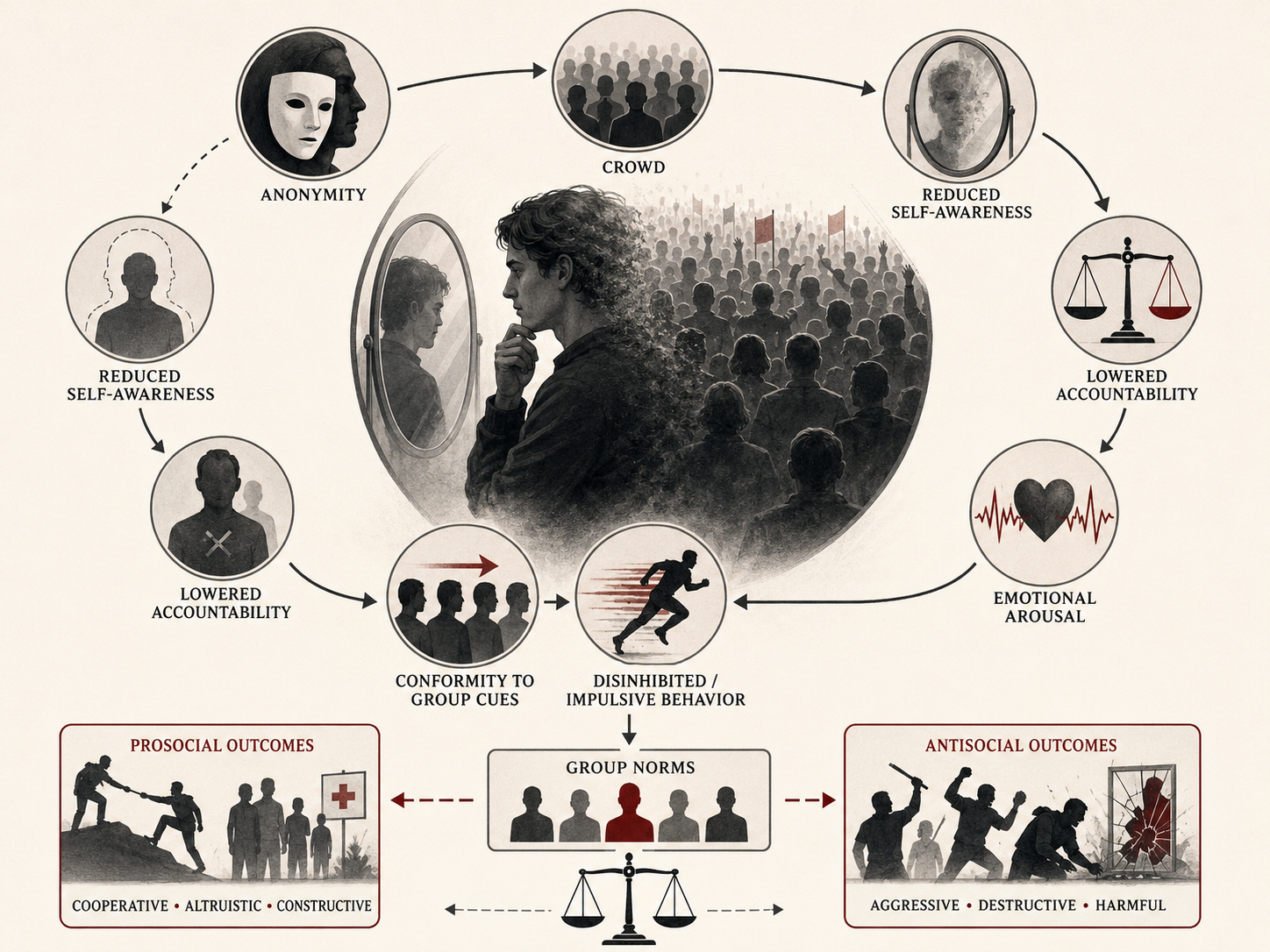
Deindividuation connects directly to conformity and social influence, group polarization, groupthink, social identity theory, diffusion of responsibility, moral disengagement, obedience to authority, and social norms. Together these frameworks explain how groups reshape responsibility, self-regulation, identity, and conduct.
What is deindividuation?
Deindividuation describes a psychological condition in which the individual experiences reduced self-awareness, weakened concern for personal evaluation, and diminished attention to personal accountability. It is most often associated with anonymity, crowd immersion, uniforms, masks, role absorption, online pseudonymity, and high-arousal collective environments.
In classic formulations, deindividuation was understood as a loss of individual identity. People in crowds or anonymous settings were thought to become less rational, less restrained, and more impulsive. Contemporary research is more careful. Deindividuation does not necessarily eliminate identity. It may reduce personal identity salience while increasing social identity salience. People may act less as private individuals and more as members of a group.
This means that deindividuation does not automatically produce antisocial behavior. The outcome depends on the norms that guide the deindividuated setting. If a salient group norm is hostile, punitive, exclusionary, or violent, anonymity may intensify harmful conduct. If the salient group norm is protective, solidaristic, cooperative, or justice-oriented, anonymity may support prosocial action.
Deindividuation is therefore best understood as a theory of shifted regulation. Behavior becomes less governed by personal self-monitoring and more governed by group identity, situational cues, norm salience, role expectations, emotional arousal, and perceived accountability.
Origins of deindividuation theory
The roots of deindividuation theory lie in early crowd psychology, especially late nineteenth- and early twentieth-century debates about crowds, mobs, mass emotion, contagion, and collective action. Early writers were fascinated and alarmed by the fact that people could behave differently in crowds than they did alone.
These early theories often treated crowds as irrational and dangerous. They emphasized contagion, suggestibility, emotional intensity, and loss of reason. Although historically influential, this tradition was often politically loaded and sociologically crude. It could pathologize popular movements, protests, and collective action while ignoring the rational, moral, and political dimensions of crowd behavior.
Modern social psychology reframed the question. Instead of assuming that crowds simply erase reason, researchers asked which mechanisms change behavior in collective settings. Do people feel anonymous? Are they less self-aware? Do they expect accountability? Are group norms salient? Does social identity become more important than personal identity? Do institutions reward or punish harmful conduct?
Deindividuation theory emerged from that shift. It translated broad claims about crowds into experimentally testable processes: anonymity, self-awareness, identifiability, accountability, arousal, group immersion, and norm salience.
Le Bon, crowd psychology, and the problem of collective behavior
Gustave Le Bon’s The Crowd: A Study of the Popular Mind is one of the classic sources of crowd psychology. Le Bon argued that individuals in crowds undergo psychological transformation, becoming more emotional, suggestible, and responsive to contagion. He treated crowds as powerful collective organisms that could override individual judgment.
Le Bon’s influence was enormous, but his framework has major limits. It often portrayed crowds as inherently irrational and politically dangerous. It did not adequately distinguish different types of crowds, leadership, norms, institutions, grievances, identities, or moral purposes. It also tended to treat collective action from below with suspicion, making it vulnerable to elitist or anti-democratic readings.
Even so, Le Bon identified a real problem: social environments can alter the relationship between individual self-regulation and collective behavior. Later deindividuation theory retained this core question while replacing sweeping crowd claims with more specific psychological mechanisms.
A contemporary reading should therefore treat Le Bon as historically important but insufficient. Crowds do not simply dissolve rationality. They create social conditions in which identity, emotion, accountability, and norms become reorganized. Some crowds harm; others protect, mourn, celebrate, resist injustice, or coordinate mutual aid.
Zimbardo and early experimental deindividuation research
Philip Zimbardo’s 1969 essay on individuation and deindividuation was one of the most influential statements of the classic model. Zimbardo emphasized anonymity, reduced self-observation, arousal, and weakened accountability as conditions that could increase impulsive or norm-deviant conduct.
Early experimental work often manipulated identifiability through hoods, uniforms, name tags, lighting, or group conditions. The central question was whether people who were less identifiable would behave more aggressively or less responsibly. These studies helped turn deindividuation from a general crowd idea into a research program.
Zimbardo later connected deindividuation to broader arguments about situational power, institutional roles, and the capacity of ordinary people to behave harmfully under certain conditions. The Stanford Prison Experiment became culturally famous in this context, though it has also faced serious methodological, ethical, and interpretive criticism. A research-grade article should not treat that study as clean evidence. Its symbolic influence is real, but its empirical status is contested.
The enduring contribution of Zimbardo’s approach is not that anonymity mechanically produces evil. It is that social conditions can change self-awareness, accountability, role behavior, and moral restraint. The weakness of early deindividuation theory was its tendency to overstate the link between anonymity and antisocial behavior while underdeveloping the role of group norms and social identity.
Psychological mechanisms of deindividuation
Deindividuation is not caused by a single mechanism. It usually reflects several interacting processes.
Anonymity
Anonymity reduces personal identifiability. When people feel less traceable, they may experience lower concern for personal reputation, punishment, shame, or social judgment. However, anonymity is not inherently antisocial. It can also protect dissenters, whistleblowers, vulnerable communities, and people resisting coercive institutions.
Reduced self-awareness
Deindividuating settings can shift attention away from internal standards and self-reflection. When self-awareness falls, people may rely more heavily on immediate environmental cues or group expectations. This can increase impulsivity, but it can also increase norm-congruent behavior when group norms are clear.
Diffusion of responsibility
In groups, responsibility can feel distributed. An individual may think, “Everyone is doing it,” “No single person is responsible,” or “The group made me do it.” Diffusion of responsibility can weaken moral restraint, especially when accountability systems are unclear.
Group identity salience
Group immersion can shift attention from personal identity to social identity. People may act not as isolated individuals but as members of a crowd, movement, team, army, fandom, organization, political faction, or online community.
Emotional contagion and arousal
Crowds and online cascades can amplify emotion. Anger, fear, joy, grief, outrage, pride, humiliation, and moral certainty can spread quickly. Arousal can intensify norm-congruent action and reduce reflective delay.
Role absorption
Institutional roles can deindividuate when people identify more with the role than with personal moral responsibility. Uniforms, ranks, procedures, scripts, and chain-of-command systems can focus attention on role expectations rather than personal judgment.
Moral disengagement
People may rationalize harmful behavior by displacing responsibility, diffusing responsibility, dehumanizing targets, minimizing harm, or using euphemistic language. Deindividuating contexts can make these rationalizations easier by embedding them in group norms.
These mechanisms do not eliminate agency. They change the psychological environment in which agency is exercised. That distinction is essential: deindividuation explains altered regulation, not the disappearance of responsibility.
Formalizing deindividuation
Deindividuation can be represented as a shift in the relative weight of personal self-regulation and group-norm regulation. Let behavior \(B_i\) depend on personal standards \(P_i\) and salient group norms \(G_i\):
B_i=(1-\lambda_i)P_i+\lambda_iG_i
\]
Interpretation: As \(\lambda_i\) rises, behavior is regulated less by personal standards and more by salient group norms.
The group-regulation weight \(\lambda_i\) can be modeled as a function of anonymity, crowd immersion, group identity salience, personal identity salience, and accountability:
\lambda_i=\operatorname{logit}^{-1}(\beta_0+\beta_1A_i+\beta_2C_i+\beta_3I_{g,i}-\beta_4I_{p,i}-\beta_5K_i)
\]
Interpretation: Group-based regulation rises with anonymity \(A\), crowd immersion \(C\), and group identity salience \(I_g\), but falls with personal identity salience \(I_p\) and accountability \(K\).
Reduced self-awareness can be represented as:
S_i^*=S_i-\alpha_1A_i-\alpha_2C_i+\alpha_3K_i
\]
Interpretation: Effective self-awareness declines with anonymity and crowd immersion, but increases with accountability.
The SIDE model can be represented by distinguishing personal and social identity salience:
I_{g,i}=I_{g,i}^{0}+\gamma A_iN_i
\]
Interpretation: Anonymity can increase social identity salience when a group norm or identity \(N\) is available.
I_{p,i}=I_{p,i}^{0}-\delta A_i
\]
Interpretation: Anonymity may reduce personal identity salience, especially when individual identifiability is low.
Norm-congruent behavior can then be modeled as:
NC_i=\theta_0+\theta_1A_i+\theta_2I_{g,i}+\theta_3V_i+\theta_4Q_i-\theta_5K_i
\]
Interpretation: Norm congruence rises with anonymity, group identity salience, norm valence \(V\), and norm clarity \(Q\), while accountability may constrain harmful norm enactment.
These equations clarify why deindividuation should not be modeled as simple normlessness. The key question is which regulatory system becomes stronger: personal self-monitoring or group-norm responsiveness.
Crowds, anonymity, and collective behavior
Deindividuation has long been associated with crowd behavior because crowds can reduce identifiability, heighten arousal, diffuse responsibility, and make group cues more salient. Public demonstrations, protests, riots, sporting events, concerts, festivals, military formations, religious gatherings, and mass celebrations can all alter the relation between individual self-regulation and collective conduct.
But crowd behavior is not inherently irrational or destructive. Crowds can be disciplined, moral, organized, protective, joyful, solidaristic, and politically meaningful. A crowd at a vigil may enforce norms of silence and care. A protest crowd may enforce norms of restraint or mutual aid. A hostile crowd may enforce norms of aggression. A celebratory crowd may amplify joy and shared identity.
The central question is therefore not “Does the crowd make people irrational?” The better question is “Which identity and norms become salient within the crowd, and how do accountability, leadership, threat, policing, and institutional context shape behavior?”
This matters for public policy. Treating crowds as automatically dangerous can justify excessive control, surveillance, and repression. A better approach examines crowd composition, grievances, identity, leadership, communication, policing strategy, spatial design, and institutional legitimacy.
Deindividuation is useful only when it avoids crowd-pathology assumptions. It should explain altered regulation, not pathologize collective life.
The Social Identity Model of Deindividuation Effects
The Social Identity Model of Deindividuation Effects, commonly known as SIDE, is one of the most important revisions of classic deindividuation theory. Associated with Stephen Reicher, Russell Spears, and Tom Postmes, the model challenges the assumption that anonymity simply dissolves identity and produces uncontrolled behavior.
SIDE argues that anonymity can reduce personal identity salience while increasing social identity salience. People do not become identity-less. They may become more responsive to the group identity that is psychologically active in the situation.
This revision changes the interpretation of anonymity. In older theories, anonymity was often treated as a cause of disinhibition and antinormative behavior. In SIDE, anonymity can intensify conformity to group norms. If the group norm is prosocial, anonymity may increase prosocial behavior. If the group norm is hostile, anonymity may increase hostility. If the group norm is disciplined, anonymity may increase discipline. If the group norm is exclusionary, anonymity may increase exclusion.
SIDE is especially important for digital environments. Online anonymity does not simply remove social influence. It can make online groups more influential by shifting attention toward shared identity, in-group norms, and community cues. Pseudonymous spaces can therefore produce solidarity, harassment, mutual aid, extremism, support networks, or collective action depending on norm structure and platform design.
The model is a major reason contemporary scholarship treats deindividuation as identity transformation rather than mere identity loss.
Norm salience and prosocial versus antisocial outcomes
One of the most important advances in deindividuation research is the recognition that anonymity can intensify both prosocial and antisocial behavior. The key variable is norm salience. Deindividuation does not automatically produce transgression; it can increase behavior consistent with the cues and norms made salient in the environment.
Johnson and Downing’s classic work on deindividuation and cue valence illustrated this point by showing that deindividuated participants could become more prosocial or more antisocial depending on the cues associated with the experimental context. This finding helped weaken the older assumption that deindividuation directly causes aggression.
Norm valence matters in several domains:
- an anonymous online group with hostile norms may amplify harassment;
- an anonymous support community with care norms may amplify disclosure and mutual aid;
- a protest crowd with restraint norms may remain disciplined;
- a crowd with revenge norms may escalate punishment;
- a platform with visible moderation may reduce antisocial norm spread;
- a workplace role system with accountability gaps may normalize harmful conduct;
- a mutual-aid network may use anonymity to protect vulnerable participants.
The research implication is clear: deindividuation studies should measure the norm environment. Anonymity alone is not enough. Researchers should ask what group identity is active, what behavior is modeled, what language is used, what role expectations exist, and whether institutions reward or punish norm violations.
The ethical implication is equally important. Anonymous spaces should not be designed as if anonymity itself is the problem. The deeper issue is how anonymity interacts with norms, accountability, moderation, power, and group identity.
Deindividuation in digital environments
Digital environments have renewed the importance of deindividuation theory. Online platforms often combine anonymity or pseudonymity, rapid group formation, reduced face-to-face cues, large audiences, algorithmic amplification, weak accountability, and emotionally charged interaction. These conditions can intensify norm-congruent behavior, for better or worse.
Online deindividuation can contribute to harassment, trolling, pile-ons, doxxing, hate speech, reputational cascades, and moral outrage cycles. People may feel less personally accountable when acting through pseudonyms, avatars, disposable accounts, or large crowds. Responsibility can feel distributed across the platform or group.
But anonymity also protects important forms of speech and association. Whistleblowers, dissidents, marginalized communities, abuse survivors, labor organizers, political critics, and vulnerable users may depend on anonymity for safety. Removing anonymity can silence legitimate speech while failing to address harmful norms.
This is why digital deindividuation must be analyzed through platform design. Important variables include:
- pseudonymity versus real-name identity;
- traceability and persistence of records;
- visibility of rules;
- moderation consistency;
- algorithmic amplification of outrage;
- community norm clarity;
- audience size and imagined audience;
- friction before posting;
- reputation systems;
- appeal and accountability procedures;
- protection for vulnerable users.
The SIDE model is particularly useful online because it explains why anonymous digital spaces can be highly normative rather than normless. Users may become more influenced by community identity and group expectations precisely because personal identity cues are reduced.
Digital governance should therefore focus not only on identifiability, but on norm design, accountability, community structure, moderation legitimacy, and the protection of legitimate anonymity.
Institutional and political implications
Deindividuation has major implications for institutions because many institutions deliberately alter identity, accountability, and role salience. Military systems, police units, prisons, fraternities, bureaucracies, corporations, political movements, sports fandoms, online communities, and activist organizations can all create conditions in which personal identity becomes less salient and collective identity becomes more powerful.
Uniforms, masks, ranks, slogans, chants, rituals, shared symbols, procedures, and chain-of-command systems can strengthen group identity. These tools are not inherently harmful. They can create solidarity, discipline, courage, mutual responsibility, and shared purpose. But they can also reduce personal moral reflection when institutional norms license aggression, humiliation, cruelty, exclusion, or abuse.
Political contexts are especially important. Deindividuation can support democratic solidarity, collective courage, and resistance to oppression. It can also intensify partisan hostility, scapegoating, mob punishment, and ideological violence. The direction depends on leadership, norms, accountability, policing, media framing, and institutional legitimacy.
Organizations also face deindividuation risks. Role-based systems can allow people to say, “I was only following procedure,” “Everyone does it,” or “The system required it.” This is where deindividuation connects with moral disengagement and obedience. Institutions can diffuse responsibility so widely that no individual feels accountable for collective harm.
A serious institutional response should not simply individualize blame after the fact. It should examine how roles, incentives, anonymity, hierarchy, surveillance gaps, and group norms made the behavior more likely.
Ethics, accountability, and the design of anonymous spaces
Deindividuation raises a difficult ethical question: how can institutions preserve the benefits of anonymity while limiting the harms of unaccountable behavior?
Anonymity can protect conscience, dissent, privacy, safety, experimentation, recovery, and vulnerable speech. It can allow people to seek help, challenge power, disclose abuse, or participate in communities without exposing themselves to retaliation. A society that eliminates anonymity can become less free, less safe, and less open to marginalized voices.
At the same time, anonymity can enable harassment, threats, manipulation, hate campaigns, fraud, and coordinated abuse. When people believe they cannot be identified or sanctioned, harmful group norms can spread quickly.
The ethical task is not simply to remove anonymity. It is to design accountability without destroying legitimate privacy. Better systems may include:
- clear community norms;
- visible and consistent moderation;
- graduated sanctions;
- appeal mechanisms;
- privacy-preserving accountability;
- friction for high-risk actions;
- protection against doxxing and retaliation;
- separation of public pseudonymity from platform-level traceability;
- special protections for whistleblowing and vulnerable users;
- transparent institutional governance.
The ethical lesson is that anonymity is not one thing. It can mean privacy from the public, privacy from peers, privacy from institutions, lack of traceability, lack of reputation, or lack of accountability. Each design has different psychological and political consequences.
Deindividuation research helps institutions ask better questions: who is invisible, to whom, under what norms, with what protections, and with what accountability?
Deindividuation in the architecture of social influence
Within the broader architecture of social influence, deindividuation helps explain how group environments alter the balance between personal self-regulation and collective norm responsiveness. Conformity explains alignment with group expectations. Social norms explain the expectations themselves. Group polarization explains how group discussion can intensify positions. Diffusion of responsibility explains why accountability may weaken in groups. Moral disengagement explains how harmful conduct becomes rationalized.
Deindividuation adds a specific mechanism: under anonymity, immersion, arousal, or role absorption, personal identity and accountability may become less salient while group identity and situational norms become more influential.
This makes deindividuation especially important for understanding online mobs, crowd events, role-based institutions, political movements, and high-arousal collective settings. It explains why the same person may act differently when alone, named, observed, and accountable than when anonymous, immersed, and guided by a powerful group norm.
Seen this way, deindividuation is not merely a theory of disorder. It is a theory of social regulation under conditions where the self is reweighted by the group.
Critiques and limits of the concept
Deindividuation remains influential, but it has important limits. Early versions often implied that anonymity, crowds, or reduced self-awareness produce antisocial behavior directly. Later research showed that this claim was too crude. Group settings do not have one inevitable psychological effect. They intensify behavior in relation to salient identities, norms, accountability structures, and institutional conditions.
Several cautions are essential:
- Do not treat crowds as inherently irrational.
- Do not treat anonymity as inherently antisocial.
- Do not ignore prosocial uses of anonymity.
- Do not confuse personal identity reduction with identity loss.
- Do not ignore social identity and group norms.
- Do not apply the concept without measuring norm valence.
- Do not use deindividuation to excuse harm or erase agency.
- Do not ignore leadership, ideology, power, policing, institutions, or platform design.
- Do not use crowd psychology to pathologize protest or collective action.
- Do not overgeneralize from contested or ethically problematic studies.
The strongest use of the concept today is integrated with social identity theory, norm theory, institutional analysis, and digital-platform governance. Deindividuation should not be used as a stand-alone explanation for bad behavior. It should be used to ask how identity, anonymity, accountability, norms, and institutions interacted to shape conduct.
It is also important to preserve moral clarity. Explaining deindividuation does not remove responsibility. It helps identify the conditions that made harmful behavior more likely, so those conditions can be changed.
Measurement, data, and research design
Deindividuation research uses laboratory experiments, crowd surveys, online experiments, platform-behavior studies, group-identity manipulations, self-awareness manipulations, accountability manipulations, role-immersion studies, response-time tasks, discourse analysis, and computational social-science methods.
Key variables include:
- participant, session, group, site, and platform identifiers;
- anonymity;
- identifiability;
- group size;
- crowd immersion;
- self-awareness;
- accountability;
- group identity salience;
- personal identity salience;
- group norm valence;
- norm clarity;
- norm congruence;
- arousal;
- emotional contagion;
- responsibility diffusion;
- moral disengagement;
- perceived surveillance;
- moderation visibility;
- prosocial behavior;
- antisocial behavior;
- response time.
Strong designs should distinguish anonymity from accountability. A person may be anonymous to other users but accountable to platform moderators. A person may be identifiable but still feel unaccountable if institutions do not enforce rules. These are different psychological conditions.
Researchers should also measure group norm valence. Without measuring whether the salient norm is prosocial, antisocial, punitive, celebratory, cooperative, or exclusionary, the meaning of deindividuated behavior is unclear.
SIDE-oriented designs should explicitly test interactions among anonymity, group identity salience, and norm salience. The core prediction is not simply that anonymity increases antisocial behavior. It is that anonymity can increase norm-congruent behavior when group identity is salient.
Finally, digital research should measure platform design: pseudonymity, moderation visibility, rule clarity, traceability, audience size, algorithmic amplification, reputation systems, and appeal mechanisms. Online behavior is not shaped by anonymity alone.
R code for deindividuation research
The following R workflow models norm congruence, prosocial behavior, antisocial behavior, deindividuation index, and response time as functions of anonymity, group identity salience, group norm valence, self-awareness, accountability, moderation visibility, and context.
# Install packages if needed:
# pak::pak(c("tidyverse", "lme4", "lmerTest", "emmeans", "broom.mixed", "performance"))

library(tidyverse)
library(lme4)
library(lmerTest)
library(emmeans)
library(broom.mixed)
library(performance)

# Expected columns:
# participant, session_id, group_id, site_id, condition, context_type,
# trial, anonymity, identifiability, group_size, crowd_immersion,
# self_awareness, accountability, group_identity_salience,
# personal_identity_salience, group_norm_valence, norm_clarity,
# norm_congruence, arousal_index, emotional_contagion,
# responsibility_diffusion, moral_disengagement,
# perceived_surveillance, moderation_visibility, behavior_score,
# prosocial_behavior, antisocial_behavior, response_time_ms

dat <- read_csv("deindividuation_trials.csv") %>%
  mutate(
    participant = factor(participant),
    session_id = factor(session_id),
    group_id = factor(group_id),
    site_id = factor(site_id),
    condition = factor(condition),
    context_type = factor(context_type),
    log_group_size = log1p(group_size),
    identity_shift_index =
      group_identity_salience - personal_identity_salience,
    deindividuation_index = (
      anonymity +
      crowd_immersion +
      responsibility_diffusion +
      arousal_index -
      self_awareness -
      accountability
    ) / 4,
    side_norm_activation = (
      anonymity *
      group_identity_salience *
      norm_clarity
    ) / 100,
    antisocial_norm = as.integer(group_norm_valence < 0),
    prosocial_norm = as.integer(group_norm_valence > 0),
    log_response_time = log(response_time_ms)
  )

# -----------------------------
# 1. Descriptive summary
# -----------------------------

summary_table <- dat %>%
  group_by(condition, context_type) %>%
  summarise(
    n = n(),
    participants = n_distinct(participant),
    mean_behavior = mean(behavior_score, na.rm = TRUE),
    mean_prosocial = mean(prosocial_behavior, na.rm = TRUE),
    mean_antisocial = mean(antisocial_behavior, na.rm = TRUE),
    mean_anonymity = mean(anonymity, na.rm = TRUE),
    mean_self_awareness = mean(self_awareness, na.rm = TRUE),
    mean_accountability = mean(accountability, na.rm = TRUE),
    mean_group_identity = mean(group_identity_salience, na.rm = TRUE),
    mean_norm_congruence = mean(norm_congruence, na.rm = TRUE),
    mean_deindividuation = mean(deindividuation_index, na.rm = TRUE),
    mean_response_time = mean(response_time_ms, na.rm = TRUE),
    .groups = "drop"
  )

print(summary_table)

# -----------------------------
# 2. SIDE / norm-congruence model
# -----------------------------

norm_model <- lmer(
  norm_congruence ~
    anonymity * group_identity_salience * group_norm_valence +
    self_awareness +
    accountability +
    norm_clarity +
    crowd_immersion +
    perceived_surveillance +
    moderation_visibility +
    condition +
    context_type +
    (1 + anonymity | participant) +
    (1 | group_id) +
    (1 | site_id),
  data = dat,
  REML = FALSE
)

summary(norm_model)
emmeans(norm_model, ~ anonymity | group_identity_salience)

# -----------------------------
# 3. Prosocial and antisocial behavior models
# -----------------------------

prosocial_model <- lmer(
  prosocial_behavior ~
    anonymity * group_identity_salience * group_norm_valence +
    norm_congruence +
    self_awareness +
    accountability +
    moral_disengagement +
    moderation_visibility +
    condition +
    context_type +
    (1 | participant) +
    (1 | group_id) +
    (1 | site_id),
  data = dat,
  REML = FALSE
)

antisocial_model <- lmer(
  antisocial_behavior ~
    anonymity * group_identity_salience * group_norm_valence +
    norm_congruence +
    responsibility_diffusion +
    moral_disengagement +
    accountability +
    moderation_visibility +
    self_awareness +
    condition +
    context_type +
    (1 | participant) +
    (1 | group_id) +
    (1 | site_id),
  data = dat,
  REML = FALSE
)

summary(prosocial_model)
summary(antisocial_model)

# -----------------------------
# 4. Deindividuation index model
# -----------------------------

deindividuation_model <- lmer(
  deindividuation_index ~
    anonymity +
    identifiability +
    log_group_size +
    crowd_immersion +
    group_identity_salience +
    personal_identity_salience +
    accountability +
    moderation_visibility +
    condition +
    context_type +
    (1 | participant) +
    (1 | group_id) +
    (1 | site_id),
  data = dat,
  REML = FALSE
)

summary(deindividuation_model)

# -----------------------------
# 5. Response-time model
# -----------------------------

rt_model <- lmer(
  log_response_time ~
    deindividuation_index +
    norm_clarity +
    arousal_index +
    self_awareness +
    accountability +
    condition +
    context_type +
    (1 | participant) +
    (1 | group_id) +
    (1 | site_id),
  data = dat %>% filter(response_time_ms >= 150),
  REML = FALSE
)

summary(rt_model)

# -----------------------------
# 6. Norm-valence summary
# -----------------------------

norm_summary <- dat %>%
  mutate(
    norm_band = cut(
      group_norm_valence,
      breaks = c(-5.1, -1.0, 1.0, 5.1),
      labels = c("antisocial_norm", "neutral_norm", "prosocial_norm")
    )
  ) %>%
  group_by(condition, norm_band) %>%
  summarise(
    n = n(),
    mean_norm_congruence = mean(norm_congruence, na.rm = TRUE),
    mean_prosocial = mean(prosocial_behavior, na.rm = TRUE),
    mean_antisocial = mean(antisocial_behavior, na.rm = TRUE),
    mean_deindividuation = mean(deindividuation_index, na.rm = TRUE),
    .groups = "drop"
  )

print(norm_summary)

# -----------------------------
# 7. Export outputs
# -----------------------------

write_csv(summary_table, "deindividuation_summary.csv")
write_csv(norm_summary, "deindividuation_norm_valence_summary.csv")

write_csv(
  tidy(norm_model, effects = "fixed", conf.int = TRUE),
  "deindividuation_norm_congruence_coefficients.csv"
)

write_csv(
  tidy(prosocial_model, effects = "fixed", conf.int = TRUE),
  "deindividuation_prosocial_coefficients.csv"
)

write_csv(
  tidy(antisocial_model, effects = "fixed", conf.int = TRUE),
  "deindividuation_antisocial_coefficients.csv"
)

# -----------------------------
# 8. Visualization
# -----------------------------

ggplot(
  norm_summary,
  aes(x = norm_band, y = mean_norm_congruence, color = condition, group = condition)
) +
  geom_line() +
  geom_point() +
  labs(
    title = "Norm congruence under anonymity and salient norms",
    x = "Group norm valence",
    y = "Mean norm congruence"
  ) +
  theme_minimal()
This workflow tests a SIDE-oriented claim: anonymity should not be expected to increase antisocial behavior in general; instead, anonymity should increase norm-congruent behavior when group identity and group norms are salient.
Python code for deindividuation research
The Python workflow below parallels the R analysis and adds a SIDE simulation. It is useful for modeling how anonymity, group identity salience, group norm valence, self-awareness, accountability, and moderation visibility jointly affect norm-congruent, prosocial, and antisocial behavior.
import numpy as np
import pandas as pd
import statsmodels.formula.api as smf
import matplotlib.pyplot as plt

# Expected columns:
# participant, session_id, group_id, site_id, condition, context_type,
# trial, anonymity, identifiability, group_size, crowd_immersion,
# self_awareness, accountability, group_identity_salience,
# personal_identity_salience, group_norm_valence, norm_clarity,
# norm_congruence, arousal_index, emotional_contagion,
# responsibility_diffusion, moral_disengagement,
# perceived_surveillance, moderation_visibility, behavior_score,
# prosocial_behavior, antisocial_behavior, response_time_ms

df = pd.read_csv("deindividuation_trials.csv")

for col in [
    "participant",
    "session_id",
    "group_id",
    "site_id",
    "condition",
    "context_type"
]:
    df[col] = df[col].astype("category")

df["log_group_size"] = np.log1p(df["group_size"])

df["identity_shift_index"] = (
    df["group_identity_salience"]
    - df["personal_identity_salience"]
)

df["deindividuation_index"] = (
    df["anonymity"]
    + df["crowd_immersion"]
    + df["responsibility_diffusion"]
    + df["arousal_index"]
    - df["self_awareness"]
    - df["accountability"]
) / 4

df["side_norm_activation"] = (
    df["anonymity"]
    * df["group_identity_salience"]
    * df["norm_clarity"]
) / 100

df["antisocial_norm"] = (
    df["group_norm_valence"] < 0
).astype(int)

df["prosocial_norm"] = (
    df["group_norm_valence"] > 0
).astype(int)

df["log_response_time"] = np.log(df["response_time_ms"])

# -----------------------------
# 1. Descriptive summary
# -----------------------------

summary_table = (
    df.groupby(["condition", "context_type"], observed=True)
    .agg(
        n=("participant", "size"),
        participants=("participant", "nunique"),
        mean_behavior=("behavior_score", "mean"),
        mean_prosocial=("prosocial_behavior", "mean"),
        mean_antisocial=("antisocial_behavior", "mean"),
        mean_anonymity=("anonymity", "mean"),
        mean_self_awareness=("self_awareness", "mean"),
        mean_accountability=("accountability", "mean"),
        mean_group_identity=("group_identity_salience", "mean"),
        mean_norm_congruence=("norm_congruence", "mean"),
        mean_deindividuation=("deindividuation_index", "mean"),
        mean_response_time=("response_time_ms", "mean"),
    )
    .reset_index()
)

print(summary_table)

# -----------------------------
# 2. SIDE / norm-congruence model
# -----------------------------

norm_model = smf.ols(
    "norm_congruence ~ anonymity * group_identity_salience * group_norm_valence "
    "+ self_awareness + accountability + norm_clarity "
    "+ crowd_immersion + perceived_surveillance "
    "+ moderation_visibility + condition + context_type",
    data=df,
)

norm_result = norm_model.fit(
    cov_type="cluster",
    cov_kwds={"groups": df["participant"]},
)

print(norm_result.summary())

# -----------------------------
# 3. Prosocial and antisocial behavior models
# -----------------------------

prosocial_model = smf.ols(
    "prosocial_behavior ~ anonymity * group_identity_salience * group_norm_valence "
    "+ norm_congruence + self_awareness + accountability "
    "+ moral_disengagement + moderation_visibility "
    "+ condition + context_type",
    data=df,
)

prosocial_result = prosocial_model.fit(
    cov_type="cluster",
    cov_kwds={"groups": df["participant"]},
)

print(prosocial_result.summary())

antisocial_model = smf.ols(
    "antisocial_behavior ~ anonymity * group_identity_salience * group_norm_valence "
    "+ norm_congruence + responsibility_diffusion "
    "+ moral_disengagement + accountability "
    "+ moderation_visibility + self_awareness "
    "+ condition + context_type",
    data=df,
)

antisocial_result = antisocial_model.fit(
    cov_type="cluster",
    cov_kwds={"groups": df["participant"]},
)

print(antisocial_result.summary())

# -----------------------------
# 4. Deindividuation and response-time models
# -----------------------------

deindividuation_model = smf.ols(
    "deindividuation_index ~ anonymity + identifiability "
    "+ log_group_size + crowd_immersion "
    "+ group_identity_salience + personal_identity_salience "
    "+ accountability + moderation_visibility "
    "+ condition + context_type",
    data=df,
)

deindividuation_result = deindividuation_model.fit(
    cov_type="cluster",
    cov_kwds={"groups": df["participant"]},
)

print(deindividuation_result.summary())

rt_df = df[df["response_time_ms"] >= 150].copy()

response_time_model = smf.ols(
    "log_response_time ~ deindividuation_index "
    "+ norm_clarity + arousal_index "
    "+ self_awareness + accountability "
    "+ condition + context_type",
    data=rt_df,
)

response_time_result = response_time_model.fit(
    cov_type="cluster",
    cov_kwds={"groups": rt_df["participant"]},
)

print(response_time_result.summary())

# -----------------------------
# 5. SIDE simulation
# -----------------------------

def simulate_side(n_cases=8000, seed=42):
    rng = np.random.default_rng(seed)
    rows = []

    for condition in [
        "identified",
        "anonymous_prosocial_norm",
        "anonymous_antisocial_norm",
        "moderated_platform"
    ]:
        for _ in range(n_cases):
            anonymity = {
                "identified": 1.5,
                "anonymous_prosocial_norm": 8.5,
                "anonymous_antisocial_norm": 8.5,
                "moderated_platform": 6.0
            }[condition] + rng.normal(0, 0.8)

            group_identity = {
                "identified": 3.0,
                "anonymous_prosocial_norm": 8.0,
                "anonymous_antisocial_norm": 8.0,
                "moderated_platform": 7.0
            }[condition] + rng.normal(0, 0.8)

            norm_valence = {
                "identified": 0.0,
                "anonymous_prosocial_norm": 4.0,
                "anonymous_antisocial_norm": -4.0,
                "moderated_platform": 3.0
            }[condition] + rng.normal(0, 0.8)

            accountability = {
                "identified": 8.0,
                "anonymous_prosocial_norm": 3.0,
                "anonymous_antisocial_norm": 2.0,
                "moderated_platform": 7.0
            }[condition] + rng.normal(0, 0.8)

            self_awareness = {
                "identified": 8.0,
                "anonymous_prosocial_norm": 3.2,
                "anonymous_antisocial_norm": 3.0,
                "moderated_platform": 5.0
            }[condition] + rng.normal(0, 0.8)

            norm_clarity = {
                "identified": 3.0,
                "anonymous_prosocial_norm": 8.0,
                "anonymous_antisocial_norm": 8.0,
                "moderated_platform": 8.0
            }[condition] + rng.normal(0, 0.8)

            lambda_group = 1 / (
                1 + np.exp(
                    -(
                        -2.0
                        + 0.32 * anonymity
                        + 0.30 * group_identity
                        + 0.18 * norm_clarity
                        - 0.20 * accountability
                    )
                )
            )

            norm_congruence = np.clip(
                2.0 + 7.0 * lambda_group + rng.normal(0, 0.9),
                0,
                10
            )

            prosocial = np.clip(
                40
                + 7 * max(norm_valence, 0)
                + 2.5 * norm_congruence * (norm_valence > 0)
                + 1.0 * accountability
                + rng.normal(0, 6),
                0,
                100
            )

            antisocial = np.clip(
                20
                + 8 * max(-norm_valence, 0)
                + 2.8 * norm_congruence * (norm_valence < 0)
                - 1.3 * accountability
                - 0.9 * self_awareness
                + rng.normal(0, 6),
                0,
                100
            )

            rows.append({
                "condition": condition,
                "anonymity": anonymity,
                "group_identity_salience": group_identity,
                "group_norm_valence": norm_valence,
                "accountability": accountability,
                "self_awareness": self_awareness,
                "norm_clarity": norm_clarity,
                "lambda_group": lambda_group,
                "norm_congruence": norm_congruence,
                "prosocial_behavior": prosocial,
                "antisocial_behavior": antisocial,
            })

    simulation = pd.DataFrame(rows)

    simulation_summary = (
        simulation.groupby("condition")
        .agg(
            n=("condition", "size"),
            mean_lambda_group=("lambda_group", "mean"),
            mean_norm_congruence=("norm_congruence", "mean"),
            mean_prosocial=("prosocial_behavior", "mean"),
            mean_antisocial=("antisocial_behavior", "mean"),
        )
        .reset_index()
    )

    return simulation, simulation_summary

simulation, simulation_summary = simulate_side()

print(simulation_summary)

# -----------------------------
# 6. Visualization
# -----------------------------

norm_summary = (
    df.assign(
        norm_band=pd.cut(
            df["group_norm_valence"],
            bins=[-5.1, -1.0, 1.0, 5.1],
            labels=["antisocial_norm", "neutral_norm", "prosocial_norm"]
        )
    )
    .groupby(["condition", "norm_band"], observed=True)
    .agg(mean_norm_congruence=("norm_congruence", "mean"))
    .reset_index()
)

fig, ax = plt.subplots(figsize=(8, 5))

for condition, group in norm_summary.groupby("condition", observed=True):
    ax.plot(
        group["norm_band"].astype(str),
        group["mean_norm_congruence"],
        marker="o",
        label=condition
    )

ax.set_xlabel("Group norm valence")
ax.set_ylabel("Mean norm congruence")
ax.set_title("Norm congruence under anonymity and salient norms")
ax.legend()
plt.tight_layout()
plt.show()

# -----------------------------
# 7. Export summaries
# -----------------------------

summary_table.to_csv("deindividuation_summary.csv", index=False)
norm_summary.to_csv("deindividuation_norm_valence_summary.csv", index=False)
simulation.to_csv("side_simulation.csv", index=False)
simulation_summary.to_csv("side_simulation_summary.csv", index=False)
This Python workflow supports experimental and simulation-based deindividuation research. It estimates how anonymity, group identity salience, group norm valence, self-awareness, accountability, responsibility diffusion, moral disengagement, and moderation visibility predict norm-congruent, prosocial, and antisocial behavior.
Research data architecture
Deindividuation research often depends on relational data: participants, sessions, groups, sites, conditions, context types, anonymity, identifiability, group size, crowd immersion, self-awareness, accountability, group identity salience, personal identity salience, norm valence, norm clarity, norm congruence, arousal, emotional contagion, responsibility diffusion, moral disengagement, perceived surveillance, moderation visibility, behavior scores, prosocial behavior, antisocial behavior, and response time. Rather than embedding executable database code directly in the WordPress article body, the companion GitHub repository includes the full SQL schema and example queries for researchers who want to reproduce or extend the data model.
The research data model is designed to support questions such as:
- Does anonymity reduce self-awareness?
- Does anonymity increase norm-congruent behavior when group identity is salient?
- Does group norm valence determine whether anonymous behavior becomes prosocial or antisocial?
- Does accountability moderate anonymity effects?
- Does moral disengagement predict antisocial behavior in anonymous group settings?
- Does moderation visibility reduce antisocial behavior on digital platforms?
- Does crowd immersion predict responsibility diffusion?
- Does personal identity salience reduce deindividuation effects?
- Do online contexts differ from laboratory or crowd contexts?
The GitHub repository contains the full database schema, example analytical queries, validation logic, and reproducible data workflow. Keeping executable SQL in GitHub avoids WordPress hosting restrictions while preserving the research-grade infrastructure for readers who want to inspect or reuse the model.
View the SQL research data architecture in GitHub.
GitHub repository
The companion repository provides reusable code and research scaffolding for studying deindividuation, including workflows for anonymity, identifiability, self-awareness, accountability, group identity salience, norm valence, norm congruence, crowd immersion, online pseudonymity, moral disengagement, responsibility diffusion, moderation visibility, prosocial behavior, and antisocial behavior.
Complete Code Repository
Access the full companion repository for this article, including reproducible analysis materials and multi-language code workflows for deindividuation research.
Why deindividuation matters
Deindividuation matters because it explains how social environments can change the basis of self-regulation. Under anonymity, crowd immersion, role absorption, or reduced accountability, people may become less guided by personal self-monitoring and more guided by group norms, situational cues, and social identity.
The concept is especially important today because anonymous and semi-anonymous environments are central to digital life. Platforms, crowds, movements, organizations, and institutions all create conditions in which visibility, identity, accountability, and norms are designed — not merely given. Those designs influence whether anonymity protects vulnerable speech, enables collective care, amplifies harassment, or diffuses responsibility for harm.
The strongest lesson is conditional: deindividuation does not make people inherently irrational or antisocial. It makes behavior more responsive to the identities and norms activated by the social environment. That means institutions, platforms, and movements must take norm design seriously. The question is not only whether people are anonymous, but what kind of group they become when personal identity recedes.
Read alongside social identity theory, social norms, diffusion of responsibility, moral disengagement, conformity, and Institutions & Governance, deindividuation becomes more than a theory of crowds. It becomes a framework for understanding how identity, accountability, and collective norms shape moral conduct.
Related articles
- Social Psychology
- Social Identity Theory
- Conformity and Social Influence
- Social Norms in Social Psychology
- Group Polarization in Social Psychology
- Groupthink in Social Psychology
- Diffusion of Responsibility
- Moral Disengagement
- Obedience to Authority in Social Psychology
- Prosocial Behavior in Social Psychology
- Institutions & Governance
- Stewardship & Ethics
Further reading
- American Psychological Association (2018) ‘Deindividuation’, APA Dictionary of Psychology. Available at: https://dictionary.apa.org/deindividuation.
- Diener, E., Fraser, S.C., Beaman, A.L. and Kelem, R.T. (1976) ‘Effects of deindividuation variables on stealing among Halloween trick-or-treaters’, Journal of Personality and Social Psychology, 33(2), pp. 178–183. Available at: https://doi.org/10.1037/0022-3514.33.2.178.
- Festinger, L., Pepitone, A. and Newcomb, T. (1952) ‘Some consequences of de-individuation in a group’, Journal of Abnormal and Social Psychology, 47(2), pp. 382–389. Available at: https://doi.org/10.1037/h0057906.
- Johnson, R.D. and Downing, L.L. (1979) ‘Deindividuation and valence of cues: Effects on prosocial and antisocial behavior’, Journal of Personality and Social Psychology, 37(9), pp. 1532–1538. Available at: https://doi.org/10.1037/0022-3514.37.9.1532.
- Le Bon, G. (1895) The Crowd: A Study of the Popular Mind. London: T. Fisher Unwin. Public-domain edition available at: https://archive.org/details/in.ernet.dli.2015.223078.
- Postmes, T. and Spears, R. (1998) ‘Deindividuation and antinormative behavior: A meta-analysis’, Psychological Bulletin, 123(3), pp. 238–259. Available at: https://doi.org/10.1037/0033-2909.123.3.238.
- Postmes, T., Spears, R., Sakhel, K. and De Groot, D. (2001) ‘Social influence in computer-mediated communication: The effects of anonymity on group behavior’, Personality and Social Psychology Bulletin, 27(10), pp. 1243–1254. Available at: https://doi.org/10.1177/01461672012710001.
- Reicher, S.D. (1984) ‘Social influence in the crowd: Attitudinal and behavioural effects of de-individuation in conditions of high and low group salience’, British Journal of Social Psychology, 23(4), pp. 341–350. Available at: https://doi.org/10.1111/j.2044-8309.1984.tb00650.x.
- Reicher, S.D., Spears, R. and Postmes, T. (1995) ‘A social identity model of deindividuation phenomena’, European Review of Social Psychology, 6(1), pp. 161–198. Available at: https://doi.org/10.1080/14792779443000049.
- Spears, R. and Lea, M. (1992) ‘Social influence and the influence of the “social” in computer-mediated communication’, in Lea, M. (ed.) Contexts of Computer-Mediated Communication. Hemel Hempstead: Harvester Wheatsheaf, pp. 30–65. Publication record available at: https://research.rug.nl/en/publications/social-influence-and-the-influence-of-the-social-in-computer-medi/.
- Spears, R., Lea, M. and Lee, S. (1990) ‘De-individuation and group polarization in computer-mediated communication’, British Journal of Social Psychology, 29(2), pp. 121–134. Available at: https://doi.org/10.1111/j.2044-8309.1990.tb00893.x.
- Vilanova, F., Beria, F.M., Costa, Â.B. and Koller, S.H. (2017) ‘Deindividuation: From Le Bon to the social identity model of deindividuation effects’, Cogent Psychology, 4(1). Available at: https://doi.org/10.1080/23311908.2017.1308104.
- Zimbardo, P.G. (1969) ‘The human choice: Individuation, reason, and order versus deindividuation, impulse, and chaos’, in Arnold, W.J. and Levine, D. (eds.) Nebraska Symposium on Motivation, 17, pp. 237–307. Reference listing available at: https://procon.bg/article/human-choice-individuation-reason-and-order-versus-deindividuation-impulse-and-chaos.
References
- American Psychological Association (2018) ‘Deindividuation’, APA Dictionary of Psychology. Available at: https://dictionary.apa.org/deindividuation.
- Diener, E., Fraser, S.C., Beaman, A.L. and Kelem, R.T. (1976) ‘Effects of deindividuation variables on stealing among Halloween trick-or-treaters’, Journal of Personality and Social Psychology, 33(2), pp. 178–183. Available at: https://doi.org/10.1037/0022-3514.33.2.178.
- Festinger, L., Pepitone, A. and Newcomb, T. (1952) ‘Some consequences of de-individuation in a group’, Journal of Abnormal and Social Psychology, 47(2), pp. 382–389. Available at: https://doi.org/10.1037/h0057906.
- Johnson, R.D. and Downing, L.L. (1979) ‘Deindividuation and valence of cues: Effects on prosocial and antisocial behavior’, Journal of Personality and Social Psychology, 37(9), pp. 1532–1538. Available at: https://doi.org/10.1037/0022-3514.37.9.1532.
- Le Bon, G. (1895) The Crowd: A Study of the Popular Mind. London: T. Fisher Unwin. Public-domain edition available at: https://archive.org/details/in.ernet.dli.2015.223078.
- Postmes, T. and Spears, R. (1998) ‘Deindividuation and antinormative behavior: A meta-analysis’, Psychological Bulletin, 123(3), pp. 238–259. Available at: https://doi.org/10.1037/0033-2909.123.3.238.
- Postmes, T., Spears, R., Sakhel, K. and De Groot, D. (2001) ‘Social influence in computer-mediated communication: The effects of anonymity on group behavior’, Personality and Social Psychology Bulletin, 27(10), pp. 1243–1254. Available at: https://doi.org/10.1177/01461672012710001.
- Reicher, S.D. (1984) ‘Social influence in the crowd: Attitudinal and behavioural effects of de-individuation in conditions of high and low group salience’, British Journal of Social Psychology, 23(4), pp. 341–350. Available at: https://doi.org/10.1111/j.2044-8309.1984.tb00650.x.
- Reicher, S.D., Spears, R. and Postmes, T. (1995) ‘A social identity model of deindividuation phenomena’, European Review of Social Psychology, 6(1), pp. 161–198. Available at: https://doi.org/10.1080/14792779443000049.
- Spears, R. and Lea, M. (1992) ‘Social influence and the influence of the “social” in computer-mediated communication’, in Lea, M. (ed.) Contexts of Computer-Mediated Communication. Hemel Hempstead: Harvester Wheatsheaf, pp. 30–65. Publication record available at: https://research.rug.nl/en/publications/social-influence-and-the-influence-of-the-social-in-computer-medi/.
- Spears, R., Lea, M. and Lee, S. (1990) ‘De-individuation and group polarization in computer-mediated communication’, British Journal of Social Psychology, 29(2), pp. 121–134. Available at: https://doi.org/10.1111/j.2044-8309.1990.tb00893.x.
- Vilanova, F., Beria, F.M., Costa, Â.B. and Koller, S.H. (2017) ‘Deindividuation: From Le Bon to the social identity model of deindividuation effects’, Cogent Psychology, 4(1). Available at: https://doi.org/10.1080/23311908.2017.1308104.
- Zimbardo, P.G. (1969) ‘The human choice: Individuation, reason, and order versus deindividuation, impulse, and chaos’, in Arnold, W.J. and Levine, D. (eds.) Nebraska Symposium on Motivation, 17, pp. 237–307. Reference listing available at: https://procon.bg/article/human-choice-individuation-reason-and-order-versus-deindividuation-impulse-and-chaos.