
Last Updated May 21, 2026
Prosocial behavior refers to actions intended to benefit other people, groups, communities, institutions, or public goods. In social psychology, the concept provides one of the central frameworks for understanding how helping, sharing, cooperation, volunteering, donation, emotional support, mutual aid, and civic responsibility become possible in social life.
Much of social psychology examines conflict, conformity, prejudice, obedience, group tension, and social influence. Prosocial behavior asks a complementary question: under what conditions do people help rather than ignore, cooperate rather than defect, share rather than hoard, and contribute rather than withdraw? The answer is never only individual kindness. Prosocial behavior emerges from empathy, identity, social norms, perceived responsibility, reciprocity, institutional trust, moral identity, perceived efficacy, and the costs or risks attached to action.
A serious treatment of prosocial behavior should also distinguish it from altruism, which is narrower and more specifically tied to costly helping motivated by concern for another’s welfare. Altruism is a narrower concept usually reserved for costly helping motivated substantially by concern for another’s welfare. Prosocial behavior is broader. It includes altruistic helping, but also cooperation shaped by norms, reciprocity, reputation, organizational citizenship, public-health compliance, mutual aid, emotional support, and institutional participation. Prosocial behavior is therefore not pure selflessness. It is the wider social architecture through which care, cooperation, and contribution become behaviorally real.
Main Library
Publications
Article Map
Social Psychology
Related Topic
Stewardship & Ethics
Related Topic
Behavioral Economics
Related Topic
Institutions & Governance
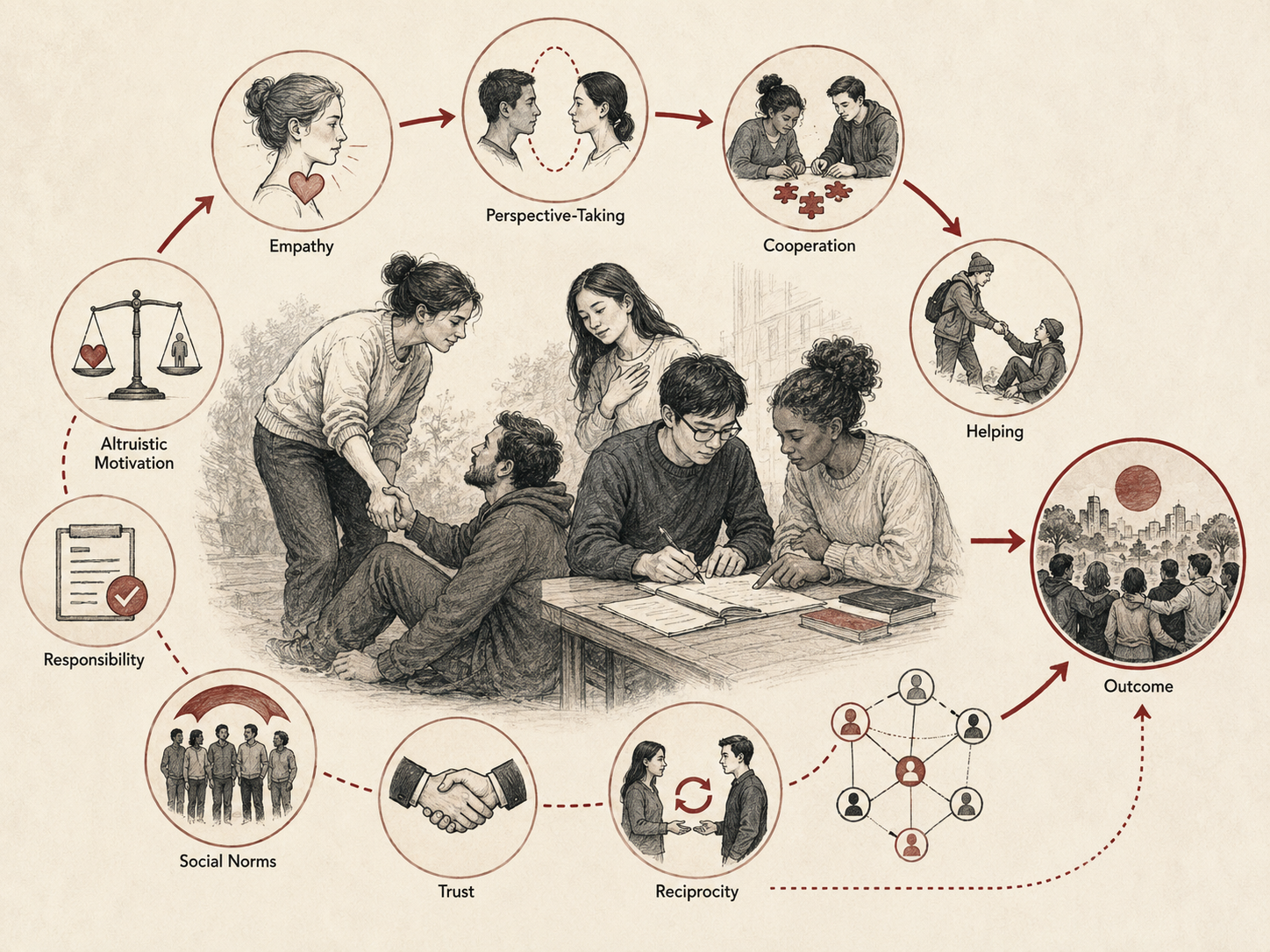
Prosocial behavior connects closely to altruism, the bystander effect, diffusion of responsibility, social norms, conformity, social identity theory, in-group bias, collective action, social dilemmas, and the tragedy of the commons. Together these frameworks explain how helping behavior emerges from the interaction of emotion, identity, norms, reciprocity, institutional context, and collective need.
What is prosocial behavior?
Prosocial behavior refers to actions intended to benefit others or contribute to collective welfare. These actions include helping a stranger, sharing resources, cooperating with a group, comforting someone in distress, donating money, volunteering time, mentoring, reporting harm, protecting vulnerable people, participating in mutual aid, contributing to public goods, and supporting institutions that serve common welfare.
The defining feature is benefit-directed action. The action is oriented toward another person, group, community, or public good. It does not necessarily require pure selflessness. A person can behave prosocially because they feel empathy, because they believe helping is morally required, because others expect it, because reciprocity is likely, because helping strengthens identity, because cooperation is institutionally valued, or because the act supports a valued self-image.
This breadth is why prosocial behavior is such an important construct. It includes both everyday acts of kindness and large-scale forms of social cooperation. Holding a door, donating blood, sharing knowledge, mentoring a colleague, helping during a disaster, wearing a mask to protect vulnerable people, contributing to open-source infrastructure, or supporting community response systems can all be prosocial under the right conditions.
Prosocial behavior is therefore not merely a personality trait. It is a pattern of action shaped by persons, situations, groups, institutions, and cultures. People differ in prosocial tendencies, but the same person may help in one context and not another depending on cost, responsibility, visibility, identity, trust, and perceived efficacy.
A serious account of prosocial behavior must therefore ask not only “who helps?” but “when, why, for whom, at what cost, under what institutional conditions, and with what consequences?”
The scope of prosocial behavior
Prosocial behavior ranges from intimate interpersonal care to large-scale collective action. At the interpersonal level, it includes comforting, listening, assisting, sharing, forgiving, encouraging, teaching, mentoring, and protecting. At the group level, it includes cooperation, role support, mutual aid, team helping, organizational citizenship behavior, peer support, and community participation. At the societal level, it includes donation, volunteering, public-health cooperation, civic engagement, humanitarian aid, environmental stewardship, and defense of public goods.
Because the category is broad, prosocial behavior should be analyzed across multiple forms:
- helping — direct assistance to someone in need;
- sharing — distributing resources, information, time, or attention;
- cooperation — coordinated action toward shared outcomes;
- comforting — emotional support for distress;
- donation — giving money, goods, blood, data, or materials;
- volunteering — unpaid or partly compensated contribution to social benefit;
- mutual aid — reciprocal community-based care and support;
- organizational citizenship — discretionary workplace contribution beyond formal role requirements;
- public-goods contribution — individual contribution to collective welfare;
- intervention — action to prevent harm, report danger, or protect others.
These forms differ in cost, visibility, risk, institutional structure, and motivational basis. Comforting a friend is not the same as donating anonymously. Reporting workplace abuse is not the same as volunteering at a food pantry. Public-health cooperation is not the same as emergency rescue. Yet all involve behavior oriented toward another’s welfare or a collective good.
The scope of prosocial behavior also means that it connects psychological processes to social systems. If people are willing to help only when costs are low and recipients are close, the reach of prosociality remains narrow. If institutions can build trust, efficacy, fairness, and inclusive norms, prosocial behavior can scale into durable forms of cooperation.
Prosocial behavior and altruism
Prosocial behavior and altruism are related but not identical. Prosocial behavior is the broader category of actions that benefit others. Altruism is usually treated as a subset of prosocial behavior in which helping involves cost to the actor and is motivated substantially by concern for another’s welfare.
This distinction matters because much socially valuable behavior is not purely altruistic. A person may volunteer because they care, because friends are volunteering, because the act builds skills, because it strengthens identity, because it is socially admired, or because it produces emotional satisfaction. The action can still be prosocial even if the motive is mixed.
Altruism asks a narrower motivational question: does the actor help for the sake of the other? Prosocial behavior asks a broader behavioral and social question: what actions benefit others, and what conditions make those actions more likely?
In practice, motives often overlap. A donation may be driven by empathy, moral obligation, reputational concern, warm glow, reciprocity, religious duty, political identity, and belief in the effectiveness of the cause. Rather than treating mixed motives as a problem, social psychology can study how they interact.
Prosocial behavior is therefore useful because it avoids a false binary between selfishness and selflessness. Human cooperation is often built from layered motives. People help because they care, because others expect it, because the action matters, because institutions make contribution possible, and because helping sustains the kind of social world they want to inhabit.
A multilevel framework for prosocial behavior
One of the strongest ways to organize prosocial-behavior research is through a multilevel framework. Penner, Dovidio, Piliavin, and Schroeder argued that prosocial behavior can be understood across micro, meso, and macro levels.
At the micro level, research examines individual differences, moral development, empathy, personality, socialization, biological influences, and developmental roots of helping. Why are some people more disposed toward cooperation, compassion, or generosity than others? How do children learn to share, comfort, and help?
At the meso level, research examines helper-recipient interactions in specific situations. Who needs help? What is the cost? Is the situation ambiguous? Are other people present? Is the recipient similar, identifiable, innocent, or socially close? Does the helper feel responsible and competent?
At the macro level, research examines organizations, institutions, cultures, social movements, public policies, and systems of cooperation. How do societies encourage donation, civic participation, mutual aid, public-health compliance, disaster response, and organizational citizenship?
This multilevel framing prevents reductionism. Prosocial behavior is not only a matter of good people making good choices. It is shaped by development, emotion, identity, institutions, incentives, norms, inequality, and political legitimacy. A person may be highly compassionate but fail to act when responsibility is diffuse. An institution may demand cooperation but fail to earn trust. A society may celebrate generosity while allowing preventable suffering to persist.
The strongest research therefore asks how individual motivation, situational design, and institutional structure interact to produce helping or non-helping.
Evolutionary perspectives on helping and cooperation
Evolutionary approaches help explain why helping and cooperation can persist in systems shaped by competition. At first glance, costly helping seems difficult to reconcile with natural selection. If individuals pay costs to benefit others, why would such behavior survive?
Several major mechanisms address this puzzle. Kin selection explains helping relatives through inclusive fitness. Direct reciprocity explains cooperation when people interact repeatedly and can return benefits. Indirect reciprocity explains helping that builds reputation. Network reciprocity explains how clusters of cooperators can support one another. Group-level mechanisms examine whether groups with higher cooperation can outperform less cooperative groups under certain conditions.
Martin Nowak’s “five rules” for the evolution of cooperation gave a widely cited synthesis of these mechanisms. It showed that cooperation can emerge under specific structural conditions: relatedness, repeated interaction, reputation, network clustering, and group competition.
Evolutionary accounts do not replace social psychology. They explain how capacities for helping may be adaptive over time. Social psychology explains how those capacities are activated or suppressed in specific situations. A person helping during a crisis is not calculating kin selection or network reciprocity. They may feel empathy, responsibility, duty, identity, or moral urgency. The evolutionary background and the psychological experience operate at different levels.
Evolutionary theory is most useful when it shows that prosociality is not an anomaly. Cooperation, care, fairness, reciprocity, and punishment of free riders are deeply connected to the survival of social systems. Yet human prosocial behavior also exceeds narrow evolutionary logic: people help strangers, future generations, nonhuman animals, abstract causes, and public goods that offer no obvious personal return.
Developmental foundations of prosocial behavior
Prosocial behavior develops across childhood and adolescence through emotional maturation, socialization, modeling, moral learning, cognitive development, attachment, family norms, peer interaction, schooling, culture, and institutional experience. Children learn not only whether helping is valued, but who is seen as deserving help and what forms of helping are expected.
Developmental research shows that prosocial behavior is not a single capacity. It includes empathy, concern, sharing, comforting, fairness sensitivity, cooperation, perspective taking, guilt, moral reasoning, and regulation of self-interest. These capacities emerge at different points and are shaped by both temperament and environment.
Caregivers influence prosocial development by modeling care, explaining others’ emotions, encouraging perspective taking, setting expectations for sharing, and responding to distress. Schools influence prosocial behavior through cooperative learning, classroom norms, anti-bullying practices, peer culture, civic education, and disciplinary systems. Communities influence it through religious traditions, mutual-aid practices, cultural obligations, neighborhood trust, and exposure to inequality or violence.
Development also reveals the boundary problem of prosociality. Children may learn strong care for family or in-group members before they learn broader obligations to strangers, out-groups, or distant others. Expanding prosocial concern requires moral education, cross-group contact, perspective-taking opportunities, and institutions that make distant suffering visible without turning it into spectacle.
Prosocial behavior is therefore learned, practiced, reinforced, and constrained. It is not simply a fixed trait or spontaneous emotion. It is cultivated through social worlds.
Psychological mechanisms of prosocial behavior
Several psychological mechanisms shape whether people act prosocially. These mechanisms often operate together.
Empathy
Empathy allows another person’s welfare to become emotionally salient. It can make distress, exclusion, pain, or need feel personally meaningful rather than abstract.
Perspective taking
Perspective taking helps people understand another person’s situation, constraints, emotions, and needs. It can reduce psychological distance and increase appropriate helping.
Moral identity
Moral identity refers to the degree to which care, fairness, generosity, responsibility, or compassion are central to the self. People are more likely to help when doing so expresses who they believe themselves to be.
Social norms
Norms define when helping is expected, admired, required, or shameful to withhold. Norms can encourage generosity, reciprocity, civic responsibility, mutual aid, and public-health cooperation.
Reciprocity
People often help because they expect mutual responsiveness over time. Reciprocity can be direct, indirect, relational, or institutional.
Perceived efficacy
People are more likely to help when they believe their action will matter. Low perceived efficacy can suppress prosocial behavior even when empathy is high.
Felt responsibility
A person may recognize need but act only when they feel responsible. Responsibility is shaped by role, proximity, assignment, identity, and the presence of other potential helpers.
Cost and risk
Helping becomes less likely when cost, danger, time burden, social risk, reputational risk, or uncertainty rises. High-cost helping requires stronger motives, clearer norms, or deeper identity commitments.
These mechanisms make prosocial behavior highly context-sensitive. People do not help simply because they are “good.” They help when emotion, meaning, responsibility, efficacy, and manageable cost align.
Empathy, perspective taking, and compassion
Empathy is one of the most studied pathways into prosocial behavior. It allows another person’s experience to matter psychologically. When someone recognizes another’s pain or need, empathic concern can motivate comfort, donation, rescue, advocacy, or protection.
Empathy should be distinguished from personal distress. Empathic concern is other-oriented; it focuses on the welfare of the person in need. Personal distress is self-oriented; it focuses on the observer’s discomfort in response to another’s suffering. Both can motivate helping, but through different pathways. Empathic concern may produce helping even when escape is easy. Personal distress may produce helping mainly when helping reduces the observer’s own discomfort.
Perspective taking adds a cognitive dimension. A person may help more effectively when they understand what the recipient actually needs rather than projecting their own assumptions. Perspective taking is especially important in cross-cultural, intergroup, medical, educational, and humanitarian settings, where well-intended help can be misaligned with recipient needs.
Compassion integrates emotional concern with a desire to relieve suffering. It is not merely feeling another’s pain. It includes an action orientation: what can be done to reduce harm or support flourishing?
Yet empathy has limits. It can be biased toward identifiable individuals, similar others, nearby suffering, and emotionally vivid cases. It can also become exhausting or paralyzing when suffering is overwhelming. Prosocial systems should therefore combine empathy with norms, institutions, rights, duties, and evidence-based practices so that care does not depend only on emotional immediacy.
Social norms, reciprocity, and moral obligation
Social norms are central to prosocial behavior because they define what people are expected to do for others. Norms can make helping ordinary rather than heroic. They can tell people that one should return favors, assist those in danger, care for children and elders, support neighbors, contribute to common goods, share during scarcity, or protect vulnerable people.
Two norms are especially important. The norm of reciprocity encourages people to help those who have helped them or who are likely to participate in mutual support. The social responsibility norm encourages helping those who depend on assistance, especially when they cannot easily help themselves.
Norms influence behavior through expectation, identity, approval, guilt, shame, and institutional reinforcement. A person may help because they internalize the norm, because others will judge them, because the group values helping, or because failing to help would violate their self-concept.
Reciprocity can sustain cooperation, but it can also narrow helping. If people help only those likely to return benefits, those with the least power may be excluded. A just prosocial order requires more than reciprocity. It also requires responsibility toward those who cannot repay.
Norms also need legitimacy. If institutions ask people to cooperate while acting unfairly, selectively enforcing rules, or ignoring public burdens, prosocial compliance may weaken. Public-health cooperation, civic participation, organizational citizenship, and environmental contribution all depend partly on trust that shared sacrifice is meaningful and fairly distributed.
Prosocial norms are strongest when they are clear, fair, modeled by leaders, supported by institutions, and connected to visible outcomes.
The bystander effect and the suppression of helping
Prosocial behavior can be suppressed by the social environment. Research on the bystander effect shows that people may be less likely to help during emergencies when other observers are present. The presence of others can reduce personal responsibility, increase uncertainty, and make inaction appear normal.
The bystander effect is commonly explained through three mechanisms. Diffusion of responsibility occurs when each person assumes someone else can act. Pluralistic ignorance occurs when people interpret others’ calm or inaction as evidence that intervention is unnecessary. Evaluation apprehension occurs when people fear embarrassment, judgment, or doing the wrong thing.
This research is important because it shows that helping is not determined by compassion alone. A person may feel concern but hesitate because the situation is ambiguous, responsibility is shared, other people are passive, or the cost of public intervention feels high.
The bystander effect also appears beyond emergencies. In organizations, people may fail to report misconduct because responsibility is diffuse. In online spaces, users may witness harassment but assume moderators or other users will act. In classrooms, students may watch bullying but remain silent because no one else intervenes. In public-health crises, citizens may assume that small individual actions are insignificant.
Reducing bystander suppression requires clear responsibility, direct assignment, visible norms, safe intervention options, and competence. “Someone should help” is weaker than “You, call emergency services.” “We value safety” is weaker than clear reporting channels and anti-retaliation protections. Prosocial behavior must be made actionable.
Social identity and collective helping
Prosocial behavior is strongly shaped by identity. People are often more likely to help those they perceive as part of “us”: family, friends, neighbors, co-workers, co-religionists, teammates, co-nationals, political allies, or members of a shared community.
Social identity can strengthen prosocial behavior by creating solidarity, obligation, trust, shared fate, and moral closeness. Mutual aid networks, labor movements, religious charity, disaster response, and community defense often rely on strong group identity. When people see another’s suffering as connected to their own group, helping becomes more likely.
But identity can also restrict prosociality. In-group care can coexist with out-group neglect. People may be generous toward those they identify with and indifferent toward those they see as outsiders. This is why prosocial behavior must be studied alongside in-group bias, stereotypes, prejudice, and discrimination, and intergroup conflict.
Social identity can also be expanded. Broader identities — civic, humanitarian, ecological, religious, professional, democratic, or global — can widen the circle of care. A person may help not only family or neighbors, but strangers, refugees, future generations, animals, ecosystems, or public institutions when those are included within a moral community.
The ethical and political challenge is not to eliminate local attachment, but to prevent local attachment from becoming moral exclusion. Prosocial systems should cultivate forms of identity that support solidarity without denying the dignity of those outside the immediate group.
Trust, efficacy, and institutional legitimacy
Prosocial behavior depends heavily on trust and perceived efficacy. People are more likely to contribute when they believe their action will matter, that others will also contribute, and that institutions will use contributions fairly.
Perceived efficacy is especially important in large-scale social problems. A person may care about climate change, public health, poverty, disaster relief, or democratic participation, yet feel that their individual contribution is too small to matter. When efficacy is low, prosocial motivation can collapse into helplessness.
Trust matters because prosocial action often requires vulnerability. Donors trust organizations to use resources well. Citizens trust public-health institutions to give accurate guidance. Employees trust organizations not to punish those who help or speak up. Volunteers trust that their labor is meaningful rather than symbolic. Communities trust that shared sacrifice will not be exploited.
Institutional legitimacy links prosocial behavior to governance. People are more willing to cooperate with institutions they perceive as fair, accountable, competent, transparent, and responsive. When institutions lack legitimacy, appeals to prosocial duty may fail or appear manipulative.
This has important policy implications. Public campaigns often try to increase prosocial behavior through messaging alone. But messaging works best when supported by credible institutions. People are more likely to cooperate when they trust the system, understand the goal, see others contributing, and believe the burden is fairly shared.
Prosocial behavior is therefore not merely a moral resource. It is also an institutional outcome. Trustworthy systems make helping more likely.
Formalizing prosocial behavior
Prosocial behavior can be represented as a probability of helping based on motivation, norms, efficacy, identity, responsibility, and cost. Let \(P(H_i=1)\) represent the probability that person \(i\) helps:
P(H_i=1)=\operatorname{logit}^{-1}(H_i^*)
\]
Interpretation: The probability of helping rises as latent helping propensity \(H_i^*\) increases.
A simplified helping-propensity model can be written as:
H_i^*=\beta_0+\beta_1E_i+\beta_2P_i+\beta_3N_i+\beta_4R_i+\beta_5F_i+\beta_6D_i+\beta_7I_i+\beta_8T_i-\beta_9C_i-\beta_{10}Z_i-\beta_{11}\log(B_i+1)
\]
Interpretation: Helping propensity rises with empathy \(E\), perspective taking \(P\), norm salience \(N\), reciprocity \(R\), efficacy \(F\), felt responsibility \(D\), identity overlap \(I\), and trust \(T\), but falls with cost \(C\), risk \(Z\), and bystander count \(B\).
The distinction between prosocial behavior and altruism can be represented through motive structure. Prosocial behavior may include both other-regarding and self-regarding components:
M_i=\alpha O_i+\gamma S_i
\]
Interpretation: Motivation \(M_i\) can include other-regarding concern \(O_i\) and self-regarding motives \(S_i\), such as reputation, warm glow, identity, or reciprocity.
Bystander suppression can be represented as a reduction in responsibility:
D_i=\delta_0-\delta_1\log(B_i+1)+\delta_2A_i+\delta_3U_i+\delta_4N_i
\]
Interpretation: Felt responsibility \(D_i\) declines with perceived bystander count \(B_i\), but rises with direct assignment \(A_i\), urgency \(U_i\), and helping norms \(N_i\).
Public-goods cooperation can be modeled as contribution to collective welfare:
W_{t+1}=W_t+\sum_{i=1}^{n}h_i-\sum_{i=1}^{n}d_i
\]
Interpretation: Collective welfare \(W\) increases through prosocial contributions \(h_i\) and declines through depletion, defection, or harm \(d_i\).
At the institutional level, cooperation can be represented as a function of legitimacy:
C_i^*=\theta_0+\theta_1L_i+\theta_2T_i+\theta_3F_i+\theta_4N_i-\theta_5K_i
\]
Interpretation: Cooperation propensity \(C_i^*\) rises with institutional legitimacy \(L\), trust \(T\), perceived efficacy \(F\), and norm salience \(N\), but falls with perceived cost \(K\).
These models are simplified, but they make the central point visible: prosocial behavior is not caused by one motive alone. It emerges when other-regarding concern, norms, efficacy, responsibility, identity, trust, and manageable cost align.
Prosocial behavior in institutions and organizations
Institutions rely on prosocial behavior every day. Workplaces depend on employees who help colleagues, share knowledge, mentor newcomers, prevent errors, support team goals, and contribute beyond narrow job descriptions. Schools depend on peer support, teacher care, cooperative norms, and student responsibility. Health systems depend on caregiving, trust, public cooperation, and professional duty. Civic institutions depend on voting, volunteering, compliance with legitimate rules, and public-minded participation.
Organizational psychology often studies these behaviors through the concept of organizational citizenship behavior: discretionary contributions that support organizational functioning but are not always formally rewarded. Examples include helping a co-worker, attending optional meetings, offering constructive suggestions, preserving morale, showing courtesy, and supporting institutional goals.
Organizational prosocial behavior can be valuable, but it is not ethically simple. When organizations rely on voluntary care while failing to provide adequate staffing, compensation, or recognition, prosocial behavior can become a hidden subsidy. Employees may be praised for “going above and beyond” while structural problems remain unaddressed.
Institutional prosociality therefore needs balance. Healthy institutions encourage helping, mentoring, civic contribution, and shared responsibility. But they also protect boundaries, distribute labor fairly, recognize contribution, and avoid moralizing overwork.
The same applies to public institutions. Governments and nonprofits often depend on citizens’ willingness to volunteer, donate, cooperate, and accept burdens for collective welfare. Such appeals work best when institutions are trustworthy and when citizens believe sacrifice is shared fairly.
Prosocial behavior helps institutions function, but institutions must not exploit prosociality as a substitute for justice, staffing, accountability, or public investment.
Public goods, civic cooperation, and collective welfare
Many of the most important social problems are public-goods problems. A public good benefits people whether or not each individual contributes. Clean air, public health, neighborhood safety, democratic integrity, scientific knowledge, disaster preparedness, biodiversity, open-source infrastructure, and social trust all depend on contributions that may exceed immediate private benefit.
Prosocial behavior is central to public goods because people must often contribute even when free riding is possible. A person may recycle, vaccinate, donate blood, volunteer after a disaster, vote, report hazards, or support public institutions even though their individual action is only one small part of the collective outcome.
Public-goods contribution depends on several factors:
- whether people believe the good matters;
- whether they believe their contribution is effective;
- whether they trust others to contribute;
- whether institutions are legitimate;
- whether norms of contribution are visible;
- whether free riding is discouraged;
- whether burdens are fairly distributed;
- whether the public good is connected to identity and responsibility.
When trust and efficacy are low, appeals to prosocial behavior often fail. People may care but conclude that contribution is pointless, exploited, or unfair. When legitimacy is high, norms are clear, and outcomes are visible, prosocial cooperation becomes more durable.
Public-goods research shows that prosocial behavior is not only interpersonal kindness. It is one of the foundations of collective survival. Societies depend on people who contribute to goods they cannot privately own and may not personally control.
Encouraging prosocial behavior in society
Governments, schools, nonprofits, workplaces, health systems, and civic organizations often try to encourage prosocial behavior. Behavioral science offers several useful principles, but these principles must be applied ethically and with attention to trust.
Prosocial behavior can be encouraged by:
- making need visible without exploiting suffering;
- increasing empathy and perspective taking;
- showing that contribution is effective;
- making helpful norms salient;
- reducing friction and cost;
- assigning responsibility clearly;
- building shared identity;
- providing safe and specific action scripts;
- recognizing contribution without turning care into status competition;
- protecting helpers from retaliation or exploitation;
- making institutional use of contributions transparent;
- showing that others are also contributing.
Norm messages can be powerful when they are credible. People are more likely to contribute when they believe helping is common, expected, and valued. But norm messaging can backfire if it highlights low participation or appears manipulative.
Empathy-based appeals can also be powerful, especially when recipients are vivid and identifiable. Yet policy should not depend entirely on emotional salience. Some of the most important needs are statistical, distant, chronic, or structurally produced. Ethical prosocial design must connect emotion with evidence, rights, and institutional responsibility.
Cost reduction is often more effective than moral pressure. People may be willing to help but unable to do so because time, money, risk, or complexity is too high. Making donation easier, reporting safer, volunteering more flexible, or cooperation less burdensome can increase prosocial action without shaming people.
The best prosocial interventions do not merely exhort people to be better. They make better action easier, safer, meaningful, and institutionally supported.
Power, exploitation, and unequal expectations of care
Prosocial behavior should not be romanticized. Societies often praise helping while distributing the burden of care unequally. Women, racialized communities, migrants, low-wage workers, disabled people, teachers, nurses, caregivers, community organizers, and marginalized groups are often expected to absorb emotional, social, and practical labor in the name of duty, love, resilience, or service.
This matters because prosocial expectations can become exploitative. An organization may celebrate “teamwork” while relying on unpaid overtime. A community may praise volunteers while failing to fund basic services. A society may celebrate caregivers while underpaying care work. A workplace may reward employees who help others but punish those who set boundaries.
Prosocial behavior is ethically valuable when it is freely chosen, meaningfully supported, and fairly distributed. It becomes morally suspect when institutions use prosocial language to shift responsibility downward while preserving unequal power.
A critical account should therefore ask:
- who is expected to help?
- who benefits from the helping?
- who receives recognition?
- who bears the cost?
- is the contribution voluntary or coerced?
- does helping address a temporary need or mask structural failure?
- are helpers protected from harm, burnout, retaliation, or exploitation?
This does not diminish the value of prosocial behavior. It protects it. Genuine prosocial systems should support care without demanding self-erasure. They should honor generosity while also building institutions that reduce preventable need and distribute burdens justly.
Prosocial behavior in the architecture of social influence
Within the broader architecture of social influence, prosocial behavior occupies a central role. Social norms define when helping is expected. Conformity explains how people align with those expectations. Social identity theory explains why helping often follows group boundaries. The bystander effect explains why helping can be suppressed by the presence of others. Collective action explains how prosocial behavior scales into coordinated public effort.
Prosocial behavior is the connective tissue between individual morality and social systems. It turns concern into care, responsibility into action, norms into cooperation, and identity into solidarity. It also reveals where social systems fail: when people do not help because they do not trust institutions, do not see recipients as part of the moral community, do not believe action will matter, or fear the cost of intervening.
Seen in this framework, prosocial behavior is not simply “being nice.” It is a social mechanism through which communities maintain trust, institutions function, crises are managed, public goods are protected, and vulnerable people receive support.
But prosocial behavior must be connected to justice. A society that relies only on charity without addressing structural harm leaves too much to voluntary care. The strongest systems combine prosocial motivation with accountable institutions, fair distribution, public investment, and protection for those who help.
Prosocial behavior therefore belongs at the center of social psychology because it explains both the possibility of cooperation and the fragility of collective care.
Limits and interpretive cautions
Prosocial behavior is essential, but several cautions are important.
- Do not equate all prosocial behavior with altruism.
- Do not assume helping is pure because it benefits others.
- Do not assume mixed motives make helping meaningless.
- Do not ignore cost, risk, and institutional barriers.
- Do not ignore bystander effects and diffusion of responsibility.
- Do not assume empathy is unbiased or universal.
- Do not overlook in-group favoritism in helping.
- Do not treat public cooperation as only an individual moral problem.
- Do not use prosocial language to justify unpaid, coerced, or unequal labor.
- Do not confuse charity with justice.
Prosocial behavior is strongest as an analytical concept when it remains broad but not vague. It should include helping, sharing, cooperation, and contribution, but researchers should specify the form of behavior, the recipient, the cost, the motive, the institutional context, and the outcome.
It is also important to distinguish intention from impact. A person may intend to help but produce harmful consequences because they misunderstand the recipient’s needs, ignore local knowledge, or act through paternalistic assumptions. Prosocial behavior should therefore be evaluated not only by motive, but also by effectiveness, dignity, and accountability.
Finally, prosocial behavior should be understood in relation to power. Who is helped, who is ignored, who is asked to sacrifice, and who defines the public good are not neutral questions. They are central to a mature social psychology of care and cooperation.
Measurement, data, and research design
Prosocial-behavior research uses laboratory experiments, field experiments, surveys, donation studies, volunteering measures, public-goods games, dictator games, prisoner’s dilemma tasks, bystander paradigms, organizational citizenship scales, public-health cooperation studies, online-platform data, mutual-aid research, and multilevel modeling.
Key variables include:
- participant, session, recipient, scenario, site, and group identifiers;
- experimental condition;
- context type;
- empathic concern;
- perspective taking;
- norm salience;
- reciprocity expectation;
- perceived efficacy;
- helping cost;
- intervention risk;
- bystander count;
- felt responsibility;
- identity overlap;
- group identification;
- trust level;
- moral identity;
- reputation visibility;
- institutional legitimacy;
- helping decision;
- donation amount;
- volunteer time;
- cooperation contribution;
- emotional support;
- response time.
Strong research designs should measure behavior where possible, not only intention. People may overstate their willingness to help in hypothetical scenarios. Behavioral measures such as actual donation, time volunteered, cooperation contribution, reporting behavior, message support, or intervention latency provide stronger evidence.
Researchers should also measure both motivation and context. Empathy, norms, identity, reciprocity, reputation, efficacy, and moral identity are not interchangeable. They may produce similar behavior through different mechanisms. A donation driven by empathy differs from a donation driven by public recognition, even if both benefit recipients.
For institutional research, trust and legitimacy should be measured directly. Prosocial cooperation with public-health guidance, environmental policy, workplace reporting, or civic participation often depends on whether institutions are seen as fair, competent, and accountable.
Finally, prosocial behavior should be studied distributionally. Which groups receive help? Which groups are ignored? Which people are expected to provide care? Which institutions benefit from unpaid contribution? These questions connect prosocial behavior to ethics, governance, and social justice.
R code for prosocial behavior research
The following R workflow models helping, donation, cooperation, emotional support, and response time as functions of empathy, perspective taking, norm salience, reciprocity, efficacy, cost, bystander count, felt responsibility, identity, trust, moral identity, reputation visibility, and institutional legitimacy.
# Install packages if needed:
# pak::pak(c("tidyverse", "lme4", "lmerTest", "emmeans", "broom.mixed", "performance"))

library(tidyverse)
library(lme4)
library(lmerTest)
library(emmeans)
library(broom.mixed)
library(performance)

# Expected columns:
# participant, session_id, recipient_id, scenario_id, site_id,
# condition, context_type, trial, empathy_score, perspective_taking,
# norm_salience, reciprocity_expectation, efficacy_belief,
# helping_cost, intervention_risk, bystander_count,
# felt_responsibility, identity_overlap, group_identification,
# trust_level, moral_identity, reputation_visibility,
# institutional_legitimacy, helping_decision, donation_amount,
# volunteer_minutes, cooperation_contribution, emotional_support,
# response_time_ms

dat <- read_csv("prosocial_behavior_trials.csv") %>%
  mutate(
    participant = factor(participant),
    session_id = factor(session_id),
    recipient_id = factor(recipient_id),
    scenario_id = factor(scenario_id),
    site_id = factor(site_id),
    condition = factor(condition),
    context_type = factor(context_type),
    helping_decision = as.integer(helping_decision),
    emotional_support = as.integer(emotional_support),
    log_bystanders = log1p(bystander_count),
    prosocial_motivation_index = (
      empathy_score +
      perspective_taking +
      norm_salience +
      efficacy_belief +
      felt_responsibility +
      moral_identity -
      helping_cost -
      intervention_risk
    ) / 6,
    social_embeddedness_index = (
      identity_overlap +
      group_identification +
      trust_level +
      institutional_legitimacy +
      reciprocity_expectation
    ) / 5,
    cost_pressure_index = (
      helping_cost +
      intervention_risk +
      log_bystanders
    ) / 3,
    log_response_time = log(response_time_ms)
  )

summary_table <- dat %>%
  group_by(condition, context_type) %>%
  summarise(
    n = n(),
    participants = n_distinct(participant),
    helping_rate = mean(helping_decision, na.rm = TRUE),
    emotional_support_rate = mean(emotional_support, na.rm = TRUE),
    mean_donation = mean(donation_amount, na.rm = TRUE),
    mean_volunteer_minutes = mean(volunteer_minutes, na.rm = TRUE),
    mean_cooperation = mean(cooperation_contribution, na.rm = TRUE),
    mean_empathy = mean(empathy_score, na.rm = TRUE),
    mean_norms = mean(norm_salience, na.rm = TRUE),
    mean_efficacy = mean(efficacy_belief, na.rm = TRUE),
    mean_cost = mean(helping_cost, na.rm = TRUE),
    mean_bystanders = mean(bystander_count, na.rm = TRUE),
    mean_responsibility = mean(felt_responsibility, na.rm = TRUE),
    mean_identity = mean(identity_overlap, na.rm = TRUE),
    mean_legitimacy = mean(institutional_legitimacy, na.rm = TRUE),
    mean_prosocial_motivation = mean(prosocial_motivation_index, na.rm = TRUE),
    mean_social_embeddedness = mean(social_embeddedness_index, na.rm = TRUE),
    .groups = "drop"
  )

print(summary_table)

helping_model <- glmer(
  helping_decision ~
    empathy_score +
    perspective_taking +
    norm_salience +
    reciprocity_expectation +
    efficacy_belief +
    helping_cost +
    intervention_risk +
    log_bystanders +
    felt_responsibility +
    identity_overlap +
    group_identification +
    trust_level +
    moral_identity +
    reputation_visibility +
    institutional_legitimacy +
    condition +
    context_type +
    (1 | participant) +
    (1 | recipient_id) +
    (1 | scenario_id) +
    (1 | site_id),
  data = dat,
  family = binomial(),
  control = glmerControl(optimizer = "bobyqa")
)

summary(helping_model)
emmeans(helping_model, ~ condition, type = "response")

donation_model <- lmer(
  donation_amount ~
    empathy_score +
    norm_salience +
    efficacy_belief +
    helping_cost +
    intervention_risk +
    felt_responsibility +
    identity_overlap +
    moral_identity +
    reputation_visibility +
    institutional_legitimacy +
    helping_decision +
    condition +
    context_type +
    (1 | participant) +
    (1 | recipient_id) +
    (1 | scenario_id) +
    (1 | site_id),
  data = dat,
  REML = FALSE
)

summary(donation_model)

cooperation_model <- lmer(
  cooperation_contribution ~
    norm_salience +
    efficacy_belief +
    reciprocity_expectation +
    group_identification +
    trust_level +
    institutional_legitimacy +
    helping_cost +
    helping_decision +
    condition +
    context_type +
    (1 | participant) +
    (1 | scenario_id) +
    (1 | site_id),
  data = dat,
  REML = FALSE
)

summary(cooperation_model)

emotional_support_model <- glmer(
  emotional_support ~
    empathy_score +
    perspective_taking +
    norm_salience +
    identity_overlap +
    intervention_risk +
    condition +
    context_type +
    (1 | participant) +
    (1 | recipient_id) +
    (1 | scenario_id),
  data = dat,
  family = binomial(),
  control = glmerControl(optimizer = "bobyqa")
)

summary(emotional_support_model)

response_time_model <- lmer(
  log_response_time ~
    empathy_score +
    norm_salience +
    efficacy_belief +
    helping_cost +
    intervention_risk +
    log_bystanders +
    felt_responsibility +
    helping_decision +
    condition +
    context_type +
    (1 | participant) +
    (1 | scenario_id) +
    (1 | site_id),
  data = dat %>% filter(response_time_ms >= 150),
  REML = FALSE
)

summary(response_time_model)

cost_summary <- dat %>%
  mutate(
    cost_band = cut(
      helping_cost,
      breaks = c(-0.1, 2.5, 5, 7.5, 10.1),
      labels = c("low_cost", "moderate_cost", "high_cost", "very_high_cost")
    )
  ) %>%
  group_by(condition, cost_band) %>%
  summarise(
    n = n(),
    helping_rate = mean(helping_decision, na.rm = TRUE),
    mean_donation = mean(donation_amount, na.rm = TRUE),
    mean_cooperation = mean(cooperation_contribution, na.rm = TRUE),
    mean_efficacy = mean(efficacy_belief, na.rm = TRUE),
    mean_responsibility = mean(felt_responsibility, na.rm = TRUE),
    .groups = "drop"
  )

write_csv(summary_table, "prosocial_behavior_summary.csv")
write_csv(cost_summary, "prosocial_behavior_cost_band_summary.csv")

write_csv(
  tidy(helping_model, effects = "fixed", conf.int = TRUE),
  "prosocial_behavior_helping_coefficients.csv"
)

ggplot(
  cost_summary,
  aes(x = cost_band, y = helping_rate, color = condition, group = condition)
) +
  geom_line() +
  geom_point() +
  labs(
    title = "Prosocial helping by cost band and condition",
    x = "Helping-cost band",
    y = "Helping rate"
  ) +
  theme_minimal()
This workflow supports prosocial-behavior research by separating helping decisions, donation, cooperation, emotional support, response time, empathy, norms, bystander count, responsibility, trust, and institutional legitimacy.
Python code for prosocial behavior research
The Python workflow below parallels the R analysis and adds simulation logic for public-goods cooperation, institutional legitimacy, efficacy, shared identity, and trust.
import numpy as np
import pandas as pd
import statsmodels.formula.api as smf
import statsmodels.api as sm
import matplotlib.pyplot as plt

# Expected columns:
# participant, session_id, recipient_id, scenario_id, site_id,
# condition, context_type, trial, empathy_score, perspective_taking,
# norm_salience, reciprocity_expectation, efficacy_belief,
# helping_cost, intervention_risk, bystander_count,
# felt_responsibility, identity_overlap, group_identification,
# trust_level, moral_identity, reputation_visibility,
# institutional_legitimacy, helping_decision, donation_amount,
# volunteer_minutes, cooperation_contribution, emotional_support,
# response_time_ms

df = pd.read_csv("prosocial_behavior_trials.csv")

for col in [
    "participant",
    "session_id",
    "recipient_id",
    "scenario_id",
    "site_id",
    "condition",
    "context_type"
]:
    df[col] = df[col].astype("category")

df["helping_decision"] = df["helping_decision"].astype(int)
df["emotional_support"] = df["emotional_support"].astype(int)
df["log_bystanders"] = np.log1p(df["bystander_count"])

df["prosocial_motivation_index"] = (
    df["empathy_score"]
    + df["perspective_taking"]
    + df["norm_salience"]
    + df["efficacy_belief"]
    + df["felt_responsibility"]
    + df["moral_identity"]
    - df["helping_cost"]
    - df["intervention_risk"]
) / 6

df["social_embeddedness_index"] = (
    df["identity_overlap"]
    + df["group_identification"]
    + df["trust_level"]
    + df["institutional_legitimacy"]
    + df["reciprocity_expectation"]
) / 5

df["cost_pressure_index"] = (
    df["helping_cost"]
    + df["intervention_risk"]
    + df["log_bystanders"]
) / 3

df["log_response_time"] = np.log(df["response_time_ms"])

summary_table = (
    df.groupby(["condition", "context_type"], observed=True)
    .agg(
        n=("participant", "size"),
        participants=("participant", "nunique"),
        helping_rate=("helping_decision", "mean"),
        emotional_support_rate=("emotional_support", "mean"),
        mean_donation=("donation_amount", "mean"),
        mean_volunteer_minutes=("volunteer_minutes", "mean"),
        mean_cooperation=("cooperation_contribution", "mean"),
        mean_empathy=("empathy_score", "mean"),
        mean_norms=("norm_salience", "mean"),
        mean_efficacy=("efficacy_belief", "mean"),
        mean_cost=("helping_cost", "mean"),
        mean_bystanders=("bystander_count", "mean"),
        mean_responsibility=("felt_responsibility", "mean"),
        mean_identity=("identity_overlap", "mean"),
        mean_legitimacy=("institutional_legitimacy", "mean"),
        mean_prosocial_motivation=("prosocial_motivation_index", "mean"),
        mean_social_embeddedness=("social_embeddedness_index", "mean"),
    )
    .reset_index()
)

print(summary_table)

helping_model = smf.glm(
    "helping_decision ~ empathy_score + perspective_taking "
    "+ norm_salience + reciprocity_expectation + efficacy_belief "
    "+ helping_cost + intervention_risk + log_bystanders "
    "+ felt_responsibility + identity_overlap + group_identification "
    "+ trust_level + moral_identity + reputation_visibility "
    "+ institutional_legitimacy + condition + context_type",
    data=df,
    family=sm.families.Binomial()
)

helping_result = helping_model.fit(
    cov_type="cluster",
    cov_kwds={"groups": df["participant"]}
)

print(helping_result.summary())

donation_model = smf.ols(
    "donation_amount ~ empathy_score + norm_salience "
    "+ efficacy_belief + helping_cost + intervention_risk "
    "+ felt_responsibility + identity_overlap + moral_identity "
    "+ reputation_visibility + institutional_legitimacy "
    "+ helping_decision + condition + context_type",
    data=df,
)

donation_result = donation_model.fit(
    cov_type="cluster",
    cov_kwds={"groups": df["participant"]}
)

print(donation_result.summary())

cooperation_model = smf.ols(
    "cooperation_contribution ~ norm_salience + efficacy_belief "
    "+ reciprocity_expectation + group_identification + trust_level "
    "+ institutional_legitimacy + helping_cost + helping_decision "
    "+ condition + context_type",
    data=df,
)

cooperation_result = cooperation_model.fit(
    cov_type="cluster",
    cov_kwds={"groups": df["participant"]}
)

print(cooperation_result.summary())

support_model = smf.glm(
    "emotional_support ~ empathy_score + perspective_taking "
    "+ norm_salience + identity_overlap + intervention_risk "
    "+ condition + context_type",
    data=df,
    family=sm.families.Binomial()
)

support_result = support_model.fit(
    cov_type="cluster",
    cov_kwds={"groups": df["participant"]}
)

print(support_result.summary())

def simulate_public_goods(n_cases=8000, seed=42):
    rng = np.random.default_rng(seed)
    rows = []

    conditions = [
        "weak_norm_low_trust",
        "strong_norm_high_trust",
        "high_efficacy",
        "low_legitimacy",
        "shared_identity"
    ]

    for condition in conditions:
        for _ in range(n_cases):
            empathy = 6.0 + rng.normal(0, 0.8)

            norms = {
                "weak_norm_low_trust": 3.0,
                "strong_norm_high_trust": 8.5,
                "high_efficacy": 7.0,
                "low_legitimacy": 5.0,
                "shared_identity": 7.0
            }[condition] + rng.normal(0, 0.7)

            efficacy = {
                "high_efficacy": 9.0,
                "low_legitimacy": 5.0
            }.get(condition, 7.0) + rng.normal(0, 0.7)

            trust = {
                "weak_norm_low_trust": 3.0,
                "strong_norm_high_trust": 8.0,
                "low_legitimacy": 3.0
            }.get(condition, 6.5) + rng.normal(0, 0.7)

            legitimacy = {
                "weak_norm_low_trust": 3.0,
                "strong_norm_high_trust": 8.0,
                "low_legitimacy": 2.5
            }.get(condition, 7.0) + rng.normal(0, 0.7)

            identity = {
                "shared_identity": 8.5
            }.get(condition, 5.0) + rng.normal(0, 0.7)

            cost = 4.0 + rng.normal(0, 0.7)

            latent = (
                -4.0
                + 0.20 * empathy
                + 0.35 * norms
                + 0.38 * efficacy
                + 0.25 * trust
                + 0.30 * legitimacy
                + 0.22 * identity
                - 0.35 * cost
            )

            probability = 1 / (1 + np.exp(-latent))
            helping = int(rng.random() < probability)

            contribution = np.clip(
                8
                + 8 * helping
                + 3.0 * norms
                + 3.2 * efficacy
                + 2.4 * trust
                + 2.8 * legitimacy
                + 2.0 * identity
                - 2.0 * cost
                + rng.normal(0, 7),
                0,
                100
            )

            rows.append({
                "condition": condition,
                "empathy_score": empathy,
                "norm_salience": norms,
                "efficacy_belief": efficacy,
                "trust_level": trust,
                "institutional_legitimacy": legitimacy,
                "identity_overlap": identity,
                "helping_cost": cost,
                "helping_probability": probability,
                "helping_decision": helping,
                "cooperation_contribution": contribution,
            })

    simulation = pd.DataFrame(rows)

    simulation_summary = (
        simulation.groupby("condition")
        .agg(
            n=("condition", "size"),
            mean_norms=("norm_salience", "mean"),
            mean_efficacy=("efficacy_belief", "mean"),
            mean_legitimacy=("institutional_legitimacy", "mean"),
            helping_rate=("helping_decision", "mean"),
            mean_contribution=("cooperation_contribution", "mean"),
        )
        .reset_index()
    )

    return simulation, simulation_summary

simulation, simulation_summary = simulate_public_goods()

print(simulation_summary)

cost_summary = (
    df.assign(
        cost_band=pd.cut(
            df["helping_cost"],
            bins=[-0.1, 2.5, 5, 7.5, 10.1],
            labels=["low_cost", "moderate_cost", "high_cost", "very_high_cost"]
        )
    )
    .groupby(["condition", "cost_band"], observed=True)
    .agg(helping_rate=("helping_decision", "mean"))
    .reset_index()
)

fig, ax = plt.subplots(figsize=(8, 5))

for condition, group in cost_summary.groupby("condition", observed=True):
    ax.plot(
        group["cost_band"].astype(str),
        group["helping_rate"],
        marker="o",
        label=condition
    )

ax.set_xlabel("Helping-cost band")
ax.set_ylabel("Helping rate")
ax.set_title("Prosocial helping by cost band and condition")
ax.legend()
plt.tight_layout()
plt.show()

summary_table.to_csv("prosocial_behavior_summary.csv", index=False)
simulation.to_csv("public_goods_prosocial_simulation.csv", index=False)
simulation_summary.to_csv("public_goods_prosocial_simulation_summary.csv", index=False)
This Python workflow supports experimental, organizational, public-health, and public-goods prosocial-behavior research by modeling helping, donation, emotional support, cooperation, cost, bystander count, trust, norms, efficacy, and institutional legitimacy.
Research data architecture
Prosocial-behavior research often depends on relational data: participants, sessions, recipients, scenarios, sites, conditions, context types, empathy, perspective taking, norm salience, reciprocity expectation, efficacy belief, helping cost, intervention risk, bystander count, felt responsibility, identity overlap, group identification, trust, moral identity, reputation visibility, institutional legitimacy, helping decisions, donation amounts, volunteer minutes, cooperation contributions, emotional support, and response time.
Rather than embedding executable database code directly in the WordPress article body, the companion GitHub repository includes the full SQL schema and example queries for researchers who want to reproduce or extend the data model.
The research data model is designed to support questions such as:
- Does empathy predict helping after controlling for cost, reputation, and reciprocity?
- Does norm salience increase donation or cooperation?
- Does perceived efficacy increase public-goods contribution?
- Does bystander count reduce felt responsibility and helping?
- Does institutional legitimacy moderate public-health or civic cooperation?
- Does identity overlap increase helping for in-group recipients?
- Does reputation visibility change donation amount?
- Does trust increase cooperation contribution?
- Are organizational citizenship behaviors driven by different predictors than emergency helping?
The GitHub repository contains the full database schema, example analytical queries, validation logic, and reproducible data workflow. Keeping executable SQL in GitHub avoids WordPress hosting restrictions while preserving the research-grade infrastructure for readers who want to inspect or reuse the model.
View the SQL research data architecture in GitHub.
GitHub repository
The companion repository provides reusable code and research scaffolding for studying prosocial behavior, including workflows for helping, donation, volunteering, cooperation, emotional support, empathy, perspective taking, social norms, reciprocity, perceived efficacy, cost, bystander effects, institutional legitimacy, public-goods contribution, and organizational citizenship behavior.
Complete Code Repository
Access the full companion repository for this article, including reproducible analysis materials and multi-language code workflows for prosocial-behavior research.
Why prosocial behavior matters
Prosocial behavior matters because it explains how social life remains possible. Helping, sharing, cooperation, emotional support, volunteering, donation, public-goods contribution, and institutional citizenship are not peripheral to society. They are part of the infrastructure that allows communities, organizations, and public systems to function.
The study of prosocial behavior also shows that care is not automatic. People help when empathy, norms, responsibility, identity, trust, efficacy, and manageable cost align. They fail to help when responsibility is diffuse, costs are high, institutions lack legitimacy, recipients are excluded from the moral community, or action appears ineffective.
A mature account of prosocial behavior therefore avoids both cynicism and sentimentality. It recognizes that people are capable of care, cooperation, and sacrifice. It also recognizes that helping is selective, socially structured, institutionally constrained, and sometimes exploited.
Read alongside altruism, the bystander effect, social norms, social identity theory, collective action, Behavioral Economics, and Stewardship & Ethics, prosocial behavior becomes more than kindness. It becomes a framework for understanding how cooperation is built, how care is organized, and how societies decide whose welfare matters enough to act.
Related articles
- Social Psychology
- Altruism in Social Psychology
- The Bystander Effect
- Diffusion of Responsibility
- Social Norms in Social Psychology
- Conformity and Social Influence
- Social Identity Theory
- In-Group Bias
- Collective Action and Social Change
- Social Dilemmas
- The Tragedy of the Commons
- Behavioral Economics
- Stewardship & Ethics
Further reading
- American Psychological Association (2018) ‘Prosocial’, APA Dictionary of Psychology. Available at: https://dictionary.apa.org/prosocial.
- American Psychological Association (2018) ‘Helping’, APA Dictionary of Psychology. Available at: https://dictionary.apa.org/helping.
- Andreoni, J. (1990) ‘Impure altruism and donations to public goods: A theory of warm-glow giving’, The Economic Journal, 100(401), pp. 464–477. Available at: https://doi.org/10.2307/2234133.
- Batson, C.D. (2011) Altruism in Humans. New York: Oxford University Press. Available at: https://global.oup.com/academic/product/altruism-in-humans-9780195341065.
- Brief, A.P. and Motowidlo, S.J. (1986) ‘Prosocial organizational behaviors’, Academy of Management Review, 11(4), pp. 710–725. Available at: https://doi.org/10.5465/amr.1986.4283909.
- Darley, J.M. and Latané, B. (1968) ‘Bystander intervention in emergencies: Diffusion of responsibility’, Journal of Personality and Social Psychology, 8(4), pp. 377–383. Available at: https://www.ucdenver.edu/docs/librariesprovider102/default-document-library/bystander-intervention-john-darley-and-bibb-latane.pdf.
- Eisenberg, N., Fabes, R.A. and Spinrad, T.L. (2006) ‘Prosocial development’, in Damon, W., Lerner, R.M. and Eisenberg, N. (eds.) Handbook of Child Psychology: Social, Emotional, and Personality Development. Hoboken: Wiley. Available at: https://onlinelibrary.wiley.com/doi/abs/10.1002/9780470147658.chpsy0311.
- Fehr, E. and Gächter, S. (2002) ‘Altruistic punishment in humans’, Nature, 415, pp. 137–140. Available at: https://doi.org/10.1038/415137a.
- Nowak, M.A. (2006) ‘Five rules for the evolution of cooperation’, Science, 314(5805), pp. 1560–1563. Available at: https://doi.org/10.1126/science.1133755.
- Organ, D.W. (1988) Organizational Citizenship Behavior: The Good Soldier Syndrome. Lexington, MA: Lexington Books. Available at: https://books.google.com/books/about/Organizational_Citizenship_Behavior.html?id=DKq3AAAAIAAJ.
- Penner, L.A., Dovidio, J.F., Piliavin, J.A. and Schroeder, D.A. (2005) ‘Prosocial behavior: Multilevel perspectives’, Annual Review of Psychology, 56, pp. 365–392. Available at: https://doi.org/10.1146/annurev.psych.56.091103.070141.
- Podsakoff, P.M., MacKenzie, S.B., Paine, J.B. and Bachrach, D.G. (2000) ‘Organizational citizenship behaviors: A critical review of the theoretical and empirical literature and suggestions for future research’, Journal of Management, 26(3), pp. 513–563. Available at: https://doi.org/10.1177/014920630002600307.
- Trivers, R.L. (1971) ‘The evolution of reciprocal altruism’, The Quarterly Review of Biology, 46(1), pp. 35–57. Available at: https://doi.org/10.1086/406755.
- Warneken, F. and Tomasello, M. (2006) ‘Altruistic helping in human infants and young chimpanzees’, Science, 311(5765), pp. 1301–1303. Available at: https://doi.org/10.1126/science.1121448.
References
- American Psychological Association (2018) ‘Prosocial’, APA Dictionary of Psychology. Available at: https://dictionary.apa.org/prosocial.
- American Psychological Association (2018) ‘Helping’, APA Dictionary of Psychology. Available at: https://dictionary.apa.org/helping.
- Andreoni, J. (1990) ‘Impure altruism and donations to public goods: A theory of warm-glow giving’, The Economic Journal, 100(401), pp. 464–477. Available at: https://doi.org/10.2307/2234133.
- Batson, C.D. (2011) Altruism in Humans. New York: Oxford University Press. Available at: https://global.oup.com/academic/product/altruism-in-humans-9780195341065.
- Brief, A.P. and Motowidlo, S.J. (1986) ‘Prosocial organizational behaviors’, Academy of Management Review, 11(4), pp. 710–725. Available at: https://doi.org/10.5465/amr.1986.4283909.
- Darley, J.M. and Latané, B. (1968) ‘Bystander intervention in emergencies: Diffusion of responsibility’, Journal of Personality and Social Psychology, 8(4), pp. 377–383. Available at: https://www.ucdenver.edu/docs/librariesprovider102/default-document-library/bystander-intervention-john-darley-and-bibb-latane.pdf.
- Eisenberg, N., Fabes, R.A. and Spinrad, T.L. (2006) ‘Prosocial development’, in Damon, W., Lerner, R.M. and Eisenberg, N. (eds.) Handbook of Child Psychology: Social, Emotional, and Personality Development. Hoboken: Wiley. Available at: https://onlinelibrary.wiley.com/doi/abs/10.1002/9780470147658.chpsy0311.
- Fehr, E. and Gächter, S. (2002) ‘Altruistic punishment in humans’, Nature, 415, pp. 137–140. Available at: https://doi.org/10.1038/415137a.
- Nowak, M.A. (2006) ‘Five rules for the evolution of cooperation’, Science, 314(5805), pp. 1560–1563. Available at: https://doi.org/10.1126/science.1133755.
- Organ, D.W. (1988) Organizational Citizenship Behavior: The Good Soldier Syndrome. Lexington, MA: Lexington Books. Available at: https://books.google.com/books/about/Organizational_Citizenship_Behavior.html?id=DKq3AAAAIAAJ.
- Penner, L.A., Dovidio, J.F., Piliavin, J.A. and Schroeder, D.A. (2005) ‘Prosocial behavior: Multilevel perspectives’, Annual Review of Psychology, 56, pp. 365–392. Available at: https://doi.org/10.1146/annurev.psych.56.091103.070141.
- Podsakoff, P.M., MacKenzie, S.B., Paine, J.B. and Bachrach, D.G. (2000) ‘Organizational citizenship behaviors: A critical review of the theoretical and empirical literature and suggestions for future research’, Journal of Management, 26(3), pp. 513–563. Available at: https://doi.org/10.1177/014920630002600307.
- Trivers, R.L. (1971) ‘The evolution of reciprocal altruism’, The Quarterly Review of Biology, 46(1), pp. 35–57. Available at: https://doi.org/10.1086/406755.
- Warneken, F. and Tomasello, M. (2006) ‘Altruistic helping in human infants and young chimpanzees’, Science, 311(5765), pp. 1301–1303. Available at: https://doi.org/10.1121448.