
Last Updated May 21, 2026
Groupthink is a failure of collective judgment that occurs when cohesive groups prioritize agreement, harmony, loyalty, or institutional self-protection over critical evaluation. In groupthink, the problem is not that decision makers are unintelligent. It is that the social structure of the group makes dissent costly, filters corrective information, inflates confidence, and turns apparent consensus into a substitute for evidence.
The concept is one of the most important contributions of social psychology to the study of institutional failure. It explains how leadership groups, policy committees, boards, crisis teams, military staffs, scientific panels, and executive groups can make flawed decisions even when members are individually capable, experienced, and well informed. Groupthink is not simply an individual bias. It is a decision-process pathology: a breakdown in the architecture through which groups gather information, test assumptions, hear dissent, evaluate alternatives, and revise judgment under pressure.
A serious treatment of groupthink must therefore connect psychology to governance. The core question is not merely why people conform. It is how institutions structure agreement, how leaders shape the cost of disagreement, how silence is mistaken for consent, how private doubts disappear from the public record, and how groups become more certain as their capacity for correction declines.
Main Library
Publications
Article Map
Social Psychology
Related Topic
Stewardship & Ethics
Related Topic
Behavioral Economics
Related Topic
Institutions & Governance
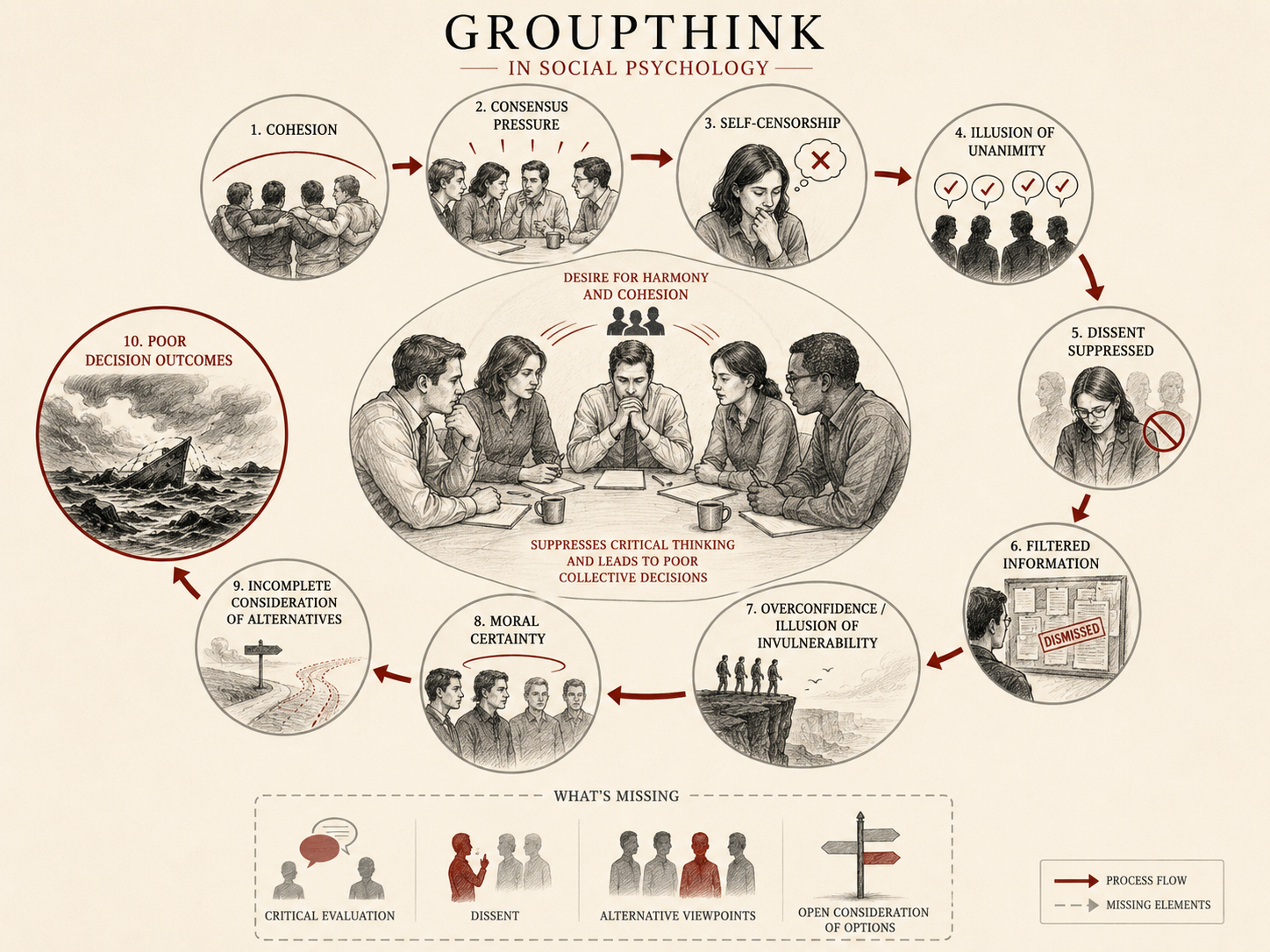
Groupthink connects directly to conformity and social influence, obedience to authority, group polarization and collective judgment, social identity theory, social norms, diffusion of responsibility, intergroup conflict, cognitive biases in decision-making, and Institutions & Governance. Together these frameworks explain why groups can become more confident, less critical, and less accountable at precisely the moment they most need disciplined judgment.
What is groupthink?
Groupthink refers to a pattern of collective decision failure in which the desire for unanimity overrides realistic appraisal of alternatives. A group affected by groupthink may appear unified, confident, and decisive, but that surface agreement can conceal self-censorship, suppressed dissent, poor risk analysis, weak alternative search, and inadequate attention to disconfirming evidence.
The term is most strongly associated with Irving Janis, who used it to explain how highly capable leadership groups could make disastrous policy decisions. His core insight was that bad collective judgment is not always produced by ignorance or incompetence. It can be produced by social pressure inside decision-making groups.
Groupthink is different from ordinary agreement. Groups can reach consensus after careful analysis, open disagreement, evidence review, and serious consideration of alternatives. Groupthink occurs when consensus emerges because disagreement has been discouraged, filtered, punished, or never invited in the first place.
It is also different from simple conformity. Conformity describes alignment with group expectations. Groupthink describes a broader institutional pattern in which conformity, hierarchy, cohesion, stress, leadership direction, and information filtering combine to distort a decision process.
The practical danger is that groupthink can feel like good teamwork. Members may experience harmony, loyalty, shared mission, and confidence. Yet the same conditions that make the group feel cohesive may also reduce its ability to detect error.
Why groupthink matters
Groupthink matters because many high-stakes decisions are made by small groups. Governments decide whether to go to war. Boards approve acquisitions. Scientific panels evaluate evidence. Crisis teams respond to emergencies. Executive teams set strategy. Courts and juries deliberate. Platform teams decide moderation policy. Public agencies interpret risk. In each case, the quality of the decision depends not only on individual intelligence, but on the structure of collective judgment.
The danger of groupthink is that groups can become less accurate as they become more confident. Members may assume that silence means agreement. Leaders may interpret lack of objection as support. Dissenters may privately worry but publicly conform. Information that threatens consensus may be delayed, softened, reframed, or ignored.
This makes groupthink especially dangerous in crisis settings. Stress, urgency, threat, and time pressure can make groups seek unity quickly. But when a group closes too soon, it may fail to consider alternatives, underestimate risk, ignore warning signs, and prepare poorly for failure.
Groupthink also matters for institutional accountability. After failure, organizations often ask why no one spoke up. The deeper question is whether the institution created conditions in which speaking up was safe, useful, and expected. If dissent was costly or symbolic, silence should not be mistaken for genuine consent.
Groupthink therefore belongs at the center of social psychology, organizational behavior, governance, and decision science. It shows that judgment is social, and that institutions must design for correction before consensus becomes self-protective.
Intellectual origins of the groupthink concept
The theory of groupthink emerged from twentieth-century social psychology’s broader concern with conformity, authority, persuasion, group pressure, and collective behavior. Earlier research showed that individual judgment can be shaped by group expectations and authority structures. Janis extended that concern to leadership groups and institutional decision-making.
The question he pursued was not simply why one person conforms. It was why a group of experienced decision makers could collectively fail to challenge weak assumptions. That shift was important because it moved analysis from individual susceptibility to social pressure toward the design of group decision processes.
Groupthink also emerged in the shadow of major twentieth-century policy failures. Janis wanted to explain episodes in which leaders had access to expertise yet still made decisions marked by overconfidence, incomplete analysis, and resistance to warnings. His case-study method drew criticism, but the concept endured because it named a recognizable institutional pattern.
At its core, groupthink belongs to a family of social-psychological concepts that challenge the idea that groups are automatically wiser than individuals. Groups can pool knowledge, correct error, and improve judgment. But they can also filter knowledge, amplify confidence, suppress dissent, and rationalize failure.
The importance of the concept lies in that tension. Collective judgment is powerful, but it is not automatically self-correcting.
Irving Janis and the development of the theory
Irving Janis introduced groupthink in Victims of Groupthink and later expanded the theory in Groupthink: Psychological Studies of Policy Decisions and Fiascoes. He argued that cohesive decision-making groups can become vulnerable to flawed judgment when the desire for unanimity becomes stronger than the motivation to evaluate alternatives realistically.
Janis did not claim that cohesion is always harmful. Cohesion can support trust, communication, loyalty, and coordinated action. The danger arises when cohesion combines with insulation, directive leadership, stress, and weak decision procedures. Under those conditions, loyalty can become silence, confidence can become overconfidence, and consensus can become a defensive shield.
Janis’s account had three major parts:
- antecedent conditions, such as group cohesion, insulation, directive leadership, stress, and weak procedural norms;
- symptoms, such as illusion of invulnerability, self-censorship, mindguarding, and illusion of unanimity;
- defective decision processes, such as incomplete alternative search, poor risk analysis, selective evidence use, and weak contingency planning.
This structure is still useful because it prevents groupthink from becoming a vague insult. A rigorous analysis should not simply label any bad decision as groupthink. It should ask whether the decision process displayed the antecedents, symptoms, and process failures that make the concept meaningful.
Janis’s contribution was therefore both psychological and institutional. He showed that groups can fail not only because of what they know, but because of how they organize knowing.
Antecedent conditions of groupthink
Groupthink is most likely when several structural and situational conditions converge. Cohesion alone is not enough. A group may be cohesive and still make excellent decisions if dissent is protected, evidence is diverse, leadership is open, and alternatives are reviewed seriously. The risk rises when cohesion is paired with conditions that reduce correction.
Important antecedent conditions include:
- high group cohesion, especially when loyalty and harmony become central to group identity;
- directive leadership, where leaders signal preferred conclusions before discussion has tested alternatives;
- group insulation, where outside experts, affected stakeholders, critics, or disconfirming evidence are excluded;
- high stress, especially when crisis pressure makes rapid agreement feel necessary;
- low psychological safety, where members fear embarrassment, retaliation, exclusion, or status loss;
- homogeneous membership, where shared background, ideology, profession, or status narrows the range of assumptions;
- weak decision procedures, where no formal process requires alternatives, risk review, dissent, or contingency planning.
These conditions matter because they make agreement easier and correction harder. A group under pressure may converge quickly because convergence reduces discomfort. But the speed of consensus can become a liability when the problem requires careful analysis.
The most dangerous groups are often not chaotic groups. They are groups that are orderly, loyal, confident, and insulated.
Diagnostic symptoms of groupthink
Janis identified eight major symptoms that signal groupthink. These symptoms remain useful as diagnostic indicators, especially when they appear together.
- Illusion of invulnerability — the group develops excessive optimism and underestimates risk.
- Collective rationalization — members discount warnings and reinterpret evidence to preserve the preferred decision.
- Belief in inherent morality — the group assumes its motives are righteous and gives insufficient attention to ethical consequences.
- Stereotyping of opponents — critics, adversaries, or outsiders are dismissed as weak, biased, ignorant, immoral, or hostile.
- Self-censorship — members with doubts withhold objections because disagreement feels costly or futile.
- Illusion of unanimity — silence is mistaken for agreement.
- Direct pressure on dissenters — members who question the consensus are treated as disloyal, obstructive, naïve, or negative.
- Mindguarding — members shield the group from information that could disrupt consensus.
These symptoms form a reinforcing cycle. Invulnerability reduces risk sensitivity. Rationalization protects the preferred decision. Moral certainty reduces ethical reflection. Stereotyping discredits critics. Self-censorship hides disagreement. Illusion of unanimity strengthens consensus pressure. Direct pressure punishes dissent. Mindguarding filters information.
The result is a group that appears united but becomes increasingly unable to learn. Its internal harmony is maintained by narrowing what can be said, seen, and considered.
Decision-process failures
Groupthink matters because it damages the decision process itself. The issue is not merely that members feel pressure. The issue is that pressure changes what the group does: which options it considers, what evidence it trusts, how risk is analyzed, and whether the decision can be revised.
Common decision-process failures include:
- incomplete survey of alternatives;
- failure to reconsider initially rejected options;
- poor search for relevant information;
- selective attention to evidence that supports the preferred course;
- discounting warnings and negative feedback;
- weak evaluation of risks and uncertainties;
- failure to develop contingency plans;
- lack of independent review;
- absence of post-decision learning.
These failures explain why groupthink is an institutional problem. A group can be full of talented people and still fail if its process does not require serious challenge. Talent cannot compensate for a structure that systematically filters out correction.
Decision quality depends on more than reaching agreement. It depends on how agreement was produced. A consensus that survives dissent, evidence review, and alternative testing is very different from a consensus that emerges because dissent was never safe.
In this sense, groupthink is best understood as a failure of process legitimacy. The group’s conclusion may look legitimate from the outside, but internally it may rest on silence, hierarchy, and untested assumptions.
Historical case studies and interpretive caution
Janis used historical case studies to illustrate groupthink, including the Bay of Pigs invasion, escalation decisions in the Vietnam War, and failures surrounding Pearl Harbor. These cases became influential because they suggested that policy disasters can arise not only from bad information, but from social and institutional processes that prevent decision makers from using information well.
Case studies are valuable because they reveal patterns that are difficult to capture in laboratory settings: hierarchy, secrecy, crisis, reputation, ideology, loyalty, institutional rivalry, and political pressure. They also show why groupthink is so difficult to detect in real time. Decision makers often experience themselves as responsible and serious, not as irrational.
At the same time, case studies require caution. Historical outcomes are complex. A failed decision should not automatically be labeled groupthink. Analysts must ask whether the decision process actually showed the relevant antecedents, symptoms, and process defects. Otherwise, groupthink becomes a retrospective explanation applied too easily after failure.
The best use of case studies is diagnostic rather than decorative. A strong analysis asks: Was dissent visible? Were alternatives explored? Did leaders signal a preferred outcome early? Were outside experts heard? Were warnings discounted? Was unanimity real or only perceived? Were contingency plans made?
Groupthink is most useful when it disciplines inquiry rather than replaces it.
Psychological mechanisms
Groupthink emerges through several interacting psychological mechanisms.
Conformity pressure encourages members to align with perceived group expectations. Even when disagreement is not explicitly punished, members may sense that objections are unwelcome.
Obedience and hierarchy shape who speaks and who remains silent. When leaders signal preferred conclusions, lower-status members may reinterpret their role as implementation rather than evaluation.
Social identity makes loyalty psychologically important. Members may experience criticism of the group’s decision as criticism of the group itself.
Self-censorship hides private disagreement. When members withhold doubts, others falsely infer that consensus is stronger than it is.
Pluralistic ignorance can arise when many members privately doubt the decision but each believes others support it.
Mindguarding reduces exposure to disconfirming information. Members may protect the group from uncomfortable evidence because they believe unity is more important than uncertainty.
Moral certainty reduces ethical reflection. Groups convinced of their own righteousness may ignore harms they would notice in another group.
These mechanisms do not require bad intentions. Groupthink can emerge from loyalty, urgency, respect for authority, fear of conflict, and desire to protect the mission. That is what makes it dangerous. The social motives may feel honorable while the decision process deteriorates.
Formalizing groupthink
Groupthink can be represented as a decline in decision quality when consensus pressure, directive leadership, stress, and informational insulation rise while dissent visibility and outside information fall. Let decision quality be \(Q\), cohesion \(C\), leadership directiveness \(L\), group insulation \(I\), stress \(S\), dissent visibility \(D\), outside information \(O\), and procedural safeguards \(P\):
Q_i=\beta_0-\beta_1C_i-\beta_2L_i-\beta_3I_i-\beta_4S_i+\beta_5D_i+\beta_6O_i+\beta_7P_i+\varepsilon_i
\]
Interpretation: Decision quality declines when cohesion, directive leadership, insulation, and stress suppress correction, and improves when dissent, outside information, and safeguards remain strong.
Self-censorship can be modeled as a function of consensus pressure and psychological safety:
P(SC_i=1)=\operatorname{logit}^{-1}(\theta_0+\theta_1C_i+\theta_2L_i+\theta_3S_i+\theta_4CP_i-\theta_5PS_i-\theta_6D_i)
\]
Interpretation: Self-censorship becomes more likely when cohesion, directive leadership, stress, and consensus pressure are high, and less likely when psychological safety and dissent visibility are high.
The illusion of unanimity can be represented as a gap between perceived agreement and true private agreement:
UG_i=U^{perceived}_i-U^{private}_i
\]
Interpretation: The unanimity gap \(UG\) grows when the group appears more unified than members’ private judgments actually support.
A practical groupthink-risk index can combine antecedent conditions, symptoms, and weak safeguards:
GTR=w_1C+w_2L+w_3I+w_4S+w_5CP+w_6SC+w_7M-w_8D-w_9O-w_{10}P
\]
Interpretation: Groupthink risk rises with cohesion, directive leadership, insulation, stress, consensus pressure, self-censorship, and mindguarding, and falls with dissent, outside information, and procedural safeguards.
These models are simplified, but they help separate groupthink from ordinary disagreement or ordinary consensus. A groupthink analysis should measure process conditions, symptoms, and decision quality rather than merely labeling a bad outcome after the fact.
False unanimity and private disagreement
One of the most important features of groupthink is false unanimity. A group may appear to agree because members are silent, but silence does not necessarily mean support. It may mean fear, fatigue, status pressure, uncertainty, deference, or belief that dissent would not matter.
False unanimity is especially dangerous because it creates feedback. A member with doubts stays silent because others appear confident. That silence makes others believe agreement is stronger. Their silence then reinforces the first member’s impression. The group becomes trapped in an agreement that may not actually exist privately.
This dynamic is closely related to pluralistic ignorance. Members may privately question a decision while incorrectly believing that others support it. The result is public consensus built on private uncertainty.
Institutions often misread false unanimity. Leaders may say, “No one objected.” Committees may record a unanimous decision. Boards may assume alignment. But if the process did not actively invite dissent, protect dissenters, and record alternative views, the absence of objection is weak evidence of agreement.
Good decision processes make private disagreement visible before consensus forms. Anonymous pre-votes, independent written assessments, minority reports, structured dissent rounds, and second-chance meetings can reveal reservations that ordinary discussion suppresses.
False unanimity is not a communication inconvenience. It is a core mechanism by which groups lose access to their own intelligence.
Groupthink and group polarization
Group polarization and groupthink are related but distinct. Group polarization refers to discussion that shifts group members toward a more extreme position in the direction of their initial leaning. Groupthink refers to defective decision-making caused by consensus pressure, suppression of dissent, and weak evaluation of alternatives.
The two can reinforce one another. A cohesive group may suppress dissent and then polarize around the preferred position. As discussion proceeds, members generate more arguments for the favored course, interpret silence as consensus, and become more confident. The group may become both less critical and more extreme.
However, they are not identical. A group can polarize without classic groupthink if members freely exchange one-sided arguments in a like-minded environment. A group can show groupthink without becoming dramatically more extreme if it simply converges prematurely around a flawed plan.
The distinction matters because interventions differ. Reducing groupthink requires protecting dissent, limiting directive leadership, widening information access, and improving decision procedures. Reducing polarization also requires viewpoint diversity, cross-cutting exposure, and attention to social rewards for extremity.
Both concepts reveal a shared lesson: discussion is not automatically corrective. It must be designed to correct.
Modern research on collective decision failure
Modern research has expanded beyond Janis’s original framework by examining collective intelligence, forecasting accuracy, cognitive diversity, group polarization, psychological safety, organizational learning, and decision architecture.
Research on expert judgment emphasizes calibration, probabilistic thinking, revision, and feedback. Groups improve when they are willing to update beliefs, track predictions, and distinguish confidence from accuracy. This matters because groupthink often increases confidence while weakening calibration.
Work on cognitive diversity shows that groups can outperform homogeneous expert teams when they bring different models, heuristics, experiences, and problem representations to complex tasks. Diversity alone is not enough, but diversity paired with legitimate voice and good process can improve judgment.
Research on psychological safety shows that teams learn better when members can speak up without fear of humiliation or punishment. This directly addresses one of groupthink’s central mechanisms: self-censorship.
Collective-intelligence research also highlights process design. Group intelligence depends not only on the average intelligence of members, but on communication patterns, social sensitivity, turn-taking, diversity of contribution, and the ability to integrate distributed information.
The modern lesson is clear: collective intelligence is designed through interaction. Groups become wiser when institutions reward correction, not merely cohesion.
Groupthink in digital and algorithmic environments
Digital environments can reproduce groupthink dynamics at scale. Online communities, internal workplace platforms, encrypted group chats, recommendation feeds, and algorithmically sorted publics can create conditions of cohesion, insulation, consensus pressure, and mindguarding.
Digital groupthink does not always look like a formal committee. It may appear as a community where dissent is mocked, moderators filter contrary information, group identity becomes morally charged, and members learn that only certain interpretations are acceptable. Apparent consensus can be intensified by likes, shares, upvotes, reposts, and algorithmic visibility.
Recommendation systems can deepen informational insulation by repeatedly surfacing material aligned with prior engagement. Members may come to believe that their group’s view is not only correct but overwhelmingly shared. Platform metrics can turn perceived consensus into social proof.
Digital mindguards may be human or technical. Human moderators, influencers, or high-status members may discredit dissent. Algorithms may reduce exposure to corrective information. Group norms may encourage blocking, dogpiling, or purity tests.
Digital groupthink is especially risky when communities interpret outside criticism as proof of persecution. In that setting, corrective evidence becomes identity threat, and disagreement strengthens rather than weakens consensus.
Studying groupthink today therefore requires attention to platform design, recommendation systems, moderation norms, network structure, status incentives, and the public performance of belonging.
Institutional implications
Groupthink is fundamentally an institutional problem. It appears wherever organizations depend on collective judgment but fail to protect correction. Governments, corporations, universities, hospitals, courts, public agencies, technology companies, media organizations, and scientific institutions can all become vulnerable.
Institutional groupthink often emerges when loyalty to the organization becomes stronger than loyalty to truth. Members may protect the institution’s reputation, leader, strategy, or public narrative by minimizing evidence of failure. This can create a culture in which bad news travels slowly, weak signals are ignored, and dissenters are treated as threats.
Institutions can also create structural incentives for groupthink. If promotions reward agreement, if leaders punish embarrassment, if meetings are performative, if dissent is recorded as negativity, or if crisis communication prioritizes message discipline over learning, the organization will produce silence.
The institutional implication is that groupthink prevention cannot rely on personality alone. Leaders may say they welcome disagreement, but unless disagreement is structurally protected and visibly useful, members will learn the real norm.
A healthy institution does not merely permit dissent. It organizes for dissent before failure makes dissent unavoidable.
Organizations, boards, and leadership teams
Organizations are especially vulnerable to groupthink because hierarchy, reputation, speed, and loyalty are often built into decision-making. Executive teams and boards may feel pressure to present unity, reassure stakeholders, support leadership, and move quickly. Those pressures can suppress careful evaluation.
Common organizational warning signs include:
- leaders state preferred outcomes before discussion;
- meetings reward agreement and punish uncertainty;
- bad news is softened before reaching senior leaders;
- skeptics are labeled negative, disloyal, or not team players;
- outside expertise is consulted only after decisions are effectively made;
- risk reviews are treated as compliance exercises;
- the same inner circle makes repeated high-stakes decisions;
- post-decision reviews protect reputations rather than learning.
Boards and leadership teams need deliberate safeguards because their members often share background, status, language, incentives, and professional networks. Homogeneity can make assumptions invisible. The group may interpret smooth agreement as evidence of alignment when it is actually evidence of narrow perspective.
Strong organizations use structured decision protocols: independent written assessments, pre-mortems, red teams, external review, alternative-ranking exercises, risk registers, decision logs, and after-action reviews. These tools slow premature consensus and make correction part of the process.
Good leadership is not the ability to produce agreement quickly. It is the ability to create conditions where truth can survive hierarchy.
Policy, security, and crisis decision-making
Policy and security decisions are classic settings for groupthink because they often involve secrecy, urgency, high stakes, threat perception, hierarchy, and reputational risk. Leaders may fear appearing weak. Advisors may fear undermining confidence. Agencies may protect institutional assumptions. Crisis conditions make rapid agreement attractive.
In crisis settings, groupthink can distort judgment in several ways. Threat can narrow attention. Time pressure can reduce alternative search. Leadership cues can become decisive. Dissent can appear dangerous because it delays action. Opponents may be stereotyped. Ethical concerns may be minimized in the name of necessity.
Security and foreign-policy settings are especially vulnerable to moral certainty. Groups may assume their motives are defensive and righteous while interpreting adversaries through simplified threat narratives. This can produce escalation, overconfidence, and poor contingency planning.
Good crisis governance requires a paradoxical discipline: speed without premature closure. Institutions need rapid processes that still preserve dissent, identify assumptions, consult external expertise, evaluate failure modes, and define triggers for revision.
Effective crisis teams do not avoid pressure. They build procedures that keep pressure from becoming tunnel vision.
Science, expertise, and expert panels
Scientific and expert groups can also experience groupthink. Expertise improves collective judgment when experts expose claims to criticism, evidence, replication, uncertainty, and competing models. But expertise can become vulnerable when panels are homogeneous, dissent is stigmatized, or reputational incentives favor consensus over revision.
Expert panels often operate under public pressure. They may be expected to provide clear guidance despite uncertainty. In such settings, acknowledging uncertainty can feel risky. Members may converge around a consensus statement that is more confident than the evidence justifies.
Scientific groupthink can also arise from shared paradigms. Members trained in the same field may share assumptions about what counts as evidence, which methods are legitimate, and which questions are worth asking. These shared assumptions are often necessary, but they can also narrow interpretation.
Safeguards include methodological transparency, minority reports, open data, adversarial collaboration, preregistration, replication, cross-disciplinary review, external audit, and explicit uncertainty communication. These practices are not signs of weakness. They are the infrastructure of credible expertise.
Expert communities are strongest when they normalize correction. The goal is not permanent consensus. The goal is accountable convergence that remains open to evidence.
Preventing groupthink
Preventing groupthink requires more than telling people to speak up. It requires creating decision structures that make dissent legitimate, information diverse, and revision possible.
Useful safeguards include:
- leader impartiality, where leaders withhold preferences early in the process;
- independent pre-meeting judgment, so members record views before social pressure begins;
- structured dissent rounds, where objections are required rather than merely allowed;
- devil’s advocacy, used seriously rather than symbolically;
- red-team analysis, especially for high-stakes strategies;
- outside expert review, to reduce informational insulation;
- subgroup analysis, where independent teams evaluate the same problem separately;
- second-chance meetings, where members revisit decisions after reflection;
- anonymous concern collection, especially in hierarchical settings;
- pre-mortem analysis, to imagine plausible failure before implementation;
- risk registers and contingency plans, to force explicit uncertainty review;
- minority reports, so dissent is preserved in the record;
- after-action reviews, to learn after decisions without scapegoating.
The most important principle is that dissent should be procedural, not personal. If dissent depends on heroic individuals willing to risk status, the system is weak. A strong system makes challenge part of the expected workflow.
Good prevention also requires follow-through. If dissent is invited but ignored, people learn that dissent is symbolic. If dissent changes decisions, people learn that speaking up matters.
Power, hierarchy, and the unequal cost of dissent
Groupthink cannot be understood without power. The cost of dissent is not equally distributed. Senior members, dominant-group members, permanent employees, tenured faculty, executives, or socially secure insiders can often disagree with less risk. Junior members, marginalized members, contingent workers, students, whistleblowers, and outsiders may face greater consequences.
This matters because groups often claim to welcome disagreement while making disagreement safe only for some people. A leader may ask for feedback, but if past dissenters were punished, the request will not be trusted. A committee may include diverse members, but if status norms favor established voices, diversity will not improve judgment.
Hierarchy also shapes what counts as “constructive.” A powerful member may be seen as rigorous when challenging assumptions. A lower-status member may be seen as difficult. A dominant-group member may be praised for candor. A marginalized member may be penalized for the same behavior.
Groupthink prevention must therefore include protection for dissenters. Anonymous channels, independent review, anti-retaliation norms, facilitation, rotating speaking order, written input, and formal minority reports can reduce unequal voice.
The goal is not conflict for its own sake. The goal is to prevent hierarchy from deciding what the group is allowed to know.
Groupthink in the architecture of social influence
Within the broader architecture of social influence, groupthink is the institutional form of suppressed correction. Conformity explains alignment with group expectations. Obedience explains deference to hierarchy. Social norms explain what the group rewards or punishes. Group polarization explains how discussion can intensify attitudes. Groupthink explains how these forces become locked into decision procedures that prevent learning.
Groupthink is especially important because it connects micro-level psychology to institutional failure. A member self-censors. A leader signals preference. A group treats silence as agreement. A mindguard filters information. A committee ignores alternatives. A decision becomes policy. A failure becomes public.
The concept therefore helps explain how ordinary social processes become consequential at scale. The same desire for belonging that operates in small groups can shape wars, corporate failures, public-health decisions, scientific consensus, legal judgments, and organizational crises.
Groupthink also clarifies why accountability must be structural. It is not enough to ask whether individuals had doubts. Institutions must ask whether their decision processes could hear those doubts before failure occurred.
Limits and critiques of the concept
Groupthink remains influential, but it has limits. Critics have argued that the original case-study method is vulnerable to hindsight bias, that symptoms are sometimes difficult to measure independently, and that the concept can be applied too broadly after any failed decision.
These critiques are important. Groupthink should not become a catch-all explanation. Not every failed decision involves groupthink. Not every consensus is defective. Not every cohesive group suppresses dissent. Not every strong leader produces poor judgment.
Several cautions are useful:
- Do not infer groupthink from outcome failure alone.
- Do not treat cohesion as automatically harmful.
- Do not assume dissent always improves decisions; dissent must be informed and engaged.
- Do not ignore external constraints, uncertainty, incomplete information, or political pressures.
- Do not confuse groupthink with group polarization, conformity, or obedience, even though they overlap.
- Do not use groupthink language to delegitimize solidarity among marginalized groups.
- Do not assume that a more divided group is automatically wiser.
The strongest use of groupthink is as a process diagnosis. Analysts should look for antecedent conditions, symptoms, and decision-process defects. They should also compare decisions that failed with decisions that succeeded under similar conditions.
Groupthink is valuable not because it explains everything, but because it forces attention to something institutions often avoid: the process by which agreement is manufactured.
Measurement, data, and research design
Groupthink research can use experiments, simulations, case studies, organizational surveys, meeting transcripts, decision audits, forecasting records, institutional documents, interview data, and post-decision reviews.
Key variables include:
- participant, group, session, scenario, site, and institution identifiers;
- institutional context;
- experimental condition;
- cohesion;
- leadership directiveness;
- group insulation;
- stress level;
- consensus pressure;
- self-censorship;
- illusion of invulnerability;
- collective rationalization;
- belief in inherent morality;
- outgroup stereotyping;
- direct pressure on dissenters;
- mindguarding;
- dissent visibility;
- outside information;
- alternative search;
- risk analysis;
- contingency planning;
- devil’s advocate presence;
- independent expert consultation;
- subgroup review;
- leader impartiality;
- psychological safety;
- perceived unanimity;
- private disagreement;
- decision quality;
- forecast calibration;
- implementation risk;
- post-decision review quality;
- response time.
Strong research designs should measure private disagreement separately from public consensus. Without that distinction, illusion of unanimity cannot be detected. Researchers should also measure decision process separately from decision outcome. A good process can still face bad luck, and a bad process can sometimes produce a successful outcome by chance.
Experiments can manipulate leadership style, dissent visibility, outside expertise, stress, and safeguard procedures. Field studies can examine meeting transcripts, decision logs, minority reports, risk registers, and post-decision reviews. Case studies can map symptoms and process failures across time.
The best research treats groupthink as a measurable process rather than a retrospective label.
R code for groupthink research
The following R workflow models decision quality, self-censorship, forecast calibration, implementation risk, and response time as functions of cohesion, directive leadership, insulation, stress, consensus pressure, dissent visibility, outside information, alternative search, risk analysis, contingency planning, leader impartiality, psychological safety, and institutional safeguards.
# Install packages if needed:
# pak::pak(c("tidyverse", "lme4", "lmerTest", "emmeans", "broom.mixed", "performance"))

library(tidyverse)
library(lme4)
library(lmerTest)
library(emmeans)
library(broom.mixed)
library(performance)

# Expected columns:
# participant, session_id, group_id, scenario_id, site_id,
# institution_context, condition, trial, cohesion,
# leadership_directive, group_insulation, stress_level,
# consensus_pressure, self_censorship,
# illusion_invulnerability, collective_rationalization,
# inherent_morality, outgroup_stereotyping,
# direct_pressure_dissenters, mindguarding,
# dissent_visibility, outside_information, alternative_search,
# risk_analysis, contingency_planning, devils_advocate,
# independent_expert_consulted, subgroup_review,
# leader_impartiality, psychological_safety,
# perceived_unanimity, private_disagreement,
# decision_quality, forecast_calibration,
# implementation_risk, post_decision_review_quality,
# response_time_ms

dat <- read_csv("groupthink_trials.csv") %>%
  mutate(
    participant = factor(participant),
    session_id = factor(session_id),
    group_id = factor(group_id),
    scenario_id = factor(scenario_id),
    site_id = factor(site_id),
    institution_context = factor(institution_context),
    condition = factor(condition),
    symptom_index = (
      illusion_invulnerability +
      collective_rationalization +
      inherent_morality +
      outgroup_stereotyping +
      self_censorship +
      direct_pressure_dissenters +
      mindguarding
    ) / 7,
    antecedent_risk_index = (
      cohesion +
      leadership_directive +
      group_insulation +
      stress_level +
      consensus_pressure
    ) / 5,
    process_quality_index = (
      dissent_visibility +
      outside_information +
      alternative_search +
      risk_analysis +
      contingency_planning +
      leader_impartiality +
      psychological_safety
    ) / 7,
    safeguard_index = (
      dissent_visibility +
      outside_information +
      alternative_search +
      risk_analysis +
      contingency_planning +
      leader_impartiality +
      psychological_safety +
      2 * devils_advocate +
      2 * independent_expert_consulted +
      2 * subgroup_review
    ) / 9,
    unanimity_gap = perceived_unanimity - (100 - private_disagreement),
    groupthink_risk_index = antecedent_risk_index + symptom_index - process_quality_index,
    log_response_time = log(response_time_ms)
  )

summary_table <- dat %>%
  group_by(condition, institution_context) %>%
  summarise(
    n = n(),
    participants = n_distinct(participant),
    groups = n_distinct(group_id),
    mean_groupthink_risk = mean(groupthink_risk_index, na.rm = TRUE),
    mean_antecedent_risk = mean(antecedent_risk_index, na.rm = TRUE),
    mean_symptoms = mean(symptom_index, na.rm = TRUE),
    mean_process_quality = mean(process_quality_index, na.rm = TRUE),
    mean_safeguards = mean(safeguard_index, na.rm = TRUE),
    mean_unanimity_gap = mean(unanimity_gap, na.rm = TRUE),
    mean_self_censorship = mean(self_censorship, na.rm = TRUE),
    mean_dissent_visibility = mean(dissent_visibility, na.rm = TRUE),
    mean_outside_information = mean(outside_information, na.rm = TRUE),
    mean_decision_quality = mean(decision_quality, na.rm = TRUE),
    mean_forecast_calibration = mean(forecast_calibration, na.rm = TRUE),
    mean_implementation_risk = mean(implementation_risk, na.rm = TRUE),
    mean_review_quality = mean(post_decision_review_quality, na.rm = TRUE),
    .groups = "drop"
  )

print(summary_table)

decision_quality_model <- lmer(
  decision_quality ~
    groupthink_risk_index +
    safeguard_index +
    cohesion +
    leadership_directive +
    group_insulation +
    stress_level +
    consensus_pressure +
    dissent_visibility +
    outside_information +
    alternative_search +
    risk_analysis +
    contingency_planning +
    leader_impartiality +
    psychological_safety +
    condition +
    institution_context +
    (1 | participant) +
    (1 | group_id) +
    (1 | scenario_id) +
    (1 | site_id),
  data = dat,
  REML = FALSE
)

summary(decision_quality_model)
emmeans(decision_quality_model, ~ condition)

self_censorship_model <- lmer(
  self_censorship ~
    cohesion +
    leadership_directive +
    group_insulation +
    stress_level +
    consensus_pressure +
    dissent_visibility +
    leader_impartiality +
    psychological_safety +
    condition +
    institution_context +
    (1 | participant) +
    (1 | group_id) +
    (1 | scenario_id) +
    (1 | site_id),
  data = dat,
  REML = FALSE
)

summary(self_censorship_model)

forecast_model <- lmer(
  forecast_calibration ~
    groupthink_risk_index +
    safeguard_index +
    outside_information +
    risk_analysis +
    illusion_invulnerability +
    collective_rationalization +
    condition +
    institution_context +
    (1 | participant) +
    (1 | group_id) +
    (1 | scenario_id) +
    (1 | site_id),
  data = dat,
  REML = FALSE
)

summary(forecast_model)

implementation_risk_model <- lmer(
  implementation_risk ~
    groupthink_risk_index +
    symptom_index +
    risk_analysis +
    contingency_planning +
    outside_information +
    safeguard_index +
    condition +
    institution_context +
    (1 | participant) +
    (1 | group_id) +
    (1 | scenario_id) +
    (1 | site_id),
  data = dat,
  REML = FALSE
)

summary(implementation_risk_model)

response_time_model <- lmer(
  log_response_time ~
    stress_level +
    consensus_pressure +
    self_censorship +
    alternative_search +
    risk_analysis +
    condition +
    institution_context +
    (1 | participant) +
    (1 | group_id) +
    (1 | scenario_id),
  data = dat %>% filter(response_time_ms >= 150),
  REML = FALSE
)

summary(response_time_model)

condition_summary <- dat %>%
  group_by(condition) %>%
  summarise(
    n = n(),
    mean_groupthink_risk = mean(groupthink_risk_index, na.rm = TRUE),
    mean_self_censorship = mean(self_censorship, na.rm = TRUE),
    mean_unanimity_gap = mean(unanimity_gap, na.rm = TRUE),
    mean_decision_quality = mean(decision_quality, na.rm = TRUE),
    mean_forecast_calibration = mean(forecast_calibration, na.rm = TRUE),
    mean_implementation_risk = mean(implementation_risk, na.rm = TRUE),
    mean_safeguards = mean(safeguard_index, na.rm = TRUE),
    .groups = "drop"
  )

write_csv(summary_table, "groupthink_summary.csv")
write_csv(condition_summary, "groupthink_condition_summary.csv")

write_csv(
  tidy(decision_quality_model, effects = "fixed", conf.int = TRUE),
  "groupthink_decision_quality_coefficients.csv"
)

ggplot(
  condition_summary,
  aes(x = reorder(condition, mean_groupthink_risk), y = mean_groupthink_risk, group = 1)
) +
  geom_line() +
  geom_point() +
  coord_flip() +
  labs(
    title = "Mean groupthink-risk index by condition",
    x = "Condition",
    y = "Mean groupthink-risk index"
  ) +
  theme_minimal()
This workflow supports groupthink research by separating antecedent risk, symptom indicators, process quality, safeguards, false unanimity, self-censorship, decision quality, calibration, implementation risk, and post-decision learning.
Python code for groupthink research
The Python workflow below parallels the R analysis and adds simulation logic for safeguards such as devil’s advocacy, outside experts, red teams, subgroup review, and second-chance meetings.
import numpy as np
import pandas as pd
import statsmodels.formula.api as smf
import matplotlib.pyplot as plt

# Expected columns:
# participant, session_id, group_id, scenario_id, site_id,
# institution_context, condition, trial, cohesion,
# leadership_directive, group_insulation, stress_level,
# consensus_pressure, self_censorship,
# illusion_invulnerability, collective_rationalization,
# inherent_morality, outgroup_stereotyping,
# direct_pressure_dissenters, mindguarding,
# dissent_visibility, outside_information, alternative_search,
# risk_analysis, contingency_planning, devils_advocate,
# independent_expert_consulted, subgroup_review,
# leader_impartiality, psychological_safety,
# perceived_unanimity, private_disagreement,
# decision_quality, forecast_calibration,
# implementation_risk, post_decision_review_quality,
# response_time_ms

df = pd.read_csv("groupthink_trials.csv")

for col in [
    "participant",
    "session_id",
    "group_id",
    "scenario_id",
    "site_id",
    "institution_context",
    "condition"
]:
    df[col] = df[col].astype("category")

df["symptom_index"] = (
    df["illusion_invulnerability"]
    + df["collective_rationalization"]
    + df["inherent_morality"]
    + df["outgroup_stereotyping"]
    + df["self_censorship"]
    + df["direct_pressure_dissenters"]
    + df["mindguarding"]
) / 7

df["antecedent_risk_index"] = (
    df["cohesion"]
    + df["leadership_directive"]
    + df["group_insulation"]
    + df["stress_level"]
    + df["consensus_pressure"]
) / 5

df["process_quality_index"] = (
    df["dissent_visibility"]
    + df["outside_information"]
    + df["alternative_search"]
    + df["risk_analysis"]
    + df["contingency_planning"]
    + df["leader_impartiality"]
    + df["psychological_safety"]
) / 7

df["safeguard_index"] = (
    df["dissent_visibility"]
    + df["outside_information"]
    + df["alternative_search"]
    + df["risk_analysis"]
    + df["contingency_planning"]
    + df["leader_impartiality"]
    + df["psychological_safety"]
    + 2 * df["devils_advocate"]
    + 2 * df["independent_expert_consulted"]
    + 2 * df["subgroup_review"]
) / 9

df["unanimity_gap"] = (
    df["perceived_unanimity"] - (100 - df["private_disagreement"])
)

df["groupthink_risk_index"] = (
    df["antecedent_risk_index"]
    + df["symptom_index"]
    - df["process_quality_index"]
)

df["log_response_time"] = np.log(df["response_time_ms"])

summary_table = (
    df.groupby(["condition", "institution_context"], observed=True)
    .agg(
        n=("participant", "size"),
        participants=("participant", "nunique"),
        groups=("group_id", "nunique"),
        mean_groupthink_risk=("groupthink_risk_index", "mean"),
        mean_antecedent_risk=("antecedent_risk_index", "mean"),
        mean_symptoms=("symptom_index", "mean"),
        mean_process_quality=("process_quality_index", "mean"),
        mean_safeguards=("safeguard_index", "mean"),
        mean_unanimity_gap=("unanimity_gap", "mean"),
        mean_self_censorship=("self_censorship", "mean"),
        mean_dissent_visibility=("dissent_visibility", "mean"),
        mean_outside_information=("outside_information", "mean"),
        mean_decision_quality=("decision_quality", "mean"),
        mean_forecast_calibration=("forecast_calibration", "mean"),
        mean_implementation_risk=("implementation_risk", "mean"),
        mean_review_quality=("post_decision_review_quality", "mean"),
    )
    .reset_index()
)

print(summary_table)

decision_quality_model = smf.ols(
    "decision_quality ~ groupthink_risk_index + safeguard_index "
    "+ cohesion + leadership_directive + group_insulation "
    "+ stress_level + consensus_pressure + dissent_visibility "
    "+ outside_information + alternative_search + risk_analysis "
    "+ contingency_planning + leader_impartiality "
    "+ psychological_safety + condition + institution_context",
    data=df,
)

decision_quality_result = decision_quality_model.fit(
    cov_type="cluster",
    cov_kwds={"groups": df["group_id"]}
)

print(decision_quality_result.summary())

self_censorship_model = smf.ols(
    "self_censorship ~ cohesion + leadership_directive "
    "+ group_insulation + stress_level + consensus_pressure "
    "+ dissent_visibility + leader_impartiality "
    "+ psychological_safety + condition + institution_context",
    data=df,
)

self_censorship_result = self_censorship_model.fit(
    cov_type="cluster",
    cov_kwds={"groups": df["group_id"]}
)

print(self_censorship_result.summary())

forecast_model = smf.ols(
    "forecast_calibration ~ groupthink_risk_index + safeguard_index "
    "+ outside_information + risk_analysis "
    "+ illusion_invulnerability + collective_rationalization "
    "+ condition + institution_context",
    data=df,
)

forecast_result = forecast_model.fit(
    cov_type="cluster",
    cov_kwds={"groups": df["group_id"]}
)

print(forecast_result.summary())

implementation_risk_model = smf.ols(
    "implementation_risk ~ groupthink_risk_index + symptom_index "
    "+ risk_analysis + contingency_planning "
    "+ outside_information + safeguard_index "
    "+ condition + institution_context",
    data=df,
)

implementation_risk_result = implementation_risk_model.fit(
    cov_type="cluster",
    cov_kwds={"groups": df["group_id"]}
)

print(implementation_risk_result.summary())

def simulate_safeguards(n_groups=1000, periods=12, seed=42):
    rng = np.random.default_rng(seed)
    rows = []

    scenarios = [
        "unstructured_crisis",
        "directive_leader",
        "devils_advocate",
        "outside_experts",
        "red_team",
        "second_chance_meeting"
    ]

    for scenario in scenarios:
        for group in range(1, n_groups + 1):
            if scenario == "unstructured_crisis":
                risk, safeguards, stress, dissent = 7.5, 2.5, 8.5, 2.5
            elif scenario == "directive_leader":
                risk, safeguards, stress, dissent = 8.0, 2.0, 7.0, 2.0
            elif scenario == "devils_advocate":
                risk, safeguards, stress, dissent = 5.0, 7.0, 6.0, 7.5
            elif scenario == "outside_experts":
                risk, safeguards, stress, dissent = 4.5, 7.8, 6.0, 7.2
            elif scenario == "red_team":
                risk, safeguards, stress, dissent = 4.0, 8.5, 6.5, 8.5
            else:
                risk, safeguards, stress, dissent = 4.2, 8.0, 7.0, 8.0

            quality = np.clip(rng.normal(60, 8), 0, 100)

            for period in range(1, periods + 1):
                consensus_pressure = np.clip(
                    risk + 0.15 * period + rng.normal(0, 0.8),
                    0,
                    10
                )

                self_censorship = np.clip(
                    0.65 * risk
                    + 0.45 * stress
                    + 0.55 * consensus_pressure
                    - 0.60 * safeguards
                    - 0.45 * dissent
                    + rng.normal(0, 1.0),
                    0,
                    10
                )

                quality = np.clip(
                    quality
                    - 2.2 * risk
                    - 1.5 * self_censorship
                    + 2.8 * safeguards
                    + 2.0 * dissent
                    + rng.normal(0, 5),
                    0,
                    100
                )

                implementation_risk = np.clip(
                    75
                    + 2.5 * risk
                    + 2.0 * self_censorship
                    - 2.5 * safeguards
                    - 1.8 * dissent
                    + rng.normal(0, 6),
                    0,
                    100
                )

                rows.append({
                    "scenario": scenario,
                    "group": group,
                    "period": period,
                    "groupthink_risk": risk,
                    "safeguards": safeguards,
                    "stress": stress,
                    "dissent_visibility": dissent,
                    "consensus_pressure": consensus_pressure,
                    "self_censorship": self_censorship,
                    "decision_quality": quality,
                    "implementation_risk": implementation_risk,
                })

    simulation = pd.DataFrame(rows)

    simulation_summary = (
        simulation.groupby(["scenario", "period"])
        .agg(
            mean_groupthink_risk=("groupthink_risk", "mean"),
            mean_safeguards=("safeguards", "mean"),
            mean_self_censorship=("self_censorship", "mean"),
            mean_decision_quality=("decision_quality", "mean"),
            mean_implementation_risk=("implementation_risk", "mean"),
        )
        .reset_index()
    )

    return simulation, simulation_summary

simulation, simulation_summary = simulate_safeguards()

print(simulation_summary.tail())

condition_summary = (
    df.groupby("condition", observed=True)
    .agg(
        mean_groupthink_risk=("groupthink_risk_index", "mean"),
        mean_self_censorship=("self_censorship", "mean"),
        mean_unanimity_gap=("unanimity_gap", "mean"),
        mean_decision_quality=("decision_quality", "mean"),
        mean_forecast_calibration=("forecast_calibration", "mean"),
        mean_implementation_risk=("implementation_risk", "mean"),
        mean_safeguards=("safeguard_index", "mean"),
    )
    .reset_index()
)

fig, ax = plt.subplots(figsize=(8, 5))

ordered = condition_summary.sort_values("mean_groupthink_risk")
ax.plot(
    ordered["mean_groupthink_risk"],
    ordered["condition"].astype(str),
    marker="o"
)

ax.set_xlabel("Mean groupthink-risk index")
ax.set_ylabel("Condition")
ax.set_title("Mean groupthink-risk index by condition")
plt.tight_layout()
plt.show()

summary_table.to_csv("groupthink_summary.csv", index=False)
condition_summary.to_csv("groupthink_condition_summary.csv", index=False)
simulation.to_csv("groupthink_safeguard_simulation.csv", index=False)
simulation_summary.to_csv("groupthink_safeguard_simulation_summary.csv", index=False)
This Python workflow supports groupthink research by modeling antecedent risk, symptoms, self-censorship, false unanimity, decision quality, calibration, implementation risk, and institutional safeguards over repeated decision cycles.
Research data architecture
Groupthink research often depends on relational data: participants, groups, sessions, scenarios, institutional contexts, conditions, cohesion, leadership directiveness, insulation, stress, consensus pressure, self-censorship, Janis-style symptom indicators, dissent visibility, outside information, alternative search, risk analysis, contingency planning, safeguards, perceived unanimity, private disagreement, decision quality, forecast calibration, implementation risk, and post-decision review quality.
Rather than embedding executable database code directly in the WordPress article body, the companion GitHub repository includes the full SQL schema and example queries for researchers who want to reproduce or extend the data model.
The research data model is designed to support questions such as:
- Does directive leadership increase self-censorship?
- Does group insulation reduce decision quality after accounting for stress?
- Does perceived unanimity exceed confidentially measured agreement?
- Does dissent visibility reduce groupthink-risk scores?
- Do outside experts improve forecast calibration?
- Do devil’s advocate and red-team procedures reduce implementation risk?
- Does psychological safety moderate the effect of cohesion?
- Do high-stress groups show weaker alternative search?
- Does post-decision review quality improve when dissent was preserved?
The GitHub repository contains the full database schema, example analytical queries, validation logic, and reproducible data workflow. Keeping executable SQL in GitHub avoids WordPress hosting restrictions while preserving the technical infrastructure for readers who want to inspect or reuse the model.
View the SQL research data architecture in GitHub.
GitHub repository
The companion repository provides reusable code and research scaffolding for studying groupthink, including workflows for cohesion, directive leadership, insulation, stress, consensus pressure, self-censorship, mindguarding, dissent visibility, outside information, decision quality, calibration, implementation risk, and institutional safeguards.
Access the full companion repository for this article, including reproducible analysis materials and multi-language code workflows for groupthink and collective-decision research.
Why groupthink matters for social psychology
Groupthink matters because it shows how collective judgment can fail inside competent groups. The danger is not simply ignorance. It is the social organization of knowing: who speaks, who stays silent, what information reaches the group, how leaders frame dissent, and whether agreement is tested before it becomes policy.
The concept remains powerful because it connects everyday social influence to institutional failure. Conformity, obedience, social identity, consensus pressure, and self-censorship are not small interpersonal details when they operate inside governments, corporations, scientific panels, courts, crisis teams, and public agencies. They can shape decisions that affect lives.
At the same time, groupthink should be used carefully. It is not a label for every bad decision or every cohesive group. Its value lies in diagnosing specific process failures: suppressed dissent, false unanimity, weak alternative search, selective evidence, and poor risk analysis.
Read alongside conformity and social influence, obedience to authority, group polarization and collective judgment, social norms, cognitive biases in decision-making, Behavioral Economics, and Institutions & Governance, groupthink becomes more than a theory of flawed meetings. It becomes a framework for designing institutions where truth can reach power before failure does.
Related articles
- Social Psychology
- Conformity and Social Influence
- Obedience to Authority
- Group Polarization and Collective Judgment
- Social Identity Theory
- Social Norms in Social Psychology
- Diffusion of Responsibility
- Intergroup Conflict in Social Psychology
- Cognitive Biases in Decision-Making
- Decision-Making in Cognitive Psychology
- Behavioral Economics
- Institutions & Governance
Further reading
- American Psychological Association (n.d.) ‘Groupthink’, APA Dictionary of Psychology. Available at: https://dictionary.apa.org/groupthink.
- Aldag, R.J. and Fuller, S.R. (1993) ‘Beyond fiasco: A reappraisal of the groupthink phenomenon and a new model of group decision processes’, Psychological Bulletin, 113(3), pp. 533–552. Available at: https://doi.org/10.1037/0033-2909.113.3.533.
- Baron, R.S. (2005) ‘So right it’s wrong: Groupthink and the ubiquitous nature of polarized group decision making’, Advances in Experimental Social Psychology, 37, pp. 219–253. Available at: https://doi.org/10.1016/S0065-2601(05)37004-3.
- Edmondson, A.C. (1999) ‘Psychological safety and learning behavior in work teams’, Administrative Science Quarterly, 44(2), pp. 350–383. Available at: https://doi.org/10.2307/2666999.
- Janis, I.L. (1972) Victims of Groupthink: A Psychological Study of Foreign-Policy Decisions and Fiascoes. Boston: Houghton Mifflin. Available at: https://archive.org/details/victimsofgroupth0000jani.
- Janis, I.L. (1982) Groupthink: Psychological Studies of Policy Decisions and Fiascoes. 2nd edn. Boston: Houghton Mifflin.
- Page, S.E. (2007) The Difference: How the Power of Diversity Creates Better Groups, Firms, Schools, and Societies. Princeton, NJ: Princeton University Press. Available at: https://press.princeton.edu/books/paperback/9780691138541/the-difference.
- Sunstein, C.R. (1999) ‘The law of group polarization’, John M. Olin Law & Economics Working Paper, No. 91. Available at: https://chicagounbound.uchicago.edu/law_and_economics/542/.
- Sunstein, C.R. (2002) ‘The law of group polarization’, Journal of Political Philosophy, 10(2), pp. 175–195. Available at: https://chicagounbound.uchicago.edu/journal_articles/8588/.
- Tetlock, P.E. (2005) Expert Political Judgment: How Good Is It? How Can We Know? Princeton, NJ: Princeton University Press. Available at: https://archive.org/details/expertpoliticalj0000tetl_u0t8.
- Turner, M.E. and Pratkanis, A.R. (1998) ‘Twenty-five years of groupthink theory and research: Lessons from the evaluation of a theory’, Organizational Behavior and Human Decision Processes, 73(2–3), pp. 105–115. Available at: https://doi.org/10.1006/obhd.1998.2756.
References
- American Psychological Association (n.d.) ‘Groupthink’, APA Dictionary of Psychology. Available at: https://dictionary.apa.org/groupthink.
- Aldag, R.J. and Fuller, S.R. (1993) ‘Beyond fiasco: A reappraisal of the groupthink phenomenon and a new model of group decision processes’, Psychological Bulletin, 113(3), pp. 533–552. Available at: https://doi.org/10.1037/0033-2909.113.3.533.
- Baron, R.S. (2005) ‘So right it’s wrong: Groupthink and the ubiquitous nature of polarized group decision making’, Advances in Experimental Social Psychology, 37, pp. 219–253. Available at: https://doi.org/10.1016/S0065-2601(05)37004-3.
- Edmondson, A.C. (1999) ‘Psychological safety and learning behavior in work teams’, Administrative Science Quarterly, 44(2), pp. 350–383. Available at: https://doi.org/10.2307/2666999.
- Janis, I.L. (1972) Victims of Groupthink: A Psychological Study of Foreign-Policy Decisions and Fiascoes. Boston: Houghton Mifflin. Available at: https://archive.org/details/victimsofgroupth0000jani.
- Janis, I.L. (1982) Groupthink: Psychological Studies of Policy Decisions and Fiascoes. 2nd edn. Boston: Houghton Mifflin.
- Page, S.E. (2007) The Difference: How the Power of Diversity Creates Better Groups, Firms, Schools, and Societies. Princeton, NJ: Princeton University Press. Available at: https://press.princeton.edu/books/paperback/9780691138541/the-difference.
- Sunstein, C.R. (1999) ‘The law of group polarization’, John M. Olin Law & Economics Working Paper, No. 91. Available at: https://chicagounbound.uchicago.edu/law_and_economics/542/.
- Sunstein, C.R. (2002) ‘The law of group polarization’, Journal of Political Philosophy, 10(2), pp. 175–195. Available at: https://chicagounbound.uchicago.edu/journal_articles/8588/.
- Tetlock, P.E. (2005) Expert Political Judgment: How Good Is It? How Can We Know? Princeton, NJ: Princeton University Press. Available at: https://archive.org/details/expertpoliticalj0000tetl_u0t8.
- Turner, M.E. and Pratkanis, A.R. (1998) ‘Twenty-five years of groupthink theory and research: Lessons from the evaluation of a theory’, Organizational Behavior and Human Decision Processes, 73(2–3), pp. 105–115. Available at: https://doi.org/10.1006/obhd.1998.2756.