
Last Updated May 21, 2026
Heuristics and biases explain how people make judgments under uncertainty when information is incomplete, time is limited, attention is scarce, and formal calculation is impractical. Heuristics are cognitive shortcuts: simplified strategies that help people estimate probability, risk, value, causation, trust, blame, responsibility, and likely outcomes without computing everything from first principles. Biases are the patterned errors that can emerge when those shortcuts are applied outside the conditions where they work well.
The modern heuristics-and-biases research program, associated most closely with Amos Tversky and Daniel Kahneman, transformed psychology, economics, law, medicine, public policy, and organizational decision-making. It showed that judgment errors are often systematic rather than random. People do not merely make occasional mistakes; they often rely on recurring mental strategies that simplify uncertainty in predictable ways.
A serious treatment of heuristics and biases must therefore avoid two simplifications. It should not describe human beings as perfectly rational calculators who merely need better information. But it should also avoid portraying cognition as simply irrational or defective. Human judgment is bounded, adaptive, social, affective, and context-sensitive. Heuristics often make action possible. They become dangerous when environments exploit them, when institutions amplify them, or when decision systems fail to correct their predictable distortions.
Main Library
Publications
Article Map
Social Psychology
Related Topic
Stewardship & Ethics
Related Topic
Behavioral Economics
Related Topic
Institutions & Governance
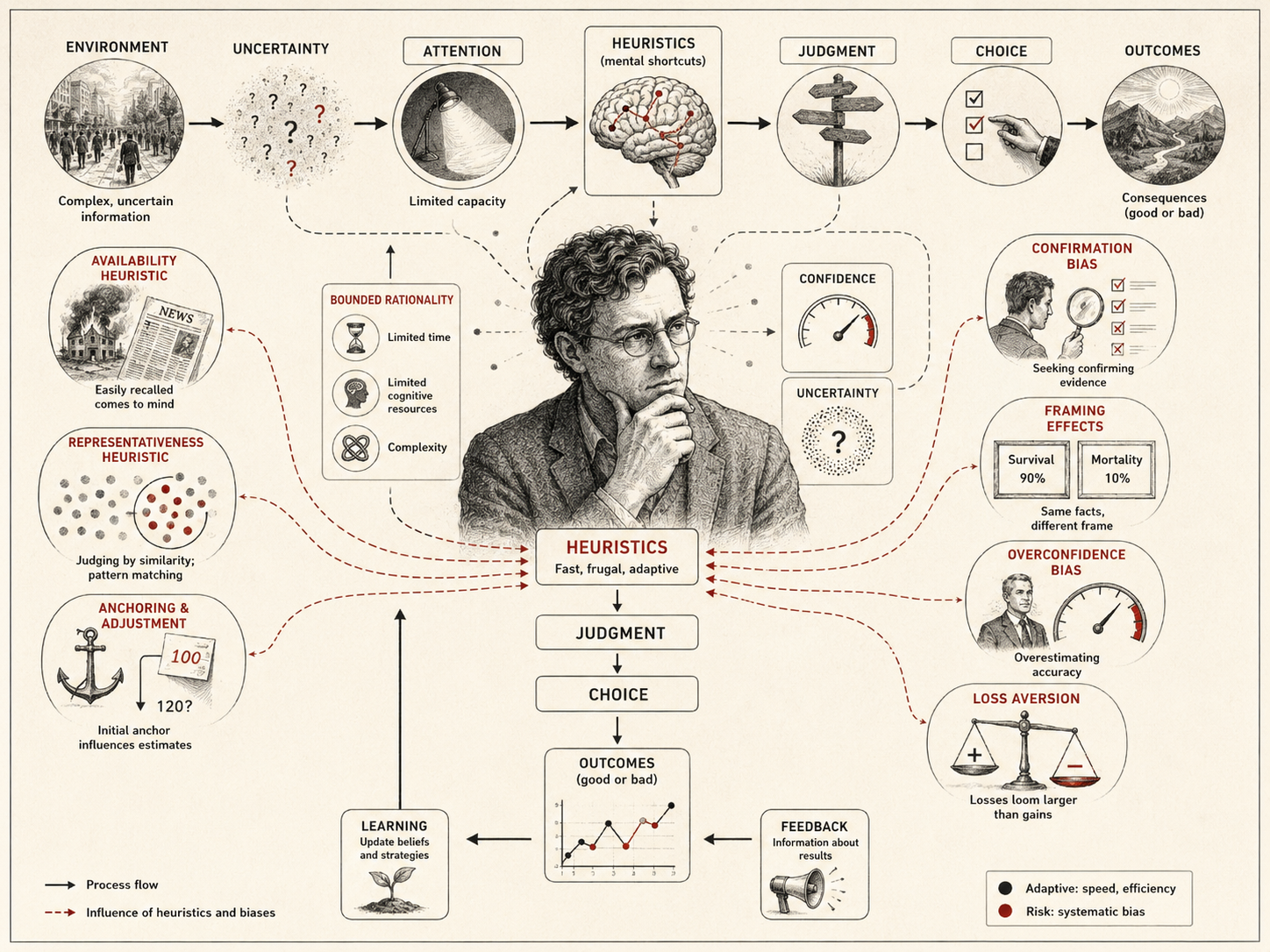
Heuristics and biases belong at the center of social cognition because social life is filled with uncertainty. People must judge trustworthiness, intention, threat, credibility, fairness, blame, risk, expertise, group membership, and institutional legitimacy under incomplete information. In those conditions, judgment is shaped by salience, memory, emotion, prototypes, framing, prior belief, confidence, and social context.
This article connects directly to social cognition, attribution theory, fundamental attribution error, self-serving bias, cognitive dissonance theory, cognitive biases and decision-making, risk perception and uncertainty, Behavioral Economics, and Institutions & Governance. Together these frameworks explain why people often rely on cognitive shortcuts and why institutions need decision architectures that account for bounded human judgment.
What are heuristics and biases?
Heuristics are simplified cognitive strategies used to make judgments quickly and efficiently. They are not random guesses. They are structured shortcuts that reduce cognitive effort by relying on accessible cues, familiar patterns, emotional signals, prototypes, reference points, or prior beliefs.
Biases are systematic deviations from a relevant standard: a true value, base rate, statistical benchmark, calibrated probability, evidence-based estimate, or more complete model. Bias is different from noise. Noise is random variation. Bias is patterned error.
This distinction matters. A person who gives different answers on different days may be noisy. A person who consistently overestimates vivid risks, underuses base rates, remains anchored to irrelevant numbers, or interprets evidence in favor of prior beliefs is showing bias.
Heuristics and biases are linked but not identical. A heuristic can be useful in many contexts and biased in others. The availability heuristic, for example, often works because events that are easy to remember may be common, important, or recent. But it becomes misleading when media exposure, emotional vividness, trauma, repetition, or political messaging makes rare events feel common.
The central insight is that human cognition is not built for unlimited computation. It is built for action under constraint. Heuristics make judgment possible, but they also create predictable vulnerabilities.
Why heuristics and biases matter
Heuristics and biases matter because much of social life depends on judgment under uncertainty. People rarely have complete evidence when evaluating a person, policy, diagnosis, investment, legal claim, social risk, political message, workplace decision, or institutional strategy.
They matter because small errors can scale. A single biased estimate may be trivial. Repeated across medical diagnosis, sentencing, hiring, lending, public communication, platform moderation, risk assessment, school discipline, organizational strategy, or crisis response, systematic judgment errors can become institutional patterns.
They also matter because decision environments are not neutral. Media systems, political campaigns, advertising, user-interface design, institutional incentives, algorithmic ranking, legal procedure, medical workflow, and organizational culture all shape which cues become salient. If environments make vivid anecdotes more accessible than base rates, anchor decisions around arbitrary numbers, or reward overconfidence, bias becomes more likely.
Heuristics and biases also complicate public reasoning. People may overestimate dramatic threats, underestimate slow-moving risks, accept evidence that confirms identity, reject evidence that threatens belonging, and interpret the same policy differently depending on frame.
The study of heuristics and biases therefore belongs not only to cognitive psychology, but also to social psychology, behavioral economics, public policy, law, medicine, organizational governance, and institutional ethics.
Bounded rationality and cognitive constraint
The study of heuristics and biases is rooted in a broader recognition that human rationality is bounded. Herbert Simon challenged the image of the fully informed, optimizing decision maker. Real decision makers operate with limited information, limited time, limited attention, limited memory, limited computational capacity, and institutional constraints.
Bounded rationality does not mean irrationality. It means that rational behavior must be understood within limits. People often satisfice: they seek a good-enough option rather than the mathematically optimal one. This can be sensible when information is costly, time is scarce, and perfect optimization is impossible.
Heuristics are one way bounded cognition works. They reduce complexity by narrowing the information used for judgment. Instead of computing all relevant probabilities, people may ask: What comes to mind? What does this resemble? What number did I hear first? How do I feel about this? What do people like me believe? Which option is framed as a loss?
The danger arises when the shortcut is mismatched to the environment. A heuristic that performs well in one setting can fail in another. Intuitive trust may work in a familiar community and fail in a deceptive market. Availability may track real danger in direct experience and fail in a media-saturated environment. Confidence may signal expertise in a practiced domain and fail in novel uncertainty.
Bounded rationality therefore reframes the problem. The question is not whether humans are rational or irrational in the abstract. The question is how cognitive limits interact with environments, institutions, feedback, incentives, and decision design.
Origins of the heuristics-and-biases research program
The modern heuristics-and-biases research program emerged in the 1970s through the work of Amos Tversky and Daniel Kahneman. Their landmark article “Judgment under Uncertainty: Heuristics and Biases” identified three major heuristics: representativeness, availability, and adjustment from an anchor.
The significance of their work was not simply that people make mistakes. The deeper claim was that errors are systematic because they arise from recurring cognitive processes. When people judge probability by similarity, frequency by recall ease, or estimates by adjustment from an initial value, they may produce predictable deviations from statistical reasoning.
This research challenged idealized models of judgment in economics and decision theory. It showed that people often violate principles of probability, ignore base rates, misjudge randomness, overweight vivid cases, remain anchored to arbitrary numbers, and respond differently to equivalent options depending on presentation.
The program later helped shape behavioral economics, especially through prospect theory, which explained how people evaluate gains and losses relative to reference points rather than final wealth alone. These ideas influenced public policy, finance, medicine, law, management, risk communication, and behavioral design.
The legacy of the heuristics-and-biases program is not a simple claim that people are irrational. It is a disciplined account of how judgment works when cognition is bounded, environments are complex, and shortcuts become necessary.
Availability heuristic
The availability heuristic involves judging frequency, probability, or importance by how easily examples come to mind. Events that are vivid, recent, emotionally intense, repeatedly discussed, visually memorable, or personally experienced tend to feel more common or likely than they may be statistically.
Availability is not foolish. In everyday life, ease of recall can be informative. If examples come to mind easily, the event may indeed be frequent, important, or recently encountered. The heuristic becomes biased when recall ease is shaped by factors other than frequency.
Several conditions intensify availability bias:
- dramatic media coverage;
- recent exposure;
- personal experience;
- trauma or fear;
- graphic imagery;
- repeated political messaging;
- viral social-media content;
- memorable anecdotes;
- socially shared narratives;
- algorithmic amplification.
Availability helps explain risk perception. People may overestimate rare but dramatic threats and underestimate common but less visible risks. A plane crash, terrorist attack, shark bite, violent crime story, or viral medical anecdote can become psychologically larger than its base rate.
Availability also shapes social judgment. A highly publicized case can influence perceptions of a whole group. A vivid story about fraud can reshape attitudes toward welfare, migration, disability, unemployment, or public aid. A memorable anecdote can become more persuasive than statistical evidence.
In institutional settings, availability bias can affect policy. Decision makers may respond strongly to recent crises while neglecting slow-moving harms. A scandal may trigger reform, while chronic underfunding remains invisible. A vivid failure can dominate strategy, while routine success receives little attention.
Representativeness heuristic
The representativeness heuristic involves judging probability by similarity to a prototype. A person, case, event, or story seems likely when it resembles what people expect that category to look like.
Representativeness is often useful because categories do have patterns. But it becomes misleading when similarity overwhelms base rates, sample size, regression to the mean, or other statistical information.
Base-rate neglect is one of the classic errors. If a description sounds like a stereotypical engineer, artist, lawyer, activist, criminal, entrepreneur, or scientist, people may judge the person as belonging to that category even when the base rate makes the category unlikely.
Representativeness also contributes to stereotyping. People may infer that a person belongs to a group, has a trait, poses a risk, or deserves suspicion because they resemble a culturally available prototype. In social settings, this can become deeply consequential. A person may be judged as “professional,” “dangerous,” “competent,” “untrustworthy,” “leadership material,” “not a fit,” or “suspicious” through prototype matching rather than evidence.
Representativeness also affects judgments of randomness. People expect random sequences to look random locally, so they may see patterns where none exist or reject truly random sequences as too orderly. This contributes to gambler’s fallacy, hot-hand beliefs, and misinterpretation of streaks.
The central danger is that representativeness can make a story feel statistically stronger than it is. A vivid case that fits expectations may override the quiet discipline of base rates.
Anchoring and adjustment
Anchoring occurs when judgment is pulled toward an initial value, reference point, suggestion, comparison, or frame. Even arbitrary anchors can influence later estimates. People adjust away from the anchor, but often insufficiently.
Anchoring affects many domains:
- price negotiation;
- salary expectations;
- legal damages;
- sentencing recommendations;
- medical probability estimates;
- budget projections;
- performance ratings;
- forecasting;
- risk assessment;
- public opinion polling;
- strategic planning.
Anchors matter because they structure the range of plausible answers. Once an initial number is introduced, later judgment often moves around that number rather than starting from an independent analysis.
Anchoring can be social as well as numerical. A first impression can anchor later interpretation. A label such as “high risk,” “gifted,” “difficult,” “noncompliant,” “elite,” “troubled,” or “promising” can shape how later behavior is interpreted. A person may then need stronger evidence to escape the original frame.
Institutionally, anchoring is important because early classifications often persist. Initial diagnoses, credit scores, disciplinary labels, performance ratings, risk categories, and audit findings can become reference points for later decisions. Even when new evidence emerges, the first frame may continue to exert influence.
Good decision systems therefore need deliberate anchor checks: independent estimates, blind review, reference-class forecasting, second opinions, structured rubrics, and explicit comparison with base rates.
Affect heuristic
The affect heuristic describes the way immediate positive or negative feeling shapes judgment. People often evaluate risk, benefit, trust, danger, morality, and acceptability through affective response before analytic reasoning has fully developed.
If a technology, group, policy, company, person, or institution feels good, people may judge it as more beneficial and less risky. If it feels bad, they may judge it as more risky and less beneficial. This risk-benefit coupling can be powerful even when risk and benefit should be evaluated separately.
Affect is not merely irrational noise. Emotion can carry information. Fear, disgust, trust, anger, sympathy, pride, and moral concern can alert people to important social meanings. But affect can also be manipulated through imagery, framing, repetition, stereotypes, political rhetoric, and emotionally charged anecdotes.
The affect heuristic is especially important in public judgment. People rarely evaluate policies through technical cost-benefit analysis alone. They respond to symbols, narratives, identities, histories, moral intuitions, and emotional associations.
This helps explain why risk communication often fails when it presents only statistics. If the public affective meaning of an issue is fear, contamination, betrayal, injustice, greed, corruption, or threat, numerical reassurance may not be enough. The emotional frame must also be understood.
In institutional settings, affect can shape credibility. Decision makers may trust data from sources they like, distrust evidence from sources they dislike, and interpret ambiguous information through moral feeling. Affective judgment is therefore central to social psychology, not peripheral to it.
Framing effects and prospect theory
Framing effects occur when equivalent information produces different judgments depending on how it is presented. A policy described as saving lives may be evaluated differently from the same policy described in terms of lives lost. A treatment with a 90 percent survival rate may feel different from one with a 10 percent mortality rate.
Tversky and Kahneman’s framing research showed that people are sensitive to the psychological presentation of outcomes, not only their formal equivalence. Prospect theory deepened this insight by arguing that people evaluate gains and losses relative to reference points and that losses often loom larger than equivalent gains.
Framing matters because social and political life is full of competing descriptions. A tax can be framed as burden or public investment. A regulation can be framed as protection or constraint. Immigration can be framed as threat or renewal. Climate policy can be framed as cost or prevention. Public health can be framed as liberty restriction or collective care.
Frames do not merely decorate information. They organize attention, emotion, causal interpretation, and moral meaning. They define what is at stake.
Framing effects are also central to institutional communication. A performance metric, risk category, budget forecast, or evaluation system can change behavior depending on whether it frames outcomes as gains, losses, compliance, failure, safety, harm, efficiency, or justice.
The ethical challenge is that framing is unavoidable. Every description emphasizes something. Responsible communication therefore requires clarity about what a frame reveals, what it hides, and whose interests it serves.
Confirmation bias
Confirmation bias is the tendency to seek, interpret, remember, and weight evidence in ways that support existing beliefs, expectations, or hypotheses. It is one of the most consequential biases in social and institutional life.
Confirmation bias does not always mean people consciously ignore the truth. Often, it works through attention and interpretation. People notice confirming evidence more easily, ask questions that favor their hypothesis, treat supportive cases as typical, and subject contradictory evidence to greater scrutiny.
In social judgment, confirmation bias can harden first impressions. Once someone is labeled as unreliable, talented, dangerous, promising, difficult, trustworthy, or suspicious, later behavior may be interpreted through that lens.
Confirmation bias also sustains stereotypes, ideological belief, organizational narratives, and policy commitments. A group that believes a policy works may highlight success stories and dismiss failures as exceptions. A political community may accept weak evidence from ingroup sources and reject stronger evidence from outgroup sources.
Confirmation bias is especially powerful when linked to identity. If a belief supports a person’s moral self-image, professional competence, political group, religious worldview, or institutional legitimacy, disconfirming evidence becomes psychologically threatening.
Debiasing confirmation bias often requires structured exposure to disconfirming evidence, adversarial review, red teams, decision logs, precommitment to evaluation criteria, protected dissent, and norms that treat belief revision as strength rather than humiliation.
Overconfidence and calibration
Overconfidence occurs when subjective confidence exceeds actual accuracy. It can appear as overestimation of one’s ability, overprecision in estimates, or excessive certainty about predictions.
Overconfidence is socially important because confidence is often mistaken for competence. In meetings, courts, markets, media, politics, medicine, and organizations, people who speak with certainty may receive more trust than their evidence warrants.
Calibration is the relationship between confidence and accuracy. A well-calibrated person who says they are 70 percent confident should be correct about 70 percent of the time across similar judgments. Poor calibration means confidence and accuracy diverge.
Overconfidence can be especially dangerous in high-stakes institutional contexts:
- medical diagnosis;
- legal judgment;
- financial forecasting;
- military planning;
- engineering risk assessment;
- public policy;
- executive strategy;
- algorithmic deployment;
- emergency management.
Feedback is essential. People often remain overconfident because feedback is delayed, ambiguous, missing, or filtered through status. Experts can become well calibrated when they receive frequent, clear, outcome-based feedback in environments with learnable structure. They may remain poorly calibrated in noisy environments where outcomes are rare, delayed, political, or difficult to evaluate.
Good institutions should therefore measure calibration, not merely confidence. They should ask: Who is accurate? Under what conditions? With what feedback? How often do confident judgments prove correct?
Heuristics, social cognition, and attribution
Heuristics matter in social psychology because people constantly interpret other people under uncertainty. They infer motives from behavior, traits from single incidents, danger from appearance, competence from fluency, sincerity from emotion, and responsibility from outcomes.
These judgments often rely on shortcuts. A behavior that is vivid may be treated as diagnostic. A first impression may anchor later evaluation. A person who resembles a prototype may be judged according to category expectations. A confident speaker may be treated as credible. A negative affective reaction may be interpreted as evidence of risk.
Heuristics also shape attribution. People may overattribute behavior to personality because the person is more salient than the situation. This connects heuristics to the fundamental attribution error. People may interpret their own success as ability and failure as circumstance, connecting heuristics to the self-serving bias.
Social cognition is therefore not only about what people know. It is about how they simplify. The mind must compress complex social information into usable judgments. That compression is useful, but it can also reproduce unfairness when the shortcut is shaped by stereotype, status, emotion, or institutional habit.
In everyday life, people rarely say, “I am using the availability heuristic.” They say, “This happens all the time.” They rarely say, “I am anchored by the first number.” They say, “That seems reasonable.” They rarely say, “I am using representativeness.” They say, “They just seem like that kind of person.”
Heuristics operate most powerfully when they feel like common sense.
Heuristics, stereotypes, and group judgment
Stereotypes can function as social heuristics. They simplify judgment by linking groups to expected traits, behaviors, risks, roles, or values. Like other heuristics, stereotypes reduce cognitive effort. Unlike neutral shortcuts, they are embedded in power, history, inequality, representation, and institutional consequences.
Representativeness can make stereotypes feel evidential. A person who resembles a cultural prototype may be judged as more likely to possess a trait. Availability can make stereotypes feel common when media repeatedly associates a group with crime, dependency, threat, genius, incompetence, foreignness, poverty, wealth, or danger. Anchoring can make early labels hard to escape. Affect can make prejudice feel like intuition.
This is why heuristics-and-biases research must be connected to stereotypes, prejudice, and discrimination. A shortcut that seems efficient at the individual level can become unjust at the social level when it tracks inherited group narratives rather than evidence.
Institutional settings intensify the stakes. A teacher’s first impression can shape academic expectations. A clinician’s prototype can affect diagnosis. A manager’s sense of “fit” can affect hiring. A police officer’s threat perception can affect surveillance. A journalist’s availability-based framing can shape public opinion.
Because stereotypes operate as shortcuts, reducing their harm requires more than telling people to be fair. Institutions need structured criteria, accountability, diverse evidence, slow review in high-stakes cases, base-rate awareness, and mechanisms that interrupt automatic category-based judgment.
Risk perception, salience, and public judgment
Risk perception is one of the most important applied domains for heuristics and biases. People do not evaluate risk only through probability and expected value. They evaluate it through dread, controllability, familiarity, voluntariness, trust, fairness, catastrophic potential, moral meaning, and vividness.
Availability makes vivid risks feel common. Affect makes disliked technologies or groups seem more dangerous. Framing changes whether a policy appears protective or restrictive. Anchoring shapes numerical estimates. Confirmation bias filters evidence through prior trust or suspicion.
This matters for public policy. Slow-moving risks such as climate change, chronic disease, infrastructure decay, inequality, biodiversity loss, antimicrobial resistance, or democratic erosion may be underestimated because they lack immediate vividness. Dramatic risks may receive disproportionate attention because they are emotionally salient.
Risk communication often fails when it assumes that the problem is simply lack of information. People interpret risk through trust, identity, institutional history, and moral meaning. A community that distrusts authorities may reject accurate risk information because the source lacks legitimacy. A public accustomed to dramatic media coverage may misjudge base rates because salience has replaced probability.
Good risk communication therefore combines data with trust-building, transparency, uncertainty disclosure, community knowledge, historical context, and ethical framing. The goal is not to manipulate fear, but to align public attention with real stakes.
Institutions and repeated decision error
Heuristics and biases become especially consequential when repeated through institutions. A single biased judgment may affect one case. A repeated judgment process can shape entire populations.
Institutional settings often amplify bias because they involve time pressure, incomplete evidence, professional hierarchy, ambiguous feedback, workload, incentives, precedent, risk avoidance, and inherited categories. Decision makers may rely on shortcuts because the system gives them little time or support to do otherwise.
Examples include:
- triage decisions under medical pressure;
- sentencing recommendations influenced by anchors;
- hiring judgments shaped by first impressions;
- credit decisions influenced by historical data;
- school discipline shaped by availability and stereotypes;
- risk assessments influenced by base-rate neglect;
- policy responses shaped by recent crises;
- organizational strategy distorted by overconfidence;
- platform moderation shaped by salience and escalation.
Bias in institutions is not merely a matter of individual prejudice or incompetence. It can be a property of workflow. If a system rewards speed, discourages dissent, hides feedback, punishes uncertainty, and gives decision makers unstructured discretion, predictable biases will recur.
Institutional correction requires design: structured decision protocols, calibrated feedback, independent review, base-rate prompts, audit trails, accountability, representative data, dissent channels, and regular comparison between predictions and outcomes.
The question is not only whether people are biased. The question is whether institutions are designed to catch predictable human error before it becomes policy, precedent, or harm.
Formalizing heuristics and biases
Heuristic judgment can be represented as an approximation to a fuller judgment model. Let \(J^*\) be the judgment that would follow from a more complete statistical, evidentiary, or normative procedure, and let \(\hat{J}\) be the observed heuristic judgment:
B=\hat{J}-J^*
\]
Interpretation: Bias \(B\) is the systematic deviation between observed judgment and the normative or evidence-based benchmark.
A heuristic can be modeled as a reduced-cue judgment function. If a full model would use \(n\) relevant cues, but the decision maker relies on only \(k \lt n\), then:
\hat{J}=g(x_1,x_2,\ldots,x_k), \qquad k \lt n
\]
Interpretation: The heuristic judgment uses a smaller set of cues, reducing cognitive cost but risking omission of relevant information.
Availability-based probability judgment can be expressed as:
\hat{P}(E)=f(R_E)
\]
Interpretation: The perceived probability of event \(E\) is shaped by retrieval ease \(R_E\), which may diverge from actual frequency.
Anchoring can be represented as insufficient adjustment from a starting value:
\hat{\theta}=A+\lambda(\theta^*-A)
\]
Interpretation: The estimate \(\hat{\theta}\) begins at anchor \(A\) and adjusts toward target \(\theta^*\); when \(\lambda\) is too small, the estimate remains biased toward the anchor.
Calibration error can be represented as:
CE=|Conf-Acc|
\]
Interpretation: Calibration error \(CE\) is the absolute difference between subjective confidence and actual accuracy.
The efficiency-accuracy trade-off can be represented as:
U=A-\kappa E
\]
Interpretation: The utility \(U\) of a judgment process depends on expected accuracy \(A\) minus the cognitive effort cost \(E\), weighted by \(\kappa\).
These equations clarify that heuristics are not merely mistakes. They are compressed decision procedures. Their value depends on the relationship between accuracy, effort, environment, feedback, and stakes.
Adaptive heuristics and ecological rationality
The heuristics-and-biases program has been challenged and enriched by research on adaptive heuristics and ecological rationality, especially associated with Gerd Gigerenzer and colleagues. This perspective argues that simple heuristics can perform well, and sometimes outperform more complex models, when matched to the structure of the environment.
The key idea is ecological fit. A heuristic is not good or bad in isolation. Its performance depends on the environment in which it is used. In noisy environments with limited data, simple rules can avoid overfitting. In fast-moving settings, speed may be more valuable than exhaustive analysis. In domains with reliable cues, a simple rule may be effective.
This perspective is important because it corrects an overly negative interpretation of heuristics. Human judgment is not simply a catalog of errors. Heuristics often work because they exploit environmental regularities.
But ecological rationality does not eliminate concern about bias. It sharpens the question. The problem is mismatch. A heuristic becomes risky when it is applied in an environment where its cues are unreliable, manipulated, incomplete, outdated, or institutionally distorted.
For example, trusting confidence may work in a domain where confidence is built through clear feedback and expertise. It fails in domains where confidence is rewarded independently of accuracy. Availability may work when direct experience tracks real frequency. It fails when media amplification or algorithmic ranking distorts exposure.
The best analysis therefore combines both traditions: heuristics are necessary and often adaptive, but their limits must be studied carefully because predictable errors can become consequential when environments exploit or amplify them.
Debiasing, decision design, and accountability
Debiasing is the effort to reduce systematic judgment error. It is difficult because biases are often efficient, automatic, socially reinforced, and institutionally embedded. Simply telling people to “be less biased” rarely works.
More effective strategies change the decision environment:
- base-rate prompts, which make statistical background information salient;
- structured decision protocols, which reduce unstructured discretion;
- independent estimates, which reduce anchoring and group influence;
- consider-the-opposite procedures, which counter confirmation bias;
- calibration feedback, which aligns confidence with accuracy;
- reference-class forecasting, which compares plans to similar past cases;
- red teams and pre-mortems, which surface disconfirming evidence;
- audit trails, which make decision reasoning reviewable;
- accountability, which encourages careful justification;
- slowing procedures, which create time for high-stakes review.
Debiasing should be matched to the bias. Base-rate prompts address representativeness. Blind independent estimates address anchoring. Calibration feedback addresses overconfidence. Exposure to disconfirming evidence addresses confirmation bias. Structured rubrics reduce ambiguous judgment.
Institutional debiasing should also avoid overconfidence in the intervention itself. A checklist can become symbolic. A rubric can encode bias. An algorithm can reproduce historical inequality. A training can produce awareness without changing outcomes.
The strongest approach is not a single intervention, but a decision system: clear criteria, good data, feedback, review, accountability, dissent, and regular outcome evaluation.
Limits and interpretive cautions
The language of heuristics and biases is powerful, but it must be used carefully.
- Do not treat all heuristics as irrational.
- Do not call something a bias without specifying the benchmark.
- Do not confuse value disagreement with judgment error.
- Do not ignore ecological rationality; shortcuts can work well in the right environment.
- Do not treat laboratory effects as automatically equivalent to institutional outcomes.
- Do not reduce structural injustice to individual cognitive error.
- Do not assume debiasing training alone will change behavior.
- Do not treat confidence as accuracy.
- Do not ignore incentives, power, culture, and institutional workflow.
- Do not use bias language as a way to shame people rather than improve systems.
Heuristics and biases are best understood as features of bounded cognition interacting with environments. The same shortcut may be adaptive in one setting and misleading in another. The same person may be well calibrated in a practiced domain and overconfident in a novel one.
The strongest use of the framework is diagnostic and constructive. It helps identify where judgment is likely to fail and how decision systems can be redesigned to make better judgment easier.
Heuristics and biases in the architecture of social influence
Within the broader architecture of social influence, heuristics and biases explain how people simplify complex social information. Social cognition explains how people perceive and interpret others. Attribution theory explains how people assign causes. Cognitive dissonance theory explains how people preserve coherence after contradiction. Heuristics and biases explain the shortcuts that shape judgment before full analysis occurs.
They also connect to conformity and social influence. Social consensus can function as a heuristic. If many people appear to believe something, it may feel credible. If ingroup members repeat a claim, it may become more available and emotionally persuasive.
They connect to stereotypes, prejudice, and discrimination, because stereotypes often operate as social shortcuts. They connect to groupthink, because cohesive groups can suppress disconfirming evidence. They connect to Behavioral Economics, because economic choice is shaped by framing, reference points, loss aversion, overconfidence, and bounded rationality.
The central lesson is that judgment is not made by isolated minds in neutral environments. It is shaped by memory, salience, emotion, identity, social cues, institutional design, and the structure of information itself.
Measurement, data, and research design
Research on heuristics and biases can use laboratory experiments, online judgment tasks, vignette studies, numerical estimation tasks, probability tasks, risk-perception studies, legal and medical simulations, organizational audits, public-policy experiments, decision logs, forecasting tournaments, and institutional simulations.
Key variables include:
- participant, session, group, scenario, site, and institutional identifiers;
- judgment domain;
- heuristic type;
- experimental condition;
- anchor value;
- true value or normative benchmark;
- estimate;
- estimation error;
- base rate;
- individuating information;
- representativeness rating;
- availability salience;
- affect valence;
- perceived risk;
- perceived benefit;
- frame type;
- choice outcome;
- confidence rating;
- actual accuracy;
- calibration error;
- confirmation tendency;
- disconfirming evidence exposure;
- overconfidence score;
- response time;
- debiasing intervention strength;
- institutional accountability;
- feedback quality;
- decision quality.
Strong research should specify the benchmark for bias. It should distinguish error from disagreement, bias from noise, confidence from accuracy, and heuristic use from poor reasoning. It should also test whether an intervention improves actual outcomes rather than only increasing awareness.
Institutional research should include workflow variables: time pressure, caseload, available data, incentives, authority gradients, auditability, feedback delay, appeals, and review structures.
In high-stakes domains, the goal should not be to eliminate all heuristics. That is impossible. The goal is to design environments where fast judgment is supported by good cues, and where high-risk decisions receive structure, feedback, and accountability.
R code for heuristics-and-biases research
The following R workflow models anchoring error, calibration error, risk perception, decision quality, response time, and debiasing intervention effects.
# Install packages if needed:
# pak::pak(c("tidyverse", "lme4", "lmerTest", "emmeans", "broom.mixed", "performance"))

library(tidyverse)
library(lme4)
library(lmerTest)
library(emmeans)
library(broom.mixed)
library(performance)

# Expected columns:
# participant, session_id, group_id, scenario_id, site_id,
# institution_context, judgment_domain, heuristic_type, condition,
# trial, anchor_value, true_value, estimate, base_rate,
# individuating_information_strength, representativeness_rating,
# availability_salience, affect_valence, perceived_risk,
# perceived_benefit, frame_type, choice_binary, confidence_rating,
# actual_accuracy, confirmation_tendency,
# disconfirming_evidence_exposure, overconfidence_score,
# response_time_ms, debiasing_intervention_strength,
# institutional_accountability, feedback_quality, decision_quality

dat <- read_csv("heuristics_biases_trials.csv") %>%
  mutate(
    participant = factor(participant),
    session_id = factor(session_id),
    group_id = factor(group_id),
    scenario_id = factor(scenario_id),
    site_id = factor(site_id),
    institution_context = factor(institution_context),
    judgment_domain = factor(judgment_domain),
    heuristic_type = factor(heuristic_type),
    condition = factor(condition),
    frame_type = factor(frame_type),
    anchoring_error = estimate - true_value,
    absolute_error = abs(anchoring_error),
    calibration_error = abs(confidence_rating - actual_accuracy),
    log_response_time = log(response_time_ms),
    bias_pressure_index = (
      availability_salience +
      representativeness_rating +
      confirmation_tendency +
      abs(affect_valence) -
      debiasing_intervention_strength -
      institutional_accountability -
      feedback_quality
    ) / 4,
    evidence_discipline_index = (
      debiasing_intervention_strength +
      institutional_accountability +
      feedback_quality +
      disconfirming_evidence_exposure
    ) / 4
  )

summary_table <- dat %>%
  group_by(heuristic_type, condition) %>%
  summarise(
    n = n(),
    participants = n_distinct(participant),
    mean_estimate = mean(estimate, na.rm = TRUE),
    mean_true_value = mean(true_value, na.rm = TRUE),
    mean_anchoring_error = mean(anchoring_error, na.rm = TRUE),
    mean_absolute_error = mean(absolute_error, na.rm = TRUE),
    mean_calibration_error = mean(calibration_error, na.rm = TRUE),
    mean_overconfidence = mean(overconfidence_score, na.rm = TRUE),
    mean_decision_quality = mean(decision_quality, na.rm = TRUE),
    mean_bias_pressure = mean(bias_pressure_index, na.rm = TRUE),
    mean_evidence_discipline = mean(evidence_discipline_index, na.rm = TRUE),
    .groups = "drop"
  )

print(summary_table)

anchor_model <- lmer(
  anchoring_error ~
    anchor_value +
    true_value +
    heuristic_type +
    condition +
    debiasing_intervention_strength +
    institutional_accountability +
    (1 | participant) +
    (1 | scenario_id),
  data = dat,
  REML = FALSE
)

summary(anchor_model)
emmeans(anchor_model, ~ condition)

calibration_model <- lmer(
  calibration_error ~
    confidence_rating +
    actual_accuracy +
    heuristic_type +
    condition +
    feedback_quality +
    debiasing_intervention_strength +
    (1 | participant) +
    (1 | scenario_id),
  data = dat,
  REML = FALSE
)

summary(calibration_model)

risk_model <- lmer(
  perceived_risk ~
    availability_salience +
    affect_valence +
    representativeness_rating +
    confirmation_tendency +
    debiasing_intervention_strength +
    condition +
    judgment_domain +
    (1 | participant) +
    (1 | scenario_id),
  data = dat,
  REML = FALSE
)

summary(risk_model)

decision_quality_model <- lmer(
  decision_quality ~
    absolute_error +
    calibration_error +
    debiasing_intervention_strength +
    institutional_accountability +
    feedback_quality +
    disconfirming_evidence_exposure +
    condition +
    institution_context +
    (1 | participant) +
    (1 | scenario_id),
  data = dat,
  REML = FALSE
)

summary(decision_quality_model)

response_time_model <- lmer(
  log_response_time ~
    availability_salience +
    absolute_error +
    debiasing_intervention_strength +
    institutional_accountability +
    condition +
    (1 | participant) +
    (1 | scenario_id),
  data = dat %>% filter(response_time_ms >= 150),
  REML = FALSE
)

summary(response_time_model)

condition_summary <- dat %>%
  group_by(condition) %>%
  summarise(
    n = n(),
    mean_absolute_error = mean(absolute_error, na.rm = TRUE),
    mean_calibration_error = mean(calibration_error, na.rm = TRUE),
    mean_overconfidence = mean(overconfidence_score, na.rm = TRUE),
    mean_decision_quality = mean(decision_quality, na.rm = TRUE),
    .groups = "drop"
  )

write_csv(summary_table, "heuristics_biases_summary.csv")
write_csv(condition_summary, "heuristics_biases_condition_summary.csv")
write_csv(
  tidy(anchor_model, effects = "fixed", conf.int = TRUE),
  "heuristics_biases_anchor_coefficients.csv"
)

ggplot(
  condition_summary,
  aes(x = reorder(condition, mean_decision_quality), y = mean_decision_quality, group = 1)
) +
  geom_line() +
  geom_point() +
  coord_flip() +
  labs(
    title = "Mean decision quality by condition",
    x = "Condition",
    y = "Mean decision quality"
  ) +
  theme_minimal()
This workflow supports heuristics-and-biases research by separating anchor value, true value, estimate, base rate, representativeness, availability, affect, framing, confidence, accuracy, overconfidence, debiasing, accountability, feedback, and decision quality.
Python code for heuristics-and-biases research
The Python workflow below parallels the R analysis and adds an institutional bias simulation for studying repeated decision error, calibration, feedback, accountability, base-rate prompting, and structured decision protocols.
import numpy as np
import pandas as pd
import statsmodels.formula.api as smf
import matplotlib.pyplot as plt

# Expected columns:
# participant, session_id, group_id, scenario_id, site_id,
# institution_context, judgment_domain, heuristic_type, condition,
# trial, anchor_value, true_value, estimate, base_rate,
# individuating_information_strength, representativeness_rating,
# availability_salience, affect_valence, perceived_risk,
# perceived_benefit, frame_type, choice_binary, confidence_rating,
# actual_accuracy, confirmation_tendency,
# disconfirming_evidence_exposure, overconfidence_score,
# response_time_ms, debiasing_intervention_strength,
# institutional_accountability, feedback_quality, decision_quality

df = pd.read_csv("heuristics_biases_trials.csv")

for col in [
    "participant",
    "session_id",
    "group_id",
    "scenario_id",
    "site_id",
    "institution_context",
    "judgment_domain",
    "heuristic_type",
    "condition",
    "frame_type",
]:
    df[col] = df[col].astype("category")

df["anchoring_error"] = df["estimate"] - df["true_value"]
df["absolute_error"] = np.abs(df["anchoring_error"])
df["calibration_error"] = np.abs(df["confidence_rating"] - df["actual_accuracy"])
df["log_response_time"] = np.log(df["response_time_ms"])

df["bias_pressure_index"] = (
    df["availability_salience"]
    + df["representativeness_rating"]
    + df["confirmation_tendency"]
    + np.abs(df["affect_valence"])
    - df["debiasing_intervention_strength"]
    - df["institutional_accountability"]
    - df["feedback_quality"]
) / 4

df["evidence_discipline_index"] = (
    df["debiasing_intervention_strength"]
    + df["institutional_accountability"]
    + df["feedback_quality"]
    + df["disconfirming_evidence_exposure"]
) / 4

summary_table = (
    df.groupby(["heuristic_type", "condition"], observed=True)
    .agg(
        n=("participant", "size"),
        participants=("participant", "nunique"),
        mean_estimate=("estimate", "mean"),
        mean_true_value=("true_value", "mean"),
        mean_anchoring_error=("anchoring_error", "mean"),
        mean_absolute_error=("absolute_error", "mean"),
        mean_calibration_error=("calibration_error", "mean"),
        mean_overconfidence=("overconfidence_score", "mean"),
        mean_decision_quality=("decision_quality", "mean"),
        mean_bias_pressure=("bias_pressure_index", "mean"),
        mean_evidence_discipline=("evidence_discipline_index", "mean"),
    )
    .reset_index()
)

print(summary_table)

anchoring_model = smf.ols(
    "anchoring_error ~ anchor_value + true_value "
    "+ heuristic_type + condition "
    "+ debiasing_intervention_strength "
    "+ institutional_accountability",
    data=df
)

anchoring_result = anchoring_model.fit(
    cov_type="cluster",
    cov_kwds={"groups": df["participant"]}
)

print(anchoring_result.summary())

calibration_model = smf.ols(
    "calibration_error ~ confidence_rating + actual_accuracy "
    "+ heuristic_type + condition "
    "+ feedback_quality + debiasing_intervention_strength",
    data=df
)

calibration_result = calibration_model.fit(
    cov_type="cluster",
    cov_kwds={"groups": df["participant"]}
)

print(calibration_result.summary())

risk_model = smf.ols(
    "perceived_risk ~ availability_salience + affect_valence "
    "+ representativeness_rating + confirmation_tendency "
    "+ debiasing_intervention_strength + condition + judgment_domain",
    data=df
)

risk_result = risk_model.fit(
    cov_type="cluster",
    cov_kwds={"groups": df["participant"]}
)

print(risk_result.summary())

decision_quality_model = smf.ols(
    "decision_quality ~ absolute_error + calibration_error "
    "+ debiasing_intervention_strength + institutional_accountability "
    "+ feedback_quality + disconfirming_evidence_exposure "
    "+ condition + institution_context",
    data=df
)

decision_quality_result = decision_quality_model.fit(
    cov_type="cluster",
    cov_kwds={"groups": df["participant"]}
)

print(decision_quality_result.summary())

rt_df = df[df["response_time_ms"] >= 150].copy()

response_time_model = smf.ols(
    "log_response_time ~ availability_salience + absolute_error "
    "+ debiasing_intervention_strength + institutional_accountability "
    "+ condition",
    data=rt_df
)

response_time_result = response_time_model.fit(
    cov_type="cluster",
    cov_kwds={"groups": rt_df["participant"]}
)

print(response_time_result.summary())

def simulate_institutional_bias(steps=80, seed=42):
    rng = np.random.default_rng(seed)
    rows = []

    scenarios = [
        "unstructured_judgment",
        "high_accountability",
        "calibration_feedback",
        "base_rate_prompting",
        "structured_decision_protocol",
    ]

    for scenario in scenarios:
        accumulated_error = 0.0
        calibration_error = 0.25

        for step in range(1, steps + 1):
            if scenario == "unstructured_judgment":
                bias_pressure, discipline = 0.85, 0.15
            elif scenario == "high_accountability":
                bias_pressure, discipline = 0.55, 0.65
            elif scenario == "calibration_feedback":
                bias_pressure, discipline = 0.50, 0.75
            elif scenario == "base_rate_prompting":
                bias_pressure, discipline = 0.45, 0.80
            else:
                bias_pressure, discipline = 0.35, 0.90

            decision_error = rng.normal(
                0.02 + 0.10 * bias_pressure - 0.08 * discipline,
                0.05
            )

            accumulated_error += decision_error

            calibration_error = np.clip(
                calibration_error
                + 0.04 * bias_pressure
                - 0.05 * discipline
                + rng.normal(0, 0.01),
                0,
                1
            )

            decision_quality = np.clip(
                1
                - abs(decision_error)
                - calibration_error / 2
                + 0.25 * discipline,
                0,
                1
            )

            rows.append({
                "scenario": scenario,
                "step": step,
                "decision_error": decision_error,
                "accumulated_error": accumulated_error,
                "calibration_error": calibration_error,
                "decision_quality": decision_quality,
                "bias_pressure": bias_pressure,
                "evidence_discipline": discipline,
            })

    return pd.DataFrame(rows)

simulation = simulate_institutional_bias()

condition_summary = (
    df.groupby("condition", observed=True)
    .agg(
        mean_absolute_error=("absolute_error", "mean"),
        mean_calibration_error=("calibration_error", "mean"),
        mean_overconfidence=("overconfidence_score", "mean"),
        mean_decision_quality=("decision_quality", "mean"),
    )
    .reset_index()
)

fig, ax = plt.subplots(figsize=(8, 5))

ordered = condition_summary.sort_values("mean_decision_quality")
ax.plot(
    ordered["mean_decision_quality"],
    ordered["condition"].astype(str),
    marker="o"
)

ax.set_xlabel("Mean decision quality")
ax.set_ylabel("Condition")
ax.set_title("Mean decision quality by condition")
plt.tight_layout()
plt.show()

summary_table.to_csv("heuristics_biases_summary.csv", index=False)
condition_summary.to_csv("heuristics_biases_condition_summary.csv", index=False)
simulation.to_csv("institutional_bias_simulation.csv", index=False)
This Python workflow supports heuristics-and-biases research by modeling anchoring, calibration, availability, representativeness, affective judgment, framing, confirmation bias, debiasing intervention strength, accountability, feedback, and simulated institutional decision error.
Research data architecture
Heuristics-and-biases research often depends on relational data: participants, sessions, groups, scenarios, institutions, judgment domains, heuristic types, experimental conditions, anchor values, true values, estimates, base rates, representativeness ratings, availability salience, affect valence, perceived risk, perceived benefit, frame type, confidence, accuracy, overconfidence, response time, debiasing intervention strength, accountability, feedback quality, and decision quality.
The companion GitHub repository includes a full SQL schema and example analytical queries for researchers who want to reproduce, inspect, or extend the data model. Keeping executable SQL in GitHub avoids WordPress hosting restrictions while preserving the technical infrastructure for readers who want to use the article as a reproducible research workflow.
The research data model supports questions such as:
- Does anchor value predict estimation error after controlling for true value?
- Do base-rate prompts reduce representativeness-driven error?
- Does availability salience increase perceived risk?
- Does affect valence predict lower perceived risk and higher perceived benefit?
- Do gain and loss frames change binary choice?
- Does calibration feedback reduce overconfidence?
- Does accountability improve decision quality?
- Does exposure to disconfirming evidence reduce confirmation tendency?
- Do structured decision protocols reduce accumulated institutional error?
- Does feedback quality improve calibration across repeated trials?
View the SQL research data architecture in GitHub.
GitHub repository
The companion repository provides reusable code and research scaffolding for studying heuristics, cognitive biases, bounded rationality, anchoring, availability, representativeness, affective judgment, framing effects, calibration, overconfidence, debiasing, and institutional decision quality.
Complete Code Repository
Access the full companion repository for this article, including reproducible analysis materials and multi-language code workflows for heuristics and biases research.
Why heuristics and biases matter for social psychology
Heuristics and biases matter because they reveal how people actually judge under uncertainty. Human beings do not process social information from a position of unlimited time, neutral attention, complete data, and perfect probability calculation. They rely on shortcuts shaped by memory, emotion, salience, category expectations, social identity, confidence, and institutional context.
The theory’s importance lies in its balance. Heuristics make judgment possible. Biases show where judgment predictably fails. Good social science must hold both truths together.
The study of heuristics and biases helps explain why vivid anecdotes overpower base rates, why first impressions stick, why prototypes shape social judgment, why confidence can exceed accuracy, why losses loom large, why frames change choices, why people seek confirming evidence, and why institutions need structured decision systems.
Read alongside social cognition, attribution theory, fundamental attribution error, self-serving bias, cognitive dissonance theory, moral disengagement, risk perception and uncertainty, Behavioral Economics, and Institutions & Governance, heuristics and biases become more than a list of mental errors. They become a framework for understanding how bounded human judgment shapes social life, institutional outcomes, and the conditions of responsible decision-making.
Related articles
- Social Psychology
- Social Cognition
- Attribution Theory
- Fundamental Attribution Error
- Self-Serving Bias
- Cognitive Dissonance Theory
- Cognitive Biases and Decision-Making
- Risk Perception and Uncertainty
- Stereotypes, Prejudice, and Discrimination
- Groupthink in Social Psychology
- Behavioral Economics
- Institutions & Governance
- Stewardship & Ethics
Further reading
- Gigerenzer, G. and Gaissmaier, W. (2011) ‘Heuristic decision making’, Annual Review of Psychology, 62, pp. 451–482. Available at: https://doi.org/10.1146/annurev-psych-120709-145346.
- Gilovich, T., Griffin, D. and Kahneman, D. (eds.) (2002) Heuristics and Biases: The Psychology of Intuitive Judgment. Cambridge: Cambridge University Press. Available at: https://doi.org/10.1017/CBO9780511808098.
- Kahneman, D. (2011) Thinking, Fast and Slow. New York: Farrar, Straus and Giroux.
- Kahneman, D. (2003) ‘A perspective on judgment and choice: Mapping bounded rationality’, American Psychologist, 58(9), pp. 697–720. Available at: https://doi.org/10.1037/0003-066X.58.9.697.
- Kahneman, D. and Tversky, A. (1979) ‘Prospect theory: An analysis of decision under risk’, Econometrica, 47(2), pp. 263–291. Available at: https://www.jstor.org/stable/1914185.
- Nickerson, R.S. (1998) ‘Confirmation bias: A ubiquitous phenomenon in many guises’, Review of General Psychology, 2(2), pp. 175–220. Available at: https://doi.org/10.1037/1089-2680.2.2.175.
- Simon, H.A. (1955) ‘A behavioral model of rational choice’, The Quarterly Journal of Economics, 69(1), pp. 99–118. Available at: https://www.jstor.org/stable/1884852.
- Slovic, P., Finucane, M.L., Peters, E. and MacGregor, D.G. (2007) ‘The affect heuristic’, European Journal of Operational Research, 177(3), pp. 1333–1352. Available at: https://doi.org/10.1016/j.ejor.2005.04.006.
- Tversky, A. and Kahneman, D. (1974) ‘Judgment under uncertainty: Heuristics and biases’, Science, 185(4157), pp. 1124–1131. Available at: https://doi.org/10.1126/science.185.4157.1124.
- Tversky, A. and Kahneman, D. (1981) ‘The framing of decisions and the psychology of choice’, Science, 211(4481), pp. 453–458. Available at: https://doi.org/10.1126/science.7455683.
References
- Fiske, S.T. and Taylor, S.E. (2021) Social Cognition: From Brains to Culture. 5th edn. London: Sage.
- Gigerenzer, G. (2007) Gut Feelings: The Intelligence of the Unconscious. New York: Viking.
- Gigerenzer, G. and Gaissmaier, W. (2011) ‘Heuristic decision making’, Annual Review of Psychology, 62, pp. 451–482. Available at: https://doi.org/10.1146/annurev-psych-120709-145346.
- Gilovich, T., Griffin, D. and Kahneman, D. (eds.) (2002) Heuristics and Biases: The Psychology of Intuitive Judgment. Cambridge: Cambridge University Press. Available at: https://doi.org/10.1017/CBO9780511808098.
- Kahneman, D. (2003) ‘A perspective on judgment and choice: Mapping bounded rationality’, American Psychologist, 58(9), pp. 697–720. Available at: https://doi.org/10.1037/0003-066X.58.9.697.
- Kahneman, D. (2011) Thinking, Fast and Slow. New York: Farrar, Straus and Giroux.
- Kahneman, D. and Tversky, A. (1979) ‘Prospect theory: An analysis of decision under risk’, Econometrica, 47(2), pp. 263–291. Available at: https://www.jstor.org/stable/1914185.
- Nickerson, R.S. (1998) ‘Confirmation bias: A ubiquitous phenomenon in many guises’, Review of General Psychology, 2(2), pp. 175–220. Available at: https://doi.org/10.1037/1089-2680.2.2.175.
- Simon, H.A. (1955) ‘A behavioral model of rational choice’, The Quarterly Journal of Economics, 69(1), pp. 99–118. Available at: https://www.jstor.org/stable/1884852.
- Slovic, P., Finucane, M.L., Peters, E. and MacGregor, D.G. (2007) ‘The affect heuristic’, European Journal of Operational Research, 177(3), pp. 1333–1352. Available at: https://doi.org/10.1016/j.ejor.2005.04.006.
- Thaler, R.H. and Sunstein, C.R. (2008) Nudge: Improving Decisions About Health, Wealth, and Happiness. New Haven: Yale University Press.
- Tversky, A. and Kahneman, D. (1974) ‘Judgment under uncertainty: Heuristics and biases’, Science, 185(4157), pp. 1124–1131. Available at: https://doi.org/10.1126/science.185.4157.1124.
- Tversky, A. and Kahneman, D. (1981) ‘The framing of decisions and the psychology of choice’, Science, 211(4481), pp. 453–458. Available at: https://doi.org/10.1126/science.7455683.