
Last Updated August 6, 2026
Energy systems integrate physical infrastructure, fuel systems, electricity networks, storage assets, markets, public institutions, environmental constraints, and social demand into the essential systems that make modern life possible. Rather than treating energy as a narrow technology category or a commodity market alone, this pillar treats energy as a foundational sociotechnical system: a linked architecture of generation, conversion, transmission, distribution, storage, consumption, regulation, finance, labor, ecological impact, and public accountability.
Energy systems shape industry, housing, transportation, food systems, communications, public health, national security, climate stability, household wellbeing, and the material conditions of development. They are also at the center of one of the defining transformations of the twenty-first century: the movement away from high-carbon, extraction-intensive energy regimes toward cleaner, more resilient, more efficient, more equitable, and more intelligently governed energy systems.
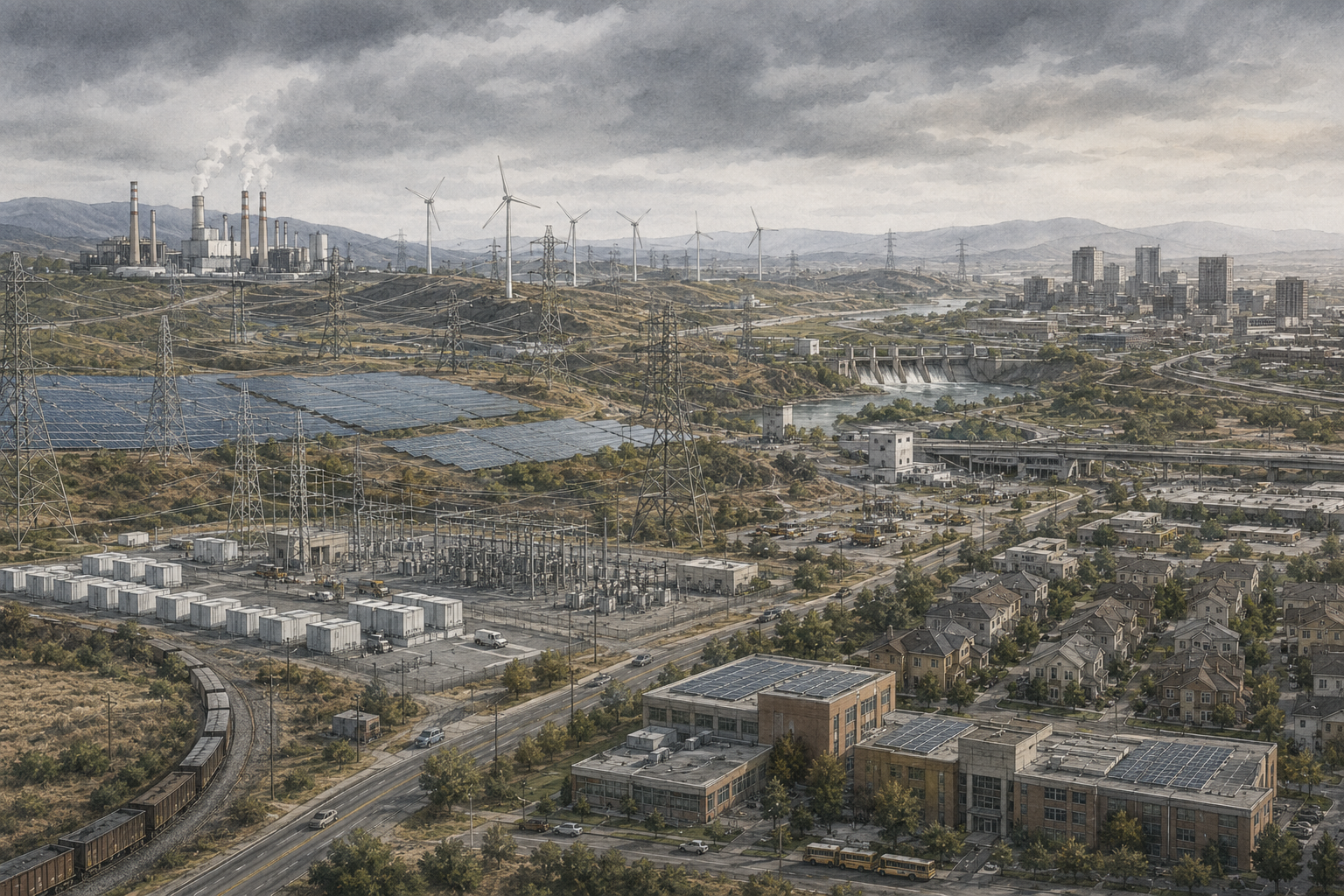
Energy matters because contemporary societies are built on dense energy dependence. Electricity powers communications, water treatment, hospitals, data centers, transportation, industry, finance, housing, refrigeration, emergency response, and the information systems that coordinate daily life. Fuels move goods, heat buildings, process materials, power heavy equipment, and structure global trade. As energy systems become more electrified, digitized, decentralized, and climate-constrained, their reliability, affordability, material basis, and institutional governance become central public questions.
The energy transition is therefore not only a technological substitution from one set of machines to another. It is a transformation of infrastructures, markets, industrial processes, mineral supply chains, land use, labor systems, regulatory institutions, investment priorities, and public expectations. Solar panels, wind turbines, batteries, transmission lines, heat pumps, electric vehicles, electrolyzers, nuclear plants, carbon capture systems, demand-response platforms, and microgrids are not isolated devices. They become meaningful only inside larger systems of interconnection, dispatch, maintenance, financing, permitting, governance, and social legitimacy.
Energy systems also introduce hard trade-offs. Cleaner systems require materials, land, transmission corridors, storage, balancing, and institutional capacity. Reliable systems require redundancy, flexibility, reserves, cyber resilience, and investment. Affordable systems require careful rate design, public oversight, efficiency, and protection for energy-burdened households. Just systems require attention to extraction, pollution, community consent, labor, household burden, and historical inequality. Resilient systems require adaptation to heat, storms, drought, wildfire, flooding, geopolitical risk, cyber threats, and cascading infrastructure failure.
Complete Code Repository
The companion repository for this knowledge series contains synthetic hourly energy datasets, grid dispatch models, renewable variability analysis, storage state-of-charge simulations, emissions accounting workflows, simplified LCOE models, energy-burden metrics, microgrid resilience scenarios, climate-risk stress tests, hydrogen production examples, SQL schemas, Python workflows, R reports, Julia simulations, C and C++ engineering kernels, Fortran numerical examples, Rust validators, Go services, MATLAB/Octave teaching models, Modelica system examples, notebooks, LaTeX technical notes, validation documentation, and policy-analysis scaffolds for energy systems.
What Are Energy Systems?
Energy systems are the linked technical, economic, ecological, institutional, and social arrangements through which societies obtain useful energy. They include primary energy resources, conversion technologies, fuels, electricity generation, transmission networks, distribution systems, storage assets, end-use technologies, pricing mechanisms, regulatory institutions, supply chains, labor systems, environmental impacts, and patterns of demand.
In practical terms, energy systems include several interrelated components:
- primary energy resources such as sunlight, wind, moving water, geothermal heat, uranium, coal, oil, natural gas, biomass, and stored chemical energy
- conversion technologies such as turbines, combustion systems, photovoltaic cells, reactors, boilers, electrolyzers, fuel cells, engines, batteries, generators, inverters, and heat pumps
- electricity infrastructure including power plants, substations, transformers, transmission lines, distribution feeders, switchgear, protection systems, meters, and control centers
- storage and flexibility systems including batteries, pumped hydro, thermal storage, hydrogen, demand response, flexible loads, reserve capacity, and grid-forming controls
- fuel and material supply chains including extraction, refining, transport, pipelines, ports, rail, critical minerals, manufacturing, recycling, and decommissioning
- markets and finance including wholesale power markets, fuel markets, capacity markets, utility rates, public investment, subsidies, procurement, and project finance
- governance and institutions including utilities, regulators, grid operators, public agencies, planning authorities, reliability organizations, standards bodies, and community institutions
- end-use systems including buildings, transportation, industry, agriculture, data centers, public services, appliances, heating, cooling, lighting, and industrial process heat
- environmental and social consequences including greenhouse-gas emissions, air pollution, water use, land use, waste, extraction impacts, labor conditions, household burden, and environmental justice
Seen in this way, energy is not simply “supply.” A power plant is not an energy system by itself. A solar array is not an energy transition by itself. A battery is not resilience by itself. Energy systems emerge through the relationships among resources, infrastructure, institutions, users, environments, and decisions over time.
Energy systems are also historically layered. New energy technologies rarely arrive on a blank slate. They enter landscapes shaped by legacy fuels, existing grids, incumbent industries, political commitments, sunk capital, regulatory constraints, public expectations, and material dependencies. This is why the energy transition is difficult: it requires building new systems while operating, modifying, retiring, and governing older ones.
Why Energy Systems Matter
Energy systems matter because they are enabling systems. They do not merely serve economic life from the outside; they structure the possibility of economic life. Food production depends on fuel, fertilizer, irrigation, refrigeration, and transport. Public health depends on electricity, heating, cooling, water treatment, medical equipment, laboratories, supply chains, and emergency response. Digital systems depend on power, cooling, materials, and backup systems. Homes depend on heating, cooling, cooking, lighting, and appliance energy. Industry depends on process heat, motors, pumps, compressors, feedstocks, and electricity.
Modern energy systems also determine much of the climate problem. High-carbon energy use remains deeply embedded in electricity, transportation, buildings, industry, agriculture, and global trade. Decarbonization therefore requires more than adding renewable generation. It requires reducing demand where possible, improving efficiency, electrifying end uses, replacing fossil fuels in power generation, decarbonizing industry, expanding transmission, deploying storage, managing critical minerals, reforming markets, investing in public capacity, and protecting communities from unjust transition burdens.
Energy systems matter for resilience as well. Extreme heat raises electricity demand and stresses thermal plants, transformers, distribution systems, and human health. Drought affects hydropower, cooling water, navigation, agriculture, and thermal generation. Storms and floods damage substations, pipelines, ports, rail systems, and distribution networks. Wildfires threaten transmission corridors and rural distribution lines. Cyberattacks, fuel disruptions, geopolitical conflict, and supply-chain bottlenecks can propagate through energy systems into wider social disruption.
Finally, energy systems matter because they are public systems even when privately owned or market-operated. Reliable, affordable, clean, and safe energy is a precondition for human dignity and social stability. Decisions about energy infrastructure determine who bears pollution, who pays transition costs, who gains access to reliable service, which industries are supported, which communities are sacrificed, and how seriously societies confront planetary limits.
System Architecture and Functional Layers
Energy systems can be analyzed as layered architectures in which physical flows, electrical flows, financial flows, information flows, and institutional decisions interact.
Resource and Primary Energy Layer
The resource layer includes sunlight, wind, moving water, fossil fuels, uranium, geothermal heat, biomass, and mineral inputs. This layer is shaped by geography, geology, climate, land use, ecology, extraction systems, property rights, public policy, and geopolitical relations. The resource layer determines what energy forms are physically available, but institutions and technologies determine how those resources are developed or constrained.
Conversion Layer
The conversion layer transforms primary energy into useful forms. Solar cells convert light into electricity. Wind turbines convert kinetic energy into mechanical and electrical power. Thermal plants convert fuel or nuclear heat into steam and electricity. Boilers and furnaces convert fuel into heat. Electrolyzers convert electricity and water into hydrogen. Heat pumps move thermal energy rather than creating heat through combustion. Conversion systems are governed by thermodynamics, efficiency, capital cost, maintenance, fuel supply, material performance, and environmental impact.
Transmission and Transport Layer
Energy must move from where it is produced to where it is used. Electricity moves through transmission and distribution networks. Fuels move through pipelines, ships, rail, trucks, terminals, ports, and storage facilities. Hydrogen, ammonia, biofuels, uranium, coal, natural gas, oil, and refined products each require distinct transport and storage systems. The transmission and transport layer creates bottlenecks, vulnerabilities, geopolitical dependencies, and planning challenges.
Storage and Flexibility Layer
Storage and flexibility help align supply and demand over time. Batteries can shift electricity over hours. Pumped hydro can provide large-scale storage and balancing. Thermal storage can support buildings and industry. Hydrogen and synthetic fuels may support longer-duration or industrial applications. Demand response can shift or reduce load. Flexible generation, interconnections, reserves, forecasting, and market design also provide system flexibility.
End-Use Layer
The end-use layer includes buildings, vehicles, factories, farms, data centers, public facilities, appliances, heating, cooling, lighting, motors, process heat, and digital infrastructure. Energy demand is not fixed. It changes with technology, behavior, climate, urban form, industrial structure, standards, prices, income, public policy, and efficiency.
Information and Control Layer
Modern energy systems increasingly depend on sensing, metering, forecasting, communications, automated control, distributed energy coordination, cyber security, and data platforms. Smart meters, grid sensors, distributed energy resource management systems, energy management systems, power-market software, inverter controls, forecasting models, and digital twins are becoming part of energy-system operation.
Market and Governance Layer
Energy systems are governed through utilities, regulators, system operators, standards, market rules, public agencies, planning processes, subsidies, taxes, procurement, permitting, ownership structures, and community participation. Technical feasibility does not become system transformation without governance capacity.
Environmental and Social Layer
Every energy system has environmental and social consequences. Emissions, air pollution, water use, land disturbance, mining impacts, waste streams, household energy burden, labor conditions, public health, and community consent are not external to energy systems. They are part of the full system boundary.
Energy, Power, Work, and Thermodynamics
Energy systems begin with physical principles. Energy is the capacity to do work or produce change. Power is the rate at which energy is transferred or used. Work is energy transfer through force and displacement. Heat is energy transfer due to temperature difference. Electricity is not an energy source in the same sense as sunlight, fuel, or uranium; it is an energy carrier produced through conversion processes.
Thermodynamics matters because energy conversion is never perfect. Combustion engines lose energy as waste heat. Thermal power plants are constrained by temperature differences and heat-rejection requirements. Electric motors can be highly efficient, but they still depend on upstream electricity generation and grid losses. Batteries store and return less energy than they receive. Heat pumps can deliver more heat energy than the electrical energy they consume because they move heat rather than generate it directly. Industrial processes face limits imposed by temperature, entropy, material degradation, and reaction pathways.
This physical foundation prevents energy analysis from becoming merely rhetorical. Claims about efficiency, decarbonization, electrification, storage, hydrogen, or industrial transition must be tested against energy balance, conversion losses, system boundaries, cost, material needs, and operational constraints.
Electricity Grids and Power-System Coordination
Electricity grids are among the most complex infrastructures humans have built. They must balance supply and demand continuously, manage power flows across networks, maintain frequency and voltage, protect equipment, recover from faults, coordinate generation, integrate distributed resources, and serve diverse loads in real time.
Traditional grids were built around large central generators, one-way power flows, predictable load patterns, and dispatchable thermal generation. Contemporary grids increasingly include variable wind and solar generation, rooftop solar, batteries, electric vehicles, heat pumps, data centers, demand response, microgrids, digital controls, inverter-based resources, and more complex load patterns. This creates new coordination challenges.
Grid modernization therefore requires more than adding renewable capacity. It requires transmission expansion, distribution upgrades, flexible demand, storage, forecasting, advanced inverters, interconnection reform, resource adequacy planning, system visibility, cyber resilience, faster permitting, market reform, and institutional learning.
The grid is also where energy transition becomes a public-capacity problem. A society can have abundant renewable resources and still fail to decarbonize if it cannot build transmission, connect projects, reform planning processes, govern utility incentives, protect reliability, and distribute costs fairly.
Energy Transition, Decarbonization, and Electrification
Energy transition refers to the long-term transformation of energy systems from one dominant configuration to another. Earlier transitions included shifts from biomass to coal, from coal to oil and gas, and from direct mechanical power to electrified systems. The current transition is distinctive because it is driven not only by cost and performance, but by climate constraint, air pollution, public health, technological change, energy security, and ecological limits.
Decarbonization requires reducing greenhouse-gas emissions across power, transportation, buildings, industry, and land-linked energy systems. In many sectors, electrification is central because electricity can increasingly be generated from low-carbon sources. Electric vehicles, heat pumps, induction cooking, industrial electric boilers, resistance heating, heat-pump dryers, electric arc furnaces, and some forms of process electrification can reduce direct fossil-fuel combustion. But electrification increases electricity demand and therefore requires clean generation, grid investment, load flexibility, and affordability protections.
Some sectors are harder to electrify directly. Cement, steel, chemicals, aviation, shipping, long-duration storage, fertilizer, refining, and high-temperature industrial heat may require hydrogen, ammonia, synthetic fuels, carbon capture, alternative chemistries, circular material systems, demand reduction, or major process innovation. This is why energy transition cannot be reduced to a single technology pathway.
Energy Resilience, Reliability, and Climate Risk
Energy resilience is the capacity of energy systems to anticipate, absorb, adapt to, and recover from disturbances while maintaining critical services. Reliability focuses on the ability to deliver energy according to accepted standards under expected conditions. Resilience extends the question to high-impact disruptions, extreme events, cascading failures, institutional response, recovery pathways, and social consequences.
Energy systems face many risks: extreme weather, heat waves, storms, floods, droughts, wildfires, cyberattacks, fuel-supply disruptions, equipment failures, aging infrastructure, underinvestment, market volatility, geopolitical conflict, material shortages, and rapid demand growth. Because energy systems are interdependent with water, telecommunications, transportation, health care, finance, food systems, and emergency response, energy failure can propagate across society.
Resilience requires technical and institutional capacity. It may include microgrids, black-start capability, distributed generation, islanding, hardened substations, undergrounding where appropriate, vegetation management, flood protection, backup power, redundant communication channels, fuel diversity, spare transformer programs, grid-forming inverters, flexible demand, emergency planning, and community-centered recovery strategies.
The central resilience question is not whether every disruption can be prevented. It is whether the system can protect critical services, reduce harm, recover quickly, learn from events, and avoid repeatedly sacrificing the same vulnerable communities.
Mathematical Lens
Energy systems require mathematics because power, energy, reliability, capacity, emissions, cost, storage, and risk must be measured rather than merely asserted.
E = P \times t
\]
CF = \frac{E_{\text{actual}}}{P_{\text{nameplate}} \times t}
\]
SOC_{t+1} = SOC_t + \eta_c C_t – \frac{D_t}{\eta_d}
\]
I = \frac{\sum_i E_i f_i}{\sum_i E_i}
\]
LCOE = \frac{CAPEX \cdot CRF + FOM}{8760 \cdot CF} + VOM + Fuel
\]
B = \frac{\text{Annual Energy Cost}}{\text{Annual Household Income}}
\]
RM = \frac{C_{\text{available}} – D_{\text{peak}}}{D_{\text{peak}}}
\]
| Symbol | Meaning | Energy-system interpretation |
|---|---|---|
| \(E\) | Energy | Total work, heat, electricity, or fuel quantity over time. |
| \(P\) | Power | Rate of energy transfer or use. |
| \(CF\) | Capacity factor | Actual generation relative to maximum possible output. |
| \(SOC\) | State of charge | Stored energy available in a battery or storage system. |
| \(I\) | Emissions intensity | Pollution per unit of useful energy or electricity delivered. |
| \(LCOE\) | Levelized cost of energy | Simplified lifetime cost per unit of generated electricity. |
| \(B\) | Energy burden | Share of household income spent on energy. |
| \(RM\) | Reserve margin | Capacity buffer relative to peak demand. |
The mathematical lesson is practical. Energy systems do not become clean, reliable, affordable, or just because they are described with ambitious language. They must be measured across energy balance, capacity, storage, cost, emissions, reliability, burden, and risk.
Core Domains of Energy Systems
Energy systems span multiple domains, each with distinct physics, infrastructure, institutions, markets, and social consequences.
Electricity Systems
Electricity systems include generation, transmission, distribution, storage, grid operations, markets, reliability standards, and end-use demand. They are central to decarbonization because electricity can be produced from low-carbon sources and used across transportation, buildings, industry, and digital systems.
Fuel Systems
Fuel systems include coal, oil, natural gas, refined products, biofuels, hydrogen, ammonia, synthetic fuels, and fuel supply chains. They involve extraction, refining, storage, pipelines, shipping, rail, terminals, geopolitics, price volatility, safety, pollution, and transition risk.
Renewable Energy Systems
Renewable energy systems include solar, wind, hydropower, geothermal, bioenergy, marine energy, and hybrid systems. Their system value depends on resource quality, location, variability, transmission access, storage, demand patterns, permitting, land use, ecological impact, and integration.
Nuclear Energy Systems
Nuclear energy systems involve reactors, fuel cycles, safety, waste, regulation, construction cost, public trust, reliability, thermal constraints, decommissioning, and strategic debates about firm low-carbon power.
Storage and Flexibility Systems
Storage and flexibility systems include batteries, pumped hydro, thermal storage, hydrogen, flexible demand, grid interconnection, demand response, and operational reserves. They help align supply and demand across time.
Industrial Energy Systems
Industrial energy systems include process heat, motors, boilers, furnaces, refineries, cement, steel, chemicals, pulp and paper, food processing, mining, and manufacturing. Industrial decarbonization is difficult because many processes require high temperatures, chemical feedstocks, continuous operation, or major capital replacement.
Building and Transportation Energy Systems
Buildings and transportation shape end-use demand. Heating, cooling, cooking, appliances, lighting, electric vehicles, public transit, freight, aviation, shipping, and urban form all determine how much energy is needed and what forms are useful.
Energy Markets and Public Utilities
Energy markets and utilities translate technical systems into prices, investment decisions, service obligations, and risk allocation. Market design, rate structures, monopoly regulation, capacity payments, public ownership, and procurement rules all shape system outcomes.
Energy Justice and Energy Poverty
Energy justice focuses on who receives benefits, who bears harms, who participates in decisions, and whose lives are made more secure or more precarious by energy systems. Energy poverty and household energy burden are not side issues; they are central indicators of whether energy systems serve public wellbeing.
Energy Security and Geopolitics
Energy security includes supply reliability, strategic reserves, fuel diversity, critical minerals, trade routes, sanctions, infrastructure vulnerability, cyber risk, and geopolitical dependence. Energy transition changes these dependencies rather than eliminating them automatically.
Energy Materials and Lifecycle Systems
Energy technologies depend on materials: copper, lithium, nickel, cobalt, rare earths, steel, aluminum, silicon, concrete, polymers, catalysts, ceramics, graphite, uranium, and many others. Lifecycle analysis connects energy technologies to extraction, manufacturing, operation, maintenance, recycling, and end-of-life impacts.
Energy Systems Pillar Map
The roadmap below organizes the Energy Systems knowledge series into conceptual domains. All articles are currently listed as planned and unlinked so the pillar can function as both a public index and a long-range technical architecture for the series.
Foundations of Energy Systems
- What Are Energy Systems? (Planned) — A foundational introduction to energy systems as linked technical, social, ecological, economic, and institutional structures.
- Energy, Power, and Work (Planned) — Explains energy, power, work, units, conversion, efficiency, and the difference between energy sources and energy carriers.
- Energy and Thermodynamics (Planned) — Introduces thermodynamic principles, energy quality, entropy, heat engines, losses, and conversion limits.
- Primary, Secondary, and Final Energy (Planned) — Explains energy accounting across resources, fuels, electricity, useful work, and end-use demand.
- Energy Flows and Sankey Diagrams (Planned) — Shows how to visualize energy flows, losses, sectoral demand, conversion pathways, and system boundaries.
- Energy Return on Investment (Planned) — Examines EROI, net energy, system boundaries, extraction cost, and long-term energetic viability.
- Energy Systems Thinking (Planned) — Connects feedback loops, delays, lock-in, tipping points, rebound effects, and interdependence in energy systems.
Electricity and Grid Systems
- Electricity Grids (Planned) — Explains generation, transmission, distribution, balancing, system operation, frequency, voltage, and reliability.
- Grid Reliability and Resilience (Planned) — Examines reliability standards, resource adequacy, outage risk, restoration, extreme weather, redundancy, and recovery.
- Transmission and Distribution Systems (Planned) — Covers high-voltage transmission, distribution feeders, substations, transformers, congestion, losses, and expansion planning.
- Smart Grids (Planned) — Studies digital sensing, advanced metering, automation, distributed resources, demand response, and intelligent grid management.
- Microgrids and Distributed Energy Systems (Planned) — Explains local energy systems, islanding, community resilience, campuses, remote power, and critical facilities.
- Power-System Operations and Dispatch (Planned) — Introduces economic dispatch, unit commitment, reserves, ramping, forecasting, and operational constraints.
- Grid Interconnection and Transmission Planning (Planned) — Examines project queues, network upgrades, cost allocation, permitting, and regional planning.
- Inverter-Based Resources and Grid Stability (Planned) — Covers solar, wind, batteries, grid-forming inverters, synthetic inertia, protection, and stability challenges.
Energy Resources and Generation
- Fossil-Fuel Energy Systems (Planned) — Examines coal, oil, natural gas, infrastructure lock-in, pollution, emissions, methane leakage, and transition risk.
- Solar Energy Systems (Planned) — Covers photovoltaic systems, solar thermal energy, capacity factor, intermittency, land use, storage, and grid integration.
- Wind Energy Systems (Planned) — Explains onshore wind, offshore wind, turbines, capacity factor, siting, variability, transmission, and maintenance.
- Hydropower Systems (Planned) — Studies dams, run-of-river systems, pumped storage, water management, ecological impacts, drought, and sedimentation.
- Geothermal Energy Systems (Planned) — Introduces geothermal heat, electricity generation, enhanced geothermal systems, drilling, and subsurface risk.
- Nuclear Energy Systems (Planned) — Examines fission, reactors, safety, waste, regulation, reliability, construction cost, and climate strategy.
- Bioenergy Systems (Planned) — Covers biomass, biofuels, land use, lifecycle emissions, food-system interactions, and ecological constraints.
- Marine and Tidal Energy Systems (Planned) — Introduces wave, tidal, ocean-current, and marine energy technologies, including resource and deployment constraints.
Storage, Flexibility, and Demand
- Energy Storage Systems (Planned) — A foundation for batteries, pumped hydro, thermal storage, compressed air, hydrogen, and long-duration storage.
- Battery Systems (Planned) — Explores battery chemistry, performance, degradation, safety, recycling, supply chains, and grid applications.
- Long-Duration Energy Storage (Planned) — Studies multi-hour, seasonal, and strategic storage for renewable-heavy systems.
- Demand Response (Planned) — Explains flexible demand, load shifting, pricing signals, automation, and customer participation.
- Energy Efficiency (Planned) — Treats efficiency as infrastructure, climate policy, affordability strategy, and demand-reduction system.
- Flexible Loads and Load Shaping (Planned) — Examines EV charging, heat pumps, water heating, industrial loads, and smart demand coordination.
- Virtual Power Plants (Planned) — Covers aggregated distributed resources, batteries, thermostats, EVs, solar, and market participation.
Energy Transition and Decarbonization
- Energy Transition (Planned) — Studies historical and contemporary energy transitions, technology change, political conflict, and institutional inertia.
- Electrification (Planned) — Explains shifting transportation, buildings, industry, and appliances from direct combustion to electricity.
- Industrial Decarbonization (Planned) — Covers cement, steel, chemicals, refining, manufacturing, high-temperature heat, and process redesign.
- Hydrogen Energy Systems (Planned) — Examines hydrogen production, transport, storage, industrial use, fuel cells, color labels, and constraints.
- Carbon Capture and Storage (Planned) — Studies capture, utilization, storage, industrial applications, leakage risk, monitoring, and policy design.
- Net-Zero Energy Systems (Planned) — Examines net-zero planning, emissions accounting, residual emissions, offsets, credibility, and system boundaries.
- Coal Phaseout and Just Transition (Planned) — Covers coal retirement, worker transition, regional economies, grid reliability, and public responsibility.
- Oil and Gas in the Energy Transition (Planned) — Examines methane, petrochemicals, LNG, stranded assets, energy security, and transition pathways.
Markets, Policy, and Governance
- Energy Markets (Planned) — Explains electricity markets, fuel markets, pricing, capacity markets, investment signals, and market failures.
- Public Utilities and Energy Governance (Planned) — Covers utilities, regulation, public service obligations, rate design, monopoly power, and accountability.
- Energy Policy (Planned) — Introduces standards, subsidies, taxes, procurement, planning, regulation, public investment, and industrial policy.
- Energy Subsidies and Public Investment (Planned) — Examines fossil-fuel subsidies, clean-energy incentives, infrastructure finance, and state capacity.
- Energy Security (Planned) — Studies supply risk, geopolitical dependence, strategic reserves, infrastructure vulnerability, and transition security.
- Energy Geopolitics (Planned) — Covers oil, gas, minerals, shipping routes, sanctions, industrial policy, and global power relations.
- Permitting, Siting, and Public Legitimacy (Planned) — Examines project approval, community consent, land use, public participation, and infrastructure conflict.
- Energy Regulation and Rate Design (Planned) — Covers utility rates, cost recovery, performance incentives, equity, affordability, and regulatory reform.
Justice, Resilience, and Public Value
- Energy Justice (Planned) — Examines affordability, access, procedural justice, distributional justice, recognition, and historical harm.
- Energy Poverty (Planned) — Covers energy insecurity, household burden, health impacts, housing quality, and public responsibility.
- Community Energy Systems (Planned) — Explores local ownership, cooperatives, municipal power, community solar, and community resilience.
- Energy Resilience (Planned) — Studies disturbance, redundancy, adaptive capacity, restoration, critical services, and infrastructure resilience.
- Climate Risk and Energy Infrastructure (Planned) — Covers heat, storms, drought, wildfire, flooding, sea-level rise, and climate stress on energy systems.
- Public Health and Energy Systems (Planned) — Examines pollution, indoor air, heat exposure, outages, medical dependence, and energy as health infrastructure.
- Energy Democracy and Public Accountability (Planned) — Explores participation, ownership, transparency, municipal systems, and democratic governance of energy.
Materials, Supply Chains, and Lifecycle Systems
- Critical Minerals and Energy Systems (Planned) — Studies lithium, cobalt, nickel, copper, rare earths, mining impacts, supply risk, and industrial strategy.
- Energy Materials (Planned) — Covers materials used in batteries, solar cells, wind turbines, transmission, nuclear plants, and hydrogen systems.
- Lifecycle Assessment for Energy Systems (Planned) — Examines embodied energy, lifecycle emissions, extraction, manufacturing, operation, decommissioning, and recycling.
- Circular Energy Systems (Planned) — Covers reuse, recycling, remanufacturing, repair, decommissioning, and circular material flows in energy infrastructure.
- Energy Infrastructure Supply Chains (Planned) — Examines transformers, turbines, semiconductors, steel, cables, batteries, and global manufacturing capacity.
- Decommissioning and End-of-Life Energy Infrastructure (Planned) — Studies retiring fossil assets, solar panels, wind blades, batteries, reactors, pipelines, and industrial sites.
Digital, Intelligent, and Future Energy Systems
- Energy Scenarios and Futures Thinking (Planned) — Introduces scenario planning, uncertainty, technology pathways, policy futures, and long-term strategy.
- AI and Energy Systems (Planned) — Examines AI for forecasting, grid optimization, infrastructure planning, demand modeling, and governance risk.
- Digital Energy Infrastructure (Planned) — Covers sensors, platforms, cybersecurity, data systems, automation, and digital control of energy infrastructure.
- Data Centers and Energy Demand (Planned) — Studies AI, cloud computing, cooling, load growth, grid planning, siting, and public accountability.
- Energy System Digital Twins (Planned) — Explores simulation, telemetry, scenario modeling, operational planning, and cyber-physical feedback.
- The Future of Energy Systems (Planned) — A capstone article on energy transformation, public purpose, ecological limits, infrastructure intelligence, and institutional responsibility.
GitHub Code Repository
The Energy Systems knowledge series is supported by a companion code repository designed for practical, reproducible, multi-language energy systems workflows. This repository should bridge physical energy analysis, grid dispatch, storage modeling, emissions accounting, energy-burden analysis, reliability, resilience, industrial decarbonization, hydrogen modeling, lifecycle assessment, policy evaluation, and technical communication.
Recommended repository structure:
energy-systems-code/
├── README.md
├── LICENSE
├── CITATION.cff
├── requirements-advanced.txt
├── pyproject.toml
├── Makefile
├── .github/
│   └── workflows/
│       └── smoke-tests.yml
├── articles/
│   ├── what-are-energy-systems/
│   ├── electricity-grids/
│   ├── energy-storage-systems/
│   ├── energy-transition/
│   ├── industrial-decarbonization/
│   ├── energy-justice/
│   └── future-of-energy-systems/
├── data/
│   ├── raw/
│   ├── processed/
│   └── synthetic/
│       ├── hourly_load_and_renewables.csv
│       ├── generator_fleet.csv
│       ├── storage_assumptions.csv
│       ├── emissions_factors.csv
│       ├── lcoe_assumptions.csv
│       ├── household_energy_burden.csv
│       ├── transmission_lines.csv
│       ├── outage_restoration_scenarios.csv
│       ├── industrial_energy_demand.csv
│       ├── hydrogen_scenarios.csv
│       └── climate_stressors.csv
├── sql/
│   ├── schema.sql
│   └── example_queries.sql
├── python/
│   ├── run_all.py
│   ├── storage_dispatch.py
│   ├── capacity_factor.py
│   ├── emissions_accounting.py
│   ├── lcoe_model.py
│   ├── demand_response.py
│   ├── energy_burden.py
│   ├── microgrid_resilience.py
│   ├── hydrogen_model.py
│   ├── climate_risk_stress.py
│   └── advanced_energy_dashboard.py
├── r/
│   ├── energy_summary.R
│   ├── energy_burden_summary.R
│   └── lcoe_summary.R
├── julia/
│   ├── storage_state_model.jl
│   └── emissions_intensity.jl
├── c/
│   └── energy_balance.c
├── cpp/
│   └── dispatch_merit_order.cpp
├── fortran/
│   └── storage_balance.f90
├── rust/
│   └── capacity_factor.rs
├── go/
│   └── energy_burden.go
├── matlab/
│   └── demand_response_demo.m
├── modelica/
│   └── BatteryStorageTeachingModel.mo
├── notebooks/
│   ├── grid_dispatch_and_storage.ipynb
│   ├── emissions_and_lcoe.ipynb
│   └── energy_justice_and_resilience.ipynb
├── latex/
│   └── energy_systems_equations.tex
├── docs/
│   ├── data_dictionary.md
│   ├── modeling_notes.md
│   ├── validation_plan.md
│   ├── engineering_use_notes.md
│   ├── policy_analysis_notes.md
│   ├── energy_justice_notes.md
│   ├── emissions_accounting_notes.md
│   └── responsible_use.md
└── outputs/
    ├── figures/
    └── tables/
The repository should support several practical workflows:
- SQL: energy assets, hourly demand, generation, emissions factors, household burden, storage assumptions, transmission lines, and climate-risk indicators.
- Python: storage dispatch, capacity factor, emissions accounting, simplified LCOE, demand response, household energy burden, microgrid resilience, hydrogen production, and climate-risk stress testing.
- R: energy-burden reporting, affordability summaries, renewable share analysis, LCOE input summaries, and publication-ready tables.
- Julia: storage state-of-charge simulation, emissions-intensity calculations, energy-balance modeling, and numerical scenario analysis.
- C: lightweight energy-balance kernels for embedded or systems-level examples.
- C++: merit-order dispatch, resource sorting, and engineering simulation scaffolds.
- Fortran: numerical reserve-margin and storage-balance examples for scientific computing continuity.
- Rust: safe validation of capacity-factor, emissions, and telemetry inputs.
- Go: small energy-data services, affordability APIs, and lightweight reporting tools.
- MATLAB/Octave: demand-response and control-oriented teaching examples.
- Modelica: system-dynamics models for storage, thermal systems, and energy conversion.
- Notebooks: exploratory analysis for grid dispatch, emissions, cost, energy justice, and resilience scenarios.
SQL Workflow: Energy Asset, Demand, and Emissions Registry
SQL provides the durable structure for energy systems analysis. It defines assets, generation resources, demand profiles, emissions factors, storage systems, household burden, and transmission constraints.
Suggested filename:
sql/schema.sql-- Energy Asset, Demand, and Emissions Registry
-- --------------------------------------------
-- This schema supports energy systems examples:
-- hourly demand, generator fleets, storage assets,
-- emissions factors, household energy burden, and transmission lines.
CREATE TABLE IF NOT EXISTS hourly_energy (
hour INTEGER PRIMARY KEY,
demand_mwh REAL NOT NULL,
solar_mwh REAL NOT NULL,
wind_mwh REAL NOT NULL,
temperature_c REAL
);
CREATE TABLE IF NOT EXISTS generator_fleet (
plant TEXT PRIMARY KEY,
technology TEXT NOT NULL,
nameplate_mw REAL NOT NULL,
variable_cost_usd_mwh REAL,
emissions_kg_co2_mwh REAL,
forced_outage_rate REAL,
capacity_credit REAL
);
CREATE TABLE IF NOT EXISTS storage_assets (
asset TEXT PRIMARY KEY,
technology TEXT NOT NULL,
power_mw REAL NOT NULL,
energy_mwh REAL NOT NULL,
round_trip_efficiency REAL NOT NULL,
initial_soc_mwh REAL
);
CREATE TABLE IF NOT EXISTS household_energy_burden (
household_id TEXT PRIMARY KEY,
income_usd_yr REAL NOT NULL,
annual_energy_cost_usd REAL NOT NULL,
housing_type TEXT,
region TEXT,
heat_source TEXT
);
CREATE TABLE IF NOT EXISTS transmission_lines (
line TEXT PRIMARY KEY,
from_node TEXT NOT NULL,
to_node TEXT NOT NULL,
capacity_mw REAL NOT NULL,
length_km REAL,
loss_percent_per_100km REAL,
climate_exposure TEXT
);This schema supports the central purpose of the pillar: energy systems analysis requires linked data about demand, generation, storage, emissions, affordability, transmission, and risk.
Python Workflow: Renewable Storage Dispatch Model
Python is the primary workflow language for transparent energy systems analysis. The example below models renewable generation, demand, battery state of charge, unmet demand, and curtailed energy.
Suggested filename:
python/storage_dispatch.pyfrom __future__ import annotations
import csv
from dataclasses import dataclass
from pathlib import Path
ROOT = Path(__file__).resolve().parents[1]
INPUT = ROOT / "data" / "synthetic" / "hourly_load_and_renewables.csv"
OUTPUT = ROOT / "outputs" / "tables" / "storage_dispatch_results.csv"
@dataclass
class DispatchState:
hour: int
demand_mwh: float
renewable_mwh: float
state_of_charge_mwh: float
unmet_demand_mwh: float
curtailed_mwh: float
def simulate_dispatch(
rows: list[dict[str, float]],
battery_capacity_mwh: float = 720.0,
initial_soc_mwh: float = 300.0,
charge_efficiency: float = 0.94,
discharge_efficiency: float = 0.94,
) -> list[DispatchState]:
soc = min(initial_soc_mwh, battery_capacity_mwh)
results: list[DispatchState] = []
for row in rows:
demand = row["demand_mwh"]
renewable = row["solar_mwh"] + row["wind_mwh"]
net = renewable - demand
unmet = 0.0
curtailed = 0.0
if net >= 0:
available_space = battery_capacity_mwh - soc
charged = min(net * charge_efficiency, available_space)
soc += charged
curtailed = max(0.0, net - charged / charge_efficiency)
else:
deficit = abs(net)
discharge_needed = deficit / discharge_efficiency
discharged = min(discharge_needed, soc)
soc -= discharged
unmet = max(0.0, deficit - discharged * discharge_efficiency)
results.append(
DispatchState(
hour=int(row["hour"]),
demand_mwh=demand,
renewable_mwh=renewable,
state_of_charge_mwh=round(soc, 3),
unmet_demand_mwh=round(unmet, 3),
curtailed_mwh=round(curtailed, 3),
)
)
return results
def read_rows() -> list[dict[str, float]]:
with INPUT.open(newline="", encoding="utf-8") as handle:
return [{key: float(value) for key, value in row.items()} for row in csv.DictReader(handle)]
def main() -> None:
results = simulate_dispatch(read_rows())
OUTPUT.parent.mkdir(parents=True, exist_ok=True)
with OUTPUT.open("w", newline="", encoding="utf-8") as handle:
writer = csv.DictWriter(handle, fieldnames=results[0].__dict__.keys())
writer.writeheader()
for row in results:
writer.writerow(row.__dict__)
total_unmet = sum(row.unmet_demand_mwh for row in results)
total_curtailed = sum(row.curtailed_mwh for row in results)
print(f"Wrote {OUTPUT}")
print(f"Total unmet demand MWh: {total_unmet:.2f}")
print(f"Total curtailed renewable MWh: {total_curtailed:.2f}")
if __name__ == "__main__":
main()This workflow helps explain that renewable integration is not simply a question of installed capacity. It depends on time, demand, storage, dispatch rules, curtailment, reliability needs, and system flexibility.
R Workflow: Energy Burden and Affordability Report
R is useful for equity reporting, affordability summaries, policy communication, and tabular analysis of household energy burden.
Suggested filename:
r/energy_burden_summary.R# Energy Burden and Affordability Report
# --------------------------------------
# Base R workflow for summarizing household energy burden.
args <- commandArgs(trailingOnly = FALSE)
file_arg <- "--file="
script_path <- sub(file_arg, "", grep(file_arg, args, value = TRUE)) if (length(script_path) > 0) {
root <- normalizePath(file.path(dirname(script_path[1]), ".."), mustWork = FALSE)
} else {
root <- getwd()
}
input <- file.path(root, "data", "synthetic", "household_energy_burden.csv")
output <- file.path(root, "outputs", "tables", "r_energy_burden_summary.csv")
dir.create(dirname(output), recursive = TRUE, showWarnings = FALSE)
burden <- read.csv(input)
burden$energy_burden <- burden$annual_energy_cost_usd / burden$income_usd_yr
summary <- aggregate(
energy_burden ~ region + housing_type,
data = burden,
FUN = mean
)
write.csv(summary, output, row.names = FALSE)
cat("Wrote", output, "\n")Energy burden is not a secondary indicator. It shows whether an energy system is affordable in lived household terms rather than only technically reliable or financially investable.
Julia Workflow: Storage State-of-Charge Simulation
Julia is useful for numerical modeling, simulation, optimization, and scenario analysis in energy systems.
Suggested filename:
julia/storage_state_model.jl# Lightweight Julia storage state-of-charge teaching model
demand = [420.0, 405.0, 395.0, 390.0, 410.0, 455.0, 520.0, 590.0]
renewables = [165.0, 172.0, 168.0, 160.0, 155.0, 165.0, 215.0, 298.0]
capacity = 720.0
soc = 300.0
eff = 0.94
states = Float64[]
for i in eachindex(demand)
net = renewables[i] - demand[i]
if net >= 0
soc = min(capacity, soc + net * eff)
else
soc = max(0.0, soc - abs(net) / eff)
end
push!(states, soc)
end
mkpath(joinpath(@__DIR__, "..", "outputs", "tables"))
output = joinpath(@__DIR__, "..", "outputs", "tables", "julia_storage_states.csv")
open(output, "w") do io
println(io, "hour,state_of_charge_mwh")
for (hour, value) in enumerate(states)
println(io, "$(hour),$(round(value, digits=3))")
end
end
println("Wrote $output")The Julia workflow reinforces the idea that storage is a dynamic system. Its value depends on when energy is available, when demand occurs, what efficiency losses apply, and what constraints shape charge and discharge.
C Workflow: Energy Balance Kernel
C is useful for lightweight systems examples, embedded logic, control kernels, and transparent numerical calculations.
Suggested filename:
c/energy_balance.c#include <stdio.h>
int main(void) {
double demand_mwh = 690.0;
double solar_mwh = 455.0;
double wind_mwh = 120.0;
double storage_discharge_mwh = 80.0;
double supply_mwh = solar_mwh + wind_mwh + storage_discharge_mwh;
double balance_mwh = supply_mwh - demand_mwh;
printf("demand_mwh,%.2f\n", demand_mwh);
printf("supply_mwh,%.2f\n", supply_mwh);
printf("balance_mwh,%.2f\n", balance_mwh);
return 0;
}This small kernel makes the core system idea explicit: every energy system must balance useful supply, demand, losses, storage, and unmet need.
C++ Workflow: Merit-Order Dispatch Model
C++ is useful for dispatch logic, sorted resources, simulation frameworks, and performance-oriented engineering examples.
Suggested filename:
cpp/dispatch_merit_order.cpp#include <algorithm>
#include <iostream>
#include <string>
#include <vector>
struct Generator {
std::string name;
double capacity_mw;
double variable_cost;
double emissions;
};
int main() {
std::vector<Generator> fleet = {
{"Wind", 300.0, 0.0, 0.0},
{"Solar", 280.0, 0.0, 0.0},
{"Nuclear", 650.0, 18.0, 12.0},
{"Gas CC", 450.0, 48.0, 370.0},
{"Coal", 500.0, 62.0, 950.0},
{"Gas CT", 180.0, 92.0, 560.0}
};
double demand = 1200.0;
std::sort(fleet.begin(), fleet.end(), [](const Generator& a, const Generator& b) {
return a.variable_cost < b.variable_cost;
});
std::cout << "generator,dispatch_mwh,cost_usd,emissions_kg\n";
for (const auto& gen : fleet) {
if (demand <= 0) {
break;
}
double dispatch = std::min(gen.capacity_mw, demand);
demand -= dispatch;
std::cout << gen.name << ","
<< dispatch << ","
<< dispatch * gen.variable_cost << ","
<< dispatch * gen.emissions << "\n";
}
return 0;
}Merit-order dispatch illustrates why market rules, variable cost, emissions intensity, and available capacity shape real-world system outcomes.
Fortran Workflow: Grid Reliability Reserve Margin
Fortran remains relevant for numerical modeling traditions in engineering, physics, climate science, and infrastructure simulation.
Suggested filename:
fortran/reserve_margin.f90program reserve_margin
implicit none
real(8) :: available_capacity_mw
real(8) :: peak_demand_mw
real(8) :: reserve_margin
available_capacity_mw = 5400.0d0
peak_demand_mw = 4800.0d0
reserve_margin = (available_capacity_mw - peak_demand_mw) / peak_demand_mw
print *, "available_capacity_mw,peak_demand_mw,reserve_margin"
print *, available_capacity_mw, peak_demand_mw, reserve_margin
end program reserve_marginReserve margin is only a starting point for reliability. Modern energy systems also require probabilistic adequacy, extreme-event planning, fuel-security analysis, transmission constraints, and resilience metrics.
Rust Workflow: Capacity-Factor Validator
Rust is useful for safe command-line validation, schema checks, telemetry validation, and energy-data quality tools.
Suggested filename:
rust/capacity_factor.rsfn main() {
let actual_generation_mwh = 8200.0;
let nameplate_mw = 300.0;
let hours = 24.0;
let capacity_factor = actual_generation_mwh / (nameplate_mw * hours);
if capacity_factor < 0.0 || capacity_factor > 1.0 {
panic!("Capacity factor outside expected range.");
}
println!("actual_generation_mwh,nameplate_mw,hours,capacity_factor");
println!(
"{},{},{},{}",
actual_generation_mwh,
nameplate_mw,
hours,
capacity_factor
);
}Validation matters because energy analytics can become misleading quickly when units, time windows, capacity values, emissions factors, or missing data are mishandled.
Go Workflow: Energy Burden Service
Go is useful for lightweight energy-data services, APIs, command-line utilities, and operational tools.
Suggested filename:
go/energy_burden.gopackage main
import "fmt"
type Household struct {
ID string
Income float64
Cost float64
}
func main() {
households := []Household{
{"H001", 22000, 3100},
{"H002", 36000, 2800},
{"H003", 52000, 2600},
}
fmt.Println("household_id,energy_burden")
for _, h := range households {
fmt.Printf("%s,%.3f\n", h.ID, h.Cost/h.Income)
}
}An energy-burden service can be expanded into tools for affordability analysis, household assistance targeting, rate-design evaluation, and public accountability dashboards.
Modelica Workflow: Battery Storage Teaching Model
Modelica is useful for system-level modeling of dynamic physical systems, including storage, thermal systems, power electronics, and coupled energy flows.
Suggested filename:
modelica/BatteryStorageTeachingModel.momodel BatteryStorageTeachingModel
parameter Real capacity = 720 "Energy capacity MWh";
parameter Real initialSOC = 300 "Initial state of charge MWh";
parameter Real chargeEfficiency = 0.94;
parameter Real dischargeEfficiency = 0.94;
Real soc(start=initialSOC) "State of charge MWh";
input Real chargePower "Charge power MW";
input Real dischargePower "Discharge power MW";
equation
der(soc) = chargePower * chargeEfficiency - dischargePower / dischargeEfficiency;
end BatteryStorageTeachingModel;Modelica helps frame energy systems as dynamic systems rather than static spreadsheets. Storage, thermal systems, and industrial energy flows all evolve over time.
Governance, Markets, and Institutional Capacity
Energy systems are governed systems. They are shaped by utilities, regulators, system operators, public agencies, private firms, communities, standards bodies, investors, courts, legislatures, and international institutions. Technical pathways do not implement themselves. They require institutions capable of planning, financing, permitting, coordinating, regulating, monitoring, and adjusting energy systems under uncertainty.
Markets can coordinate investment and dispatch, but they do not automatically produce public value. Energy markets must be designed around reliability, affordability, investment adequacy, emissions, consumer protection, and system resilience. Poorly designed markets can underinvest in reliability, misprice externalities, ignore vulnerable households, reward short-term gains, or fail to build long-term infrastructure.
Utilities occupy a special position because they often operate monopoly networks or essential services. Their incentives matter. Traditional cost-of-service regulation can encourage capital investment but may not reward efficiency, demand reduction, equity, or innovation. Deregulated markets can encourage competition but may fragment accountability. Public ownership can align infrastructure with public goals but still requires competence, transparency, and financial capacity.
Energy governance also requires coordination across scales. Local siting decisions affect national decarbonization. Regional transmission planning affects renewable integration. National industrial policy affects critical minerals, manufacturing, and supply chains. International energy markets affect domestic affordability and security. Community participation affects legitimacy. Energy governance must therefore be treated as a systems problem, not a narrow administrative function.
Energy Justice and Public Value
Energy justice asks who benefits, who pays, who is exposed to harm, who participates, and who is recognized in energy decisions. A system can be low-carbon and still unjust. It can be reliable and still unaffordable. It can be innovative and still extractive. It can be efficient and still place burdens on communities with the least political power.
Energy justice includes several dimensions:
- distributional justice — how costs, benefits, pollution, service quality, and transition burdens are distributed
- procedural justice — who has meaningful participation in siting, planning, regulation, and investment decisions
- recognition justice — whether historically burdened communities, workers, Indigenous peoples, low-income households, and energy-insecure populations are treated as legitimate knowledge holders and rights-bearing publics
- restorative justice — how energy systems address historical harms from extraction, pollution, displacement, exclusion, and underinvestment
Energy systems also provide public value when they support health, dignity, economic participation, climate stability, democratic accountability, and long-term stewardship. Treating energy only as a commodity obscures these public obligations. Energy is a condition of human capability. People need safe heating and cooling, reliable electricity, clean air, affordable bills, mobility, communication, refrigeration, and protection during emergencies.
This is why the energy transition must be judged by more than megawatts installed or emissions reduced. It must also be judged by whether it reduces energy poverty, improves public health, creates accountable institutions, protects workers, respects communities, reduces ecological harm, and builds systems that can endure under climate stress.
Future Directions
The future of energy systems will be shaped by several converging developments: renewable generation growth, transmission expansion, electrification, battery deployment, long-duration storage, advanced nuclear debates, hydrogen systems, industrial decarbonization, critical mineral constraints, climate adaptation, digital grid management, AI-driven demand growth, cyber risk, and changing geopolitical energy relations.
One major frontier is grid expansion and flexibility. Many decarbonization pathways depend on building more transmission, modernizing distribution systems, coordinating distributed resources, and enabling flexible demand. The technical challenge is not only producing clean electricity, but delivering it reliably when and where it is needed.
A second frontier is industrial energy. Heavy industry will require new approaches to process heat, feedstocks, materials efficiency, recycling, hydrogen, carbon capture, electrification, and product substitution. Energy transition and materials transition are deeply linked.
A third frontier is energy governance. The energy transition will test whether public institutions can coordinate long-term investment, avoid infrastructure bottlenecks, protect households, maintain reliability, govern private power, and build legitimacy for difficult trade-offs.
A fourth frontier is resilience under climate volatility. Future energy systems must be designed for hotter, more unstable, more disaster-prone conditions. This means hardening assets, decentralizing critical services where appropriate, building adaptive capacity, protecting vulnerable communities, and ensuring that energy systems remain functional during compound crises.
In this sense, the future of energy systems is not only a technological future. It is an institutional, ecological, ethical, and democratic future.
Methodological Orientation
This pillar uses a systems-based, infrastructure-aware, and justice-centered approach to energy systems. It treats energy as a linked architecture of physics, engineering, economics, ecology, governance, computation, and public purpose.
The methodological stance is practical but critical. Thermodynamic equations are treated as constraints on rhetoric. Grid models are treated as simplified representations of complex operations. LCOE is treated as useful but incomplete. Emissions accounting is treated as boundary-dependent. Energy burden is treated as a public wellbeing metric. Scenario analysis is treated as a way to reason under uncertainty, not as prophecy.
The computational layer of the series is designed to reinforce this orientation. SQL structures energy data. Python models dispatch, storage, emissions, cost, burden, and resilience. R supports reporting and equity summaries. Julia supports numerical simulation. C, C++, Fortran, Rust, Go, MATLAB/Octave, and Modelica provide additional engineering and systems perspectives.
The goal is not to create a narrow technical manual. The goal is to build a knowledge architecture capable of connecting energy science, infrastructure systems, policy design, public accountability, climate responsibility, and reproducible computation.
How This Series Connects Across the Site
Energy Systems connects naturally with several neighboring knowledge series.
- Intelligent Infrastructure Systems — Energy systems increasingly depend on sensing, telemetry, automation, cyber-physical control, grid monitoring, and infrastructure intelligence.
- Environmental Monitoring Systems — Energy systems affect emissions, air quality, water systems, land use, climate risk, and environmental exposure.
- Materials Science — Batteries, solar cells, wind turbines, transmission systems, nuclear plants, hydrogen systems, and low-carbon infrastructure all depend on materials.
- Economic Systems — Energy markets, public investment, industrial policy, energy burden, and transition costs are economic-system questions.
- Risk and Resilience — Energy systems face climate risk, infrastructure failure, cascading disruption, cyber threats, and long-term adaptation challenges.
- Artificial Intelligence Systems — AI affects energy demand through data centers and can also support forecasting, optimization, grid planning, and infrastructure monitoring.
- Data Systems and Analytics — Energy systems depend on metering, operational data, forecasting, scenario modeling, telemetry, and reproducible analytics.
- Public Policy and Governance — Energy transition requires institutions capable of coordinating markets, regulation, public investment, permitting, justice, and accountability.
Energy is therefore not an isolated category. It is one of the central connective systems linking technology, climate, infrastructure, economics, materials, governance, and human wellbeing.
Related Reading
- Intelligent Infrastructure Systems
- Environmental Monitoring Systems
- Materials Science
- Economic Systems
- Artificial Intelligence Systems
- Data Systems & Analytics
- Risk & Resilience
- Technology & Systems Intelligence
Further Reading
- International Energy Agency. World Energy Outlook 2025. Available at: https://www.iea.org/reports/world-energy-outlook-2025.
- Intergovernmental Panel on Climate Change. Climate Change 2022: Mitigation of Climate Change. Available at: https://www.ipcc.ch/report/ar6/wg3/.
- Intergovernmental Panel on Climate Change. Chapter 6: Energy Systems. Available at: https://www.ipcc.ch/report/ar6/wg3/chapter/chapter-6/.
- International Renewable Energy Agency. World Energy Transitions Outlook 2024: 1.5°C Pathway. Available at: https://www.irena.org/-/media/Files/IRENA/Agency/Publication/2024/Nov/IRENA_World_energy_transitions_outlook_2024.pdf.
- U.S. Energy Information Administration. Annual Energy Outlook 2026. Available at: https://www.eia.gov/outlooks/aeo/.
- National Renewable Energy Laboratory. Energy Systems Integration Facility. Available at: https://www.nrel.gov/esif/.
- U.S. Department of Energy. Grid Modernization Initiative. Available at: https://www.energy.gov/gmi/grid-modernization-initiative.
- Lazard. Levelized Cost of Energy+ 2025. Available at: https://www.lazard.com/research-insights/levelized-cost-of-energyplus-lcoeplus/.
References
- International Energy Agency. World Energy Outlook 2025. Available at: https://www.iea.org/reports/world-energy-outlook-2025.
- Intergovernmental Panel on Climate Change. Climate Change 2022: Mitigation of Climate Change. Available at: https://www.ipcc.ch/report/ar6/wg3/.
- Intergovernmental Panel on Climate Change. Chapter 6: Energy Systems. Available at: https://www.ipcc.ch/report/ar6/wg3/chapter/chapter-6/.
- International Renewable Energy Agency. World Energy Transitions Outlook 2024: 1.5°C Pathway. Available at: https://www.irena.org/-/media/Files/IRENA/Agency/Publication/2024/Nov/IRENA_World_energy_transitions_outlook_2024.pdf.
- U.S. Energy Information Administration. Annual Energy Outlook 2026. Available at: https://www.eia.gov/outlooks/aeo/.
- U.S. Energy Information Administration. Short-Term Energy Outlook. Available at: https://www.eia.gov/outlooks/steo/.
- U.S. Department of Energy. Grid Modernization Initiative. Available at: https://www.energy.gov/gmi/grid-modernization-initiative.
- National Renewable Energy Laboratory. Energy Systems Integration Facility. Available at: https://www.nrel.gov/esif/.
- Federal Energy Regulatory Commission. Reliability Explainer. Available at: https://www.ferc.gov/reliability-explainer.
- North American Electric Reliability Corporation. Resource Adequacy Risks Intensify Across North America as Demand Growth Surges. Available at: https://www.nerc.com/newsroom/resource-adequacy-risks-intensify-across-north-america-as-demand-growth-surges.
- Lazard. Levelized Cost of Energy+ 2025. Available at: https://www.lazard.com/research-insights/levelized-cost-of-energyplus-lcoeplus/.
- Mantegna, G., Hu, Z., Van Caelenberg, G., Frew, B., Lynch, M. and O’Malley, M. Maintaining reliability while navigating unprecedented uncertainty: a synthesis of and guide to advances in electric sector resource adequacy. Available at: https://arxiv.org/abs/2412.00533.