
Last Updated June 2, 2026
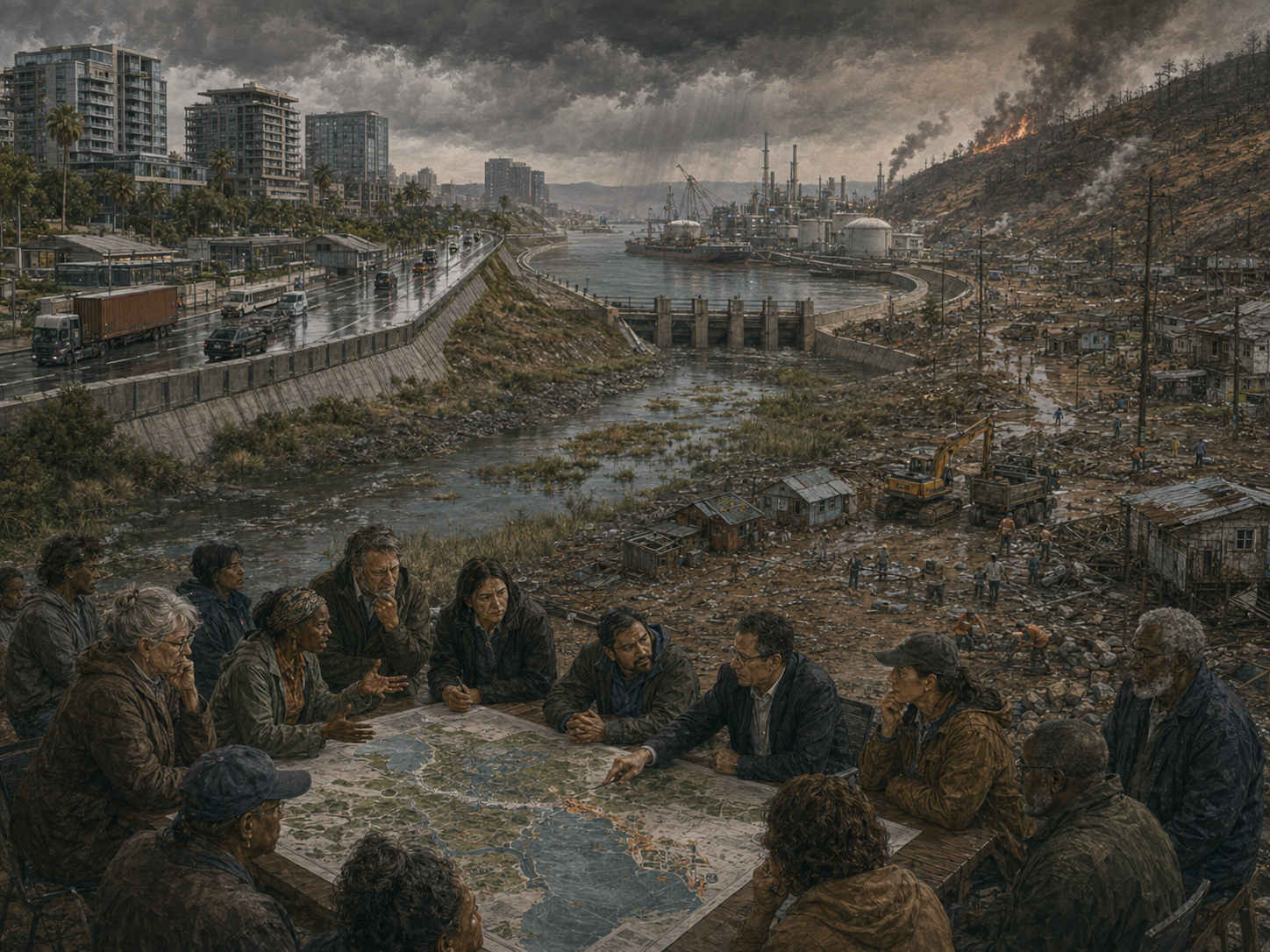
Maladaptive resilience describes the persistence of systems, behaviors, institutions, infrastructures, or social arrangements that remain durable under stress while continuing to produce harm. It is one of the most important cautionary concepts in resilience thinking because it shows that resilience is not automatically desirable. A system can absorb shocks, recover from disturbance, reproduce itself, and even become stronger after crisis while deepening inequality, ecological degradation, exclusion, extraction, surveillance, dependency, or long-term vulnerability.
This is why resilience thinking must distinguish between resilience as life-sustaining capacity and resilience as harmful persistence. A wetland that buffers floods, a public-health system that protects vulnerable people, a community care network that reduces isolation, and a water system that maintains safe service under drought are examples of resilience worth strengthening. But a fossil-fuel regime that survives repeated crises, a housing market that preserves exclusion, a supply chain that protects buyers by shifting risk to workers, or a governance system that repeatedly abandons vulnerable communities may also be resilient in a technical sense. Their persistence is not evidence of justice or sustainability.
Maladaptive resilience appears when short-term coping, recovery, stabilization, or protection locks systems into patterns that make future harm more likely. A levee can protect development in a floodplain while encouraging more exposure. Disaster recovery can rebuild the same unsafe housing. Insurance systems can price people out of protection while maintaining asset markets. Emergency food aid can reduce immediate suffering while leaving food insecurity intact. Security systems can maintain order while eroding rights. Organizational routines can keep institutions functioning while preventing learning. In each case, the system “works” by preserving structures that need to change.
This article examines maladaptive resilience through ecological systems, climate adaptation, infrastructure, housing, disaster recovery, institutions, technology, organizations, public health, supply chains, governance, and social inequality. The central argument is that resilience thinking becomes more rigorous when it asks not only whether systems persist, but whether persistence is desirable. The goal is not resilience at any cost. The goal is to strengthen forms of resilience that protect life, dignity, ecological function, learning, justice, and transformation while identifying and dismantling resilience that preserves harm.
What Maladaptive Resilience Means
Maladaptive resilience is the capacity of a harmful or unsustainable system to persist, recover, reorganize, or defend itself despite producing vulnerability, injustice, ecological damage, or long-term fragility. The concept challenges a common assumption: that resilience is always a positive property. In reality, resilience describes persistence under disturbance. Whether that persistence is desirable depends on what is being preserved, who benefits, who is harmed, and what future pathways are being closed.
A system can be resilient because it is diverse, adaptive, well-governed, and socially legitimate. But it can also be resilient because it is powerful, entrenched, subsidized, legally protected, culturally normalized, technologically locked in, or institutionally difficult to change. Maladaptive resilience often combines short-term usefulness with long-term damage. It solves one problem while deepening another. It protects one group while increasing risk for another. It maintains visible order while hiding structural harm.
This matters because many systems that societies depend on also produce harm. Carbon-intensive energy systems provide power while destabilizing climate. Car-dependent urban systems provide mobility while creating emissions, sprawl, household cost burdens, road deaths, and exclusion for non-drivers. Industrial food systems provide calories while damaging soils, biodiversity, labor conditions, animal welfare, public health, and rural livelihoods. Highly optimized supply chains reduce costs while increasing fragility and shifting risk to workers and suppliers. These systems are not fragile in a simple sense. Many are durable, adaptive, politically defended, and profitable. That is precisely why they are difficult to change.
| Resilience form | What persists? | Why it matters |
|---|---|---|
| Beneficial resilience | Life-sustaining functions, ecological buffers, care systems, public health, democratic capacity | Persistence protects people, ecosystems, dignity, and essential services. |
| Neutral or ambiguous resilience | Systems whose effects depend on context, governance, and distribution | Persistence requires evaluation, not automatic praise. |
| Maladaptive resilience | Harmful structures, unequal exposure, ecological degradation, extractive institutions, brittle dependencies | Persistence deepens long-term vulnerability or injustice. |
| Transformative resilience | Core values and life-supporting functions through structural change | Persistence shifts from protecting old forms to preserving what matters through redesign. |
Maladaptive resilience is therefore not the absence of resilience. It is resilience attached to the wrong thing.
Why Maladaptive Resilience Matters
Maladaptive resilience matters because the most dangerous systems are not always the ones that collapse quickly. Some harmful systems survive repeated warnings, crises, protests, reforms, disasters, and scientific evidence. They adapt just enough to continue. They absorb criticism, reorganize incentives, shift burdens, update rhetoric, and preserve their basic structure. This kind of persistence can be more difficult to confront than obvious fragility.
The concept is especially important in climate resilience, disaster recovery, infrastructure planning, institutional reform, public health, economic systems, and technology governance. A city may repeatedly rebuild in hazardous areas because property systems, tax bases, insurance rules, and development politics make retreat difficult. A hospital system may survive crisis after crisis through staff overwork rather than structural capacity. A school system may maintain operations while reproducing inequality. A digital platform may remain operational while increasing surveillance, dependency, and information asymmetry. These systems are resilient in the sense that they continue. But continuation may depend on hidden exhaustion, exploitation, or displaced risk.
Without the concept of maladaptive resilience, resilience planning can make systems stronger in the wrong direction. It can harden unsafe infrastructure, stabilize unjust institutions, subsidize harmful industries, normalize repeated exposure, and reward short-term recovery over long-term transformation. The concept helps analysts ask whether resilience interventions reduce vulnerability or preserve the mechanisms that produce it.
Why maladaptive resilience deserves careful attention
It exposes harmful persistence
Some systems remain stable because they transfer harm to people, ecosystems, workers, or future generations.
It challenges simple recovery language
Recovering quickly is not enough if recovery restores the same unsafe or unjust conditions.
It reveals lock-in
Infrastructure, finance, policy, culture, and technology can trap societies in damaging pathways.
It protects against false solutions
Some adaptation strategies reduce visible risk while increasing long-term exposure or inequity.
It clarifies transformation
Breaking maladaptive resilience often requires redesign, not minor improvement.
It strengthens ethical analysis
The question is not only whether systems survive, but whether survival protects dignity, ecology, and justice.
Maladaptive resilience matters because systems can be both durable and wrong. Resilience thinking must be able to recognize that combination.
Resilience Is Not Always Good
One of the most important lessons in resilience thinking is that resilience is a descriptive property before it is a normative good. It describes the ability of a system to absorb disturbance, recover, reorganize, or maintain function. But whether that ability is desirable depends on the system’s purpose, effects, distributional consequences, ecological impacts, and relationship to power.
This distinction is easy to lose because resilience is often used as a positive term in public policy, organizational strategy, disaster management, and sustainability discourse. Cities want to be resilient. Communities want to be resilient. Supply chains want to be resilient. Institutions want to be resilient. But the word can obscure the more important question: resilient in what form, for whom, and at whose expense?
A system can remain resilient by making others fragile. A supply chain may protect consumer availability by imposing precarious conditions on logistics workers. A city may protect high-value infrastructure while allowing low-income neighborhoods to flood. A corporation may preserve profitability through layoffs, wage suppression, or environmental externalization. A government may preserve stability through surveillance or repression. A household may remain functional through unpaid care work that exhausts women, elders, or informal caregivers. Resilience at one level can create vulnerability at another.
| Resilience claim | Critical question | Possible maladaptive pattern |
|---|---|---|
| The system recovered quickly | Recovered for whom? | Aggregate recovery hides unequal recovery. |
| The institution survived crisis | What costs were shifted to staff, clients, or communities? | Survival depends on burnout, unpaid labor, or service cuts. |
| The infrastructure was hardened | Did hardening reduce exposure or encourage more risky development? | Protection creates deeper lock-in. |
| The market adapted | Who absorbed volatility? | Workers, suppliers, renters, or ecosystems carry the risk. |
| The community proved resilient | Was the community supported or abandoned? | Endurance is praised while structural harm continues. |
| The technology improved continuity | Did it increase dependency, opacity, or surveillance? | Digital resilience creates new forms of vulnerability. |
Resilience is not automatically good because persistence is not automatically good. The ethical and analytical task is to evaluate what resilience is preserving.
Core Components of Maladaptive Resilience
Maladaptive resilience usually emerges from a combination of persistence, harm, lock-in, burden shifting, feedback reinforcement, and resistance to transformation. These components help identify when resilience is no longer a protective capacity but a mechanism that sustains vulnerability.
Harmful Persistence
Harmful persistence occurs when a system continues operating despite producing ecological damage, social inequality, institutional failure, health risk, exploitation, or long-term vulnerability. The problem is not that the system fails to persist; the problem is that it persists too well.
Short-Term Stabilization
Short-term stabilization can become maladaptive when immediate repair or recovery prevents deeper reform. Emergency measures may be necessary, but they become risky when they repeatedly restore the same unsafe conditions.
Path Dependence
Path dependence occurs when earlier investments, rules, infrastructures, habits, or technologies make future alternatives more costly or politically difficult. The longer the pathway persists, the harder it becomes to change.
Lock-In
Lock-in occurs when systems become trapped in patterns that are technically, financially, culturally, legally, or institutionally difficult to reverse. Lock-in can make harmful systems resilient against reform.
Burden Shifting
Burden shifting occurs when resilience for one actor is achieved by transferring cost, risk, labor, displacement, pollution, surveillance, or ecological harm onto another actor or future generation.
Feedback Reinforcement
Maladaptive systems often contain reinforcing feedback loops: profits fund influence, influence protects subsidies, subsidies maintain infrastructure, infrastructure sustains demand, and demand justifies further investment.
False Learning
False learning occurs when systems respond to failure by improving their ability to continue rather than questioning whether the underlying system should continue in its current form.
Transformation Resistance
Transformation resistance occurs when institutional routines, financial interests, political narratives, technical standards, or cultural habits protect the current system from redesign even when adaptation is insufficient.
| Component | Diagnostic question | Warning sign |
|---|---|---|
| Harmful persistence | What harm is being preserved? | The system survives while vulnerability, injustice, or ecological damage continues. |
| Short-term stabilization | Does recovery reduce future harm? | Each crisis restores the same conditions that produced the last crisis. |
| Path dependence | Do past investments constrain future choices? | Alternatives are dismissed because the current system is already built. |
| Lock-in | What makes the harmful system difficult to change? | Infrastructure, finance, rules, habits, and vested interests reinforce one another. |
| Burden shifting | Who absorbs the costs of persistence? | Risk moves to workers, renters, ecosystems, poorer regions, or future generations. |
| Feedback reinforcement | Which loops keep the system in place? | Success under current metrics strengthens the forces that prevent reform. |
| False learning | Is the system learning to change or learning to survive criticism? | Reforms improve optics without altering structural incentives. |
| Transformation resistance | Who benefits from avoiding structural change? | Adaptation protects existing power rather than redesigning harmful systems. |
These components show why maladaptive resilience is difficult to address. Harmful systems persist not only because of failure, but because they are often organized to defend their own continuity.
Maladaptation vs. Maladaptive Resilience
Maladaptation and maladaptive resilience are related, but they are not identical. Maladaptation usually refers to actions taken to reduce risk that unintentionally increase vulnerability, emissions, inequality, ecological damage, or future exposure. Maladaptive resilience refers to the broader persistence of harmful systems or resilience pathways that continue despite producing damaging outcomes. A maladaptive action may contribute to maladaptive resilience if it becomes institutionalized, funded, normalized, or difficult to reverse.
For example, installing air conditioning without addressing housing quality, tree canopy, energy affordability, and emissions may reduce heat risk for some households while increasing energy demand and leaving others exposed. That can be maladaptation. If the built environment, energy system, housing market, and public-health system then become organized around private cooling as the main response to heat, the pattern may become maladaptively resilient. The system continues functioning by shifting cost and risk to households while preserving the conditions that produce heat vulnerability.
The distinction matters because maladaptation can be episodic, while maladaptive resilience is systemic. A maladaptive policy can be corrected. A maladaptively resilient regime may resist correction through institutional routines, sunk costs, political interests, cultural habits, and reinforcing feedback loops.
| Concept | Primary focus | Example |
|---|---|---|
| Maladaptation | An intervention that increases vulnerability or harm over time | A flood wall protects one area while increasing downstream flooding. |
| Maladaptive resilience | A harmful system or pathway that persists and defends itself | Development continues in floodplains because infrastructure, insurance, tax revenue, and politics reinforce exposure. |
| Maladaptive recovery | Post-crisis rebuilding that restores vulnerability | Disaster aid rebuilds unsafe housing without changing land use or tenant protections. |
| Maladaptive adaptation | Climate adaptation that protects some while worsening long-term risk | Private cooling reduces heat stress for wealthy households while increasing grid stress and energy burdens. |
| Maladaptive governance | Institutions that survive by avoiding responsibility or excluding affected people | Agencies produce plans and dashboards without changing budgets, authority, or accountability. |
Maladaptation is often the pathway into maladaptive resilience. Once harmful adaptations become embedded, they can become difficult to reverse.
Lock-In, Path Dependence, and Institutional Inertia
Maladaptive resilience often depends on lock-in. Lock-in occurs when previous decisions make alternative futures difficult to pursue. Infrastructure, legal rules, subsidies, professional standards, financial models, cultural expectations, data systems, and organizational routines can all lock systems into harmful pathways. Once locked in, a system may remain resilient not because it is optimal, but because changing it becomes expensive, disruptive, politically contested, or institutionally unfamiliar.
Path dependence is especially important in built environments. Roads, zoning, utilities, transit, drainage, housing, and energy systems shape future choices for decades. A city designed around car dependence becomes difficult to redesign because jobs, housing, retail, infrastructure finance, household routines, and political expectations become organized around driving. A floodplain filled with development becomes difficult to restore because homes, mortgages, tax bases, insurers, and local politics become tied to continued occupation. A fossil-fuel system becomes difficult to transform because infrastructure, jobs, subsidies, lobbying, consumer habits, and grid design reinforce dependence.
Institutional inertia adds another layer. Organizations often continue existing practices because rules, budgets, reporting systems, professional incentives, and risk avoidance favor continuity. Even when leaders recognize the need for change, existing systems may reward incremental adjustment rather than transformation. Inertia is not always passive. It can be actively defended by actors who benefit from current arrangements.
Common sources of maladaptive lock-in
Infrastructure lock-in
Physical systems such as roads, pipelines, levees, ports, grids, and buildings shape future options for decades.
Financial lock-in
Debt, asset values, insurance, subsidies, and investment models make harmful systems difficult to unwind.
Regulatory lock-in
Codes, permits, standards, zoning, and procurement rules can preserve outdated assumptions.
Cultural lock-in
Norms about mobility, consumption, housing, work, safety, or growth can make alternatives seem unrealistic.
Technological lock-in
Platforms, data formats, vendors, algorithms, and legacy systems create dependency and switching costs.
Political lock-in
Vested interests, lobbying, patronage, and institutional authority protect existing systems from reform.
Breaking maladaptive resilience requires more than identifying harm. It requires understanding the lock-in mechanisms that keep harmful systems in place.
Ecological Examples of Maladaptive Resilience
Ecology provides powerful examples of maladaptive resilience because ecosystems can shift into degraded regimes that are difficult to reverse. A lake may shift from clear water to a turbid, algae-dominated state. A grassland may shift toward shrubland. A coral reef may shift toward algae dominance. A forest may become more fire-prone after repeated disturbance, invasive species, drought, and management changes. These altered states can be resilient: they persist, reproduce, and resist restoration.
The concept of regime shifts is central here. Once feedback loops stabilize a degraded state, simply removing the original stressor may not restore the prior system. A lake affected by nutrient pollution may remain turbid because algae reduce light, reduce plant recovery, alter oxygen dynamics, and reinforce the degraded regime. A landscape altered by invasive grasses may burn more frequently, and frequent fire may favor those same grasses. The system is resilient—but resilient in a degraded state.
Ecological maladaptive resilience matters for social systems because people often depend on ecosystem functions: water filtration, flood buffering, pollination, soil fertility, fisheries, carbon storage, shade, coastal protection, and cultural value. When degraded ecosystems become resilient, social systems may also become locked into compensating for lost ecological services through costly infrastructure, extraction, or emergency management.
| Ecological case | Maladaptive resilience pattern | Why reversal is difficult |
|---|---|---|
| Eutrophic lake | Algae-dominated state persists after nutrient loading | Internal nutrient cycling and reduced vegetation reinforce turbidity. |
| Invasive grass-fire cycle | Invasive grasses increase fire frequency, which favors more invasive grasses | Feedback between fire and invasion stabilizes the altered regime. |
| Degraded coral reef | Reef shifts from coral dominance to algae dominance | Warming, pollution, overfishing, and herbivore loss reduce coral recovery. |
| Overgrazed dryland | Vegetation loss and soil degradation persist | Erosion, reduced infiltration, and altered plant communities inhibit recovery. |
| Simplified agricultural landscape | Monoculture dependence persists despite soil and biodiversity loss | Market, machinery, subsidy, and supply-chain systems reinforce simplification. |
| Channelized river | Engineered flow regime persists while reducing habitat and floodplain function | Infrastructure, property, flood control, and land use lock in the altered system. |
Ecological examples make the core lesson clear: systems can become resilient in undesirable states. Restoration then requires changing feedback loops, not merely treating symptoms.
Climate Adaptation and Maladaptive Resilience
Climate adaptation is one of the most important areas where maladaptive resilience can emerge. Adaptation is necessary because climate risks are already affecting heat, water, agriculture, housing, health, infrastructure, ecosystems, and disaster recovery. But adaptation can become maladaptive when it reduces near-term risk while increasing long-term vulnerability, emissions, inequality, ecological damage, or dependency on unsafe systems.
For example, air conditioning can reduce heat mortality, but if it is deployed without building retrofits, cooling access, energy affordability, grid resilience, shade, labor protections, and decarbonized electricity, it may increase energy demand and deepen inequality. Seawalls can protect property, but they may intensify coastal squeeze, damage ecosystems, encourage development in hazardous areas, and shift risk elsewhere. Fire suppression can protect communities in the short term, but if it eliminates beneficial fire and allows fuel accumulation, it may increase catastrophic fire risk. Rebuilding after disaster can restore local economies, but if rebuilding occurs in the same exposed locations without stronger protections, it can lock in future losses.
Climate adaptation must therefore be evaluated across time, scale, distribution, and transformation. A good adaptation today may become maladaptive if it closes future options. A technically successful intervention may be unjust if it protects wealthy property while leaving vulnerable residents exposed. A resilient infrastructure system may be ecologically damaging if it undermines wetlands, forests, rivers, or coastal systems that provide long-term protection.
| Adaptation strategy | Short-term resilience benefit | Maladaptive resilience risk |
|---|---|---|
| Seawalls and hard coastal defenses | Protects assets from storm surge and erosion | Encourages continued development, damages ecosystems, and shifts risk. |
| Private air conditioning | Reduces heat exposure for households with access | Increases energy demand and leaves low-income households exposed. |
| Fire suppression | Protects people and property from immediate fire | Can increase fuel loads and severe future fires if not paired with stewardship. |
| Disaster rebuilding in place | Restores homes, businesses, and tax base quickly | Recreates exposure if land use and housing vulnerability remain unchanged. |
| Water transfers and groundwater pumping | Maintains agriculture, cities, or industry during drought | Can deplete aquifers and delay demand reduction or land-use change. |
| Insurance withdrawal without public alternatives | Reduces insurer exposure to growing climate risk | Leaves households, renters, and communities without affordable protection. |
Climate adaptation becomes transformative when it reduces future vulnerability. It becomes maladaptive when it protects the present by narrowing the future.
Infrastructure and Built-Environment Lock-In
Infrastructure is a major source of maladaptive resilience because built systems persist for decades and shape social behavior, investment, land use, ecological relationships, and institutional expectations. Roads, highways, bridges, levees, sewers, housing, pipelines, ports, grids, dams, data centers, and drainage systems do not merely serve existing patterns. They create future patterns.
A highway can make car dependence more resilient. A levee can make floodplain development more resilient. A pipeline can make fossil-fuel dependence more resilient. A drainage system can make wetland destruction more resilient. A suburban development pattern can make high energy use, long commutes, fiscal strain, and ecological fragmentation more resilient. Infrastructure often creates material facts that later become arguments against change: too much has already been built, too much is invested, too many people depend on it, and alternatives seem disruptive.
Built-environment lock-in is especially challenging because infrastructure often provides real benefits. People need roads, energy, water, housing, sanitation, communication, and protection from hazards. Maladaptive resilience does not mean infrastructure should be rejected. It means infrastructure should be evaluated for the pathways it locks in. Does it reduce exposure or invite more exposure? Does it support transformation or delay it? Does it protect vulnerable people or protect asset value? Does it preserve ecological function or replace it with brittle engineering?
Built-environment pathways that can become maladaptively resilient
Floodplain development
Levees, insurance, roads, and tax incentives can make continued exposure politically and financially resilient.
Car-dependent urban form
Roads, zoning, parking, mortgages, and retail geography reinforce mobility patterns that are costly and emissions-intensive.
Fossil energy infrastructure
Pipelines, power plants, subsidies, and workforce structures can delay transition unless just alternatives are built.
Overbuilt coastal protection
Hard defenses may preserve high-value development while reducing ecological buffers and adaptive options.
Centralized digital systems
Large platforms and cloud dependencies can improve efficiency while increasing systemic vulnerability.
Deferred-maintenance systems
Infrastructure may continue operating through patchwork repair until failure becomes normalized.
Infrastructure resilience must therefore be judged not only by durability, but by the future it makes more likely.
Social and Economic Maladaptive Resilience
Social and economic systems can also become maladaptively resilient. Poverty, segregation, labor precarity, housing exclusion, unequal school funding, environmental injustice, debt dependency, and extractive supply chains can persist across shocks because institutions, markets, policies, and power relations reproduce them. These systems are not simply failing to change. They are often organized in ways that make change difficult.
Economic systems can show maladaptive resilience when they maintain growth, profit, or continuity by externalizing harm. A supply chain may become resilient by diversifying suppliers while keeping wages low and working conditions precarious. A housing market may remain profitable by preserving scarcity and displacement pressure. A financial system may absorb shocks through public rescue while households bear debt, eviction, or austerity. A local economy may survive downturns by relying on underpaid care work, informal labor, or ecological depletion.
Social systems can show maladaptive resilience when inequality reproduces itself through mutually reinforcing mechanisms. Poor housing increases health risk. Health risk reduces income. Lower income limits mobility. Limited mobility increases exposure. Exposure increases loss. Loss deepens debt. Debt constrains future choices. These loops can persist through crisis and recovery unless deliberately interrupted.
| System | Maladaptive resilience mechanism | Harm sustained |
|---|---|---|
| Housing market | Scarcity, speculation, exclusionary zoning, weak tenant protections, asset politics | Displacement, unaffordability, unsafe housing, climate exposure |
| Labor market | Precarious work, low bargaining power, outsourcing, algorithmic control | Income volatility, burnout, unsafe working conditions, weak recovery capacity |
| Supply chains | Cost pressure, just-in-time optimization, supplier dependency, labor externalization | Worker vulnerability, regional extraction, brittle continuity |
| Public finance | Austerity cycles, deferred maintenance, debt constraints, short-term budgeting | Weak public capacity, infrastructure decline, uneven recovery |
| Environmental injustice | Land use, political exclusion, pollution burden, weak enforcement | Chronic exposure, health disparities, distrust, ecological harm |
| Care systems | Unpaid labor, underpaid workers, family burden, fragmented services | Hidden exhaustion, gendered burden, fragile support networks |
Social and economic maladaptive resilience shows why “bouncing back” can be an inadequate goal. If the pre-crisis system was already harmful, returning to it restores vulnerability.
Institutional and Organizational Maladaptive Resilience
Institutions can be remarkably resilient in maladaptive ways. They can survive crisis, criticism, reform efforts, leadership changes, scandals, budget cuts, and external pressure while maintaining core routines that produce poor outcomes. This happens when institutions become skilled at preserving legitimacy without changing underlying incentives, accountability, or power structures.
Organizational maladaptive resilience can appear as bureaucratic self-protection, compliance theater, crisis normalization, staff burnout, symbolic reform, fragmented responsibility, and performance metrics that reward continuity over learning. A public agency may produce plans and reports without implementing corrective action. A hospital may remain operational by relying on exhausted staff. A school system may maintain attendance metrics while failing to address inequality. A corporation may adopt sustainability language while preserving harmful business models. An organization may become resilient not by learning, but by absorbing criticism.
This is a major challenge for resilience governance. Institutions need stability, memory, and continuity. But when continuity prevents learning, institutional resilience becomes maladaptive. The question is whether the organization can change its own structure when evidence shows that existing routines are producing harm.
| Institutional pattern | How it becomes resilient | Why it is maladaptive |
|---|---|---|
| Symbolic reform | New language, committees, or dashboards absorb pressure for change | Underlying budgets, rules, and authority remain unchanged. |
| Compliance theater | Documentation demonstrates activity without improving outcomes | Procedural compliance replaces learning and responsibility. |
| Burnout-based continuity | Staff keep systems functioning through overwork | Resilience depends on human exhaustion and hidden labor. |
| Fragmented accountability | Responsibility is dispersed across offices or levels | No actor is answerable for repeated failure. |
| Crisis normalization | Repeated emergencies become routine operating conditions | The organization adapts to crisis rather than reducing it. |
| Metric lock-in | Performance indicators reward stability, speed, or volume | What is measured obscures equity, quality, or long-term harm. |
Institutions are resilient in a healthy way when they learn, revise, and repair. They are maladaptively resilient when they survive by preventing necessary change.
Technology, Data, and Digital Maladaptive Resilience
Digital systems can strengthen resilience by improving monitoring, coordination, communication, forecasting, maintenance, and decision support. But they can also create maladaptive resilience when they stabilize harmful systems, increase dependency, obscure accountability, or shift risk through automation. A platform, algorithm, dashboard, or data infrastructure can make a system more efficient and more durable while making it less transparent, less contestable, and more difficult to change.
Digital maladaptive resilience often appears through platform lock-in, vendor dependency, data extraction, surveillance creep, algorithmic decision-making, technical opacity, cybersecurity concentration, and model-driven governance. A city may depend on proprietary systems for mobility, policing, utilities, or service delivery. A public agency may use risk scores that reproduce bias. A hospital may rely on digital systems that fail under outage. A workplace may become resilient through monitoring and algorithmic scheduling while increasing worker stress. A supply chain may become more responsive through data integration while becoming more fragile to cyberattacks or platform failure.
The key question is whether digital resilience supports human judgment, rights, public accountability, and material protection—or whether it makes harmful systems more efficient and harder to contest.
Digital patterns that can become maladaptively resilient
Platform lock-in
Institutions become dependent on vendors, data formats, workflows, and software ecosystems that are difficult to exit.
Surveillance resilience
Monitoring systems persist and expand after crisis even when rights safeguards are weak.
Algorithmic inertia
Automated systems reproduce old assumptions at scale while appearing neutral or objective.
Dashboard substitution
Measurement becomes a substitute for repair, funding, participation, or governance change.
Cyber-physical dependency
Critical infrastructure becomes more efficient but more dependent on software, connectivity, and centralized control.
Data extraction
Resilience analytics collect information from communities without transferring authority, resources, or protection.
Digital resilience should be judged by whether it increases adaptive capacity and accountability, not merely by whether it keeps systems running.
Warning Signs of Maladaptive Resilience
Maladaptive resilience can be difficult to detect because it often appears as success. The system continues. Metrics stabilize. Operations resume. Stakeholders adapt. Recovery is declared. The problem is that the deeper structure remains harmful. Warning signs help identify when resilience is preserving the wrong thing.
| Warning sign | How it appears | What to ask |
|---|---|---|
| Recovery restores repeated harm | The same communities experience the same losses after each crisis | Did recovery reduce future exposure or rebuild vulnerability? |
| Short-term protection increases long-term risk | Hard defenses, subsidies, or emergency measures encourage more exposure | What future pathway is being locked in? |
| Burden is shifted downward | Households, workers, renters, or local communities absorb risk | Who benefits from continuity and who pays for it? |
| Metrics show success while lived experience worsens | Aggregate indicators improve but vulnerable groups remain exposed | What is missing from the measurement system? |
| Institutions survive without learning | Plans, reports, and reforms do not change outcomes | What accountability mechanism forces correction? |
| Alternatives are dismissed as unrealistic | The current system is treated as inevitable | Which interests, sunk costs, and rules make alternatives seem impossible? |
| Resilience depends on exhaustion | Staff, caregivers, volunteers, or communities compensate for structural failure | Is hidden labor being treated as capacity? |
| Adaptation prevents transformation | Incremental fixes delay structural change | At what point does adaptation become avoidance? |
The central warning sign is persistence without repair. When systems continue by reproducing the conditions that cause harm, resilience has become maladaptive.
Breaking Maladaptive Resilience
Breaking maladaptive resilience requires more than making systems stronger. It requires changing the feedback loops, incentives, infrastructures, rules, narratives, and power relations that preserve harmful persistence. In many cases, the task is not to increase resilience, but to redirect resilience toward different functions and futures.
The first step is diagnosis. Analysts must identify what is being preserved, who benefits, who is harmed, which feedback loops maintain the system, and what alternatives have been blocked. The second step is destabilization of harmful reinforcement. This may involve ending subsidies, changing regulations, altering metrics, redistributing authority, funding alternatives, reducing exposure, protecting affected communities, and creating transition pathways. The third step is building replacement capacity. Harmful systems cannot simply be dismantled without providing safe, just, and viable alternatives.
Transformation is especially important. If a system is maladaptively resilient, small improvements may only strengthen it. A fossil-fuel system can become more efficient while remaining climate-damaging. A car-dependent city can add smart traffic systems while preserving exclusionary mobility patterns. A disaster recovery system can process claims faster while still restoring unsafe land use. Breaking maladaptive resilience means asking whether the underlying structure should continue.
Strategies for breaking maladaptive resilience
Identify harmful feedback loops
Map how money, rules, infrastructure, metrics, culture, and authority reinforce damaging persistence.
Stop reinforcing harm
Phase out subsidies, incentives, procurement rules, or policies that stabilize unsustainable systems.
Build viable alternatives
Transformation requires replacement capacity: housing, transit, energy, care, finance, governance, and ecological restoration.
Protect vulnerable groups
Transition must not impose the cost of change on those already exposed to risk.
Change success metrics
Measure exposure reduction, justice, ecological function, learning, and long-term viability—not only continuity.
Institutionalize learning
Failures, near misses, and community reports should trigger budgets, policy changes, and corrective action.
Breaking maladaptive resilience is not simply disruption. It is the deliberate redirection of system capacity away from harmful persistence and toward just, viable, life-sustaining futures.
A Practical Framework for Diagnosing Maladaptive Resilience
A practical diagnosis of maladaptive resilience should examine persistence, harm, feedback, distribution, lock-in, alternatives, and transformation capacity. The framework below can be used for climate adaptation plans, infrastructure investments, disaster recovery programs, institutional reforms, technology systems, public-health systems, and economic strategies.
| Step | Question | Evidence to examine |
|---|---|---|
| Define what persists | Which system, behavior, institution, or pathway is proving resilient? | System boundaries, functions, stakeholders, operating patterns, recovery behavior |
| Identify harm | What vulnerability, injustice, ecological damage, or long-term fragility is being reproduced? | Disaggregated impacts, ecological indicators, health outcomes, exposure data, lived experience |
| Map beneficiaries and burdens | Who benefits from continuity and who bears its costs? | Distributional analysis, labor effects, community impacts, ecological burdens, future costs |
| Trace feedback loops | What mechanisms reinforce persistence? | Subsidies, asset values, routines, regulations, metrics, political influence, cultural narratives |
| Assess lock-in | What makes the system difficult to change? | Infrastructure, contracts, debt, professional standards, data systems, land use, legal constraints |
| Evaluate recovery patterns | Does recovery reduce future harm or restore vulnerability? | Post-crisis rebuilding, aid distribution, repeated loss, maintenance, relocation, service restoration |
| Test alternatives | Which safer or more just pathways are being blocked? | Scenario analysis, transition plans, community proposals, policy options, investment needs |
| Identify transformation triggers | When is adaptation no longer enough? | Thresholds, repeated failure, escalating cost, unacceptable harm, community refusal, ecological limits |
| Design transition protection | How can harmful systems be changed without abandoning affected people? | Just transition support, social protection, workforce planning, housing protections, public finance |
| Create accountability | Who is responsible for changing the system? | Mandates, budgets, public reporting, deadlines, audits, community oversight, corrective action |
This framework helps move resilience analysis from admiration of persistence toward judgment about whether persistence is worth defending.
Mathematical Lens: Modeling Persistence, Harm, and Lock-In
Maladaptive resilience can be represented formally by distinguishing persistence from desirability. Let \(P_i\) represent the persistence capacity of system \(i\), \(H_i\) the harm it produces, \(L_i\) the degree of lock-in, and \(T_i\) its transformative capacity. A simple maladaptive resilience risk score can be written as:
MR_i = \alpha P_i + \beta H_i + \gamma L_i – \delta T_i
\]
Interpretation: Maladaptive resilience risk increases when a system is persistent, harmful, and locked in. It decreases when transformative capacity is strong enough to redirect or redesign the system.
Burden shifting can be modeled across affected groups. If \(c_{ij}\) is the cost shifted from system \(i\) to group \(j\), and \(v_j\) is the vulnerability of that group, then burden-weighted harm can be represented as:
B_i = \sum_{j=1}^{n} c_{ij}v_j
\]
Interpretation: Harm is more serious when burdens are shifted to groups with high vulnerability or low recovery capacity.
Lock-in can be represented as the cost of switching from the current pathway \(A\) to an alternative pathway \(B\):
L_{A \rightarrow B} = C_{infrastructure} + C_{institutional} + C_{financial} + C_{political} + C_{cultural}
\]
Interpretation: The difficulty of transition depends on more than physical infrastructure. Institutional routines, finance, politics, and culture also increase lock-in.
A justice-adjusted resilience score can penalize systems that persist by creating harm:
R_i^{*} = R_i – \theta H_i – \lambda B_i – \mu L_i
\]
Interpretation: A system may score highly on conventional resilience \(R_i\), but lose value once harm, burden shifting, and lock-in are included.
The value of these equations is not precision for its own sake. Their value is conceptual discipline: they force resilience analysis to ask whether persistence is protective or harmful.
Advanced R Workflow: Comparing Adaptive and Maladaptive Resilience Strategies
The R workflow below compares system strategies across persistence, harm reduction, lock-in reduction, equity, transformation capacity, ecological integrity, and burden shifting. It illustrates how a strategy that looks resilient under conventional criteria may appear risky once maladaptive resilience is included.
# Install packages if needed:
# install.packages(c("tidyverse", "scales"))

library(tidyverse)
library(scales)

# -------------------------------------------------------------------
# Synthetic strategies for maladaptive resilience analysis.
# Higher persistence can be good or bad depending on harm and lock-in.
# Higher harm, lock_in, and burden_shift are penalties.
# -------------------------------------------------------------------

strategies <- tibble(
  strategy = c(
    "Rebuild Same Floodplain Housing",
    "Floodplain Restoration and Housing Transition",
    "Private Cooling Expansion Only",
    "Housing Retrofit and Public Cooling Network",
    "Fossil Backup Power Expansion",
    "Distributed Renewable Resilience Hubs",
    "Dashboard Monitoring Without Repair",
    "Maintenance Backlog Repair and Governance Reform"
  ),
  persistence_capacity = c(8.8, 7.6, 8.4, 8.2, 8.6, 8.1, 7.9, 8.0),
  harm_reduction = c(3.2, 8.8, 4.4, 8.7, 3.8, 8.5, 3.6, 8.4),
  lock_in_reduction = c(2.8, 8.6, 3.4, 8.0, 2.9, 8.2, 3.0, 8.1),
  equity = c(4.2, 8.7, 5.0, 9.0, 4.4, 8.6, 4.8, 8.5),
  transformation_capacity = c(3.0, 8.9, 3.8, 8.4, 3.2, 8.7, 3.5, 8.3),
  ecological_integrity = c(3.8, 9.0, 4.5, 7.8, 3.4, 8.2, 4.2, 7.6),
  burden_shift = c(6.8, 2.9, 6.2, 2.8, 6.5, 3.0, 6.0, 3.1),
  implementation_burden = c(3.2, 4.0, 2.9, 3.7, 3.1, 3.8, 2.6, 3.9)
)

# -------------------------------------------------------------------
# Score strategies.
# -------------------------------------------------------------------

score_strategies <- function(data, wp, wh, wl, we, wt, wi, wb, wc) {
  data %>%
    mutate(
      adaptive_resilience_value =
        wp * persistence_capacity +
        wh * harm_reduction +
        wl * lock_in_reduction +
        we * equity +
        wt * transformation_capacity +
        wi * ecological_integrity -
        wb * burden_shift -
        wc * implementation_burden,
      maladaptive_risk =
        0.28 * pmax(0, 8.0 - harm_reduction) +
        0.24 * pmax(0, 8.0 - lock_in_reduction) +
        0.20 * pmax(0, 8.0 - transformation_capacity) +
        0.16 * burden_shift +
        0.12 * pmax(0, 8.0 - equity),
      adjusted_value = adaptive_resilience_value - maladaptive_risk,
      diagnostic = case_when(
        maladaptive_risk >= 3.0 ~ "high maladaptive-resilience risk",
        burden_shift >= 5.5 ~ "burden-shifting review needed",
        harm_reduction < 6.0 ~ "harm-reduction gap",
        lock_in_reduction < 6.0 ~ "lock-in reduction gap",
        transformation_capacity < 6.0 ~ "transformation gap",
        TRUE ~ "adaptive resilience candidate"
      )
    ) %>%
    arrange(desc(adjusted_value))
}

scenarios <- tribble(
  ~scenario,              ~wp,  ~wh,  ~wl,  ~we,  ~wt,  ~wi,  ~wb,  ~wc,
  "Balanced",             0.12, 0.20, 0.16, 0.16, 0.18, 0.14, 0.03, 0.01,
  "Persistence-first",    0.36, 0.14, 0.12, 0.12, 0.12, 0.10, 0.03, 0.01,
  "Harm-reduction-first", 0.10, 0.38, 0.14, 0.14, 0.14, 0.12, 0.03, 0.01,
  "Transformation-first", 0.10, 0.14, 0.16, 0.14, 0.38, 0.12, 0.03, 0.01,
  "Equity-first",         0.10, 0.16, 0.14, 0.36, 0.14, 0.12, 0.03, 0.01,
  "Ecology-first",        0.10, 0.14, 0.14, 0.14, 0.14, 0.36, 0.03, 0.01,
  "Burden-sensitive",     0.10, 0.18, 0.15, 0.15, 0.16, 0.12, 0.13, 0.01,
  "Implementation-aware", 0.12, 0.20, 0.16, 0.16, 0.18, 0.14, 0.02, 0.10
)

ranked_results <- scenarios %>%
  rowwise() %>%
  do(
    score_strategies(
      strategies,
      wp = .$wp,
      wh = .$wh,
      wl = .$wl,
      we = .$we,
      wt = .$wt,
      wi = .$wi,
      wb = .$wb,
      wc = .$wc
    ) %>%
      mutate(scenario = .$scenario)
  ) %>%
  ungroup() %>%
  group_by(scenario) %>%
  arrange(desc(adjusted_value), .by_group = TRUE) %>%
  mutate(rank = row_number()) %>%
  ungroup()

print(ranked_results)

ggplot(ranked_results, aes(x = strategy, y = adjusted_value, group = scenario)) +
  geom_point(size = 3) +
  geom_line(aes(color = scenario), linewidth = 1) +
  coord_flip() +
  labs(
    title = "Adaptive vs. Maladaptive Resilience Strategy Rankings",
    x = "Strategy",
    y = "Adjusted Adaptive Resilience Value",
    color = "Priority"
  ) +
  theme_minimal(base_size = 12)

top_rank_summary <- ranked_results %>%
  filter(rank == 1) %>%
  count(strategy, name = "times_ranked_first") %>%
  arrange(desc(times_ranked_first))

write_csv(ranked_results, "maladaptive_resilience_strategy_rankings.csv")
write_csv(top_rank_summary, "maladaptive_resilience_top_rank_summary.csv")

print(top_rank_summary)
This workflow demonstrates why persistence alone is not enough. Strategies that preserve existing systems may look resilient when continuity is emphasized, but they fall sharply when harm reduction, lock-in reduction, equity, ecological integrity, and transformation capacity are included.
Advanced Python Workflow: Simulating Maladaptive Lock-In
The Python workflow below simulates how maladaptive resilience can increase over time when persistence, harm, lock-in, burden shifting, and weak transformation reinforce one another. It uses synthetic data for methodological demonstration.
# Install packages if needed:
# pip install pandas numpy matplotlib

import numpy as np
import pandas as pd
import matplotlib.pyplot as plt

# ---------------------------------------------------------------------
# Synthetic pathways.
# ---------------------------------------------------------------------

pathways = pd.DataFrame({
    "pathway": [
        "Rebuild Same Floodplain Development",
        "Just Transition and Exposure Reduction",
        "Private Cooling Dependence",
        "Public Retrofit and Cooling Network",
        "Fossil Backup Lock-In",
        "Distributed Renewable Resilience Hubs"
    ],
    "initial_persistence": [0.82, 0.70, 0.78, 0.74, 0.80, 0.72],
    "initial_harm": [0.70, 0.42, 0.66, 0.38, 0.72, 0.36],
    "initial_lock_in": [0.76, 0.44, 0.68, 0.42, 0.78, 0.40],
    "burden_shift": [0.72, 0.28, 0.66, 0.26, 0.70, 0.30],
    "transformation_capacity": [0.30, 0.82, 0.36, 0.78, 0.32, 0.84],
    "ecological_integrity": [0.38, 0.86, 0.44, 0.72, 0.34, 0.80],
    "equity": [0.42, 0.84, 0.50, 0.88, 0.44, 0.86]
})

rng = np.random.default_rng(42)
rows = []
n_steps = 70

for _, p in pathways.iterrows():
    persistence = p["initial_persistence"]
    harm = p["initial_harm"]
    lock_in = p["initial_lock_in"]
    transformation = p["transformation_capacity"]
    equity = p["equity"]
    ecological_integrity = p["ecological_integrity"]
    burden_shift = p["burden_shift"]

    for t in range(n_steps):
        shock = 0.0
        if t in [12, 25, 40, 55]:
            shock = rng.uniform(0.18, 0.34)

        # Persistence can rise after shocks if recovery restores the same system.
        persistence = np.clip(
            persistence
            + 0.04 * shock
            + 0.02 * lock_in
            - 0.03 * transformation,
            0,
            1
        )

        # Harm rises when persistence and burden shifting are high and transformation is weak.
        harm = np.clip(
            harm
            + 0.035 * persistence
            + 0.030 * burden_shift
            + 0.025 * shock
            - 0.060 * transformation
            - 0.030 * ecological_integrity,
            0,
            1
        )

        # Lock-in rises when persistence is reinforced and falls with transformation.
        lock_in = np.clip(
            lock_in
            + 0.030 * persistence
            + 0.020 * shock
            - 0.055 * transformation,
            0,
            1
        )

        # Ecological integrity and equity erode under harm and improve with transformation.
        ecological_integrity = np.clip(
            ecological_integrity
            - 0.025 * harm
            + 0.040 * transformation,
            0,
            1
        )

        equity = np.clip(
            equity
            - 0.030 * burden_shift
            - 0.020 * harm
            + 0.045 * transformation,
            0,
            1
        )

        maladaptive_risk = np.clip(
            0.30 * persistence
            + 0.28 * harm
            + 0.22 * lock_in
            + 0.15 * burden_shift
            - 0.20 * transformation
            - 0.10 * equity,
            0,
            1
        )

        adaptive_resilience = np.clip(
            0.24 * transformation
            + 0.20 * ecological_integrity
            + 0.20 * equity
            + 0.16 * (1 - harm)
            + 0.12 * (1 - lock_in)
            + 0.08 * persistence
            - 0.16 * maladaptive_risk,
            0,
            1
        )

        rows.append({
            "pathway": p["pathway"],
            "time": t,
            "shock": shock,
            "persistence": persistence,
            "harm": harm,
            "lock_in": lock_in,
            "burden_shift": burden_shift,
            "transformation_capacity": transformation,
            "ecological_integrity": ecological_integrity,
            "equity": equity,
            "maladaptive_risk": maladaptive_risk,
            "adaptive_resilience": adaptive_resilience
        })

simulation = pd.DataFrame(rows)

summary = (
    simulation
    .groupby("pathway")
    .agg(
        mean_maladaptive_risk=("maladaptive_risk", "mean"),
        max_maladaptive_risk=("maladaptive_risk", "max"),
        final_maladaptive_risk=("maladaptive_risk", "last"),
        mean_adaptive_resilience=("adaptive_resilience", "mean"),
        final_adaptive_resilience=("adaptive_resilience", "last"),
        final_harm=("harm", "last"),
        final_lock_in=("lock_in", "last"),
        final_equity=("equity", "last")
    )
    .reset_index()
    .sort_values("final_adaptive_resilience", ascending=False)
)

print(summary)

plt.figure(figsize=(10, 6))
for pathway, subset in simulation.groupby("pathway"):
    plt.plot(subset["time"], subset["maladaptive_risk"], label=pathway)
plt.xlabel("Time")
plt.ylabel("Maladaptive resilience risk")
plt.title("Maladaptive Resilience Risk Across Pathways")
plt.legend()
plt.tight_layout()
plt.show()

plt.figure(figsize=(10, 6))
for pathway, subset in simulation.groupby("pathway"):
    plt.plot(subset["time"], subset["adaptive_resilience"], label=pathway)
plt.xlabel("Time")
plt.ylabel("Adaptive resilience")
plt.title("Adaptive Resilience Across Pathways")
plt.legend()
plt.tight_layout()
plt.show()

simulation.to_csv("maladaptive_resilience_simulation.csv", index=False)
summary.to_csv("maladaptive_resilience_summary.csv", index=False)
The simulation shows how systems can become more persistent and more harmful at the same time. When transformation capacity is weak, shocks may strengthen the existing pathway rather than redirect it. When transformation capacity, equity, and ecological integrity are strong, resilience shifts from harmful persistence toward adaptive renewal.
GitHub Repository
The companion GitHub repository for this article is designed as a maladaptive resilience modeling scaffold. It translates persistence capacity, harm reduction, lock-in reduction, equity, transformation capacity, ecological integrity, burden shifting, maladaptive risk, and adaptive resilience into reproducible workflows for systems analysis.
Complete Code Repository
Companion code for Maladaptive Resilience, including harmful-persistence diagnostics, lock-in simulation, burden-shift analysis, adaptive versus maladaptive strategy comparison, transformation-capacity modeling, responsible-use notes, and multi-language computational examples.
The companion article directory is articles/maladaptive-resilience/. It is structured to support a professional modeling workflow: Python for maladaptive lock-in simulation; R for strategy comparison across resilience priorities; SQL for adaptive and maladaptive resilience data structures; and lightweight examples in Julia, C, C++, Go, Rust, and Fortran.
The modeling objective is to show why resilience must be evaluated through harm, lock-in, burden shifting, equity, ecological integrity, and transformation capacity. A system can look resilient when measured by persistence alone but become dangerous when its long-term effects are included.
Conclusion
Maladaptive resilience is one of the clearest reminders that resilience is not automatically good. Systems can persist in ways that protect life, dignity, ecological function, and public purpose. They can also persist in ways that preserve inequality, extraction, exposure, ecological damage, institutional failure, and long-term fragility. The analytical task is to distinguish between resilience that should be strengthened and resilience that should be transformed.
The concept matters because many harmful systems do not simply collapse when confronted by crisis. They adapt. They absorb criticism. They reorganize incentives. They shift burdens. They update language. They harden infrastructure. They preserve authority. They recover just enough to continue. This is why resilience thinking must ask whether persistence is protective or harmful.
Breaking maladaptive resilience requires more than better recovery. It requires changing feedback loops, reducing lock-in, redistributing responsibility, supporting vulnerable people, protecting ecological function, and building viable alternatives. When adaptation preserves harm, transformation becomes necessary. When recovery restores vulnerability, repair must replace restoration. When institutions survive by avoiding learning, accountability must become part of resilience itself.
In the broader Resilience Thinking series, maladaptive resilience connects directly to resilience or abandonment, just transformation, ethics and politics, social vulnerability, climate adaptation, institutional resilience, infrastructure resilience, and adaptive governance. Its central lesson is simple but demanding: resilience must never be judged by survival alone. The question is what survives, who benefits, who is burdened, and whether the system’s persistence moves society toward a more just, viable, and ecologically responsible future.
Related Articles
- Resilience or Abandonment?
- Just Transformation and Resilience
- Ethics and Politics of Resilience
- Transformation in Complex Systems
- System Thresholds and Tipping Points
- Regime Shifts and Early Warning Signals
- Social Vulnerability and Resilience
- Adaptive Governance and Resilience
Further Reading
- Barnett, J. and O’Neill, S. (2010) ‘Maladaptation’, Global Environmental Change, 20(2), pp. 211–213. Available at: https://doi.org/10.1016/j.gloenvcha.2009.11.004.
- Cinner, J.E. (2011) ‘Social-ecological traps in reef fisheries’, Global Environmental Change, 21(3), pp. 835–839. Available at: https://doi.org/10.1016/j.gloenvcha.2011.04.012.
- Folke, C. et al. (2010) ‘Resilience thinking: integrating resilience, adaptability and transformability’, Ecology and Society, 15(4). Available at: https://www.ecologyandsociety.org/vol15/iss4/art20/.
- Intergovernmental Panel on Climate Change (2022) Climate Change 2022: Impacts, Adaptation and Vulnerability. Available at: https://www.ipcc.ch/report/ar6/wg2/.
- Levin, K. et al. (2012) ‘Overcoming the tragedy of super wicked problems: constraining our future selves to ameliorate global climate change’, Policy Sciences, 45, pp. 123–152. Available at: https://doi.org/10.1007/s11077-012-9151-0.
- Pelling, M. (2011) Adaptation to Climate Change: From Resilience to Transformation. London: Routledge.
- Seto, K.C. et al. (2016) ‘Carbon lock-in: types, causes, and policy implications’, Annual Review of Environment and Resources, 41, pp. 425–452. Available at: https://doi.org/10.1146/annurev-environ-110615-085934.
- Walker, B. and Salt, D. (2006) Resilience Thinking: Sustaining Ecosystems and People in a Changing World. Washington, DC: Island Press.
References
- Adger, W.N. (2000) ‘Social and ecological resilience: Are they related?’, Progress in Human Geography, 24(3), pp. 347–364. Available at: https://doi.org/10.1191/030913200701540465.
- Anderies, J.M., Janssen, M.A. and Ostrom, E. (2004) ‘A framework to analyze the robustness of social-ecological systems from an institutional perspective’, Ecology and Society, 9(1). Available at: https://www.ecologyandsociety.org/vol9/iss1/art18/.
- Barnett, J. and O’Neill, S. (2010) ‘Maladaptation’, Global Environmental Change, 20(2), pp. 211–213. Available at: https://doi.org/10.1016/j.gloenvcha.2009.11.004.
- Cinner, J.E. (2011) ‘Social-ecological traps in reef fisheries’, Global Environmental Change, 21(3), pp. 835–839. Available at: https://doi.org/10.1016/j.gloenvcha.2011.04.012.
- Folke, C. et al. (2010) ‘Resilience thinking: integrating resilience, adaptability and transformability’, Ecology and Society, 15(4). Available at: https://www.ecologyandsociety.org/vol15/iss4/art20/.
- Gunderson, L.H. and Holling, C.S. (eds.) (2002) Panarchy: Understanding Transformations in Human and Natural Systems. Washington, DC: Island Press.
- Intergovernmental Panel on Climate Change (2022) Climate Change 2022: Impacts, Adaptation and Vulnerability. Available at: https://www.ipcc.ch/report/ar6/wg2/.
- Levin, K. et al. (2012) ‘Overcoming the tragedy of super wicked problems: constraining our future selves to ameliorate global climate change’, Policy Sciences, 45, pp. 123–152. Available at: https://doi.org/10.1007/s11077-012-9151-0.
- Pelling, M. (2011) Adaptation to Climate Change: From Resilience to Transformation. London: Routledge.
- Seto, K.C. et al. (2016) ‘Carbon lock-in: types, causes, and policy implications’, Annual Review of Environment and Resources, 41, pp. 425–452. Available at: https://doi.org/10.1146/annurev-environ-110615-085934.
- Walker, B. and Salt, D. (2006) Resilience Thinking: Sustaining Ecosystems and People in a Changing World. Washington, DC: Island Press.