
Last Updated June 2, 2026
Technology system resilience refers to the capacity of digital, computational, communication, cyber-physical, infrastructure, platform, data, software, hardware, and organizational technology systems to continue essential functions, degrade safely, recover from disruption, learn from failure, and adapt as risks, dependencies, users, and environments change. It is not only a cybersecurity concept, an uptime target, or an engineering reliability problem. It is a systems problem involving architecture, governance, people, institutions, supply chains, data, maintenance, interoperability, accountability, and power.
Modern societies now depend on technology systems for finance, healthcare, energy, water, transportation, education, emergency response, public administration, communication, logistics, science, agriculture, manufacturing, media, and civic life. A technology system failure can interrupt payments, medical care, public benefits, shipping, electricity, water treatment, emergency alerts, elections, identity systems, scientific instruments, or local business operations. Technology resilience therefore has public consequences even when the system is privately owned.
Technology system resilience is often reduced to hardening: stronger security, better backups, redundant servers, disaster recovery, and monitoring. These are necessary, but not sufficient. A resilient technology system must also be maintainable, understandable, governable, repairable, interoperable, ethically accountable, and adaptable. It must protect people when automation fails. It must preserve essential services when platforms, vendors, networks, models, sensors, data pipelines, or supply chains are disrupted. It must avoid pushing hidden risk onto users, workers, communities, public agencies, or future maintainers.
This article examines technology system resilience as part of the Resilience Thinking series. It connects software reliability, cybersecurity, digital infrastructure, cloud concentration, platform dependence, data governance, AI risk, cyber-physical systems, supply-chain fragility, public-interest technology, organizational learning, and ethical governance. The central argument is that resilient technology is not merely technology that stays online. It is technology designed, governed, maintained, and embedded in institutions so that essential functions can continue safely under stress.
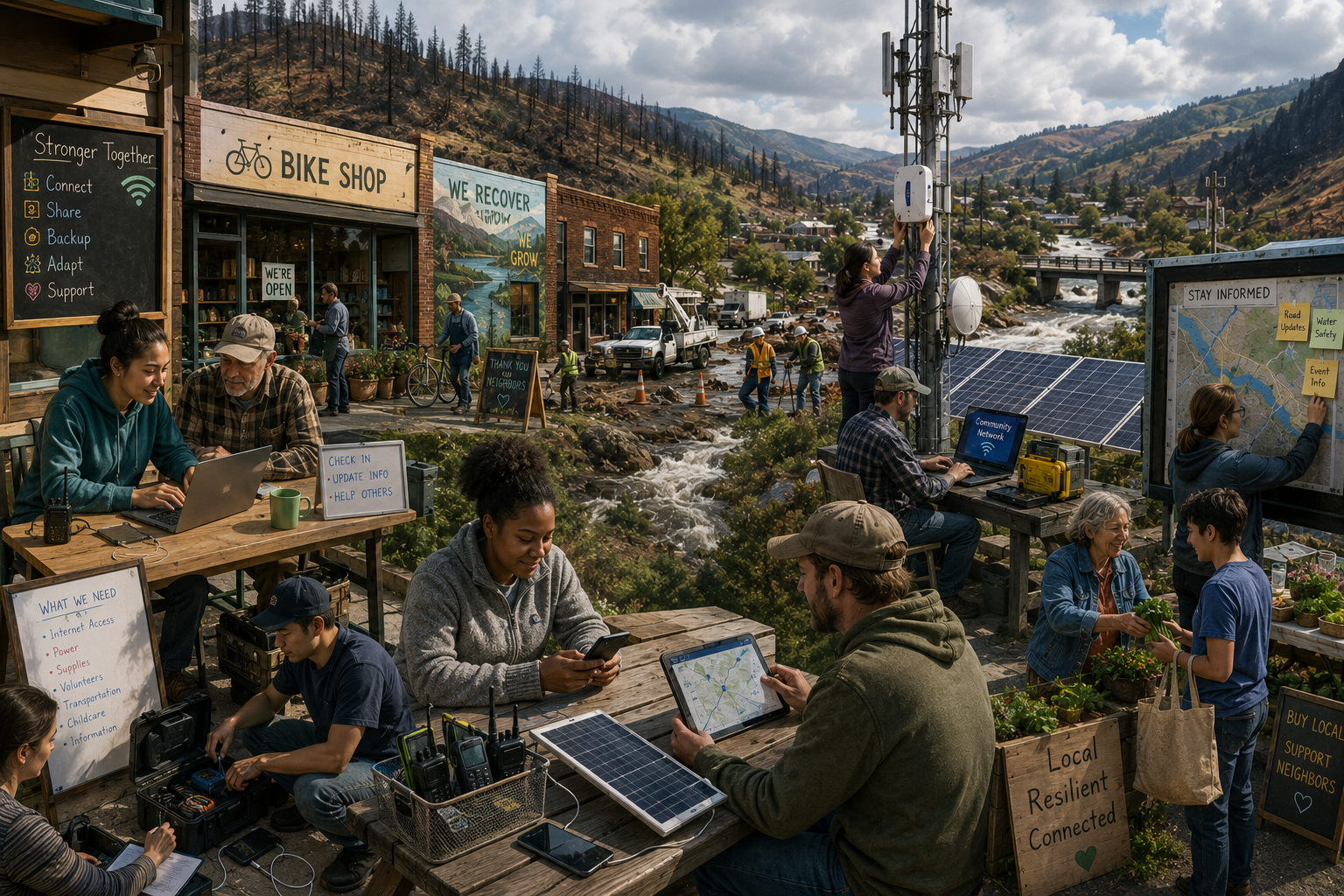
What Technology System Resilience Means
Technology system resilience is the ability of a technology-dependent system to preserve essential functions, absorb disturbance, recover from disruption, adapt to changing conditions, and learn from failure without creating unacceptable harm. It applies to software systems, data systems, cloud infrastructure, operational technology, communication networks, embedded devices, AI systems, digital public infrastructure, platforms, cyber-physical systems, and the organizations that design, operate, and depend on them.
A technology system is resilient when it can continue serving its critical purpose even when some components fail. It may reroute traffic, isolate compromised services, degrade nonessential features, recover data, switch to backup procedures, preserve audit trails, protect users, alert operators, and restore function without catastrophic cascading failure. It is also resilient when it can learn from incidents and change architecture, governance, staffing, documentation, monitoring, procurement, or policy afterward.
Resilience is different from perfection. No technology system is immune from failure. Hardware fails, software contains bugs, networks go down, credentials are stolen, APIs change, vendors collapse, data becomes corrupted, models drift, people make mistakes, and attackers adapt. The question is whether the system can fail safely, recover effectively, and improve afterward.
| Technology resilience concept | Meaning | Example |
|---|---|---|
| Continuity | Essential functions continue during disruption | A hospital preserves emergency care when its scheduling system fails. |
| Graceful degradation | Nonessential features fail before critical services fail | A payment platform limits optional analytics while preserving core transactions. |
| Recoverability | The system can restore data, service, and trust after failure | A public-benefits system restores service from tested backups after a cyber incident. |
| Adaptability | The system can change architecture, rules, capacity, or workflows as risk changes | A logistics platform adds alternate routing after repeated climate-related disruption. |
| Observability | Operators can understand system state, errors, dependencies, and anomalies | A cloud service detects abnormal latency and identifies the failing dependency. |
| Governability | Human institutions can oversee, intervene, audit, and correct the system | An AI-assisted decision tool can be paused, reviewed, audited, and reverted. |
Technology system resilience is strongest when technical design, organizational capacity, human judgment, institutional governance, and public accountability are aligned. A technically sophisticated system can still be fragile if no one understands it, maintains it, governs it, or knows how to respond when it fails.
Why Technology Resilience Matters
Technology resilience matters because technology systems now mediate access to essential goods, services, rights, information, money, infrastructure, work, public benefits, health, safety, and democratic participation. When technology systems fail, people may lose more than convenience. They may lose wages, medical care, public assistance, transportation, communication, identity verification, legal access, emergency information, or the ability to operate a business.
Technology failures can also cascade. A cloud outage can affect thousands of dependent services. A cyberattack on a supplier can disrupt hospitals, schools, manufacturers, retailers, and government agencies. A corrupted data pipeline can produce bad decisions downstream. A payment-system outage can harm small businesses with little cash slack. A platform rule change can damage livelihoods. A failure in operational technology can affect water, power, transport, or industrial safety.
Technology resilience is therefore a public-interest issue. Even when systems are privately operated, their failure may have social consequences. The resilience of a payment processor, cloud provider, telecommunications network, health IT system, logistics platform, social platform, energy-control system, or identity service can affect communities far beyond the organization that owns it.
Why technology resilience is a systems priority
It protects essential services
Technology supports healthcare, finance, benefits, education, logistics, utilities, emergency response, and public communication.
It limits cascading failure
Digital dependencies can transmit disruption quickly across organizations, sectors, and communities.
It protects trust
People rely on technology systems to be available, accurate, secure, understandable, and accountable.
It supports local resilience
Small businesses, households, schools, and public agencies depend on payment, communication, broadband, cloud, and data systems.
It preserves institutional memory
Digital records, documentation, archives, and knowledge systems help organizations recover and learn after disruption.
It shapes justice
Technology failure and surveillance often harm vulnerable users first when systems are poorly governed.
Technology resilience is not simply about keeping systems online. It is about preserving the social functions that technology systems now carry.
Technology Systems as Complex Adaptive Systems
Technology systems are complex adaptive systems because they combine software, hardware, data, users, operators, vendors, attackers, regulators, institutions, interfaces, networks, and feedback loops. Their behavior is not always predictable from component behavior. A small configuration change, software dependency, model update, network failure, or user workaround can produce systemwide effects.
Technology systems also adapt. Developers patch code. Users change behavior. Attackers probe weaknesses. Vendors update APIs. Algorithms learn from data. Operators adjust infrastructure. Regulators change rules. Organizations add workarounds. Platform incentives reshape participation. These adaptive dynamics mean that technology resilience cannot be treated as a static design property. It must be maintained over time.
Complexity is amplified by dependency. A modern technology system may rely on cloud services, authentication providers, open-source packages, payment processors, content-delivery networks, third-party APIs, machine-learning models, data vendors, mobile operating systems, hardware suppliers, telecommunications networks, and human support teams. Some dependencies are visible. Others are hidden until failure occurs.
| Complex-system feature | Technology expression | Resilience implication |
|---|---|---|
| Interdependence | Applications rely on cloud, identity, data, APIs, networks, vendors, and users | Local failures can become systemwide disruption. |
| Feedback loops | Monitoring, user behavior, platform incentives, automation, and alerts shape response | Poor feedback can amplify error or create false confidence. |
| Adaptation | Systems, users, operators, and attackers all change over time | Controls that worked yesterday may not work tomorrow. |
| Opacity | Large systems can become difficult to understand or audit | Operators may not know why failure is occurring. |
| Path dependence | Legacy systems, technical debt, procurement history, and old standards shape current constraints | Past decisions can trap present systems in fragile architectures. |
| Nonlinearity | Small failures can trigger large outages through shared dependencies | Stress testing must consider cascades, not isolated components only. |
Technology resilience therefore requires systems thinking. It asks how architecture, human behavior, institutions, vendors, incentives, data, and failure modes interact.
Reliability, Robustness, Resilience, and Adaptability
Reliability, robustness, resilience, and adaptability are related but distinct. Reliability means the system performs as expected under expected conditions. Robustness means the system can withstand specified stresses. Resilience means the system can absorb, recover, adapt, and learn when disturbance occurs. Adaptability means the system can change as environments, risks, users, and dependencies change.
A technology system may be reliable but not resilient. It may work well during ordinary traffic but fail catastrophically during a cloud outage, cyberattack, data corruption event, or vendor failure. A system may be robust against known threats but fragile against novel ones. A system may be resilient technically but weak institutionally if there is no incident governance, documentation, staffing, or public accountability.
Resilience expands the design question. Instead of asking only, “How do we prevent failure?” it asks, “What happens when failure occurs? What functions matter most? How does the system degrade? Who is harmed? Who knows what to do? Can users still access essential services? Can operators understand the failure? Can the organization learn?”
| Concept | Primary question | Technology example |
|---|---|---|
| Reliability | Does the system perform consistently under expected conditions? | A website maintains normal response time during ordinary traffic. |
| Robustness | Can the system withstand a specified stress? | A database remains available after one server fails. |
| Resilience | Can the system absorb, recover, adapt, and learn after disturbance? | A public service platform preserves essential access during cyber recovery. |
| Adaptability | Can the system change as conditions change? | A data pipeline is redesigned when climate, demand, or regulatory conditions shift. |
| Maintainability | Can people repair, update, understand, and operate the system? | Engineers can patch, monitor, document, and safely change legacy software. |
| Governability | Can institutions oversee and correct the system? | A model or platform can be audited, paused, appealed, and revised. |
Technology system resilience requires all of these capacities, but it is not reducible to any one of them.
Core Components of Technology System Resilience
Technology system resilience has several recurring components: architecture, redundancy, observability, cybersecurity, data integrity, recoverability, maintainability, interoperability, human-centered design, governance, supply-chain resilience, and ethical accountability. These components interact. Strong security without recovery planning can still leave essential services unavailable. Redundancy without observability can hide failure. Automation without human override can amplify harm. Cloud scalability without vendor contingency can create concentration risk.
Resilient Architecture
Resilient architecture uses modularity, isolation, redundancy, loose coupling, fallback modes, safe defaults, and graceful degradation so that failures are contained rather than amplified across the system.
Observability and Monitoring
Observability allows operators to understand system health, dependencies, errors, latency, anomalies, and user impact. Monitoring is not only technical instrumentation; it is an early-warning system for service, security, and public harm.
Cybersecurity and Recovery
Cyber resilience includes prevention, detection, containment, response, restoration, tested backups, identity security, network segmentation, incident governance, and communication with affected users and stakeholders.
Data Integrity and Governance
Data resilience protects accuracy, provenance, availability, confidentiality, auditability, privacy, and recovery. A system may stay online yet fail if its data are corrupted, biased, missing, inaccessible, or untrusted.
Maintainability and Technical Debt
Maintainability ensures that people can understand, repair, update, test, document, and safely change the system. Technical debt becomes a resilience risk when it prevents adaptation or safe recovery.
Interoperability and Portability
Interoperability allows systems to exchange data and services safely. Portability reduces lock-in and enables migration when vendors, platforms, standards, costs, or risks change.
Human-Centered Fallback
Human-centered fallback ensures that people can understand, override, appeal, or work around technology failure. Essential services should not become inaccessible because users cannot navigate brittle digital systems.
Ethical and Public Accountability
Technology resilience must account for rights, equity, accessibility, privacy, transparency, labor, environmental impact, and public consequence. A system is not resilient if it preserves service by shifting harm onto vulnerable users or workers.
| Component | Primary function | Failure if neglected |
|---|---|---|
| Resilient architecture | Contains failures and protects essential functions | Small faults cascade across the system. |
| Observability | Reveals system state, dependencies, anomalies, and user impact | Operators respond blindly or too late. |
| Cybersecurity and recovery | Prevents, detects, contains, and restores after attacks | Security incidents become prolonged service failures. |
| Data integrity | Protects accuracy, provenance, privacy, and trust | Systems make decisions from corrupted or unreliable information. |
| Maintainability | Allows repair, update, adaptation, and safe change | Technical debt blocks resilience. |
| Interoperability | Reduces lock-in and supports data or service portability | Dependency on one platform becomes fragility. |
| Human-centered fallback | Protects users when automation or interfaces fail | People are locked out of essential services. |
| Ethical accountability | Ensures resilience protects people, rights, equity, and public purpose | Continuity is achieved by shifting harm. |
Technology resilience is multidimensional. It must be designed across infrastructure, software, people, governance, data, and public consequence.
Architecture, Modularity, and Graceful Degradation
Architecture shapes how technology systems fail. A tightly coupled system can transmit failure quickly because components depend on one another in ways that leave little room for isolation. A modular system can often contain failure because components have clearer boundaries, fallback paths, and substitution options. Resilience depends not only on whether components are strong, but on how they are connected.
Graceful degradation is a core resilience principle. When disruption occurs, the system should preserve essential functions even if nonessential functions are reduced. A public benefits system might prioritize application submission and benefit payments while suspending optional analytics. A hospital system might preserve clinical access while postponing nonurgent reporting. A communications platform might limit media upload while preserving emergency messaging.
Resilient architecture requires knowing which functions matter most. Not every feature deserves the same protection. Critical functions should be identified, isolated, monitored, backed up, and tested. Noncritical features should not be allowed to compromise essential services.
| Architectural practice | Resilience function | Risk if absent |
|---|---|---|
| Modularity | Separates components so failure can be contained | One failing component can destabilize the whole system. |
| Loose coupling | Reduces unnecessary dependency among services | Systems become brittle and hard to change. |
| Redundancy | Provides alternate capacity when components fail | Single points of failure interrupt essential function. |
| Fallback modes | Preserve minimum service during disruption | Users lose access entirely when primary systems fail. |
| Isolation | Contains security or operational incidents | Compromise spreads across systems. |
| Critical-function prioritization | Protects essential services before optional features | Nonessential features consume capacity during crisis. |
Technology systems become more resilient when they are designed to fail in bounded, understandable, recoverable ways.
Cybersecurity and Operational Continuity
Cybersecurity is central to technology resilience, but resilience is broader than prevention. A system must reduce the probability of attack, detect compromise quickly, contain damage, restore function, communicate honestly, preserve evidence, and learn afterward. Cyber resilience assumes that some controls will fail and asks what happens next.
Operational continuity is especially important because cyber incidents are often service incidents. Ransomware can shut down hospitals, municipalities, schools, logistics firms, manufacturers, and public agencies. Credential compromise can expose users to fraud. Data theft can undermine trust. Denial-of-service attacks can make services unavailable. A resilient cyber program therefore integrates security with continuity planning, backups, identity management, incident response, legal response, communications, and recovery testing.
Backups are not enough unless they are isolated, tested, restorable, current, and governed. Incident response plans are not enough unless teams practice them. Security tools are not enough unless alerts are investigated and translated into action. Cyber resilience is an organizational capability, not only a technical control stack.
Cyber resilience practices
Identity protection
Use multi-factor authentication, least privilege, credential monitoring, and access review.
Segmentation
Separate systems so compromise does not spread unchecked across the environment.
Tested backups
Maintain isolated, verified backups and practice restoration under realistic conditions.
Incident response
Define roles, escalation, evidence preservation, communication, legal review, and recovery procedures.
Detection and monitoring
Use logs, anomaly detection, endpoint visibility, and alert triage to identify compromise early.
Learning review
Convert incidents into architecture, policy, training, procurement, and governance improvements.
Cyber resilience is successful when security failure does not become prolonged institutional failure.
Data Resilience and Information Integrity
Data resilience is the capacity to preserve the availability, integrity, confidentiality, provenance, usability, and recoverability of data under stress. A technology system can remain online while still failing if its data are corrupted, incomplete, biased, inaccessible, outdated, poorly governed, or impossible to audit. Data are not passive inputs. They shape decisions, services, models, metrics, accountability, and public trust.
Information integrity matters because technology systems increasingly automate or guide decisions. A public agency may rely on eligibility data. A hospital may rely on medication records. A logistics firm may rely on routing data. A financial institution may rely on transaction data. An AI system may rely on training and inference data. If these data are compromised, the system’s outputs can become harmful even when the software appears functional.
Resilient data systems require backups, validation, lineage, metadata, access control, privacy safeguards, anomaly detection, audit trails, governance, and human review. They also require data minimization and ethical purpose limitation. Collecting more data does not automatically make a system more resilient; it may create more risk if the data are sensitive, poorly protected, or misused.
| Data resilience practice | Purpose | Failure if absent |
|---|---|---|
| Data backups | Allows restoration after deletion, corruption, or attack | Records are permanently lost or recovery is delayed. |
| Validation checks | Detects errors, missing values, anomalies, or impossible records | Bad data propagate into downstream decisions. |
| Lineage and provenance | Shows where data came from and how they changed | Errors cannot be traced or explained. |
| Access control | Limits who can view, edit, export, or delete data | Confidentiality and integrity are compromised. |
| Audit trails | Records changes, decisions, and system activity | Accountability is weakened after incident or dispute. |
| Privacy governance | Limits harmful collection, exposure, or secondary use | Resilience becomes surveillance or risk accumulation. |
Data resilience is not only technical preservation. It is the protection of trustworthy information in service of accountable decisions.
Cloud, Platform, and Vendor Dependence
Cloud platforms, software-as-a-service products, payment systems, authentication providers, analytics platforms, app stores, delivery apps, social platforms, and infrastructure vendors can strengthen technology resilience by providing scale, expertise, security tooling, and redundancy. They can also create concentration risk. When many organizations depend on a small number of providers, one outage, policy change, breach, pricing shift, or contractual failure can affect many systems at once.
Vendor dependence becomes a resilience problem when organizations cannot exit, migrate, understand, audit, or operate without a provider. Lock-in may be technical, contractual, financial, operational, or knowledge-based. A system may be nominally portable but practically trapped because data export is difficult, staff lack expertise, integrations are deep, or costs are prohibitive.
Platform dependence is especially important for small businesses, creators, public agencies, nonprofits, and local services. A platform account suspension, algorithm change, payment hold, API change, or marketplace outage can disrupt livelihoods. Resilience requires alternatives, direct relationships, data portability, contract review, and contingency planning.
| Dependency risk | How it appears | Resilience response |
|---|---|---|
| Cloud concentration | Many services depend on a small number of cloud providers | Identify critical dependencies, define recovery plans, and test regional or provider failures. |
| Vendor lock-in | Data, integrations, contracts, or skills make exit difficult | Require portability, documentation, export rights, and migration planning. |
| Platform policy change | External rules affect visibility, access, revenue, or communication | Build direct channels and diversify platform dependence. |
| API instability | Third-party interfaces change or fail unexpectedly | Use abstraction layers, monitoring, fallback logic, and contract review. |
| Payment dependence | One processor controls transaction continuity | Maintain backup payment options and reconciliation procedures. |
| Support failure | Critical vendors are unavailable during incidents | Negotiate service obligations and maintain internal knowledge. |
Technology resilience requires asking not only whether a vendor is powerful, but whether the organization and its users can continue functioning if that vendor fails or changes terms.
Software Maintenance and Technical Debt
Software maintenance is a resilience function. Systems that cannot be maintained eventually become fragile, even if they were well designed at launch. Dependencies age, libraries lose support, staff leave, documentation becomes outdated, security patches are delayed, infrastructure changes, data schemas drift, and workarounds accumulate. Technical debt becomes resilience debt when it prevents safe adaptation, recovery, or repair.
Technical debt is not only bad code. It includes undocumented systems, brittle integrations, outdated infrastructure, missing tests, unclear ownership, manual deployment, inaccessible logs, hard-coded assumptions, poor data governance, unsupported hardware, vendor black boxes, and institutional knowledge trapped in a few people. Debt becomes dangerous when no one knows where it is, how severe it is, or what functions depend on it.
Maintenance is often undervalued because it is less visible than new development. Yet many resilience failures occur not because organizations lacked innovation, but because they failed to maintain essential systems. Public agencies, hospitals, schools, utilities, small businesses, and nonprofits often depend on legacy systems because replacement is expensive and risky. Resilience requires investment in stewardship, not only novelty.
Maintenance and technical-debt controls
Ownership maps
Clarify who owns each system, service, data pipeline, dependency, and recovery process.
Dependency inventories
Track libraries, vendors, APIs, hardware, infrastructure, and open-source components.
Testing coverage
Use automated and manual tests to detect failure before deployment or incident.
Documentation
Preserve architecture, procedures, decision records, incident lessons, and operational context.
Patch governance
Define how security and reliability updates are prioritized, tested, and deployed.
Refactoring capacity
Protect time and budget to improve systems before fragility becomes crisis.
Technology resilience requires maintaining the systems society already depends on, not only building new ones.
Cyber-Physical and Infrastructure Systems
Cyber-physical systems connect digital control with physical processes. They include energy grids, water treatment systems, transportation networks, building controls, industrial systems, medical devices, logistics automation, agricultural sensing, environmental monitoring, emergency communications, and intelligent infrastructure. In these systems, digital failure can produce physical consequences.
Cyber-physical resilience requires integration between operational technology, information technology, engineering, safety management, emergency response, cybersecurity, and public governance. It is not enough for a digital component to be secure in isolation. The system must remain safe when sensors fail, communications are interrupted, automation behaves unexpectedly, operators lose visibility, or control systems are compromised.
Physical infrastructure also has slower dynamics than software. Equipment ages, maintenance backlogs accumulate, replacement parts have long lead times, climate hazards intensify, and regulatory processes take time. Resilience requires lifecycle planning, spare parts, manual operations, trained operators, segmentation, monitoring, and coordination with public agencies.
| Cyber-physical risk | Potential consequence | Resilience response |
|---|---|---|
| Sensor failure | Operators receive false or missing information | Use validation, redundancy, calibration, and human inspection. |
| Control-system compromise | Physical processes operate unsafely | Segment networks, monitor anomalies, and preserve manual override. |
| Communications outage | Remote systems cannot coordinate | Maintain local control, backup channels, and emergency procedures. |
| Automation surprise | System behavior becomes difficult for operators to anticipate | Design transparent interfaces, training, and safe fallback modes. |
| Long-lead equipment failure | Repair is delayed by scarce parts or vendors | Maintain spare parts, supplier diversity, and mutual-aid agreements. |
| Climate stress | Heat, flood, fire, or storm affects equipment and data systems | Integrate climate adaptation with technology resilience planning. |
Technology system resilience in cyber-physical systems is a safety, infrastructure, and public-governance issue as much as a digital design issue.
Human Factors and Socio-Technical Resilience
Technology systems are socio-technical systems. People design them, fund them, operate them, maintain them, regulate them, attack them, repair them, depend on them, and work around them. A system that ignores users, operators, workers, and affected communities is fragile even if the technology appears advanced.
Human factors matter during both normal operations and crisis. Poor interfaces can increase error. Alert overload can cause warnings to be missed. Automation can deskill operators. Complex procedures can fail under stress. Hidden assumptions can exclude people with disabilities, limited English proficiency, low digital access, or low trust in institutions. Resilience requires design that fits real human conditions.
Socio-technical resilience also means protecting workers. Technology teams often become the emergency buffer during outages, cyber incidents, migrations, and public failures. If resilience depends on permanent on-call exhaustion, understaffing, or heroic repair, the system is not truly resilient. It is borrowing from human capacity.
Human-centered technology resilience practices
Usable fallback
Ensure users can access essential services when digital interfaces fail or become inaccessible.
Operator training
Train teams to diagnose, escalate, recover, communicate, and work safely under stress.
Alert discipline
Reduce noise so alerts support judgment rather than overwhelm attention.
Accessible design
Account for disability, language, bandwidth, device access, literacy, and trust.
Worker recovery
Protect technology workers from burnout after incidents, migrations, and sustained on-call pressure.
Participatory review
Include users, operators, frontline staff, and affected communities in failure analysis and redesign.
Technology resilience is strongest when systems are designed around real human capacities and limits, not idealized users or endlessly available workers.
AI, Automation, and Model Risk
AI and automation create new resilience opportunities and risks. They can detect anomalies, route incidents, summarize logs, forecast demand, optimize maintenance, support diagnostics, and help operators interpret complex signals. But they can also create opacity, bias, automation dependency, model drift, adversarial vulnerability, hallucination, privacy exposure, and false confidence.
AI system resilience requires monitoring model performance over time, testing under distribution shift, preserving human oversight, documenting data provenance, preventing harmful automation, and allowing appeal or override when decisions affect people. A model that works under historical conditions may fail when user behavior, climate conditions, economic stress, attack patterns, or data collection changes.
Automation can improve resilience when it handles routine load and supports human judgment. It weakens resilience when it removes human understanding, creates brittle dependency, hides uncertainty, or accelerates harmful decisions. In high-stakes systems, automation must be governable.
| AI or automation risk | Resilience concern | Safeguard |
|---|---|---|
| Model drift | Performance declines as conditions change | Monitor accuracy, bias, calibration, and input distributions over time. |
| Automation bias | Humans over-trust automated outputs | Show uncertainty, preserve review, and train users to challenge outputs. |
| Opacity | Decisions cannot be explained or audited | Use documentation, model cards, audit trails, and interpretable processes where needed. |
| Data dependency | Bad data produce bad outputs | Validate data pipelines and monitor quality, provenance, and missingness. |
| Adversarial manipulation | Inputs are crafted to mislead the system | Use security testing, anomaly detection, and human escalation. |
| Loss of human fallback | People cannot operate when automation fails | Maintain manual procedures, training, and override authority. |
AI resilience is not achieved by making systems more autonomous. It is achieved by making them more accountable, observable, correctable, and safe under changing conditions.
Supply-Chain Resilience for Technology Systems
Technology systems depend on supply chains for hardware, semiconductors, firmware, software libraries, open-source packages, cloud infrastructure, APIs, data vendors, contractors, managed service providers, network providers, device manufacturers, and security tools. Supply-chain disruption can arise from geopolitical conflict, export controls, natural disasters, vendor compromise, maintainer burnout, licensing changes, malware, logistics delay, or concentration of production.
Software supply-chain resilience has become especially important because systems often rely on many third-party and open-source components. A vulnerability in a widely used library can affect thousands of systems. A compromised update can propagate quickly. A volunteer-maintained package can become critical infrastructure without adequate support. Organizations need inventories, dependency scanning, signing, provenance, patch governance, and support for maintainers.
Hardware supply chains also matter. Devices, sensors, routers, chips, batteries, servers, transformers, industrial controllers, and medical equipment may have long lead times. A technology system may be software-defined but physically constrained. Resilience planning must account for both code and material infrastructure.
| Technology supply-chain risk | How it appears | Resilience response |
|---|---|---|
| Open-source dependency | Critical systems rely on externally maintained packages | Track dependencies, support maintainers, scan vulnerabilities, and test updates. |
| Vendor compromise | Trusted supplier becomes attack pathway | Assess vendors, segment access, monitor behavior, and verify updates. |
| Hardware scarcity | Long-lead components delay repair or expansion | Maintain inventories, alternatives, lifecycle plans, and procurement visibility. |
| Data vendor dependency | External data becomes unavailable, costly, or unreliable | Define data portability, quality checks, and fallback sources. |
| Managed service concentration | Many organizations depend on the same provider | Review systemic concentration and continuity obligations. |
| Firmware and device risk | Embedded vulnerabilities persist in physical systems | Track assets, update firmware, monitor devices, and plan replacement cycles. |
Technology supply-chain resilience requires visibility into dependencies that are often treated as invisible until they fail.
Governance, Accountability, and Public Interest
Technology resilience requires governance because technology systems make choices about access, priority, risk, privacy, visibility, automation, and failure. Governance defines who owns risk, who can make emergency decisions, who is accountable to affected users, how incidents are disclosed, how systems are audited, how vendors are managed, and how lessons become changes.
Public-interest governance matters when systems affect essential services or rights. A private technology failure can have public consequences. A public agency may outsource technology but cannot outsource responsibility. A platform may moderate access to livelihoods and speech. An AI system may shape eligibility, surveillance, policing, hiring, lending, or healthcare. Resilience governance must therefore include accountability beyond uptime.
Ethical technology resilience asks who is protected, who is exposed, who can appeal, who can understand the system, who can opt out, who bears the cost of failure, and who participates in redesign. A system is not resilient if it preserves institutional convenience while making vulnerable people absorb the disruption.
Governance questions for technology resilience
Who owns risk?
Are technology, legal, operational, ethical, public, and user risks clearly assigned?
Who can act?
Are emergency decision rights, escalation pathways, and authority boundaries clear?
Who is informed?
Are affected users, regulators, partners, and communities told what happened and what to do?
Who can appeal?
Can people challenge automated decisions, account suspensions, data errors, or service denials?
Who audits?
Are systems, models, vendors, incidents, and recovery claims independently reviewable?
Who learns?
Do incidents lead to changes in architecture, staffing, procurement, policy, and accountability?
Technology resilience without governance can become technical self-protection. Public-interest resilience requires accountability to the people and institutions affected by failure.
Measuring Technology System Resilience
Technology resilience measurement should include more than uptime. Availability matters, but a system can be online while delivering wrong information, excluding users, exposing data, overloading workers, amplifying bias, or hiding failure. Resilience metrics must track service continuity, recovery, data integrity, security, human impact, governance, and learning.
Useful metrics include recovery time, recovery point, critical-function availability, incident detection time, containment time, backup restoration success, dependency health, data-quality checks, error budgets, change failure rate, mean time to repair, security exposure, patch latency, user-impact severity, accessibility, incident communication quality, after-action completion, and implementation of corrective actions.
Metrics should also avoid perverse incentives. If teams are judged only by incident count, they may underreport. If judged only by uptime, they may ignore user harm. If judged only by deployment speed, they may accumulate technical debt. If judged only by cost, they may remove redundancy. Good resilience measurement encourages truth, learning, and repair.
| Measurement domain | Example indicators | Interpretive caution |
|---|---|---|
| Availability | Uptime, critical-function availability, error budgets | Availability alone can hide bad data, exclusion, or unsafe automation. |
| Recoverability | Recovery time, recovery point, backup restoration success | Backups must be tested, not merely configured. |
| Security | Detection time, containment time, patch latency, access review | Low incident count may mean poor detection or reporting. |
| Data integrity | Validation failures, lineage coverage, audit trails, missingness, anomalies | Data quality must be linked to decisions and user harm. |
| Maintainability | Technical debt, documentation coverage, test coverage, change failure rate | Fast delivery can mask accumulating fragility. |
| User impact | Service denial, accessibility failures, complaint patterns, support burden | Aggregate metrics can hide harm to vulnerable users. |
| Governance | Incident review, corrective-action completion, vendor review, auditability | Reviews must change practice, not only produce reports. |
| Human sustainability | On-call load, incident fatigue, staffing coverage, burnout risk | Reliability may be achieved by overworking technical teams. |
Resilience metrics should make hidden fragility visible before failure turns it into public harm.
A Practical Framework for Technology System Resilience
A practical technology resilience framework begins with essential functions, dependencies, failure modes, users, and governance. It then connects architecture, security, data, maintenance, vendors, human procedures, and ethical safeguards. The goal is not to eliminate all failure, but to ensure that failure is contained, recoverable, learnable, and less harmful.
| Step | Question | Output |
|---|---|---|
| Define essential functions | Which services, decisions, transactions, or safety functions must continue? | Critical-function inventory and priority map. |
| Map dependencies | Which systems, vendors, data, APIs, networks, people, and devices are required? | Dependency map and single-point-of-failure inventory. |
| Analyze failure modes | How can components fail, and how can failure cascade? | Failure-mode and cascade-risk assessment. |
| Design graceful degradation | How will nonessential functions shut down before essential functions? | Fallback modes and service-priority rules. |
| Strengthen cyber resilience | How will the system prevent, detect, contain, and recover from attack? | Security architecture, incident response, and tested recovery plan. |
| Protect data integrity | How will data remain accurate, recoverable, private, and auditable? | Data governance, validation, backup, lineage, and audit controls. |
| Plan vendor and platform contingencies | What happens if a provider fails, changes, or becomes unsafe? | Portability, contract, exit, and continuity strategy. |
| Maintain and reduce debt | Where does technical debt threaten recovery or adaptation? | Maintenance roadmap, refactoring plan, ownership map, and documentation update. |
| Protect people | How will users, operators, workers, and affected communities be protected? | Fallback access, accessibility, communication, on-call sustainability, and appeal process. |
| Institutionalize learning | How will incidents change architecture, policy, staffing, procurement, and governance? | After-action review, corrective-action tracking, and resilience improvement cycle. |
Technology resilience is not one project. It is an ongoing governance and design discipline that must evolve as systems, threats, dependencies, and public expectations change.
Mathematical Lens: Modeling Technology Resilience
Technology resilience can be modeled as a function of architecture, redundancy, observability, cybersecurity, data integrity, maintainability, governance, and human safeguards. Let technology resilience \(R_i\) for system \(i\) be represented as:
R_i = w_a A_i + w_r R_i^{d} + w_o O_i + w_c C_i + w_d D_i + w_m M_i + w_g G_i + w_h H_i – w_t T_i
\]
Interpretation: \(A_i\) represents architecture quality, \(R_i^{d}\) redundancy, \(O_i\) observability, \(C_i\) cybersecurity capacity, \(D_i\) data integrity, \(M_i\) maintainability, \(G_i\) governance, \(H_i\) human safeguards, and \(T_i\) technical debt or hidden fragility.
System function under disruption can be modeled dynamically. Let function at time \(t\) be \(F_t\), disruption load be \(D_t\), redundancy and fallback capacity be \(B_t\), recovery capacity be \(C_t\), and human strain be \(S_t\):
F_{t+1} = F_t – \alpha D_t + \beta B_t + \gamma C_t – \delta S_t
\]
Interpretation: Technology function declines with disruption and strain but is supported by fallback capacity and recovery capability.
Technical debt can be modeled as a slow variable that increases fragility over time if maintenance investment is insufficient:
T_{t+1} = T_t + \lambda C_h – \rho I_m
\]
Interpretation: \(C_h\) represents change pressure or complexity growth, while \(I_m\) represents maintenance investment. Technical debt accumulates when complexity grows faster than stewardship.
Technology recovery can be represented as a function of detection, containment, restoration, and learning:
Q = \frac{1}{1 + D_r + C_r + R_r} + L
\]
Interpretation: \(D_r\), \(C_r\), and \(R_r\) represent detection delay, containment delay, and restoration delay. \(L\) represents learning quality. Recovery improves when delays fall and learning improves.
Ethical adjustment is necessary because a system can maintain technical performance while harming users or workers:
R_i^{*} = R_i – \theta U_i – \lambda W_i
\]
Interpretation: \(U_i\) represents user harm or exclusion, while \(W_i\) represents worker strain. Technology resilience is weaker when continuity is achieved by shifting burden onto people.
These equations are not complete models. They are tools for clarifying assumptions, comparing resilience strategies, and making hidden fragility visible.
Advanced R Workflow: Comparing Technology Resilience Strategies
The R workflow below compares technology resilience strategies across architecture, redundancy, observability, cybersecurity, data integrity, maintainability, governance, human safeguards, technical debt reduction, and implementation burden.
# Install packages if needed:
# install.packages(c("tidyverse", "scales"))

library(tidyverse)
library(scales)

strategies <- tibble(
  strategy = c(
    "Critical Function and Dependency Mapping",
    "Graceful Degradation and Fallback Architecture",
    "Cyber Recovery and Tested Backup Program",
    "Data Integrity and Lineage Governance",
    "Technical Debt and Maintainability Program",
    "Vendor Portability and Platform Contingency Planning"
  ),
  architecture = c(8.5, 9.2, 8.0, 8.0, 8.4, 8.2),
  redundancy = c(8.2, 8.8, 8.9, 7.8, 7.8, 8.6),
  observability = c(8.6, 8.4, 8.5, 8.6, 8.2, 8.0),
  cybersecurity = c(8.0, 8.2, 9.2, 8.1, 8.2, 8.3),
  data_integrity = c(8.1, 7.8, 8.4, 9.3, 8.0, 8.2),
  maintainability = c(8.2, 8.3, 8.1, 8.2, 9.2, 8.0),
  governance = c(8.7, 8.4, 8.6, 8.8, 8.5, 8.7),
  human_safeguards = c(8.1, 8.5, 8.0, 8.2, 8.3, 8.0),
  technical_debt_risk = c(3.1, 3.0, 3.2, 3.0, 2.6, 3.1),
  implementation_burden = c(3.0, 3.4, 3.5, 3.4, 3.7, 3.6)
)

score_strategies <- function(data, wa, wr, wo, wc, wd, wm, wg, wh, wt, wi) {
  data %>%
    mutate(
      technology_resilience_value =
        wa * architecture +
        wr * redundancy +
        wo * observability +
        wc * cybersecurity +
        wd * data_integrity +
        wm * maintainability +
        wg * governance +
        wh * human_safeguards -
        wt * technical_debt_risk -
        wi * implementation_burden,
      maintainability_gap = pmax(0, 8.3 - maintainability),
      governance_gap = pmax(0, 8.3 - governance),
      human_gap = pmax(0, 8.2 - human_safeguards),
      adjusted_value =
        technology_resilience_value -
        0.06 * maintainability_gap -
        0.06 * governance_gap -
        0.07 * human_gap,
      diagnostic = case_when(
        implementation_burden >= 3.7 ~ "implementation-burden review needed",
        technical_debt_risk >= 3.3 ~ "technical-debt review needed",
        human_safeguards < 8.1 ~ "human-safeguards review needed",
        maintainability < 8.1 ~ "maintainability review needed",
        governance < 8.3 ~ "governance review needed",
        TRUE ~ "promising but requires stress testing"
      )
    ) %>%
    arrange(desc(adjusted_value))
}

scenarios <- tribble(
  ~scenario,              ~wa,  ~wr,  ~wo,  ~wc,  ~wd,  ~wm,  ~wg,  ~wh,  ~wt,  ~wi,
  "Balanced",             0.11, 0.11, 0.11, 0.12, 0.12, 0.12, 0.12, 0.12, 0.04, 0.03,
  "Cyber-first",          0.09, 0.12, 0.12, 0.30, 0.10, 0.10, 0.10, 0.10, 0.04, 0.03,
  "Data-first",           0.09, 0.10, 0.12, 0.10, 0.32, 0.10, 0.11, 0.10, 0.03, 0.03,
  "Architecture-first",   0.30, 0.20, 0.10, 0.10, 0.08, 0.10, 0.08, 0.08, 0.03, 0.03,
  "Maintainability-first",0.10, 0.10, 0.10, 0.10, 0.10, 0.32, 0.12, 0.10, 0.04, 0.02,
  "Governance-first",     0.09, 0.09, 0.10, 0.10, 0.10, 0.12, 0.32, 0.12, 0.03, 0.03,
  "Human-safeguards",     0.09, 0.09, 0.10, 0.10, 0.10, 0.11, 0.13, 0.32, 0.03, 0.03,
  "Implementation-aware", 0.11, 0.11, 0.11, 0.12, 0.12, 0.12, 0.12, 0.12, 0.03, 0.10
)

scenario_results <- scenarios %>%
  rowwise() %>%
  do(
    score_strategies(
      strategies,
      wa = .$wa,
      wr = .$wr,
      wo = .$wo,
      wc = .$wc,
      wd = .$wd,
      wm = .$wm,
      wg = .$wg,
      wh = .$wh,
      wt = .$wt,
      wi = .$wi
    ) %>%
      mutate(scenario = .$scenario)
  ) %>%
  ungroup()

ranked_results <- scenario_results %>%
  group_by(scenario) %>%
  arrange(desc(adjusted_value), .by_group = TRUE) %>%
  mutate(rank = row_number()) %>%
  ungroup()

print(ranked_results)

ggplot(ranked_results, aes(x = strategy, y = adjusted_value, group = scenario)) +
  geom_point(size = 3) +
  geom_line(aes(color = scenario), linewidth = 1) +
  coord_flip() +
  labs(
    title = "Technology Resilience Strategy Value Across Priority Scenarios",
    x = "Strategy",
    y = "Adjusted Technology Resilience Value",
    color = "Scenario"
  ) +
  theme_minimal(base_size = 12)

top_rank_summary <- ranked_results %>%
  filter(rank == 1) %>%
  count(strategy, name = "times_ranked_first") %>%
  arrange(desc(times_ranked_first))

print(top_rank_summary)

write_csv(ranked_results, "technology_resilience_strategy_rankings.csv")
write_csv(top_rank_summary, "technology_resilience_top_rank_summary.csv")
This workflow shows why technology resilience strategy depends on context. Cyber recovery, data integrity, graceful degradation, technical-debt reduction, dependency mapping, and vendor portability may rank differently depending on whether the organization’s primary risk is outage, cyberattack, data corruption, platform lock-in, maintenance fragility, or public accountability.
Advanced Python Workflow: Simulating Technology System Resilience Under Disruption
The Python workflow below models technology function, technical debt, recovery capacity, observability, human strain, and ethical-adjusted performance under repeated disruption. It uses synthetic values to illustrate how different technology-system profiles respond to cloud outage, cyber incident, data corruption, vendor failure, and compound stress.
# Install packages if needed:
# pip install pandas numpy matplotlib

import numpy as np
import pandas as pd
import matplotlib.pyplot as plt

systems = pd.DataFrame({
    "system": [
        "Legacy high-debt public service system",
        "Cloud-scaled but vendor-dependent platform",
        "Cyber-hardened but low-maintenance system",
        "Balanced resilient technology system",
        "AI-enabled system with governance gaps"
    ],
    "initial_function": [0.78, 0.84, 0.82, 0.86, 0.83],
    "architecture": [0.48, 0.72, 0.66, 0.84, 0.70],
    "redundancy": [0.42, 0.78, 0.72, 0.82, 0.68],
    "observability": [0.46, 0.76, 0.70, 0.84, 0.62],
    "cybersecurity": [0.44, 0.70, 0.88, 0.84, 0.68],
    "data_integrity": [0.50, 0.72, 0.70, 0.86, 0.62],
    "maintainability": [0.36, 0.64, 0.52, 0.84, 0.58],
    "governance": [0.50, 0.62, 0.66, 0.84, 0.48],
    "human_safeguards": [0.54, 0.60, 0.58, 0.82, 0.46],
    "technical_debt": [0.82, 0.54, 0.66, 0.32, 0.64],
    "initial_human_strain": [0.66, 0.54, 0.58, 0.34, 0.62]
})

events = {
    10: {"name": "cloud dependency outage", "intensity": 0.68},
    24: {"name": "credential compromise and cyber incident", "intensity": 0.76},
    38: {"name": "data corruption and pipeline failure", "intensity": 0.70},
    54: {"name": "vendor API and platform disruption", "intensity": 0.66},
    70: {"name": "technical-debt maintenance failure", "intensity": 0.72},
    84: {"name": "compound technology disruption", "intensity": 0.88}
}

rows = []
n_steps = 96
rng = np.random.default_rng(42)

for _, s in systems.iterrows():
    function = s["initial_function"]
    technical_debt = s["technical_debt"]
    human_strain = s["initial_human_strain"]

    for t in range(n_steps):
        event = events.get(t)
        if event is None:
            event_name = "background technology pressure"
            disruption = 0.05 + rng.normal(0, 0.01)
        else:
            event_name = event["name"]
            disruption = event["intensity"]

        disruption = np.clip(disruption, 0, 1)

        fallback_capacity = (
            0.20 * s["architecture"]
            + 0.20 * s["redundancy"]
            + 0.14 * s["maintainability"]
            + 0.12 * s["governance"]
            + 0.10 * s["human_safeguards"]
        )

        recovery_capacity = (
            0.16 * s["observability"]
            + 0.16 * s["cybersecurity"]
            + 0.16 * s["data_integrity"]
            + 0.16 * s["maintainability"]
            + 0.18 * s["governance"]
            + 0.18 * s["human_safeguards"]
        )

        fragility_gap = max(0, disruption + 0.30 * technical_debt - fallback_capacity)

        strain_increase = 0.18 * disruption + 0.18 * fragility_gap + 0.08 * technical_debt
        strain_recovery = 0.08 * s["human_safeguards"] + 0.06 * s["governance"]
        human_strain = np.clip(human_strain + strain_increase - strain_recovery, 0, 1)

        function = (
            function
            - 0.32 * disruption
            - 0.18 * fragility_gap
            + 0.18 * fallback_capacity
            + 0.18 * recovery_capacity
            - 0.14 * human_strain
        )
        function = np.clip(function, 0, 1)

        complexity_growth = 0.020 + 0.030 * disruption
        maintenance_investment = 0.045 * s["maintainability"] + 0.025 * s["governance"]
        technical_debt = np.clip(technical_debt + complexity_growth - maintenance_investment, 0, 1)

        ethical_adjusted_function = np.clip(
            function * (0.70 + 0.30 * s["human_safeguards"])
            - 0.08 * human_strain,
            0,
            1
        )

        resilience_score = np.clip(
            0.18 * function
            + 0.16 * fallback_capacity
            + 0.16 * recovery_capacity
            + 0.14 * s["data_integrity"]
            + 0.14 * s["governance"]
            + 0.12 * s["human_safeguards"]
            + 0.10 * (1 - technical_debt),
            0,
            1
        )

        rows.append({
            "system": s["system"],
            "time": t,
            "event": event_name,
            "disruption": disruption,
            "fallback_capacity": fallback_capacity,
            "recovery_capacity": recovery_capacity,
            "fragility_gap": fragility_gap,
            "function": function,
            "technical_debt": technical_debt,
            "human_strain": human_strain,
            "ethical_adjusted_function": ethical_adjusted_function,
            "resilience_score": resilience_score
        })

simulation = pd.DataFrame(rows)

summary = (
    simulation
    .groupby("system")
    .agg(
        mean_function=("function", "mean"),
        minimum_function=("function", "min"),
        final_function=("function", "last"),
        final_technical_debt=("technical_debt", "last"),
        maximum_human_strain=("human_strain", "max"),
        mean_fragility_gap=("fragility_gap", "mean"),
        final_ethical_adjusted_function=("ethical_adjusted_function", "last"),
        final_resilience_score=("resilience_score", "last")
    )
    .reset_index()
    .sort_values("final_resilience_score", ascending=False)
)

print(summary)

plt.figure(figsize=(10, 6))
for system, subset in simulation.groupby("system"):
    plt.plot(subset["time"], subset["function"], label=system)
plt.xlabel("Time")
plt.ylabel("Technology function")
plt.title("Technology System Function Under Repeated Disruption")
plt.legend()
plt.tight_layout()
plt.show()

plt.figure(figsize=(10, 6))
for system, subset in simulation.groupby("system"):
    plt.plot(subset["time"], subset["technical_debt"], label=system)
plt.xlabel("Time")
plt.ylabel("Technical debt")
plt.title("Technical Debt as a Slow Resilience Variable")
plt.legend()
plt.tight_layout()
plt.show()

plt.figure(figsize=(10, 6))
for system, subset in simulation.groupby("system"):
    plt.plot(subset["time"], subset["human_strain"], label=system)
plt.xlabel("Time")
plt.ylabel("Human strain")
plt.title("Human Strain During Technology Disruption")
plt.legend()
plt.tight_layout()
plt.show()

simulation.to_csv("technology_system_resilience_simulation.csv", index=False)
summary.to_csv("technology_system_resilience_summary.csv", index=False)
The simulation illustrates a central resilience principle: technology systems with balanced architecture, redundancy, observability, cybersecurity, data integrity, maintainability, governance, and human safeguards are better positioned to recover from repeated disruption. Systems with high technical debt or weak governance may remain functional for a while, but their fragility accumulates.
GitHub Repository
The companion GitHub repository for this article is designed as a technology system resilience modeling scaffold. It translates architecture quality, redundancy, observability, cybersecurity, data integrity, maintainability, governance, human safeguards, technical debt, vendor dependence, recovery capacity, and repeated disruption into reproducible workflows for resilience analysis.
Complete Code Repository
Companion code for technology system resilience modeling, including strategy scoring, dependency and fallback diagnostics, technical-debt simulation, cyber recovery analysis, data integrity review, vendor-dependence assessment, human-strain modeling, Monte Carlo uncertainty examples, responsible-use notes, and multi-language computational examples.
The companion article directory is articles/technology-system-resilience/. It is structured to support a professional modeling workflow: Python for simulation and uncertainty analysis; R for strategy comparison and ranking sensitivity; SQL for technology resilience strategies, system profiles, disruption scenarios, indicators, model runs, and outputs; Julia for resilience pathway examples; and Rust, Go, C, C++, and Fortran for lightweight diagnostic and simulation utilities.
The modeling objective is to explore how architecture, redundancy, observability, cybersecurity, data integrity, maintainability, governance, and human safeguards shape technology resilience under uncertainty. The scaffold includes synthetic data, validation notes, responsible-use documentation, generated outputs, and notebook placeholders.
This repository extends the article from conceptual technology resilience analysis into applied systems modeling. It gives readers a reproducible foundation for examining when technology systems can absorb disruption, when technical debt creates hidden fragility, and how governance and human safeguards can reduce harmful failure.
Conclusion
Technology system resilience matters because technology systems now carry essential social, economic, infrastructural, and civic functions. A technology failure can interrupt healthcare, payments, education, public benefits, utilities, communication, transportation, logistics, public safety, and local economic life. Resilience therefore cannot be measured only by uptime or technical sophistication. It must be measured by whether essential functions remain available, trustworthy, safe, accessible, and accountable under stress.
Resilient technology is not only secure technology. It is maintainable, observable, recoverable, interoperable, governable, human-centered, and ethically accountable technology. It can degrade gracefully, recover from cyber incidents, preserve data integrity, withstand vendor disruption, reduce technical debt, protect users, and support workers who must keep systems running. It can also learn from failure rather than repeat the same fragile patterns.
The broader lesson is that technology resilience is socio-technical. Software, hardware, data, cloud infrastructure, AI models, vendors, operators, users, laws, public institutions, and communities interact. A system designed only for performance under ordinary conditions may fail under real uncertainty. A system designed for resilience accepts that failure will happen and makes failure less catastrophic, less hidden, less unjust, and more learnable.
In the Resilience Thinking series, technology system resilience connects strategic slack, small business resilience, organizational resilience, infrastructure resilience, AI and resilience thinking, intelligent infrastructure, supply-chain resilience, institutional resilience, and ethical governance. The central question is not whether technology can be made perfect. It is whether technology systems can be designed and governed so that society does not collapse into fragility when they fail.
Related Articles
- Resilience in Small Business and Local Economies
- AI and Resilience Thinking
- Intelligent Infrastructure and Resilience
- Infrastructure Resilience
- Resilience and Strategic Slack
- Organizational Resilience and Learning
- Resilience in Global Supply Chains
- Modularity and Cascading Failure
Further Reading
- Anderson, R. (2020) Security Engineering: A Guide to Building Dependable Distributed Systems. 3rd edn. Indianapolis: Wiley. Available at: https://www.cl.cam.ac.uk/~rja14/book.html.
- Beyer, B., Jones, C., Petoff, J. and Murphy, N.R. (eds.) (2016) Site Reliability Engineering: How Google Runs Production Systems. Sebastopol, CA: O’Reilly. Available at: https://sre.google/sre-book/table-of-contents/.
- Hollnagel, E., Woods, D.D. and Leveson, N. (eds.) (2006) Resilience Engineering: Concepts and Precepts. Aldershot: Ashgate.
- National Institute of Standards and Technology (2024) The NIST Cybersecurity Framework 2.0. Available at: https://www.nist.gov/cyberframework.
- National Institute of Standards and Technology (2023) AI Risk Management Framework. Available at: https://www.nist.gov/itl/ai-risk-management-framework.
- National Institute of Standards and Technology (2022) Secure Software Development Framework. Available at: https://csrc.nist.gov/Projects/ssdf.
- Open Source Security Foundation (n.d.) Supply Chain Integrity Working Group. Available at: https://openssf.org/.
- Woods, D.D. (2015) ‘Four concepts for resilience and the implications for the future of resilience engineering’, Reliability Engineering & System Safety, 141, pp. 5–9. Available at: https://doi.org/10.1016/j.ress.2015.03.018.
References
- Anderson, R. (2020) Security Engineering: A Guide to Building Dependable Distributed Systems. 3rd edn. Indianapolis: Wiley. Available at: https://www.cl.cam.ac.uk/~rja14/book.html.
- Beyer, B., Jones, C., Petoff, J. and Murphy, N.R. (eds.) (2016) Site Reliability Engineering: How Google Runs Production Systems. Sebastopol, CA: O’Reilly. Available at: https://sre.google/sre-book/table-of-contents/.
- Hollnagel, E., Woods, D.D. and Leveson, N. (eds.) (2006) Resilience Engineering: Concepts and Precepts. Aldershot: Ashgate.
- Leveson, N.G. (2011) Engineering a Safer World: Systems Thinking Applied to Safety. Cambridge, MA: MIT Press. Available at: https://mitpress.mit.edu/9780262533690/engineering-a-safer-world/.
- National Institute of Standards and Technology (2024) The NIST Cybersecurity Framework 2.0. Available at: https://www.nist.gov/cyberframework.
- National Institute of Standards and Technology (2023) AI Risk Management Framework. Available at: https://www.nist.gov/itl/ai-risk-management-framework.
- National Institute of Standards and Technology (2022) Secure Software Development Framework. Available at: https://csrc.nist.gov/Projects/ssdf.
- Woods, D.D. (2015) ‘Four concepts for resilience and the implications for the future of resilience engineering’, Reliability Engineering & System Safety, 141, pp. 5–9. Available at: https://doi.org/10.1016/j.ress.2015.03.018.