
Last Updated June 1, 2026
Causal loop diagrams are one of the core visual tools of systems thinking. They help analysts move beyond lists of factors and toward the logic of interaction: how variables influence one another, how consequences return as causes, how feedback loops generate behavior over time, and how system structure produces recurring outcomes. A good causal loop diagram does not simply show that “everything is connected.” It shows how things are connected, in what direction influence moves, where feedback closes, where delays occur, and why the system behaves as it does.
The value of a causal loop diagram is not decorative. It is analytical. A diagram can reveal why a policy fails, why a problem returns, why an intervention creates unintended consequences, why growth becomes fragility, why trust erodes, why workload spirals, why ecological damage accelerates, or why institutions resist reform. The diagram gives structure to causal reasoning. It makes assumptions visible enough to question, revise, test, and improve.
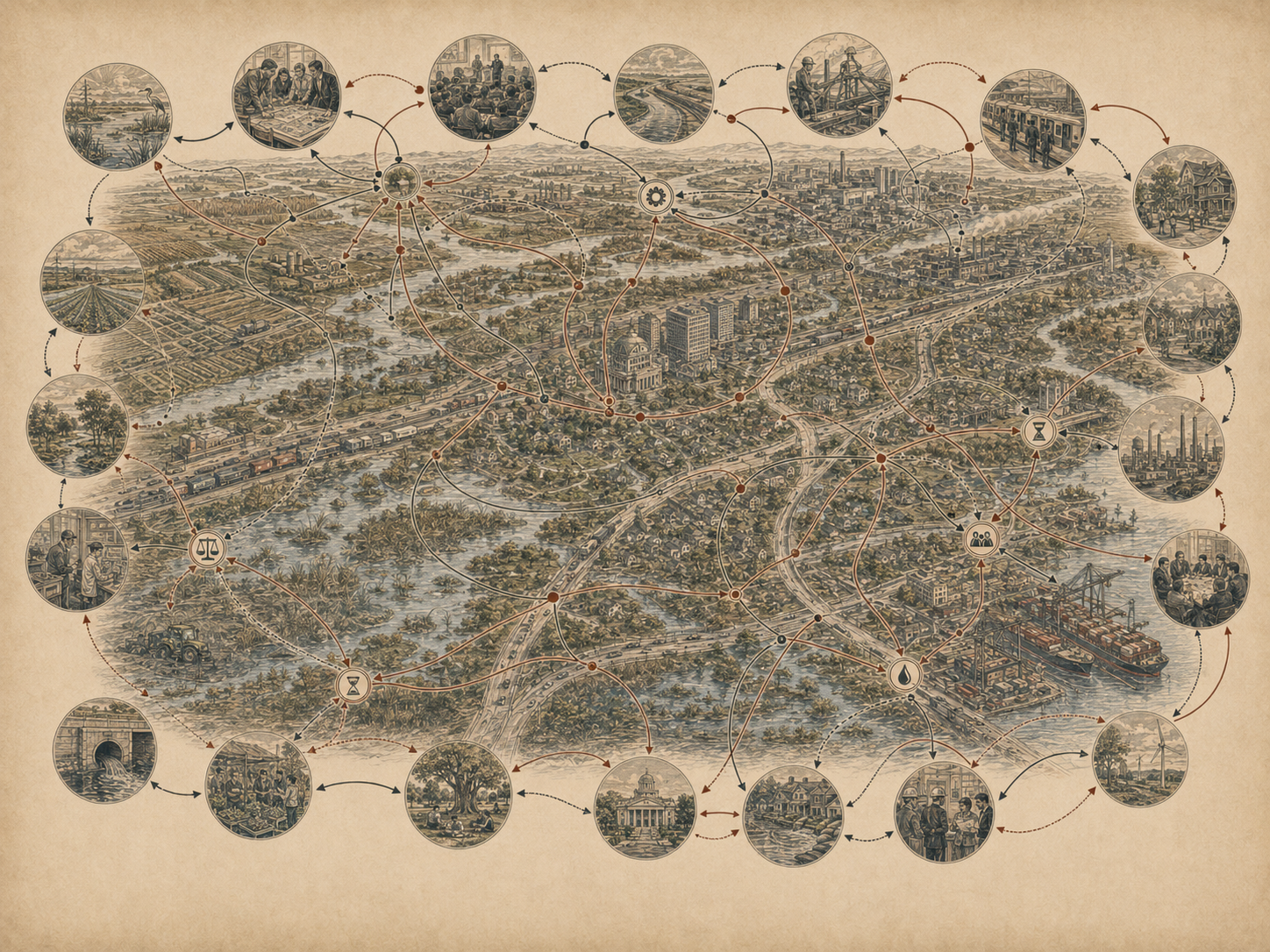
This article explains causal loop diagrams as a method for understanding interaction in complex systems. It covers variables, causal links, polarity, reinforcing loops, balancing loops, delays, behavior-over-time patterns, system boundaries, evidence, ambiguity, stakeholder interpretation, and ethical responsibility. It also explains why causal loop diagrams should be treated as disciplined hypotheses rather than finished truth: every variable, arrow, sign, delay, and boundary is a claim about how the system works.
Why Causal Loop Diagrams Matter
Causal loop diagrams matter because many systems problems cannot be understood through isolated variables. A problem may involve demand, capacity, delay, trust, incentives, resources, rules, measurement, public response, institutional legitimacy, ecological limits, and adaptive behavior. Listing these variables is useful, but it is not enough. Systems thinking asks how they interact.
A causal loop diagram helps reveal interaction structure. It shows whether increasing one variable tends to increase or decrease another. It shows whether effects return to influence their own causes. It shows whether a loop amplifies change or counteracts it. It also helps identify delays that separate action from consequence. In this way, the diagram becomes a bridge between causal explanation and behavior over time.
For example, a public agency experiencing service delays might initially see only a backlog problem. A causal loop diagram might reveal a deeper structure: high demand increases workload; workload increases processing delay; delay reduces public trust; reduced trust increases calls, appeals, incomplete submissions, and conflict; these increase workload further. The visible backlog is part of a feedback system. A narrow intervention that pressures staff to move faster may reduce backlog briefly while increasing error, rework, stress, and turnover. The diagram reveals why the symptom returns.
| Causal-loop function | Systems purpose | Example question |
|---|---|---|
| Clarify variables | Identifies what can rise, fall, accumulate, or change. | What exactly is changing in the system? |
| Map causal links | Shows direction of influence among variables. | How does workload affect delay? |
| Assign polarity | Distinguishes same-direction and opposite-direction effects. | Does more staffing increase or reduce delay? |
| Identify feedback | Shows when consequences return to shape causes. | Does delay create more workload later? |
| Mark delays | Reveals timing gaps that distort learning. | How long before trust changes after service improvement? |
| Connect to behavior | Explains growth, decline, oscillation, resistance, or collapse. | What pattern does this loop generate over time? |
Causal loop diagrams are especially valuable in group settings because they expose mental models. Different people often hold different assumptions about what causes what. A leader may believe more monitoring improves performance. Workers may believe more monitoring reduces trust and honest reporting. Residents may believe enforcement reduces legitimacy. Analysts may believe capacity constraints matter more than motivation. A diagram gives these assumptions a shared surface.
The goal is not to draw a perfect map. The goal is to make causal reasoning visible enough to improve it.
The Logic of Interaction
The logic of interaction is the idea that system behavior emerges from relationships among variables, not from isolated variables alone. A factor does not matter only because it exists. It matters because of how it influences other factors and how those effects return through the system.
In linear thinking, causality is often framed as a chain: A causes B, B causes C, and C causes D. This form of explanation can be useful for immediate events. But systems often involve circular causality: A influences B, B influences C, and C returns to influence A. Once the causal path closes, the system can amplify, stabilize, oscillate, resist, or transform itself over time.
A \rightarrow B \rightarrow C \rightarrow A
\]
Interpretation: A causal loop occurs when a chain of influence returns to affect an earlier variable. The consequence becomes part of the cause of future behavior.
Interaction also means that effects are conditional. The impact of a policy, technology, resource, rule, or intervention depends on surrounding relationships. Adding staff may reduce delay if training, tools, workflow, and role clarity are sufficient. More data may improve decisions if the data are meaningful, timely, trusted, and connected to authority. More enforcement may reduce harmful behavior in one context and reduce cooperation in another. The relationship is not only between two variables. It is between those variables inside a wider system.
The logic of interaction requires several habits:
- look for circular causality, not only linear chains;
- ask what consequences return to influence causes;
- distinguish direct effects from feedback effects;
- ask how time delays alter interpretation;
- identify whether relationships amplify or counteract change;
- examine how actors adapt to rules, incentives, and measurements;
- test whether the diagram explains behavior over time;
- revise the diagram when evidence contradicts the assumed structure.
A causal loop diagram is therefore not a static picture. It is a reasoning tool for dynamic interaction. It helps analysts ask how one condition changes another, how effects circulate, what patterns emerge, and where intervention might shift the structure rather than merely react to the latest event.
Variables: Naming What Can Change
A causal loop diagram begins with variables. A variable should be something that can increase or decrease, accumulate or deplete, strengthen or weaken, speed up or slow down. Variables may describe stocks, flows, conditions, risks, capacities, perceptions, behaviors, resources, burdens, legitimacy, demand, delay, trust, quality, cost, exposure, or resilience.
Weak diagrams often begin with vague categories. “Policy,” “technology,” “culture,” “problems,” “leadership,” or “infrastructure” may be important topics, but they are not yet clear variables. A good diagram translates broad topics into directional quantities: policy complexity, technology dependency, psychological safety, unresolved service requests, leadership responsiveness, maintenance backlog, infrastructure reliability, public trust, administrative burden, or ecological resilience.
| Broad topic | Stronger causal-loop variable | Why it works better |
|---|---|---|
| Policy | Policy complexity | Can rise or fall and can affect implementation burden. |
| Technology | Automation dependency | Names a changing system condition. |
| Culture | Psychological safety | Can increase or decrease and affects reporting, learning, and trust. |
| Infrastructure | Maintenance backlog | Represents an accumulated stock that influences failure risk. |
| Community response | Public trust in agency | Clarifies the relationship between experience and cooperation. |
| Workforce | Staffing capacity | Can be compared with workload and service demand. |
Good variable naming matters because causal signs depend on variable meaning. If the variable is “rules,” the relationship with safety may be unclear. If the variables are “minimum safety standards” and “procedural complexity,” the relationships can be analyzed more carefully. Minimum safety standards may reduce risk. Procedural complexity may increase burden, delay, and avoidance. A vague variable hides this distinction.
Variables should also avoid embedding blame. “Resident noncompliance” may frame behavior as individual failure. A more systems-aware diagram might include service accessibility, administrative burden, trust in agency, language access, transportation availability, perceived legitimacy, and fear of error. The variable choices shape the explanation before any arrow is drawn.
A useful test is simple: can the variable be placed in the sentence “more of this” or “less of this” without confusion? If not, the variable may need refinement.
Causal Links and Direction of Influence
A causal link is an arrow from one variable to another. It states that change in one variable tends to influence change in another, all else equal. The arrow is not a decorative connection. It is a claim about causality. The analyst should be able to explain the mechanism behind the arrow.
For example, an arrow from workload to stress claims that higher workload tends to increase stress. An arrow from staffing capacity to response delay claims that higher staffing capacity tends to reduce delay. An arrow from public trust to cooperation claims that higher public trust tends to increase cooperation. Each arrow should be interpretable as a sentence.
X \rightarrow Y
\]
Interpretation: A causal arrow from \(X\) to \(Y\) means that change in \(X\) is expected to influence change in \(Y\), all else equal.
The phrase “all else equal” is important. A causal link does not mean the effect will always dominate every other influence. More staffing capacity may reduce response delay, but if demand rises faster than staffing, delay may still increase overall. The link describes one causal tendency within a broader system.
Causal links can represent several kinds of influence:
- Material influence: more rainfall increases runoff.
- Behavioral influence: more trust increases cooperation.
- Institutional influence: more procedural complexity increases administrative burden.
- Economic influence: higher cost reduces affordability.
- Informational influence: better monitoring increases early warning capacity.
- Ecological influence: lower biodiversity increases vulnerability.
- Technical influence: higher automation dependency reduces manual review capacity.
- Political influence: lower legitimacy increases resistance or contestation.
Causal links should be questioned. What evidence supports the link? Is the relationship direct or mediated by another variable? Is the effect immediate or delayed? Does the relationship hold under all conditions? Is it stronger for some groups or contexts than others? Could the arrow point in both directions through separate mechanisms?
The quality of a causal loop diagram depends less on the number of arrows and more on the clarity of the causal claims each arrow makes.
Polarity, Same-Direction, and Opposite-Direction Effects
Every causal link in a causal loop diagram should usually have a polarity. Polarity indicates whether two variables tend to move in the same direction or opposite directions, all else equal.
A positive causal link means that variables move in the same direction. If the first variable increases, the second tends to increase above what it otherwise would have been. If the first variable decreases, the second tends to decrease below what it otherwise would have been. A negative causal link means that variables move in opposite directions. If the first variable increases, the second tends to decrease below what it otherwise would have been. If the first variable decreases, the second tends to increase above what it otherwise would have been.
X \xrightarrow{+} Y
\qquad
X \xrightarrow{-} Y
\]
Interpretation: A positive link means \(X\) and \(Y\) tend to move in the same direction. A negative link means they tend to move in opposite directions.
The signs are not moral categories. Positive does not mean beneficial. Negative does not mean harmful. More maintenance backlog increasing failure risk is a positive link, but it describes harm. More preventive maintenance reducing failure risk is a negative link, but it may be beneficial. The signs describe direction of movement, not value.
| Causal link | Polarity | Meaning |
|---|---|---|
| Workload → Stress | Positive | Higher workload tends to increase stress. |
| Staffing Capacity → Response Delay | Negative | Higher staffing capacity tends to reduce delay. |
| Public Trust → Cooperation | Positive | Higher trust tends to increase cooperation. |
| Administrative Burden → Program Access | Negative | Higher burden tends to reduce access. |
| Maintenance Backlog → Failure Risk | Positive | Higher backlog tends to increase risk. |
| Early Warning Capacity → Crisis Severity | Negative | Higher early-warning capacity tends to reduce severity. |
Polarity is where many systems diagrams become rigorous or vague. If a sign cannot be assigned, the variables may be unclear, the relationship may be conditional, or the analyst may not yet understand the mechanism. Ambiguity is not failure. It is information. It shows where further inquiry is needed.
Some causal links may change sign under different conditions. More rules may improve safety up to a point, then increase complexity and reduce responsiveness. More transparency may increase trust when paired with accountability, but reduce trust when it reveals harm without repair. In these cases, the diagram should document the condition or split the variable into more precise components.
Polarity discipline helps keep causal loop diagrams from becoming decorative complexity. It forces the analyst to explain the direction of influence.
Reinforcing Feedback Loops
A reinforcing feedback loop amplifies change. The loop returns to strengthen the direction of movement. If the initial variable increases, the loop tends to produce further increase. If the initial variable decreases, the loop may produce further decrease. Reinforcing loops can generate growth, decline, acceleration, escalation, cumulative advantage, cumulative disadvantage, collapse, contagion, learning, trust, or recovery.
A simple reinforcing trust loop might work like this: public trust increases cooperation; cooperation improves program performance; better performance increases public trust. The loop reinforces itself. If trust is high, the loop can support improved outcomes. If trust is low, the same structure can operate in reverse: distrust reduces cooperation; lower cooperation weakens performance; weaker performance deepens distrust.
\text{Trust} \xrightarrow{+} \text{Cooperation} \xrightarrow{+} \text{Performance} \xrightarrow{+} \text{Trust}
\]
Interpretation: This reinforcing loop shows how trust, cooperation, and performance can strengthen one another over time.
Reinforcing loops are often powerful because they create momentum. Once the loop is operating, the original trigger may no longer be necessary. A rumor spreads through repeated sharing. A culture of fear persists through silence and hidden errors. An infrastructure backlog grows because failures consume funds that might have been used for prevention. An advantage compounds because resources follow prior success.
Common reinforcing loops include:
- trust and cooperation: trust increases cooperation, which improves outcomes and strengthens trust;
- burnout and workload: workload increases stress, errors, rework, and turnover, increasing workload further;
- maintenance decline: backlog increases failure, emergency repair consumes resources, backlog grows;
- cumulative advantage: success attracts resources, resources create more success;
- cumulative disadvantage: lack of resources reduces performance, which reduces future resources;
- platform amplification: engagement produces data, data shapes recommendations, recommendations produce engagement;
- ecological degradation: degradation reduces resilience, lower resilience increases damage, damage deepens degradation.
Reinforcing does not mean good. A reinforcing loop can build capacity or destroy it. The key question is what the loop reinforces, for whom, over what time horizon, and at what cost.
Balancing Feedback Loops
A balancing feedback loop counteracts change. It pushes a system toward a goal, limit, norm, target, or reference condition. Balancing loops are the structures of regulation, correction, stabilization, adaptation, resistance, and control. They can protect safety and resilience, but they can also preserve unjust or ineffective equilibrium.
A simple workload balancing loop might work like this: workload increases pressure to hire; hiring increases staffing capacity; higher staffing capacity reduces workload. The loop counteracts workload growth. If the response is timely and adequate, the system may stabilize. If hiring is delayed, the system may oscillate between overload and correction.
\text{Workload} \xrightarrow{+} \text{Hiring Pressure} \xrightarrow{+} \text{Staffing Capacity} \xrightarrow{-} \text{Workload}
\]
Interpretation: This balancing loop shows how rising workload can trigger staffing response that reduces workload. The negative link closes the loop as a counteracting structure.
Balancing loops are often associated with goals. A thermostat maintains temperature. A budget process constrains spending. A safety system reduces risk. A regulatory system responds to harm. A public agency may add capacity when service delay becomes unacceptable. An ecosystem may stabilize through predator-prey relationships or regeneration processes.
But balancing loops can also resist necessary change. An institution may respond to criticism by protecting reputation rather than addressing harm. A bureaucracy may return to familiar procedures after each reform. A workplace may normalize overwork after each temporary relief effort. A political system may absorb public protest without changing policy. The loop stabilizes the system, but the stabilized condition may be unjust.
| Balancing loop type | Potentially beneficial role | Potentially harmful role |
|---|---|---|
| Safety regulation | Reduces risk and prevents failure. | Can become symbolic compliance if disconnected from real conditions. |
| Budget control | Prevents unsustainable spending. | Can defer maintenance and shift costs to the future. |
| Performance management | Identifies problems and supports improvement. | Can create gaming, fear, and narrowed behavior. |
| Institutional stability | Protects continuity and procedural fairness. | Can preserve exclusion, delay, or low accountability. |
| Ecological regulation | Supports resilience and recovery. | Can fail if human pressure exceeds regenerative capacity. |
The central question for a balancing loop is not only whether it stabilizes the system. It is what the system stabilizes around. Stability can protect life, rights, safety, and resilience. It can also protect power, delay, inequality, and institutional self-preservation.
Delays in Causal Loop Diagrams
Delays are time gaps between cause and effect. They are often shown in causal loop diagrams with a mark on the arrow, a double line, a delay label, or a note. Delay is not the same as polarity. A link can be positive and delayed, or negative and delayed. The sign describes direction. The delay describes timing.
Delays matter because they change system behavior. A balancing loop without delay may stabilize. A balancing loop with delay may oscillate. A reinforcing loop with delayed limits may overshoot. A policy with delayed benefits may be abandoned too early. A harmful practice with delayed costs may continue too long. Delays also distort learning because people often judge interventions before delayed consequences appear.
X_t \xrightarrow{+,\ d} Y_{t+d}
\qquad
X_t \xrightarrow{-,\ d} Y_{t+d}
\]
Interpretation: A causal effect may be positive or negative and still be delayed by time \(d\). Delay affects timing, not the direction of influence.
For example, more preventive maintenance tends to reduce failure risk, but the effect may appear over time. That is a negative link with delay. More trust-building behavior tends to increase legitimacy, but only after repeated credible action. That is a positive link with delay. More emissions tend to increase climate risk, but the full effect is delayed. That is a positive link with delay.
Delays are especially important in public policy and institutions because decisions often operate through long chains: adoption, funding, staffing, implementation, public experience, data collection, evaluation, revision, and recovery. A diagram that omits delay may make a policy look simpler than it is.
Delay questions include:
- How long does the effect take to appear?
- Who experiences the effect first?
- How long before decision-makers recognize the signal?
- How long before the institution responds?
- Does the delay cause overcorrection or underreaction?
- Are benefits delayed while costs are immediate?
- Are costs delayed while benefits are immediate?
- Who bears harm during the delay?
A causal loop diagram without delays can still be useful, but it may miss one of the main reasons systems behave badly. Time is part of structure.
From Diagram to Behavior Over Time
A causal loop diagram should help explain behavior over time. It is not enough to show variables and arrows. The diagram should help answer why a system grows, declines, stabilizes, oscillates, overshoots, collapses, resists reform, or recovers. If the diagram does not connect to observed behavior, it may be an interesting map but not yet a systems explanation.
Behavior-over-time analysis asks what the system is doing. Is backlog increasing? Is trust declining? Is workload oscillating? Are costs rising? Is ecological condition eroding? Is access improving temporarily and then worsening? Is service quality stable in the aggregate but uneven across groups? The causal loop diagram should offer a plausible structural explanation for that behavior.
\text{Structure} \rightarrow \text{Behavior Over Time}
\]
Interpretation: In systems thinking, causal-loop structure is evaluated by whether it helps explain observed behavior over time.
Different loop structures produce different behavior patterns:
| Behavior pattern | Possible loop structure | Example |
|---|---|---|
| Compounding growth | Dominant reinforcing loop. | Network adoption, skill development, cumulative advantage. |
| Compounding decline | Reinforcing deterioration loop. | Trust erosion, maintenance backlog, workforce burnout. |
| Goal seeking | Balancing loop. | Inventory control, temperature regulation, staffing adjustment. |
| Oscillation | Balancing loop with delay. | Hiring cycles, policy swings, inventory overcorrection. |
| Overshoot and collapse | Reinforcing growth plus delayed limit. | Resource depletion, overexpansion, ecological collapse. |
| Temporary improvement then relapse | Symptom fix with unchanged underlying structure. | Backlog reduction followed by return, burnout relief followed by renewed overload. |
| Policy resistance | Compensating feedback loop. | Road expansion followed by induced demand, metrics followed by gaming. |
Behavior over time is a test of the diagram. If a diagram suggests balancing stability but the real system shows accelerating decline, something is missing or mis-specified. If the diagram suggests direct improvement but the system relapses, compensating feedback may be omitted. If the system oscillates, delays may be missing. If collapse appears sudden, hidden stocks and thresholds may need to be added.
A causal loop diagram should evolve as evidence appears. It is not a final illustration. It is a living hypothesis about how system structure produces behavior.
Boundaries, Missing Variables, and Framing
Every causal loop diagram has a boundary. The boundary defines which variables are included and which are excluded. Boundary choices are unavoidable, but they are never neutral. A diagram can be technically coherent inside a boundary and still misleading if the boundary excludes essential causes, costs, constraints, affected groups, or delayed consequences.
For example, a diagram of hospital efficiency might include bed turnover, staffing, discharge speed, and cost. If it excludes housing instability, caregiver capacity, transportation, community care, readmission, and patient experience, it may encourage faster discharge while shifting burden outside the hospital boundary. A diagram of economic development might include investment, jobs, revenue, and growth. If it excludes displacement, water use, heat exposure, infrastructure strain, emissions, and ecological loss, it may mistake extraction for success.
Boundary errors often produce policy resistance. The intervention works inside the diagram but fails in the wider system. Costs return through another pathway. Public trust declines. Appeals rise. Environmental damage accumulates. Workers leave. Maintenance costs explode. The excluded variables were still part of the real system.
\text{System Map} \subset \text{Real System}
\]
Interpretation: A causal loop diagram is always a simplified representation. It includes selected variables and relationships, not the whole system.
Boundary questions include:
- What variables are inside the diagram?
- What variables are outside the diagram?
- Whose experience is represented?
- Whose burden is missing?
- What costs are externalized beyond the frame?
- What time horizon is included?
- What ecological or historical conditions are treated as background?
- What would change if affected communities helped redraw the boundary?
Good causal loop diagrams document their boundaries. They do not pretend to show everything. They state what the diagram is designed to explain and what it leaves out. This makes the diagram more credible, not less. A clear boundary can be debated, revised, and expanded. A hidden boundary becomes ideology disguised as analysis.
Evidence, Hypotheses, and Stakeholder Knowledge
A causal loop diagram is a hypothesis about system structure. It should be treated as a disciplined, revisable model rather than a final truth. The diagram may be informed by data, theory, observation, stakeholder experience, institutional knowledge, historical evidence, scientific research, and practical expertise. But each arrow remains a claim that can be questioned.
Evidence for causal loop diagrams can take many forms. Quantitative data can show trends, correlations, distributions, delays, and behavior over time. Qualitative evidence can reveal mechanisms, lived experience, interpretation, trust, fear, burden, and institutional practice. Historical evidence can show how structures developed. Stakeholder knowledge can reveal how the system is experienced from different positions. Technical expertise can clarify material constraints and feedback pathways.
No single evidence type is sufficient for every systems question. A dataset may show that service delay is rising, but frontline workers may explain why. Residents may identify burdens that official metrics miss. Engineers may identify infrastructure constraints. Ecologists may identify thresholds and recovery times. Administrators may identify rule conflicts. Affected communities may identify harms that institutions normalize.
| Evidence type | What it can reveal | Limitation |
|---|---|---|
| Time-series data | Trends, cycles, delay, recurrence, sudden shifts. | May not explain mechanisms by itself. |
| Administrative data | Service counts, processing times, backlogs, outcomes. | May reflect institutional categories rather than lived reality. |
| Stakeholder interviews | Experience, burden, trust, interpretation, informal practice. | May need triangulation across positions and evidence types. |
| Frontline knowledge | Workflow, constraints, workarounds, early warning signals. | May be ignored if authority is concentrated elsewhere. |
| Scientific and technical expertise | Material limits, ecological dynamics, engineering constraints. | May miss institutional, social, or ethical dimensions if isolated. |
| Historical evidence | Path dependence, inherited structures, accumulated harm. | May be excluded by short-term policy frames. |
Stakeholder disagreement is not a problem to eliminate too quickly. It may reveal different positions in the system. A manager may see policy compliance. A worker may see workload burden. A resident may see access failure. A regulator may see risk reduction. An analyst may see feedback compensation. The diagram should help surface these differences and test them.
A strong causal loop diagram is not one that avoids disagreement. It is one that makes disagreement precise: which variable, which arrow, which sign, which delay, which boundary, which evidence, which time horizon?
Ethics, Power, and Causal Mapping
Causal mapping has ethical stakes because diagrams shape explanation. They influence who is blamed, what is measured, what is ignored, what interventions seem reasonable, and whose experience counts as evidence. A causal loop diagram can clarify responsibility, but it can also hide it if variables are framed narrowly or boundaries exclude harm.
Power enters causal mapping through naming. A diagram that includes “beneficiary noncompliance” but not “administrative burden” frames the problem differently from one that includes both. A diagram that includes “crime” but not “housing instability,” “economic exclusion,” “public trust,” or “institutional legitimacy” may direct attention toward enforcement. A workplace diagram that includes “employee resilience” but not “workload intensity,” “staffing capacity,” “decision authority,” or “recovery time” may individualize a structural problem.
Power also enters through boundary-setting. A diagram built from the perspective of an institution may include internal costs and exclude external burdens. A diagram built from the perspective of affected people may reveal costs that the institution does not measure. Neither perspective is automatically complete, but the difference matters. Systems thinking should not allow powerful actors to define the system boundary unilaterally.
Ethical causal-loop analysis asks:
- Who helped define the variables?
- Whose experience is missing?
- Who assigned the causal signs?
- Which harms are inside or outside the boundary?
- Does the diagram blame individuals for structural conditions?
- Does it hide agency behind vague references to “the system”?
- What delayed costs are excluded?
- What repair obligations become visible once loops are mapped?
Causal loop diagrams should make responsibility clearer, not more evasive. It is possible to acknowledge complexity while still identifying decisions, rules, incentives, authority, and institutional responsibilities. Complexity should not become a shield for inaction.
The ethical promise of causal mapping is that it can reveal how repeated harm is produced. If a system keeps generating the same burden, delay, exclusion, exposure, or failure, the diagram can show why. Once that pattern is visible, responsibility shifts from reacting to incidents toward changing the structure that produces them.
Examples Across Systems
Causal loop diagrams can be used across many systems. The examples below show how interaction logic helps explain recurring behavior.
Public health
A public-health system may include trust, access, communication quality, service reliability, cooperation, health outcomes, misinformation, and institutional legitimacy. Trust can increase cooperation, cooperation can improve outcomes, and better outcomes can reinforce trust. But poor access can reduce trust, lower cooperation, worsen outcomes, and deepen distrust. A causal loop diagram helps show why information campaigns alone may fail when access and legitimacy are weak.
Infrastructure
An infrastructure system may include maintenance backlog, failure risk, emergency repairs, preventive maintenance funding, public complaints, political pressure, and asset condition. Deferred maintenance increases failure risk. Failures increase emergency repair spending. Emergency repair spending can reduce funds for preventive maintenance. Reduced preventive maintenance increases backlog. The loop explains why infrastructure systems can enter reinforcing decline.
Organizations
An organization may include workload, stress, errors, rework, turnover, staffing capacity, psychological safety, and trust. Higher workload increases stress. Stress increases errors. Errors increase rework. Rework increases workload. Turnover reduces capacity, which further increases workload. A causal loop diagram shows why exhorting people to work harder may intensify the problem.
Education
An education system may include belonging, participation, learning success, teacher support, exclusionary discipline, absenteeism, and family stress. Belonging increases participation. Participation supports learning. Learning success increases belonging. But exclusion reduces belonging, weakens participation, and increases disengagement. The diagram helps show how punitive responses can create long-term reinforcing harm.
Artificial intelligence systems
An AI system may include model output, user reliance, oversight capacity, data feedback, error detection, appeal access, trust, and automation dependency. More reliance can reduce human review. Reduced review may weaken error detection. Lower error detection allows flawed outputs to circulate. More circulation can produce feedback data that reinforces the model’s assumptions. A causal loop diagram helps show why governance must be part of deployment, not an afterthought.
Climate and ecology
An ecological system may include emissions, warming, ice cover, reflectivity, heat absorption, biodiversity, resilience, disturbance, and regeneration. Some climate feedbacks are reinforcing, such as ice-albedo feedback. Ecological resilience can act as a buffer, but if biodiversity declines, the system may become more vulnerable to disturbance. Causal loop diagrams help show why delayed ecological feedback can produce overshoot.
Economic systems
An economic system may include confidence, investment, employment, income, demand, debt, inequality, inflation, and public policy. Confidence can increase investment, employment, income, demand, and further confidence. But debt burdens, inflation, resource limits, or inequality can introduce balancing or destabilizing feedback. A causal loop diagram helps connect expectations, behavior, and material constraints.
Public administration
A public benefits system may include verification requirements, administrative burden, processing time, eligible participation, error detection, appeals, staff workload, and trust. More verification may reduce some errors but increase burden and processing time. Higher burden can reduce access and trust. Lower trust can increase conflict and appeals. Appeals increase workload, which increases delay. The diagram helps show why fraud prevention policies can create access failure if designed too narrowly.
Across these examples, causal loop diagrams help translate complex interaction into visible structure. They make it easier to ask where intervention should occur and what unintended feedback might follow.
Mathematics, Computation, and Modeling
Causal loop diagrams can be represented formally using signed graphs, adjacency matrices, loop detection algorithms, stock-flow models, simulations, and scenario analysis. Formal modeling is not always necessary, but it can help check consistency, detect loops, classify polarity, document assumptions, and test whether a proposed structure can generate observed behavior.
A signed causal graph can be represented as:
G_s = (V, E, \sigma)
\]
Interpretation: A signed causal graph includes variables \(V\), causal edges \(E\), and a sign function \(\sigma\) that assigns positive or negative polarity to each causal link.
A signed adjacency matrix can represent causal relationships:
A_{ij} =
\begin{cases}
+1, & \text{if variable } i \text{ increases variable } j \\
-1, & \text{if variable } i \text{ decreases variable } j \\
0, & \text{if no direct causal link is specified}
\end{cases}
\]
Interpretation: The matrix records whether one variable has a positive, negative, or unspecified direct causal influence on another variable.
Loop polarity can be calculated by multiplying the signs of all links in a closed loop:
P_L = \prod_{e \in L} \sigma(e)
\]
Interpretation: The polarity of loop \(L\) is the product of the signs of its causal edges. A positive product indicates a reinforcing loop; a negative product indicates a balancing loop.
A dynamic state model can connect causal logic to behavior over time:
x_{t+1} = f(x_t, u_t, \theta)
\]
Interpretation: The future system state \(x_{t+1}\) depends on the current state \(x_t\), interventions or inputs \(u_t\), and structural parameters \(\theta\). Causal loop diagrams help define the structure behind this relationship.
A stock-flow relation can represent accumulation inside causal loops:
S_{t+1} = S_t + I_t – O_t
\]
Interpretation: A stock \(S\) changes through inflows \(I_t\) and outflows \(O_t\). Causal loop diagrams can show how feedback loops influence those flows.
| Modeling task | Causal-loop question | Example use |
|---|---|---|
| Signed graph construction | What variables and causal signs define the system? | Mapping trust, workload, delay, backlog, risk, capacity, and legitimacy. |
| Loop detection | Which causal pathways close into feedback loops? | Identifying reinforcing and balancing structures. |
| Polarity calculation | Does a loop amplify or counteract change? | Classifying loops in a policy, organizational, or ecological system. |
| Delay annotation | Where do effects appear late? | Studying oscillation, overshoot, policy timing, and misperception. |
| Scenario simulation | How might the system respond under different interventions? | Comparing capacity investment, enforcement, simplification, prevention, or feedback redesign. |
| Boundary analysis | What costs or variables are outside the map? | Testing whether success inside one boundary creates harm elsewhere. |
Formal models can strengthen causal-loop analysis, but they also require caution. A model may be precise and still wrong if variables are poorly defined, signs are unjustified, delays are omitted, boundaries are too narrow, or affected knowledge is excluded. Computation should make assumptions clearer, not hide them behind technical formality.
Python Workflow: Causal Loop Graph, Polarity, Delay, and Behavior Diagnostics
The Python workflow below turns causal-loop diagramming into a small reproducible signed-graph diagnostic. It constructs causal edges, detects closed loops, classifies reinforcing and balancing polarity, evaluates delay risk, and compares interpretation quality under different review conditions. The script uses only the Python standard library, writes CSV outputs relative to the article folder, and is designed as a clear starting point for companion repository work.
# causal_loop_diagrams_logic_interaction_workflow.py
# Dependency-light workflow for causal loop diagrams, signed graphs,
# loop detection, polarity classification, delay annotation,
# stakeholder map comparison, and behavior-over-time diagnostics.
# Writes outputs relative to the article root.

from __future__ import annotations

from dataclasses import dataclass
from pathlib import Path
import csv
from collections import defaultdict
from statistics import mean
from typing import Iterable

ARTICLE_ROOT = Path(__file__).resolve().parents[1]
TABLES = ARTICLE_ROOT / "outputs" / "tables"


@dataclass(frozen=True)
class CausalEdge:
    source: str
    target: str
    sign: int
    delay: int
    evidence_strength: float
    stakeholder_weight: float
    mechanism: str


@dataclass(frozen=True)
class MapScenario:
    name: str
    evidence_quality: float
    stakeholder_inclusion: float
    delay_awareness: float
    boundary_awareness: float
    accountability: float


def sign_label(sign: int) -> str:
    if sign > 0:
        return "positive"
    if sign < 0:
        return "negative"
    return "unspecified"


def loop_polarity(product: int) -> str:
    return "reinforcing" if product > 0 else "balancing"


def build_adjacency(edges: Iterable[CausalEdge]) -> dict[str, list[CausalEdge]]:
    adjacency: dict[str, list[CausalEdge]] = defaultdict(list)
    for edge in edges:
        adjacency[edge.source].append(edge)
    return adjacency


def canonical_cycle(nodes: list[str]) -> tuple[str, ...]:
    rotations = [tuple(nodes[i:] + nodes[:i]) for i in range(len(nodes))]
    return min(rotations)


def find_simple_cycles(edges: list[CausalEdge], max_length: int = 6) -> list[list[CausalEdge]]:
    adjacency = build_adjacency(edges)
    cycles: list[list[CausalEdge]] = []
    seen: set[tuple[str, ...]] = set()

    def dfs(start: str, current: str, path_edges: list[CausalEdge], path_nodes: list[str]) -> None:
        if len(path_edges) >= max_length:
            return
        for edge in adjacency.get(current, []):
            if edge.target == start and path_edges:
                key = canonical_cycle(path_nodes)
                if key not in seen:
                    seen.add(key)
                    cycles.append(path_edges + [edge])
            elif edge.target not in path_nodes:
                dfs(start, edge.target, path_edges + [edge], path_nodes + [edge.target])

    nodes = sorted({edge.source for edge in edges} | {edge.target for edge in edges})
    for node in nodes:
        dfs(node, node, [], [node])
    return cycles


def loop_diagnostics(loop: list[CausalEdge], scenario: MapScenario) -> dict[str, object]:
    product = 1
    negative_count = 0
    total_delay = 0
    evidence_values: list[float] = []
    stakeholder_values: list[float] = []

    for edge in loop:
        product *= edge.sign
        negative_count += int(edge.sign < 0)
        total_delay += edge.delay
        evidence_values.append(edge.evidence_strength)
        stakeholder_values.append(edge.stakeholder_weight)

    avg_evidence = mean(evidence_values)
    avg_stakeholder_weight = mean(stakeholder_values)

    delay_risk = min(100.0, total_delay * 10.0 * (1.0 - scenario.delay_awareness * 0.45))
    evidence_risk = min(100.0, max(0.0, 1.0 - avg_evidence * scenario.evidence_quality) * 70.0)
    boundary_risk = min(100.0, max(0.0, 1.0 - scenario.boundary_awareness) * 42.0)
    stakeholder_gap = min(100.0, max(0.0, 1.0 - avg_stakeholder_weight * scenario.stakeholder_inclusion) * 55.0)

    interpretation_confidence = max(
        0.0,
        min(
            100.0,
            100.0
            - delay_risk * 0.20
            - evidence_risk * 0.30
            - boundary_risk * 0.20
            - stakeholder_gap * 0.20
            + scenario.accountability * 12.0,
        ),
    )

    behavior_prediction = classify_behavior(product, total_delay, interpretation_confidence)
    nodes = [loop[0].source] + [edge.target for edge in loop]

    return {
        "scenario": scenario.name,
        "loop_path": " -> ".join(nodes),
        "edge_count": len(loop),
        "negative_link_count": negative_count,
        "loop_polarity": loop_polarity(product),
        "total_delay_units": total_delay,
        "average_evidence_strength": round(avg_evidence, 3),
        "average_stakeholder_weight": round(avg_stakeholder_weight, 3),
        "delay_risk": round(delay_risk, 3),
        "evidence_risk": round(evidence_risk, 3),
        "boundary_risk": round(boundary_risk, 3),
        "stakeholder_gap": round(stakeholder_gap, 3),
        "interpretation_confidence": round(interpretation_confidence, 3),
        "behavior_prediction": behavior_prediction,
    }


def classify_behavior(product: int, total_delay: int, confidence: float) -> str:
    if confidence < 45:
        return "diagram needs more evidence, boundary review, or stakeholder validation"
    if product > 0 and total_delay >= 3:
        return "reinforcing loop with delayed visibility; watch for overshoot or compounding harm"
    if product > 0:
        return "reinforcing loop likely amplifies growth or decline"
    if total_delay >= 3:
        return "balancing loop with delay; watch for oscillation or overcorrection"
    return "balancing loop likely counteracts change toward a reference condition"


def write_csv(path: Path, rows: list[dict[str, object]]) -> None:
    path.parent.mkdir(parents=True, exist_ok=True)
    if not rows:
        raise ValueError(f"No rows to write: {path}")
    with path.open("w", newline="", encoding="utf-8") as handle:
        writer = csv.DictWriter(handle, fieldnames=list(rows[0].keys()))
        writer.writeheader()
        writer.writerows(rows)


def summarize(loop_rows: list[dict[str, object]]) -> list[dict[str, object]]:
    output: list[dict[str, object]] = []
    for scenario_name in sorted({row["scenario"] for row in loop_rows}):
        subset = [row for row in loop_rows if row["scenario"] == scenario_name]
        avg_confidence = mean(float(row["interpretation_confidence"]) for row in subset)
        avg_delay = mean(float(row["delay_risk"]) for row in subset)
        avg_boundary = mean(float(row["boundary_risk"]) for row in subset)
        avg_stakeholder_gap = mean(float(row["stakeholder_gap"]) for row in subset)
        reinforcing_count = sum(1 for row in subset if row["loop_polarity"] == "reinforcing")
        balancing_count = sum(1 for row in subset if row["loop_polarity"] == "balancing")

        if avg_confidence >= 70 and avg_boundary <= 25 and avg_stakeholder_gap <= 30:
            diagnostic = "strong causal-loop interpretation with reviewable assumptions"
        elif avg_boundary >= 40:
            diagnostic = "boundary review needed before using diagram for intervention"
        elif avg_stakeholder_gap >= 40:
            diagnostic = "stakeholder knowledge is underrepresented"
        elif avg_delay >= 45:
            diagnostic = "delay risk may distort behavior-over-time interpretation"
        else:
            diagnostic = "usable diagram, but assumptions should remain revisable"

        output.append({
            "scenario": scenario_name,
            "loop_count": len(subset),
            "reinforcing_loop_count": reinforcing_count,
            "balancing_loop_count": balancing_count,
            "average_interpretation_confidence": round(avg_confidence, 3),
            "average_delay_risk": round(avg_delay, 3),
            "average_boundary_risk": round(avg_boundary, 3),
            "average_stakeholder_gap": round(avg_stakeholder_gap, 3),
            "diagnostic": diagnostic,
        })

    return output


def main() -> None:
    edges = [
        CausalEdge("public_trust", "cooperation", +1, 0, 0.82, 0.78, "trust supports voluntary cooperation"),
        CausalEdge("cooperation", "service_performance", +1, 1, 0.76, 0.70, "cooperation improves implementation quality"),
        CausalEdge("service_performance", "public_trust", +1, 1, 0.80, 0.76, "reliable performance rebuilds trust"),
        CausalEdge("workload", "stress", +1, 0, 0.86, 0.82, "higher workload increases strain"),
        CausalEdge("stress", "errors", +1, 1, 0.74, 0.72, "strain increases error risk"),
        CausalEdge("errors", "rework", +1, 1, 0.82, 0.78, "errors generate rework"),
        CausalEdge("rework", "workload", +1, 0, 0.84, 0.80, "rework adds workload"),
        CausalEdge("workload", "staffing_pressure", +1, 1, 0.72, 0.64, "workload can trigger staffing pressure"),
        CausalEdge("staffing_pressure", "staffing_capacity", +1, 2, 0.70, 0.58, "pressure can increase capacity after delay"),
        CausalEdge("staffing_capacity", "workload", -1, 1, 0.76, 0.68, "capacity reduces workload if demand is stable"),
        CausalEdge("maintenance_backlog", "failure_risk", +1, 1, 0.88, 0.74, "backlog raises failure risk"),
        CausalEdge("failure_risk", "emergency_repair_demand", +1, 0, 0.82, 0.70, "risk creates emergency repair demand"),
        CausalEdge("emergency_repair_demand", "preventive_maintenance", -1, 1, 0.68, 0.60, "emergency work crowds out prevention"),
        CausalEdge("preventive_maintenance", "maintenance_backlog", -1, 2, 0.84, 0.66, "prevention reduces backlog over time"),
    ]

    scenarios = [
        MapScenario("Internal expert map", 0.68, 0.30, 0.46, 0.38, 0.42),
        MapScenario("Evidence-reviewed map", 0.82, 0.48, 0.62, 0.54, 0.56),
        MapScenario("Stakeholder-reviewed map", 0.78, 0.78, 0.70, 0.68, 0.68),
        MapScenario("Accountable living model", 0.86, 0.86, 0.84, 0.82, 0.82),
    ]

    edge_rows = [
        {
            "source": edge.source,
            "target": edge.target,
            "sign": edge.sign,
            "sign_label": sign_label(edge.sign),
            "delay_units": edge.delay,
            "evidence_strength": edge.evidence_strength,
            "stakeholder_weight": edge.stakeholder_weight,
            "mechanism": edge.mechanism,
        }
        for edge in edges
    ]

    loops = find_simple_cycles(edges)
    loop_rows: list[dict[str, object]] = []
    for scenario in scenarios:
        for loop in loops:
            loop_rows.append(loop_diagnostics(loop, scenario))

    write_csv(TABLES / "causal_loop_edges.csv", edge_rows)
    write_csv(TABLES / "causal_loop_diagnostics.csv", loop_rows)
    write_csv(TABLES / "causal_loop_scenario_summary.csv", summarize(loop_rows))

    print("Causal loop diagram workflow complete.")
    print(TABLES / "causal_loop_diagnostics.csv")


if __name__ == "__main__":
    main()
The workflow is intentionally simple enough to inspect. It shows why causal loop diagrams should be treated as structured hypotheses: variables, arrows, signs, delays, evidence strength, stakeholder representation, and boundaries all shape interpretation. The model is synthetic and illustrative; it supports disciplined inquiry rather than replacing domain expertise, stakeholder evidence, or ethical judgment.
R Workflow: Loop Summary, Sign Review, and Scenario Visualization
The R workflow reads the Python-generated edge and loop diagnostics, creates causal-sign and loop-polarity summaries, and exports base R plots for interpretation confidence, delay risk, evidence risk, boundary risk, and stakeholder gaps. It uses only base R so it remains portable across simple local environments.
# causal_loop_diagrams_logic_interaction_diagnostics.R
# Base R workflow for causal-loop summary, sign review, and scenario visualization.

args <- commandArgs(trailingOnly = FALSE)
file_arg <- grep("^--file=", args, value = TRUE)

if (length(file_arg) > 0) {
  script_path <- normalizePath(sub("^--file=", "", file_arg[1]), mustWork = TRUE)
  article_root <- normalizePath(file.path(dirname(script_path), ".."), mustWork = TRUE)
} else {
  article_root <- getwd()
}

setwd(article_root)

tables_dir <- file.path(article_root, "outputs", "tables")
figures_dir <- file.path(article_root, "outputs", "figures")

if (!dir.exists(tables_dir)) {
  dir.create(tables_dir, recursive = TRUE)
}

if (!dir.exists(figures_dir)) {
  dir.create(figures_dir, recursive = TRUE)
}

edge_path <- file.path(tables_dir, "causal_loop_edges.csv")
loop_path <- file.path(tables_dir, "causal_loop_diagnostics.csv")

if (!file.exists(edge_path) || !file.exists(loop_path)) {
  stop("Missing causal-loop workflow outputs. Run the Python workflow first.")
}

edges <- read.csv(edge_path, stringsAsFactors = FALSE)
loops <- read.csv(loop_path, stringsAsFactors = FALSE)

sign_summary <- aggregate(
  cbind(evidence_strength, stakeholder_weight, delay_units) ~ sign_label,
  data = edges,
  FUN = mean
)

loop_summary <- aggregate(
  cbind(
    interpretation_confidence,
    delay_risk,
    evidence_risk,
    boundary_risk,
    stakeholder_gap
  ) ~ scenario + loop_polarity,
  data = loops,
  FUN = mean
)

loop_summary$diagnostic <- ifelse(
  loop_summary$interpretation_confidence >= 70,
  "strong loop interpretation",
  ifelse(
    loop_summary$interpretation_confidence >= 55,
    "usable loop interpretation with review needed",
    "requires evidence, boundary, or stakeholder review"
  )
)

write.csv(
  sign_summary,
  file.path(tables_dir, "causal_loop_sign_r_summary.csv"),
  row.names = FALSE
)

write.csv(
  loop_summary,
  file.path(tables_dir, "causal_loop_r_summary.csv"),
  row.names = FALSE
)

plot_metric <- function(metric, label, file_name) {
  png(file.path(figures_dir, file_name), width = 1200, height = 700)
  boxplot(
    loops[[metric]] ~ loops$scenario,
    xlab = "Scenario",
    ylab = label,
    main = paste(label, "by Causal-Loop Review Scenario"),
    las = 2
  )
  grid()
  dev.off()
}

plot_metric("interpretation_confidence", "Interpretation confidence", "interpretation_confidence_by_scenario.png")
plot_metric("delay_risk", "Delay risk", "delay_risk_by_scenario.png")
plot_metric("evidence_risk", "Evidence risk", "evidence_risk_by_scenario.png")
plot_metric("boundary_risk", "Boundary risk", "boundary_risk_by_scenario.png")
plot_metric("stakeholder_gap", "Stakeholder gap", "stakeholder_gap_by_scenario.png")

polarity_counts <- as.data.frame(table(loops$scenario, loops$loop_polarity))
names(polarity_counts) <- c("scenario", "loop_polarity", "loop_count")
write.csv(
  polarity_counts,
  file.path(tables_dir, "loop_polarity_counts_by_scenario.csv"),
  row.names = FALSE
)

print(sign_summary)
print(loop_summary)
This workflow supports the article’s central methodological claim: causal-loop diagrams are strongest when they are signed, evidence-aware, delay-aware, boundary-aware, and open to stakeholder review. The R outputs help readers identify which loops are strong enough to support intervention reasoning and which need revision.
GitHub Repository
The companion repository for this article should help readers build causal loop diagrams, represent signed causal graphs, detect feedback loops, classify loop polarity, annotate delays, compare stakeholder mental models, and connect causal structure to behavior-over-time examples using synthetic datasets and reproducible workflows.
Complete Code Repository
Companion repository for the article, including causal-loop diagram data structures, signed graph examples, loop detection, polarity calculation, delay annotation, stakeholder map comparison, synthetic datasets, documentation notes, and multi-language scaffolds for systems analysis.
articles/causal-loop-diagrams-and-the-logic-of-interaction/
├── python/
│   ├── causal_loop_diagrams_logic_interaction_workflow.py
│   ├── causal_loop_diagram_builder.py
│   ├── signed_graph_loop_detection.py
│   ├── loop_polarity_analysis.py
│   ├── delay_annotation_workflow.py
│   ├── stakeholder_map_comparison.py
│   ├── behavior_over_time_linkage.py
│   ├── validation_checks.py
│   └── run_all_causal_loop_workflows.py
├── r/
│   ├── causal_loop_diagrams_logic_interaction_diagnostics.R
│   ├── causal_loop_edge_tables.R
│   ├── signed_graph_summary.R
│   ├── loop_polarity_tables.R
│   ├── causal_loop_visualization.R
│   ├── stakeholder_map_comparison.R
│   └── run_all_causal_loop_workflows.R
├── julia/
│   ├── signed_feedback_networks.jl
│   └── loop_dynamics_examples.jl
├── sql/
│   ├── schema_causal_variables.sql
│   ├── schema_causal_edges.sql
│   ├── schema_feedback_loops.sql
│   ├── schema_loop_polarity.sql
│   ├── schema_delay_annotations.sql
│   └── schema_model_runs.sql
├── rust/
│   └── causal_loop_diagnostics_cli.rs
├── go/
│   └── causal_pathway_utility.go
├── cpp/
│   ├── efficient_loop_detection.cpp
│   └── signed_graph_diagnostics.cpp
├── fortran/
│   └── recurrence_loop_dynamics.f90
├── c/
│   └── low_level_loop_scan.c
├── docs/
│   ├── modeling_principles.md
│   ├── article_notes.md
│   ├── causal_loop_diagram_style_guide.md
│   ├── assumptions_and_limitations.md
│   └── responsible_use.md
├── data/
│   ├── synthetic_causal_variables.csv
│   ├── synthetic_causal_edges.csv
│   ├── synthetic_feedback_loops.csv
│   ├── synthetic_delay_annotations.csv
│   ├── synthetic_stakeholder_maps.csv
│   └── synthetic_behavior_over_time.csv
├── outputs/
│   ├── figures/
│   └── tables/
└── notebooks/
    ├── python_causal_loop_walkthrough.ipynb
    └── r_causal_loop_visualization_placeholder.ipynb
This repository structure supports the article’s central argument: causal loop diagrams make interaction logic visible. The data/ folder separates variables, causal edges, feedback loops, delay annotations, stakeholder maps, and behavior-over-time examples. The python/ and r/ folders support diagram construction, signed graph analysis, loop detection, polarity calculation, delay annotation, stakeholder map comparison, and visualization. The julia folder supports dynamic signed-feedback examples. The sql folder defines schemas for variables, edges, loops, polarity, delays, and model runs. The lower-level language folders provide scaffolds for efficient diagnostics, pathway tracing, loop scanning, and recurrence modeling.
A Practical Method for Building Causal Loop Diagrams
Causal loop diagrams can become practical through a disciplined sequence of steps. The goal is not to create a beautiful diagram. The goal is to make causal assumptions visible and useful for systems learning.
1. Name the focal problem or behavior
Begin with a behavior that needs explanation: rising backlog, declining trust, recurring burnout, policy resistance, infrastructure failure, ecological degradation, increasing cost, service delay, or oscillating demand. A diagram should explain behavior, not merely collect topics.
2. Define the time horizon
Decide whether the pattern unfolds over days, months, years, or decades. Time horizon affects which variables and delays matter.
3. Identify core variables
Select variables that can increase or decrease. Avoid vague labels. Use directional terms such as workload, trust, delay, capacity, burden, backlog, risk, legitimacy, cooperation, maintenance condition, or ecological resilience.
4. Draw causal links
Connect variables with arrows where one variable influences another. Each arrow should be explainable in plain language.
5. Assign polarity
Mark whether the relationship is same-direction or opposite-direction. Positive means same direction. Negative means opposite direction.
6. Mark delays
Identify where effects take time. Delays are essential for understanding oscillation, overshoot, premature judgment, and policy misperception.
7. Close feedback loops
Look for causal pathways that return to earlier variables. Identify whether each loop is reinforcing or balancing.
8. Connect loops to behavior over time
Ask what pattern each loop would generate if dominant. Compare the diagram with observed trends, events, and stakeholder experience.
9. Test boundaries
Ask what is excluded. Include missing variables when the map hides costs, burdens, delayed effects, or affected groups.
10. Revise with evidence and stakeholders
Use data, interviews, technical knowledge, historical evidence, and affected experience to revise variables, arrows, signs, delays, and boundaries.
This method treats causal loop diagrams as living models. They are most useful when they remain open to revision.
Common Pitfalls
Causal loop diagrams are powerful, but they are also easy to misuse. Several pitfalls are common.
- Drawing too many arrows: A crowded diagram can obscure rather than clarify. Each arrow should represent a meaningful causal claim.
- Using vague variables: Labels such as “policy,” “culture,” “technology,” or “problems” are often too broad. Variables should be quantities that can change.
- Confusing correlation with causation: Two variables may move together without one directly causing the other. Arrows require mechanisms and evidence.
- Ignoring polarity: Without signs, the diagram cannot show whether relationships amplify or counteract change.
- Confusing positive with good and negative with bad: Positive and negative signs describe direction of movement, not moral value.
- Omitting delays: Many systems problems arise because effects appear late. Diagrams that omit delay may mislead intervention timing.
- Failing to connect the diagram to behavior over time: A diagram should explain patterns. If it does not connect to observed behavior, it may be a conceptual map rather than a systems explanation.
- Letting powerful actors define the boundary: If affected people, ecological costs, future harms, or externalized burdens are excluded, the diagram may protect the status quo.
- Treating the diagram as final truth: A causal loop diagram is a hypothesis. It should be tested, revised, and improved.
The best diagrams are not the most complex. They are the ones that help people reason more clearly about why the system behaves as it does and what might change that behavior responsibly.
Why the Logic of Interaction Matters
Causal loop diagrams matter because they reveal the logic of interaction. They help systems thinkers move from factors to relationships, from events to feedback, from symptoms to structure, and from isolated intervention to dynamic response. They show how consequences return, how delays distort learning, how reinforcing loops amplify change, how balancing loops stabilize or resist change, and how system behavior emerges over time.
But causal loop diagrams are not neutral illustrations. They are structured arguments. Each variable, arrow, sign, delay, and boundary makes a claim. Those claims should be clear, evidence-aware, contestable, and ethically responsible. A diagram can clarify structural responsibility or hide it. It can reveal externalized costs or exclude them. It can show how harm recurs or reduce harm to individual behavior. The quality of the diagram depends on the quality of the thinking behind it.
In systems work, the goal is not to draw complexity for its own sake. The goal is to understand interaction well enough to intervene more wisely. A good causal loop diagram helps people see why the system keeps producing the same pattern and where change might alter the pattern instead of merely reacting to the next event.
To understand a system is to understand how its parts participate in one another’s behavior. Causal loop diagrams make that participation visible.
Related Articles
- Dynamic Complexity and Policy Resistance
- Feedback Loop Polarity and Causal Signs
- Feedback Loops and System Behavior
- Reinforcing and Balancing Dynamics
- Delays, Oscillation, and Misperception
- Stocks, Flows, and the Architecture of Change
- Stock and Flow Diagrams
- Nonlinear Change and Threshold Effects
Further Reading
- Meadows, Donella H. Thinking in Systems: A Primer. Chelsea Green Publishing.
- Sterman, John D. Business Dynamics: Systems Thinking and Modeling for a Complex World. Irwin/McGraw-Hill.
- Richardson, George P. Feedback Thought in Social Science and Systems Theory. University of Pennsylvania Press.
- Senge, Peter M. The Fifth Discipline: The Art and Practice of the Learning Organization. Doubleday/Currency.
- Forrester, Jay W. Industrial Dynamics. MIT Press.
- Checkland, Peter. Systems Thinking, Systems Practice. John Wiley & Sons.
- Ashby, W. Ross. An Introduction to Cybernetics. Chapman & Hall.
- Wiener, Norbert. Cybernetics: Or Control and Communication in the Animal and the Machine. MIT Press.
References
- Ashby, W.R. (1956) An Introduction to Cybernetics. London: Chapman & Hall. Available at: https://archive.org/details/introductiontocy00ashb
- Checkland, P. (1981) Systems Thinking, Systems Practice. Chichester: John Wiley & Sons.
- Forrester, J.W. (1961) Industrial Dynamics. Cambridge, MA: MIT Press.
- Meadows, D.H. (2008) Thinking in Systems: A Primer. White River Junction, VT: Chelsea Green Publishing. Available at: https://www.chelseagreen.com/product/thinking-in-systems/
- MIT OpenCourseWare (2013) Introduction to System Dynamics. Massachusetts Institute of Technology. Available at: https://ocw.mit.edu/courses/15-871-introduction-to-system-dynamics-fall-2013/
- Richardson, G.P. (1991) Feedback Thought in Social Science and Systems Theory. Philadelphia: University of Pennsylvania Press.
- Senge, P.M. (1990) The Fifth Discipline: The Art and Practice of the Learning Organization. New York: Doubleday/Currency.
- Sterman, J.D. (2000) Business Dynamics: Systems Thinking and Modeling for a Complex World. Boston: Irwin/McGraw-Hill.
- Wiener, N. (1948) Cybernetics: Or Control and Communication in the Animal and the Machine. Cambridge, MA: MIT Press.