
Last Updated June 1, 2026
Delayed feedback is one of the most important reasons policy decisions fail, arrive too late, overcorrect, or produce unintended consequences. In simple systems, action and consequence may be close together. In complex social, ecological, technological, economic, and institutional systems, the effects of a policy often appear only after time has passed. By then, political attention may have shifted, leadership may have changed, costs may have accumulated, and the system may have adapted around the intervention.
Policy timing is therefore not only a matter of choosing when to act. It is a systems problem. A policy acts inside feedback loops, delays, stocks, flows, institutional constraints, public expectations, information lags, implementation limits, and contested interpretations of evidence. Acting too early may appear premature. Acting too late may allow harm to become irreversible. Acting too forcefully after delayed recognition may create oscillation or overcorrection. Acting on short-term indicators may create long-term damage. Systems thinking helps policymakers, institutions, analysts, and communities ask whether feedback is arriving in time to guide responsible action.
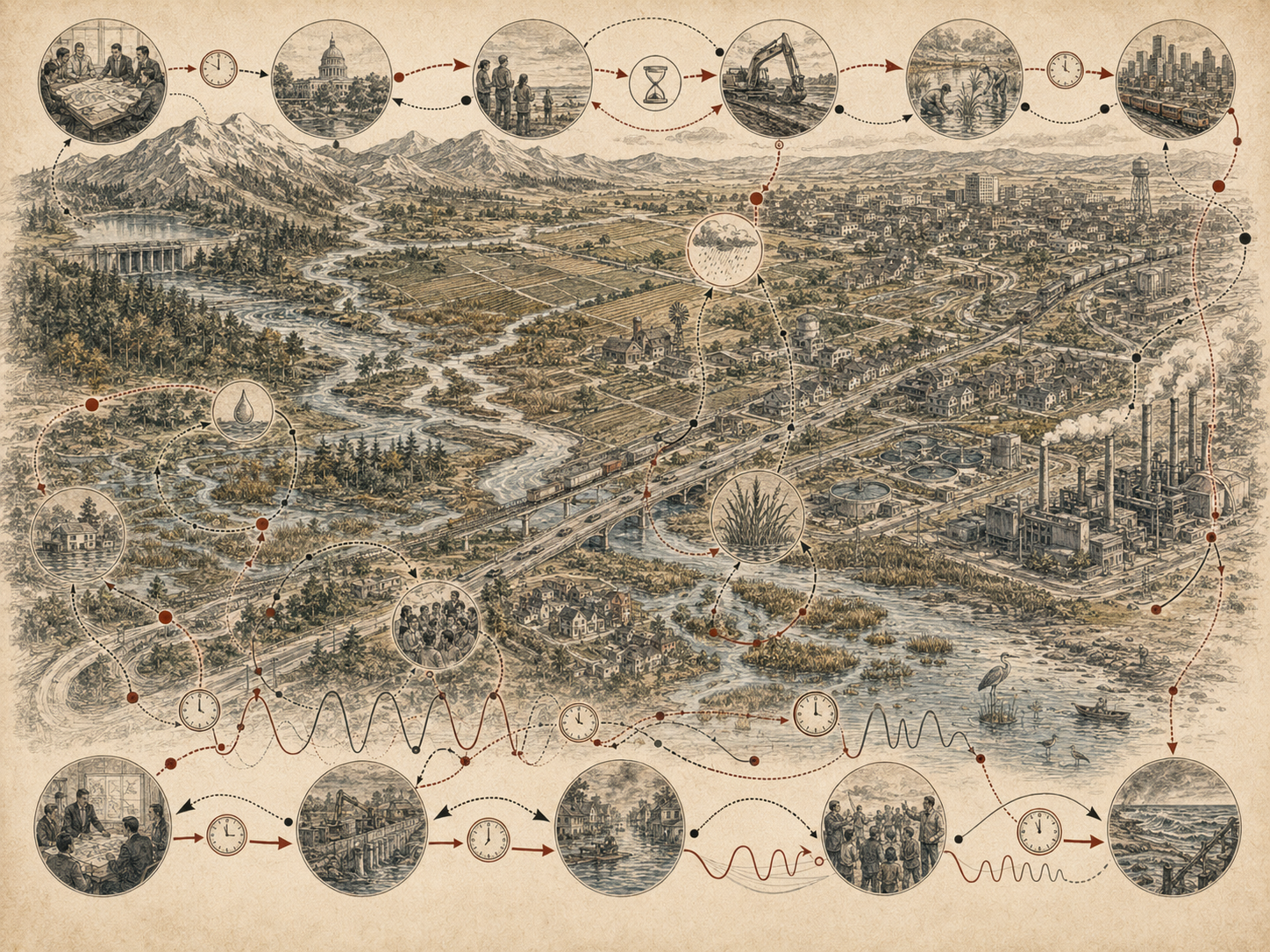
This article examines delayed feedback and policy timing as a central problem in systems thinking. It explains why policies are often judged too early or too late, how delayed consequences distort institutional learning, why feedback lags create oscillation and overcorrection, and how short political, budgetary, and evaluation cycles can misalign with long system dynamics. It also explores the ethical stakes of delayed feedback: who benefits before consequences appear, who pays when they do, and how future people, ecosystems, workers, and marginalized communities often absorb costs created by decisions made elsewhere.
Why Delayed Feedback Matters
Delayed feedback occurs when the consequences of an action are not visible immediately. A policy is adopted, a program is funded, a rule is changed, a regulation is weakened, a technology is deployed, or an infrastructure decision is deferred. The effects may appear months, years, or decades later. In the meantime, the system continues moving. People adapt. Institutions reinterpret evidence. Costs accumulate. Benefits may remain invisible because they take the form of avoided harm.
Delayed feedback matters because learning depends on timely consequence. If feedback comes too late, systems can learn the wrong lesson. A harmful policy may appear successful because its costs have not yet surfaced. A beneficial policy may appear ineffective because its benefits require time. A crisis may seem sudden because the accumulated causes were hidden. A system may overreact because delayed data make present conditions look worse or better than they are.
Policy decisions are especially vulnerable to delayed feedback because policy operates through institutions. A law, rule, budget, standard, incentive, or mandate does not change the world instantly. It must be interpreted, administered, funded, implemented, communicated, monitored, enforced, contested, revised, and absorbed by the people and organizations affected by it. Each step can introduce delay.
| Delay | Policy problem | Systems consequence |
|---|---|---|
| Delayed harm | A damaging policy appears successful in the short term. | Risk accumulates before correction begins. |
| Delayed benefit | A beneficial policy appears ineffective too early. | Prevention, capacity building, and trust repair may be abandoned. |
| Delayed information | Decision-makers rely on old signals. | Policy may respond to yesterday’s system. |
| Delayed implementation | Adoption is mistaken for real-world change. | Institutions are blamed before capacity exists. |
| Delayed recovery | Repair takes longer than damage. | Late intervention may be costly, incomplete, or impossible. |
Systems thinking treats delayed feedback as part of the structure, not as an inconvenience. The central question is not only whether a policy works. It is when the policy works, when evidence becomes visible, when consequences accumulate, when affected people experience change, and when institutions are capable of responding.
Policy Timing as a Systems Problem
Policy timing is often discussed as a political or administrative question: when can a policy be passed, funded, announced, evaluated, or revised? Systems thinking broadens the question. Timing must be matched to the system’s causal dynamics. Some systems respond quickly. Others respond slowly. Some show early signals. Others hide stress until thresholds are crossed. Some policies produce immediate relief but delayed harm. Others produce delayed benefit after an initial period of cost, confusion, or institutional learning.
A policy can fail because it is not timed to the system it is trying to change. If a housing policy is evaluated before construction, affordability, displacement, and neighborhood effects have unfolded, the evaluation may be premature. If climate adaptation waits until disasters become undeniable, the policy may arrive after development patterns, infrastructure exposure, and ecological degradation have already locked in risk. If workforce policy reacts only after resignation spikes, the organization may have already lost trust and institutional memory.
Policy timing requires several distinctions:
- Decision timing: when the policy is adopted.
- Implementation timing: when institutions actually change practice.
- Signal timing: when evidence of system change becomes visible.
- Evaluation timing: when the policy is judged.
- Correction timing: when feedback leads to revision.
- Recovery timing: how long the system takes to repair after harm.
T_{\text{policy}} \neq T_{\text{system}}
\]
Interpretation: Policy time and system time are often misaligned. A policy may be adopted, funded, evaluated, or revised on a schedule that does not match the system’s actual response time.
This mismatch is one reason policy debates often become confused. Supporters may point to early implementation challenges and claim the policy is being sabotaged. Critics may point to the same challenges and claim the policy has failed. Both may be reading the system too early. Conversely, a policy may look successful because the early metrics are favorable while delayed costs remain outside the evaluation window.
Systems thinking asks: what should we expect to see first, what should appear later, what may not be visible at all unless we measure it deliberately, and what delayed harms or benefits should be anticipated before judgment is made?
Feedback Lags, Information Lags, and Implementation Lags
Delayed feedback is not one delay. It is often a chain of delays. A condition changes, but it takes time for the change to affect people. Then it takes time for affected people to report or experience the change in visible ways. Then it takes time for institutions to collect, interpret, and validate the signal. Then it takes time for decision-makers to authorize response. Then it takes time for the response to alter the system.
These delays can be grouped into three broad categories: feedback lags, information lags, and implementation lags. A feedback lag is the time between action and consequence. An information lag is the time between consequence and recognized signal. An implementation lag is the time between decision and changed system behavior.
T_{\text{total}} = T_{\text{effect}} + T_{\text{information}} + T_{\text{decision}} + T_{\text{implementation}}
\]
Interpretation: Total policy delay includes the time required for effects to occur, information to reach decision-makers, decisions to be made, and implementation to change system behavior.
Each delay creates a different governance challenge. If effect delay is long, the system needs leading indicators and precaution. If information delay is long, the system needs better monitoring and stakeholder feedback. If decision delay is long, authority and escalation pathways may need redesign. If implementation delay is long, evaluation must distinguish policy adoption from policy effect.
| Lag type | Core question | Example |
|---|---|---|
| Feedback lag | How long until the consequence appears? | Health effects after exposure, climate effects after emissions, trust effects after repeated institutional behavior. |
| Information lag | How long until the consequence is recognized? | Delayed reporting, fragmented data, ignored complaints, slow evaluation cycles. |
| Decision lag | How long until authority responds? | Budget approvals, legal review, interagency coordination, political negotiation. |
| Implementation lag | How long until action changes the system? | Hiring, construction, training, procurement, technology integration, culture change. |
| Recovery lag | How long until damage is repaired? | Trust rebuilding, ecosystem restoration, workforce rebuilding, infrastructure renewal. |
Policy timing improves when these lags are named separately. A policy that “failed” may have been judged before implementation was complete. A policy that “worked” may have been judged before delayed costs appeared. A system that “responded” may still be acting on information that reflects a past condition.
The more complex the system, the more dangerous it is to treat policy as an instant cause.
Judging Policies Too Early
Policies are often judged too early because political, media, funding, and institutional cycles demand visible results before complex systems have had time to respond. This creates a bias against policies whose benefits are delayed: prevention, capacity building, trust repair, early childhood investment, ecological restoration, workforce development, public-health preparedness, infrastructure maintenance, and climate adaptation.
Prevention is especially vulnerable to premature judgment because its success often appears as an absence. The bridge does not collapse. The outbreak does not spread. The flood damage is lower than it would have been. The worker does not burn out. The student does not disengage. The ecosystem does not cross a threshold. Avoided harm is real, but politically and institutionally difficult to see.
Policies that build capacity also require time. Hiring staff, training workers, developing trust, improving data systems, repairing infrastructure, changing organizational culture, and restoring ecosystems rarely produce immediate full effects. Early measurement may capture transition costs rather than long-term value.
Y_{\text{early}} \neq Y_{\text{long-term}}
\]
Interpretation: Early outcomes may not represent long-term system effects. A policy can look weak early and strong later, or strong early and harmful later.
Premature evaluation creates several risks:
- effective policies are abandoned before benefits appear;
- preventive investments are defunded because avoided harm is hard to measure;
- institutions are punished for transition challenges rather than supported through implementation;
- short-term metrics dominate long-term public value;
- actors learn to favor policies with visible immediate payoff over durable change.
This does not mean policies should be protected from early scrutiny. Early scrutiny is necessary. But early evaluation should focus on appropriate indicators: implementation progress, capacity creation, participation, trust, early-warning signals, process quality, equity of access, and whether the policy is moving the system in the expected direction. It should not demand mature outcomes before system response is plausible.
Systems thinking asks evaluators to distinguish between early failure signals and normal implementation delay. The distinction is difficult, but ignoring it leads to bad policy learning.
Acting Too Late
The opposite timing failure is acting too late. A system can delay action until evidence is overwhelming, but overwhelming evidence often arrives after damage has accumulated. By the time the problem is visible enough to satisfy institutional caution, the system may have lost capacity, trust, ecological resilience, public legitimacy, or financial flexibility.
Late action is common when harms are gradual, distributed, politically inconvenient, or borne by people with little power. Infrastructure deterioration, environmental exposure, climate risk, public distrust, workforce burnout, administrative burden, and ecological degradation often produce early warnings long before crisis. But those warnings may be dismissed as anecdotal, uncertain, too costly to address, outside the budget cycle, or politically difficult.
Late action can also result from institutional incentives. Leaders may benefit from deferring costs. Budgets may reward short-term savings. Political cycles may favor visible projects over preventive maintenance. Organizations may rely on employee overextension until turnover becomes measurable. Markets may reward growth while externalizing long-term risk.
C_{\text{late}} > C_{\text{early}}
\]
Interpretation: In many systems, the cost of late correction exceeds the cost of early prevention because harm accumulates, capacity erodes, and recovery becomes harder.
Late action is not only inefficient. It can be unjust. Waiting for proof can mean waiting for harm to fall repeatedly on affected communities. Waiting for infrastructure failure can mean exposing residents to preventable risk. Waiting for climate impacts to become undeniable can mean shifting costs to future generations and vulnerable ecosystems. Waiting for workforce collapse can mean consuming human capacity while calling it productivity.
Systems thinking asks:
- What early signals are being ignored?
- Who sees the problem first?
- Who has authority to act early?
- Who benefits from delay?
- Who bears the cost of waiting?
- What becomes harder to repair if action is delayed?
- What threshold might be crossed before evidence becomes undeniable?
Late action often reflects a failure to value prevention, early warning, and affected knowledge. Systems governance must learn before crisis, not only after it.
Overcorrection, Oscillation, and Policy Swings
Delayed feedback can cause overcorrection. If decision-makers respond to old information as if it were current, they may act too strongly, too late, or in the wrong direction. The result can be oscillation: policy swings back and forth around a goal rather than moving steadily toward it.
Oscillation often appears when a balancing feedback loop contains delay. A system detects a gap between desired and actual conditions. It responds. But the response takes time. By the time the response has an effect, conditions may have changed. The system then corrects again, often in the opposite direction. This can create repeated cycles of tightening and loosening, expansion and contraction, hiring and freezing, building and cutting, regulating and deregulating.
Policy swings can occur in many domains. Housing policy may alternate between encouraging development and reacting to displacement. Public-health policy may alternate between strict control and rapid relaxation. Monetary policy may respond to lagging indicators and overshoot. Organizations may alternate between hiring surges and layoffs. Schools may swing between punitive discipline and reform without changing deeper conditions.
x_{t+1} = x_t + k(G – x_{t-d})
\]
Interpretation: A delayed balancing response adjusts the current state \(x_t\) toward a goal \(G\) using delayed information \(x_{t-d}\). Larger delays and stronger corrections can produce oscillation.
Overcorrection is not always caused by incompetence. It may be produced by the structure of feedback. If information is delayed, decision cycles are slow, and responses are large, oscillation becomes likely. The system is correcting, but its correction is mistimed.
Reducing oscillation may require:
- shorter information delays;
- more frequent, smaller adjustments;
- better leading indicators;
- clearer implementation tracking;
- buffers and reserves;
- longer evaluation windows;
- adaptive governance rather than crisis-driven reversal;
- distinguishing noise from structural change.
Policy timing is therefore a design problem. A system needs feedback that is fast enough to learn, slow enough to avoid panic, and grounded enough to distinguish temporary fluctuation from meaningful structural change.
Political Cycles, Budget Cycles, and System Time
Policy timing is often distorted by cycles that do not match system dynamics. Elections, budget years, grant periods, quarterly reports, media attention cycles, funding deadlines, procurement timelines, and leadership tenures shape what kinds of feedback matter institutionally. But many systems operate on longer or different timelines.
Infrastructure may require decades of maintenance planning. Ecological restoration may require years before outcomes are visible. Early childhood investment may shape life outcomes over decades. Public trust may take years to rebuild after repeated harm. Climate policy operates across generations. Organizational culture changes slowly even when formal rules change quickly.
When political and budget cycles are shorter than system feedback, institutions may underinvest in long-term capacity. Preventive maintenance is deferred. Ecological damage is discounted. Trust repair is treated as communication strategy rather than repeated performance. Workforce resilience is reduced to wellness programming. The system favors actions that can be announced, counted, and claimed within the decision-maker’s time horizon.
| Cycle | Typical time horizon | Risk when misaligned with system time |
|---|---|---|
| Election cycle | Short to medium term | Visible projects may be favored over long-term prevention. |
| Annual budget cycle | One year | Deferred maintenance and capacity erosion may be hidden. |
| Grant cycle | Fixed funding period | Programs may be judged before mature effects appear. |
| Quarterly performance cycle | Very short term | Output metrics may dominate learning, trust, quality, and resilience. |
| Ecological cycle | Seasonal to generational | Damage may accumulate before institutions recognize it. |
| Infrastructure life cycle | Decades | Short-term savings may produce long-term failure risk. |
Systems thinking asks whether the institution’s decision rhythm matches the system’s feedback rhythm. If not, governance must create mechanisms that protect long-term responsibility: maintenance funds, trust metrics, ecological indicators, independent monitoring, intergenerational accounting, adaptive review, and public accountability beyond leadership turnover.
Policy systems often fail not because they lack information, but because the information that matters arrives outside the cycle that controls decisions.
Leading and Lagging Indicators
Delayed feedback makes indicator design critical. A lagging indicator measures outcomes after they occur. A leading indicator provides earlier evidence of conditions that may produce future outcomes. Both are useful, but they serve different purposes.
Lagging indicators are often easier to understand because they measure visible results: failure rates, mortality, graduation rates, emissions totals, claims, complaints, outages, turnover, costs, or completed cases. But lagging indicators often arrive too late for prevention. By the time they change, the system may already have produced harm.
Leading indicators are earlier signals: maintenance condition, staffing strain, trust levels, response delay, soil moisture, biodiversity signals, absenteeism, workload, service access, debt stress, early health symptoms, or infrastructure stress. Leading indicators are often less politically dramatic, but they are essential for timely intervention.
| Indicator type | What it shows | Policy use | Risk |
|---|---|---|---|
| Leading indicator | Early signal of future risk or improvement. | Supports prevention and early correction. | May be uncertain, indirect, or contested. |
| Lagging indicator | Outcome after the system has already responded. | Confirms impact, harm, or performance. | May arrive too late for prevention. |
| Process indicator | Whether implementation is occurring. | Helps distinguish adoption from actual change. | Can become box-checking if disconnected from outcomes. |
| Stock indicator | Accumulated condition. | Tracks backlog, trust, debt, fatigue, carbon, or capacity. | May be slow-moving and easy to ignore. |
| Distributional indicator | Who is affected differently. | Reveals unequal burden or benefit. | May be hidden by averages if not disaggregated. |
A strong policy timing system uses multiple indicator types. It does not wait for lagging indicators alone. It tracks implementation progress, early signals, accumulated stocks, distributional effects, and delayed outcomes. It also asks whether the indicators are connected to authority. A warning signal is weak if no one has responsibility or power to act on it.
Indicator design is also ethical. Systems often measure what institutions find convenient rather than what affected people experience. A public agency may track completed applications but not discouraged applicants. A school may track test scores but not belonging or exclusion. An organization may track output but not fatigue. A climate policy may track territorial emissions but not outsourced harm. Delayed feedback becomes more dangerous when the wrong indicators define success.
Good policy timing requires early signals that are meaningful, trusted, disaggregated, and actionable.
Precaution, Uncertainty, and Early Action
Delayed feedback creates a difficult governance problem: sometimes action is needed before full certainty is available. Waiting for perfect evidence may mean waiting until damage is visible, widespread, or irreversible. This is especially important in climate systems, public health, ecological protection, infrastructure safety, technology governance, and institutional harm.
Precaution does not mean acting without evidence. It means recognizing that delayed feedback changes the burden of judgment. When the potential harm is severe, irreversible, unequal, or cumulative, systems governance may require early action based on plausible evidence, leading indicators, historical patterns, scientific understanding, and affected experience.
Uncertainty should be analyzed, not used as an automatic excuse for delay. Some uncertainty concerns the existence of harm. Some concerns timing. Some concerns scale. Some concerns distribution. Some concerns the effectiveness of intervention. Systems thinking asks what kind of uncertainty exists and what the cost of waiting might be.
R_{\text{waiting}} = P(H) \times C(H) \times D
\]
Interpretation: The risk of waiting can be understood conceptually as a function of the probability of harm \(P(H)\), the cost of harm \(C(H)\), and delay \(D\). When delay increases irreversibility or accumulated damage, waiting becomes more dangerous.
Early action can take many forms. It may involve full intervention, pilot programs, adaptive monitoring, temporary safeguards, precautionary limits, staged implementation, capacity building, reversible measures, public consultation, or strengthened feedback systems. The point is not always to impose the strongest possible policy immediately. The point is to avoid passive delay when the system is accumulating risk.
Precaution is particularly important when affected communities have less power to force response. A demand for certainty can become a tool for maintaining harmful systems. By the time evidence satisfies those who benefit from the status quo, the people bearing the harm may have absorbed years of avoidable damage.
Systems thinking asks: what evidence is sufficient for early action, what safeguards are justified under uncertainty, what should be monitored, and how can the policy be adjusted as feedback arrives?
Ethics, Power, and Delayed Consequences
Delayed feedback is ethically charged because time can hide responsibility. A policy can produce benefits now and costs later. It can help one group immediately while harming another group gradually. It can create political reward in the present while transferring risk to future residents, workers, communities, ecosystems, or generations.
Power determines whose feedback is heard in time. Financial signals may trigger rapid response. Elite complaints may move institutions quickly. Community warnings may be delayed, studied, or dismissed. Worker stress may be ignored until turnover rises. Ecological signals may be discounted until restoration becomes expensive or impossible. Delayed feedback is not only technical; it is often political.
Some harms are delayed because they are difficult to measure. Others are delayed because institutions choose not to measure them. Administrative burden, fatigue, distrust, ecological depletion, informal care work, community displacement, cultural loss, and intergenerational harm may not appear in official policy feedback unless the system is designed to see them.
Ethical policy timing asks:
- Who benefits before consequences appear?
- Who bears the delayed costs?
- Whose warnings are treated as evidence?
- Whose warnings are treated as anecdote?
- What harms are excluded from the evaluation window?
- What costs are shifted across time or across boundaries?
- What would early repair require?
- What responsibilities exist to future people and ecological systems?
Systems thinking should make delayed consequences visible before they become irreversible. It should also challenge policy frames that declare success inside short time horizons while exporting harm beyond the frame.
Delay is often where power hides. Responsible systems analysis brings that hidden timing into the open.
Examples Across Systems
Delayed feedback and policy timing appear across many systems. The examples below show how timing changes interpretation, accountability, and intervention.
Public health
Public-health policy often operates under delay. Exposure may precede symptoms. Symptoms may precede diagnosis. Diagnosis may precede reporting. Reporting may precede public response. Public response may precede measurable improvement. If institutions wait for lagging indicators, outbreaks, chronic disease burdens, or environmental health harms may already be entrenched. Effective policy timing requires surveillance, trust, leading indicators, and early response capacity.
Infrastructure
Infrastructure policy is shaped by long delays between investment, maintenance, deterioration, and failure. Deferred maintenance produces immediate budget relief but delayed risk. Preventive maintenance produces immediate cost but delayed benefit. If evaluation privileges short-term savings, the system learns to underinvest. A systems approach tracks asset condition, backlog, failure risk, repair cost, service disruption, and community exposure over time.
Climate and ecology
Climate policy is defined by delayed feedback. Emissions accumulate before full effects appear. Ecosystems can absorb stress before crossing thresholds. Restoration may take decades. Waiting for undeniable harm can mean waiting until action becomes more expensive or less effective. Policy timing must therefore use leading indicators, precaution, adaptive monitoring, and long-term responsibility.
Organizations
Organizations often misread delayed workforce feedback. Output may remain high while fatigue accumulates. Leaders may interpret short-term productivity as evidence that workload is sustainable. Later, errors, conflict, disengagement, and turnover reveal the delayed cost. Policy timing inside organizations requires monitoring workload, recovery, trust, capacity, quality, and institutional memory before collapse appears.
Education
Education policy often produces delayed effects. Early childhood investment, literacy support, belonging, mentoring, and family stability may shape outcomes over years. Exclusionary discipline, chronic stress, and unstable housing may also show delayed consequences. Short evaluation windows can understate both benefit and harm. Strong policy timing includes intermediate indicators and long-term outcome tracking.
Artificial intelligence systems
AI governance faces delayed feedback because harms may accumulate across many decisions before becoming visible. A model may perform well during testing but create downstream effects through automation bias, institutional reliance, data drift, appeal failure, or unequal exposure. Policy timing requires post-deployment monitoring, incident reporting, contestability, audit cycles, and early correction before harm scales.
Economic systems
Economic policy often responds to lagging indicators. Employment, inflation, investment, housing supply, and consumer demand can all shift after decisions have been made. Strong correction based on delayed data can produce oscillation. Policy timing requires attention to leading indicators, expectations, distributional effects, and the delay between intervention and real economic response.
Across these domains, delayed feedback changes what responsible action means. It requires humility, early warning, longer time horizons, and correction mechanisms that can learn before crisis becomes the only evidence.
Mathematics, Computation, and Modeling
Delayed feedback and policy timing can be studied through timelines, stock-flow models, delayed feedback equations, scenario analysis, time-series models, leading-indicator dashboards, decision-lag simulations, and adaptive policy models. Modeling helps make timing assumptions explicit. It can show whether an intervention is likely to appear weak early and strong later, strong early and harmful later, or unstable because correction is delayed.
A simple delayed response model can be represented as:
x_{t+1} = x_t + k(G – x_{t-d})
\]
Interpretation: The system adjusts current conditions based on delayed information. When the delay \(d\) is large, policy response may overcorrect or oscillate.
A policy effect with implementation delay can be represented as:
Y_t = \alpha + \beta P_{t-d} + \epsilon_t
\]
Interpretation: The observed outcome \(Y_t\) may depend on a policy \(P\) implemented at an earlier time \(t-d\). Evaluation must account for the delay between adoption and effect.
A stock affected by policy can be represented as:
S_{t+1} = S_t + I(P_t,t) – O(P_t,t)
\]
Interpretation: A policy may change the inflows and outflows that determine a stock such as trust, backlog, debt, carbon, fatigue, or infrastructure condition.
A leading indicator can be represented conceptually as:
L_t \rightarrow Y_{t+d}
\]
Interpretation: A leading indicator \(L_t\) provides early information about an outcome \(Y\) that may appear after delay \(d\).
| Modeling task | Policy timing question | Example use |
|---|---|---|
| Implementation-lag model | How long before a policy changes practice? | Tracking hiring, procurement, infrastructure repair, or program rollout. |
| Delayed-effect model | When should outcomes appear? | Evaluating education, health, climate, trust, or workforce policies. |
| Stock-flow model | What is accumulating before visible change? | Modeling backlog, fatigue, emissions, debt, trust, or ecological stress. |
| Oscillation simulation | Does delayed correction create policy swings? | Studying inventory, staffing, monetary policy, public-health restrictions, or budget cycles. |
| Leading-indicator analysis | What can be measured before lagging outcomes appear? | Designing dashboards for prevention, early warning, and adaptive governance. |
| Scenario comparison | How do early, late, weak, and strong interventions compare? | Testing policy timing under uncertainty, delay, and threshold risk. |
Models should not be treated as substitutes for judgment. They depend on assumptions about delay length, causal strength, system boundaries, data quality, stakeholder experience, political response, and institutional capacity. But when used carefully, modeling can protect policy from two common timing failures: abandoning good action too early and waiting too long to prevent harm.
Python Workflow: Policy Delay, Timing, Leading Indicators, and Adaptive Correction
The Python workflow below turns delayed feedback and policy timing into a small reproducible model. It compares four scenarios: waiting for lagging evidence, premature judgment, leading-indicator governance, and adaptive precautionary timing. The script uses only the Python standard library, writes CSV outputs relative to the article folder, and is designed as a clear starting point for companion repository work.
# delayed_feedback_policy_timing_workflow.py
# Dependency-light workflow for policy timing, implementation lag,
# leading indicators, delayed outcomes, oscillation, and adaptive correction.
# Writes outputs relative to the article root.

from __future__ import annotations

from dataclasses import dataclass
from pathlib import Path
import csv
from statistics import mean

ARTICLE_ROOT = Path(__file__).resolve().parents[1]
TABLES = ARTICLE_ROOT / "outputs" / "tables"


@dataclass
class PolicyTimingScenario:
    name: str
    implementation_capacity: float
    effect_delay: float
    information_lag: float
    decision_lag: float
    leading_indicator_quality: float
    adaptive_correction: float
    precaution: float
    accountability: float
    harm_accumulation_pressure: float


def clamp(value: float, low: float = 0.0, high: float = 120.0) -> float:
    return max(low, min(high, value))


def run_scenario(scenario: PolicyTimingScenario, periods: int = 60) -> list[dict[str, object]]:
    harm_stock = scenario.harm_accumulation_pressure * 46.0
    implementation_stock = 20.0 + scenario.implementation_capacity * 28.0
    leading_signal = scenario.leading_indicator_quality * 32.0
    lagging_signal = harm_stock * 0.45
    policy_memory = scenario.accountability * 34.0
    correction_capacity = 24.0 + scenario.adaptive_correction * 28.0
    harm_history: list[float] = [harm_stock]
    rows: list[dict[str, object]] = []

    effect_delay_steps = max(0, int(round(scenario.effect_delay * 8.0)))
    information_delay_steps = max(0, int(round(scenario.information_lag * 8.0)))
    decision_delay_steps = max(0, int(round(scenario.decision_lag * 8.0)))
    total_delay_steps = effect_delay_steps + information_delay_steps + decision_delay_steps

    for period in range(periods + 1):
        information_index = max(0, len(harm_history) - 1 - information_delay_steps)
        decision_index = max(0, len(harm_history) - 1 - total_delay_steps)
        observed_harm = harm_history[information_index]
        decision_basis = harm_history[decision_index]

        leading_signal = clamp(
            leading_signal
            + scenario.leading_indicator_quality * 1.9
            + scenario.precaution * 1.2
            + scenario.accountability * 1.1
            - scenario.information_lag * 0.8
            - max(0.0, harm_stock - observed_harm) * 0.03,
            0.0,
            100.0
        )

        lagging_signal = clamp(
            lagging_signal
            + 0.22 * (observed_harm - lagging_signal)
            + scenario.leading_indicator_quality * 0.05 * (harm_stock - lagging_signal),
            0.0,
            120.0
        )

        implementation_progress = clamp(
            scenario.implementation_capacity * 18.0
            + scenario.accountability * 8.0
            + policy_memory * 0.08
            - scenario.implementation_capacity * scenario.effect_delay * 3.0,
            0.0,
            100.0
        )

        implementation_stock = clamp(
            implementation_stock
            + implementation_progress * 0.12
            + scenario.implementation_capacity * 1.4
            - max(0.0, harm_stock - 70.0) * 0.04,
            0.0,
            100.0
        )

        early_action = clamp(
            scenario.precaution * 18.0
            + leading_signal * 0.20
            + scenario.accountability * 8.0
            - scenario.decision_lag * 5.0,
            0.0,
            100.0
        )

        delayed_correction = clamp(
            correction_capacity * 0.20
            + lagging_signal * 0.18
            + decision_basis * 0.12
            + scenario.adaptive_correction * 10.0
            - scenario.decision_lag * 5.0,
            0.0,
            100.0
        )

        overcorrection_pressure = clamp(
            delayed_correction * 0.18
            + total_delay_steps * 1.8
            + max(0.0, lagging_signal - harm_stock) * 0.20
            - scenario.adaptive_correction * 5.0
            - scenario.leading_indicator_quality * 4.0,
            0.0,
            100.0
        )

        harm_growth = clamp(
            scenario.harm_accumulation_pressure * 16.0
            + max(0.0, 55.0 - implementation_stock) * 0.16
            + max(0.0, 45.0 - leading_signal) * 0.10
            - early_action * 0.09
            - scenario.accountability * 2.2,
            0.0,
            100.0
        )

        harm_reduction = clamp(
            implementation_stock * 0.13
            + early_action * 0.12
            + delayed_correction * 0.09
            + scenario.precaution * 5.0
            - scenario.effect_delay * 4.0,
            0.0,
            100.0
        )

        harm_stock = clamp(
            harm_stock
            + harm_growth * 0.18
            - harm_reduction * 0.14
            + overcorrection_pressure * 0.02,
            0.0,
            120.0
        )

        correction_capacity = clamp(
            correction_capacity
            + scenario.adaptive_correction * 1.9
            + scenario.accountability * 1.4
            + leading_signal * 0.04
            - overcorrection_pressure * 0.05,
            0.0,
            100.0
        )

        policy_memory = clamp(
            policy_memory
            + scenario.accountability * 1.8
            + scenario.adaptive_correction * 1.2
            + leading_signal * 0.04
            - harm_stock * 0.035,
            0.0,
            100.0
        )

        timing_alignment_score = clamp(
            implementation_stock * 0.18
            + leading_signal * 0.22
            + correction_capacity * 0.20
            + policy_memory * 0.14
            + scenario.precaution * 10.0
            + scenario.accountability * 10.0
            - harm_stock * 0.16
            - overcorrection_pressure * 0.12
            - total_delay_steps * 0.75,
            0.0,
            100.0
        )

        rows.append({
            "period": period,
            "scenario": scenario.name,
            "harm_stock": round(harm_stock, 3),
            "implementation_stock": round(implementation_stock, 3),
            "leading_signal": round(leading_signal, 3),
            "lagging_signal": round(lagging_signal, 3),
            "observed_harm": round(observed_harm, 3),
            "decision_basis": round(decision_basis, 3),
            "early_action": round(early_action, 3),
            "delayed_correction": round(delayed_correction, 3),
            "overcorrection_pressure": round(overcorrection_pressure, 3),
            "correction_capacity": round(correction_capacity, 3),
            "policy_memory": round(policy_memory, 3),
            "timing_alignment_score": round(timing_alignment_score, 3),
        })

        harm_history.append(harm_stock)

    return rows


def write_csv(path: Path, rows: list[dict[str, object]]) -> None:
    path.parent.mkdir(parents=True, exist_ok=True)
    if not rows:
        raise ValueError(f"No rows to write: {path}")
    with path.open("w", newline="", encoding="utf-8") as handle:
        writer = csv.DictWriter(handle, fieldnames=list(rows[0].keys()))
        writer.writeheader()
        writer.writerows(rows)


def summarize(rows: list[dict[str, object]]) -> list[dict[str, object]]:
    output: list[dict[str, object]] = []
    for scenario_name in sorted({row["scenario"] for row in rows}):
        subset = [row for row in rows if row["scenario"] == scenario_name]
        final = subset[-1]
        avg_harm = mean(float(row["harm_stock"]) for row in subset)
        avg_overcorrection = mean(float(row["overcorrection_pressure"]) for row in subset)
        avg_alignment = mean(float(row["timing_alignment_score"]) for row in subset)

        if float(final["timing_alignment_score"]) >= 65 and float(final["harm_stock"]) <= 35:
            diagnostic = "policy timing is aligned with system feedback"
        elif avg_harm >= 55:
            diagnostic = "harm accumulates because feedback arrives too late"
        elif avg_overcorrection >= 45:
            diagnostic = "delayed signals create overcorrection risk"
        elif avg_alignment >= 55:
            diagnostic = "partial timing alignment with remaining delay risk"
        else:
            diagnostic = "policy timing is misaligned with system dynamics"

        output.append({
            "scenario": scenario_name,
            "final_timing_alignment_score": final["timing_alignment_score"],
            "final_harm_stock": final["harm_stock"],
            "final_leading_signal": final["leading_signal"],
            "final_lagging_signal": final["lagging_signal"],
            "final_overcorrection_pressure": final["overcorrection_pressure"],
            "average_harm_stock": round(avg_harm, 3),
            "average_overcorrection_pressure": round(avg_overcorrection, 3),
            "average_timing_alignment_score": round(avg_alignment, 3),
            "diagnostic": diagnostic,
        })

    return output


def main() -> None:
    scenarios = [
        PolicyTimingScenario("Wait for lagging evidence", 0.42, 0.72, 0.76, 0.72, 0.24, 0.26, 0.20, 0.28, 0.76),
        PolicyTimingScenario("Premature judgment cycle", 0.54, 0.64, 0.58, 0.62, 0.42, 0.40, 0.30, 0.38, 0.60),
        PolicyTimingScenario("Leading-indicator governance", 0.68, 0.46, 0.38, 0.42, 0.74, 0.66, 0.64, 0.62, 0.42),
        PolicyTimingScenario("Adaptive precautionary timing", 0.80, 0.32, 0.28, 0.30, 0.84, 0.82, 0.82, 0.82, 0.30),
    ]

    rows: list[dict[str, object]] = []
    for scenario in scenarios:
        rows.extend(run_scenario(scenario))

    write_csv(TABLES / "delayed_feedback_policy_timing_timeseries.csv", rows)
    write_csv(TABLES / "delayed_feedback_policy_timing_summary.csv", summarize(rows))

    print("Delayed feedback and policy timing workflow complete.")
    print(TABLES / "delayed_feedback_policy_timing_timeseries.csv")


if __name__ == "__main__":
    main()
The workflow is intentionally simple enough to inspect. It shows how harm can accumulate when policy relies on lagging evidence, how delayed signals can create overcorrection risk, and how leading indicators, implementation capacity, adaptive correction, precaution, and accountability improve timing alignment. The model is synthetic and illustrative; it supports disciplined inquiry rather than replacing domain expertise, stakeholder evidence, or ethical judgment.
R Workflow: Policy Timing Summary and Delay Visualization
The R workflow reads the Python-generated time-series output, creates policy-timing summaries, and exports base R plots for harm stock, leading signal, lagging signal, overcorrection pressure, and timing alignment. It uses only base R so it remains portable across simple local environments.
# delayed_feedback_policy_timing_diagnostics.R
# Base R workflow for policy timing summary and delay visualization.

args <- commandArgs(trailingOnly = FALSE)
file_arg <- grep("^--file=", args, value = TRUE)

if (length(file_arg) > 0) {
  script_path <- normalizePath(sub("^--file=", "", file_arg[1]), mustWork = TRUE)
  article_root <- normalizePath(file.path(dirname(script_path), ".."), mustWork = TRUE)
} else {
  article_root <- getwd()
}

setwd(article_root)

tables_dir <- file.path(article_root, "outputs", "tables")
figures_dir <- file.path(article_root, "outputs", "figures")

if (!dir.exists(tables_dir)) {
  dir.create(tables_dir, recursive = TRUE)
}

if (!dir.exists(figures_dir)) {
  dir.create(figures_dir, recursive = TRUE)
}

timeseries_path <- file.path(tables_dir, "delayed_feedback_policy_timing_timeseries.csv")

if (!file.exists(timeseries_path)) {
  stop(paste("Missing", timeseries_path, "Run the Python workflow first."))
}

data <- read.csv(timeseries_path, stringsAsFactors = FALSE)

last_by_scenario <- do.call(
  rbind,
  lapply(split(data, data$scenario), function(df) df[nrow(df), ])
)

avg_harm <- aggregate(harm_stock ~ scenario, data = data, FUN = mean)
avg_overcorrection <- aggregate(overcorrection_pressure ~ scenario, data = data, FUN = mean)
avg_alignment <- aggregate(timing_alignment_score ~ scenario, data = data, FUN = mean)

names(avg_harm)[2] <- "average_harm_stock"
names(avg_overcorrection)[2] <- "average_overcorrection_pressure"
names(avg_alignment)[2] <- "average_timing_alignment_score"

final_fields <- last_by_scenario[, c(
  "scenario",
  "timing_alignment_score",
  "harm_stock",
  "leading_signal",
  "lagging_signal",
  "overcorrection_pressure"
)]

names(final_fields) <- c(
  "scenario",
  "final_timing_alignment_score",
  "final_harm_stock",
  "final_leading_signal",
  "final_lagging_signal",
  "final_overcorrection_pressure"
)

summary_table <- Reduce(
  function(x, y) merge(x, y, by = "scenario"),
  list(avg_harm, avg_overcorrection, avg_alignment, final_fields)
)

summary_table$diagnostic <- ifelse(
  summary_table$final_timing_alignment_score >= 65 &
    summary_table$final_harm_stock <= 35,
  "policy timing is aligned with system feedback",
  ifelse(
    summary_table$average_harm_stock >= 55,
    "harm accumulates because feedback arrives too late",
    ifelse(
      summary_table$average_overcorrection_pressure >= 45,
      "delayed signals create overcorrection risk",
      ifelse(
        summary_table$average_timing_alignment_score >= 55,
        "partial timing alignment with remaining delay risk",
        "policy timing is misaligned with system dynamics"
      )
    )
  )
)

write.csv(
  summary_table,
  file.path(tables_dir, "delayed_feedback_policy_timing_r_summary.csv"),
  row.names = FALSE
)

plot_metric <- function(metric, label, file_name) {
  png(file.path(figures_dir, file_name), width = 1200, height = 700)
  scenarios <- unique(data$scenario)
  plot(
    NA,
    xlim = range(data$period),
    ylim = range(data[[metric]], na.rm = TRUE),
    xlab = "Period",
    ylab = label,
    main = paste(label, "by Policy Timing Scenario")
  )
  for (scenario_name in scenarios) {
    subset_data <- data[data$scenario == scenario_name, ]
    lines(subset_data$period, subset_data[[metric]], lwd = 2)
  }
  legend("topleft", legend = scenarios, lwd = 2, cex = 0.8, bty = "n")
  grid()
  dev.off()
}

plot_metric("harm_stock", "Harm stock", "harm_stock_trajectories.png")
plot_metric("leading_signal", "Leading signal", "leading_signal_trajectories.png")
plot_metric("lagging_signal", "Lagging signal", "lagging_signal_trajectories.png")
plot_metric("overcorrection_pressure", "Overcorrection pressure", "overcorrection_pressure_trajectories.png")
plot_metric("timing_alignment_score", "Timing alignment score", "timing_alignment_score_trajectories.png")

print(summary_table)
This workflow supports the article’s central methodological claim: policy should be evaluated on a timeline that matches system feedback. The R outputs help readers compare early action, delayed correction, leading indicators, and lagging signals across scenarios.
GitHub Repository
The companion repository for this article should help readers model delayed feedback, policy timing, implementation lags, leading and lagging indicators, policy oscillation, early-versus-late intervention, and hidden accumulation using synthetic datasets and reproducible workflows.
Complete Code Repository
Companion repository for the article, including delayed-feedback simulations, policy-timing models, implementation-lag analysis, leading-indicator workflows, oscillation examples, early-versus-late intervention scenarios, synthetic datasets, documentation notes, and multi-language scaffolds for systems analysis.
articles/delayed-feedback-and-policy-timing/
├── python/
│   ├── delayed_feedback_policy_timing_workflow.py
│   ├── delayed_feedback_policy_model.py
│   ├── implementation_lag_analysis.py
│   ├── policy_timing_scenarios.py
│   ├── leading_lagging_indicators.py
│   ├── policy_oscillation_simulation.py
│   ├── early_late_intervention_comparison.py
│   ├── validation_checks.py
│   └── run_all_policy_timing_workflows.py
├── r/
│   ├── delayed_feedback_policy_timing_diagnostics.R
│   ├── policy_timing_plots.R
│   ├── delayed_effect_visualization.R
│   ├── leading_lagging_indicator_tables.R
│   ├── implementation_lag_summary.R
│   ├── scenario_comparison.R
│   └── run_all_policy_timing_workflows.R
├── julia/
│   ├── delayed_policy_dynamics.jl
│   └── nonlinear_timing_feedback.jl
├── sql/
│   ├── schema_policy_interventions.sql
│   ├── schema_feedback_lags.sql
│   ├── schema_indicators.sql
│   ├── schema_implementation_milestones.sql
│   ├── schema_scenarios.sql
│   └── schema_model_runs.sql
├── rust/
│   └── policy_timing_diagnostics_cli.rs
├── go/
│   └── delayed_feedback_pathway_utility.go
├── cpp/
│   ├── efficient_policy_delay_model.cpp
│   └── policy_oscillation_simulation.cpp
├── fortran/
│   └── recurrence_policy_timing_model.f90
├── c/
│   └── low_level_policy_delay_simulation.c
├── docs/
│   ├── modeling_principles.md
│   ├── article_notes.md
│   ├── policy_timing_framework.md
│   ├── assumptions_and_limitations.md
│   └── responsible_use.md
├── data/
│   ├── synthetic_policy_interventions.csv
│   ├── synthetic_feedback_lags.csv
│   ├── synthetic_indicators.csv
│   ├── synthetic_implementation_milestones.csv
│   ├── synthetic_scenarios.csv
│   └── synthetic_outcomes.csv
├── outputs/
│   ├── figures/
│   └── tables/
└── notebooks/
    ├── python_policy_timing_walkthrough.ipynb
    └── r_delayed_feedback_visualization_placeholder.ipynb
This repository structure supports the article’s central argument: policy timing must be matched to system feedback. The data/ folder separates policy interventions, feedback lags, indicators, implementation milestones, scenarios, and outcomes. The python/ and r/ folders support delayed-feedback modeling, implementation-lag analysis, leading and lagging indicator comparison, oscillation simulation, and scenario testing. The julia folder supports dynamic and nonlinear timing examples. The sql folder defines schemas for interventions, lags, indicators, milestones, scenarios, and model runs. The lower-level language folders provide scaffolds for efficient timing diagnostics, pathway tracing, recurrence modeling, and delay simulation.
A Practical Method for Policy Timing Analysis
Policy timing analysis can become practical through a disciplined sequence of questions. The goal is to understand whether a policy is being adopted, implemented, evaluated, and revised on a timeline that matches the system it is trying to change.
1. Define the policy action
Start by naming the policy clearly. Is it a rule, budget, incentive, standard, mandate, program, enforcement change, infrastructure investment, monitoring system, or governance reform?
2. Identify the intended system change
State what condition the policy is supposed to change: emissions, trust, backlog, service delay, risk exposure, workforce capacity, housing supply, health outcomes, educational access, or ecological resilience.
3. Map the causal pathway
Identify how the policy is expected to produce change. A policy should not be evaluated without a clear theory of how it reaches the system.
4. Estimate implementation lag
Ask how long it takes for the policy to be funded, staffed, communicated, administered, adopted in practice, and experienced by affected people.
5. Estimate effect lag
Ask when meaningful outcomes should appear. Some effects may be immediate, some intermediate, and some long-term.
6. Identify leading indicators
Select early signals that show whether the system is moving in the expected direction before final outcomes appear.
7. Identify lagging indicators
Define long-term outcomes that should eventually confirm whether the policy worked, failed, shifted burden, or created unintended consequences.
8. Track stocks and accumulations
Ask whether the policy affects accumulated conditions such as backlog, trust, debt, carbon, fatigue, capacity, soil health, institutional memory, or public legitimacy.
9. Test timing scenarios
Compare early, late, weak, strong, phased, and adaptive intervention scenarios. Ask how delay changes cost, harm, feasibility, and distribution.
10. Build adaptive correction
Policy should include feedback mechanisms that allow revision as evidence arrives. Good timing is not one perfect moment. It is an ongoing learning process.
This method helps distinguish genuine policy failure from premature judgment, and genuine policy success from short-term appearance. It also asks whether waiting itself is producing harm.
Common Pitfalls
Delayed feedback and policy timing are often misunderstood. Several pitfalls recur across policy, governance, organizational, technological, and sustainability systems.
- Confusing adoption with implementation: A policy has not changed the system merely because it has been passed, announced, or funded. Implementation requires capacity, authority, practice, and time.
- Judging outcomes before effects can appear: Some policies require long time horizons. Early evaluation should focus on implementation, leading indicators, and expected transition dynamics.
- Ignoring delayed harms: A policy can look successful when only early benefits are counted. Delayed costs, externalities, and long-term burdens must be tracked.
- Waiting for undeniable evidence: In systems with irreversible or cumulative harm, undeniable evidence may arrive too late. Precaution and early warning matter.
- Using lagging indicators as the only evidence: Lagging indicators confirm outcomes after the fact. They are not enough for prevention or adaptive governance.
- Overcorrecting based on delayed signals: Policy swings can occur when institutions respond strongly to old data. Smaller, more frequent, adaptive adjustments may reduce oscillation.
- Ignoring distribution over time: A policy may create early benefits for one group and delayed costs for another. Timing analysis should be distributional.
- Letting political time dominate system time: Election, budget, and reporting cycles often misalign with ecological, infrastructural, educational, health, and institutional dynamics.
The central pitfall is treating timing as a procedural detail. In systems thinking, timing is part of causality.
Why Timing Is a Systems Issue
Delayed feedback and policy timing matter because systems do not respond instantly to decisions. They absorb, reinterpret, resist, amplify, delay, and redistribute consequences. A policy that appears successful early may create delayed harm. A policy that appears weak early may be building long-term capacity. A crisis that appears sudden may be the late signal of accumulated risk. A correction that appears decisive may produce oscillation if it responds to delayed information.
Systems thinking improves policy judgment by aligning evaluation with system time. It asks when effects should appear, what leading indicators should be monitored, what harms may be delayed, what stocks are accumulating, who experiences consequences first, and who has the authority to act before crisis. It also asks whether the system is designed to learn from feedback while there is still time to change course.
This is especially important for sustainability, public health, climate adaptation, infrastructure, education, artificial intelligence, organizational governance, economic policy, and institutional reform. These systems often punish short horizons and reward early prevention, even when prevention is politically difficult to prove.
Responsible policy is not only about choosing the right intervention. It is about acting, learning, evaluating, and correcting at the right time for the system being changed.
Related Articles
- Delays, Oscillation, and Misperception
- Behavior Over Time and Structural Explanation
- Feedback Loop Polarity and Causal Signs
- Overshoot, Collapse, and Correction
- Dynamic Complexity and Policy Resistance
- Stocks, Flows, and Accumulation
- Stock and Flow Diagrams
- Nonlinear Change and Threshold Effects
Further Reading
- Meadows, Donella H. Thinking in Systems: A Primer. Chelsea Green Publishing.
- Sterman, John D. Business Dynamics: Systems Thinking and Modeling for a Complex World. Irwin/McGraw-Hill.
- Forrester, Jay W. Industrial Dynamics. MIT Press.
- Senge, Peter M. The Fifth Discipline: The Art and Practice of the Learning Organization. Doubleday/Currency.
- Richardson, George P. Feedback Thought in Social Science and Systems Theory. University of Pennsylvania Press.
- Rittel, Horst W.J. and Webber, Melvin M. “Dilemmas in a General Theory of Planning.” Policy Sciences.
- Ostrom, Elinor. Understanding Institutional Diversity. Princeton University Press.
References
- Forrester, J.W. (1961) Industrial Dynamics. Cambridge, MA: MIT Press.
- Meadows, D.H. (2008) Thinking in Systems: A Primer. White River Junction, VT: Chelsea Green Publishing. Available at: https://www.chelseagreen.com/product/thinking-in-systems/
- MIT OpenCourseWare (2013) Introduction to System Dynamics. Massachusetts Institute of Technology. Available at: https://ocw.mit.edu/courses/15-871-introduction-to-system-dynamics-fall-2013/
- Ostrom, E. (2005) Understanding Institutional Diversity. Princeton, NJ: Princeton University Press.
- Richardson, G.P. (1991) Feedback Thought in Social Science and Systems Theory. Philadelphia: University of Pennsylvania Press.
- Rittel, H.W.J. and Webber, M.M. (1973) “Dilemmas in a General Theory of Planning.” Policy Sciences, 4, pp. 155–169.
- Senge, P.M. (1990) The Fifth Discipline: The Art and Practice of the Learning Organization. New York: Doubleday/Currency.
- Sterman, J.D. (1989) “Misperceptions of Feedback in Dynamic Decision Making.” Organizational Behavior and Human Decision Processes, 43(3), pp. 301–335.
- Sterman, J.D. (2000) Business Dynamics: Systems Thinking and Modeling for a Complex World. Boston: Irwin/McGraw-Hill.