
Last Updated June 1, 2026
Feedback-loop diagrams are useful only when their causal relationships are clear. A systems map filled with arrows may look sophisticated, but if the arrows do not specify how variables influence one another, the diagram can become confusing or misleading. Feedback loop polarity and causal signs provide the grammar that makes causal-loop diagrams interpretable. They show whether variables move in the same direction or opposite directions, whether a loop reinforces change or balances it, and how local relationships combine into system behavior over time.
In systems thinking, a plus sign does not mean good, and a minus sign does not mean bad. A positive causal link means that two variables tend to move in the same direction, all else equal. A negative causal link means that two variables tend to move in opposite directions, all else equal. These signs describe causal direction, not moral value. A positive loop can amplify trust or amplify collapse. A negative link can reduce risk or reduce opportunity. Understanding this distinction is essential for serious systems analysis.
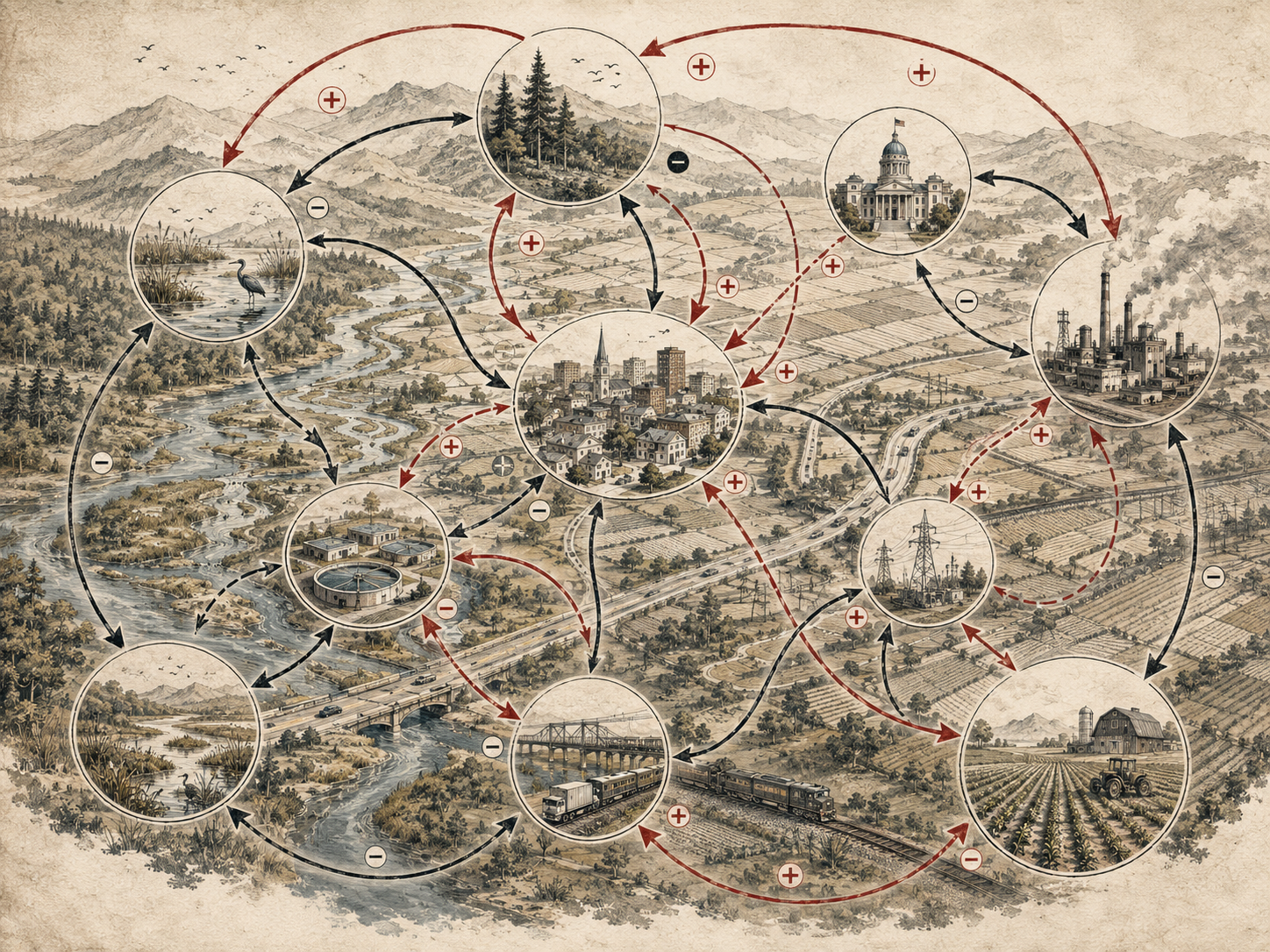
This article explains how causal signs and loop polarity work in systems thinking. It distinguishes link polarity from loop polarity, explains why variables must be phrased as quantities that can rise or fall, shows how positive and negative links combine into reinforcing or balancing loops, and examines common mistakes that make causal-loop diagrams misleading. It also explains why polarity is ethically important: causal signs shape how systems explain responsibility, intervention, correction, harm, benefit, and unintended consequences.
Why Polarity Matters in Systems Thinking
Polarity matters because systems thinking is not only about identifying connections. It is about understanding how one change affects another. Two variables may be connected, but the connection is incomplete until the analyst specifies the direction of influence. Does an increase in one variable tend to increase the other? Does it tend to decrease the other? Is the effect delayed, conditional, nonlinear, or mediated by another variable?
Causal-loop diagrams use signs to answer these questions. A positive sign indicates that two variables move in the same direction, all else equal. A negative sign indicates that they move in opposite directions, all else equal. These simple signs help analysts identify whether a loop is reinforcing or balancing. They also help prevent vague systems language. A diagram that says everything is connected without explaining how it is connected is not yet a causal model.
Polarity also matters because feedback loops generate behavior over time. If the signs are wrong, the interpretation of the loop may be wrong. A loop labeled reinforcing may actually be balancing. A loop that appears to stabilize a system may actually amplify decline. A policy intervention may be designed around a mistaken causal sign and produce unintended consequences.
For example, if an organization assumes that more monitoring always improves quality, it may draw a positive link from monitoring to quality. But if monitoring increases fear, reduces trust, encourages hiding problems, and shifts attention toward compliance rather than learning, the relationship may be negative under certain conditions. The sign is not a decoration. It is a causal claim.
| Polarity question | Systems purpose | Example |
|---|---|---|
| Does this variable increase or decrease another variable? | Clarifies causal direction. | More staffing tends to reduce response delay. |
| Do the variables move in the same or opposite direction? | Assigns causal sign. | More trust tends to increase cooperation. |
| Does the causal chain close back on itself? | Identifies feedback. | Trust improves cooperation, cooperation improves performance, performance improves trust. |
| Does the full loop amplify or counteract change? | Determines loop polarity. | Trust and cooperation form a reinforcing loop. |
| Is the sign stable under all conditions? | Tests limits and assumptions. | More rules may improve safety up to a point, then create overload or evasion. |
Polarity is therefore a discipline of causal clarity. It forces the analyst to say what each relationship means. It also makes disagreement visible. Stakeholders may disagree about whether a relationship is positive, negative, delayed, or conditional. That disagreement is valuable because it exposes different mental models of how the system works.
Variables Must Be Quantities That Can Change
Before assigning causal signs, the analyst must define variables clearly. A variable in a causal-loop diagram should be something that can increase or decrease. It should represent a condition, level, rate, stock, flow, perception, capacity, risk, trust, demand, delay, cost, quality, pressure, legitimacy, exposure, or other changing quantity.
Many weak causal-loop diagrams fail because their variables are not real variables. They use vague labels such as “problems,” “policy,” “culture,” “technology,” “people,” or “leadership.” These may be topics, but they are not specific enough for polarity analysis. A causal sign cannot be assigned meaningfully unless the analyst knows what it means for the variable to rise or fall.
For example, “policy” is too broad. “Policy enforcement capacity” can increase or decrease. “Policy complexity” can increase or decrease. “Policy legitimacy” can increase or decrease. “Policy responsiveness” can increase or decrease. Each of these variables could have different causal relationships.
| Weak label | Better variable | Why it is better |
|---|---|---|
| Problems | Number of unresolved service requests | Can increase or decrease and can be measured or estimated. |
| Policy | Policy complexity | Clarifies which feature of policy is changing. |
| Culture | Psychological safety | More specific and connected to behavior. |
| Infrastructure | Infrastructure maintenance backlog | Identifies an accumulated stock. |
| Technology | Automation dependency | Specifies the system condition affected by technical design. |
| Public response | Public trust in the institution | Names the variable that can rise or fall over time. |
Clear variables make causal signs interpretable. If “workload” increases, “stress” may increase. If “staffing capacity” increases, “response delay” may decrease. If “public trust” increases, “cooperation” may increase. If “maintenance backlog” increases, “failure risk” may increase. The signs become meaningful because the variables are directional.
Variables should also avoid built-in moral judgment when possible. “Bad leadership” is not a good variable. “Leadership responsiveness,” “clarity of decision rights,” or “frequency of contradictory priorities” is more useful. “Broken system” is not a good variable. “Service delay,” “appeal success rate,” “maintenance backlog,” “case-processing capacity,” or “institutional trust” is more precise.
Good variable naming is an ethical issue as well as a technical issue. Labels can blame people, hide structures, or naturalize assumptions. A variable called “resident noncompliance” frames behavior differently from “administrative burden,” “service accessibility,” or “trust in public agency.” The causal signs that follow depend on how the system is named.
Before drawing signs, define variables carefully. A causal diagram is only as strong as the language from which it is built.
Positive Causal Links
A positive causal link means that two variables tend to move in the same direction, all else equal. If the first variable increases, the second tends to increase above what it otherwise would have been. If the first variable decreases, the second tends to decrease below what it otherwise would have been. Positive links are often marked with a plus sign or the letter “s” for same direction.
A \xrightarrow{+} B
\]
Interpretation: A positive causal link means that \(A\) and \(B\) tend to move in the same direction, all else equal. More \(A\) tends to produce more \(B\); less \(A\) tends to produce less \(B\).
Examples of positive causal links include:
- More workload tends to increase worker stress.
- More trust tends to increase cooperation.
- More maintenance backlog tends to increase failure risk.
- More service demand tends to increase queue length.
- More practice tends to increase skill.
- More public legitimacy tends to increase voluntary compliance.
- More ecological degradation tends to increase restoration difficulty.
- More platform engagement data tends to increase recommendation confidence.
The word “positive” can be misleading because it sounds favorable. In systems thinking, it is not. A positive link can describe a harmful relationship. If more misinformation increases public confusion, that is a positive causal link. If more debt increases interest burden, that is a positive causal link. If more distrust increases institutional conflict, that is a positive causal link. The sign describes movement, not desirability.
A positive link should be interpreted with the phrase “all else equal.” This matters because real systems contain multiple causes. More staffing may reduce delay if demand remains stable, but if demand rises faster than staffing, delay may still increase. The causal sign describes the direction of influence from one variable to another, not the total observed outcome in all circumstances.
Positive links also require attention to time. Some same-direction effects are immediate. Others are delayed. More investment in preventive maintenance may eventually increase infrastructure reliability, but the effect may take time. More trust-building effort may eventually increase legitimacy, but only after repeated credible action. The link may be positive while the result is delayed.
When assigning a positive sign, the analyst should ask: in what direction does the dependent variable move because of this causal influence, compared with what would otherwise happen?
Negative Causal Links
A negative causal link means that two variables tend to move in opposite directions, all else equal. If the first variable increases, the second tends to decrease below what it otherwise would have been. If the first variable decreases, the second tends to increase above what it otherwise would have been. Negative links are often marked with a minus sign or the letter “o” for opposite direction.
A \xrightarrow{-} B
\]
Interpretation: A negative causal link means that \(A\) and \(B\) tend to move in opposite directions, all else equal. More \(A\) tends to produce less \(B\); less \(A\) tends to produce more \(B\).
Examples of negative causal links include:
- More staffing capacity tends to reduce response delay.
- More preventive maintenance tends to reduce failure risk.
- More public transparency tends to reduce suspicion.
- More effective insulation tends to reduce household energy burden.
- More biodiversity tends to reduce ecosystem vulnerability.
- More appeal access tends to reduce uncorrected administrative error.
- More early warning capacity tends to reduce crisis severity.
- More workload control tends to reduce burnout risk.
As with positive links, negative does not mean bad. A negative link may describe a beneficial causal relationship. More staffing reducing delay is usually desirable. More ecological restoration reducing flood risk may be desirable. More public accountability reducing abuse may be desirable. The sign simply means opposite-direction movement.
Negative links are especially important in balancing loops. Many balancing loops work by detecting a gap and reducing it. If a system detects higher risk, it may increase corrective action. Corrective action may reduce risk. The relationship from corrective action to risk is negative. That negative link helps the system counteract change.
Negative links can also be harmful. More surveillance may reduce visible dissent. More punishment may reduce reporting of problems. More procedural complexity may reduce access. More cost cutting may reduce organizational capacity. These are negative causal links, but their consequences may be ethically troubling.
A negative link should always be interpreted through a clear variable name. If the variable is “safety,” then “more safety reduces harm” seems obvious. But if the variable is “punitive enforcement,” its relationship with harm may be complex. It may reduce some visible incidents while increasing mistrust, avoidance, or long-term vulnerability. The causal sign depends on the actual mechanism.
Link Polarity and Loop Polarity
Link polarity and loop polarity are related but different. Link polarity describes the causal sign between two variables. Loop polarity describes the behavior of an entire closed loop. A loop may contain several positive and negative links. The combination of signs determines whether the loop is reinforcing or balancing.
A link says how one variable affects another. A loop says how a chain of effects returns to influence itself. The loop is reinforcing if the full cycle amplifies the original change. The loop is balancing if the full cycle counteracts the original change.
\text{Loop polarity} = \prod_{i=1}^{n} s_i
\]
Interpretation: If each causal link sign \(s_i\) is represented as \(+1\) or \(-1\), the product of the signs determines loop polarity. A positive product indicates a reinforcing loop; a negative product indicates a balancing loop.
A loop with zero or an even number of negative links is reinforcing. A loop with an odd number of negative links is balancing. This rule is useful because it prevents confusion when loops contain multiple negative links.
| Number of negative links | Loop polarity | Typical behavior |
|---|---|---|
| Zero | Reinforcing | Amplifies change. |
| One | Balancing | Counteracts change. |
| Two | Reinforcing | Amplifies change. |
| Three | Balancing | Counteracts change. |
| Even number | Reinforcing | Change returns in the same direction. |
| Odd number | Balancing | Change returns in the opposite direction. |
For example, consider a trust loop. More public trust increases cooperation. More cooperation improves service performance. Better service performance increases public trust. All links are positive. The loop is reinforcing because trust helps produce more trust through cooperation and performance.
Now consider a workload control loop. Higher workload increases pressure for staffing. More staffing reduces workload. The first link is positive. The second link is negative. There is one negative link, so the loop is balancing. It counteracts workload growth by adding capacity.
The distinction between link and loop polarity helps analysts avoid a common mistake: assuming that any loop with a negative sign is balancing. That is not true. A loop with two negative signs is reinforcing because the effects reverse twice and return in the same direction. The full loop matters, not one link alone.
From Causal Signs to Reinforcing and Balancing Loops
Reinforcing and balancing loops are the major dynamic patterns produced by causal signs. A reinforcing loop amplifies change. A balancing loop counteracts change. These loop types are not moral categories. They are behavioral categories.
A reinforcing loop can contain all positive links, or it can contain an even number of negative links. Consider a fear-and-silence loop in an organization. More fear reduces problem reporting. Less problem reporting reduces visible evidence of risk. Lower visible evidence reduces corrective action. Less corrective action increases future failures. Future failures increase fear. Some links may be negative, but the loop can still reinforce deterioration depending on how the variables are phrased.
A balancing loop contains an odd number of negative links. Consider a temperature regulation loop. Higher temperature increases cooling action. More cooling action reduces temperature. The loop counteracts the original increase. Similarly, higher service delay may increase process-improvement effort, and more effective process-improvement effort may reduce service delay. The loop is balancing.
\text{Reinforcing loop: } \Delta A \rightarrow \Delta B \rightarrow \Delta C \rightarrow \Delta A
\]
Interpretation: In a reinforcing loop, change returns to support more change in the same direction.
\text{Balancing loop: } \Delta A \rightarrow \Delta B \rightarrow \Delta C \rightarrow -\Delta A
\]
Interpretation: In a balancing loop, change returns to counteract the original change.
The same variables can sometimes participate in multiple loops. Public trust may be part of a reinforcing cooperation loop and a balancing accountability loop. Workload may be part of a reinforcing burnout loop and a balancing staffing loop. Maintenance backlog may be part of a reinforcing deterioration loop and a balancing investment loop. System behavior depends on which loops dominate under which conditions.
This is why causal signs are the beginning of analysis, not the end. After assigning signs and loop polarity, the analyst must ask what behavior the loop generates over time, what delays exist, what stocks accumulate, what boundaries shape interpretation, and what evidence supports the proposed relationships.
Loop polarity helps identify structure. Behavior-over-time evidence helps test whether the structure is plausible.
Why Delays Are Not Causal Signs
Delays are often shown on causal-loop diagrams, but they are not causal signs. A delay indicates a time gap between cause and effect. It does not tell whether the variables move in the same or opposite direction. A link can be positive and delayed, or negative and delayed.
For example, more preventive maintenance may reduce failure risk, but the effect may take time. That is a negative link with delay. More trust-building effort may increase public legitimacy, but only after repeated credible action. That is a positive link with delay. More emissions may increase climate risk, but effects may appear over long time horizons. That is a positive link with delay.
A_t \xrightarrow{+,\ d} B_{t+d}
\qquad
A_t \xrightarrow{-,\ d} B_{t+d}
\]
Interpretation: A causal link can be positive or negative and also delayed. The delay \(d\) describes timing, not direction.
Delays are important because they change system behavior. A balancing loop with delay can oscillate. A reinforcing loop with delayed limits can overshoot. A policy with delayed benefits may be abandoned too early. A harmful practice with delayed costs may be continued too long. But the delay itself does not determine whether the link is positive or negative.
Confusing delay with polarity can lead to serious errors. An analyst may see a delayed improvement and assume the intervention has a weak or negative relationship with the outcome. In reality, the relationship may be positive but slow. Another analyst may see no immediate harm from a decision and assume the relationship is harmless. In reality, the relationship may be harmful but delayed.
Systems thinking asks four separate questions:
- What is the causal direction?
- What is the causal sign?
- How long is the delay?
- How does the delay affect behavior over time?
Good causal-loop diagrams mark delays clearly, but they do not treat delay as a substitute for polarity. Direction, sign, and timing must all be specified.
Reading Causal-Loop Diagrams Carefully
Reading a causal-loop diagram requires more than following arrows. The analyst must interpret variables, signs, loops, delays, boundaries, evidence, and behavior over time. A diagram should be read as a set of causal claims, not as a picture of complexity.
A disciplined reading begins with variable names. Are the variables clear? Can they increase or decrease? Are they framed neutrally enough to support analysis? Then the reader examines each link. What is the mechanism? Is the sign positive or negative? Is the effect immediate or delayed? Is the relationship supported by evidence, experience, theory, or stakeholder knowledge?
Next, the reader traces loops. Does the causal chain close? How many negative links are in the loop? Is the loop reinforcing or balancing? What behavior would the loop generate if it dominated? Does that behavior match observed behavior over time?
A careful reading also asks what is missing. What variables were excluded? What boundary defines the diagram? Are power, resources, constraints, ecological conditions, historical causes, affected stakeholders, or institutional rules missing? A diagram can be technically correct inside a boundary and still be misleading if the boundary excludes essential causes or consequences.
| Reading step | Question | Why it matters |
|---|---|---|
| Check variables | Can each variable rise or fall? | Unclear variables make signs meaningless. |
| Check links | What mechanism connects the variables? | Arrows should represent causal claims. |
| Check signs | Same direction or opposite direction? | Signs determine loop polarity. |
| Check delays | Where does timing matter? | Delays can produce oscillation, overshoot, or misperception. |
| Check loops | Does the causal chain close? | Closed loops generate feedback behavior. |
| Check behavior | What pattern would the loop produce over time? | A loop should explain observed system behavior. |
| Check boundaries | What is outside the diagram? | Excluded variables may change the explanation. |
Causal-loop diagrams can be especially useful in group settings because they reveal different mental models. One stakeholder may believe that more enforcement reduces harm. Another may believe that more enforcement reduces trust, which reduces cooperation, which increases long-term harm. The disagreement is not only about values. It is also about causal signs and feedback structure.
A good systems diagram invites scrutiny. It should make causal assumptions visible enough to question, revise, and test.
Ambiguous, Conditional, and Nonlinear Signs
Not every causal relationship has a stable sign across all conditions. Some relationships are conditional, nonlinear, threshold-dependent, or context-sensitive. This does not make causal signs useless. It means signs must be assigned carefully, with assumptions documented.
For example, more rules may reduce risk when a system lacks basic safeguards. But after a point, more rules may increase complexity, reduce flexibility, slow response, encourage box-checking, or push behavior underground. The relationship between rules and safety may be positive at low levels of regulation and negative at high levels of bureaucratic complexity.
More technology may increase efficiency in one context and reduce it in another. More data may improve decision-making when data are meaningful and usable, but may reduce decision quality when data overloads staff, creates false precision, or excludes lived experience. More public participation may improve legitimacy when participation is meaningful, but may reduce trust when it is symbolic, burdensome, or ignored.
\frac{\partial B}{\partial A} =
\begin{cases}
+, & A < T \\ -, & A \geq T \end{cases} \]
Interpretation: A causal sign may change after a threshold \(T\). The relationship between \(A\) and \(B\) is positive under one condition and negative under another.
Conditional signs require careful explanation. A diagram can show the dominant relationship under a defined boundary, time horizon, or operating range. But the analyst should document the condition. “More staffing reduces delay” may be true when staffing is deployed effectively. It may not hold if training, coordination, tools, or role clarity are poor. “More transparency increases trust” may be true when transparency is credible and actionable. It may not hold if transparency reveals harm without accountability.
Nonlinear relationships can also require different diagramming choices. Sometimes it is better to split one variable into two. Instead of “rules,” the analyst might use “minimum safety standards” and “procedural complexity.” Instead of “technology use,” the analyst might distinguish “automation support” from “automation dependency.” Instead of “participation,” the analyst might distinguish “meaningful participation” from “consultation burden.”
Systems thinking should not force false simplicity. If a sign is uncertain, conditional, or contested, the diagram should say so. The purpose of causal signs is not to pretend uncertainty does not exist. It is to make causal assumptions explicit enough to examine.
Ethics, Power, and Causal Sign Interpretation
Causal signs are not morally neutral in their consequences. They shape how problems are explained, who is blamed, what interventions appear reasonable, and what harms become visible. A mistaken sign can lead to harmful action. A politically convenient sign can protect power. A narrow sign can hide delayed or externalized effects.
Consider public assistance. If policymakers assume that increasing verification requirements reduces fraud and improves program integrity, they may draw a negative link from verification burden to fraud. But if increased verification also reduces access for eligible people, increases administrative burden, delays support, and erodes trust, the diagram is incomplete. The sign on one link may be technically plausible, but the broader feedback structure may reveal harm.
Consider workplace monitoring. Leaders may assume that more monitoring increases productivity. But if monitoring reduces trust, increases stress, discourages honest reporting, and shifts attention toward performative compliance, the long-term relationship with real productivity may be negative. The causal sign depends on the mechanism and time horizon.
Power shapes which signs become official. Institutions often define causal relationships in ways that justify their preferred interventions. If a problem is framed as individual noncompliance, the system may assign positive links from enforcement to improvement. If the same problem is framed as distrust, burden, exclusion, or resource scarcity, the signs and loops may change. The diagram becomes a site of contestation.
Ethical causal-sign analysis asks:
- Who assigned the sign?
- What evidence supports it?
- Whose experience might contradict it?
- What time horizon does it assume?
- Does the sign hide delayed effects?
- Does the sign count externalized costs?
- Who benefits if the sign is accepted?
- Who bears harm if the sign is wrong?
Causal signs should therefore be treated as claims that require accountability. They are not merely diagram notation. They are statements about how the world works. When those statements guide policy, technology, organizational design, infrastructure investment, public health, education, or ecological governance, the stakes are real.
Systems thinking becomes more responsible when it makes causal signs visible, contestable, and evidence-seeking.
Examples Across Systems
Feedback loop polarity and causal signs appear across many systems. The examples below show how signs shape interpretation and intervention.
Public health
More public trust tends to increase cooperation with public-health guidance. That is a positive link. More cooperation tends to improve health outcomes. Better outcomes can increase trust. This forms a reinforcing loop. But more misinformation may reduce trust, a negative link. More delayed communication may increase uncertainty, a positive link from communication delay to uncertainty. The signs help show why public health depends on trust, timing, access, and credibility.
Infrastructure
More preventive maintenance tends to reduce failure risk. That is a negative link. More failure risk tends to increase emergency repair demand. More emergency repair demand can reduce funds available for preventive maintenance if budgets are fixed. That negative relationship can create a reinforcing deterioration loop. The signs reveal why deferred maintenance can become self-reinforcing.
Organizations
More workload tends to increase stress. More stress tends to increase errors. More errors increase rework. More rework increases workload. These are mostly positive links, forming a reinforcing overload loop. A balancing loop may occur if higher workload increases staffing action and more staffing reduces workload. If staffing is delayed, the balancing loop may oscillate or fail to prevent burnout.
Education
More belonging tends to increase participation. More participation tends to improve learning. More learning success tends to increase belonging. This is a reinforcing learning loop. By contrast, more exclusionary discipline may reduce classroom disruption in the short term, but may also reduce belonging, reduce participation, and increase long-term disengagement. Different time horizons can change how signs are interpreted.
Artificial intelligence systems
More user engagement can increase training or recommendation data. More recommendation data can increase system confidence in similar content. More similar recommendations can increase engagement. This can form a reinforcing loop. If the content being reinforced is harmful, biased, polarizing, or misleading, the loop may amplify risk. Balancing loops require auditing, moderation, appeal, user control, and governance mechanisms that reduce harm.
Climate and ecology
More atmospheric warming tends to reduce ice cover. Less ice cover reduces reflectivity. Lower reflectivity increases heat absorption. More heat absorption increases warming. Some links are negative and some positive depending on variable wording, but the full loop is reinforcing. Careful signs help prevent confusion in ecological feedback analysis.
Economic systems
More confidence can increase investment. More investment can increase employment. More employment can increase income. More income can increase demand. More demand can increase confidence. This is reinforcing. But inflation, interest rates, resource constraints, or regulatory response may create balancing loops. Economic behavior depends on multiple signed relationships operating across time.
Across these examples, causal signs do not merely label relationships. They help explain how system behavior is produced.
Mathematics, Computation, and Modeling
Causal signs can be represented formally using signed graphs, adjacency matrices, causal-loop diagrams, stock-flow models, and dynamic simulations. These representations help analysts check whether a loop is reinforcing or balancing, identify feedback pathways, test assumptions, and compare scenarios.
A signed causal graph can be represented as:
G_s = (V, E, \sigma)
\]
Interpretation: A signed causal graph \(G_s\) contains variables \(V\), causal edges \(E\), and a sign function \(\sigma\) that assigns each edge a positive or negative polarity.
A signed adjacency matrix can represent causal signs:
A_{ij} =
\begin{cases}
+1, & \text{if variable } i \text{ increases variable } j \\
-1, & \text{if variable } i \text{ decreases variable } j \\
0, & \text{if no direct causal link is specified}
\end{cases}
\]
Interpretation: A signed matrix records whether one variable has a positive, negative, or unspecified direct causal influence on another variable.
Loop polarity can be computed by multiplying the signs of all links in a closed loop:
P_{\text{loop}} = \prod_{e \in L} \sigma(e)
\]
Interpretation: The polarity of loop \(L\) is the product of the signs of its edges. A positive product indicates a reinforcing loop; a negative product indicates a balancing loop.
A dynamic relationship can be written conceptually as:
x_{j,t+1} = x_{j,t} + \beta_{ij}x_{i,t}
\]
Interpretation: If \(\beta_{ij} > 0\), variable \(i\) has a positive influence on variable \(j\). If \(\beta_{ij} < 0\), the influence is negative. Real systems often require nonlinear, delayed, and bounded versions of this relationship.
| Modeling task | Polarity question | Example use |
|---|---|---|
| Signed graph construction | Which variables influence one another, and with what sign? | Mapping trust, workload, backlog, risk, capacity, and legitimacy relationships. |
| Loop detection | Which causal pathways close into feedback loops? | Identifying reinforcing and balancing loops in institutional systems. |
| Loop polarity calculation | Does the loop amplify or counteract change? | Classifying loops in causal-loop diagrams. |
| Delay annotation | Which causal links operate slowly? | Studying oscillation, overshoot, and policy misperception. |
| Scenario comparison | What changes if a sign, strength, or delay is revised? | Testing competing stakeholder mental models. |
| Sensitivity analysis | Which causal relationships most affect behavior? | Prioritizing evidence collection and intervention design. |
Modeling is useful because causal-loop diagrams can become complex quickly. Computation can help detect loops, count signs, identify feedback pathways, and test whether a signed structure could generate observed behavior. But the signs themselves remain interpretive claims. They require evidence, stakeholder review, domain knowledge, and boundary awareness.
A signed model is not automatically true because it is formal. Its value depends on whether its variables are meaningful, its signs are justified, its boundaries are honest, and its behavior corresponds to the system being studied.
Python Workflow: Signed Causal Graph, Loop Polarity, and Delay Diagnostics
The Python workflow below turns causal signs into a small reproducible signed-graph diagnostic. It constructs a synthetic causal graph, detects closed feedback loops, multiplies causal signs to classify loop polarity, and compares how interpretation confidence changes under different evidence and stakeholder-review conditions. The script uses only the Python standard library, writes CSV outputs relative to the article folder, and is designed as a clear starting point for companion repository work.
# feedback_loop_polarity_causal_signs_workflow.py
# Dependency-light workflow for signed causal graphs, loop polarity,
# delayed signs, ambiguous signs, and scenario sensitivity.
# Writes outputs relative to the article root.

from __future__ import annotations

from dataclasses import dataclass
from pathlib import Path
import csv
from collections import defaultdict
from typing import Iterable

ARTICLE_ROOT = Path(__file__).resolve().parents[1]
TABLES = ARTICLE_ROOT / "outputs" / "tables"


@dataclass(frozen=True)
class SignedEdge:
    source: str
    target: str
    sign: int
    delay: int
    evidence_strength: float
    mechanism: str


@dataclass(frozen=True)
class Scenario:
    name: str
    stakeholder_inclusion: float
    evidence_quality: float
    delay_awareness: float
    sign_contestation: float
    accountability: float


def sign_label(sign: int) -> str:
    if sign > 0:
        return "positive"
    if sign < 0:
        return "negative"
    return "unspecified"


def polarity_label(product: int) -> str:
    return "reinforcing" if product > 0 else "balancing"


def build_adjacency(edges: Iterable[SignedEdge]) -> dict[str, list[SignedEdge]]:
    adjacency: dict[str, list[SignedEdge]] = defaultdict(list)
    for edge in edges:
        adjacency[edge.source].append(edge)
    return adjacency


def find_simple_cycles(edges: list[SignedEdge], max_length: int = 6) -> list[list[SignedEdge]]:
    adjacency = build_adjacency(edges)
    cycles: list[list[SignedEdge]] = []
    seen: set[tuple[str, ...]] = set()

    def canonical(nodes: list[str]) -> tuple[str, ...]:
        rotations = [tuple(nodes[i:] + nodes[:i]) for i in range(len(nodes))]
        return min(rotations)

    def dfs(start: str, current: str, path_edges: list[SignedEdge], path_nodes: list[str]) -> None:
        if len(path_edges) >= max_length:
            return

        for edge in adjacency.get(current, []):
            if edge.target == start and path_edges:
                nodes = path_nodes[:]
                key = canonical(nodes)
                if key not in seen:
                    seen.add(key)
                    cycles.append(path_edges + [edge])
            elif edge.target not in path_nodes:
                dfs(start, edge.target, path_edges + [edge], path_nodes + [edge.target])

    for node in sorted({edge.source for edge in edges} | {edge.target for edge in edges}):
        dfs(node, node, [], [node])

    return cycles


def loop_diagnostics(loop: list[SignedEdge], scenario: Scenario) -> dict[str, object]:
    product = 1
    negative_count = 0
    total_delay = 0
    evidence_values: list[float] = []

    for edge in loop:
        product *= edge.sign
        negative_count += 1 if edge.sign < 0 else 0
        total_delay += edge.delay
        evidence_values.append(edge.evidence_strength)

    average_evidence = sum(evidence_values) / len(evidence_values)
    delay_risk = min(100.0, total_delay * 12.0 * (1.0 - scenario.delay_awareness * 0.45))
    contestation_risk = min(100.0, scenario.sign_contestation * 45.0 * (1.0 - scenario.stakeholder_inclusion * 0.35))
    evidence_risk = min(100.0, max(0.0, 1.0 - average_evidence * scenario.evidence_quality) * 70.0)

    interpretation_confidence = max(
        0.0,
        min(
            100.0,
            100.0
            - delay_risk * 0.22
            - contestation_risk * 0.26
            - evidence_risk * 0.34
            + scenario.accountability * 12.0
            + scenario.stakeholder_inclusion * 8.0,
        ),
    )

    nodes = [loop[0].source] + [edge.target for edge in loop]

    return {
        "scenario": scenario.name,
        "loop_path": " -> ".join(nodes),
        "edge_count": len(loop),
        "negative_link_count": negative_count,
        "loop_polarity": polarity_label(product),
        "total_delay_units": total_delay,
        "average_evidence_strength": round(average_evidence, 3),
        "delay_risk": round(delay_risk, 3),
        "contestation_risk": round(contestation_risk, 3),
        "evidence_risk": round(evidence_risk, 3),
        "interpretation_confidence": round(interpretation_confidence, 3),
        "diagnostic": classify_loop(product, total_delay, interpretation_confidence),
    }


def classify_loop(product: int, total_delay: int, confidence: float) -> str:
    if confidence < 45:
        return "polarity interpretation requires more evidence and stakeholder review"
    if total_delay >= 3 and product < 0:
        return "delayed balancing loop may oscillate or overcorrect"
    if total_delay >= 3 and product > 0:
        return "reinforcing loop has delayed visibility risk"
    if product > 0:
        return "reinforcing loop amplifies change"
    return "balancing loop counteracts change"


def write_csv(path: Path, rows: list[dict[str, object]]) -> None:
    path.parent.mkdir(parents=True, exist_ok=True)
    if not rows:
        raise ValueError(f"No rows to write: {path}")
    with path.open("w", newline="", encoding="utf-8") as handle:
        writer = csv.DictWriter(handle, fieldnames=list(rows[0].keys()))
        writer.writeheader()
        writer.writerows(rows)


def main() -> None:
    edges = [
        SignedEdge("public_trust", "cooperation", +1, 0, 0.82, "trust supports voluntary cooperation"),
        SignedEdge("cooperation", "service_performance", +1, 1, 0.76, "cooperation improves implementation quality"),
        SignedEdge("service_performance", "public_trust", +1, 1, 0.78, "reliable performance rebuilds trust"),
        SignedEdge("workload", "stress", +1, 0, 0.84, "higher workload increases strain"),
        SignedEdge("stress", "errors", +1, 1, 0.74, "strain increases error risk"),
        SignedEdge("errors", "rework", +1, 1, 0.80, "errors generate rework"),
        SignedEdge("rework", "workload", +1, 0, 0.82, "rework adds workload"),
        SignedEdge("workload", "staffing_action", +1, 2, 0.70, "high workload can trigger staffing action"),
        SignedEdge("staffing_action", "workload", -1, 3, 0.68, "effective staffing reduces workload after delay"),
        SignedEdge("preventive_maintenance", "failure_risk", -1, 2, 0.86, "maintenance lowers risk over time"),
        SignedEdge("failure_risk", "emergency_repair_demand", +1, 0, 0.82, "higher risk creates more emergency repairs"),
        SignedEdge("emergency_repair_demand", "preventive_maintenance", -1, 1, 0.66, "emergency work crowds out prevention"),
    ]

    scenarios = [
        Scenario("Official diagram only", 0.24, 0.52, 0.34, 0.64, 0.28),
        Scenario("Evidence-reviewed diagram", 0.48, 0.72, 0.56, 0.42, 0.52),
        Scenario("Stakeholder-reviewed diagram", 0.76, 0.76, 0.68, 0.34, 0.68),
        Scenario("Accountable causal-sign practice", 0.86, 0.84, 0.82, 0.24, 0.82),
    ]

    edge_rows = [
        {
            "source": edge.source,
            "target": edge.target,
            "sign": edge.sign,
            "sign_label": sign_label(edge.sign),
            "delay_units": edge.delay,
            "evidence_strength": edge.evidence_strength,
            "mechanism": edge.mechanism,
        }
        for edge in edges
    ]

    cycles = find_simple_cycles(edges)
    loop_rows: list[dict[str, object]] = []
    for scenario in scenarios:
        for loop in cycles:
            loop_rows.append(loop_diagnostics(loop, scenario))

    write_csv(TABLES / "causal_sign_edges.csv", edge_rows)
    write_csv(TABLES / "feedback_loop_polarity_diagnostics.csv", loop_rows)

    print("Feedback-loop polarity workflow complete.")
    print(TABLES / "feedback_loop_polarity_diagnostics.csv")


if __name__ == "__main__":
    main()
The workflow is intentionally simple enough to inspect. It shows why causal signs are not decorative marks: they determine whether a loop is interpreted as reinforcing or balancing, and whether delay, weak evidence, or stakeholder contestation should reduce confidence in the diagram. The model is synthetic and illustrative; it supports disciplined inquiry rather than replacing domain expertise, stakeholder evidence, or ethical judgment.
R Workflow: Causal Sign Summary and Loop Visualization
The R workflow reads the Python-generated edge and loop diagnostics, creates causal-sign and loop-polarity summaries, and exports base R plots for interpretation confidence, delay risk, contestation risk, and evidence risk. It uses only base R so it remains portable across simple local environments.
# feedback_loop_polarity_causal_signs_diagnostics.R
# Base R workflow for causal sign summary and loop visualization.

args <- commandArgs(trailingOnly = FALSE)
file_arg <- grep("^--file=", args, value = TRUE)

if (length(file_arg) > 0) {
  script_path <- normalizePath(sub("^--file=", "", file_arg[1]), mustWork = TRUE)
  article_root <- normalizePath(file.path(dirname(script_path), ".."), mustWork = TRUE)
} else {
  article_root <- getwd()
}

setwd(article_root)

tables_dir <- file.path(article_root, "outputs", "tables")
figures_dir <- file.path(article_root, "outputs", "figures")

if (!dir.exists(tables_dir)) {
  dir.create(tables_dir, recursive = TRUE)
}

if (!dir.exists(figures_dir)) {
  dir.create(figures_dir, recursive = TRUE)
}

edge_path <- file.path(tables_dir, "causal_sign_edges.csv")
loop_path <- file.path(tables_dir, "feedback_loop_polarity_diagnostics.csv")

if (!file.exists(edge_path) || !file.exists(loop_path)) {
  stop("Missing polarity workflow outputs. Run the Python workflow first.")
}

edges <- read.csv(edge_path, stringsAsFactors = FALSE)
loops <- read.csv(loop_path, stringsAsFactors = FALSE)

sign_summary <- aggregate(
  evidence_strength ~ sign_label,
  data = edges,
  FUN = mean
)

names(sign_summary)[2] <- "average_evidence_strength"

loop_summary <- aggregate(
  cbind(
    interpretation_confidence,
    delay_risk,
    contestation_risk,
    evidence_risk,
    total_delay_units
  ) ~ scenario + loop_polarity,
  data = loops,
  FUN = mean
)

loop_summary$diagnostic <- ifelse(
  loop_summary$interpretation_confidence >= 70,
  "strong causal-sign interpretation",
  ifelse(
    loop_summary$interpretation_confidence >= 55,
    "usable interpretation with review needed",
    "requires more evidence, sign review, or stakeholder validation"
  )
)

write.csv(
  sign_summary,
  file.path(tables_dir, "causal_sign_r_summary.csv"),
  row.names = FALSE
)

write.csv(
  loop_summary,
  file.path(tables_dir, "loop_polarity_r_summary.csv"),
  row.names = FALSE
)

plot_metric <- function(metric, label, file_name) {
  png(file.path(figures_dir, file_name), width = 1200, height = 700)
  boxplot(
    loops[[metric]] ~ loops$scenario,
    xlab = "Scenario",
    ylab = label,
    main = paste(label, "by Causal-Sign Review Scenario"),
    las = 2
  )
  grid()
  dev.off()
}

plot_metric("interpretation_confidence", "Interpretation confidence", "interpretation_confidence_by_scenario.png")
plot_metric("delay_risk", "Delay risk", "delay_risk_by_scenario.png")
plot_metric("contestation_risk", "Contestation risk", "contestation_risk_by_scenario.png")
plot_metric("evidence_risk", "Evidence risk", "evidence_risk_by_scenario.png")

polarity_counts <- as.data.frame(table(loops$loop_polarity))
names(polarity_counts) <- c("loop_polarity", "loop_count")
write.csv(
  polarity_counts,
  file.path(tables_dir, "loop_polarity_counts.csv"),
  row.names = FALSE
)

print(sign_summary)
print(loop_summary)
This workflow supports the article’s central methodological claim: causal-loop diagrams should be reviewed as signed, evidence-bearing claims. The R outputs help readers see which loop interpretations are strong, which require review, and where delay or sign contestation weakens confidence.
GitHub Repository
The companion repository for this article should help readers construct signed causal graphs, assign link polarity, detect feedback loops, compute loop polarity, compare stakeholder causal assumptions, model delayed signs, and visualize reinforcing and balancing structures using synthetic datasets and reproducible examples.
Complete Code Repository
Companion repository for the article, including signed causal-graph examples, loop polarity calculation, causal-sign validation workflows, delay annotation, reinforcing and balancing loop diagnostics, synthetic datasets, documentation notes, and multi-language scaffolds for systems analysis.
articles/feedback-loop-polarity-and-causal-signs/
├── python/
│   ├── feedback_loop_polarity_causal_signs_workflow.py
│   ├── signed_causal_graph.py
│   ├── loop_polarity_calculator.py
│   ├── causal_sign_validation.py
│   ├── reinforcing_balancing_detection.py
│   ├── delay_annotation_examples.py
│   ├── scenario_sign_sensitivity.py
│   ├── validation_checks.py
│   └── run_all_polarity_workflows.py
├── r/
│   ├── feedback_loop_polarity_causal_signs_diagnostics.R
│   ├── signed_edge_tables.R
│   ├── loop_polarity_summary.R
│   ├── causal_sign_visualization.R
│   ├── reinforcing_balancing_plots.R
│   ├── scenario_sign_comparison.R
│   └── run_all_polarity_workflows.R
├── julia/
│   ├── signed_network_dynamics.jl
│   └── loop_polarity_dynamics.jl
├── sql/
│   ├── schema_causal_variables.sql
│   ├── schema_signed_causal_edges.sql
│   ├── schema_feedback_loops.sql
│   ├── schema_loop_polarity.sql
│   ├── schema_scenarios.sql
│   └── schema_model_runs.sql
├── rust/
│   └── polarity_diagnostics_cli.rs
├── go/
│   └── signed_pathway_utility.go
├── cpp/
│   ├── efficient_signed_graph.cpp
│   └── loop_polarity_detection.cpp
├── fortran/
│   └── recurrence_signed_feedback.f90
├── c/
│   └── low_level_signed_loop_scan.c
├── docs/
│   ├── modeling_principles.md
│   ├── article_notes.md
│   ├── causal_sign_style_guide.md
│   ├── assumptions_and_limitations.md
│   └── responsible_use.md
├── data/
│   ├── synthetic_causal_variables.csv
│   ├── synthetic_signed_edges.csv
│   ├── synthetic_feedback_loops.csv
│   ├── synthetic_scenarios.csv
│   └── synthetic_indicators.csv
├── outputs/
│   ├── figures/
│   └── tables/
└── notebooks/
    ├── python_loop_polarity_walkthrough.ipynb
    └── r_causal_sign_visualization_placeholder.ipynb
This repository structure supports the article’s central argument: causal signs make feedback-loop diagrams interpretable. The data/ folder separates variables, signed causal edges, feedback loops, scenarios, and indicators. The python/ and r/ folders support signed graph construction, loop polarity calculation, sign validation, visualization, and scenario comparison. The julia folder supports dynamic signed-network examples. The sql folder defines schemas for variables, signed edges, loops, polarity, scenarios, and model runs. The lower-level language folders provide scaffolds for efficient signed-graph diagnostics, pathway tracing, recurrence modeling, and loop scanning.
A Practical Method for Assigning Causal Signs
Assigning causal signs can become practical through a disciplined sequence of questions. The goal is not to make every diagram perfect. The goal is to make causal assumptions explicit enough to test, revise, and use responsibly.
1. Define the variables clearly
Make sure each variable can increase or decrease. Replace vague topics with directional variables such as workload, trust, capacity, delay, backlog, risk, participation, legitimacy, complexity, or exposure.
2. State the causal claim in plain language
Before adding a sign, write the relationship as a sentence. For example: “As staffing capacity increases, response delay tends to decrease.” This makes the causal claim visible.
3. Apply the same-direction or opposite-direction test
Ask whether the variables tend to move in the same direction or opposite directions, all else equal. Same direction receives a positive sign. Opposite direction receives a negative sign.
4. Check the reverse movement
Test the relationship both ways. If more staffing reduces delay, then less staffing should tend to increase delay, all else equal. If the reverse movement does not make sense, the variable may need to be renamed.
5. Identify delays
Ask whether the effect appears immediately or after a time gap. Mark delay separately from sign.
6. Explain the mechanism
Each sign should have a mechanism. Why does one variable increase or decrease the other? What process, rule, behavior, resource, or physical relationship creates the effect?
7. Check evidence and stakeholder knowledge
Use data, observation, domain knowledge, frontline experience, historical evidence, and affected-stakeholder knowledge to test the sign. Different groups may perceive different signs because they experience different parts of the system.
8. Identify conditions and thresholds
Ask whether the sign changes under different conditions. If the relationship is nonlinear or conditional, document the operating range.
9. Trace closed loops
Once links are signed, identify feedback loops. Count negative links or multiply signs to determine whether the loop is reinforcing or balancing.
10. Compare with behavior over time
Ask whether the signed loop can plausibly generate the observed system pattern. If the behavior over time does not match, revise the diagram.
This method turns causal-loop diagramming into disciplined inquiry. It prevents signs from becoming decorative and helps make systems analysis clearer, more testable, and more accountable.
Common Pitfalls
Feedback loop polarity and causal signs are easy to misuse. Several pitfalls are especially common.
- Thinking plus means good and minus means bad: This is the most basic error. Positive means same direction. Negative means opposite direction. Moral evaluation requires separate analysis.
- Using vague variables: If a variable cannot clearly rise or fall, the sign will be unclear. “Culture,” “technology,” or “policy” should be translated into specific changing quantities.
- Confusing link polarity with loop polarity: A negative link does not automatically make a loop balancing. The full loop polarity depends on the number of negative links in the closed loop.
- Ignoring the “all else equal” assumption: A causal sign describes one influence, not the total observed outcome under every condition. Other variables may offset or overwhelm the relationship.
- Using signs without mechanisms: An arrow should not be drawn unless the analyst can explain how the causal influence works.
- Ignoring delays: A relationship may be correctly signed but delayed. Missing the delay can lead to premature judgment, overcorrection, or misinterpretation.
- Forcing a stable sign onto a conditional relationship: Some relationships change sign at thresholds or under different conditions. These should be documented rather than oversimplified.
- Letting power decide the signs without critique: Official diagrams may reflect institutional assumptions. Affected communities, frontline workers, and domain experts may reveal different causal relationships.
The strongest causal-loop diagrams are not the most crowded. They are the clearest: precise variables, justified signs, visible delays, plausible mechanisms, and behavior-over-time evidence.
Why Causal Sign Discipline Matters
Causal signs are small marks with large consequences. They determine whether a loop is interpreted as reinforcing or balancing, whether a system is seen as amplifying change or counteracting it, whether an intervention appears likely to help or harm, and whether responsibility is assigned to symptoms or structures.
Feedback loop polarity gives systems thinking its causal grammar. It helps analysts move beyond vague connection toward disciplined explanation. It shows how local relationships combine into system behavior, how loops generate patterns over time, and how interventions can fail when signs, delays, or boundaries are misunderstood.
This discipline matters especially in institutions, technology systems, public policy, infrastructure, climate governance, education, health, and organizational design. A mistaken sign can justify the wrong intervention. A hidden delay can produce false learning. A vague variable can hide structural causes. A politically convenient diagram can protect existing power.
To assign a causal sign is to make a claim about how the system works. Responsible systems thinking makes that claim clear, tests it against evidence, invites contestation, and remains willing to revise the diagram when the system’s behavior proves the original model incomplete.
Related Articles
- Feedback Loops and System Behavior
- Reinforcing and Balancing Dynamics
- Delays, Oscillation, and Misperception
- Behavior Over Time and Structural Explanation
- Delayed Feedback and Policy Timing
- Dynamic Complexity and Policy Resistance
- Stocks, Flows, and Accumulation
- Stock and Flow Diagrams
Further Reading
- Meadows, Donella H. Thinking in Systems: A Primer. Chelsea Green Publishing.
- Sterman, John D. Business Dynamics: Systems Thinking and Modeling for a Complex World. Irwin/McGraw-Hill.
- Richardson, George P. Feedback Thought in Social Science and Systems Theory. University of Pennsylvania Press.
- Senge, Peter M. The Fifth Discipline: The Art and Practice of the Learning Organization. Doubleday/Currency.
- Forrester, Jay W. Industrial Dynamics. MIT Press.
- Ashby, W. Ross. An Introduction to Cybernetics. Chapman & Hall.
- Wiener, Norbert. Cybernetics: Or Control and Communication in the Animal and the Machine. MIT Press.
References
- Ashby, W.R. (1956) An Introduction to Cybernetics. London: Chapman & Hall. Available at: https://archive.org/details/introductiontocy00ashb
- Forrester, J.W. (1961) Industrial Dynamics. Cambridge, MA: MIT Press.
- Meadows, D.H. (2008) Thinking in Systems: A Primer. White River Junction, VT: Chelsea Green Publishing. Available at: https://www.chelseagreen.com/product/thinking-in-systems/
- MIT OpenCourseWare (2013) Introduction to System Dynamics. Massachusetts Institute of Technology. Available at: https://ocw.mit.edu/courses/15-871-introduction-to-system-dynamics-fall-2013/
- Richardson, G.P. (1991) Feedback Thought in Social Science and Systems Theory. Philadelphia: University of Pennsylvania Press.
- Senge, P.M. (1990) The Fifth Discipline: The Art and Practice of the Learning Organization. New York: Doubleday/Currency.
- Sterman, J.D. (2000) Business Dynamics: Systems Thinking and Modeling for a Complex World. Boston: Irwin/McGraw-Hill.
- Wiener, N. (1948) Cybernetics: Or Control and Communication in the Animal and the Machine. Cambridge, MA: MIT Press.