
Last Updated June 1, 2026
Systems thinking begins to deepen when analysis moves from isolated events to behavior over time. A single event can be urgent, painful, costly, or politically visible, but an event rarely explains itself. A system is better understood by asking how key conditions change across time: whether they grow, decline, stabilize, oscillate, overshoot, recover, erode, or repeatedly return after attempted reform.
Behavior over time is the bridge between visible events and structural explanation. It shows whether a problem is exceptional or recurring, whether improvement is durable or temporary, whether a crisis is sudden or the late result of hidden accumulation, and whether an intervention changes the system or merely suppresses a symptom. Structural explanation then asks what relationships, feedback loops, incentives, constraints, stocks, flows, delays, rules, boundaries, and mental models generate the observed pattern.
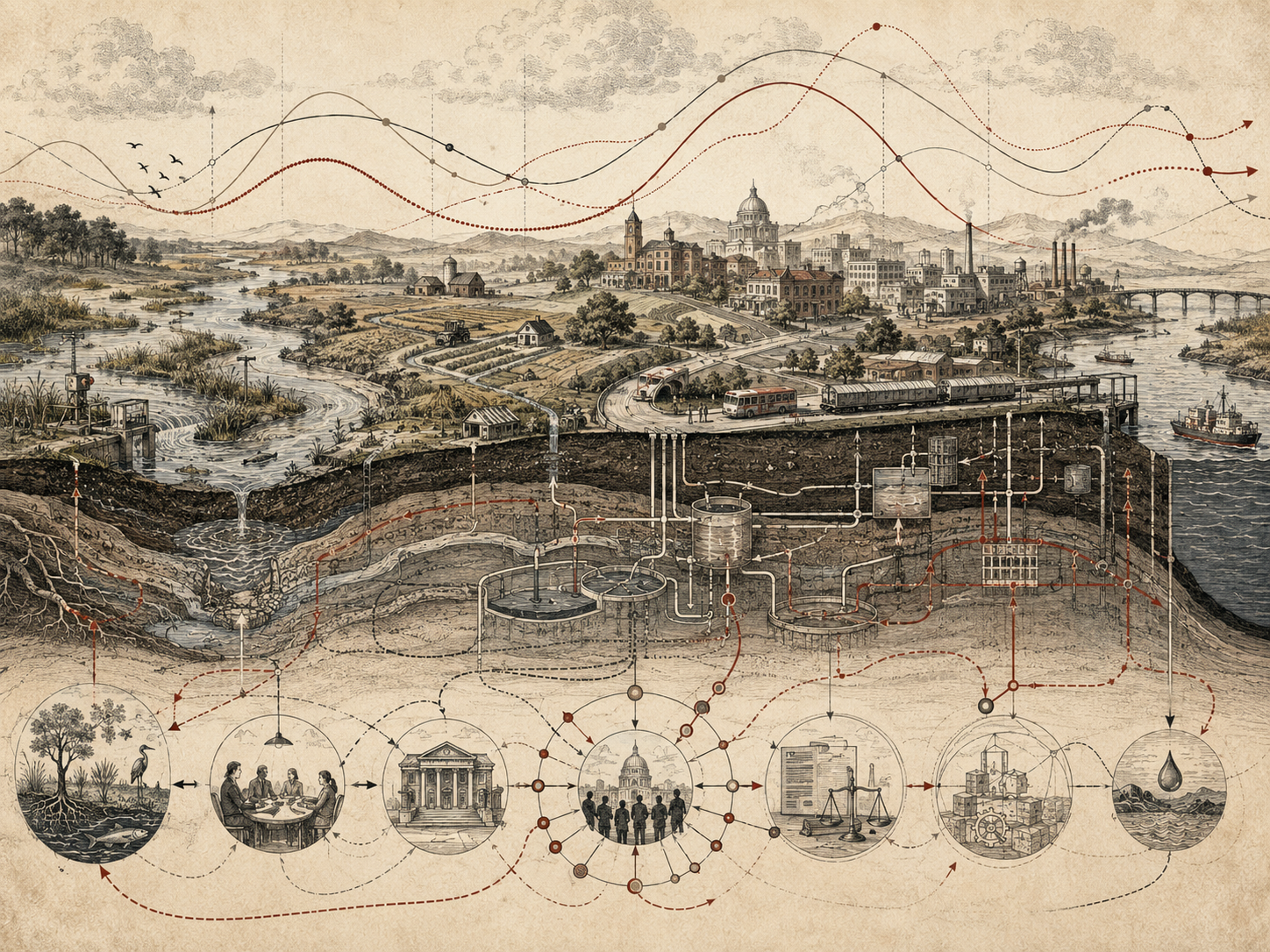
This article explains how behavior over time supports structural explanation in systems thinking. It examines why events are insufficient by themselves, how behavior-over-time graphs reveal growth, decline, oscillation, delay, overshoot, recovery, and recurrence, and how these patterns point toward underlying feedback structures. It also shows why temporal analysis is ethically important: systems often hide harm by fragmenting events, shortening time horizons, externalizing costs, and treating repeated outcomes as isolated incidents.
Why Behavior Over Time Matters
Behavior over time matters because systems are dynamic. They do not merely produce events. They produce trajectories. A school district may experience one year of low attendance, but the systems question is whether attendance is declining, recovering, unevenly distributed, seasonal, or concentrated in particular schools. A city may experience one flood, but the systems question is whether flood frequency, severity, exposure, or recovery time is changing. An organization may miss one deadline, but the systems question is whether delay is becoming a recurring feature of the workflow.
Events are often the entry point into systems analysis because they attract attention. A failure happens. A crisis breaks through. A metric drops. A public complaint spreads. A service delay becomes visible. But system behavior usually becomes intelligible only when the event is placed within time. Without time, the analyst may mistake a symptom for a cause, a trigger for a structure, or a temporary improvement for durable change.
Behavior over time helps analysts ask better questions:
- Is the issue isolated or recurring?
- Is the system improving, worsening, stabilizing, or cycling?
- Did the problem appear suddenly, or was it accumulating?
- Did an intervention change the pattern or only interrupt it briefly?
- Is the average improving while some groups are worsening?
- Are visible events increasing because conditions changed, reporting improved, or thresholds were crossed?
- What structure could plausibly generate this pattern?
Systems thinking uses behavior over time to resist event-level explanation. The point is not to ignore events. The point is to understand them as evidence of system behavior. A visible event becomes more meaningful when the analyst can say what pattern it belongs to and what structure might be producing that pattern.
Behavior-over-time thinking is also essential for prevention. Systems that wait for dramatic events often act too late. A behavior-over-time view can reveal weak signals, slow erosion, delayed consequences, and accumulating risk before collapse becomes obvious.
Events, Patterns, and Structures
Systems thinking often distinguishes among events, patterns, and structures. Events answer the question: what happened? Patterns answer the question: what keeps happening? Structures answer the question: what makes the pattern likely?
This distinction is simple but powerful. An event is visible and immediate. A pattern connects events across time. A structure explains why the pattern recurs. A hospital readmission is an event. A rising readmission rate among patients with unstable housing is a pattern. A structural explanation might examine discharge planning, housing insecurity, insurance coverage, transportation, primary care access, caregiver support, environmental exposure, and chronic disease burden.
Behavior over time is the analytical bridge from event to pattern. It helps determine whether an event is part of a larger trajectory. Once a pattern is visible, the analyst can ask what system structure generates it.
| Level | Question | Example | Typical response |
|---|---|---|---|
| Event | What happened? | A bridge is closed after structural damage is found. | Repair, inspect, communicate, reroute, assign immediate responsibility. |
| Pattern | What keeps happening over time? | Bridge closures and emergency repairs are increasing across the region. | Track trends, map recurrence, compare assets, identify common conditions. |
| Structure | What makes the pattern likely? | Maintenance funding, inspection cycles, procurement, climate stress, and political incentives create deferred-risk accumulation. | Redesign funding, governance, feedback, accountability, and preventive maintenance systems. |
Event-level responses are necessary. People need immediate protection, repair, service, explanation, and accountability. But event response is incomplete when the system keeps producing similar events. If the same type of failure returns, the system has not learned. It has only absorbed the event.
Structural explanation does not deny proximate causes. It contextualizes them. A failed component, human error, missed deadline, delayed payment, or broken process may matter. But when similar events recur across people, places, or time, the explanation must examine the system that makes those events more likely.
Behavior over time is therefore a test of explanation. If an explanation cannot account for recurrence, trend, delay, or distribution, it may be too narrow.
Behavior-Over-Time Graphs
A behavior-over-time graph is a simple systems-thinking tool that plots a variable across time. The variable might be trust, demand, cost, backlog, emissions, delay, quality, workload, risk, attendance, biodiversity, debt, temperature, maintenance, response time, or public legitimacy. The graph does not need to be complex. Its purpose is to make the system’s trajectory visible.
Behavior-over-time graphs are useful because people often remember events better than trajectories. A graph can reveal whether a crisis was sudden or gradual, whether improvement is sustained or temporary, whether an intervention changed the slope of a pattern, and whether a system is oscillating around a target rather than moving toward it.
y_t = f(t)
\]
Interpretation: A behavior-over-time view represents a system condition \(y_t\) as it changes across time \(t\). The goal is to examine the pattern before assuming the cause.
A good behavior-over-time graph should prompt questions rather than pretend to answer everything by itself:
- What variable is being tracked?
- What time horizon is shown?
- What is the unit of measurement?
- What events or interventions occurred during the period?
- What is increasing, decreasing, stabilizing, or cycling?
- Are there thresholds, inflection points, or sudden shifts?
- Does the graph hide distributional differences?
- What structure could generate this pattern?
The same system may require several behavior-over-time graphs. For example, an organization studying burnout might track workload, staff capacity, turnover, sick leave, error rates, meeting hours, response times, and employee trust. A city studying flood risk might track rainfall intensity, impervious surface, drainage capacity, insurance claims, maintenance backlog, emergency response time, and household displacement. A single metric is rarely enough.
Behavior-over-time graphs are also useful for comparing perceived behavior and actual behavior. Stakeholders often hold different mental models of how a system is changing. Leaders may believe performance is improving because one metric is rising. Frontline workers may see capacity eroding. Residents may experience service deterioration before official indicators show it. A graph can make competing claims discussable, though it must be interpreted alongside lived experience and domain knowledge.
The value of behavior-over-time analysis lies in forcing the question: before explaining the system, what exactly is the system doing?
Common Behavior-Over-Time Patterns
Systems often produce recognizable patterns. These patterns are not proof of a particular structure, but they provide clues. A rising curve may suggest reinforcing growth. A plateau may suggest a constraint. Oscillation may suggest delayed balancing feedback. Sudden collapse may suggest hidden accumulation, threshold crossing, or exhausted resilience. Temporary improvement followed by relapse may suggest a symptomatic fix or policy resistance.
| Pattern | Possible systems interpretation | Example |
|---|---|---|
| Steady growth | Reinforcing loop, increasing demand, compounding advantage, or expanding capacity. | Platform adoption, service demand, debt, emissions, knowledge accumulation. |
| Steady decline | Reinforcing deterioration, resource depletion, trust erosion, or capacity loss. | Institutional trust, biodiversity, workforce morale, infrastructure condition. |
| S-shaped growth | Early reinforcing growth followed by limits, saturation, or balancing constraint. | Technology adoption, program scaling, population growth, organizational expansion. |
| Oscillation | Balancing feedback with delay, overcorrection, or mistimed response. | Inventory cycles, hiring cycles, policy tightening and relaxation, demand swings. |
| Overshoot and collapse | Reinforcing growth exceeds delayed limits or depletes supporting stocks. | Resource depletion, organizational overexpansion, ecological collapse. |
| Temporary improvement then relapse | Symptomatic fix, shifting the burden, policy resistance, or unchanged structure. | Backlog reduction followed by return, burnout relief followed by overload. |
| Sudden crisis after apparent stability | Hidden accumulation, threshold crossing, or delayed visibility. | Infrastructure failure, legitimacy crisis, debt crisis, ecosystem regime shift. |
These patterns should be treated as diagnostic clues, not automatic conclusions. A rising trend may have many causes. A decline may reflect measurement change, reporting change, actual deterioration, or shifting boundaries. Oscillation may reflect delayed feedback, but it may also reflect external cycles. A sudden crisis may reflect accumulation, but it may also reflect a true external shock. Systems thinking requires evidence, mechanism, and interpretation.
The strength of behavior-over-time analysis is that it slows down explanation. Instead of jumping from event to blame, the analyst first asks what pattern is visible. The pattern then guides structural inquiry.
Pattern recognition also helps identify leverage. A system in reinforcing decline may need early interruption and capacity repair. A system in oscillation may need better timing and smaller adjustments. A system in overshoot may need limits, buffers, or goal change. A system experiencing relapse may need structural redesign rather than another short-term fix.
How Structure Generates Behavior
One of the central claims of systems thinking is that structure generates behavior. This does not mean individuals do not matter. It means that repeated behavior often reflects repeated conditions. If similar outcomes appear across different people, departments, neighborhoods, institutions, or time periods, the explanation should examine the structure shaping those outcomes.
Structure includes relationships, incentives, rules, resources, feedback loops, information flows, authority, constraints, physical infrastructure, data systems, institutional norms, mental models, and historical conditions. It is the arrangement that makes certain patterns more likely than others.
For example, repeated project delays may be structurally generated by unclear decision rights, unrealistic planning assumptions, dependency bottlenecks, under-resourced teams, fragmented information, approval delays, and incentives that reward optimistic commitments. Repeated delay is not explained well by blaming each project team individually. The behavior over time points toward structure.
Similarly, repeated flooding may be structurally generated by land-use patterns, impervious surfaces, drainage capacity, watershed disruption, climate change, maintenance backlog, zoning, insurance incentives, and unequal infrastructure investment. The storm may trigger the event, but the pattern reveals the structure of vulnerability.
B_t = f(S_t)
\]
Interpretation: System behavior \(B_t\) at time \(t\) can be understood as a function of system structure \(S_t\). Structural explanation asks which relationships and conditions generate the observed pattern.
Structural explanation usually asks several questions:
- What relationships connect the variables?
- What feedback loops reinforce or regulate the behavior?
- What stocks are accumulating or depleting?
- What delays separate cause and effect?
- What rules and incentives shape action?
- What information reaches decision-makers?
- What boundaries hide costs or causes?
- What mental models define the problem?
Structure is not always formally designed. It may emerge from many decisions over time. A housing market, organizational culture, public-health system, platform economy, watershed, or supply chain may be shaped by accumulated choices, inherited infrastructure, power relations, and adaptive behavior. The structure may be nobody’s complete plan and still be the source of recurring outcomes.
Behavior over time is therefore one of the best ways to detect structure. If the pattern persists, the system is organized in a way that produces it.
Feedback Loops and Temporal Patterns
Feedback loops are one of the main ways structures generate behavior over time. A reinforcing loop can create growth, decline, escalation, or compounding advantage. A balancing loop can create stability, correction, resistance, or oscillation. A delayed balancing loop can produce overcorrection. A reinforcing loop constrained by a delayed limit can produce overshoot and collapse.
This is why behavior-over-time patterns often point toward feedback structure. If a variable grows faster as it grows, a reinforcing loop may be operating. If a variable returns toward a target, a balancing loop may be operating. If the system swings around a target, the balancing loop may be delayed. If improvement repeatedly fades, compensating feedback may be pulling the system back toward its old behavior.
A \rightarrow B \rightarrow C \rightarrow A
\]
Interpretation: Feedback occurs when a causal chain returns to influence an earlier variable. Feedback structures are often responsible for recurring behavior over time.
For example, a public agency may experience a reinforcing distrust loop. Service delays reduce public trust. Lower trust reduces cooperation and increases conflict. Lower cooperation increases service difficulty. Service difficulty increases delays. Delays further reduce trust. The behavior over time may show declining trust and rising delays. The structural explanation identifies the loop that connects them.
A workplace may experience a delayed balancing loop around staffing. Workload rises. Eventually leaders approve hiring. Hiring takes time. New staff take time to become effective. Meanwhile, overload causes turnover. The system repeatedly cycles between overload and attempted correction. The behavior over time may show oscillation in staffing, workload, and performance.
A city may experience a limits-to-growth pattern. Development increases tax revenue and attracts more development. Over time, infrastructure capacity, housing affordability, water availability, transportation, or flood risk becomes a constraint. Growth slows or produces harm. The behavior over time reveals the shift from reinforcing growth to balancing constraint.
Feedback analysis strengthens structural explanation because it connects variables dynamically. It does not merely say many things are connected. It shows how consequences return, accumulate, and shape future behavior.
Delay, Accumulation, and Late Visibility
Some of the most important behavior-over-time patterns are difficult to see because they involve delay and accumulation. A system may appear stable while a hidden stock is changing. The crisis appears only after the stock crosses a threshold or after resilience has been depleted.
Stocks are accumulated conditions. They include trust, debt, fatigue, carbon, biodiversity, soil health, maintenance backlog, institutional memory, public legitimacy, workforce capacity, and risk exposure. Flows change stocks. Hiring and turnover change workforce capacity. Emissions and absorption change atmospheric carbon concentration. Maintenance and deterioration change infrastructure condition. Reliable service and repeated failure change public trust.
S_{t+1} = S_t + I_t – O_t
\]
Interpretation: A stock \(S\) changes through inflows \(I\) and outflows \(O\). Behavior over time often reflects accumulated change rather than isolated events.
Late visibility creates mistaken explanations. A bridge closure may look like the result of a recent inspection, but the underlying condition may have accumulated over decades. A wave of resignations may look sudden, but fatigue and mistrust may have been building for months or years. A legitimacy crisis may appear to be caused by one scandal, but the scandal may only reveal years of accumulated institutional failure.
Delay also changes intervention. If a stock has been eroding for a long time, a quick response may not repair it quickly. Trust takes time to rebuild. Experienced workers take time to replace. Ecosystems take time to recover. Infrastructure backlogs take time to reduce. Educational gaps take time to address. Climate effects may persist long after emissions are reduced.
Behavior-over-time analysis therefore asks not only what is visible now, but what has been accumulating. It asks what leading indicators might reveal the pattern earlier, what delayed consequences should be anticipated, and whether the system is waiting until visible crisis before responding.
Temporary Improvement and Problem Recurrence
Many systems show temporary improvement followed by recurrence. A backlog is reduced, then returns. A team’s workload is relieved, then overload returns. A city repairs flood damage, then floods again. A school improves a metric, then declines later. A platform moderates harmful content after public pressure, then the same pattern reappears. These patterns often suggest that the intervention addressed a symptom without changing the structure.
Temporary improvement can be valuable. It may reduce immediate harm. But if the same pattern returns, the system structure remains intact. Systems thinking asks why the improvement was not durable.
Several structures can produce temporary improvement followed by recurrence:
- Shifting the burden: a symptomatic solution reduces pressure while weakening the fundamental solution.
- Fixes that fail: a short-term intervention creates delayed consequences that worsen the problem.
- Policy resistance: the system adapts in ways that offset the intervention.
- Unchanged incentives: behavior returns because rewards and constraints remain the same.
- Delayed effects: early improvement hides later costs.
- Capacity mismatch: demand exceeds the system’s ability to sustain improvement.
\text{Durable Change} \neq \text{Short-Term Symptom Relief}
\]
Interpretation: A short-term improvement is not evidence of structural change unless the underlying feedback, capacity, incentives, or goals have shifted.
Recurring problems are especially important because they reveal learning failure. If an institution repeatedly responds to the same issue without changing the structure that produces it, response becomes ritual. The system may become skilled at managing optics, emergencies, or complaints while remaining unable to prevent recurrence.
Behavior-over-time analysis helps distinguish intervention types. Did the intervention alter the slope of the trend? Did it change the frequency of recurrence? Did it reduce severity? Did it shift burden elsewhere? Did it create delayed costs? Did it improve one metric while worsening another? Did it change the feedback loop or only the visible symptom?
Durable systems change is visible not in one event, but in altered behavior over time.
Measurement, Time Horizons, and Misleading Signals
Behavior-over-time analysis depends on measurement, but measurement is never neutral. What is measured, how often it is measured, what time horizon is used, and whose experience is included all shape interpretation. A system can appear to improve if the chosen metric is narrow, the time horizon is short, or the boundary excludes externalized costs.
A short-term budget metric may improve while maintenance backlog grows. A productivity metric may improve while worker fatigue accumulates. A platform engagement metric may rise while trust declines. A school performance metric may improve while exclusion increases. A public agency may reduce processing time for completed cases while eligible people are discouraged from applying. A climate policy may count emissions within one boundary while shifting emissions elsewhere.
Time horizon is especially important. Some system effects appear quickly. Others appear slowly. A prevention strategy may look costly in the short term because the avoided harm is not visible. A harmful strategy may look successful in the short term because its costs are delayed. Behavior over time must be matched to the system’s actual timing.
| Measurement issue | Risk | Systems question |
|---|---|---|
| Short time horizon | Delayed harms or benefits are missed. | When should the effect realistically appear? |
| Narrow metric | One visible outcome improves while hidden costs grow. | What does this metric exclude? |
| Aggregate average | Unequal distribution is hidden. | Who is improving and who is worsening? |
| Delayed reporting | Decision-makers respond to outdated conditions. | How old is the signal by the time it is used? |
| Incentivized measurement | Actors game the metric. | What behavior does this measure reward? |
| Boundary exclusion | Costs are shifted outside the frame. | Where do the externalized effects appear? |
Good systems measurement tracks multiple time horizons, multiple levels, and multiple forms of evidence. It includes early warning indicators, accumulated stocks, distributional effects, stakeholder experience, and delayed outcomes. It also asks whether the measurement system itself changes behavior.
Behavior over time is only as honest as the frame that defines what counts.
Ethics, Power, and Pattern Recognition
Pattern recognition is ethically important because repeated harm is often hidden by treating each event as isolated. A complaint is described as anecdotal. A failure is called exceptional. A crisis is framed as unexpected. A community’s experience is dismissed until it becomes statistically undeniable. By the time the pattern is recognized, harm may have accumulated for years.
Power shapes whether behavior over time is visible. Institutions often control records, categories, dashboards, reports, and official explanations. If the system does not collect the right data, the pattern may remain invisible. If affected communities are not believed, early warnings may be ignored. If metrics are designed around institutional convenience, hidden burdens may never appear in official behavior-over-time analysis.
Repeated harm raises responsibility. If a system produces the same outcome again and again, leaders cannot indefinitely claim surprise. Recurrence is evidence. A system that repeatedly exposes some groups to delay, exclusion, pollution, surveillance, underinvestment, or administrative burden is not merely experiencing random events. It is producing a pattern.
Ethical behavior-over-time analysis asks:
- Whose repeated experience is being treated as isolated?
- What patterns are visible to affected people but invisible to official systems?
- Which metrics hide unequal burden?
- Who benefits when the time horizon is short?
- Who pays when consequences are delayed?
- What structural explanation becomes unavoidable once the pattern is recognized?
- What duty to repair follows from repeated harm?
Systems thinking should not use complexity to soften responsibility. It should use temporal evidence to clarify responsibility. If a system repeatedly generates harm, the burden of explanation shifts. The question is no longer whether the harm occurred once. The question is why the structure keeps producing it.
Behavior over time can therefore be a tool of accountability. It shows that what institutions call incidents may actually be the normal behavior of the system.
Examples Across Systems
Behavior-over-time analysis applies across many systems. The examples below show how temporal patterns support structural explanation.
Public health
A spike in emergency-room visits is an event. Repeated spikes during heat waves, concentrated in neighborhoods with poor housing and low tree canopy, form a pattern. Structural explanation examines housing quality, chronic illness, energy costs, public cooling access, environmental exposure, transportation, and public-health capacity. The behavior over time reveals that vulnerability is not evenly distributed.
Infrastructure
A broken water main is an event. Increasing breaks across older parts of the network are a pattern. Structural explanation examines pipe age, maintenance backlog, funding cycles, inspection regimes, procurement, climate stress, and political incentives. The behavior over time reveals accumulated risk.
Organizations
A missed deadline is an event. Repeated delays across projects are a pattern. Structural explanation examines workload, handoffs, unclear authority, meeting burden, dependency bottlenecks, unrealistic planning, and incentives that reward overcommitment. The behavior over time shows that delay is not merely a team failure.
Education
A student absence is an event. Rising chronic absenteeism across particular schools or communities is a pattern. Structural explanation examines transportation, housing, health, school climate, family economic pressure, disability support, disciplinary practices, and belonging. The behavior over time shows that absence is not only individual choice.
Artificial intelligence systems
One harmful model output is an event. Repeated errors affecting certain groups, decisions, or contexts are a pattern. Structural explanation examines training data, evaluation metrics, deployment context, feedback loops, institutional incentives, appeal systems, monitoring, and governance. The behavior over time reveals whether harm is systemic rather than accidental.
Climate and ecological systems
A severe storm, drought, fire, or flood is an event. Increasing frequency, severity, or recovery time is a pattern. Structural explanation examines emissions, land use, ecological degradation, infrastructure exposure, development incentives, public investment, and unequal vulnerability. Behavior over time reveals that disasters are shaped by both hazard and structure.
Economic systems
A price spike is an event. Persistent inflation, recurring shortages, debt cycles, or boom-bust behavior are patterns. Structural explanation examines production capacity, market concentration, energy prices, supply chains, monetary policy, expectations, labor conditions, and public investment. Behavior over time reveals how economic outcomes are generated by interacting systems.
Across these examples, the event is the doorway. The pattern is the evidence. The structure is the explanation.
Mathematics, Computation, and Modeling
Behavior-over-time analysis can be supported by qualitative timelines, stakeholder histories, archival evidence, behavior-over-time graphs, time-series analysis, stock-flow modeling, simulation, and scenario comparison. Modeling helps clarify whether a proposed structure could plausibly generate the observed pattern.
A simple trend model can be represented as:
y_t = \alpha + \beta t + \epsilon_t
\]
Interpretation: A basic trend model asks whether a variable \(y_t\) is changing over time. The slope \(\beta\) summarizes direction, but structural explanation requires a causal mechanism.
A behavior-over-time pattern with feedback can be represented dynamically:
x_{t+1} = f(x_t, u_t, \theta)
\]
Interpretation: The future state \(x_{t+1}\) depends on the current state \(x_t\), interventions or inputs \(u_t\), and system parameters \(\theta\). This supports analysis of dynamic system behavior.
Structural explanation can be represented as a relationship between variables and system structure:
Y_t = f(R_t, F_t, S_t, D_t, B_t)
\]
Interpretation: An outcome \(Y_t\) may depend on relationships \(R_t\), feedback loops \(F_t\), stocks \(S_t\), delays \(D_t\), and boundaries \(B_t\). The equation is conceptual, not a claim that system behavior can be reduced to one formula.
A stock-flow model helps explain hidden accumulation:
\frac{dS}{dt} = I(t) – O(t)
\]
Interpretation: The stock \(S\) changes through inflows \(I(t)\) and outflows \(O(t)\). Many visible events are late signals of accumulated stock change.
| Modeling task | Behavior-over-time question | Example use |
|---|---|---|
| Timeline analysis | What sequence of events, decisions, and effects led to the pattern? | Studying policy implementation, infrastructure failure, or institutional trust erosion. |
| Trend analysis | Is the variable increasing, decreasing, or stable? | Tracking emissions, cost, demand, backlog, attendance, or service delay. |
| Stock-flow modeling | What has accumulated or depleted over time? | Modeling maintenance backlog, fatigue, debt, carbon, trust, or capacity. |
| Feedback simulation | Can the proposed feedback structure generate the observed pattern? | Testing reinforcing decline, balancing correction, oscillation, or policy resistance. |
| Scenario comparison | How might the pattern change under different interventions? | Comparing symptom relief, capacity investment, governance reform, or early prevention. |
| Distributional analysis | Does the average hide unequal trends? | Comparing neighborhoods, groups, institutions, assets, or regions. |
Models are tools for disciplined inquiry. They should not be treated as automatic proof. A model may reproduce a pattern while omitting power, history, lived experience, institutional conflict, ecological limits, or data gaps. Good modeling supports structural explanation by making assumptions visible and testable.
Python Workflow: Behavior-Over-Time, Recurrence, Stock, and Structural Diagnostics
The Python workflow below turns behavior-over-time analysis into a small reproducible model. It compares four scenarios: event response only, pattern tracking, structural diagnosis, and a learning-and-repair system. The script uses only the Python standard library, writes CSV outputs relative to the article folder, and is designed as a clear starting point for companion repository work.
# behavior_over_time_structural_explanation_workflow.py
# Dependency-light workflow for behavior-over-time analysis, recurrence,
# hidden stocks, temporary fixes, and structural explanation.
# Writes outputs relative to the article root.

from __future__ import annotations

from dataclasses import dataclass
from pathlib import Path
import csv
from statistics import mean

ARTICLE_ROOT = Path(__file__).resolve().parents[1]
TABLES = ARTICLE_ROOT / "outputs" / "tables"


@dataclass
class TemporalScenario:
    name: str
    event_response: float
    recurrence_pressure: float
    structural_diagnosis: float
    stock_accumulation: float
    feedback_visibility: float
    delay_pressure: float
    measurement_quality: float
    accountability: float
    intervention_specificity: float


def clamp(value: float, low: float = 0.0, high: float = 120.0) -> float:
    return max(low, min(high, value))


def run_scenario(scenario: TemporalScenario, periods: int = 48) -> list[dict[str, object]]:
    event_pressure = scenario.recurrence_pressure * 45.0
    hidden_stock = scenario.stock_accumulation * 42.0
    structural_learning = scenario.structural_diagnosis * 36.0
    pattern_visibility = scenario.measurement_quality * 32.0
    repair_capacity = 30.0 + scenario.intervention_specificity * 20.0
    rows: list[dict[str, object]] = []

    for period in range(periods + 1):
        visible_event_rate = clamp(
            event_pressure * 0.34
            + hidden_stock * 0.18
            + scenario.recurrence_pressure * 16.0
            - pattern_visibility * 0.08
        )

        pattern_visibility = clamp(
            pattern_visibility
            + scenario.measurement_quality * 1.8
            + scenario.feedback_visibility * 1.7
            + scenario.accountability * 1.2
            - scenario.delay_pressure * 0.9
        )

        structural_learning = clamp(
            structural_learning
            + pattern_visibility * 0.06
            + scenario.structural_diagnosis * 1.8
            + scenario.feedback_visibility * 1.2
            + scenario.accountability * 1.4
            - max(0.0, 45.0 - pattern_visibility) * 0.04
        )

        symptom_relief = clamp(
            scenario.event_response * 20.0
            + scenario.intervention_specificity * 8.0
            - max(0.0, hidden_stock - 55.0) * 0.07
        )

        structural_intervention = clamp(
            scenario.structural_diagnosis * 20.0
            + scenario.intervention_specificity * 16.0
            + scenario.accountability * 14.0
            + structural_learning * 0.12
            - scenario.delay_pressure * 4.0
        )

        recurrence_risk = clamp(
            scenario.recurrence_pressure * 18.0
            + hidden_stock * 0.16
            + max(0.0, 55.0 - structural_intervention) * 0.20
            + scenario.delay_pressure * 8.0
            - symptom_relief * 0.08
            - scenario.accountability * 3.0
        )

        hidden_stock = clamp(
            hidden_stock
            + scenario.stock_accumulation * 2.2
            + recurrence_risk * 0.18
            - structural_intervention * 0.12
            - scenario.accountability * 1.3
        )

        event_pressure = clamp(
            event_pressure
            + recurrence_risk * 0.16
            - symptom_relief * 0.12
            - structural_intervention * 0.10
            + scenario.delay_pressure * 0.6
        )

        repair_capacity = clamp(
            repair_capacity
            + structural_intervention * 0.06
            + scenario.accountability * 1.6
            + scenario.feedback_visibility * 1.1
            - hidden_stock * 0.035
        )

        structural_explanation_score = clamp(
            structural_learning * 0.24
            + pattern_visibility * 0.22
            + structural_intervention * 0.22
            + repair_capacity * 0.14
            + scenario.accountability * 12.0
            - recurrence_risk * 0.14
            - hidden_stock * 0.12,
            0.0,
            100.0
        )

        rows.append({
            "period": period,
            "scenario": scenario.name,
            "visible_event_rate": round(visible_event_rate, 3),
            "pattern_visibility": round(pattern_visibility, 3),
            "structural_learning": round(structural_learning, 3),
            "symptom_relief": round(symptom_relief, 3),
            "structural_intervention": round(structural_intervention, 3),
            "recurrence_risk": round(recurrence_risk, 3),
            "hidden_stock": round(hidden_stock, 3),
            "event_pressure": round(event_pressure, 3),
            "repair_capacity": round(repair_capacity, 3),
            "structural_explanation_score": round(structural_explanation_score, 3),
        })

    return rows


def write_csv(path: Path, rows: list[dict[str, object]]) -> None:
    path.parent.mkdir(parents=True, exist_ok=True)
    if not rows:
        raise ValueError(f"No rows to write: {path}")
    with path.open("w", newline="", encoding="utf-8") as handle:
        writer = csv.DictWriter(handle, fieldnames=list(rows[0].keys()))
        writer.writeheader()
        writer.writerows(rows)


def summarize(rows: list[dict[str, object]]) -> list[dict[str, object]]:
    output: list[dict[str, object]] = []
    for scenario_name in sorted({row["scenario"] for row in rows}):
        subset = [row for row in rows if row["scenario"] == scenario_name]
        final = subset[-1]
        avg_recurrence = mean(float(row["recurrence_risk"]) for row in subset)
        avg_hidden_stock = mean(float(row["hidden_stock"]) for row in subset)
        avg_score = mean(float(row["structural_explanation_score"]) for row in subset)

        if float(final["structural_explanation_score"]) >= 65 and float(final["recurrence_risk"]) <= 35:
            diagnostic = "behavior-over-time analysis supports structural change"
        elif avg_hidden_stock >= 55:
            diagnostic = "hidden stock accumulation remains high"
        elif avg_recurrence >= 55:
            diagnostic = "recurrence continues despite event response"
        elif avg_score >= 55:
            diagnostic = "partial structural learning with remaining recurrence risk"
        else:
            diagnostic = "event-level response dominates pattern recognition"

        output.append({
            "scenario": scenario_name,
            "final_structural_explanation_score": final["structural_explanation_score"],
            "final_visible_event_rate": final["visible_event_rate"],
            "final_recurrence_risk": final["recurrence_risk"],
            "final_hidden_stock": final["hidden_stock"],
            "final_repair_capacity": final["repair_capacity"],
            "average_recurrence_risk": round(avg_recurrence, 3),
            "average_hidden_stock": round(avg_hidden_stock, 3),
            "average_structural_explanation_score": round(avg_score, 3),
            "diagnostic": diagnostic,
        })

    return output


def main() -> None:
    scenarios = [
        TemporalScenario("Event response only", 0.82, 0.72, 0.20, 0.74, 0.24, 0.62, 0.34, 0.24, 0.32),
        TemporalScenario("Pattern tracking", 0.68, 0.60, 0.42, 0.58, 0.58, 0.50, 0.64, 0.42, 0.48),
        TemporalScenario("Structural diagnosis", 0.56, 0.42, 0.76, 0.44, 0.72, 0.36, 0.72, 0.64, 0.68),
        TemporalScenario("Learning and repair system", 0.48, 0.30, 0.84, 0.30, 0.82, 0.24, 0.82, 0.82, 0.82),
    ]

    rows: list[dict[str, object]] = []
    for scenario in scenarios:
        rows.extend(run_scenario(scenario))

    write_csv(TABLES / "behavior_over_time_structural_explanation_timeseries.csv", rows)
    write_csv(TABLES / "behavior_over_time_structural_explanation_summary.csv", summarize(rows))

    print("Behavior-over-time structural explanation workflow complete.")
    print(TABLES / "behavior_over_time_structural_explanation_timeseries.csv")


if __name__ == "__main__":
    main()
The workflow is intentionally simple enough to inspect. It shows how event response can reduce visible pressure while hidden stocks and recurrence risk continue to accumulate, and how pattern visibility, structural diagnosis, feedback, accountability, and specific intervention design improve structural explanation over time. The model is synthetic and illustrative; it supports disciplined inquiry rather than replacing domain expertise, stakeholder evidence, or ethical judgment.
R Workflow: Temporal Pattern Summary and Visualization
The R workflow reads the Python-generated time-series output, creates scenario summaries, and exports base R plots for visible event rate, hidden stock, recurrence risk, repair capacity, and structural explanation score. It uses only base R so it remains portable across simple local environments.
# behavior_over_time_structural_explanation_diagnostics.R
# Base R workflow for temporal pattern summary and visualization.

args <- commandArgs(trailingOnly = FALSE)
file_arg <- grep("^--file=", args, value = TRUE)

if (length(file_arg) > 0) {
  script_path <- normalizePath(sub("^--file=", "", file_arg[1]), mustWork = TRUE)
  article_root <- normalizePath(file.path(dirname(script_path), ".."), mustWork = TRUE)
} else {
  article_root <- getwd()
}

setwd(article_root)

tables_dir <- file.path(article_root, "outputs", "tables")
figures_dir <- file.path(article_root, "outputs", "figures")

if (!dir.exists(tables_dir)) {
  dir.create(tables_dir, recursive = TRUE)
}

if (!dir.exists(figures_dir)) {
  dir.create(figures_dir, recursive = TRUE)
}

timeseries_path <- file.path(tables_dir, "behavior_over_time_structural_explanation_timeseries.csv")

if (!file.exists(timeseries_path)) {
  stop(paste("Missing", timeseries_path, "Run the Python workflow first."))
}

data <- read.csv(timeseries_path, stringsAsFactors = FALSE)

last_by_scenario <- do.call(
  rbind,
  lapply(split(data, data$scenario), function(df) df[nrow(df), ])
)

avg_recurrence <- aggregate(recurrence_risk ~ scenario, data = data, FUN = mean)
avg_hidden <- aggregate(hidden_stock ~ scenario, data = data, FUN = mean)
avg_score <- aggregate(structural_explanation_score ~ scenario, data = data, FUN = mean)

names(avg_recurrence)[2] <- "average_recurrence_risk"
names(avg_hidden)[2] <- "average_hidden_stock"
names(avg_score)[2] <- "average_structural_explanation_score"

final_fields <- last_by_scenario[, c(
  "scenario",
  "structural_explanation_score",
  "visible_event_rate",
  "recurrence_risk",
  "hidden_stock",
  "repair_capacity"
)]

names(final_fields) <- c(
  "scenario",
  "final_structural_explanation_score",
  "final_visible_event_rate",
  "final_recurrence_risk",
  "final_hidden_stock",
  "final_repair_capacity"
)

summary_table <- Reduce(
  function(x, y) merge(x, y, by = "scenario"),
  list(avg_recurrence, avg_hidden, avg_score, final_fields)
)

summary_table$diagnostic <- ifelse(
  summary_table$final_structural_explanation_score >= 65 &
    summary_table$final_recurrence_risk <= 35,
  "behavior-over-time analysis supports structural change",
  ifelse(
    summary_table$average_hidden_stock >= 55,
    "hidden stock accumulation remains high",
    ifelse(
      summary_table$average_recurrence_risk >= 55,
      "recurrence continues despite event response",
      ifelse(
        summary_table$average_structural_explanation_score >= 55,
        "partial structural learning with remaining recurrence risk",
        "event-level response dominates pattern recognition"
      )
    )
  )
)

write.csv(
  summary_table,
  file.path(tables_dir, "behavior_over_time_structural_explanation_r_summary.csv"),
  row.names = FALSE
)

plot_metric <- function(metric, label, file_name) {
  png(file.path(figures_dir, file_name), width = 1200, height = 700)
  scenarios <- unique(data$scenario)
  plot(
    NA,
    xlim = range(data$period),
    ylim = range(data[[metric]], na.rm = TRUE),
    xlab = "Period",
    ylab = label,
    main = paste(label, "by Scenario")
  )
  for (scenario_name in scenarios) {
    subset_data <- data[data$scenario == scenario_name, ]
    lines(subset_data$period, subset_data[[metric]], lwd = 2)
  }
  legend("topleft", legend = scenarios, lwd = 2, cex = 0.8, bty = "n")
  grid()
  dev.off()
}

plot_metric("visible_event_rate", "Visible event rate", "visible_event_rate_trajectories.png")
plot_metric("hidden_stock", "Hidden stock", "hidden_stock_trajectories.png")
plot_metric("recurrence_risk", "Recurrence risk", "recurrence_risk_trajectories.png")
plot_metric("repair_capacity", "Repair capacity", "repair_capacity_trajectories.png")
plot_metric("structural_explanation_score", "Structural explanation score", "structural_explanation_score_trajectories.png")

print(summary_table)
This workflow supports the article’s central methodological claim: visible events should be interpreted through temporal patterns, hidden accumulations, recurrence, and structural explanation. The R outputs help readers see whether an intervention changes behavior over time or merely suppresses the visible event.
GitHub Repository
The companion repository for this article should help readers study behavior-over-time patterns, structural explanations, recurring events, trend analysis, stock-flow accumulation, feedback-generated behavior, intervention comparison, and distributional variation using synthetic datasets and reproducible examples.
Complete Code Repository
Companion repository for the article, including behavior-over-time analysis, structural explanation workflows, trend and recurrence examples, stock-flow accumulation models, feedback-generated patterns, scenario comparisons, synthetic datasets, documentation notes, and multi-language scaffolds for systems analysis.
articles/behavior-over-time-and-structural-explanation/
├── python/
│   ├── behavior_over_time_structural_explanation_workflow.py
│   ├── behavior_over_time_analysis.py
│   ├── structural_explanation_model.py
│   ├── trend_and_recurrence_detection.py
│   ├── stock_flow_accumulation.py
│   ├── feedback_generated_patterns.py
│   ├── intervention_scenario_comparison.py
│   ├── validation_checks.py
│   └── run_all_behavior_over_time_workflows.py
├── r/
│   ├── behavior_over_time_structural_explanation_diagnostics.R
│   ├── behavior_over_time_plots.R
│   ├── trend_summary_tables.R
│   ├── recurrence_visualization.R
│   ├── structural_pattern_comparison.R
│   ├── scenario_comparison.R
│   └── run_all_behavior_over_time_workflows.R
├── julia/
│   ├── dynamic_behavior_patterns.jl
│   └── nonlinear_structural_dynamics.jl
├── sql/
│   ├── schema_events.sql
│   ├── schema_time_series_indicators.sql
│   ├── schema_structural_variables.sql
│   ├── schema_causal_relationships.sql
│   ├── schema_scenarios.sql
│   └── schema_model_runs.sql
├── rust/
│   └── behavior_pattern_diagnostics_cli.rs
├── go/
│   └── temporal_pathway_utility.go
├── cpp/
│   ├── efficient_time_series_patterns.cpp
│   └── structural_dynamics_simulation.cpp
├── fortran/
│   └── recurrence_behavior_model.f90
├── c/
│   └── low_level_temporal_simulation.c
├── docs/
│   ├── modeling_principles.md
│   ├── article_notes.md
│   ├── assumptions_and_limitations.md
│   └── responsible_use.md
├── data/
│   ├── synthetic_events.csv
│   ├── synthetic_time_series_indicators.csv
│   ├── synthetic_structural_variables.csv
│   ├── synthetic_causal_edges.csv
│   ├── synthetic_scenarios.csv
│   └── synthetic_interventions.csv
├── outputs/
│   ├── figures/
│   └── tables/
└── notebooks/
    ├── python_behavior_over_time_walkthrough.ipynb
    └── r_temporal_pattern_visualization_placeholder.ipynb
This repository structure supports the article’s central argument: visible events become more meaningful when they are placed within behavior-over-time patterns and linked to structural explanation. The data/ folder separates events, time-series indicators, structural variables, causal edges, scenarios, and interventions. The python/ and r/ folders support trend analysis, recurrence detection, behavior-over-time visualization, stock-flow accumulation, feedback-generated patterns, and scenario comparison. The julia folder supports dynamic and nonlinear behavior examples. The sql folder defines schemas for events, indicators, structures, causal relationships, scenarios, and model runs. The lower-level language folders provide scaffolds for efficient diagnostics, recurrence modeling, pathway tracing, and temporal simulation.
A Practical Method for Behavior-Over-Time Analysis
Behavior-over-time analysis can become practical through a disciplined sequence of questions. The goal is to move from event response to pattern recognition and then to structural explanation.
1. Name the focal variable
Choose a condition that changes over time: trust, demand, cost, backlog, emissions, workload, quality, delay, attendance, risk, debt, biodiversity, maintenance condition, public legitimacy, or workforce capacity. The variable should be specific enough to track.
2. Define the time horizon
Decide what period matters. Some patterns appear over days or weeks. Others require years or decades. The time horizon should match the system’s dynamics, not only the reporting cycle.
3. Plot or describe the behavior
Create a behavior-over-time graph or written pattern description. Is the variable rising, falling, stable, oscillating, recovering, overshooting, or relapsing?
4. Identify key events and interventions
Mark when major events, policies, leadership changes, shocks, investments, reforms, failures, or external conditions occurred. Ask whether they changed the pattern or only created temporary movement.
5. Look for recurrence
Ask whether similar events or conditions repeat. Recurrence suggests the need for structural explanation.
6. Identify stocks and flows
Ask what is accumulating or depleting. Many behavior-over-time patterns are driven by stocks such as trust, backlog, debt, fatigue, carbon, capacity, knowledge, or ecological resilience.
7. Map feedback loops
Ask what consequences return to influence future behavior. Identify reinforcing and balancing loops that could generate the pattern.
8. Examine delays
Ask whether causes and effects are separated by time. Delays may explain late visibility, overcorrection, oscillation, or premature evaluation.
9. Test structural hypotheses
Develop possible explanations based on incentives, rules, resources, information flows, authority, boundaries, feedback, and mental models. Compare them against evidence.
10. Match intervention to structure
Choose interventions that change the structure generating the pattern. If the problem is recurring, another event-level response is unlikely to be enough.
This method helps analysts ask not only what happened, but what the system has been doing and why it keeps doing it.
Common Pitfalls
Behavior-over-time analysis is powerful, but several pitfalls are common.
- Treating one event as the whole explanation: An event may be dramatic, but it may not be the deepest cause. The analyst should ask whether the event belongs to a longer pattern.
- Using too short a time horizon: Some systems change slowly. A short time window may hide accumulation, delay, recovery, or long-term harm.
- Ignoring distribution: A system-wide average may improve while some groups, places, or assets worsen. Behavior over time should be disaggregated where possible.
- Assuming a trend explains itself: A trend shows what is happening. It does not automatically explain why. Structural explanation requires mechanisms.
- Confusing temporary improvement with structural change: A short-term improvement may disappear if feedback loops, incentives, resources, or rules remain unchanged.
- Ignoring measurement change: A shift in reported behavior may reflect changed definitions, improved reporting, altered incentives, or data-system changes rather than actual system change.
- Missing hidden stocks: Visible flows may look manageable while hidden stocks worsen. Backlog, fatigue, debt, carbon, trust, and ecological resilience require special attention.
- Using complexity to avoid accountability: Structural explanation should clarify responsibility, not dissolve it. If a system repeatedly produces harm, recurrence increases the obligation to change the structure.
The strongest behavior-over-time analysis connects pattern, mechanism, evidence, and responsibility.
Why Behavior-Over-Time Thinking Matters
Behavior-over-time thinking matters because systems reveal themselves through patterns. Events are visible, but patterns are explanatory. A system that repeatedly produces delay, harm, exclusion, overload, failure, or distrust cannot be understood through isolated incidents alone. Recurrence points toward structure.
This kind of analysis helps prevent shallow solutions. It shows whether an intervention changed the system’s behavior or only produced temporary relief. It reveals hidden accumulation before crisis. It exposes delay, oscillation, relapse, and policy resistance. It also makes ethical responsibility clearer by showing when repeated outcomes are being mislabeled as accidents.
Behavior over time does not eliminate the need for local knowledge, qualitative evidence, historical analysis, stakeholder experience, or moral judgment. It organizes them. It gives systems thinking a temporal spine: what has the system been doing, what pattern is emerging, and what structure is likely producing it?
To think systemically is to ask not only what happened, but what keeps happening, how long it has been happening, who experiences it, what it reveals, and what would have to change for the pattern itself to change.
Related Articles
- Feedback Loops and System Behavior
- Reinforcing and Balancing Dynamics
- Delays, Oscillation, and Misperception
- Feedback Loop Polarity and Causal Signs
- Dynamic Complexity and Policy Resistance
- Stocks, Flows, and Accumulation
- Stock and Flow Diagrams
- Nonlinear Change and Threshold Effects
Further Reading
- Meadows, Donella H. Thinking in Systems: A Primer. Chelsea Green Publishing.
- Sterman, John D. Business Dynamics: Systems Thinking and Modeling for a Complex World. Irwin/McGraw-Hill.
- Forrester, Jay W. Industrial Dynamics. MIT Press.
- Senge, Peter M. The Fifth Discipline: The Art and Practice of the Learning Organization. Doubleday/Currency.
- Richardson, George P. Feedback Thought in Social Science and Systems Theory. University of Pennsylvania Press.
- Checkland, Peter. Systems Thinking, Systems Practice. John Wiley & Sons.
- Holland, John H. Hidden Order: How Adaptation Builds Complexity. Addison-Wesley.
References
- Checkland, P. (1981) Systems Thinking, Systems Practice. Chichester: John Wiley & Sons.
- Forrester, J.W. (1961) Industrial Dynamics. Cambridge, MA: MIT Press.
- Holland, J.H. (1995) Hidden Order: How Adaptation Builds Complexity. Reading, MA: Addison-Wesley.
- Meadows, D.H. (2008) Thinking in Systems: A Primer. White River Junction, VT: Chelsea Green Publishing. Available at: https://www.chelseagreen.com/product/thinking-in-systems/
- MIT OpenCourseWare (2013) Introduction to System Dynamics. Massachusetts Institute of Technology. Available at: https://ocw.mit.edu/courses/15-871-introduction-to-system-dynamics-fall-2013/
- Richardson, G.P. (1991) Feedback Thought in Social Science and Systems Theory. Philadelphia: University of Pennsylvania Press.
- Senge, P.M. (1990) The Fifth Discipline: The Art and Practice of the Learning Organization. New York: Doubleday/Currency.
- Sterman, J.D. (2000) Business Dynamics: Systems Thinking and Modeling for a Complex World. Boston: Irwin/McGraw-Hill.