
Last Updated May 28, 2026
Service design is one of the most important extensions of design thinking because it shifts attention from isolated products, interfaces, or touchpoints to the full lived experience of a service as it unfolds across time, channels, people, rules, systems, environments, and institutional responsibilities. It asks not only whether a single interaction is usable, but whether the whole service makes sense from the perspective of the people who must find it, understand it, trust it, use it, recover from breakdowns, and live with its consequences.
In design thinking, service design provides the connective tissue between human-centered research and organizational implementation. It translates empathy, problem framing, journey mapping, prototyping, testing, and iteration into a broader practice of designing experiences that are delivered through people, processes, policies, technologies, physical environments, data flows, governance routines, and backstage operations. A service is not merely what the user sees. It is also the operational system that makes the visible experience possible.
This distinction matters because many service failures are not caused by bad intentions or weak front-end design. They are caused by misaligned incentives, fragmented ownership, unclear handoffs, inaccessible communication, confusing rules, broken data systems, overloaded staff, invisible labor, missing escalation pathways, and institutional inability to learn from recurring friction. Service design helps design thinking confront that full system. It connects the frontstage experience of users with the backstage structures that shape what the organization can actually deliver.
At its strongest, service design is not customer-experience polish. It is a disciplined way of making services legible, humane, equitable, operationally coherent, and institutionally accountable. It asks who is served, who is burdened, who is excluded, where work is hidden, how trust is built or lost, how failure is handled, and whether the organization has designed the conditions needed to deliver what it promises.
Main Library
Publications
Article Map
Design Thinking
Related Topic
Systems Thinking
Related Topic
Organizational Psychology
Related Topic
Institutions & Governance
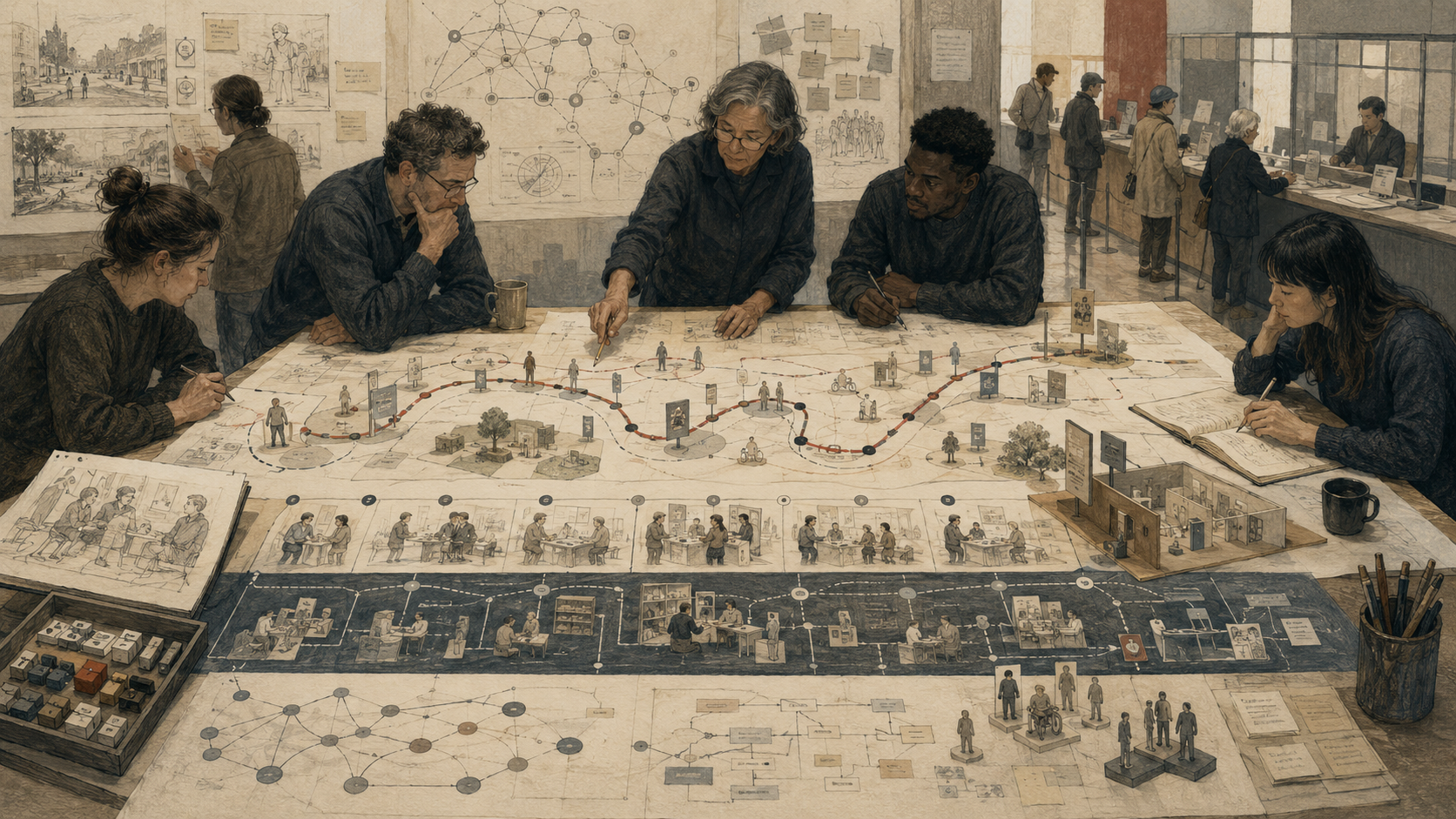
Service design connects directly to human-centered problem solving, empathy and stakeholder research, contextual inquiry and synthesis, problem framing, insight generation, prototyping, testing and validation, iteration and experimentation, implementation and scaling, design evaluation, learning, and outcome measurement, co-design and participatory design, ethics, power, and inclusion, public policy, and organizational innovation.
What Service Design Means in Design Thinking
Service design is the practice of designing services as integrated experiences and delivery systems. It examines how people encounter a service across time, touchpoints, channels, roles, spaces, technologies, policies, data systems, and support structures. Within design thinking, service design turns human-centered inquiry into a more complete account of how value is created, delivered, interrupted, repaired, and sustained.
A service is not a single interface or transaction. It may involve discovery, eligibility, onboarding, waiting, communication, decision-making, payment, support, escalation, recovery, documentation, renewal, exit, and long-term relationship management. Each stage may involve multiple actors, including users, customers, patients, citizens, employees, frontline staff, managers, technical teams, partners, vendors, regulators, caregivers, advocates, and affected publics.
| Service-design concern | Design-thinking translation | Core question |
|---|---|---|
| End-to-end experience | Study the whole journey rather than isolated touchpoints. | What does the service feel like across time? |
| Frontstage interaction | Examine what users see, hear, read, touch, and experience directly. | Is the visible service clear, humane, accessible, and trustworthy? |
| Backstage operations | Map the roles, workflows, systems, policies, and data that support delivery. | Can the organization actually deliver the promised experience? |
| Service evidence | Identify the artifacts, messages, receipts, forms, dashboards, and records that shape perception. | What makes the service legible and credible? |
| Handoffs | Track where responsibility moves between people, departments, channels, or systems. | Where does continuity break down? |
| Failure and recovery | Design how the service responds when things go wrong. | How does the system preserve trust after failure? |
| Burden and equity | Measure who must do extra work to make the service function. | Who carries the hidden cost of service complexity? |
Service design therefore expands the scope of design thinking. It moves from “What should we build?” to “How should this experience be delivered, supported, governed, repaired, and improved?” It asks designers to connect human insight to organizational capability.
The service-design mindset is especially important when designing for complex systems: healthcare, education, public benefits, banking, transportation, customer support, social services, digital platforms, civic technology, employee onboarding, emergency response, sustainability programs, and institutional knowledge systems. In these environments, a beautiful interface can still fail if the service system behind it is fragmented, inaccessible, or unable to learn.
Why Service Design Matters
Service design matters because people often experience institutions through services. They do not encounter an organization only through its mission statement, brand, policy, or strategy. They encounter it through waiting times, forms, phone calls, letters, applications, appointments, eligibility rules, staff interactions, error messages, onboarding flows, service desks, digital portals, support tickets, billing processes, escalation routes, case decisions, and moments of failure or recovery.
When services work well, they can create trust, clarity, dignity, access, confidence, continuity, and value. When they work poorly, they can produce confusion, delay, abandonment, anxiety, exclusion, wasted labor, duplicate work, mistrust, and institutional harm. Service design matters because it treats those experiences as designable, not accidental.
| Common service failure | What users experience | Service-design response |
|---|---|---|
| Fragmented touchpoints | People receive inconsistent information across website, phone, email, staff, and physical locations. | Map channels, scripts, content, systems, and ownership across the full journey. |
| Hidden eligibility logic | People cannot tell whether they qualify, what they need, or why they were rejected. | Design legible rules, decision explanations, document checklists, and appeal pathways. |
| Operational silos | Departments hand people off without shared context or accountability. | Blueprint backstage workflows, handoff points, data flows, and escalation responsibilities. |
| Excessive user burden | People must repeat information, track status manually, chase updates, or coordinate the service themselves. | Measure administrative burden and shift coordination back to the service provider where possible. |
| Weak recovery | When something goes wrong, the system becomes harder to navigate. | Design service recovery, apology, correction, escalation, and human support pathways. |
| Staff overload | Frontline workers compensate for broken systems through invisible effort. | Map employee burden, exception handling, and support needs alongside user experience. |
| Exclusion by design | Services work for confident or well-resourced users but fail for people with access barriers. | Test with non-users, edge cases, disabled users, low-trust groups, and high-burden stakeholders. |
Service design also matters because services are relational. A person’s experience of a service is shaped not only by efficiency, but by whether the service communicates respect, competence, transparency, fairness, and care. A fast service can still feel dehumanizing. A technically accurate service can still be confusing. A digital-first service can still exclude those who need assistance. A well-intended service can still shift burden to people already under pressure.
Design thinking benefits from service design because service design forces the method to confront delivery reality. It is not enough to generate an appealing concept. The service must be made operational, accessible, maintainable, measurable, and accountable. The design must work for users and for the people and systems responsible for delivering it.
Services, Products, Experiences, and Systems
Design thinking often moves across products, services, experiences, and systems, but these terms should not be collapsed into one another. A product may be tangible or digital. A service is performed, delivered, coordinated, or experienced over time. An experience is the subjective and practical encounter people have with the service. A system is the wider set of relationships, rules, infrastructures, incentives, technologies, and institutions that make the service possible.
Service design is particularly powerful because it sits between experience and system. It asks how the experience is produced. That means studying not only what the user does, but what the organization does, what staff must know, what systems must exchange, what data must be available, what policies shape decisions, and what happens when things go wrong.
| Design object | Primary focus | Service-design implication |
|---|---|---|
| Product | A tangible or digital artifact people use. | The product may be one touchpoint in a larger service journey. |
| Interface | The visible interaction layer between person and system. | Interface clarity depends on backstage logic, content, data, and support. |
| Experience | How people perceive, understand, feel, and act across interaction moments. | Experience must be studied across time, not only at one point of contact. |
| Service | A coordinated process of value creation and support across people, channels, and systems. | Design must include frontstage interaction and backstage delivery. |
| Operation | The internal processes, roles, systems, and resources that deliver the service. | Operational design determines whether the service promise is realistic. |
| Institution | The organization, authority, policy, governance, and accountability structure behind the service. | Service design must confront power, legitimacy, trust, and responsibility. |
| Ecosystem | The wider network of actors, partners, platforms, policies, and affected publics. | Service outcomes may depend on relationships beyond the service provider. |
This distinction prevents a common mistake: treating service design as interface design. A confusing digital portal may need better navigation, but it may also reveal deeper problems: unclear eligibility criteria, siloed case ownership, inconsistent records, inaccessible language, or rules that require too much documentation. Redesigning the screen without redesigning the service system may make the surface cleaner while leaving the underlying burden unchanged.
Service design therefore extends the unit of analysis. It asks designers to see services as relational infrastructures: patterns of coordinated action that distribute value, burden, responsibility, trust, and risk across people and institutions.
Historical Development of Service Design
Service design emerged from several overlapping traditions: service marketing, operations management, human-centered design, interaction design, user experience, service blueprinting, sociotechnical systems, public-sector design, and organizational innovation. Early service-design thinking recognized that services differ from manufactured goods because they are often intangible, time-based, interactive, variable, and co-produced by users and providers.
G. Lynn Shostack’s work on service blueprinting helped make service processes visible by mapping service actions, customer contact, support processes, and failure points. Later work by Mary Jo Bitner, Amy Ostrom, and Felicia Morgan further established service blueprinting as a practical technique for service innovation. Contemporary service design expanded this logic into a broader practice of designing multichannel, human-centered, organizationally grounded service experiences.
| Historical strand | Contribution to service design | Continuing relevance |
|---|---|---|
| Service marketing | Recognized services as distinct from goods and emphasized experience, interaction, and value delivery. | Services require attention to perception, trust, relationship, and quality over time. |
| Service blueprinting | Made service processes visible across frontstage and backstage actions. | Blueprints still help teams diagnose breakdowns, handoffs, dependencies, and innovation opportunities. |
| Operations management | Studied process, reliability, capacity, throughput, queuing, and service delivery. | Service concepts must work under operational constraints, not only in prototype form. |
| Human-centered design | Centered users, context, needs, pain points, and lived experience. | Service design begins with situated human experience but extends into delivery systems. |
| Interaction design and UX | Developed methods for designing digital and interactive touchpoints. | Digital touchpoints must be understood as parts of larger service journeys. |
| Service design practice | Integrated journey mapping, blueprinting, prototyping, stakeholder research, and implementation. | Modern services require coordination across channels, teams, systems, and institutions. |
| Public-sector design | Applied service design to government, health, education, benefits, and civic systems. | Public services require legitimacy, equity, procedural fairness, and accountability. |
The history of service design reveals a movement from customer contact and process visibility toward systems-aware design. Contemporary service designers increasingly work with complex service ecosystems: healthcare journeys, public-benefit systems, financial services, digital platforms, mobility networks, educational pathways, workplace services, and civic infrastructures. These services cannot be improved by touchpoint redesign alone. They require organizational and institutional change.
For design thinking, the historical lesson is that service design makes design more operationally honest. It asks how ideas become delivered realities, how organizations coordinate around experience, and how invisible structures shape visible outcomes.
Frontstage, Backstage, and the Service System
The frontstage/backstage distinction is one of service design’s most useful concepts. The frontstage includes the parts of the service directly experienced by users: conversations, interfaces, physical spaces, messages, forms, instructions, staff interactions, appointments, waiting rooms, portals, notifications, receipts, and support channels. The backstage includes what users may not see but what makes the service possible: staffing, training, databases, policies, approvals, case notes, scheduling systems, logistics, scripts, routing rules, quality control, and escalation procedures.
Many service problems arise because organizations improve the frontstage without redesigning the backstage. A website may promise easy access while internal eligibility review remains slow and opaque. A chatbot may provide quick responses while escalation to a human is poorly governed. A redesigned intake form may look simpler while staff still lack the data needed to process requests. Service design insists that the two layers must be examined together.
| Layer | Examples | Design question |
|---|---|---|
| Customer or user actions | Searching, applying, booking, waiting, submitting, asking, deciding, paying, appealing. | What is the person trying to accomplish, and what effort does the service demand? |
| Frontstage touchpoints | Website, app, form, phone call, service desk, email, letter, appointment, signage. | Are touchpoints clear, consistent, accessible, and emotionally appropriate? |
| Frontstage staff actions | Greeting, explaining, advising, triaging, resolving, escalating, reassuring. | Do staff have the tools, authority, and support to deliver the intended experience? |
| Backstage staff actions | Case review, verification, scheduling, routing, documentation, coordination, approval. | Where does invisible work determine user outcomes? |
| Support processes | Data systems, policy rules, training, scripts, workflow queues, vendor systems, quality assurance. | What must work behind the scenes for the service to be reliable? |
| Governance and ownership | Decision rights, accountability, funding, compliance, escalation, evaluation. | Who owns service performance across the full journey? |
| Evidence and artifacts | Messages, receipts, status updates, documents, notices, confirmations, records. | What evidence helps people understand, trust, and navigate the service? |
This distinction is especially important in public, healthcare, education, and organizational services, where the visible interaction often hides complex institutional processes. A person may experience delay as neglect, even when the cause is a broken data integration. A staff member may appear unhelpful, even when they lack authority to resolve the issue. A form may seem poorly written, even when the deeper problem is a policy that requires unnecessary documentation.
Service design makes those relationships visible. It allows teams to ask whether a failure is a communication problem, a workflow problem, a staffing problem, a governance problem, a data problem, a policy problem, or a deeper institutional design problem. The answer is often more than one.
Journey Mapping and Service Experience Over Time
Journey mapping is a core service-design method because services unfold over time. A service experience may begin before the first official interaction and continue long after the formal transaction ends. People form expectations, search for information, compare alternatives, ask for help, prepare documents, enter queues, experience uncertainty, receive decisions, resolve problems, and remember whether the organization treated them fairly.
A journey map helps teams see this sequence from the perspective of the person moving through the service. It can document steps, goals, emotions, questions, pain points, touchpoints, channels, support needs, decision moments, failure points, and opportunities for improvement. In stronger practice, journey mapping is not merely an internal workshop exercise. It is grounded in research and validated with the people whose journeys are being represented.
| Journey component | What it captures | Service-design use |
|---|---|---|
| Stage | Major phase of the experience, such as discover, apply, wait, receive, use, resolve, renew, or exit. | Clarifies the end-to-end structure of the service. |
| User goal | What the person is trying to accomplish at each stage. | Prevents the service from optimizing internal steps while missing user intent. |
| Touchpoint | Website, phone, email, office, staff interaction, letter, portal, app, or physical environment. | Identifies where the service becomes visible. |
| Emotion | Confidence, confusion, anxiety, relief, frustration, trust, anger, uncertainty. | Reveals how service design affects meaning and trust. |
| Friction | Delay, repetition, unclear instructions, inaccessible channels, missing status, failed handoff. | Shows where the experience breaks down. |
| Support need | Explanation, translation, human assistance, documentation help, reassurance, escalation. | Reveals what the service must provide beyond the main transaction. |
| Backstage dependency | Data, staff, policy, scheduling, routing, verification, approval, fulfillment. | Connects visible experience to operational causes. |
Journey maps can be powerful, but they can also mislead if treated as decorative artifacts. A polished journey map based on weak research may simplify real variation. A journey map that represents only ideal users may erase excluded groups. A journey map that stops at the visible experience may fail to explain why the service breaks. A serious journey map should be treated as a hypothesis grounded in evidence, not as a finished truth.
Service design also requires multiple journeys. Different users may experience the same service differently depending on language, disability, income, device access, trust, geography, time constraints, family obligations, immigration status, prior trauma, professional status, or familiarity with institutions. Staff journeys also matter. A service that improves user experience by increasing staff burden may not be sustainable or ethical.
Service Blueprinting and Operational Visibility
Service blueprinting extends journey mapping by connecting the visible user experience to the invisible service-delivery system. A blueprint usually includes user actions, frontstage touchpoints, frontstage staff actions, backstage staff actions, support processes, systems, evidence, and lines of visibility or interaction. It helps teams see not only what people experience, but what must happen behind the scenes for the service to function.
This is why service blueprinting is one of the most important methods in service design. It reveals where services fail because of poor coordination, unclear ownership, fragile handoffs, missing data, policy complexity, technology constraints, staffing overload, or unsupported frontline labor. It also helps teams identify where to prototype: not only screens and messages, but workflows, scripts, queues, escalation rules, staff roles, data flows, and governance routines.
| Blueprint element | What it shows | Diagnostic question |
|---|---|---|
| User actions | Steps the person takes to navigate or use the service. | Where does the service demand excessive effort from the user? |
| Physical or digital evidence | Artifacts the user encounters, such as forms, emails, confirmations, signage, dashboards, receipts. | Does the service leave people with clear evidence of what happened and what comes next? |
| Frontstage interactions | Visible staff or system actions. | Are user-facing interactions clear, consistent, accessible, and trustworthy? |
| Line of visibility | Boundary between what users see and what remains hidden. | Does hidden complexity create confusion or mistrust? |
| Backstage actions | Internal staff work, review, routing, documentation, scheduling, verification, or coordination. | Where does invisible work determine service quality? |
| Support systems | Data platforms, policy rules, automation, training, vendors, reporting, quality control. | What infrastructure must function reliably? |
| Failure points | Known breakdowns, delays, errors, contradictions, and unsupported exceptions. | Where should the service be redesigned, prototyped, or governed differently? |
Blueprinting is also useful because it allows different stakeholders to see the same service from different vantage points. Users can reveal confusion, burden, and trust issues. Frontline staff can reveal exceptions, workarounds, and hidden labor. Managers can reveal constraints, metrics, and capacity limits. Technical teams can reveal data and integration problems. Policy owners can reveal rule structures. Service design brings these forms of knowledge into a shared map.
The value of a service blueprint is not the artifact itself. The value lies in the conversations, diagnosis, and redesign decisions it supports. A blueprint should lead to action: removing friction, clarifying ownership, simplifying rules, reducing burden, improving staff tools, redesigning communication, strengthening recovery, and creating feedback loops for ongoing service learning.
Users, Staff, Partners, and Affected Stakeholders
Service design requires a wider view of stakeholders than many design processes use. The “user” matters deeply, but services are delivered through networks of people and systems. A person receiving a service may depend on frontline staff, caregivers, caseworkers, call-center agents, clinicians, teachers, administrators, technicians, delivery partners, vendors, policy owners, data stewards, and community intermediaries. Each group may experience the service differently.
This matters because service improvements can unintentionally shift burden. A self-service portal may reduce call volume while increasing difficulty for users with disabilities or low digital access. A new dashboard may help managers while increasing surveillance pressure on staff. A simplified application may help users while requiring more backstage verification. A faster intake process may overload downstream teams. Service design must examine the distribution of effort, risk, and value across the full system.
| Stakeholder group | What they may know | Risk if ignored |
|---|---|---|
| Primary users | Goals, confusion, emotions, access barriers, trust, service value. | The service may fail the people it claims to serve. |
| Non-users and abandoners | Why people avoid, distrust, cannot access, or drop out of the service. | The service may optimize for successful users while hiding exclusion. |
| Frontline staff | Workarounds, recurring failures, hidden labor, customer pain, exception handling. | The service may become impossible or harmful to deliver. |
| Back-office staff | Verification, documentation, routing, compliance, data problems, queue management. | Visible improvements may fail because internal processes remain broken. |
| Managers | Capacity, incentives, staffing, performance measures, resource constraints. | Service redesign may lack operational feasibility. |
| Technical teams | System dependencies, integrations, automation limits, data quality, security. | Concepts may be desirable but technically fragile. |
| Partners and intermediaries | Cross-system handoffs, community support, advocacy, navigation, referral pathways. | The service may externalize work to actors it does not fund or support. |
| Affected publics | Consequences for people indirectly shaped by the service. | The service may create harms beyond the visible user population. |
Service design therefore benefits from co-design and participatory design. People affected by a service should help identify failure points, define what good service means, test prototypes, review trade-offs, and evaluate implementation. Staff participation is especially important because frontline workers often hold the clearest knowledge of where official service models diverge from reality.
Stakeholder analysis in service design should document not only who is involved, but who has influence. It should ask whose evidence determines priorities, whose burden is measured, whose needs are considered exceptions, and whose participation changes the service design. Without this attention, service design can become a polished version of existing institutional power.
Research Methods for Service Design
Service design research combines qualitative, quantitative, observational, participatory, operational, and systems-oriented methods. It must understand how people experience the service, how the organization delivers it, and how outcomes vary across groups and contexts. No single method is enough. Interviews reveal meaning and interpretation. Observation reveals behavior and context. Journey mapping reveals sequence. Blueprinting reveals backstage systems. Analytics reveal patterns at scale. Staff research reveals operational reality. Prototype testing reveals whether redesigned services work in practice.
| Method | What it reveals | Service-design use |
|---|---|---|
| Contextual inquiry | How people navigate services in real environments. | Identify access barriers, workarounds, documents, time constraints, and support needs. |
| Service walkthrough | What the service feels like when experienced step by step. | Find friction in discovery, navigation, communication, waiting, and resolution. |
| Journey mapping | User experience across time, channels, emotions, and decision points. | Locate pain points, moments of truth, abandonment, and recovery needs. |
| Service blueprinting | Frontstage and backstage relationships, systems, handoffs, and support processes. | Diagnose operational causes of visible service breakdowns. |
| Diary studies | Longitudinal experience, waiting, uncertainty, and service use over time. | Understand services that unfold across days, weeks, months, or recurring cycles. |
| Support-ticket analysis | Recurring problems, complaint themes, escalation patterns, and confusion points. | Identify high-frequency and high-severity service failures. |
| Operational data review | Cycle time, queue length, abandonment, errors, rework, completion, and throughput. | Connect lived experience to delivery performance. |
| Participatory workshops | Stakeholder interpretation, priorities, trade-offs, and solution ideas. | Co-design service improvements with users, staff, partners, and affected groups. |
Service design research should also include edge cases and non-users. The people who successfully navigate a service are often easier to find, but they may not reveal the service’s deepest failures. People who abandon a service, avoid it, distrust it, or rely on intermediaries often reveal the most important design problems.
Researchers should be careful not to reduce service experience to satisfaction. Satisfaction scores can hide fear, resignation, low expectations, or lack of alternatives. A person may report satisfaction simply because a service eventually worked, even if the process was confusing, burdensome, or humiliating. Service design should measure experience, effort, trust, dignity, accessibility, and equity alongside conventional satisfaction metrics.
Service Prototyping and Simulation
Service prototyping makes service concepts tangible before full implementation. Because services are time-based and interactive, prototypes may include role-play, scripts, paper forms, digital mockups, service walkthroughs, staged environments, workflow simulations, concierge pilots, Wizard-of-Oz testing, service rehearsals, scenario cards, policy notices, escalation scripts, and operational pilots. The goal is to test how the service works as an experience and as a delivery system.
A service prototype should test more than whether users understand a touchpoint. It should test whether staff can deliver the service, whether handoffs work, whether data is available, whether support channels are adequate, whether exceptions are handled, whether users trust the process, whether the service reduces or increases burden, and whether the organization can sustain the service at scale.
| Prototype type | What it tests | Example |
|---|---|---|
| Script prototype | Language, explanation, emotional tone, consistency, and staff support. | Testing a benefits eligibility explanation with applicants and caseworkers. |
| Touchpoint prototype | Forms, portals, messages, signage, letters, status updates, and notifications. | Testing whether users understand what documents they need and what happens next. |
| Role-play prototype | Staff-user interaction, conflict, trust, escalation, and recovery. | Simulating a failed appointment, rejected claim, or complaint resolution. |
| Journey prototype | End-to-end sequence across multiple touchpoints and channels. | Testing discovery, intake, review, decision, follow-up, and renewal as one journey. |
| Backstage workflow prototype | Internal roles, queues, handoffs, data access, and ownership. | Testing whether staff can resolve a case without repeated user contact. |
| Concierge pilot | Manual delivery of a future service to learn before automation or scale. | Providing high-touch support to understand what users need before building a portal. |
| Implementation pilot | Service performance under limited real-world conditions. | Rolling out a redesigned intake process to one region, team, or user segment. |
Service prototypes should be evaluated through both user and provider perspectives. A prototype that users like but staff cannot deliver is incomplete. A prototype that reduces staff workload but confuses users is also incomplete. A prototype that improves average experience but worsens outcomes for disabled users, low-trust users, or people with limited time is ethically weak.
Service prototyping is therefore not only a creative activity. It is a learning system. It helps teams discover whether a service concept is desirable, feasible, equitable, trustworthy, operationally coherent, and ready for implementation.
Failure, Recovery, Trust, and Procedural Dignity
Every service fails sometimes. Appointments are missed, information is wrong, systems go down, forms are rejected, calls are dropped, cases are delayed, payments fail, instructions conflict, staff make mistakes, and users misunderstand requirements. Service design must therefore design not only the ideal pathway, but also failure and recovery.
Failure moments often reveal the real quality of a service. When everything goes well, users may not notice the service system. When something goes wrong, the service’s values become visible. Does the organization explain the problem? Does it take responsibility? Does it provide a human path to resolution? Does it preserve dignity? Does it require the user to restart from the beginning? Does it punish people for errors caused by the service itself?
| Failure type | User experience | Recovery design requirement |
|---|---|---|
| Information failure | Instructions are unclear, contradictory, incomplete, or inaccessible. | Provide plain-language explanation, examples, status, and correction paths. |
| Handoff failure | The user is transferred without context or accountability. | Maintain shared records, warm handoffs, ownership, and escalation tracking. |
| System failure | Portal, database, payment, scheduling, or messaging system breaks. | Provide fallback channels, confirmation, continuity, and transparent updates. |
| Eligibility or decision failure | The user does not understand why a decision was made or how to respond. | Design explanations, evidence requirements, appeal rights, and support pathways. |
| Staff capacity failure | Staff are unable to respond quickly, accurately, or empathetically. | Improve training, staffing, scripts, authority, and workload management. |
| Accessibility failure | The service excludes people because of disability, language, device, location, or time barriers. | Provide alternative channels, accommodations, assisted service, and inclusive testing. |
| Trust failure | The user believes the service is unfair, unsafe, opaque, or indifferent. | Use transparency, apology, correction, procedural fairness, and visible accountability. |
Procedural dignity is central here. People may tolerate delay or complexity more readily when they understand what is happening, feel respected, and have meaningful recourse. Conversely, even a technically correct decision can feel illegitimate if the process is opaque, dismissive, confusing, or impossible to challenge.
Service design should therefore include recovery metrics: resolution time, repeat contact, reopened cases, complaint escalation, user comprehension, apology quality, appeal success, staff discretion, burden reduction, and trust restoration. A service that cannot recover well is not well designed.
Digital, Omnichannel, and AI-Assisted Services
Many services now unfold across digital and physical channels: websites, apps, SMS, email, call centers, chatbots, service desks, kiosks, portals, documents, staff interactions, and third-party platforms. Service design is essential in these environments because users rarely think in channels. They think in tasks, needs, uncertainty, and outcomes. When channels are disconnected, the burden falls on the user to coordinate the service.
Digital transformation often fails when organizations digitize broken services rather than redesigning them. A confusing policy becomes a confusing portal. A fragmented workflow becomes a fragmented dashboard. A slow approval process becomes a digital status screen that still provides no meaningful explanation. Service design asks whether digital tools reduce burden, improve clarity, expand access, strengthen trust, and support staff, or merely move complexity into a new interface.
| Digital service challenge | Service-design concern | Design response |
|---|---|---|
| Channel fragmentation | Users receive different answers across website, phone, chat, email, and staff. | Unify content, knowledge systems, service logic, and ownership across channels. |
| Digital exclusion | Digital-first services fail people without access, confidence, language support, or assistive compatibility. | Design assisted digital, alternative channels, accessibility testing, and human support. |
| Automation opacity | Users do not know when automation is involved or how to contest outcomes. | Provide explanation, human review, appeal routes, and transparent decision logic. |
| Chatbot containment | People are trapped in automated support when they need human resolution. | Design escalation triggers, human handoff, transcript continuity, and accountability. |
| Data mismatch | Systems contain inconsistent or outdated records. | Design data governance, correction pathways, and cross-system reconciliation. |
| Status uncertainty | Users cannot tell where they are in the process or what happens next. | Design meaningful status, expected timelines, next steps, and responsibility markers. |
| AI-assisted triage | AI ranks, routes, or recommends service decisions with uneven consequences. | Use bias review, participatory testing, audit logs, human oversight, and consequence monitoring. |
AI-assisted services require special caution. AI can help identify patterns, triage requests, summarize cases, route support, draft responses, predict demand, and detect anomalies. But it can also amplify bias, hide accountability, reduce contestability, increase surveillance, and make weak service logic appear objective. Service design should require human-centered and participatory review before AI becomes part of a service journey.
The central question is not “Can this service be automated?” It is “What should automation do, what should remain human, what support is needed, who can challenge the system, and how will the organization know when the service is causing harm?”
Public Services and Institutional Legitimacy
Service design has special significance in public services because public institutions do not merely serve customers. They administer rights, obligations, benefits, protections, education, health, mobility, safety, documentation, justice, and public goods. People may depend on public services under conditions of vulnerability, urgency, poverty, disability, displacement, illness, aging, unemployment, crisis, or legal uncertainty. The quality of the service can shape whether public authority feels legitimate or hostile.
Public-service design should therefore be evaluated through access, dignity, equity, transparency, due process, burden, and trust. A public benefits application that is technically available but impossible to understand may deny access in practice. A healthcare referral pathway that requires repeated self-advocacy may fail people with limited time or capacity. A civic technology system that is efficient for the agency but opaque to residents may weaken legitimacy.
Appeals and correctionCan people challenge errors or provide missing evidence without starting over?Justice, legitimacy, and harm reduction.
| Public-service concern | Service-design question | Public value at stake |
|---|---|---|
| Eligibility | Can people understand whether they qualify and what evidence is required? | Access, fairness, and procedural clarity. |
| Administrative burden | How much time, documentation, learning, and psychological effort does the service demand? | Equity, dignity, and real access. |
| Decision explanation | Can people understand why a decision was made and what they can do next? | Due process, trust, and accountability. |
| Assisted access | Can people get human help when digital or written channels fail? | Inclusion, disability access, and language justice. |
| Cross-agency coordination | Do agencies share enough context to reduce repetition and burden? | Continuity, efficiency, and public trust. |
| Community participation | Do affected communities help define what good service means? | Democratic legitimacy and public accountability. |
Public service design should not be confused with making government “feel like a consumer app.” The standards are different. Public services must be accessible to people with different abilities, languages, resources, risks, and levels of trust. They must provide accountability and recourse. They must handle edge cases fairly. They must avoid creating hidden exclusion through complexity.
In public institutions, service design is a form of governance design. It shapes how people encounter public authority and whether that authority can be understood, trusted, corrected, and held accountable.
Organizational Implementation and Service Operations
Service design fails when it stops at concepts, maps, and prototypes. A service must be implemented through an organization. That means service design must address ownership, staffing, training, governance, technology, funding, maintenance, quality assurance, monitoring, and continuous improvement. Without these conditions, even a well-designed service concept can deteriorate quickly.
Implementation is especially difficult because services often cross organizational boundaries. One team owns the website, another owns operations, another owns policy, another owns data, another owns support, another owns compliance, another owns procurement, and another owns evaluation. Users experience one service, but the organization manages many fragments. Service design helps make those fragments visible, but leadership must still create accountability across them.
| Implementation condition | Why it matters | Design implication |
|---|---|---|
| Service ownership | Someone must be accountable for the end-to-end service, not only one touchpoint. | Assign ownership across journey performance, quality, and improvement. |
| Staff capability | Staff need training, tools, authority, and time to deliver the service. | Prototype staff workflows, scripts, escalation, and support structures. |
| Technology readiness | Data and systems must support the intended service model. | Test integrations, status visibility, data quality, and fallback channels. |
| Governance | Services need review, decision rights, quality standards, and escalation paths. | Design governance routines alongside user-facing touchpoints. |
| Performance measurement | Organizations manage what they measure. | Measure experience, burden, trust, equity, reliability, recovery, and staff workload. |
| Funding and maintenance | Services require support beyond launch. | Budget for iteration, content updates, staff support, technology maintenance, and evaluation. |
| Learning loops | Services drift as user needs, policies, staff, and systems change. | Create mechanisms for feedback, monitoring, revision, and service ownership over time. |
Service design also requires attention to employee experience. Staff are not merely delivery mechanisms. They interpret rules, manage emotion, absorb frustration, handle exceptions, and compensate for system weaknesses. A service that depends on heroic staff effort is fragile. A service that improves user experience by overloading staff is not well designed.
Implementation should therefore be treated as part of the design process, not as a handoff after design. The service is not complete until the organization can deliver it reliably, ethically, and sustainably.
Ethics, Equity, Accessibility, and Burden
Service design is ethical because services distribute access, effort, time, dignity, visibility, risk, and care. A service may be efficient for the organization while burdensome for users. It may be convenient for confident users while excluding those with disabilities, limited literacy, language barriers, low trust, unstable housing, caregiving responsibilities, or limited digital access. It may reduce costs by shifting work to families, frontline staff, community organizations, or unpaid intermediaries.
Equity in service design requires more than equal availability. A service can be formally available to everyone and practically accessible only to some. Service design must examine who can find the service, understand it, complete it, get help, recover from mistakes, appeal decisions, and maintain access over time.
| Ethical dimension | Service-design question | Evidence to examine |
|---|---|---|
| Accessibility | Can people with different abilities, languages, devices, and support needs use the service? | Accessibility testing, assisted access data, language support, disability feedback. |
| Administrative burden | How much learning, compliance, documentation, waiting, and psychological effort is required? | Completion time, repeat contact, abandonment, document requirements, user interviews. |
| Procedural dignity | Does the service treat people with respect, clarity, and recourse? | Complaint themes, interview data, decision explanations, appeal pathways. |
| Burden shifting | Is work transferred from the organization to users, staff, families, or intermediaries? | Workload analysis, support logs, staff interviews, community partner feedback. |
| Equity of outcomes | Do service outcomes differ by group, geography, language, disability, income, or channel? | Disaggregated service metrics, qualitative evidence, journey variation. |
| Privacy and surveillance | Does the service collect, expose, or infer more information than necessary? | Data inventory, consent review, access controls, algorithmic audit. |
| Contestability | Can people correct errors, challenge decisions, and access human review? | Appeal rates, correction time, human-review access, error resolution. |
Ethical service design also requires humility about “efficiency.” Efficiency can be valuable, but it can become harmful when measured only from the provider’s perspective. Reducing call volume may look efficient because users gave up. Reducing staff time may increase user burden. Automating decisions may speed processing while reducing explanation and recourse. Service design must ask what kind of efficiency is being created and who pays for it.
Equitable service design should include people most likely to be excluded. It should test high-burden journeys, not only ideal journeys. It should measure failure and recovery, not only completion. It should treat accessibility, dignity, and trust as core service outcomes.
Service Design Measurement and Evaluation
Service design requires measurement, but measurement must be broad enough to reflect service reality. Traditional service metrics often include satisfaction, wait time, completion rate, cost, throughput, usage, conversion, and support volume. These are useful, but they can be misleading if interpreted alone. A service may have high completion among those who persist while excluding those who abandon early. A service may reduce support volume by making help harder to reach. A service may lower cost by increasing unpaid burden.
A stronger service-design evaluation combines experience metrics, operational metrics, equity metrics, trust metrics, staff metrics, and learning metrics. It examines whether the service works well across different groups and contexts, not only on average.
| Measurement domain | Possible indicators | Interpretive caution |
|---|---|---|
| Experience quality | Clarity, confidence, trust, satisfaction, perceived fairness, emotional burden. | Average satisfaction may hide severe failures for smaller groups. |
| Task performance | Completion rate, error rate, abandonment, repeat contact, help requests. | Completion can reflect persistence, not good design. |
| Operational reliability | Cycle time, queue length, rework, handoff failure, system uptime, escalation rates. | Operational success must be connected to lived experience. |
| Administrative burden | Time, documents, steps, repeat submissions, status checks, cognitive load. | Burden should be measured from the user’s perspective. |
| Equity and access | Outcome differences by group, channel, language, disability, geography, income, or device. | Disaggregation is essential; aggregate improvement may hide exclusion. |
| Staff experience | Workload, discretion, confidence, burnout risk, tool usability, exception burden. | User improvement that harms staff may not be sustainable. |
| Recovery quality | Complaint resolution, appeal success, correction time, apology quality, reopened cases. | Recovery quality often matters most when trust is fragile. |
| Learning and governance | Feedback loops, decisions changed, service improvements, ownership, monitoring cadence. | Measurement has little value if it does not change the service. |
Service evaluation should also include qualitative evidence. Numbers can show where something is happening, but they may not explain why. Interviews, observation, staff reflection, complaint review, participatory synthesis, and service walkthroughs help interpret patterns. A serious service-design measurement system combines the scale of quantitative data with the meaning of qualitative evidence.
The goal is not measurement for its own sake. The goal is service learning. Good metrics help the organization see friction, burden, exclusion, failure, and drift early enough to redesign the service before harm becomes normalized.
Critiques and Limits of Service Design
Service design can be misused. It can become customer-experience polish that leaves deeper institutional problems untouched. It can map journeys without changing power. It can produce beautiful blueprints without implementation authority. It can emphasize delight while ignoring dignity. It can improve service efficiency while shifting burden to users or workers. It can make harmful systems easier to use without questioning whether those systems should exist in their current form.
These critiques are serious. Service design is not automatically ethical, equitable, or transformative. It depends on what questions are asked, who participates, what evidence counts, what constraints are challenged, and whether organizations are willing to change backstage systems, policies, resources, and governance.
| Misuse | How it appears | Stronger alternative |
|---|---|---|
| Touchpoint polish | The organization improves screens, scripts, or forms while leaving underlying service logic unchanged. | Redesign frontstage and backstage systems together. |
| Journey-map theater | Maps are created for workshops or presentations but do not influence decisions. | Connect journey findings to owners, funding, prototypes, and implementation changes. |
| Customer-only framing | Service design focuses on high-value or dominant users while ignoring excluded groups. | Include non-users, marginalized users, frontline staff, and affected publics. |
| Efficiency bias | Success is measured by cost reduction, automation, or speed alone. | Measure dignity, access, trust, burden, equity, reliability, and recovery. |
| Staff invisibility | Employee workarounds and emotional labor are ignored. | Design employee experience and operational capacity as part of service quality. |
| Implementation gap | Service concepts are handed off without governance or ownership. | Design service ownership, training, quality monitoring, and continuous improvement. |
| Legitimacy laundering | Service design language is used to make institutions appear responsive without changing accountability. | Document what changed, what did not change, and why. |
Service design also has limits because not every service problem is only a service problem. Some problems are caused by underfunding, unjust policy, structural inequality, labor exploitation, surveillance, austerity, or political choices. Service design can reveal these issues, but it cannot solve them through journey maps alone. In such cases, the ethical responsibility of service design is to make structural causes visible rather than disguising them as mere experience problems.
A mature practice therefore treats service design as one part of institutional and systems change. It improves services, but it also asks whether the service is organized around legitimate goals, fair rules, sufficient resources, and accountable governance.
Cross-Pillar Connections
Service design connects naturally to several areas of inquiry. It belongs within design thinking because it translates human-centered research into end-to-end service systems. It connects to systems thinking because services are produced by interacting actors, rules, technologies, workflows, incentives, and feedback loops. It connects to organizational psychology because service quality depends on staff behavior, leadership, trust, role clarity, psychological safety, and change capacity.
Service design also connects to institutions and governance because services are how many institutions become real to people. Public benefits, healthcare, education, transportation, housing, justice, environmental services, and civic platforms all depend on service design, even when they are not named that way. Digital and AI systems add another layer by embedding service decisions in data, automation, and algorithmic support.
| Related field | Connection to service design |
|---|---|
| Design thinking | Provides the broader inquiry process of framing, research, ideation, prototyping, testing, and iteration. |
| Systems thinking | Reveals how service outcomes emerge from relationships among rules, roles, technologies, incentives, and feedback loops. |
| Organizational psychology | Explains staff experience, motivation, role conflict, trust, burnout, leadership, and change behavior. |
| Co-design and participatory design | Involve users, workers, communities, and affected stakeholders in service diagnosis and redesign. |
| Public policy | Connects services to rights, eligibility, administrative burden, procedural fairness, and legitimacy. |
| Data systems and analytics | Support service measurement, status tracking, segmentation, operational monitoring, and equity analysis. |
| Artificial intelligence systems | Raise questions about automated triage, decision support, explainability, appeal, and governance. |
| Stewardship and ethics | Frames service design in relation to dignity, care, justice, responsibility, and burden distribution. |
The broader lesson is that service design is not a narrow specialization. It is a way of understanding how human experience, organizational capacity, technology, governance, and ethics meet in practice. It helps design thinking become more accountable to delivery, not only imagination.
Mathematical Lens: Modeling Service Quality, Burden, and Reliability
Service design cannot be reduced to equations, but formal models can help clarify assumptions. A service journey can be represented as a sequence of stages \(s_1, s_2, \ldots, s_n\). Each stage has some probability of successful completion, some level of user burden, some degree of trust, and some risk of failure.
R = \prod_{i=1}^{n} p_i
\]
Interpretation: End-to-end service reliability declines when any stage in the journey has a low probability of successful completion.
This matters because a service with many individually acceptable steps may still fail as a whole. If each stage has a 95 percent completion probability, a 10-stage journey has lower end-to-end reliability than any single stage suggests. Service design therefore asks teams to reduce unnecessary steps, strengthen weak stages, and provide support where failure risk is high.
User burden can be represented as the weighted sum of time, cognitive effort, documentation effort, emotional stress, and coordination work:
B = w_tT + w_cC + w_dD + w_eE + w_oO
\]
Interpretation: Service burden is not only time; it also includes cognitive, documentary, emotional, and coordination effort.
Service quality can be modeled as a balance among reliability, clarity, trust, accessibility, recovery, staff sustainability, and burden:
Q = w_rR + w_lL + w_tT + w_aA + w_vV + w_sS – w_bB
\]
Interpretation: A service improves when reliability, legibility, trust, accessibility, recovery, and staff sustainability rise while user burden falls.
Equity can be modeled by comparing service outcomes across groups. Let \(Q_g\) represent service quality for group \(g\), and let \(Q_{\max}\) represent the highest observed group quality.
E = \sum_{g=1}^{m} a_g(Q_{\max} – Q_g)
\]
Interpretation: Equity gaps increase when highly affected groups experience lower service quality than better-served groups.
These models are not substitutes for qualitative service research. They are tools for making service assumptions visible. They help teams ask where reliability breaks, where burden accumulates, where trust declines, and where average performance hides unequal outcomes.
R Workflow: Service Blueprint Friction and Equity Analysis
The R workflow below models a service journey across stages, channels, completion probability, burden, trust, accessibility, staff load, and recovery quality. It helps service-design teams identify which stages create the greatest end-to-end reliability risk and which groups experience the highest burden.
# Install packages if needed.
# install.packages(c("tidyverse", "scales"))

library(tidyverse)
library(scales)

# -------------------------------------------------------------------
# Example service journey stages.
# Scores use a 1-10 scale unless otherwise noted.
# completion_probability uses a 0-1 scale.
# -------------------------------------------------------------------

journey_stages <- tibble(
  stage = c(
    "Discover service",
    "Understand eligibility",
    "Prepare documents",
    "Submit request",
    "Wait for review",
    "Receive decision",
    "Resolve issue",
    "Maintain access"
  ),
  channel = c(
    "web_search",
    "website_and_phone",
    "documents",
    "digital_form",
    "status_portal",
    "email_letter",
    "phone_support",
    "portal_and_staff"
  ),
  completion_probability = c(0.92, 0.78, 0.70, 0.84, 0.76, 0.88, 0.62, 0.80),
  clarity = c(7.4, 5.8, 5.2, 6.8, 5.5, 6.4, 5.0, 6.2),
  trust = c(7.0, 5.8, 5.4, 6.4, 5.3, 6.2, 5.5, 6.0),
  accessibility = c(7.2, 5.6, 5.0, 6.8, 5.4, 6.0, 5.8, 6.4),
  user_burden = c(3.5, 5.8, 7.4, 6.2, 6.8, 5.6, 7.2, 5.9),
  staff_load = c(3.0, 5.2, 6.0, 5.8, 6.5, 5.6, 7.4, 6.2),
  recovery_quality = c(6.8, 5.4, 4.8, 5.8, 4.6, 5.2, 5.0, 5.6)
)

# -------------------------------------------------------------------
# Stage-level service quality score.
# -------------------------------------------------------------------

stage_scores <- journey_stages %>%
  mutate(
    stage_quality =
      0.22 * completion_probability * 10 +
      0.18 * clarity +
      0.18 * trust +
      0.16 * accessibility +
      0.14 * recovery_quality -
      0.07 * user_burden -
      0.05 * staff_load,
    failure_risk =
      1 - completion_probability,
    burden_risk =
      0.55 * user_burden + 0.45 * staff_load,
    redesign_priority =
      0.34 * failure_risk * 10 +
      0.26 * burden_risk +
      0.18 * (10 - clarity) +
      0.12 * (10 - accessibility) +
      0.10 * (10 - recovery_quality)
  ) %>%
  arrange(desc(redesign_priority))

print(stage_scores)

# -------------------------------------------------------------------
# End-to-end service reliability.
# -------------------------------------------------------------------

service_reliability <- prod(journey_stages$completion_probability)

service_summary <- tibble(
  service_reliability = service_reliability,
  mean_stage_quality = mean(stage_scores$stage_quality),
  mean_user_burden = mean(stage_scores$user_burden),
  mean_staff_load = mean(stage_scores$staff_load),
  mean_recovery_quality = mean(stage_scores$recovery_quality),
  highest_priority_stage = stage_scores$stage[1]
)

print(service_summary)

# -------------------------------------------------------------------
# Equity-oriented service analysis by user group.
# -------------------------------------------------------------------

group_experience <- tibble(
  group = c(
    "Confident digital users",
    "Low digital access users",
    "Disabled users",
    "Limited English users",
    "High time-pressure users",
    "Low-trust users"
  ),
  affectedness = c(0.55, 0.86, 0.92, 0.88, 0.80, 0.84),
  completion_rate = c(0.88, 0.58, 0.54, 0.60, 0.62, 0.56),
  clarity = c(7.8, 5.2, 5.0, 4.8, 5.4, 5.0),
  accessibility = c(8.0, 5.0, 4.8, 5.2, 5.6, 5.4),
  trust = c(7.6, 5.4, 5.2, 5.6, 5.5, 4.8),
  burden = c(3.8, 7.2, 7.6, 7.0, 7.4, 7.8)
)

group_scores <- group_experience %>%
  mutate(
    group_quality =
      0.26 * completion_rate * 10 +
      0.20 * clarity +
      0.20 * accessibility +
      0.18 * trust -
      0.16 * burden,
    equity_gap =
      max(group_quality) - group_quality,
    affectedness_weighted_gap =
      affectedness * equity_gap,
    attention_priority =
      0.40 * affectedness_weighted_gap +
      0.25 * (10 - accessibility) +
      0.20 * burden +
      0.15 * (10 - trust)
  ) %>%
  arrange(desc(attention_priority))

print(group_scores)

# -------------------------------------------------------------------
# Visualize service-stage redesign priorities.
# -------------------------------------------------------------------

ggplot(stage_scores, aes(x = reorder(stage, redesign_priority), y = redesign_priority)) +
  geom_col() +
  coord_flip() +
  labs(
    title = "Service Stage Redesign Priority",
    x = "Journey stage",
    y = "Redesign priority"
  ) +
  theme_minimal(base_size = 12)

# -------------------------------------------------------------------
# Export outputs.
# -------------------------------------------------------------------

write_csv(stage_scores, "service_stage_scores.csv")
write_csv(service_summary, "service_summary.csv")
write_csv(group_scores, "service_equity_group_scores.csv")
This workflow is useful because it treats a service as an end-to-end system. It shows how weak stages, cumulative burden, low recovery quality, and unequal group experiences can undermine the apparent success of a service.
Python Workflow: Service Journey Reliability and Burden Modeling
The Python workflow below extends the service-design model with Monte Carlo simulation. It estimates how uncertainty in stage completion, user burden, staff load, trust, accessibility, and recovery quality affects end-to-end service reliability and redesign priorities.
# Install packages if needed:
# pip install pandas numpy matplotlib scipy

import numpy as np
import pandas as pd
import matplotlib.pyplot as plt

# ---------------------------------------------------------------------
# Example service journey data.
# ---------------------------------------------------------------------

stages = pd.DataFrame({
    "stage": [
        "Discover service",
        "Understand eligibility",
        "Prepare documents",
        "Submit request",
        "Wait for review",
        "Receive decision",
        "Resolve issue",
        "Maintain access"
    ],
    "completion_probability": [0.92, 0.78, 0.70, 0.84, 0.76, 0.88, 0.62, 0.80],
    "clarity": [7.4, 5.8, 5.2, 6.8, 5.5, 6.4, 5.0, 6.2],
    "trust": [7.0, 5.8, 5.4, 6.4, 5.3, 6.2, 5.5, 6.0],
    "accessibility": [7.2, 5.6, 5.0, 6.8, 5.4, 6.0, 5.8, 6.4],
    "user_burden": [3.5, 5.8, 7.4, 6.2, 6.8, 5.6, 7.2, 5.9],
    "staff_load": [3.0, 5.2, 6.0, 5.8, 6.5, 5.6, 7.4, 6.2],
    "recovery_quality": [6.8, 5.4, 4.8, 5.8, 4.6, 5.2, 5.0, 5.6]
})

def score_service_stages(df):
    result = df.copy()

    result["stage_quality"] = (
        0.22 * result["completion_probability"] * 10 +
        0.18 * result["clarity"] +
        0.18 * result["trust"] +
        0.16 * result["accessibility"] +
        0.14 * result["recovery_quality"] -
        0.07 * result["user_burden"] -
        0.05 * result["staff_load"]
    )

    result["failure_risk"] = 1 - result["completion_probability"]
    result["burden_risk"] = 0.55 * result["user_burden"] + 0.45 * result["staff_load"]

    result["redesign_priority"] = (
        0.34 * result["failure_risk"] * 10 +
        0.26 * result["burden_risk"] +
        0.18 * (10 - result["clarity"]) +
        0.12 * (10 - result["accessibility"]) +
        0.10 * (10 - result["recovery_quality"])
    )

    return result.sort_values("redesign_priority", ascending=False)

baseline = score_service_stages(stages)
baseline_reliability = np.prod(stages["completion_probability"])

print("Baseline service reliability:", round(baseline_reliability, 4))
print(baseline[["stage", "stage_quality", "failure_risk", "burden_risk", "redesign_priority"]])

# ---------------------------------------------------------------------
# Monte Carlo uncertainty analysis.
# ---------------------------------------------------------------------

np.random.seed(42)
n_simulations = 10000
records = []

for simulation_id in range(n_simulations):
    simulated = stages.copy()

    simulated["completion_probability"] = np.random.normal(
        loc=stages["completion_probability"],
        scale=0.04
    ).clip(0.05, 0.99)

    for col in ["clarity", "trust", "accessibility", "user_burden", "staff_load", "recovery_quality"]:
        simulated[col] = np.random.normal(
            loc=stages[col],
            scale=0.45
        ).clip(1, 10)

    scored = score_service_stages(simulated)
    reliability = np.prod(simulated["completion_probability"])

    for _, row in scored.iterrows():
        records.append({
            "simulation_id": simulation_id,
            "stage": row["stage"],
            "service_reliability": reliability,
            "stage_quality": row["stage_quality"],
            "failure_risk": row["failure_risk"],
            "burden_risk": row["burden_risk"],
            "redesign_priority": row["redesign_priority"]
        })

simulation_df = pd.DataFrame(records)

reliability_summary = simulation_df.groupby("simulation_id")["service_reliability"].first().describe()
print("\nReliability uncertainty summary:")
print(reliability_summary)

priority_summary = (
    simulation_df
    .groupby("stage")
    .agg(
        mean_stage_quality=("stage_quality", "mean"),
        sd_stage_quality=("stage_quality", "std"),
        mean_failure_risk=("failure_risk", "mean"),
        mean_burden_risk=("burden_risk", "mean"),
        mean_redesign_priority=("redesign_priority", "mean"),
        p90_redesign_priority=("redesign_priority", lambda x: np.quantile(x, 0.90))
    )
    .reset_index()
    .sort_values("mean_redesign_priority", ascending=False)
)

print("\nRedesign priority under uncertainty:")
print(priority_summary)

# ---------------------------------------------------------------------
# Identify how often each stage has the highest redesign priority.
# ---------------------------------------------------------------------

top_stage_counts = (
    simulation_df
    .sort_values(["simulation_id", "redesign_priority"], ascending=[True, False])
    .groupby("simulation_id")
    .first()["stage"]
    .value_counts(normalize=True)
    .rename("probability_highest_priority")
    .reset_index()
)

top_stage_counts.columns = ["stage", "probability_highest_priority"]
top_stage_counts["probability_highest_priority"] *= 100

print("\nProbability each stage is highest redesign priority:")
print(top_stage_counts)

# ---------------------------------------------------------------------
# Plot redesign priority.
# ---------------------------------------------------------------------

plt.figure(figsize=(10, 6))
plt.bar(priority_summary["stage"], priority_summary["mean_redesign_priority"])
plt.xticks(rotation=20, ha="right")
plt.ylabel("Mean redesign priority")
plt.title("Service Journey Redesign Priority Under Uncertainty")
plt.tight_layout()
plt.show()

# ---------------------------------------------------------------------
# Export outputs.
# ---------------------------------------------------------------------

baseline.to_csv("service_stage_baseline_scores.csv", index=False)
priority_summary.to_csv("service_stage_uncertainty_priority.csv", index=False)
top_stage_counts.to_csv("service_stage_top_priority_probability.csv", index=False)
simulation_df.to_csv("service_journey_simulation_records.csv", index=False)
This workflow helps teams avoid judging a service from isolated touchpoints. It shows how reliability, trust, accessibility, burden, staff load, and recovery interact across the whole journey, and it identifies which stages deserve the strongest redesign attention.
GitHub Repository
The companion repository will provide a reproducible technical workspace for exploring the modeling, simulation, documentation, and implementation ideas associated with this article. The article folder is organized for multi-language service-design research and includes folders for Python, R, Julia, C++, Fortran, C, Rust, Go, SQL, notebooks, documentation, raw data, processed data, and outputs.
Complete Code Repository
This repository folder contains companion materials for modeling service journeys, service blueprints, frontstage and backstage dependencies, reliability, burden, accessibility, trust, equity gaps, recovery quality, staff load, operational friction, and service redesign priorities across multiple technical environments.
The repository structure is designed to support reproducible service-design research rather than isolated code examples. The language-specific folders allow the same service-quality, reliability, burden, equity, and operational-friction logic to be explored across statistical, scientific, systems, and database workflows. The documentation and data folders help preserve assumptions, service-stage definitions, stakeholder evidence, journey maps, blueprint variables, operational dependencies, accessibility notes, recovery metrics, and implementation commitments so that service-design judgments remain traceable.
| Folder | Purpose |
|---|---|
python/ |
Service journey reliability modeling, uncertainty analysis, burden scoring, equity-gap analysis, rank stability, and reproducible decision-support workflows. |
r/ |
Service-stage diagnostics, blueprint friction analysis, group-equity scoring, visualization, and evaluation-review outputs. |
julia/ |
Numerical modeling, service-reliability simulation, and high-performance exploratory workflows. |
cpp/, c/, rust/, go/ |
Systems-oriented examples, command-line scoring tools, validation utilities, and reproducible implementation components. |
fortran/ |
Scientific-computing examples for numerical modeling and legacy-compatible analytical workflows. |
sql/ |
Structured service-stage schemas, blueprint tables, analytical queries, scoring views, and reproducible summaries. |
notebooks/ |
Exploratory analysis, teaching materials, interactive demonstrations, and service-design review workflows. |
docs/ |
Method notes, model cards, data dictionaries, reproducibility guidance, blueprint protocols, accessibility review, service recovery review, and validation documentation. |
data/raw/ |
Original or synthetic source data used for service-design examples. |
data/processed/ |
Cleaned, transformed, model-ready, or scored service-design data outputs. |
outputs/ |
Generated figures, tables, reports, uncertainty results, service-quality diagnostics, and model outputs. |
Conclusion
Service design matters because services are where institutional promises meet lived reality. A strategy, policy, product, or platform becomes meaningful only when people can actually navigate it, understand it, trust it, receive support from it, recover when it fails, and experience it without unnecessary burden. Service design gives design thinking the tools to examine that full reality.
Its strongest contribution is the connection it creates between frontstage experience and backstage delivery. It shows that a service is not only what users see. It is also the staff, systems, policies, data, scripts, rules, handoffs, governance, and support structures that make the visible experience possible. When those structures are misaligned, even the best touchpoint design will fail.
Service design also deepens the ethical responsibilities of design thinking. It asks who carries burden, who is excluded, whose labor is invisible, who can recover from failure, who can challenge decisions, and whether the service preserves dignity. These are not secondary concerns. They are central to whether a service is well designed.
A mature service-design practice does not stop at journey maps or blueprints. It uses them to change decisions. It connects research to prototypes, prototypes to operational redesign, operational redesign to governance, and governance to ongoing learning. It measures not only satisfaction and speed, but access, trust, burden, reliability, equity, recovery, staff sustainability, and institutional accountability.
In that sense, service design is one of the most practical and serious forms of design thinking. It insists that human-centered design must be deliverable. It asks organizations to make their services clear, coherent, humane, accessible, reliable, and accountable across the whole journey. It turns design thinking from a method for generating ideas into a discipline for improving how people actually experience systems.
Related articles
- What Is Design Thinking?
- Human-Centered Problem Solving
- Empathy and Stakeholder Research in Design Thinking
- Design Research Methods: Contextual Inquiry and Synthesis
- Problem Framing in Design Thinking
- Insight Generation in Design Thinking
- Prototyping in Design Thinking
- Testing and Validation in Design Thinking
- Iteration and Experimentation in Design Thinking
- Implementation and Scaling in Design Thinking
- Design Evaluation, Learning, and Outcome Measurement
- Co-Design and Participatory Design
- Design Thinking in Public Policy
- Design Thinking and Organizational Innovation
Further reading
- Bitner, M.J., Ostrom, A.L. and Morgan, F.N. (2008) ‘Service blueprinting: A practical technique for service innovation’, California Management Review, 50(3), pp. 66–94. Available at: https://doi.org/10.2307/41166446.
- Hollins, G. and Hollins, B. (1991) Total Design: Managing the Design Process in the Service Sector. London: Pitman. Available at: https://www.worldcat.org/title/total-design-managing-the-design-process-in-the-service-sector/oclc/24630144.
- Kalbach, J. (2020) Mapping Experiences: A Complete Guide to Customer Alignment Through Journeys, Blueprints, and Diagrams. 2nd edn. Sebastopol, CA: O’Reilly Media. Available at: https://www.oreilly.com/library/view/mapping-experiences-2nd/9781492076621/.
- Løvlie, L., Polaine, A. and Reason, B. (2025) Service Design: From Insight to Implementation. 2nd edn. Brooklyn, NY: Rosenfeld Media. Available at: https://rosenfeldmedia.com/books/service-design-second-edition/.
- Penin, L. (2018) An Introduction to Service Design: Designing the Invisible. London: Bloomsbury. Available at: https://www.bloomsbury.com/us/introduction-to-service-design-9781472572592/.
- Shostack, G.L. (1984) ‘Designing services that deliver’, Harvard Business Review, January. Available at: https://hbr.org/1984/01/designing-services-that-deliver.
- Stickdorn, M. and Schneider, J. (eds) (2011) This Is Service Design Thinking: Basics, Tools, Cases. Hoboken, NJ: Wiley. Available at: https://www.service-design-network.org/books-and-reports/this-is-service-design-thinking.
- Stickdorn, M., Hormess, M.E., Lawrence, A. and Schneider, J. (2018) This Is Service Design Doing: Applying Service Design Thinking in the Real World. Sebastopol, CA: O’Reilly Media. Available at: https://www.thisisservicedesigndoing.com/.
- Vargo, S.L. and Lusch, R.F. (2004) ‘Evolving to a new dominant logic for marketing’, Journal of Marketing, 68(1), pp. 1–17. Available at: https://doi.org/10.1509/jmkg.68.1.1.24036.
References
- Bitner, M.J., Ostrom, A.L. and Morgan, F.N. (2008) ‘Service blueprinting: A practical technique for service innovation’, California Management Review, 50(3), pp. 66–94. Available at: https://doi.org/10.2307/41166446.
- Hollins, G. and Hollins, B. (1991) Total Design: Managing the Design Process in the Service Sector. London: Pitman. Available at: https://www.worldcat.org/title/total-design-managing-the-design-process-in-the-service-sector/oclc/24630144.
- Kalbach, J. (2020) Mapping Experiences: A Complete Guide to Customer Alignment Through Journeys, Blueprints, and Diagrams. 2nd edn. Sebastopol, CA: O’Reilly Media. Available at: https://www.oreilly.com/library/view/mapping-experiences-2nd/9781492076621/.
- Løvlie, L., Polaine, A. and Reason, B. (2025) Service Design: From Insight to Implementation. 2nd edn. Brooklyn, NY: Rosenfeld Media. Available at: https://rosenfeldmedia.com/books/service-design-second-edition/.
- Penin, L. (2018) An Introduction to Service Design: Designing the Invisible. London: Bloomsbury. Available at: https://www.bloomsbury.com/us/introduction-to-service-design-9781472572592/.
- Shostack, G.L. (1984) ‘Designing services that deliver’, Harvard Business Review, January. Available at: https://hbr.org/1984/01/designing-services-that-deliver.
- Stickdorn, M. and Schneider, J. (eds) (2011) This Is Service Design Thinking: Basics, Tools, Cases. Hoboken, NJ: Wiley. Available at: https://www.service-design-network.org/books-and-reports/this-is-service-design-thinking.
- Stickdorn, M., Hormess, M.E., Lawrence, A. and Schneider, J. (2018) This Is Service Design Doing: Applying Service Design Thinking in the Real World. Sebastopol, CA: O’Reilly Media. Available at: https://www.thisisservicedesigndoing.com/.
- Vargo, S.L. and Lusch, R.F. (2004) ‘Evolving to a new dominant logic for marketing’, Journal of Marketing, 68(1), pp. 1–17. Available at: https://doi.org/10.1509/jmkg.68.1.1.24036.