
Last Updated May 28, 2026
Co-design and participatory design are often described as methods for involving people in design, but that description is too weak for the seriousness of the field. At their best, these traditions challenge the assumption that design knowledge belongs only to professional designers, researchers, strategists, technologists, managers, or institutional decision-makers. They ask who has the right to define the problem, whose experience counts as evidence, who participates in imagining alternatives, who controls the terms of participation, and who benefits when a design becomes real.
In the context of design thinking, co-design and participatory design deepen the field’s human-centered commitments. They move design beyond observation of users toward shared inquiry with people who are affected by a system, service, policy, product, institution, or environment. The shift is not merely methodological. It is ethical, political, and epistemic. It recognizes that people are not only sources of feedback, pain points, or personas. They are interpreters of their own conditions, holders of situated knowledge, creators of meaning, and potential co-authors of change.
This matters because many design processes invite participation only after the most important decisions have already been made. Stakeholders may be asked to validate a concept, react to a prototype, attend a workshop, or provide stories that support an existing agenda. Co-design and participatory design set a higher standard. They ask whether participation begins early enough to shape problem framing, whether it includes people who carry the greatest burden, whether it distributes real influence rather than symbolic visibility, and whether the process changes institutional decisions, not only workshop artifacts.
In mature practice, co-design and participatory design connect human-centered problem solving, empathy and stakeholder research, contextual inquiry and synthesis, problem framing, insight generation, prototyping, testing and validation, systems thinking, ethics, power, and inclusion, public policy, and organizational innovation into a more accountable practice of shared design judgment.
Main Library
Publications
Article Map
Design Thinking
Related Topic
Systems Thinking
Related Topic
Organizational Psychology
Related Topic
Institutions & Governance
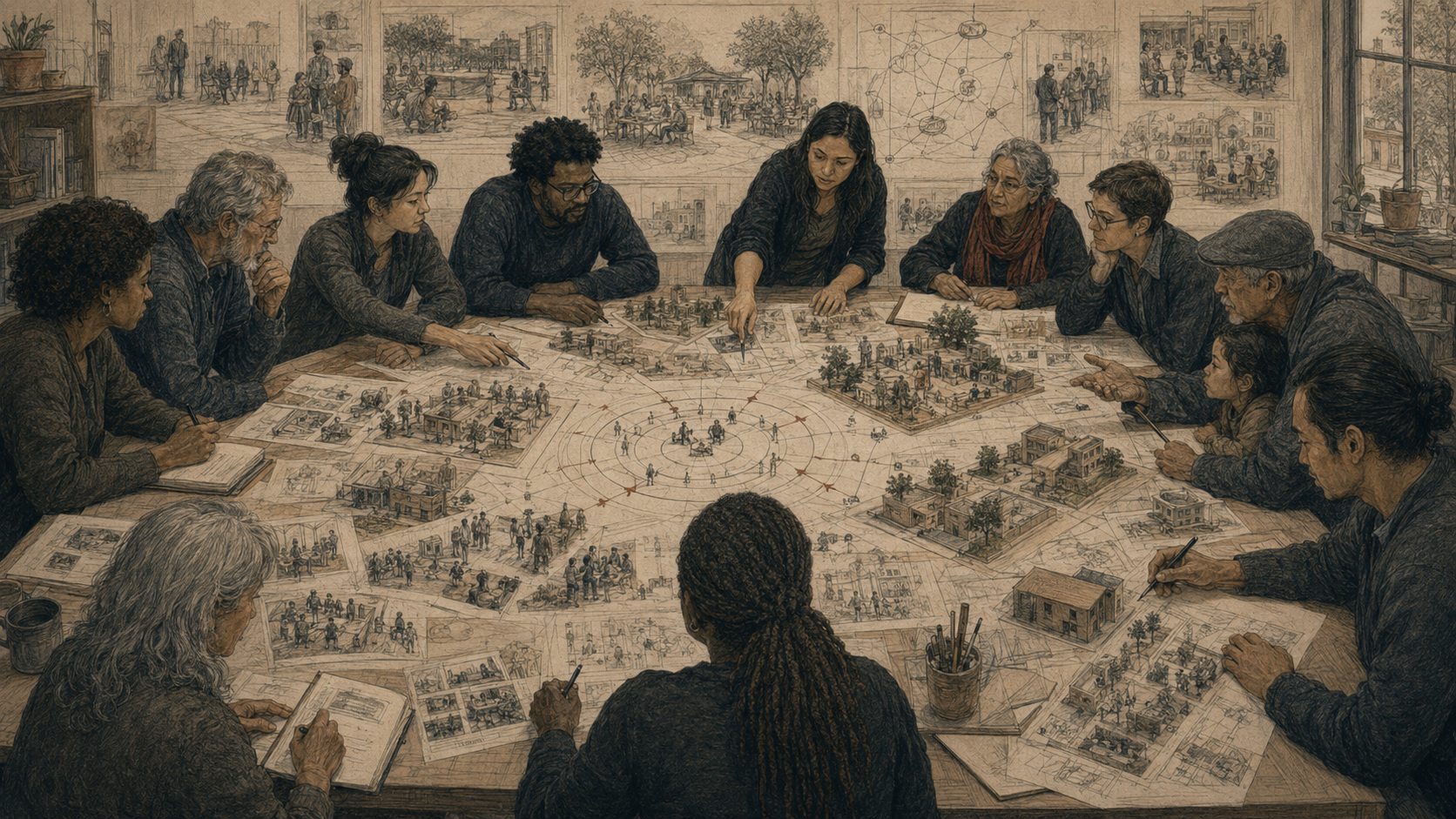
Co-design is not simply a workshop format. Participatory design is not simply stakeholder engagement. Both are ways of redistributing design attention, design authority, and design learning. They ask institutions to move from designing for people, to designing with people, and in some cases toward supporting communities who design for themselves.
What Co-Design and Participatory Design Mean
Co-design refers to design activity in which people who are affected by a product, service, policy, environment, technology, or institution participate directly in shaping it. Participatory design refers to a broader tradition in which users, workers, communities, citizens, patients, students, residents, or other affected groups are treated as participants in design decision-making rather than passive recipients of expert solutions. The two terms overlap, but they carry different histories and emphases.
Co-design is often used in contemporary design practice to describe shared creative work across stakeholders. It can include collaborative workshops, generative research, journey mapping, participatory prototyping, service blueprinting, future-scenario exercises, design games, community mapping, model-building, and iterative feedback. Participatory design has deeper roots in democratic workplace design, labor rights, sociotechnical systems, Scandinavian computing traditions, public participation, and community-led change. It asks not only how people can contribute ideas, but how design processes can support meaningful voice, influence, and control.
| Dimension | Co-design emphasis | Participatory design emphasis |
|---|---|---|
| Core idea | People affected by a design help create, test, and refine it. | People affected by a design have a meaningful role in shaping decisions, not only giving input. |
| Typical setting | Service design, product design, public services, healthcare, education, digital systems, community projects. | Workplace systems, civic systems, technology design, community development, public institutions, social innovation. |
| Knowledge claim | Stakeholders contribute lived experience, creativity, and contextual knowledge. | Stakeholders hold situated knowledge and should share authority over systems that affect them. |
| Common methods | Co-creation workshops, mapping, prototyping, design games, participatory synthesis, generative exercises. | Workplace democracy, collaborative inquiry, design workshops, mock-ups, future workshops, collective decision processes. |
| Risk | Can become a workshop technique without real influence. | Can become symbolic participation if institutional power remains unchanged. |
| Strong practice | Links creative participation to evidence, prototyping, and implementation. | Links participation to decision authority, accountability, and shared ownership. |
Both traditions challenge a narrow view of design expertise. Professional designers may bring methods, visualization skill, facilitation ability, systems thinking, prototyping experience, and technical knowledge. Participants bring lived expertise, occupational knowledge, cultural knowledge, community memory, practical constraints, workarounds, values, and interpretations that outside experts often lack. Co-design becomes powerful when these forms of knowledge are brought into productive relationship without pretending they are identical.
The word “with” is therefore central. Designing with people is different from designing for them. It requires not only empathy but shared inquiry. It asks designers to become facilitators of collective intelligence, translators across knowledge systems, stewards of process quality, and advocates for the visibility of experience that institutions often ignore.
Why Participation Matters in Design Thinking
Participation matters because many design failures begin with misrecognized experience. Institutions often misunderstand what people are trying to do, what they already know, what constraints they face, what they fear, what they value, and what trade-offs they are forced to make. A service may be technically available but practically inaccessible. A digital system may be efficient for confident users but punishing for people with disabilities, low trust, limited connectivity, language barriers, or unstable schedules. A workplace tool may look rational to managers while creating hidden labor for frontline staff. A public policy may be well intended while imposing procedural burdens on those least able to carry them.
Design thinking has long emphasized empathy, observation, and iterative learning. Co-design and participatory design extend that commitment by asking whether affected people should also participate in framing the problem, generating alternatives, evaluating trade-offs, testing prototypes, interpreting findings, and shaping implementation. This changes the moral and practical quality of design work. It moves participation from consultation to co-inquiry.
| Design failure | Participation problem | Participatory design response |
|---|---|---|
| Problem framed too narrowly | The institution defines the problem before affected people can contest the frame. | Begin participation during problem framing, not only after solution concepts exist. |
| Research extracts stories | Participants provide evidence but have no influence over interpretation or decisions. | Invite participants into synthesis, prioritization, and decision review. |
| Dominant users define the solution | Confident, accessible, or high-status users become proxies for everyone. | Recruit edge cases, excluded groups, non-users, frontline workers, and high-burden stakeholders. |
| Workshop energy does not change outcomes | Participation produces artifacts but no institutional commitment. | Connect participation to authority, implementation pathways, and accountability. |
| Prototype testing validates a predetermined idea | Stakeholders are asked to react to a solution they did not shape. | Use participatory prototyping to generate, alter, reject, and reinterpret concepts. |
| Implementation creates hidden burden | The design works in theory but transfers work to users, workers, or communities. | Map burden distribution and involve those who will operate or live with the system. |
| Participation is symbolic | Institutions use inclusion language without sharing influence. | Define participation rights, decision boundaries, feedback loops, and evidence of change. |
Participation also improves design judgment because it reveals the difference between institutional assumptions and lived reality. People affected by a system often know where it fails, what workarounds keep it functioning, what official metrics miss, and what kinds of change would be credible. This knowledge is not automatically complete or uncontested, but it is indispensable.
For design thinking, the lesson is clear: empathy is not enough if it leaves authority unchanged. Observation is not enough if participants cannot challenge the interpretation. Testing is not enough if feedback cannot change decisions. Participation matters because design is not only about making better artifacts. It is about changing how decisions are made about shared futures.
Co-Design, Participatory Design, and Related Terms
The language around participation can become confusing because related terms are often used interchangeably: co-design, co-creation, participatory design, collaborative design, community-based design, design justice, public participation, user involvement, stakeholder engagement, citizen engagement, and human-centered design. These terms overlap, but they are not identical. The differences matter because language can hide the level of influence participants actually have.
A user interview is not the same as co-design. A public comment period is not the same as participatory design. A workshop is not automatically empowering. A stakeholder map does not guarantee representation. A prototype test does not necessarily give people meaningful voice. The crucial question is not whether people were present. The crucial question is what role they had in defining, shaping, challenging, revising, and governing the design.
| Term | Typical meaning | Key limitation if weakly practiced |
|---|---|---|
| Human-centered design | Design grounded in human needs, experiences, contexts, and usability. | Can study people without sharing design authority. |
| User research | Research into user behavior, needs, motivations, pain points, and contexts. | Can extract evidence without involving participants in interpretation or decision-making. |
| Stakeholder engagement | Structured involvement of groups affected by or relevant to a decision. | Can become consultation without consequence. |
| Co-creation | Broad collective creativity among two or more people or groups. | Can be vague if not tied to a design process or decision rights. |
| Co-design | Collaborative design activity across the span of a design process. | Can become a workshop label if participants cannot influence outcomes. |
| Participatory design | Design tradition emphasizing meaningful participation by those affected, often with democratic and workplace roots. | Can be diluted if participation is limited to feedback or symbolic involvement. |
| Community-led design | Design in which communities set priorities, define problems, and lead or govern the process. | Can be difficult when institutions retain funding, legal, or implementation control. |
| Design justice | Design practice oriented toward dismantling structural inequality and centering marginalized communities. | Can be appropriated rhetorically if power and ownership do not shift. |
The practical distinction is the degree of influence. In low-influence models, people are observed, surveyed, consulted, or tested. In stronger models, people help frame the problem, generate options, evaluate trade-offs, build prototypes, interpret evidence, define success, govern implementation, and hold institutions accountable. Co-design and participatory design are strongest when they move toward the latter.
This does not mean that every project can or should make every participant a full decision-maker in every respect. Constraints may include law, safety, public accountability, technical feasibility, budget, confidentiality, expertise, and conflicting stakeholder claims. But a serious participatory process makes those constraints explicit rather than hiding them. It tells participants what is open, what is fixed, what decisions they can influence, and how their participation will matter.
Historical Development: From Workplace Democracy to Contemporary Co-Design
Participatory design has deep historical roots in democratic workplace design, especially Scandinavian traditions that sought to involve workers in the design of computer systems affecting their labor. These traditions emerged from concerns about industrial democracy, labor power, technical change, and the quality of working life. The central issue was not merely usability. It was the right of workers to have a say in systems that would restructure their work, knowledge, autonomy, and organizational power.
This history matters because it reminds contemporary designers that participation was not originally just a way to improve product-market fit. It was also a way to challenge expert domination, managerial control, and technological systems imposed on people without meaningful voice. As participatory design expanded into human-computer interaction, service design, public policy, health, education, community development, and social innovation, it carried forward a core question: who gets to shape the systems that shape them?
| Historical strand | Contribution | Continuing relevance |
|---|---|---|
| Scandinavian workplace democracy | Involved workers in the design of technologies affecting their work. | Design should consider labor, autonomy, knowledge, and power, not only usability. |
| Sociotechnical systems | Recognized that technical systems and social organization are intertwined. | Participation must address workflows, roles, incentives, and institutional structure. |
| Human-computer interaction | Developed methods for involving users in system design and evaluation. | Digital systems require participation before interfaces become fixed around expert assumptions. |
| Community development | Emphasized local knowledge, public participation, and collective problem solving. | Communities should help define needs, priorities, and acceptable futures. |
| Public participation | Developed critiques of tokenism and frameworks for meaningful influence. | Participation must be evaluated by power, not merely presence. |
| Service design | Connected user experience to organizational systems and backstage delivery. | Participants can help map service journeys, failures, burdens, and support needs. |
| Design justice | Centers marginalized communities and structural inequality in design practice. | Participation should challenge unequal power, not merely make systems more acceptable. |
Contemporary co-design has spread across healthcare, education, public services, civic technology, sustainability, organizational change, AI governance, product development, social innovation, and community planning. This diffusion has created new possibilities, but also new risks. As the language becomes more popular, it can be detached from its democratic roots. Co-design can become a branded workshop. Participatory design can become a consultation step. Community-led language can be used while institutions retain control.
A serious practice preserves the historical lesson: participation is not simply a way to collect better input. It is a way to confront the relationship between design, knowledge, labor, community, technology, and power.
Participation, Power, and Decision Authority
The central question in participatory design is not whether people were invited. It is whether they had influence. Many processes appear participatory because they include workshops, interviews, listening sessions, advisory groups, community meetings, surveys, or prototype tests. But participation can still be shallow if the agenda is fixed, the problem frame is predetermined, the institution controls interpretation, and participants never see how their contributions affected the result.
Power appears in the design of the process itself. Who chooses the topic? Who funds the work? Who recruits participants? Who controls the room? Who sets the language? Who decides what counts as evidence? Who synthesizes the findings? Who can veto proposals? Who owns the data? Who controls implementation? Who benefits from the final design? These are not external political concerns. They are design concerns.
| Participation level | Participant role | Design risk | Stronger practice |
|---|---|---|---|
| Information | People are told what will happen. | Communication is mistaken for participation. | Use only when decisions are genuinely fixed and explain why. |
| Consultation | People provide opinions, stories, or reactions. | Input is gathered without obligation to respond. | Report what was heard, what changed, and what could not change. |
| Involvement | People participate in research, mapping, workshops, or testing. | Participation informs the process but may not shape decisions. | Give participants a role in framing, synthesis, prioritization, and prototype revision. |
| Collaboration | People help generate options and evaluate trade-offs. | Collaboration may be limited by hidden institutional constraints. | Clarify decision rights, constraints, and how conflicts will be resolved. |
| Co-design | People share creative and interpretive work across the design process. | Workshops may produce artifacts without implementation authority. | Connect co-design outputs to resourcing, governance, implementation, and evaluation. |
| Community leadership | Affected communities set priorities and guide design direction. | Institutions may claim community leadership while retaining effective control. | Shift authority, funding, data governance, and accountability mechanisms where appropriate. |
A participatory process should therefore include a clear participation contract. Participants should know what is open for influence, what is not, how decisions will be made, what will happen to their contributions, how they will be credited or compensated, what risks exist, and how the institution will report back. Without that clarity, participation can become extractive.
Design thinking benefits from this discipline because it keeps the method honest. It prevents empathy from becoming performance, workshops from becoming theater, and stakeholder engagement from becoming legitimacy laundering. Participation is meaningful only when it changes what institutions know, what they value, and what they are willing to do.
Stakeholders, Communities, Users, and Affected Publics
Co-design begins with the question of who should participate, but that question is more difficult than it appears. Many projects default to the most available, visible, articulate, institutionally fluent, or already engaged participants. That can distort the design process. A healthcare redesign may hear from patients who have time and trust, but not from those who avoid care. A digital service project may hear from confident users, but not from people excluded by devices, language, disability, privacy concerns, or fear. A workplace innovation project may hear from managers and high-performing employees, but not from workers who carry hidden labor.
The terms “user,” “stakeholder,” “community,” and “affected public” carry different assumptions. A user is someone who interacts with a product or service. A stakeholder has an interest in the outcome. A community may share place, identity, history, practice, vulnerability, or collective concern. An affected public may include people who do not choose to use a system but are governed, monitored, categorized, displaced, burdened, or exposed by it. Participatory design must consider all of these categories.
| Participant group | What they may know | Design danger if excluded |
|---|---|---|
| Current users | How the system works in practice, where friction appears, what they value. | The design may miss ordinary pain points and practical use contexts. |
| Non-users | Why people avoid, reject, distrust, cannot access, or abandon the system. | The design may optimize for those already served while ignoring exclusion. |
| Frontline workers | Operational constraints, workarounds, hidden labor, recurring failures, emotional burden. | The design may be impossible or harmful to implement. |
| Marginalized groups | How systems distribute risk, stigma, exclusion, surveillance, or procedural burden. | The design may reproduce inequality while claiming neutrality. |
| Caregivers and intermediaries | How families, advocates, teachers, social workers, navigators, or nonprofits support access. | The design may shift invisible work onto unpaid or under-resourced actors. |
| Technical and operational teams | System dependencies, implementation risks, data constraints, maintenance burdens. | The design may be desirable but operationally fragile. |
| Decision-makers and funders | Legal, financial, governance, and institutional constraints. | The design may lack authority, resources, or implementation pathway. |
| Affected publics | Consequences for people who may not be direct users but are shaped by the system. | The design may externalize harm beyond the visible user group. |
Recruitment is therefore a design act. It determines whose knowledge enters the process and whose knowledge remains invisible. A serious participatory design process should document recruitment criteria, missing voices, access barriers, compensation, accessibility provisions, language support, consent, safety, and the limits of representation.
Representation does not mean that any one participant speaks for an entire group. It means the process has made a serious effort to understand variation, conflict, power, and exclusion. Participants may disagree with one another. That disagreement is not a failure of participation. It is evidence that design decisions are social decisions, not merely technical ones.
Research Methods for Co-Design and Participatory Design
Participatory design uses research methods not only to observe people but to involve them in making sense of problems and imagining alternatives. These methods can be qualitative, quantitative, visual, material, narrative, spatial, embodied, digital, or deliberative. What makes them participatory is not the tool itself, but the role participants have in shaping inquiry, generating knowledge, and influencing decisions.
A standard interview can be extractive if the participant only supplies data. A mapping exercise can be participatory if participants define categories, identify relationships, challenge institutional assumptions, and interpret the resulting map. A prototype test can be narrow if it only measures task success. It can be participatory if participants alter the concept, expose hidden assumptions, propose alternatives, and help define what “success” should mean.
| Method | Participatory use | What it can reveal |
|---|---|---|
| Contextual inquiry | Participants explain work, life, or service contexts while designers observe and ask questions. | Environmental constraints, tacit knowledge, routines, workarounds, hidden labor. |
| Journey mapping | Participants map steps, emotions, barriers, supports, delays, and decisions across an experience. | Friction, abandonment points, uncertainty, burden, trust, and support needs. |
| Service blueprinting | Stakeholders connect frontstage experience to backstage roles, systems, data, and handoffs. | How visible experience depends on invisible organizational systems. |
| Community mapping | Participants map places, resources, risks, relationships, routes, and institutional touchpoints. | Spatial inequality, access barriers, local assets, exposure, and community knowledge. |
| Design games | Structured activities help participants explore possibilities, constraints, and trade-offs. | Values, priorities, tensions, future scenarios, and decision criteria. |
| Participatory prototyping | Participants build, alter, test, reject, or reimagine concepts. | Use contexts, meaning, feasibility, accessibility, trust, and unintended consequences. |
| Future workshops | Participants critique current conditions, imagine alternatives, and develop action pathways. | Collective aspirations, structural barriers, and actionable future directions. |
| Participatory analysis | Participants help interpret evidence, cluster themes, prioritize issues, and validate findings. | Misinterpretation, missing context, disagreement, and legitimacy of synthesis. |
The best method depends on the project’s purpose, participant needs, power conditions, available time, and implementation context. A workshop may be useful for collaborative sensemaking, but not for participants who face fear, trauma, surveillance, language barriers, or scheduling constraints. A digital co-design board may be efficient for professional stakeholders, but exclusionary for those without reliable access or comfort with technology. A public meeting may appear open while favoring people with time, confidence, transportation, and institutional fluency.
Methods must therefore be designed around participation conditions. Accessibility, compensation, consent, psychological safety, language, childcare, transportation, disability accommodation, cultural credibility, data privacy, and feedback obligations are not administrative details. They shape whether participation is real.
Facilitation, Safety, and the Design of Participation
Facilitation is one of the most important and least neutral parts of co-design. The facilitator shapes whose voice is heard, how disagreement is handled, what forms of knowledge are welcomed, how time is distributed, how activities are framed, and how institutional power enters the room. Poor facilitation can reproduce the very inequalities a participatory process claims to challenge.
A strong facilitator does more than manage time or encourage creativity. They design conditions for equitable participation. That may require pre-work with community partners, separate sessions for different groups, trauma-aware methods, anonymous contribution channels, multilingual facilitation, accessible materials, clear consent processes, compensation, explicit ground rules, and careful attention to how institutional representatives participate. In some cases, institutional leaders should listen but not dominate. In others, participants may need closed spaces without authority figures present.
| Facilitation concern | Risk | Stronger practice |
|---|---|---|
| Voice imbalance | Confident, high-status, or professionally fluent participants dominate. | Use structured turn-taking, small groups, anonymous input, and facilitator intervention. |
| Institutional intimidation | Participants may withhold criticism when funders, managers, or officials are present. | Separate power holders from affected participants when needed and protect confidentiality. |
| Tokenism | Participants are visibly included but have little real influence. | Clarify decision influence and report how participation changed the design. |
| Extractive storytelling | Participants share painful experiences without support or consequence. | Use trauma-aware consent, avoid unnecessary disclosure, and connect stories to action. |
| Method mismatch | Activities assume literacy, digital comfort, speed, cultural style, or abstract reasoning. | Adapt methods to participant needs, contexts, languages, and abilities. |
| Conflict avoidance | Important disagreements are smoothed over to preserve workshop harmony. | Treat disagreement as evidence of real trade-offs and document unresolved tensions. |
| Unclear closure | Participants leave without knowing what happens next. | Provide timelines, decision pathways, reporting commitments, and contact points. |
Safety does not mean avoiding difficult truths. It means creating conditions where people can contribute without unnecessary harm, retaliation, humiliation, or exploitation. In many projects, participants are being asked to speak about systems that have failed them. That requires humility and care. Design teams should not treat vulnerability as raw material for innovation.
Facilitation also requires transparency about constraints. Participants should know whether budgets are fixed, laws limit options, technical systems cannot change quickly, or institutional leadership has already made certain decisions. Concealing constraints may make the workshop feel more open, but it damages trust when participants discover that their ideas were never actionable. Honest constraint-setting is part of respect.
From Participation to Synthesis: Interpreting Shared Evidence
Participation does not end when a workshop ends. Some of the most important power in design lies in synthesis: deciding what the evidence means. Designers often collect notes, recordings, maps, artifacts, sketches, themes, stories, and prototype reactions, then retreat to analyze them internally. This can be efficient, but it can also recentralize authority. Participants may contribute knowledge while designers retain control over interpretation.
Participatory synthesis addresses this problem by involving stakeholders in sensemaking. That can include member checking, theme review, prioritization sessions, collaborative clustering, interpretation workshops, community review boards, feedback loops, and iterative validation. The goal is not to make participants responsible for all analysis. It is to reduce the risk that professional designers misread, simplify, or selectively use what participants contributed.
| Synthesis task | Conventional risk | Participatory alternative |
|---|---|---|
| Theme clustering | Designers group evidence according to their own assumptions. | Ask participants to review, rename, challenge, or reorganize themes. |
| Prioritization | Institutions prioritize what is feasible or visible to them. | Include participant priorities and distinguish urgency, severity, and feasibility. |
| Problem framing | Participant evidence is used to support a preexisting frame. | Invite participants to contest the frame and propose alternative definitions. |
| Insight generation | Insights become polished statements detached from lived complexity. | Preserve contradictions, minority experiences, edge cases, and unresolved tensions. |
| Concept selection | Design teams select ideas that fit organizational comfort. | Evaluate concepts with participants using transparent criteria and trade-offs. |
| Evidence reporting | Reports summarize people without showing how interpretation occurred. | Document synthesis steps, participant review, dissent, and decision rationale. |
| Implementation translation | Participatory findings are reduced to recommendations without accountability. | Link findings to owners, resources, timelines, and feedback commitments. |
Good synthesis must balance fidelity and actionability. It should not simply reproduce every statement without interpretation, but it should not flatten complexity into convenient themes either. Participants may disagree. Evidence may conflict. Some needs may be urgent but difficult. Some solutions may help one group while burdening another. Participatory synthesis keeps those tensions visible instead of forcing false consensus.
This is especially important when working with marginalized communities. Institutions may be tempted to use participant stories to validate designs that do not address structural causes. Participatory synthesis can help resist that tendency by asking whether the interpretation honors what participants actually meant, whether it acknowledges power, and whether it leads to meaningful institutional change.
Participatory Prototyping and Shared Making
Prototyping is one of the clearest places where co-design becomes visible. Participants can sketch, build, rearrange, annotate, role-play, simulate, test, critique, and transform concepts. The prototype may be a paper form, service script, workflow, policy notice, interface mockup, public-space model, care pathway, data dashboard, classroom activity, AI governance process, or community resource map. The goal is not artistic polish. The goal is shared learning.
Participatory prototyping differs from ordinary prototype testing because participants are not only asked whether a proposed design works. They help change what the design is. They may reject the concept, identify missing conditions, propose new features, expose harmful assumptions, redesign the sequence, alter the language, define support needs, or reveal that the prototype is solving the wrong problem.
| Prototype type | Participatory activity | Learning value |
|---|---|---|
| Paper prototype | Participants annotate, reorder, rewrite, or redraw screens, forms, letters, or workflows. | Reveals comprehension, language, sequence, missing support, and procedural burden. |
| Service role-play | Participants enact service encounters, handoffs, support moments, or failure scenarios. | Reveals emotional dynamics, staff burden, trust, escalation, and dignity concerns. |
| Journey prototype | Participants assemble or alter experience pathways across time. | Reveals friction, abandonment, uncertainty, and hidden dependencies. |
| Policy prototype | Participants review simplified rules, eligibility pathways, notices, or appeal processes. | Reveals public legibility, fairness, procedural barriers, and rights awareness. |
| Data or AI prototype | Participants review data categories, decision logic, explanations, alerts, or human-review pathways. | Reveals bias, contestability, trust, explainability, and governance needs. |
| Spatial prototype | Participants map or model physical environments, routes, service points, or public spaces. | Reveals access, safety, movement, visibility, exposure, and local knowledge. |
| Governance prototype | Participants test decision rights, feedback loops, review boards, escalation routes, or accountability mechanisms. | Reveals whether participation can survive beyond the workshop. |
Participatory prototyping is especially valuable because it allows people to respond to tangible possibilities rather than abstract questions. People often know more when they can point, move, draw, compare, enact, or modify. The prototype becomes a boundary object: something shared enough that different forms of expertise can gather around it, but flexible enough that participants can change it.
The process should also protect participants from being used as unpaid product development labor. If participants contribute substantial knowledge, creative ideas, cultural expertise, or community access, the design team should consider compensation, attribution, data governance, benefit sharing, and long-term accountability. Shared making does not excuse extraction.
Co-Design in Organizations and Institutions
Inside organizations, co-design can improve innovation, service design, employee experience, knowledge systems, workflow redesign, internal tools, transformation initiatives, and change management. But it also encounters institutional constraints: hierarchy, performance metrics, budget cycles, legal review, technical debt, silos, procurement, managerial authority, and political sensitivity. These constraints do not make co-design impossible. They make it more necessary and more difficult.
Organizations often invite participation when they need buy-in for a change already decided. That is not co-design. It is change communication. Real co-design invites people earlier, when their knowledge can shape the problem, the options, and the implementation conditions. Frontline employees, support staff, service operators, customers, managers, technical teams, and affected communities may each hold different pieces of the system. Without them, organizational innovation can become a strategy exercise detached from operational reality.
| Organizational use | Co-design contribution | Institutional risk |
|---|---|---|
| Workflow redesign | Frontline staff reveal actual work, exception handling, bottlenecks, and hidden labor. | Management may use participation to increase efficiency while ignoring workload. |
| Employee experience | Employees identify friction, support needs, trust issues, and meaningful work conditions. | Participation may raise expectations without authority to change structures. |
| Customer service redesign | Customers and staff jointly map service breakdowns and recovery needs. | Organizations may optimize customer experience by shifting burden to employees. |
| Digital transformation | Users, staff, and technical teams test whether digital tools fit real contexts. | Institutions may digitize broken processes without redesigning underlying rules. |
| Knowledge systems | Participants define how information is found, trusted, maintained, and used. | Knowledge bases may decay without ownership and governance. |
| Innovation governance | Teams co-design decision criteria, portfolio review, learning metrics, and escalation routes. | Governance may become reporting theater without funding or authority. |
| Organizational change | Participation surfaces resistance as evidence about systems, identity, trust, and capacity. | Leaders may frame resistance as attitude rather than information. |
Organizational co-design should therefore include implementation design. It is not enough to generate a better concept. The organization must design the conditions under which that concept can survive: ownership, training, incentives, governance, budget, data systems, maintenance, communication, and evaluation. Participants should not be asked to imagine solutions that leadership is unwilling to support.
When practiced seriously, co-design can strengthen organizational learning. It helps institutions hear inconvenient evidence, test assumptions, involve those closest to the work, and identify implementation barriers before failure becomes expensive. It also makes innovation more accountable because the people who live with organizational systems help shape them.
Co-Design in Public Policy and Civic Systems
Co-design is increasingly important in public policy, civic technology, healthcare, education, social services, housing, climate adaptation, transportation, disability services, and community development. Public systems affect people not only as consumers or users, but as citizens, residents, patients, tenants, workers, students, caregivers, migrants, families, and communities. The stakes are therefore higher than usability. Public co-design concerns rights, dignity, legitimacy, access, fairness, accountability, and trust.
Public institutions often seek participation through consultation, public meetings, surveys, comment periods, advisory panels, or listening sessions. These can be valuable, but they do not automatically produce meaningful participation. Public co-design requires attention to who participates, who is missing, what authority participants have, how evidence is interpreted, and whether the process changes policy, services, administrative burdens, or governance.
| Public design context | Participatory design question | Public value at stake |
|---|---|---|
| Public benefits | Can eligible people understand, access, maintain, and appeal benefits without excessive burden? | Access, dignity, procedural fairness, poverty reduction. |
| Healthcare | Do patients, caregivers, clinicians, and communities shape care pathways and support systems? | Trust, safety, equity, continuity, patient agency. |
| Housing | Do tenants, unhoused people, advocates, landlords, and public agencies define problems and trade-offs? | Stability, rights, safety, affordability, community voice. |
| Climate adaptation | Do exposed communities help design resilience investments, warnings, relocation, and support? | Survival, justice, local knowledge, intergenerational responsibility. |
| Transportation | Do riders, disabled people, workers, low-income communities, and neighborhoods shape mobility design? | Access, safety, time, mobility justice, economic opportunity. |
| Education | Do students, families, teachers, and communities help define learning environments and supports? | Equity, belonging, agency, developmental opportunity. |
| Civic technology | Can people understand, contest, and shape digital systems used in governance? | Legitimacy, privacy, accessibility, due process. |
Public co-design must also avoid participation fatigue. Communities that have been repeatedly consulted without seeing change may distrust new engagement processes. That distrust is rational. Institutions must therefore close the feedback loop: explain what was heard, what changed, what did not change, why, and what happens next. Participation without feedback erodes legitimacy.
The public-policy lesson is that co-design is not a shortcut around democracy, law, expertise, or public accountability. It is a way of improving public judgment by bringing affected experience into the design of services, policies, systems, and institutions. It must be practiced with transparency, equity, and respect for the seriousness of public power.
Co-Design for Digital, Data, and AI Systems
Digital, data, and AI systems make participatory design more urgent. These systems often classify people, mediate access, allocate attention, automate decisions, shape workflows, recommend actions, detect risks, personalize content, monitor behavior, or structure public and organizational services. If affected people are excluded from design, the result can be systems that are opaque, biased, inaccessible, untrusted, burdensome, or difficult to contest.
Co-design for AI and data systems requires more than asking users whether an interface is understandable. Participants may need to help examine data categories, decision thresholds, explanations, appeal routes, consent practices, human oversight, error consequences, monitoring risks, and governance structures. People affected by AI systems may not be direct users of the tool. A caseworker may use an algorithmic triage tool, but the person being triaged is also affected. A manager may use a dashboard, but employees whose work is represented by the data are affected. A public agency may use a risk model, but communities subject to its classifications are affected.
| AI or data-design element | Participatory question | Risk if ignored |
|---|---|---|
| Data categories | Do categories reflect lived reality, or do they simplify people into institutional convenience? | Misclassification, stigma, exclusion, and biased inference. |
| Training data | Whose histories are represented, missing, or distorted? | Historical bias becomes automated prediction. |
| Decision thresholds | Who is harmed by false positives, false negatives, delays, or escalation? | Unequal risk distribution and hidden procedural harm. |
| Explanations | Can affected people understand why a recommendation or decision occurred? | Opacity, mistrust, and inability to contest outcomes. |
| Human oversight | Who can review, override, correct, or challenge system outputs? | Automation bias and weakened accountability. |
| Monitoring | Does the system increase surveillance, discipline, or behavioral control? | Chilling effects, labor harm, community distrust. |
| Governance | Who participates in auditing, updating, pausing, or retiring the system? | Technical drift, unreviewed harm, and institutional irresponsibility. |
Participatory AI design must also confront asymmetry. Technical systems are difficult to understand, and institutions may control the data, models, documentation, and implementation environment. Participation therefore requires translation. Designers and technical teams must create materials that allow participants to reason about system behavior without requiring them to become machine-learning specialists. This may include model cards, scenario walkthroughs, decision simulations, error examples, consequence mapping, data-flow diagrams, and rights-and-remedies exercises.
The goal is not to make every technical decision a public vote. The goal is to make the social consequences of technical decisions visible, contestable, and accountable. Co-design helps ensure that AI systems are not built only around what institutions can measure, but around what affected people can live with, understand, challenge, and govern.
Ethics, Inclusion, and Design Justice
Ethics is not an optional layer added after co-design. It is built into the structure of participation. Who is invited, who is paid, who is safe, who is heard, who controls interpretation, who owns the outputs, and who benefits are ethical questions. Participatory design can challenge unequal power, but it can also reproduce it if institutions use participation to legitimize decisions already made.
Design justice pushes this critique further by asking whether design practices reproduce structural inequality or help communities build more just futures. This orientation is especially important when working with marginalized communities, disabled people, low-income groups, racialized communities, migrants, workers with limited power, Indigenous communities, incarcerated or surveilled populations, patients, children, older adults, and people affected by public systems. Participation must not become a way to extract lived experience from those already carrying harm.
| Ethical concern | Participatory risk | Stronger practice |
|---|---|---|
| Extraction | Participants provide stories, labor, or cultural knowledge without benefit or control. | Use compensation, attribution, benefit sharing, data governance, and feedback obligations. |
| Tokenism | Marginalized participants are included visibly but lack influence. | Clarify authority, involve participants early, and document how participation changed decisions. |
| Representation burden | One person is treated as speaking for an entire community. | Recruit diverse participants and avoid essentializing group experience. |
| Trauma exposure | Participants are asked to recount harm without support or purpose. | Use trauma-aware methods, avoid unnecessary disclosure, and connect evidence to action. |
| Accessibility failure | Participation methods exclude people through language, disability, timing, location, or technology. | Design access supports into participation from the beginning. |
| Data misuse | Participant contributions are stored, shared, or analyzed without adequate consent. | Use clear consent, minimization, confidentiality, community review, and deletion options. |
| Legitimacy laundering | Institutions use participation to claim public support without changing decisions. | Publish decision rationales, constraints, dissent, and follow-up commitments. |
Inclusion is not achieved by adding more people to a poorly structured process. It requires changing the process itself. That may mean shifting where meetings happen, how language is used, how time is valued, how expertise is recognized, how disagreement is handled, how data is governed, and how authority is distributed. Participation should make the design process more accountable, not merely more diverse in appearance.
Design teams should also recognize that some communities may refuse participation. Refusal can be meaningful evidence, especially where institutions have histories of extraction, harm, broken promises, surveillance, or neglect. A serious participatory practice does not treat refusal as an obstacle to overcome. It asks what conditions would make participation trustworthy, and whether the institution has earned the right to ask.
Methods and Measurement in Participatory Design
Participatory design is sometimes evaluated only by whether people attended or whether they enjoyed the process. That is inadequate. A process can be well attended and still tokenistic. A workshop can feel energizing and still have no influence. A prototype can receive positive feedback and still fail excluded groups. Serious co-design needs methods for evaluating the quality, equity, influence, and consequences of participation.
Measurement should not reduce participation to numbers alone, but it should make claims accountable. Teams can track representation, stakeholder coverage, participation depth, accessibility supports, compensation, decision influence, synthesis validation, prototype changes, implementation commitments, and follow-up. They can also measure whether the resulting design improves access, trust, comprehension, usability, equity, burden reduction, adoption, service quality, or public value.
| Measurement domain | Possible indicators | Interpretive caution |
|---|---|---|
| Representation | Participant diversity, missing groups, non-users, edge cases, affected publics. | Demographics alone do not prove meaningful influence. |
| Participation depth | Whether participants shaped framing, synthesis, concepts, prototypes, decisions, or governance. | Participation at one stage may not compensate for exclusion at another. |
| Accessibility | Language access, disability accommodations, compensation, timing, childcare, transport, digital access. | Access supports must be evaluated by participant experience, not only availability. |
| Influence | Design changes traceable to participant contributions. | Influence should include rejected ideas and reasons, not only adopted suggestions. |
| Synthesis validity | Participant review of themes, frames, priorities, and decision criteria. | Consensus may conceal power differences or unresolved conflict. |
| Implementation accountability | Owners, timelines, resources, decision pathways, feedback loops. | Strong co-design artifacts mean little without implementation authority. |
| Outcome quality | Usability, access, trust, burden reduction, equity, adoption, service quality, and durability. | Outcome success should be disaggregated across groups and contexts. |
A useful participatory evaluation asks three questions. First, was the process equitable and accessible? Second, did participation influence interpretation and decisions? Third, did the resulting design improve the lived conditions it was meant to address? A process that scores well on the first but not the second may be respectful but powerless. A process that scores well on the second but not the third may be influential but ineffective. A mature practice examines all three.
Measurement should also include learning. What assumptions changed? What did participants reveal that the institution did not know? What design decisions were revised? What constraints were exposed? What conflicts remain unresolved? What would the team do differently next time? Participatory design is not only a method for creating better outputs. It is a method for making institutions more capable of learning with those they affect.
Critiques and Limits of Co-Design
Co-design and participatory design are not magic solutions. They can be slow, difficult, expensive, emotionally demanding, politically contested, and institutionally fragile. They can also be misused. Participation can become tokenistic. Workshops can become theater. Stakeholders can be overburdened. Institutions can invite participation while retaining all meaningful control. Designers can extract stories and ideas without accountability. Funders can demand visible engagement without giving communities authority. Digital tools can make participation appear scalable while excluding those without access.
These critiques do not invalidate co-design. They clarify the conditions under which it becomes meaningful. The problem is not that participation is too ambitious. The problem is that institutions often want the legitimacy of participation without the obligations that participation creates.
| Critique | What can go wrong | Responsible response |
|---|---|---|
| Tokenism | Participants are present but cannot influence decisions. | Define influence, decision rights, feedback obligations, and evidence of change. |
| Participation fatigue | Communities are repeatedly consulted without seeing results. | Limit unnecessary engagement, compensate fairly, and close feedback loops. |
| Representation limits | Participants cannot represent all experiences within a group. | Document missing voices, variation, disagreement, and recruitment limits. |
| Power imbalance | Institutional actors dominate framing, interpretation, resources, or implementation. | Design governance, facilitation, and accountability mechanisms that address power directly. |
| Conflict | Stakeholders disagree about priorities, harms, values, or trade-offs. | Treat disagreement as evidence, not failure; document tensions and decision rationale. |
| Time and resource constraints | Meaningful participation requires labor, access support, and follow-up. | Budget for participation as core design work, not optional engagement. |
| Implementation gap | Co-design outputs are not carried into policy, operations, technology, or governance. | Connect co-design to owners, funding, authority, metrics, and implementation plans. |
Participation can also create ethical dilemmas. What happens when community priorities conflict with legal constraints? What if participant groups disagree? What if the most affected people cannot safely participate? What if participation creates expectations that institutions cannot meet? What if stakeholder input supports exclusionary or harmful outcomes? Co-design does not remove the need for ethical judgment. It makes that judgment more visible.
A mature practice is honest about limits. It does not overpromise transformation. It does not claim community ownership where none exists. It does not treat participation as proof of justice. Instead, it asks what level of participation is possible, what level is needed, what authority is available, and what responsibilities follow from inviting people into the design process.
Cross-Pillar Connections
Co-design and participatory design connect naturally to several areas of inquiry. They belong within design thinking because they deepen human-centered design into shared inquiry and shared making. They connect to systems thinking because participation must account for relationships among people, institutions, technologies, rules, incentives, histories, and feedback loops. They connect to organizational psychology because participation depends on trust, psychological safety, group dynamics, leadership, conflict, motivation, and decision authority.
The topic also connects strongly to institutions and governance. Participation is not only a design method; it is a question of legitimacy. Public agencies, universities, nonprofits, healthcare systems, companies, and civic institutions all make decisions that affect people whose knowledge is often excluded from formal authority. Co-design can help repair that gap, but only when participation is linked to accountability.
| Related field | Connection to co-design and participatory design |
|---|---|
| Design thinking | Provides the broader inquiry cycle of framing, research, ideation, prototyping, testing, and iteration. |
| Systems thinking | Shows how participant experience is produced by rules, incentives, infrastructures, feedback loops, and power. |
| Organizational psychology | Explains participation, psychological safety, leadership, group process, conflict, and change behavior. |
| Institutions and governance | Connects participation to legitimacy, decision authority, accountability, and public trust. |
| Public policy | Applies participatory design to services, benefits, civic systems, regulation, and public value. |
| Artificial intelligence systems | Raises questions about participatory AI, data justice, explainability, auditability, and contestability. |
| Data systems and analytics | Supports evidence infrastructure, stakeholder coverage analysis, participation metrics, and outcome monitoring. |
| Stewardship and ethics | Frames participation in relation to dignity, justice, care, responsibility, and long-term consequences. |
The broader lesson is that co-design is not merely a method within design thinking. It is a bridge between design practice and democratic, institutional, ethical, and systems-oriented thinking. It asks designers and institutions to treat people not only as users of systems, but as participants in shaping the systems that shape them.
Mathematical Lens: Modeling Participation, Influence, and Design Legitimacy
Co-design and participatory design are not reducible to equations, but formal models can clarify assumptions that are often left implicit. One useful abstraction is to distinguish participant presence from participant influence. A project may involve many people while granting them little authority. Let \(P_i\) represent the presence of participant group \(i\), and let \(I_i\) represent the influence that group has over problem framing, synthesis, prototyping, decision-making, and implementation.
L = \sum_{i=1}^{n} w_i P_i I_i
\]
Interpretation: Participatory legitimacy increases when important participant groups are present and have real influence, not merely visibility.
Here \(w_i\) represents the ethical or practical importance of including a given group, especially when that group is highly affected, historically excluded, or likely to bear burdens. This model clarifies why participation cannot be measured by attendance alone. A group may be present but have low influence. Another group may be highly affected but absent. Both conditions weaken legitimacy.
Representation can also be modeled as a coverage problem. Let \(A_i\) represent the affectedness of group \(i\), and \(C_i\) represent the degree to which the participatory process covers that group’s experience.
G = \sum_{i=1}^{n} A_i(1 – C_i)
\]
Interpretation: The participation gap grows when highly affected groups are poorly represented or excluded.
Influence can be assessed across stages of the design process. Let \(F\) represent influence over framing, \(S\) influence over synthesis, \(C\) influence over concept generation, \(T\) influence over testing, and \(M\) influence over implementation or governance.
I = \alpha F + \beta S + \gamma C + \delta T + \theta M
\]
Interpretation: Participation is stronger when influence is distributed across the design process, especially in early framing and later implementation.
Finally, co-design quality can be evaluated as a balance among legitimacy, evidence quality, accessibility, influence, implementation accountability, and ethical risk.
Q = w_lL + w_eE + w_aA + w_iI + w_mM – w_rR
\]
Interpretation: A participatory design process improves when legitimacy, evidence, accessibility, influence, and implementation accountability rise while ethical and procedural risk decline.
These models are not meant to mechanize participation. They are meant to make participation auditable. They help teams ask whether the people most affected are actually represented, whether their participation changes decisions, whether access barriers have been reduced, whether synthesis is valid, and whether the process leads to accountable implementation.
R Workflow: Participatory Design Influence and Representation Analysis
The R workflow below models a participatory design process across representation, affectedness, influence, accessibility, trust, evidence quality, and implementation accountability. It helps teams examine whether participation is broad, deep, and consequential rather than merely visible.
# Install packages if needed.
# install.packages(c("tidyverse", "scales"))

library(tidyverse)
library(scales)

# -------------------------------------------------------------------
# Example participant groups in a co-design process.
# Scores use a 0-1 scale unless otherwise noted.
# -------------------------------------------------------------------

participant_groups <- tibble(
  group = c(
    "Current users",
    "Non-users",
    "Frontline workers",
    "Disabled participants",
    "Low-income participants",
    "Community advocates",
    "Technical implementers",
    "Institutional decision-makers"
  ),
  affectedness = c(0.75, 0.80, 0.78, 0.92, 0.88, 0.82, 0.65, 0.70),
  presence = c(0.85, 0.42, 0.76, 0.48, 0.52, 0.68, 0.82, 0.90),
  framing_influence = c(0.58, 0.32, 0.64, 0.38, 0.40, 0.55, 0.50, 0.72),
  synthesis_influence = c(0.50, 0.28, 0.56, 0.34, 0.36, 0.48, 0.52, 0.68),
  concept_influence = c(0.62, 0.30, 0.60, 0.42, 0.40, 0.52, 0.58, 0.66),
  testing_influence = c(0.70, 0.36, 0.68, 0.52, 0.48, 0.56, 0.64, 0.60),
  implementation_influence = c(0.42, 0.20, 0.50, 0.30, 0.28, 0.38, 0.62, 0.80),
  access_support = c(0.72, 0.45, 0.70, 0.56, 0.58, 0.66, 0.78, 0.82),
  trust_score = c(0.68, 0.42, 0.64, 0.50, 0.48, 0.60, 0.72, 0.78)
)

# -------------------------------------------------------------------
# Influence index across design stages.
# Early framing and implementation influence receive high weight
# because they strongly affect real authority.
# -------------------------------------------------------------------

participant_scores <- participant_groups %>%
  mutate(
    influence_index =
      0.24 * framing_influence +
      0.18 * synthesis_influence +
      0.18 * concept_influence +
      0.16 * testing_influence +
      0.24 * implementation_influence,
    weighted_legitimacy =
      affectedness * presence * influence_index,
    participation_gap =
      affectedness * (1 - presence),
    influence_gap =
      affectedness * presence * (1 - influence_index),
    access_gap =
      affectedness * (1 - access_support),
    trust_gap =
      affectedness * (1 - trust_score)
  )

print(participant_scores)

# -------------------------------------------------------------------
# Overall process diagnostics.
# -------------------------------------------------------------------

process_summary <- participant_scores %>%
  summarize(
    mean_presence = mean(presence),
    affectedness_weighted_presence = weighted.mean(presence, affectedness),
    affectedness_weighted_influence = weighted.mean(influence_index, affectedness),
    affectedness_weighted_access_support = weighted.mean(access_support, affectedness),
    affectedness_weighted_trust = weighted.mean(trust_score, affectedness),
    total_participation_gap = sum(participation_gap),
    total_influence_gap = sum(influence_gap),
    total_access_gap = sum(access_gap),
    total_trust_gap = sum(trust_gap),
    participatory_legitimacy = sum(weighted_legitimacy) / sum(affectedness)
  )

print(process_summary)

# -------------------------------------------------------------------
# Identify groups needing stronger participation design.
# -------------------------------------------------------------------

priority_groups <- participant_scores %>%
  mutate(
    attention_priority =
      0.34 * participation_gap +
      0.30 * influence_gap +
      0.20 * access_gap +
      0.16 * trust_gap
  ) %>%
  arrange(desc(attention_priority))

print(priority_groups)

# -------------------------------------------------------------------
# Visualize participation gaps.
# -------------------------------------------------------------------

priority_groups %>%
  select(group, participation_gap, influence_gap, access_gap, trust_gap) %>%
  pivot_longer(
    cols = -group,
    names_to = "gap_type",
    values_to = "gap_value"
  ) %>%
  ggplot(aes(x = reorder(group, gap_value), y = gap_value, fill = gap_type)) +
  geom_col(position = "dodge") +
  coord_flip() +
  labs(
    title = "Participatory Design Gaps by Participant Group",
    x = "Participant group",
    y = "Gap score"
  ) +
  theme_minimal(base_size = 12)

# -------------------------------------------------------------------
# Export outputs.
# -------------------------------------------------------------------

write_csv(participant_scores, "participatory_design_group_scores.csv")
write_csv(process_summary, "participatory_design_process_summary.csv")
write_csv(priority_groups, "participatory_design_priority_groups.csv")
This workflow is useful because it distinguishes attendance from influence. A participatory process can appear strong if many people are present, but the deeper question is whether highly affected groups can shape framing, synthesis, concepts, testing, implementation, and governance. The analysis helps reveal where participation needs to be redesigned before legitimacy claims are made.
Python Workflow: Co-Design Portfolio, Equity, and Uncertainty Modeling
The Python workflow below evaluates a portfolio of co-design activities across representation, accessibility, influence, trust, evidence quality, implementation accountability, ethical risk, and decision impact. It then uses Monte Carlo simulation to estimate how robust the process assessment remains under uncertainty.
# Install packages if needed:
# pip install pandas numpy matplotlib scipy

import numpy as np
import pandas as pd
import matplotlib.pyplot as plt

# ---------------------------------------------------------------------
# Example co-design activities within a participatory design program.
# Scores use a 1-10 scale unless otherwise noted.
# ---------------------------------------------------------------------

activities = pd.DataFrame({
    "activity": [
        "Community problem-framing sessions",
        "Frontline worker journey mapping",
        "Non-user contextual inquiry",
        "Accessible prototype workshops",
        "Participatory synthesis review",
        "AI decision-scenario walkthroughs",
        "Implementation governance board",
        "Community feedback and accountability forum"
    ],
    "activity_type": [
        "problem_framing",
        "journey_mapping",
        "field_research",
        "prototype_workshop",
        "synthesis_review",
        "ai_governance",
        "implementation_governance",
        "feedback_loop"
    ],
    "representation": [7.8, 8.0, 6.4, 7.2, 6.8, 6.0, 7.0, 7.6],
    "accessibility": [7.4, 7.8, 6.2, 8.4, 7.0, 6.6, 7.2, 8.0],
    "participant_influence": [7.6, 7.2, 6.8, 7.8, 7.0, 6.4, 8.0, 7.4],
    "trust_quality": [7.0, 7.4, 5.8, 7.2, 6.8, 6.2, 7.0, 7.8],
    "evidence_quality": [7.2, 8.0, 6.6, 7.4, 7.0, 6.5, 7.2, 7.4],
    "implementation_accountability": [6.8, 6.6, 5.8, 6.4, 7.0, 7.2, 8.4, 8.0],
    "decision_impact": [7.4, 7.0, 6.2, 6.8, 7.2, 6.6, 8.2, 7.8],
    "ethical_risk": [3.8, 3.4, 5.2, 4.0, 3.6, 6.4, 4.2, 3.5]
})

weights = {
    "representation": 0.18,
    "accessibility": 0.14,
    "participant_influence": 0.22,
    "trust_quality": 0.12,
    "evidence_quality": 0.12,
    "implementation_accountability": 0.12,
    "decision_impact": 0.14,
    "ethical_risk": 0.08
}

def compute_codesign_quality(df, weights_dict):
    result = df.copy()

    result["codesign_quality"] = (
        weights_dict["representation"] * result["representation"] +
        weights_dict["accessibility"] * result["accessibility"] +
        weights_dict["participant_influence"] * result["participant_influence"] +
        weights_dict["trust_quality"] * result["trust_quality"] +
        weights_dict["evidence_quality"] * result["evidence_quality"] +
        weights_dict["implementation_accountability"] * result["implementation_accountability"] +
        weights_dict["decision_impact"] * result["decision_impact"] -
        weights_dict["ethical_risk"] * result["ethical_risk"]
    )

    result["equity_participation_index"] = (
        0.30 * result["representation"] +
        0.25 * result["accessibility"] +
        0.25 * result["participant_influence"] +
        0.20 * result["trust_quality"] -
        0.10 * result["ethical_risk"]
    )

    result["implementation_legitimacy_index"] = (
        0.30 * result["participant_influence"] +
        0.25 * result["implementation_accountability"] +
        0.25 * result["decision_impact"] +
        0.20 * result["trust_quality"] -
        0.10 * result["ethical_risk"]
    )

    result["learning_priority"] = (
        0.28 * result["ethical_risk"] +
        0.20 * (10 - result["representation"]) +
        0.18 * (10 - result["participant_influence"]) +
        0.18 * (10 - result["implementation_accountability"]) +
        0.16 * (10 - result["accessibility"])
    )

    return result.sort_values("codesign_quality", ascending=False)

baseline = compute_codesign_quality(activities, weights)

print("Baseline co-design activity ranking:")
print(
    baseline[
        [
            "activity",
            "activity_type",
            "codesign_quality",
            "equity_participation_index",
            "implementation_legitimacy_index",
            "learning_priority"
        ]
    ]
)

# ---------------------------------------------------------------------
# Monte Carlo uncertainty analysis.
# Each activity score is allowed to vary around its current estimate.
# ---------------------------------------------------------------------

np.random.seed(42)
n_simulations = 10000
score_columns = [
    "representation",
    "accessibility",
    "participant_influence",
    "trust_quality",
    "evidence_quality",
    "implementation_accountability",
    "decision_impact",
    "ethical_risk"
]

records = []
winners = []

for simulation_id in range(n_simulations):
    simulated = activities.copy()

    for col in score_columns:
        simulated[col] = np.random.normal(
            loc=activities[col],
            scale=0.55
        ).clip(1, 10)

    scored = compute_codesign_quality(simulated, weights).reset_index(drop=True)
    winners.append(scored.iloc[0]["activity"])

    for rank, row in scored.iterrows():
        records.append({
            "simulation_id": simulation_id,
            "activity": row["activity"],
            "activity_type": row["activity_type"],
            "codesign_quality": row["codesign_quality"],
            "equity_participation_index": row["equity_participation_index"],
            "implementation_legitimacy_index": row["implementation_legitimacy_index"],
            "learning_priority": row["learning_priority"],
            "rank": rank + 1
        })

winner_summary = (
    pd.Series(winners)
    .value_counts(normalize=True)
    .rename("probability_ranked_first")
    .reset_index()
)

winner_summary.columns = ["activity", "probability_ranked_first"]
winner_summary["probability_ranked_first"] *= 100

simulation_df = pd.DataFrame(records)

rank_stability = (
    simulation_df
    .groupby(["activity", "activity_type"])
    .agg(
        mean_codesign_quality=("codesign_quality", "mean"),
        sd_codesign_quality=("codesign_quality", "std"),
        mean_equity_participation_index=("equity_participation_index", "mean"),
        mean_implementation_legitimacy_index=("implementation_legitimacy_index", "mean"),
        mean_learning_priority=("learning_priority", "mean"),
        median_rank=("rank", "median"),
        mean_rank=("rank", "mean"),
        best_rank=("rank", "min"),
        worst_rank=("rank", "max")
    )
    .reset_index()
    .sort_values(["median_rank", "mean_rank"])
)

print("\nProbability each activity ranks first:")
print(winner_summary)

print("\nRank stability:")
print(rank_stability)

# ---------------------------------------------------------------------
# Plot rank-first probability.
# ---------------------------------------------------------------------

plt.figure(figsize=(10, 6))
plt.bar(winner_summary["activity"], winner_summary["probability_ranked_first"])
plt.xticks(rotation=20, ha="right")
plt.ylabel("Probability of Ranking First (%)")
plt.title("Co-Design Activity Robustness Under Uncertainty")
plt.tight_layout()
plt.show()

# ---------------------------------------------------------------------
# Export outputs.
# ---------------------------------------------------------------------

baseline.to_csv("codesign_activity_baseline_scores.csv", index=False)
winner_summary.to_csv("codesign_activity_uncertainty_winners.csv", index=False)
rank_stability.to_csv("codesign_activity_rank_stability.csv", index=False)
simulation_df.to_csv("codesign_activity_simulation_records.csv", index=False)
This workflow helps design teams avoid vague participation claims. It creates a structured way to compare participation quality across activities, identify weak points in representation or influence, and prioritize improvements before the design process moves into implementation.
GitHub Repository
The companion repository will provide a reproducible technical workspace for exploring the modeling, simulation, documentation, and implementation ideas associated with this article. The article folder is organized for multi-language co-design and participatory design research and includes folders for Python, R, Julia, C++, Fortran, C, Rust, Go, SQL, notebooks, documentation, raw data, processed data, and outputs.
Complete Code Repository
This repository folder contains companion materials for modeling participatory design quality, representation gaps, stakeholder influence, accessibility, trust, ethical risk, decision impact, implementation accountability, uncertainty, and co-design learning across multiple technical environments.
The repository structure is designed to support reproducible participatory design research rather than isolated code examples. The language-specific folders allow the same participation-quality, influence, representation, and uncertainty logic to be explored across statistical, scientific, systems, and database workflows. The documentation and data folders help preserve assumptions, provenance, stakeholder coverage, recruitment limits, participation rights, access supports, ethical risks, synthesis decisions, prototype-learning notes, and implementation commitments so that co-design judgments remain traceable.
| Folder | Purpose |
|---|---|
python/ |
Co-design quality scoring, uncertainty analysis, representation-gap modeling, influence analysis, rank stability, and reproducible decision-support workflows. |
r/ |
Participatory process diagnostics, stakeholder coverage analysis, influence modeling, visualization, and evaluation-review outputs. |
julia/ |
Numerical modeling, participation-influence simulation, and high-performance exploratory workflows. |
cpp/, c/, rust/, go/ |
Systems-oriented examples, command-line scoring tools, validation utilities, and reproducible implementation components. |
fortran/ |
Scientific-computing examples for numerical modeling and legacy-compatible analytical workflows. |
sql/ |
Structured participatory-design schemas, stakeholder tables, influence views, analytical queries, and reproducible summaries. |
notebooks/ |
Exploratory analysis, teaching materials, interactive demonstrations, and participatory design review workflows. |
docs/ |
Method notes, model cards, data dictionaries, reproducibility guidance, ethics protocols, participation contracts, recruitment notes, and validation documentation. |
data/raw/ |
Original or synthetic source data used for co-design and participatory design examples. |
data/processed/ |
Cleaned, transformed, model-ready, or scored participatory design data outputs. |
outputs/ |
Generated figures, tables, reports, uncertainty results, participation-quality diagnostics, and model outputs. |
Conclusion
Co-design and participatory design matter because design decisions are rarely neutral. They shape access, labor, trust, dignity, risk, knowledge, public value, institutional authority, and the distribution of burden. When people affected by design are excluded from defining problems and shaping alternatives, systems often reproduce the assumptions of those already closest to power. Co-design challenges that pattern by treating affected people as knowledge holders and possible co-authors of change.
The strongest participatory design practice does not romanticize participation. It recognizes that participation can be shallow, extractive, symbolic, or inequitable if power is not addressed. It asks who is present, who is missing, who is heard, who influences decisions, who owns the outcomes, and who benefits from the final design. It treats facilitation, recruitment, synthesis, prototyping, implementation, and feedback as ethical acts, not merely methodological steps.
For design thinking, co-design provides a necessary deepening. It moves the field beyond empathy as observation and toward participation as shared inquiry. It strengthens problem framing by allowing affected people to contest institutional assumptions. It strengthens prototyping by allowing participants to make and alter possible futures. It strengthens implementation by revealing whether systems can actually work for those who must use, operate, or live with them. It strengthens ethics by making power visible.
A mature co-design practice does not ask only whether people were consulted. It asks whether participation changed the design. It asks whether the most affected groups had meaningful influence. It asks whether the process was accessible, honest, compensated where appropriate, and accountable after the workshop ended. It asks whether the final design reduces burden, expands agency, improves trust, and respects the dignity of those it touches.
That is why co-design and participatory design are not peripheral techniques. They are central to any serious design practice concerned with human systems, public institutions, organizational change, social impact, digital systems, and responsible innovation. They remind designers that the people living with a system are not only its users. They are among its most important theorists, critics, and possible makers.
Related articles
- What Is Design Thinking?
- Human-Centered Problem Solving
- Empathy and Stakeholder Research in Design Thinking
- Design Research Methods: Contextual Inquiry and Synthesis
- Problem Framing in Design Thinking
- Insight Generation in Design Thinking
- Prototyping in Design Thinking
- Testing and Validation in Design Thinking
- Iteration and Experimentation in Design Thinking
- Implementation and Scaling in Design Thinking
- Design Evaluation, Learning, and Outcome Measurement
- Ethics, Power, and Inclusion in Design Thinking
- Design Thinking in Public Policy
- Design Thinking and Organizational Innovation
Further reading
- Arnstein, S.R. (1969) ‘A ladder of citizen participation’, Journal of the American Institute of Planners, 35(4), pp. 216–224. Available at: https://www.tandfonline.com/doi/abs/10.1080/01944366908977225.
- Costanza-Chock, S. (2020) Design Justice: Community-Led Practices to Build the Worlds We Need. Cambridge, MA: MIT Press. Available at: https://direct.mit.edu/books/oa-monograph/4605/Design-JusticeCommunity-Led-Practices-to-Build-the.
- Ehn, P. (1988) Work-Oriented Design of Computer Artifacts. Stockholm: Arbetslivscentrum. Available at: https://www.diva-portal.org/smash/get/diva2%3A580037/fulltext02.pdf.
- Kensing, F. and Greenbaum, J. (2013) ‘Heritage: Having a say’, in Simonsen, J. and Robertson, T. (eds) Routledge International Handbook of Participatory Design. New York: Routledge. Available at: https://www.taylorfrancis.com/chapters/edit/10.4324/9780203108543-3/heritage-finn-kensing-joan-greenbaum.
- Manzini, E. (2015) Design, When Everybody Designs: An Introduction to Design for Social Innovation. Cambridge, MA: MIT Press. Available at: https://mitpress.mit.edu/9780262028608/design-when-everybody-designs/.
- Sanders, E.B.-N. and Stappers, P.J. (2008) ‘Co-creation and the new landscapes of design’, CoDesign, 4(1), pp. 5–18. Available at: https://www.tandfonline.com/doi/full/10.1080/15710880701875068.
- Schuler, D. and Namioka, A. (eds) (1993) Participatory Design: Principles and Practices. Hillsdale, NJ: Lawrence Erlbaum Associates. Available at: https://www.routledge.com/Participatory-Design-Principles-and-Practices/Schuler-Namioka/p/book/9780805809510.
- Simonsen, J. and Robertson, T. (eds) (2013) Routledge International Handbook of Participatory Design. New York: Routledge. Available at: https://www.routledge.com/Routledge-International-Handbook-of-Participatory-Design/Simonsen-Robertson/p/book/9780415720212.
- Steen, M. (2013) ‘Co-design as a process of joint inquiry and imagination’, Design Issues, 29(2), pp. 16–28. Available at: https://direct.mit.edu/desi/article/29/2/16/69111/Co-Design-as-a-Process-of-Joint-Inquiry-and.
- Wacnik, P., Daly, S. and Verma, A. (2024) ‘Participatory design: A systematic review and insights for future practice’. Available at: https://arxiv.org/abs/2409.17952.
References
- Arnstein, S.R. (1969) ‘A ladder of citizen participation’, Journal of the American Institute of Planners, 35(4), pp. 216–224. Available at: https://www.tandfonline.com/doi/abs/10.1080/01944366908977225.
- Costanza-Chock, S. (2020) Design Justice: Community-Led Practices to Build the Worlds We Need. Cambridge, MA: MIT Press. Available at: https://direct.mit.edu/books/oa-monograph/4605/Design-JusticeCommunity-Led-Practices-to-Build-the.
- Ehn, P. (1988) Work-Oriented Design of Computer Artifacts. Stockholm: Arbetslivscentrum. Available at: https://www.diva-portal.org/smash/get/diva2%3A580037/fulltext02.pdf.
- Kensing, F. and Greenbaum, J. (2013) ‘Heritage: Having a say’, in Simonsen, J. and Robertson, T. (eds) Routledge International Handbook of Participatory Design. New York: Routledge. Available at: https://www.taylorfrancis.com/chapters/edit/10.4324/9780203108543-3/heritage-finn-kensing-joan-greenbaum.
- Manzini, E. (2015) Design, When Everybody Designs: An Introduction to Design for Social Innovation. Cambridge, MA: MIT Press. Available at: https://mitpress.mit.edu/9780262028608/design-when-everybody-designs/.
- Sanders, E.B.-N. and Stappers, P.J. (2008) ‘Co-creation and the new landscapes of design’, CoDesign, 4(1), pp. 5–18. Available at: https://www.tandfonline.com/doi/full/10.1080/15710880701875068.
- Schuler, D. and Namioka, A. (eds) (1993) Participatory Design: Principles and Practices. Hillsdale, NJ: Lawrence Erlbaum Associates. Available at: https://www.routledge.com/Participatory-Design-Principles-and-Practices/Schuler-Namioka/p/book/9780805809510.
- Simonsen, J. and Robertson, T. (eds) (2013) Routledge International Handbook of Participatory Design. New York: Routledge. Available at: https://www.routledge.com/Routledge-International-Handbook-of-Participatory-Design/Simonsen-Robertson/p/book/9780415720212.
- Steen, M. (2013) ‘Co-design as a process of joint inquiry and imagination’, Design Issues, 29(2), pp. 16–28. Available at: https://direct.mit.edu/desi/article/29/2/16/69111/Co-Design-as-a-Process-of-Joint-Inquiry-and.
- Wacnik, P., Daly, S. and Verma, A. (2024) ‘Participatory design: A systematic review and insights for future practice’. Available at: https://arxiv.org/abs/2409.17952.