
Last Updated May 27, 2026
Knowledge architecture and systems thinking belong together because every serious knowledge system is also a system of relationships, feedback, boundaries, flows, assumptions, delays, and consequences. Knowledge is not simply a collection of articles, datasets, concepts, files, or categories. It is an organized structure through which people understand how ideas connect, how evidence travels, how decisions are made, how institutions remember, and how complex problems become intelligible enough to act on.
Systems thinking helps knowledge architecture move beyond storage and classification. It asks how the parts of a knowledge system interact, what feedback loops shape learning, where bottlenecks form, which categories hide relationships, how information flows across disciplines, and how the structure of knowledge changes what people can see. A taxonomy may organize topics, but systems thinking asks how those topics influence one another. A repository may preserve files, but systems thinking asks whether the repository supports learning, revision, accountability, and adaptive understanding.
Within knowledge architecture, systems thinking provides a disciplined way to design intellectual infrastructure for complexity. It helps connect concepts, frameworks, evidence, models, decisions, institutions, communities, and outcomes into structures that can evolve. It also cautions against fragmented knowledge: isolated articles, disconnected datasets, static diagrams, unreviewed assumptions, and platforms that retrieve information without preserving context. A strong knowledge architecture does not merely arrange knowledge. It helps a system think.
Article Map
Knowledge Architecture
Related Topic
Systems Thinking
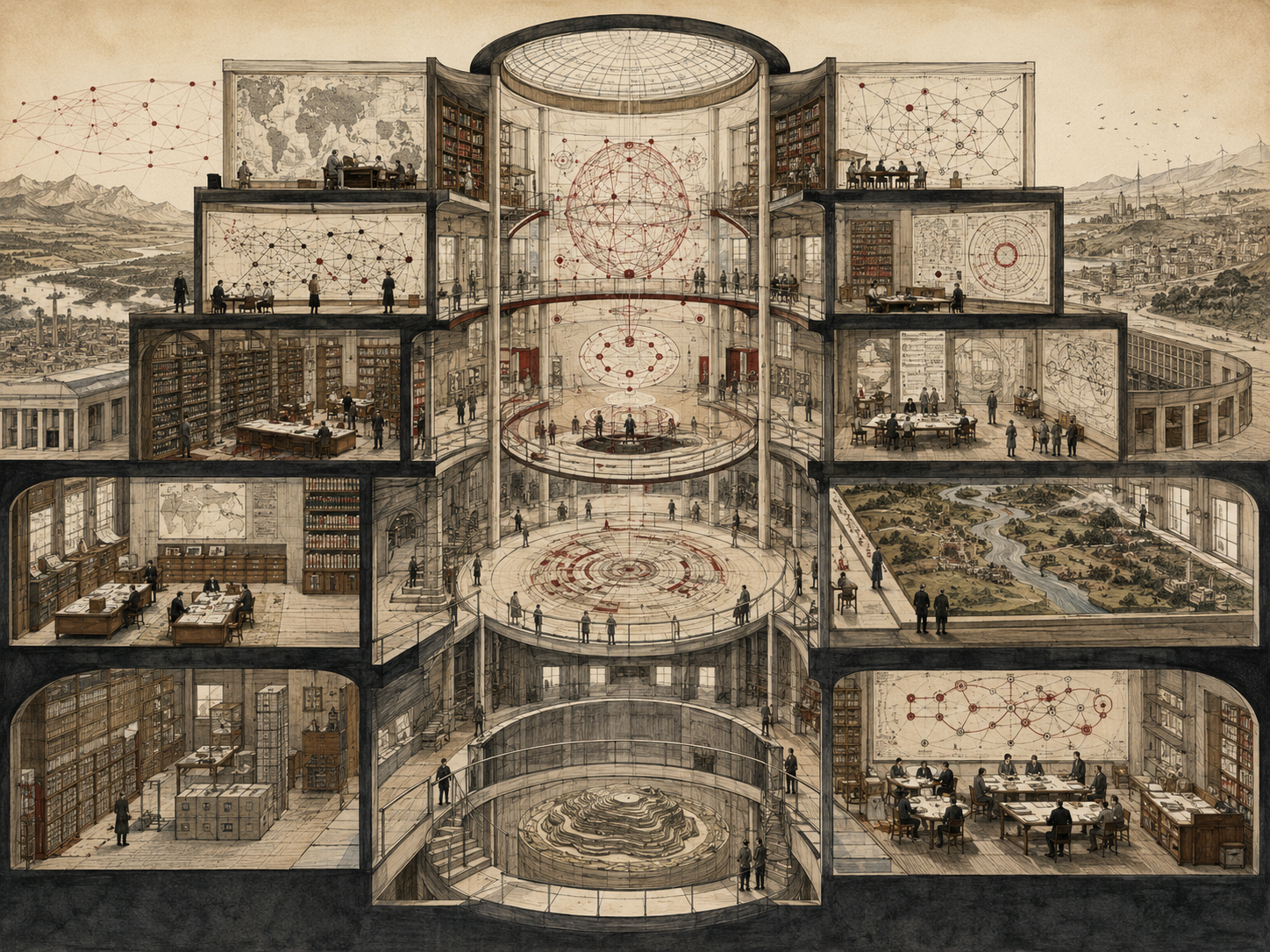
What Is Knowledge Architecture and Systems Thinking?
Knowledge architecture is the design of intellectual structures that organize knowledge so it can be found, understood, connected, reused, revised, governed, and trusted. Systems thinking is a way of understanding relationships, feedback loops, boundaries, delays, patterns, and whole-system behavior. Together, they ask how knowledge should be structured when the subject matter itself is complex, dynamic, interdisciplinary, and consequential.
A systems-oriented knowledge architecture does not treat knowledge objects as isolated units. It treats them as parts of a larger system. Articles relate to concepts. Concepts relate to frameworks. Frameworks relate to evidence. Evidence relates to models. Models relate to decisions. Decisions relate to outcomes. Outcomes create feedback. Feedback revises knowledge. The architecture must preserve these relationships if the system is to learn.
Systems thinking changes the central question of knowledge architecture. Instead of asking only, “Where should this content go?” it asks, “How does this knowledge behave inside the whole system?” Does it clarify relationships? Does it reveal assumptions? Does it connect disciplines? Does it preserve uncertainty? Does it support decision-making? Does it allow revision? Does it strengthen institutional memory?
KA_{ST} = f(B, R, F, S, A, E, G)
\]
Interpretation: A systems-oriented knowledge architecture \(KA_{ST}\) can be understood as a function of boundaries \(B\), relationships \(R\), feedback loops \(F\), scale \(S\), assumptions \(A\), evidence \(E\), and governance \(G\).
Knowledge architecture and systems thinking therefore meet at the level of structure. Knowledge systems are not just collections. They are living intellectual systems whose design shapes learning, reasoning, and action.
Why Systems Thinking Matters for Knowledge Architecture
Systems thinking matters for knowledge architecture because knowledge problems are rarely isolated. A concept belongs to a framework. A framework belongs to a discipline. A discipline belongs to an institutional context. Evidence belongs to a method, a community, a data infrastructure, and a history of interpretation. Decisions create outcomes that produce new knowledge. A knowledge architecture that ignores these relationships becomes brittle.
Many knowledge systems fail because they organize content by surface categories while losing system behavior. They classify topics but do not show causal relationships. They store reports but do not preserve learning loops. They publish research but do not connect it to decisions. They build repositories but do not maintain metadata. They add AI retrieval but do not govern source provenance, uncertainty, or context.
| Knowledge-Architecture Problem | Systems-Thinking Response | Risk if Missing |
|---|---|---|
| Disconnected content | Map relationships among concepts, evidence, frameworks, and decisions. | Users see fragments rather than systems. |
| Static categories | Represent flows, feedback, revision, and changing meaning. | The architecture becomes outdated quickly. |
| Hidden assumptions | Document framing, model boundaries, and interpretive choices. | Knowledge appears more neutral than it is. |
| Poor learning loops | Connect outcomes, feedback, audits, and revisions to knowledge records. | The system cannot learn from use or failure. |
| Scale confusion | Preserve local, regional, global, institutional, and platform-level context. | Evidence is applied at the wrong level. |
| AI retrieval without structure | Use metadata, provenance, and governed knowledge graphs. | AI produces plausible summaries without accountability. |
Systems thinking makes knowledge architecture more adaptive. It helps designers ask not only whether the system is organized, but whether it learns, corrects, connects, and explains itself.
From Static Organization to Dynamic Relationships
Traditional information organization often begins with stable containers: folders, menus, taxonomies, tags, catalogs, archives, and databases. These are useful, but complex knowledge systems need more than static organization. They need dynamic relationships.
A static taxonomy can tell users that climate systems, governance, economics, infrastructure, and public health are separate topics. A systems-oriented architecture can show how climate stress affects infrastructure, how infrastructure affects health risk, how governance affects adaptation, how economic inequality shapes vulnerability, and how public health outcomes feed back into institutional trust.
The same principle applies across knowledge domains. A legal doctrine connects to institutional authority. A research method connects to evidence quality. A model connects to assumptions. A decision connects to outcomes. A community record connects to governance and consent. The architecture must preserve the relationship type, not merely the relationship itself.
| Static Knowledge Organization | Systems-Oriented Knowledge Architecture | Difference |
|---|---|---|
| Category lists | Relationship maps | Shows how topics interact. |
| Folders | Linked knowledge objects | Connects content across contexts. |
| Tags | Typed relationships | Distinguishes causes, supports, constrains, revises, and governs. |
| Search results | Evidence pathways | Shows why a source matters. |
| Static dashboards | Feedback systems | Connects indicators to learning and revision. |
| Published articles | Living knowledge networks | Preserves updates, revisions, dependencies, and institutional memory. |
Dynamic relationships make knowledge architecture more intelligent. They allow the system to represent how knowledge changes, interacts, and produces consequences.
Boundaries, Scales, and Context
Systems thinking begins with boundaries. A boundary defines what is included in the system and what is treated as external context. Knowledge architecture also requires boundaries: article boundaries, category boundaries, domain boundaries, repository boundaries, disciplinary boundaries, access boundaries, and governance boundaries.
Boundaries are necessary, but they are never neutral. The boundary around a knowledge system shapes what becomes visible. If a climate article excludes governance, adaptation may appear purely technical. If a health article excludes housing, disease may appear individual rather than structural. If an AI article excludes labor, law, and public accountability, technology may appear disconnected from institutions.
Scale is equally important. Knowledge may operate at the level of a concept, article, dataset, discipline, institution, platform, community, region, nation, or planet. A systems-oriented architecture preserves scale so that knowledge is not misapplied.
| Boundary or Scale Question | Knowledge-Architecture Application | Risk if Ignored |
|---|---|---|
| What is inside the system? | Define content, concept, domain, and repository boundaries. | Important relationships are excluded silently. |
| What is outside but relevant? | Link adjacent topics, constraints, and contextual systems. | Knowledge appears more self-contained than it is. |
| What scale does this knowledge address? | Record local, institutional, regional, global, or platform scale. | Evidence is applied at the wrong level. |
| Who defines the boundary? | Document editorial, disciplinary, community, or institutional authority. | Power becomes hidden in classification. |
| Can the boundary change? | Preserve revision records and architecture governance. | The knowledge system cannot adapt. |
Boundaries help knowledge systems remain coherent. Systems thinking helps ensure those boundaries remain explicit, contestable, and revisable.
Stocks, Flows, Feedback, and Delay
Systems thinking often distinguishes stocks, flows, feedback loops, and delays. These concepts apply directly to knowledge architecture. A knowledge system has stocks of accumulated content: articles, datasets, references, repositories, tags, models, decisions, and records. It also has flows: new publications, revisions, citations, user searches, AI retrievals, editorial updates, community feedback, and governance reviews.
Feedback loops determine whether the system learns. If users search for a topic and fail to find it, does that failure become metadata improvement? If an article becomes outdated, is there a review trigger? If a repository example breaks, does the error lead to revision? If AI retrieves a weak source, does the system learn from that failure?
Delays matter because knowledge systems rarely fail immediately. Metadata decay, broken links, outdated assumptions, weak categories, and unreviewed AI summaries may accumulate slowly. The architecture may appear functional until trust erodes or users can no longer understand the system.
| Systems Concept | Knowledge-Architecture Equivalent | Example |
|---|---|---|
| Stock | Accumulated knowledge assets. | Articles, datasets, repositories, references, concepts, records. |
| Flow | Movement or change of knowledge. | New articles, revisions, citations, searches, feedback, updates. |
| Reinforcing feedback | Loop that amplifies learning or error. | Good metadata improves retrieval, which exposes more useful links. |
| Balancing feedback | Loop that stabilizes quality. | Review workflow corrects outdated content. |
| Delay | Time lag between problem and visible consequence. | Outdated references weaken credibility months later. |
| Leverage point | Structural change that improves the whole system. | Better relationship typing improves search, AI retrieval, and article maps. |
KnowledgeStock_{t+1} = KnowledgeStock_t + Inflow_t – Decay_t + Revision_t
\]
Interpretation: A knowledge system changes as new knowledge enters, old knowledge decays, and revision processes restore accuracy, relevance, and coherence.
A knowledge architecture becomes systems-oriented when it designs not only for storage, but for flow, feedback, delay, and renewal.
Mental Models, Assumptions, and Framing
Systems thinking emphasizes mental models: the assumptions, categories, causal stories, and interpretive frames through which people understand a system. Knowledge architecture has mental models too. Every taxonomy reflects assumptions about what belongs together. Every article map reflects an interpretation of a field. Every ontology encodes judgments about entities and relationships. Every navigation system teaches users how to think about the knowledge space.
These mental models should be explicit. If a knowledge architecture presents sustainability as only environmental science, it may understate governance, justice, economics, and infrastructure. If it presents AI as only technical engineering, it may hide labor, law, politics, and social consequences. If it presents governance as only administration, it may hide power, legitimacy, and contestation.
Systems-oriented knowledge architecture therefore requires assumption registers, framing notes, series context blocks, model documentation, and revision histories. These do not weaken the system. They make the system more trustworthy by showing that knowledge organization is an intellectual act.
| Mental Model Element | Knowledge-Architecture Expression | Review Question |
|---|---|---|
| Problem frame | How a knowledge domain is introduced. | What does this framing reveal or hide? |
| Category logic | How topics are grouped. | Are categories disciplinary, practical, moral, institutional, or technical? |
| Relationship assumptions | How concepts are linked. | Are relationships causal, conceptual, evidentiary, historical, or governance-related? |
| Evidence hierarchy | Which sources are treated as authoritative. | Are marginalized, local, historical, or community sources excluded? |
| Update logic | How knowledge is revised. | What triggers review, correction, or expansion? |
Mental models are unavoidable. Good knowledge architecture does not pretend otherwise. It makes them visible enough to examine and improve.
Knowledge Flows and Learning Loops
A knowledge system becomes alive through learning loops. A user reads an article, follows related links, discovers a gap, asks a question, generates a new article, creates a repository, updates metadata, improves navigation, and strengthens the article map. That is a learning loop. It connects use to revision.
Learning loops also operate institutionally. Research produces evidence. Evidence informs a framework. A framework shapes a decision. A decision produces outcomes. Outcomes generate feedback. Feedback updates the framework. The knowledge architecture should preserve this sequence so that learning is not lost.
Many platforms fail because they have publication workflows but not learning workflows. They publish content, but they do not know when content becomes outdated. They store references, but they do not know when references break. They deploy AI search, but they do not know when AI retrieves weak or decontextualized material.
Learning_{t+1} = f(Use_t, Feedback_t, Review_t, Revision_t)
\]
Interpretation: Learning at the next stage depends on use, feedback, review, and revision. Knowledge systems need explicit loops that connect use to improvement.
| Learning Loop | Knowledge-System Function | Design Requirement |
|---|---|---|
| User feedback loop | Shows where users struggle, search, or need clarification. | Feedback records, search logs, update tasks, editorial review. |
| Evidence update loop | Keeps content aligned with new research. | Review dates, source monitoring, reference updates. |
| Repository loop | Connects articles to runnable examples and validation. | Code folders, tests, outputs, documentation. |
| Governance loop | Preserves accountability and revision history. | Decision records, audit notes, revision logs. |
| AI retrieval loop | Improves AI outputs through metadata and correction. | Provenance, source hierarchy, error review, guardrails. |
Knowledge architecture becomes stronger when every major knowledge object can participate in learning: content, data, models, repositories, decisions, governance records, and user feedback.
Complexity, Emergence, and Adaptive Knowledge
Complex systems often display emergent behavior: patterns that arise from interactions among parts. Knowledge systems also produce emergent behavior. A single article may be useful, but a connected article map can create a deeper field of understanding. A single dataset may be informative, but a linked evidence architecture can support modeling, evaluation, and decision-making. A single repository may be practical, but a network of repositories can become intellectual infrastructure.
Emergence can be positive or negative. A well-designed knowledge system can produce coherence, discovery, interdisciplinary insight, and institutional memory. A poorly designed system can produce confusion, duplication, stale content, hidden assumptions, and misleading AI retrieval. The emergent behavior depends on structure.
Adaptive knowledge architecture recognizes that fields change. Scientific understanding evolves. Governance contexts shift. Technology changes. Legal and ethical standards develop. Social priorities change. A systems-oriented architecture should be designed for adaptation rather than pretending that a static map will remain complete.
| Complexity Feature | Knowledge-Architecture Implication | Design Response |
|---|---|---|
| Emergence | System-level meaning arises from connected knowledge objects. | Design relationship-rich article maps and knowledge graphs. |
| Nonlinearity | Small architectural changes can have large effects. | Prioritize high-leverage improvements such as metadata and relationship typing. |
| Path dependence | Early category decisions shape future structure. | Preserve revision ability and avoid rigid premature classification. |
| Adaptation | Knowledge domains change over time. | Use review cycles, versioning, and update workflows. |
| Interdependence | Articles, datasets, models, and decisions affect one another. | Use linked records and traceable dependencies. |
Knowledge architecture is therefore not only a design problem. It is a complexity problem. The architecture shapes the emergent intelligence of the whole system.
Taxonomies, Ontologies, and Systems Maps
Taxonomies, ontologies, and systems maps each support systems-oriented knowledge architecture, but they do different work. A taxonomy organizes categories. An ontology defines entities and relationships. A systems map shows structure, feedback, boundaries, flows, and dependencies. A mature knowledge architecture may need all three.
For example, a taxonomy might classify articles under Artificial Intelligence Systems, Data Systems & Analytics, Embedded and Edge Systems, Environmental Monitoring Systems, and Intelligent Infrastructure Systems. An ontology might define relationships such as usesDataset, supportsModel, governsDecision, updatesConcept, or dependsOnEvidence. A systems map might show how these domains influence one another through data flows, infrastructure, governance, risk, and learning.
| Structure | Primary Function | Systems-Thinking Contribution |
|---|---|---|
| Taxonomy | Groups knowledge into categories. | Clarifies domain boundaries and navigation. |
| Ontology | Defines entities and relationships. | Makes relationships explicit and machine-readable. |
| Knowledge graph | Connects knowledge objects through typed relationships. | Supports traceability, retrieval, reasoning, and AI grounding. |
| Systems map | Represents relationships, feedback, boundaries, and flows. | Shows system behavior and interdependence. |
| Framework | Organizes inquiry and interpretation. | Connects concepts, evidence, assumptions, and decisions. |
A systems-oriented knowledge architecture should not force all knowledge into one structure. It should use the right structure for the right purpose and connect those structures through clear metadata and governance.
Governance, Equity, and System Responsibility
Systems thinking also reveals responsibility. Knowledge systems shape what users can know, what institutions can remember, what AI systems can retrieve, what evidence becomes visible, and what communities are represented. Knowledge architecture is therefore not neutral infrastructure. It has ethical and governance consequences.
A systems-oriented architecture should ask who benefits from the structure, who is excluded, whose knowledge is recognized, whose knowledge is extracted, and who can challenge the system. This is especially important when organizing knowledge about marginalized communities, environmental harm, public governance, health, law, migration, labor, or historical injustice.
Equity-aware knowledge architecture requires more than adding a tag. It requires structures that preserve affected-group context, historical conditions, local knowledge, community governance, access restrictions, and contestability. Some knowledge should be amplified. Some knowledge should be protected. Some categories should be challenged because they reproduce institutional harm.
| Responsibility Question | Knowledge-System Risk | Architecture Response |
|---|---|---|
| Whose knowledge is visible? | Dominant institutional sources crowd out marginalized knowledge. | Include source diversity, local knowledge, and historical context. |
| Who defines the categories? | Classification reproduces power. | Document category logic and allow revision. |
| Who can contest the system? | Errors become durable infrastructure. | Provide correction, feedback, and governance pathways. |
| What should remain protected? | Sensitive or community-governed knowledge is exposed. | Use access controls, consent notes, and stewardship rules. |
| How does AI use the architecture? | AI retrieves without context or accountability. | Use provenance, metadata, source hierarchy, and review workflows. |
A knowledge architecture that thinks systemically must also think morally. Structure creates consequences.
AI-Assisted Systems Thinking in Knowledge Architecture
AI can assist systems-oriented knowledge architecture by identifying relationships, summarizing fields, detecting missing links, classifying content, generating draft taxonomies, supporting semantic search, and surfacing patterns across large knowledge collections. But AI can also flatten complexity, overconnect weakly related ideas, hallucinate relationships, and obscure source uncertainty.
Systems thinking provides a useful discipline for AI-assisted knowledge architecture. It asks whether AI is preserving boundaries, scale, feedback, uncertainty, provenance, and governance. It asks whether AI is helping users understand relationships or merely generating plausible summaries. It asks whether AI outputs are being reviewed and incorporated into learning loops.
AI_{KA} = f(Text, Metadata, Relationships, Provenance, Feedback, Governance)
\]
Interpretation: AI-assisted knowledge architecture depends on text, metadata, relationships, provenance, feedback, and governance. AI becomes more useful when the underlying architecture is structured and reviewable.
AI should not become the hidden systems thinker. It should support human and institutional reasoning by making relationships easier to inspect, not by replacing accountability.
Mathematical and Computational Modeling
A systems-oriented knowledge architecture can be represented as a graph of knowledge objects, relationships, feedback loops, review records, and governance structures. These representations can help audit whether the system is connected, traceable, adaptive, and reviewable.
KSG = (V, E)
\]
Interpretation: A knowledge-system graph \(KSG\) consists of knowledge objects \(V\) and relationships \(E\).
Traceability = \frac{|E_P|}{|E|}
\]
Interpretation: Traceability measures the share of relationships \(E\) with provenance \(E_P\). A systems-oriented knowledge architecture needs evidence for why relationships exist.
FeedbackCoverage = \frac{|L_F|}{|K|}
\]
Interpretation: Feedback coverage measures how many major knowledge objects \(K\) participate in feedback loops \(L_F\), such as review, revision, user feedback, audit, or update workflows.
ArchitectureResilience = f(Diversity, Redundancy, Feedback, Revision, Governance)
\]
Interpretation: A resilient knowledge architecture depends on diversity of sources, redundancy where appropriate, feedback, revision capacity, and governance.
These metrics do not replace qualitative judgment. They help identify whether the knowledge system has enough structure to support learning, correction, and responsible use.
Python Section: Auditing a Systems-Oriented Knowledge Architecture
The following Python example models a small systems-oriented knowledge architecture and audits metadata coverage, relationship traceability, feedback coverage, scale diversity, and review needs.
# systems_oriented_knowledge_architecture_audit.py
# Lightweight audit for knowledge architecture and systems thinking.

from pathlib import Path
import csv
from collections import Counter, defaultdict

ROOT = Path(".")
OUTPUTS = ROOT / "outputs"
OUTPUTS.mkdir(exist_ok=True)

objects = [
    {"id": "article_map", "label": "Article Map", "type": "structure", "metadata": True, "scale": "platform", "feedback": True},
    {"id": "concept_framework", "label": "Conceptual Framework", "type": "framework", "metadata": True, "scale": "domain", "feedback": True},
    {"id": "evidence_record", "label": "Evidence Record", "type": "evidence", "metadata": True, "scale": "source", "feedback": False},
    {"id": "model_record", "label": "Model Record", "type": "model", "metadata": True, "scale": "analytical", "feedback": True},
    {"id": "decision_record", "label": "Decision Record", "type": "decision", "metadata": True, "scale": "institutional", "feedback": True},
    {"id": "outcome_indicator", "label": "Outcome Indicator", "type": "outcome", "metadata": True, "scale": "system", "feedback": True},
    {"id": "revision_log", "label": "Revision Log", "type": "governance", "metadata": False, "scale": "platform", "feedback": True},
    {"id": "ai_retrieval_record", "label": "AI Retrieval Record", "type": "ai", "metadata": True, "scale": "platform", "feedback": False}
]

relationships = [
    {"source": "article_map", "target": "concept_framework", "type": "organizes", "provenance": "series_architecture", "feedback": False},
    {"source": "concept_framework", "target": "evidence_record", "type": "usesEvidence", "provenance": "reference_map", "feedback": False},
    {"source": "evidence_record", "target": "model_record", "type": "supportsModel", "provenance": "methods_note", "feedback": False},
    {"source": "model_record", "target": "decision_record", "type": "informsDecision", "provenance": "decision_file", "feedback": False},
    {"source": "decision_record", "target": "outcome_indicator", "type": "monitoredBy", "provenance": "evaluation_plan", "feedback": True},
    {"source": "outcome_indicator", "target": "revision_log", "type": "feedsBackTo", "provenance": "review_cycle", "feedback": True},
    {"source": "revision_log", "target": "article_map", "type": "revises", "provenance": "editorial_update", "feedback": True},
    {"source": "ai_retrieval_record", "target": "evidence_record", "type": "retrieves", "provenance": "retrieval_log", "feedback": False},
    {"source": "ai_retrieval_record", "target": "revision_log", "type": "flagsGapFor", "provenance": "ai_review", "feedback": True},
    {"source": "article_map", "target": "ai_retrieval_record", "type": "related", "provenance": "", "feedback": False}
]

degree = defaultdict(int)
relationship_types = Counter()
traceable = 0
underspecified = 0
feedback_edges = 0

for rel in relationships:
    degree[rel["source"]] += 1
    degree[rel["target"]] += 1
    relationship_types[rel["type"]] += 1
    if rel["provenance"].strip():
        traceable += 1
    if rel["type"] in {"related", "sameAs", ""}:
        underspecified += 1
    if rel["feedback"]:
        feedback_edges += 1

object_rows = []
for obj in objects:
    row = {
        "id": obj["id"],
        "label": obj["label"],
        "type": obj["type"],
        "has_metadata": obj["metadata"],
        "scale": obj["scale"],
        "has_feedback_role": obj["feedback"],
        "degree": degree[obj["id"]],
        "is_orphan": degree[obj["id"]] == 0,
        "needs_review": not obj["metadata"] or degree[obj["id"]] == 0
    }
    object_rows.append(row)

with (OUTPUTS / "systems_knowledge_object_diagnostics.csv").open("w", newline="", encoding="utf-8") as f:
    writer = csv.DictWriter(
        f,
        fieldnames=["id", "label", "type", "has_metadata", "scale", "has_feedback_role", "degree", "is_orphan", "needs_review"]
    )
    writer.writeheader()
    writer.writerows(object_rows)

with (OUTPUTS / "systems_knowledge_relationships.csv").open("w", newline="", encoding="utf-8") as f:
    writer = csv.DictWriter(f, fieldnames=["source", "target", "type", "provenance", "feedback"])
    writer.writeheader()
    writer.writerows(relationships)

with (OUTPUTS / "systems_knowledge_relationship_type_summary.csv").open("w", newline="", encoding="utf-8") as f:
    writer = csv.writer(f)
    writer.writerow(["relationship_type", "count"])
    for relationship_type, count in relationship_types.items():
        writer.writerow([relationship_type, count])

object_type_counts = Counter(obj["type"] for obj in objects)
scale_counts = Counter(obj["scale"] for obj in objects)

summary = {
    "object_count": len(objects),
    "relationship_count": len(relationships),
    "metadata_coverage": round(sum(obj["metadata"] for obj in objects) / len(objects), 3),
    "feedback_role_coverage": round(sum(obj["feedback"] for obj in objects) / len(objects), 3),
    "relationship_traceability": round(traceable / len(relationships), 3),
    "feedback_edge_share": round(feedback_edges / len(relationships), 3),
    "underspecified_relationship_risk": round(underspecified / len(relationships), 3),
    "scale_count": len(scale_counts),
    "object_type_count": len(object_type_counts),
    "orphan_count": sum(row["is_orphan"] for row in object_rows),
    "review_needed_count": sum(row["needs_review"] for row in object_rows),
    "relationship_type_count": len(relationship_types)
}

with (OUTPUTS / "systems_knowledge_architecture_summary.csv").open("w", newline="", encoding="utf-8") as f:
    writer = csv.writer(f)
    writer.writerow(["metric", "value"])
    for key, value in summary.items():
        writer.writerow([key, value])

print("Wrote systems-oriented knowledge architecture diagnostics to outputs/")
This example can be extended to article maps, knowledge graphs, governance systems, repository networks, AI retrieval systems, and research-platform architectures. Its purpose is to make system structure visible enough for review.
R Section: Feedback, Coverage, and Relationship Diagnostics
The following R example summarizes object types, scale distribution, metadata coverage, feedback roles, relationship traceability, and review needs in a systems-oriented knowledge architecture.
# systems_oriented_knowledge_architecture_diagnostics.R
# Lightweight diagnostics for knowledge architecture and systems thinking.

objects <- data.frame(
  id = c(
    "article_map",
    "concept_framework",
    "evidence_record",
    "model_record",
    "decision_record",
    "outcome_indicator",
    "revision_log",
    "ai_retrieval_record"
  ),
  type = c(
    "structure",
    "framework",
    "evidence",
    "model",
    "decision",
    "outcome",
    "governance",
    "ai"
  ),
  has_metadata = c(TRUE, TRUE, TRUE, TRUE, TRUE, TRUE, FALSE, TRUE),
  scale = c("platform", "domain", "source", "analytical", "institutional", "system", "platform", "platform"),
  has_feedback_role = c(TRUE, TRUE, FALSE, TRUE, TRUE, TRUE, TRUE, FALSE)
)

relationships <- data.frame(
  source = c(
    "article_map",
    "concept_framework",
    "evidence_record",
    "model_record",
    "decision_record",
    "outcome_indicator",
    "revision_log",
    "ai_retrieval_record",
    "ai_retrieval_record",
    "article_map"
  ),
  target = c(
    "concept_framework",
    "evidence_record",
    "model_record",
    "decision_record",
    "outcome_indicator",
    "revision_log",
    "article_map",
    "evidence_record",
    "revision_log",
    "ai_retrieval_record"
  ),
  relationship_type = c(
    "organizes",
    "usesEvidence",
    "supportsModel",
    "informsDecision",
    "monitoredBy",
    "feedsBackTo",
    "revises",
    "retrieves",
    "flagsGapFor",
    "related"
  ),
  has_provenance = c(TRUE, TRUE, TRUE, TRUE, TRUE, TRUE, TRUE, TRUE, TRUE, FALSE),
  feedback = c(FALSE, FALSE, FALSE, FALSE, TRUE, TRUE, TRUE, FALSE, TRUE, FALSE)
)

dir.create("outputs", showWarnings = FALSE)

object_type_summary <- as.data.frame(table(objects$type))
names(object_type_summary) <- c("object_type", "count")

scale_summary <- as.data.frame(table(objects$scale))
names(scale_summary) <- c("scale", "count")

relationship_type_summary <- as.data.frame(table(relationships$relationship_type))
names(relationship_type_summary) <- c("relationship_type", "count")

relationship_ids <- c(relationships$source, relationships$target)

degree_table <- data.frame(
  id = objects$id,
  type = objects$type,
  has_metadata = objects$has_metadata,
  scale = objects$scale,
  has_feedback_role = objects$has_feedback_role,
  degree = sapply(objects$id, function(x) sum(relationship_ids == x))
)

degree_table$is_orphan <- degree_table$degree == 0
degree_table$needs_review <- !degree_table$has_metadata | degree_table$is_orphan

coverage_summary <- data.frame(
  object_count = nrow(objects),
  relationship_count = nrow(relationships),
  metadata_coverage = mean(objects$has_metadata),
  feedback_role_coverage = mean(objects$has_feedback_role),
  relationship_traceability = mean(relationships$has_provenance),
  feedback_edge_share = mean(relationships$feedback),
  underspecified_relationship_risk = mean(relationships$relationship_type %in% c("related", "sameAs", "")),
  scale_count = length(unique(objects$scale)),
  orphan_count = sum(degree_table$is_orphan),
  review_needed_count = sum(degree_table$needs_review)
)

write.csv(object_type_summary, "outputs/systems_knowledge_object_type_summary.csv", row.names = FALSE)
write.csv(scale_summary, "outputs/systems_knowledge_scale_summary.csv", row.names = FALSE)
write.csv(relationship_type_summary, "outputs/systems_knowledge_relationship_type_summary.csv", row.names = FALSE)
write.csv(degree_table, "outputs/systems_knowledge_degree_table.csv", row.names = FALSE)
write.csv(coverage_summary, "outputs/systems_knowledge_coverage_summary.csv", row.names = FALSE)

print(object_type_summary)
print(scale_summary)
print(coverage_summary)
R is useful for systems-oriented knowledge architecture because it can quickly expose coverage, relationship, scale, and feedback patterns. These summaries can support editorial governance, repository planning, AI retrieval review, and platform-level learning.
SQL Section: Systems Thinking Knowledge Architecture Schema
SQL can support systems-oriented knowledge architecture by storing knowledge objects, system boundaries, relationship types, feedback loops, assumptions, evidence links, revision records, and governance checks. A relational schema can provide a practical foundation even when graph databases or semantic-web tools are added later.
-- systems_thinking_knowledge_architecture_schema.sql
-- Minimal schema for knowledge architecture and systems thinking.

CREATE TABLE IF NOT EXISTS knowledge_systems (
  system_id TEXT PRIMARY KEY,
  title TEXT NOT NULL,
  system_type TEXT,
  scope_note TEXT,
  boundary_note TEXT,
  scale TEXT,
  status TEXT DEFAULT 'active',
  last_reviewed DATE
);

CREATE TABLE IF NOT EXISTS knowledge_objects (
  object_id TEXT PRIMARY KEY,
  system_id TEXT,
  title TEXT NOT NULL,
  object_type TEXT NOT NULL,
  description TEXT,
  scale TEXT,
  metadata_status TEXT,
  review_status TEXT DEFAULT 'provisional',
  FOREIGN KEY (system_id) REFERENCES knowledge_systems(system_id)
);

CREATE TABLE IF NOT EXISTS relationship_types (
  relationship_type_id TEXT PRIMARY KEY,
  label TEXT NOT NULL,
  definition TEXT,
  feedback_relevance INTEGER DEFAULT 0,
  status TEXT DEFAULT 'active'
);

CREATE TABLE IF NOT EXISTS knowledge_relationships (
  relationship_id INTEGER PRIMARY KEY,
  system_id TEXT,
  source_object_id TEXT NOT NULL,
  relationship_type_id TEXT NOT NULL,
  target_object_id TEXT NOT NULL,
  provenance_note TEXT,
  uncertainty_note TEXT,
  review_status TEXT DEFAULT 'provisional',
  FOREIGN KEY (system_id) REFERENCES knowledge_systems(system_id),
  FOREIGN KEY (source_object_id) REFERENCES knowledge_objects(object_id),
  FOREIGN KEY (relationship_type_id) REFERENCES relationship_types(relationship_type_id),
  FOREIGN KEY (target_object_id) REFERENCES knowledge_objects(object_id)
);

CREATE TABLE IF NOT EXISTS feedback_loops (
  loop_id TEXT PRIMARY KEY,
  system_id TEXT,
  loop_name TEXT NOT NULL,
  loop_type TEXT,
  description TEXT,
  evidence_note TEXT,
  review_status TEXT DEFAULT 'provisional',
  FOREIGN KEY (system_id) REFERENCES knowledge_systems(system_id)
);

CREATE TABLE IF NOT EXISTS loop_relationships (
  loop_id TEXT NOT NULL,
  relationship_id INTEGER NOT NULL,
  sequence_order INTEGER,
  PRIMARY KEY (loop_id, relationship_id),
  FOREIGN KEY (loop_id) REFERENCES feedback_loops(loop_id),
  FOREIGN KEY (relationship_id) REFERENCES knowledge_relationships(relationship_id)
);

CREATE TABLE IF NOT EXISTS assumptions (
  assumption_id TEXT PRIMARY KEY,
  system_id TEXT,
  assumption_text TEXT NOT NULL,
  assumption_type TEXT,
  sensitivity_level TEXT,
  evidence_note TEXT,
  review_status TEXT DEFAULT 'provisional',
  FOREIGN KEY (system_id) REFERENCES knowledge_systems(system_id)
);

CREATE TABLE IF NOT EXISTS evidence_links (
  evidence_id TEXT PRIMARY KEY,
  object_id TEXT,
  evidence_type TEXT,
  source_note TEXT,
  quality_note TEXT,
  uncertainty_note TEXT,
  FOREIGN KEY (object_id) REFERENCES knowledge_objects(object_id)
);

CREATE TABLE IF NOT EXISTS revision_records (
  revision_id TEXT PRIMARY KEY,
  object_id TEXT,
  revision_type TEXT,
  revision_note TEXT,
  changed_at DATE,
  reviewed_by TEXT,
  FOREIGN KEY (object_id) REFERENCES knowledge_objects(object_id)
);

CREATE TABLE IF NOT EXISTS governance_checks (
  check_id TEXT PRIMARY KEY,
  system_id TEXT,
  layer TEXT,
  check_name TEXT,
  severity TEXT,
  review_status TEXT DEFAULT 'provisional',
  FOREIGN KEY (system_id) REFERENCES knowledge_systems(system_id)
);
This schema separates systems, objects, relationships, feedback loops, assumptions, evidence, revisions, and governance checks. That separation matters because systems thinking requires the architecture to preserve both structure and change.
GitHub Repository
This article is supported by a companion repository folder with reproducible examples, small synthetic datasets, documentation, and language-specific modeling scaffolds for knowledge architecture and systems thinking.
Complete Code Repository
This folder contains companion research and code assets for the Knowledge Architecture and Systems Thinking article, including Python, R, Julia, SQL, Rust, Go, C++, Fortran, C, documentation, data, and generated outputs.
The repository structure mirrors the article’s systems-thinking argument. Python supports knowledge-object, relationship, feedback, traceability, and review diagnostics. R supports coverage summaries and system-level review. SQL supports knowledge systems, objects, relationships, feedback loops, assumptions, evidence links, revisions, and governance checks. Systems-language folders provide space for validation utilities, graph-processing experiments, and reproducible tooling. Documentation, data, and outputs preserve the relationship between knowledge architecture, systems thinking, and adaptive learning.
Quality Criteria for Systems-Oriented Knowledge Architecture
A systems-oriented knowledge architecture should be relational, adaptive, traceable, feedback-aware, scale-aware, assumption-aware, equity-aware, and governable. It should help users understand not only what knowledge exists, but how knowledge behaves inside the larger system.
| Quality Criterion | Evaluation Question | Warning Sign |
|---|---|---|
| Relational clarity | Are relationships among knowledge objects explicit and typed? | Everything is connected only by vague “related” links. |
| Boundary clarity | Are system boundaries and adjacent contexts visible? | The knowledge system appears complete without explaining scope. |
| Feedback awareness | Can use, outcomes, errors, and revisions feed back into the system? | The system publishes but does not learn. |
| Scale awareness | Are local, institutional, disciplinary, platform, and global scales preserved? | Evidence is applied outside its proper context. |
| Assumption transparency | Are framing choices and mental models documented? | Categories appear natural rather than designed. |
| Traceability | Can users follow concepts to evidence, models, decisions, and revisions? | Claims cannot be audited. |
| Governance | Are review, access, correction, and stewardship processes defined? | Errors become durable infrastructure. |
| AI readiness | Can AI retrieval use metadata, provenance, and relationship context? | AI summarizes fragments without system understanding. |
Systems-oriented quality is not the same as visual complexity. A knowledge map can look impressive while hiding weak relationships. A strong architecture may be visually simple but structurally rigorous, traceable, and revisable.
Interpretive Cautions and Ethical Limits
Systems thinking is powerful, but it can also be misused. Not every relationship is causal. Not every system map is evidence. Not every feedback loop is measurable. Not every complex diagram is insightful. Knowledge architecture should avoid using systems language to create the appearance of depth without analytical discipline.
Systems thinking can also become overly abstract. It may turn people, communities, histories, and institutions into nodes and arrows. A systems-oriented knowledge architecture must preserve human meaning, not flatten lived experience into diagrams. This is especially important when dealing with injustice, health, governance, ecology, migration, labor, religion, or vulnerable communities.
There is also a danger of totalizing architecture. No knowledge system can represent everything. Boundaries are necessary. A responsible architecture should acknowledge what it excludes, what it simplifies, what it cannot know, and what requires local, historical, ethical, or community-governed interpretation.
AI-assisted systems mapping adds another caution. AI can generate relationship-rich structures quickly, but it can also overconnect concepts, invent causal links, and hide uncertainty. AI-generated systems maps should be treated as provisional drafts requiring review, not as finished knowledge infrastructure.
The goal is not to make knowledge architecture look systemic. The goal is to make it genuinely capable of supporting learning, accountability, adaptation, and responsible understanding.
Why Systems Thinking Belongs to Knowledge Architecture
Systems thinking belongs to knowledge architecture because knowledge systems are systems. They have parts, relationships, boundaries, flows, feedback, delays, leverage points, failure modes, and emergent behavior. A knowledge architecture that ignores systems thinking may organize content neatly while failing to support understanding.
Systems thinking helps knowledge architecture become more than classification. It turns article maps into intellectual ecosystems, repositories into reproducible knowledge infrastructure, metadata into feedback infrastructure, and AI retrieval into governed reasoning support. It helps knowledge systems preserve context, uncertainty, revision, and responsibility.
For public-facing research platforms, systems thinking is especially important because the work spans domains: science, technology, governance, law, psychology, economics, ecology, infrastructure, and ethics. These domains cannot be understood only as separate categories. They must also be understood as interacting systems.
At its best, knowledge architecture and systems thinking create a platform that does more than store knowledge. It helps people see relationships, learn across domains, revise assumptions, understand consequences, and build intellectual infrastructure for complex public life. That is why systems thinking is not an optional design layer. It is one of the foundations of serious knowledge architecture.
Related Articles
- Foundations of Knowledge Architecture
- What Is Knowledge Architecture?
- Conceptual Modeling in Complex Systems
- Knowledge Systems and Decision-Making
- Knowledge Architecture in Governance Systems
- Knowledge Architecture in Sustainability Science
- Knowledge Mapping and Conceptual Models
- Knowledge Graphs and Semantic Relationships
- Structuring Interdisciplinary Knowledge
Further Reading
- Checkland, P. (1981) Systems Thinking, Systems Practice. Chichester: Wiley.
- Forrester, J.W. (1961) Industrial Dynamics. Cambridge, MA: MIT Press.
- Holland, J.H. (1995) Hidden Order: How Adaptation Builds Complexity. Reading, MA: Addison-Wesley.
- Meadows, D.H. (2008) Thinking in Systems: A Primer. White River Junction, VT: Chelsea Green Publishing.
- Senge, P.M. (2006) The Fifth Discipline: The Art & Practice of the Learning Organization. Revised edn. New York: Doubleday.
- Sterman, J.D. (2000) Business Dynamics: Systems Thinking and Modeling for a Complex World. Boston: Irwin/McGraw-Hill.
- Weinberg, G.M. (1975) An Introduction to General Systems Thinking. New York: Wiley.
- Wenger, E. (1998) Communities of Practice: Learning, Meaning, and Identity. Cambridge: Cambridge University Press.
References
- Checkland, P. (1981) Systems Thinking, Systems Practice. Chichester: Wiley.
- Forrester, J.W. (1961) Industrial Dynamics. Cambridge, MA: MIT Press.
- Holland, J.H. (1995) Hidden Order: How Adaptation Builds Complexity. Reading, MA: Addison-Wesley.
- Meadows, D.H. (2008) Thinking in Systems: A Primer. White River Junction, VT: Chelsea Green Publishing. Available at: https://www.chelseagreen.com/product/thinking-in-systems/
- Santa Fe Institute (n.d.) What Is Complex Systems Science? Available at: https://www.santafe.edu/what-is-complex-systems-science
- Senge, P.M. (2006) The Fifth Discipline: The Art & Practice of the Learning Organization. Revised edn. New York: Doubleday.
- Sterman, J.D. (2000) Business Dynamics: Systems Thinking and Modeling for a Complex World. Boston: Irwin/McGraw-Hill.
- Weinberg, G.M. (1975) An Introduction to General Systems Thinking. New York: Wiley.
- Wenger, E. (1998) Communities of Practice: Learning, Meaning, and Identity. Cambridge: Cambridge University Press. Available at: https://doi.org/10.1017/CBO9780511803932