
Last Updated May 27, 2026
Framework design in policy research is the practice of building structured analytical models that help researchers, institutions, policymakers, and public audiences understand policy problems, compare options, trace evidence, anticipate trade-offs, evaluate outcomes, and revise decisions over time. A policy framework is not merely a diagram, outline, or list of categories. It is an intellectual structure that defines a problem, identifies actors and institutions, clarifies assumptions, connects evidence to judgment, organizes uncertainty, and preserves the reasoning pathway from diagnosis to action.
Policy research is difficult because public problems are rarely technical alone. Housing, climate adaptation, public health, education, inequality, infrastructure, migration, economic development, digital governance, food systems, labor markets, and institutional trust all involve evidence, values, law, budgets, implementation capacity, political conflict, historical context, and affected communities. Framework design helps policy researchers avoid treating complex problems as if they were simple administrative tasks.
Within knowledge architecture, framework design in policy research shows why policy knowledge must be organized across concepts, variables, evidence types, causal pathways, stakeholder positions, institutional constraints, implementation mechanisms, evaluation criteria, and governance records. A strong framework does not decide policy automatically. It makes the reasoning structure visible enough to be tested, debated, revised, and used responsibly.
Article Map
Knowledge Architecture
Related Topic
Institutions & Governance

What Is Framework Design in Policy Research?
Framework design in policy research is the structured organization of a policy problem, its causes, actors, evidence, options, assumptions, trade-offs, implementation pathways, and evaluation criteria. It gives policy inquiry an architecture. Instead of treating evidence, values, institutions, and recommendations as separate fragments, a framework shows how they relate.
A policy framework can take many forms: a logic model, theory of change, causal map, results framework, decision matrix, institutional analysis framework, policy cycle model, stakeholder map, risk framework, equity framework, implementation framework, or evaluation framework. Each form serves a different purpose. Some explain causality. Some organize evidence. Some clarify accountability. Some compare policy options. Some guide evaluation. Some support communication across institutions.
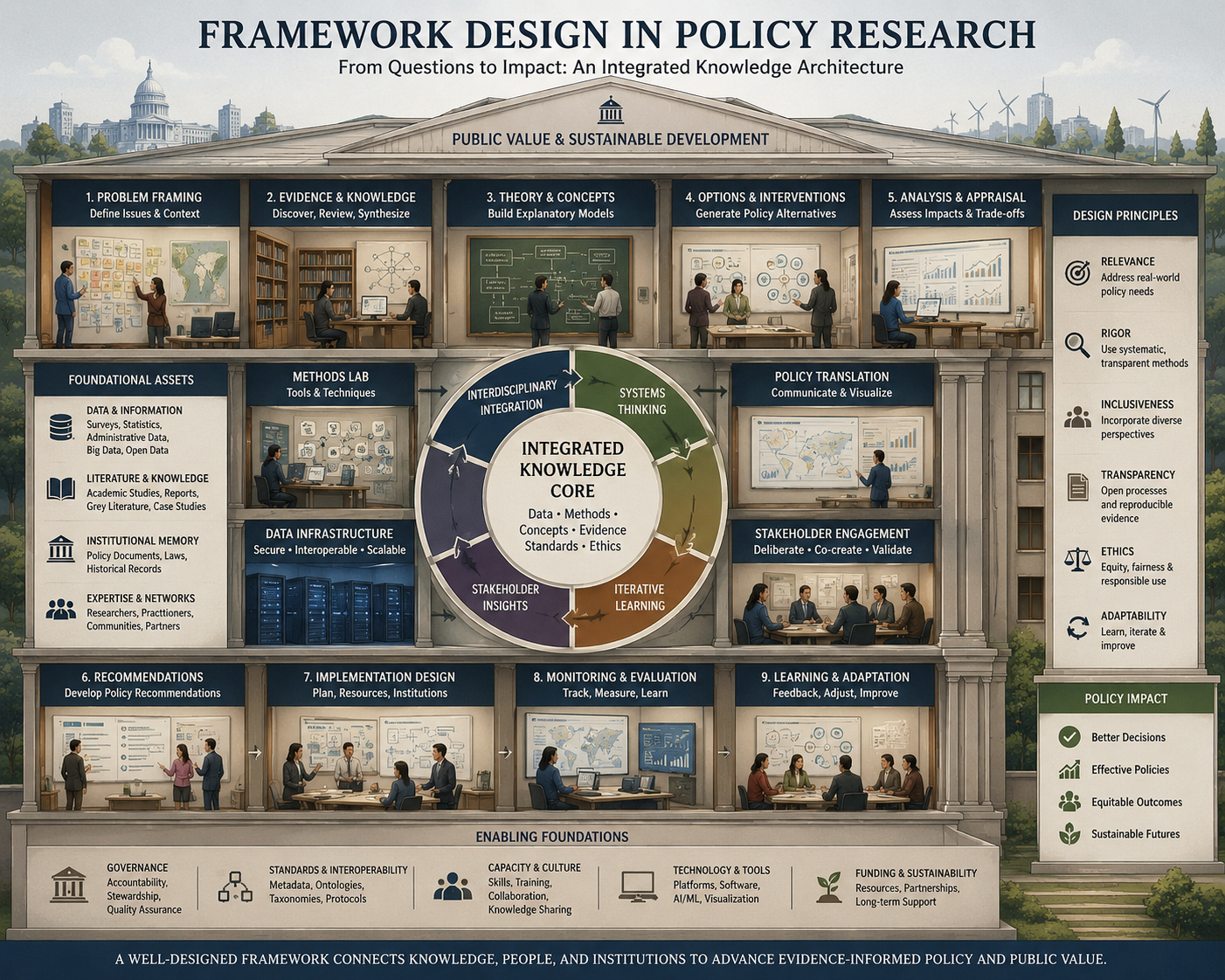
Framework design is not the same as policy advocacy. Advocacy may argue for a preferred option. Framework design creates the structure through which options can be examined. A good framework can support argument, but it should also expose assumptions, uncertainty, missing evidence, affected groups, implementation limits, and possible harms.
PFR = f(P, C, E, A, I, G, V)
\]
Interpretation: A policy research framework \(PFR\) can be understood as a function of the policy problem \(P\), causal assumptions \(C\), evidence \(E\), actors \(A\), institutions \(I\), governance constraints \(G\), and public values \(V\).
The purpose of a policy research framework is not to eliminate judgment. Policy choices always involve values, priorities, constraints, and contestation. The purpose is to make judgment more disciplined by organizing the knowledge environment in which decisions are made.
Why Policy Research Needs Frameworks
Policy research needs frameworks because public problems are complex, contested, and institutionally embedded. A policy issue rarely presents itself as a clean research question. It arrives as a mixture of symptoms, claims, data gaps, stakeholder demands, political pressures, legal constraints, budget limits, administrative routines, historical grievances, and competing definitions of success.
Without a framework, policy research can become a list of evidence fragments: statistics, reports, examples, stakeholder quotes, case studies, cost estimates, program descriptions, and recommendations. These fragments may be useful, but they do not automatically explain how the problem works or how policy should respond. Framework design creates the connective tissue.
Frameworks also help researchers distinguish levels of analysis. A problem may involve individual behavior, household conditions, organizational capacity, institutional rules, market incentives, infrastructure, cultural norms, and national policy. A framework helps identify which level is being analyzed and which intervention level is being proposed.
Policy frameworks also support transparency. They make it easier to ask: What is the problem definition? What causal pathway is assumed? What evidence supports it? Which groups are affected? What options were considered? What trade-offs were accepted? What implementation risks remain? What would count as success? How will learning occur?
| Policy Research Challenge | Framework Function | Risk if Missing |
|---|---|---|
| Problem ambiguity | Defines the problem, scope, and boundaries. | Research answers the wrong question. |
| Causal uncertainty | Maps mechanisms, assumptions, and evidence. | Policy options are disconnected from causes. |
| Evidence plurality | Distinguishes data, evaluation, legal authority, expert judgment, and lived experience. | Different evidence types are treated interchangeably. |
| Institutional complexity | Identifies agencies, authorities, constraints, and implementation capacity. | Recommendations ignore how policy is actually delivered. |
| Trade-offs | Clarifies criteria, values, costs, benefits, and risks. | Policy choices appear technical when they are also normative. |
| Accountability | Links goals, interventions, outcomes, and evaluation. | Policies cannot be reviewed or learned from responsibly. |
Frameworks matter because they help policy research become cumulative. A well-designed framework can be revised, compared, tested, reused, and improved. A poorly structured policy analysis may answer one immediate question but leave little institutional memory behind.
Policy Problems as Structured Knowledge Problems
A policy problem is partly a social problem, partly an institutional problem, and partly a knowledge problem. Before a government, organization, or community can decide what to do, it must decide what kind of problem it is facing. Is homelessness primarily a housing supply issue, income issue, mental health issue, zoning issue, labor-market issue, institutional coordination issue, or rights issue? The answer shapes the evidence collected and the policies considered.
Knowledge architecture is essential because problem definition organizes the entire research process. If the problem is defined too narrowly, important causes disappear. If it is defined too broadly, research becomes unmanageable. If it is defined only through administrative data, lived experience may be excluded. If it is defined only through political narratives, causal analysis may weaken.
Policy problems also involve categories. Who is counted? What counts as harm? What counts as success? What time horizon matters? Which jurisdiction is responsible? Which population is visible? Which evidence is considered authoritative? Framework design makes these categories explicit.
| Knowledge Question | Policy Research Role | Framework Design Response |
|---|---|---|
| What is the problem? | Defines scope and interpretation. | Problem statement, boundary conditions, and affected populations. |
| What causes it? | Identifies mechanisms and intervention points. | Causal map, theory of change, and evidence links. |
| Who is affected? | Establishes distributional and equity context. | Stakeholder map, vulnerability assessment, and justice indicators. |
| Who can act? | Clarifies institutional authority and capacity. | Agency map, legal authority, and implementation pathway. |
| What options exist? | Structures policy comparison. | Option matrix, cost-benefit logic, feasibility analysis, and risk review. |
| How will learning occur? | Supports monitoring, evaluation, and revision. | Results framework, indicators, feedback loops, and evaluation plan. |
When policy problems are treated as structured knowledge problems, framework design becomes a form of public reasoning. It helps turn scattered claims into an inspectable architecture of inquiry.
Problem Definition and Policy Framing
Problem definition is the foundation of policy framework design. Every framework begins by deciding what counts as the problem, what lies inside the scope of analysis, what lies outside, and how the problem should be interpreted. These choices are never neutral. They shape evidence selection, policy options, institutional responsibility, and public accountability.
Policy framing determines whether a situation is seen as a market failure, public health concern, civil rights issue, environmental risk, infrastructure problem, institutional coordination failure, behavioral issue, security problem, or social justice issue. Different frames may reveal different truths. They may also hide different harms.
A strong policy framework should not hide framing decisions. It should document them. It should identify competing frames, explain why one frame is used, and show how alternative frames might change the analysis. This is especially important when affected communities, marginalized groups, or frontline practitioners understand the problem differently from official institutions.
| Frame Type | Typical Focus | Possible Blind Spot |
|---|---|---|
| Economic frame | Costs, incentives, efficiency, market failure, productivity. | May understate rights, power, care, or historical harm. |
| Public health frame | Population risk, prevention, exposure, morbidity, mortality. | May understate law, political agency, or institutional accountability. |
| Governance frame | Institutions, rules, coordination, implementation, legitimacy. | May understate lived experience or structural inequality. |
| Rights frame | Legal entitlements, procedural guarantees, dignity, accountability. | May understate resource constraints or implementation capacity. |
| Behavioral frame | Decision-making, incentives, defaults, norms, compliance. | May individualize problems rooted in structural conditions. |
| Justice frame | Distribution, recognition, participation, history, power. | May require complex institutional and political analysis. |
PolicyFrame = f(ProblemDefinition, CausalStory, Values, Institutions, Audience)
\]
Interpretation: A policy frame is shaped by problem definition, causal story, values, institutional context, and audience. Framework design should make these framing choices visible.
Good policy research does not pretend that framing can be avoided. It makes framing explicit enough to be debated and revised.
Causal Pathways, Mechanisms, and Theory of Change
Policy frameworks need causal structure. A policy recommendation is only as strong as the causal pathway connecting intervention to outcome. If a city funds rental assistance, what mechanism is expected to reduce homelessness? If a government changes school funding, how is learning expected to improve? If a public health agency launches a vaccination campaign, what barriers must change? If a climate adaptation program funds green infrastructure, what pathway connects investment to reduced heat exposure?
A theory of change makes this logic explicit. It connects inputs, activities, outputs, outcomes, impacts, assumptions, risks, and external conditions. A logic model provides a similar structure, often with a simpler program-management orientation. A results framework adds indicators and monitoring structures. A causal map may show more complex feedbacks and interactions.
Framework design should distinguish causal assumptions from evidence. A framework may assume that financial incentives change behavior, that coordination improves service delivery, that information changes risk perception, or that regulation reduces harm. Each assumption should be testable or at least inspectable.
| Causal Element | Policy Framework Role | Review Question |
|---|---|---|
| Input | Resources committed to the policy. | Are funding, staff, authority, and data sufficient? |
| Activity | Actions taken by implementing actors. | Are activities feasible within institutional capacity? |
| Output | Direct products of implementation. | Are outputs measurable and linked to intended outcomes? |
| Outcome | Short- or medium-term change. | Is there evidence that outputs can plausibly produce outcomes? |
| Impact | Long-term social, economic, environmental, or institutional change. | Can impact be attributed, contributed to, or reasonably assessed? |
| Assumption | Condition required for the causal pathway to hold. | Is the assumption documented and testable? |
| Risk | Condition that could weaken or reverse expected change. | Are implementation, equity, political, and unintended-effect risks included? |
Outcome = f(Intervention, Mechanism, Context, Implementation, Time)
\]
Interpretation: Policy outcomes depend not only on the intervention itself, but on mechanisms, context, implementation quality, and time horizon.
Strong causal frameworks support evaluation because they clarify what should be measured and why. They also support learning because they show where failure may occur: the problem diagnosis, intervention design, implementation process, institutional context, or theory of change.
Evidence Architecture for Policy Research
Evidence architecture is the structured organization of the evidence used in policy research. It distinguishes evidence types, methods, sources, quality, uncertainty, relevance, and limits. This matters because policy research uses many forms of evidence: administrative data, surveys, experiments, quasi-experimental studies, qualitative interviews, legal analysis, budget data, implementation records, historical evidence, expert judgment, stakeholder testimony, and community experience.
Not all evidence answers the same question. Randomized trials may estimate causal effects under specific conditions. Administrative data may reveal patterns but not lived experience. Legal analysis may clarify authority but not implementation feasibility. Community knowledge may reveal harms that official data does not capture. Cost-benefit analysis may organize economic trade-offs but may not capture dignity, rights, or historical injustice.
A policy framework should therefore include evidence metadata. What question does the evidence answer? What method produced it? What population does it cover? What time period? What uncertainty? What limitations? What assumptions? What values does it omit? What groups are underrepresented?
| Evidence Type | Policy Research Use | Metadata Needed |
|---|---|---|
| Administrative data | Measures program use, service delivery, compliance, or outcomes. | Coverage, definitions, missingness, collection process, bias risk. |
| Experimental or quasi-experimental study | Estimates causal effects. | Design, comparison group, external validity, implementation context. |
| Survey data | Measures attitudes, conditions, needs, or experiences. | Sampling, questionnaire design, response bias, population coverage. |
| Qualitative research | Explains mechanisms, meaning, implementation, and lived experience. | Method, sampling logic, context, coding, interpretation limits. |
| Legal analysis | Clarifies authority, rights, obligations, and constraints. | Jurisdiction, source authority, doctrine, date, interpretation. |
| Budget and fiscal data | Evaluates affordability, allocation, and sustainability. | Baseline, assumptions, time horizon, distribution, sensitivity. |
| Community knowledge | Documents lived experience, local expertise, and affected-group priorities. | Consent, attribution, governance, context, access restrictions. |
Evidence architecture protects policy research from false precision. It helps users see when evidence is strong, when it is incomplete, when it is context-specific, and when policy judgment goes beyond available evidence.
Stakeholders, Institutions, and Governance Context
Policy frameworks must include stakeholders and institutions because policy does not operate in an empty space. Agencies, legislatures, courts, local governments, service providers, firms, unions, civil society groups, affected communities, professional associations, and funders all shape what policies can be designed, implemented, resisted, monitored, or revised.
Stakeholder analysis identifies who is affected, who has authority, who has expertise, who has resources, who bears costs, who benefits, and who can block or enable change. Institutional analysis identifies rules, mandates, capacity, jurisdiction, funding streams, accountability mechanisms, and implementation routines.
Framework design should avoid treating stakeholders as a public-relations category. Stakeholders are part of the policy knowledge system. Affected communities may identify problem definitions that official data misses. Frontline workers may understand implementation constraints. Local governments may reveal capacity limits. Advocacy groups may surface legal or ethical concerns. Researchers may clarify evidence and uncertainty.
| Actor Type | Policy Research Role | Framework Question |
|---|---|---|
| Affected communities | Experience harms, benefits, exclusions, and implementation effects. | Are they included in problem definition and evaluation criteria? |
| Implementing agencies | Deliver programs and enforce rules. | Do they have authority, capacity, and resources? |
| Legislatures and executives | Authorize, fund, and oversee policy. | What political and legal constraints shape options? |
| Courts and legal institutions | Interpret rights, limits, and obligations. | What legal risks and protections matter? |
| Service providers | Translate policy into practice. | What operational barriers affect implementation? |
| Researchers and evaluators | Generate and interpret evidence. | What evidence is available, credible, and relevant? |
| Public and media | Shape legitimacy, understanding, and accountability. | How will the policy be explained and contested? |
Policy framework design should preserve institutional context because the same intervention can succeed or fail depending on administrative capacity, trust, legitimacy, law, funding, and local conditions.
Criteria, Trade-offs, and Decision Logic
Policy research is not only about identifying what works. It is also about deciding what matters. Policy options can be evaluated according to effectiveness, equity, cost, feasibility, legality, administrative burden, political acceptability, sustainability, resilience, public legitimacy, rights protection, and unintended consequences. Framework design makes these criteria explicit.
Trade-offs are unavoidable. A policy may be effective but expensive. Efficient but inequitable. Legally strong but politically difficult. Popular but poorly targeted. Fast to implement but weak in long-term capacity. Technically sound but publicly mistrusted. A framework should not hide these trade-offs behind a single score unless the weighting logic is transparent.
Decision matrices can help compare options, but they must be used carefully. The choice of criteria, weights, and scoring rules reflects values. A framework should show who defined the criteria, whose priorities they represent, and how uncertainty affects rankings.
| Decision Criterion | Policy Question | Possible Evidence |
|---|---|---|
| Effectiveness | Is the option likely to improve the target outcome? | Evaluation evidence, causal studies, implementation records. |
| Equity | Who benefits, who bears costs, and who may be excluded? | Distributional analysis, demographic data, community input. |
| Feasibility | Can the option be implemented with available capacity? | Administrative review, staffing, legal authority, institutional readiness. |
| Cost and fiscal sustainability | Can the policy be funded and maintained? | Budget estimates, cost-effectiveness, sensitivity analysis. |
| Legality | Is the policy authorized and rights-compliant? | Statutory analysis, constitutional review, regulatory authority. |
| Public legitimacy | Can the policy be justified and trusted? | Public consultation, transparency, procedural fairness, communication review. |
| Risk and resilience | What could fail, and how adaptable is the policy? | Risk assessment, scenario analysis, contingency planning. |
PolicyScore_i = \sum_{j=1}^{n} w_j c_{ij}
\]
Interpretation: A policy option \(i\) can be scored across criteria \(c_{ij}\) with weights \(w_j\), but the weights reflect value judgments and should be transparent, reviewable, and contestable.
Good framework design does not pretend that a scoring model eliminates politics. It uses structured comparison to clarify where evidence ends and public judgment begins.
Implementation, Learning, and Evaluation Design
A policy framework is incomplete if it stops at recommendation. Policies are implemented through institutions, budgets, staff, rules, contracts, infrastructure, technology systems, communication, training, enforcement, and feedback. Implementation design asks how policy moves from decision to practice.
Evaluation design asks how policy will be assessed. Evaluation may examine design, implementation, outputs, outcomes, impact, cost-effectiveness, equity effects, unintended consequences, and learning. A framework should identify what will be measured, why it matters, how data will be collected, how results will be interpreted, and how findings will feed back into policy revision.
Policy learning matters because public problems change. A program may work in one context but fail in another. Initial implementation may reveal barriers. Stakeholders may identify harms. Data may show uneven effects. New legal or economic conditions may alter feasibility. A good framework includes feedback loops.
| Evaluation Focus | Core Question | Framework Requirement |
|---|---|---|
| Design evaluation | Is the policy theory coherent and evidence-informed? | Problem definition, causal pathway, assumptions, evidence map. |
| Process evaluation | Was the policy implemented as intended? | Implementation milestones, delivery records, stakeholder feedback. |
| Outcome evaluation | Did intended outcomes change? | Indicators, baseline, comparison logic, measurement plan. |
| Impact evaluation | Can change be attributed or credibly linked to the policy? | Evaluation design, counterfactual logic, causal assumptions. |
| Equity evaluation | Were effects distributed fairly? | Disaggregated data, affected-group input, justice criteria. |
| Economic evaluation | Were benefits justified relative to costs? | Cost data, benefit assumptions, sensitivity analysis, distributional effects. |
| Learning evaluation | What should be adapted? | Feedback loops, revision triggers, governance review. |
Learning_t = f(Data_t, Feedback_t, Evaluation_t, Governance_t)
\]
Interpretation: Policy learning at time \(t\) depends on data, feedback, evaluation, and governance. Learning requires structures that connect evidence to revision.
A strong policy framework therefore includes monitoring, evaluation, and learning from the beginning. Evaluation should not be an afterthought added after implementation has already obscured the theory of change.
Equity, Power, and Public Accountability
Framework design in policy research must account for equity and power because policies distribute benefits, burdens, voice, recognition, and risk. A framework that ignores power may appear neutral while reinforcing existing inequality. A framework that ignores equity may optimize average outcomes while worsening conditions for vulnerable groups.
Equity analysis should be built into the framework, not added as a final paragraph. It should appear in problem definition, evidence review, stakeholder analysis, option comparison, implementation design, evaluation criteria, and revision governance. This includes distributional effects, procedural fairness, recognition of affected groups, historical context, legal rights, and public accountability.
Power also shapes evidence. Some groups are more visible in administrative data. Some have more capacity to participate in consultation. Some are described by institutions rather than through their own terms. Some harms are undercounted because they occur outside official categories. Framework design should document these limitations.
| Equity Dimension | Framework Question | Policy Research Risk if Ignored |
|---|---|---|
| Distribution | Who receives benefits and who bears costs? | Average improvements hide unequal burdens. |
| Recognition | Whose experiences and identities are acknowledged? | Affected groups are misnamed, generalized, or omitted. |
| Procedure | Who participates in defining the problem and judging options? | Policy appears evidence-based but lacks legitimacy. |
| Historical context | How did past policy create present conditions? | Structural harms are treated as individual deficits. |
| Rights and dignity | What legal or moral claims constrain policy choice? | Efficiency is pursued at the expense of basic protections. |
| Accountability | Who can challenge, revise, or appeal policy decisions? | Implementation harms remain invisible or uncorrected. |
Policy frameworks should make public reasoning more accountable. They should help people see not only what option is recommended, but whose knowledge shaped the recommendation and whose interests may be affected by it.
Metadata, Taxonomies, and Policy Knowledge Graphs
Policy research frameworks can be strengthened by metadata, taxonomies, ontologies, and knowledge graphs. Metadata preserves context about problems, evidence, actors, institutions, options, criteria, assumptions, and evaluation status. Taxonomies classify policy domains and problem types. Ontologies define entities and relationship types. Knowledge graphs connect specific policy objects through typed relationships.
A policy knowledge graph might connect a policy problem to affected populations, causal mechanisms, evidence sources, policy options, implementing agencies, legal authorities, budget lines, evaluation indicators, and outcomes. This makes the framework inspectable and reusable.
Semantic structure is especially useful when policy research spans domains. A climate adaptation framework may connect environmental data, infrastructure inventories, public health outcomes, housing conditions, emergency management institutions, budget programs, and community vulnerability. A knowledge graph can preserve these relationships more explicitly than a flat report.
| Knowledge-Architecture Tool | Policy Research Function | Example |
|---|---|---|
| Metadata schema | Preserves context for policy objects. | Problem type, jurisdiction, evidence type, affected group, review status. |
| Taxonomy | Organizes policy domains and problem categories. | Housing, health, environment, education, labor, governance. |
| Ontology | Defines entities and relationship types. | PolicyProblem, EvidenceSource, Option, Institution, Indicator. |
| Knowledge graph | Connects policy objects through typed relationships. | PolicyOption → affects → PopulationGroup. |
| Evidence map | Links claims to sources and methods. | Problem diagnosis → evidence source → uncertainty note. |
| Governance record | Tracks review, revision, accountability, and status. | Framework version, reviewer, update date, contested assumptions. |
These structures help policy research move from one-off documents toward durable institutional memory. They allow future researchers and decision-makers to understand how a policy analysis was built, what it assumed, and where it needs revision.
AI-Assisted Policy Research Frameworks
AI-assisted tools can help policy researchers search literature, summarize reports, classify policy documents, extract entities, identify stakeholders, compare options, generate draft evidence maps, and detect missing assumptions. But AI can also flatten context, overstate certainty, reproduce bias, and produce policy-sounding synthesis without adequate grounding.
AI-assisted policy research therefore requires strong framework design. The framework should define the problem, evidence types, jurisdiction, affected populations, legal context, source hierarchy, uncertainty, and review status before AI-generated material is trusted. AI should not silently decide which evidence is authoritative, which stakeholders matter, or which trade-offs are acceptable.
A well-structured policy knowledge architecture can make AI more useful by giving retrieval systems metadata and relationship context. For example, an AI system can distinguish evaluation evidence from advocacy claims, statute from commentary, local data from national data, proposed policy from enacted policy, and synthetic examples from empirical findings.
AI_{Policy} = f(Text, M, E, C, J, P, G)
\]
Interpretation: AI-assisted policy research \(AI_{Policy}\) depends on text, metadata \(M\), evidence context \(E\), causal structure \(C\), jurisdiction \(J\), provenance \(P\), and governance \(G\).
AI should be treated as an assistant within governed policy research, not as a substitute for public reasoning. Framework design provides the structure that allows AI outputs to be checked, constrained, and revised.
Mathematical and Computational Modeling
Policy frameworks can be modeled as structured systems of problems, actors, evidence, options, criteria, outcomes, and governance records. Computational modeling can help audit whether a framework includes problem definition, evidence coverage, stakeholder representation, equity context, causal traceability, option comparison, and evaluation logic.
PF = (P, A, E, O, C, R, G)
\]
Interpretation: A policy framework \(PF\) can be represented as policy problems \(P\), actors \(A\), evidence \(E\), options \(O\), criteria \(C\), relationships \(R\), and governance records \(G\).
EvidenceCoverage = \frac{|Q_E|}{|Q|}
\]
Interpretation: Evidence coverage measures the share of framework questions \(Q\) that have relevant evidence \(Q_E\). Low coverage indicates unsupported reasoning or major knowledge gaps.
EquityCoverage = \frac{|O_{EQ}|}{|O|}
\]
Interpretation: Equity coverage measures the share of policy options \(O\) with documented equity analysis \(O_{EQ}\), including distributional, procedural, recognition, or rights-based considerations.
Traceability = \frac{|R_P|}{|R|}
\]
Interpretation: Traceability measures the share of relationships \(R\) with provenance \(R_P\). In policy research, traceability helps show why evidence, options, criteria, and outcomes are linked.
These metrics should guide review, not replace judgment. A framework can have high evidence coverage but weak problem framing. It can include equity fields but still ignore power. It can score options numerically while hiding value judgments. Computational diagnostics are useful only when paired with substantive policy reasoning and public accountability.
Python Section: Auditing a Policy Research Framework
The following Python example models a small policy research framework and audits evidence coverage, stakeholder coverage, equity coverage, relationship traceability, and review needs.
# policy_research_framework_audit.py
# Lightweight audit for framework design in policy research.

from pathlib import Path
import csv
from collections import Counter, defaultdict

ROOT = Path(".")
OUTPUTS = ROOT / "outputs"
OUTPUTS.mkdir(exist_ok=True)

objects = [
    {"id": "problem_housing_instability", "label": "Housing Instability", "type": "policy_problem", "metadata": True, "equity": True},
    {"id": "evidence_admin_data", "label": "Administrative Housing Data", "type": "evidence", "metadata": True, "equity": False},
    {"id": "evidence_community_input", "label": "Community Testimony", "type": "evidence", "metadata": True, "equity": True},
    {"id": "option_rental_assistance", "label": "Rental Assistance", "type": "policy_option", "metadata": True, "equity": True},
    {"id": "option_zoning_reform", "label": "Zoning Reform", "type": "policy_option", "metadata": True, "equity": False},
    {"id": "institution_city_agency", "label": "City Housing Agency", "type": "institution", "metadata": True, "equity": False},
    {"id": "indicator_eviction_rate", "label": "Eviction Rate", "type": "indicator", "metadata": True, "equity": True},
    {"id": "evaluation_plan", "label": "Evaluation Plan", "type": "evaluation", "metadata": False, "equity": True},
    {"id": "governance_record", "label": "Framework Review Record", "type": "governance_record", "metadata": True, "equity": True}
]

relationships = [
    {"source": "problem_housing_instability", "target": "evidence_admin_data", "type": "supportedByEvidence", "provenance": "data_inventory"},
    {"source": "problem_housing_instability", "target": "evidence_community_input", "type": "informedByCommunityKnowledge", "provenance": "consultation_notes"},
    {"source": "option_rental_assistance", "target": "problem_housing_instability", "type": "respondsToProblem", "provenance": "theory_of_change"},
    {"source": "option_zoning_reform", "target": "problem_housing_instability", "type": "respondsToProblem", "provenance": "policy_analysis"},
    {"source": "institution_city_agency", "target": "option_rental_assistance", "type": "implementsOption", "provenance": "agency_authority"},
    {"source": "indicator_eviction_rate", "target": "evaluation_plan", "type": "measuresOutcomeFor", "provenance": "evaluation_design"},
    {"source": "evaluation_plan", "target": "option_rental_assistance", "type": "evaluatesOption", "provenance": "results_framework"},
    {"source": "governance_record", "target": "evaluation_plan", "type": "governsReviewOf", "provenance": "review_protocol"},
    {"source": "option_zoning_reform", "target": "option_rental_assistance", "type": "related", "provenance": ""}
]

degree = defaultdict(int)
relationship_types = Counter()
traceable = 0
underspecified = 0

for rel in relationships:
    degree[rel["source"]] += 1
    degree[rel["target"]] += 1
    relationship_types[rel["type"]] += 1
    if rel["provenance"].strip():
        traceable += 1
    if rel["type"] in {"related", "sameAs", ""}:
        underspecified += 1

object_rows = []
for obj in objects:
    row = {
        "id": obj["id"],
        "label": obj["label"],
        "type": obj["type"],
        "has_metadata": obj["metadata"],
        "has_equity_context": obj["equity"],
        "degree": degree[obj["id"]],
        "is_orphan": degree[obj["id"]] == 0,
        "needs_review": not obj["metadata"] or degree[obj["id"]] == 0
    }
    object_rows.append(row)

with (OUTPUTS / "policy_framework_object_diagnostics.csv").open("w", newline="", encoding="utf-8") as f:
    writer = csv.DictWriter(
        f,
        fieldnames=["id", "label", "type", "has_metadata", "has_equity_context", "degree", "is_orphan", "needs_review"]
    )
    writer.writeheader()
    writer.writerows(object_rows)

with (OUTPUTS / "policy_framework_relationships.csv").open("w", newline="", encoding="utf-8") as f:
    writer = csv.DictWriter(f, fieldnames=["source", "target", "type", "provenance"])
    writer.writeheader()
    writer.writerows(relationships)

with (OUTPUTS / "policy_framework_relationship_type_summary.csv").open("w", newline="", encoding="utf-8") as f:
    writer = csv.writer(f)
    writer.writerow(["relationship_type", "count"])
    for rel_type, count in relationship_types.items():
        writer.writerow([rel_type, count])

object_type_counts = Counter(obj["type"] for obj in objects)
with (OUTPUTS / "policy_framework_object_type_summary.csv").open("w", newline="", encoding="utf-8") as f:
    writer = csv.writer(f)
    writer.writerow(["object_type", "count"])
    for object_type, count in object_type_counts.items():
        writer.writerow([object_type, count])

summary = {
    "object_count": len(objects),
    "relationship_count": len(relationships),
    "metadata_coverage": round(sum(obj["metadata"] for obj in objects) / len(objects), 3),
    "equity_context_coverage": round(sum(obj["equity"] for obj in objects) / len(objects), 3),
    "relationship_traceability": round(traceable / len(relationships), 3),
    "underspecified_relationship_risk": round(underspecified / len(relationships), 3),
    "orphan_count": sum(row["is_orphan"] for row in object_rows),
    "review_needed_count": sum(row["needs_review"] for row in object_rows),
    "relationship_type_count": len(relationship_types)
}

with (OUTPUTS / "policy_framework_summary.csv").open("w", newline="", encoding="utf-8") as f:
    writer = csv.writer(f)
    writer.writerow(["metric", "value"])
    for key, value in summary.items():
        writer.writerow([key, value])

print("Wrote policy framework diagnostics to outputs/")
This example can be extended to real policy research frameworks, program logic models, results frameworks, stakeholder maps, policy option matrices, evaluation plans, and evidence inventories. Its purpose is to make framework completeness and reasoning traceability visible enough for review.
R Section: Policy Framework Coverage and Trade-off Diagnostics
The following R example summarizes object types, metadata coverage, equity context, relationship traceability, and review needs for a simplified policy research framework.
# policy_research_framework_diagnostics.R
# Lightweight policy framework coverage and trade-off diagnostics.

objects <- data.frame(
  id = c(
    "problem_housing_instability",
    "evidence_admin_data",
    "evidence_community_input",
    "option_rental_assistance",
    "option_zoning_reform",
    "institution_city_agency",
    "indicator_eviction_rate",
    "evaluation_plan",
    "governance_record"
  ),
  label = c(
    "Housing Instability",
    "Administrative Housing Data",
    "Community Testimony",
    "Rental Assistance",
    "Zoning Reform",
    "City Housing Agency",
    "Eviction Rate",
    "Evaluation Plan",
    "Framework Review Record"
  ),
  type = c(
    "policy_problem",
    "evidence",
    "evidence",
    "policy_option",
    "policy_option",
    "institution",
    "indicator",
    "evaluation",
    "governance_record"
  ),
  has_metadata = c(TRUE, TRUE, TRUE, TRUE, TRUE, TRUE, TRUE, FALSE, TRUE),
  has_equity_context = c(TRUE, FALSE, TRUE, TRUE, FALSE, FALSE, TRUE, TRUE, TRUE)
)

relationships <- data.frame(
  source = c(
    "problem_housing_instability",
    "problem_housing_instability",
    "option_rental_assistance",
    "option_zoning_reform",
    "institution_city_agency",
    "indicator_eviction_rate",
    "evaluation_plan",
    "governance_record",
    "option_zoning_reform"
  ),
  target = c(
    "evidence_admin_data",
    "evidence_community_input",
    "problem_housing_instability",
    "problem_housing_instability",
    "option_rental_assistance",
    "evaluation_plan",
    "option_rental_assistance",
    "evaluation_plan",
    "option_rental_assistance"
  ),
  relationship_type = c(
    "supportedByEvidence",
    "informedByCommunityKnowledge",
    "respondsToProblem",
    "respondsToProblem",
    "implementsOption",
    "measuresOutcomeFor",
    "evaluatesOption",
    "governsReviewOf",
    "related"
  ),
  has_provenance = c(TRUE, TRUE, TRUE, TRUE, TRUE, TRUE, TRUE, TRUE, FALSE)
)

dir.create("outputs", showWarnings = FALSE)

object_type_summary <- as.data.frame(table(objects$type))
names(object_type_summary) <- c("object_type", "count")

relationship_type_summary <- as.data.frame(table(relationships$relationship_type))
names(relationship_type_summary) <- c("relationship_type", "count")

relationship_ids <- c(relationships$source, relationships$target)

degree_table <- data.frame(
  id = objects$id,
  label = objects$label,
  type = objects$type,
  has_metadata = objects$has_metadata,
  has_equity_context = objects$has_equity_context,
  degree = sapply(objects$id, function(x) sum(relationship_ids == x))
)

degree_table$is_orphan <- degree_table$degree == 0
degree_table$needs_review <- !degree_table$has_metadata | degree_table$is_orphan

coverage_summary <- data.frame(
  object_count = nrow(objects),
  relationship_count = nrow(relationships),
  metadata_coverage = mean(objects$has_metadata),
  equity_context_coverage = mean(objects$has_equity_context),
  relationship_traceability = mean(relationships$has_provenance),
  underspecified_relationship_risk = mean(relationships$relationship_type %in% c("related", "sameAs", "")),
  orphan_count = sum(degree_table$is_orphan),
  review_needed_count = sum(degree_table$needs_review)
)

write.csv(object_type_summary, "outputs/policy_framework_object_type_summary.csv", row.names = FALSE)
write.csv(relationship_type_summary, "outputs/policy_framework_relationship_type_summary.csv", row.names = FALSE)
write.csv(degree_table, "outputs/policy_framework_degree_table.csv", row.names = FALSE)
write.csv(coverage_summary, "outputs/policy_framework_coverage_summary.csv", row.names = FALSE)

print(object_type_summary)
print(relationship_type_summary)
print(coverage_summary)
R is useful for policy framework diagnostics because it can quickly summarize evidence distribution, object coverage, relationship quality, and review needs. In a larger policy platform, these diagnostics can support framework maintenance, evaluation planning, and institutional learning.
SQL Section: Policy Research Framework Schema
SQL can support policy framework design by storing policy problems, evidence sources, stakeholders, institutions, options, criteria, indicators, relationships, evaluation plans, and governance records. A relational schema can serve as a practical registry even when graph databases or semantic-web systems are added later.
-- policy_research_framework_schema.sql
-- Minimal schema for framework design in policy research.

CREATE TABLE IF NOT EXISTS policy_problems (
  problem_id TEXT PRIMARY KEY,
  title TEXT NOT NULL,
  problem_statement TEXT,
  jurisdiction TEXT,
  affected_population TEXT,
  scope_note TEXT,
  status TEXT DEFAULT 'active',
  last_reviewed DATE
);

CREATE TABLE IF NOT EXISTS evidence_sources (
  evidence_id TEXT PRIMARY KEY,
  title TEXT NOT NULL,
  evidence_type TEXT NOT NULL,
  method_note TEXT,
  source_url TEXT,
  quality_note TEXT,
  uncertainty_note TEXT,
  equity_note TEXT,
  status TEXT DEFAULT 'active'
);

CREATE TABLE IF NOT EXISTS stakeholders (
  stakeholder_id TEXT PRIMARY KEY,
  name TEXT NOT NULL,
  stakeholder_type TEXT,
  role_note TEXT,
  affected_status TEXT,
  authority_level TEXT,
  participation_status TEXT
);

CREATE TABLE IF NOT EXISTS institutions (
  institution_id TEXT PRIMARY KEY,
  name TEXT NOT NULL,
  institution_type TEXT,
  jurisdiction TEXT,
  authority_note TEXT,
  capacity_note TEXT,
  accountability_note TEXT
);

CREATE TABLE IF NOT EXISTS policy_options (
  option_id TEXT PRIMARY KEY,
  title TEXT NOT NULL,
  problem_id TEXT,
  intervention_type TEXT,
  theory_of_change TEXT,
  implementation_note TEXT,
  risk_note TEXT,
  equity_note TEXT,
  status TEXT DEFAULT 'proposed',
  FOREIGN KEY (problem_id) REFERENCES policy_problems(problem_id)
);

CREATE TABLE IF NOT EXISTS decision_criteria (
  criterion_id TEXT PRIMARY KEY,
  label TEXT NOT NULL,
  definition TEXT,
  criterion_type TEXT,
  weight REAL,
  value_note TEXT
);

CREATE TABLE IF NOT EXISTS option_scores (
  option_id TEXT NOT NULL,
  criterion_id TEXT NOT NULL,
  score REAL,
  score_note TEXT,
  evidence_id TEXT,
  PRIMARY KEY (option_id, criterion_id),
  FOREIGN KEY (option_id) REFERENCES policy_options(option_id),
  FOREIGN KEY (criterion_id) REFERENCES decision_criteria(criterion_id),
  FOREIGN KEY (evidence_id) REFERENCES evidence_sources(evidence_id)
);

CREATE TABLE IF NOT EXISTS indicators (
  indicator_id TEXT PRIMARY KEY,
  label TEXT NOT NULL,
  definition TEXT,
  unit TEXT,
  baseline_value REAL,
  target_value REAL,
  data_source TEXT,
  disaggregation_note TEXT,
  limitation_note TEXT
);

CREATE TABLE IF NOT EXISTS framework_relationship_types (
  relationship_type_id TEXT PRIMARY KEY,
  label TEXT NOT NULL,
  definition TEXT,
  status TEXT DEFAULT 'active'
);

CREATE TABLE IF NOT EXISTS framework_relationships (
  relationship_id INTEGER PRIMARY KEY,
  source_object_id TEXT NOT NULL,
  relationship_type_id TEXT NOT NULL,
  target_object_id TEXT NOT NULL,
  provenance_note TEXT,
  uncertainty_note TEXT,
  review_status TEXT DEFAULT 'provisional'
);

CREATE TABLE IF NOT EXISTS evaluation_plans (
  evaluation_id TEXT PRIMARY KEY,
  option_id TEXT,
  evaluation_type TEXT,
  evaluation_question TEXT,
  design_note TEXT,
  indicator_id TEXT,
  learning_use TEXT,
  review_date DATE,
  FOREIGN KEY (option_id) REFERENCES policy_options(option_id),
  FOREIGN KEY (indicator_id) REFERENCES indicators(indicator_id)
);

CREATE TABLE IF NOT EXISTS governance_records (
  governance_id TEXT PRIMARY KEY,
  object_type TEXT NOT NULL,
  object_id TEXT NOT NULL,
  governance_type TEXT,
  review_status TEXT,
  review_note TEXT,
  reviewed_at DATE
);
This schema separates problems, evidence, stakeholders, institutions, options, criteria, indicators, relationships, evaluations, and governance records. That separation matters because a policy option is not the same as evidence, a criterion is not the same as a value, an institution is not the same as a stakeholder, and a recommendation is not valid unless its assumptions and evidence links can be inspected.
GitHub Repository
This article is supported by a companion repository folder with reproducible examples, small synthetic datasets, documentation, and language-specific modeling scaffolds for policy research framework design.
Complete Code Repository
This folder contains companion research and code assets for the Framework Design in Policy Research article, including Python, R, Julia, SQL, Rust, Go, C++, Fortran, C, documentation, data, and generated outputs.
The repository structure mirrors the article’s policy-framework argument. Python supports object, evidence, equity, relationship, and traceability diagnostics. R supports coverage summaries and framework review. SQL supports policy problems, evidence sources, stakeholders, institutions, options, criteria, indicators, relationships, evaluation plans, and governance records. Systems-language folders provide space for validation utilities, graph-processing experiments, and reproducible tooling. Documentation, data, and outputs preserve the relationship between policy reasoning, computational review, and institutional learning.
Quality Criteria for Policy Framework Design
A strong policy research framework should be clear, causal, evidence-aware, institutionally grounded, equity-aware, transparent about trade-offs, evaluable, and revisable. It should support decision-making without pretending that evidence alone resolves public value conflicts.
| Quality Criterion | Evaluation Question | Warning Sign |
|---|---|---|
| Problem clarity | Is the problem defined with scope, affected populations, and context? | The framework begins with a solution rather than a diagnosis. |
| Causal logic | Are mechanisms, assumptions, and pathways explicit? | Recommendations are not connected to problem causes. |
| Evidence awareness | Are evidence types, quality, uncertainty, and relevance documented? | All sources are treated as equally authoritative. |
| Institutional realism | Are authority, capacity, budgets, and implementation conditions included? | The framework assumes policy can be implemented by declaration. |
| Equity and justice | Are distribution, recognition, participation, rights, and history considered? | Average outcomes hide unequal burdens. |
| Trade-off transparency | Are criteria, weights, and value judgments visible? | Scoring appears objective while hiding normative choices. |
| Evaluation readiness | Are indicators, baselines, outcomes, and learning pathways defined? | The framework cannot be evaluated after implementation. |
| Governance and revision | Can assumptions, evidence, and recommendations be reviewed over time? | The framework becomes static institutional memory. |
Framework quality depends on the whole structure. A framework can have strong data but weak values analysis. It can have a compelling theory of change but poor implementation realism. It can have excellent evaluation metrics but ignore affected communities. Framework design requires the full architecture to hold together.
Interpretive Cautions and Ethical Limits
Policy frameworks can clarify public reasoning, but they can also create false authority. A polished framework may make assumptions appear settled. A scoring matrix may make value judgments appear technical. A results framework may make measurable outcomes appear more important than unmeasured harms. A cost-benefit model may make distributional injustice appear secondary.
Frameworks also reflect institutional power. The actor who defines the problem often shapes the solution space. The actor who chooses criteria often shapes the decision. The actor who controls data often shapes what becomes visible. A framework can discipline analysis, but it can also narrow democratic debate if used without transparency.
Policy researchers should be especially cautious when frameworks concern vulnerable populations, rights, policing, migration, housing, health, welfare, education, surveillance, environmental justice, or Indigenous and community-governed knowledge. Some knowledge should not be extracted or exposed simply because it would improve analysis. Some policy questions require consent, participation, legal protection, and public accountability.
AI-assisted framework design adds another caution. AI systems may generate plausible policy logic without understanding jurisdiction, authority, rights, implementation capacity, local context, or lived experience. AI-generated framework components should be treated as draft material requiring review, not as policy evidence.
The goal is not to avoid frameworks. The goal is accountable framework design: explicit, revisable, evidence-aware, equity-conscious, and open to critique.
Why Policy Framework Design Belongs to Knowledge Architecture
Framework design in policy research belongs to knowledge architecture because policy research is fundamentally a problem of structured knowledge. It requires organizing evidence, concepts, institutions, actors, values, options, criteria, outcomes, and revision processes into a form that can support public reasoning.
Knowledge architecture helps policy frameworks become more than static diagrams. It connects problem definitions to evidence, evidence to causal assumptions, assumptions to options, options to institutions, institutions to implementation, implementation to indicators, indicators to evaluation, and evaluation to learning. It also preserves equity, uncertainty, and governance context.
For research platforms, policy frameworks are especially important because they translate knowledge into action-facing structures. A platform may publish strong articles, but policy research requires additional architecture: theory of change, decision criteria, stakeholder maps, implementation pathways, evaluation logic, and public accountability.
At their best, policy research frameworks make public reasoning more transparent. They do not eliminate disagreement. They give disagreement a structure: What problem are we solving? What evidence matters? Who is affected? What options exist? What trade-offs are we accepting? What outcomes will we measure? What will we revise when evidence changes?
That is why framework design is not only a policy technique. It is a knowledge-architecture practice.
Related Articles
- Foundations of Knowledge Architecture
- What Is Knowledge Architecture?
- Conceptual Frameworks in Research
- Research Frameworks and Analytical Models
- Structuring Interdisciplinary Knowledge
- Knowledge Systems in Research Institutions
- Intellectual Infrastructure for Research Platforms
- Knowledge Graphs and Semantic Relationships
- Knowledge Architecture in Sustainability Science
Further Reading
- Bardach, E. and Patashnik, E.M. (2020) A Practical Guide for Policy Analysis: The Eightfold Path to More Effective Problem Solving. 6th edn. Washington, DC: CQ Press.
- HM Treasury (2022) The Green Book: Central Government Guidance on Appraisal and Evaluation. London: HM Treasury.
- HM Treasury (2020) The Magenta Book: Central Government Guidance on Evaluation. London: HM Treasury.
- OECD (2020) Building Capacity for Evidence-Informed Policy-Making: Lessons from Country Experiences. Paris: OECD Publishing.
- OECD (2022) Recommendation of the Council on Public Policy Evaluation. Paris: OECD.
- Patton, M.Q. (2011) Developmental Evaluation: Applying Complexity Concepts to Enhance Innovation and Use. New York: Guilford Press.
- Rossi, P.H., Lipsey, M.W. and Henry, G.T. (2018) Evaluation: A Systematic Approach. 8th edn. Thousand Oaks, CA: SAGE.
- World Bank (2012) Designing a Results Framework for Achieving Results: A How-to Guide. Washington, DC: World Bank.
References
- Bardach, E. and Patashnik, E.M. (2020) A Practical Guide for Policy Analysis: The Eightfold Path to More Effective Problem Solving. 6th edn. Washington, DC: CQ Press.
- HM Treasury (2022) The Green Book: Central Government Guidance on Appraisal and Evaluation. Available at: https://www.gov.uk/government/publications/the-green-book-appraisal-and-evaluation-in-central-government
- HM Treasury (2020) The Magenta Book: Central Government Guidance on Evaluation. Available at: https://www.gov.uk/government/publications/the-magenta-book
- Kusek, J.Z. and Rist, R.C. (2004) Ten Steps to a Results-Based Monitoring and Evaluation System. Washington, DC: World Bank. Available at: https://openknowledge.worldbank.org/entities/publication/57dcbd53-1fc6-5a3e-9e14-6d0f74e7c0be
- OECD (2020) Building Capacity for Evidence-Informed Policy-Making: Lessons from Country Experiences. Paris: OECD Publishing. Available at: https://www.oecd.org/en/publications/building-capacity-for-evidence-informed-policy-making_86331250-en.html
- OECD (2022) Recommendation of the Council on Public Policy Evaluation. OECD Legal Instruments. Available at: https://legalinstruments.oecd.org/en/instruments/OECD-LEGAL-0478
- OECD (n.d.) Public Policymaking. Available at: https://www.oecd.org/en/topics/policy-issues/public-policymaking.html
- Patton, M.Q. (2011) Developmental Evaluation: Applying Complexity Concepts to Enhance Innovation and Use. New York: Guilford Press.
- Rossi, P.H., Lipsey, M.W. and Henry, G.T. (2018) Evaluation: A Systematic Approach. 8th edn. Thousand Oaks, CA: SAGE.
- World Bank (2012) Designing a Results Framework for Achieving Results: A How-to Guide. Washington, DC: World Bank. Available at: https://openknowledge.worldbank.org/entities/publication/337883df-2733-5f10-b8f5-a930026703e6
- World Bank (n.d.) Monitoring, Evaluation and Results. Available at: https://www.worldbank.org/en/scci/topic/monitoring-evaluation-and-results