
Last Updated May 7, 2026
Population growth and the global economy are linked through a changing structure of mortality, fertility, age composition, urbanization, labor supply, care burdens, public finance, migration, gender relations, and ecological throughput. Demography does not determine development on its own, but it powerfully shapes the scale, timing, and institutional difficulty of development. A serious sustainable-development framework must therefore ask not only how many people there are, but how demographic change alters the age structure of societies, the ratio of workers to dependents, the demands placed on cities and infrastructure, the pressure on food and water systems, and the political capacity required to turn population change into inclusive human development rather than social strain.
Population should not be treated as a moral panic, a purely biological force, or a substitute explanation for inequality and environmental damage. Demographic change is a systems variable. It interacts with public health, education, women’s autonomy, labor markets, migration, urban planning, energy systems, technology, consumption patterns, and state capacity. The same population trend can generate opportunity in one institutional context and fragility in another. Numbers matter, but systems determine what numbers mean.
Main Library
Publications
Article Map
Sustainable Development
Related Topic
Economic Systems
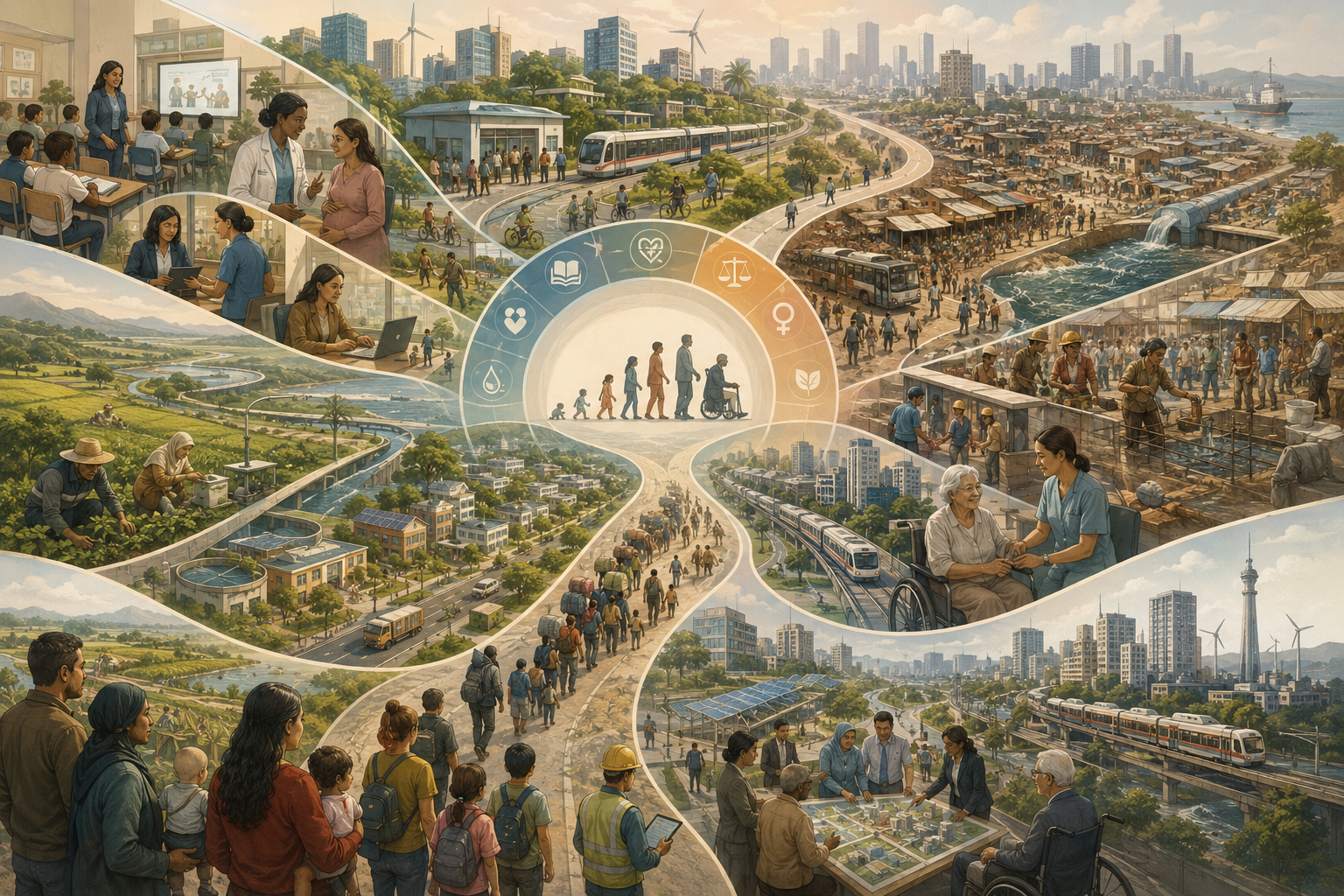
For most of human history, population growth was slow because high mortality, recurrent disease, low agricultural productivity, and limited medical knowledge constrained long-run expansion. Modern demographic growth emerged as mortality declined through sanitation, public health, nutrition, vaccination, and medicine. According to United Nations population materials, the world reached 8 billion people on 15 November 2022, stood at about 8.2 billion in 2024, and is now expected to peak around 10.3 billion in the mid-2080s rather than growing indefinitely.
This does not mean population growth is simply “good” or “bad.” It means demographic change is developmental. A youthful age structure can widen the workforce and create the possibility of a demographic dividend, but only if economies generate productive employment, invest in education and health, and build institutions capable of absorbing new workers. Later-stage demographic transition produces different pressures: population aging, pension strain, rising health and care demand, and tighter labor supply. Population is therefore not a single problem with a single answer. It is a shifting demographic structure that interacts with productivity, migration, gender relations, urban governance, energy systems, and ecological limits.
Why Demography Matters for Development
Population matters because development is always embodied in households, age cohorts, labor systems, schools, housing markets, transport networks, care systems, and fiscal institutions. Demographic change alters how many children need schooling, how many workers seek employment, how many older adults require care, how fast cities expand, how much housing must be built, and how much food, water, and energy are demanded. Demography therefore shapes the material scale of development.
But it also shapes its timing. A country with rapidly falling mortality and still-high fertility faces a different development problem from a country with long-term fertility decline and population aging. One may confront school expansion, youth employment, land pressure, urban growth, infrastructure deficits, and pressure on public health systems. The other may confront shrinking workforces, rising old-age dependency, pension strain, long-term care burdens, and a need for productivity gains or migration. These are not the same challenge wearing different labels. They are distinct developmental structures produced by different demographic regimes.
That is why population should be analyzed as a systems variable. Numbers matter, but the relationship between numbers and development is mediated by institutions, distribution, technology, and political capacity. Population growth in a society with strong health systems, industrial upgrading, expanding cities, reproductive autonomy, and investment in human capability may widen opportunity. The same growth under weak institutions, low job creation, unequal land systems, and stressed ecological conditions may magnify vulnerability. The difference lies not in demography alone, but in the social system through which demography is organized.
Demography also affects the horizon of public policy. Education systems must plan for cohorts years before they enter the workforce. Housing, transport, and water systems must anticipate settlement growth before informal deficits become entrenched. Pension and care systems must adapt before aging becomes a fiscal crisis. Environmental policy must account for both population scale and consumption intensity. Population dynamics therefore make sustainability a planning problem as much as a statistical one.
A sustainable-development approach treats demographic change neither as destiny nor as an afterthought. It asks how public systems can convert demographic pressure into human capability, decent work, urban inclusion, care security, gender equality, and ecological resilience.
Historical Patterns of Population Growth
For most of human history, global population rose slowly because death rates remained high. Epidemic disease, famine, limited sanitation, low agricultural productivity, war, high infant mortality, and weak medical knowledge repeatedly checked demographic expansion. The modern population surge was not simply a story of fertility rising. It was largely a story of mortality falling. Public-health systems, urban sanitation, vaccination, medical advances, transport integration, and improved food availability sharply lowered death rates, often before fertility declined. That produced rapid population growth as a historical consequence of development itself.
This history matters because it complicates simplistic population narratives. Population growth did not emerge because poor societies irrationally produced too many people. It emerged because survival improved. More children lived. Adults lived longer. Epidemics became more manageable. Food systems became more productive. Public health, not reproductive excess alone, reshaped the demographic trajectory of modernity.
The current global pattern is different from older linear stories of endless population explosion. UN DESA’s 2024 projections indicate that the world population is likely to peak within this century, reaching about 10.3 billion in the mid-2080s and then declining slightly by 2100. The same materials note that population growth is already slowing in many regions and that population aging is becoming a major feature of the global demographic future.
This changes the meaning of the population question. The issue is no longer simply whether the world is growing, but how unevenly demographic transition is unfolding across countries and what that means for labor, care, migration, public finance, gender equality, urban systems, and ecological demand. Some societies face rapid growth and youth dependency. Others face low fertility, aging, and labor shortages. Still others face both youthful populations and fragile institutions, or aging before becoming wealthy. These patterns produce different policy challenges.
Population history therefore belongs inside development history, not outside it. Demographic expansion was produced by changes in mortality, health, food, sanitation, and social organization. Future demographic stabilization will also be shaped by development: education, healthcare, reproductive autonomy, income security, urbanization, gender equality, and public trust.
Demographic Transition and Development
The demographic transition remains the most widely used model for understanding long-run population change. In broad terms, societies move from high fertility and high mortality to low fertility and low mortality. In between, mortality often falls before fertility declines, creating a period of rapid population growth. Over time, fertility tends to decline as child survival improves, women gain access to education and employment, urbanization advances, reproductive health services become more available, and families no longer need high numbers of births to secure household survival.
But the demographic transition should not be treated as a mechanical law. The pace and shape of fertility decline depend on institutions, gender norms, social protection, housing costs, labor markets, educational access, reproductive autonomy, and confidence in child survival. Fertility is not simply a biological variable. It is shaped by whether families expect children to survive, whether women can control reproduction, whether girls can remain in school, whether employment opportunities exist, whether public pensions reduce dependence on large families, and whether healthcare systems are trusted.
The strongest sustainable-development reading of demographic transition is therefore institutional rather than deterministic. Demography changes when public systems and social conditions change. Fertility decline is not best understood as coercive control over population. It is best understood as an outcome of capability expansion: education, health, autonomy, child survival, economic security, and gender justice.
This matters ethically. Population policy has a troubling history when framed around control, panic, or the management of poor people’s fertility. A sustainable-development framework must reject coercive population politics. It should focus instead on rights, health, education, reproductive autonomy, and social conditions that allow people to make informed choices about family life.
Seen this way, demographic transition becomes a development process rather than a population problem. Changes in fertility and mortality reflect changes in how societies organize health, care, education, women’s autonomy, work, and family security. Population dynamics are not external to development. They are one of its clearest expressions.
Age Structure, Dependency, and the Demographic Dividend
The most economically important dimension of demographic change is often not total population size but age structure. When mortality falls and fertility later declines, the share of working-age adults can rise relative to dependents. This creates the possibility of a demographic dividend: faster growth in output per capita, higher savings, broader tax bases, and greater room for investment in health, education, infrastructure, and industrial transformation. But the key word is possibility. A demographic dividend is not automatic.
UN population materials and UNFPA demographic-dividend guidance stress this point clearly. Younger populations can support a more sustainable future only when states invest in education, health, jobs, and effective public institutions. Age-structure change can be advantageous only if young people are healthy, educated, protected, and productively employed. Demography opens a window; institutions determine whether societies pass through it successfully.
This distinction is central for sustainable development. A youthful age structure can be an asset, but only if it is translated into decent work, human capability, and infrastructural inclusion. Otherwise, the same age structure can intensify unemployment, informalization, political frustration, outward migration pressure, and urban strain. Age composition is therefore a developmental opportunity only when connected to state capacity and productive transformation.
Dependency ratios also matter because they shape household burdens and public finance. A high youth-dependency ratio places pressure on schools, child health, nutrition, housing, and family support. A high old-age-dependency ratio places pressure on pensions, healthcare, long-term care, and labor-force participation. These pressures are not identical. Youthful societies need to invest in future workers. Aging societies need to sustain care and income security while maintaining productivity and social cohesion.
A sustainable-demography framework therefore asks how age structure can be transformed into capability rather than strain. It treats the demographic dividend as conditional on education, health, gender equality, decent employment, infrastructure, and governance. Without those supports, a demographic window can close without delivering the promised developmental gains.
Population Growth and Labor Markets
Population growth changes labor markets by increasing the scale and composition of labor supply. In favorable conditions, a larger working-age population can widen domestic demand, increase specialization, support productivity gains, and strengthen public revenue. In unfavorable conditions, rapid demographic expansion can overwhelm labor absorption, deepen underemployment, suppress wages, and trap households in precarious informal livelihoods. The decisive variable is not population growth alone, but whether economic systems can convert labor-force growth into productive transformation.
This is where demography becomes a labor-system issue. A society cannot claim demographic success simply because its labor force is large. Developmentally, the question is whether workers can enter systems of decent employment, rights protection, training, mobility, income security, and productive enterprise. Otherwise, population growth can coexist with economic activity while still leaving large parts of the population developmentally insecure.
Youth bulges are especially important. A large cohort of young people can be a source of innovation, entrepreneurship, civic energy, and economic transformation. But it can also become a source of frustration if education is weak, jobs are scarce, housing is unaffordable, and political systems are unresponsive. The difference between demographic opportunity and social instability depends heavily on whether economies can absorb young workers into productive and dignified livelihoods.
Labor-market structure matters as much as labor supply. If growth occurs in capital-intensive sectors that create few jobs, a youthful population may not benefit. If employment expands mainly through informal work, workers may remain vulnerable despite participation. If women are excluded from labor markets, the full developmental value of fertility decline and education investment is lost. If migration becomes the only path to opportunity, demographic pressure becomes global rather than only domestic.
Population growth and labor markets therefore belong beside wider questions of industrial policy, livelihoods, skills, care work, informality, and inequality. Demography provides the cohort structure. Development determines whether those cohorts become productive, secure, and socially included.
Urbanization, Settlement Systems, and Infrastructure
Population growth is deeply bound to urbanization. As economies industrialize and service sectors expand, cities concentrate employment, education, finance, infrastructure, and political visibility. Migration from rural areas to cities is both a demographic movement and an economic reorganization. World Bank indicator metadata define urban population as people living in urban areas according to national statistical definitions, with data collected and smoothed by the UN Population Division. That measurement detail matters because urbanization has become central to how development itself is tracked.
Urbanization can generate major gains through density, agglomeration, specialization, service access, cultural exchange, and more efficient infrastructure provision. But when population growth outpaces planning and investment, urbanization can also produce congestion, housing deficits, transport overload, informal settlements, environmental stress, sanitation gaps, heat exposure, and exclusion. The issue is not whether population growth leads to urbanization. It is whether urban governance can convert demographic concentration into livable, inclusive, and resilient development.
This is why demographic analysis belongs inside territorial-development analysis. Population growth changes not only how many people there are, but where development pressure lands: on transport systems, water networks, schools, clinics, housing, waste systems, land markets, drainage, electricity, and public administration. Demography becomes real in cities.
Settlement systems also shape inequality. A country may urbanize rapidly while concentrating opportunity in a few metropolitan centers and neglecting secondary cities, small towns, and rural-urban corridors. That can produce uneven development: megacities under stress, peripheral regions without opportunity, and migrants caught between rural deprivation and urban informality. Sustainable urbanization requires distributed planning, affordable housing, transport integration, public services, and climate-resilient infrastructure.
The demographic future is therefore also an infrastructure future. Population growth without housing, transit, water, sanitation, schools, clinics, and decent work produces strain. Population growth with inclusive infrastructure can produce capability. The difference is governance.
Public Finance, Care, and Social Protection
Population dynamics reshape public finance because age structure affects both revenue and expenditure. A growing working-age population can expand the tax base if workers are formally employed and productive. But if labor markets are informal, wages are low, and administrative capacity is weak, the fiscal benefit of demographic growth may remain limited. Similarly, youthful populations increase demand for education, child health, nutrition, housing, and job creation, while aging populations increase demand for pensions, healthcare, disability support, and long-term care.
Care is one of the most important but often undermeasured dimensions of demographic change. Children require care, older adults require care, people with disabilities require care, and illness creates care burdens inside households. When care systems are weak, these burdens often fall disproportionately on women and girls, affecting education, employment, income, autonomy, and health. Demography therefore interacts directly with gender justice and economic participation.
Aging societies face a distinctive care challenge. Longer lives are a major achievement of development, but they require institutions capable of supporting old-age income security, healthcare, social connection, accessible housing, and long-term care. Societies that age before building strong care systems may face both household strain and fiscal pressure. Societies with low fertility and shrinking labor forces may also depend more on productivity growth, later retirement, immigration, or care-system redesign.
Youthful societies face different social-protection needs. They must invest in maternal and child health, schooling, early childhood development, nutrition, skills, and employment transitions. Social protection can help prevent demographic pressure from becoming poverty reproduction by protecting households from shocks, reducing child deprivation, and supporting human-capital formation.
Public finance and care therefore connect demography to sustainable development in a practical way. It is not enough to count people by age. Institutions must ask what systems of support each age structure requires and whether public revenue, public administration, and social policy are capable of meeting those needs over time.
Population, Consumption, and Resource Demand
Population growth raises aggregate demand for food, water, housing, energy, land, transport, and materials, but ecological stress cannot be explained by population alone. Environmental impact reflects the interaction of population, affluence, technology, infrastructure, consumption patterns, and governance, not sheer numbers in isolation. Lower-income populations may grow quickly while contributing relatively little per person to cumulative ecological damage, whereas wealthier societies with low population growth may exert enormous pressure through energy use, material throughput, aviation, meat-heavy diets, large housing footprints, and waste-intensive systems.
This point matters for both accuracy and ethics. Population growth in poorer settings can intensify local land, water, housing, and infrastructure pressure, especially where institutions are weak. But it is analytically wrong and politically dangerous to let population become a substitute explanation for high-consumption development models. Sustainable development depends on transforming provisioning systems, not merely stabilizing headcounts.
The relationship between population and environment is therefore metabolic rather than purely demographic. The real question is how economies are organized to feed, house, transport, employ, and care for people, and with what ecological consequences. A city can support a growing population with compact housing, public transit, clean energy, and efficient water systems, or it can sprawl outward through high-emission infrastructure and land conversion. The population count matters, but the provisioning system determines much of the environmental effect.
Technology also changes the relationship between people and throughput. Renewable energy, public transit, precision agriculture, water efficiency, circular material systems, and low-carbon housing can reduce per-capita pressure. But efficiency gains can be offset by scale effects and rebound if total consumption continues rising. Sustainable development must therefore examine both population and consumption together.
This systems framing makes demographic analysis compatible with work on overshoot, planetary boundaries, and long-run viability. Population matters, but it must be understood within the larger system of consumption, inequality, infrastructure, technology, and ecological constraint.
Food, Water, Energy, and Demographic Scale
Population growth becomes materially visible through food, water, and energy systems. More people require more nutrition, housing, sanitation, electricity, cooking fuel, transport, and productive infrastructure. But the relationship between demographic scale and resource demand depends heavily on how provisioning systems are built. A growing population supplied through wasteful, unequal, high-throughput systems will place very different pressures on the planet than a growing population supported by efficient, equitable, resilient systems.
Food systems show this clearly. Population growth increases food demand, but hunger and malnutrition are not simply the result of global food scarcity. They are shaped by poverty, distribution, conflict, land access, food prices, storage, transport, agricultural resilience, nutrition systems, and public policy. Demographic scale matters, but food security depends on whether societies can produce, distribute, and protect access to nutritious food under climate stress.
Water systems show a similar pattern. Population growth increases demand for drinking water, sanitation, agriculture, industry, and energy. But water insecurity is also shaped by infrastructure, governance, pricing, pollution, watershed degradation, groundwater depletion, and climate variability. Rapid settlement growth without water and sanitation investment can turn demographic change into public-health risk. Conversely, strong water governance can reduce vulnerability even under demographic pressure.
Energy systems reveal the development challenge most sharply. Energy access is essential for health, education, communication, work, cooking, cooling, and economic transformation. But if energy expansion depends on fossil-intensive pathways, demographic development can increase climate risk. If energy access expands through clean, reliable, affordable systems, population growth can be linked to capability expansion without reproducing the same ecological burdens.
Food, water, and energy therefore show why population dynamics cannot be separated from systems design. The question is not only how many people must be supported, but what kind of material metabolism will support them.
Gender, Reproductive Autonomy, and Human Development
The most important ethical clarification in any population article is that population policy should not be framed as coercive management of numbers. Demographic outcomes change through human development: women’s education, reproductive autonomy, access to healthcare, child survival, legal rights, economic opportunity, and freedom from violence or coercion. Voluntary fertility decline is most ethically and developmentally meaningful when it emerges from expanded capability rather than imposed control.
This is where population belongs inside gender justice rather than beside it. When girls remain in school, when women can access healthcare, when reproductive health services are available, when child survival improves, when women have legal rights and economic opportunities, family-size decisions change. These changes are not merely demographic. They are expansions of agency and dignity.
Reproductive autonomy also changes the structure of development. It affects maternal health, child health, educational attainment, household investment, labor-force participation, poverty risk, and intergenerational capability. When women and girls lack control over fertility, demographic outcomes reflect inequality rather than free choice. When reproductive autonomy is protected, population change becomes part of a broader human-development process.
This is why the strongest population framing is not “population control,” but capability expansion. Coercive approaches violate rights and often target the poor, racialized communities, colonized populations, or marginalized groups. A sustainable-development approach rejects that history. It treats people as rights-bearing agents, not demographic variables to be managed from above.
Population dynamics become part of sustainable development when interpreted through health, education, autonomy, care, and institutional support. Fertility decline is not valuable because it reduces numbers abstractly; it is valuable when it reflects people’s expanded freedom to make informed, safe, and dignified choices about their lives.
Aging, Migration, and Global Interdependence
Later-stage demographic transition introduces a different set of development pressures. Many higher-income societies face low fertility, rising median age, shrinking or stagnating workforces, and growing care burdens. Younger societies often face the opposite challenge: large youth cohorts, limited job creation, and the pressure to absorb new entrants into productive work. These contrasting demographic profiles are not mirror images because they exist under radically different levels of wealth, institutional capacity, and fiscal space.
Migration becomes central here. Aging societies may rely more heavily on migrant labor to sustain care systems, agriculture, logistics, public services, construction, healthcare, and parts of the workforce. Youthful societies with weak job creation may experience stronger outward migration pressures. Demography therefore does not stop at borders. It reshapes the architecture of global interdependence through labor mobility, remittances, care chains, diaspora networks, skills transfer, and political conflict over belonging.
Migration can support development when it expands opportunity, sends remittances, fills labor shortages, and builds transnational networks. But it can also expose workers to exploitation, family separation, legal precarity, xenophobia, and unequal citizenship. The demographic need for migration in aging societies often coexists with political resistance to migrants. This creates a contradiction: economies may depend on migrant labor while political systems marginalize the people providing it.
Care migration is especially important. Aging societies may depend on workers from poorer or younger societies to provide elder care, healthcare support, domestic work, and service labor. This can create global care chains in which the care needs of one society are met through the labor of people whose own families and communities may be left with care gaps. Demography therefore links household life, global inequality, and labor rights.
This gives the article a geopolitical-demographic layer within sustainable development. Aging, migration, dependency, and uneven development prospects are not separate issues. They are part of the same global demographic system.
Inequality and Population Narratives
Population debates can easily become distorted when they ignore inequality. It is misleading to treat all people as equal contributors to environmental pressure or all countries as facing the same demographic problem. A child born into a low-income rural household has a very different ecological footprint from a high-income consumer in a wealthy society. A country with high fertility but low per-capita emissions does not have the same role in planetary overshoot as a high-consuming economy with low fertility but enormous material throughput.
This matters because population narratives have often been used to shift blame away from high-consumption systems and onto poorer populations. Sustainable development requires a more precise and just analysis. Population growth can intensify local development pressures, especially where public systems are weak. But global ecological pressure is also shaped by affluence, technology, fossil-fuel dependence, consumption patterns, trade systems, and unequal control over resources.
Inequality also shapes demographic outcomes. Fertility is often higher where child mortality is high, education is weak, reproductive healthcare is unavailable, women’s autonomy is constrained, social protection is limited, and old-age security depends on family support. In such settings, fertility is not simply a cultural preference or individual choice. It is embedded in insecurity. Reducing fertility ethically requires reducing insecurity, not coercing reproduction.
Population analysis must therefore be careful about causality. It should not use demography as a shortcut explanation for poverty, environmental degradation, or instability. Instead, it should ask how demographic patterns are produced by unequal development and how those patterns then interact with institutions, labor markets, cities, and ecosystems.
A just population framework holds two truths together: demographic scale matters, and inequality determines much of what demographic scale means. Sustainable development cannot ignore population, but it must never use population to erase power, consumption, history, or responsibility.
Population Dynamics and Sustainable Development
Population growth belongs inside sustainable development because sustainable development is about building systems that can support human flourishing over time. Population size alone does not determine prosperity or environmental harm. Outcomes depend on how demographic change interacts with education, labor markets, public health, gender equality, infrastructure, governance, urbanization, migration, care systems, and ecological constraint.
The strongest sustainable-development reading of population has four commitments. First, it refuses demographic determinism. Second, it rejects coercive population politics. Third, it connects fertility change to health, education, autonomy, child survival, gender equality, and social security. Fourth, it treats ecological pressure as a joint function of population, consumption, technology, infrastructure, and institutional organization rather than of numbers alone.
This framing also changes how population policy should be evaluated. A policy that reduces fertility through coercion, exclusion, or rights violations is not sustainable development. A policy that expands reproductive autonomy, education, health, and economic security is. A policy that celebrates a youthful population while failing to generate jobs, housing, and services is not enough. A policy that treats aging only as a fiscal burden without valuing care, dignity, and social participation is incomplete. A policy that blames environmental strain on population while ignoring high-consumption systems is analytically weak and morally evasive.
The deeper lesson is not simply that “population matters,” but that demographic systems matter relationally. Population growth can widen opportunity or intensify fragility depending on whether societies can convert demographic change into capability, employment, urban inclusion, ecological stewardship, and institutional resilience. Population aging can deepen fiscal and care strain, or it can be managed through healthier aging, productivity, inclusive care systems, and migration policy. Migration can become exploitation, or it can become shared development if rights are protected.
Numbers matter, but systems matter more. Sustainable development requires the demographic imagination to see populations not as abstractions, but as people moving through life stages inside institutions that either expand or constrain their possibilities.
Mathematical Lens
Population dynamics can be represented as a development problem of age structure, labor absorption, human capability, urban capacity, and ecological throughput rather than of headcount alone. Let \(D\) denote demographic-development quality, \(W\) the working-age share, \(E\) productive employment absorption, \(H\) human-capital formation, \(U\) urban-governance capacity, and \(P\) ecological pressure:
D = \alpha W + \beta E + \gamma H + \delta U – \epsilon P
\]
Interpretation: Demographic change becomes developmental when age structure is translated into jobs, capability, and governable settlement systems without excessive ecological strain.
This captures the article’s central claim: population change is not automatically beneficial or harmful. It becomes developmental through institutions, labor markets, public systems, and ecological organization.
We can also express dependency pressure as:
R_d = \lambda Y + \mu O
\]
Interpretation: Dependency pressure rises with youth dependency and old-age dependency, though each places different demands on households, public finance, care systems, education, health, and labor markets.
Here, \(Y\) is youth dependency and \(O\) is old-age dependency. Higher \(R_d\) means greater pressure on households, public finance, and institutional systems, though the composition of that pressure differs sharply between youthful and aging societies.
Finally, an expanded demographic-dividend proxy can be written as:
V = \theta A + \kappa J + \rho C
\]
Interpretation: Demographic-dividend potential increases when age-structure advantage is joined to job creation and capability investment.
Here, \(A\) is age-structure advantage, \(J\) is job creation, and \(C\) is capability investment. This helps show why demographic dividends are conditional rather than automatic.
| Term | Meaning | Interpretive role |
|---|---|---|
| \(D\) | Demographic-development quality | Represents whether population structure is being converted into inclusive development. |
| \(W\) | Working-age share | Represents the potential labor-force advantage created by age structure. |
| \(E\) | Employment absorption | Represents whether labor markets can convert workers into decent, productive employment. |
| \(H\) | Human-capital formation | Represents health, education, skills, and capability investment. |
| \(U\) | Urban-governance capacity | Represents the ability of cities and settlements to absorb demographic growth inclusively. |
| \(P\) | Ecological pressure | Represents pressure from consumption, infrastructure, energy, food, water, and material throughput. |
| \(R_d\) | Dependency pressure | Represents pressure from youth and old-age dependency on households and institutions. |
| \(V\) | Demographic-dividend potential | Represents the conditional opportunity created by age structure, jobs, and capability investment. |
The equations are conceptual rather than predictive. Their value is to make visible the structure of demographic development: age composition, jobs, capability, urban systems, ecological pressure, and dependency must be interpreted together.
Advanced Python Workflow: Population Growth, Demographic Transition, and Development Risk Scoring
This Python workflow models demographic-development risk by combining age structure, labor absorption, urbanization pressure, ecological demand, care pressure, migration pressure, and institutional capacity. It is designed to make the article’s main claim operational: population becomes a development question when numbers interact with jobs, cities, public systems, care systems, and resource pressure.
from __future__ import annotations

import pandas as pd
import numpy as np

INPUT_FILE = "population_growth_global_economy_panel.csv"
OUTPUT_FILE = "population_growth_global_economy_scores.csv"


def load_data(path: str) -> pd.DataFrame:
    """
    Load a territory-level demographic-development dataset.

    All *_index columns should be normalized to [0, 1].
    Higher values should mean more of the named property.

    Examples:
      - youth_dependency_index: higher = stronger youth dependency pressure
      - working_age_share_index: higher = larger working-age share
      - labor_absorption_capacity_index: higher = stronger job absorption capacity
      - ecological_throughput_pressure_index: higher = greater ecological pressure
    """
    df = pd.read_csv(path)

    required_columns = [
        "territory_name",
        "country_or_region",
        "territory_type",
        "youth_dependency_index",
        "old_age_dependency_index",
        "working_age_share_index",
        "labor_absorption_capacity_index",
        "human_capital_investment_index",
        "urbanization_pressure_index",
        "infrastructure_capacity_index",
        "care_system_pressure_index",
        "migration_pressure_index",
        "ecological_throughput_pressure_index",
        "governance_capacity_index",
        "gender_autonomy_index",
        "demographic_transition_alignment_index",
    ]

    missing = [col for col in required_columns if col not in df.columns]

    if missing:
        raise ValueError(f"Missing required columns: {missing}")

    return df


def validate_indices(df: pd.DataFrame) -> pd.DataFrame:
    """Validate that all *_index fields are complete and normalized to [0, 1]."""
    index_columns = [col for col in df.columns if col.endswith("_index")]

    for col in index_columns:
        if df[col].isna().any():
            raise ValueError(f"Column '{col}' contains missing values.")

        if ((df[col] < 0) | (df[col] > 1)).any():
            raise ValueError(f"Column '{col}' contains values outside [0, 1].")

    return df


def compute_scores(df: pd.DataFrame) -> pd.DataFrame:
    """
    Compute demographic pressure, demographic opportunity,
    and demographic-development risk.

    Demographic pressure rises with dependency, weak labor absorption,
    weak human-capital investment, urban pressure, infrastructure gaps,
    care pressure, migration pressure, ecological throughput, and weak governance.

    Demographic opportunity rises with working-age share, labor absorption,
    human-capital investment, infrastructure capacity, governance capacity,
    gender autonomy, and alignment with demographic transition.
    """
    df = df.copy()

    df["demographic_pressure_score"] = (
        0.12 * df["youth_dependency_index"] +
        0.11 * df["old_age_dependency_index"] +
        0.10 * (1 - df["labor_absorption_capacity_index"]) +
        0.10 * (1 - df["human_capital_investment_index"]) +
        0.12 * df["urbanization_pressure_index"] +
        0.10 * (1 - df["infrastructure_capacity_index"]) +
        0.10 * df["care_system_pressure_index"] +
        0.08 * df["migration_pressure_index"] +
        0.11 * df["ecological_throughput_pressure_index"] +
        0.06 * (1 - df["governance_capacity_index"])
    ).clip(lower=0, upper=1)

    df["demographic_opportunity_score"] = (
        0.18 * df["working_age_share_index"] +
        0.18 * df["labor_absorption_capacity_index"] +
        0.17 * df["human_capital_investment_index"] +
        0.13 * df["infrastructure_capacity_index"] +
        0.13 * df["governance_capacity_index"] +
        0.11 * df["gender_autonomy_index"] +
        0.10 * df["demographic_transition_alignment_index"]
    ).clip(lower=0, upper=1)

    df["demographic_development_risk_score"] = (
        0.46 * df["demographic_pressure_score"] +
        0.24 * (1 - df["demographic_opportunity_score"]) +
        0.12 * df["ecological_throughput_pressure_index"] +
        0.10 * df["care_system_pressure_index"] +
        0.08 * (1 - df["gender_autonomy_index"])
    ).clip(lower=0, upper=1)

    df["risk_band"] = np.select(
        [
            df["demographic_development_risk_score"] >= 0.80,
            df["demographic_development_risk_score"] >= 0.60,
            df["demographic_development_risk_score"] >= 0.40,
        ],
        [
            "Extreme demographic-development risk",
            "High demographic-development risk",
            "Moderate demographic-development risk",
        ],
        default="Lower demographic-development risk",
    )

    df["opportunity_gap"] = (
        df["demographic_pressure_score"] -
        df["demographic_opportunity_score"]
    )

    df["development_warning"] = np.select(
        [
            df["opportunity_gap"] >= 0.35,
            df["opportunity_gap"] >= 0.20,
            df["opportunity_gap"] >= 0.05,
        ],
        [
            "Severe demographic-opportunity gap",
            "High demographic-opportunity gap",
            "Moderate demographic-opportunity gap",
        ],
        default="Lower demographic-opportunity gap or stronger opportunity capacity",
    )

    return df


def build_summary(df: pd.DataFrame) -> pd.DataFrame:
    """Return a ranked summary table for review or reporting."""
    columns = [
        "territory_name",
        "country_or_region",
        "territory_type",
        "demographic_pressure_score",
        "demographic_opportunity_score",
        "demographic_development_risk_score",
        "risk_band",
        "opportunity_gap",
        "development_warning",
    ]

    summary = df[columns].copy()

    summary = summary.sort_values(
        by=[
            "demographic_development_risk_score",
            "demographic_pressure_score",
            "demographic_opportunity_score",
        ],
        ascending=[False, False, True],
    ).reset_index(drop=True)

    return summary


def main() -> None:
    df = load_data(INPUT_FILE)
    df = validate_indices(df)
    scored = compute_scores(df)
    summary = build_summary(scored)

    summary.to_csv(OUTPUT_FILE, index=False)

    print("Population-growth and development scoring complete.")
    print(summary.to_string(index=False))


if __name__ == "__main__":
    main()
This workflow is intentionally transparent. It does not claim that demographic development can be reduced to one objective score. Instead, it makes assumptions visible: youth dependency, old-age dependency, working-age share, labor absorption, human-capital investment, urban pressure, infrastructure, care systems, migration, ecological throughput, governance, gender autonomy, and demographic-transition alignment are treated as distinct components. The value of the model is diagnostic. It helps identify where demographic change is most likely to become social strain rather than development opportunity.
Advanced R Workflow: Age Structure, Urbanization, and Public-System Pressure
This R workflow focuses on the interaction among age structure, urbanization, labor absorption, care pressure, gender autonomy, and public-system capacity. It is useful for comparing where demographic transition is creating opportunity and where it is creating pressure on jobs, infrastructure, care systems, and urban governance.
library(readr)
library(dplyr)

input_file <- "population_growth_global_economy_country_panel.csv"
region_output_file <- "cross_region_population_development_summary.csv"
territory_output_file <- "cross_territory_population_development_summary.csv"

pop_df <- read_csv(input_file, show_col_types = FALSE)

required_cols <- c(
  "territory_name",
  "country_or_region",
  "territory_type",
  "youth_dependency_index",
  "old_age_dependency_index",
  "working_age_share_index",
  "labor_absorption_capacity_index",
  "human_capital_investment_index",
  "urbanization_pressure_index",
  "infrastructure_capacity_index",
  "care_system_pressure_index",
  "migration_pressure_index",
  "ecological_throughput_pressure_index",
  "governance_capacity_index",
  "gender_autonomy_index",
  "demographic_transition_alignment_index"
)

missing_cols <- setdiff(required_cols, names(pop_df))

if (length(missing_cols) > 0) {
  stop(paste("Missing required columns:", paste(missing_cols, collapse = ", ")))
}

index_cols <- names(pop_df)[grepl("_index$", names(pop_df))]

invalid_index_cols <- index_cols[
  vapply(
    pop_df[index_cols],
    function(x) any(is.na(x) | x < 0 | x > 1),
    logical(1)
  )
]

if (length(invalid_index_cols) > 0) {
  stop(
    paste(
      "Index columns must be complete and normalized to [0, 1]:",
      paste(invalid_index_cols, collapse = ", ")
    )
  )
}

pop_df <- pop_df %>%
  mutate(
    demographic_pressure_proxy = (
      youth_dependency_index +
      old_age_dependency_index +
      (1 - labor_absorption_capacity_index) +
      (1 - human_capital_investment_index) +
      urbanization_pressure_index +
      (1 - infrastructure_capacity_index) +
      care_system_pressure_index +
      migration_pressure_index +
      ecological_throughput_pressure_index +
      (1 - governance_capacity_index) +
      (1 - gender_autonomy_index) +
      (1 - demographic_transition_alignment_index)
    ) / 12,
    demographic_opportunity_proxy = (
      working_age_share_index +
      labor_absorption_capacity_index +
      human_capital_investment_index +
      infrastructure_capacity_index +
      governance_capacity_index +
      gender_autonomy_index +
      demographic_transition_alignment_index
    ) / 7,
    demographic_development_proxy = (
      demographic_pressure_proxy +
      (1 - demographic_opportunity_proxy) +
      ecological_throughput_pressure_index +
      care_system_pressure_index
    ) / 4,
    opportunity_gap = demographic_pressure_proxy - demographic_opportunity_proxy,
    risk_band = case_when(
      demographic_development_proxy >= 0.75 ~ "Extreme demographic-development risk",
      demographic_development_proxy >= 0.55 ~ "High demographic-development risk",
      demographic_development_proxy >= 0.35 ~ "Moderate demographic-development risk",
      TRUE ~ "Lower demographic-development risk"
    )
  )

region_summary <- pop_df %>%
  group_by(country_or_region) %>%
  summarise(
    avg_demographic_development_proxy = mean(demographic_development_proxy, na.rm = TRUE),
    avg_demographic_pressure_proxy = mean(demographic_pressure_proxy, na.rm = TRUE),
    avg_demographic_opportunity_proxy = mean(demographic_opportunity_proxy, na.rm = TRUE),
    avg_youth_dependency = mean(youth_dependency_index, na.rm = TRUE),
    avg_old_age_dependency = mean(old_age_dependency_index, na.rm = TRUE),
    avg_working_age_share = mean(working_age_share_index, na.rm = TRUE),
    avg_labor_absorption = mean(labor_absorption_capacity_index, na.rm = TRUE),
    avg_human_capital_investment = mean(human_capital_investment_index, na.rm = TRUE),
    avg_urbanization_pressure = mean(urbanization_pressure_index, na.rm = TRUE),
    avg_care_system_pressure = mean(care_system_pressure_index, na.rm = TRUE),
    avg_ecological_throughput_pressure = mean(ecological_throughput_pressure_index, na.rm = TRUE),
    avg_gender_autonomy = mean(gender_autonomy_index, na.rm = TRUE),
    avg_opportunity_gap = mean(opportunity_gap, na.rm = TRUE),
    observations = n(),
    .groups = "drop"
  ) %>%
  mutate(
    regional_risk_band = case_when(
      avg_demographic_development_proxy >= 0.75 ~ "Extreme demographic-development risk",
      avg_demographic_development_proxy >= 0.55 ~ "High demographic-development risk",
      avg_demographic_development_proxy >= 0.35 ~ "Moderate demographic-development risk",
      TRUE ~ "Lower demographic-development risk"
    )
  ) %>%
  arrange(desc(avg_demographic_development_proxy))

territory_summary <- pop_df %>%
  group_by(territory_type) %>%
  summarise(
    avg_demographic_development_proxy = mean(demographic_development_proxy, na.rm = TRUE),
    avg_demographic_pressure_proxy = mean(demographic_pressure_proxy, na.rm = TRUE),
    avg_demographic_opportunity_proxy = mean(demographic_opportunity_proxy, na.rm = TRUE),
    avg_youth_dependency = mean(youth_dependency_index, na.rm = TRUE),
    avg_old_age_dependency = mean(old_age_dependency_index, na.rm = TRUE),
    avg_working_age_share = mean(working_age_share_index, na.rm = TRUE),
    avg_labor_absorption = mean(labor_absorption_capacity_index, na.rm = TRUE),
    avg_human_capital_investment = mean(human_capital_investment_index, na.rm = TRUE),
    avg_urbanization_pressure = mean(urbanization_pressure_index, na.rm = TRUE),
    avg_care_system_pressure = mean(care_system_pressure_index, na.rm = TRUE),
    avg_ecological_throughput_pressure = mean(ecological_throughput_pressure_index, na.rm = TRUE),
    avg_gender_autonomy = mean(gender_autonomy_index, na.rm = TRUE),
    avg_opportunity_gap = mean(opportunity_gap, na.rm = TRUE),
    observations = n(),
    .groups = "drop"
  ) %>%
  arrange(desc(avg_demographic_development_proxy))

write_csv(region_summary, region_output_file)
write_csv(territory_summary, territory_output_file)

cat("Cross-region population-development summary exported to:", region_output_file, "\n")
print(region_summary)

cat("\nCross-territory population-development summary exported to:", territory_output_file, "\n")
print(territory_summary)
This workflow helps distinguish demographic pressure from demographic opportunity. A territory may have a large working-age population but weak labor absorption, weak education investment, urbanization pressure, care strain, and ecological throughput pressure. Conversely, strong human-capital investment, gender autonomy, infrastructure capacity, and governance can help convert demographic transition into inclusive development. The workflow therefore treats population as a systems-governance issue rather than a headcount problem.
GitHub Repository
Complete Code Repository
The full code distribution for this article, including demographic-development scoring workflows, urbanization pressure diagnostics, SQL materials, optional monitoring support tooling, supporting documentation, and repository structure, is available on GitHub.
Related Articles
- From Economic Growth to Human Development
- Poverty, Deprivation, and Multidimensional Development
- Health, Education, and Human Capability Expansion
- Inequality and Inclusive Development
- Work, Livelihoods, and Decent Employment
- Growth, Limits, and the Problem of Overshoot
- Trade-Offs, Synergies, and Policy Coherence
- Safe Operating Space and the Conditions of Long-Run Development
- Local Governance, Cities, and Territorial Development
- Urbanization, Housing, and Basic Services
Further Reading
- United Nations, Department of Economic and Social Affairs, Population Division (2024) World Population Prospects 2024: Summary of Results. New York: United Nations. Available at: https://population.un.org/wpp/assets/Files/WPP2024_Summary-of-Results.pdf
- United Nations, Department of Economic and Social Affairs, Population Division (2024) World Population Prospects 2024. New York: United Nations. Available at: https://population.un.org/wpp/
- United Nations (n.d.) Population. New York: United Nations. Available at: https://www.un.org/en/global-issues/population
- United Nations Population Fund (n.d.) Demographic dividend. New York: UNFPA. Available at: https://www.unfpa.org/demographic-dividend
- United Nations Population Fund (n.d.) Demographic dividend data and resources. New York: UNFPA. Available at: https://www.unfpa.org/data/demographic-dividend
- Bloom, D.E., Canning, D. and Sevilla, J. (2003) The Demographic Dividend: A New Perspective on the Economic Consequences of Population Change. Santa Monica, CA: RAND Corporation. Available at: https://www.rand.org/pubs/monograph_reports/MR1274.html
- Cohen, J.E. (1995) How Many People Can the Earth Support? New York: W.W. Norton. Available at: https://wwnorton.com/books/9780393314953
- United Nations Development Programme (2025) Human Development Report 2025: A Matter of Choice: People and Possibilities in the Age of AI. New York: UNDP. Available at: https://hdr.undp.org/content/human-development-report-2025
- World Bank (n.d.) Urban population (% of total population). Washington, DC: World Bank. Available at: https://data.worldbank.org/indicator/SP.URB.TOTL.IN.ZS
- World Bank (n.d.) Urban population (% of total population): Metadata glossary. Washington, DC: World Bank. Available at: https://databank.worldbank.org/metadataglossary/world-development-indicators/series/SP.URB.TOTL.IN.ZS
References
- United Nations (n.d.) Population. New York: United Nations. Available at: https://www.un.org/en/global-issues/population
- United Nations, Department of Economic and Social Affairs, Population Division (2024) World Population Prospects 2024. New York: United Nations. Available at: https://population.un.org/wpp/
- United Nations, Department of Economic and Social Affairs, Population Division (2024) World Population Prospects 2024: Summary of Results. New York: United Nations. Available at: https://population.un.org/wpp/assets/Files/WPP2024_Summary-of-Results.pdf
- United Nations, Department of Economic and Social Affairs, Population Division (2024) Ten key messages from World Population Prospects 2024. New York: United Nations. Available at: https://population.un.org/wpp/assets/Files/WPP2024_Key-Messages.pdf
- United Nations (2022) World population to reach 8 billion on 15 November 2022. New York: United Nations. Available at: https://www.un.org/en/desa/world-population-reach-8-billion-15-november-2022
- United Nations Population Fund (n.d.) Demographic dividend. New York: UNFPA. Available at: https://www.unfpa.org/demographic-dividend
- United Nations Population Fund (n.d.) Demographic dividend data and resources. New York: UNFPA. Available at: https://www.unfpa.org/data/demographic-dividend
- United Nations Population Fund (2014) The Power of 1.8 Billion: Adolescents, Youth and the Transformation of the Future. New York: UNFPA. Available at: https://www.unfpa.org/publications/power-18-billion
- Bloom, D.E., Canning, D. and Sevilla, J. (2003) The Demographic Dividend: A New Perspective on the Economic Consequences of Population Change. Santa Monica, CA: RAND Corporation. Available at: https://www.rand.org/pubs/monograph_reports/MR1274.html
- Cohen, J.E. (1995) How Many People Can the Earth Support? New York: W.W. Norton. Available at: https://wwnorton.com/books/9780393314953
- World Bank (n.d.) Urban population (% of total population). Washington, DC: World Bank. Available at: https://data.worldbank.org/indicator/SP.URB.TOTL.IN.ZS
- World Bank (n.d.) Urban population (% of total population): Metadata glossary. Washington, DC: World Bank. Available at: https://databank.worldbank.org/metadataglossary/world-development-indicators/series/SP.URB.TOTL.IN.ZS
- United Nations Development Programme (n.d.) Data Center. New York: UNDP. Available at: https://hdr.undp.org/data-center
- United Nations Development Programme (n.d.) Human Development Index. New York: UNDP. Available at: https://hdr.undp.org/data-center/human-development-index
- United Nations Development Programme (2025) Human Development Report 2025: A Matter of Choice: People and Possibilities in the Age of AI. New York: UNDP. Available at: https://hdr.undp.org/content/human-development-report-2025
- United Nations (2015) Transforming our world: the 2030 Agenda for Sustainable Development. New York: United Nations. Available at: https://sdgs.un.org/2030agenda