
Last Updated May 7, 2026
Economic growth and human progress have often moved together, but they are not identical. Over the past two centuries, rising productivity, expanding industrial capacity, scientific advance, and technological innovation have transformed human life on a scale unprecedented in history. Economic growth helped societies build sanitation systems, hospitals, schools, transport networks, power systems, food systems, communications infrastructure, and public institutions. Yet growth alone does not guarantee healthier lives, broader freedom, lower inequality, ecological stability, democratic legitimacy, or stronger institutions. The central developmental question is therefore not whether growth matters, but what kind of growth advances human progress, how its gains are distributed, and whether it can remain socially inclusive and ecologically durable over time.
Growth remains indispensable where poverty, infrastructure deficits, weak public capacity, and limited productive transformation constrain human flourishing. But growth becomes developmentally meaningful only when it is translated into health, education, security, opportunity, institutional competence, ecological resilience, and long-run viability. In that sense, the relationship between economic growth and human progress is historically powerful but institutionally conditional.
Main Library
Publications
Article Map
Sustainable Development
Related Topic
Economic Systems
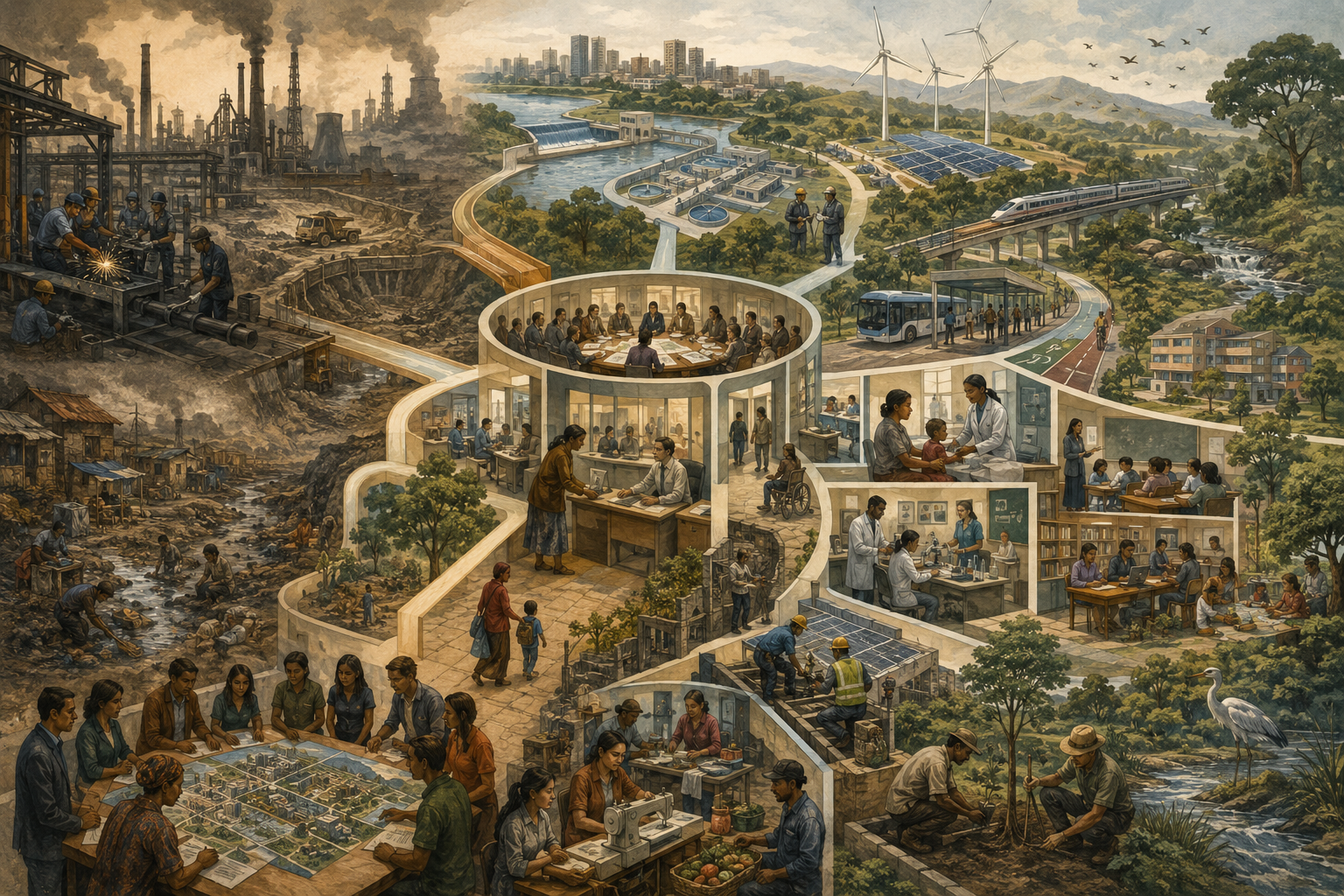
Measured through indicators such as GDP and GDP per capita growth, economic growth captures the expansion of output within an economy. The World Bank’s GDP per capita growth indicator describes annual growth in GDP per capita based on constant local currency, making it a useful macroeconomic measure of rising productive capacity. But GDP does not directly measure justice, dignity, health, education, ecological integrity, institutional trust, or whether people can live lives they value and have reason to value.
The modern history of development shows why this distinction matters. Growth enabled extraordinary improvements in human life, including expansions in life expectancy, literacy, nutrition, public infrastructure, and technological capability. Yet these gains were never automatic. Some societies translated output expansion into broad-based wellbeing far more effectively than others, while growth has often coexisted with exclusion, ecological degradation, political fragility, or uneven territorial development. The task is not to dismiss growth, but to govern it toward human ends.
Economic Growth and the Modern Transformation of Human Progress
For most of human history, output per person changed only slowly. Agrarian societies often generated enough to sustain populations, but productivity growth was limited, technological change was intermittent, and large gains in living standards were difficult to sustain across generations. The Industrial Revolution marked a historic break. Mechanization, fossil-energy use, new production systems, expanding trade, urbanization, scientific research, and modern state capacity dramatically widened productive possibility. What followed was not a small improvement in material life, but a structural transformation in what economies could produce and what public institutions could support.
This transformation matters because human progress at scale required material surpluses. Public sanitation, vaccination campaigns, mass schooling, transport systems, electricity grids, water networks, hospitals, and modern medicine all depended on societies becoming capable of mobilizing more output, more energy, more infrastructure, more knowledge, and more administrative coordination. Growth made it possible to support larger populations at higher average levels of survival and welfare. That historical connection is real and should not be minimized in development analysis.
But the historical record also shows variation. Some societies converted growth into broad-based progress more effectively than others. Others generated output without building inclusive institutions, without expanding public goods, or without protecting workers and communities from exploitation. Growth changed the scale of what was possible, but institutions, distribution, public investment, gender relations, territorial inclusion, and political choices shaped what was actually realized.
This distinction gives the article a clear role within sustainable-development analysis. It is not a simple defense of GDP, nor a rejection of growth. It is an inquiry into the historical and institutional relationship between output expansion and human progress. Growth can create the material possibility of progress, but it does not settle the moral, political, or ecological question of whether progress is actually achieved.
That is why the relationship between growth and progress should be understood as mediated rather than automatic. Output expansion can support health, education, infrastructure, and public capability. But it can also support inequality, extraction, militarization, environmental degradation, or elite accumulation. The meaning of growth depends on the systems through which it passes.
Productivity, Technology, and the Rise of Income
The deepest driver of long-run growth is productivity: the ability to generate more output from a given set of labor, capital, energy, land, knowledge, and organizational inputs. Productivity growth emerges through technological innovation, human-capital formation, improved logistics, better institutions, organizational learning, infrastructure deepening, scientific discovery, and the diffusion of practical knowledge. Growth is therefore not just about “more” activity. It is about raising the efficiency, complexity, and scale of economic systems.
Technological change plays a central role in this process. Advances in energy systems, industrial production, medicine, digital computation, transportation, communications, agriculture, and materials have each expanded the frontier of possible output. Yet technology alone is not enough. Education, training, governance quality, research capacity, property rights, regulatory competence, financial systems, and stable institutions shape whether societies can adopt and diffuse innovation. The same technology can produce very different outcomes in different institutional environments.
This productivity-centered view helps explain why some economies escape stagnation while others remain trapped in low-output equilibria. The real development issue is not simply accumulating capital, but building systems that translate knowledge into productive capacity. Machines, energy, skills, organization, public infrastructure, and institutions work together. Without public goods, technological adoption can remain narrow. Without education, productivity gains may be concentrated in a small formal sector. Without infrastructure, innovation may fail to spread geographically. Without institutions, investment may become extractive or unstable.
Productivity also has a distributive dimension. A society may become more productive overall while workers receive little of the gain, while regions remain excluded, or while public services fail to improve. Productivity growth therefore matters, but it must be connected to wages, public revenue, social protection, health, education, and long-run opportunity. Otherwise, productivity can raise output while leaving human progress uneven.
In that sense, growth is already a social and institutional process before it becomes a macroeconomic outcome. The key question is not only whether an economy produces more, but whether its productivity gains are converted into broader human capability and durable public systems.
Economic Growth and Improvements in Human Wellbeing
Historically, sustained growth has often been associated with improvements in life expectancy, nutrition, literacy, education, housing quality, access to public goods, and the ability of states to provide basic services. Households with rising incomes can spend more on food, housing, communication, mobility, and health. States with growing fiscal capacity can build roads, hospitals, schools, water systems, sanitation networks, energy systems, and regulatory institutions. Over time, these changes reshape the structure of everyday life.
This is one reason economic growth remains central to development policy. Where poverty is severe and public systems are weak, output growth can widen the material base from which health, education, infrastructure, and social protection are built. It is difficult to fund public goods, support scientific capacity, expand housing, or maintain healthcare systems without a productive economy. Growth matters because development requires resources.
But the strongest version of this argument is not that GDP equals wellbeing. It is that growth expands the material possibility set from which wellbeing can be built. Life expectancy, for example, does not rise simply because output rises. It rises because societies use resources for public health, medicine, sanitation, maternal care, nutrition, vaccination, disease control, clean water, safer work, and institutional support. The conversion mechanism matters.
That conversion mechanism is the crucial bridge between growth and human progress. Growth generates capacity. Human progress depends on how that capacity is used. In the best cases, economic expansion supports longer lives, wider educational access, lower infant mortality, safer housing, cleaner water, richer opportunities, and greater resilience across generations. In weaker cases, growth occurs while many of those gains remain partial, uneven, or fragile.
Growth is therefore not meaningless, but neither is it self-interpreting. It becomes progress when output is translated into the conditions of life: health, knowledge, security, dignity, public capability, and meaningful choice.
Fiscal Capacity, Public Goods, and the Growth-to-Welfare Channel
One of the most important ways growth becomes human progress is through fiscal capacity. A growing economy can generate public revenue that supports schools, clinics, roads, transit, housing, sanitation, courts, social protection, environmental regulation, and scientific institutions. But this channel is not automatic. It depends on taxation, public administration, political accountability, institutional trust, and the willingness of governments to invest in public goods rather than only in narrow elite priorities.
Fiscal capacity helps explain why similar levels of output can produce different social outcomes. Two countries may grow at comparable rates, but if one has a more effective tax system, stronger public institutions, better corruption controls, and a more inclusive social contract, it may convert growth into human development more successfully. The other may generate output while failing to build durable public systems.
Public goods are especially important because many of the conditions of human progress cannot be reduced to private income alone. Clean water, sanitation, disease surveillance, mass education, public safety, environmental protection, transportation, and basic research require collective organization. Households may benefit from higher income, but they cannot individually build a functioning public-health system or protect a watershed. Growth contributes to progress when it strengthens the public systems that households rely on.
This also means that growth without public-goods conversion can become socially thin. National output may rise while schools remain weak, hospitals underfunded, public transport inadequate, courts inaccessible, and environmental harms unregulated. In such cases, growth has occurred, but progress remains incomplete. The economy has expanded, but the social architecture of capability has not kept pace.
Sustainable development therefore requires asking whether growth is fiscally and institutionally converted into public value. Output expansion is a means. Public capability is one of the tests of whether that means has been used well.
The Limits of Growth as a Measure of Progress
GDP and GDP growth remain useful measures of output, but they do not directly measure justice, dignity, security, ecological integrity, social cohesion, institutional trust, unpaid care, democratic voice, or capability. Output can rise while inequality deepens, public trust erodes, regional disparities persist, or ecosystems deteriorate. Informal precarity can coexist with rising national averages. High production can coexist with poor health, low wages, housing insecurity, pollution, and weak public institutions. These limitations do not invalidate GDP; they show that GDP is partial.
The deeper problem is evaluative substitution. Because GDP is legible, standardized, and institutionally entrenched, it is often asked to do more conceptual work than it can bear. It becomes a proxy not only for economic performance, but for national success, modernity, welfare, and political competence. That is precisely where analysis becomes thin. A society may become richer while failing to broaden real opportunity or while locking itself into unsustainable and exclusionary patterns of growth.
GDP also records many forms of activity without distinguishing their developmental meaning. Spending after disasters may raise measured output, but it may reflect damage rather than progress. Pollution-intensive production may raise GDP while worsening health and ecological stability. Defensive expenditures may appear as economic activity even when they compensate for social or environmental failure. GDP measures market output, not the moral quality of output.
This is why sustainable development and human development both matter. They expand the evaluative field. They ask what economic activity is for, how its gains are distributed, what institutions mediate them, what harms it produces, and whether the resulting pattern remains viable across time. Growth matters, but it should be judged within a broader account of progress rather than serving as its sole summary.
The question is not whether GDP should be abandoned. It remains important. The question is whether GDP is placed in the right conceptual position: as one indicator of productive capacity, not the final definition of human progress.
Inequality and the Distribution of Growth
One of the defining questions of modern development is whether growth is broadly shared. Growth that concentrates gains in narrow sectors, regions, firms, asset classes, or social groups may raise national output while leaving large populations excluded from meaningful progress. In such settings, growth can coexist with underemployment, insecure housing, poor public services, weak mobility, debt burdens, and blocked opportunity. Distribution is therefore not a secondary issue added after growth. It is part of whether growth becomes progress at all.
Inclusive progress depends on how economies and states distribute access to education, health, infrastructure, finance, legal protection, land, technology, and decent work. If these channels remain unequal, growth may widen rather than reduce developmental gaps. A country can industrialize while maintaining deep rural exclusion. A city can expand while displacing poor residents. A digital economy can raise output while concentrating gains among platform owners and highly skilled workers. A resource boom can enrich elites while leaving public systems weak.
Distribution also affects political legitimacy. When growth is visible but unfairly shared, public trust can erode. People may experience national progress as exclusion if they see rising wealth around them but remain locked out of secure work, housing, education, and services. Growth that fails to broaden dignity and opportunity can therefore produce social resentment, polarization, and institutional distrust.
This is why social policy, labor institutions, public investment, progressive taxation, territorial inclusion, and rights protection are central to development strategy. Economic growth does not “trickle down” automatically. It is translated through institutions. That translation determines whether output becomes human progress or merely aggregate expansion.
The distinct contribution of this article is to show that growth is historically powerful but distributively mediated. That makes it a bridge between economic history, human development, inequality, and sustainable-development governance.
Institutions, Rights, and the Translation of Output into Capability
Institutions shape whether growth becomes capability. Markets can generate output, but institutions determine whether that output is governed through law, public goods, labor protections, rights, taxation, environmental regulation, social insurance, education, and accountable public administration. Without institutions, growth can become volatile, extractive, exclusionary, or ecologically damaging. With stronger institutions, growth can support broad-based human progress.
The institutional question includes both capacity and legitimacy. Capacity matters because governments must be able to collect revenue, deliver services, regulate harm, plan infrastructure, protect rights, and respond to shocks. Legitimacy matters because people are more likely to support development strategies when institutions are trusted, accountable, and fair. Growth without institutional legitimacy may produce wealth, but it may also produce instability.
Rights are part of this conversion process. People need legal and political standing to claim wages, land rights, public services, education, healthcare, environmental protection, and protection from exploitation. Without rights and institutions, economic growth may increase output while leaving workers, communities, and ecosystems exposed. Human progress requires that people not only participate in the economy, but have enforceable claims within it.
Institutions also shape time horizons. Short-term growth can be pursued through extraction, deferred maintenance, pollution, debt, and weak labor protections. Long-run development requires institutions capable of preserving public assets, maintaining infrastructure, regulating ecological harm, investing in children, and protecting future capacity. The ability to convert growth into progress is therefore also the ability to govern beyond the immediate present.
This institutional lens helps explain why growth is not self-sufficient. Productive capacity must pass through governance before it becomes durable human wellbeing. Sustainable development depends on the quality of that passage.
Growth, Environment, and Sustainability
Another limit of growth as a development metric appears when ecological costs are taken seriously. Historically, many growth trajectories depended on fossil fuels, intensive extraction, pollution-heavy industrialization, deforestation, land conversion, throughput-intensive urbanization, and waste-generating consumption systems. These pathways supported real material gains, but they also contributed to climate change, biodiversity loss, air pollution, waste accumulation, and pressure on land, water, and atmosphere. Growth and environmental strain were often coupled.
This is why sustainable development cannot be satisfied with growth alone. The 2030 Agenda places economic, social, and environmental dimensions in a balanced and integrated framework and describes the Goals as integrated and indivisible. Growth is not rejected, but it is no longer sovereign. It must be considered alongside environmental integrity, social inclusion, institutional resilience, and long-run viability.
The central challenge is therefore not whether to choose growth or sustainability in the abstract, but how to change the composition, energy basis, distributive structure, and ecological metabolism of growth. A growth model based on fossil dependence, wasteful land use, toxic exposure, and material overshoot cannot be made sustainable merely by raising output faster. It must be redesigned. Clean energy, circular materials, efficient buildings, public transit, ecosystem restoration, sustainable agriculture, and ecological accounting all become part of what growth must become if it is to remain developmentally legitimate.
Environmental sustainability also changes the meaning of productivity. A system is not truly productive if it generates present output by degrading the climate, soils, water systems, biodiversity, and public health conditions that future output and welfare require. When ecological costs are ignored, growth can be overstated as progress. It may be consuming the foundations of future wellbeing.
This section connects directly to work on overshoot, planetary boundaries, and safe operating space. Growth remains developmentally important, but it must operate within the ecological conditions of long-run human flourishing.
Technology, Productivity, and the Quality of Work
Technology has always shaped the relationship between growth and progress. Mechanization, electrification, public health technologies, digital systems, logistics, agriculture, and medicine have all expanded productive capacity and transformed human life. But technology does not guarantee inclusive development. Its effects depend on ownership, labor markets, education systems, regulation, public investment, and the distribution of gains.
Productivity growth can raise wages and living standards when workers share in the gains and when public institutions convert economic expansion into services and security. But productivity growth can also coexist with job polarization, precarious work, stagnant wages, regional decline, or concentrated monopoly power. A technological economy can become more productive while many workers experience insecurity. The question is not only whether innovation raises output, but whether it expands human capability.
This matters especially in periods of rapid technological change. Artificial intelligence, automation, platform work, and digital infrastructure can increase efficiency and create new possibilities for knowledge, healthcare, education, science, and public administration. But they can also intensify inequality if gains are captured narrowly or if workers are displaced without social protection, retraining, or bargaining power. Technology must therefore be governed as part of development, not treated as an automatic route to progress.
The quality of work remains central. Human progress requires more than employment counts. It requires decent work, rights, safety, income security, skill development, voice, and the ability to build a life. Growth that expands low-wage precarity may increase output but fail to deepen human flourishing. Growth that strengthens dignified livelihoods can convert productivity into progress more effectively.
A sustainable growth strategy therefore asks how technology, productivity, and work can be aligned. Innovation matters, but its human meaning depends on whether it supports capability, security, inclusion, and ecological transition.
Human Development Beyond GDP
Human development frameworks emerged in part because GDP was too narrow to capture the substance of progress. UNDP’s human-development tradition shifts the evaluative center of development away from output alone and toward people’s choices, freedoms, capabilities, and the lives they are able to live. This matters because a society’s success cannot be judged only by how much it produces. It must also be judged by whether people can be healthy, educated, secure, respected, and able to participate meaningfully in social life.
This does not diminish growth’s importance. Instead, it clarifies its place. Growth supports health systems, educational systems, scientific capacity, infrastructure, and public finance. But those are valuable because they expand human possibility, not because they raise production statistics for their own sake. Human development broadens the lens through which economic success is judged.
Beyond-GDP thinking also clarifies why development cannot be reduced to consumption. A person may consume more and still lack safety, dignity, clean air, public trust, or political voice. A society may produce more and still suffer from loneliness, inequality, preventable disease, ecological instability, or institutional erosion. Human progress requires a wider account of what people need to live well.
This is why the article should sit beside, not replace, the conceptual shift from economic growth to human development. The latter centers capability as a guiding framework. This article centers the historical and institutional relationship between growth and progress. Together, they show both sides of the argument: growth matters as a means, but development must be judged by what growth enables in human life.
Human development beyond GDP is therefore not anti-growth. It is anti-reduction. It refuses to let one economic indicator stand in for the whole of human possibility.
Toward Inclusive and Sustainable Growth
The challenge for the twenty-first century is not simply to accelerate growth, but to reshape it. Growth strategies must become more inclusive, so that rising output expands opportunity rather than concentrating advantage. They must also become more sustainable, so that human progress is not financed through ecological overshoot or deferred systemic instability. With only a few years remaining to 2030, official SDG reporting continues to show that global progress remains insufficient to achieve the Goals on time. This is a reminder that growth, welfare, and sustainability are still not aligned at the pace required.
Inclusive and sustainable growth requires innovation in energy systems, industrial organization, public finance, urban planning, transport, agriculture, social protection, labor institutions, and public administration. It also requires governments capable of balancing dynamism with regulation, innovation with fairness, and present welfare with future viability. Growth remains a powerful instrument of human advancement, but only when institutionally governed toward broader human ends.
Inclusive growth means asking who benefits, who is left behind, which regions are included, what kinds of jobs are created, how public goods are financed, whether inequality falls, and whether marginalized communities gain real access to capability-building systems. Sustainable growth means asking whether output expansion reduces ecological pressure, protects future conditions, and avoids locking societies into harmful infrastructure and consumption patterns.
The strongest development strategies will not treat inclusion and sustainability as constraints placed on growth after the fact. They will treat them as design principles for growth itself. A productive economy should generate broad human capability. A technologically advanced economy should reduce ecological harm. A wealthy society should build public systems worthy of its resources. A growing economy should not require exclusion or overshoot to function.
Economic growth and human progress are historically intertwined. The task now is to make that relationship less fragile, more equitable, and more ecologically intelligent than many past growth regimes allowed.
Why This Matters for Sustainable Development
Economic growth matters for sustainable development because deprivation cannot be overcome without productive capacity, public revenue, infrastructure, technology, and institutional capability. Poverty reduction, public health, education, housing, energy access, sanitation, climate adaptation, and scientific development all require resources. Growth can help create those resources. In that sense, any serious sustainable-development framework must understand growth rather than dismiss it.
But growth also matters because it can mislead. If output becomes the dominant measure of progress, societies may mistake expansion for development even when welfare remains uneven, institutions weaken, work becomes precarious, and ecological systems deteriorate. Growth can support human progress, but it can also conceal the costs of exclusion, pollution, territorial inequality, unpaid care, and future risk.
The central sustainable-development question is therefore one of translation. How is output translated into human capability? Through what institutions? For whose benefit? With what ecological cost? Over what time horizon? A society that cannot answer those questions cannot know whether its growth is becoming progress or merely increasing activity.
This article strengthens the broader sustainable-development framework by holding together two truths. First, economic growth has been one of the most powerful historical forces behind modern improvements in living standards. Second, growth is not the same as human progress. Progress requires health, education, dignity, security, inclusion, institutional competence, ecological stability, and future viability.
Growth is a means. Human flourishing is the end. Sustainable development begins when that distinction is made explicit and then built into policy, measurement, and governance.
Mathematical Lens
Economic growth and human progress can be represented as related but non-identical processes. Let \(P\) denote human progress, \(Y\) income or output growth, \(H\) health improvement, \(E\) educational expansion, \(I\) inclusion, and \(S\) sustainability conditions:
P = \alpha Y + \beta H + \gamma E + \delta I + \epsilon S
\]
Interpretation: Output growth contributes to human progress, but progress depends on health, education, inclusion, and sustainability conditions as well as income.
This captures the article’s central argument: growth is a powerful input to progress, but it is not sufficient to define progress by itself.
We can also express growth-translation failure as:
R_g = \lambda D + \mu Q + \nu C
\]
Interpretation: Growth-translation risk rises when distributional exclusion, weak public-goods conversion, and ecological cost intensity prevent output from becoming broad and durable human welfare.
Here, \(D\) is distributional exclusion, \(Q\) is institutional weakness in public-goods conversion, and \(C\) is ecological cost intensity. Higher \(R_g\) means rising output is being translated poorly into broad and durable human welfare.
Finally, inclusive sustainable growth capacity can be represented as:
V = \theta T + \kappa G + \rho A
\]
Interpretation: Inclusive sustainable growth capacity increases when technological productivity, governance quality, and access to capability-building institutions improve together.
Here, \(T\) is technological productivity, \(G\) is governance quality, and \(A\) is access to capability-building institutions such as health, education, infrastructure, and social protection. This helps show why long-run progress is not reducible to growth rates alone.
| Term | Meaning | Interpretive role |
|---|---|---|
| \(P\) | Human progress | Represents broad improvement in human wellbeing, capability, dignity, security, and future viability. |
| \(Y\) | Output or income growth | Represents growth in productive capacity, often measured through GDP or GDP per capita. |
| \(H\) | Health improvement | Represents gains in life expectancy, disease reduction, public health, nutrition, and survival. |
| \(E\) | Educational expansion | Represents learning, literacy, skills, knowledge access, and human-capital formation. |
| \(I\) | Inclusion | Represents distributional fairness, access, rights, decent work, and territorial inclusion. |
| \(S\) | Sustainability conditions | Represents ecological stability, resilience, long-run viability, and protection of future conditions. |
| \(R_g\) | Growth-translation risk | Represents the risk that output growth does not become broad and durable human progress. |
| \(V\) | Inclusive sustainable growth capacity | Represents the ability to turn productivity into equitable and sustainable human development. |
The equations are conceptual rather than predictive. Their value is to make visible the structure of the problem: growth must be interpreted through distribution, public-goods conversion, capability expansion, ecological cost, and institutional quality.
Advanced Python Workflow: Economic Growth and Human Progress Risk Scoring
This Python workflow models whether economic growth is being translated into broad-based human progress. It treats growth as historically important but developmentally conditional by combining output expansion, health and education translation, inequality pressure, employment quality, institutional capacity, public-goods conversion, and sustainability stress.
from __future__ import annotations

import pandas as pd
import numpy as np

INPUT_FILE = "economic_growth_human_progress_panel.csv"
OUTPUT_FILE = "economic_growth_human_progress_scores.csv"


def load_data(path: str) -> pd.DataFrame:
    """
    Load a territory-level economic growth and human progress dataset.

    All *_index columns should be normalized to [0, 1].
    Higher values should mean more of the named property.

    Examples:
      - gdp_per_capita_growth_index: higher = stronger output expansion
      - public_goods_conversion_index: higher = stronger conversion into public goods
      - inequality_pressure_index: higher = stronger distributional exclusion
      - ecological_cost_intensity_index: higher = more ecological cost per unit of growth
    """
    df = pd.read_csv(path)

    required_columns = [
        "territory_name",
        "country_or_region",
        "territory_type",
        "gdp_per_capita_growth_index",
        "life_expectancy_gain_index",
        "education_expansion_index",
        "public_goods_conversion_index",
        "inequality_pressure_index",
        "employment_quality_index",
        "institutional_capacity_index",
        "ecological_cost_intensity_index",
        "technology_productivity_index",
        "territorial_inclusion_index",
        "human_progress_alignment_index",
    ]

    missing = [col for col in required_columns if col not in df.columns]

    if missing:
        raise ValueError(f"Missing required columns: {missing}")

    return df


def validate_indices(df: pd.DataFrame) -> pd.DataFrame:
    """Validate that all *_index fields are complete and normalized to [0, 1]."""
    index_columns = [col for col in df.columns if col.endswith("_index")]

    for col in index_columns:
        if df[col].isna().any():
            raise ValueError(f"Column '{col}' contains missing values.")

        if ((df[col] < 0) | (df[col] > 1)).any():
            raise ValueError(f"Column '{col}' contains values outside [0, 1].")

    return df


def compute_scores(df: pd.DataFrame) -> pd.DataFrame:
    """
    Compute growth translation pressure, human progress capacity,
    and economic growth-human progress risk.

    Growth translation pressure rises with weak public-goods conversion,
    inequality, poor employment quality, weak institutions, ecological cost,
    weak territorial inclusion, and low human-progress alignment.

    Human progress capacity rises with growth, life expectancy gains,
    educational expansion, public goods, employment quality, institutional
    capacity, productivity, and territorial inclusion.
    """
    df = df.copy()

    df["growth_translation_pressure_score"] = (
        0.14 * (1 - df["public_goods_conversion_index"]) +
        0.15 * df["inequality_pressure_index"] +
        0.13 * (1 - df["employment_quality_index"]) +
        0.12 * (1 - df["institutional_capacity_index"]) +
        0.17 * df["ecological_cost_intensity_index"] +
        0.12 * (1 - df["territorial_inclusion_index"]) +
        0.17 * (1 - df["human_progress_alignment_index"])
    ).clip(lower=0, upper=1)

    df["human_progress_capacity_score"] = (
        0.16 * df["gdp_per_capita_growth_index"] +
        0.15 * df["life_expectancy_gain_index"] +
        0.15 * df["education_expansion_index"] +
        0.14 * df["public_goods_conversion_index"] +
        0.12 * df["employment_quality_index"] +
        0.12 * df["institutional_capacity_index"] +
        0.08 * df["technology_productivity_index"] +
        0.08 * df["territorial_inclusion_index"]
    ).clip(lower=0, upper=1)

    df["economic_growth_human_progress_risk_score"] = (
        0.42 * df["growth_translation_pressure_score"] +
        0.26 * (1 - df["human_progress_capacity_score"]) +
        0.14 * df["inequality_pressure_index"] +
        0.10 * df["ecological_cost_intensity_index"] +
        0.08 * (1 - df["public_goods_conversion_index"])
    ).clip(lower=0, upper=1)

    df["risk_band"] = np.select(
        [
            df["economic_growth_human_progress_risk_score"] >= 0.80,
            df["economic_growth_human_progress_risk_score"] >= 0.60,
            df["economic_growth_human_progress_risk_score"] >= 0.40,
        ],
        [
            "Extreme growth-progress translation risk",
            "High growth-progress translation risk",
            "Moderate growth-progress translation risk",
        ],
        default="Lower growth-progress translation risk",
    )

    df["progress_translation_gap"] = (
        df["growth_translation_pressure_score"] -
        df["human_progress_capacity_score"]
    )

    df["translation_warning"] = np.select(
        [
            df["progress_translation_gap"] >= 0.35,
            df["progress_translation_gap"] >= 0.20,
            df["progress_translation_gap"] >= 0.05,
        ],
        [
            "Severe growth-progress translation gap",
            "High growth-progress translation gap",
            "Moderate growth-progress translation gap",
        ],
        default="Lower translation gap or stronger progress capacity",
    )

    return df


def build_summary(df: pd.DataFrame) -> pd.DataFrame:
    """Return a ranked summary table for review or reporting."""
    columns = [
        "territory_name",
        "country_or_region",
        "territory_type",
        "growth_translation_pressure_score",
        "human_progress_capacity_score",
        "economic_growth_human_progress_risk_score",
        "risk_band",
        "progress_translation_gap",
        "translation_warning",
    ]

    summary = df[columns].copy()

    summary = summary.sort_values(
        by=[
            "economic_growth_human_progress_risk_score",
            "growth_translation_pressure_score",
            "human_progress_capacity_score",
        ],
        ascending=[False, False, True],
    ).reset_index(drop=True)

    return summary


def main() -> None:
    df = load_data(INPUT_FILE)
    df = validate_indices(df)
    scored = compute_scores(df)
    summary = build_summary(scored)

    summary.to_csv(OUTPUT_FILE, index=False)

    print("Economic growth and human progress scoring complete.")
    print(summary.to_string(index=False))


if __name__ == "__main__":
    main()
This workflow is intentionally transparent. It does not claim that human progress can be reduced to one objective score. Instead, it makes assumptions visible: output growth, life expectancy gains, education, public goods, inequality, work quality, institutions, ecological cost, productivity, territorial inclusion, and human-progress alignment are treated as distinct components. The value of the model is diagnostic. It helps identify where growth is most likely to remain narrow, exclusionary, or ecologically costly rather than becoming broad and durable progress.
Advanced R Workflow: Growth Translation, Capability Expansion, and Sustainability Pressure
This R workflow compares how growth translates into health, education, institutional support, employment quality, territorial inclusion, and ecological cost across territories. It is useful for seeing where rising output is more likely to become durable human progress and where it is being undermined by exclusion or unsustainable intensity.
library(readr)
library(dplyr)

input_file <- "economic_growth_human_progress_country_panel.csv"
region_output_file <- "cross_region_growth_progress_summary.csv"
territory_output_file <- "cross_territory_growth_progress_summary.csv"

gp_df <- read_csv(input_file, show_col_types = FALSE)

required_cols <- c(
  "territory_name",
  "country_or_region",
  "territory_type",
  "gdp_per_capita_growth_index",
  "life_expectancy_gain_index",
  "education_expansion_index",
  "public_goods_conversion_index",
  "inequality_pressure_index",
  "employment_quality_index",
  "institutional_capacity_index",
  "ecological_cost_intensity_index",
  "technology_productivity_index",
  "territorial_inclusion_index",
  "human_progress_alignment_index"
)

missing_cols <- setdiff(required_cols, names(gp_df))

if (length(missing_cols) > 0) {
  stop(paste("Missing required columns:", paste(missing_cols, collapse = ", ")))
}

index_cols <- names(gp_df)[grepl("_index$", names(gp_df))]

invalid_index_cols <- index_cols[
  vapply(
    gp_df[index_cols],
    function(x) any(is.na(x) | x < 0 | x > 1),
    logical(1)
  )
]

if (length(invalid_index_cols) > 0) {
  stop(
    paste(
      "Index columns must be complete and normalized to [0, 1]:",
      paste(invalid_index_cols, collapse = ", ")
    )
  )
}

gp_df <- gp_df %>%
  mutate(
    growth_translation_pressure_proxy = (
      (1 - public_goods_conversion_index) +
      inequality_pressure_index +
      (1 - employment_quality_index) +
      (1 - institutional_capacity_index) +
      ecological_cost_intensity_index +
      (1 - territorial_inclusion_index) +
      (1 - human_progress_alignment_index)
    ) / 7,
    human_progress_capacity_proxy = (
      gdp_per_capita_growth_index +
      life_expectancy_gain_index +
      education_expansion_index +
      public_goods_conversion_index +
      employment_quality_index +
      institutional_capacity_index +
      technology_productivity_index +
      territorial_inclusion_index
    ) / 8,
    growth_progress_risk_proxy = (
      growth_translation_pressure_proxy +
      (1 - human_progress_capacity_proxy) +
      inequality_pressure_index +
      ecological_cost_intensity_index
    ) / 4,
    progress_translation_gap = (
      growth_translation_pressure_proxy -
      human_progress_capacity_proxy
    ),
    risk_band = case_when(
      growth_progress_risk_proxy >= 0.75 ~ "Extreme growth-progress translation risk",
      growth_progress_risk_proxy >= 0.55 ~ "High growth-progress translation risk",
      growth_progress_risk_proxy >= 0.35 ~ "Moderate growth-progress translation risk",
      TRUE ~ "Lower growth-progress translation risk"
    )
  )

region_summary <- gp_df %>%
  group_by(country_or_region) %>%
  summarise(
    avg_growth_progress_risk_proxy = mean(growth_progress_risk_proxy, na.rm = TRUE),
    avg_growth_translation_pressure_proxy = mean(growth_translation_pressure_proxy, na.rm = TRUE),
    avg_human_progress_capacity_proxy = mean(human_progress_capacity_proxy, na.rm = TRUE),
    avg_growth_index = mean(gdp_per_capita_growth_index, na.rm = TRUE),
    avg_life_expectancy_gain = mean(life_expectancy_gain_index, na.rm = TRUE),
    avg_education_expansion = mean(education_expansion_index, na.rm = TRUE),
    avg_public_goods_conversion = mean(public_goods_conversion_index, na.rm = TRUE),
    avg_inequality_pressure = mean(inequality_pressure_index, na.rm = TRUE),
    avg_employment_quality = mean(employment_quality_index, na.rm = TRUE),
    avg_institutional_capacity = mean(institutional_capacity_index, na.rm = TRUE),
    avg_ecological_cost_intensity = mean(ecological_cost_intensity_index, na.rm = TRUE),
    avg_territorial_inclusion = mean(territorial_inclusion_index, na.rm = TRUE),
    avg_progress_translation_gap = mean(progress_translation_gap, na.rm = TRUE),
    observations = n(),
    .groups = "drop"
  ) %>%
  mutate(
    regional_risk_band = case_when(
      avg_growth_progress_risk_proxy >= 0.75 ~ "Extreme growth-progress translation risk",
      avg_growth_progress_risk_proxy >= 0.55 ~ "High growth-progress translation risk",
      avg_growth_progress_risk_proxy >= 0.35 ~ "Moderate growth-progress translation risk",
      TRUE ~ "Lower growth-progress translation risk"
    )
  ) %>%
  arrange(desc(avg_growth_progress_risk_proxy))

territory_summary <- gp_df %>%
  group_by(territory_type) %>%
  summarise(
    avg_growth_progress_risk_proxy = mean(growth_progress_risk_proxy, na.rm = TRUE),
    avg_growth_translation_pressure_proxy = mean(growth_translation_pressure_proxy, na.rm = TRUE),
    avg_human_progress_capacity_proxy = mean(human_progress_capacity_proxy, na.rm = TRUE),
    avg_growth_index = mean(gdp_per_capita_growth_index, na.rm = TRUE),
    avg_life_expectancy_gain = mean(life_expectancy_gain_index, na.rm = TRUE),
    avg_education_expansion = mean(education_expansion_index, na.rm = TRUE),
    avg_public_goods_conversion = mean(public_goods_conversion_index, na.rm = TRUE),
    avg_inequality_pressure = mean(inequality_pressure_index, na.rm = TRUE),
    avg_employment_quality = mean(employment_quality_index, na.rm = TRUE),
    avg_institutional_capacity = mean(institutional_capacity_index, na.rm = TRUE),
    avg_ecological_cost_intensity = mean(ecological_cost_intensity_index, na.rm = TRUE),
    avg_territorial_inclusion = mean(territorial_inclusion_index, na.rm = TRUE),
    avg_progress_translation_gap = mean(progress_translation_gap, na.rm = TRUE),
    observations = n(),
    .groups = "drop"
  ) %>%
  arrange(desc(avg_growth_progress_risk_proxy))

write_csv(region_summary, region_output_file)
write_csv(territory_summary, territory_output_file)

cat("Cross-region growth-progress summary exported to:", region_output_file, "\n")
print(region_summary)

cat("\nCross-territory growth-progress summary exported to:", territory_output_file, "\n")
print(territory_summary)
This workflow helps distinguish output growth from human progress. A territory may show strong GDP per capita growth while still facing weak public-goods conversion, high inequality pressure, low employment quality, ecological cost intensity, or territorial exclusion. Conversely, moderate growth with strong public goods, employment quality, institutional capacity, and sustainability alignment may produce more durable progress. The workflow therefore treats growth as a development input, not a final measure of development itself.
GitHub Repository
Complete Code Repository
The full code distribution for this article, including growth-progress scoring workflows, translation diagnostics, SQL materials, optional monitoring support tooling, supporting documentation, and repository structure, is available on GitHub.
Related Articles
- From Economic Growth to Human Development
- Human Development Indicators and Their Limits
- Poverty, Deprivation, and Multidimensional Development
- Inequality and Inclusive Development
- Growth, Limits, and the Problem of Overshoot
- What Is Sustainable Development? Meaning, Systems, and Long-Run Viability
- Health, Education, and Human Capability Expansion
- Work, Livelihoods, and Decent Employment
- Trade-Offs, Synergies, and Policy Coherence
- Safe Operating Space and the Conditions of Long-Run Development
Further Reading
- Sachs, J.D. (2015) The Age of Sustainable Development. New York: Columbia University Press. Available at: https://cup.columbia.edu/book/the-age-of-sustainable-development/9780231173155
- Sen, A. (1999) Development as Freedom. Oxford: Oxford University Press. Available at: https://global.oup.com/academic/product/development-as-freedom-9780192893307
- Piketty, T. (2014) Capital in the Twenty-First Century. Cambridge, MA: Harvard University Press. Available at: https://www.hup.harvard.edu/books/9780674430006
- Raworth, K. (2017) Doughnut Economics: Seven Ways to Think Like a 21st-Century Economist. White River Junction, VT: Chelsea Green Publishing. Available at: https://www.chelseagreen.com/product/doughnut-economics-paperback/
- United Nations Development Programme (2025) Human Development Report 2025: A Matter of Choice: People and Possibilities in the Age of AI. New York: UNDP. Available at: https://hdr.undp.org/content/human-development-report-2025
- United Nations Statistics Division (2025) The Sustainable Development Goals Report 2025. New York: United Nations. Available at: https://unstats.un.org/sdgs/report/2025/
- World Bank (n.d.) World Development Indicators. Washington, DC: World Bank. Available at: https://data.worldbank.org/
- World Bank (n.d.) GDP per capita growth (annual %). Washington, DC: World Bank. Available at: https://data.worldbank.org/indicator/NY.GDP.PCAP.KD.ZG
- World Bank (n.d.) Life expectancy at birth, total (years). Washington, DC: World Bank. Available at: https://data.worldbank.org/indicator/SP.DYN.LE00.IN
References
- United Nations (2015) Transforming our world: the 2030 Agenda for Sustainable Development. New York: United Nations. Available at: https://sdgs.un.org/2030agenda
- United Nations Statistics Division (2025) The Sustainable Development Goals Report 2025. New York: United Nations. Available at: https://unstats.un.org/sdgs/report/2025/
- United Nations Statistics Division (2025) The Sustainable Development Goals Report 2025. New York: United Nations. Available at: https://unstats.un.org/sdgs/report/2025/The-Sustainable-Development-Goals-Report-2025.pdf
- United Nations Development Programme (2025) Human Development Report 2025: A Matter of Choice: People and Possibilities in the Age of AI. New York: UNDP. Available at: https://hdr.undp.org/content/human-development-report-2025
- United Nations Development Programme (2025) Human Development Report 2025: A Matter of Choice: People and Possibilities in the Age of AI. New York: UNDP. Available at: https://hdr.undp.org/system/files/documents/global-report-document/hdr2025reporten.pdf
- United Nations Development Programme (n.d.) About human development. New York: UNDP. Available at: https://hdr.undp.org/about/human-development
- United Nations Development Programme (n.d.) Human Development Index. New York: UNDP. Available at: https://hdr.undp.org/data-center/human-development-index
- World Bank (n.d.) GDP per capita growth (annual %). Washington, DC: World Bank. Available at: https://data.worldbank.org/indicator/NY.GDP.PCAP.KD.ZG
- World Bank (n.d.) Life expectancy at birth, total (years). Washington, DC: World Bank. Available at: https://data.worldbank.org/indicator/SP.DYN.LE00.IN
- World Bank (n.d.) Life expectancy at birth, total (years): Metadata glossary. Washington, DC: World Bank. Available at: https://databank.worldbank.org/metadataglossary/world-development-indicators/series/SP.DYN.LE00.IN
- Sachs, J.D. (2015) The Age of Sustainable Development. New York: Columbia University Press. Available at: https://cup.columbia.edu/book/the-age-of-sustainable-development/9780231173155
- Sen, A. (1999) Development as Freedom. Oxford: Oxford University Press. Available at: https://global.oup.com/academic/product/development-as-freedom-9780192893307
- Piketty, T. (2014) Capital in the Twenty-First Century. Cambridge, MA: Harvard University Press. Available at: https://www.hup.harvard.edu/books/9780674430006
- Raworth, K. (2017) Doughnut Economics: Seven Ways to Think Like a 21st-Century Economist. White River Junction, VT: Chelsea Green Publishing. Available at: https://www.chelseagreen.com/product/doughnut-economics-paperback/
“`
[1]: https://data.worldbank.org/indicator/SP.DYN.LE00.IN?utm_source=chatgpt.com “Life expectancy at birth, total (years)”