
Last Updated May 28, 2026
Moral development in childhood and adolescence concerns how human beings gradually come to understand harm, fairness, rules, responsibility, care, obligation, intention, empathy, punishment, trust, exclusion, and the claims of other persons. It is one of the central areas of moral psychology because it asks not only what mature agents judge, but how moral agency is formed over time through cognition, emotion, social experience, norm learning, family life, peer relations, institutional discipline, culture, and widening participation in society.
A strong account of moral development cannot be reduced to a single ladder of reasoning. Piaget and Kohlberg remain foundational because they made moral growth a structured developmental problem. But contemporary moral-development research is more plural. It examines early moral cognition, children’s acquisition and application of norms, social-domain distinctions between moral and conventional rules, empathy and prosocial concern, adolescence, peer life, identity formation, culture, schooling, and the way moral learning continues across the lifespan. Moral development is not only the growth of verbal justification. It is the formation of moral perception, emotional response, social understanding, norm interpretation, and practical responsibility.
This article argues that moral development in childhood and adolescence should be understood as a multidimensional process. Children are not simply passive recipients of adult rules, nor are adolescents merely unfinished adults. Children actively interpret harm, fairness, authority, intention, and convention. Adolescents then enter a more complex moral ecology shaped by autonomy, identity, peer status, group belonging, sexuality, politics, digital life, institutional expectations, and widening social imagination. Moral agency is formed through the interaction of early capacities, social teaching, emotional development, cultural worlds, institutional structures, and the child’s growing ability to see others as persons whose claims matter.
Main Library
Publications
Article Map
Moral Psychology
Related Topic
Developmental Psychology
Related Topic
Social Psychology
Related Topic
Cognitive Psychology
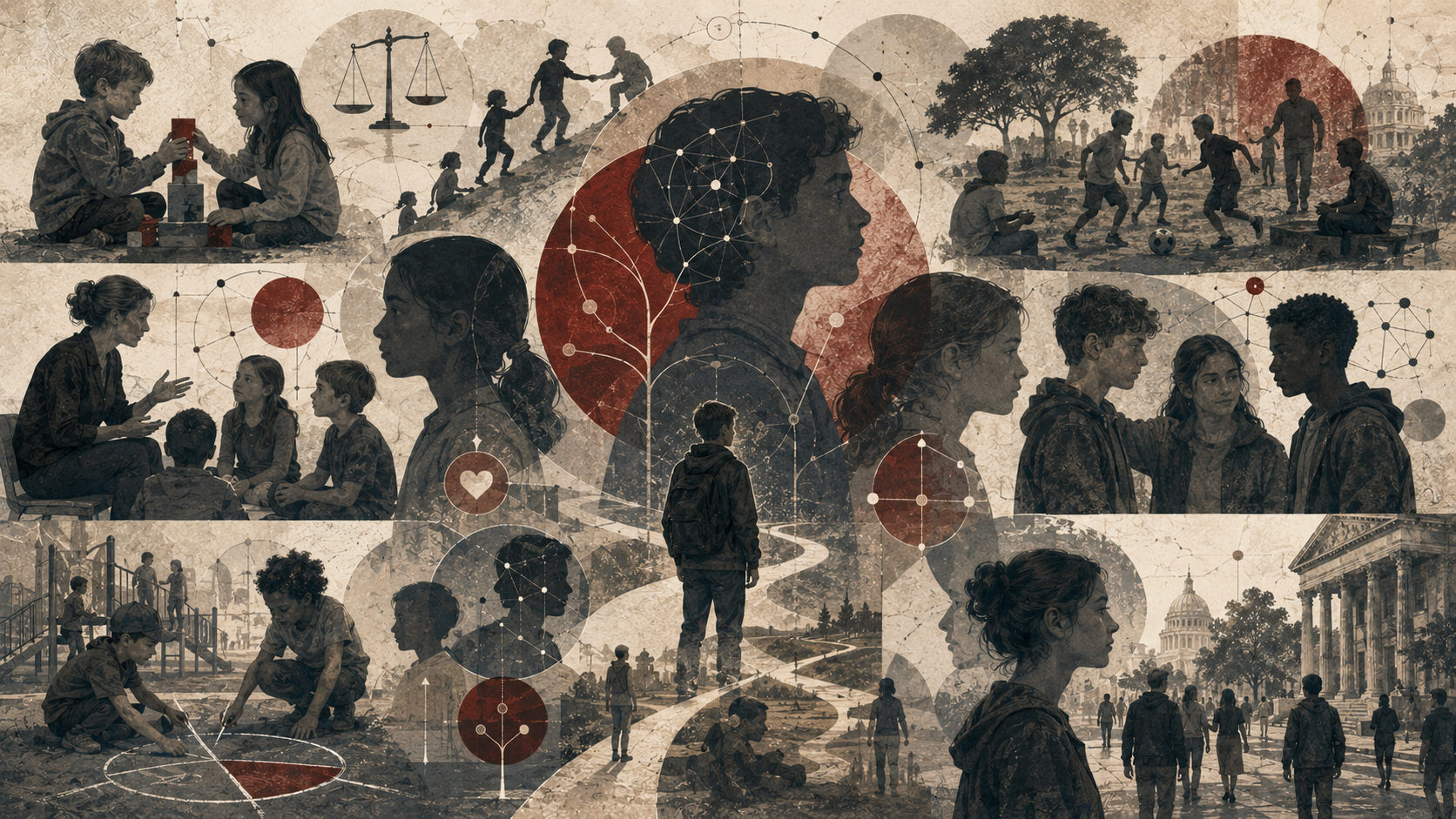
Childhood and adolescence matter because moral agency is not simply possessed. It is formed. Children learn to distinguish accidental harm from intentional harm, personal preference from obligation, rules from reasons, authority from justice, punishment from repair, and fairness from mere equality. Adolescents then confront a wider world in which identity, peer belonging, reputation, autonomy, social comparison, political awareness, institutional discipline, and moral disagreement become increasingly important. The result is not one clean movement from immaturity to maturity, but a shifting moral ecology in which cognition, emotion, relationships, institutions, and culture all matter.
This developmental view also prevents two common distortions. The first is the assumption that young children are morally empty until adults impose rules upon them. The second is the assumption that moral development is simply a march toward adult-style reasoning. Contemporary work suggests a more nuanced picture: early moral capacities may emerge surprisingly soon, but they are incomplete, culturally shaped, socially revised, and transformed by later development. Childhood and adolescence are therefore formative without being final.
What Moral Development Is
Moral development refers to the changing ways children and adolescents perceive, interpret, evaluate, and respond to morally relevant features of the world. It includes judgments about harm, fairness, intention, rights, punishment, care, loyalty, exclusion, obligation, and responsibility. It also includes the development of empathy, guilt, shame, pride, compassion, prosocial behavior, norm understanding, social perspective-taking, and the ability to distinguish different kinds of rules.
This makes moral development broader than moral reasoning in the narrow sense. A child’s moral growth is not only measured by what the child can explain verbally. It also includes what the child notices, how the child interprets another person’s distress, whether the child sees a rule violation as harmful or merely conventional, how the child understands intention, and how the child responds to authority, peers, punishment, and apology. Moral understanding is cognitive, emotional, relational, and practical.
Moral development also includes norm learning. Children do not simply absorb norms as fixed instructions. They gradually learn that norms differ in source, seriousness, scope, and justification. Some rules are treated as moral because they concern harm, fairness, welfare, dignity, or rights. Other rules are conventional because they depend on social coordination, etiquette, local authority, or custom. Still others concern personal preference or autonomy. Learning to distinguish these domains is one of the major achievements of childhood moral development.
Adolescence adds further complexity because moral life becomes more deeply tied to identity, peer status, autonomy, group belonging, social comparison, sexuality, politics, and institutional experience. Adolescents are not only learning what is right or wrong. They are also learning who they are in relation to moral communities, what kind of person they want to become, which authorities they trust, how they respond to exclusion, and whether moral values can guide action when belonging is at stake.
| Dimension | Developmental question | Moral significance |
|---|---|---|
| Harm understanding | Does the child recognize suffering, injury, coercion, or vulnerability? | Forms the basis for care, protection, restraint, and concern for others. |
| Fairness reasoning | How does the child understand sharing, turn-taking, equality, desert, and need? | Shapes judgments about justice, reciprocity, punishment, and distribution. |
| Intention understanding | Can the child distinguish accident, negligence, malice, and good-faith mistake? | Supports blame, forgiveness, apology, and proportional response. |
| Norm understanding | Does the child distinguish moral rules, conventions, authority rules, and preferences? | Prevents morality from being reduced to obedience. |
| Empathy and emotion | How does the child or adolescent respond emotionally to another person’s state? | Links judgment to care, guilt, compassion, and prosocial action. |
| Identity formation | How does morality become part of selfhood, belonging, and agency? | Explains why moral values become action-guiding for some adolescents more than others. |
| Social context | How do family, peers, school, culture, media, and institutions shape moral learning? | Shows that moral agency develops inside structured social worlds. |
Why Childhood and Adolescence Matter
Childhood and adolescence matter because they are periods in which moral capacities are actively assembled. Children are learning to interpret the world as a place filled not only with objects and rules, but with persons, claims, vulnerabilities, obligations, permissions, prohibitions, relationships, and reasons. They learn that some actions hurt others, that some distributions are unfair, that some intentions matter, that some rules can be challenged, and that other people have minds, feelings, and expectations of their own.
These early developments matter because later moral agency often presupposes capacities formed earlier: perspective-taking, emotion regulation, norm understanding, empathy, fairness reasoning, and the ability to recognize others as bearers of claims. A person who cannot recognize another’s pain, distinguish accident from intention, or understand the difference between authority and moral justification will struggle with later moral responsibility. Childhood moral development provides the early architecture for later moral life.
Adolescence matters because the moral world expands. Children increasingly move beyond family-centered regulation into peer groups, schools, public norms, digital environments, romantic relationships, civic awareness, and ideological exposure. Adolescents must negotiate autonomy and dependence, loyalty and fairness, belonging and conscience, reputation and integrity, self-interest and care. Moral life becomes more social, more identity-laden, and more vulnerable to group pressure.
These stages are therefore not morally simple. Young children may show early sensitivity to harm and fairness while still misunderstanding intention, scale, convention, or structural context. Adolescents may reason more abstractly while also becoming more vulnerable to peer approval, social exclusion, online status, political identity, and institutional mistrust. Moral development is not simply “more mature with age.” It is a reorganization of moral perception under changing cognitive, emotional, and social conditions.
| Developmental period | Core moral task | Important risk |
|---|---|---|
| Early childhood | Recognizing harm, distress, rules, intention, and basic fairness | Overreliance on authority, punishment, or visible consequence. |
| Middle childhood | Understanding reciprocity, cooperation, peer fairness, apology, and rule negotiation | Exclusion, rigid rule-following, status conflict, and limited perspective-taking. |
| Early adolescence | Integrating peer belonging, autonomy, moral emotion, and social comparison | Conformity, reputational fear, cruelty through group dynamics, and moral disengagement. |
| Middle adolescence | Connecting identity, values, relationships, and broader social norms | Identity performance, selective empathy, polarization, and status-driven morality. |
| Late adolescence | Developing moral self-authorship, civic awareness, and responsibility beyond immediate group life | Cynicism, ideological simplification, or moral abstraction without action. |
Early Moral Cognition and Norm Learning
Recent research has challenged older assumptions that serious moral understanding emerges only relatively late. Work on early moral cognition suggests that young children may show early sensitivity to prosocial and antisocial behavior, helping and hindering, fairness, and certain kinds of norm violation. Research on children’s acquisition and application of norms likewise shows that children learn norms in increasingly differentiated ways rather than merely copying adult commands.
This does not mean infants or young children possess a complete moral theory. Early moral cognition should not be romanticized. Very young children may show striking sensitivities while still lacking mature understanding of intention, context, proportionality, social structure, hypocrisy, authority, and moral disagreement. Early competencies are real, but they are partial. They provide developmental materials that later social experience, language, teaching, culture, and institutions transform.
Norm learning is especially important because children must learn not only that rules exist, but what kinds of rules they are. Some rules protect persons from harm. Some coordinate group life. Some preserve local customs. Some enforce hierarchy. Some express fairness. Some reflect adult convenience. Some may be unjust. Moral development requires children to learn not only compliance, but interpretation: what is the rule for, whom does it protect, who has authority, what happens when it conflicts with care or fairness, and can it be changed?
This interpretive dimension becomes visible when children begin to protest unfairness, negotiate rules in play, distinguish accidents from intentional harm, or challenge unequal treatment. These responses show that moral development is not merely obedience training. Children are building a practical map of how norms relate to persons, reasons, relationships, and consequences.
| Early capacity | What it supports | Developmental limitation |
|---|---|---|
| Distress recognition | Awareness that another person is hurt, sad, afraid, or vulnerable | May remain selective, immediate, and dependent on visible cues. |
| Helping sensitivity | Recognition that assistance can matter to another person | Does not yet imply mature understanding of obligation or justice. |
| Fairness sensitivity | Concern with sharing, equal treatment, and unequal outcomes | May focus on simple equality before need, desert, context, or repair. |
| Norm learning | Understanding that actions are governed by expectations | May initially blend moral rules, conventions, authority commands, and preferences. |
| Intention tracking | Beginning ability to distinguish accident from deliberate action | Develops gradually and may be overridden by visible consequences. |
| Protest | Emerging sense that some actions are wrong or unfair | May be self-centered before expanding into broader moral concern. |
Piaget and the Developmental Tradition
Jean Piaget remains foundational because he helped make morality a developmental problem rather than merely a problem of obedience. In his account, children’s understanding of rules changes as they move from a more heteronomous orientation, where rules are experienced as fixed, external, and imposed by authority, toward a more autonomous orientation, where intention, reciprocity, mutual respect, and cooperation become more central.
Piaget’s lasting contribution is not that every detail of his sequence remains uncontested. Later research has complicated his picture in many ways, especially by showing earlier competencies and more domain-specific forms of moral understanding. But Piaget’s major insight remains powerful: children are not simply smaller adults who know fewer rules. Their understanding of rule, responsibility, intention, punishment, and fairness is structurally developing.
The distinction between heteronomous and autonomous morality remains useful because it captures a real developmental tension. Younger children often experience rules as belonging to adults, authorities, or the structure of the world itself. Older children increasingly understand that rules can be negotiated, justified, revised, or challenged. They become better able to distinguish the seriousness of harm from the mere fact of rule violation and to recognize that intentions matter when evaluating responsibility.
This tradition matters today because moral development still requires explaining how children move from externally regulated conduct toward more reflective moral agency. Even when early moral capacities are acknowledged, children must still learn how to reason about conflicting claims, social expectations, punishment, reciprocity, and the difference between being caught and being responsible. Piaget made that movement psychologically visible.
| Piagetian theme | Developmental meaning | Contemporary value |
|---|---|---|
| Heteronomous morality | Rules are treated as fixed, external, and authority-based. | Explains early reliance on adult rule, punishment, and visible consequence. |
| Autonomous morality | Rules are understood through reciprocity, intention, and cooperation. | Supports moral agency beyond obedience. |
| Intention | Responsibility depends partly on what the actor meant to do. | Important for blame, forgiveness, apology, and proportional judgment. |
| Reciprocity | Fairness emerges through mutual relation rather than unilateral authority. | Connects moral development to peer interaction and cooperation. |
| Rule negotiation | Children learn that some rules can be revised by mutual agreement. | Prepares later distinction between convention and moral obligation. |
Kohlberg and Moral Reasoning
Lawrence Kohlberg extended the developmental tradition by organizing moral reasoning into staged levels, emphasizing increasingly complex forms of justification. His work focused on how children and adolescents explain what is right, moving through orientations such as punishment and obedience, instrumental exchange, social approval, law and order, social contract, and principle. Although the strict universality and completeness of this stage model have been widely criticized, Kohlberg’s work remains central to the history of moral psychology.
Kohlberg’s enduring contribution lies in the idea that moral development involves qualitative reorganization in reasoning. A child who avoids wrongdoing only because punishment is expected is not reasoning in the same way as an adolescent who appeals to fairness, social obligation, rights, or principles. Even if moral development is not a single universal ladder, there are real developmental changes in how young people justify moral claims.
The limitations of Kohlberg’s model are equally important. It has been criticized for overemphasizing justice reasoning, formal verbal justification, and abstract dilemmas while underemphasizing care, emotion, culture, gendered experience, social relationships, institutions, and domain-specific moral understanding. Many young people may show moral sensitivity, empathy, loyalty, care, or resistance to unfairness in ways not captured well by formal dilemma reasoning.
What remains useful today is not the assumption that all children must pass through one sequence in the same way, but the developmental ambition. Moral psychology still needs to explain how children and adolescents justify moral claims, how fairness and obligation become more differentiated, how law and authority are interpreted, and how principle, care, identity, and social context become integrated over time.
| Kohlbergian theme | Developmental insight | Major limitation |
|---|---|---|
| Stages of reasoning | Moral justification can become more complex over development. | Development may not follow one universal, rigid sequence. |
| Justice orientation | Fairness, rights, law, and principle are central to moral reasoning. | Care, emotion, relationship, culture, and context may be underemphasized. |
| Dilemma method | Reveals how young people justify difficult moral choices. | Artificial dilemmas may not capture lived moral practice. |
| Law and authority | Children and adolescents learn to interpret social order and obligation. | Authority can be unjust, and obedience is not always moral maturity. |
| Principled reasoning | Later reasoning can appeal to rights, justice, and universalizable claims. | Abstract principle without care or context can become thin or detached. |
Social Domain Theory
Social domain theory is one of the most important correctives to unitary stage models. Rather than treating moral development as one general ladder, it argues that children differentiate among moral, conventional, and personal domains. Moral concerns involve harm, welfare, fairness, rights, and justice. Conventional rules involve socially agreed practices such as manners, dress codes, classroom routines, or local customs. Personal matters involve choice, preference, privacy, and autonomy.
This distinction matters because children often do not treat all rules the same way. They may judge hitting as wrong even if an authority permits it, while treating a dress-code violation as more dependent on local rules. They may see some matters as personal choice rather than moral obligation or convention. Such distinctions suggest that children are not merely measuring all behavior by obedience. They are learning which kinds of reasons apply to which kinds of actions.
Social domain theory also helps explain moral conflict in childhood and adolescence. A parent may treat clothing, friendship, speech, religion, sexuality, or digital life as matters of authority or convention, while the adolescent treats them as personal autonomy. A school may frame discipline as conventional order, while a student sees unequal treatment as injustice. A peer group may treat exclusion as social preference, while the excluded child experiences harm. Moral development requires learning to navigate these domain conflicts.
The theory also makes culture more visible. Communities may differ in how they classify certain issues: as moral, conventional, religious, personal, familial, civic, or political. Development therefore includes learning a local moral map while also becoming capable of evaluating that map. Children and adolescents learn what their community treats as serious, but they may also learn to question whether those classifications are just.
| Domain | Typical concern | Example question | Developmental importance |
|---|---|---|---|
| Moral domain | Harm, fairness, welfare, rights, justice, dignity | Is it wrong to hurt, exclude, cheat, humiliate, or exploit someone? | Forms the basis for concern that does not depend only on authority approval. |
| Conventional domain | Custom, etiquette, coordination, local rule, social expectation | Is this allowed in this classroom, family, group, or institution? | Helps children understand social order without confusing it with morality itself. |
| Personal domain | Preference, autonomy, privacy, identity, self-expression | Who gets to decide what I wear, believe, like, or choose? | Becomes especially important in adolescence and autonomy development. |
| Prudential domain | Safety, health, self-protection, long-term consequence | Is this risky or harmful to me? | Connects moral development with self-care and future-oriented judgment. |
| Mixed domain | Cases where harm, convention, autonomy, and authority overlap | Is this about safety, control, identity, fairness, or group belonging? | Explains why real moral conflicts are often developmentally difficult. |
Emotion, Empathy, and Prosocial Development
Moral development is not only cognitive. Emotion and empathy play a major role in the development of prosocial concern, helping behavior, guilt, compassion, and the salience of others’ suffering. Children do not only learn that harming is wrong; they gradually learn to feel that another person’s distress matters. The emotional dimension of moral development helps explain why moral judgment may or may not become care, repair, restraint, or action.
Empathy develops through early attachment, social interaction, modeling, language, perspective-taking, and repeated encounters with vulnerability. A young child may respond to another’s distress with concern, confusion, imitation, avoidance, or self-focused distress. Over time, empathic concern can become more other-oriented, more regulated, and more linked to helping. Adolescents may become capable of more abstract empathy for distant others, marginalized groups, or broader social injustice, though such concern remains shaped by identity, peer culture, and moral imagination.
Prosocial development includes helping, sharing, comforting, cooperating, defending, including, forgiving, and repairing. These behaviors do not emerge from one source alone. They are shaped by temperament, empathy, family modeling, discipline, social norms, peer relationships, culture, and opportunity. A child may help because of affection, expectation, reciprocity, guilt, moral identity, reward, or recognition. Development involves changes in both behavior and motive.
Moral emotion can also be selective. Children and adolescents may feel empathy more readily for familiar people, similar people, visible suffering, or members of their own group. They may feel less concern for disliked peers, stigmatized groups, distant strangers, or people represented as deserving harm. Moral development therefore requires not only the growth of empathy, but its widening, regulation, and integration with fairness and principle.
| Moral-emotional capacity | Developmental function | Potential limitation |
|---|---|---|
| Empathy | Makes another person’s suffering emotionally salient. | Can be selective, biased, overwhelming, or limited to familiar people. |
| Guilt | Supports responsibility, apology, repair, and restraint from harm. | Can become avoidance if the child seeks relief without repair. |
| Shame | Signals threat to self-image or social standing. | Can produce hiding, aggression, withdrawal, or defensiveness. |
| Compassion | Motivates care for vulnerability and need. | Can remain narrow if not linked to justice and wider concern. |
| Anger | Can protest unfairness, bullying, exclusion, or humiliation. | Can become retaliatory, status-driven, or dehumanizing. |
| Pride | Can reinforce prosocial identity and responsible action. | Can become moral performance or superiority. |
Family, Peers, and the Social World
Moral development unfolds in relationships. Families provide early models of care, discipline, authority, apology, punishment, repair, generosity, fairness, and truth-telling. Children learn not only from what adults say, but from how adults distribute attention, respond to harm, handle conflict, apologize, enforce rules, show favoritism, speak about outsiders, and treat those with less power. Family life is a child’s first moral institution.
Discipline matters because it teaches the meaning of wrongdoing. Harsh, arbitrary, or humiliating discipline may teach fear, resentment, secrecy, or obedience without responsibility. Inductive discipline, explanation, repair, and emotionally attuned correction can help children understand the consequences of their actions for others. The moral meaning of discipline depends not only on rule enforcement, but on whether the child learns responsibility, empathy, proportionality, and restoration.
Peers provide a different moral environment. In peer groups, children encounter reciprocity, negotiation, inclusion, exclusion, loyalty, competition, jealousy, status, betrayal, apology, and shared rule-making. Because peers are closer to equal status than adults and children, peer interaction can become a powerful site for learning fairness and cooperation. It can also become a site of cruelty, bullying, conformity, and moral disengagement when group belonging is tied to exclusion or humiliation.
As children enter adolescence, peer relationships become more morally intense because belonging, reputation, attraction, identity, and status become more central. Adolescents may defend friends, hide wrongdoing, resist authority, participate in exclusion, take moral risks, or become publicly committed to justice partly because peer contexts reshape what feels possible and what feels costly. Moral development is therefore relational, not merely individual.
| Social context | Moral learning supported | Moral risk |
|---|---|---|
| Family care | Attachment, trust, compassion, responsibility, and repair | Favoritism, neglect, harshness, hypocrisy, or conditional regard |
| Parental discipline | Understanding consequences, intention, apology, and rule justification | Fear-based obedience without internal responsibility |
| Sibling relations | Sharing, jealousy, conflict, fairness, apology, and negotiation | Unequal treatment, rivalry, resentment, or normalized aggression |
| Peer play | Cooperation, rule negotiation, reciprocity, and mutual expectation | Exclusion, cheating, dominance, or status-driven cruelty |
| Friendship | Loyalty, trust, care, forgiveness, and moral intimacy | Covering wrongdoing, conformity, or loyalty against conscience |
| Peer status | Recognition, belonging, identity, and social risk-taking | Bullying, humiliation, performative morality, and fear of dissent |
Adolescence, Identity, and Moral Complexity
Adolescence is not simply a later version of childhood. It is a developmental period in which moral life becomes more complex because identity, autonomy, peer influence, social comparison, status, sexuality, institutional authority, digital life, and political awareness intensify. Adolescents are increasingly capable of abstract reasoning, perspective-taking, and moral reflection, but they also face new social pressures that can shape whether moral insight becomes action.
Moral identity becomes especially important during adolescence. Young people begin to ask, explicitly or implicitly: What kind of person am I? What do I stand for? Which groups do I belong to? Which authorities deserve trust? What do I owe to friends, family, strangers, institutions, and myself? Adolescence is a period in which morality becomes linked to selfhood and belonging, not only to rule-following.
This creates both moral possibility and moral danger. Adolescents may develop deep commitments to justice, care, inclusion, environmental responsibility, civic action, religious duty, or solidarity. They may also become vulnerable to group polarization, cruelty, status anxiety, moral performance, ideological simplification, and peer-enforced silence. The adolescent’s moral world expands, but expansion does not guarantee maturity. It creates a wider field of influence.
Adolescence also brings a more complex relation to institutions. Schools, law, media, platforms, workplaces, religious communities, and civic institutions become objects of evaluation. Adolescents may notice hypocrisy, inequality, racism, sexism, exclusion, poverty, war, ecological harm, or institutional failure. Their moral development therefore includes not only learning norms, but learning whether norms are just, who benefits from them, and how one can respond when institutions fail.
| Adolescent development | Moral opportunity | Moral vulnerability |
|---|---|---|
| Identity formation | Values can become part of selfhood and long-term commitment. | Moral identity can become performance, superiority, or group signaling. |
| Peer belonging | Friendship can deepen loyalty, care, and mutual responsibility. | Belonging can require silence, exclusion, cruelty, or conformity. |
| Autonomy | Young people can evaluate authority and take responsibility for choices. | Autonomy can become reaction against guidance without moral grounding. |
| Abstract reasoning | Justice, rights, institutions, and social systems become thinkable. | Abstract ideals can detach from concrete care or humility. |
| Political awareness | Concern can expand toward public injustice and collective responsibility. | Group identity can produce polarization, enemy images, and selective empathy. |
| Digital participation | Young people can encounter wider perspectives and causes. | Status, outrage, harassment, imitation, and dehumanization can intensify. |
Culture, Context, and Moral Development
Moral development is shaped by culture and context, not only by age. Children and adolescents develop within families, languages, religions, schools, neighborhoods, media systems, economic structures, legal systems, historical memories, and political orders. These contexts shape which harms are visible, which authorities are trusted, which obligations are emphasized, which groups are humanized or stigmatized, and which forms of care, discipline, loyalty, and autonomy are treated as normal.
This means moral development is not culturally blank. Even early-emerging sensitivities are interpreted through social worlds. A child may learn that fairness means equal sharing, respect for elders, need-based distribution, merit, family obligation, religious duty, national loyalty, or resistance to oppression depending on context. Adolescents may interpret autonomy, obedience, gender, sexuality, punishment, protest, and care through the moral languages available in their communities.
Cultural context can deepen moral development when it teaches responsibility, hospitality, humility, care for elders, solidarity, truthfulness, and respect for vulnerable persons. But culture can also normalize exclusion, hierarchy, shame, violence, prejudice, gendered control, or unquestioned obedience. A serious moral psychology must therefore avoid treating culture as either mere background or unquestionable authority. Culture forms moral agency, but it can also require moral critique.
Context also includes inequality. Children do not develop under equal conditions. Poverty, racism, displacement, violence, disability, family stress, unsafe schools, punitive institutions, war, digital exploitation, and social exclusion can reshape moral learning. Children exposed to injustice may develop strong moral sensitivity, mistrust, defensiveness, solidarity, anger, fear, or early responsibility. Moral development must therefore be studied with attention to power and social conditions, not only age and cognition.
| Contextual factor | What it shapes | Moral-development implication |
|---|---|---|
| Family culture | Care, authority, discipline, apology, gender roles, loyalty, and obligation | Forms early expectations about responsibility and personhood. |
| Religion and spirituality | Sacred duty, conscience, mercy, justice, sin, forgiveness, humility, and service | Can deepen moral seriousness or intensify boundary policing. |
| Economic condition | Scarcity, opportunity, insecurity, responsibility, resentment, and solidarity | Shapes how children learn fairness, need, work, and dignity. |
| Race, ethnicity, and social identity | Belonging, exclusion, vulnerability, pride, threat, and recognition | Shapes whose suffering is visible and whose dignity is protected. |
| Media and digital culture | Norms of attention, outrage, empathy, comparison, ridicule, and status | Can expand moral imagination or normalize dehumanization. |
| Institutions | Authority, discipline, inclusion, voice, punishment, and public norms | Teach whether systems are fair, caring, trustworthy, or hypocritical. |
Institutions, Schooling, and Public Norms
Schools and other institutions are not merely settings where moral development happens. They are moral-development environments. Children and adolescents learn from institutional rules, discipline practices, recognition systems, grading, inclusion policies, peer cultures, teacher expectations, surveillance, punishment, restorative practices, and the everyday distribution of voice and respect. Institutions teach morality not only through lessons, but through lived structure.
Schools may teach fairness by applying rules transparently, listening to students, addressing harm seriously, and practicing repair. They may also teach cynicism if discipline is arbitrary, biased, humiliating, or unequal. A child who sees some students protected and others punished learns something about moral standing. A student who reports harm and is ignored learns something about institutional trust. A young person who is invited into repair rather than only punishment learns something different about responsibility.
Institutional moral development includes civic learning. Children and adolescents encounter public norms about voting, rights, law, protest, inequality, history, belonging, and authority. These lessons may be explicit, as in civics education, or implicit, as in whose stories are included, whose suffering is minimized, whose achievements are celebrated, and whose dissent is treated as disorder. Institutions shape moral imagination by defining the public world children are invited to see.
This makes school discipline, inclusion, and voice morally serious. A school can teach obedience without justice, competition without care, achievement without solidarity, diversity without power-sharing, or safety without dignity. But it can also become a site where children learn responsibility, conflict repair, democratic participation, respect for difference, and the equal moral standing of persons. Institutional design is therefore part of moral development.
| Institutional practice | Moral lesson taught | Potential distortion |
|---|---|---|
| Transparent rules | Authority can be accountable and understandable. | Rules can still be unjust if they ignore unequal burdens. |
| Restorative discipline | Wrongdoing requires repair, responsibility, and reintegration. | Can become superficial if power and harm are not taken seriously. |
| Punitive discipline | Wrongdoing is managed through penalty and control. | Can teach fear, resentment, exclusion, or moral disengagement. |
| Student voice | Young people are moral participants, not only subjects of authority. | Can become symbolic if students are heard but not taken seriously. |
| Inclusive curriculum | Different lives, histories, and communities have moral visibility. | Can become tokenism if injustice and power are softened. |
| Peer accountability | Students learn to respond to harm within community. | Can become mob punishment if not guided by fairness and repair. |
Digital Life, Peer Status, and Moral Learning
Contemporary childhood and adolescence increasingly unfold in digital environments where moral learning is shaped by visibility, comparison, speed, anonymity, algorithmic amplification, peer judgment, public shaming, group belonging, imitation, and status metrics. Young people do not only learn morality in families, classrooms, and playgrounds. They learn it in feeds, group chats, comment sections, games, platforms, and mediated peer spaces where attention and approval can become powerful moral forces.
Digital life can expand moral imagination. Adolescents may encounter distant suffering, marginalized voices, social movements, historical testimony, mutual aid, public debate, and forms of solidarity unavailable in their immediate environment. They may learn to care beyond local boundaries and discover language for injustice they previously experienced but could not name. Digital environments can therefore support moral learning, identity formation, and civic awareness.
But digital life can also distort moral development. Outrage can become performance. Compassion can become selective spectacle. Humiliation can become entertainment. Group belonging can depend on public denunciation. Nuance can be punished by speed. Algorithms may reward anger, certainty, ridicule, fear, and dehumanization. Adolescents may learn that moral standing is gained through visibility rather than responsibility, or that being seen as righteous matters more than repairing harm.
This does not mean digital life is morally corrupt by nature. It means that digital environments are moral-development environments with their own incentives. A serious account of adolescent moral development must ask how platform design, peer status, anonymity, metrics, moderation, and group identity shape empathy, fairness, accountability, courage, exclusion, and moral judgment.
| Digital feature | Moral possibility | Moral risk |
|---|---|---|
| Visibility | Harm, injustice, and testimony can be seen more widely. | Attention can turn suffering into spectacle or status currency. |
| Peer metrics | Prosocial action can be recognized and shared. | Approval can replace conscience as the main guide. |
| Anonymity | Vulnerable young people may find voice and support. | Cruelty, harassment, and dehumanization can become easier. |
| Algorithmic amplification | Important moral issues can reach wider audiences. | Anger, fear, certainty, and humiliation may be rewarded. |
| Networked solidarity | Adolescents can connect across difference and distance. | Group identity can harden into moral tribalism. |
| Public judgment | Accountability can become visible. | Repair can be displaced by shaming, pile-on punishment, or reputational destruction. |
Care, Exclusion, and the Politics of Belonging
Childhood and adolescence are also periods in which young people learn who belongs, who counts, who is protected, who is mocked, who is believed, who is punished, and whose pain matters. Moral development is therefore inseparable from the politics of belonging. Children learn moral categories not only through abstract rules, but through the social distribution of care, recognition, credibility, and safety.
Exclusion is morally formative. A child who is bullied, racially marginalized, disabled, poor, linguistically isolated, gender nonconforming, religiously stigmatized, or socially rejected may learn that moral rules are not applied equally. Another child may learn from privilege that their own comfort is normal and others’ exclusion is invisible. Both are moral-development experiences. One may develop heightened sensitivity to injustice; the other may develop moral blindness unless challenged by education, contact, and institutional accountability.
Care is also formative. Children learn responsibility by being cared for, but also by being invited to care. They learn that younger children, elders, animals, classmates, siblings, strangers, and vulnerable people may have needs that deserve response. Yet care must be taught with fairness. Some children, especially girls, eldest siblings, disabled children, poor children, or children in stressed families, may be assigned excessive responsibility too early. Moral development must distinguish healthy care from burdening children with adult obligations.
Belonging shapes moral courage. A young person may know that exclusion is wrong but remain silent because challenging the group is costly. Another may defend an excluded peer because empathy, identity, and courage align. Moral development therefore includes the capacity to remain connected to conscience when belonging is at risk. That capacity depends not only on individual character, but on whether families, schools, and communities protect dissent and repair.
| Belonging question | Moral-development issue | Protective practice |
|---|---|---|
| Who is included? | Children learn whose presence is treated as normal and welcome. | Inclusive peer norms, representation, and active protection from exclusion. |
| Whose pain counts? | Children learn whether suffering is recognized equally. | Adult modeling of equal concern and serious response to harm. |
| Who is believed? | Children learn credibility, trust, and the burden of testimony. | Fair listening practices and trauma-aware response to reports of harm. |
| Who is punished? | Children learn whether discipline is fair or status-dependent. | Transparent, restorative, bias-aware accountability. |
| Who must care? | Children learn the distribution of emotional and practical responsibility. | Shared care norms that do not overburden vulnerable children. |
| Who can dissent? | Children learn whether conscience can survive group pressure. | Protected voice, bystander education, and repair-based peer accountability. |
What Development Does Not Mean
Moral development does not mean a single, inevitable march toward moral perfection. It does not mean all children develop along exactly the same path, nor that later stages simply replace earlier ones in a clean sequence. Contemporary work is more plural and modest than some older theories. It emphasizes multiple interacting processes, early competencies, contextual variation, cultural learning, domain differentiation, emotional development, peer life, and the continuing importance of moral learning across the lifespan.
Development also does not mean simple obedience. A child who follows every rule may not be morally mature if they cannot distinguish unjust authority from legitimate obligation. A child who questions rules may not be morally deficient if the questioning reflects fairness, autonomy, or concern for harm. Mature moral development requires understanding why rules matter, when they can be changed, and when moral responsibility requires resistance.
Nor does development mean that adolescents are morally irrational simply because they are socially influenced. Peer influence can distort judgment, but peers also teach loyalty, reciprocity, care, courage, cooperation, and justice. Adolescence is not only a risk period. It is a period of moral possibility, identity formation, and expanding social imagination.
Finally, childhood and adolescence are formative but not final. Early moral development matters deeply, but adult moral learning continues. A child’s early empathy, norm understanding, and fairness reasoning can shape later life, but they do not determine it mechanically. Moral agency remains open to growth, failure, repair, and transformation across the life course.
| Misunderstanding | Why it is wrong | Better interpretation |
|---|---|---|
| “Moral development is just learning rules.” | Children also learn intention, harm, fairness, empathy, autonomy, and domain differences. | Moral development is cognitive, emotional, relational, and practical. |
| “Older children are always morally better.” | Development can involve growth, but also new vulnerabilities to status, conformity, and identity pressure. | Development is nonlinear and context-sensitive. |
| “Obedience equals morality.” | Rules may be unjust, arbitrary, or merely conventional. | Moral maturity includes judgment about authority and reasons. |
| “Young children have no morality.” | Early moral and norm sensitivities emerge before mature reasoning. | Early morality is real but partial and developing. |
| “Adolescents are only impulsive.” | Adolescence also brings identity, empathy, social awareness, and moral commitment. | Adolescence is both vulnerable and morally generative. |
| “Culture is just background.” | Culture shapes moral salience, authority, care, justice, and belonging. | Moral development occurs inside social and historical worlds. |
Mathematical Lens: Modeling Moral Development
Moral development can be modeled as a changing latent structure shaped by cognition, emotion, norm understanding, and social context. Let \(M_i(t)\) represent the moral-development profile of person \(i\) at time \(t\):
M_i(t) = f(C_i(t), E_i(t), N_i(t), S_i(t))
\]
Interpretation: Moral development is modeled as a multidimensional process shaped by cognitive perspective-taking, empathic-emotional development, norm understanding, and social-context input. This reflects the contemporary view that moral development is not reducible to one reasoning scale.
where \(C_i(t)\) is cognitive perspective-taking capacity, \(E_i(t)\) is empathic-emotional development, \(N_i(t)\) is norm understanding, and \(S_i(t)\) is social-context input from family, peers, schools, culture, and institutions.
A developmental growth model can be written as:
M_i(t) = \alpha_i + \beta_i t + \gamma_i t^2 + \varepsilon_i(t)
\]
Interpretation: The model allows moral development to be nonlinear. Children and adolescents may show growth, acceleration, plateau, or reorganization rather than a simple straight-line increase with age.
where \(\alpha_i\) is initial developmental level, \(\beta_i\) is growth rate, \(\gamma_i\) allows acceleration or plateau, and \(\varepsilon_i(t)\) captures unobserved variation.
To represent domain differentiation, we can define a vector of moral-development components:
\mathbf{D}_i = (H_i, F_i, V_i, P_i)
\]
Interpretation: Moral development includes distinguishable domains: harm understanding, fairness reasoning, conventional-rule sensitivity, and personal-autonomy understanding. This reflects social domain theory’s claim that children do not reason about all rules in the same way.
where \(H_i\) is harm-based moral understanding, \(F_i\) is fairness reasoning, \(V_i\) is conventional-rule sensitivity, and \(P_i\) is personal-domain or autonomy understanding.
A peer-context model can represent adolescence more directly:
A_{ij}(t) = \sigma(\theta_1 M_i(t) + \theta_2 I_i(t) + \theta_3 R_j – \theta_4 Q_j)
\]
Interpretation: Moral action in adolescence depends on the young person’s developmental profile, moral identity, relationship support, and peer-status pressure. This captures the fact that adolescent moral insight may fail to become action when belonging is at risk.
where \(A_{ij}(t)\) is moral action by person \(i\) in situation \(j\), \(I_i(t)\) is moral identity, \(R_j\) is relational or institutional support, and \(Q_j\) is peer-status pressure or threat of exclusion.
| Model term | Meaning | Moral interpretation |
|---|---|---|
| \(M_i(t)\) | Moral-development profile | Changing multidimensional profile of moral cognition, emotion, norm understanding, and social response. |
| \(C_i(t)\) | Cognitive perspective-taking | Capacity to understand intentions, beliefs, perspectives, and social relations. |
| \(E_i(t)\) | Empathic-emotional development | Empathy, guilt, compassion, concern, shame, anger, and emotional regulation. |
| \(N_i(t)\) | Norm understanding | Ability to understand rules, obligations, conventions, and authority. |
| \(S_i(t)\) | Social-context input | Family, peers, schools, institutions, culture, media, and community conditions. |
| \(H_i\) | Harm understanding | Recognition of suffering, coercion, injury, vulnerability, and welfare. |
| \(F_i\) | Fairness reasoning | Reasoning about equality, reciprocity, desert, need, rights, and distribution. |
| \(V_i\) | Conventional sensitivity | Understanding of local customs, etiquette, coordination rules, and authority-specific norms. |
| \(P_i\) | Personal-domain understanding | Understanding of privacy, preference, autonomy, self-expression, and personal choice. |
| \(Q_j\) | Peer-status pressure | Belonging, reputation, exclusion risk, conformity, and group approval. |
R Workflow: Modeling Moral Development Across Childhood and Adolescence
The following R workflow simulates developmental changes in age, perspective-taking, empathic concern, norm understanding, peer context, family support, school climate, harm understanding, fairness reasoning, conventional sensitivity, personal-autonomy understanding, and moral action probability. The dataset is synthetic and intended for reproducible article support, not empirical claims about real children, adolescents, families, schools, cultures, or communities.
# Moral Development in Childhood and Adolescence
# Synthetic R workflow for modeling moral development.
# Educational and reproducible research scaffold only.

suppressPackageStartupMessages({
  library(tidyverse)
  library(broom)
  library(MASS)
})

set.seed(42)

# ------------------------------------------------------------
# 1. Set up output folders
# ------------------------------------------------------------

dir.create("outputs", showWarnings = FALSE)
dir.create("outputs/tables", recursive = TRUE, showWarnings = FALSE)
dir.create("outputs/figures", recursive = TRUE, showWarnings = FALSE)

# ------------------------------------------------------------
# 2. Simulate developmental data
# ------------------------------------------------------------

n <- 2400

df <- tibble(
  case_id = 1:n,
  age = runif(n, min = 5, max = 18),
  perspective_taking = rnorm(n, 0, 1),
  empathic_concern = rnorm(n, 0, 1),
  norm_understanding = rnorm(n, 0, 1),
  peer_context = rnorm(n, 0, 1),
  family_support = rnorm(n, 0, 1),
  school_climate = rnorm(n, 0, 1),
  peer_status_pressure = rnorm(n, 0, 1)
) %>%
  mutate(
    latent_moral_development =
      0.12 * age -
      0.002 * age^2 +
      0.40 * perspective_taking +
      0.35 * empathic_concern +
      0.38 * norm_understanding +
      0.20 * peer_context +
      0.25 * family_support +
      0.20 * school_climate -
      0.20 * peer_status_pressure +
      rnorm(n, 0, 1),

    harm_understanding =
      0.50 * latent_moral_development +
      0.25 * empathic_concern +
      rnorm(n, 0, 0.8),

    fairness_reasoning =
      0.45 * latent_moral_development +
      0.20 * perspective_taking +
      rnorm(n, 0, 0.8),

    conventional_sensitivity =
      0.30 * latent_moral_development +
      0.25 * norm_understanding +
      rnorm(n, 0, 0.8),

    personal_autonomy_understanding =
      0.25 * latent_moral_development +
      0.30 * perspective_taking +
      0.18 * age +
      rnorm(n, 0, 0.8),

    development_band = case_when(
      latent_moral_development < -0.5 ~ "Early-childhood pattern",
      latent_moral_development < 0.8 ~ "Middle-childhood pattern",
      TRUE ~ "Adolescent pattern"
    ),

    development_band = factor(
      development_band,
      levels = c(
        "Early-childhood pattern",
        "Middle-childhood pattern",
        "Adolescent pattern"
      ),
      ordered = TRUE
    ),

    moral_action_latent =
      0.45 * latent_moral_development +
      0.30 * empathic_concern +
      0.25 * school_climate -
      0.30 * peer_status_pressure +
      rnorm(n, 0, 0.9),

    moral_action_probability = plogis(moral_action_latent),
    moral_action = if_else(moral_action_probability >= 0.5, 1, 0)
  )

# ------------------------------------------------------------
# 3. Estimate ordinal developmental-band model
# ------------------------------------------------------------

model_dev <- polr(
  development_band ~ age + perspective_taking + empathic_concern +
    norm_understanding + peer_context + family_support +
    school_climate + peer_status_pressure,
  data = df,
  Hess = TRUE
)

dev_results <- tidy(model_dev)
print(dev_results)

# ------------------------------------------------------------
# 4. Estimate moral action model
# ------------------------------------------------------------

model_action <- glm(
  moral_action ~ latent_moral_development + empathic_concern +
    school_climate + peer_status_pressure,
  data = df,
  family = binomial()
)

action_results <- tidy(
  model_action,
  conf.int = TRUE,
  exponentiate = TRUE
)

action_fit <- glance(model_action)

print(action_results)

# ------------------------------------------------------------
# 5. Summarize by developmental band
# ------------------------------------------------------------

band_summary <- df %>%
  group_by(development_band) %>%
  summarize(
    mean_age = mean(age),
    mean_perspective_taking = mean(perspective_taking),
    mean_empathy = mean(empathic_concern),
    mean_norm_understanding = mean(norm_understanding),
    mean_harm = mean(harm_understanding),
    mean_fairness = mean(fairness_reasoning),
    mean_convention = mean(conventional_sensitivity),
    mean_personal_autonomy = mean(personal_autonomy_understanding),
    mean_action_probability = mean(moral_action_probability),
    action_rate = mean(moral_action),
    .groups = "drop"
  )

print(band_summary)

# ------------------------------------------------------------
# 6. Build prediction grid across age and empathy
# ------------------------------------------------------------

pred_grid <- expand_grid(
  age = seq(5, 18, length.out = 100),
  empathic_concern = c(-1, 0, 1),
  perspective_taking = 0,
  norm_understanding = 0,
  peer_context = 0,
  family_support = 0,
  school_climate = 0,
  peer_status_pressure = 0
)

pred_probs <- predict(model_dev, newdata = pred_grid, type = "probs")

pred_df <- bind_cols(pred_grid, as_tibble(pred_probs)) %>%
  pivot_longer(
    cols = c(
      `Early-childhood pattern`,
      `Middle-childhood pattern`,
      `Adolescent pattern`
    ),
    names_to = "development_band",
    values_to = "probability"
  ) %>%
  mutate(
    empathy_label = case_when(
      empathic_concern == -1 ~ "Low empathy",
      empathic_concern == 0 ~ "Average empathy",
      TRUE ~ "High empathy"
    )
  )

# ------------------------------------------------------------
# 7. Plot developmental probabilities
# ------------------------------------------------------------

plot_dev <- ggplot(
  pred_df,
  aes(x = age, y = probability)
) +
  geom_line(linewidth = 1) +
  facet_grid(development_band ~ empathy_label) +
  labs(
    title = "Predicted Moral Development Across Childhood and Adolescence",
    subtitle = "Developmental patterns shift with age and empathic concern",
    x = "Age",
    y = "Predicted probability"
  ) +
  theme_minimal(base_size = 12)

print(plot_dev)

# ------------------------------------------------------------
# 8. Export outputs
# ------------------------------------------------------------

write_csv(df, "outputs/tables/moral_development_childhood_adolescence_simulated_data.csv")
write_csv(dev_results, "outputs/tables/moral_development_ordinal_model.csv")
write_csv(action_results, "outputs/tables/moral_development_action_model.csv")
write_csv(action_fit, "outputs/tables/moral_development_action_model_fit.csv")
write_csv(band_summary, "outputs/tables/moral_development_band_summary.csv")
write_csv(pred_df, "outputs/tables/moral_development_predicted_probabilities.csv")

ggsave(
  filename = "outputs/figures/predicted_moral_development_childhood_adolescence.png",
  plot = plot_dev,
  width = 11,
  height = 7,
  dpi = 300
)
This workflow is useful because it treats moral development as multidimensional and age-sensitive rather than as a single raw score. It also keeps harm understanding, fairness reasoning, conventional sensitivity, and personal autonomy analytically distinct while modeling their relation to broader developmental patterns.
Python Workflow: Simulating Moral Developmental Change
The Python workflow below simulates developmental shifts in perspective-taking, empathic concern, norm understanding, peer context, family support, school climate, peer-status pressure, harm understanding, fairness reasoning, conventional sensitivity, personal-autonomy understanding, and moral action probability. The example uses synthetic data for reproducible demonstration and should not be interpreted as an assessment of real children, adolescents, families, schools, cultures, or communities.
# Moral Development in Childhood and Adolescence
# Python workflow for synthetic moral-development modeling.
# Educational and reproducible research scaffold only.

from pathlib import Path

import numpy as np
import pandas as pd

np.random.seed(42)

# ------------------------------------------------------------
# 1. Set up output folders
# ------------------------------------------------------------

output_tables = Path("outputs/tables")
output_tables.mkdir(parents=True, exist_ok=True)

# ------------------------------------------------------------
# 2. Simulate developmental observations
# ------------------------------------------------------------

n = 2600

df = pd.DataFrame({
    "case_id": np.arange(1, n + 1),
    "age": np.random.uniform(5, 18, n),
    "perspective_taking": np.random.normal(0, 1, n),
    "empathic_concern": np.random.normal(0, 1, n),
    "norm_understanding": np.random.normal(0, 1, n),
    "peer_context": np.random.normal(0, 1, n),
    "family_support": np.random.normal(0, 1, n),
    "school_climate": np.random.normal(0, 1, n),
    "peer_status_pressure": np.random.normal(0, 1, n)
})

# ------------------------------------------------------------
# 3. Generate latent development and domain scores
# ------------------------------------------------------------

df["latent_moral_development"] = (
    0.12 * df["age"] -
    0.002 * (df["age"] ** 2) +
    0.40 * df["perspective_taking"] +
    0.35 * df["empathic_concern"] +
    0.38 * df["norm_understanding"] +
    0.20 * df["peer_context"] +
    0.25 * df["family_support"] +
    0.20 * df["school_climate"] -
    0.20 * df["peer_status_pressure"] +
    np.random.normal(0, 1, n)
)

df["harm_understanding"] = (
    0.50 * df["latent_moral_development"] +
    0.25 * df["empathic_concern"] +
    np.random.normal(0, 0.8, n)
)

df["fairness_reasoning"] = (
    0.45 * df["latent_moral_development"] +
    0.20 * df["perspective_taking"] +
    np.random.normal(0, 0.8, n)
)

df["conventional_sensitivity"] = (
    0.30 * df["latent_moral_development"] +
    0.25 * df["norm_understanding"] +
    np.random.normal(0, 0.8, n)
)

df["personal_autonomy_understanding"] = (
    0.25 * df["latent_moral_development"] +
    0.30 * df["perspective_taking"] +
    0.18 * df["age"] +
    np.random.normal(0, 0.8, n)
)

conditions = [
    df["latent_moral_development"] < -0.5,
    (df["latent_moral_development"] >= -0.5) &
    (df["latent_moral_development"] < 0.8),
    df["latent_moral_development"] >= 0.8
]

choices = [
    "Early-childhood pattern",
    "Middle-childhood pattern",
    "Adolescent pattern"
]

df["development_band"] = np.select(conditions, choices)

latent_action = (
    0.45 * df["latent_moral_development"] +
    0.30 * df["empathic_concern"] +
    0.25 * df["school_climate"] -
    0.30 * df["peer_status_pressure"] +
    np.random.normal(0, 0.9, n)
)

df["moral_action_probability"] = 1 / (1 + np.exp(-latent_action))
df["moral_action"] = (df["moral_action_probability"] >= 0.5).astype(int)

# ------------------------------------------------------------
# 4. Summarize by developmental band
# ------------------------------------------------------------

summary = (
    df.groupby("development_band")
      .agg(
          mean_age=("age", "mean"),
          mean_perspective_taking=("perspective_taking", "mean"),
          mean_empathy=("empathic_concern", "mean"),
          mean_norm_understanding=("norm_understanding", "mean"),
          mean_harm=("harm_understanding", "mean"),
          mean_fairness=("fairness_reasoning", "mean"),
          mean_convention=("conventional_sensitivity", "mean"),
          mean_personal_autonomy=("personal_autonomy_understanding", "mean"),
          mean_action_probability=("moral_action_probability", "mean"),
          action_rate=("moral_action", "mean")
      )
      .reset_index()
)

print(summary)

# ------------------------------------------------------------
# 5. Build age-based scenario grid
# ------------------------------------------------------------

scenario_rows = []

for age in np.linspace(5, 18, 40):
    for empathy in [-1, 0, 1]:
        for peer_pressure in [-1, 0, 1]:
            latent = (
                0.12 * age -
                0.002 * (age ** 2) +
                0.40 * 0 +
                0.35 * empathy +
                0.38 * 0 +
                0.20 * 0 +
                0.25 * 0 +
                0.20 * 0 -
                0.20 * peer_pressure
            )

            if latent < -0.5:
                band = "Early-childhood pattern"
            elif latent < 0.8:
                band = "Middle-childhood pattern"
            else:
                band = "Adolescent pattern"

            action_latent = (
                0.45 * latent +
                0.30 * empathy +
                0.25 * 0 -
                0.30 * peer_pressure
            )

            action_probability = 1 / (1 + np.exp(-action_latent))

            scenario_rows.append({
                "age": age,
                "empathic_concern": empathy,
                "peer_status_pressure": peer_pressure,
                "latent_moral_development": latent,
                "predicted_band": band,
                "predicted_action_probability": action_probability
            })

scenario_df = pd.DataFrame(scenario_rows)

print(scenario_df.head(12))

# ------------------------------------------------------------
# 6. Identify high-development low-action synthetic cases
# ------------------------------------------------------------

high_development_low_action = (
    df[
        (df["latent_moral_development"] > df["latent_moral_development"].quantile(0.75)) &
        (df["moral_action"] == 0)
    ]
    .sort_values("peer_status_pressure", ascending=False)
    .head(25)
    .reset_index(drop=True)
)

# ------------------------------------------------------------
# 7. Export outputs
# ------------------------------------------------------------

df.to_csv(output_tables / "moral_development_childhood_adolescence_python.csv", index=False)
summary.to_csv(output_tables / "moral_development_band_summary.csv", index=False)
scenario_df.to_csv(output_tables / "moral_development_age_scenarios.csv", index=False)
high_development_low_action.to_csv(
    output_tables / "moral_development_high_development_low_action_cases.csv",
    index=False
)

print("Synthetic childhood and adolescence moral-development outputs written to:", output_tables)
This workflow is useful because it keeps harm, fairness, convention, personal autonomy, empathy, family support, school climate, and peer pressure analytically distinct while still modeling broader developmental change. It also makes visible a crucial point about adolescence: stronger moral development does not always become moral action when peer-status pressure is high and social support is weak.
In a full article repository, this Python workflow can be extended into notebooks, SQL schema, synthetic datasets, validation notes, childhood/adolescence scenario grids, social-domain models, peer-status simulations, school-climate analyses, and additional language examples. R can support statistical modeling and visualization; Python can support simulation and data pipelines; SQL can preserve structured scenario metadata; Julia can support developmental simulations; and C, C++, Fortran, Go, and Rust can support reproducible command-line tools, validation utilities, and computational demonstrations.
GitHub Repository
The companion repository for this article provides a reproducible code scaffold for modeling childhood and adolescent moral development, perspective-taking, empathic concern, norm understanding, peer context, family support, school climate, peer-status pressure, harm understanding, fairness reasoning, conventional sensitivity, personal-autonomy understanding, developmental-band classification, and moral action probability.
The repository structure should support a full research workflow rather than a single script. The article folder can include language-specific examples in python, r, julia, sql, c, cpp, fortran, go, and rust, along with data, docs, notebooks, and outputs. This structure makes the article reproducible, inspectable, and extensible for readers who want to move from conceptual argument to analytical demonstration.
Conclusion
Moral development in childhood and adolescence is not a narrow story about learning rules. It is the broader formation of moral perception, norm understanding, empathic concern, prosocial action, social interpretation, identity, and responsibility under changing developmental conditions. Children learn to recognize harm, fairness, intention, convention, authority, personal autonomy, and the claims of others. Adolescents then learn to carry those capacities into more complex worlds of peers, identity, digital life, social status, institutions, and public moral conflict.
The strongest contemporary picture is plural and developmental rather than narrowly stage-based. Piaget and Kohlberg remain important because they made moral development a structured psychological problem. But the field now requires a wider account that includes early moral cognition, social-domain theory, empathy, prosocial development, peer life, culture, schooling, family systems, public norms, and the moral significance of belonging and exclusion.
This means moral agency is not simply discovered inside the individual. It is formed through relationships and institutions. Children learn morality through care, correction, imitation, conflict, story, play, discipline, recognition, and repair. Adolescents learn morality through autonomy, identity, peer pressure, political awareness, digital participation, and the widening question of what kind of person they will become in relation to others.
A serious moral psychology must therefore study not only the mature adult who judges, but the child and adolescent whose capacities for judgment are being formed. It must ask how young people learn whose pain matters, which rules deserve obedience, when authority should be questioned, how fairness should be practiced, how empathy can be widened, and how moral courage can survive the pressure to belong. Childhood and adolescence are indispensable because they show that moral agency is not merely possessed. It is taught, tested, repaired, and formed.
Related articles
- Moral Development Across Adulthood and Aging
- Moral Reasoning: Piaget, Kohlberg, and the Developmental Tradition
- Moral Judgment and the Psychology of Right and Wrong
- Moral Identity and the Formation of Moral Agency
- Moral Perception, Salience, and the Psychology of Ethical Attention
- Moral Emotion: Guilt, Shame, Disgust, Compassion, and Elevation
- Prosocial Behavior, Altruism, and Care for Others
- Care, Empathy, and Relational Moral Life
- Cross-Cultural Moral Psychology
Further reading
- Lockwood, P.L. and Decety, J. (2025) ‘Moral Learning and Decision-Making Across the Lifespan’, Annual Review of Psychology, 76, pp. 457–485. Available at: https://www.annualreviews.org/content/journals/10.1146/annurev-psych-021324-060611.
- Machery, E. (2022) ‘The Moral/Conventional Distinction’, in Zalta, E.N. and Nodelman, U. (eds.) The Stanford Encyclopedia of Philosophy. Available at: https://plato.stanford.edu/entries/moral-conventional/.
- Schmidt, M.F.H. and Rakoczy, H. (2023) ‘Children’s Acquisition and Application of Norms’, Annual Review of Developmental Psychology, 5, pp. 193–215. Available at: https://www.annualreviews.org/content/journals/10.1146/annurev-devpsych-120621-034731.
- Smetana, J.G., Campione-Barr, N. and Metzger, A. (2006) ‘Adolescent Development in Interpersonal and Societal Contexts’, Annual Review of Psychology, 57, pp. 255–284. Available at: https://www.annualreviews.org/doi/10.1146/annurev.psych.57.102904.190124.
- Wynn, K. and Hamlin, J.K. (2022) ‘Human Morality Is Based on an Early-Emerging Moral Core’, Annual Review of Developmental Psychology, 4. Available at: https://www.annualreviews.org/eprint/B8AC93IGDFT7H8M9SPJI/full/10.1146/annurev-devpsych-121020-023312.
- Dahl, A. and Killen, M. (2018) ‘A Developmental Perspective on the Origins of Morality in Infancy and Early Childhood’, Frontiers in Psychology, 9. Available at: https://www.frontiersin.org/articles/10.3389/fpsyg.2018.01736/full.
- Turiel, E. (2015) ‘Moral Development’, in Wright, J.D. (ed.) International Encyclopedia of the Social & Behavioral Sciences. Amsterdam: Elsevier. Available at: https://www.sciencedirect.com/referencework/9780080970875/international-encyclopedia-of-the-social-and-behavioral-sciences.
References
- Dahl, A. and Killen, M. (2018) ‘A Developmental Perspective on the Origins of Morality in Infancy and Early Childhood’, Frontiers in Psychology, 9. Available at: https://www.frontiersin.org/articles/10.3389/fpsyg.2018.01736/full.
- Lockwood, P.L. and Decety, J. (2025) ‘Moral Learning and Decision-Making Across the Lifespan’, Annual Review of Psychology, 76, pp. 457–485. Available at: https://www.annualreviews.org/content/journals/10.1146/annurev-psych-021324-060611.
- Machery, E. (2022) ‘The Moral/Conventional Distinction’, in Zalta, E.N. and Nodelman, U. (eds.) The Stanford Encyclopedia of Philosophy. Available at: https://plato.stanford.edu/entries/moral-conventional/.
- Schmidt, M.F.H. and Rakoczy, H. (2023) ‘Children’s Acquisition and Application of Norms’, Annual Review of Developmental Psychology, 5, pp. 193–215. Available at: https://www.annualreviews.org/content/journals/10.1146/annurev-devpsych-120621-034731.
- Smetana, J.G., Campione-Barr, N. and Metzger, A. (2006) ‘Adolescent Development in Interpersonal and Societal Contexts’, Annual Review of Psychology, 57, pp. 255–284. Available at: https://www.annualreviews.org/doi/10.1146/annurev.psych.57.102904.190124.
- Turiel, E. (2015) ‘Moral Development’, in Wright, J.D. (ed.) International Encyclopedia of the Social & Behavioral Sciences. Amsterdam: Elsevier. Available at: https://www.sciencedirect.com/referencework/9780080970875/international-encyclopedia-of-the-social-and-behavioral-sciences.
- Wynn, K. and Hamlin, J.K. (2022) ‘Human Morality Is Based on an Early-Emerging Moral Core’, Annual Review of Developmental Psychology, 4. Available at: https://www.annualreviews.org/eprint/B8AC93IGDFT7H8M9SPJI/full/10.1146/annurev-devpsych-121020-023312.