
Last Updated May 10, 2026
AI, labor, automation, and the future of work concern the ways artificial intelligence systems reorganize tasks, skills, occupations, workplace power, productivity, surveillance, job quality, and economic security. AI does not affect labor only by replacing workers. It changes how work is divided, measured, managed, evaluated, delegated, intensified, monitored, and rewarded. In some settings, AI augments human capability. In others, it automates tasks, deskills jobs, shifts bargaining power, concentrates control, or creates new forms of dependency between workers, employers, platforms, vendors, and institutions.
The future of work is therefore not a technological inevitability. It is a design and governance problem. AI systems can be used to reduce drudgery, improve safety, expand accessibility, support training, enhance decision-making, and raise productivity. They can also be used to intensify work, displace labor, automate judgment, monitor workers excessively, weaken autonomy, reproduce discrimination, and transfer gains away from workers. The difference depends on organizational design, public policy, worker participation, labor protections, education systems, economic institutions, and accountability.
A serious account of AI and labor must move beyond simple predictions of job loss or job creation. The more important question is how AI redistributes work, power, risk, and reward. A worker may keep a job while losing autonomy. A team may become more productive while experiencing greater surveillance. An entry-level role may remain available while losing the training tasks that once helped workers develop expertise. A firm may report productivity gains while wages, security, and job quality stagnate. Labor impact therefore requires examining both employment quantity and the quality of work that remains.
Main Library
Publications
Article Map
Artificial Intelligence Systems
Related Topic
Economic Systems
Related Topic
Institutions & Governance
Related Topic
Data Systems & Analytics
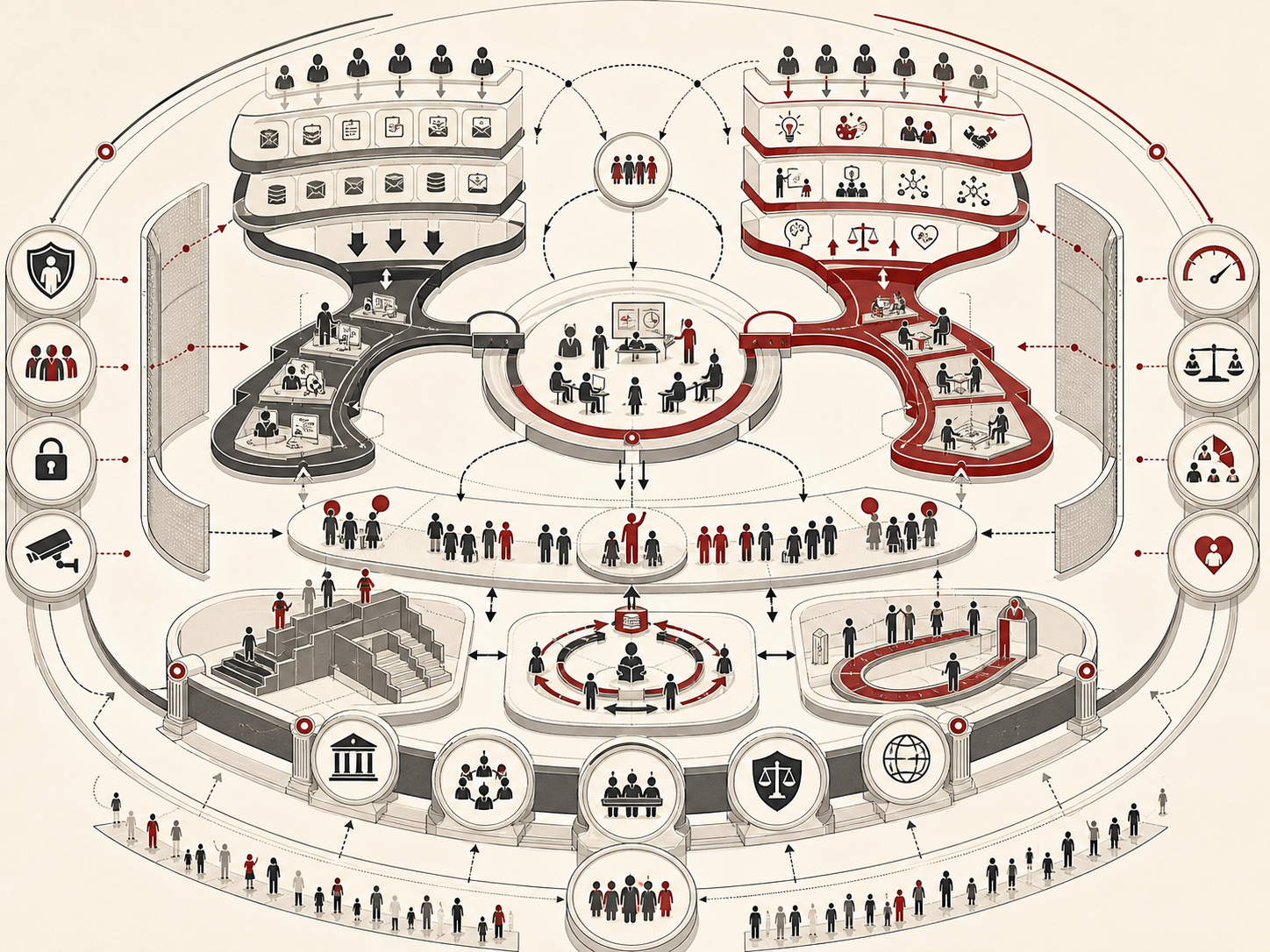
This article develops AI, Labor, Automation, and the Future of Work as an advanced article within the Artificial Intelligence Systems knowledge series. It explains task exposure, automation, augmentation, labor displacement, job redesign, skill change, deskilling, reskilling, algorithmic management, workplace surveillance, job quality, productivity distribution, collective bargaining, labor-market inequality, governance, monitoring, and public accountability. Selected Python and R examples appear here, while the full GitHub repository contains expanded computational scaffolding for task-exposure analysis, automation-versus-augmentation scoring, job-quality monitoring, SQL workforce-governance schemas, documentation templates, and reproducible notebooks.
Why AI and Labor Matter
AI and labor matter because work is not only a source of income. It is also a source of identity, skill, social participation, status, autonomy, discipline, security, and vulnerability. When AI systems change work, they change more than productivity. They change the relationship between people, institutions, machines, and economic power.
The labor-market effects of AI are uneven. Some workers may gain powerful tools that make their work easier, safer, more creative, or more productive. Others may face task displacement, tighter monitoring, lower bargaining power, reduced discretion, or declining entry-level opportunities. Some occupations may be transformed rather than eliminated. Some tasks may be automated while others become more valuable. Some workers may experience AI as assistance; others may experience it as surveillance.
This is why the future of work cannot be understood through a simple question: “Will AI take jobs?” The better question is: which tasks will change, who controls the tools, how are productivity gains distributed, what happens to worker autonomy, who receives training, who bears transition costs, and what governance structures protect dignity, fairness, and security?
AI also matters for labor because it can reshape the hidden architecture of work. It can determine which applications are seen, which workers are scheduled, which tasks are assigned, which calls are flagged, which employees are rated highly, which contractors are deactivated, which writers are evaluated, which drivers receive work, and which professionals are expected to produce more in less time. These changes may happen quietly through dashboards, scoring systems, productivity metrics, and workflow tools rather than through visible layoffs.
The future of work is therefore a public question, not only a managerial one. If AI raises productivity, society must decide whether those gains support wages, reduced working time, safer jobs, better services, broader access, and shared prosperity—or whether they concentrate income and control. Labor governance is one of the central tests of whether AI becomes a tool for human development or a mechanism for institutional extraction.
Foundations of AI, Work, and Automation
AI changes work through task transformation. A job is a bundle of tasks, responsibilities, relationships, and institutional expectations. AI may automate some tasks, augment others, create new tasks, or change the skill level required to perform existing tasks.
Job \neq Task
\]
Interpretation: A job is a bundle of tasks, while AI usually affects specific tasks before it transforms entire occupations.
AI systems may affect work through several mechanisms:
- Automation: replacing human performance of a task with machine performance.
- Augmentation: improving human performance through decision support, retrieval, drafting, prediction, analysis, or simulation.
- Substitution: reducing demand for a worker role because AI performs enough of its tasks.
- Complementarity: increasing demand for workers whose skills become more valuable alongside AI.
- Reorganization: changing workflows, supervision, roles, pacing, documentation, and accountability.
- Monitoring: using AI to evaluate, score, schedule, discipline, or direct workers.
The same AI system may produce different effects depending on workplace design. A writing assistant can support professional judgment, or it can be used to reduce staffing. A scheduling algorithm can improve coordination, or it can impose unpredictable hours. A clinical support system can help workers focus attention, or it can intensify workload. Technology does not determine labor outcomes by itself.
Labor effects are also mediated by institutions. A worker in a unionized workplace with consultation rights, training funds, transparent evaluation rules, and appeal procedures may experience AI differently from a worker in a precarious role with no voice, no visibility into scoring, and no protection from automated discipline. AI capability matters, but governance determines how capability is translated into work.
Labor\ Impact = f(Technology,\ Organization,\ Policy,\ Power)
\]
Interpretation: AI’s labor impact depends on technical capability, organizational design, public policy, and the distribution of power among workers, employers, vendors, and institutions.
Tasks, Not Just Jobs
Task-level analysis is essential because AI exposure is rarely uniform across an occupation. A teacher’s job includes lesson planning, instruction, emotional support, assessment, classroom management, family communication, mentoring, and professional judgment. AI may support planning and feedback while being poorly suited to relational care. A lawyer’s job includes research, drafting, negotiation, advocacy, client counseling, legal judgment, and ethical responsibility. AI may assist research while failing to replace professional accountability.
E_j = \sum_{i=1}^{n} w_i e_i
\]
Interpretation: Job exposure \(E_j\) is the weighted sum of task exposures \(e_i\), where \(w_i\) represents each task’s share of the job.
Task exposure does not equal job loss. A task may be highly exposed to AI and still remain human-supervised because of legal, ethical, contextual, relational, or accountability requirements. Conversely, a task may be only partially automatable but still change staffing levels if organizations redesign work around AI systems.
A serious labor analysis must therefore examine:
- task frequency;
- task importance;
- task automability;
- need for human judgment;
- risk of error;
- relationship to worker autonomy;
- training requirements;
- institutional accountability;
- distribution of productivity gains.
Task analysis also helps prevent misleading occupational narratives. A high-exposure occupation may contain many tasks that AI can assist but few that should be fully automated. A lower-exposure occupation may still experience major disruption if the exposed tasks are central to wages, staffing, training, or career entry. The question is not only how many tasks are exposed, but which tasks are exposed and what role they play in the structure of the job.
| Task Type | AI Effect | Labor Risk | Governance Question |
|---|---|---|---|
| Routine administrative tasks | High automation potential | Job compression or increased throughput expectations | Are productivity gains shared through better work, pay, or reduced burden? |
| Research and information retrieval | High augmentation potential | Overreliance, shallow review, or loss of source literacy | Does AI support judgment or replace verification? |
| Care, teaching, counseling, and mentoring | Selective support potential | Relational work may be undervalued because it is harder to measure | Which human tasks should be protected rather than automated? |
| Evaluation and discipline | Algorithmic management potential | Opaque scoring, bias, surveillance, or automated punishment | Can workers understand, contest, and appeal AI-mediated evaluations? |
| Professional judgment | Decision-support potential | Automation bias, deskilling, and accountability displacement | Who owns the final judgment and how is disagreement handled? |
Note: Task exposure should be interpreted alongside task value, risk, worker autonomy, training function, and institutional accountability.
Automation, Augmentation, and Job Redesign
Automation and augmentation are not fixed properties of a technology. They are outcomes of design. The same capability can be used to replace a task, support a worker, or reorganize a workflow.
An automation-oriented deployment asks: what can the system do instead of workers? An augmentation-oriented deployment asks: what can the system help workers do better, more safely, more creatively, or with less administrative burden?
Impact_{\mathrm{labor}} = f(Capability,\ Workflow,\ Control,\ Governance)
\]
Interpretation: Labor impact depends not only on AI capability, but on workflow design, control over deployment, and governance.
Job redesign should distinguish among:
- tasks to automate: repetitive, low-risk, low-discretion tasks where automation reduces burden;
- tasks to augment: complex tasks where AI supports search, drafting, analysis, or decision support;
- tasks to protect: tasks requiring empathy, accountability, moral judgment, craft, care, safety, or professional responsibility;
- tasks to monitor: tasks where AI may introduce bias, error, surveillance, or deskilling;
- new tasks to create: AI oversight, validation, prompt design, data stewardship, model monitoring, audit, and workflow governance.
The best future-of-work strategies do not ask only how many workers can be replaced. They ask how work should be redesigned to improve productivity, dignity, autonomy, safety, and shared prosperity.
A worker-centered redesign should begin with the work itself. What tasks create value? Which tasks are burdensome but necessary? Which tasks are training grounds for expertise? Which tasks require trust, empathy, or accountability? Which tasks are already poorly designed? AI should not be used to automate a bad workflow without asking why the workflow exists. Automation can lock in poor institutional design if organizations treat technology as a substitute for organizational reform.
Job redesign should also examine the direction of control. AI can give workers more control over information, scheduling, learning, accessibility, and creative output. It can also give management more control over pace, evaluation, discipline, and surveillance. The same system that helps a worker draft a report may also produce metadata used to rank that worker’s productivity. Governance must therefore examine both the visible tool and the managerial use of data generated by the tool.
Skills, Reskilling, Deskilling, and Expertise
AI changes skill demand. Some skills become more valuable: judgment, communication, domain expertise, data literacy, systems thinking, critical evaluation, human-centered design, ethics, governance, and AI oversight. Other skills may be compressed into software workflows. Entry-level tasks that once served as training pathways may be automated, creating a pipeline problem for professional development.
Skill change has two directions:
- Upskilling: workers gain new capabilities by using AI tools effectively.
- Deskilling: workers lose opportunities to practice judgment, craft, problem-solving, or domain reasoning because systems perform too much of the work.
S_{t+1}=S_t + L_t – D_t
\]
Interpretation: Future skill \(S_{t+1}\) depends on current skill \(S_t\), learning \(L_t\), and deskilling pressure \(D_t\).
Reskilling should not be used as a slogan that shifts all transition costs onto workers. If organizations benefit from AI-driven productivity, they should also invest in training, job redesign, mobility pathways, wage progression, and worker participation. A just transition requires institutional responsibility.
The entry-level problem is especially important. Many professions develop expertise through lower-level tasks: junior lawyers review documents, junior analysts clean data, junior writers draft copy, junior engineers debug small components, junior clinicians learn through routine cases, and apprentices practice foundational skills. If AI absorbs these tasks, organizations must deliberately replace the learning function. Otherwise, they may improve short-term productivity while weakening the future expert pipeline.
A responsible skill strategy should include:
- paid training time;
- role-specific AI literacy;
- protected practice for foundational skills;
- clear career pathways into AI-augmented roles;
- participatory job redesign;
- recognition of new oversight and validation tasks;
- support for workers whose tasks are displaced.
Algorithmic Management and Workplace Surveillance
AI affects labor not only by automating tasks but by managing workers. Algorithmic management systems can schedule shifts, assign tasks, monitor productivity, evaluate performance, predict attrition, score applicants, detect anomalies, recommend discipline, and allocate work. These systems can improve coordination, but they can also reduce autonomy, intensify surveillance, and make workplace power less visible.
Workplace AI can create risks in several areas:
- surveillance: excessive monitoring of workers’ time, behavior, communication, movement, or output;
- opacity: workers may not know how scores or evaluations are generated;
- discipline: automated flags may influence punishment or termination;
- bias: performance metrics may disadvantage workers with disabilities, caregiving responsibilities, language differences, or nonstandard work patterns;
- work intensification: optimization may increase pace without increasing compensation;
- loss of voice: workers may lack the ability to challenge algorithmic decisions.
R_{\mathrm{management}} = P_{\mathrm{monitoring}} \times I_{\mathrm{discipline}} \times (1-C_{\mathrm{contestability}})
\]
Interpretation: Risk increases when monitoring is extensive, disciplinary impact is high, and workers lack contestability.
A workplace AI system should therefore include notice, explanation, human review, worker access to records, appeal procedures, privacy limits, and collective governance where appropriate.
Algorithmic management also changes the emotional experience of work. Workers may feel constantly measured, compared, and optimized. A system that tracks keystrokes, call times, delivery speed, customer ratings, facial expressions, location, or response times can produce stress even when no formal discipline occurs. Surveillance is not only a privacy issue. It is a job-quality issue.
Management systems should therefore be evaluated not only for accuracy, but for proportionality. Does the organization need this level of monitoring? Is the data collection necessary? Are workers told how the data are used? Can the system be challenged? Does it increase safety or merely intensify control? Are metrics interpreted in context? Is human judgment preserved before discipline, termination, pay, scheduling, or promotion decisions?
Job Quality, Autonomy, and Worker Wellbeing
AI labor analysis must include job quality, not just employment quantity. A job may remain while becoming worse: more monitored, less autonomous, more precarious, more intense, less skilled, or less secure. Conversely, AI may improve job quality if it reduces repetitive burden, supports safety, expands accessibility, or gives workers better tools.
Job quality includes:
- wages and benefits;
- security and predictability;
- autonomy and discretion;
- skill development;
- health and safety;
- privacy and dignity;
- fair evaluation;
- voice and participation;
- reasonable workload;
- career mobility.
Q_{\mathrm{job}} = \alpha W + \beta A + \gamma S + \delta H + \eta V – \lambda M
\]
Interpretation: Job quality may increase with wages \(W\), autonomy \(A\), skill development \(S\), health and safety \(H\), and worker voice \(V\), while decreasing with excessive monitoring \(M\).
This framing matters because productivity gains alone do not guarantee better work. The same AI deployment may improve output while degrading autonomy, privacy, or skill.
Worker wellbeing should also include workload and pace. AI tools may make some tasks faster, but organizations may respond by increasing expectations. A worker who previously produced five reports per week may be expected to produce fifteen AI-assisted reports with the same or greater review burden. If AI increases the volume of work without increasing time, staffing, compensation, or support, productivity becomes intensification.
A responsible AI labor strategy should monitor whether AI reduces drudgery or simply reallocates pressure. It should ask whether workers have more meaningful work, more control, and better support—or whether they are expected to supervise machine output at an unsustainable pace.
Inequality, Bargaining Power, and Distribution of Gains
AI may increase inequality if gains accrue mainly to owners, platforms, vendors, or highly skilled workers while risks fall on workers with less bargaining power. The labor-market consequences of AI depend on who owns the tools, who controls deployment, who receives training, who captures productivity gains, and who bears displacement costs.
AI can affect inequality through:
- wage polarization;
- reduced demand for some entry-level tasks;
- greater returns to workers who control AI tools;
- concentration of productivity gains in firms or platforms;
- weaker bargaining power for monitored or replaceable workers;
- unequal access to training and transition support;
- regional and sectoral labor-market disruption.
G_{\mathrm{workers}} = \rho \Delta P
\]
Interpretation: Worker gains \(G_{\mathrm{workers}}\) depend on the share \(\rho\) of productivity gains \(\Delta P\) captured by workers.
If \(\rho\) is low, AI may raise productivity while leaving workers with stagnant wages, intensified workloads, or greater insecurity. The future of work therefore depends on labor institutions: wage policy, collective bargaining, worker consultation, social insurance, education, competition policy, and public investment.
Bargaining power is central because technology does not automatically distribute benefits. If workers have voice, legal protections, mobility, and collective leverage, AI can support better work and shared gains. If workers lack power, AI may be used primarily to reduce labor costs, increase monitoring, and transfer risk downward. This is why the future of work must be analyzed through political economy as well as technology.
Worker Voice, Participation, and Collective Governance
Worker participation is essential because workers often understand the real workflow better than executives, vendors, or technical teams. They know where workarounds occur, where data are misleading, where customers or patients need human judgment, where metrics distort behavior, and where automation would create hidden burdens. Excluding workers from AI deployment often produces systems that look efficient on paper but fail in practice.
Worker voice should occur before, during, and after deployment:
- Before deployment: workers should help identify risks, affected tasks, training needs, and unacceptable uses.
- During implementation: workers should participate in pilot testing, workflow redesign, and safeguard development.
- After deployment: workers should have channels to report harms, challenge evaluations, and suggest improvements.
Participation should not be symbolic. If worker consultation cannot change the system, it is not meaningful governance. A serious participation process should document concerns, responses, changes made, and unresolved disagreements. It should include frontline workers, managers, technical teams, worker representatives, accessibility specialists, and groups most likely to be affected by monitoring or task redesign.
Collective governance is especially important for algorithmic management. Individual workers may fear retaliation if they challenge a scoring system, surveillance tool, or scheduling algorithm. Collective mechanisms can create safer channels for contestation, negotiation, and oversight.
Education, Transition, and Training Pathways
AI-driven labor change requires education and transition policy. Workers cannot be expected to absorb technological disruption alone. Training must be accessible, paid, relevant, and connected to real career mobility. A generic AI literacy course is not enough for workers whose tasks are being redesigned or displaced.
A serious transition strategy should include:
- task-level workforce impact assessment;
- role-specific training pathways;
- paid time for learning;
- career ladders into AI-augmented roles;
- support for workers in declining task areas;
- recognition of new governance and oversight responsibilities;
- public investment in education and social protection;
- local and sector-specific transition planning.
Training should also be connected to worker agency. Workers should not merely learn how to use AI tools; they should learn how to question outputs, identify errors, protect privacy, document decisions, preserve professional judgment, and participate in governance. AI literacy should include power literacy: who benefits, who is monitored, who decides, and how workers can challenge harmful uses.
Exposure \rightarrow Assessment \rightarrow Training \rightarrow Redesign \rightarrow Mobility \rightarrow Security
\]
Interpretation: A just transition links AI exposure to assessment, training, job redesign, career mobility, and economic security.
Governance, Monitoring, and Worker Participation
AI workplace governance should begin before deployment. Workers and their representatives should have a role in identifying risks, evaluating use cases, shaping safeguards, and reviewing outcomes. Workplace AI affects the people who must live with its consequences. Governance without worker participation is incomplete.
Governance questions include:
- What workplace problem is the AI system intended to solve?
- Will it automate, augment, monitor, evaluate, or discipline workers?
- What tasks are affected?
- Who gains productivity benefits?
- What training is provided?
- What data are collected about workers?
- Can workers challenge AI-mediated decisions?
- Does the system affect wages, scheduling, promotion, discipline, or termination?
- Are impacts monitored by group, role, location, and employment status?
- What safeguards protect dignity, autonomy, privacy, and job quality?
Monitoring should include:
- task displacement indicators;
- job redesign outcomes;
- wage and productivity distribution;
- worker training access;
- AI acceptance and override rates;
- surveillance intensity;
- discipline or evaluation impacts;
- worker complaints and appeals;
- job-quality measures;
- demographic and occupational disparities.
Consult \rightarrow Assess \rightarrow Redesign \rightarrow Train \rightarrow Monitor \rightarrow Remedy \rightarrow Share\ Gains
\]
Interpretation: Responsible workplace AI requires consultation, assessment, redesign, training, monitoring, remedy, and fair distribution of gains.
Governance should also define prohibited uses. Some AI uses may be inappropriate even if technically feasible: covert worker surveillance, automated discipline without human review, emotion inference for employment decisions, productivity scoring without context, or systems that prevent workers from contesting records used against them. Responsible AI governance should define boundaries before harm occurs.
Common Failure Modes
AI labor deployments often fail because organizations treat work as a set of efficiency problems rather than a human, institutional, and economic system. The following failure modes are especially important.
| Failure Mode | Description | Likely Consequence | Governance Response |
|---|---|---|---|
| Automation-first redesign | The organization asks what can be replaced before asking what work should become. | Job quality, training, and accountability deteriorate. | Use participatory task analysis and augmentation-first design where appropriate. |
| Productivity without sharing | AI raises output but workers do not share gains through wages, time, security, or development. | Inequality and work intensification increase. | Track productivity distribution and negotiate gain-sharing mechanisms. |
| Deskilling by convenience | AI performs foundational tasks workers need for learning. | Future expertise pipeline weakens. | Preserve training tasks, mentorship, and deliberate practice. |
| Surveillance creep | AI tools collect worker data beyond what is necessary for the task. | Privacy, trust, and autonomy decline. | Use data minimization, notice, proportionality review, and worker consultation. |
| Opaque evaluation | Workers are scored, ranked, scheduled, or disciplined through unclear systems. | Unfairness, anxiety, and unchallengeable management power increase. | Provide explanation, records access, human review, and appeal pathways. |
| Training as blame shifting | Workers are told to reskill without paid time, career mobility, or institutional support. | Transition costs fall on workers least able to bear them. | Fund paid training, mobility pathways, and transition protections. |
| Ignoring worker knowledge | AI systems are deployed without frontline input. | Systems misread workflows and create hidden burdens. | Require worker participation before and after deployment. |
Note: Workplace AI governance should evaluate productivity, autonomy, surveillance, skill development, worker voice, and distribution of gains together.
Limits and Open Problems
AI labor analysis faces several open problems. First, exposure is not the same as displacement. A task may be technically automatable but socially, legally, ethically, or operationally unsuitable for automation. Second, productivity gains are difficult to measure at the level of individual workers, teams, firms, sectors, and national economies. Third, labor-market effects unfold over time through hiring, job redesign, wage bargaining, training pipelines, and institutional adaptation.
There is also a measurement problem. Employers may track productivity but not autonomy, wellbeing, surveillance burden, deskilling, or worker voice. Policymakers may see unemployment statistics but miss changes in job quality. Workers may experience AI as pressure long before official statistics reflect displacement.
Finally, there is a political economy problem. AI adoption is not only a technical decision. It is shaped by ownership, capital investment, labor law, market power, public policy, procurement, and social norms. The future of work will be determined by institutions as much as algorithms.
A further challenge is that AI may reshape labor invisibly through expectations rather than immediate job loss. If AI makes faster output possible, employers may raise performance targets. If AI generates drafts, workers may become editors of machine output. If AI makes monitoring cheaper, surveillance may become normalized. These changes can occur gradually, making them harder to regulate or contest.
The practical conclusion is that AI labor governance must be continuous. It should begin before deployment, but it cannot end at launch. Organizations should monitor job quality, training access, workload, wages, worker voice, surveillance, and distribution of gains over time.
Mathematical Lens
A job can be represented as a bundle of tasks:
J = \{t_1,t_2,\ldots,t_n\}
\]
Interpretation: A job \(J\) consists of multiple tasks \(t_i\), each of which may be affected differently by AI.
Task exposure can be represented as:
E_j = \sum_{i=1}^{n} w_i e_i
\]
Interpretation: Job exposure \(E_j\) is the weighted sum of task exposures \(e_i\), with weights \(w_i\) representing task importance or time share.
Automation pressure can be represented as:
A_i = C_i \times R_i \times (1-H_i)
\]
Interpretation: Automation pressure for task \(i\) increases with AI capability \(C_i\) and routineness \(R_i\), and decreases when human judgment \(H_i\) is essential.
Augmentation potential can be represented as:
U_i = C_i \times H_i \times V_i
\]
Interpretation: Augmentation potential for task \(i\) is high when AI capability \(C_i\), human judgment \(H_i\), and task value \(V_i\) are all significant.
Job quality can be represented as:
Q_{\mathrm{job}} = \alpha W + \beta A + \gamma S + \delta H + \eta V – \lambda M
\]
Interpretation: Job quality depends on wages, autonomy, skill development, health and safety, worker voice, and monitoring burden.
Distribution of productivity gains can be represented as:
G_{\mathrm{workers}} = \rho \Delta P
\]
Interpretation: Workers gain from AI productivity improvements only to the extent that institutions allocate a share \(\rho\) of productivity gains \(\Delta P\) to them.
Work intensification can be represented as:
I_{\mathrm{work}} = \frac{Output_{\mathrm{expected}}}{Time_{\mathrm{available}} \times Support_{\mathrm{provided}}}
\]
Interpretation: Work intensification rises when expected output increases faster than available time and organizational support.
A transition-support gap can be represented as:
G_{\mathrm{transition}} = Exposure_{\mathrm{AI}} \times (1-Training_{\mathrm{access}}) \times (1-Mobility_{\mathrm{pathways}})
\]
Interpretation: Transition risk is highest when AI exposure is high and workers lack training access or mobility pathways.
Variables and System Interpretation
| Symbol or Term | Meaning | Typical Type | System Interpretation |
|---|---|---|---|
| \(J\) | Job | bundle of tasks | An occupation or role composed of many activities, responsibilities, and relationships |
| \(t_i\) | Task | work activity | A specific unit of work that may be automated, augmented, protected, or redesigned |
| \(w_i\) | Task weight | time share or importance score | How much task \(i\) contributes to the overall job |
| \(e_i\) | Task exposure | exposure score | Degree to which task \(i\) is exposed to AI capability |
| \(E_j\) | Job exposure | weighted score | Overall AI exposure of job \(j\) |
| \(A_i\) | Automation pressure | task-level score | Pressure to replace human performance of task \(i\) |
| \(U_i\) | Augmentation potential | task-level score | Potential for AI to support rather than replace human performance |
| \(H_i\) | Human judgment requirement | judgment score | Degree to which context, ethics, care, craft, or accountability require human judgment |
| \(Q_{\mathrm{job}}\) | Job quality | composite index | Quality of work after considering wages, autonomy, skill, safety, voice, and monitoring |
| \(\Delta P\) | Productivity gain | change in output or efficiency | Additional productivity associated with AI adoption |
| \(\rho\) | Worker share | distribution parameter | Share of productivity gains captured by workers |
| \(I_{\mathrm{work}}\) | Work intensification | workload-pressure index | Pressure created when output expectations rise relative to time and support |
| \(G_{\mathrm{transition}}\) | Transition-support gap | risk score | Risk that exposed workers lack training and mobility support |
Note: AI labor analysis is meaningful only when task exposure, job redesign, worker power, skill development, job quality, and distribution of gains are examined together.
Worked Example: AI-Assisted Knowledge Work Redesign
Suppose an organization introduces generative AI into a professional services team. The system can summarize documents, draft memos, compare policies, generate code snippets, analyze customer feedback, and produce first drafts of reports. Management sees an opportunity to improve productivity. Workers see both opportunity and risk.
A narrow automation strategy might identify tasks that AI can perform and reduce staffing. A better workforce strategy decomposes the job into tasks:
J = \{\mathrm{research},\mathrm{drafting},\mathrm{review},\mathrm{client\ judgment},\mathrm{coordination},\mathrm{accountability}\}
\]
Interpretation: The job includes tasks with different exposure levels, value, and human judgment requirements.
Research and drafting may have high AI exposure. Client judgment, accountability, negotiation, interpretation, and ethical responsibility may require human expertise. The appropriate design is not simply replacement. It is redesign.
The organization should ask:
- Which tasks should AI assist?
- Which tasks require human review?
- Will entry-level workers still learn foundational skills?
- How will productivity gains be shared?
- Will AI outputs increase review burden?
- Will workers be monitored more closely?
- Can workers challenge AI-mediated evaluation?
- What training is required?
A responsible redesign would automate low-value administrative work, augment research and drafting, protect professional judgment, preserve training pathways, monitor workload, and share productivity gains through compensation, reduced burden, skill development, or improved job quality.
The example also shows why AI governance should include workers early. If management evaluates the tool only through output volume, it may miss hidden review labor. AI-generated drafts may require fact-checking, source verification, editing, client adaptation, and accountability review. A worker-centered assessment would ask whether AI saves time after review, whether it shifts risk onto workers, and whether quality expectations change.
Computational Modeling
Computational modeling can make labor impacts more concrete. A task-exposure workflow can estimate whether tasks are more suitable for automation, augmentation, protection, or redesign. A job-quality workflow can monitor whether AI adoption improves or degrades work. A governance schema can preserve records about use cases, worker consultation, training, monitoring, appeals, and distribution of productivity gains.
The examples below are intentionally lightweight so the article remains readable and WordPress-friendly. The GitHub repository extends the same logic into SQL schemas, workforce impact templates, monitoring workflows, job-quality dashboards, task inventories, and reproducible notebooks.
These workflows do not predict the future of work on their own. They help structure a better inquiry. The goal is to make task exposure, automation pressure, augmentation potential, job quality, training access, and worker voice visible enough to support better decisions.
Python Workflow: Task Exposure and Job Redesign Scoring
"""
AI, Labor, Automation, and the Future of Work Mini-Workflow

This example demonstrates:
1. task-level AI exposure scoring
2. automation pressure
3. augmentation potential
4. job redesign category assignment
5. workforce-governance prioritization

It is educational and uses synthetic data.
"""

from __future__ import annotations

import pandas as pd


tasks = pd.DataFrame({
    "task": [
        "document_summarization",
        "first_draft_generation",
        "client_context_interpretation",
        "quality_review",
        "routine_data_entry",
        "ethical_decision_review",
        "team_coordination",
        "training_and_mentoring"
    ],
    "task_weight": [0.12, 0.14, 0.16, 0.14, 0.10, 0.12, 0.10, 0.12],
    "ai_capability": [0.85, 0.80, 0.45, 0.55, 0.90, 0.30, 0.40, 0.35],
    "routineness": [0.70, 0.60, 0.20, 0.35, 0.90, 0.10, 0.30, 0.20],
    "human_judgment_requirement": [0.35, 0.45, 0.90, 0.80, 0.20, 0.95, 0.75, 0.85],
    "task_value": [0.65, 0.70, 0.95, 0.85, 0.40, 0.95, 0.80, 0.85]
})

tasks["automation_pressure"] = (
    tasks["ai_capability"] *
    tasks["routineness"] *
    (1 - tasks["human_judgment_requirement"])
)

tasks["augmentation_potential"] = (
    tasks["ai_capability"] *
    tasks["human_judgment_requirement"] *
    tasks["task_value"]
)


def classify_task(row: pd.Series) -> str:
    """Assign a governance-oriented redesign category to a task."""
    if (
        row["automation_pressure"] > 0.35 and
        row["human_judgment_requirement"] < 0.40 ): return "candidate_for_careful_automation" if row["augmentation_potential"] > 0.35:
        return "candidate_for_augmentation"

    if row["human_judgment_requirement"] > 0.80:
        return "protect_human_judgment"

    return "redesign_with_monitoring"


tasks["redesign_category"] = tasks.apply(classify_task, axis=1)

job_exposure = (tasks["task_weight"] * tasks["ai_capability"]).sum()
mean_automation_pressure = tasks["automation_pressure"].mean()
mean_augmentation_potential = tasks["augmentation_potential"].mean()

summary = pd.DataFrame({
    "job_exposure": [job_exposure],
    "mean_automation_pressure": [mean_automation_pressure],
    "mean_augmentation_potential": [mean_augmentation_potential]
})

print(tasks)
print(summary)
This workflow helps separate exposure from redesign. A task can have high AI capability but still be better suited to augmentation when human judgment, accountability, or task value remains high. That distinction is essential for avoiding crude automation decisions.
R Workflow: Job Quality and Automation-Risk Monitoring
# AI, Labor, Automation, and the Future of Work Diagnostics
#
# This educational workflow simulates:
# - workplace AI exposure
# - job-quality indicators
# - monitoring burden
# - training access
# - worker voice
# - job-quality scoring

set.seed(42)

n <- 600

workers <- data.frame(
  worker_id = 1:n,
  role_group = sample(
    c("administrative", "technical", "professional", "support"),
    n,
    replace = TRUE,
    prob = c(0.30, 0.25, 0.30, 0.15)
  ),
  ai_exposure = runif(n, 0, 1),
  wage_security = runif(n, 0.30, 1.00),
  autonomy = runif(n, 0.20, 1.00),
  skill_development = runif(n, 0.10, 1.00),
  health_safety = runif(n, 0.40, 1.00),
  worker_voice = runif(n, 0.10, 1.00),
  monitoring_burden = runif(n, 0, 1),
  training_access = runif(n, 0, 1)
)

workers$job_quality_score <-
  0.20 * workers$wage_security +
  0.20 * workers$autonomy +
  0.20 * workers$skill_development +
  0.15 * workers$health_safety +
  0.15 * workers$worker_voice -
  0.10 * workers$monitoring_burden

workers$transition_priority <- ifelse(
  workers$ai_exposure > 0.60 &
    workers$training_access < 0.50 &
    workers$job_quality_score < 0.50,
  1,
  0
)

summary_table <- aggregate(
  cbind(
    ai_exposure,
    job_quality_score,
    monitoring_burden,
    training_access,
    transition_priority
  ) ~ role_group,
  data = workers,
  FUN = mean
)

print(summary_table)
This workflow treats job quality as a governance metric. If AI exposure is high, training access is low, monitoring burden is high, and job quality is weak, the organization should not treat the deployment as a success merely because output increased.
GitHub Repository
The article body includes selected computational examples so the conceptual and mathematical argument remains readable. The full repository contains expanded computational infrastructure for task-exposure scoring, automation-versus-augmentation analysis, job-quality monitoring, workforce-governance schemas, SQL labor-impact tables, Rust and Go examples, Julia sensitivity analysis, TypeScript validation, C++ scoring, documentation templates, and reproducible notebooks.
Complete Code RepositoryThe full code distribution for this article includes Python, R, SQL, Rust, Go, Julia, TypeScript, C++, documentation templates, and advanced notebooks for studying AI labor impacts, task exposure, automation pressure, augmentation potential, job quality, worker voice, and workforce-governance monitoring.
From Automation to Labor Governance
AI, labor, automation, and the future of work show why the central question is not simply whether AI will create or destroy jobs. The deeper question is how AI reorganizes tasks, skills, autonomy, surveillance, productivity, wages, bargaining power, and institutional responsibility.
The future of work will not be determined by model capability alone. It will be shaped by workplace governance, public policy, education, collective bargaining, labor standards, competition, procurement, and the distribution of productivity gains. AI can be used to support better work, or it can be used to intensify control. It can expand expertise, or it can deskill workers. It can reduce burden, or it can increase surveillance. It can create shared prosperity, or it can concentrate power.
The ethical and economic challenge is to move from automation as replacement to AI as governed workplace transformation. That means asking not only what the technology can do, but what kind of work society wants to preserve, what kind of work should be improved, what risks workers should not have to bear alone, and how productivity gains should be shared.
Within the Artificial Intelligence Systems knowledge series, this article belongs near AI, Expertise, and Human Judgment, AI Ethics, Human Rights, and Public Accountability, Human Oversight, Contestability, and AI Accountability, AI Risk Registers, Model Cards, and Audit Documentation, Model Monitoring, Drift, and AI Observability, and AI Governance and Regulatory Systems. It provides the labor and institutional-design layer for understanding how AI systems should be governed in the workplace.
Related Articles
- Artificial Intelligence Systems
- AI, Expertise, and Human Judgment
- AI Ethics, Human Rights, and Public Accountability
- Human Oversight, Contestability, and AI Accountability
- AI Risk Registers, Model Cards, and Audit Documentation
- Model Monitoring, Drift, and AI Observability
- AI Governance and Regulatory Systems
Further Reading
- ILO (2025) Generative AI and Jobs: A Refined Global Index of Occupational Exposure. Available at: https://www.ilo.org/publications/generative-ai-and-jobs-refined-global-index-occupational-exposure
- ILO (2023) Generative AI and Jobs: A Global Analysis of Potential Effects on Job Quantity and Quality. Available at: https://www.ilo.org/publications/generative-ai-and-jobs-global-analysis-potential-effects-job-quantity-and-quality
- OECD (ongoing) AI and Work. Available at: https://www.oecd.org/en/topics/sub-issues/ai-and-work.html
- OECD (2024) Artificial Intelligence and the Changing Demand for Skills in the Labour Market. Available at: https://www.oecd.org/en/publications/artificial-intelligence-and-the-changing-demand-for-skills-in-the-labour-market_88684e36-en.html
- World Economic Forum (2025) The Future of Jobs Report 2025. Available at: https://www.weforum.org/publications/the-future-of-jobs-report-2025/
- NIST (2023) Artificial Intelligence Risk Management Framework. Available at: https://www.nist.gov/itl/ai-risk-management-framework
- Autor, D.H. (2015) ‘Why Are There Still So Many Jobs? The History and Future of Workplace Automation’, Journal of Economic Perspectives, 29(3), pp. 3–30. Available at: https://www.aeaweb.org/articles?id=10.1257/jep.29.3.3
- Acemoglu, D. and Restrepo, P. (2019) ‘Automation and New Tasks: How Technology Displaces and Reinstates Labor’, Journal of Economic Perspectives, 33(2), pp. 3–30. Available at: https://www.aeaweb.org/articles?id=10.1257/jep.33.2.3
References
- Acemoglu, D. and Restrepo, P. (2019) ‘Automation and New Tasks: How Technology Displaces and Reinstates Labor’, Journal of Economic Perspectives, 33(2), pp. 3–30. Available at: https://www.aeaweb.org/articles?id=10.1257/jep.33.2.3
- Autor, D.H. (2015) ‘Why Are There Still So Many Jobs? The History and Future of Workplace Automation’, Journal of Economic Perspectives, 29(3), pp. 3–30. Available at: https://www.aeaweb.org/articles?id=10.1257/jep.29.3.3
- ILO (2023) Generative AI and Jobs: A Global Analysis of Potential Effects on Job Quantity and Quality. International Labour Organization. Available at: https://www.ilo.org/publications/generative-ai-and-jobs-global-analysis-potential-effects-job-quantity-and-quality
- ILO (2025) Generative AI and Jobs: A Refined Global Index of Occupational Exposure. International Labour Organization. Available at: https://www.ilo.org/publications/generative-ai-and-jobs-refined-global-index-occupational-exposure
- NIST (2023) Artificial Intelligence Risk Management Framework (AI RMF 1.0). National Institute of Standards and Technology. Available at: https://www.nist.gov/itl/ai-risk-management-framework
- OECD (2024) Artificial Intelligence and the Changing Demand for Skills in the Labour Market. Organisation for Economic Co-operation and Development. Available at: https://www.oecd.org/en/publications/artificial-intelligence-and-the-changing-demand-for-skills-in-the-labour-market_88684e36-en.html
- OECD (ongoing) AI and Work. Organisation for Economic Co-operation and Development. Available at: https://www.oecd.org/en/topics/sub-issues/ai-and-work.html
- World Economic Forum (2025) The Future of Jobs Report 2025. Available at: https://www.weforum.org/publications/the-future-of-jobs-report-2025/