
Last Updated May 10, 2026
Transfer learning, fine-tuning, and model adaptation explain how artificial intelligence systems reuse learned representations, pretrained parameters, and general capabilities in new domains, tasks, environments, and institutional contexts. Instead of training every model from scratch, modern AI systems increasingly begin with a pretrained foundation: an image encoder, language model, multimodal model, scientific model, recommender model, or general representation system. Adaptation then reshapes that foundation for a more specific task.
This shift is one of the defining features of contemporary AI. A model trained on large-scale general data may later be adapted for legal search, medical classification, environmental monitoring, software assistance, scientific discovery, industrial inspection, educational tutoring, content moderation, or organizational knowledge retrieval. The key question is no longer only how a model learns, but how prior learning transfers—and when transfer helps, fails, or causes harm.
Transfer learning is powerful because it reduces data requirements, lowers training costs, improves performance in low-data settings, and allows AI systems to reuse broad representations. But adaptation is also a systems problem. A model adapted to a new domain may inherit biases from pretraining data, overfit to a narrow dataset, forget prior capabilities, expose privacy risks, or appear competent outside its valid operating range. Fine-tuning therefore requires evaluation, governance, documentation, versioning, monitoring, and rollback mechanisms.
Main Library
Publications
Article Map
Artificial Intelligence Systems
Related Topic
Data Systems & Analytics
Related Topic
Institutions & Governance
Related Topic
Risk & Resilience
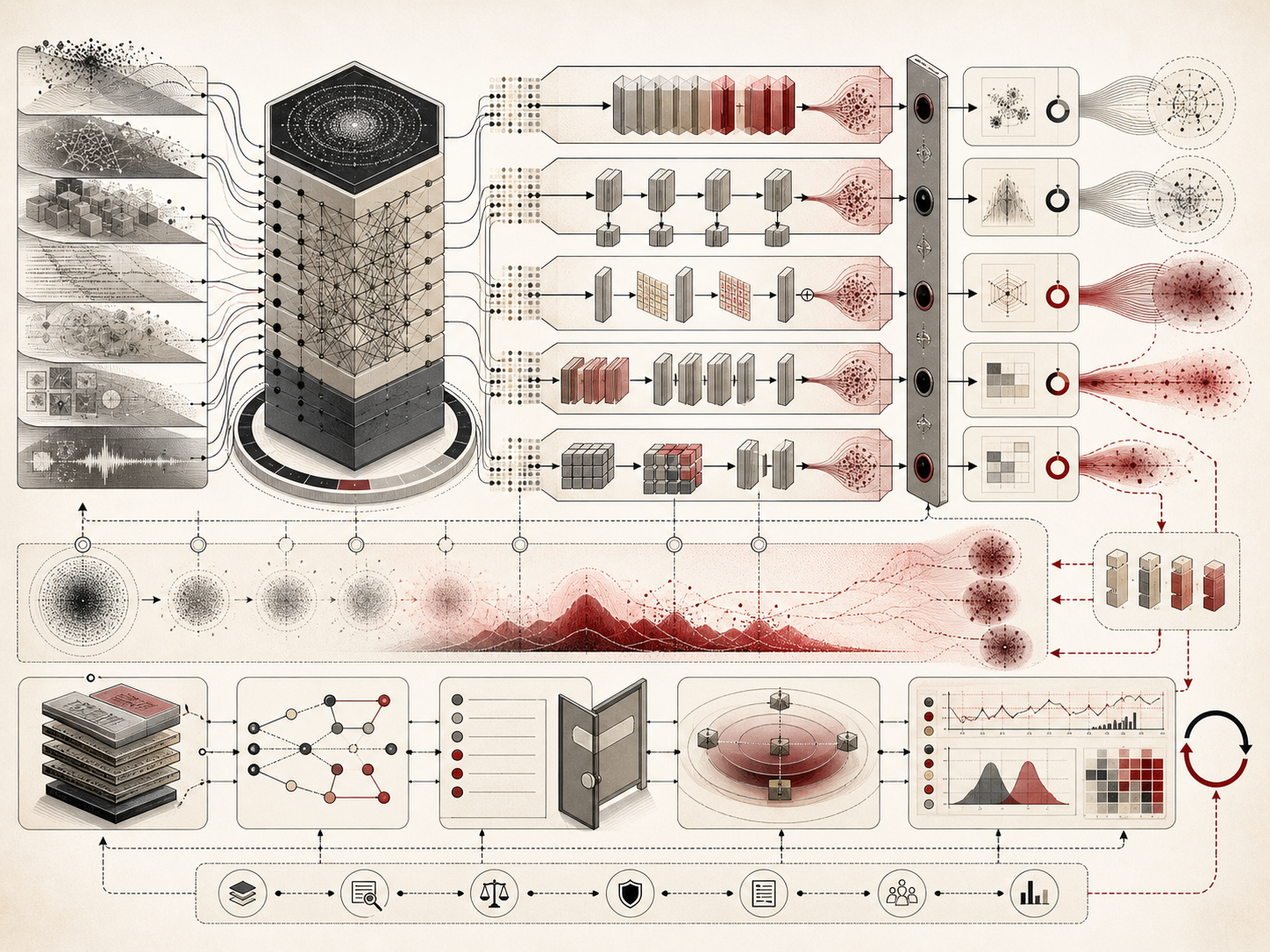
This article develops Transfer Learning, Fine-Tuning, and Model Adaptation as an advanced article within the Artificial Intelligence Systems knowledge series. It explains source and target domains, pretrained representations, transfer gain, domain adaptation, distribution shift, full fine-tuning, regularized fine-tuning, parameter-efficient methods, LoRA, adapters, prefix-tuning, QLoRA, catastrophic forgetting, negative transfer, evaluation, deployment risk, model sprawl, versioning, monitoring, and institutional accountability. Selected Python and R examples appear here, while the full GitHub repository contains expanded computational scaffolding for adaptation experiment review, fine-tuning risk scoring, transfer-gain analysis, source-retention testing, SQL schemas, documentation templates, and reproducible notebooks.
Why Transfer Learning Matters
Transfer learning matters because many real-world AI tasks do not have enough labeled data to support training from scratch. A hospital may not have millions of labeled clinical cases for every prediction task. A city may not have enough infrastructure failure examples for every asset type. A scientific team may have limited experimental measurements. A company may have a small internal corpus, a specialized vocabulary, or a narrow classification need. Transfer learning allows these systems to begin from general learned structure and adapt to the target problem.
The basic idea is simple: knowledge learned in one setting can help learning in another. In AI systems, this knowledge may take the form of pretrained weights, feature extractors, embedding spaces, language representations, vision backbones, multimodal encoders, domain-general patterns, or task-specific adapters. The source task or source domain provides reusable structure. The target task or target domain provides adaptation pressure.
Transfer learning is one reason modern AI systems scale across domains. A large language model can be instruction-tuned for dialogue. A vision model pretrained on general images can be fine-tuned for medical imaging or industrial inspection. A sentence embedding model can be adapted for legal, scientific, or organizational search. A speech model can be adapted for accents, acoustic environments, or specialized terminology. Transfer turns AI from one-off model training into a reusable systems strategy.
Transfer learning also changes what institutions must govern. The adapted model is shaped by both its source history and its target data. A fine-tuned model is not a clean new system; it is a new system state created from inherited representations, new training examples, changed parameters, updated prompts, adapters, evaluation gates, and deployment boundaries. The source matters, the target matters, and the adaptation method matters.
Transfer \neq Guaranteed\ Improvement
\]
Interpretation: Transfer learning can improve performance, reduce data needs, and lower cost, but it can also introduce negative transfer, overfitting, forgetting, bias inheritance, and deployment risk.
The strategic value of transfer learning is therefore not only efficiency. It is a way to build AI systems from reusable foundations while preserving enough evaluation discipline to know when reuse is valid, when specialization is dangerous, and when the adapted model should be restricted, reviewed, or rolled back.
Transfer Learning Foundations
Traditional supervised learning often assumes that training and test data come from the same distribution. Transfer learning relaxes that assumption. It asks how a model trained under one distribution, task, or domain can be reused when the target setting differs. This is central to modern AI because models are rarely trained and deployed in perfectly matched conditions.
Several transfer settings are common:
- inductive transfer learning: the source and target tasks differ, but knowledge from the source helps the target task;
- transductive transfer learning: the source and target domains differ, but the task may be similar;
- unsupervised transfer learning: the target setting has little or no labeled data;
- domain adaptation: the model adapts from a source domain to a related target domain with a shifted data distribution;
- multi-task learning: a model learns multiple tasks jointly so that shared structure improves generalization;
- continual adaptation: a model updates over time as domains, tasks, or environments change.
In contemporary AI, transfer learning is often built into the full model lifecycle. Pretraining learns broad structure. Fine-tuning adapts to downstream tasks. Parameter-efficient methods adapt models without updating all parameters. Evaluation checks whether transfer improved target performance without introducing unacceptable failure modes. Monitoring checks whether the adapted model remains valid after deployment.
| Transfer Setting | What Changes? | Example | Governance Question |
|---|---|---|---|
| Inductive transfer | The target task differs from the source task. | A language model pretrained on text is fine-tuned for sentiment, extraction, or question answering. | Does the adapted model perform well on the intended task without losing important base capabilities? |
| Domain adaptation | The domain distribution shifts while the task may remain similar. | A model trained on general documents is adapted for legal, scientific, or policy documents. | Does the source representation remain valid under target-domain language and evidence? |
| Unsupervised adaptation | Target labels are limited or unavailable. | Adapting embeddings using unlabeled target-domain documents. | How is improvement validated without strong target labels? |
| Multi-task learning | Several tasks are trained jointly. | A model learns classification, extraction, and summarization together. | Do tasks help one another or create hidden tradeoffs? |
| Continual adaptation | The model updates as new data or domains appear. | A deployed system adapts to changing user queries or policy language. | How are drift, forgetting, rollback, and version history managed? |
Note: Transfer learning is not one method. It is a family of reuse strategies shaped by source data, target data, task differences, domain shift, and deployment constraints.
Transfer learning depends on relatedness. If the source and target settings share useful structure, transfer can help. If they differ in misleading ways, transfer can hurt. A general-purpose language model may transfer well to many document tasks, but poorly to a domain with specialized terminology, new regulatory meaning, minority-language variation, or high-stakes factual requirements. The transfer question is always contextual: which knowledge transfers, which assumptions do not, and what evidence shows the difference?
Fine-Tuning as Controlled Model Adaptation
Fine-tuning adapts a pretrained model by training it further on target data. In full fine-tuning, all or most model parameters are updated. In partial fine-tuning, only selected layers are updated. In parameter-efficient fine-tuning, the pretrained model may remain mostly frozen while small trainable modules, low-rank updates, prompts, prefixes, or adapters are learned.
Fine-tuning is powerful because pretrained models often contain broadly useful features. A language model pretrained on large text corpora may already encode grammar, semantic associations, discourse structure, and many task patterns. A vision model pretrained on large image datasets may already encode edges, textures, object parts, and visual categories. Fine-tuning shifts these representations toward the target task.
However, fine-tuning is not automatic improvement. The target dataset may be too small, biased, noisy, stale, or unrepresentative. The model may overfit. The adapted model may perform well on target validation data while losing general capabilities. It may become more confident but less robust. It may encode institutional artifacts rather than true domain structure. Fine-tuning should therefore be treated as a controlled intervention on a model system.
| Fine-Tuning Choice | Purpose | Potential Benefit | Risk if Ungoverned |
|---|---|---|---|
| Target dataset selection | Defines what the adapted model learns from. | Improves domain fit and task specificity. | Overfitting to narrow, biased, stale, or noisy examples. |
| Parameter update scope | Determines which parts of the model change. | Controls specialization and cost. | Forgetting, instability, or insufficient adaptation. |
| Regularization | Limits movement away from the pretrained model. | Reduces overfitting and forgetting. | May prevent useful target specialization if too strong. |
| Validation design | Tests target-domain improvement. | Detects whether fine-tuning helped. | False confidence from narrow or leaked validation sets. |
| Regression testing | Checks whether previous capabilities remain intact. | Detects catastrophic forgetting. | Adapted model degrades outside the target benchmark. |
| Deployment scope | Defines where the adapted model may be used. | Matches model behavior to approved context. | Model is reused outside its validated domain. |
Note: Fine-tuning creates a new model state. That state needs its own evaluation record, version identity, deployment boundary, and rollback path.
Fine\text{-}Tuning = Specialization + Regression\ Risk
\]
Interpretation: Fine-tuning can improve target performance, but it can also reduce generality, robustness, calibration, or safety unless regression testing is part of the workflow.
Fine-tuning should therefore be judged by a portfolio of evidence: target performance, transfer gain, source retention, robustness, calibration, fairness, privacy, security, cost, latency, and governance readiness. A model that improves one metric while degrading safety or generality may not be a better system.
Pretraining and Reusable Representations
Pretraining creates reusable representations before a model is adapted to a narrower target task. In natural language processing, pretraining may involve language modeling, masked token prediction, next-token prediction, contrastive learning, or instruction-following objectives. In computer vision, pretraining may involve image classification, contrastive visual learning, masked image modeling, or multimodal alignment. In scientific modeling, pretraining may use sequences, structures, simulations, measurements, or domain-specific representations.
The value of pretraining depends on transferability. A pretrained model is useful when its learned features remain relevant to the target setting. Low-level visual features may transfer across many image tasks. General language representations may transfer across classification, search, extraction, summarization, and dialogue tasks. Multimodal representations may transfer across retrieval, captioning, visual question answering, and generation.
Pretraining also creates dependency. If the pretraining corpus contains bias, low-quality data, outdated knowledge, privacy-sensitive material, or domain imbalance, those patterns may influence downstream adaptation. Fine-tuning may reduce some errors, but it does not erase the pretrained model’s history. Adaptation begins from inherited structure.
| Pretraining Asset | What It Provides | Downstream Benefit | Inherited Risk |
|---|---|---|---|
| Language representations | Semantic, syntactic, discourse, and world-pattern structure. | Supports classification, search, summarization, extraction, generation. | Bias, misinformation, stale associations, memorization, weak grounding. |
| Vision backbones | Reusable visual features and spatial structure. | Supports classification, segmentation, detection, inspection. | Dataset imbalance, domain mismatch, sensor conditions, rare-case failure. |
| Multimodal encoders | Shared representation across language, image, audio, or video. | Supports cross-modal retrieval and generation. | Noisy alignment, incomplete captions, privacy, and stereotype propagation. |
| Scientific foundation models | Domain structure from molecules, proteins, climate data, or sensors. | Supports scientific discovery and simulation support. | Physical invalidity, narrow data regimes, uncertainty gaps. |
| Embedding models | Similarity spaces for retrieval, clustering, and search. | Supports knowledge systems and semantic navigation. | Similarity may not equal authority, freshness, or evidential support. |
Note: Pretraining creates useful structure, but downstream systems inherit both capability and risk from the source model.
Reusable representations make modern AI efficient, but they also make source documentation more important. An adapted system may be evaluated on the target task, yet unexplained source assumptions can still affect behavior. Teams should therefore preserve model lineage: base model, data source, pretraining objective, version, adaptation method, target data, evaluation record, and deployment scope.
Domain Adaptation and Distribution Shift
Domain adaptation addresses the problem that a model trained in one setting may be deployed in another. A model trained on general documents may be used for legal filings. A model trained on urban infrastructure data may be used in rural regions. A vision model trained on clear images may be deployed under fog, glare, dust, or sensor noise. A speech model trained on one accent distribution may be deployed across many accents and acoustic environments.
Distribution shift can occur in several ways:
- covariate shift: input distribution changes while the task relationship may remain similar;
- label shift: class proportions change across domains;
- concept shift: the relationship between inputs and outputs changes;
- context shift: institutional, cultural, temporal, or environmental conditions change;
- measurement shift: sensors, labels, forms, or collection processes change.
Adaptation methods attempt to reduce the gap between source and target domains. Some methods reweight examples. Others learn domain-invariant representations. Some use unlabeled target data. Others rely on small amounts of labeled target data. In modern AI systems, retrieval, prompt adaptation, fine-tuning, and parameter-efficient methods may all be used to adapt to target settings.
| Shift Type | What Changes? | Example | Adaptation Concern |
|---|---|---|---|
| Covariate shift | Input distribution changes. | Inspection images are taken under different lighting or sensor conditions. | Model may rely on visual or textual patterns absent in target setting. |
| Label shift | Outcome or class proportions change. | Rare events become more common under new climate or operational conditions. | Predicted probabilities and thresholds may become unreliable. |
| Concept shift | Relationship between inputs and outputs changes. | A policy term changes meaning after a regulation update. | Past labels no longer represent current meaning. |
| Context shift | Institutional, cultural, geographic, or temporal setting changes. | A model adapted in one jurisdiction is used in another. | Local norms, law, infrastructure, or language invalidate assumptions. |
| Measurement shift | Data collection process changes. | New sensors, forms, annotation rules, or record systems are introduced. | The model may interpret measurement artifacts as real patterns. |
Note: Domain adaptation should identify what kind of shift is present. Different shifts require different validation, monitoring, and governance responses.
P_S(x,y) \neq P_T(x,y)
\]
Interpretation: Source and target distributions may differ. Transfer is useful only if the learned source structure remains relevant under target conditions.
Distribution shift should not be treated only as a technical nuisance. In many institutional systems, shift reflects social, legal, ecological, or operational change. A model adapted to one population, infrastructure system, legal standard, or environmental regime may not be valid elsewhere. Governance should define where the adapted model is allowed to operate and how drift will be detected.
Parameter-Efficient Fine-Tuning
As pretrained models grow larger, full fine-tuning becomes expensive. It may require substantial compute, memory, storage, and deployment infrastructure. Maintaining a separate fully fine-tuned copy of a large model for every task can be impractical. Parameter-efficient fine-tuning addresses this by adapting only a small number of parameters while reusing the frozen base model.
Parameter-efficient methods have several systems advantages:
- lower training cost;
- lower storage cost per adapted task;
- faster experimentation;
- modular task specialization;
- easier rollback and version control;
- less risk of overwriting base-model capabilities;
- practical adaptation on smaller hardware.
These advantages make parameter-efficient adaptation important for institutions that need specialized AI systems without building or hosting many full model copies. However, efficiency does not eliminate risk. A small adapter can still create harmful behavior, overfit to bad data, encode sensitive information, or degrade performance in unexpected contexts.
| Adaptation Approach | What Changes? | Strength | Governance Risk |
|---|---|---|---|
| Full fine-tuning | Most or all model parameters are updated. | High adaptation capacity. | Higher cost, stronger forgetting risk, separate model version burden. |
| Partial fine-tuning | Selected layers or task heads are updated. | Balances adaptation and stability. | Layer choices may be poorly justified or under-tested. |
| Adapter tuning | Small inserted modules are trained. | Modular, reusable, lower storage burden. | Adapter sprawl and configuration confusion. |
| LoRA-style tuning | Low-rank updates are trained for selected matrices. | Efficient specialization for large models. | Low-rank updates still require safety and regression testing. |
| Prompt or prefix tuning | Learned prompts or prefixes condition the frozen model. | Low parameter count and fast adaptation. | Behavior may be brittle or hard to interpret. |
Note: Parameter-efficient adaptation reduces cost and version burden, but it does not remove the need for evaluation, documentation, access control, and monitoring.
Parameter-efficient methods can also support governance when designed carefully. A base model can remain frozen, while each task-specific adapter has its own version, scope, evaluation record, and approval status. This modularity can make rollback easier. But it can also create configuration complexity: which adapter is active, which base model version it expects, which dataset trained it, which tasks it is approved for, and whether it has expired.
LoRA, Adapters, Prefix-Tuning, and QLoRA
Several parameter-efficient adaptation methods are widely used. They differ in where they place trainable capacity, how they interact with the frozen base model, and what tradeoffs they create among cost, flexibility, interpretability, and deployment risk.
Adapters insert small trainable modules into a pretrained network while keeping most base parameters frozen. Each task can have its own adapter, making adaptation modular. This supports task-specific specialization without storing a full model copy per task.
LoRA freezes the original model weights and learns low-rank updates for selected weight matrices. Instead of updating all parameters, LoRA learns small matrices whose product approximates a useful weight change. This is especially important for adapting large transformer models efficiently.
Prefix-tuning keeps the main model fixed and learns continuous task-specific prefix vectors. These vectors act like virtual tokens that condition generation. Prefix-tuning is closely related to prompting, but the prompt is learned rather than manually written.
QLoRA combines quantization with low-rank adaptation. It allows large models to be adapted with lower memory requirements by backpropagating through a frozen quantized model into low-rank adapters. This made fine-tuning very large models more accessible under constrained hardware.
| Method | Core Mechanism | Best Use | Risk to Monitor |
|---|---|---|---|
| Adapters | Insert small trainable modules between existing layers. | Many task-specific variants sharing one base model. | Adapter sprawl, compatibility, and unclear deployment scope. |
| LoRA | Train low-rank updates to selected weight matrices. | Efficient adaptation of large transformer models. | Target-task overfitting and regression outside target domain. |
| Prefix-tuning | Learn continuous prefix vectors that condition the model. | Generation tasks where base model remains frozen. | Brittle behavior and limited interpretability of learned prefixes. |
| Prompt tuning | Learn soft prompts or task-conditioning vectors. | Low-cost task adaptation. | Weak robustness under prompt variation or distribution shift. |
| QLoRA | Combine quantization with low-rank adaptation. | Adapting large models under memory constraints. | Quantization artifacts, compatibility, and evaluation gaps. |
Note: Efficient adaptation methods should be governed as deployed model components, not treated as harmless configuration files.
These methods illustrate a larger architectural shift: adaptation is becoming modular. Instead of one monolithic fine-tuned model, systems may use a base model plus task-specific adapters, domain adapters, retrieval layers, prompts, policies, and evaluation controls. This modularity improves flexibility, but it also increases the need for configuration governance.
Base\ Model + Adapter + Policy + Retrieval \rightarrow Deployed\ Behavior
\]
Interpretation: Deployed behavior emerges from the full configuration, not from the base model alone. Each adaptation component should be versioned and evaluated.
Catastrophic Forgetting and Negative Transfer
Fine-tuning changes a model. That change can improve target performance while degrading other capabilities. Catastrophic forgetting occurs when new training overwrites useful prior knowledge. Negative transfer occurs when source knowledge harms target performance. Both are central risks in adaptation.
Forgetting may appear when a model adapted to a narrow domain loses general reasoning, language fluency, safety behavior, multilingual ability, calibration, or robustness. Negative transfer may appear when the source domain is misleading, when target data is too different, or when the model learns spurious shortcuts from small target datasets.
Mitigation strategies include:
- holding out target and source evaluation sets;
- regularizing against large weight changes;
- freezing lower layers;
- using adapters or LoRA rather than full fine-tuning;
- mixing source and target data carefully;
- monitoring general capability benchmarks;
- checking calibration and robustness after adaptation;
- using rollback and version control for adapted models.
The deeper principle is that adaptation should be evaluated as a tradeoff. A model can become more specialized and less general at the same time. Whether that tradeoff is acceptable depends on the system’s purpose.
| Failure Risk | What Happens? | Warning Signal | Control |
|---|---|---|---|
| Catastrophic forgetting | The adapted model loses useful prior capabilities. | Regression on source-domain or general benchmark tests. | Source retention testing, regularization, adapters, rollback. |
| Negative transfer | Transfer performs worse than baseline or training from scratch. | Target performance below base or simple model baseline. | Baseline comparison and target-domain validation. |
| Overfitting | The model memorizes narrow target examples. | High validation variance, poor out-of-domain performance. | Data review, regularization, cross-validation, stress testing. |
| Calibration drift | Confidence no longer matches reliability. | Worse Brier score, reliability curves, or ECE. | Post-adaptation calibration review and monitoring. |
| Safety regression | Fine-tuning weakens refusal, security, or harmful-output behavior. | Red-team failures or unsafe outputs after adaptation. | Safety evaluation before deployment approval. |
| Scope creep | An adapted model is used outside its validated domain. | Unapproved deployment context or user group. | Deployment registry, access controls, and use limitations. |
Note: Adaptation should be evaluated for what improved and what degraded. Target gain alone is not enough.
Target\ Gain – Source\ Regression = Adaptation\ Tradeoff
\]
Interpretation: A fine-tuned model should be judged by the balance between target improvement and degradation of retained capabilities, safety, calibration, and robustness.
Evaluating Adapted Models
Adapted models should be evaluated across target performance, source capability retention, robustness, calibration, fairness, safety, operational efficiency, and governance readiness. A fine-tuned model should not be approved solely because one target metric improves. It should be compared against the base model, a simple baseline, prior adapted versions, and, where feasible, a model trained from scratch.
| Evaluation Dimension | Question | Example Measure | Governance Relevance |
|---|---|---|---|
| Target performance | Did adaptation improve the intended task? | Accuracy, F1, AUC, RMSE, task success. | Tests whether adaptation achieved its stated purpose. |
| Transfer gain | Did transfer beat a baseline? | Performance delta versus scratch, zero-shot, or simple baseline. | Detects helpful transfer or negative transfer. |
| Capability retention | Did the model forget useful prior capabilities? | General benchmark regression, source-domain holdout tests. | Identifies catastrophic forgetting. |
| Robustness | Does the adapted model handle perturbations and shift? | Stress tests, out-of-domain tests, adversarial examples. | Prevents narrow validation overconfidence. |
| Calibration | Are probabilities reliable after adaptation? | Brier score, reliability curves, expected calibration error. | Supports trustworthy thresholds and decision rules. |
| Fairness | Did adaptation change subgroup performance? | Group metrics, error gaps, allocation review. | Detects unequal harm introduced by target data. |
| Safety | Did adaptation weaken safeguards? | Safety benchmarks, red-team tests, policy checks. | Prevents target specialization from bypassing safety behavior. |
| Efficiency | Is adaptation practical to train and deploy? | Trainable parameter count, memory use, latency, storage. | Determines operational feasibility and cost. |
| Governance readiness | Is the adapted model documented and reviewable? | Model card, data record, version log, approval record. | Makes the adapted system accountable. |
Note: Adaptation evaluation should include both improvement and regression. A model that improves one target metric may still be unsafe for deployment.
Evaluation should include comparison points. A fine-tuned model should be compared against the base model, a simple baseline, a fully trained model if feasible, and previous adapted versions. Without baselines, it is difficult to know whether adaptation helped or merely changed the model.
Evaluation should also include realistic target conditions. If the adapted model will operate across jurisdictions, populations, document types, sensor conditions, languages, or user groups, validation should include those slices. A target-domain score averaged across all examples may hide severe failure in a subgroup, rare event, or high-impact scenario.
Evaluation = Target\ Performance + Retention + Robustness + Safety
\]
Interpretation: Adapted models require multidimensional evaluation because specialization can improve task metrics while degrading other system properties.
Governance, Versioning, and Deployment Risk
Model adaptation creates governance complexity. Each adapted model or adapter may have its own data, objective, training process, evaluation record, approval status, and deployment scope. Organizations need to know which base model was used, which adaptation method was applied, which target data was included, which parameters were updated, which evaluation tests passed, and where the adapted model is deployed.
A responsible adaptation workflow should document:
- base model name and version;
- adaptation method;
- target dataset provenance;
- training configuration;
- trainable parameter count;
- evaluation results before and after adaptation;
- known limitations and prohibited uses;
- human review and approval records;
- deployment environment;
- monitoring plan;
- rollback procedure.
This is especially important when multiple adapters, fine-tuned variants, or domain-specific models are deployed at once. Adaptation can become a form of model sprawl. Without governance, organizations may lose track of which model is used for which purpose, which version is current, which dataset shaped behavior, and which risks were accepted.
| Governance Record | What It Captures | Why It Matters | Failure if Missing |
|---|---|---|---|
| Base model lineage | Model name, version, provider, pretraining notes, known limitations. | Shows what the adapted model inherited. | Teams cannot trace source risks or compatibility. |
| Target data record | Dataset provenance, labeling rules, date, scope, sensitivity, quality. | Defines adaptation evidence. | Bias, leakage, or stale data cannot be diagnosed. |
| Training configuration | Hyperparameters, update scope, regularization, adapter settings. | Supports reproducibility and review. | Adaptation cannot be replicated or audited. |
| Evaluation report | Target performance, retention, robustness, calibration, safety, fairness. | Determines approval readiness. | Deployment decisions rest on incomplete evidence. |
| Version registry | Which adapted model or adapter is active where. | Prevents model sprawl and configuration confusion. | Wrong model version may be deployed or retained. |
| Rollback plan | How to restore prior approved behavior. | Supports incident response. | Teams cannot recover quickly from failed adaptation. |
Note: Fine-tuning and adapter deployment should be treated as controlled releases, not informal experiments once they affect users or workflows.
Adapted\ Model = Base\ Model + Target\ Data + Method + Version
\]
Interpretation: An adapted model is a traceable system state. Its behavior depends on lineage, target data, adaptation method, and configuration version.
Governance should also distinguish research adaptation from operational deployment. A fine-tuned model may be acceptable for experimentation but not for user-facing advice, automated decisions, regulated workflows, or high-impact classification. Approval should be tied to scope: which task, which users, which data, which domain, which version, and which monitoring plan.
Common Failure Modes
Transfer learning, fine-tuning, and model adaptation often fail when improvement on a target validation set is mistaken for system readiness. An adapted model can look better on a narrow benchmark while becoming less robust, less calibrated, less safe, or less fair. Because adapted models often enter production as specialized tools, these failures can become institutional failures.
| Failure Mode | Description | Likely Consequence | Governance Response |
|---|---|---|---|
| Negative transfer | Source knowledge harms target performance. | Adapted model performs worse than baseline. | Compare against base, scratch, and simple baselines. |
| Overfitting to target data | Small or biased target set distorts behavior. | Validation success but real-world failure. | Use cross-validation, stress tests, and data-quality review. |
| Catastrophic forgetting | Model loses prior useful capabilities. | General reliability or safety behavior degrades. | Use source-retention tests and regression benchmarks. |
| Inherited bias | Pretraining bias remains after adaptation. | Unequal performance or representational harm persists. | Evaluate base and adapted model across affected groups. |
| Domain overreach | Adapted model is used outside validated target scope. | False confidence in untested contexts. | Define deployment boundaries and access controls. |
| Adapter sprawl | Many small variants become hard to track. | Wrong adapter, stale model, or unapproved configuration used. | Use model registry, versioning, and lifecycle retirement. |
| Calibration failure | Fine-tuning changes confidence behavior. | Thresholds and risk scores become unreliable. | Run calibration review after adaptation. |
| Unreviewed sensitive-domain adaptation | Model is adapted for high-impact domains without governance approval. | Legal, medical, financial, civic, or infrastructure harm. | Require documented approval and human review rules. |
Note: Many adaptation failures are release-management failures: missing baselines, missing regression tests, missing version control, or missing deployment boundaries.
The most dangerous failure mode is hidden regression. A team may celebrate improved target performance while missing that the model is now less safe, less calibrated, more brittle, or more biased. Adaptation governance exists to make those regressions visible before deployment, not after harm.
Limits and Open Problems
Transfer learning, fine-tuning, and model adaptation have important limits. Transfer can be negative: source knowledge may harm target performance. Adaptation can overfit: small or biased target datasets can distort the model. Fine-tuning can cause forgetting: target specialization can degrade prior capabilities. Domain shift may persist: adapted models can still fail outside narrow validation conditions.
Adapters can create model sprawl. Many small variants can become difficult to govern if they are not registered, versioned, evaluated, and retired. Evaluation can be too narrow. Target performance alone may hide robustness, fairness, calibration, privacy, and safety regressions. Inherited bias remains. Fine-tuning does not automatically remove pretraining biases. Deployment risk changes. An adapted model may be safe for one domain and unsafe for another.
Several open problems remain difficult. How much target data is enough for safe adaptation? How should teams measure whether source knowledge is still valid in the target domain? How should institutions compare full fine-tuning, LoRA, adapters, retrieval, and prompting when each changes different parts of the system? How should continual adaptation be governed when models update after deployment? How should adapted models be audited when they depend on proprietary base models?
Another open problem is responsibility across the adaptation chain. A model provider may supply the base model. A vendor may supply a fine-tuning tool. An organization may provide target data. A team may deploy the adapted system. Users may rely on outputs. When something fails, accountability can become diffuse unless the adaptation lifecycle is documented from source model to target deployment.
The goal is not to avoid transfer learning. Transfer learning is one of the most important techniques in modern AI. The goal is to treat adaptation as a lifecycle process: documented, evaluated, versioned, monitored, and governed. A fine-tuned model is not merely a better model. It is a new system state with new capabilities, limitations, and responsibilities.
Mathematical Lens
A pretrained model begins with parameters learned from a source distribution or source task.
\theta_0 =
\arg\min_{\theta}
\mathbb{E}_{(x,y)\sim P_S}
\left[
\mathcal{L}(f_{\theta}(x),y)
\right]
\]
Interpretation: The initial parameters \(\theta_0\) are learned from source distribution \(P_S\). The model minimizes loss on source examples before being adapted to a target setting.
Fine-tuning updates the pretrained parameters using target data.
\theta_T =
\arg\min_{\theta}
\frac{1}{n_T}
\sum_{i=1}^{n_T}
\mathcal{L}(f_{\theta}(x_i^T),y_i^T)
\]
Interpretation: Fine-tuning learns target-adapted parameters \(\theta_T\) by minimizing loss on target-domain examples \((x_i^T,y_i^T)\).
Regularized fine-tuning discourages the adapted model from moving too far from the pretrained model.
\theta_T =
\arg\min_{\theta}
\left[
\mathcal{L}_T(\theta)
+
\lambda \|\theta-\theta_0\|^2
\right]
\]
Interpretation: The regularization term penalizes large deviations from the pretrained parameters. This can reduce overfitting and catastrophic forgetting when target data is limited.
Domain adaptation recognizes that source and target distributions may differ.
P_S(x,y) \neq P_T(x,y)
\]
Interpretation: The source and target domains may have different data distributions. Transfer is useful only if the learned structure remains relevant under this shift.
Parameter-efficient adaptation trains only a small subset of parameters.
\phi^{*} =
\arg\min_{\phi}
\mathcal{L}_T(f_{\theta_0,\phi})
\quad
\text{with}
\quad
|\phi| \ll |\theta_0|
\]
Interpretation: The base model parameters \(\theta_0\) may remain frozen while a much smaller set of adaptation parameters \(\phi\) is trained.
Low-rank adaptation represents the model update through low-rank matrices.
W’ = W+\Delta W,
\quad
\Delta W = BA,
\quad
r \ll \min(d,k)
\]
Interpretation: LoRA-style adaptation freezes the original weight matrix \(W\) and learns a low-rank update \(BA\), where rank \(r\) is much smaller than the original matrix dimensions.
Transfer gain compares adapted performance with a baseline.
\Delta_T = P_{\mathrm{transfer}} – P_{\mathrm{baseline}}
\]
Interpretation: If \(\Delta_T < 0\), the transferred or fine-tuned model performs worse than a baseline. This is negative transfer.
Forgetting risk can be represented as performance loss on retained capabilities.
F_{risk}
=
P_{source}^{before}
–
P_{source}^{after}
\]
Interpretation: Forgetting risk increases when the adapted model performs worse on source-domain or general capability tests after fine-tuning.
A governance review rule can route adapted models for additional review.
Review =
\begin{cases}
1, & \Delta_T \leq 0 \\
1, & F_{risk} \geq \tau_F \\
1, & DomainShift \geq \tau_D \\
1, & SensitiveUse = 1 \\
1, & GovernanceReadiness \leq \tau_G \\
0, & \mathrm{otherwise}
\end{cases}
\]
Interpretation: Adapted models should be reviewed when transfer does not improve performance, forgetting is high, domain shift is large, use is sensitive, or governance readiness is weak.
Variables and System Interpretation
| Symbol or Term | Meaning | Adaptation Interpretation | System Relevance |
|---|---|---|---|
| \(P_S\) | Source distribution | Data distribution used for pretraining or source-task learning. | Defines what the model initially learns. |
| \(P_T\) | Target distribution | Domain, task, or deployment distribution for adaptation. | Defines where the adapted model must work. |
| \(\theta_0\) | Pretrained parameters | Base model weights before adaptation. | Reusable learned capability. |
| \(\theta_T\) | Target-adapted parameters | Model weights after fine-tuning. | Adapted model behavior. |
| \(\phi\) | Adaptation parameters | Adapters, prefixes, LoRA matrices, task heads, or other small trainable modules. | Parameter-efficient specialization. |
| \(\mathcal{L}_T\) | Target loss | Training objective on target-domain data. | Defines adaptation pressure. |
| \(\lambda\) | Regularization strength | Penalty for moving away from pretrained weights. | Controls stability versus specialization. |
| \(\Delta W\) | Weight update | Change applied to a model layer during adaptation. | Core object in fine-tuning and LoRA-style updates. |
| \(r\) | Low rank | Rank of the low-dimensional adaptation update. | Controls efficiency and adaptation capacity. |
| \(\Delta_T\) | Transfer gain | Performance improvement relative to a baseline. | Detects helpful transfer or negative transfer. |
| \(F_{risk}\) | Forgetting risk | Loss of retained source or general capability after adaptation. | Detects regression caused by fine-tuning. |
| \(\tau\) | Review threshold | Boundary for transfer, forgetting, domain shift, or governance readiness. | Turns evaluation signals into review decisions. |
Note: Adaptation variables should be interpreted as lifecycle variables. They connect source lineage, target data, training method, model behavior, deployment scope, and governance decisions.
Worked Example: Domain Adapting a Knowledge Classifier
Consider an organization that has a general document classifier trained on broad business documents. It wants to adapt the classifier for sustainability governance documents: climate risk reports, ESG disclosures, environmental monitoring records, infrastructure resilience plans, and policy documents. Training from scratch may be unrealistic because labeled examples are limited.
A transfer learning workflow might proceed as follows:
- Start with a pretrained language encoder or document representation model.
- Evaluate the base model on a small target-domain validation set.
- Create a labeled target dataset with clear taxonomy and reviewer guidelines.
- Fine-tune a task head, adapter, or LoRA module on target examples.
- Compare target performance against zero-shot and simple baseline models.
- Check whether the adapted model preserves general document understanding.
- Review subgroup or topic-level error patterns.
- Document the adapted model version, data provenance, and scope.
- Deploy only within the approved domain.
- Monitor drift as new policy language and reporting standards appear.
The model may improve substantially on sustainability-specific documents, but it may also overfit to the organization’s labeling style or fail on documents from other jurisdictions. A systems discipline treats adaptation as both a performance strategy and a governance responsibility.
Suppose the adapted classifier performs well on internal ESG reports but poorly on public-sector climate adaptation plans. The target score may look strong if the validation data mostly resembles internal reports. A governed workflow would require topic-level, jurisdiction-level, source-level, and document-type-level evaluation before broad deployment. It would also define where the model is allowed to operate.
Target\ Validation \rightarrow Domain\ Slices \rightarrow Deployment\ Scope
\]
Interpretation: Adapted models should be validated across the slices where they will actually be used, then deployed only within the tested scope.
Computational Modeling
Computational modeling can make adaptation governance concrete. A fine-tuning review workflow can compare zero-shot baselines, linear heads, full fine-tuning, regularized fine-tuning, adapter tuning, LoRA, and QLoRA across target gain, source retention, forgetting risk, overfitting risk, compute cost, sensitive-domain risk, and review requirements. A model registry workflow can connect these experiment results to deployment approvals, version numbers, and rollback plans.
The examples below are intentionally lightweight and educational. They do not replace real training runs, model registries, evaluation harnesses, red-team reviews, or production monitoring. Their purpose is to show how transfer learning can be evaluated as a governance process rather than as a single performance metric.
A mature production system would connect these workflows to real experiment logs, model cards, dataset records, fine-tuning configurations, adapter registries, evaluation results, monitoring signals, incident records, and approval workflows. The goal is not merely to ask whether fine-tuning improved performance. The goal is to ask whether the adapted model is ready for a defined use under defined controls.
Python Workflow: Fine-Tuning Risk and Adaptation Review
The following Python workflow creates a synthetic adaptation experiment. It compares base-model performance, full fine-tuning, regularized fine-tuning, adapter tuning, LoRA, and QLoRA across target performance, source retention, compute cost, transfer gain, forgetting risk, overfitting risk, sensitive-domain risk, and governance flags. It is intentionally dependency-light so it can be adapted to real experiment logs.
"""
Transfer Learning, Fine-Tuning, and Model Adaptation

Python workflow:
- Simulate adaptation experiments for multiple fine-tuning methods.
- Compare target performance, transfer gain, source retention, and cost.
- Estimate forgetting risk, overfitting risk, domain-shift risk, and review status.
- Produce governance-ready summaries and deployment recommendations.

This example is intentionally lightweight. Production workflows should connect
to real experiment logs, model registries, dataset records, model cards,
system cards, evaluation reports, monitoring dashboards, and approval records.
"""

from __future__ import annotations

from pathlib import Path

import numpy as np
import pandas as pd


RANDOM_SEED = 42
rng = np.random.default_rng(RANDOM_SEED)

OUTPUT_DIR = Path("outputs")
OUTPUT_DIR.mkdir(exist_ok=True)


def simulate_adaptation_experiments(n: int = 140) -> pd.DataFrame:
    """Create synthetic transfer-learning experiment records."""
    methods = [
        "base_model_zero_shot",
        "linear_head_only",
        "full_fine_tuning",
        "regularized_fine_tuning",
        "adapter_tuning",
        "lora",
        "qlora",
    ]

    domains = [
        "general_documents",
        "legal_documents",
        "medical_notes",
        "environmental_monitoring",
        "industrial_inspection",
        "scientific_literature",
        "organizational_knowledge",
    ]

    rows = []

    for experiment_id in range(n):
        method = rng.choice(methods)
        target_domain = rng.choice(domains)

        base_target = rng.normal(0.62, 0.04)
        base_source_retention = rng.normal(0.91, 0.03)

        if method == "base_model_zero_shot":
            target_performance = base_target
            source_retention = base_source_retention
            trainable_parameter_share = 0.00
            compute_cost = 0.05
        elif method == "linear_head_only":
            target_performance = base_target + rng.normal(0.05, 0.03)
            source_retention = base_source_retention - rng.normal(0.01, 0.01)
            trainable_parameter_share = 0.01
            compute_cost = 0.12
        elif method == "full_fine_tuning":
            target_performance = base_target + rng.normal(0.12, 0.04)
            source_retention = base_source_retention - rng.normal(0.10, 0.04)
            trainable_parameter_share = 1.00
            compute_cost = 0.90
        elif method == "regularized_fine_tuning":
            target_performance = base_target + rng.normal(0.10, 0.035)
            source_retention = base_source_retention - rng.normal(0.05, 0.02)
            trainable_parameter_share = 1.00
            compute_cost = 0.88
        elif method == "adapter_tuning":
            target_performance = base_target + rng.normal(0.09, 0.03)
            source_retention = base_source_retention - rng.normal(0.02, 0.015)
            trainable_parameter_share = 0.04
            compute_cost = 0.28
        elif method == "lora":
            target_performance = base_target + rng.normal(0.10, 0.03)
            source_retention = base_source_retention - rng.normal(0.02, 0.015)
            trainable_parameter_share = 0.02
            compute_cost = 0.24
        else:
            target_performance = base_target + rng.normal(0.09, 0.035)
            source_retention = base_source_retention - rng.normal(0.025, 0.015)
            trainable_parameter_share = 0.02
            compute_cost = 0.16

        sensitive_domain = int(
            target_domain in ["legal_documents", "medical_notes", "industrial_inspection"]
        )

        rows.append(
            {
                "experiment_id": f"ADAPT-{experiment_id:03d}",
                "method": method,
                "target_domain": target_domain,
                "target_performance": float(np.clip(target_performance, 0, 1)),
                "source_retention": float(np.clip(source_retention, 0, 1)),
                "trainable_parameter_share": float(trainable_parameter_share),
                "compute_cost_index": float(compute_cost),
                "target_dataset_size": int(rng.integers(100, 5000)),
                "target_data_quality": float(rng.uniform(0.45, 0.98)),
                "domain_shift_score": float(rng.uniform(0.05, 0.70)),
                "sensitive_domain": sensitive_domain,
                "documentation_score": float(rng.uniform(0.35, 0.98)),
                "monitoring_readiness": float(rng.uniform(0.35, 0.98)),
            }
        )

    return pd.DataFrame(rows)


def score_adaptation(records: pd.DataFrame) -> pd.DataFrame:
    """Score adaptation experiments for transfer gain and governance risk."""
    scored = records.copy()

    baseline = scored.loc[
        scored["method"].eq("base_model_zero_shot"),
        "target_performance",
    ].mean()

    if np.isnan(baseline):
        baseline = 0.62

    scored["transfer_gain"] = scored["target_performance"] - baseline
    scored["forgetting_risk"] = np.clip(1 - scored["source_retention"], 0, 1)

    scored["overfit_risk"] = (
        0.35 * (1 - scored["target_data_quality"])
        + 0.35 * (1 / np.sqrt(scored["target_dataset_size"] / 100))
        + 0.30 * scored["domain_shift_score"]
    )

    scored["governance_readiness"] = (
        0.50 * scored["documentation_score"]
        + 0.50 * scored["monitoring_readiness"]
    )

    scored["adaptation_risk"] = (
        0.25 * scored["forgetting_risk"]
        + 0.22 * scored["overfit_risk"]
        + 0.18 * scored["domain_shift_score"]
        + 0.14 * scored["sensitive_domain"]
        + 0.10 * scored["compute_cost_index"]
        + 0.11 * (1 - scored["governance_readiness"])
    )

    scored["review_required"] = (
        (scored["adaptation_risk"] > 0.45)
        | (scored["transfer_gain"] < 0)
        | (scored["source_retention"] < 0.80)
        | (scored["sensitive_domain"] == 1)
        | (scored["governance_readiness"] < 0.60)
    )

    scored["deployment_recommendation"] = np.select(
        [
            scored["transfer_gain"] < 0,
            scored["adaptation_risk"] > 0.55,
            scored["source_retention"] < 0.80,
            scored["governance_readiness"] < 0.60,
            scored["review_required"],
            scored["transfer_gain"] > 0.05,
        ],
        [
            "reject_negative_transfer",
            "pause_for_risk_review",
            "investigate_capability_regression",
            "complete_documentation_and_monitoring_plan",
            "approve_only_after_governance_review",
            "candidate_for_controlled_deployment",
        ],
        default="continue_experimentation",
    )

    return scored.sort_values("adaptation_risk", ascending=False)


def summarize_by_method(scored: pd.DataFrame) -> pd.DataFrame:
    """Create method-level experiment summary."""
    return (
        scored.groupby("method")
        .agg(
            experiments=("experiment_id", "count"),
            mean_target_performance=("target_performance", "mean"),
            mean_transfer_gain=("transfer_gain", "mean"),
            mean_source_retention=("source_retention", "mean"),
            mean_forgetting_risk=("forgetting_risk", "mean"),
            mean_overfit_risk=("overfit_risk", "mean"),
            mean_adaptation_risk=("adaptation_risk", "mean"),
            review_rate=("review_required", "mean"),
            mean_trainable_parameter_share=("trainable_parameter_share", "mean"),
            mean_compute_cost=("compute_cost_index", "mean"),
            mean_governance_readiness=("governance_readiness", "mean"),
        )
        .reset_index()
        .sort_values("mean_transfer_gain", ascending=False)
    )


def summarize_by_domain(scored: pd.DataFrame) -> pd.DataFrame:
    """Create domain-level experiment summary."""
    return (
        scored.groupby("target_domain")
        .agg(
            experiments=("experiment_id", "count"),
            mean_target_performance=("target_performance", "mean"),
            mean_transfer_gain=("transfer_gain", "mean"),
            mean_domain_shift=("domain_shift_score", "mean"),
            mean_adaptation_risk=("adaptation_risk", "mean"),
            review_rate=("review_required", "mean"),
            sensitive_share=("sensitive_domain", "mean"),
        )
        .reset_index()
        .sort_values("mean_adaptation_risk", ascending=False)
    )


def main() -> None:
    """Run the adaptation review workflow."""
    records = simulate_adaptation_experiments()
    scored = score_adaptation(records)
    method_summary = summarize_by_method(scored)
    domain_summary = summarize_by_domain(scored)

    governance_summary = pd.DataFrame(
        [
            {
                "experiments_reviewed": len(scored),
                "methods_compared": scored["method"].nunique(),
                "domains_compared": scored["target_domain"].nunique(),
                "review_required": int(scored["review_required"].sum()),
                "negative_transfer_cases": int((scored["transfer_gain"] < 0).sum()),
                "high_forgetting_risk_cases": int(
                    (scored["source_retention"] < 0.80).sum()
                ),
                "sensitive_domain_cases": int(scored["sensitive_domain"].sum()),
                "low_governance_readiness_cases": int(
                    (scored["governance_readiness"] < 0.60).sum()
                ),
                "mean_transfer_gain": scored["transfer_gain"].mean(),
                "mean_source_retention": scored["source_retention"].mean(),
                "mean_adaptation_risk": scored["adaptation_risk"].mean(),
                "mean_governance_readiness": scored["governance_readiness"].mean(),
            }
        ]
    )

    records.to_csv(
        OUTPUT_DIR / "python_adaptation_experiment_records.csv",
        index=False,
    )

    scored.to_csv(
        OUTPUT_DIR / "python_adaptation_risk_scores.csv",
        index=False,
    )

    method_summary.to_csv(
        OUTPUT_DIR / "python_adaptation_method_summary.csv",
        index=False,
    )

    domain_summary.to_csv(
        OUTPUT_DIR / "python_adaptation_domain_summary.csv",
        index=False,
    )

    governance_summary.to_csv(
        OUTPUT_DIR / "python_adaptation_governance_summary.csv",
        index=False,
    )

    memo = f"""# Transfer Learning and Fine-Tuning Governance Memo

Experiments reviewed: {int(governance_summary.loc[0, "experiments_reviewed"])}
Methods compared: {int(governance_summary.loc[0, "methods_compared"])}
Domains compared: {int(governance_summary.loc[0, "domains_compared"])}
Review required: {int(governance_summary.loc[0, "review_required"])}
Negative transfer cases: {int(governance_summary.loc[0, "negative_transfer_cases"])}
High forgetting-risk cases: {int(governance_summary.loc[0, "high_forgetting_risk_cases"])}
Sensitive-domain cases: {int(governance_summary.loc[0, "sensitive_domain_cases"])}
Low governance-readiness cases: {int(governance_summary.loc[0, "low_governance_readiness_cases"])}
Mean transfer gain: {governance_summary.loc[0, "mean_transfer_gain"]:.4f}
Mean source retention: {governance_summary.loc[0, "mean_source_retention"]:.4f}
Mean adaptation risk: {governance_summary.loc[0, "mean_adaptation_risk"]:.4f}
Mean governance readiness: {governance_summary.loc[0, "mean_governance_readiness"]:.4f}

Interpretation:
- Adapted models should be compared against base and baseline systems.
- Fine-tuning should be evaluated for target gain and source capability retention.
- Parameter-efficient methods can reduce cost and forgetting risk but still require review.
- Sensitive-domain adaptation should require documented governance approval.
- Deployment should depend on evaluation evidence, model lineage, monitoring readiness, and rollback capacity.
"""

    (OUTPUT_DIR / "python_adaptation_governance_memo.md").write_text(memo)

    print(method_summary)
    print(domain_summary)
    print(governance_summary.T)
    print(memo)


if __name__ == "__main__":
    main()
This workflow treats adaptation as a model-release decision. It does not rank methods only by target performance. It also evaluates transfer gain, source retention, forgetting risk, overfit risk, domain shift, sensitive-domain status, compute cost, documentation, monitoring readiness, and governance review. That mirrors the article’s central argument: an adapted model is a new system state.
R Workflow: Transfer Learning Experiment Review
The following R workflow summarizes adaptation experiments by method, target-domain performance, source-retention risk, transfer gain, adaptation risk, and review status. It provides a statistical review pattern for comparing full fine-tuning, adapter tuning, LoRA-style methods, QLoRA, and baselines.
# Transfer Learning, Fine-Tuning, and Model Adaptation
# R workflow: transfer learning experiment review.

set.seed(42)

n <- 140

methods <- c(
  "base_model_zero_shot",
  "linear_head_only",
  "full_fine_tuning",
  "regularized_fine_tuning",
  "adapter_tuning",
  "lora",
  "qlora"
)

target_domains <- c(
  "general_documents",
  "legal_documents",
  "medical_notes",
  "environmental_monitoring",
  "industrial_inspection",
  "scientific_literature",
  "organizational_knowledge"
)

records <- data.frame(
  experiment_id = paste0("ADAPT-", sprintf("%03d", 1:n)),
  method = sample(methods, size = n, replace = TRUE),
  target_domain = sample(target_domains, size = n, replace = TRUE),
  target_dataset_size = sample(100:5000, size = n, replace = TRUE),
  target_data_quality = runif(n, min = 0.45, max = 0.98),
  domain_shift_score = runif(n, min = 0.05, max = 0.70),
  documentation_score = runif(n, min = 0.35, max = 0.98),
  monitoring_readiness = runif(n, min = 0.35, max = 0.98)
)

records$sensitive_domain <- ifelse(
  records$target_domain %in% c(
    "legal_documents",
    "medical_notes",
    "industrial_inspection"
  ),
  1,
  0
)

records$target_performance <- 0.62 + rnorm(n, mean = 0, sd = 0.04)
records$source_retention <- 0.91 + rnorm(n, mean = 0, sd = 0.03)
records$trainable_parameter_share <- 0.00
records$compute_cost_index <- 0.05

for (i in 1:nrow(records)) {
  method <- records$method[i]

  if (method == "linear_head_only") {
    records$target_performance[i] <- records$target_performance[i] +
      rnorm(1, 0.05, 0.03)
    records$source_retention[i] <- records$source_retention[i] -
      rnorm(1, 0.01, 0.01)
    records$trainable_parameter_share[i] <- 0.01
    records$compute_cost_index[i] <- 0.12
  } else if (method == "full_fine_tuning") {
    records$target_performance[i] <- records$target_performance[i] +
      rnorm(1, 0.12, 0.04)
    records$source_retention[i] <- records$source_retention[i] -
      rnorm(1, 0.10, 0.04)
    records$trainable_parameter_share[i] <- 1.00
    records$compute_cost_index[i] <- 0.90
  } else if (method == "regularized_fine_tuning") {
    records$target_performance[i] <- records$target_performance[i] +
      rnorm(1, 0.10, 0.035)
    records$source_retention[i] <- records$source_retention[i] -
      rnorm(1, 0.05, 0.02)
    records$trainable_parameter_share[i] <- 1.00
    records$compute_cost_index[i] <- 0.88
  } else if (method == "adapter_tuning") {
    records$target_performance[i] <- records$target_performance[i] +
      rnorm(1, 0.09, 0.03)
    records$source_retention[i] <- records$source_retention[i] -
      rnorm(1, 0.02, 0.015)
    records$trainable_parameter_share[i] <- 0.04
    records$compute_cost_index[i] <- 0.28
  } else if (method == "lora") {
    records$target_performance[i] <- records$target_performance[i] +
      rnorm(1, 0.10, 0.03)
    records$source_retention[i] <- records$source_retention[i] -
      rnorm(1, 0.02, 0.015)
    records$trainable_parameter_share[i] <- 0.02
    records$compute_cost_index[i] <- 0.24
  } else if (method == "qlora") {
    records$target_performance[i] <- records$target_performance[i] +
      rnorm(1, 0.09, 0.035)
    records$source_retention[i] <- records$source_retention[i] -
      rnorm(1, 0.025, 0.015)
    records$trainable_parameter_share[i] <- 0.02
    records$compute_cost_index[i] <- 0.16
  }
}

records$target_performance <- pmin(pmax(records$target_performance, 0), 1)
records$source_retention <- pmin(pmax(records$source_retention, 0), 1)

baseline <- mean(
  records$target_performance[
    records$method == "base_model_zero_shot"
  ]
)

if (is.nan(baseline)) {
  baseline <- 0.62
}

records$transfer_gain <- records$target_performance - baseline
records$forgetting_risk <- 1 - records$source_retention

records$overfit_risk <- 0.35 * (1 - records$target_data_quality) +
  0.35 * (1 / sqrt(records$target_dataset_size / 100)) +
  0.30 * records$domain_shift_score

records$governance_readiness <- 0.50 * records$documentation_score +
  0.50 * records$monitoring_readiness

records$adaptation_risk <- 0.25 * records$forgetting_risk +
  0.22 * records$overfit_risk +
  0.18 * records$domain_shift_score +
  0.14 * records$sensitive_domain +
  0.10 * records$compute_cost_index +
  0.11 * (1 - records$governance_readiness)

records$review_required <- records$adaptation_risk > 0.45 |
  records$transfer_gain < 0 |
  records$source_retention < 0.80 |
  records$sensitive_domain == 1 |
  records$governance_readiness < 0.60

method_summary <- aggregate(
  cbind(
    target_performance,
    transfer_gain,
    source_retention,
    forgetting_risk,
    overfit_risk,
    adaptation_risk,
    review_required,
    trainable_parameter_share,
    compute_cost_index,
    governance_readiness
  ) ~ method,
  data = records,
  FUN = mean
)

domain_summary <- aggregate(
  cbind(
    target_performance,
    transfer_gain,
    domain_shift_score,
    adaptation_risk,
    review_required,
    sensitive_domain
  ) ~ target_domain,
  data = records,
  FUN = mean
)

governance_summary <- data.frame(
  experiments_reviewed = nrow(records),
  methods_compared = length(unique(records$method)),
  domains_compared = length(unique(records$target_domain)),
  review_required = sum(records$review_required),
  negative_transfer_cases = sum(records$transfer_gain < 0),
  high_forgetting_risk_cases = sum(records$source_retention < 0.80),
  sensitive_domain_cases = sum(records$sensitive_domain),
  low_governance_readiness_cases = sum(records$governance_readiness < 0.60),
  mean_transfer_gain = mean(records$transfer_gain),
  mean_source_retention = mean(records$source_retention),
  mean_adaptation_risk = mean(records$adaptation_risk),
  mean_governance_readiness = mean(records$governance_readiness)
)

dir.create("outputs", recursive = TRUE, showWarnings = FALSE)

write.csv(
  records,
  "outputs/r_adaptation_experiment_records.csv",
  row.names = FALSE
)

write.csv(
  method_summary,
  "outputs/r_adaptation_method_summary.csv",
  row.names = FALSE
)

write.csv(
  domain_summary,
  "outputs/r_adaptation_domain_summary.csv",
  row.names = FALSE
)

write.csv(
  governance_summary,
  "outputs/r_adaptation_governance_summary.csv",
  row.names = FALSE
)

print("Method summary")
print(method_summary)

print("Domain summary")
print(domain_summary)

print("Governance summary")
print(governance_summary)
This R workflow mirrors the adaptation-governance structure in a compact statistical form. It summarizes method-level and domain-level patterns so target performance, transfer gain, source retention, forgetting risk, domain shift, sensitive-domain risk, compute cost, governance readiness, and review status can be interpreted together.
GitHub Repository
The article body includes selected computational examples so the conceptual and mathematical argument remains readable. The full repository can hold expanded workflows for adaptation experiments, fine-tuning records, LoRA and adapter metadata, source-retention testing, transfer-gain analysis, evaluation sets, model versioning, governance review, drift monitoring, and deployment approval.
From Adaptation to Accountable AI Systems
Transfer learning, fine-tuning, and model adaptation show how modern AI systems become useful beyond their original training conditions. Pretrained models give organizations reusable capability. Fine-tuning and parameter-efficient methods make specialization practical. Domain adaptation helps models operate where source and target settings differ. These methods are essential because most institutions cannot train every model from scratch.
The central lesson is that adaptation is not only technical optimization. It is a lifecycle decision. A fine-tuned model has lineage, target data, updated parameters, new evaluation results, new deployment boundaries, and new failure modes. It may improve target performance while creating forgetting, bias, privacy, calibration, safety, or domain-overreach risks. An adapted model should therefore be treated as a new system state, not simply a better version of the old one.
This article also shows why versioning matters. Modern AI systems may include a base model, several adapters, prompts, retrieval settings, task heads, policies, and monitoring rules. The deployed behavior emerges from that configuration. Responsible teams need model registries, dataset records, evaluation evidence, approval workflows, rollback plans, and monitoring signals that connect each adapted variant to its approved use.
The strongest adaptation systems will not be those that fine-tune fastest or produce the largest target-metric increase. They will be those that compare against baselines, preserve source capabilities, detect negative transfer, monitor drift, document lineage, control scope, and remain accountable after deployment. Transfer learning turns prior learning into new capability. Governance determines whether that capability is safe, valid, and responsible in context.
Within the Artificial Intelligence Systems knowledge series, this article belongs near Machine Learning Foundations: How Systems Learn from Data, Deep Learning Systems: Representation, Scale, and Generalization, Self-Supervised Learning and Foundation Models, Representation Learning and Embedding Spaces, Large Language Models and Foundation Model Systems, Retrieval-Augmented Generation and AI Knowledge Systems, Model Training, Optimization, and Evaluation, and Model Monitoring, Drift, and AI Observability. It provides the adaptation layer for understanding how pretrained models become specialized systems.
Related Articles
- Artificial Intelligence Systems
- Machine Learning Foundations: How Systems Learn from Data
- Deep Learning Systems: Representation, Scale, and Generalization
- Self-Supervised Learning and Foundation Models
- Representation Learning and Embedding Spaces
- Large Language Models and Foundation Model Systems
- Retrieval-Augmented Generation and AI Knowledge Systems
- Model Training, Optimization, and Evaluation
- Model Validation, Benchmarking, and Generalization Theory
- Data Governance, Provenance, and Lineage in AI Systems
- AI Safety and System Reliability
Further Reading
- Pan, S.J. and Yang, Q. (2010) ‘A Survey on Transfer Learning’, IEEE Transactions on Knowledge and Data Engineering, 22(10), pp. 1345–1359. Available at: https://www.cse.ust.hk/~qyang/Docs/2009/tkde_transfer_learning.pdf
- Howard, J. and Ruder, S. (2018) ‘Universal Language Model Fine-tuning for Text Classification’, Proceedings of the 56th Annual Meeting of the Association for Computational Linguistics. Available at: https://aclanthology.org/P18-1031/
- Devlin, J., Chang, M.W., Lee, K. and Toutanova, K. (2019) ‘BERT: Pre-training of Deep Bidirectional Transformers for Language Understanding’, Proceedings of NAACL-HLT 2019. Available at: https://arxiv.org/abs/1810.04805
- Ganin, Y. et al. (2016) ‘Domain-Adversarial Training of Neural Networks’, Journal of Machine Learning Research, 17(59), pp. 1–35. Available at: https://jmlr.org/papers/v17/15-239.html
- Houlsby, N. et al. (2019) ‘Parameter-Efficient Transfer Learning for NLP’, Proceedings of the 36th International Conference on Machine Learning. Available at: https://proceedings.mlr.press/v97/houlsby19a.html
- Hu, E.J. et al. (2021) ‘LoRA: Low-Rank Adaptation of Large Language Models’. Available at: https://arxiv.org/abs/2106.09685
- Li, X.L. and Liang, P. (2021) ‘Prefix-Tuning: Optimizing Continuous Prompts for Generation’. Available at: https://arxiv.org/abs/2101.00190
- Dettmers, T., Pagnoni, A., Holtzman, A. and Zettlemoyer, L. (2023) ‘QLoRA: Efficient Finetuning of Quantized LLMs’. Available at: https://arxiv.org/abs/2305.14314
- NIST (2023) Artificial Intelligence Risk Management Framework (AI RMF 1.0). Available at: https://www.nist.gov/publications/artificial-intelligence-risk-management-framework-ai-rmf-10
References
- Dettmers, T., Pagnoni, A., Holtzman, A. and Zettlemoyer, L. (2023) ‘QLoRA: Efficient Finetuning of Quantized LLMs’. Available at: https://arxiv.org/abs/2305.14314
- Devlin, J., Chang, M.W., Lee, K. and Toutanova, K. (2019) ‘BERT: Pre-training of Deep Bidirectional Transformers for Language Understanding’, Proceedings of NAACL-HLT 2019. Available at: https://arxiv.org/abs/1810.04805
- Ganin, Y. et al. (2016) ‘Domain-Adversarial Training of Neural Networks’, Journal of Machine Learning Research, 17(59), pp. 1–35. Available at: https://jmlr.org/papers/v17/15-239.html
- Houlsby, N. et al. (2019) ‘Parameter-Efficient Transfer Learning for NLP’, Proceedings of the 36th International Conference on Machine Learning. Available at: https://proceedings.mlr.press/v97/houlsby19a.html
- Howard, J. and Ruder, S. (2018) ‘Universal Language Model Fine-tuning for Text Classification’, Proceedings of the 56th Annual Meeting of the Association for Computational Linguistics. Available at: https://aclanthology.org/P18-1031/
- Hu, E.J. et al. (2021) ‘LoRA: Low-Rank Adaptation of Large Language Models’. Available at: https://arxiv.org/abs/2106.09685
- Li, X.L. and Liang, P. (2021) ‘Prefix-Tuning: Optimizing Continuous Prompts for Generation’. Available at: https://arxiv.org/abs/2101.00190
- NIST (2023) Artificial Intelligence Risk Management Framework (AI RMF 1.0). Available at: https://www.nist.gov/publications/artificial-intelligence-risk-management-framework-ai-rmf-10
- Pan, S.J. and Yang, Q. (2010) ‘A Survey on Transfer Learning’, IEEE Transactions on Knowledge and Data Engineering, 22(10), pp. 1345–1359. Available at: https://www.cse.ust.hk/~qyang/Docs/2009/tkde_transfer_learning.pdf