
Last Updated May 10, 2026
Artificial intelligence as a systems discipline means studying AI not as isolated algorithms, model architectures, or software products, but as interconnected sociotechnical systems that learn from data, operate through infrastructure, interact with people, shape institutions, and produce consequences across complex environments. AI systems include models, datasets, optimization objectives, pipelines, sensors, interfaces, compute infrastructure, feedback loops, decision workflows, governance processes, organizational incentives, and social contexts. Their behavior cannot be understood from model performance alone.
This systems view is essential because modern AI increasingly functions as embedded infrastructure. AI classifies, predicts, recommends, generates, routes, ranks, monitors, summarizes, optimizes, and supports decisions across science, healthcare, education, media, finance, logistics, infrastructure, environmental monitoring, public administration, software development, and everyday digital life. In these contexts, AI is not merely a technical artifact. It becomes part of the environment in which knowledge, attention, labor, risk, and authority are organized.
The central argument is that artificial intelligence must be treated as a lifecycle discipline, a systems-engineering discipline, a governance discipline, and a human-institutional discipline at the same time. Machine learning explains how models learn from data. Computer science explains algorithms, architectures, and computation. Statistics explains inference and uncertainty. Systems engineering explains interdependence, lifecycle design, reliability, and control. Human-centered design explains interaction, reliance, and usability. Governance explains accountability, law, risk, and institutional responsibility. AI as a systems discipline integrates all of these perspectives into one field of practice.
Main Library
Publications
Article Map
Artificial Intelligence Systems
Related Topic
Data Systems & Analytics
Related Topic
Institutions & Governance
Related Topic
Risk & Resilience
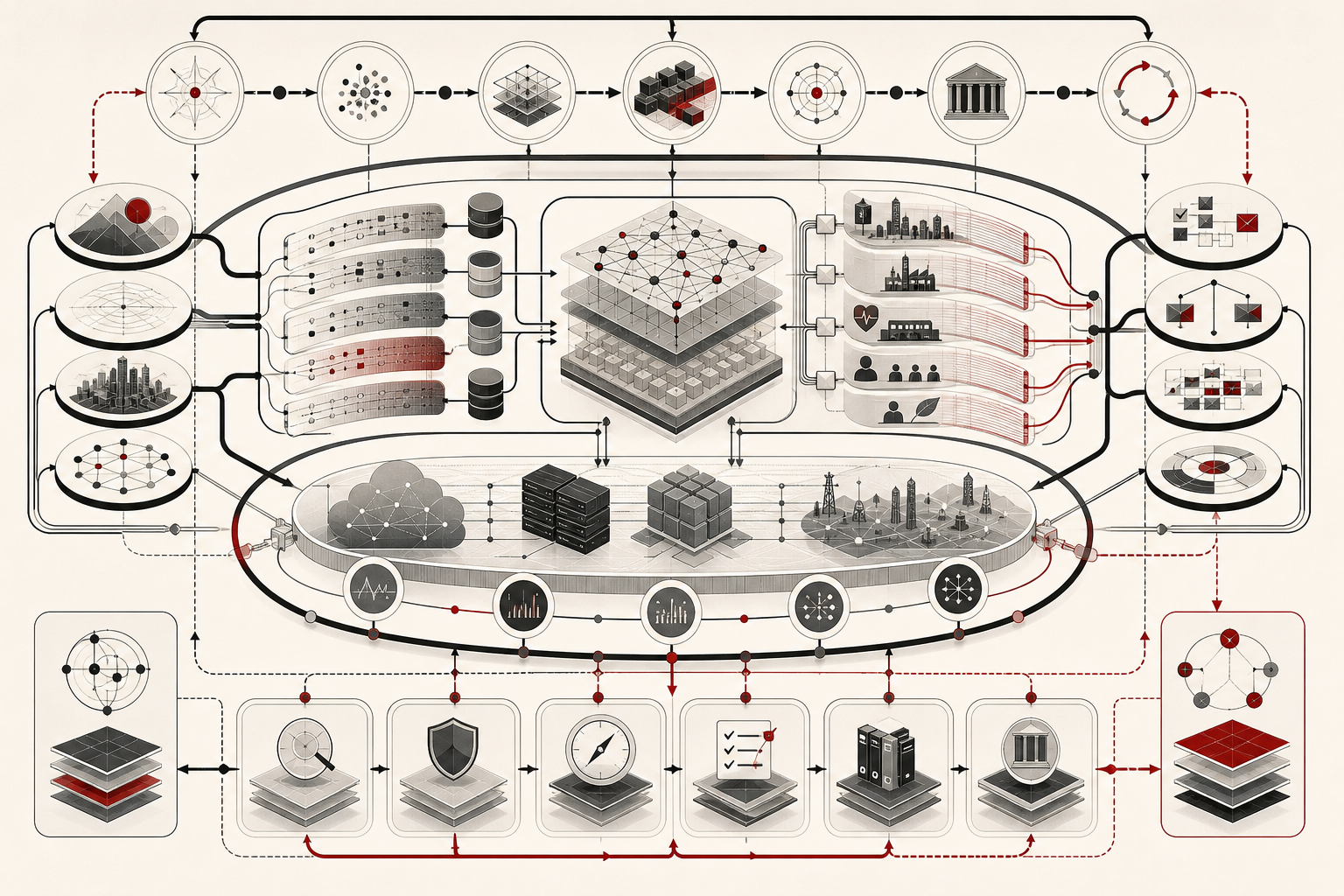
This article develops Artificial Intelligence as a Systems Discipline as a capstone article within the Artificial Intelligence Systems knowledge series. It explains why AI must be understood through system architecture, lifecycle governance, data infrastructure, model behavior, human interaction, feedback, monitoring, reliability, organizational incentives, and public accountability. It also connects AI systems to systems engineering, risk management, human-computer interaction, standards, regulation, assurance, and sociotechnical analysis. Selected Python and R examples appear here, while the full GitHub repository contains expanded computational scaffolding for AI system inventories, lifecycle maturity scoring, governance evidence, risk registers, monitoring metadata, incident review, SQL schemas, documentation templates, and reproducible notebooks.
Why AI as a Systems Discipline Matters
Artificial intelligence is often introduced through model families: symbolic AI, machine learning, deep learning, natural language processing, computer vision, reinforcement learning, generative AI, or multimodal systems. These categories are useful, but incomplete. In practice, deployed AI systems are not only models. They are operating environments. A real AI system has data pipelines, training processes, evaluation procedures, deployment infrastructure, monitoring dashboards, human users, feedback loops, organizational goals, governance rules, security risks, and social consequences.
This matters because many AI failures are system failures rather than narrow model failures. A model may perform well on a benchmark but fail in deployment because the data distribution changes. A recommender may optimize engagement while degrading information quality. A decision-support model may be accurate on average but harmful for a subgroup. A generative system may produce fluent outputs that are poorly grounded. A predictive maintenance system may prioritize assets with better data rather than greater public need. A high-performing model may become unsafe when embedded in the wrong workflow.
AI as a systems discipline asks a broader set of questions:
- What system is the model part of?
- What data, incentives, interfaces, and feedback loops shape its behavior?
- What objective is being optimized, and what values are excluded?
- Who uses the output, who is affected by it, and who is accountable?
- How is uncertainty communicated?
- How are failures detected, escalated, and corrected?
- How does the system change the environment that generated its data?
- How can lifecycle governance make the system more trustworthy?
These questions shift AI from a model-centric discipline toward a systems discipline. They also explain why responsible AI cannot be reduced to ethics statements or model cards alone. It requires system architecture, monitoring, assurance, organizational practice, and accountability.
Model\ Performance \neq System\ Trustworthiness
\]
Interpretation: A model can perform well in testing while the deployed system remains unsafe, unfair, unreliable, insecure, unaccountable, or misaligned with institutional purpose.
The systems view is especially important as AI becomes general-purpose infrastructure. A language model may support search, writing, coding, analysis, customer service, education, legal drafting, scientific review, and internal decision support. A computer-vision model may support quality control, medical imaging, surveillance, robotics, infrastructure inspection, and ecological monitoring. A single model or platform can affect many workflows. The more general and embedded the system becomes, the less adequate model-only thinking becomes.
From Models to Systems
A model is a component. A system is the full arrangement of components, relationships, processes, users, institutions, and environments that produce behavior over time. Confusing the model with the system is one of the most common conceptual errors in AI practice.
A model may be represented as a function:
\hat{y}=f_{\theta}(x)
\]
Interpretation: The model \(f_{\theta}\) maps input data \(x\) to an output \(\hat{y}\). This representation is useful, but it describes only one component of a larger AI system.
A deployed AI system includes more than this mapping. It includes how \(x\) was measured, selected, transformed, stored, and governed. It includes how \(\theta\) was trained, validated, versioned, monitored, and updated. It includes how \(\hat{y}\) is displayed, interpreted, acted upon, challenged, audited, or ignored. It includes how outputs affect future inputs.
This distinction explains why the same model can behave differently in different contexts. A risk score used as a soft advisory signal in a transparent workflow may support better decisions. The same score used as an automatic denial mechanism may become harmful, opaque, or legally contested. A generative model used for internal brainstorming differs from one used to mass-produce public information. A recommender used to organize a small professional library differs from one shaping political attention at platform scale.
| Level | Model-Centric Question | Systems-Centric Question | Why the Difference Matters |
|---|---|---|---|
| Input | What data does the model receive? | How was the data measured, selected, governed, and made meaningful? | Inputs may encode bias, missingness, incentives, or institutional history. |
| Output | What prediction or generated result is produced? | How is the output interpreted, acted on, challenged, or ignored? | Consequences depend on workflow, not output alone. |
| Performance | How accurate is the model? | Does the system improve real outcomes without unacceptable harm? | Benchmark performance may not reflect deployment effects. |
| Responsibility | Who built the model? | Who owns the deployed system and its consequences? | Accountability requires institutional ownership. |
| Failure | Did the model make an error? | Which part of the system failed: data, model, interface, workflow, monitoring, or governance? | Corrective action depends on diagnosing the system, not only the model. |
Note: Model behavior is important, but deployed AI behavior emerges from data, infrastructure, humans, workflows, incentives, and governance.
AI systems must therefore be evaluated at multiple levels: model level, data level, infrastructure level, interface level, workflow level, organizational level, and societal level. A model-level evaluation may measure predictive performance, calibration, robustness, or interpretability. A data-level evaluation may examine quality, representativeness, provenance, privacy, and measurement validity. A workflow-level evaluation may examine how humans use outputs, when review occurs, and how contested decisions are handled.
AI\ System = Model + Data + Infrastructure + People + Workflow + Governance
\]
Interpretation: A deployed AI system is a sociotechnical arrangement. The model is necessary, but not sufficient, for understanding system behavior.
The Architecture of an AI System
An AI system can be understood as a layered architecture. Each layer contributes to system behavior and each layer introduces distinct risks. A weak layer can undermine the entire system even when other layers are strong. A carefully validated model can be compromised by poor data provenance. A transparent dashboard can fail if users have no meaningful authority to challenge the system. A governance policy can be hollow if monitoring is absent.
| Layer | Core Function | System Role | Risk if Weak |
|---|---|---|---|
| Purpose and problem framing | Defines the decision, prediction, generation, or automation goal. | Establishes what the system is for. | Wrong problem, harmful objective, inappropriate automation. |
| Data layer | Collects, measures, stores, labels, and governs data. | Defines what the system can learn from. | Bias, measurement error, weak provenance, privacy risk. |
| Model layer | Trains, validates, and updates computational models. | Produces predictions, classifications, recommendations, or generated outputs. | Overfitting, poor calibration, brittleness, opacity. |
| Infrastructure layer | Supports compute, deployment, monitoring, security, and scaling. | Makes the system operational. | Outages, latency, unobserved failures, security exposure. |
| Interface layer | Presents outputs, explanations, uncertainty, and controls. | Mediates human interaction. | Automation bias, confusion, poor contestability. |
| Workflow layer | Connects model output to action, review, escalation, and correction. | Turns outputs into decisions or interventions. | Unclear responsibility, rubber-stamping, poor oversight. |
| Monitoring layer | Tracks performance, drift, incidents, and unintended behavior. | Maintains system awareness after deployment. | Silent degradation, delayed response, repeated failure. |
| Governance layer | Defines policy, accountability, audit, risk management, and lifecycle control. | Connects technical systems to institutional responsibility. | Unreviewable automation, compliance failure, public harm. |
Note: AI system architecture is not only technical architecture. It includes purpose, people, workflows, monitoring, and governance.
This layered architecture helps explain why AI systems are difficult to manage. Technical excellence in one layer does not compensate for failure in another. A well-trained model can be undermined by poor data governance. A strong governance framework can fail if monitoring is absent. A transparent explanation can be useless if the workflow gives users no meaningful power to challenge the recommendation. Systems discipline requires alignment across layers.
Architecture also determines accountability. If the system has no model registry, no dataset record, no decision log, no monitoring dashboard, no incident process, and no named owner, then accountability becomes aspirational. A systems discipline treats these architectural elements as part of the AI system itself, not administrative extras.
Weakest\ Layer \rightarrow System\ Risk
\]
Interpretation: An AI system can fail because of its weakest layer: purpose, data, model, infrastructure, interface, workflow, monitoring, or governance.
The AI System Lifecycle
AI systems evolve over time. They move from problem framing to data collection, design, training, validation, deployment, monitoring, updating, retirement, and post-incident learning. Each lifecycle stage has different risks and evidence requirements.
A responsible AI lifecycle includes:
- problem framing: defining purpose, affected stakeholders, decision authority, and appropriateness of AI;
- data assessment: evaluating measurement validity, provenance, representativeness, privacy, and bias;
- model development: choosing methods, objectives, constraints, and evaluation criteria;
- validation: testing performance, robustness, fairness, uncertainty, and failure modes;
- deployment: integrating the model into infrastructure, interfaces, workflows, and governance;
- monitoring: tracking drift, incidents, usage, reliance, feedback, and external change;
- change management: updating models, data, thresholds, policies, and documentation;
- incident response: investigating failures, harms, near misses, and contested decisions;
- retirement: decommissioning systems that are obsolete, harmful, unsupported, or misaligned.
The lifecycle view prevents AI governance from being treated as a pre-launch checklist. AI systems must be governed continuously because their environments change. Data distributions shift. Users adapt. Regulations evolve. Adversaries probe weaknesses. Models degrade. Organizational incentives change. A system that was acceptable at launch may become unsafe, unfair, or ineffective later.
| Lifecycle Stage | Core Question | Evidence Needed | Failure if Missing |
|---|---|---|---|
| Problem framing | Should AI be used for this purpose? | Use-case statement, affected-party analysis, alternatives assessment. | AI optimizes an inappropriate or harmful objective. |
| Data assessment | Is the data valid for the intended use? | Provenance records, measurement review, missingness and bias analysis. | Model learns from invalid, biased, or unrepresentative data. |
| Model development | Is the method appropriate for the problem? | Training records, objective documentation, baseline comparisons. | Model complexity hides weak assumptions. |
| Validation | Does the system meet performance and risk requirements? | Evaluation reports, robustness tests, calibration review, subgroup analysis. | Deployment rests on narrow benchmark success. |
| Deployment | Can the system operate safely in workflow? | Release plan, user guidance, access controls, rollback plan. | Model enters production without operational safeguards. |
| Monitoring | Is the system still working after launch? | Drift metrics, incident logs, user feedback, performance monitoring. | Degradation goes unnoticed. |
| Change management | Are updates controlled and reviewable? | Version history, approval records, regression tests. | Changes introduce hidden failure modes. |
| Incident response | Can failures be investigated and corrected? | Decision logs, audit trails, escalation process, post-incident review. | Harm repeats without learning. |
| Retirement | When should the system be removed? | Sunset criteria, replacement plan, archival record. | Obsolete systems continue shaping decisions. |
Note: Lifecycle governance turns AI from a one-time release into an accountable system that can be reviewed, updated, corrected, and retired.
Governance\ at\ Launch \neq Governance\ Across\ Life
\]
Interpretation: AI systems require continuing governance because data, users, environments, regulations, and organizational incentives change over time.
Complexity, Emergence, and Feedback
AI systems are complex because their behavior emerges from many interacting components. A deployed recommender system, for example, includes user behavior, content supply, ranking objectives, feedback data, interface design, moderation rules, advertiser incentives, platform governance, and broader social context. The model may be mathematically precise, but the system can still produce emergent effects that were not intended by designers.
Feedback loops are especially important. AI systems often learn from the environments they influence. A ranking system changes what users see, which changes what users click, which changes future training data. A predictive policing system changes where enforcement occurs, which changes recorded crime data. A hiring model changes who enters the applicant pool. A generative content system creates synthetic material that may later enter search results, training corpora, or public knowledge systems.
Systemic AI analysis therefore asks:
- What feedback loops does the system create?
- What forms of behavior does the system reward?
- Where can errors amplify over time?
- How do users adapt to the system?
- How does the system change measurement itself?
- Which groups become more visible or less visible?
- What happens when many institutions deploy similar AI systems?
| Feedback Pattern | How It Works | Example | System Risk |
|---|---|---|---|
| Behavioral feedback | Users change behavior in response to AI outputs. | People optimize posts for recommender algorithms. | System rewards performative or manipulative behavior. |
| Data feedback | System outputs shape future training data. | Predicted high-risk areas receive more inspection, creating more records. | Recorded data reflects system attention rather than underlying reality. |
| Institutional feedback | Organizations reorganize work around AI outputs. | Staff defer to risk scores or generated summaries. | Human expertise and accountability weaken. |
| Market feedback | Actors adapt strategically to AI ranking or scoring systems. | Vendors, applicants, or content producers optimize for algorithmic signals. | Gaming and metric corruption increase. |
| Social feedback | AI systems shape visibility, trust, attention, or public belief. | Generative content floods information environments. | Knowledge quality and public trust degrade. |
Note: The most important AI consequences may appear through second-order and third-order effects rather than immediate model outputs.
The most important AI consequences may not appear in first-order model outputs. They may appear in second-order and third-order effects: changes in behavior, incentives, attention, trust, labor, institutional practice, or public knowledge. Systems discipline therefore requires studying what happens after the model output enters the world.
Output \rightarrow Action \rightarrow Environment \rightarrow Future\ Data
\]
Interpretation: AI systems can reshape the environments they observe, creating feedback loops that affect future data, behavior, and model performance.
AI as a Sociotechnical System
AI systems are sociotechnical because technical components and social arrangements co-produce outcomes. Data is collected by institutions. Labels encode human judgments. Objectives reflect values and incentives. Interfaces shape reliance. Deployment occurs inside organizations. Users interpret outputs through experience, expertise, trust, and pressure. Affected people may have limited ability to contest decisions.
This means AI system design cannot be separated from institutional design. A model used in healthcare, finance, education, employment, public administration, or criminal justice inherits the power relations, constraints, and histories of those domains. Technical systems may improve institutional performance, but they may also reproduce or intensify institutional problems.
A sociotechnical AI discipline must therefore examine measurement, incentives, authority, visibility, labor, rights, and public value. What is counted, omitted, approximated, or misclassified? What behavior does the system reward or penalize? Who can decide, override, appeal, or audit? Whose experiences appear in data and whose do not? Who trains, labels, moderates, reviews, maintains, or is displaced by AI? How are privacy, autonomy, fairness, explanation, and contestability preserved?
| Dimension | Core Question | Example Risk | Responsible Design Response |
|---|---|---|---|
| Measurement | Does the data validly represent the concept? | Complaint data reflects access to reporting, not true risk. | Use measurement review and missingness analysis. |
| Incentives | What behavior does the system reward? | Engagement optimization rewards sensational content. | Align objectives with public or institutional purpose. |
| Authority | Who can act, override, appeal, or audit? | Human review exists but lacks real power. | Define meaningful escalation and decision rights. |
| Visibility | Who is represented in the data? | Underrepresented groups receive worse service or more errors. | Review subgroup coverage and affected-party experience. |
| Labor | Who builds, labels, monitors, or is affected by the system? | Hidden moderation or labeling labor is exploited or ignored. | Account for labor conditions and workflow consequences. |
| Rights | Are privacy, explanation, due process, and contestability preserved? | People cannot challenge automated decisions. | Build appeal, audit, and explanation mechanisms. |
| Public value | Does the system serve a legitimate purpose? | Efficiency gains come at the expense of trust or equity. | Evaluate real-world outcomes and affected communities. |
Note: Sociotechnical analysis does not weaken technical rigor. It expands rigor to include the institutions and people through which AI systems operate.
This perspective does not reject technical rigor. It expands it. A technically serious AI discipline must account for how systems operate in the world, not only how models perform in controlled experiments. It must ask whether the system improves the practice it enters, whether it preserves accountability, and whether affected people retain meaningful agency.
Technical\ System + Institutional\ Context = AI\ Outcome
\]
Interpretation: AI outcomes are co-produced by algorithms, data, workflows, users, institutions, incentives, and social conditions.
Systems Engineering, Reliability, and Assurance
AI systems require engineering disciplines that are not always central in machine learning research: requirements analysis, safety cases, reliability engineering, verification and validation, incident response, configuration management, monitoring, security, documentation, and lifecycle control. These practices become more important as AI systems are deployed in high-stakes environments.
Traditional software systems are often specified through explicit logic. AI systems are partly learned from data. This creates distinctive assurance challenges. Developers may not be able to fully specify the internal decision logic of a model, especially in deep learning systems. Performance depends on training data, distributional assumptions, model architecture, optimization, deployment context, and user behavior. Testing must therefore be broader than unit testing or benchmark evaluation.
AI assurance should include requirements and intended-use documentation, data provenance and measurement review, model validation across subgroups and stress cases, robustness and security testing, uncertainty and calibration review, human factors evaluation, monitoring and drift detection, incident logging, change control, version management, and retirement criteria.
| Practice | Purpose | AI-Specific Challenge | Evidence Artifact |
|---|---|---|---|
| Requirements analysis | Define intended use and constraints. | AI capabilities may be broad, ambiguous, or reused beyond scope. | Use-case specification and prohibited-use list. |
| Verification and validation | Test whether the system meets requirements. | Learned behavior may fail under distribution shift. | Evaluation report, stress tests, subgroup tests. |
| Reliability engineering | Ensure consistent operation over time. | Model behavior can degrade as data and context change. | Monitoring dashboard and reliability metrics. |
| Configuration management | Track versions of models, data, prompts, pipelines, and policies. | AI behavior depends on many changing components. | Model registry and change log. |
| Incident response | Investigate failures, near misses, and harms. | Failures may involve model, workflow, data, or user interaction. | Incident log and post-incident review. |
| Security engineering | Protect against misuse, manipulation, and attack. | AI systems face prompt injection, data poisoning, extraction, and model abuse. | Threat model and security test results. |
| Retirement planning | Remove unsafe or obsolete systems. | AI systems may persist because dependencies accumulate. | Sunset criteria and decommissioning record. |
Note: AI assurance requires engineering the full system: data, model, infrastructure, interface, workflow, monitoring, and governance.
The goal is not to make AI perfectly predictable. The goal is to make AI systems inspectable, monitorable, contestable, resilient, and governable enough for their intended context. A low-stakes creative tool may require one level of assurance. A medical triage system, public-benefits tool, autonomous infrastructure controller, or hiring system requires another.
Assurance = Evidence\ that\ a\ System\ is\ Fit\ for\ Use
\]
Interpretation: AI assurance is not a claim that a system is perfect. It is a structured body of evidence that the system is appropriate, reliable, monitored, and governed for its intended use.
Governance, Standards, and Institutional Accountability
AI governance translates technical systems into institutional responsibility. It defines how organizations identify risks, assign accountability, document decisions, monitor systems, respond to incidents, and demonstrate that AI is being used responsibly. Governance is not external to AI systems. It is one of their operating layers.
Several governance frameworks reinforce the systems view. The NIST AI Risk Management Framework emphasizes managing AI risks to individuals, organizations, and society across design, development, deployment, and use. ISO/IEC 42001 provides requirements for establishing, implementing, maintaining, and continually improving an AI management system. The OECD AI Principles frame trustworthy AI around human rights, transparency, robustness, safety, and accountability. The EU AI Act formalizes risk-based legal obligations for AI systems in the European Union.
A systems discipline does not treat these frameworks as paperwork. It uses them to structure lifecycle evidence: What is the system’s intended purpose? What risks were identified before deployment? What evidence supports performance and safety claims? Who approved deployment? How are outputs explained and challenged? How is the system monitored? What happens when the system fails? When should the system be changed or retired?
| Governance Area | Core Question | Evidence Artifact | Accountability Function |
|---|---|---|---|
| Purpose and scope | What is the system intended and not intended to do? | System card, use-case statement, prohibited uses. | Prevents uncontrolled expansion and misuse. |
| Risk management | What risks are known and how are they controlled? | Risk register, mitigation plan, review record. | Makes risk ownership explicit. |
| Data governance | What data shaped the system? | Data sheets, provenance records, access logs. | Supports auditability and privacy review. |
| Model governance | Which model version is active and approved? | Model registry, evaluation report, release approval. | Prevents unmanaged model changes. |
| Human oversight | How do people review, override, or contest outputs? | Escalation rules, override logs, appeal process. | Preserves meaningful human responsibility. |
| Monitoring | How is the system observed after deployment? | Drift metrics, incident dashboard, user feedback logs. | Detects degradation and misuse. |
| Incident response | What happens when something goes wrong? | Incident playbook, post-incident review, corrective action log. | Turns failure into organizational learning. |
Note: Governance turns AI from a collection of technical capabilities into an accountable institutional practice.
AI\ Governance = Risk\ Ownership + Lifecycle\ Evidence + Corrective\ Capacity
\]
Interpretation: Governance is meaningful when an institution can identify risks, document evidence, assign responsibility, monitor outcomes, and correct failures.
Governance also requires proportionality. Not every AI system carries the same risk. An internal writing assistant, a recommender for research articles, a fraud-detection system, a medical prioritization tool, and an autonomous infrastructure controller require different levels of documentation, validation, monitoring, and oversight. A systems discipline evaluates governance obligations according to use, context, affected people, and consequences.
The Interdisciplinary Structure of AI Systems
AI as a systems discipline is necessarily interdisciplinary. No single field contains all the knowledge required to build and govern trustworthy AI systems. Computer science, machine learning, statistics, systems engineering, control theory, human-computer interaction, cognitive science, organizational studies, law, policy, ethics, philosophy, security, sustainability, and domain expertise all contribute different forms of knowledge.
| Discipline | Contribution to AI Systems | Example System Question |
|---|---|---|
| Computer science | Algorithms, data structures, software, architectures, computation. | How is the system implemented and scaled? |
| Machine learning | Models, training, optimization, representation, generalization. | How does the system learn from data? |
| Statistics | Inference, uncertainty, sampling, calibration, measurement error. | How reliable are the estimates? |
| Systems engineering | Requirements, interfaces, lifecycle management, integration, reliability. | How do components interact over time? |
| Control theory | Feedback, stability, adaptation, dynamic systems. | How does the system behave under feedback? |
| Human-computer interaction | Interface design, usability, reliance, explanation, accessibility. | How do people understand and use the system? |
| Cognitive science | Attention, judgment, mental models, automation bias. | How does AI affect human reasoning? |
| Organizational studies | Workflows, incentives, institutions, accountability, change management. | How does the system alter institutional behavior? |
| Law and policy | Rights, regulation, liability, compliance, due process. | What obligations constrain system use? |
| Ethics and philosophy | Values, legitimacy, explanation, responsibility, justice. | What should the system be allowed to do? |
Note: AI systems require more than technical capability. They require interdisciplinary judgment about purpose, evidence, risk, human use, law, and institutional responsibility.
The systems discipline of AI emerges from the integration of these fields. It is not enough to add ethics after engineering, governance after deployment, or human review after automation. These concerns must be designed into the system from the beginning.
Interdisciplinary AI also changes what expertise means. A technically sophisticated team can still misunderstand a domain, misread user needs, overlook legal obligations, or create incentives that undermine the system’s stated purpose. Conversely, domain experts may understand institutional consequences but need technical support to evaluate model behavior. Systems discipline requires shared artifacts—risk registers, evaluation reports, decision logs, model cards, system cards, and lifecycle dashboards—that allow different forms of expertise to meet.
Evaluating AI as a System
AI system evaluation must be multidimensional. Accuracy is necessary in many contexts, but insufficient. System evaluation should include performance, calibration, robustness, fairness, usability, security, reliability, governance readiness, and real-world impact.
| Evaluation Dimension | Core Question | Example Evidence | System Relevance |
|---|---|---|---|
| Performance | Does the system perform the intended task? | Accuracy, AUC, RMSE, precision, recall, task success. | Tests whether the model can support the use case. |
| Calibration | Do predicted probabilities match observed outcomes? | Calibration curves, Brier score, reliability diagrams. | Supports trustworthy thresholds and risk communication. |
| Robustness | Does performance hold under distribution shift or stress? | Stress tests, scenario tests, out-of-distribution evaluation. | Prevents fragile deployment. |
| Fairness | Are errors, benefits, and burdens distributed acceptably? | Subgroup metrics, allocation review, disparate impact analysis. | Detects unequal or unjust outcomes. |
| Explainability | Can relevant users understand outputs and limitations? | Explanation tests, user comprehension, documentation. | Supports informed use and contestability. |
| Reliance | Do users rely on the system appropriately? | Overreliance and underreliance studies, override logs. | Prevents automation bias and ignored warnings. |
| Security | Can the system resist misuse, attack, or manipulation? | Threat modeling, adversarial tests, access controls. | Protects the system and affected people. |
| Reliability | Does the system operate consistently over time? | Uptime, latency, incident rates, monitoring alerts. | Connects model use to operational dependability. |
| Governance | Are accountability and lifecycle controls in place? | Audit trails, approvals, risk registers, model cards, incident reviews. | Makes the system reviewable and correctable. |
| Impact | Does the system improve real outcomes without unacceptable harm? | Outcome studies, stakeholder review, external audits, public reporting. | Tests whether deployment is justified. |
Note: AI system evaluation should include both technical performance and real-world consequences.
The central challenge is that evaluation dimensions can conflict. A system may be more accurate but less interpretable. It may improve average performance while increasing inequality. It may automate work efficiently while weakening accountability. It may reduce short-term cost while increasing systemic fragility. Systems evaluation must make these tradeoffs visible.
System\ Evaluation = Performance + Reliability + Governance + Impact
\]
Interpretation: AI evaluation should combine model quality, operational reliability, human workflow behavior, governance readiness, and real-world outcomes.
Evaluation should also be tied to decision thresholds. A generative assistant used for brainstorming may tolerate different error types than a system used to summarize legal evidence. A monitoring model used to trigger human review may require different calibration than one used to automate action. Systems discipline asks not only whether an output is correct, but what happens when the system is wrong.
System-Level Failure Modes
AI systems can fail in ways that are not visible at the model level. These failures show why AI requires systems-level thinking. The model may be technically impressive while the system remains harmful, brittle, or illegitimate. Conversely, a simpler model embedded in a well-designed workflow may be safer, more useful, and more accountable than a complex model deployed without governance.
| Failure Mode | Description | Likely Consequence | Governance Response |
|---|---|---|---|
| Problem-framing failure | The system optimizes the wrong problem. | Technically successful system produces harmful or irrelevant outcomes. | Use alternatives assessment and affected-party review. |
| Measurement failure | Data does not validly represent the concept being modeled. | Model learns proxy patterns rather than true risk, need, or value. | Conduct measurement validity and missingness review. |
| Objective failure | Optimization target diverges from the real institutional goal. | System improves metrics while degrading purpose. | Align objectives with values, constraints, and impact metrics. |
| Workflow failure | Outputs are used in ways the model was not designed to support. | Advisory tools become de facto automated decisions. | Define approved use, escalation, and decision authority. |
| Interface failure | Users misunderstand uncertainty, explanations, or limits. | Automation bias, misuse, or ignored warnings. | Test user comprehension and reliance behavior. |
| Feedback failure | System actions change future data in harmful or self-reinforcing ways. | Errors amplify over time. | Monitor feedback loops and intervention effects. |
| Governance failure | No one is clearly accountable for decisions or harms. | Failures cannot be corrected or assigned responsibility. | Assign ownership, audit duties, and escalation authority. |
| Monitoring failure | Degradation or misuse is not detected in time. | System continues failing silently. | Maintain drift, incident, and performance monitoring. |
| Concentration failure | Control over data, compute, models, and platforms concentrates power. | Public dependency grows without adequate auditability or contestability. | Use procurement review, vendor governance, and fallback planning. |
| Legitimacy failure | Affected communities do not trust, understand, or accept the system. | Deployment loses public legitimacy even if technically functional. | Use transparency, participation, contestability, and public accountability. |
Note: Many AI failures are system failures. Correcting them may require changing data, workflow, interface, incentives, governance, or institutional practice—not only retraining the model.
The most dangerous failure mode is unaccountable automation. This occurs when outputs influence decisions while responsibility becomes diffuse. The vendor points to the deployer. The deployer points to the model. The user points to the interface. The affected person cannot contest the decision. A systems discipline prevents this by designing accountability into the architecture.
No\ Owner + High\ Impact = Governance\ Failure
\]
Interpretation: High-impact AI systems require clear ownership, review authority, monitoring responsibility, and corrective capacity.
Limits and Open Problems
AI as a systems discipline faces several limits and open problems. First, systems are difficult to bound. Where does an AI system begin and end? Does it include the vendor platform, data suppliers, cloud infrastructure, user workflows, downstream decisions, affected communities, or regulatory environment? A narrow boundary may make engineering manageable, but it can hide real consequences.
Second, system evaluation is hard because outcomes are often delayed, distributed, or contested. A model may improve immediate efficiency while weakening long-term institutional capacity. A recommender may improve engagement while degrading public knowledge. A decision-support tool may improve consistency while reducing individualized judgment. Systems evaluation must therefore combine quantitative metrics with qualitative review, domain expertise, and affected-party evidence.
Third, accountability can be difficult when AI systems are assembled from vendors, open-source components, internal datasets, fine-tuned models, prompts, retrieval systems, human workflows, and third-party infrastructure. Responsibility can fragment across the supply chain unless governance assigns ownership explicitly.
Fourth, AI systems are dynamic. Models update. Data shifts. users adapt. Attackers probe. Regulations change. Organizations reorganize. A system that is safe under one set of assumptions may become unsafe later. Lifecycle governance must therefore remain active rather than archival.
Several open problems remain especially important: How should institutions measure the real-world impact of AI systems over time? How should public agencies evaluate algorithmic systems when data reflects historical inequity? How should organizations govern foundation-model dependencies they did not train and cannot fully inspect? How should AI assurance scale across thousands of small internal systems? How should systems be retired when they become embedded in workflows?
The systems view does not solve every AI problem. It changes the unit of analysis. It says that AI should be judged not only by what a model can do, but by what the whole system does once it enters the world.
Mathematical Lens
A systems view can be formalized by representing an AI system as a collection of interacting components.
S=(D,M,I,H,W,G,E)
\]
Interpretation: An AI system \(S\) includes data \(D\), model \(M\), infrastructure \(I\), human actors \(H\), workflow \(W\), governance \(G\), and environment \(E\). System behavior emerges from their interaction.
The model output is only one part of system behavior.
\hat{y}_t=M_{\theta_t}(x_t)
\]
Interpretation: At time \(t\), a model \(M\) with parameters \(\theta_t\) produces an output \(\hat{y}_t\) from input \(x_t\). Both inputs and parameters may change over time.
System action depends on model output, human interpretation, workflow rules, and governance constraints.
a_t=W(\hat{y}_t,u_t,r_t,G_t)
\]
Interpretation: The action \(a_t\) taken by the system depends on the model output \(\hat{y}_t\), user or operator judgment \(u_t\), workflow rules \(r_t\), and governance constraints \(G_t\).
Feedback occurs when system actions change future data.
D_{t+1}=F(D_t,a_t,E_t)
\]
Interpretation: Future data \(D_{t+1}\) depends on prior data \(D_t\), actions \(a_t\), and the environment \(E_t\). AI systems can therefore reshape the data they later learn from.
System risk can be represented as expected harm across scenarios.
R(S)=\sum_{\omega \in \Omega}P(\omega)L(S,\omega)
\]
Interpretation: System risk \(R(S)\) is the probability-weighted loss \(L\) across possible scenarios \(\omega\). Risk depends on more than model error; it includes infrastructure, workflow, human, and governance failure.
Trustworthiness can be treated as a multidimensional function rather than a single score.
T(S)=f(P,C,R_b,F,X,A,Q)
\]
Interpretation: Trustworthiness \(T(S)\) depends on performance \(P\), calibration \(C\), robustness \(R_b\), fairness \(F\), explainability \(X\), accountability \(A\), and data quality \(Q\). No single metric captures system trustworthiness.
Lifecycle maturity can be modeled as the combination of technical and governance maturity.
Maturity(S)=\alpha M_T(S)+(1-\alpha)M_G(S)
\]
Interpretation: Overall system maturity can combine technical maturity \(M_T\) and governance maturity \(M_G\). The weight \(\alpha\) reflects how much emphasis the review places on technical readiness relative to governance readiness.
Review can be triggered when risk is high, maturity is low, monitoring is weak, or the system is high impact.
Review =
\begin{cases}
1, & R(S) \geq \tau_R \\
1, & Maturity(S) \leq \tau_M \\
1, & Monitoring(S) \leq \tau_O \\
1, & HighImpact(S)=1 \\
0, & \mathrm{otherwise}
\end{cases}
\]
Interpretation: AI systems should be reviewed when systemic risk is high, maturity is low, monitoring is weak, or the system affects high-impact decisions, rights, safety, or public trust.
Variables and System Interpretation
| Symbol or Term | Meaning | Systems Interpretation | AI Discipline Relevance |
|---|---|---|---|
| \(S\) | AI system | The full sociotechnical system. | Primary unit of analysis. |
| \(D\) | Data | Measurements, labels, logs, documents, sensor streams, human feedback. | Defines what the model can learn from. |
| \(M\) | Model | Algorithmic component producing outputs. | Necessary but insufficient part of the system. |
| \(I\) | Infrastructure | Compute, pipelines, APIs, storage, deployment, monitoring, security. | Makes AI operational and scalable. |
| \(H\) | Human actors | Users, operators, developers, reviewers, affected people, decision-makers. | Interpret, act on, contest, and govern outputs. |
| \(W\) | Workflow | Rules connecting AI outputs to decisions and actions. | Determines how model outputs become consequences. |
| \(G\) | Governance | Policies, standards, audits, accountability, approvals, constraints. | Defines responsible operation. |
| \(E\) | Environment | External context, users, markets, institutions, social conditions. | Source of uncertainty and distribution shift. |
| \(\hat{y}_t\) | Model output | Prediction, score, classification, recommendation, generated artifact. | Intermediate signal, not final decision. |
| \(a_t\) | Action | Decision, intervention, recommendation, ranking, publication, control signal. | Where system consequences begin. |
| \(R(S)\) | System risk | Expected loss across plausible scenarios. | Requires lifecycle risk management. |
| \(T(S)\) | Trustworthiness | Composite system property. | Cannot be reduced to accuracy alone. |
| \(M_T\) | Technical maturity | Readiness of data, model, infrastructure, reliability, and security. | Determines whether the system can operate technically. |
| \(M_G\) | Governance maturity | Readiness of oversight, monitoring, documentation, accountability, and review. | Determines whether the system can operate responsibly. |
| \(\tau\) | Review threshold | Boundary for risk, maturity, monitoring, or impact review. | Turns system diagnostics into governance actions. |
Note: These variables describe AI as a system of interacting technical, human, institutional, and environmental components.
Worked Example: A Responsible AI System Lifecycle
Consider an AI system used by a public agency to prioritize building inspections. The system estimates risk from historical inspection records, complaints, building age, structural features, neighborhood conditions, and environmental exposure. It recommends which buildings should be inspected first under limited staff capacity.
A model-centric view would ask whether the risk prediction is accurate. A systems view asks much more:
- Were historical inspection records biased by prior enforcement patterns?
- Are some communities underrepresented because complaints were less likely to be filed?
- Does the model distinguish true risk from data availability?
- How are uncertainty and missing data communicated?
- Can inspectors override recommendations?
- Are overrides logged and reviewed?
- Are affected building owners or tenants able to contest outcomes?
- Does the system improve safety equitably?
- What happens if the model begins shifting resources away from less visible risks?
- Who is accountable for inspection priorities?
A responsible lifecycle would include data review, subgroup validation, uncertainty thresholds, human review rules, equity analysis, monitoring, incident reporting, public accountability, and periodic reassessment. The AI model may help prioritize attention, but the system must preserve institutional responsibility.
For example, a building with limited complaint history may appear lower risk because tenants have less access to reporting channels. A model might treat this absence of complaints as evidence of safety. A systems review would recognize that missing complaints may be a measurement artifact. It would combine inspection history with structural features, environmental exposure, neighborhood vulnerability, tenant-protection data, and uncertainty signals. It would also route uncertain cases to human review rather than treating silence as safety.
| Lifecycle Stage | System Question | Responsible Control | Evidence Artifact |
|---|---|---|---|
| Problem framing | Should AI prioritize inspections? | Define purpose as public safety support, not automatic enforcement. | Use-case and affected-party review. |
| Data assessment | Do records validly represent building risk? | Review complaints, inspections, missingness, and neighborhood reporting gaps. | Data provenance and measurement report. |
| Model validation | Does the model work across building types and communities? | Evaluate calibration, subgroup performance, and uncertainty. | Validation and fairness report. |
| Workflow integration | How do inspectors use recommendations? | Require human review, override ability, and explanation. | Workflow and interface documentation. |
| Monitoring | Does the system improve equitable safety outcomes? | Track inspection results, overrides, complaints, incidents, and resource allocation. | Monitoring dashboard and periodic review. |
| Accountability | Who is responsible for system decisions? | Assign agency ownership and escalation authority. | Governance charter and decision log. |
Note: The model may prioritize inspection attention, but the institution remains responsible for evidence quality, oversight, fairness, and public accountability.
This example illustrates the broader principle: AI systems should not merely optimize existing processes. They should make decision processes more transparent, reliable, equitable, and accountable.
Prediction + Public\ Authority \rightarrow Accountability
\]
Interpretation: When AI systems influence public decisions, prediction must be connected to explanation, review, appeal, monitoring, and institutional responsibility.
Computational Modeling
Computational modeling can make AI systems governance concrete. A lifecycle review workflow can inventory AI systems, score technical maturity, score governance maturity, identify high-stakes systems, flag weak monitoring, rank systemic risk, and produce evidence for review. This does not replace legal, ethical, human, or domain judgment. It gives institutions a structured way to see their AI portfolio as a portfolio of systems rather than a scattered collection of tools.
The examples below are intentionally lightweight and educational. They do not replace formal risk assessment, legal review, safety cases, audit systems, or production monitoring. Their purpose is to show how systems thinking can be operationalized through inventories, maturity scoring, risk flags, and lifecycle governance summaries.
A mature production system would connect these workflows to real model registries, data catalogs, risk registers, incident logs, monitoring dashboards, user-feedback systems, vendor records, security reviews, and governance approvals. The goal is not merely to assign scores. The goal is to create a reviewable evidence trail for how AI systems are designed, deployed, monitored, corrected, and retired.
Python Workflow: AI System Maturity and Risk Scoring
The following Python workflow creates a synthetic AI system inventory and scores each system across data quality, model reliability, infrastructure readiness, human oversight, monitoring, governance, explainability, security, and external impact. The goal is to demonstrate how AI as a systems discipline can be operationalized as a lifecycle review practice rather than a purely conceptual claim.
"""
Artificial Intelligence as a Systems Discipline

Python workflow:
- Create a synthetic inventory of AI systems.
- Score systems across data, model, infrastructure, human, monitoring,
  governance, explainability, security, and impact dimensions.
- Identify systems requiring lifecycle review.
- Produce portfolio-level governance summaries.
- Export governance-ready outputs.

This example is intentionally dependency-light so it can be adapted to
real AI inventories, risk registers, model registries, or governance reviews.
"""

from __future__ import annotations

from pathlib import Path

import numpy as np
import pandas as pd


RANDOM_SEED = 42
rng = np.random.default_rng(RANDOM_SEED)

OUTPUT_DIR = Path("outputs")
OUTPUT_DIR.mkdir(exist_ok=True)


def create_ai_system_inventory(n: int = 120) -> pd.DataFrame:
    """Create a synthetic inventory of deployed or proposed AI systems."""
    systems = pd.DataFrame(
        {
            "system_id": [f"AI-SYS-{i:03d}" for i in range(n)],
            "domain": rng.choice(
                [
                    "decision_support",
                    "generative_content",
                    "infrastructure",
                    "environmental_monitoring",
                    "scientific_research",
                    "customer_operations",
                    "internal_productivity",
                ],
                size=n,
            ),
            "risk_tier": rng.choice(
                ["low", "medium", "high"],
                size=n,
                p=[0.35, 0.45, 0.20],
            ),
            "data_quality": rng.uniform(0.40, 0.98, n),
            "model_reliability": rng.uniform(0.45, 0.97, n),
            "infrastructure_readiness": rng.uniform(0.35, 0.96, n),
            "human_oversight": rng.uniform(0.25, 0.95, n),
            "monitoring_coverage": rng.uniform(0.20, 0.95, n),
            "governance_readiness": rng.uniform(0.20, 0.95, n),
            "explainability": rng.uniform(0.20, 0.95, n),
            "security_readiness": rng.uniform(0.30, 0.96, n),
            "external_impact": rng.uniform(0.05, 0.90, n),
            "incident_response_readiness": rng.uniform(0.20, 0.95, n),
            "rollback_readiness": rng.uniform(0.20, 0.95, n),
        }
    )

    systems["high_stakes"] = systems["risk_tier"].eq("high").astype(int)

    return systems


def score_ai_systems(systems: pd.DataFrame) -> pd.DataFrame:
    """Score AI systems for maturity, systemic risk, and review priority."""
    scored = systems.copy()

    scored["technical_maturity"] = (
        0.28 * scored["data_quality"]
        + 0.28 * scored["model_reliability"]
        + 0.22 * scored["infrastructure_readiness"]
        + 0.22 * scored["security_readiness"]
    )

    scored["governance_maturity"] = (
        0.22 * scored["human_oversight"]
        + 0.22 * scored["monitoring_coverage"]
        + 0.20 * scored["governance_readiness"]
        + 0.14 * scored["explainability"]
        + 0.12 * scored["incident_response_readiness"]
        + 0.10 * scored["rollback_readiness"]
    )

    scored["system_maturity"] = (
        0.50 * scored["technical_maturity"]
        + 0.50 * scored["governance_maturity"]
    )

    scored["systemic_risk"] = (
        0.26 * (1 - scored["system_maturity"])
        + 0.18 * (1 - scored["monitoring_coverage"])
        + 0.18 * (1 - scored["governance_readiness"])
        + 0.14 * scored["external_impact"]
        + 0.12 * scored["high_stakes"]
        + 0.06 * (1 - scored["incident_response_readiness"])
        + 0.06 * (1 - scored["rollback_readiness"])
    )

    scored["review_required"] = (
        (scored["systemic_risk"] > 0.45)
        | (scored["governance_readiness"] < 0.45)
        | (scored["monitoring_coverage"] < 0.40)
        | ((scored["high_stakes"] == 1) & (scored["human_oversight"] < 0.65))
        | ((scored["external_impact"] > 0.70) & (scored["explainability"] < 0.55))
    )

    scored["deployment_status_recommendation"] = np.select(
        [
            scored["systemic_risk"] > 0.60,
            scored["review_required"],
            scored["system_maturity"] >= 0.75,
        ],
        [
            "pause_or_remediate_before_expansion",
            "approve_only_with_governance_review",
            "acceptable_with_monitoring",
        ],
        default="continue_development",
    )

    return scored.sort_values("systemic_risk", ascending=False)


def create_governance_summary(scored: pd.DataFrame) -> pd.DataFrame:
    """Create portfolio-level governance summary."""
    return pd.DataFrame(
        [
            {
                "systems_reviewed": len(scored),
                "review_required": int(scored["review_required"].sum()),
                "high_stakes_systems": int(scored["high_stakes"].sum()),
                "mean_system_maturity": scored["system_maturity"].mean(),
                "mean_technical_maturity": scored["technical_maturity"].mean(),
                "mean_governance_maturity": scored["governance_maturity"].mean(),
                "mean_systemic_risk": scored["systemic_risk"].mean(),
                "low_monitoring_systems": int(
                    (scored["monitoring_coverage"] < 0.40).sum()
                ),
                "low_governance_systems": int(
                    (scored["governance_readiness"] < 0.45).sum()
                ),
                "weak_incident_response_systems": int(
                    (scored["incident_response_readiness"] < 0.45).sum()
                ),
                "pause_or_remediate": int(
                    scored["deployment_status_recommendation"]
                    .eq("pause_or_remediate_before_expansion")
                    .sum()
                ),
            }
        ]
    )


def summarize_by_domain(scored: pd.DataFrame) -> pd.DataFrame:
    """Summarize maturity and risk by AI system domain."""
    return (
        scored.groupby("domain")
        .agg(
            systems=("system_id", "count"),
            mean_technical_maturity=("technical_maturity", "mean"),
            mean_governance_maturity=("governance_maturity", "mean"),
            mean_system_maturity=("system_maturity", "mean"),
            mean_systemic_risk=("systemic_risk", "mean"),
            review_rate=("review_required", "mean"),
            high_stakes_share=("high_stakes", "mean"),
        )
        .reset_index()
        .sort_values("mean_systemic_risk", ascending=False)
    )


def main() -> None:
    """Run the AI systems discipline maturity workflow."""
    inventory = create_ai_system_inventory()
    scored = score_ai_systems(inventory)
    portfolio_summary = create_governance_summary(scored)
    domain_summary = summarize_by_domain(scored)

    inventory.to_csv(
        OUTPUT_DIR / "python_ai_system_inventory.csv",
        index=False,
    )

    scored.to_csv(
        OUTPUT_DIR / "python_ai_system_maturity_risk_scores.csv",
        index=False,
    )

    portfolio_summary.to_csv(
        OUTPUT_DIR / "python_ai_systems_governance_summary.csv",
        index=False,
    )

    domain_summary.to_csv(
        OUTPUT_DIR / "python_ai_system_domain_summary.csv",
        index=False,
    )

    memo = f"""# AI Systems Discipline Governance Memo

Systems reviewed: {int(portfolio_summary.loc[0, "systems_reviewed"])}
Review required: {int(portfolio_summary.loc[0, "review_required"])}
High-stakes systems: {int(portfolio_summary.loc[0, "high_stakes_systems"])}
Low-monitoring systems: {int(portfolio_summary.loc[0, "low_monitoring_systems"])}
Low-governance systems: {int(portfolio_summary.loc[0, "low_governance_systems"])}
Weak incident-response systems: {int(portfolio_summary.loc[0, "weak_incident_response_systems"])}
Pause or remediate before expansion: {int(portfolio_summary.loc[0, "pause_or_remediate"])}
Mean system maturity: {portfolio_summary.loc[0, "mean_system_maturity"]:.4f}
Mean systemic risk: {portfolio_summary.loc[0, "mean_systemic_risk"]:.4f}

Interpretation:
- AI systems should be evaluated across technical and governance maturity.
- High-stakes systems require stronger human oversight and monitoring.
- Deployment readiness depends on lifecycle evidence, not model performance alone.
- Systems with weak governance, weak monitoring, weak incident response, or high external impact require review.
- Portfolio governance should identify system-level patterns, not only individual model metrics.
"""

    (OUTPUT_DIR / "python_ai_systems_governance_memo.md").write_text(memo)

    print(scored.head(10))
    print(domain_summary)
    print(portfolio_summary.T)
    print(memo)


if __name__ == "__main__":
    main()
This workflow treats AI governance as portfolio-level systems review. It does not score only model quality. It also evaluates data quality, infrastructure readiness, human oversight, monitoring coverage, governance readiness, explainability, security, incident response, rollback capacity, external impact, and high-stakes context. That mirrors the central argument of the article: AI system readiness is a lifecycle property, not a model metric.
R Workflow: Lifecycle Governance and Assurance Review
The following R workflow complements the Python example with a portfolio-level governance review. It summarizes maturity and risk across domains and risk tiers, producing a statistical overview of where system assurance is strongest and weakest.
# Artificial Intelligence as a Systems Discipline
# R workflow: lifecycle governance and assurance review.

set.seed(42)

n <- 120

systems <- data.frame(
  system_id = paste0("AI-SYS-", sprintf("%03d", 1:n)),
  domain = sample(
    c(
      "decision_support",
      "generative_content",
      "infrastructure",
      "environmental_monitoring",
      "scientific_research",
      "customer_operations",
      "internal_productivity"
    ),
    size = n,
    replace = TRUE
  ),
  risk_tier = sample(
    c("low", "medium", "high"),
    size = n,
    replace = TRUE,
    prob = c(0.35, 0.45, 0.20)
  ),
  data_quality = runif(n, min = 0.40, max = 0.98),
  model_reliability = runif(n, min = 0.45, max = 0.97),
  infrastructure_readiness = runif(n, min = 0.35, max = 0.96),
  human_oversight = runif(n, min = 0.25, max = 0.95),
  monitoring_coverage = runif(n, min = 0.20, max = 0.95),
  governance_readiness = runif(n, min = 0.20, max = 0.95),
  explainability = runif(n, min = 0.20, max = 0.95),
  security_readiness = runif(n, min = 0.30, max = 0.96),
  external_impact = runif(n, min = 0.05, max = 0.90),
  incident_response_readiness = runif(n, min = 0.20, max = 0.95),
  rollback_readiness = runif(n, min = 0.20, max = 0.95)
)

systems$high_stakes <- ifelse(systems$risk_tier == "high", 1, 0)

systems$technical_maturity <- 0.28 * systems$data_quality +
  0.28 * systems$model_reliability +
  0.22 * systems$infrastructure_readiness +
  0.22 * systems$security_readiness

systems$governance_maturity <- 0.22 * systems$human_oversight +
  0.22 * systems$monitoring_coverage +
  0.20 * systems$governance_readiness +
  0.14 * systems$explainability +
  0.12 * systems$incident_response_readiness +
  0.10 * systems$rollback_readiness

systems$system_maturity <- 0.50 * systems$technical_maturity +
  0.50 * systems$governance_maturity

systems$systemic_risk <- 0.26 * (1 - systems$system_maturity) +
  0.18 * (1 - systems$monitoring_coverage) +
  0.18 * (1 - systems$governance_readiness) +
  0.14 * systems$external_impact +
  0.12 * systems$high_stakes +
  0.06 * (1 - systems$incident_response_readiness) +
  0.06 * (1 - systems$rollback_readiness)

systems$review_required <- systems$systemic_risk > 0.45 |
  systems$governance_readiness < 0.45 |
  systems$monitoring_coverage < 0.40 |
  (systems$high_stakes == 1 & systems$human_oversight < 0.65) |
  (systems$external_impact > 0.70 & systems$explainability < 0.55)

domain_summary <- aggregate(
  cbind(
    technical_maturity,
    governance_maturity,
    system_maturity,
    systemic_risk,
    review_required
  ) ~ domain,
  data = systems,
  FUN = mean
)

risk_tier_summary <- aggregate(
  cbind(
    technical_maturity,
    governance_maturity,
    system_maturity,
    systemic_risk,
    review_required
  ) ~ risk_tier,
  data = systems,
  FUN = mean
)

governance_summary <- data.frame(
  systems_reviewed = nrow(systems),
  review_required = sum(systems$review_required),
  high_stakes_systems = sum(systems$high_stakes),
  mean_technical_maturity = mean(systems$technical_maturity),
  mean_governance_maturity = mean(systems$governance_maturity),
  mean_system_maturity = mean(systems$system_maturity),
  mean_systemic_risk = mean(systems$systemic_risk),
  low_monitoring_systems = sum(systems$monitoring_coverage < 0.40),
  low_governance_systems = sum(systems$governance_readiness < 0.45),
  weak_incident_response_systems = sum(
    systems$incident_response_readiness < 0.45
  ),
  weak_rollback_systems = sum(systems$rollback_readiness < 0.45)
)

dir.create("outputs", recursive = TRUE, showWarnings = FALSE)

write.csv(
  systems,
  "outputs/r_ai_system_lifecycle_inventory.csv",
  row.names = FALSE
)

write.csv(
  domain_summary,
  "outputs/r_domain_maturity_summary.csv",
  row.names = FALSE
)

write.csv(
  risk_tier_summary,
  "outputs/r_risk_tier_maturity_summary.csv",
  row.names = FALSE
)

write.csv(
  governance_summary,
  "outputs/r_ai_systems_governance_summary.csv",
  row.names = FALSE
)

print("Domain-level AI systems maturity summary")
print(domain_summary)

print("Risk-tier AI systems maturity summary")
print(risk_tier_summary)

print("Governance summary")
print(governance_summary)
This R workflow mirrors the AI systems discipline argument in a compact statistical form. It summarizes technical maturity, governance maturity, systemic risk, review requirements, and assurance gaps across domains and risk tiers so organizations can see where AI governance is strongest, weakest, or most urgent.
GitHub Repository
The article body includes selected computational examples so the systems argument remains readable. The full repository can hold expanded workflows for AI system inventories, lifecycle maturity scoring, governance evidence, systems assurance, risk registers, monitoring metadata, incident review, and portfolio-level AI governance.
From AI Tools to AI Systems Disciplines
The future of artificial intelligence will not be shaped only by larger models, faster chips, better benchmarks, or more capable interfaces. It will be shaped by whether societies, institutions, and technical communities learn to treat AI as a systems discipline. That means designing AI around lifecycle accountability, not one-time deployment. It means evaluating AI through real-world consequences, not only benchmark performance. It means connecting technical capability to institutional legitimacy.
AI systems are becoming part of the infrastructure of knowledge, work, science, governance, media, and decision-making. As this happens, the discipline must become broader and more rigorous. It must integrate machine learning with systems engineering, human-centered design, risk management, social science, law, ethics, sustainability, security, and public accountability.
The central lesson is that AI should be understood not as a single technology, but as a field of systems that must be engineered, interpreted, monitored, governed, and held accountable across their full lifecycle. A model can classify, predict, recommend, generate, or optimize. A system decides how that capability enters an institution, who relies on it, who is affected by it, how errors are corrected, and whether the deployment remains legitimate over time.
The strongest AI practice will therefore not be the practice that treats governance as a constraint on innovation. It will be the practice that understands governance as part of systems intelligence: the ability to design systems that remain useful, reliable, contestable, and accountable as they interact with complex environments.
Within the Artificial Intelligence Systems knowledge series, this article functions as a capstone. It connects What Is Artificial Intelligence? Computational Intelligence and Learning Systems, Machine Learning Foundations: How Systems Learn from Data, Deep Learning Systems: Representation, Scale, and Generalization, Model Validation, Benchmarking, and Generalization Theory, AI Safety and System Reliability, Data Governance, Provenance, and Lineage in AI Systems, Human-AI Interaction and Interface Design, AI Governance and Regulatory Systems, and Generative AI and Synthetic Content Systems. It provides the systems frame for understanding how AI capabilities become institutions, infrastructures, risks, and responsibilities.
Related Articles
- Artificial Intelligence Systems
- What Is Artificial Intelligence? Computational Intelligence and Learning Systems
- Machine Learning Foundations: How Systems Learn from Data
- Deep Learning Systems: Representation, Scale, and Generalization
- Model Training, Optimization, and Evaluation
- Model Validation, Benchmarking, and Generalization Theory
- AI Safety and System Reliability
- Data Governance, Provenance, and Lineage in AI Systems
- Trust, Interpretability, and User-Centered AI Systems
- Human-AI Interaction and Interface Design
- AI Governance and Regulatory Systems
- Generative AI and Synthetic Content Systems
Further Reading
- Russell, S. and Norvig, P. (2020) Artificial Intelligence: A Modern Approach. Pearson. Available at: https://aima.cs.berkeley.edu/
- Mitchell, T.M. (1997) Machine Learning. McGraw-Hill. Available at: http://www.cs.cmu.edu/~tom/mlbook.html
- Goodfellow, I., Bengio, Y. and Courville, A. (2016) Deep Learning. MIT Press. Available at: https://www.deeplearningbook.org/
- Sculley, D. et al. (2015) ‘Hidden Technical Debt in Machine Learning Systems’, Advances in Neural Information Processing Systems. Available at: https://papers.nips.cc/paper/5656-hidden-technical-debt-in-machine-learning-systems
- Amershi, S. et al. (2019) ‘Guidelines for Human-AI Interaction’, Proceedings of the 2019 CHI Conference on Human Factors in Computing Systems. Available at: https://dl.acm.org/doi/10.1145/3290605.3300233
- Leveson, N.G. (2011) Engineering a Safer World: Systems Thinking Applied to Safety. MIT Press. Available at: https://mitpress.mit.edu/9780262016629/engineering-a-safer-world/
- National Institute of Standards and Technology (2023) Artificial Intelligence Risk Management Framework (AI RMF 1.0). Available at: https://www.nist.gov/publications/artificial-intelligence-risk-management-framework-ai-rmf-10
- International Organization for Standardization (2023) ISO/IEC 42001:2023 Artificial Intelligence Management System. Available at: https://www.iso.org/standard/42001
- OECD (2019, updated 2024) OECD AI Principles. Available at: https://www.oecd.org/en/topics/sub-issues/ai-principles.html
- European Union (2024) Regulation (EU) 2024/1689 laying down harmonised rules on artificial intelligence. Available at: https://eur-lex.europa.eu/eli/reg/2024/1689/oj/eng
References
- Amershi, S. et al. (2019) ‘Guidelines for Human-AI Interaction’, Proceedings of the 2019 CHI Conference on Human Factors in Computing Systems. Available at: https://dl.acm.org/doi/10.1145/3290605.3300233
- Barocas, S., Hardt, M. and Narayanan, A. (2023) Fairness and Machine Learning: Limitations and Opportunities. Available at: https://fairmlbook.org/
- European Union (2024) Regulation (EU) 2024/1689 laying down harmonised rules on artificial intelligence. Available at: https://eur-lex.europa.eu/eli/reg/2024/1689/oj/eng
- Goodfellow, I., Bengio, Y. and Courville, A. (2016) Deep Learning. MIT Press. Available at: https://www.deeplearningbook.org/
- International Organization for Standardization (2023) ISO/IEC 42001:2023 Artificial Intelligence Management System. Available at: https://www.iso.org/standard/42001
- Leveson, N.G. (2011) Engineering a Safer World: Systems Thinking Applied to Safety. MIT Press. Available at: https://mitpress.mit.edu/9780262016629/engineering-a-safer-world/
- Mitchell, T.M. (1997) Machine Learning. McGraw-Hill. Available at: http://www.cs.cmu.edu/~tom/mlbook.html
- National Institute of Standards and Technology (2023) Artificial Intelligence Risk Management Framework (AI RMF 1.0). Available at: https://www.nist.gov/publications/artificial-intelligence-risk-management-framework-ai-rmf-10
- OECD (2019, updated 2024) OECD AI Principles. Available at: https://www.oecd.org/en/topics/sub-issues/ai-principles.html
- Russell, S. and Norvig, P. (2020) Artificial Intelligence: A Modern Approach. Pearson. Available at: https://aima.cs.berkeley.edu/
- Sculley, D. et al. (2015) ‘Hidden Technical Debt in Machine Learning Systems’, Advances in Neural Information Processing Systems. Available at: https://papers.nips.cc/paper/5656-hidden-technical-debt-in-machine-learning-systems